Supporting Instructors   & Tutors During   Online Delivery  SLOAN C ALN Conference 29 October 2009
Willy Fahlman   [email_address]     Daph Crane   [email_address]
Presentation Goal During this interactive session we will  discuss a variety of strategies and  techniques for supporting those who  teach or facilitate online learning.
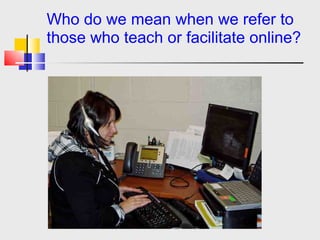
Who do we mean when we refer to   those who teach or facilitate online?
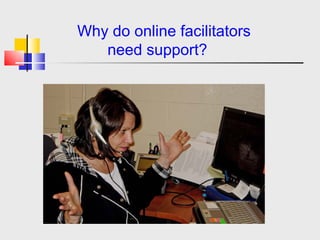
Why Do Online Facilitators    Need Support?
Online Facilitator   Competencies Content knowledge Instructional design Assessment/evaluation Presence Research Technology skills
  Course Preparation Course objectives Course assessment strategies Content presentation Learning activities Learner engagement Course and a half syndrome
  What To Do When.....
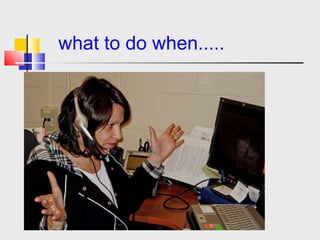
  What To Do When..... students are required to participate in an asynchronous online forum focusing on an assigned topic   1 student centres her discussion on networking & other non-relevant topics  other students are active in her  'side' discussions & not actively participating in the assigned topic you pose direct questions to stimulate discourse but the bulk of the discussion remains on these ‘side’ discussions.  
  Interactions Student-teacher Student-student Student-content Content-content Teacher-content Teacher-teacher    Anderson, T. (2004). Toward a theory of online learning. In T. Anderson and F. Elloumi (Eds.),  Theory and practice of online learning  (pp. 33  –  60) .  Athabasca: Athabasca University. (Available:  http:// cde . athabascau .ca/online_book/ch2.html .)  
  Time Management   Is the time commitment for online learning similar to traditional classes?   How can facilitators keep their workload under control?  Facilitator seldom in course Facilitator in  course 24/7
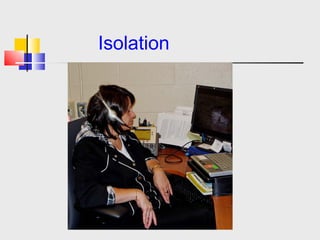
  Isolation      
  Social Networking   Community of Practice using:  Blogs Wikis Skype Chat/IM Twitter My Space / Facebook / ning Synchronous conferencing (ie Elluminate)
  Technology Does an Online Facilitator need to be a technology wizard?   What skill level is needed?   What happens when something doesn't work?   Have something in your back pocket.  
  Support Colleague support Administrative support Professional support
  What Other Factors Impact  The Need For Online  Facilitator Support?
  Questions?
  References/Resources Anderson, T. (2004). Toward a theory of online learning. In  T. Anderson and F. Elloumi (Eds.),  Theory and practice of online learning  (pp. 33 – 60) .  Athabasca: Athabasca University. (Available:  http:// cde . athabascau .ca/online_book/ch2.html .) Conference Board of Canada (2000). Employability Skills 2000+. Retrieved September 12, 2009 from  http://www. conferenceboard .ca/Libraries/EDUC_PUBLIC/esp2000. sflb       Conrad, R., Donaldson, J. (2004).  Engaging the Online Learner . San Fransico: Jossey-Bass.
  References/Resources Dorm,M. D. (2009, May).  Cyber-instructor?  Nursing Management, (40) 5, 34-37.   Faculty Focus.  www. facultyfocus .com Fouche, I.  (2006, September).  A multi-island situation without the ocean: Tutors’ perceptions about working in isolation from colleagues.  International Review of Research in Open and Distance Learning, 7 (2), 1-12.  Retrieved November 1, 2008 from  http://www. irrodl .org/index. php / irrodl /article/ viewArticle /295/640
  References/Resources Green, T., Alejandro, J., & Brown, A. H.  (2009, June). The retention of experienced faculty in online distance education programs: Understanding factors that impact their involvement. The International Review of Research in Open and Distance Learning, 10(3). Retrieved August 27, 2009 from  http://www. irrodl .org/index. php / irrodl /article/view/683/1279 Hill, C. (2009, March 23). ReL Training and supporting onlin adjuncts. [Web log message]. Retrieved from  http://www. facultyfocus .com/articles/faculty-development/training-and-supporting-online-adjuncts- qa -with- kimberly -hardy/
  References/Resources Kanuka, H., Jugdev, K., Heller, R., & West, D. (2008). The rise of the teleworker: false promises and responsive solutions.  Higher Education, 56,  149-165.  http:// auspace . athabascau .ca:8080/ dspace / bitstream /2149/1634/1/2008%20Higher%20Education. pdf http:// auspace . athabascau .ca:8080/ dspace / bitstream /2149/1634/1/2008 Higher Education. pdf   Kelly, R. (2009, June 29) Re: Millennial faculty are you ready? [Web log message]. Retrieved from  http://www. facultyfocus .com/articles/academic-leadership/millennial-faculty-are-coming-are-you-ready/
  References/Resources Kelly, R. (2009, August 25). Re: Promoting teaching excellence, what departments can do.  [Web log message]. Retrieved from  http://www. facultyfocus .com/articles/faculty-development/promoting-teaching-excellence-what-departments-can-do/ Ng, C. F.  (2006, September). Academics telecommuting in open and distance education universities:  Issues, challenges, and opportunities.   International Review of Research in Open and Distance Learning, 7 (2).  Retrieved September 20, 2009  from http  http://www. irrodl .org/index. php / irrodl /article/ viewArticle /300/632
  References/Resources Orr, R., Williams, M., & Pennington, K. (2009). Institutional efforts to support faculty in online teaching.  Innovation in Higher Education, 34,  257-268 doi: 10.1007/s10755-009-9111-6  Schank, R. (2002).  Designing World-Class E-Learning.  McGraw Hill New York.    Services Canada . (2005).  Essential Skills.  Retrieved September 12, 2009 from  http://www. rhdcc - hrsdc . gc .ca/eng/ workplaceskills /essential_skills/general/home. shtml  
  References/Resources Weimer. M. (2009, January 20). Re: False assumptions beginning teachers make [Web log message]. Retrieved from  http://www. facultyfocus .com/articles/faculty-development/false-assumptions-beginning-teachers-make/      

Supporting Instructors And Tutors Submit Version 2

  • 1.
    Supporting Instructors & Tutors During Online Delivery SLOAN C ALN Conference 29 October 2009
  • 2.
    Willy Fahlman [email_address] Daph Crane [email_address]
  • 3.
    Presentation Goal Duringthis interactive session we will discuss a variety of strategies and techniques for supporting those who teach or facilitate online learning.
  • 4.
    Who do wemean when we refer to those who teach or facilitate online?
  • 5.
    Why Do OnlineFacilitators Need Support?
  • 6.
    Online Facilitator Competencies Content knowledge Instructional design Assessment/evaluation Presence Research Technology skills
  • 7.
    CoursePreparation Course objectives Course assessment strategies Content presentation Learning activities Learner engagement Course and a half syndrome
  • 8.
    WhatTo Do When.....
  • 9.
    WhatTo Do When..... students are required to participate in an asynchronous online forum focusing on an assigned topic 1 student centres her discussion on networking & other non-relevant topics other students are active in her 'side' discussions & not actively participating in the assigned topic you pose direct questions to stimulate discourse but the bulk of the discussion remains on these ‘side’ discussions.  
  • 10.
    InteractionsStudent-teacher Student-student Student-content Content-content Teacher-content Teacher-teacher    Anderson, T. (2004). Toward a theory of online learning. In T. Anderson and F. Elloumi (Eds.), Theory and practice of online learning (pp. 33 – 60) . Athabasca: Athabasca University. (Available: http:// cde . athabascau .ca/online_book/ch2.html .)  
  • 11.
    TimeManagement Is the time commitment for online learning similar to traditional classes?   How can facilitators keep their workload under control? Facilitator seldom in course Facilitator in course 24/7
  • 12.
  • 13.
    SocialNetworking Community of Practice using: Blogs Wikis Skype Chat/IM Twitter My Space / Facebook / ning Synchronous conferencing (ie Elluminate)
  • 14.
    TechnologyDoes an Online Facilitator need to be a technology wizard?   What skill level is needed?   What happens when something doesn't work?   Have something in your back pocket.  
  • 15.
    SupportColleague support Administrative support Professional support
  • 16.
      What OtherFactors Impact The Need For Online Facilitator Support?
  • 17.
  • 18.
      References/Resources Anderson,T. (2004). Toward a theory of online learning. In T. Anderson and F. Elloumi (Eds.), Theory and practice of online learning (pp. 33 – 60) . Athabasca: Athabasca University. (Available: http:// cde . athabascau .ca/online_book/ch2.html .) Conference Board of Canada (2000). Employability Skills 2000+. Retrieved September 12, 2009 from http://www. conferenceboard .ca/Libraries/EDUC_PUBLIC/esp2000. sflb      Conrad, R., Donaldson, J. (2004). Engaging the Online Learner . San Fransico: Jossey-Bass.
  • 19.
      References/Resources Dorm,M.D. (2009, May).  Cyber-instructor? Nursing Management, (40) 5, 34-37.   Faculty Focus. www. facultyfocus .com Fouche, I.  (2006, September).  A multi-island situation without the ocean: Tutors’ perceptions about working in isolation from colleagues. International Review of Research in Open and Distance Learning, 7 (2), 1-12.  Retrieved November 1, 2008 from http://www. irrodl .org/index. php / irrodl /article/ viewArticle /295/640
  • 20.
      References/Resources Green,T., Alejandro, J., & Brown, A. H.  (2009, June). The retention of experienced faculty in online distance education programs: Understanding factors that impact their involvement. The International Review of Research in Open and Distance Learning, 10(3). Retrieved August 27, 2009 from http://www. irrodl .org/index. php / irrodl /article/view/683/1279 Hill, C. (2009, March 23). ReL Training and supporting onlin adjuncts. [Web log message]. Retrieved from http://www. facultyfocus .com/articles/faculty-development/training-and-supporting-online-adjuncts- qa -with- kimberly -hardy/
  • 21.
      References/Resources Kanuka,H., Jugdev, K., Heller, R., & West, D. (2008). The rise of the teleworker: false promises and responsive solutions. Higher Education, 56, 149-165. http:// auspace . athabascau .ca:8080/ dspace / bitstream /2149/1634/1/2008%20Higher%20Education. pdf http:// auspace . athabascau .ca:8080/ dspace / bitstream /2149/1634/1/2008 Higher Education. pdf   Kelly, R. (2009, June 29) Re: Millennial faculty are you ready? [Web log message]. Retrieved from http://www. facultyfocus .com/articles/academic-leadership/millennial-faculty-are-coming-are-you-ready/
  • 22.
      References/Resources Kelly,R. (2009, August 25). Re: Promoting teaching excellence, what departments can do. [Web log message]. Retrieved from http://www. facultyfocus .com/articles/faculty-development/promoting-teaching-excellence-what-departments-can-do/ Ng, C. F.  (2006, September). Academics telecommuting in open and distance education universities:  Issues, challenges, and opportunities.  International Review of Research in Open and Distance Learning, 7 (2).  Retrieved September 20, 2009  from http http://www. irrodl .org/index. php / irrodl /article/ viewArticle /300/632
  • 23.
      References/Resources Orr,R., Williams, M., & Pennington, K. (2009). Institutional efforts to support faculty in online teaching. Innovation in Higher Education, 34, 257-268 doi: 10.1007/s10755-009-9111-6 Schank, R. (2002). Designing World-Class E-Learning. McGraw Hill New York.   Services Canada . (2005).  Essential Skills. Retrieved September 12, 2009 from http://www. rhdcc - hrsdc . gc .ca/eng/ workplaceskills /essential_skills/general/home. shtml  
  • 24.
      References/Resources Weimer.M. (2009, January 20). Re: False assumptions beginning teachers make [Web log message]. Retrieved from http://www. facultyfocus .com/articles/faculty-development/false-assumptions-beginning-teachers-make/    

Editor's Notes

  • #12 Daph  Time management - is the time commitment for online learning similar to traditional classes minus the commute? two ends of the spectrum. One check on the course, answer email 2x week. Spending too much time keeping stats, responding to every forum posting, there is a happy medium. Set your expectations for self and learners. If spending too much time on responding/grading every post, then it may lead to the next topic...isolation.
  • #13 Isolation A sense of isolation may detrimentally affect tutor motivation, job satisfaction, professional development, & teaching performance impacting the overall institution effectiveness
  • #14 Daph  Social Networking Could be support or direct instruction but also a way of helping a facilitator over a sense of isolation. Community of Practice using: Blogs facebook wikis skype chat/IM Twitter my space ning synchronous conferencing (ie Elluminate) privacy concerns, consent, using real names, using real examples ie from health care field, etc.
  • #15 Daph  Technology To have a successful program, students and instructors need quality, effective, efficient tech support. But in my experience this is a different team from the pedagogical support team. Often facilitators believe they need to have a very high compute skill level. The skill level required will depend on a variety of factors....  Role/tasks amount of support available   subject content technology and software being used  
  • #16 Support 1. Colleague support – tutor contact includes personal meetings, telephone calls, & email messages.   2. Administrative Support marketing, basic resources, general administration & logistical arrangements including instructional and technical support. 3. Professional Support ·         Contact with colleagues working in the same field at other universities and own professional development The responsibility for countering tutor isolation does not lie solely with the institution but it is a combined responsibility with the tutor. The institution has the responsibility to coordinate and provide academic & administrative support for tutor collaboration & skills development. Tutors have a responsibility to seek out opportunities for PD, support, & collaborate with each other and institution. have a responsible to welcome new tutors, and to reduce isolation, and create a collegial environment.
  • #18 Questions  daph Wrap up Willy, support for faculty new and online for many years from admin, colleagues, etc. Seek, and provide.