Planning for a World of Connected and Automated
Vehicles
Stephen D. Boyles
Associate Professor
Civil, Architectural & Environmental Engineering
The University of Texas at Austin
April 12, 2018
Planning for AVs Boyles
The world is changing...
Planning for AVs Introduction Boyles
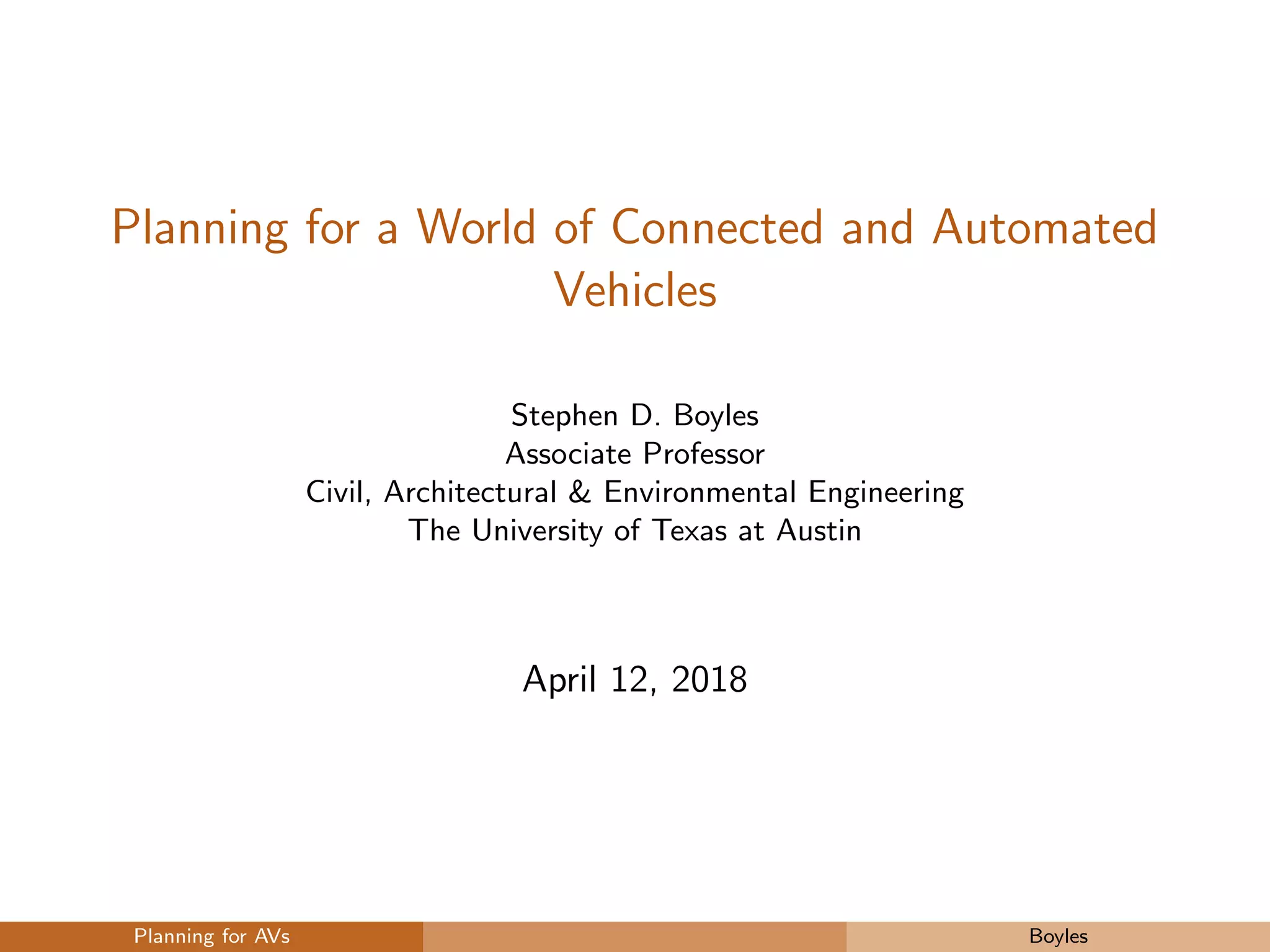
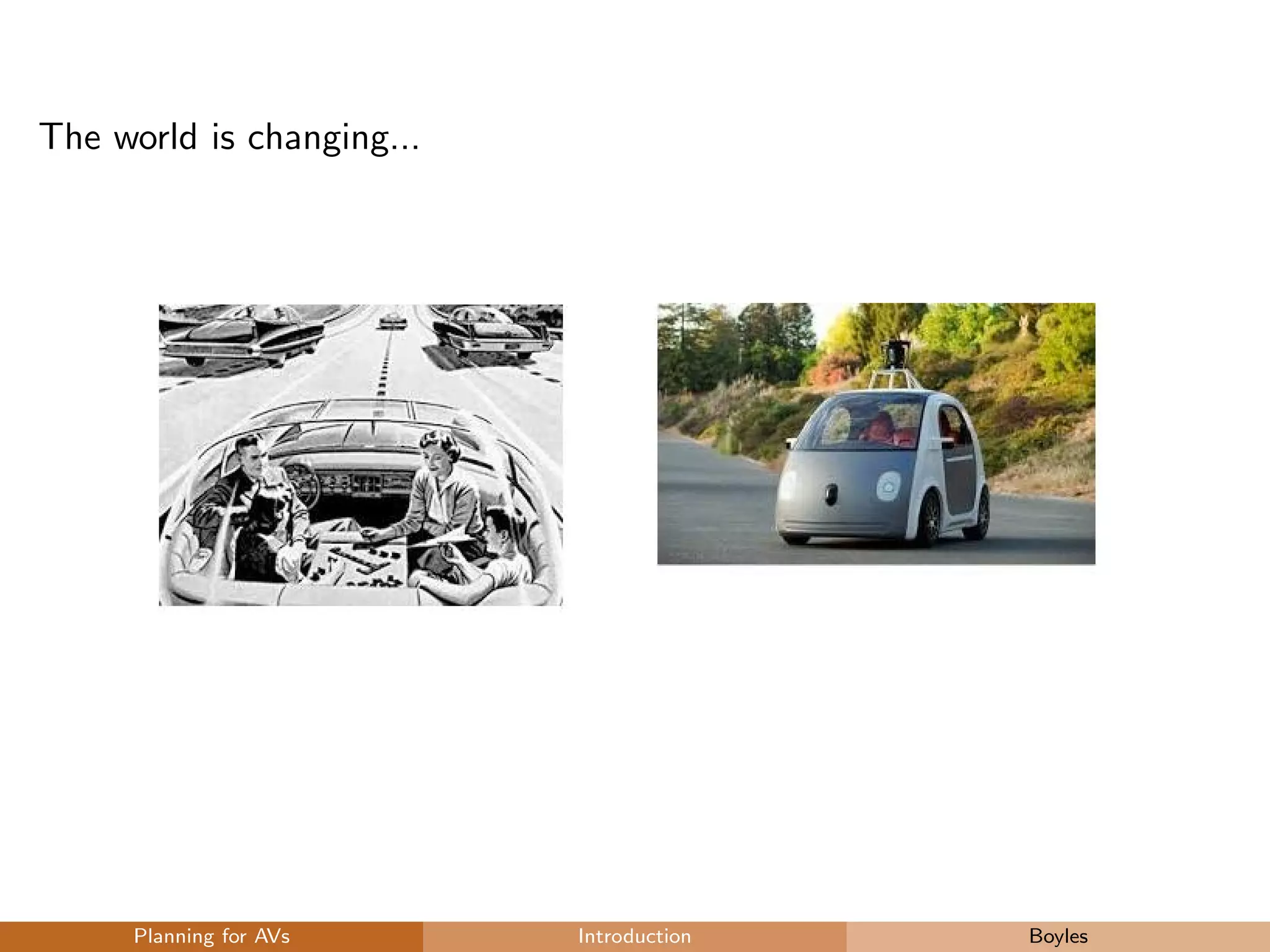
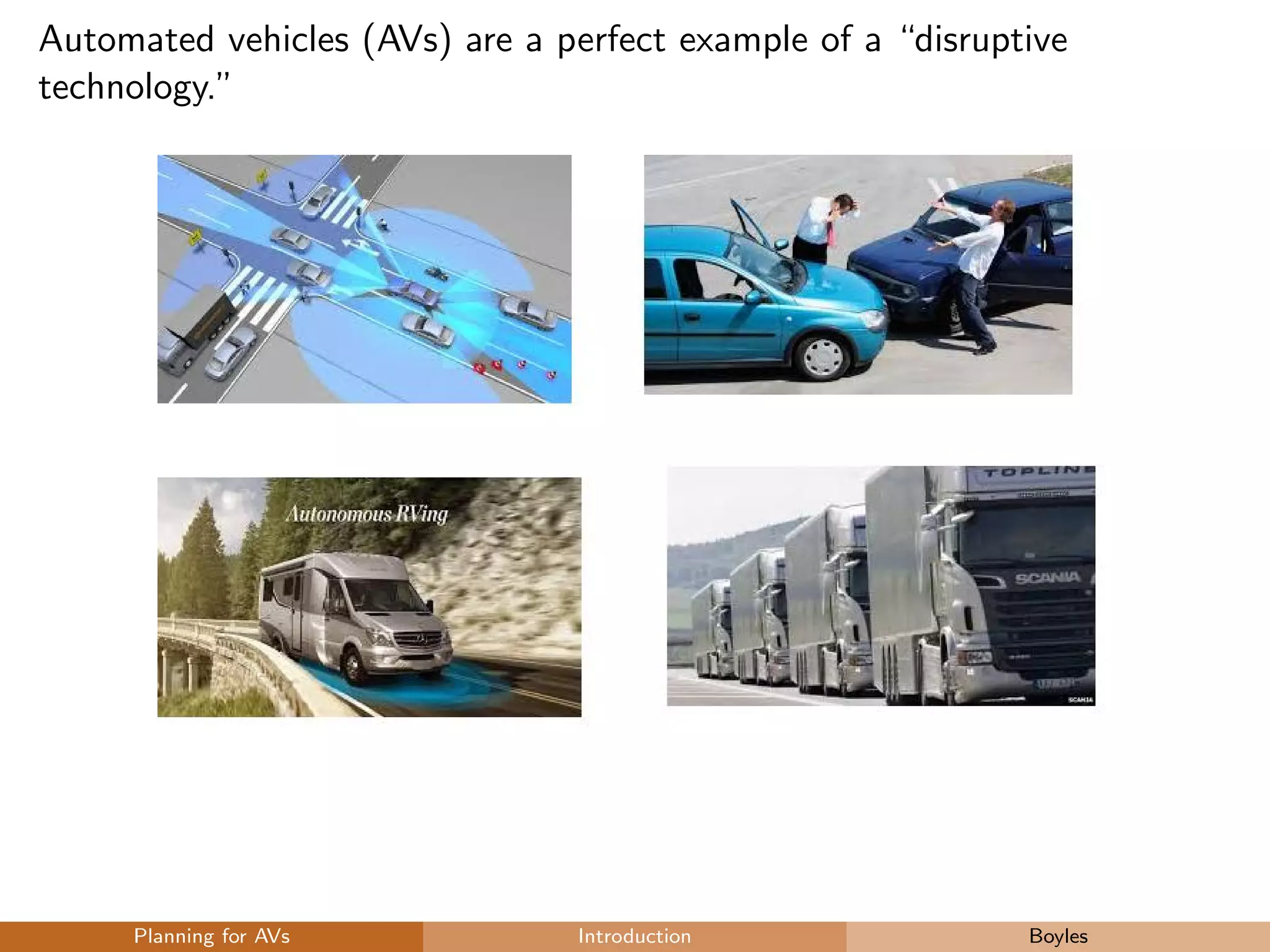
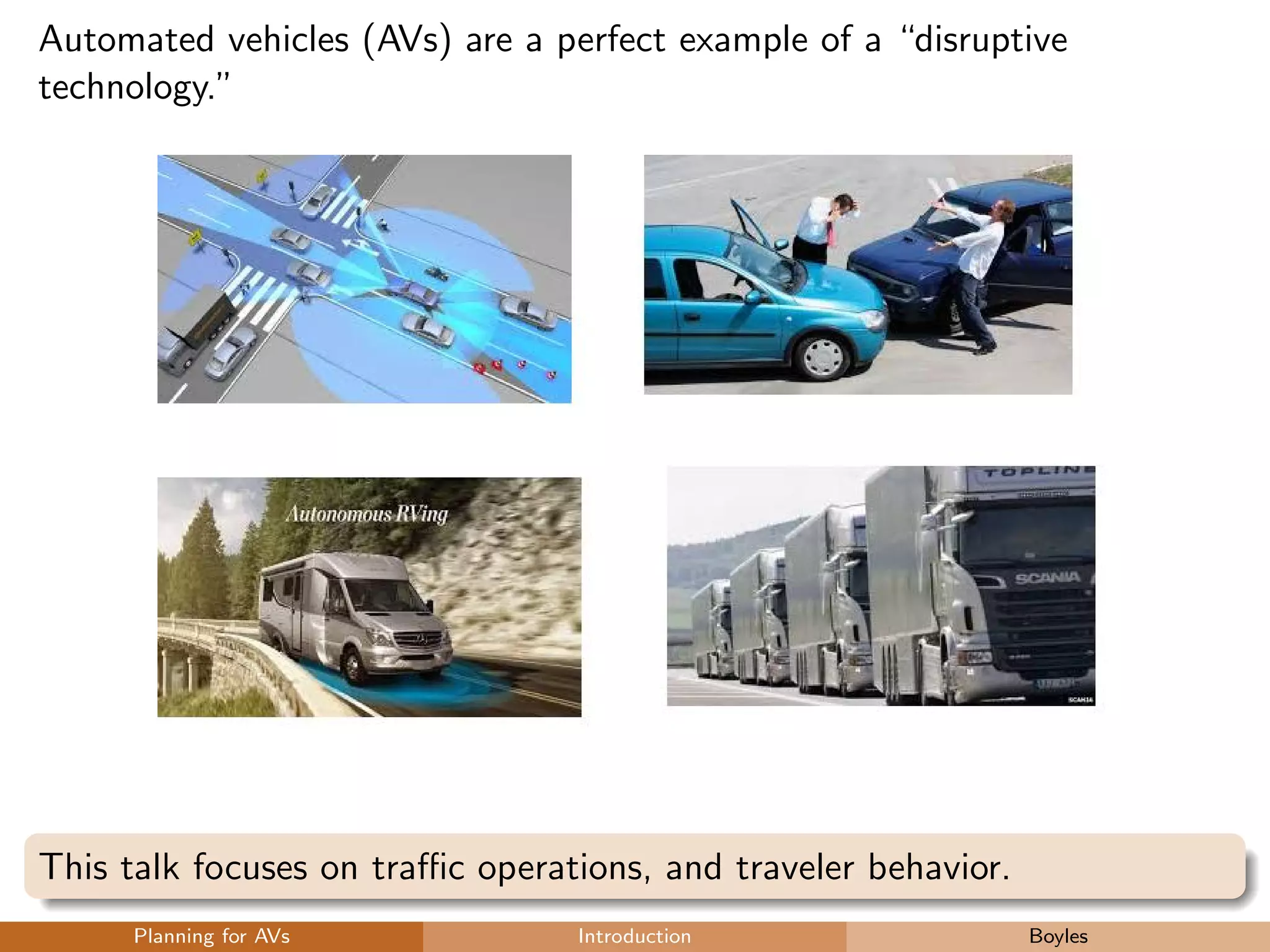
Automated vehicles (AVs) are a perfect example of a “disruptive
technology.”
Planning for AVs Introduction Boyles
Automated vehicles (AVs) are a perfect example of a “disruptive
technology.”
This talk focuses on traffic operations, and traveler behavior.
Planning for AVs Introduction Boyles
What are the traffic impacts of AVs?
Planning for AVs Introduction Boyles
What are the traffic impacts of AVs?
Platooning: If AVs have faster reaction times or communicate with other
vehicles, they can follow at shorter distances.
Planning for AVs Introduction Boyles
What are the traffic impacts of AVs?
Platooning: If AVs have faster reaction times or communicate with other
vehicles, they can follow at shorter distances.
New traffic control: Dynamic lane allocation; “microtolling” and
incentives; optimal real-time routing, etc.
Planning for AVs Introduction Boyles
What are the traffic impacts of AVs?
Platooning: If AVs have faster reaction times or communicate with other
vehicles, they can follow at shorter distances.
New traffic control: Dynamic lane allocation; “microtolling” and
incentives; optimal real-time routing, etc.
New intersection treatments: The reservation-based intersection.
Planning for AVs Introduction Boyles
What are the traffic impacts of AVs?
Platooning: If AVs have faster reaction times or communicate with other
vehicles, they can follow at shorter distances.
New traffic control: Dynamic lane allocation; “microtolling” and
incentives; optimal real-time routing, etc.
New intersection treatments: The reservation-based intersection.
There are legal and technological issues associated with each of these strate-
gies. This talk is viewing them from a “what if” perspective, to guide policy
and plan appropriately.
Planning for AVs Introduction Boyles
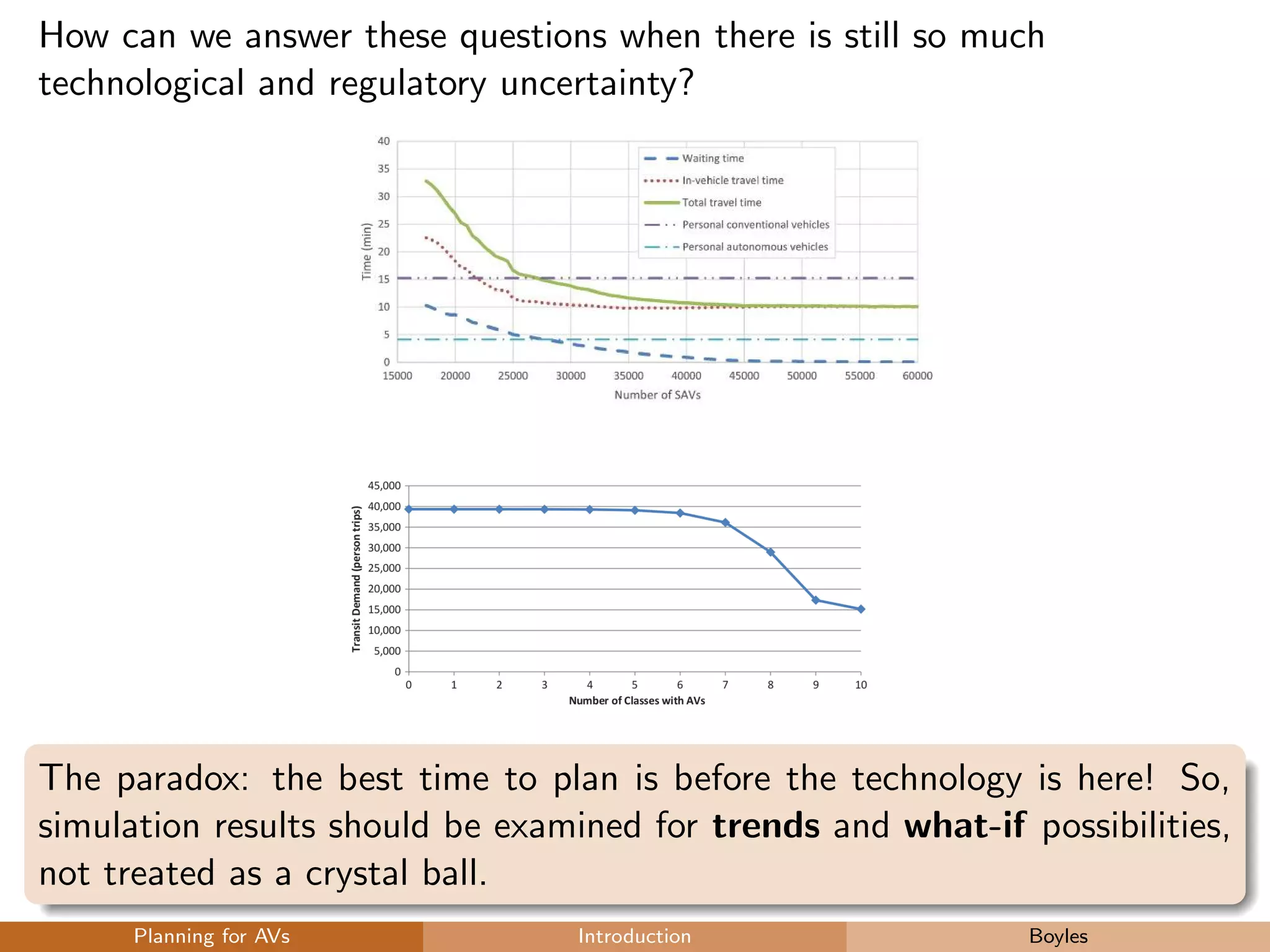
How can we answer these questions when there is still so much
technological and regulatory uncertainty?
The paradox: the best time to plan is before the technology is here! So,
simulation results should be examined for trends and what-if possibilities,
not treated as a crystal ball.
Planning for AVs Introduction Boyles
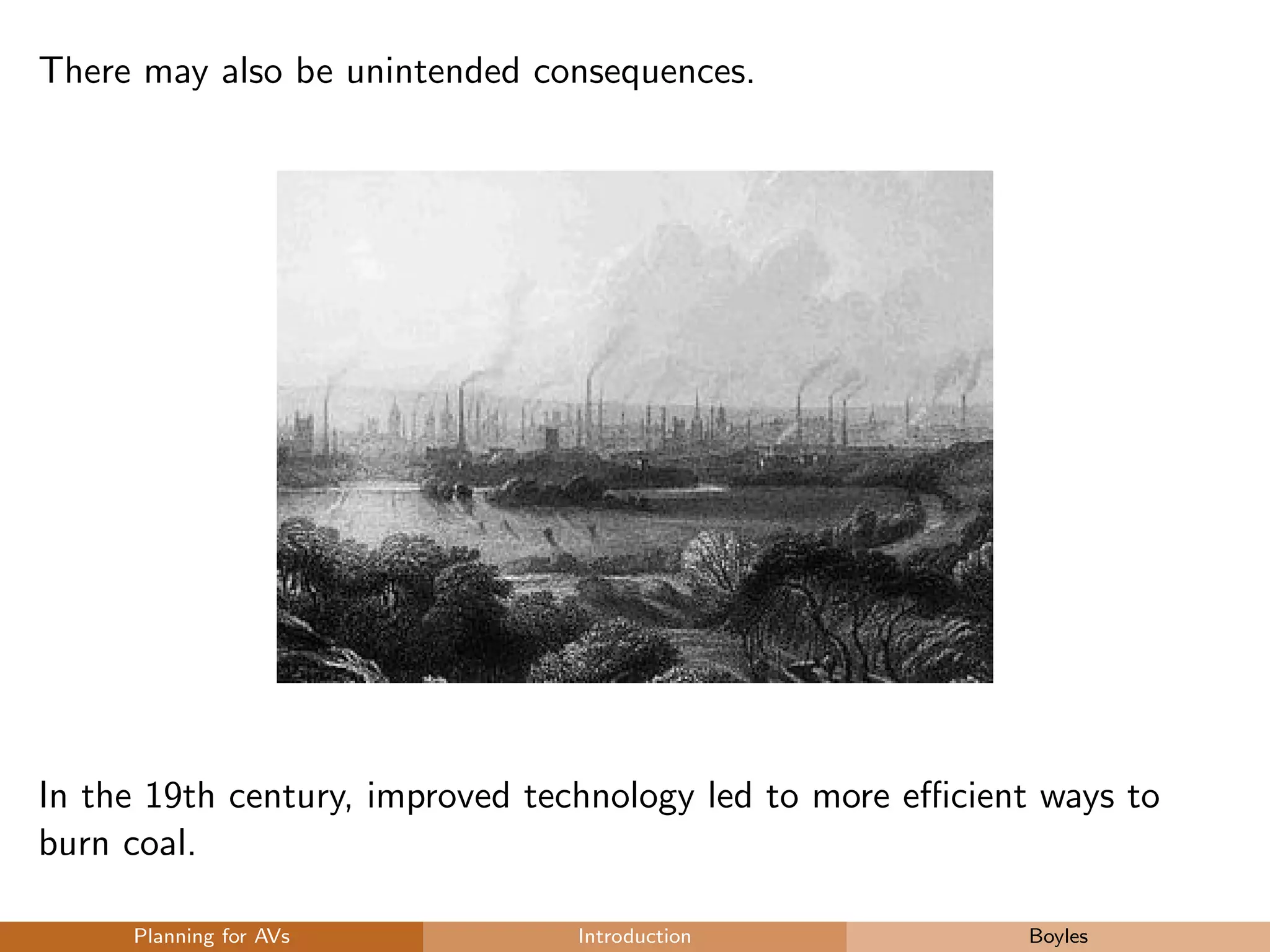
There may also be unintended consequences.
In the 19th century, improved technology led to more efficient ways to
burn coal.
Planning for AVs Introduction Boyles
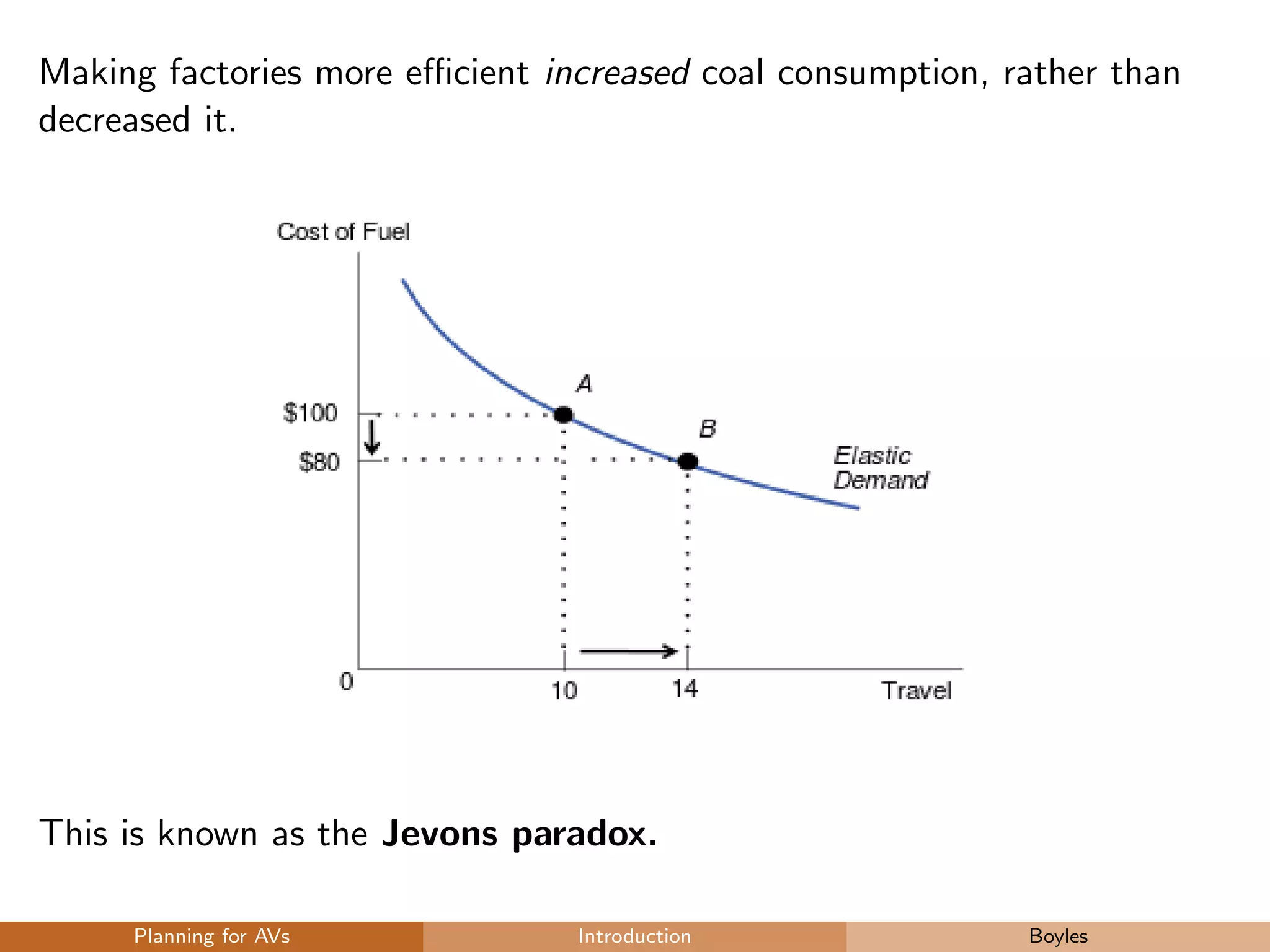
Making factories more efficient increased coal consumption, rather than
decreased it.
This is known as the Jevons paradox.
Planning for AVs Introduction Boyles
Does the Jevons paradox exist in transportation systems?
Planning for AVs Introduction Boyles
Does the Jevons paradox exist in transportation systems?
If we make travel more efficient, will demand for travel increase?
Planning for AVs Introduction Boyles
Does the Jevons paradox exist in transportation systems?
If we make travel more efficient, will demand for travel increase?
Could induced demand counteract all of the benefits of automated vehicle
technology?
Planning for AVs Introduction Boyles
Does the Jevons paradox exist in transportation systems?
If we make travel more efficient, will demand for travel increase?
Could induced demand counteract all of the benefits of automated vehicle
technology?
Transportation systems are complex systems, with many components
which interact heavily with each other.
Planning for AVs Introduction Boyles
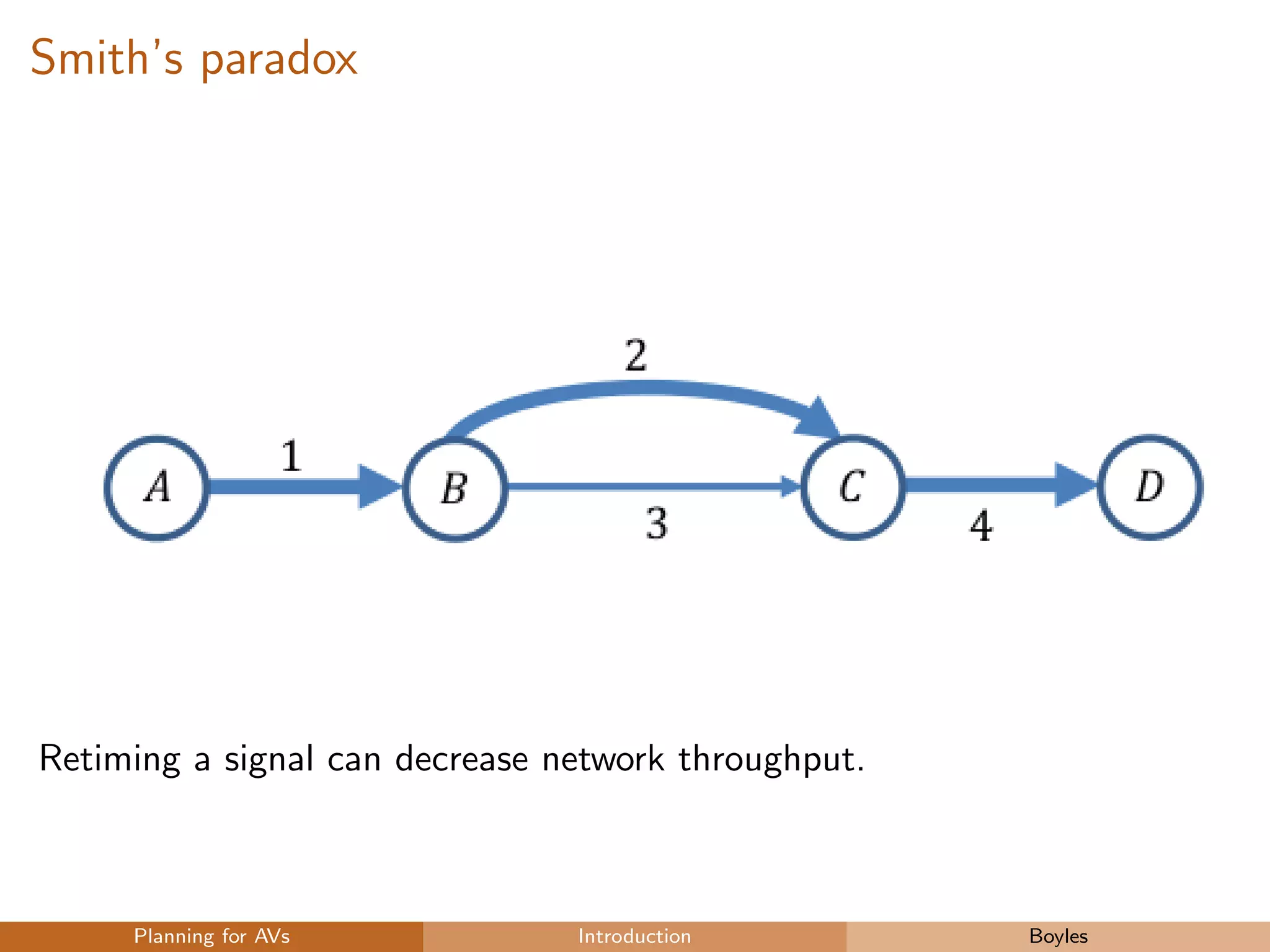
Smith’s paradox
Retiming a signal can decrease network throughput.
Planning for AVs Introduction Boyles
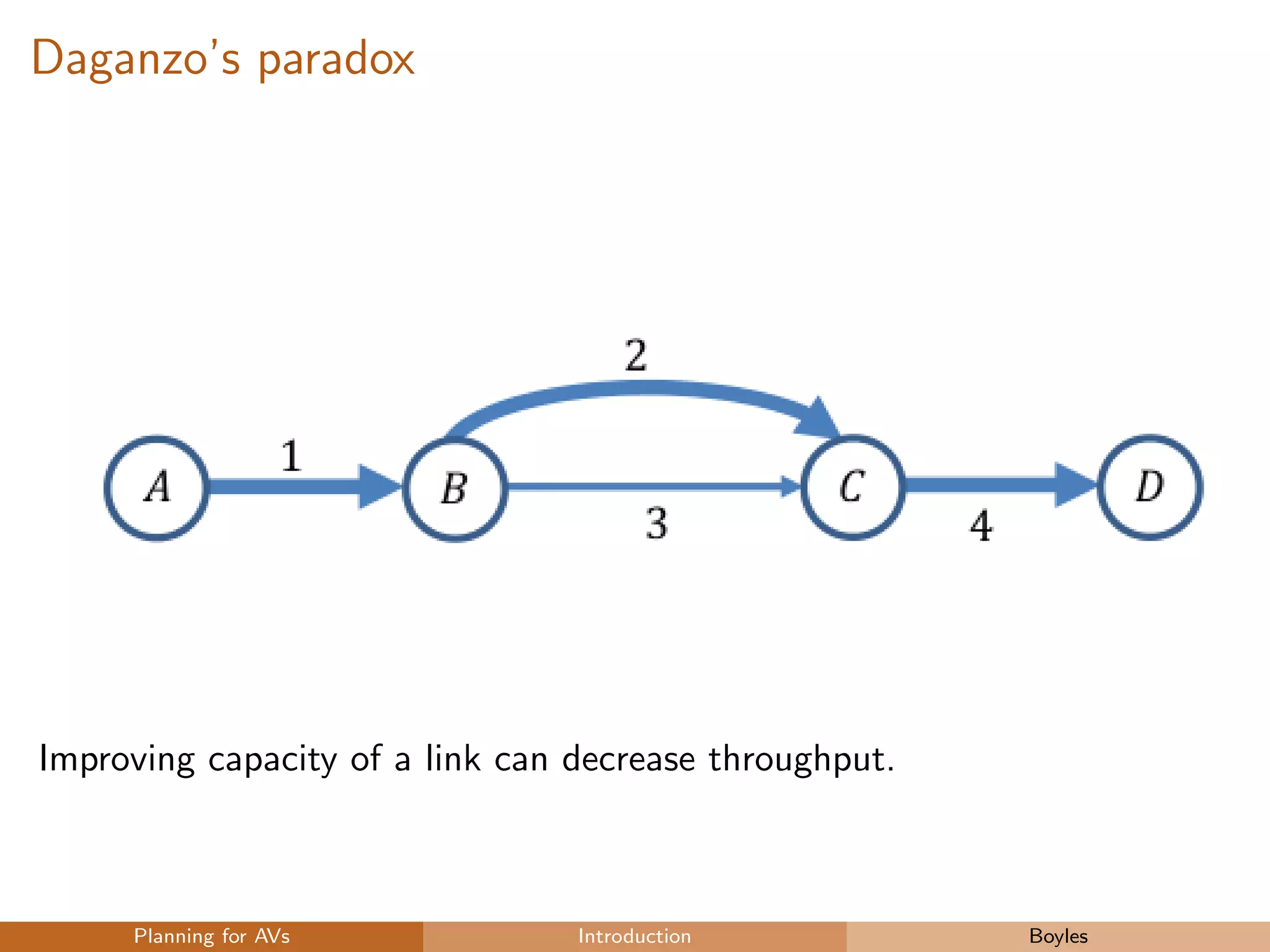
Daganzo’s paradox
Improving capacity of a link can decrease throughput.
Planning for AVs Introduction Boyles
All of this points to a need to do quantitative modeling of AVs and their
impacts. This talk provides a few examples of how this might be done.
1 Traffic modeling for AV capabilities
2 What if we replace signals with reservation-based control?
3 What if we allow AVs to be “driven empty”?
4 What are the implications for planning today?
Planning for AVs Introduction Boyles
Collaborators and Acknowledgements
This talk includes contributions from Dr. Kara Kockelman, Dr. Peter
Stone, Michael Levin, Rahul Patel, Chris Melson, and Hannah Smith.
This research was sponsored by the Texas Department of Transportation,
National Science Foundation, Federal Highway Administration, and the
Data-Supported Transportation Operations and Planning Center.
Planning for AVs Introduction Boyles
TRAFFIC MODELING FOR
AVS
How might we model the effects of platooning on roadway capacity?
Planning for AVs Traffic modeling for AVs Boyles
How might we model the effects of platooning on roadway capacity?
How might we model the effects of dynamic lane allocation?
Planning for AVs Traffic modeling for AVs Boyles
How might we model the effects of platooning on roadway capacity?
How might we model the effects of dynamic lane allocation?
How might we model the effects of reservation-based intersections?
Planning for AVs Traffic modeling for AVs Boyles
How might we model the effects of platooning on roadway capacity?
How might we model the effects of dynamic lane allocation?
How might we model the effects of reservation-based intersections?
In particular, can we find models simple enough to allow us to simulate large
regions? Small corridor models can omit complex interactions (like elastic
demand)
Planning for AVs Traffic modeling for AVs Boyles
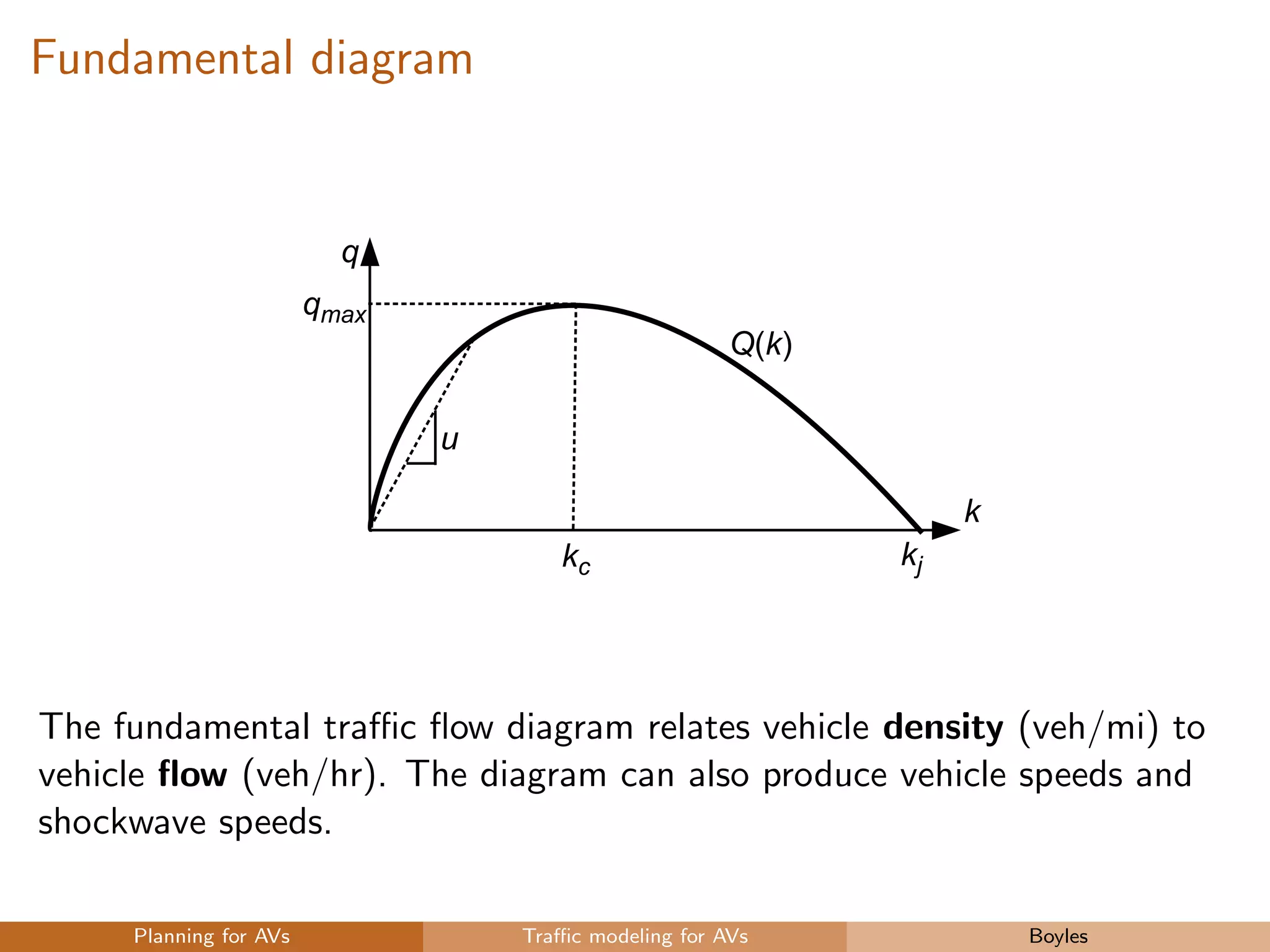
Fundamental diagram
k
q
Q(k)
qmax
kc kj
u
The fundamental traffic flow diagram relates vehicle density (veh/mi) to
vehicle flow (veh/hr). The diagram can also produce vehicle speeds and
shockwave speeds.
Planning for AVs Traffic modeling for AVs Boyles
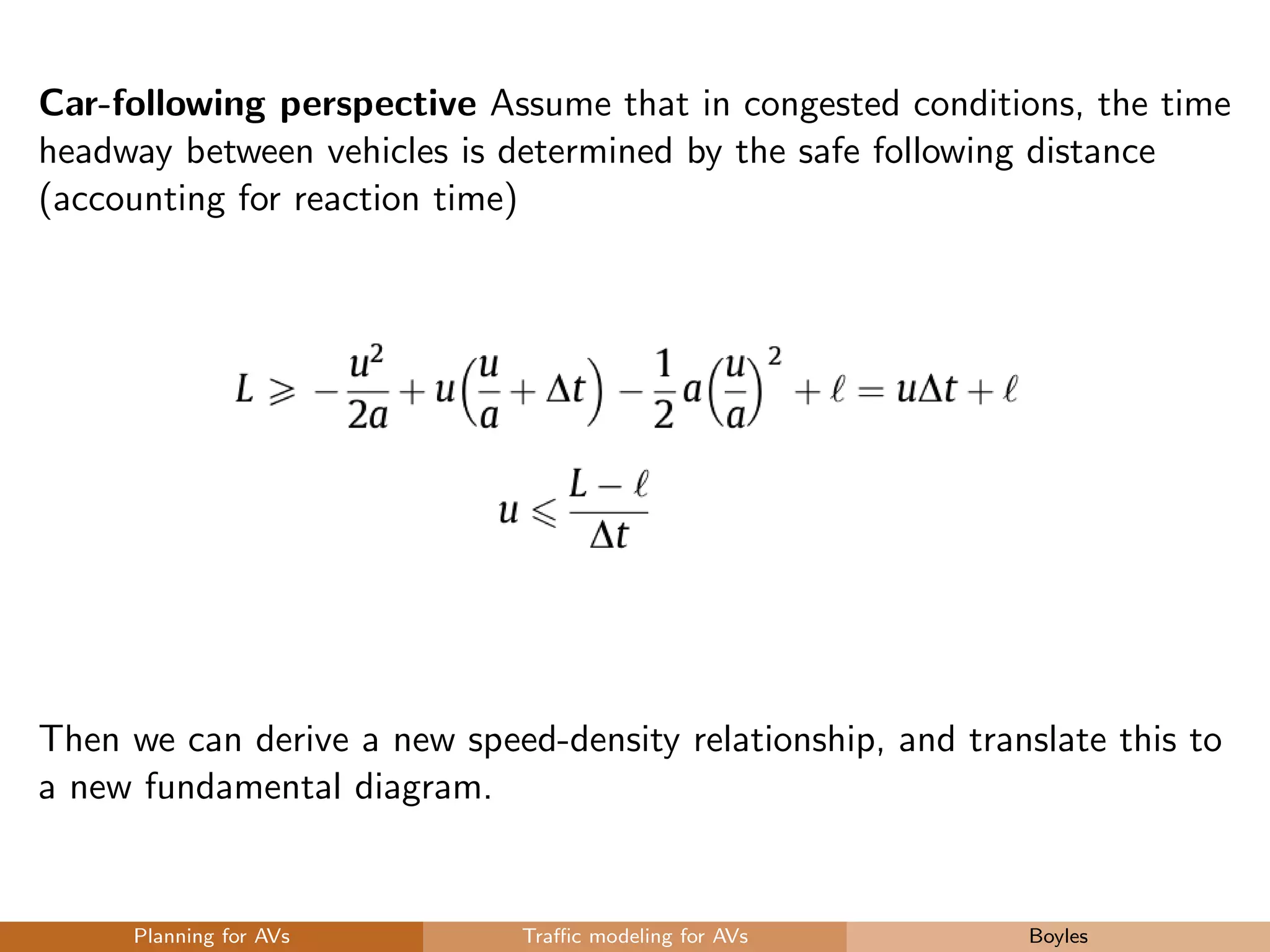
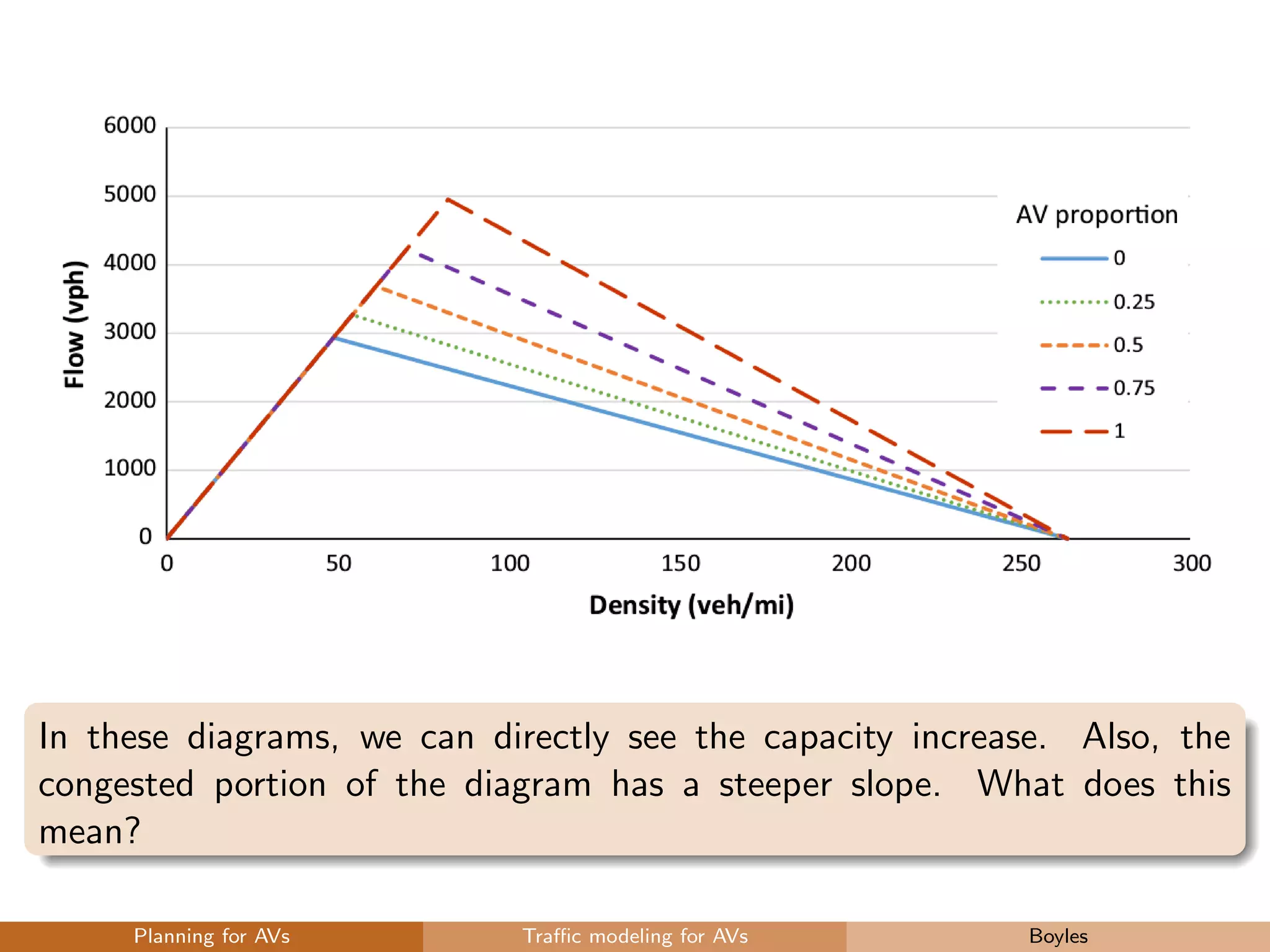
Car-following perspective Assume that in congested conditions, the time
headway between vehicles is determined by the safe following distance
(accounting for reaction time)
Then we can derive a new speed-density relationship, and translate this to
a new fundamental diagram.
Planning for AVs Traffic modeling for AVs Boyles
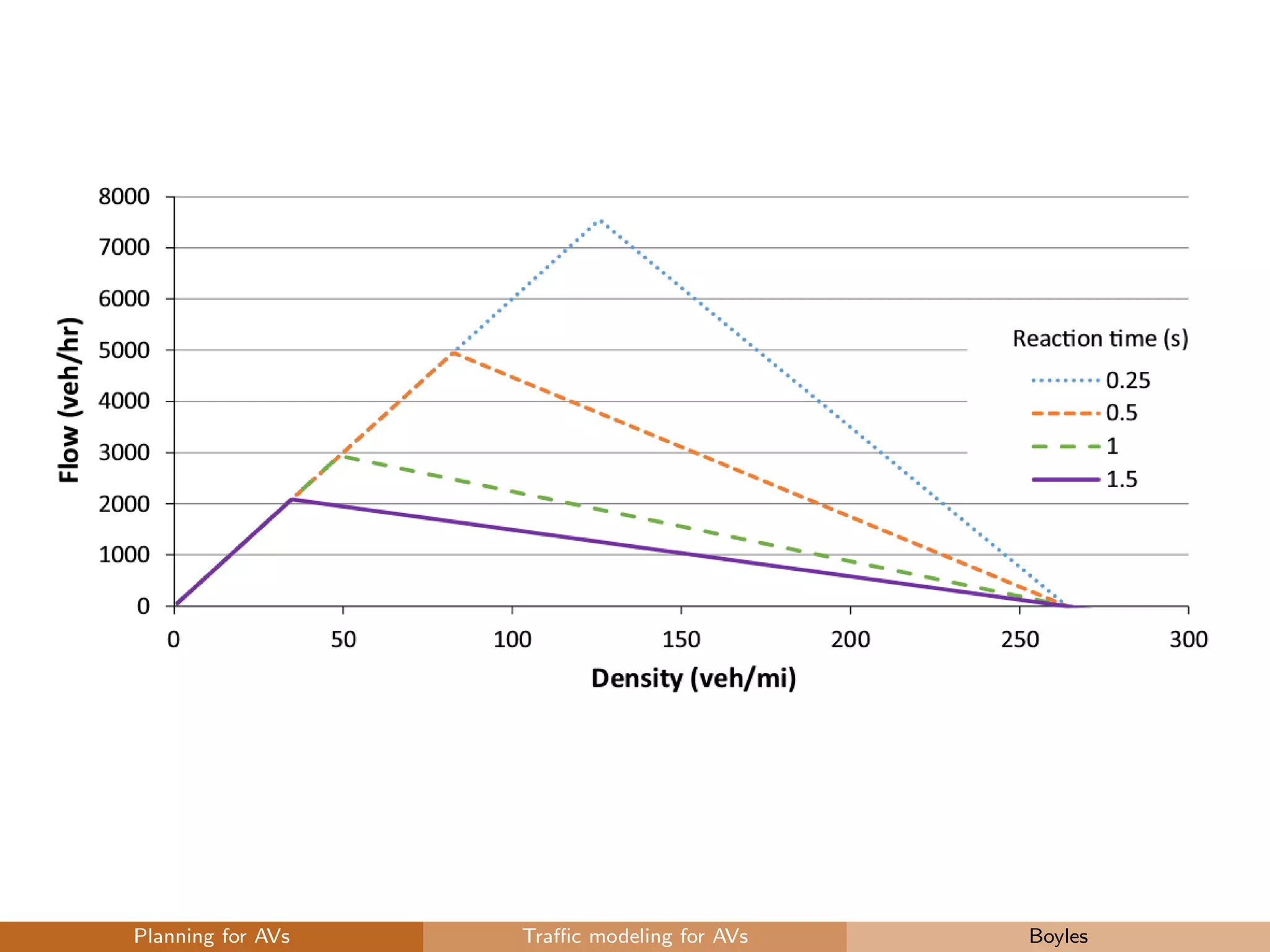
In these diagrams, we can directly see the capacity increase. Also, the
congested portion of the diagram has a steeper slope. What does this
mean?
Planning for AVs Traffic modeling for AVs Boyles
Cell transmission model
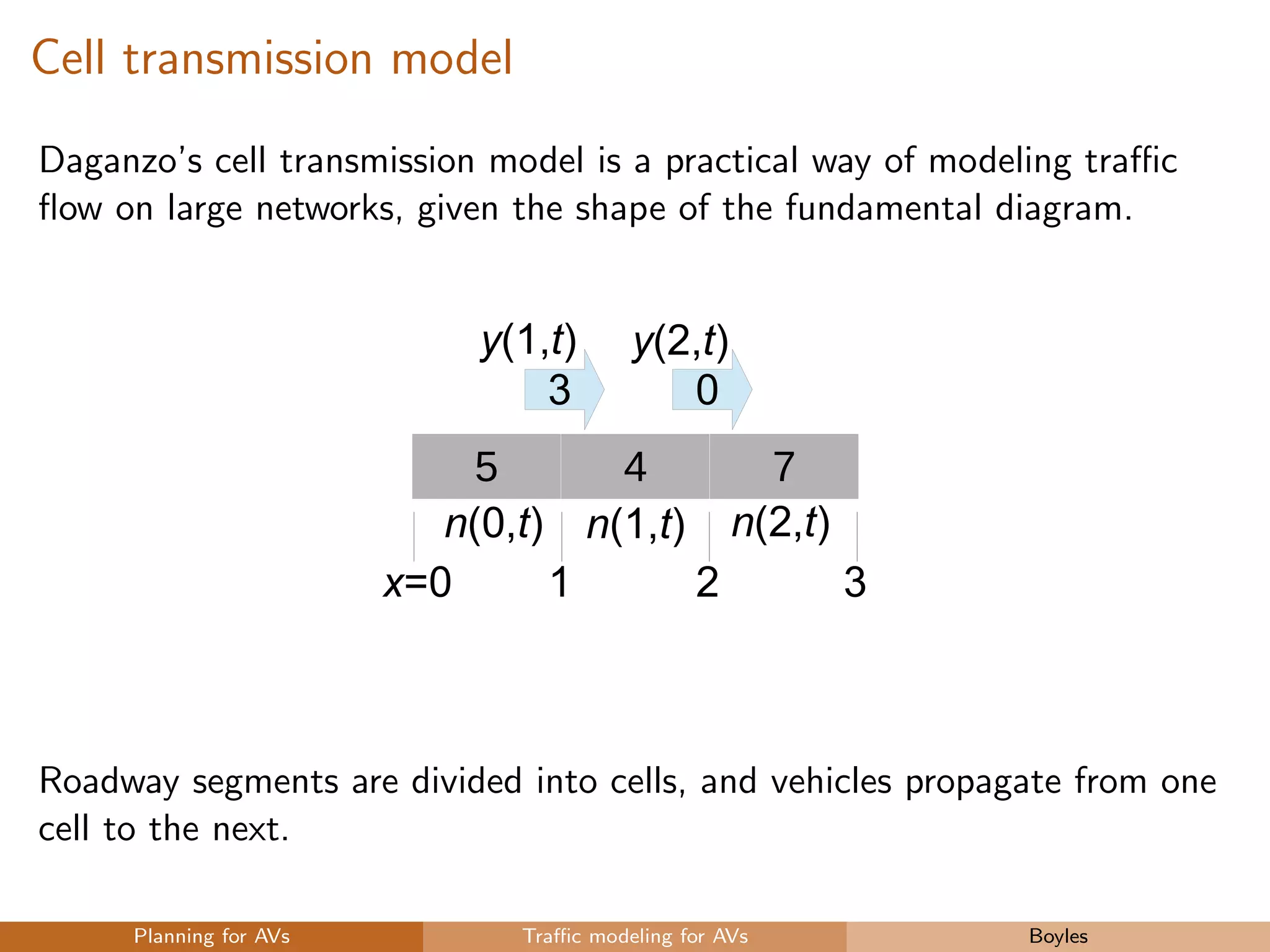
Daganzo’s cell transmission model is a practical way of modeling traffic
flow on large networks, given the shape of the fundamental diagram.
5 4 7
x=0 1 2 3
n(0,t) n(1,t) n(2,t)
3 0
y(1,t) y(2,t)
Roadway segments are divided into cells, and vehicles propagate from one
cell to the next.
Planning for AVs Traffic modeling for AVs Boyles
Reservation-based intersections
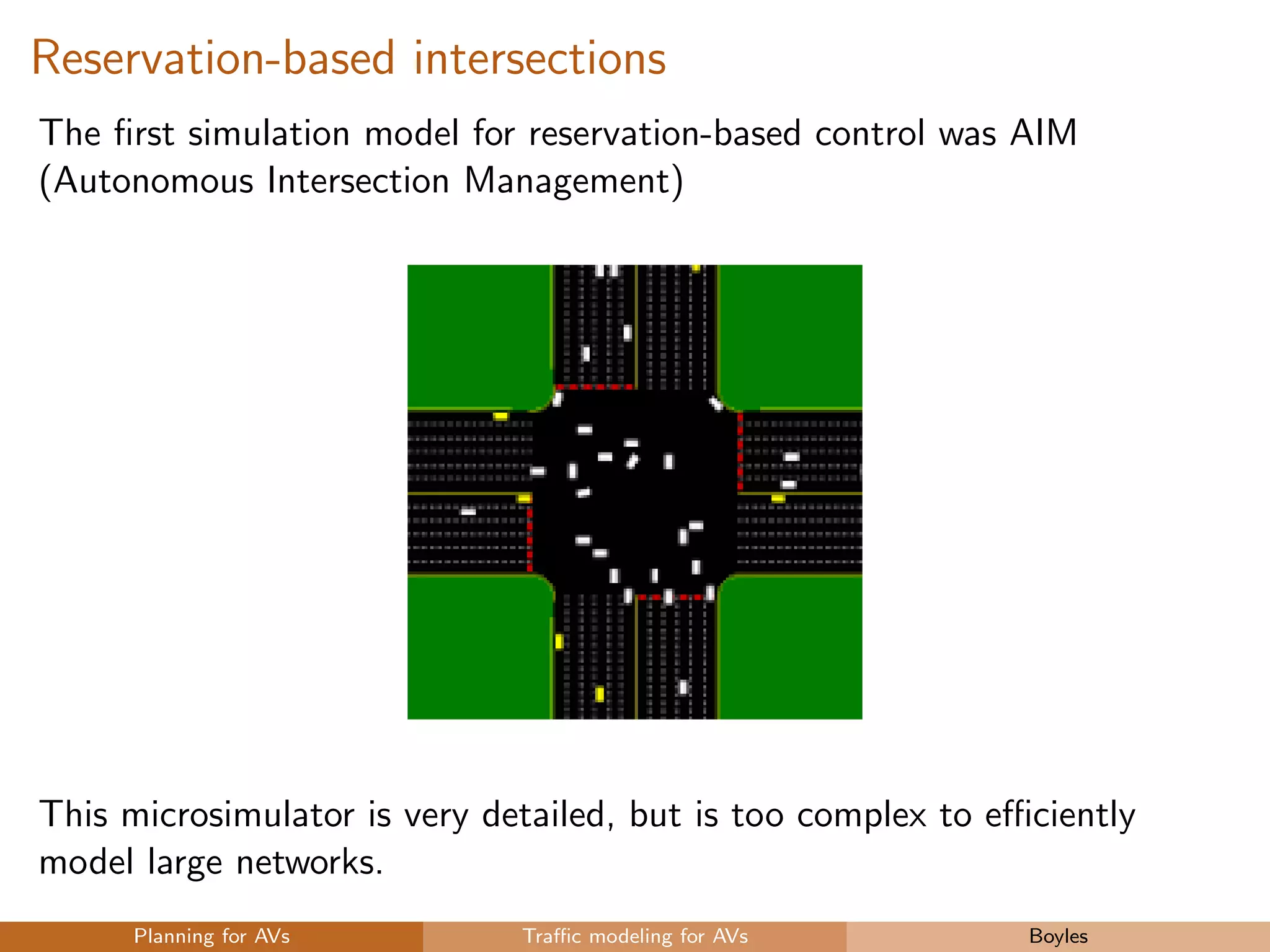
The first simulation model for reservation-based control was AIM
(Autonomous Intersection Management)
This microsimulator is very detailed, but is too complex to efficiently
model large networks.
Planning for AVs Traffic modeling for AVs Boyles
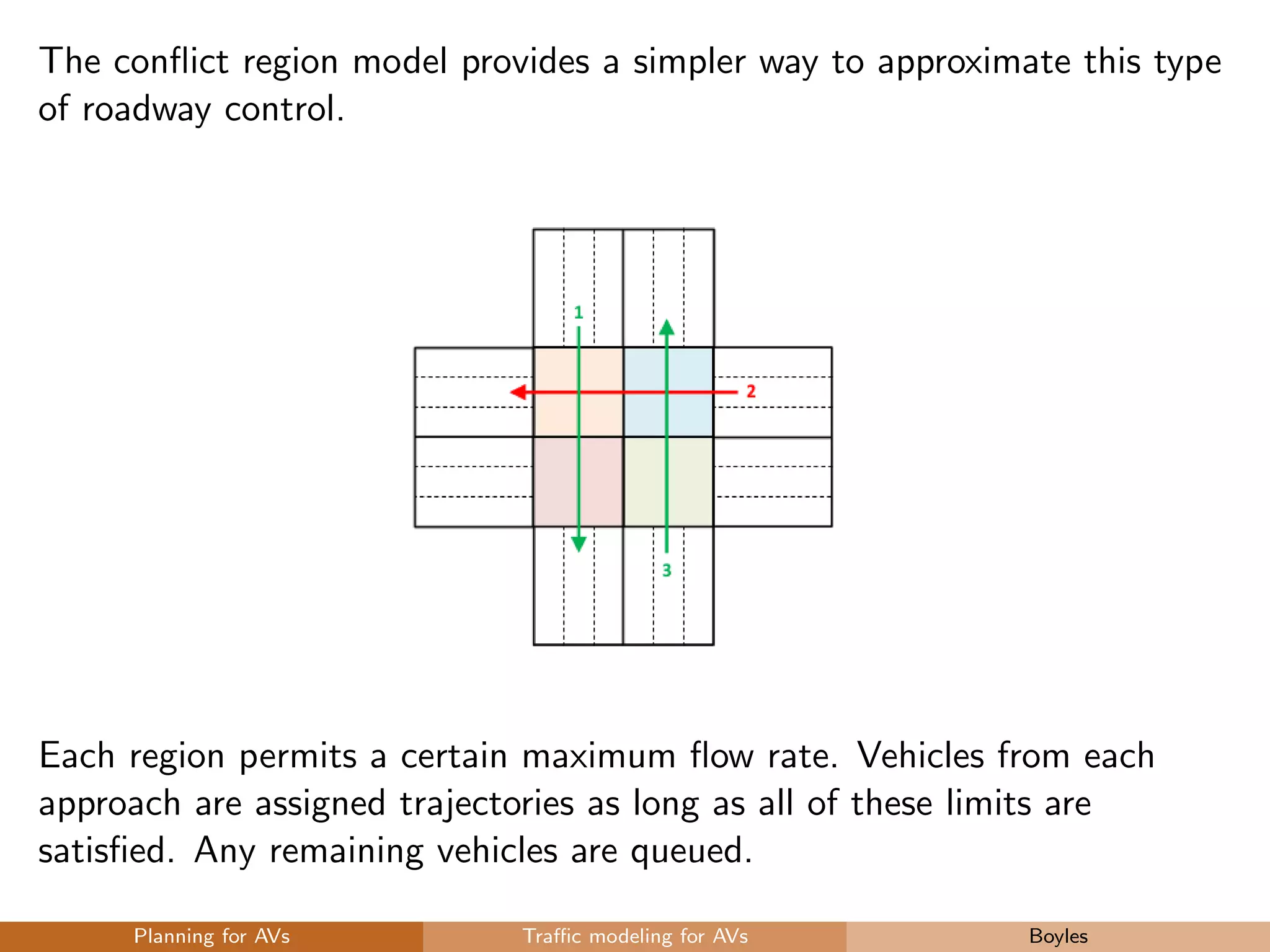
The conflict region model provides a simpler way to approximate this type
of roadway control.
Each region permits a certain maximum flow rate. Vehicles from each
approach are assigned trajectories as long as all of these limits are
satisfied. Any remaining vehicles are queued.
Planning for AVs Traffic modeling for AVs Boyles
RESERVATION-BASED
INTERSECTIONS
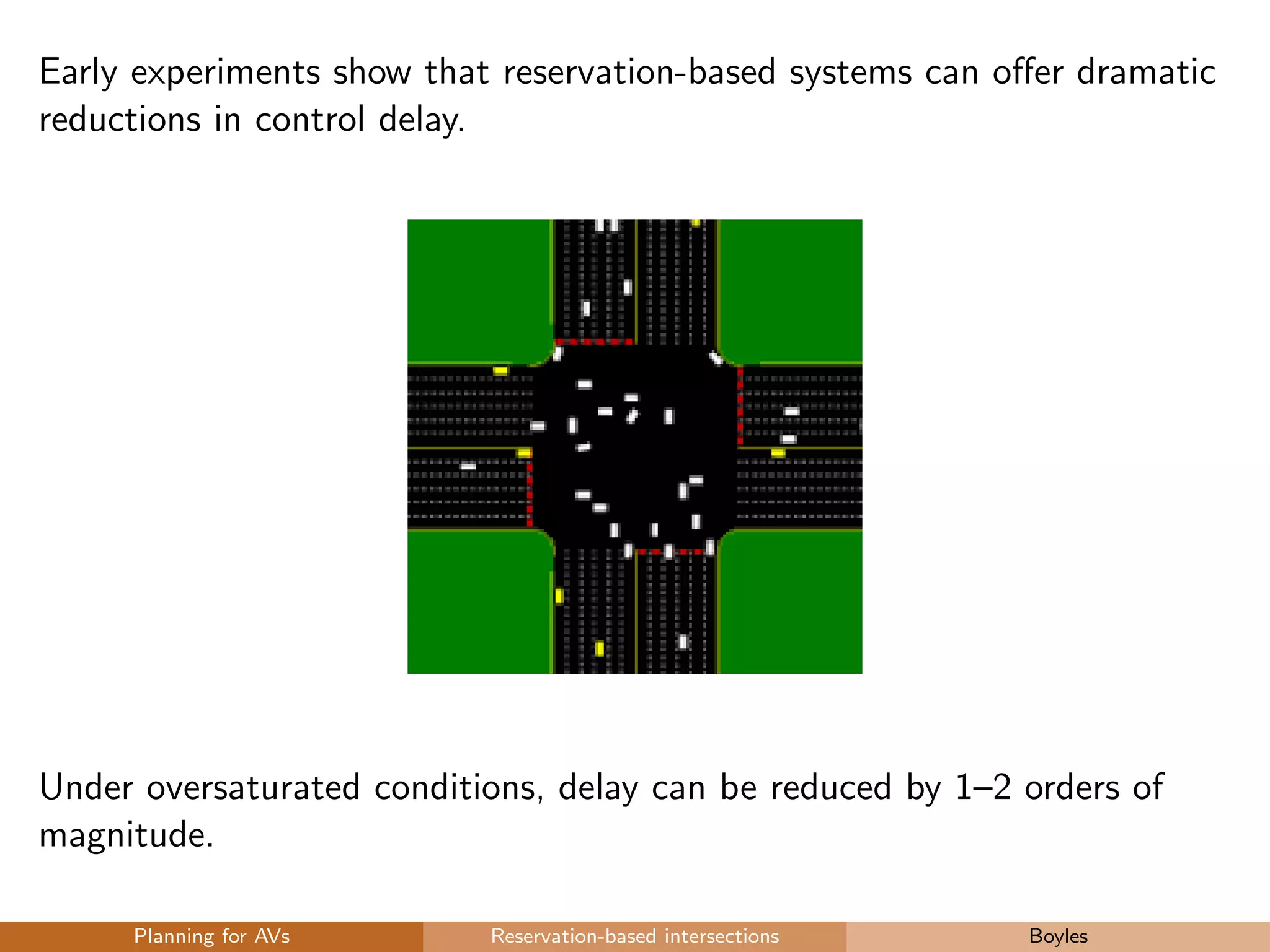
Early experiments show that reservation-based systems can offer dramatic
reductions in control delay.
Under oversaturated conditions, delay can be reduced by 1–2 orders of
magnitude.
Planning for AVs Reservation-based intersections Boyles
What happens when we apply them on real networks?
Planning for AVs Reservation-based intersections Boyles
What happens when we apply them on real networks?
(Real = multiple intersections, asymmetric demand, nonuniform roads,
drivers changing routes, etc.)
Planning for AVs Reservation-based intersections Boyles
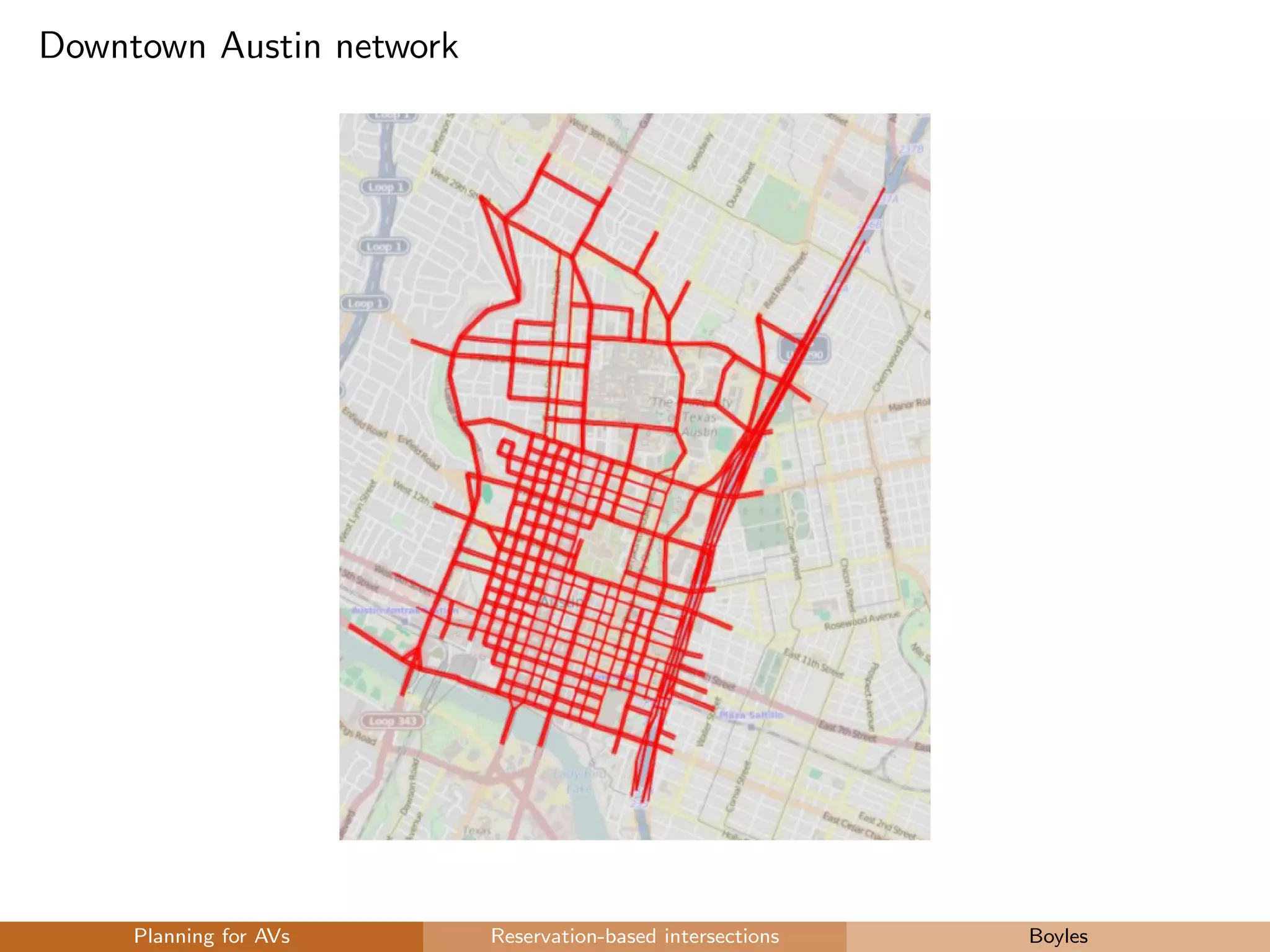
Downtown Austin network
Planning for AVs Reservation-based intersections Boyles
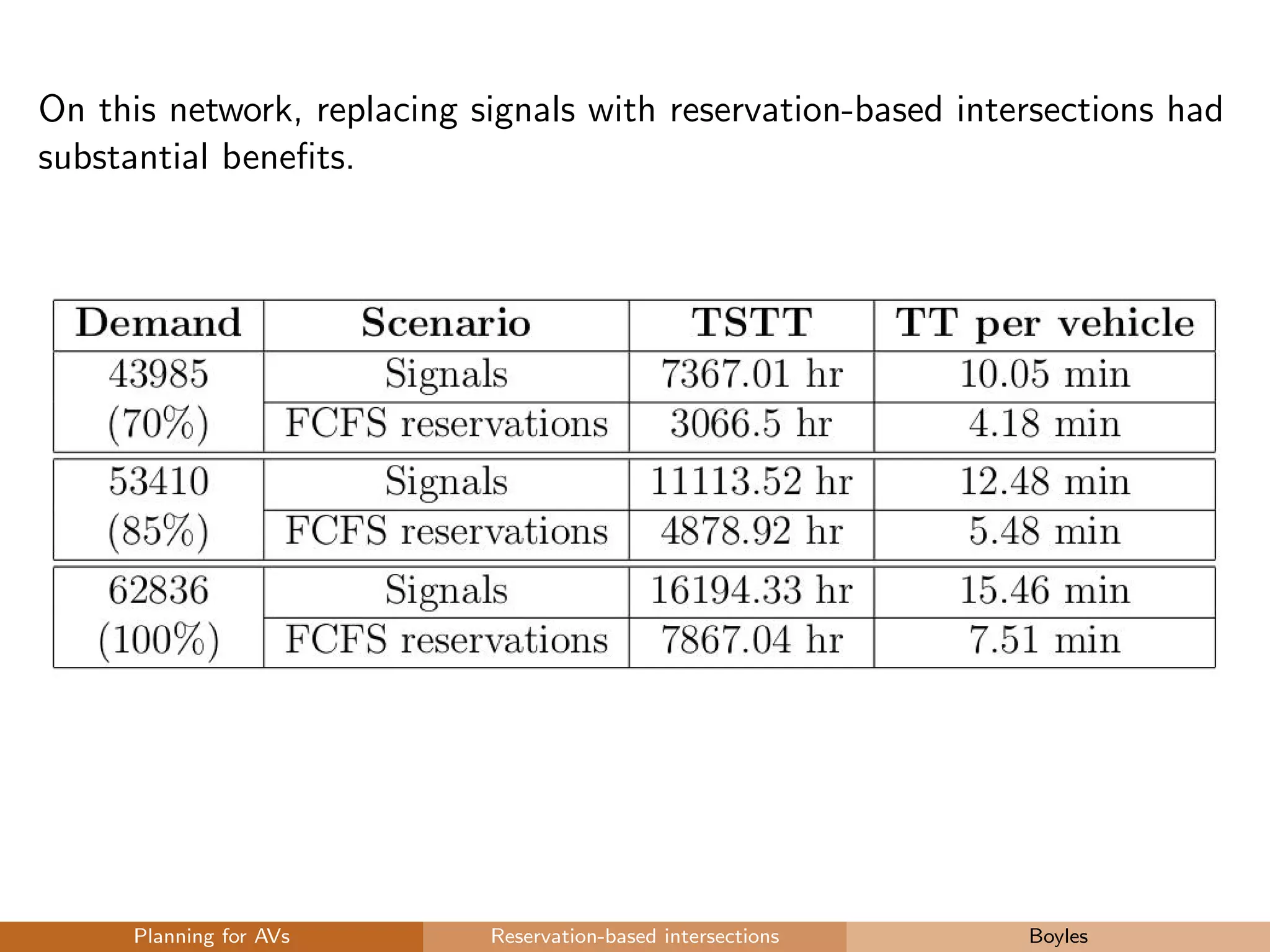
On this network, replacing signals with reservation-based intersections had
substantial benefits.
Planning for AVs Reservation-based intersections Boyles
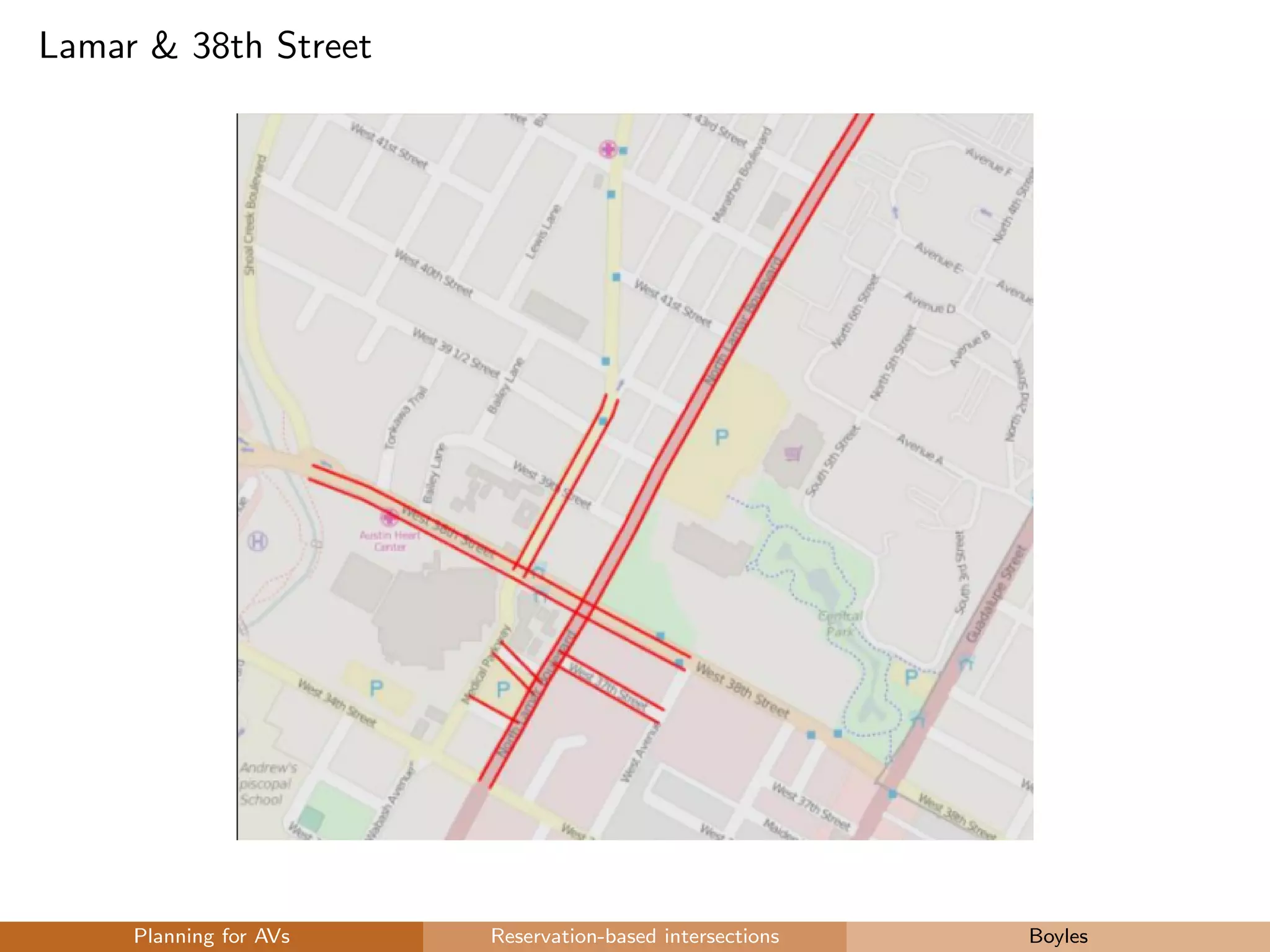
Lamar & 38th Street
Planning for AVs Reservation-based intersections Boyles
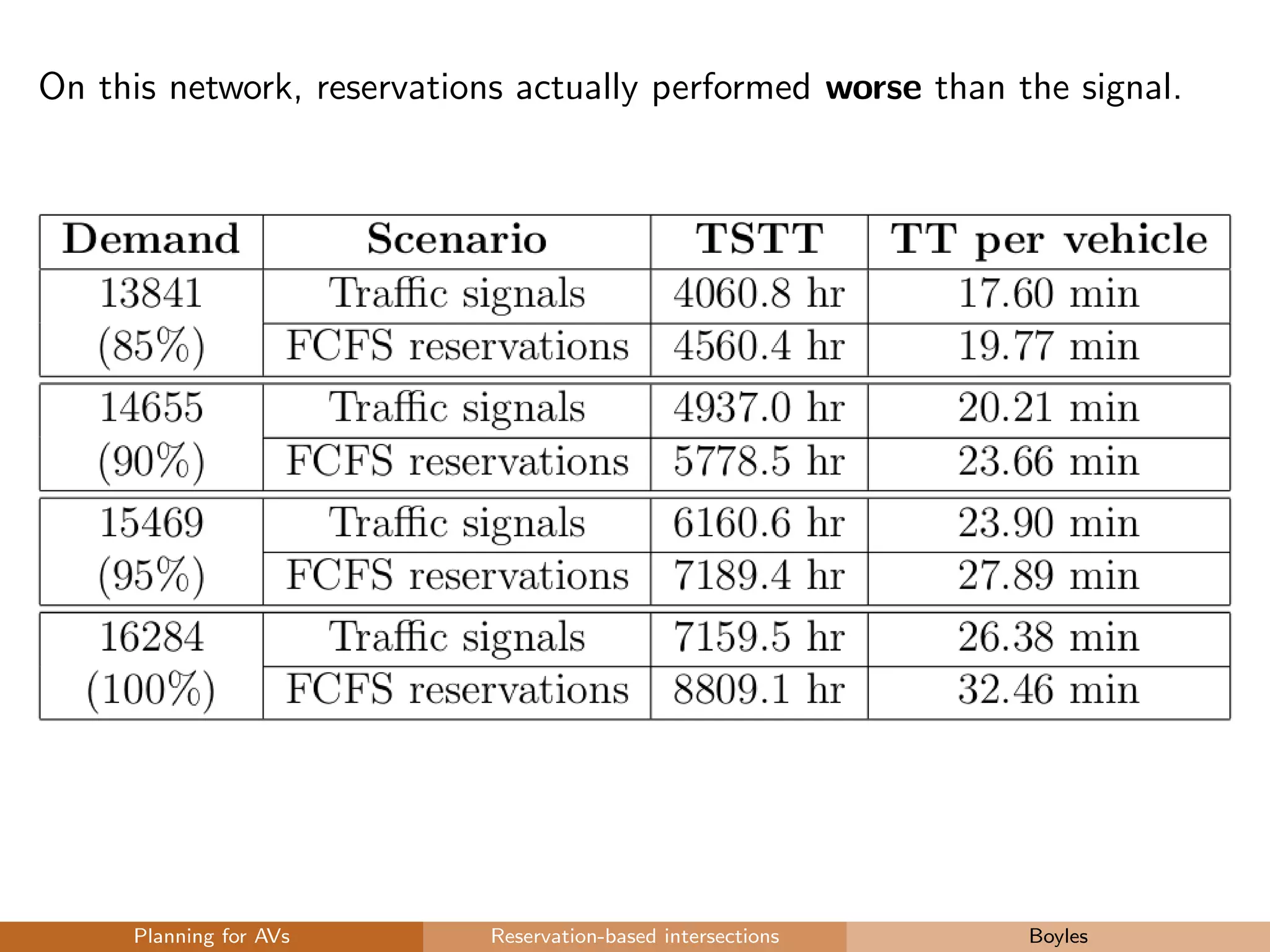
On this network, reservations actually performed worse than the signal.
Planning for AVs Reservation-based intersections Boyles
This is largely because reservations are granted in first-come, first-serve
order.
Planning for AVs Reservation-based intersections Boyles
This is largely because reservations are granted in first-come, first-serve
order.
In a network with “asymmetric” demand and capacity, this may not be the
right strategy.
Planning for AVs Reservation-based intersections Boyles
This is largely because reservations are granted in first-come, first-serve
order.
In a network with “asymmetric” demand and capacity, this may not be the
right strategy.
In this kind of network, an optimal reservation can’t be any worse than a
signal — since you can replicate a signal by how you grant reservations.
Planning for AVs Reservation-based intersections Boyles
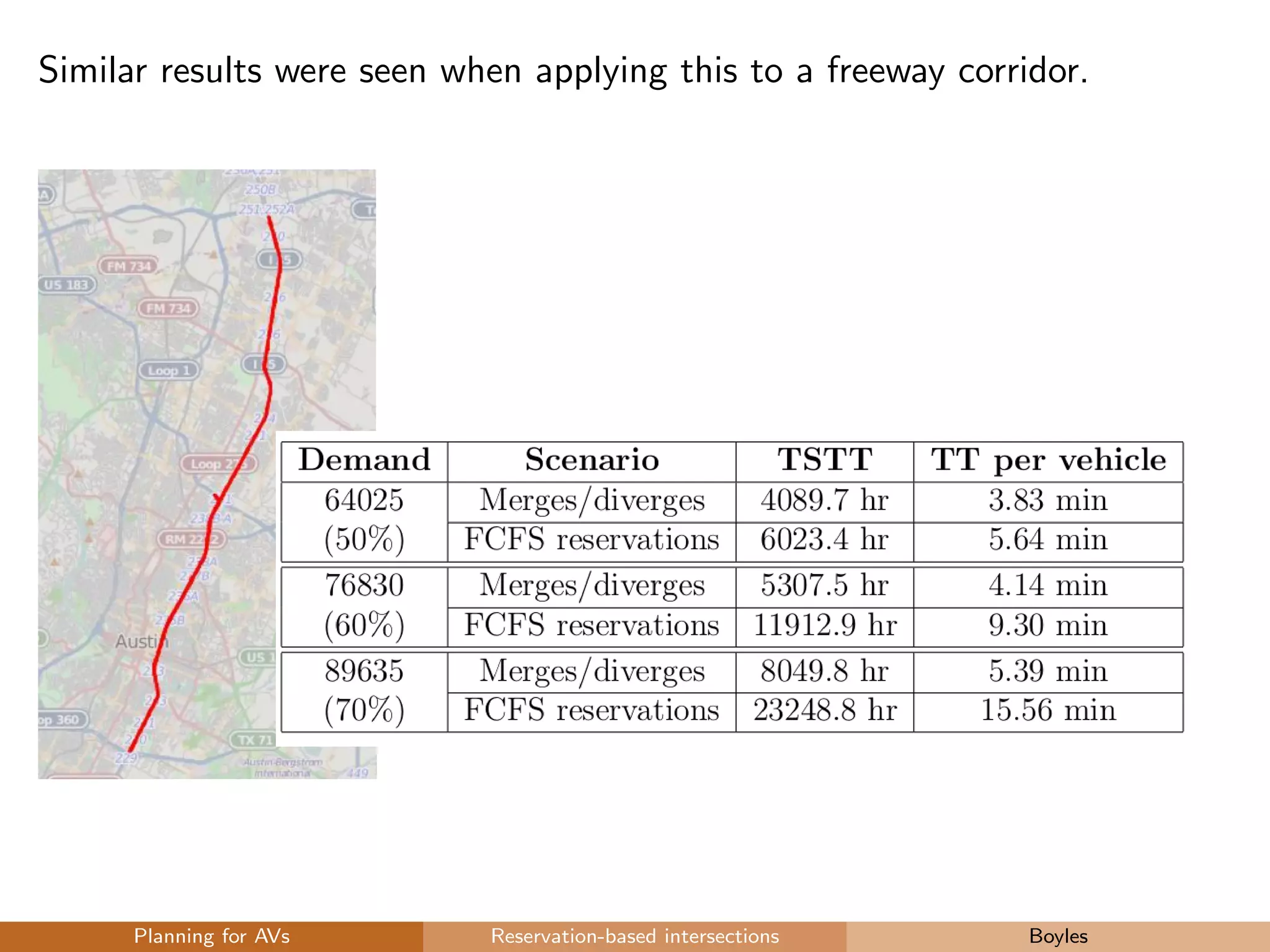
Similar results were seen when applying this to a freeway corridor.
Planning for AVs Reservation-based intersections Boyles
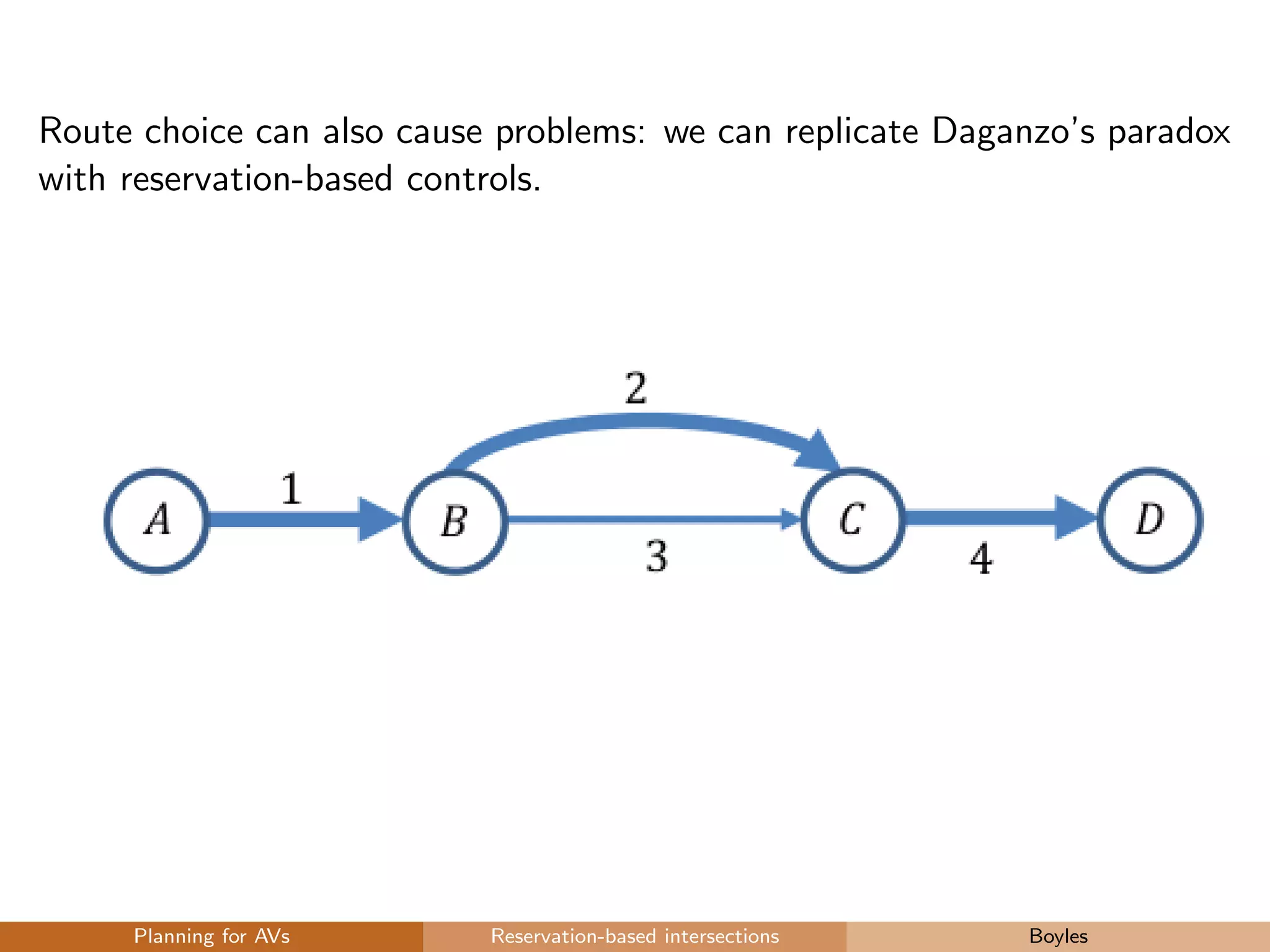
Route choice can also cause problems: we can replicate Daganzo’s paradox
with reservation-based controls.
Planning for AVs Reservation-based intersections Boyles
Lesson: Used carefully, reservations can dramatically decrease delay in
real networks. Used carelessly, they may not help... and might even make
things worse.
Planning for AVs Reservation-based intersections Boyles
OTHER AV POLICIES
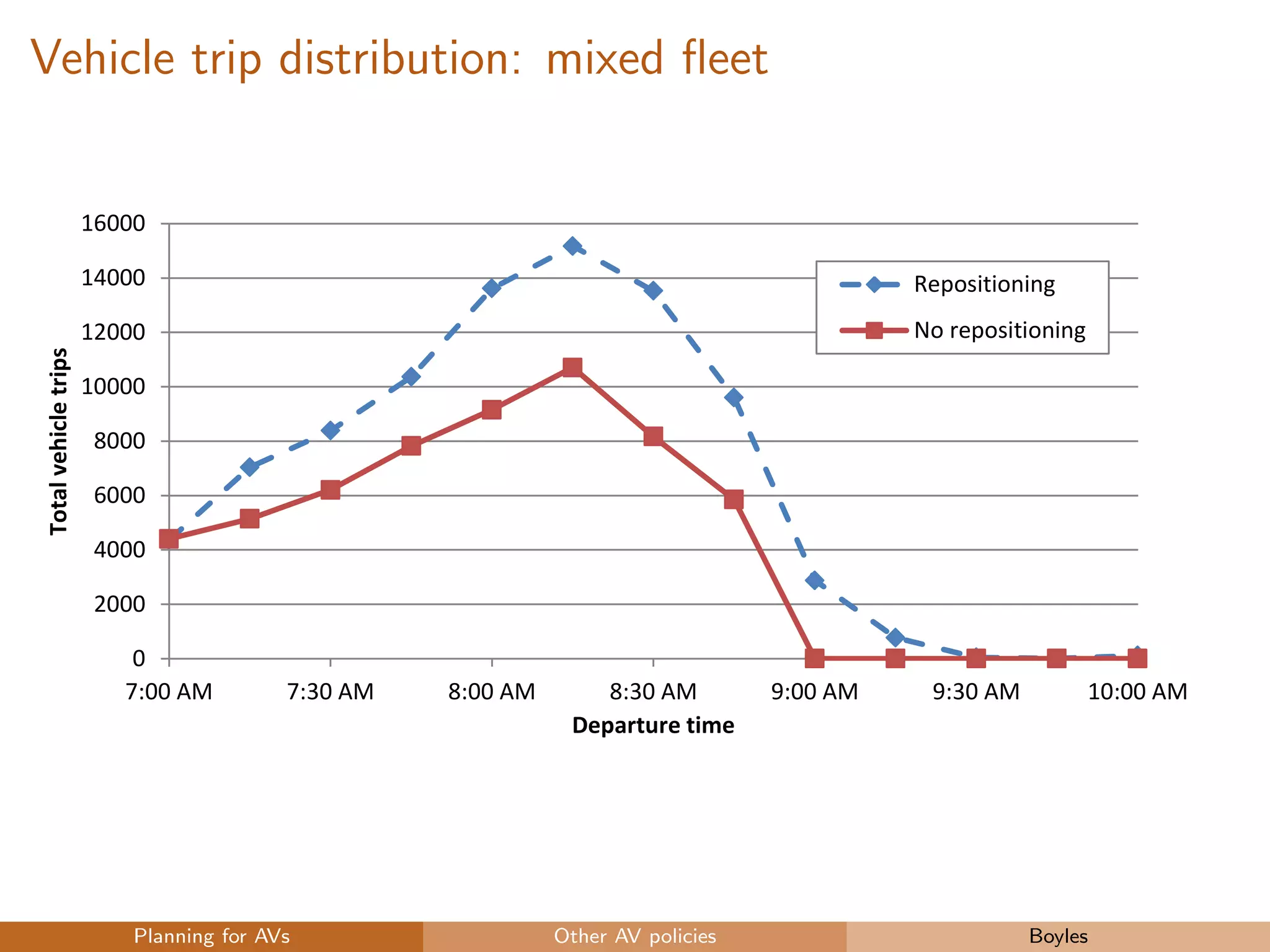
Vehicle trip distribution: mixed fleet
0
2000
4000
6000
8000
10000
12000
14000
16000
7:00 AM 7:30 AM 8:00 AM 8:30 AM 9:00 AM 9:30 AM 10:00 AM
Totalvehicletrips
Departure time
Repositioning
No repositioning
Planning for AVs Other AV policies Boyles
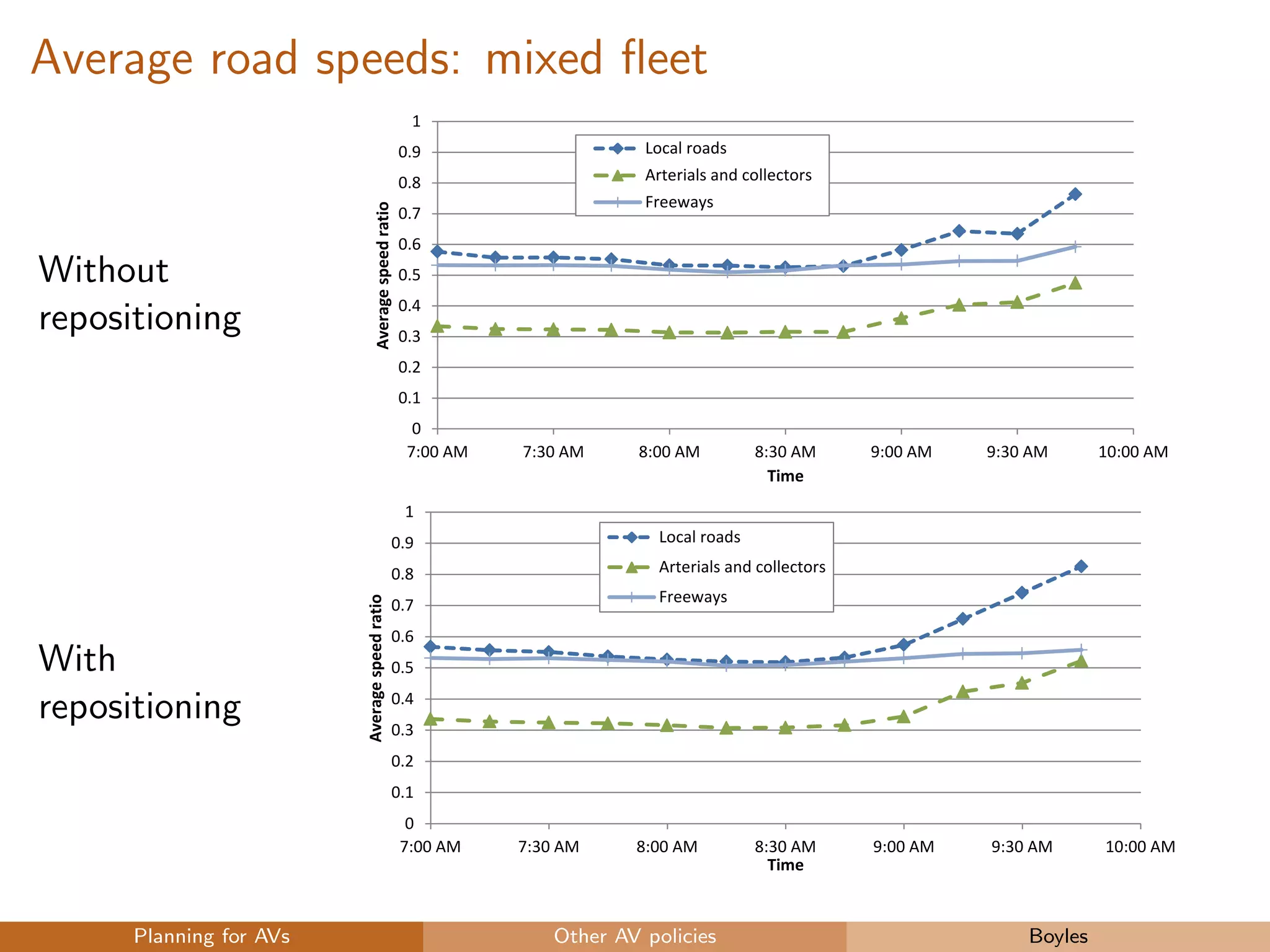
Average road speeds: mixed fleet
Without
repositioning
0
0.1
0.2
0.3
0.4
0.5
0.6
0.7
0.8
0.9
1
7:00 AM 7:30 AM 8:00 AM 8:30 AM 9:00 AM 9:30 AM 10:00 AM
Averagespeedratio
Time
Local roads
Arterials and collectors
Freeways
With
repositioning
0
0.1
0.2
0.3
0.4
0.5
0.6
0.7
0.8
0.9
1
7:00 AM 7:30 AM 8:00 AM 8:30 AM 9:00 AM 9:30 AM 10:00 AM
Averagespeedratio
Time
Local roads
Arterials and collectors
Freeways
Planning for AVs Other AV policies Boyles
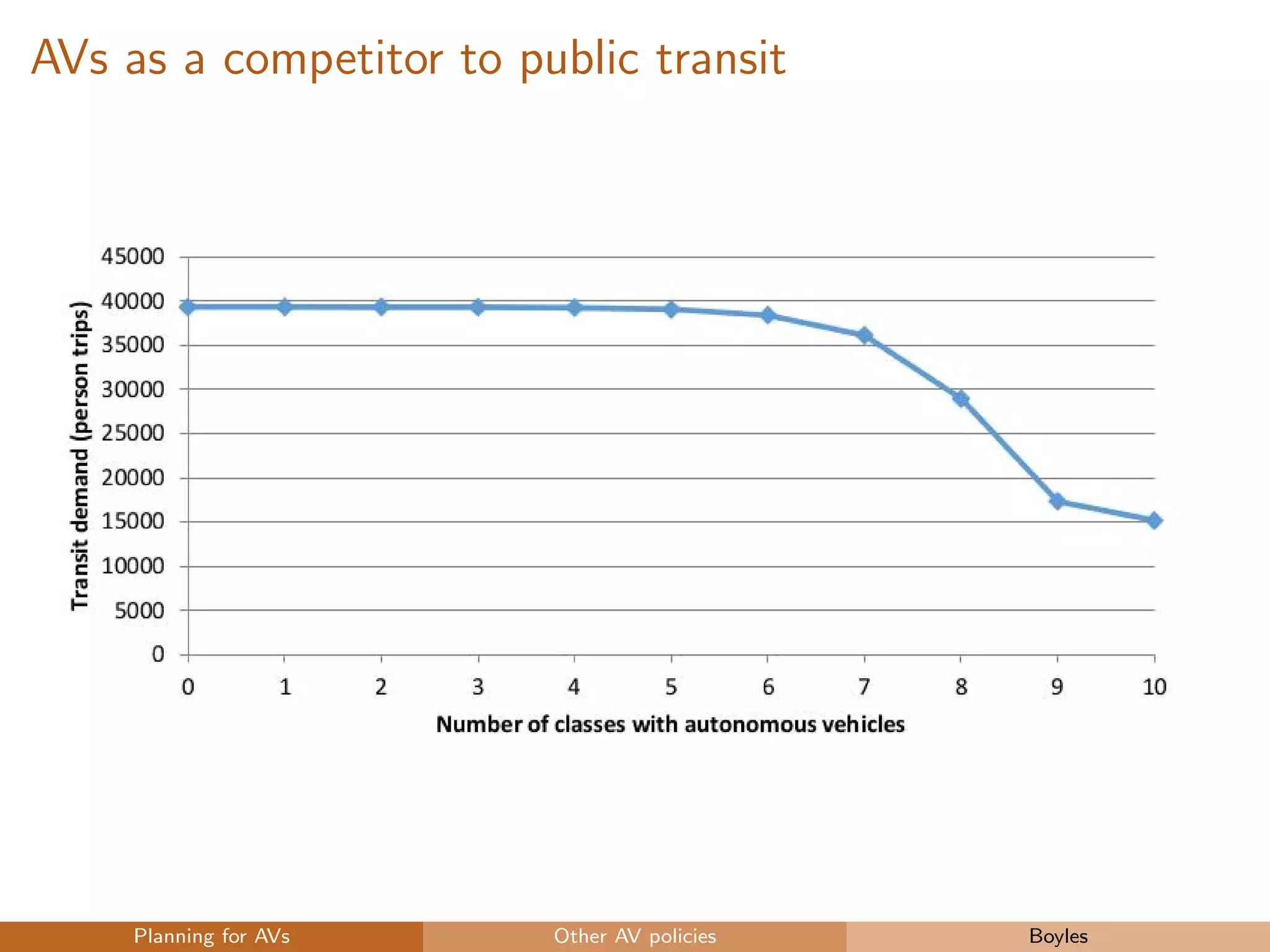
AVs as a competitor to public transit
Planning for AVs Other AV policies Boyles
CONCLUSIONS
Automated vehicles have arrived!
The future is bright: There is the potential for substantial
improvements in operations and safety.
Planning for AVs Conclusions Boyles
Automated vehicles have arrived!
The future is bright: There is the potential for substantial
improvements in operations and safety.
The future is scary: There may be unintended consequences —
remember the lesson of the Jevons paradox.
Planning for AVs Conclusions Boyles
Automated vehicles have arrived!
The future is bright: There is the potential for substantial
improvements in operations and safety.
The future is scary: There may be unintended consequences —
remember the lesson of the Jevons paradox.
The future is now: It is encouraging to see transportation
professionals being proactive about planning for AVs.
Planning for AVs Conclusions Boyles
Automated vehicles have arrived!
The future is bright: There is the potential for substantial
improvements in operations and safety.
The future is scary: There may be unintended consequences —
remember the lesson of the Jevons paradox.
The future is now: It is encouraging to see transportation
professionals being proactive about planning for AVs.
The future is ours: Quantitative models play a critical role in
guiding policy and regulation. Transportation systems are complex,
and can behave counterintuitively. Researchers are developing the
tools we need to realize the potential of AVs.
Planning for AVs Conclusions Boyles

Planning for a World of Connected and Automated Vehicles

  • 1.
    Planning for aWorld of Connected and Automated Vehicles Stephen D. Boyles Associate Professor Civil, Architectural & Environmental Engineering The University of Texas at Austin April 12, 2018 Planning for AVs Boyles
  • 2.
    The world ischanging... Planning for AVs Introduction Boyles
  • 3.
    Automated vehicles (AVs)are a perfect example of a “disruptive technology.” Planning for AVs Introduction Boyles
  • 4.
    Automated vehicles (AVs)are a perfect example of a “disruptive technology.” This talk focuses on traffic operations, and traveler behavior. Planning for AVs Introduction Boyles
  • 5.
    What are thetraffic impacts of AVs? Planning for AVs Introduction Boyles
  • 6.
    What are thetraffic impacts of AVs? Platooning: If AVs have faster reaction times or communicate with other vehicles, they can follow at shorter distances. Planning for AVs Introduction Boyles
  • 7.
    What are thetraffic impacts of AVs? Platooning: If AVs have faster reaction times or communicate with other vehicles, they can follow at shorter distances. New traffic control: Dynamic lane allocation; “microtolling” and incentives; optimal real-time routing, etc. Planning for AVs Introduction Boyles
  • 8.
    What are thetraffic impacts of AVs? Platooning: If AVs have faster reaction times or communicate with other vehicles, they can follow at shorter distances. New traffic control: Dynamic lane allocation; “microtolling” and incentives; optimal real-time routing, etc. New intersection treatments: The reservation-based intersection. Planning for AVs Introduction Boyles
  • 9.
    What are thetraffic impacts of AVs? Platooning: If AVs have faster reaction times or communicate with other vehicles, they can follow at shorter distances. New traffic control: Dynamic lane allocation; “microtolling” and incentives; optimal real-time routing, etc. New intersection treatments: The reservation-based intersection. There are legal and technological issues associated with each of these strate- gies. This talk is viewing them from a “what if” perspective, to guide policy and plan appropriately. Planning for AVs Introduction Boyles
  • 10.
    How can weanswer these questions when there is still so much technological and regulatory uncertainty? The paradox: the best time to plan is before the technology is here! So, simulation results should be examined for trends and what-if possibilities, not treated as a crystal ball. Planning for AVs Introduction Boyles
  • 11.
    There may alsobe unintended consequences. In the 19th century, improved technology led to more efficient ways to burn coal. Planning for AVs Introduction Boyles
  • 12.
    Making factories moreefficient increased coal consumption, rather than decreased it. This is known as the Jevons paradox. Planning for AVs Introduction Boyles
  • 13.
    Does the Jevonsparadox exist in transportation systems? Planning for AVs Introduction Boyles
  • 14.
    Does the Jevonsparadox exist in transportation systems? If we make travel more efficient, will demand for travel increase? Planning for AVs Introduction Boyles
  • 15.
    Does the Jevonsparadox exist in transportation systems? If we make travel more efficient, will demand for travel increase? Could induced demand counteract all of the benefits of automated vehicle technology? Planning for AVs Introduction Boyles
  • 16.
    Does the Jevonsparadox exist in transportation systems? If we make travel more efficient, will demand for travel increase? Could induced demand counteract all of the benefits of automated vehicle technology? Transportation systems are complex systems, with many components which interact heavily with each other. Planning for AVs Introduction Boyles
  • 17.
    Smith’s paradox Retiming asignal can decrease network throughput. Planning for AVs Introduction Boyles
  • 18.
    Daganzo’s paradox Improving capacityof a link can decrease throughput. Planning for AVs Introduction Boyles
  • 19.
    All of thispoints to a need to do quantitative modeling of AVs and their impacts. This talk provides a few examples of how this might be done. 1 Traffic modeling for AV capabilities 2 What if we replace signals with reservation-based control? 3 What if we allow AVs to be “driven empty”? 4 What are the implications for planning today? Planning for AVs Introduction Boyles
  • 20.
    Collaborators and Acknowledgements Thistalk includes contributions from Dr. Kara Kockelman, Dr. Peter Stone, Michael Levin, Rahul Patel, Chris Melson, and Hannah Smith. This research was sponsored by the Texas Department of Transportation, National Science Foundation, Federal Highway Administration, and the Data-Supported Transportation Operations and Planning Center. Planning for AVs Introduction Boyles
  • 21.
  • 22.
    How might wemodel the effects of platooning on roadway capacity? Planning for AVs Traffic modeling for AVs Boyles
  • 23.
    How might wemodel the effects of platooning on roadway capacity? How might we model the effects of dynamic lane allocation? Planning for AVs Traffic modeling for AVs Boyles
  • 24.
    How might wemodel the effects of platooning on roadway capacity? How might we model the effects of dynamic lane allocation? How might we model the effects of reservation-based intersections? Planning for AVs Traffic modeling for AVs Boyles
  • 25.
    How might wemodel the effects of platooning on roadway capacity? How might we model the effects of dynamic lane allocation? How might we model the effects of reservation-based intersections? In particular, can we find models simple enough to allow us to simulate large regions? Small corridor models can omit complex interactions (like elastic demand) Planning for AVs Traffic modeling for AVs Boyles
  • 26.
    Fundamental diagram k q Q(k) qmax kc kj u Thefundamental traffic flow diagram relates vehicle density (veh/mi) to vehicle flow (veh/hr). The diagram can also produce vehicle speeds and shockwave speeds. Planning for AVs Traffic modeling for AVs Boyles
  • 27.
    Car-following perspective Assumethat in congested conditions, the time headway between vehicles is determined by the safe following distance (accounting for reaction time) Then we can derive a new speed-density relationship, and translate this to a new fundamental diagram. Planning for AVs Traffic modeling for AVs Boyles
  • 28.
    Planning for AVsTraffic modeling for AVs Boyles
  • 29.
    In these diagrams,we can directly see the capacity increase. Also, the congested portion of the diagram has a steeper slope. What does this mean? Planning for AVs Traffic modeling for AVs Boyles
  • 30.
    Cell transmission model Daganzo’scell transmission model is a practical way of modeling traffic flow on large networks, given the shape of the fundamental diagram. 5 4 7 x=0 1 2 3 n(0,t) n(1,t) n(2,t) 3 0 y(1,t) y(2,t) Roadway segments are divided into cells, and vehicles propagate from one cell to the next. Planning for AVs Traffic modeling for AVs Boyles
  • 31.
    Reservation-based intersections The firstsimulation model for reservation-based control was AIM (Autonomous Intersection Management) This microsimulator is very detailed, but is too complex to efficiently model large networks. Planning for AVs Traffic modeling for AVs Boyles
  • 32.
    The conflict regionmodel provides a simpler way to approximate this type of roadway control. Each region permits a certain maximum flow rate. Vehicles from each approach are assigned trajectories as long as all of these limits are satisfied. Any remaining vehicles are queued. Planning for AVs Traffic modeling for AVs Boyles
  • 33.
  • 34.
    Early experiments showthat reservation-based systems can offer dramatic reductions in control delay. Under oversaturated conditions, delay can be reduced by 1–2 orders of magnitude. Planning for AVs Reservation-based intersections Boyles
  • 35.
    What happens whenwe apply them on real networks? Planning for AVs Reservation-based intersections Boyles
  • 36.
    What happens whenwe apply them on real networks? (Real = multiple intersections, asymmetric demand, nonuniform roads, drivers changing routes, etc.) Planning for AVs Reservation-based intersections Boyles
  • 37.
    Downtown Austin network Planningfor AVs Reservation-based intersections Boyles
  • 38.
    On this network,replacing signals with reservation-based intersections had substantial benefits. Planning for AVs Reservation-based intersections Boyles
  • 39.
    Lamar & 38thStreet Planning for AVs Reservation-based intersections Boyles
  • 40.
    On this network,reservations actually performed worse than the signal. Planning for AVs Reservation-based intersections Boyles
  • 41.
    This is largelybecause reservations are granted in first-come, first-serve order. Planning for AVs Reservation-based intersections Boyles
  • 42.
    This is largelybecause reservations are granted in first-come, first-serve order. In a network with “asymmetric” demand and capacity, this may not be the right strategy. Planning for AVs Reservation-based intersections Boyles
  • 43.
    This is largelybecause reservations are granted in first-come, first-serve order. In a network with “asymmetric” demand and capacity, this may not be the right strategy. In this kind of network, an optimal reservation can’t be any worse than a signal — since you can replicate a signal by how you grant reservations. Planning for AVs Reservation-based intersections Boyles
  • 44.
    Similar results wereseen when applying this to a freeway corridor. Planning for AVs Reservation-based intersections Boyles
  • 45.
    Route choice canalso cause problems: we can replicate Daganzo’s paradox with reservation-based controls. Planning for AVs Reservation-based intersections Boyles
  • 46.
    Lesson: Used carefully,reservations can dramatically decrease delay in real networks. Used carelessly, they may not help... and might even make things worse. Planning for AVs Reservation-based intersections Boyles
  • 47.
  • 48.
    Vehicle trip distribution:mixed fleet 0 2000 4000 6000 8000 10000 12000 14000 16000 7:00 AM 7:30 AM 8:00 AM 8:30 AM 9:00 AM 9:30 AM 10:00 AM Totalvehicletrips Departure time Repositioning No repositioning Planning for AVs Other AV policies Boyles
  • 49.
    Average road speeds:mixed fleet Without repositioning 0 0.1 0.2 0.3 0.4 0.5 0.6 0.7 0.8 0.9 1 7:00 AM 7:30 AM 8:00 AM 8:30 AM 9:00 AM 9:30 AM 10:00 AM Averagespeedratio Time Local roads Arterials and collectors Freeways With repositioning 0 0.1 0.2 0.3 0.4 0.5 0.6 0.7 0.8 0.9 1 7:00 AM 7:30 AM 8:00 AM 8:30 AM 9:00 AM 9:30 AM 10:00 AM Averagespeedratio Time Local roads Arterials and collectors Freeways Planning for AVs Other AV policies Boyles
  • 50.
    AVs as acompetitor to public transit Planning for AVs Other AV policies Boyles
  • 51.
  • 52.
    Automated vehicles havearrived! The future is bright: There is the potential for substantial improvements in operations and safety. Planning for AVs Conclusions Boyles
  • 53.
    Automated vehicles havearrived! The future is bright: There is the potential for substantial improvements in operations and safety. The future is scary: There may be unintended consequences — remember the lesson of the Jevons paradox. Planning for AVs Conclusions Boyles
  • 54.
    Automated vehicles havearrived! The future is bright: There is the potential for substantial improvements in operations and safety. The future is scary: There may be unintended consequences — remember the lesson of the Jevons paradox. The future is now: It is encouraging to see transportation professionals being proactive about planning for AVs. Planning for AVs Conclusions Boyles
  • 55.
    Automated vehicles havearrived! The future is bright: There is the potential for substantial improvements in operations and safety. The future is scary: There may be unintended consequences — remember the lesson of the Jevons paradox. The future is now: It is encouraging to see transportation professionals being proactive about planning for AVs. The future is ours: Quantitative models play a critical role in guiding policy and regulation. Transportation systems are complex, and can behave counterintuitively. Researchers are developing the tools we need to realize the potential of AVs. Planning for AVs Conclusions Boyles