ENGLISH LANGUAGE
WRITING LAYOUTS
WJEC specification
(doesn’t include review)
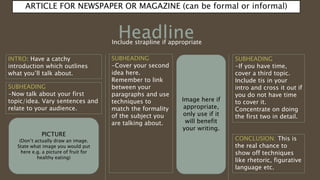
ARTICLE FOR NEWSPAPER OR MAGAZINE (can be formal or informal)
HeadlineInclude strapline if appropriate
INTRO: Have a catchy
introduction which outlines
what you’ll talk about.
SUBHEADING
-Now talk about your first
topic/idea. Vary sentences and
relate to your audience.
PICTURE
(Don’t actually draw an image.
State what image you would put
here e.g. a picture of fruit for
healthy eating)
SUBHEADING
-Cover your second
idea here.
Remember to link
between your
paragraphs and use
techniques to
match the formality
of the subject you
are talking about.
Image here if
appropriate,
only use if it
will benefit
your writing.
SUBHEADING
-If you have time,
cover a third topic.
Include tis in your
intro and cross it out if
you do not have time
to cover it.
Concentrate on doing
the first two in detail.
CONCLUSION: This is
the real chance to
show off techniques
like rhetoric, figurative
language etc.
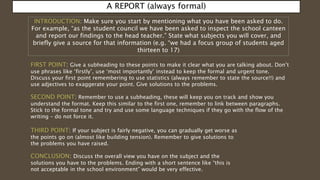
A REPORT (always formal)
INTRODUCTION: Make sure you start by mentioning what you have been asked to do.
For example, “as the student council we have been asked to inspect the school canteen
and report our findings to the head teacher.” State what subjects you will cover, and
briefly give a source for that information (e.g. “we had a focus group of students aged
thirteen to 17)
FIRST POINT: Give a subheading to these points to make it clear what you are talking about. Don’t
use phrases like ‘firstly’, use ‘most importantly’ instead to keep the formal and urgent tone.
Discuss your first point remembering to use statistics (always remember to state the source!!) and
use adjectives to exaggerate your point. Give solutions to the problems.
SECOND POINT: Remember to use a subheading, these will keep you on track and show you
understand the format. Keep this similar to the first one, remember to link between paragraphs.
Stick to the formal tone and try and use some language techniques if they go with the flow of the
writing – do not force it.
THIRD POINT: If your subject is fairly negative, you can gradually get worse as
the points go on (almost like building tension). Remember to give solutions to
the problems you have raised.
CONCLUSION: Discuss the overall view you have on the subject and the
solutions you have to the problems. Ending with a short sentence like “this is
not acceptable in the school environment” would be very effective.
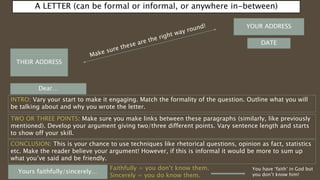
A LETTER (can be formal or informal, or anywhere in-between)
YOUR ADDRESS
DATE
THEIR ADDRESS
Dear…
Yours faithfully/sincerely…
INTRO: Vary your start to make it engaging. Match the formality of the question. Outline what you will
be talking about and why you wrote the letter.
TWO OR THREE POINTS: Make sure you make links between these paragraphs (similarly, like previously
mentioned). Develop your argument giving two/three different points. Vary sentence length and starts
to show off your skill.
CONCLUSION: This is your chance to use techniques like rhetorical questions, opinion as fact, statistics
etc. Make the reader believe your argument! However, if this is informal it would be more to sum up
what you’ve said and be friendly.
Faithfully = you don’t know them.
Sincerely = you do know them.
You have ‘faith’ in God but
you don’t know him!
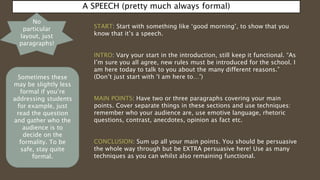
A SPEECH (pretty much always formal)
No
particular
layout, just
paragraphs!
START: Start with something like ‘good morning’, to show that you
know that it’s a speech.
INTRO: Vary your start in the introduction, still keep it functional. “As
I’m sure you all agree, new rules must be introduced for the school. I
am here today to talk to you about the many different reasons.”
(Don’t just start with ‘I am here to…’)
MAIN POINTS: Have two or three paragraphs covering your main
points. Cover separate things in these sections and use techniques:
remember who your audience are, use emotive language, rhetoric
questions, contrast, anecdotes, opinion as fact etc.
CONCLUSION: Sum up all your main points. You should be persuasive
the whole way through but be EXTRA persuasive here! Use as many
techniques as you can whilst also remaining functional.
Sometimes these
may be slightly less
formal if you’re
addressing students
for example, just
read the question
and gather who the
audience is to
decide on the
formality. To be
safe, stay quite
formal.
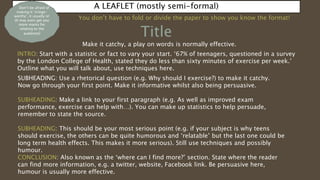
A LEAFLET (mostly semi-formal)
You don’t have to fold or divide the paper to show you know the format!
Title
Make it catchy, a play on words is normally effective.
INTRO: Start with a statistic or fact to vary your start. ‘67% of teenagers, questioned in a survey
by the London College of Health, stated they do less than sixty minutes of exercise per week.’
Outline what you will talk about, use techniques here.
SUBHEADING: Use a rhetorical question (e.g. Why should I exercise?) to make it catchy.
Now go through your first point. Make it informative whilst also being persuasive.
SUBHEADING: Make a link to your first paragraph (e.g. As well as improved exam
performance, exercise can help with…). You can make up statistics to help persuade,
remember to state the source.
SUBHEADING: This should be your most serious point (e.g. if your subject is why teens
should exercise, the others can be quite humorous and ‘relatable’ but the last one could be
long term health effects. This makes it more serious). Still use techniques and possibly
humour.
CONCLUSION: Also known as the ‘where can I find more?’ section. State where the reader
can find more information, e.g. a twitter, website, Facebook link. Be persuasive here,
humour is usually more effective.
Don’t be afraid of
making it ‘cringe-
worthy’, it usually is!
(It may even get you
more marks for
relating to the
audience)

English language Writing Layouts

  • 1.
    ENGLISH LANGUAGE WRITING LAYOUTS WJECspecification (doesn’t include review)
  • 2.
    ARTICLE FOR NEWSPAPEROR MAGAZINE (can be formal or informal) HeadlineInclude strapline if appropriate INTRO: Have a catchy introduction which outlines what you’ll talk about. SUBHEADING -Now talk about your first topic/idea. Vary sentences and relate to your audience. PICTURE (Don’t actually draw an image. State what image you would put here e.g. a picture of fruit for healthy eating) SUBHEADING -Cover your second idea here. Remember to link between your paragraphs and use techniques to match the formality of the subject you are talking about. Image here if appropriate, only use if it will benefit your writing. SUBHEADING -If you have time, cover a third topic. Include tis in your intro and cross it out if you do not have time to cover it. Concentrate on doing the first two in detail. CONCLUSION: This is the real chance to show off techniques like rhetoric, figurative language etc.
  • 3.
    A REPORT (alwaysformal) INTRODUCTION: Make sure you start by mentioning what you have been asked to do. For example, “as the student council we have been asked to inspect the school canteen and report our findings to the head teacher.” State what subjects you will cover, and briefly give a source for that information (e.g. “we had a focus group of students aged thirteen to 17) FIRST POINT: Give a subheading to these points to make it clear what you are talking about. Don’t use phrases like ‘firstly’, use ‘most importantly’ instead to keep the formal and urgent tone. Discuss your first point remembering to use statistics (always remember to state the source!!) and use adjectives to exaggerate your point. Give solutions to the problems. SECOND POINT: Remember to use a subheading, these will keep you on track and show you understand the format. Keep this similar to the first one, remember to link between paragraphs. Stick to the formal tone and try and use some language techniques if they go with the flow of the writing – do not force it. THIRD POINT: If your subject is fairly negative, you can gradually get worse as the points go on (almost like building tension). Remember to give solutions to the problems you have raised. CONCLUSION: Discuss the overall view you have on the subject and the solutions you have to the problems. Ending with a short sentence like “this is not acceptable in the school environment” would be very effective.
  • 4.
    A LETTER (canbe formal or informal, or anywhere in-between) YOUR ADDRESS DATE THEIR ADDRESS Dear… Yours faithfully/sincerely… INTRO: Vary your start to make it engaging. Match the formality of the question. Outline what you will be talking about and why you wrote the letter. TWO OR THREE POINTS: Make sure you make links between these paragraphs (similarly, like previously mentioned). Develop your argument giving two/three different points. Vary sentence length and starts to show off your skill. CONCLUSION: This is your chance to use techniques like rhetorical questions, opinion as fact, statistics etc. Make the reader believe your argument! However, if this is informal it would be more to sum up what you’ve said and be friendly. Faithfully = you don’t know them. Sincerely = you do know them. You have ‘faith’ in God but you don’t know him!
  • 5.
    A SPEECH (prettymuch always formal) No particular layout, just paragraphs! START: Start with something like ‘good morning’, to show that you know that it’s a speech. INTRO: Vary your start in the introduction, still keep it functional. “As I’m sure you all agree, new rules must be introduced for the school. I am here today to talk to you about the many different reasons.” (Don’t just start with ‘I am here to…’) MAIN POINTS: Have two or three paragraphs covering your main points. Cover separate things in these sections and use techniques: remember who your audience are, use emotive language, rhetoric questions, contrast, anecdotes, opinion as fact etc. CONCLUSION: Sum up all your main points. You should be persuasive the whole way through but be EXTRA persuasive here! Use as many techniques as you can whilst also remaining functional. Sometimes these may be slightly less formal if you’re addressing students for example, just read the question and gather who the audience is to decide on the formality. To be safe, stay quite formal.
  • 6.
    A LEAFLET (mostlysemi-formal) You don’t have to fold or divide the paper to show you know the format! Title Make it catchy, a play on words is normally effective. INTRO: Start with a statistic or fact to vary your start. ‘67% of teenagers, questioned in a survey by the London College of Health, stated they do less than sixty minutes of exercise per week.’ Outline what you will talk about, use techniques here. SUBHEADING: Use a rhetorical question (e.g. Why should I exercise?) to make it catchy. Now go through your first point. Make it informative whilst also being persuasive. SUBHEADING: Make a link to your first paragraph (e.g. As well as improved exam performance, exercise can help with…). You can make up statistics to help persuade, remember to state the source. SUBHEADING: This should be your most serious point (e.g. if your subject is why teens should exercise, the others can be quite humorous and ‘relatable’ but the last one could be long term health effects. This makes it more serious). Still use techniques and possibly humour. CONCLUSION: Also known as the ‘where can I find more?’ section. State where the reader can find more information, e.g. a twitter, website, Facebook link. Be persuasive here, humour is usually more effective. Don’t be afraid of making it ‘cringe- worthy’, it usually is! (It may even get you more marks for relating to the audience)