WOUND CARE “ the primary goal of wound care is not the technical repair of the wound; it is providing optimal conditions for the natural reparative processes of the wound to proceed” –  Richard L. Lammers (Roberts and Hedges)
GOALS of wound care Facilitate hemostasis Decrease tissue loss Promote wound healing Minimize scar formation
INTRODUCTION
Wound healing : PATHOPHYSIOLOGY 1.) Inflammatory Phase Initial response (Day 1-4 post injury) rubor, tumor, dolor, calor Platelet aggregation and activation Leukocyte (PMNs, macrophages) migration, phagocytosis and mediator release Venule dilation Exudative a biologic debridement In wounds closed by primary intention, lasts 4 days
2.) Proliferative Phase Day 4-42 macrophage-released growth factors   Fibroblast proliferation    Increased rate of collagen synthesis Granulation tissue and neovascularization Gain in tensile strength
3.) Remodeling Phase 6wks-1 year Intermolecular cross-linking of collagen via vitamin C-dependent hydroxylation Characterized by  increase in tensile strength Type III collagen replaced with type I Scar flattens
TYPES of Wound Healing 1.) Healing by first intention  (aka. primary wound healing or primary closure) wound closed by approximation of wound margins or by placement of a graft or flap , or wounds created and closed in the operating room. Best choice for wounds in well-vascularized areas Indications  -recent (<24h old) -clean -viable tissue -tension-free treated within 24 h, prior to development of granulation tissue. epithelialize within 24 to 48 h. Water barrier function restored    can shower or wash.
2.) Healing by second intention   (aka. secondary wound healing or spontaneous healing) wound left open and allowed to close by epithelialization and contraction. Commonly : management of  contaminated or infected  wounds. without surgical intervention. Unlike primary wounds , approximation  of wound margins  occurs via reepithelialization and wound contraction by myofibroblasts. Presence of granulation tissue. Complications  -late wound contracture -hypertrophic scarring
3.) Healing by third intention  (aka. tertiary wound healing or delayed primary closure) wounds that are  too heavily contaminated for primary closure but appear clean and well vascularized after 4-5 days of open observation .  Inflammation   reduced bacterial concentration (“debribe”)   allow safe closure. Indications :- infected or unhealthy wounds with high  bacterial content, -wounds with a long time lapse since injury, or  -wounds with a severe crush component with  significant tissue devitalization. Wound edges are approximated within 3-4 days tensile strength develops as with primary closure.
wound preparation (debridement,cleansing, etc.) dress with saline soaked fine mesh gauze follow up in 72-96 hours for debridement repeat cleansing and closure if no evidence of infection
Factors that affect wound healing Patient factor  : Age   Immunocompromising   -DM - renal failure - AIDS - splenectomy Medications   –systemic steroids/ other immunocompromising drugs     i ncreased infection rates   Wound Characteristics   - Time ,  Location ,  Etiology  ,  Mechanism of injury ,  Laceration width
Factors that affect wound healing In general, remember “DIDN'T HEAL” D =  Diabetes : -diminishing sensation and arterial inflow ++ acute loss of diabetic control    diminished cardiac output, poor peripheral perfusion, and impaired polymorphonuclear leukocyte phagocytosis. I =  Infection : -potentiates collagen lysis. Bacterial contamination + susceptible host + wound environment = wound infection. Foreign bodies (including sutures) potentiate wound infection.
DIDN’T HEAL D =  Drugs : Steroids and antimetabolites impede proliferation of fibroblasts and collagen synthesis. N =  Nutritional  problems: Protein-calorie malnutrition and deficiencies of vitamins A, C, and zinc. T =  Tissue necrosis , from local or systemic ischemia or radiation injury. Blood supply is important.
DIDN’T HEAL H =  Hypoxia : -esp the distal extent of the extremities. Blood volume deficit, unrelieved pain, or hypothermia    sympathetic overactivity    local vasoconstriction    Inadequate tissue oxygenation. E =  Excessive tension on wound edges    local tissue ischemia and necrosis.
DIDN’T HEAL A =  Another wound : Competition for the substrates required for wound healing. L =  Low temperature : (relatively) distal aspects of the upper and lower extremities (a reduction of 1-1.5°C [2-3°F] from normal core body temperature) is responsible for slower healing of wounds at these sites.
Wound Evaluation -HISTORY identify all extrinsic and intrinsic factors that jeopardize healing and promote infection –  mechanism  of injury –  time  of injury (accelerated growth phase of  bacteria starts at 3 hours post wound) –  environment  in which wound occurred potential contaminants, foreign bodies –  species of animal if bite wound –  pt’s  medical problems  (allergies to  medication) / immune status tetanus immunization status
history Immunocompromised Bleeding disorder.Prolonged bleeding-. Hematoma can serve as culture medium for wound infection. Peripheral vascular disease
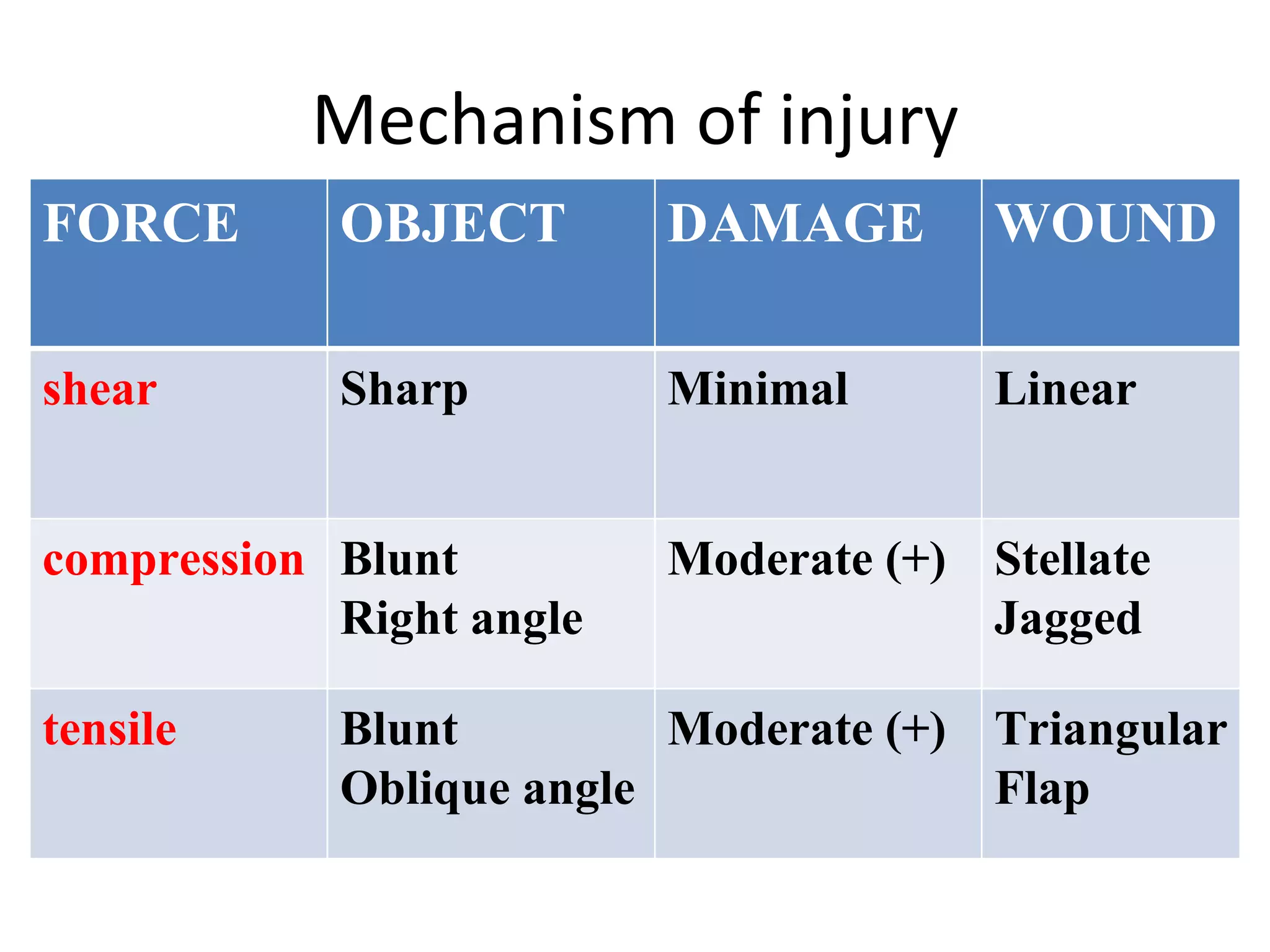
Mechanism of injury FORCE OBJECT DAMAGE WOUND shear Sharp Minimal Linear compression Blunt Right angle Moderate (+) Stellate Jagged tensile Blunt Oblique angle Moderate (+) Triangular Flap
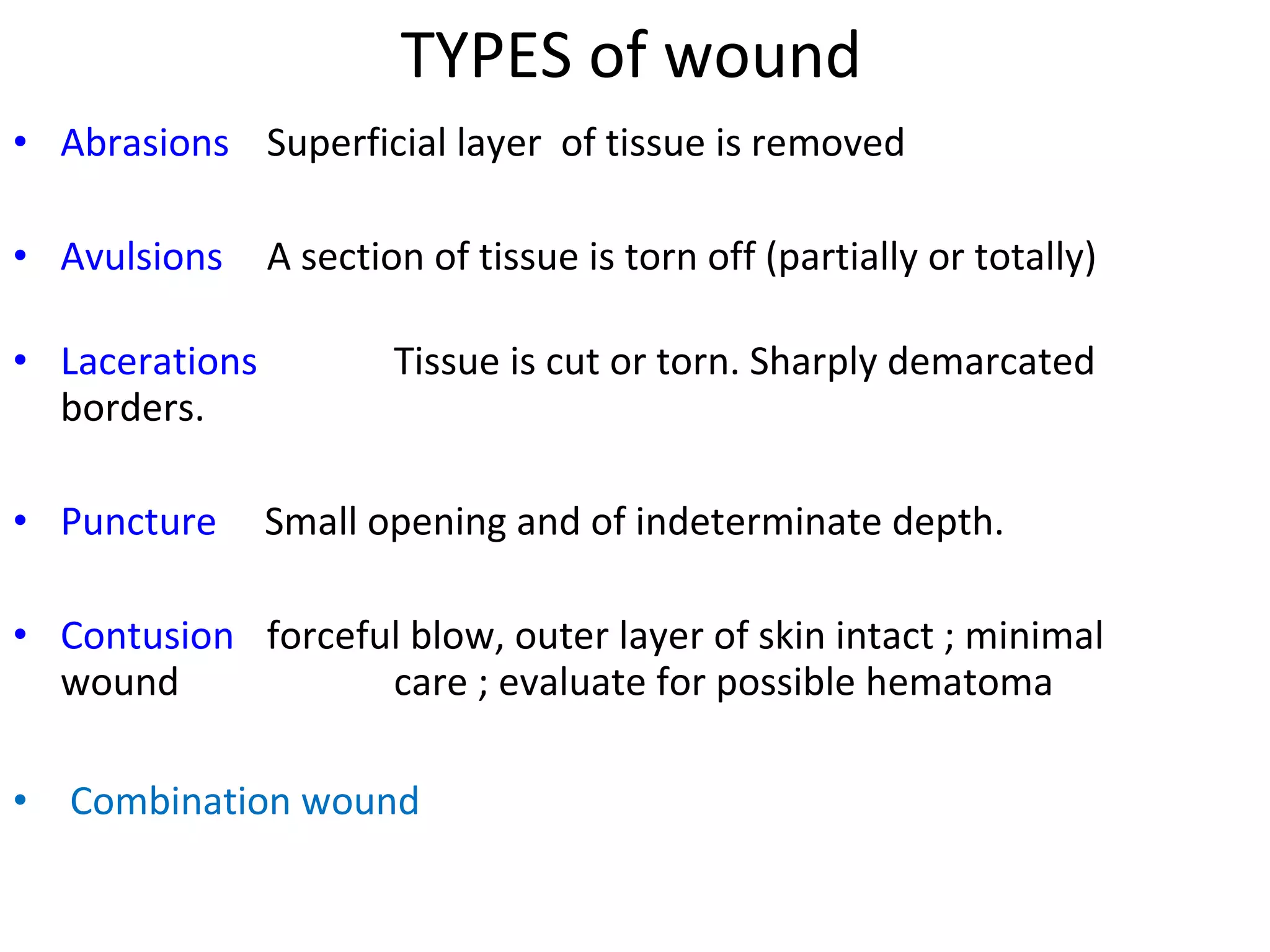
TYPES of wound Abrasions  Superficial layer  of tissue is removed Avulsions  A section of tissue is torn off (partially or totally)  Lacerations   Ti ssue is cut or torn.  Sharply demarcated borders. Puncture   Small opening and of indeterminate depth.  Contusion  forceful blow, outer layer of skin intact ; minimal wound  care ; evaluate for possible hematoma  Combination wound
Wound assessment Examine for: –  amount of tissue destruction –  degree of contamination –  damage to underlying structures
• Body Location  – Proximity to Other Structures  – Joints –Nerves –Tendons –Vasculature  – Test integrity of each structure  • Assess laxity/muscle and tendon function • Assess 2-point discrimination • Assess vascular supply
Physical examination Wound Location –  importance in the risk of infection –  high endogenous bacterial counts in hairy scalp, forehead, axilla, groin, foreskin of  penis, vagina, mouth, nails –  wounds in areas of high vascularity more easily resist infection (scalp, face)
WOUND PREPARATION
Wound Preparation - Anesthesia Topical Solution or paste LET TAC EMLA Local Direct infiltration 1% lidocaine with or without epinephrine Bupivicaine or sensorcaine for longer acting anesthesia Regional Block Local infiltration proximally in order to avoid tissue disruption Smaller amount of anesthesia required
Topical anesthesia Solely / with local infiltration Most effective :  face and scalp  (high vascularity) LET  ( lidocaine, epinephrine, tetracaine) TAC  ( tetracaine, adrenaline/epinephrine, cocaine  ) cotton ball soaked with 3–5ml applied to the open wound for at least 10 minutes
Local anesthetic Drug Max Dose Onset Duration Cocaine 6.6 mg/kg Rapid 1 hour Procaine 10-15 mg/kg Rapid 30min-1hr Tetracaine 1.5 mg/kg Moderate 2 hours Lidocaine 5 mg/kg 5-30 min 2 hours (with Epi) 7 mg/kg 5-30 min 2-3 hours Bupivacaine 2 mg/kg 7-30 min > 6 hours
Epinephrine Vasoconstrictive  – Increases Duration of Action – Promotes Hemostasis – Avoid end-arterial blood supply areas – May increase pain (low pH)
Local infiltration reduce the pain of anesthetic infiltration 1.  Premedicate   the wound with a topical anesthetic (described above) or ice.  2.  B uffer  anesthetic with sodium bicarbonate  ( 1 ml/ 10 ml )     less painful anesthetic. 3.  Needle size :  smallest diameter needle . A  30-gauge  needle is preferred. 4.  Inject slowly  (10sec), as pain results when the soft tissue stretches.
Wound Preparation - Hemostasis Direct Pressure–Usually best choice  Ligatures Use a tourniquet Chemicals – Epinephrine – Gelfoam – Oxycel – Actifoam Cautery
Wound Preparation – Foreign Body Removal Suspect with  point tenderness Visual inspection  (to the apex) Imaging Glass, metal, gravel fragments >1mm should be visible on plain  radiographs Organic substances and plastics are usually radiolucent Always discuss and document possibility of retained foreign body
Hair removal Shaving  – Increases risk of infection X 10 ! Clip Hair with Scissors  Matt Hair with Ointment Never shave eyebrows ( may not regrow )
Wound preparation : CLEANING high pressure irrigation (Normal Saline) min 100-300 ml with continued irrigation at least 8 psi force to the wound    the irrigation fluid dislodges foreign bodies, contaminants, and bacteria. A simple device setup 30-60 ml syringe and an 14-gauge angiocatheter.
Wound Preparation – Debridement Removes devitalized tissue Creates sharp wound edge Excision with elliptical shape Respect skin lines
Indications for  systemic antibiotic for traumatic wounds •  Injury  6 hours  old on the  extremities Injury  24  hours old on the  face and scalp Tendon, joint, or bony  involvement •  Cartilage  involvement •  Mammalian bite •  Co-morbidity   (diabetes mellitus, extremes of age, steroid use, morbid obesity) Puncture wound Complex  intraoral  wound
“ Prophylactic” Antibiotics  If Prescribed  • Duration 3 –7 days • Wound Recheck in 24 –48 hours
Wound preparation -Tetanus prophylaxis Clean wounds Incompleted immunization   toxoid >10 years, then give toxoid Tetanus prone wound Incompleted immunization   Toxoid & immunoglobulin > 5 years, give toxoid
WOUND CLOSURE Undermine the wound edges Release tension
Wound closure in relation to time Primary closure Suture, staple, adhesive, or tape Performed on recently sustained lacerations: <12 hours generally and <24 hours on face Secondary closure Secondary intent Allowed to granulate Tertiary closure Delayed primary (observed for 3-4days)
Suture supply needle drivers … tissue forceps (or skin hook) Scissors sterile drapes sterile gloves suture materials sterile gauze
Suture Material Absorbable Chromic catgut  ( natural monofilament) Vicryl  (synthetic braided) PDS II (synthetic monofilament) Non-Absorbable Silk  (natural braided) Ethilon  (synthetic monofilament) Monofilament  (smooth but stiff) vs.  Braided  (has interstices = haven for bacteria)
Suture size Skin Face 5/0 or 6/0 Hands and Limbs 3/0 or 4/0 Elsewhere 2/0 or 3/0
SUTURE TECHNIQUES Deep layer approximation Absorbable sutures Buried knot Serves two purposes Closes potential spaces Minimizes tension on the wound margins
Skin Closure Key – wound edge eversion “ Approximate, don’t strangulate” Anticipate wound edema Choose appropriate size of suture for location of laceration
Suture Techniques Simple Interrupted Used on majority of wounds Each stitch is independent
Suture Techniques Simple Continuous Useful in pediatrics Rapid Easy removal Provides effective hemostasis Distributed tension evenly along length Can also be locked with each stitch
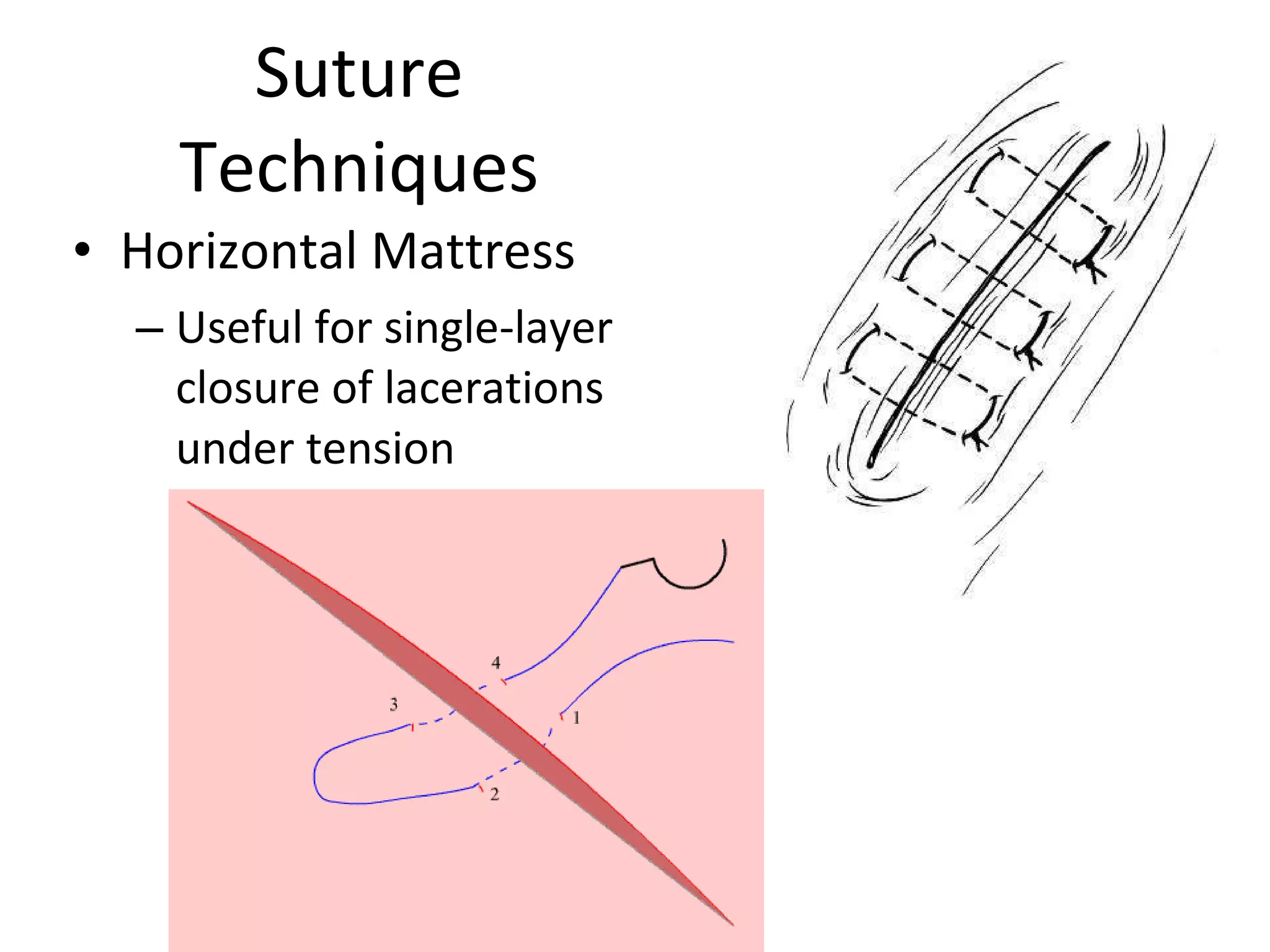
Suture Techniques Horizontal Mattress Useful for single-layer closure of lacerations under tension
Suture Techniques Vertical Mattress Useful for everting skin edges “ Far-far-near-near”
Suture Techniques Purse-string Useful for stellate lacerations
Suture Techniques Instrument tie
Other devices in wound closure Staples Quick, poor aesthetic result where scar is less of an issue (hairy scalp) Adhesives Dermabond clean, sharp edges, clean nonmobile areas, laceration less than 5 cm in length Tape Steri-strips superficial, straight laceration under little tension
After care • Wound Dressings  •   Maintain dry  –24 –48 hours – Augments reepithelialization  •“ Water-Tight” after 48 hours • Bandages – Soft-splint – Absorb exudates – Protects Wound – Protects knots
Suture removal guidelines Anatomic location  Days (average) face 3-5 arm 7 anterior trunk 7 back 10-14 feet and hand 10-14 joint 10-14   scalp 10-14
Wounds appropriate for consultation/referral •  Primary provider is  unable to perform  optimal repair –  Skill level does not match complexity of wound –  Practice setting is  too busy  to allow adequate time for repair •  Underlying injury –  Tendon ,Nerve, Vascular,Joint  involvement or underlying  fracture Eyelid : tarsal plate or lacrimal duct involvement Patient requests  specialist •  Operative repair necessary –  Skin grafting –  Flap creation  or rotation
References www.cme-ce-summaries.com/emergency-medicine/em2604.html www.medstudentlc.com www.emedicine.medscape.com www.proceduresconsult.com Essential Practice of Surgery : Basic Science and Clinical Evidence;2003;chapter7;pg77-88;H.Peter Lorenzo, Michael T. Longaker. Robbins Basic Pathology 8 th  edition;chapter3;pg70-8; Kumar, Abbas, Faustro, Mitchell. Essential Surgery : Problems, Diagnosis & Management ; chapter11;pg149-58; H.G. Burkitt,C.R.G. Quick, J.B.Reed. Wound Management ; powerpoint presentation by UNC emergency medicine (Medical Student Lecture Series). Wound Management Principles ; powerpoint presentation by Donald J Sefcik and Nicole Y Ottens, FACOEP. Wound Management 2001 ; powerpoint presentation by Gavin Greenfield and Bob Johnston.
Practice Time!

Woundcare

  • 1.
    WOUND CARE “the primary goal of wound care is not the technical repair of the wound; it is providing optimal conditions for the natural reparative processes of the wound to proceed” – Richard L. Lammers (Roberts and Hedges)
  • 2.
    GOALS of woundcare Facilitate hemostasis Decrease tissue loss Promote wound healing Minimize scar formation
  • 3.
  • 4.
    Wound healing :PATHOPHYSIOLOGY 1.) Inflammatory Phase Initial response (Day 1-4 post injury) rubor, tumor, dolor, calor Platelet aggregation and activation Leukocyte (PMNs, macrophages) migration, phagocytosis and mediator release Venule dilation Exudative a biologic debridement In wounds closed by primary intention, lasts 4 days
  • 5.
    2.) Proliferative PhaseDay 4-42 macrophage-released growth factors  Fibroblast proliferation  Increased rate of collagen synthesis Granulation tissue and neovascularization Gain in tensile strength
  • 6.
    3.) Remodeling Phase6wks-1 year Intermolecular cross-linking of collagen via vitamin C-dependent hydroxylation Characterized by increase in tensile strength Type III collagen replaced with type I Scar flattens
  • 7.
    TYPES of WoundHealing 1.) Healing by first intention (aka. primary wound healing or primary closure) wound closed by approximation of wound margins or by placement of a graft or flap , or wounds created and closed in the operating room. Best choice for wounds in well-vascularized areas Indications -recent (<24h old) -clean -viable tissue -tension-free treated within 24 h, prior to development of granulation tissue. epithelialize within 24 to 48 h. Water barrier function restored  can shower or wash.
  • 8.
    2.) Healing bysecond intention (aka. secondary wound healing or spontaneous healing) wound left open and allowed to close by epithelialization and contraction. Commonly : management of contaminated or infected wounds. without surgical intervention. Unlike primary wounds , approximation of wound margins occurs via reepithelialization and wound contraction by myofibroblasts. Presence of granulation tissue. Complications -late wound contracture -hypertrophic scarring
  • 9.
    3.) Healing bythird intention (aka. tertiary wound healing or delayed primary closure) wounds that are too heavily contaminated for primary closure but appear clean and well vascularized after 4-5 days of open observation . Inflammation  reduced bacterial concentration (“debribe”)  allow safe closure. Indications :- infected or unhealthy wounds with high bacterial content, -wounds with a long time lapse since injury, or -wounds with a severe crush component with significant tissue devitalization. Wound edges are approximated within 3-4 days tensile strength develops as with primary closure.
  • 10.
    wound preparation (debridement,cleansing,etc.) dress with saline soaked fine mesh gauze follow up in 72-96 hours for debridement repeat cleansing and closure if no evidence of infection
  • 11.
    Factors that affectwound healing Patient factor : Age Immunocompromising -DM - renal failure - AIDS - splenectomy Medications –systemic steroids/ other immunocompromising drugs  i ncreased infection rates Wound Characteristics   - Time , Location , Etiology , Mechanism of injury , Laceration width
  • 12.
    Factors that affectwound healing In general, remember “DIDN'T HEAL” D = Diabetes : -diminishing sensation and arterial inflow ++ acute loss of diabetic control  diminished cardiac output, poor peripheral perfusion, and impaired polymorphonuclear leukocyte phagocytosis. I = Infection : -potentiates collagen lysis. Bacterial contamination + susceptible host + wound environment = wound infection. Foreign bodies (including sutures) potentiate wound infection.
  • 13.
    DIDN’T HEAL D= Drugs : Steroids and antimetabolites impede proliferation of fibroblasts and collagen synthesis. N = Nutritional problems: Protein-calorie malnutrition and deficiencies of vitamins A, C, and zinc. T = Tissue necrosis , from local or systemic ischemia or radiation injury. Blood supply is important.
  • 14.
    DIDN’T HEAL H= Hypoxia : -esp the distal extent of the extremities. Blood volume deficit, unrelieved pain, or hypothermia  sympathetic overactivity  local vasoconstriction  Inadequate tissue oxygenation. E = Excessive tension on wound edges  local tissue ischemia and necrosis.
  • 15.
    DIDN’T HEAL A= Another wound : Competition for the substrates required for wound healing. L = Low temperature : (relatively) distal aspects of the upper and lower extremities (a reduction of 1-1.5°C [2-3°F] from normal core body temperature) is responsible for slower healing of wounds at these sites.
  • 16.
    Wound Evaluation -HISTORYidentify all extrinsic and intrinsic factors that jeopardize healing and promote infection – mechanism of injury – time of injury (accelerated growth phase of bacteria starts at 3 hours post wound) – environment in which wound occurred potential contaminants, foreign bodies – species of animal if bite wound – pt’s medical problems (allergies to medication) / immune status tetanus immunization status
  • 17.
    history Immunocompromised Bleedingdisorder.Prolonged bleeding-. Hematoma can serve as culture medium for wound infection. Peripheral vascular disease
  • 18.
    Mechanism of injuryFORCE OBJECT DAMAGE WOUND shear Sharp Minimal Linear compression Blunt Right angle Moderate (+) Stellate Jagged tensile Blunt Oblique angle Moderate (+) Triangular Flap
  • 19.
    TYPES of woundAbrasions Superficial layer of tissue is removed Avulsions A section of tissue is torn off (partially or totally) Lacerations Ti ssue is cut or torn. Sharply demarcated borders. Puncture Small opening and of indeterminate depth. Contusion forceful blow, outer layer of skin intact ; minimal wound care ; evaluate for possible hematoma Combination wound
  • 20.
    Wound assessment Examinefor: – amount of tissue destruction – degree of contamination – damage to underlying structures
  • 21.
    • Body Location – Proximity to Other Structures – Joints –Nerves –Tendons –Vasculature – Test integrity of each structure • Assess laxity/muscle and tendon function • Assess 2-point discrimination • Assess vascular supply
  • 22.
    Physical examination WoundLocation – importance in the risk of infection – high endogenous bacterial counts in hairy scalp, forehead, axilla, groin, foreskin of penis, vagina, mouth, nails – wounds in areas of high vascularity more easily resist infection (scalp, face)
  • 23.
  • 24.
    Wound Preparation -Anesthesia Topical Solution or paste LET TAC EMLA Local Direct infiltration 1% lidocaine with or without epinephrine Bupivicaine or sensorcaine for longer acting anesthesia Regional Block Local infiltration proximally in order to avoid tissue disruption Smaller amount of anesthesia required
  • 25.
    Topical anesthesia Solely/ with local infiltration Most effective : face and scalp (high vascularity) LET ( lidocaine, epinephrine, tetracaine) TAC ( tetracaine, adrenaline/epinephrine, cocaine ) cotton ball soaked with 3–5ml applied to the open wound for at least 10 minutes
  • 26.
    Local anesthetic DrugMax Dose Onset Duration Cocaine 6.6 mg/kg Rapid 1 hour Procaine 10-15 mg/kg Rapid 30min-1hr Tetracaine 1.5 mg/kg Moderate 2 hours Lidocaine 5 mg/kg 5-30 min 2 hours (with Epi) 7 mg/kg 5-30 min 2-3 hours Bupivacaine 2 mg/kg 7-30 min > 6 hours
  • 27.
    Epinephrine Vasoconstrictive – Increases Duration of Action – Promotes Hemostasis – Avoid end-arterial blood supply areas – May increase pain (low pH)
  • 28.
    Local infiltration reducethe pain of anesthetic infiltration 1. Premedicate the wound with a topical anesthetic (described above) or ice. 2. B uffer anesthetic with sodium bicarbonate ( 1 ml/ 10 ml )  less painful anesthetic. 3. Needle size : smallest diameter needle . A 30-gauge needle is preferred. 4. Inject slowly (10sec), as pain results when the soft tissue stretches.
  • 29.
    Wound Preparation -Hemostasis Direct Pressure–Usually best choice Ligatures Use a tourniquet Chemicals – Epinephrine – Gelfoam – Oxycel – Actifoam Cautery
  • 30.
    Wound Preparation –Foreign Body Removal Suspect with point tenderness Visual inspection (to the apex) Imaging Glass, metal, gravel fragments >1mm should be visible on plain radiographs Organic substances and plastics are usually radiolucent Always discuss and document possibility of retained foreign body
  • 31.
    Hair removal Shaving – Increases risk of infection X 10 ! Clip Hair with Scissors Matt Hair with Ointment Never shave eyebrows ( may not regrow )
  • 32.
    Wound preparation :CLEANING high pressure irrigation (Normal Saline) min 100-300 ml with continued irrigation at least 8 psi force to the wound  the irrigation fluid dislodges foreign bodies, contaminants, and bacteria. A simple device setup 30-60 ml syringe and an 14-gauge angiocatheter.
  • 33.
    Wound Preparation –Debridement Removes devitalized tissue Creates sharp wound edge Excision with elliptical shape Respect skin lines
  • 34.
    Indications for systemic antibiotic for traumatic wounds • Injury 6 hours old on the extremities Injury 24 hours old on the face and scalp Tendon, joint, or bony involvement • Cartilage involvement • Mammalian bite • Co-morbidity (diabetes mellitus, extremes of age, steroid use, morbid obesity) Puncture wound Complex intraoral wound
  • 35.
    “ Prophylactic” Antibiotics If Prescribed • Duration 3 –7 days • Wound Recheck in 24 –48 hours
  • 36.
    Wound preparation -Tetanusprophylaxis Clean wounds Incompleted immunization  toxoid >10 years, then give toxoid Tetanus prone wound Incompleted immunization  Toxoid & immunoglobulin > 5 years, give toxoid
  • 37.
    WOUND CLOSURE Underminethe wound edges Release tension
  • 38.
    Wound closure inrelation to time Primary closure Suture, staple, adhesive, or tape Performed on recently sustained lacerations: <12 hours generally and <24 hours on face Secondary closure Secondary intent Allowed to granulate Tertiary closure Delayed primary (observed for 3-4days)
  • 39.
    Suture supply needledrivers … tissue forceps (or skin hook) Scissors sterile drapes sterile gloves suture materials sterile gauze
  • 40.
    Suture Material AbsorbableChromic catgut ( natural monofilament) Vicryl (synthetic braided) PDS II (synthetic monofilament) Non-Absorbable Silk (natural braided) Ethilon (synthetic monofilament) Monofilament (smooth but stiff) vs. Braided (has interstices = haven for bacteria)
  • 41.
    Suture size SkinFace 5/0 or 6/0 Hands and Limbs 3/0 or 4/0 Elsewhere 2/0 or 3/0
  • 42.
    SUTURE TECHNIQUES Deeplayer approximation Absorbable sutures Buried knot Serves two purposes Closes potential spaces Minimizes tension on the wound margins
  • 43.
    Skin Closure Key– wound edge eversion “ Approximate, don’t strangulate” Anticipate wound edema Choose appropriate size of suture for location of laceration
  • 44.
    Suture Techniques SimpleInterrupted Used on majority of wounds Each stitch is independent
  • 45.
    Suture Techniques SimpleContinuous Useful in pediatrics Rapid Easy removal Provides effective hemostasis Distributed tension evenly along length Can also be locked with each stitch
  • 46.
    Suture Techniques HorizontalMattress Useful for single-layer closure of lacerations under tension
  • 47.
    Suture Techniques VerticalMattress Useful for everting skin edges “ Far-far-near-near”
  • 48.
    Suture Techniques Purse-stringUseful for stellate lacerations
  • 49.
  • 50.
    Other devices inwound closure Staples Quick, poor aesthetic result where scar is less of an issue (hairy scalp) Adhesives Dermabond clean, sharp edges, clean nonmobile areas, laceration less than 5 cm in length Tape Steri-strips superficial, straight laceration under little tension
  • 51.
    After care •Wound Dressings • Maintain dry –24 –48 hours – Augments reepithelialization •“ Water-Tight” after 48 hours • Bandages – Soft-splint – Absorb exudates – Protects Wound – Protects knots
  • 52.
    Suture removal guidelinesAnatomic location Days (average) face 3-5 arm 7 anterior trunk 7 back 10-14 feet and hand 10-14 joint 10-14 scalp 10-14
  • 53.
    Wounds appropriate forconsultation/referral • Primary provider is unable to perform optimal repair – Skill level does not match complexity of wound – Practice setting is too busy to allow adequate time for repair • Underlying injury – Tendon ,Nerve, Vascular,Joint involvement or underlying fracture Eyelid : tarsal plate or lacrimal duct involvement Patient requests specialist • Operative repair necessary – Skin grafting – Flap creation or rotation
  • 54.
    References www.cme-ce-summaries.com/emergency-medicine/em2604.html www.medstudentlc.comwww.emedicine.medscape.com www.proceduresconsult.com Essential Practice of Surgery : Basic Science and Clinical Evidence;2003;chapter7;pg77-88;H.Peter Lorenzo, Michael T. Longaker. Robbins Basic Pathology 8 th edition;chapter3;pg70-8; Kumar, Abbas, Faustro, Mitchell. Essential Surgery : Problems, Diagnosis & Management ; chapter11;pg149-58; H.G. Burkitt,C.R.G. Quick, J.B.Reed. Wound Management ; powerpoint presentation by UNC emergency medicine (Medical Student Lecture Series). Wound Management Principles ; powerpoint presentation by Donald J Sefcik and Nicole Y Ottens, FACOEP. Wound Management 2001 ; powerpoint presentation by Gavin Greenfield and Bob Johnston.
  • 55.

Editor's Notes

  • #13 D = Diabetes: The long-term effects of diabetes impair wound healing by diminishing sensation and arterial inflow. In addition, even acute loss of diabetic control can affect wound healing by causing diminished cardiac output, poor peripheral perfusion, and impaired polymorphonuclear leukocyte phagocytosis. I = Infection: Infection potentiates collagen lysis. Bacterial contamination is a necessary condition but is not sufficient for wound infection. A susceptible host and wound environment are also required. Foreign bodies (including sutures) potentiate wound infection. D = Drugs: Steroids and antimetabolites impede proliferation of fibroblasts and collagen synthesis. N = Nutritional problems: Protein-calorie malnutrition and deficiencies of vitamins A, C, and zinc impair normal wound-healing mechanisms. T = Tissue necrosis, resulting from local or systemic ischemia or radiation injury, impairs wound healing. Wounds in characteristically well-perfused areas, such the face and neck, may heal surprisingly well despite unfavorable circumstances. Conversely, even a minor wound involving the foot, which has a borderline blood supply, may mark the onset of a long-term, nonhealing ulcer. Hypoxia and excessive tension on the wound edges also interfere with wound healing because of local oxygen deficits. (See image below and  Image 4 .) Pressure ulcers of the lateral aspect of the right foot. H = Hypoxia: Inadequate tissue oxygenation due to local vasoconstriction resulting from sympathetic overactivity may occur because of blood volume deficit, unrelieved pain, or hypothermia, especially involving the distal extent of the extremities. E = Excessive tension on wound edges: This leads to local tissue ischemia and necrosis. A = Another wound: Competition between several healing areas for the substrates required for wound healing impairs wound healing at all sites. L = Low temperature: The relatively low tissue temperature in the distal aspects of the upper and lower extremities (a reduction of 1-1.5°C [2-3°F] from normal core body temperature) is responsible for slower healing of wounds at these sites.
  • #19 Minimal energy -&gt; minimal tissue damage -&gt; minimal devitalised tissue -&gt; low risk of infection
  • #36 Most important prevention  adequate irrigation &amp; debridement
  • #43 The major role of these sutures is to reduce tension. They are also used to close dead spaces. Placement of deep dermal sutures. The needle is inserted at the depth of the dermis and directed upward, exiting beneath the dermal-epidermal junction. Then the needle is inserted across the wound and directed downward, exiting at the wound base. The suture knot is then placed deep in the wound.
  • #45 Individual sutures: -If one loosens, remainder unaffected -If wound becomes infected, may remove individuallyUse
  • #46 Quick technique-Only two knots are tied (one at each end) Best for wounds that are linear May accommodate wound swelling Sutures are not independent sutures: -If one breaks or one end unties, all are affected -If wound becomes infected, must remove all -May invert wound margins
  • #47 useful alternative to two-layer closure in a patient who is at high risk for developing a wound infection. Quicker to place than vertical mattress sutures -Covers more distance with each suture Generally allow for better wound margin eversion -Result 2 –3 months later is often more cosmetic Helpful for wounds that are under tension-especially around joints
  • #48 Enhances skin eversion -Maximizes precise skin-to-skin coaptation Helpful for wounds that are deeper, in areas of lax skin, or when the skin margins tend to invert Scarring may be inferior to other techniques May be used as an “all-in-one” suture -Deep and superficial –at the same time