Cultural Codes
Analysing the target demographics of
Channel 4’s documentaries
Courtney O’Donnell
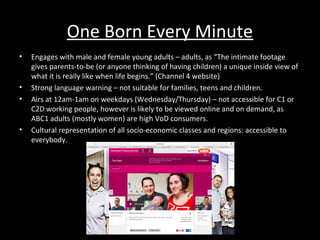
One Born Every Minute
• Engages with male and female young adults – adults, as “The intimate footage
gives parents-to-be (or anyone thinking of having children) a unique inside view of
what it is really like when life begins.” (Channel 4 website)
• Strong language warning – not suitable for families, teens and children.
• Airs at 12am-1am on weekdays (Wednesday/Thursday) – not accessible for C1 or
C2D working people, however is likely to be viewed online and on demand, as
ABC1 adults (mostly women) are high VoD consumers.
• Cultural representation of all socio-economic classes and regions: accessible to
everybody.
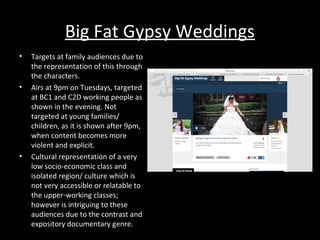
Big Fat Gypsy Weddings
• Targets at family audiences due to
the representation of this through
the characters.
• Airs at 9pm on Tuesdays, targeted
at BC1 and C2D working people as
shown in the evening. Not
targeted at young families/
children, as it is shown after 9pm,
when content becomes more
violent and explicit.
• Cultural representation of a very
low socio-economic class and
isolated region/ culture which is
not very accessible or relatable to
the upper-working classes;
however is intriguing to these
audiences due to the contrast and
expository documentary genre.
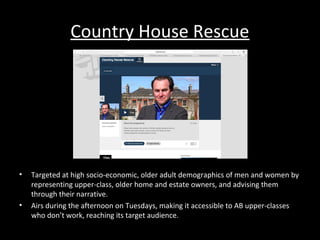
Country House Rescue
• Targeted at high socio-economic, older adult demographics of men and women by
representing upper-class, older home and estate owners, and advising them
through their narrative.
• Airs during the afternoon on Tuesdays, making it accessible to AB upper-classes
who don’t work, reaching its target audience.
Conclusion
From this analysis of cultural codes and how to reach a target
audience through scheduling, I will air my documentary at 9pm
on Thursday. This will allow me to reach my lower class BC1 and
C2D working class audience demographic by following their
sleep and work schedule, alongside my flexible AB demographic;
as sexism within the media relates to all socio-economic
audiences.
Furthermore, I can target at my 17-35 year old audience by
showing my documentary at the late evening, and can discuss
the controversial and political issue of sexism which presents a
sexual nature without effecting young children at the
appropriate time of 9pm; preventing issues of censorship.
Conclusion
From this analysis of cultural codes and how to reach a target
audience through scheduling, I will air my documentary at 9pm
on Thursday. This will allow me to reach my lower class BC1 and
C2D working class audience demographic by following their
sleep and work schedule, alongside my flexible AB demographic;
as sexism within the media relates to all socio-economic
audiences.
Furthermore, I can target at my 17-35 year old audience by
showing my documentary at the late evening, and can discuss
the controversial and political issue of sexism which presents a
sexual nature without effecting young children at the
appropriate time of 9pm; preventing issues of censorship.

Cultural Codes

  • 1.
    Cultural Codes Analysing thetarget demographics of Channel 4’s documentaries Courtney O’Donnell
  • 2.
    One Born EveryMinute • Engages with male and female young adults – adults, as “The intimate footage gives parents-to-be (or anyone thinking of having children) a unique inside view of what it is really like when life begins.” (Channel 4 website) • Strong language warning – not suitable for families, teens and children. • Airs at 12am-1am on weekdays (Wednesday/Thursday) – not accessible for C1 or C2D working people, however is likely to be viewed online and on demand, as ABC1 adults (mostly women) are high VoD consumers. • Cultural representation of all socio-economic classes and regions: accessible to everybody.
  • 3.
    Big Fat GypsyWeddings • Targets at family audiences due to the representation of this through the characters. • Airs at 9pm on Tuesdays, targeted at BC1 and C2D working people as shown in the evening. Not targeted at young families/ children, as it is shown after 9pm, when content becomes more violent and explicit. • Cultural representation of a very low socio-economic class and isolated region/ culture which is not very accessible or relatable to the upper-working classes; however is intriguing to these audiences due to the contrast and expository documentary genre.
  • 4.
    Country House Rescue •Targeted at high socio-economic, older adult demographics of men and women by representing upper-class, older home and estate owners, and advising them through their narrative. • Airs during the afternoon on Tuesdays, making it accessible to AB upper-classes who don’t work, reaching its target audience.
  • 5.
    Conclusion From this analysisof cultural codes and how to reach a target audience through scheduling, I will air my documentary at 9pm on Thursday. This will allow me to reach my lower class BC1 and C2D working class audience demographic by following their sleep and work schedule, alongside my flexible AB demographic; as sexism within the media relates to all socio-economic audiences. Furthermore, I can target at my 17-35 year old audience by showing my documentary at the late evening, and can discuss the controversial and political issue of sexism which presents a sexual nature without effecting young children at the appropriate time of 9pm; preventing issues of censorship.
  • 6.
    Conclusion From this analysisof cultural codes and how to reach a target audience through scheduling, I will air my documentary at 9pm on Thursday. This will allow me to reach my lower class BC1 and C2D working class audience demographic by following their sleep and work schedule, alongside my flexible AB demographic; as sexism within the media relates to all socio-economic audiences. Furthermore, I can target at my 17-35 year old audience by showing my documentary at the late evening, and can discuss the controversial and political issue of sexism which presents a sexual nature without effecting young children at the appropriate time of 9pm; preventing issues of censorship.