CompTIA 4th Annual Trends in
Managed Services
Copyright (c) 2014 CompTIA Properties, LLC. All Rights Reserved. | CompTIA.org
Mostly
Outsourced
Some
Outsourced/S
ome
Internal
Mostly
Internal
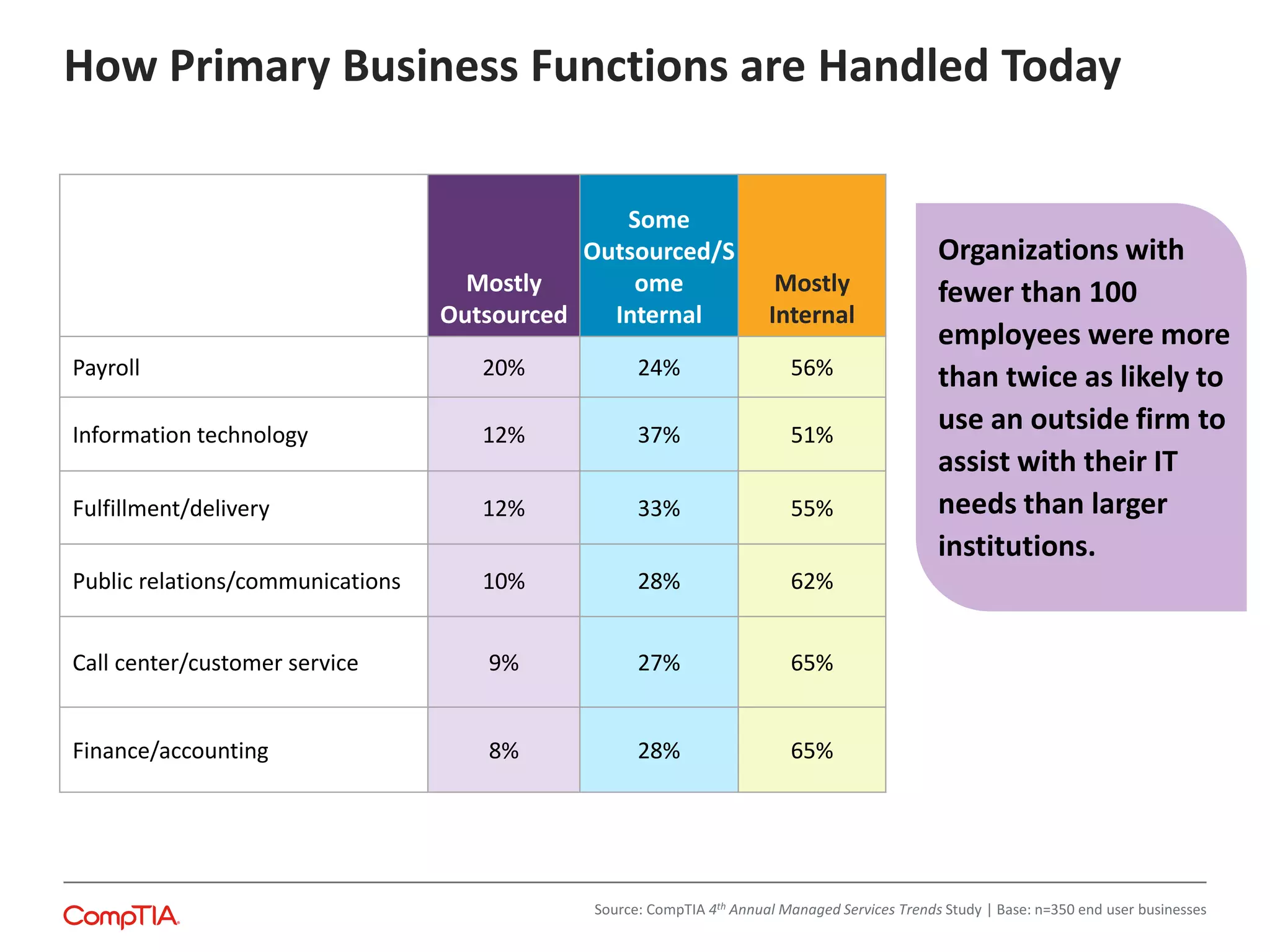
Payroll 20% 24% 56%
Information technology 12% 37% 51%
Fulfillment/delivery 12% 33% 55%
Public relations/communications 10% 28% 62%
Call center/customer service 9% 27% 65%
Finance/accounting 8% 28% 65%
Source: CompTIA 4th Annual Managed Services Trends Study | Base: n=350 end user businesses
Organizations with
fewer than 100
employees were more
than twice as likely to
use an outside firm to
assist with their IT
needs than larger
institutions.
How Primary Business Functions are Handled Today
IT Management Approaches Vary Across Companies
Source: CompTIA 4th Annual Managed Services Trends Study | Base: n=350 end user businesses
Satisfaction Levels with Current IT
Management Methods
60% Formal IT department with
dedicated staff
37% Periodic use of outside firms/ third
parties for various projects and/or
troubleshooting
35% Informally handled among non-IT
staff
21% Outsourcing/contractual
arrangement with a managed
services provider for ongoing
responsibility for some or all of IT
functions
Chief Ways IT is Handled
Within Businesses Today
Could Be
Significantly Better
Could Be
Somewhat Better
Fine As Is
39
%
52
%
9%
Ways Businesses Are Using IT Solutions/Service Providers
27%
32%
48%
50%
51%
43%
58%
55%
67%
27%
33%
38%
45%
47%
47%
48%
51%
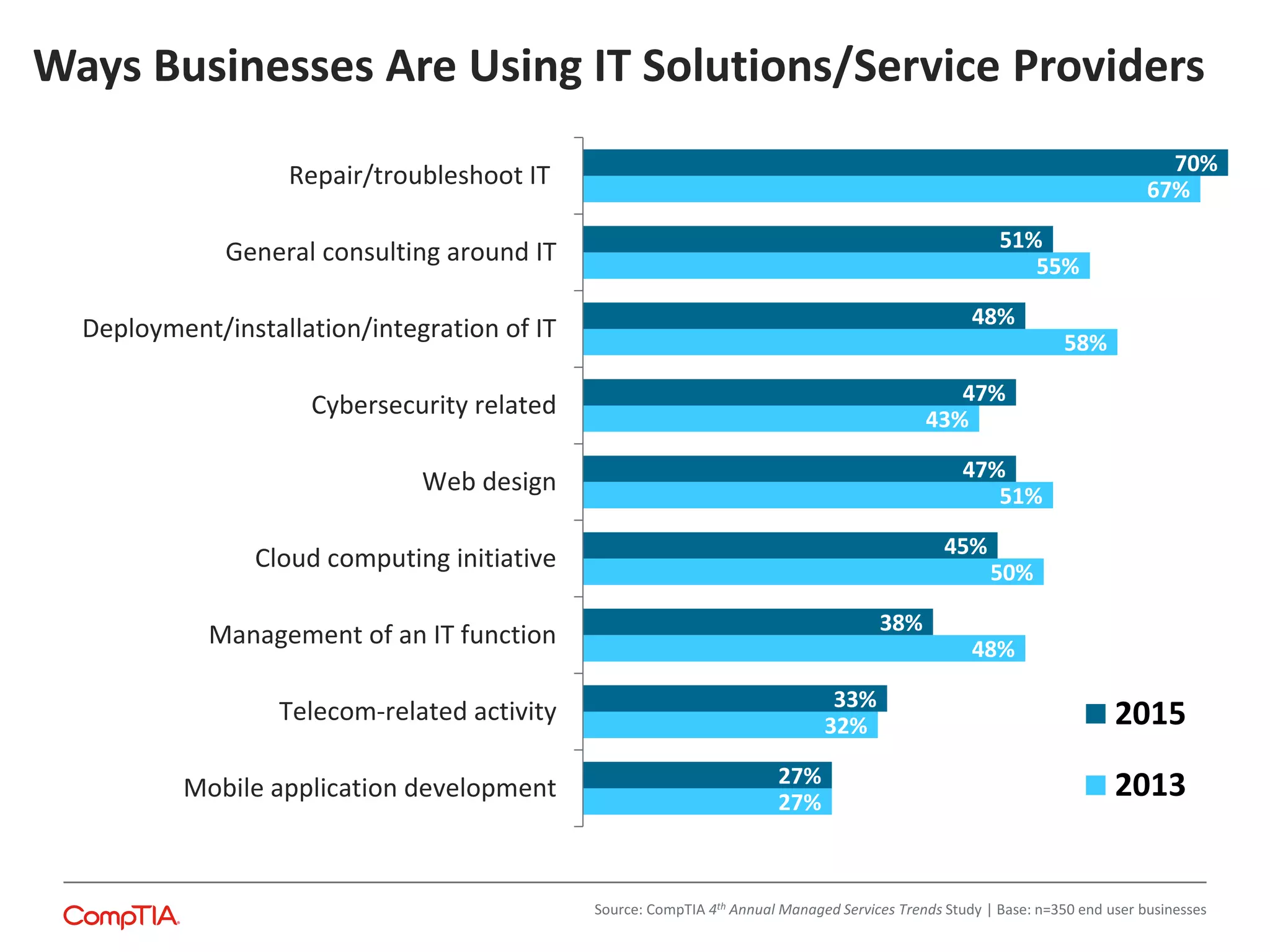
70%
Mobile application development
Telecom-related activity
Management of an IT function
Cloud computing initiative
Web design
Cybersecurity related
Deployment/installation/integration of IT
General consulting around IT
Repair/troubleshoot IT
2015
2013
Source: CompTIA 4th Annual Managed Services Trends Study | Base: n=350 end user businesses
22%
27%
38%
60%
33%
38%
26%
28%
32%
40%
45%
45%
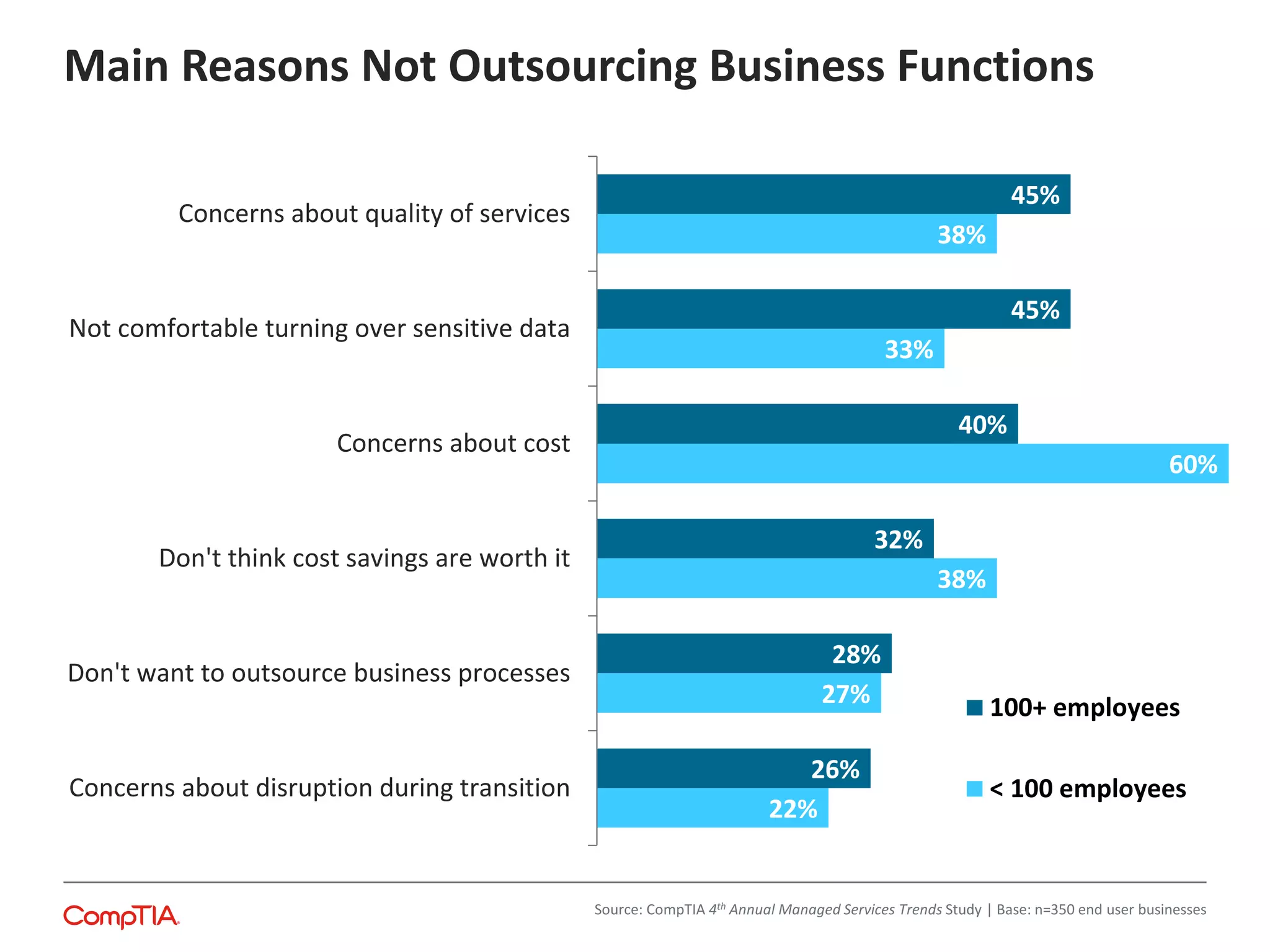
Concerns about disruption during transition
Don't want to outsource business processes
Don't think cost savings are worth it
Concerns about cost
Not comfortable turning over sensitive data
Concerns about quality of services
100+ employees
< 100 employees
Main Reasons Not Outsourcing Business Functions
Source: CompTIA 4th Annual Managed Services Trends Study | Base: n=350 end user businesses
Managed Services Usage
Patterns
Copyright (c) 2014 CompTIA Properties, LLC. All Rights Reserved. | CompTIA.org
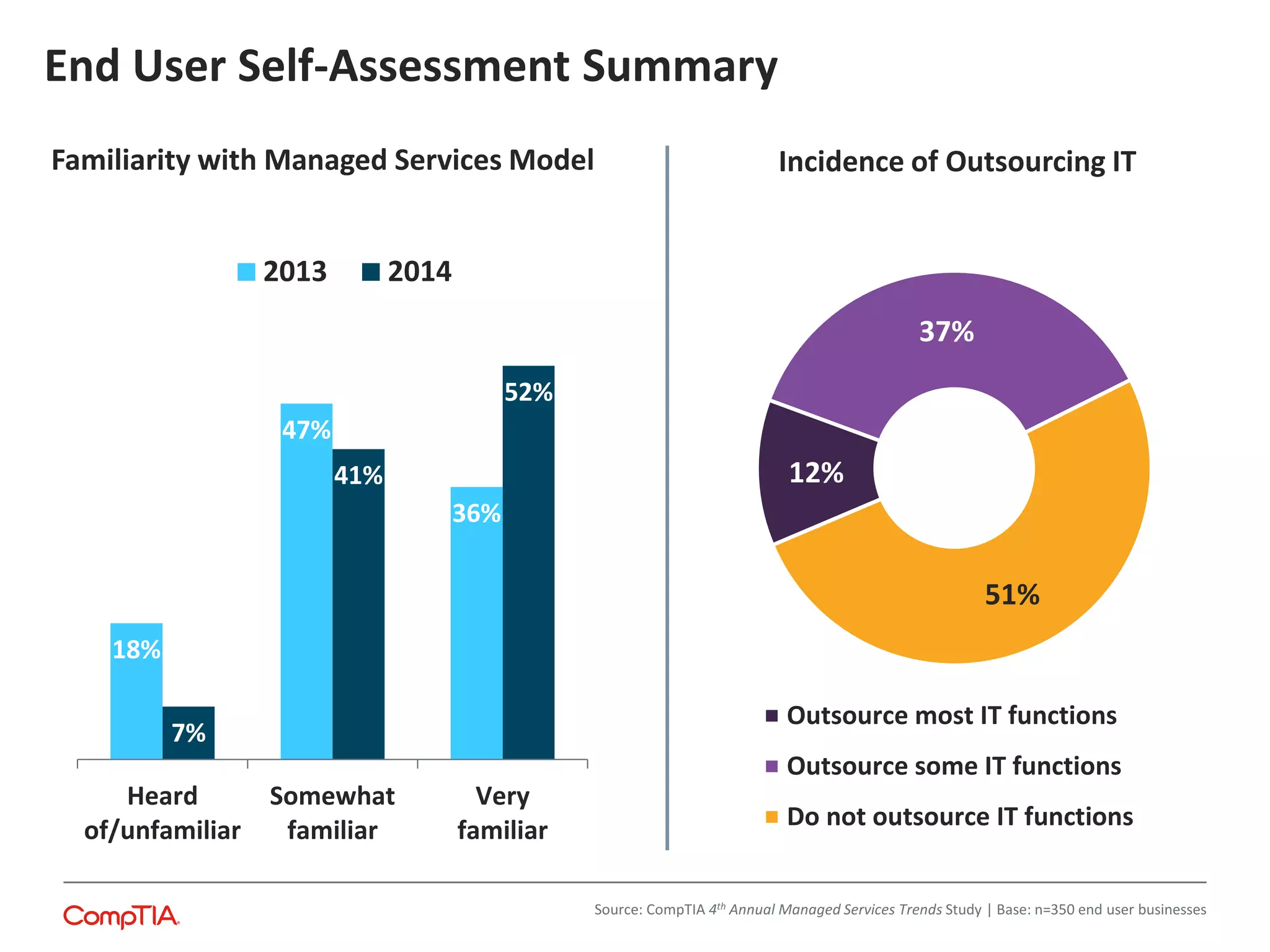
End User Self-Assessment Summary
18%
47%
36%
7%
41%
52%
Heard
of/unfamiliar
Somewhat
familiar
Very
familiar
2013 2014
Familiarity with Managed Services Model
CompTIA MPS Trustmark Value Proposition
1. Validation of MPS expertise to customers
2. Mechanism to evaluate internal MPS
operations / follow best practices
3. Differentiator
Incidence of Outsourcing IT
12%
37%
51%
Outsource most IT functions
Outsource some IT functions
Do not outsource IT functions
Source: CompTIA 4th Annual Managed Services Trends Study | Base: n=350 end user businesses
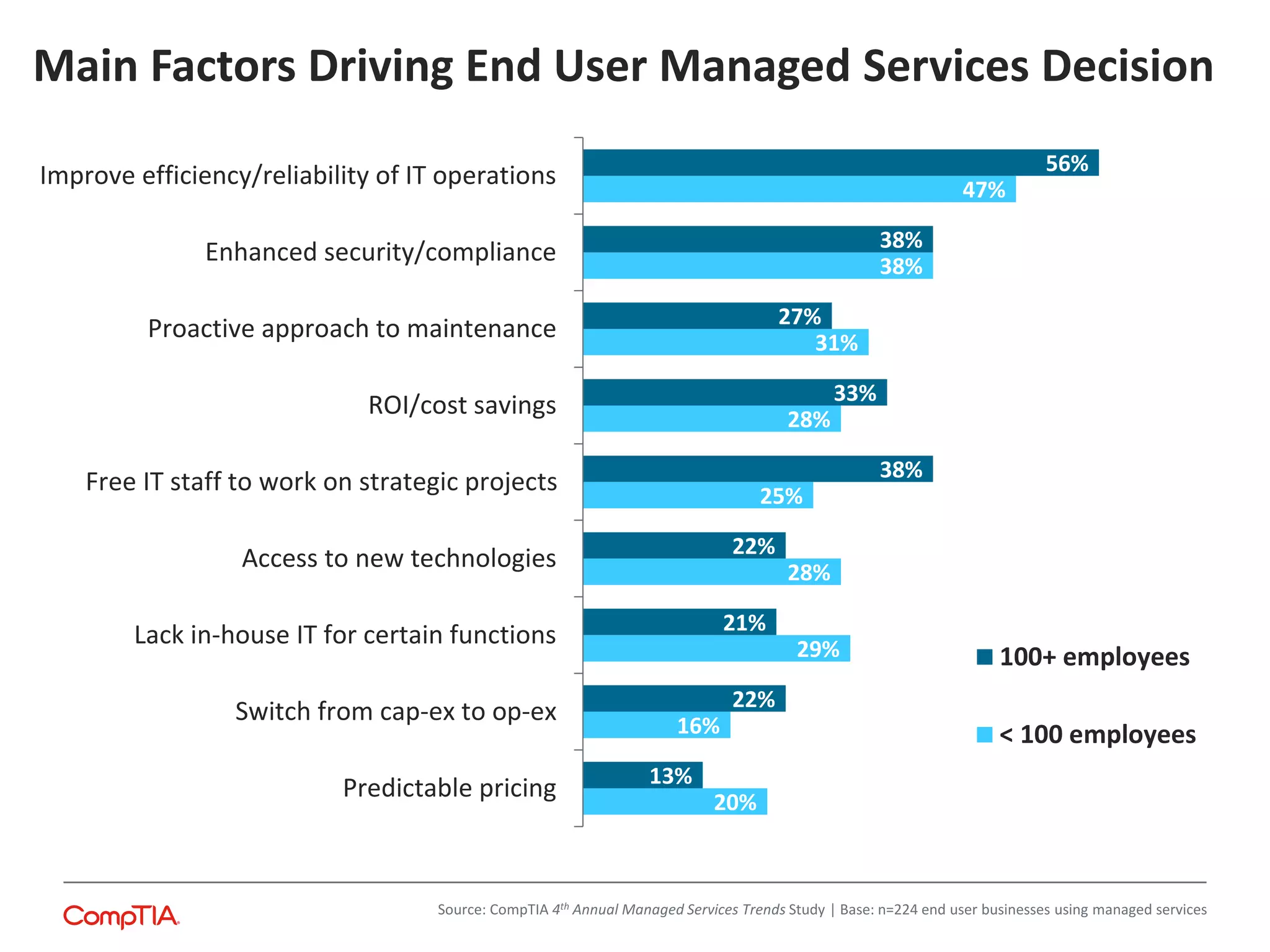
Main Factors Driving End User Managed Services Decision
20%
16%
29%
28%
25%
28%
31%
38%
47%
13%
22%
21%
22%
38%
33%
27%
38%
56%
Predictable pricing
Switch from cap-ex to op-ex
Lack in-house IT for certain functions
Access to new technologies
Free IT staff to work on strategic projects
ROI/cost savings
Proactive approach to maintenance
Enhanced security/compliance
Improve efficiency/reliability of IT operations
100+ employees
< 100 employees
Source: CompTIA 4th Annual Managed Services Trends Study | Base: n=224 end user businesses using managed services
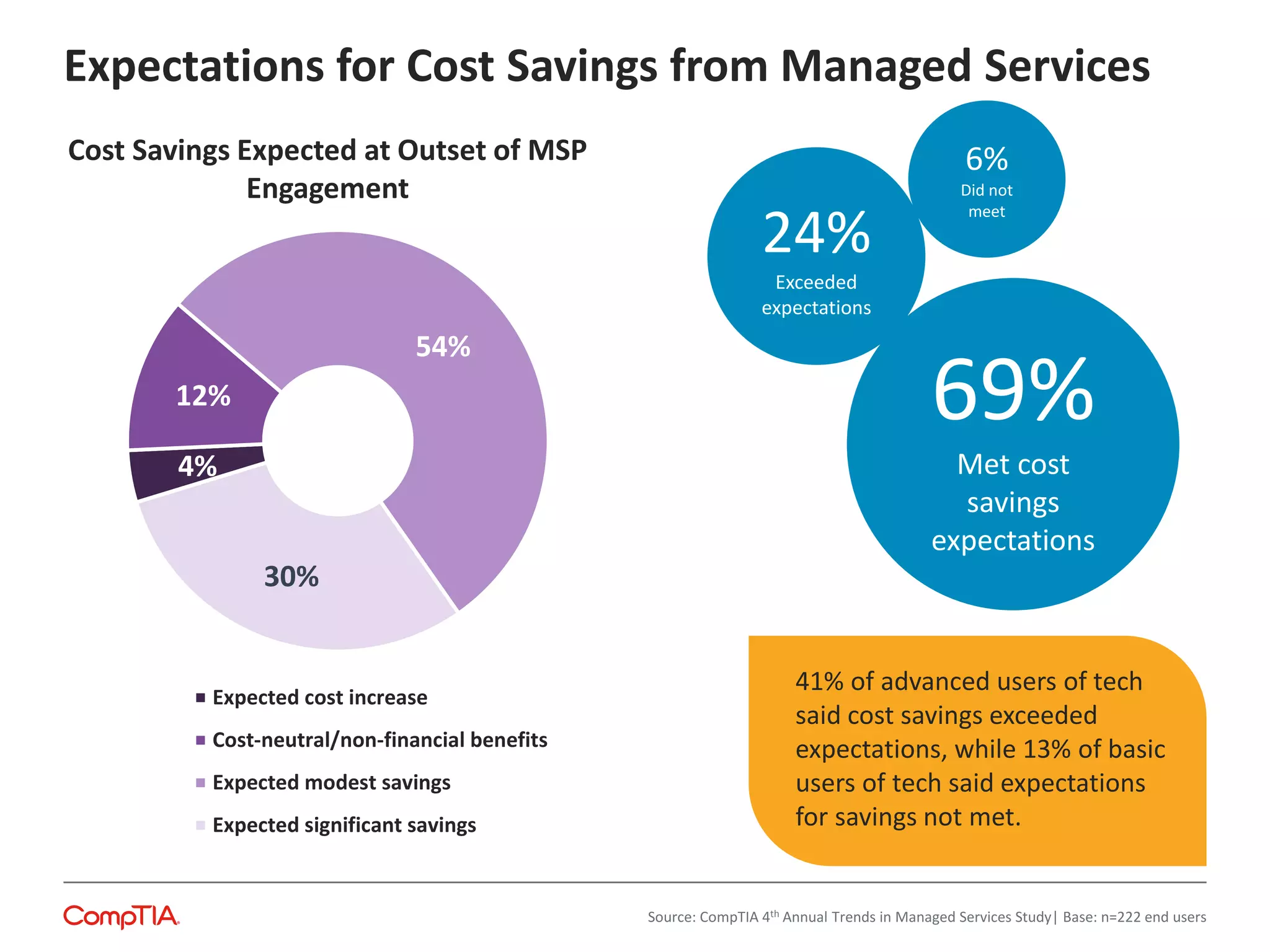
Expectations for Cost Savings from Managed Services
Cost Savings Expected at Outset of MSP
Engagement
4%
12%
54%
30%
Expected cost increase
Cost-neutral/non-financial benefits
Expected modest savings
Expected significant savings
Source: CompTIA 4th Annual Trends in Managed Services Study| Base: n=222 end users
6%
Did not
meet
24%
Exceeded
expectations
69%
Met cost
savings
expectations
41% of advanced users of tech
said cost savings exceeded
expectations, while 13% of basic
users of tech said expectations
for savings not met.
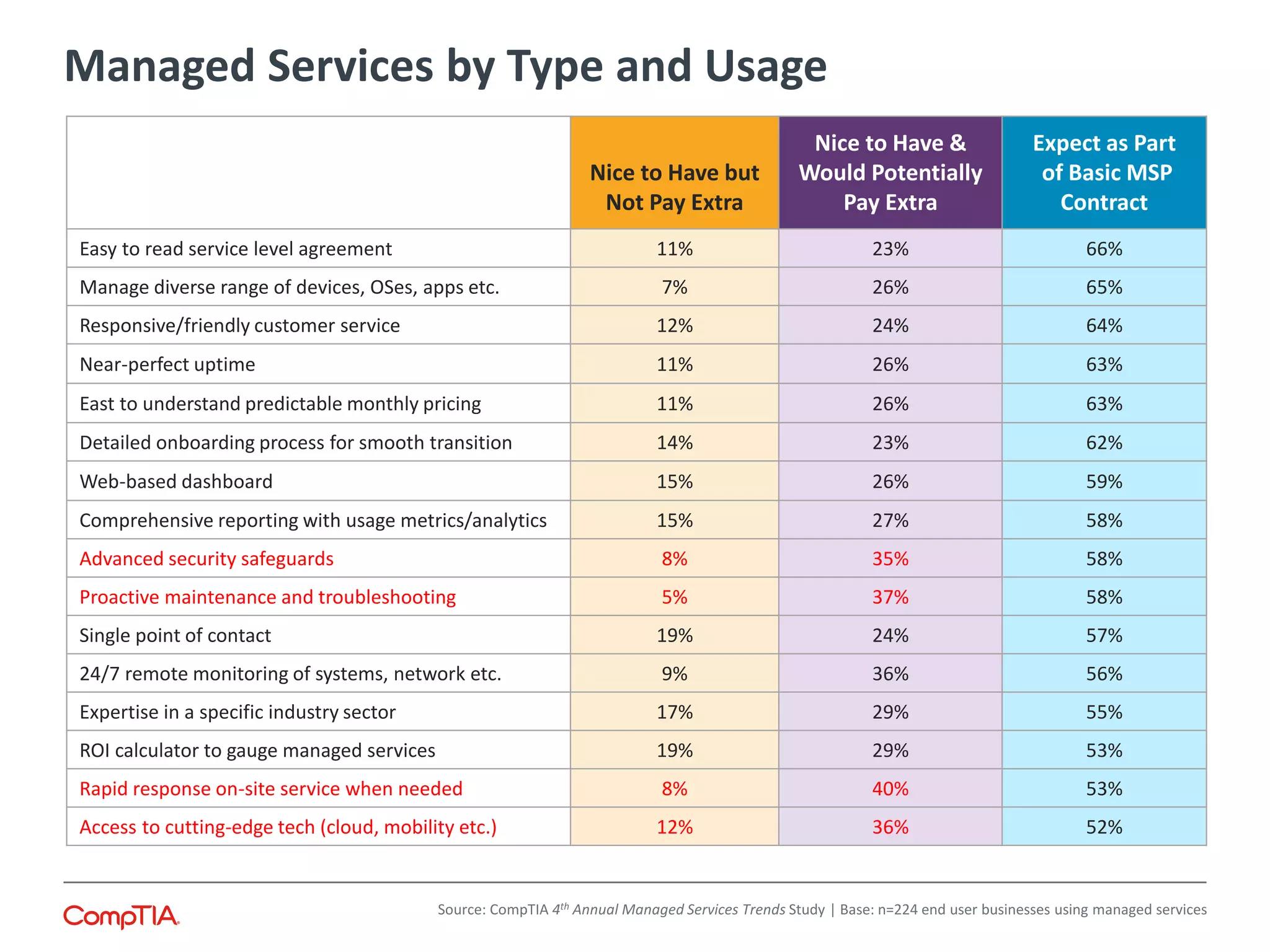
Managed Services by Type and Usage
Nice to Have but
Not Pay Extra
Nice to Have &
Would Potentially
Pay Extra
Expect as Part
of Basic MSP
Contract
Easy to read service level agreement 11% 23% 66%
Manage diverse range of devices, OSes, apps etc. 7% 26% 65%
Responsive/friendly customer service 12% 24% 64%
Near-perfect uptime 11% 26% 63%
East to understand predictable monthly pricing 11% 26% 63%
Detailed onboarding process for smooth transition 14% 23% 62%
Web-based dashboard 15% 26% 59%
Comprehensive reporting with usage metrics/analytics 15% 27% 58%
Advanced security safeguards 8% 35% 58%
Proactive maintenance and troubleshooting 5% 37% 58%
Single point of contact 19% 24% 57%
24/7 remote monitoring of systems, network etc. 9% 36% 56%
Expertise in a specific industry sector 17% 29% 55%
ROI calculator to gauge managed services 19% 29% 53%
Rapid response on-site service when needed 8% 40% 53%
Access to cutting-edge tech (cloud, mobility etc.) 12% 36% 52%
Source: CompTIA 4th Annual Managed Services Trends Study | Base: n=224 end user businesses using managed services
Neutral
Satisfied
Delighted
Disappointed
Dissatisfied
Basic Needs
Expected – no additional
satisfaction when present, but
dissatisfaction when absent
Excitement
Delight when present, but no
dissatisfaction when absent
Performance Needs
Proportional increase/decrease
in satisfaction or dissatisfaction
with performance
Fully implemented /
executed
Not implemented /
executed
KANO MODEL VISUALIZATION OF MANAGED SERVICES
 Easy to read SLA
 Mgt. of
device/app
diversity
 Proactive
maintenance
 Rapid response
on-site service
 Access to cutting-edge
technology
 Advanced security
safeguards
 Responsive/friendly
customer service
 Near-perfect uptime
 Easy to understand,
predictable pricing
 Web-based dashboard
 Superior
onboarding
process
 Comprehensive
reporting / metrics
 Single point
of contact
 Industry vertical-
specific expertise
 ROI calculator
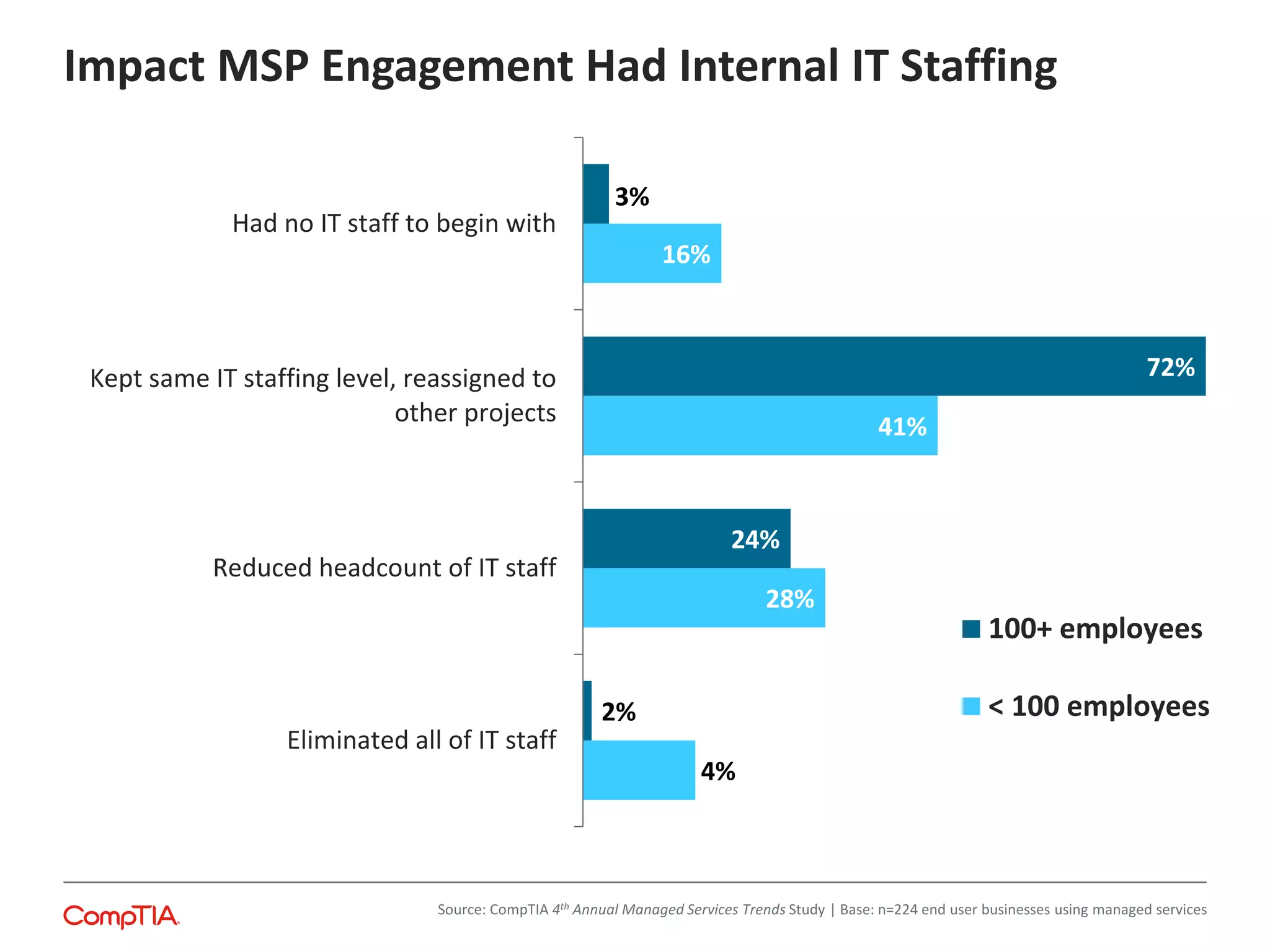
Impact MSP Engagement Had Internal IT Staffing
4%
28%
41%
16%
2%
24%
72%
3%
Eliminated all of IT staff
Reduced headcount of IT staff
Kept same IT staffing level, reassigned to
other projects
Had no IT staff to begin with
100+ employees
< 100 employees
Source: CompTIA 4th Annual Managed Services Trends Study | Base: n=224 end user businesses using managed services
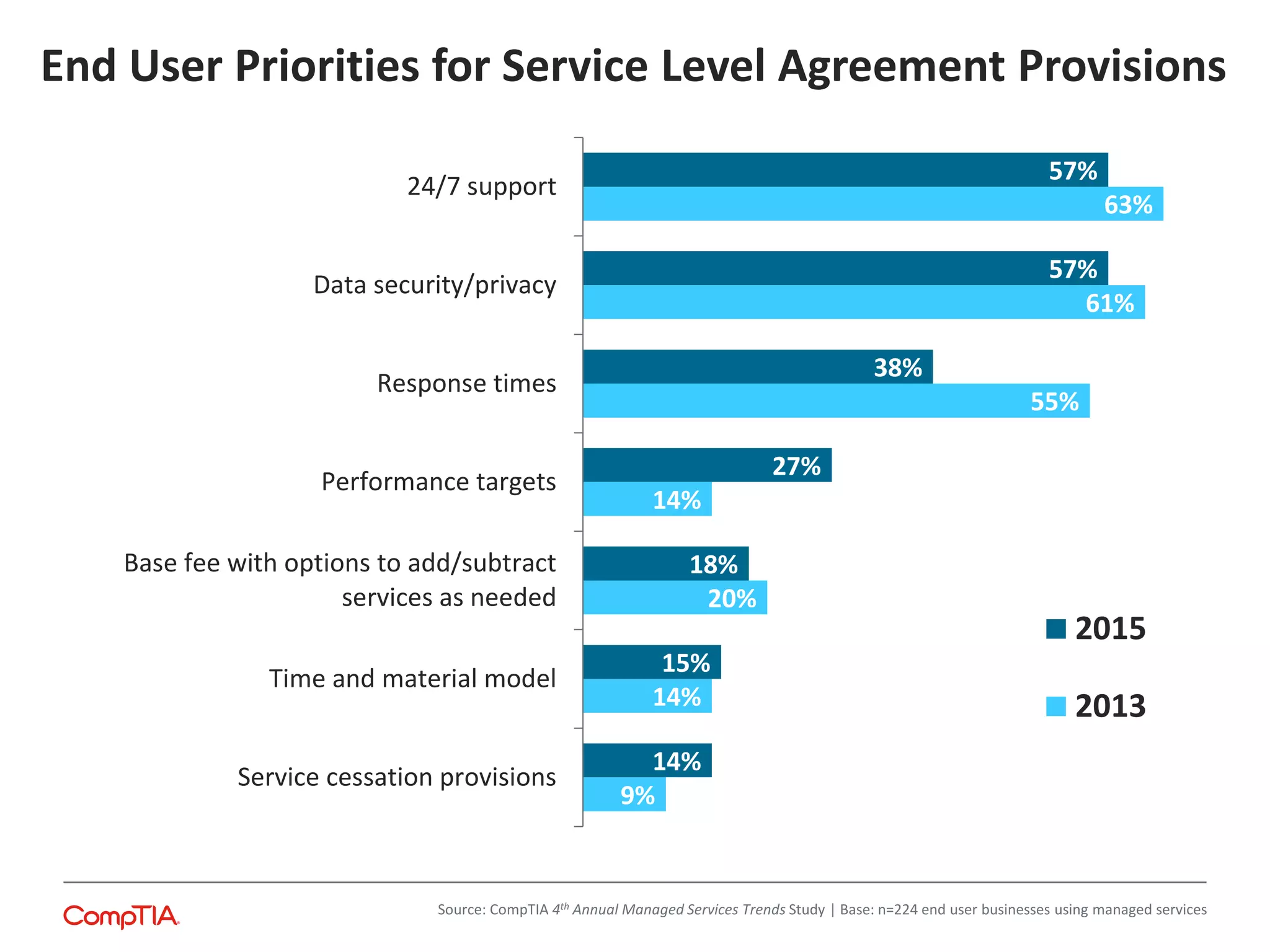
End User Priorities for Service Level Agreement Provisions
9%
14%
20%
14%
55%
61%
63%
14%
15%
18%
27%
38%
57%
57%
Service cessation provisions
Time and material model
Base fee with options to add/subtract
services as needed
Performance targets
Response times
Data security/privacy
24/7 support
2015
2013
Source: CompTIA 4th Annual Managed Services Trends Study | Base: n=224 end user businesses using managed services
Non-Users of Managed Services
Copyright (c) 2014 CompTIA Properties, LLC. All Rights Reserved. | CompTIA.org
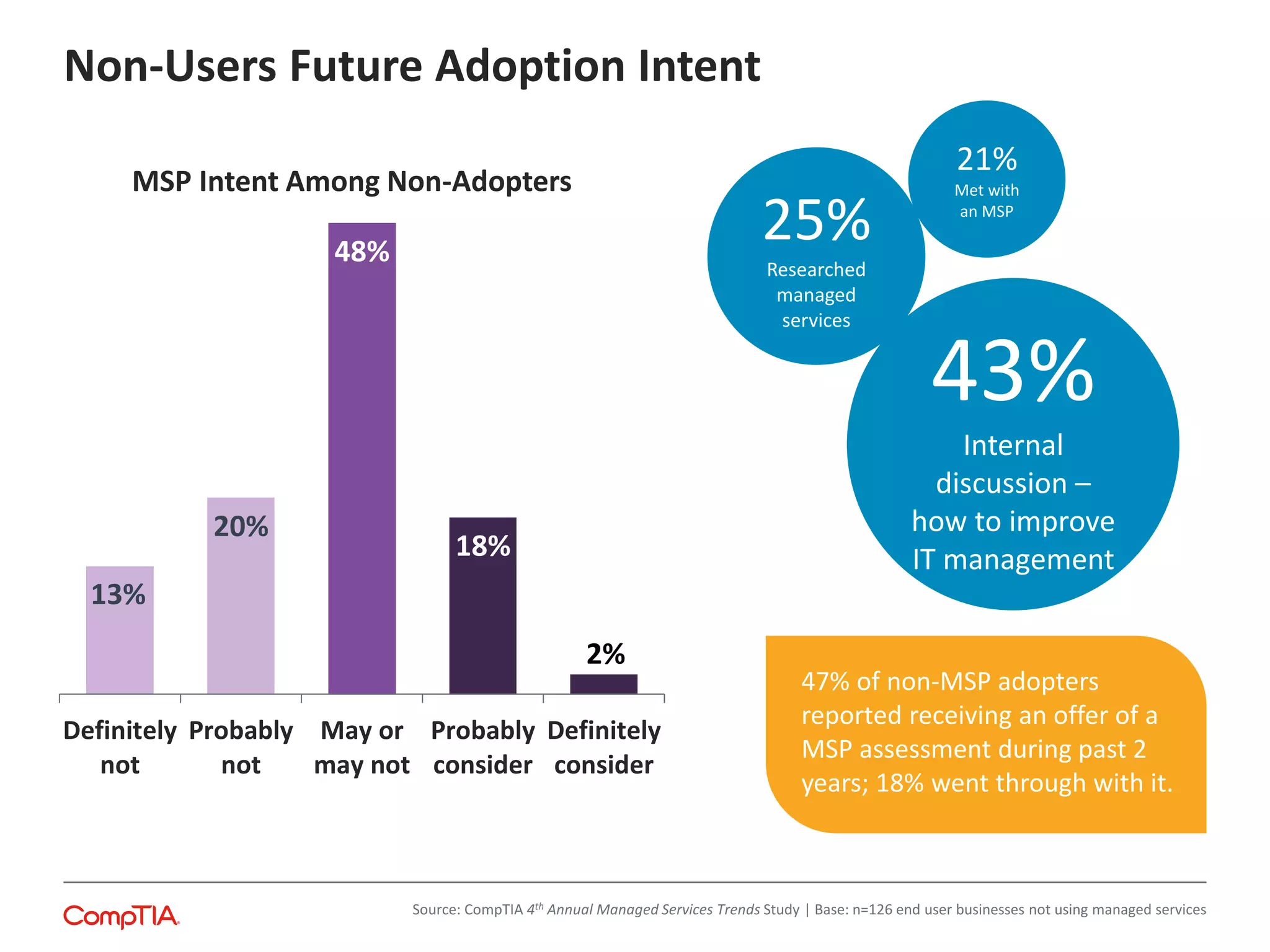
Non-Users Future Adoption Intent
13%
20%
48%
18%
2%
Definitely
not
Probably
not
May or
may not
Probably
consider
Definitely
consider
MSP Intent Among Non-Adopters
21%
Met with
an MSP
25%
Researched
managed
services
43%
Internal
discussion –
how to improve
IT management
47% of non-MSP adopters
reported receiving an offer of a
MSP assessment during past 2
years; 18% went through with it.
Source: CompTIA 4th Annual Managed Services Trends Study | Base: n=126 end user businesses not using managed services
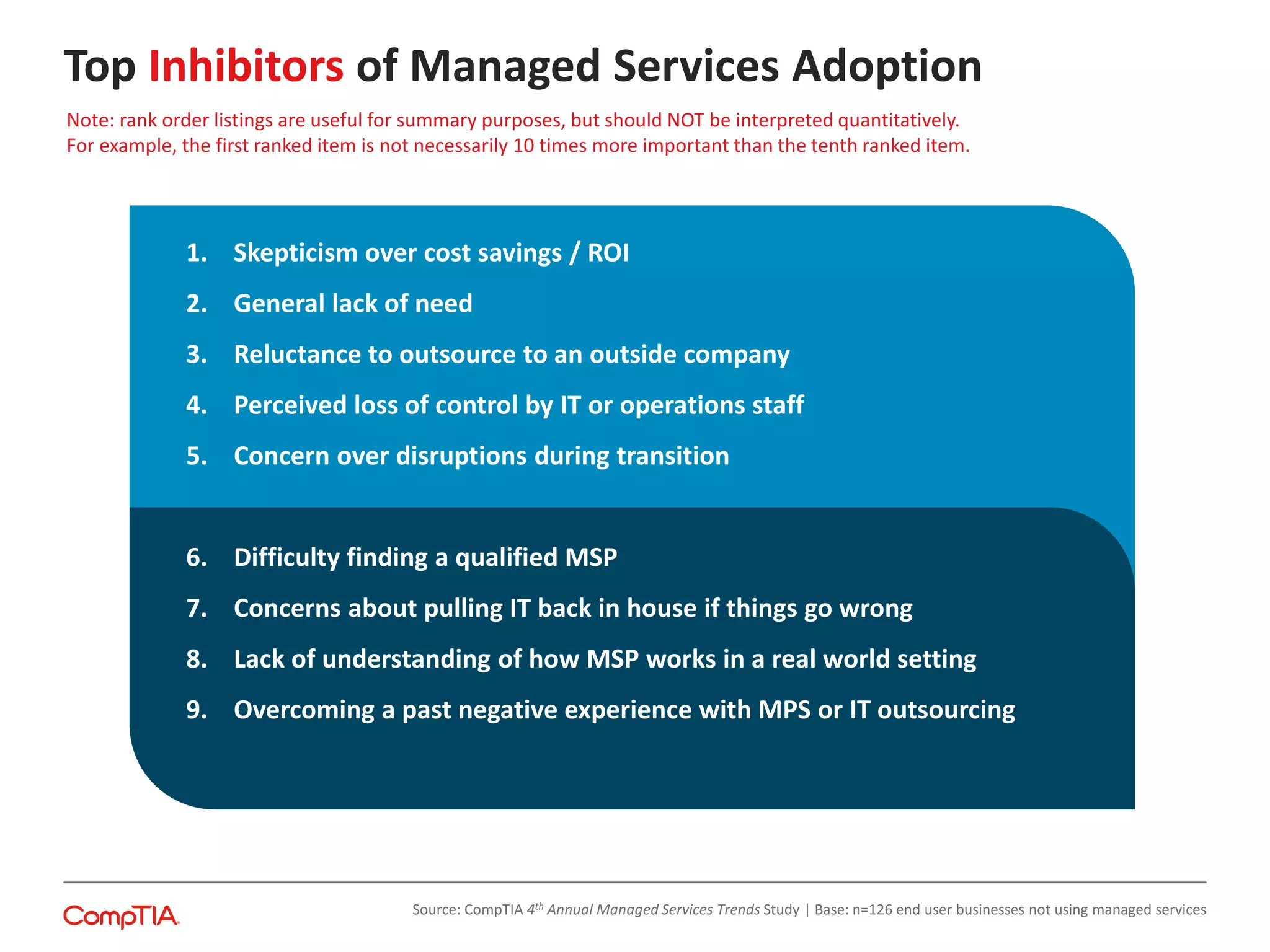
Top Inhibitors of Managed Services Adoption
1. Skepticism over cost savings / ROI
2. General lack of need
3. Reluctance to outsource to an outside company
4. Perceived loss of control by IT or operations staff
5. Concern over disruptions during transition
6. Difficulty finding a qualified MSP
7. Concerns about pulling IT back in house if things go wrong
8. Lack of understanding of how MSP works in a real world setting
9. Overcoming a past negative experience with MPS or IT outsourcing
Note: rank order listings are useful for summary purposes, but should NOT be interpreted quantitatively.
For example, the first ranked item is not necessarily 10 times more important than the tenth ranked item.
Source: CompTIA 4th Annual Managed Services Trends Study | Base: n=126 end user businesses not using managed services
Thank you
Copyright (c) 2014 CompTIA Properties, LLC. All Rights Reserved. | CompTIA.org

CompTIA 4th Annual Trends in Managed Services

  • 1.
    CompTIA 4th AnnualTrends in Managed Services Copyright (c) 2014 CompTIA Properties, LLC. All Rights Reserved. | CompTIA.org
  • 2.
    Mostly Outsourced Some Outsourced/S ome Internal Mostly Internal Payroll 20% 24%56% Information technology 12% 37% 51% Fulfillment/delivery 12% 33% 55% Public relations/communications 10% 28% 62% Call center/customer service 9% 27% 65% Finance/accounting 8% 28% 65% Source: CompTIA 4th Annual Managed Services Trends Study | Base: n=350 end user businesses Organizations with fewer than 100 employees were more than twice as likely to use an outside firm to assist with their IT needs than larger institutions. How Primary Business Functions are Handled Today
  • 3.
    IT Management ApproachesVary Across Companies Source: CompTIA 4th Annual Managed Services Trends Study | Base: n=350 end user businesses Satisfaction Levels with Current IT Management Methods 60% Formal IT department with dedicated staff 37% Periodic use of outside firms/ third parties for various projects and/or troubleshooting 35% Informally handled among non-IT staff 21% Outsourcing/contractual arrangement with a managed services provider for ongoing responsibility for some or all of IT functions Chief Ways IT is Handled Within Businesses Today Could Be Significantly Better Could Be Somewhat Better Fine As Is 39 % 52 % 9%
  • 4.
    Ways Businesses AreUsing IT Solutions/Service Providers 27% 32% 48% 50% 51% 43% 58% 55% 67% 27% 33% 38% 45% 47% 47% 48% 51% 70% Mobile application development Telecom-related activity Management of an IT function Cloud computing initiative Web design Cybersecurity related Deployment/installation/integration of IT General consulting around IT Repair/troubleshoot IT 2015 2013 Source: CompTIA 4th Annual Managed Services Trends Study | Base: n=350 end user businesses
  • 5.
    22% 27% 38% 60% 33% 38% 26% 28% 32% 40% 45% 45% Concerns about disruptionduring transition Don't want to outsource business processes Don't think cost savings are worth it Concerns about cost Not comfortable turning over sensitive data Concerns about quality of services 100+ employees < 100 employees Main Reasons Not Outsourcing Business Functions Source: CompTIA 4th Annual Managed Services Trends Study | Base: n=350 end user businesses
  • 6.
    Managed Services Usage Patterns Copyright(c) 2014 CompTIA Properties, LLC. All Rights Reserved. | CompTIA.org
  • 7.
    End User Self-AssessmentSummary 18% 47% 36% 7% 41% 52% Heard of/unfamiliar Somewhat familiar Very familiar 2013 2014 Familiarity with Managed Services Model CompTIA MPS Trustmark Value Proposition 1. Validation of MPS expertise to customers 2. Mechanism to evaluate internal MPS operations / follow best practices 3. Differentiator Incidence of Outsourcing IT 12% 37% 51% Outsource most IT functions Outsource some IT functions Do not outsource IT functions Source: CompTIA 4th Annual Managed Services Trends Study | Base: n=350 end user businesses
  • 8.
    Main Factors DrivingEnd User Managed Services Decision 20% 16% 29% 28% 25% 28% 31% 38% 47% 13% 22% 21% 22% 38% 33% 27% 38% 56% Predictable pricing Switch from cap-ex to op-ex Lack in-house IT for certain functions Access to new technologies Free IT staff to work on strategic projects ROI/cost savings Proactive approach to maintenance Enhanced security/compliance Improve efficiency/reliability of IT operations 100+ employees < 100 employees Source: CompTIA 4th Annual Managed Services Trends Study | Base: n=224 end user businesses using managed services
  • 9.
    Expectations for CostSavings from Managed Services Cost Savings Expected at Outset of MSP Engagement 4% 12% 54% 30% Expected cost increase Cost-neutral/non-financial benefits Expected modest savings Expected significant savings Source: CompTIA 4th Annual Trends in Managed Services Study| Base: n=222 end users 6% Did not meet 24% Exceeded expectations 69% Met cost savings expectations 41% of advanced users of tech said cost savings exceeded expectations, while 13% of basic users of tech said expectations for savings not met.
  • 10.
    Managed Services byType and Usage Nice to Have but Not Pay Extra Nice to Have & Would Potentially Pay Extra Expect as Part of Basic MSP Contract Easy to read service level agreement 11% 23% 66% Manage diverse range of devices, OSes, apps etc. 7% 26% 65% Responsive/friendly customer service 12% 24% 64% Near-perfect uptime 11% 26% 63% East to understand predictable monthly pricing 11% 26% 63% Detailed onboarding process for smooth transition 14% 23% 62% Web-based dashboard 15% 26% 59% Comprehensive reporting with usage metrics/analytics 15% 27% 58% Advanced security safeguards 8% 35% 58% Proactive maintenance and troubleshooting 5% 37% 58% Single point of contact 19% 24% 57% 24/7 remote monitoring of systems, network etc. 9% 36% 56% Expertise in a specific industry sector 17% 29% 55% ROI calculator to gauge managed services 19% 29% 53% Rapid response on-site service when needed 8% 40% 53% Access to cutting-edge tech (cloud, mobility etc.) 12% 36% 52% Source: CompTIA 4th Annual Managed Services Trends Study | Base: n=224 end user businesses using managed services
  • 11.
    Neutral Satisfied Delighted Disappointed Dissatisfied Basic Needs Expected –no additional satisfaction when present, but dissatisfaction when absent Excitement Delight when present, but no dissatisfaction when absent Performance Needs Proportional increase/decrease in satisfaction or dissatisfaction with performance Fully implemented / executed Not implemented / executed KANO MODEL VISUALIZATION OF MANAGED SERVICES  Easy to read SLA  Mgt. of device/app diversity  Proactive maintenance  Rapid response on-site service  Access to cutting-edge technology  Advanced security safeguards  Responsive/friendly customer service  Near-perfect uptime  Easy to understand, predictable pricing  Web-based dashboard  Superior onboarding process  Comprehensive reporting / metrics  Single point of contact  Industry vertical- specific expertise  ROI calculator
  • 12.
    Impact MSP EngagementHad Internal IT Staffing 4% 28% 41% 16% 2% 24% 72% 3% Eliminated all of IT staff Reduced headcount of IT staff Kept same IT staffing level, reassigned to other projects Had no IT staff to begin with 100+ employees < 100 employees Source: CompTIA 4th Annual Managed Services Trends Study | Base: n=224 end user businesses using managed services
  • 13.
    End User Prioritiesfor Service Level Agreement Provisions 9% 14% 20% 14% 55% 61% 63% 14% 15% 18% 27% 38% 57% 57% Service cessation provisions Time and material model Base fee with options to add/subtract services as needed Performance targets Response times Data security/privacy 24/7 support 2015 2013 Source: CompTIA 4th Annual Managed Services Trends Study | Base: n=224 end user businesses using managed services
  • 14.
    Non-Users of ManagedServices Copyright (c) 2014 CompTIA Properties, LLC. All Rights Reserved. | CompTIA.org
  • 15.
    Non-Users Future AdoptionIntent 13% 20% 48% 18% 2% Definitely not Probably not May or may not Probably consider Definitely consider MSP Intent Among Non-Adopters 21% Met with an MSP 25% Researched managed services 43% Internal discussion – how to improve IT management 47% of non-MSP adopters reported receiving an offer of a MSP assessment during past 2 years; 18% went through with it. Source: CompTIA 4th Annual Managed Services Trends Study | Base: n=126 end user businesses not using managed services
  • 16.
    Top Inhibitors ofManaged Services Adoption 1. Skepticism over cost savings / ROI 2. General lack of need 3. Reluctance to outsource to an outside company 4. Perceived loss of control by IT or operations staff 5. Concern over disruptions during transition 6. Difficulty finding a qualified MSP 7. Concerns about pulling IT back in house if things go wrong 8. Lack of understanding of how MSP works in a real world setting 9. Overcoming a past negative experience with MPS or IT outsourcing Note: rank order listings are useful for summary purposes, but should NOT be interpreted quantitatively. For example, the first ranked item is not necessarily 10 times more important than the tenth ranked item. Source: CompTIA 4th Annual Managed Services Trends Study | Base: n=126 end user businesses not using managed services
  • 17.
    Thank you Copyright (c)2014 CompTIA Properties, LLC. All Rights Reserved. | CompTIA.org

Editor's Notes

  • #3 According to the research consultancy IDC, the global information technology (IT) market totaled more than $3.7 trillion in 2014. The U.S. market accounts for approximately 28% of the total, or slightly more than $1 trillion in hardware, software, IT services and telecommunications. In the last year, 68% of organizations – whether they have internal IT departments or not -- availed themselves of the services of an outside IT firm to manage one or more of their IT functions or to provide implementation, integration or other IT project work. This does not necessarily mean they are on a managed services contract, but may have called in a third-party provider to implement new technology they have purchased, orchestrate a cloud initiative and/or provide integration across different systems.
  • #4 Roughly 4 in 10 end users think the method in which their IT is managed is working fine as currently structured, but a NET 61% believe there is room for improvement, including 9% that said IT management methods could be significantly better than they are today. This compares with 82% of users that said in 2013 that their firm’s IT management methods could be improved in some way. The number who see room for improvement represent a key sales opportunity for today’s MSPs.
  • #5 Expect emerging services such as cloud computing initiatives, mobility solutions (MDM, mobile app dev) and business data analytics to rise in prevalence in years ahead.
  • #6 Among those not outsourcing any IT today, 17% plan to begin doing so or are actively evaluating firms today. Meanwhile half said they will consider using an outside firm if need arises.
  • #8 Slightly more than half of respondents claim to be ‘very familiar’ with the concept of managed services, while another 4 in 10 say they are somewhat familiar. This compares favorably with 2013 data in which 36% of respondents professed a high degree of familiarity and 47% acknowledged some fluency. Thirty-seven percent of organizations using managed services have done so for five or more years, while 55% -- the sweet spot today – have done so between two and five years.
  • #9 Some of the main drivers leading managed services adoption include improving the efficiency and reliability of IT operations, enhancing security and compliance measures, attaining a proactive approach to IT maintenance, achieving cost savings and freeing up internal IT staff to work on strategic projects. Many end users use an MSP to manage specific IT functions such as outsourced email or help desk duties, while keeping the management of other areas of IT under their internal staff umbrella. So while the incidence rate of managed service might be relatively high across a customer base, the depth of the engagements may be quite shallow. This isn’t necessarily bad news for MSPs. It simple indicates that the market opportunity is still wide open to scale additional services to existing customers alongside the ongoing chase for net-new clients. 60% of end users describe their managed services engagement as a collaborative arrangement with their internal IT department, suggesting that certain IT areas fall into the MSP bucket, while others remain in house. More than a third of respondents characterized their managed services engagement as strategic and encompassing most of their IT functions.
  • #10 Cost savings were less of a factor driving managed services adoption in the past year. Thirty percent of respondents cited cost savings as a primary driver, compared with 58% that did so in 2013. This suggests a few possible reasons. Customer expectations about the level of cost savings to be achieved have mellowed to more reasonable numbers, or customers are looking for benefits beyond a slimmer IT budget in their use of an MSP. Twelve percent of respondents expected the move to managed services to be cost-neutral, but to generate non-financial benefits in other areas. Nearly a quarter of smaller firms (5-99 employees) expected a cost-neutral outcome. Alternative benefits for them, for example, might include increased worker productivity. The smallest firms often lack an in-house IT staff, leaving troubleshooting and other tech chores to the employee/s with the most acumen. Putting these responsibilities into an MSP’s domain will free those employees to focus full time on their real duties.
  • #12 One technique to further categorize and prioritize customer perceptions of a product or service entails the use of the Kano model. Applying this model to managed services highlights the attributes or capabilities most likely to exceed customer expectations, such as industry vertical expertise, while reminding MSPs of areas where customers will judge in a pass/fail manner, such as responsive customer service.
  • #16 Q37, Q33