Top Tips For Person-Centered Continence Care A Carlingwark Case Study
What’s our story? 
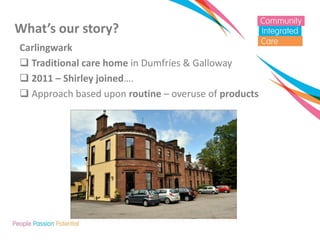
Carlingwark 
Traditional care home in Dumfries & Galloway 
2011 – Shirley joined…. 
Approach based upon routine – overuse of products
What’s our story? 
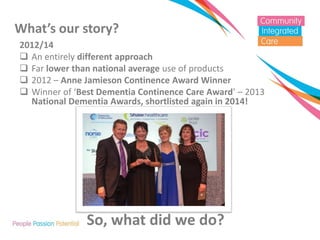
2012/14 
An entirely different approach 
Far lower than national average use of products 
2012 – Anne Jamieson Continence Award Winner 
Winner of ‘Best Dementia Continence Care Award’ – 2013 National Dementia Awards, shortlisted again in 2014! 
So, what did we do?
How did we improve things?
Culture and Education
Creating a new culture…. 
Manager, Shirley, needed to understand the needs of the people supported – not an overnight task! 
Found most residents didn’t have physical continence problems 
 Established in-home Continence Lead post – championing good practice, offering expertise and leading by example 
Challenged ingrained staff attitudes and perceptions - promoting positivity! 
Dignity Awareness built into everything we do. 
Closely partnered with NHS Continence Advisory Service – finding a powerful, interested advocate! 
Celebrated staff successes
Meaningful Assessments
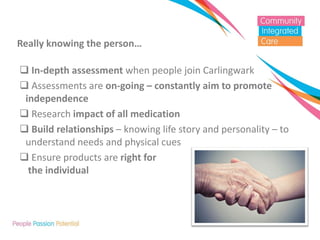
Really knowing the person… 
 In-depth assessment when people join Carlingwark 
 Assessments are on-going – constantly aim to promote independence 
 Research impact of all medication 
 Build relationships – knowing life story and personality – to understand needs and physical cues 
 Ensure products are right for the individual
Environment Efforts…
The right environment… 
 Living environment – En-suites, visual cues, bed placement, blue toilet seats, toilet raisers. 
Removing barriers – Make it easy for people to access to toilet – e.g. Are mobility aids reachable? 
 Promoting Dignity – Small but important steps, like ensuring continence products are not visible to guests 
 Having the right equipment in place 
A peaceful environment – calm and no odours 
It never stops! Working with D&G IDEAS team on dementia friendly signage, OT’s – raised toilet seats etc.
Bringing it all together…. A case study.
Changing Lives 
 Resident lives with dementia and incontinent at night 
 Poor mobility & prone to falls. 
 Assessed by team – with advice from Continence Lead 
 Supported every two hours 
 Requires support 3-4 times a night – causing him tiredness, increasing his risk of falling 
 Partnered with Falls Clinic 
 Introduced inview standard sheaths – one week trial 
 Very successful – sleep restored and anxiety reduced 
 Dietary and fluid intake increased, health improved 
 Transformed relationship with wife
Award Winners – but not perfect!
It’s a continual process… 
 Dementia-friendly signage 
 Introducing Continence and Product Passports 
 Learning from others –, Continence Leads, Care Inspectorate (they’re a friend, not an enemy!!) 
 Benchmarking 
 Sharing best practice – internally and externally 
 More training and development
Find out more in Care News, the Care Inspectorate magazine www.c-i-c.co.uk /@ComIntCare julie.cowen@c-i-c.co.uk

Top Tips for Person-Centered Continence Care

  • 1.
    Top Tips ForPerson-Centered Continence Care A Carlingwark Case Study
  • 2.
    What’s our story? Carlingwark Traditional care home in Dumfries & Galloway 2011 – Shirley joined…. Approach based upon routine – overuse of products
  • 3.
    What’s our story? 2012/14 An entirely different approach Far lower than national average use of products 2012 – Anne Jamieson Continence Award Winner Winner of ‘Best Dementia Continence Care Award’ – 2013 National Dementia Awards, shortlisted again in 2014! So, what did we do?
  • 4.
    How did weimprove things?
  • 5.
  • 6.
    Creating a newculture…. Manager, Shirley, needed to understand the needs of the people supported – not an overnight task! Found most residents didn’t have physical continence problems  Established in-home Continence Lead post – championing good practice, offering expertise and leading by example Challenged ingrained staff attitudes and perceptions - promoting positivity! Dignity Awareness built into everything we do. Closely partnered with NHS Continence Advisory Service – finding a powerful, interested advocate! Celebrated staff successes
  • 7.
  • 8.
    Really knowing theperson…  In-depth assessment when people join Carlingwark  Assessments are on-going – constantly aim to promote independence  Research impact of all medication  Build relationships – knowing life story and personality – to understand needs and physical cues  Ensure products are right for the individual
  • 9.
  • 10.
    The right environment…  Living environment – En-suites, visual cues, bed placement, blue toilet seats, toilet raisers. Removing barriers – Make it easy for people to access to toilet – e.g. Are mobility aids reachable?  Promoting Dignity – Small but important steps, like ensuring continence products are not visible to guests  Having the right equipment in place A peaceful environment – calm and no odours It never stops! Working with D&G IDEAS team on dementia friendly signage, OT’s – raised toilet seats etc.
  • 11.
    Bringing it alltogether…. A case study.
  • 12.
    Changing Lives Resident lives with dementia and incontinent at night  Poor mobility & prone to falls.  Assessed by team – with advice from Continence Lead  Supported every two hours  Requires support 3-4 times a night – causing him tiredness, increasing his risk of falling  Partnered with Falls Clinic  Introduced inview standard sheaths – one week trial  Very successful – sleep restored and anxiety reduced  Dietary and fluid intake increased, health improved  Transformed relationship with wife
  • 13.
    Award Winners –but not perfect!
  • 14.
    It’s a continualprocess…  Dementia-friendly signage  Introducing Continence and Product Passports  Learning from others –, Continence Leads, Care Inspectorate (they’re a friend, not an enemy!!)  Benchmarking  Sharing best practice – internally and externally  More training and development
  • 15.
    Find out morein Care News, the Care Inspectorate magazine www.c-i-c.co.uk /@ComIntCare julie.cowen@c-i-c.co.uk