Burak Yucesoy | Citus Data | PGConf EU
Distributed
COUNT(DISTINCT) with
HyperLogLog on
PostgreSQL
Burak Yucesoy | Citus Data | PGConf EU
What is COUNT(DISTINCT)?
● Number of unique elements (cardinality) in given data
● Useful to find things like…
○ Number of unique users visited your web page
○ Number of unique products in your inventory
Burak Yucesoy | Citus Data | PGConf EU
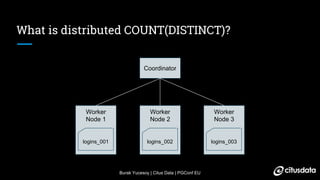
What is distributed COUNT(DISTINCT)?
Worker
Node 1
logins_001
Coordinator
Worker
Node 2
logins_002
Worker
Node 3
logins_003
Burak Yucesoy | Citus Data | PGConf EU
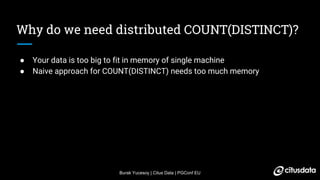
Why do we need distributed COUNT(DISTINCT)?
● Your data is too big to fit in memory of single machine
● Naive approach for COUNT(DISTINCT) needs too much memory
Burak Yucesoy | Citus Data | PGConf EU
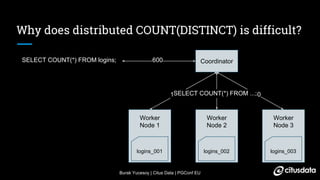
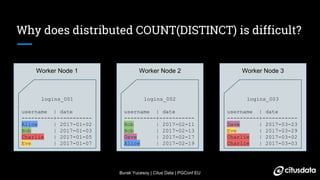
Why does distributed COUNT(DISTINCT) is difficult?
Worker
Node 1
logins_001
CoordinatorSELECT COUNT(*) FROM logins;
Worker
Node 2
logins_002
Worker
Node 3
logins_003
600
100 200 300SELECT COUNT(*) FROM ...;
Burak Yucesoy | Citus Data | PGConf EU
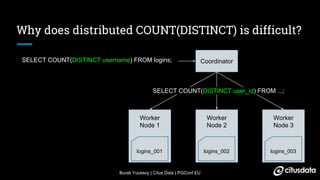
Why does distributed COUNT(DISTINCT) is difficult?
Worker
Node 1
logins_001
CoordinatorSELECT COUNT(DISTINCT username) FROM logins;
Worker
Node 2
logins_002
Worker
Node 3
logins_003
SELECT COUNT(DISTINCT user_id) FROM ...;
Burak Yucesoy | Citus Data | PGConf EU
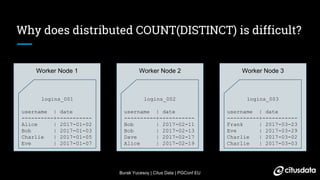
Why does distributed COUNT(DISTINCT) is difficult?
Worker Node 1
logins_001
username | date
----------+-----------
Alice | 2017-01-02
Bob | 2017-01-03
Charlie | 2017-01-05
Eve | 2017-01-07
Worker Node 3
logins_003
username | date
----------+-----------
Frank | 2017-03-23
Eve | 2017-03-29
Charlie | 2017-03-02
Charlie | 2017-03-03
Worker Node 2
logins_002
username | date
----------+-----------
Bob | 2017-02-11
Bob | 2017-02-13
Dave | 2017-02-17
Alice | 2017-02-19
Burak Yucesoy | Citus Data | PGConf EU
Why does distributed COUNT(DISTINCT) is difficult?
Worker Node 1
logins_001
username | date
----------+-----------
Alice | 2017-01-02
Bob | 2017-01-03
Charlie | 2017-01-05
Eve | 2017-01-07
Worker Node 3
logins_003
username | date
----------+-----------
Dave | 2017-03-23
Eve | 2017-03-29
Charlie | 2017-03-02
Charlie | 2017-03-03
Worker Node 2
logins_002
username | date
----------+-----------
Bob | 2017-02-11
Bob | 2017-02-13
Dave | 2017-02-17
Alice | 2017-02-19
Burak Yucesoy | Citus Data | PGConf EU
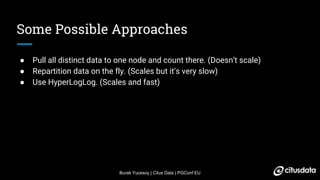
Some Possible Approaches
● Pull all distinct data to one node and count there. (Doesn’t scale)
● Repartition data on the fly. (Scales but it’s very slow)
● Use HyperLogLog. (Scales and fast)
Burak Yucesoy | Citus Data | PGConf EU
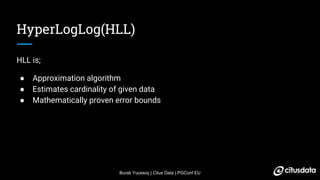
HyperLogLog(HLL)
HLL is;
● Approximation algorithm
● Estimates cardinality of given data
● Mathematically proven error bounds
Burak Yucesoy | Citus Data | PGConf EU
Is it OK to approximate?
It depends…
Burak Yucesoy | Citus Data | PGConf EU
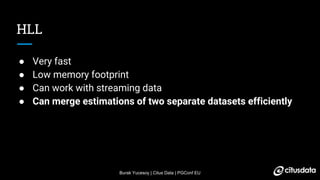
HLL
● Very fast
● Low memory footprint
● Can work with streaming data
● Can merge estimations of two separate datasets efficiently
Burak Yucesoy | Citus Data | PGConf EU
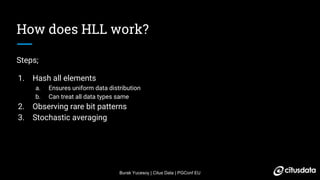
How does HLL work?
Steps;
1. Hash all elements
a. Ensures uniform data distribution
b. Can treat all data types same
2. Observing rare bit patterns
3. Stochastic averaging
Burak Yucesoy | Citus Data | PGConf EU
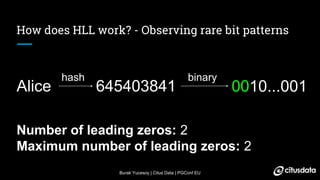
How does HLL work? - Observing rare bit patterns
hash
Alice 645403841
binary
0010...001
Number of leading zeros: 2
Maximum number of leading zeros: 2
Burak Yucesoy | Citus Data | PGConf EU
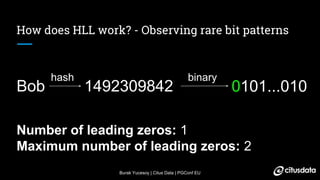
How does HLL work? - Observing rare bit patterns
hash
Bob 1492309842
binary
0101...010
Number of leading zeros: 1
Maximum number of leading zeros: 2
Burak Yucesoy | Citus Data | PGConf EU
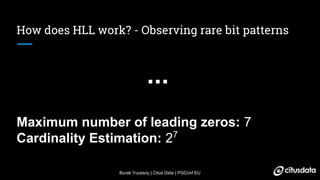
How does HLL work? - Observing rare bit patterns
...
Maximum number of leading zeros: 7
Cardinality Estimation: 27
Burak Yucesoy | Citus Data | PGConf EU
How does HLL work? Stochastic Averaging
Measuring same thing repeatedly and taking average.
Burak Yucesoy | Citus Data | PGConf EU
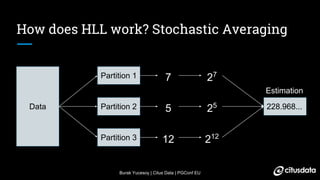
How does HLL work? Stochastic Averaging
Data
Partition 1
Partition 3
Partition 2
7
5
12
228.968...
Estimation
27
25
212
Burak Yucesoy | Citus Data | PGConf EU
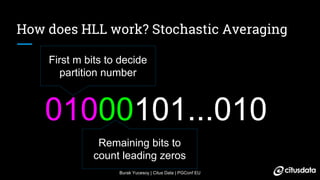
How does HLL work? Stochastic Averaging
01000101...010
First m bits to decide
partition number
Remaining bits to
count leading zeros
Burak Yucesoy | Citus Data | PGConf EU
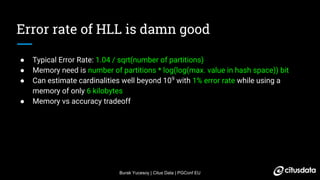
Error rate of HLL is damn good
● Typical Error Rate: 1.04 / sqrt(number of partitions)
● Memory need is number of partitions * log(log(max. value in hash space)) bit
● Can estimate cardinalities well beyond 109
with 1% error rate while using a
memory of only 6 kilobytes
● Memory vs accuracy tradeoff
Burak Yucesoy | Citus Data | PGConf EU
Why does HLL work?
It turns out, combination of lots of bad estimation is a
good estimation
Burak Yucesoy | Citus Data | PGConf EU
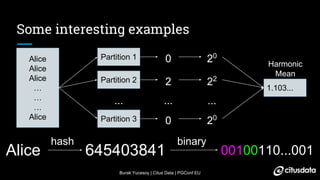
Some interesting examples
Alice
Alice
Alice
…
…
…
Alice
Partition 1
Partition 3
Partition 2
0
2
0
1.103...
Harmonic
Mean
20
22
20
hash
Alice 645403841
binary
00100110...001
... ... ...
Burak Yucesoy | Citus Data | PGConf EU
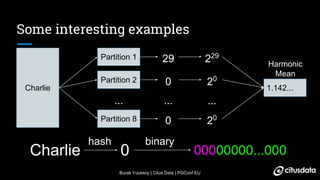
Some interesting examples
Charlie
Partition 1
Partition 8
Partition 2
29
0
0
1.142...
Harmonic
Mean
229
20
20
hash
Charlie 0
binary
00000000...000
... ... ...
Burak Yucesoy | Citus Data | PGConf EU
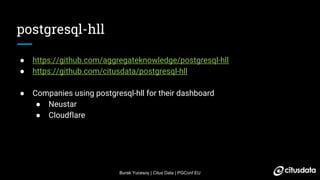
postgresql-hll
● https://github.com/aggregateknowledge/postgresql-hll
● https://github.com/citusdata/postgresql-hll
● Companies using postgresql-hll for their dashboard
● Neustar
● Cloudflare
Burak Yucesoy | Citus Data | PGConf EU
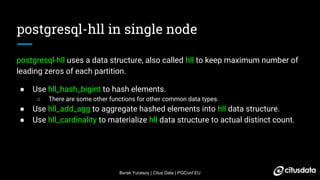
postgresql-hll uses a data structure, also called hll to keep maximum number of
leading zeros of each partition.
● Use hll_hash_bigint to hash elements.
○ There are some other functions for other common data types.
● Use hll_add_agg to aggregate hashed elements into hll data structure.
● Use hll_cardinality to materialize hll data structure to actual distinct count.
postgresql-hll in single node
Burak Yucesoy | Citus Data | PGConf EU
What Happens in
Distributed Scenario?
Burak Yucesoy | Citus Data | PGConf EU
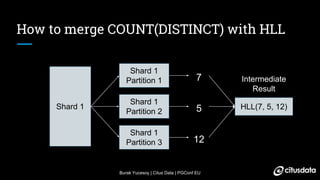
How to merge COUNT(DISTINCT) with HLL
Shard 1
Shard 1
Partition 1
Shard 1
Partition 3
Shard 1
Partition 2
7
5
12
HLL(7, 5, 12)
Intermediate
Result
Burak Yucesoy | Citus Data | PGConf EU
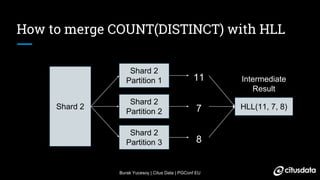
How to merge COUNT(DISTINCT) with HLL
Shard 2
Shard 2
Partition 1
Shard 2
Partition 3
Shard 2
Partition 2
11
7
8
HLL(11, 7, 8)
Intermediate
Result
Burak Yucesoy | Citus Data | PGConf EU
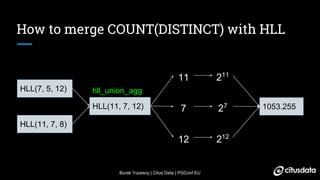
How to merge COUNT(DISTINCT) with HLL
11
7
12
1053.255
211
27
212
HLL(11, 7, 8)
HLL(7, 5, 12)
HLL(11, 7, 12)
hll_union_agg
Burak Yucesoy | Citus Data | PGConf EU
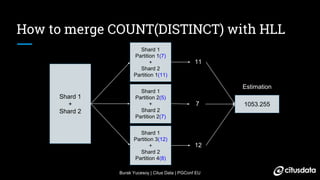
How to merge COUNT(DISTINCT) with HLL
Shard 1
+
Shard 2
Shard 1
Partition 1(7)
+
Shard 2
Partition 1(11)
11
7
12
1053.255
Estimation
Shard 1
Partition 2(5)
+
Shard 2
Partition 2(7)
Shard 1
Partition 3(12)
+
Shard 2
Partition 4(8)
Burak Yucesoy | Citus Data | PGConf EU
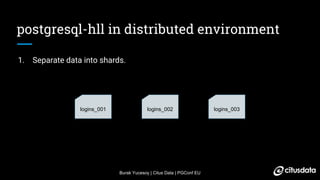
1. Separate data into shards.
postgresql-hll in distributed environment
logins_001 logins_002 logins_003
Burak Yucesoy | Citus Data | PGConf EU
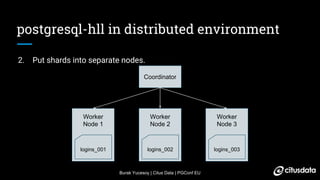
2. Put shards into separate nodes.
postgresql-hll in distributed environment
Worker
Node 1
Coordinator
Worker
Node 2
Worker
Node 3
logins_001 logins_002 logins_003
Burak Yucesoy | Citus Data | PGConf EU
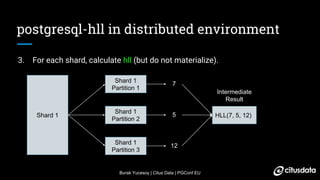
3. For each shard, calculate hll (but do not materialize).
postgresql-hll in distributed environment
Shard 1
Shard 1
Partition 1
Shard 1
Partition 3
Shard 1
Partition 2
7
5
12
HLL(7, 5, 12)
Intermediate
Result
Burak Yucesoy | Citus Data | PGConf EU
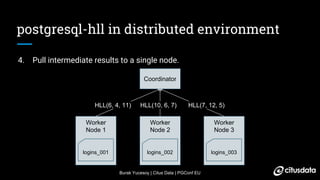
4. Pull intermediate results to a single node.
postgresql-hll in distributed environment
Worker
Node 1
logins_001
Coordinator
Worker
Node 2
logins_002
Worker
Node 3
logins_003
HLL(6, 4, 11) HLL(10, 6, 7) HLL(7, 12, 5)
Burak Yucesoy | Citus Data | PGConf EU
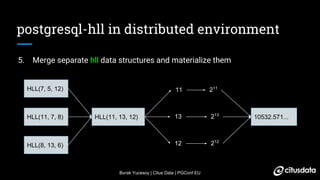
5. Merge separate hll data structures and materialize them
postgresql-hll in distributed environment
11
13
12
10532.571...
211
213
212
HLL(11, 7, 8)
HLL(7, 5, 12)
HLL(11, 13, 12)
HLL(8, 13, 6)
Burak Yucesoy | Citus Data | PGConf EU
Or use Citus :)
postgresql-hll in distributed environment
Burak Yucesoy | Citus Data | PGConf EU
Burak Yucesoy
burak@citusdata.com
@byucesoy
Thank You
citusdata.com | @citusdata

Distributed count(distinct) with hyper loglog on postgresql | PGConf EU 2017) | Burak Yucesoy

  • 1.
    Burak Yucesoy |Citus Data | PGConf EU Distributed COUNT(DISTINCT) with HyperLogLog on PostgreSQL
  • 2.
    Burak Yucesoy |Citus Data | PGConf EU What is COUNT(DISTINCT)? ● Number of unique elements (cardinality) in given data ● Useful to find things like… ○ Number of unique users visited your web page ○ Number of unique products in your inventory
  • 3.
    Burak Yucesoy |Citus Data | PGConf EU What is distributed COUNT(DISTINCT)? Worker Node 1 logins_001 Coordinator Worker Node 2 logins_002 Worker Node 3 logins_003
  • 4.
    Burak Yucesoy |Citus Data | PGConf EU Why do we need distributed COUNT(DISTINCT)? ● Your data is too big to fit in memory of single machine ● Naive approach for COUNT(DISTINCT) needs too much memory
  • 5.
    Burak Yucesoy |Citus Data | PGConf EU Why does distributed COUNT(DISTINCT) is difficult? Worker Node 1 logins_001 CoordinatorSELECT COUNT(*) FROM logins; Worker Node 2 logins_002 Worker Node 3 logins_003 600 100 200 300SELECT COUNT(*) FROM ...;
  • 6.
    Burak Yucesoy |Citus Data | PGConf EU Why does distributed COUNT(DISTINCT) is difficult? Worker Node 1 logins_001 CoordinatorSELECT COUNT(DISTINCT username) FROM logins; Worker Node 2 logins_002 Worker Node 3 logins_003 SELECT COUNT(DISTINCT user_id) FROM ...;
  • 7.
    Burak Yucesoy |Citus Data | PGConf EU Why does distributed COUNT(DISTINCT) is difficult? Worker Node 1 logins_001 username | date ----------+----------- Alice | 2017-01-02 Bob | 2017-01-03 Charlie | 2017-01-05 Eve | 2017-01-07 Worker Node 3 logins_003 username | date ----------+----------- Frank | 2017-03-23 Eve | 2017-03-29 Charlie | 2017-03-02 Charlie | 2017-03-03 Worker Node 2 logins_002 username | date ----------+----------- Bob | 2017-02-11 Bob | 2017-02-13 Dave | 2017-02-17 Alice | 2017-02-19
  • 8.
    Burak Yucesoy |Citus Data | PGConf EU Why does distributed COUNT(DISTINCT) is difficult? Worker Node 1 logins_001 username | date ----------+----------- Alice | 2017-01-02 Bob | 2017-01-03 Charlie | 2017-01-05 Eve | 2017-01-07 Worker Node 3 logins_003 username | date ----------+----------- Dave | 2017-03-23 Eve | 2017-03-29 Charlie | 2017-03-02 Charlie | 2017-03-03 Worker Node 2 logins_002 username | date ----------+----------- Bob | 2017-02-11 Bob | 2017-02-13 Dave | 2017-02-17 Alice | 2017-02-19
  • 9.
    Burak Yucesoy |Citus Data | PGConf EU Some Possible Approaches ● Pull all distinct data to one node and count there. (Doesn’t scale) ● Repartition data on the fly. (Scales but it’s very slow) ● Use HyperLogLog. (Scales and fast)
  • 10.
    Burak Yucesoy |Citus Data | PGConf EU HyperLogLog(HLL) HLL is; ● Approximation algorithm ● Estimates cardinality of given data ● Mathematically proven error bounds
  • 11.
    Burak Yucesoy |Citus Data | PGConf EU Is it OK to approximate? It depends…
  • 12.
    Burak Yucesoy |Citus Data | PGConf EU HLL ● Very fast ● Low memory footprint ● Can work with streaming data ● Can merge estimations of two separate datasets efficiently
  • 13.
    Burak Yucesoy |Citus Data | PGConf EU How does HLL work? Steps; 1. Hash all elements a. Ensures uniform data distribution b. Can treat all data types same 2. Observing rare bit patterns 3. Stochastic averaging
  • 14.
    Burak Yucesoy |Citus Data | PGConf EU How does HLL work? - Observing rare bit patterns hash Alice 645403841 binary 0010...001 Number of leading zeros: 2 Maximum number of leading zeros: 2
  • 15.
    Burak Yucesoy |Citus Data | PGConf EU How does HLL work? - Observing rare bit patterns hash Bob 1492309842 binary 0101...010 Number of leading zeros: 1 Maximum number of leading zeros: 2
  • 16.
    Burak Yucesoy |Citus Data | PGConf EU How does HLL work? - Observing rare bit patterns ... Maximum number of leading zeros: 7 Cardinality Estimation: 27
  • 17.
    Burak Yucesoy |Citus Data | PGConf EU How does HLL work? Stochastic Averaging Measuring same thing repeatedly and taking average.
  • 18.
    Burak Yucesoy |Citus Data | PGConf EU
  • 19.
    Burak Yucesoy |Citus Data | PGConf EU
  • 20.
    Burak Yucesoy |Citus Data | PGConf EU How does HLL work? Stochastic Averaging Data Partition 1 Partition 3 Partition 2 7 5 12 228.968... Estimation 27 25 212
  • 21.
    Burak Yucesoy |Citus Data | PGConf EU How does HLL work? Stochastic Averaging 01000101...010 First m bits to decide partition number Remaining bits to count leading zeros
  • 22.
    Burak Yucesoy |Citus Data | PGConf EU Error rate of HLL is damn good ● Typical Error Rate: 1.04 / sqrt(number of partitions) ● Memory need is number of partitions * log(log(max. value in hash space)) bit ● Can estimate cardinalities well beyond 109 with 1% error rate while using a memory of only 6 kilobytes ● Memory vs accuracy tradeoff
  • 23.
    Burak Yucesoy |Citus Data | PGConf EU Why does HLL work? It turns out, combination of lots of bad estimation is a good estimation
  • 24.
    Burak Yucesoy |Citus Data | PGConf EU Some interesting examples Alice Alice Alice … … … Alice Partition 1 Partition 3 Partition 2 0 2 0 1.103... Harmonic Mean 20 22 20 hash Alice 645403841 binary 00100110...001 ... ... ...
  • 25.
    Burak Yucesoy |Citus Data | PGConf EU Some interesting examples Charlie Partition 1 Partition 8 Partition 2 29 0 0 1.142... Harmonic Mean 229 20 20 hash Charlie 0 binary 00000000...000 ... ... ...
  • 26.
    Burak Yucesoy |Citus Data | PGConf EU postgresql-hll ● https://github.com/aggregateknowledge/postgresql-hll ● https://github.com/citusdata/postgresql-hll ● Companies using postgresql-hll for their dashboard ● Neustar ● Cloudflare
  • 27.
    Burak Yucesoy |Citus Data | PGConf EU postgresql-hll uses a data structure, also called hll to keep maximum number of leading zeros of each partition. ● Use hll_hash_bigint to hash elements. ○ There are some other functions for other common data types. ● Use hll_add_agg to aggregate hashed elements into hll data structure. ● Use hll_cardinality to materialize hll data structure to actual distinct count. postgresql-hll in single node
  • 28.
    Burak Yucesoy |Citus Data | PGConf EU What Happens in Distributed Scenario?
  • 29.
    Burak Yucesoy |Citus Data | PGConf EU How to merge COUNT(DISTINCT) with HLL Shard 1 Shard 1 Partition 1 Shard 1 Partition 3 Shard 1 Partition 2 7 5 12 HLL(7, 5, 12) Intermediate Result
  • 30.
    Burak Yucesoy |Citus Data | PGConf EU How to merge COUNT(DISTINCT) with HLL Shard 2 Shard 2 Partition 1 Shard 2 Partition 3 Shard 2 Partition 2 11 7 8 HLL(11, 7, 8) Intermediate Result
  • 31.
    Burak Yucesoy |Citus Data | PGConf EU How to merge COUNT(DISTINCT) with HLL 11 7 12 1053.255 211 27 212 HLL(11, 7, 8) HLL(7, 5, 12) HLL(11, 7, 12) hll_union_agg
  • 32.
    Burak Yucesoy |Citus Data | PGConf EU How to merge COUNT(DISTINCT) with HLL Shard 1 + Shard 2 Shard 1 Partition 1(7) + Shard 2 Partition 1(11) 11 7 12 1053.255 Estimation Shard 1 Partition 2(5) + Shard 2 Partition 2(7) Shard 1 Partition 3(12) + Shard 2 Partition 4(8)
  • 33.
    Burak Yucesoy |Citus Data | PGConf EU 1. Separate data into shards. postgresql-hll in distributed environment logins_001 logins_002 logins_003
  • 34.
    Burak Yucesoy |Citus Data | PGConf EU 2. Put shards into separate nodes. postgresql-hll in distributed environment Worker Node 1 Coordinator Worker Node 2 Worker Node 3 logins_001 logins_002 logins_003
  • 35.
    Burak Yucesoy |Citus Data | PGConf EU 3. For each shard, calculate hll (but do not materialize). postgresql-hll in distributed environment Shard 1 Shard 1 Partition 1 Shard 1 Partition 3 Shard 1 Partition 2 7 5 12 HLL(7, 5, 12) Intermediate Result
  • 36.
    Burak Yucesoy |Citus Data | PGConf EU 4. Pull intermediate results to a single node. postgresql-hll in distributed environment Worker Node 1 logins_001 Coordinator Worker Node 2 logins_002 Worker Node 3 logins_003 HLL(6, 4, 11) HLL(10, 6, 7) HLL(7, 12, 5)
  • 37.
    Burak Yucesoy |Citus Data | PGConf EU 5. Merge separate hll data structures and materialize them postgresql-hll in distributed environment 11 13 12 10532.571... 211 213 212 HLL(11, 7, 8) HLL(7, 5, 12) HLL(11, 13, 12) HLL(8, 13, 6)
  • 38.
    Burak Yucesoy |Citus Data | PGConf EU Or use Citus :) postgresql-hll in distributed environment
  • 39.
    Burak Yucesoy |Citus Data | PGConf EU Burak Yucesoy burak@citusdata.com @byucesoy Thank You citusdata.com | @citusdata