Count me once, count me fast!
Probabilistic methods in real-time streaming
(Hyperloglog, Bloom filters)
Kendrick Lo
Insight Data Engineering, NYC
Summer 2016
Ad ID
Unique
User ID
Time
stamp
Ad ID
Unique
User ID
Time
stamp
Ad ID
Unique
User ID
Time
stamp
Ad ID
Unique
User ID
Time
stamp
Ad ID
Unique
User ID
Time
stamp
Ad ID
Unique
User ID
Time
stamp
Ad ID
Unique
User ID
Time
stamp
Ad ID
Unique
User ID
Time
stamp
Ad ID
Unique
User ID
Time
stamp
Unique
User ID
Unique
User ID
Unique
User ID
Unique
User ID
...
...
?
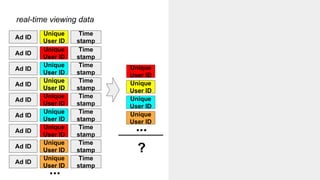
real-time viewing data
Ad ID
Unique
User ID
Time
stamp
Ad ID
Unique
User ID
Time
stamp
Ad ID
Unique
User ID
Time
stamp
Ad ID
Unique
User ID
Time
stamp
Ad ID
Unique
User ID
Time
stamp
Ad ID
Unique
User ID
Time
stamp
Ad ID
Unique
User ID
Time
stamp
Ad ID
Unique
User ID
Time
stamp
Ad ID
Unique
User ID
Time
stamp
Unique
User ID
Unique
User ID
Unique
User ID
Unique
User ID
...
...
?
13 MB
100 million
uniques
bitmap
(for exact counting)
4 KB
billions of uniques
hyperloglog
real-time viewing data
Hyperloglog
Count-distinct problem
(a.k.a. cardinality estimation problem)
● counting unique elements in a data
stream with repeated elements
● calculates an approximate number
○ typical error purported to be
less than < 2%
What it can’t do:
● give an exact count
● track frequency of
occurrence
● confirm whether a certain
element was seen
Hyperloglog - a probabilistic method
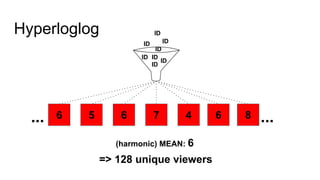
General Idea: Count leading zeros in a randomly generated binary number
Given a random number,
what is the probability of seeing…?
1 x x x x x x x x… → 0.5 (1 out of every 2)
0 1 x x x x x x x… → 0.25 (1 out of every 4)
0 0 1 x x x x x x… → 0.125 (1 out of every 8)
…
0 0 0 0 0 0 1 x x… → 0.008 (1 out of every 128)
...
Hyperloglog - a probabilistic method
1 x x x x x x x x… → 0.5 (1 out of every 2)
0 1 x x x x x x x… → 0.25 (1 out of every 4)
0 0 1 x x x x x x… → 0.125 (1 out of every 8)
…
0 0 0 0 0 0 1 x x… → 0.008 (1 out of every 128)
...
Question:
I have a list of N unique numbers.
The one with the longest string
of leading zeros is
0 0 0 0 0 0 1 x x…
What is N?
General Idea: Count leading zeros in a randomly generated binary number
Given a random number,
what is the probability of seeing…?
Hyperloglog
ID
ID
ID
ID
ID
6
=> 128 unique viewers
5 6 7 4 6 8... ...
(harmonic) MEAN: 6
IDID
ID
Pipeline
Ad ID
Unique
User ID
Gender
Age
segments
Time
stamp
Algebird
4 x m4.large
1 sec mini-batches
Pushed 1 billion records
with unique user IDs
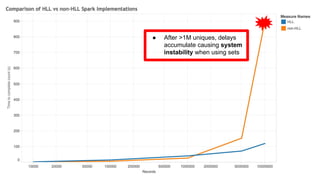
● Throughput can reach an
average of 5M records/min
● Streams of <1M records
processed within a minute
● After >1M uniques, delays
accumulate causing system
instability when using sets
Extension: counting unique viewers in a subgroup
● Associating segments with user IDs
○ Challenge: Can we avoid database accesses when
processing data in real-time?
○ Bloom filter: another fixed-size probabilistic data
structure that trades off (tunable) accuracy for size
e.g. Bloom filter + Hyperloglog count males error: 1.2%
○ needed to overcome challenges in combining
aspects of Spark (batch) and Spark Streaming
Ad ID
Unique
User ID
Gender
Age segment
(e.g. 18-34)
Time
stamp
Sample record
About me
Master of Science, Harvard University
Computational Science and Engineering
(graduated May 2016)
J.D. / MBA, University of Toronto
Bachelor of Applied Science, University of Toronto
Engineering Science (Computer)
About me
Master of Science, Harvard University
Computational Science and Engineering
(graduated May 2016)
J.D. / MBA, University of Toronto
Bachelor of Applied Science, University of Toronto
Engineering Science (Computer)
Thank you for listening!
appendix
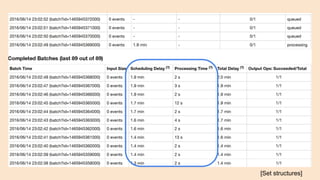
[Set structures]
[HLL structures]
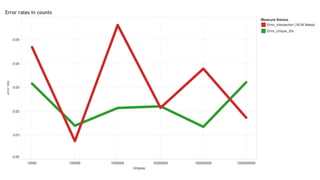
Results: error rate in counts
● Error < 2% for subgroups;
slightly higher for main group
● Error for intersection
calculation (purple) tends to
be higher on average
Use cases
● Advertising
○ ad viewership, website views, television viewership, app engagement, etc.
● Any application where you would want to count a large number of unique
things fast
○ stock trades, network traffic, twitter responses, election data, real-time voting data, etc.
● Well suited to real-time analytics
○ intermediate state of HLL structure provides for a running count
○ trivially parallelizable
Ad ID
Unique
User ID
Gender
Age segment
(e.g. 18-34)
Time
stamp
Sample record
Future exploration
● Associating segments with user IDs
○ quantifying incremental error associated with introduction of
Bloom filters
● Apache Storm versus Spark
○ Does Storm (a “pure” streaming technology) perform much
better?
● Spark DataFrames API
○ seemed to introduce significant delay: would like to quantify this
Bloom Filters
● Experiment with 1 million records
○ Employed 2 bloom filters (1 MB each), one for each segment (male, 18-34) to store segment
data to be matched with incoming user IDs, continued processing with Hyperloglog
○ estimated error for hyperloglog: 2%; estimated error for bloom filter: 3%
● Actual error:
○ Bloom filter + Hyperloglog: count males: 1.2%; count 18-34: 0.6%; intersection: 5.9%
○ Hyperloglog only: count males: 1.4%; count 18-34: 0.7%; intersection: 5.6%
● Time to process:
○ Bloom filter + Hyperloglog: 17s (+55%)
○ Hyperloglog only: 11s
Bloom Filters
Source: Wikipedia
Tuning Probabilistic Structures
Hyperloglog
(source: Twitter Algebird source code: HyperLogLog.scala)
Bloom Filters
(source: https://highlyscalable.wordpress.
com/2012/05/01/probabilistic-structures-web-analytics-data-mining/)
e.g. n = 1 M (capacity)
p = 0.03 (error)
=> k = 5 (# of hash functions)
=> m = 891 kB