SESSION ID:SESSION ID:
#RSAC
Yu Yu
Ridge-based Profiled Differential Power
Analysis
CRYP-F01
Research Professor
Shanghai Jiao Tong University
#RSAC
Outline
2
Introduction
(Profiled) Differential power analysis
Profiling phase
Exploitation phase
Our contributions
Ridge-based profiling
Theoretical analysis
Why and how is ridge-based profiling better?
How the coefficients shrink in the ridge-based profiling?
Experimental Results
Simulation-based experiments
Experiments on real FPGA implementation
#RSAC
Outline
3
Introduction
(Profiled) Differential power analysis
Profiling phase
Exploitation phase
Our contributions
Ridge-based profiling
Theoretical analysis
Why and how is ridge-based profiling better?
How the coefficients shrink in the ridge-based profiling?
Experimental Results
Simulation-based experiments
Experiments on real FPGA implementation
#RSAC
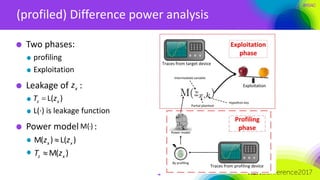
(profiled) Difference power analysis
4
Two phases:
profiling
Exploitation
Leakage of :
L(·) is leakage function
Power model :
xz
L( )z xT z
M()
M( ) L( )x xz z
M( )z xT z
#RSAC
Outline
5
Introduction
(Profiled) Differential power analysis
Profiling phase
Exploitation phase
Our contributions
Ridge-based profiling
Theoretical analysis
Why and how is ridge-based profiling better?
How the coefficients shrink in the ridge-based profiling?
Experimental Results
Simulation-based experiments
Experiments on real FPGA implementation
#RSAC
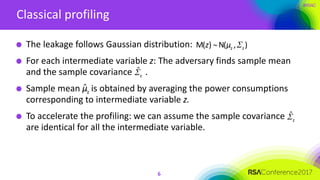
Classical profiling
6
The leakage follows Gaussian distribution:
For each intermediate variable z: The adversary finds sample mean
and the sample covariance .
Sample mean is obtained by averaging the power consumptions
corresponding to intermediate variable z.
To accelerate the profiling: we can assume the sample covariance
are identical for all the intermediate variable.
z zM( ) (N ), µz
z
ˆµ
z
ˆ
z
ˆ
#RSAC
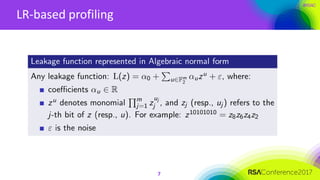
LR-based profiling
7
#RSAC
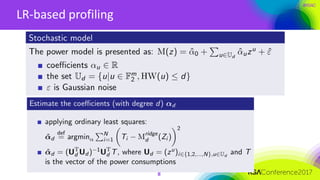
LR-based profiling
8
#RSAC
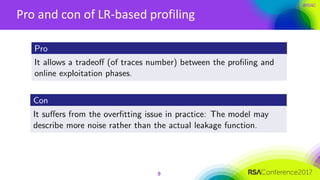
Pro and con of LR-based profiling
9
#RSAC
Outline
10
Introduction
(Profiled) Differential power analysis
Profiling phase
Exploitation phase
Our contributions
Ridge-based profiling
Theoretical analysis
Why and how is ridge-based profiling better?
How the coefficients shrink in the ridge-based profiling?
Experimental Results
Simulation-based experiments
Experiments on real FPGA implementation
#RSAC
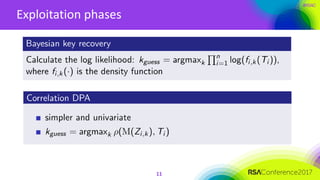
Exploitation phases
11
#RSAC
Outline
12
Introduction
(Profiled) Differential power analysis
Profiling phase
Exploitation phase
Our contributions
Ridge-based profiling
Theoretical analysis
Why and how is ridge-based profiling better?
How the coefficients shrink in the ridge-based profiling?
Experimental Results
Simulation-based experiments
Experiments on real FPGA implementation
#RSAC
Our contributions
13
(to mitigate the overfitting issue) New profiling method based on
ridge-regression
An optimized parameter find method based on cross-validation
Theoretical analysis of the new method’s improvement
Simulation based and practical experiments
#RSAC
Outline
14
Introduction
(Profiled) Differential power analysis
Profiling phase
Exploitation phase
Our contributions
Ridge-based profiling
Theoretical analysis
Why and how is ridge-based profiling better?
How the coefficients shrink in the ridge-based profiling?
Experimental Results
Simulation-based experiments
Experiments on real FPGA implementation
#RSAC
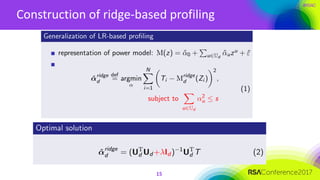
Construction of ridge-based profiling
15
#RSAC
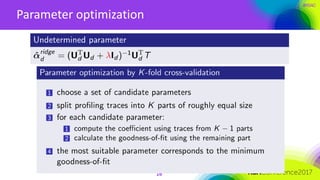
Parameter optimization
16
#RSAC
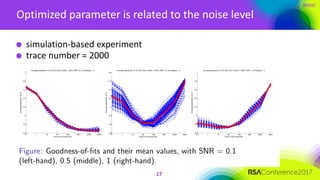
Optimized parameter is related to the noise level
17
simulation-based experiment
trace number = 2000
#RSAC
Outline
18
Introduction
(Profiled) Differential power analysis
Profiling phase
Exploitation phase
Our contributions
Ridge-based profiling
Theoretical analysis
Why and how is ridge-based profiling better?
How the coefficients shrink in the ridge-based profiling?
Experimental Results
Simulation-based experiments
Experiments on real FPGA implementation
#RSAC
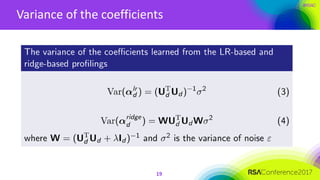
Variance of the coefficients
19
#RSAC
Variance of the coefficients
20
Figure: The variances of the coefficients for degrees (of the model) and λ. The
left and right figures correspond to the cases for d = 1 and d = 2 respectively.
#RSAC
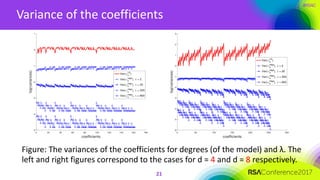
Variance of the coefficients
21
Figure: The variances of the coefficients for degrees (of the model) and λ. The
left and right figures correspond to the cases for d = 4 and d = 8 respectively.
#RSAC
Outline
22
Introduction
(Profiled) Differential power analysis
Profiling phase
Exploitation phase
Our contributions
Ridge-based profiling
Theoretical analysis
Why and how is ridge-based profiling better?
How the coefficients shrink in the ridge-based profiling?
Experimental Results
Simulation-based experiments
Experiments on real FPGA implementation
#RSAC
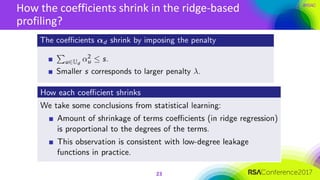
How the coefficients shrink in the ridge-based
profiling?
23
#RSAC
Outline
24
Introduction
(Profiled) Differential power analysis
Profiling phase
Exploitation phase
Our contributions
Ridge-based profiling
Theoretical analysis
Why and how is ridge-based profiling better?
How the coefficients shrink in the ridge-based profiling?
Experimental Results
Simulation-based experiments
Experiments on real FPGA implementation
#RSAC
Setup
25
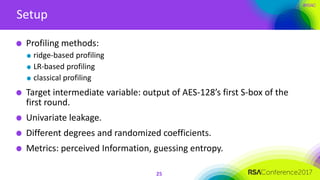
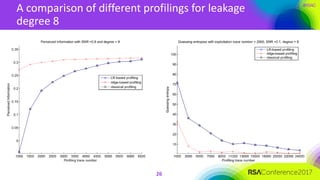
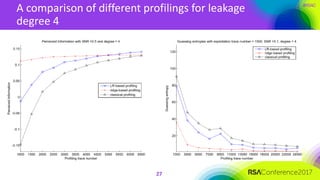
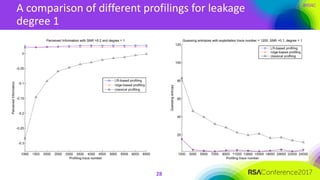
Profiling methods:
ridge-based profiling
LR-based profiling
classical profiling
Target intermediate variable: output of AES-128’s first S-box of the
first round.
Univariate leakage.
Different degrees and randomized coefficients.
Metrics: perceived Information, guessing entropy.
#RSAC
A comparison of different profilings for leakage
degree 8
26
#RSAC
A comparison of different profilings for leakage
degree 4
27
#RSAC
A comparison of different profilings for leakage
degree 1
28
#RSAC
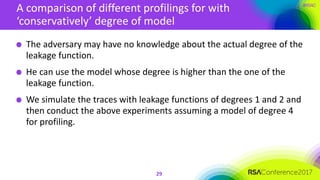
A comparison of different profilings for with
‘conservatively’ degree of model
29
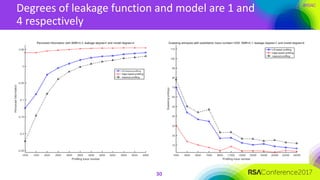
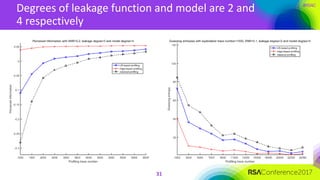
The adversary may have no knowledge about the actual degree of the
leakage function.
He can use the model whose degree is higher than the one of the
leakage function.
We simulate the traces with leakage functions of degrees 1 and 2 and
then conduct the above experiments assuming a model of degree 4
for profiling.
#RSAC
Degrees of leakage function and model are 1 and
4 respectively
30
#RSAC
Degrees of leakage function and model are 2 and
4 respectively
31
#RSAC
Outline
32
Introduction
(Profiled) Differential power analysis
Profiling phase
Exploitation phase
Our contributions
Ridge-based profiling
Theoretical analysis
Why and how is ridge-based profiling better?
How the coefficients shrink in the ridge-based profiling?
Experimental Results
Simulation-based experiments
Experiments on real FPGA implementation
#RSAC
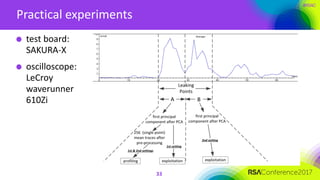
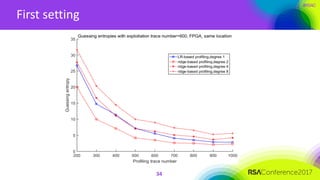
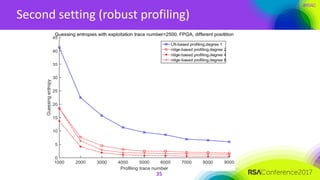
Practical experiments
33
test board:
SAKURA-X
oscilloscope:
LeCroy
waverunner
610Zi
#RSAC
First setting
34
#RSAC
Second setting (robust profiling)
35
#RSAC
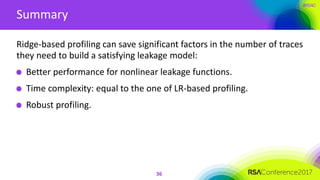
Summary
36
Ridge-based profiling can save significant factors in the number of traces
they need to build a satisfying leakage model:
Better performance for nonlinear leakage functions.
Time complexity: equal to the one of LR-based profiling.
Robust profiling.
#RSAC
37
THANK YOU
Question?
SESSION ID:SESSION ID:
#RSAC
Si Gao
My Traces Learn What You Did in the
Dark: Recovering Secret Signals without
Key Guesses
CRYP-F01
PhD Student
Trusted Computing and Information Assurance Laboratory Institute of Software,
Chinese Academy of Sciences
#RSAC
Outline
Applications in SCA
ICA-based signal recovery
Preliminaries
Introduction
Summary
#RSAC
Outline
Applications in SCA
ICA-based signal recovery
Preliminaries
Introduction
Summary
#RSAC
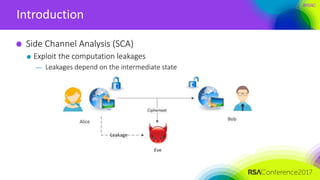
Introduction
Side Channel Analysis (SCA)
Exploit the computation leakages
— Leakages depend on the intermediate state
#RSAC
Introduction
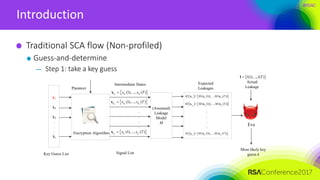
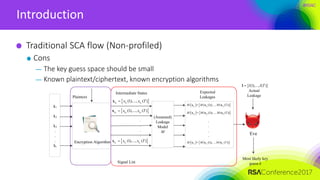
Traditional SCA flow (Non-profiled)
Guess-and-determine
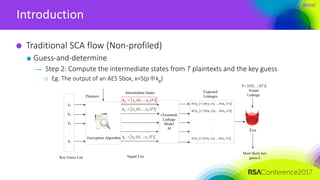
— Step 1: take a key guess
Eve
Encryption Algorithm
Plaintext
k1
k2
k3
.
.
.
kr
Key Guess List Signal List
.
.
.
.
Actual
Leakage
Most likely key
guess k
 1 1 1
(1),..., ( )k k kx x Tx
 2 2 2
(1),..., ( )k k kx x Tx
 (1),..., ( )r r rk k kx x Tx
 (1),..., ( )l l Tl
Intermediate States
(Assumed)
Leakage
Model
M
Expected
Leakages
   1 1 1
= ( (1)),..., ( ( ))k k kM M M Tx x x
   2 1 1
= ( (1)),..., ( ( ))k k kM M M Tx x x
   = ( (1)),..., ( ( ))r r rk k kM M M Tx x x
.
.
.
.
#RSAC
Introduction
Traditional SCA flow (Non-profiled)
Guess-and-determine
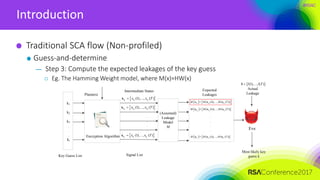
— Step 2: Compute the intermediate states from T plaintexts and the key guess
 Eg. The output of an AES Sbox, x=S(p⊕kg)
Eve
Encryption Algorithm
Plaintext
k1
k2
k3
.
.
.
kr
Key Guess List Signal List
.
.
.
.
Actual
Leakage
Most likely key
guess k
 1 1 1
(1),..., ( )k k kx x Tx
 2 2 2
(1),..., ( )k k kx x Tx
 (1),..., ( )r r rk k kx x Tx
 (1),..., ( )l l Tl
Intermediate States
(Assumed)
Leakage
Model
M
Expected
Leakages
   1 1 1
= ( (1)),..., ( ( ))k k kM M M Tx x x
   2 1 1
= ( (1)),..., ( ( ))k k kM M M Tx x x
   = ( (1)),..., ( ( ))r r rk k kM M M Tx x x
.
.
.
.
#RSAC
Introduction
Traditional SCA flow (Non-profiled)
Guess-and-determine
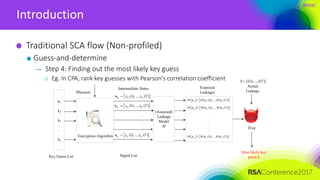
— Step 3: Compute the expected leakages of the key guess
 Eg. The Hamming Weight model, where M(x)=HW(x)
Eve
Encryption Algorithm
Plaintext
k1
k2
k3
.
.
.
kr
Key Guess List Signal List
.
.
.
.
Actual
Leakage
Most likely key
guess k
 1 1 1
(1),..., ( )k k kx x Tx
 2 2 2
(1),..., ( )k k kx x Tx
 (1),..., ( )r r rk k kx x Tx
 (1),..., ( )l l Tl
Intermediate States
(Assumed)
Leakage
Model
M
Expected
Leakages
   1 1 1
= ( (1)),..., ( ( ))k k kM M M Tx x x
   2 1 1
= ( (1)),..., ( ( ))k k kM M M Tx x x
   = ( (1)),..., ( ( ))r r rk k kM M M Tx x x
.
.
.
.
#RSAC
Introduction
Traditional SCA flow (Non-profiled)
Guess-and-determine
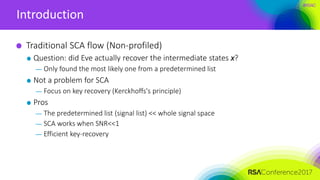
— Step 4: Finding out the most likely key guess
 Eg. In CPA, rank key guesses with Pearson's correlation coefficient
Eve
Encryption Algorithm
Plaintext
k1
k2
k3
.
.
.
kr
Key Guess List Signal List
.
.
.
.
Actual
Leakage
Most likely key
guess k
 1 1 1
(1),..., ( )k k kx x Tx
 2 2 2
(1),..., ( )k k kx x Tx
 (1),..., ( )r r rk k kx x Tx
 (1),..., ( )l l Tl
Intermediate States
(Assumed)
Leakage
Model
M
Expected
Leakages
   1 1 1
= ( (1)),..., ( ( ))k k kM M M Tx x x
   2 1 1
= ( (1)),..., ( ( ))k k kM M M Tx x x
   = ( (1)),..., ( ( ))r r rk k kM M M Tx x x
.
.
.
.
#RSAC
Introduction
Traditional SCA flow (Non-profiled)
Question: did Eve actually recover the intermediate states x?
— Only found the most likely one from a predetermined list
Not a problem for SCA
— Focus on key recovery (Kerckhoffs's principle)
Pros
— The predetermined list (signal list) << whole signal space
— SCA works when SNR<<1
— Efficient key-recovery
#RSAC
Introduction
Traditional SCA flow (Non-profiled)
Cons
— The key guess space should be small
— Known plaintext/ciphertext, known encryption algorithms
Eve
Encryption Algorithm
Plaintext
k1
k2
k3
.
.
.
kr
Signal List
.
.
.
.
Actual
Leakage
Most likely key
guess k
 1 1 1
(1),..., ( )k k kx x Tx
 2 2 2
(1),..., ( )k k kx x Tx
 (1),..., ( )r r rk k kx x Tx
 (1),..., ( )l l Tl
Intermediate States
(Assumed)
Leakage
Model
M
Expected
Leakages
   1 1 1
= ( (1)),..., ( ( ))k k kM M M Tx x x
   2 1 1
= ( (1)),..., ( ( ))k k kM M M Tx x x
   = ( (1)),..., ( ( ))r r rk k kM M M Tx x x
.
.
.
.
#RSAC
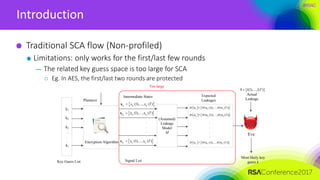
Introduction
Traditional SCA flow (Non-profiled)
Limitations: only works for the first/last few rounds
— The related key guess space is too large for SCA
 Eg. In AES, the first/last two rounds are protected
Eve
Encryption Algorithm
Plaintext
k1
k2
k3
.
.
.
kr
Key Guess List Signal List
.
.
.
.
Actual
Leakage
Most likely key
guess k
 1 1 1
(1),..., ( )k k kx x Tx
 2 2 2
(1),..., ( )k k kx x Tx
 (1),..., ( )r r rk k kx x Tx
 (1),..., ( )l l Tl
Intermediate States
(Assumed)
Leakage
Model
M
Expected
Leakages
   1 1 1
= ( (1)),..., ( ( ))k k kM M M Tx x x
   2 1 1
= ( (1)),..., ( ( ))k k kM M M Tx x x
   = ( (1)),..., ( ( ))r r rk k kM M M Tx x x
.
.
.
.
Too large
#RSAC
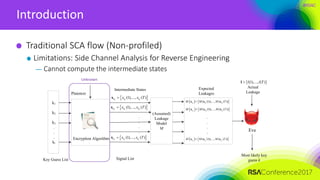
Introduction
Traditional SCA flow (Non-profiled)
Limitations: Side Channel Analysis for Reverse Engineering
— Cannot compute the intermediate states
Eve
Encryption Algorithm
Plaintext
k1
k2
k3
.
.
.
kr
Key Guess List Signal List
.
.
.
.
Actual
Leakage
Most likely key
guess k
 1 1 1
(1),..., ( )k k kx x Tx
 2 2 2
(1),..., ( )k k kx x Tx
 (1),..., ( )r r rk k kx x Tx
 (1),..., ( )l l Tl
Intermediate States
(Assumed)
Leakage
Model
M
Expected
Leakages
   1 1 1
= ( (1)),..., ( ( ))k k kM M M Tx x x
   2 1 1
= ( (1)),..., ( ( ))k k kM M M Tx x x
   = ( (1)),..., ( ( ))r r rk k kM M M Tx x x
.
.
.
.
Unknown
#RSAC
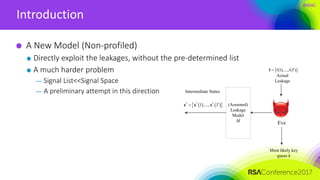
Introduction
A New Model (Non-profiled)
Directly exploit the leakages, without the pre-determined list
A much harder problem
— Signal List<<Signal Space
— A preliminary attempt in this direction
Eve
Actual
Leakage
Most likely key
guess k
 (1),..., ( )l l Tl
Intermediate States
(Assumed)
Leakage
Model
M
    * * *
1 ,..., Tx x x
#RSAC
Introduction
Notes on profiled attacks
Much stronger pre-conditions
— The Attacker gets an identical encryption device
 Build templates
 Perform template matching
— Works even if T=1 (in theory)
— Reverse the intermediate states without key guesses
Not always appropriate
— Power Variability Issues [Renauld, M., et al EUROCRYPT 2011]
We only focus on non-profiled attacks in this paper
Eve
Actual
Leakage
Most likely key
guess k
 (1),..., ( )l l Tl
Intermediate States
Templates
Tp
    * * *
1 ,..., Tx x x
#RSAC
Outline
Applications in SCA
ICA-based signal recovery
Preliminaries
Introduction
Summary
#RSAC
Preliminaries
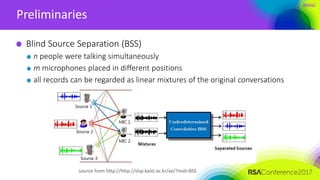
Blind Source Separation (BSS)
n people were talking simultaneously
m microphones placed in different positions
all records can be regarded as linear mixtures of the original conversations
source from http://http://slsp.kaist.ac.kr/xe/?mid=BSS
#RSAC
Preliminaries
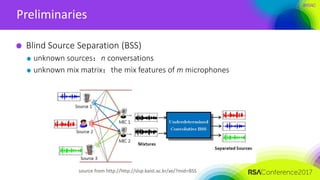
Blind Source Separation (BSS)
unknown sources:n conversations
unknown mix matrix:the mix features of m microphones
source from http://http://slsp.kaist.ac.kr/xe/?mid=BSS
#RSAC
Preliminaries
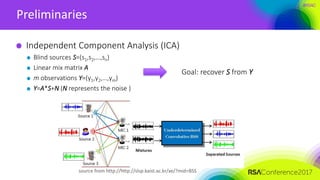
Independent Component Analysis (ICA)
Blind sources S=(s1,s2,…,sn)
Linear mix matrix A
m observations Y=(y1,y2,…,ym)
Y=A*S+N (N represents the noise )
source from http://http://slsp.kaist.ac.kr/xe/?mid=BSS
Goal: recover S from Y
#RSAC
Preliminaries
Independent Component Analysis (ICA)
ICA assumptions
— Independence: the sources are independent of each other
— Non-gaussian: the distribution of the blind sources are not gaussian
— n ≤ m
ICA algorithms
— Many popular algorithms
— Not “that” different, use FastICA in this paper
#RSAC
Outline
Applications in SCA
ICA-based signal recovery
Preliminaries
Introduction
Summary
#RSAC
ICA-based signal recovery
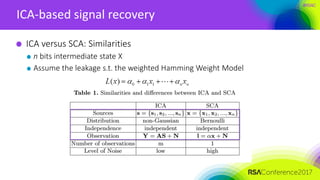
ICA versus SCA: Similarities
n bits intermediate state X
Assume the leakage s.t. the weighted Hamming Weight Model
#RSAC
ICA-based signal recovery
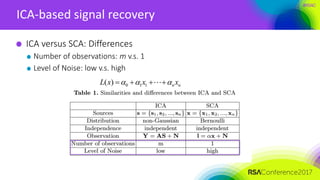
ICA versus SCA: Differences
Number of observations: m v.s. 1
Level of Noise: low v.s. high
0 1 1( ) n nL x x x     
#RSAC
ICA-based signal recovery
Constructing multi-channel observations
XOR constant
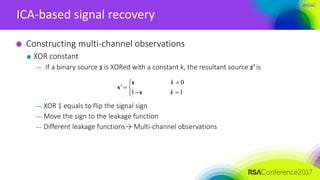
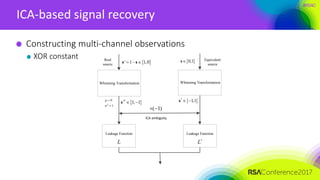
— If a binary source s is XORed with a constant k, the resultant source s′ is
— XOR 1 equals to flip the signal sign
— Move the sign to the leakage function
— Different leakage functions→ Multi-channel observations
0
'
1 1
k
k

 
 
s
s
s
#RSAC
ICA-based signal recovery
Constructing multi-channel observations
XOR constant
Whitening Transformation
 0,1s
 *
1,1 s
2
0
1




Whitening Transformation
 ' 1 1,0  s s
 *
' 1, 1 s
( 1) 
ICA ambiguity
Leakage Function
L
Leakage Function
L
Real
source
Equivalent
source
#RSAC
ICA-based signal recovery
Noise tolerance
Noise affects the performance of ICA
— ICA usually works in cases where SNR>>1
— For application in SCA, we need more robust algorithm
Ignored feature in ICA
— the distribution of the sources is given: binary signals
— the priori distribution can make ICA more robust to noise
— EM-ICA: specialized for discrete sources with random noise, using Expectation-
Maximization algorithm [Belouchrouni, Cardoso 1994]
#RSAC
ICA-based signal recovery
Specialized ICA for SCA
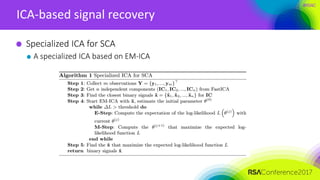
A specialized ICA based on EM-ICA
#RSAC
Outline
Applications in SCA
ICA-based signal recovery
Preliminaries
Introduction
Summary
#RSAC
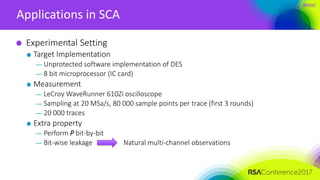
Applications in SCA
Experimental Setting
Target Implementation
— Unprotected software implementation of DES
— 8 bit microprocessor (IC card)
Measurement
— LeCroy WaveRunner 610Zi oscilloscope
— Sampling at 20 MSa/s, 80 000 sample points per trace (first 3 rounds)
— 20 000 traces
Extra property
— Perform P bit-by-bit
— Bit-wise leakage Natural multi-channel observations
#RSAC
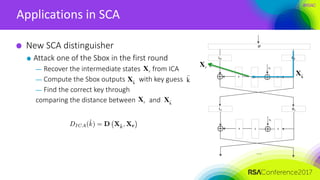
Applications in SCA
New SCA distinguisher
Attack one of the Sbox in the first round
— Recover the intermediate states from ICA
— Compute the Sbox outputs with key guess
— Find the correct key through
comparing the distance between and
k
X k
rX
k
XrX
L0 R0
IP
E
SP

L1 R1
E
SP

K1
K2
……
rX
k
X
#RSAC
Applications in SCA
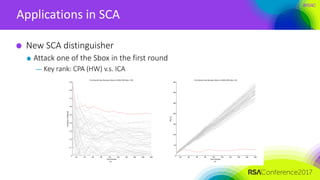
New SCA distinguisher
Attack one of the Sbox in the first round
— Key rank: CPA (HW) v.s. ICA
#RSAC
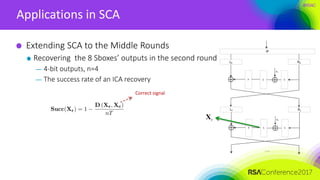
Applications in SCA
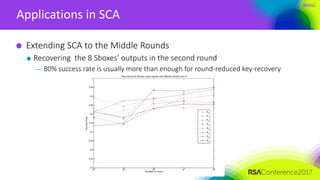
Extending SCA to the Middle Rounds
Recovering the 8 Sboxes’ outputs in the second round
— 4-bit outputs, n=4
— The success rate of an ICA recovery
L0 R0
IP
E
SP

L1 R1
E
SP

K1
K2
……
rX
Correct signal
#RSAC
Applications in SCA
Extending SCA to the Middle Rounds
Recovering the 8 Sboxes’ outputs in the second round
— 80% success rate is usually more than enough for round-reduced key-recovery
#RSAC
Applications in SCA
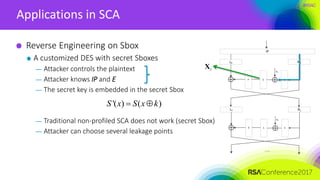
Reverse Engineering on Sbox
A customized DES with secret Sboxes
— Attacker controls the plaintext
— Attacker knows IP and E
— The secret key is embedded in the secret Sbox
— Traditional non-profiled SCA does not work (secret Sbox)
— Attacker can choose several leakage points
'( ) ( )S x S x k 
L0 R0
IP
E
SP

L1 R1
E
SP

K1
K2
……
rX
#RSAC
Applications in SCA
Reverse Engineering on Sbox
A customized DES with secret Sboxes
— Leakage point selection:
 Manually pick
 Linear Discriminant Analysis (LDA)
— Linear Discriminant Analysis
 Do not need precise points, only an approximate range
 Better recovery with larger trace sets
 not suitable when the number of traces is smaller than the range of interest
#RSAC
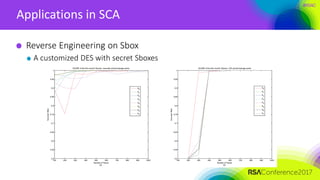
Applications in SCA
Reverse Engineering on Sbox
A customized DES with secret Sboxes
#RSAC
Applications in SCA
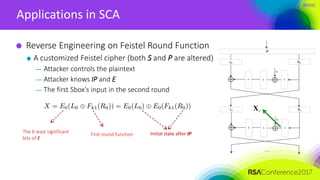
Reverse Engineering on Feistel Round Function
A customized Feistel cipher (both S and P are altered)
— Attacker controls the plaintext
— Attacker knows IP and E
— The first Sbox’s input in the second round
The 6 least significant
bits of E
First round function Initial state after IP
L0 R0
IP
E
SP

L1 R1
E
SP

K1
K2
……
rX
#RSAC
Applications in SCA
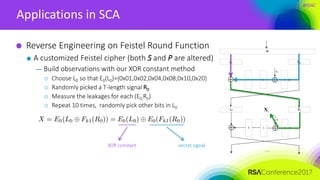
Reverse Engineering on Feistel Round Function
A customized Feistel cipher (both S and P are altered)
— Build observations with our XOR constant method
 Choose L0 so that E0(L0)={0x01,0x02,0x04,0x08,0x10,0x20}
 Randomly picked a T-length signal R0
 Measure the leakages for each (E0,R0)
 Repeat 10 times, randomly pick other bits in L0
XOR constant secret signal
L0 R0
IP
E
SP

L1 R1
E
SP

K1
K2
……
rX
#RSAC
Applications in SCA
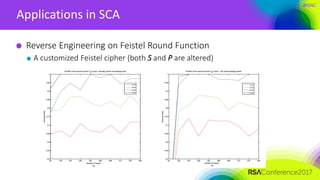
Reverse Engineering on Feistel Round Function
A customized Feistel cipher (both S and P are altered)
#RSAC
Outline
Applications in SCA
ICA-based signal recovery
Preliminaries
Introduction
Summary
#RSAC
Summary
SCA ≠ guess-and-determine
Directly recover the secret intermediate states without any key guess
— Proposed an ICA-based SCA
 Construct multi-channel observations with XOR constant
 Utilize the priori distribution with EM-ICA
— New possibilities in non-profiled SCA
 Attacking the middle round’s encryption
 Reverse engineering with fewer restrictions
A promising tool in the future?
— Needs more research effort
#RSAC
Thanks for your attention!

Ridge-based Profiled Differential Power Analysis

  • 1.
    SESSION ID:SESSION ID: #RSAC YuYu Ridge-based Profiled Differential Power Analysis CRYP-F01 Research Professor Shanghai Jiao Tong University
  • 2.
    #RSAC Outline 2 Introduction (Profiled) Differential poweranalysis Profiling phase Exploitation phase Our contributions Ridge-based profiling Theoretical analysis Why and how is ridge-based profiling better? How the coefficients shrink in the ridge-based profiling? Experimental Results Simulation-based experiments Experiments on real FPGA implementation
  • 3.
    #RSAC Outline 3 Introduction (Profiled) Differential poweranalysis Profiling phase Exploitation phase Our contributions Ridge-based profiling Theoretical analysis Why and how is ridge-based profiling better? How the coefficients shrink in the ridge-based profiling? Experimental Results Simulation-based experiments Experiments on real FPGA implementation
  • 4.
    #RSAC (profiled) Difference poweranalysis 4 Two phases: profiling Exploitation Leakage of : L(·) is leakage function Power model : xz L( )z xT z M() M( ) L( )x xz z M( )z xT z
  • 5.
    #RSAC Outline 5 Introduction (Profiled) Differential poweranalysis Profiling phase Exploitation phase Our contributions Ridge-based profiling Theoretical analysis Why and how is ridge-based profiling better? How the coefficients shrink in the ridge-based profiling? Experimental Results Simulation-based experiments Experiments on real FPGA implementation
  • 6.
    #RSAC Classical profiling 6 The leakagefollows Gaussian distribution: For each intermediate variable z: The adversary finds sample mean and the sample covariance . Sample mean is obtained by averaging the power consumptions corresponding to intermediate variable z. To accelerate the profiling: we can assume the sample covariance are identical for all the intermediate variable. z zM( ) (N ), µz z ˆµ z ˆ z ˆ
  • 7.
  • 8.
  • 9.
    #RSAC Pro and conof LR-based profiling 9
  • 10.
    #RSAC Outline 10 Introduction (Profiled) Differential poweranalysis Profiling phase Exploitation phase Our contributions Ridge-based profiling Theoretical analysis Why and how is ridge-based profiling better? How the coefficients shrink in the ridge-based profiling? Experimental Results Simulation-based experiments Experiments on real FPGA implementation
  • 11.
  • 12.
    #RSAC Outline 12 Introduction (Profiled) Differential poweranalysis Profiling phase Exploitation phase Our contributions Ridge-based profiling Theoretical analysis Why and how is ridge-based profiling better? How the coefficients shrink in the ridge-based profiling? Experimental Results Simulation-based experiments Experiments on real FPGA implementation
  • 13.
    #RSAC Our contributions 13 (to mitigatethe overfitting issue) New profiling method based on ridge-regression An optimized parameter find method based on cross-validation Theoretical analysis of the new method’s improvement Simulation based and practical experiments
  • 14.
    #RSAC Outline 14 Introduction (Profiled) Differential poweranalysis Profiling phase Exploitation phase Our contributions Ridge-based profiling Theoretical analysis Why and how is ridge-based profiling better? How the coefficients shrink in the ridge-based profiling? Experimental Results Simulation-based experiments Experiments on real FPGA implementation
  • 15.
  • 16.
  • 17.
    #RSAC Optimized parameter isrelated to the noise level 17 simulation-based experiment trace number = 2000
  • 18.
    #RSAC Outline 18 Introduction (Profiled) Differential poweranalysis Profiling phase Exploitation phase Our contributions Ridge-based profiling Theoretical analysis Why and how is ridge-based profiling better? How the coefficients shrink in the ridge-based profiling? Experimental Results Simulation-based experiments Experiments on real FPGA implementation
  • 19.
    #RSAC Variance of thecoefficients 19
  • 20.
    #RSAC Variance of thecoefficients 20 Figure: The variances of the coefficients for degrees (of the model) and λ. The left and right figures correspond to the cases for d = 1 and d = 2 respectively.
  • 21.
    #RSAC Variance of thecoefficients 21 Figure: The variances of the coefficients for degrees (of the model) and λ. The left and right figures correspond to the cases for d = 4 and d = 8 respectively.
  • 22.
    #RSAC Outline 22 Introduction (Profiled) Differential poweranalysis Profiling phase Exploitation phase Our contributions Ridge-based profiling Theoretical analysis Why and how is ridge-based profiling better? How the coefficients shrink in the ridge-based profiling? Experimental Results Simulation-based experiments Experiments on real FPGA implementation
  • 23.
    #RSAC How the coefficientsshrink in the ridge-based profiling? 23
  • 24.
    #RSAC Outline 24 Introduction (Profiled) Differential poweranalysis Profiling phase Exploitation phase Our contributions Ridge-based profiling Theoretical analysis Why and how is ridge-based profiling better? How the coefficients shrink in the ridge-based profiling? Experimental Results Simulation-based experiments Experiments on real FPGA implementation
  • 25.
    #RSAC Setup 25 Profiling methods: ridge-based profiling LR-basedprofiling classical profiling Target intermediate variable: output of AES-128’s first S-box of the first round. Univariate leakage. Different degrees and randomized coefficients. Metrics: perceived Information, guessing entropy.
  • 26.
    #RSAC A comparison ofdifferent profilings for leakage degree 8 26
  • 27.
    #RSAC A comparison ofdifferent profilings for leakage degree 4 27
  • 28.
    #RSAC A comparison ofdifferent profilings for leakage degree 1 28
  • 29.
    #RSAC A comparison ofdifferent profilings for with ‘conservatively’ degree of model 29 The adversary may have no knowledge about the actual degree of the leakage function. He can use the model whose degree is higher than the one of the leakage function. We simulate the traces with leakage functions of degrees 1 and 2 and then conduct the above experiments assuming a model of degree 4 for profiling.
  • 30.
    #RSAC Degrees of leakagefunction and model are 1 and 4 respectively 30
  • 31.
    #RSAC Degrees of leakagefunction and model are 2 and 4 respectively 31
  • 32.
    #RSAC Outline 32 Introduction (Profiled) Differential poweranalysis Profiling phase Exploitation phase Our contributions Ridge-based profiling Theoretical analysis Why and how is ridge-based profiling better? How the coefficients shrink in the ridge-based profiling? Experimental Results Simulation-based experiments Experiments on real FPGA implementation
  • 33.
  • 34.
  • 35.
  • 36.
    #RSAC Summary 36 Ridge-based profiling cansave significant factors in the number of traces they need to build a satisfying leakage model: Better performance for nonlinear leakage functions. Time complexity: equal to the one of LR-based profiling. Robust profiling.
  • 37.
  • 38.
    SESSION ID:SESSION ID: #RSAC SiGao My Traces Learn What You Did in the Dark: Recovering Secret Signals without Key Guesses CRYP-F01 PhD Student Trusted Computing and Information Assurance Laboratory Institute of Software, Chinese Academy of Sciences
  • 39.
    #RSAC Outline Applications in SCA ICA-basedsignal recovery Preliminaries Introduction Summary
  • 40.
    #RSAC Outline Applications in SCA ICA-basedsignal recovery Preliminaries Introduction Summary
  • 41.
    #RSAC Introduction Side Channel Analysis(SCA) Exploit the computation leakages — Leakages depend on the intermediate state
  • 42.
    #RSAC Introduction Traditional SCA flow(Non-profiled) Guess-and-determine — Step 1: take a key guess Eve Encryption Algorithm Plaintext k1 k2 k3 . . . kr Key Guess List Signal List . . . . Actual Leakage Most likely key guess k  1 1 1 (1),..., ( )k k kx x Tx  2 2 2 (1),..., ( )k k kx x Tx  (1),..., ( )r r rk k kx x Tx  (1),..., ( )l l Tl Intermediate States (Assumed) Leakage Model M Expected Leakages    1 1 1 = ( (1)),..., ( ( ))k k kM M M Tx x x    2 1 1 = ( (1)),..., ( ( ))k k kM M M Tx x x    = ( (1)),..., ( ( ))r r rk k kM M M Tx x x . . . .
  • 43.
    #RSAC Introduction Traditional SCA flow(Non-profiled) Guess-and-determine — Step 2: Compute the intermediate states from T plaintexts and the key guess  Eg. The output of an AES Sbox, x=S(p⊕kg) Eve Encryption Algorithm Plaintext k1 k2 k3 . . . kr Key Guess List Signal List . . . . Actual Leakage Most likely key guess k  1 1 1 (1),..., ( )k k kx x Tx  2 2 2 (1),..., ( )k k kx x Tx  (1),..., ( )r r rk k kx x Tx  (1),..., ( )l l Tl Intermediate States (Assumed) Leakage Model M Expected Leakages    1 1 1 = ( (1)),..., ( ( ))k k kM M M Tx x x    2 1 1 = ( (1)),..., ( ( ))k k kM M M Tx x x    = ( (1)),..., ( ( ))r r rk k kM M M Tx x x . . . .
  • 44.
    #RSAC Introduction Traditional SCA flow(Non-profiled) Guess-and-determine — Step 3: Compute the expected leakages of the key guess  Eg. The Hamming Weight model, where M(x)=HW(x) Eve Encryption Algorithm Plaintext k1 k2 k3 . . . kr Key Guess List Signal List . . . . Actual Leakage Most likely key guess k  1 1 1 (1),..., ( )k k kx x Tx  2 2 2 (1),..., ( )k k kx x Tx  (1),..., ( )r r rk k kx x Tx  (1),..., ( )l l Tl Intermediate States (Assumed) Leakage Model M Expected Leakages    1 1 1 = ( (1)),..., ( ( ))k k kM M M Tx x x    2 1 1 = ( (1)),..., ( ( ))k k kM M M Tx x x    = ( (1)),..., ( ( ))r r rk k kM M M Tx x x . . . .
  • 45.
    #RSAC Introduction Traditional SCA flow(Non-profiled) Guess-and-determine — Step 4: Finding out the most likely key guess  Eg. In CPA, rank key guesses with Pearson's correlation coefficient Eve Encryption Algorithm Plaintext k1 k2 k3 . . . kr Key Guess List Signal List . . . . Actual Leakage Most likely key guess k  1 1 1 (1),..., ( )k k kx x Tx  2 2 2 (1),..., ( )k k kx x Tx  (1),..., ( )r r rk k kx x Tx  (1),..., ( )l l Tl Intermediate States (Assumed) Leakage Model M Expected Leakages    1 1 1 = ( (1)),..., ( ( ))k k kM M M Tx x x    2 1 1 = ( (1)),..., ( ( ))k k kM M M Tx x x    = ( (1)),..., ( ( ))r r rk k kM M M Tx x x . . . .
  • 46.
    #RSAC Introduction Traditional SCA flow(Non-profiled) Question: did Eve actually recover the intermediate states x? — Only found the most likely one from a predetermined list Not a problem for SCA — Focus on key recovery (Kerckhoffs's principle) Pros — The predetermined list (signal list) << whole signal space — SCA works when SNR<<1 — Efficient key-recovery
  • 47.
    #RSAC Introduction Traditional SCA flow(Non-profiled) Cons — The key guess space should be small — Known plaintext/ciphertext, known encryption algorithms Eve Encryption Algorithm Plaintext k1 k2 k3 . . . kr Signal List . . . . Actual Leakage Most likely key guess k  1 1 1 (1),..., ( )k k kx x Tx  2 2 2 (1),..., ( )k k kx x Tx  (1),..., ( )r r rk k kx x Tx  (1),..., ( )l l Tl Intermediate States (Assumed) Leakage Model M Expected Leakages    1 1 1 = ( (1)),..., ( ( ))k k kM M M Tx x x    2 1 1 = ( (1)),..., ( ( ))k k kM M M Tx x x    = ( (1)),..., ( ( ))r r rk k kM M M Tx x x . . . .
  • 48.
    #RSAC Introduction Traditional SCA flow(Non-profiled) Limitations: only works for the first/last few rounds — The related key guess space is too large for SCA  Eg. In AES, the first/last two rounds are protected Eve Encryption Algorithm Plaintext k1 k2 k3 . . . kr Key Guess List Signal List . . . . Actual Leakage Most likely key guess k  1 1 1 (1),..., ( )k k kx x Tx  2 2 2 (1),..., ( )k k kx x Tx  (1),..., ( )r r rk k kx x Tx  (1),..., ( )l l Tl Intermediate States (Assumed) Leakage Model M Expected Leakages    1 1 1 = ( (1)),..., ( ( ))k k kM M M Tx x x    2 1 1 = ( (1)),..., ( ( ))k k kM M M Tx x x    = ( (1)),..., ( ( ))r r rk k kM M M Tx x x . . . . Too large
  • 49.
    #RSAC Introduction Traditional SCA flow(Non-profiled) Limitations: Side Channel Analysis for Reverse Engineering — Cannot compute the intermediate states Eve Encryption Algorithm Plaintext k1 k2 k3 . . . kr Key Guess List Signal List . . . . Actual Leakage Most likely key guess k  1 1 1 (1),..., ( )k k kx x Tx  2 2 2 (1),..., ( )k k kx x Tx  (1),..., ( )r r rk k kx x Tx  (1),..., ( )l l Tl Intermediate States (Assumed) Leakage Model M Expected Leakages    1 1 1 = ( (1)),..., ( ( ))k k kM M M Tx x x    2 1 1 = ( (1)),..., ( ( ))k k kM M M Tx x x    = ( (1)),..., ( ( ))r r rk k kM M M Tx x x . . . . Unknown
  • 50.
    #RSAC Introduction A New Model(Non-profiled) Directly exploit the leakages, without the pre-determined list A much harder problem — Signal List<<Signal Space — A preliminary attempt in this direction Eve Actual Leakage Most likely key guess k  (1),..., ( )l l Tl Intermediate States (Assumed) Leakage Model M     * * * 1 ,..., Tx x x
  • 51.
    #RSAC Introduction Notes on profiledattacks Much stronger pre-conditions — The Attacker gets an identical encryption device  Build templates  Perform template matching — Works even if T=1 (in theory) — Reverse the intermediate states without key guesses Not always appropriate — Power Variability Issues [Renauld, M., et al EUROCRYPT 2011] We only focus on non-profiled attacks in this paper Eve Actual Leakage Most likely key guess k  (1),..., ( )l l Tl Intermediate States Templates Tp     * * * 1 ,..., Tx x x
  • 52.
    #RSAC Outline Applications in SCA ICA-basedsignal recovery Preliminaries Introduction Summary
  • 53.
    #RSAC Preliminaries Blind Source Separation(BSS) n people were talking simultaneously m microphones placed in different positions all records can be regarded as linear mixtures of the original conversations source from http://http://slsp.kaist.ac.kr/xe/?mid=BSS
  • 54.
    #RSAC Preliminaries Blind Source Separation(BSS) unknown sources:n conversations unknown mix matrix:the mix features of m microphones source from http://http://slsp.kaist.ac.kr/xe/?mid=BSS
  • 55.
    #RSAC Preliminaries Independent Component Analysis(ICA) Blind sources S=(s1,s2,…,sn) Linear mix matrix A m observations Y=(y1,y2,…,ym) Y=A*S+N (N represents the noise ) source from http://http://slsp.kaist.ac.kr/xe/?mid=BSS Goal: recover S from Y
  • 56.
    #RSAC Preliminaries Independent Component Analysis(ICA) ICA assumptions — Independence: the sources are independent of each other — Non-gaussian: the distribution of the blind sources are not gaussian — n ≤ m ICA algorithms — Many popular algorithms — Not “that” different, use FastICA in this paper
  • 57.
    #RSAC Outline Applications in SCA ICA-basedsignal recovery Preliminaries Introduction Summary
  • 58.
    #RSAC ICA-based signal recovery ICAversus SCA: Similarities n bits intermediate state X Assume the leakage s.t. the weighted Hamming Weight Model
  • 59.
    #RSAC ICA-based signal recovery ICAversus SCA: Differences Number of observations: m v.s. 1 Level of Noise: low v.s. high 0 1 1( ) n nL x x x     
  • 60.
    #RSAC ICA-based signal recovery Constructingmulti-channel observations XOR constant — If a binary source s is XORed with a constant k, the resultant source s′ is — XOR 1 equals to flip the signal sign — Move the sign to the leakage function — Different leakage functions→ Multi-channel observations 0 ' 1 1 k k      s s s
  • 61.
    #RSAC ICA-based signal recovery Constructingmulti-channel observations XOR constant Whitening Transformation  0,1s  * 1,1 s 2 0 1     Whitening Transformation  ' 1 1,0  s s  * ' 1, 1 s ( 1)  ICA ambiguity Leakage Function L Leakage Function L Real source Equivalent source
  • 62.
    #RSAC ICA-based signal recovery Noisetolerance Noise affects the performance of ICA — ICA usually works in cases where SNR>>1 — For application in SCA, we need more robust algorithm Ignored feature in ICA — the distribution of the sources is given: binary signals — the priori distribution can make ICA more robust to noise — EM-ICA: specialized for discrete sources with random noise, using Expectation- Maximization algorithm [Belouchrouni, Cardoso 1994]
  • 63.
    #RSAC ICA-based signal recovery SpecializedICA for SCA A specialized ICA based on EM-ICA
  • 64.
    #RSAC Outline Applications in SCA ICA-basedsignal recovery Preliminaries Introduction Summary
  • 65.
    #RSAC Applications in SCA ExperimentalSetting Target Implementation — Unprotected software implementation of DES — 8 bit microprocessor (IC card) Measurement — LeCroy WaveRunner 610Zi oscilloscope — Sampling at 20 MSa/s, 80 000 sample points per trace (first 3 rounds) — 20 000 traces Extra property — Perform P bit-by-bit — Bit-wise leakage Natural multi-channel observations
  • 66.
    #RSAC Applications in SCA NewSCA distinguisher Attack one of the Sbox in the first round — Recover the intermediate states from ICA — Compute the Sbox outputs with key guess — Find the correct key through comparing the distance between and k X k rX k XrX L0 R0 IP E SP  L1 R1 E SP  K1 K2 …… rX k X
  • 67.
    #RSAC Applications in SCA NewSCA distinguisher Attack one of the Sbox in the first round — Key rank: CPA (HW) v.s. ICA
  • 68.
    #RSAC Applications in SCA ExtendingSCA to the Middle Rounds Recovering the 8 Sboxes’ outputs in the second round — 4-bit outputs, n=4 — The success rate of an ICA recovery L0 R0 IP E SP  L1 R1 E SP  K1 K2 …… rX Correct signal
  • 69.
    #RSAC Applications in SCA ExtendingSCA to the Middle Rounds Recovering the 8 Sboxes’ outputs in the second round — 80% success rate is usually more than enough for round-reduced key-recovery
  • 70.
    #RSAC Applications in SCA ReverseEngineering on Sbox A customized DES with secret Sboxes — Attacker controls the plaintext — Attacker knows IP and E — The secret key is embedded in the secret Sbox — Traditional non-profiled SCA does not work (secret Sbox) — Attacker can choose several leakage points '( ) ( )S x S x k  L0 R0 IP E SP  L1 R1 E SP  K1 K2 …… rX
  • 71.
    #RSAC Applications in SCA ReverseEngineering on Sbox A customized DES with secret Sboxes — Leakage point selection:  Manually pick  Linear Discriminant Analysis (LDA) — Linear Discriminant Analysis  Do not need precise points, only an approximate range  Better recovery with larger trace sets  not suitable when the number of traces is smaller than the range of interest
  • 72.
    #RSAC Applications in SCA ReverseEngineering on Sbox A customized DES with secret Sboxes
  • 73.
    #RSAC Applications in SCA ReverseEngineering on Feistel Round Function A customized Feistel cipher (both S and P are altered) — Attacker controls the plaintext — Attacker knows IP and E — The first Sbox’s input in the second round The 6 least significant bits of E First round function Initial state after IP L0 R0 IP E SP  L1 R1 E SP  K1 K2 …… rX
  • 74.
    #RSAC Applications in SCA ReverseEngineering on Feistel Round Function A customized Feistel cipher (both S and P are altered) — Build observations with our XOR constant method  Choose L0 so that E0(L0)={0x01,0x02,0x04,0x08,0x10,0x20}  Randomly picked a T-length signal R0  Measure the leakages for each (E0,R0)  Repeat 10 times, randomly pick other bits in L0 XOR constant secret signal L0 R0 IP E SP  L1 R1 E SP  K1 K2 …… rX
  • 75.
    #RSAC Applications in SCA ReverseEngineering on Feistel Round Function A customized Feistel cipher (both S and P are altered)
  • 76.
    #RSAC Outline Applications in SCA ICA-basedsignal recovery Preliminaries Introduction Summary
  • 77.
    #RSAC Summary SCA ≠ guess-and-determine Directlyrecover the secret intermediate states without any key guess — Proposed an ICA-based SCA  Construct multi-channel observations with XOR constant  Utilize the priori distribution with EM-ICA — New possibilities in non-profiled SCA  Attacking the middle round’s encryption  Reverse engineering with fewer restrictions A promising tool in the future? — Needs more research effort
  • 78.