On Optimizing Resource Utilization in AVC-based
Real-time Video Streaming
Alireza Erfanian, Farzad Tashtarian, Reza Farahani, Christian Timmerer, Hermann Hellwagner
29 June-3 July 2020
Ghent, Belgium(Virtual Conference)
This research has been supported in part by the Christian Doppler Laboratory ATHENA:
https://athena.itec.aau.at/
• Introduction
• Motivation example
• Proposed approaches
• Proposed MILP model
• Proposed heuristic algorithm
• Results
• Conclusion and future works
2
Outline
3
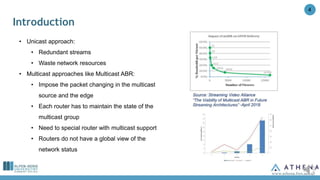
Introduction
Source :https://www.sandvine.com/
• Unicast approach:
• Redundant streams
• Waste network resources
• Multicast approaches like Multicast ABR:
• Impose the packet changing in the multicast
source and the edge
• Each router has to maintain the state of the
multicast group
• Need to special router with multicast support
• Routers do not have a global view of the
network status
4
Introduction
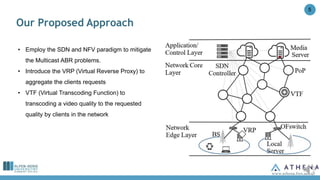
Our Proposed Approach
• Employ the SDN and NFV paradigm to mitigate
the Multicast ABR problems.
• Introduce the VRP (Virtual Reverse Proxy) to
aggregate the clients requests
• VTF (Virtual Transcoding Function) to
transcoding a video quality to the requested
quality by clients in the network
5
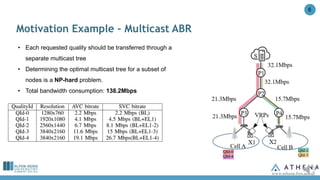
Motivation Example – Multicast ABR
• Each requested quality should be transferred through a
separate multicast tree
• Determining the optimal multicast tree for a subset of
nodes is a NP-hard problem.
• Total bandwidth consumption: 138.2Mbps
6
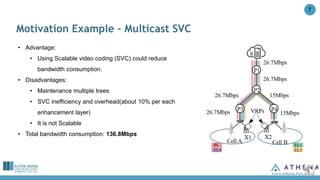
Motivation Example – Multicast SVC
• Advantage:
• Using Scalable video coding (SVC) could reduce
bandwidth consumption.
• Disadvantages:
• Maintenance multiple trees
• SVC inefficiency and overhead(about 10% per each
enhancement layer)
• It is not Scalable
• Total bandwidth consumption: 136.8Mbps
7
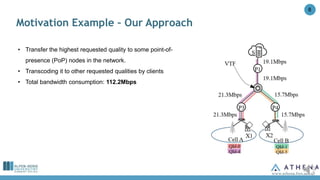
Motivation Example – Our Approach
• Transfer the highest requested quality to some point-of-
presence (PoP) nodes in the network.
• Transcoding it to other requested qualities by clients
• Total bandwidth consumption: 112.2Mbps
8
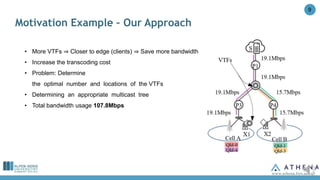
Motivation Example – Our Approach
• More VTFs ⇒ Closer to edge (clients) ⇒ Save more bandwidth
• Increase the transcoding cost
• Problem: Determine
the optimal number and locations of the VTFs
• Determining an appropriate multicast tree
• Total bandwidth usage 107.8Mbps
9
10
• We leverage the SDN concept and NFV technology to efficiently serve DASH clients’ requests in AVC real-
time streaming.
• We propose an MILP model to jointly construct the optimal multicast tree and VTFs’ placement with the
objective of minimizing the resource utilization and VTFs’ costs.
• We propose a heuristic approach to achieve a near optimal solution in polynomial time.
• We evaluate the performance of the proposed framework using MiniNet and compare it with other SVC-
and AVC based multicast and unicast approaches.
Our Contribution
Proposed MILP Model. Objective function
We formulated the mentioned problem as the following MILP model:
𝑀𝑖𝑛. 𝛼1 𝑡,𝑓
𝐹 𝑡,𝑓 𝜋 𝑡,𝑓
𝐹∗ + 𝛼2( 𝑖,𝑗,𝑡,𝑥
𝑑 𝑖,𝑗
𝑡,𝑥
𝜋 𝑖,𝑗
′
𝐷∗ + 𝑖,𝑗
𝐿 𝑖,𝑗 𝜋𝑖,𝑗
′
𝐿∗ )
s. t. Constraints 1 − 15
For more details please refer to the paper
11
12
Proposed heuristic Algorithm
• Proposed MILP model is NP-hard and is not
scalable.
• To mitigate MILP time complexity we propose a
heuristic algorithm in polynomial time complexity.
13
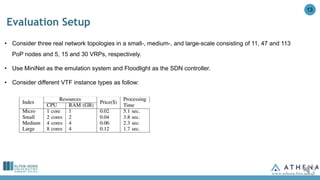
Evaluation Setup
• Consider three real network topologies in a small-, medium-, and large-scale consisting of 11, 47 and 113
PoP nodes and 5, 15 and 30 VRPs, respectively.
• Use MiniNet as the emulation system and Floodlight as the SDN controller.
• Consider different VTF instance types as follow:
Results-Scenario I
Comparing the proposed MILP and heuristic approaches in term of number of selected VTFs and
measured total transcoding costs for small scale topology.
14
Results- Scenario I
15
Comparing the proposed MILP and heuristic approaches in term of consumed bandwidth and
generated OF commands for small scale topology.
Results- Scenario II
16
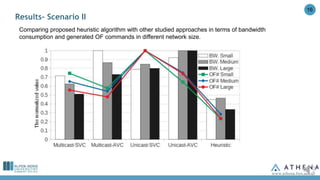
Comparing proposed heuristic algorithm with other studied approaches in terms of bandwidth
consumption and generated OF commands in different network size.
Results- Scenario III
17
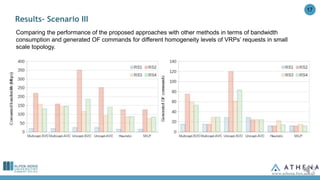
Comparing the performance of the proposed approaches with other methods in terms of bandwidth
consumption and generated OF commands for different homogeneity levels of VRPs’ requests in small
scale topology.
Results: Execution time of proposed heuristic algorithm.
18
Conclusion and future works
19
• Leveraging the SDN and NFV paradigms to propose an AVC-based real-time video multicast
streaming framework.
• Employ two types of VNFs named VRP and VTF.
• Proposing the heuristic algorithm to address time complexity of the proposed MILP model.
• Evaluating the proposed approaches by using MiniNet and Floodlight as the SDN controller and
compared with other unicast and multicast approaches.
• Improving the MILP and heuristic approaches performance and considering E2E delay are the open
challenges for the future works.
Reference
[1] C. V. N. Index, “Cisco Visual Networking Index: Forecast and Trends,2017–2022,”White Paper, February 2021.
[2] R. Malli, X. Zhang, and C. Qiao, “Benefits of multicasting in all-opticalnetworks,” inAll-Optical Networking: Architecture, Control, and
Man-agement Issues, vol. 3531.International Society for Optics and Pho-tonics, 1998, pp. 209–220.
[3] A. Striegel and G. Manimaran, “A survey of QoS multicasting issues,”IEEE Communications Magazine, vol. 40, no. 6, pp. 82–87, 2002.
[4] J. Liebeherr and M. Nahas, “Application-layer multicast with delaunaytriangulations,” inGLOBECOM’01. IEEE Global
TelecommunicationsConference (Cat. No. 01CH37270), vol. 3. IEEE, 2001, pp. 1651–1655.
[5] Y. Cui, B. Li, and K. Nahrstedt, “oStream: Asynchronous streamingmulticast in application-layer overlay networks,”IEEE Journal on
Se-lected Areas in Communications, vol. 22, no. 1, pp. 91–106, 2004
[6] F. Wang, Y. Xiong, and J. Liu, “mTreebone: A hybrid tree/mesh overlayfor application-layer live video multicast,” in27th International
Confer-ence on Distributed Computing Systems (ICDCS’07). IEEE, 2007, pp.49–49.
[7] A. Iyer, P. Kumar, and V. Mann, “Avalanche: Data center multicastusing software defined networking,” in2014 Sixth International
Confer-ence on Communication Systems and Networks (COMSNETS). IEEE,2014, pp. 1–8.
[8] S. Q. Zhang, Q. Zhang, H. Bannazadeh, and A. Leon-Garcia, “Routingalgorithms for network function virtualization enabled multicast
topol-ogy on SDN,”IEEE Transactions on Network and Service Management,vol. 12, no. 4, pp. 580–594, 2015.
[9] S.-H. Shen, L.-H. Huang, D.-N. Yang, and W.-T. Chen, “Reliable mul-ticast routing for software-defined networks,” in2015 IEEE
Conferenceon Computer Communications (INFOCOM). IEEE, 2015, pp. 181–189.
[10] N. McKeown, T. Anderson, H. Balakrishnan, G. Parulkar, L. Peterson,J. Rexford, S. Shenker, and J. Turner, “OpenFlow: Enabling
innova-tion in campus networks,”ACM SIGCOMM Computer CommunicationReview, vol. 38, no. 2, pp. 69–74, 2008.
[11] H. Schwarz, D. Marpe, and T. Wiegand, “Overview of the scalable videocoding extension of the H.264/AVC standard,”IEEE
Transactions onCircuits and Systems for Video Technology, vol. 17, no. 9, pp. 1103–1120,2007
20
On Optimizing Resource Utilization in AVC-based Real-time Video Streaming

On Optimizing Resource Utilization in AVC-based Real-time Video Streaming

  • 1.
    On Optimizing ResourceUtilization in AVC-based Real-time Video Streaming Alireza Erfanian, Farzad Tashtarian, Reza Farahani, Christian Timmerer, Hermann Hellwagner 29 June-3 July 2020 Ghent, Belgium(Virtual Conference) This research has been supported in part by the Christian Doppler Laboratory ATHENA: https://athena.itec.aau.at/
  • 2.
    • Introduction • Motivationexample • Proposed approaches • Proposed MILP model • Proposed heuristic algorithm • Results • Conclusion and future works 2 Outline
  • 3.
  • 4.
    • Unicast approach: •Redundant streams • Waste network resources • Multicast approaches like Multicast ABR: • Impose the packet changing in the multicast source and the edge • Each router has to maintain the state of the multicast group • Need to special router with multicast support • Routers do not have a global view of the network status 4 Introduction
  • 5.
    Our Proposed Approach •Employ the SDN and NFV paradigm to mitigate the Multicast ABR problems. • Introduce the VRP (Virtual Reverse Proxy) to aggregate the clients requests • VTF (Virtual Transcoding Function) to transcoding a video quality to the requested quality by clients in the network 5
  • 6.
    Motivation Example –Multicast ABR • Each requested quality should be transferred through a separate multicast tree • Determining the optimal multicast tree for a subset of nodes is a NP-hard problem. • Total bandwidth consumption: 138.2Mbps 6
  • 7.
    Motivation Example –Multicast SVC • Advantage: • Using Scalable video coding (SVC) could reduce bandwidth consumption. • Disadvantages: • Maintenance multiple trees • SVC inefficiency and overhead(about 10% per each enhancement layer) • It is not Scalable • Total bandwidth consumption: 136.8Mbps 7
  • 8.
    Motivation Example –Our Approach • Transfer the highest requested quality to some point-of- presence (PoP) nodes in the network. • Transcoding it to other requested qualities by clients • Total bandwidth consumption: 112.2Mbps 8
  • 9.
    Motivation Example –Our Approach • More VTFs ⇒ Closer to edge (clients) ⇒ Save more bandwidth • Increase the transcoding cost • Problem: Determine the optimal number and locations of the VTFs • Determining an appropriate multicast tree • Total bandwidth usage 107.8Mbps 9
  • 10.
    10 • We leveragethe SDN concept and NFV technology to efficiently serve DASH clients’ requests in AVC real- time streaming. • We propose an MILP model to jointly construct the optimal multicast tree and VTFs’ placement with the objective of minimizing the resource utilization and VTFs’ costs. • We propose a heuristic approach to achieve a near optimal solution in polynomial time. • We evaluate the performance of the proposed framework using MiniNet and compare it with other SVC- and AVC based multicast and unicast approaches. Our Contribution
  • 11.
    Proposed MILP Model.Objective function We formulated the mentioned problem as the following MILP model: 𝑀𝑖𝑛. 𝛼1 𝑡,𝑓 𝐹 𝑡,𝑓 𝜋 𝑡,𝑓 𝐹∗ + 𝛼2( 𝑖,𝑗,𝑡,𝑥 𝑑 𝑖,𝑗 𝑡,𝑥 𝜋 𝑖,𝑗 ′ 𝐷∗ + 𝑖,𝑗 𝐿 𝑖,𝑗 𝜋𝑖,𝑗 ′ 𝐿∗ ) s. t. Constraints 1 − 15 For more details please refer to the paper 11
  • 12.
    12 Proposed heuristic Algorithm •Proposed MILP model is NP-hard and is not scalable. • To mitigate MILP time complexity we propose a heuristic algorithm in polynomial time complexity.
  • 13.
    13 Evaluation Setup • Considerthree real network topologies in a small-, medium-, and large-scale consisting of 11, 47 and 113 PoP nodes and 5, 15 and 30 VRPs, respectively. • Use MiniNet as the emulation system and Floodlight as the SDN controller. • Consider different VTF instance types as follow:
  • 14.
    Results-Scenario I Comparing theproposed MILP and heuristic approaches in term of number of selected VTFs and measured total transcoding costs for small scale topology. 14
  • 15.
    Results- Scenario I 15 Comparingthe proposed MILP and heuristic approaches in term of consumed bandwidth and generated OF commands for small scale topology.
  • 16.
    Results- Scenario II 16 Comparingproposed heuristic algorithm with other studied approaches in terms of bandwidth consumption and generated OF commands in different network size.
  • 17.
    Results- Scenario III 17 Comparingthe performance of the proposed approaches with other methods in terms of bandwidth consumption and generated OF commands for different homogeneity levels of VRPs’ requests in small scale topology.
  • 18.
    Results: Execution timeof proposed heuristic algorithm. 18
  • 19.
    Conclusion and futureworks 19 • Leveraging the SDN and NFV paradigms to propose an AVC-based real-time video multicast streaming framework. • Employ two types of VNFs named VRP and VTF. • Proposing the heuristic algorithm to address time complexity of the proposed MILP model. • Evaluating the proposed approaches by using MiniNet and Floodlight as the SDN controller and compared with other unicast and multicast approaches. • Improving the MILP and heuristic approaches performance and considering E2E delay are the open challenges for the future works.
  • 20.
    Reference [1] C. V.N. Index, “Cisco Visual Networking Index: Forecast and Trends,2017–2022,”White Paper, February 2021. [2] R. Malli, X. Zhang, and C. Qiao, “Benefits of multicasting in all-opticalnetworks,” inAll-Optical Networking: Architecture, Control, and Man-agement Issues, vol. 3531.International Society for Optics and Pho-tonics, 1998, pp. 209–220. [3] A. Striegel and G. Manimaran, “A survey of QoS multicasting issues,”IEEE Communications Magazine, vol. 40, no. 6, pp. 82–87, 2002. [4] J. Liebeherr and M. Nahas, “Application-layer multicast with delaunaytriangulations,” inGLOBECOM’01. IEEE Global TelecommunicationsConference (Cat. No. 01CH37270), vol. 3. IEEE, 2001, pp. 1651–1655. [5] Y. Cui, B. Li, and K. Nahrstedt, “oStream: Asynchronous streamingmulticast in application-layer overlay networks,”IEEE Journal on Se-lected Areas in Communications, vol. 22, no. 1, pp. 91–106, 2004 [6] F. Wang, Y. Xiong, and J. Liu, “mTreebone: A hybrid tree/mesh overlayfor application-layer live video multicast,” in27th International Confer-ence on Distributed Computing Systems (ICDCS’07). IEEE, 2007, pp.49–49. [7] A. Iyer, P. Kumar, and V. Mann, “Avalanche: Data center multicastusing software defined networking,” in2014 Sixth International Confer-ence on Communication Systems and Networks (COMSNETS). IEEE,2014, pp. 1–8. [8] S. Q. Zhang, Q. Zhang, H. Bannazadeh, and A. Leon-Garcia, “Routingalgorithms for network function virtualization enabled multicast topol-ogy on SDN,”IEEE Transactions on Network and Service Management,vol. 12, no. 4, pp. 580–594, 2015. [9] S.-H. Shen, L.-H. Huang, D.-N. Yang, and W.-T. Chen, “Reliable mul-ticast routing for software-defined networks,” in2015 IEEE Conferenceon Computer Communications (INFOCOM). IEEE, 2015, pp. 181–189. [10] N. McKeown, T. Anderson, H. Balakrishnan, G. Parulkar, L. Peterson,J. Rexford, S. Shenker, and J. Turner, “OpenFlow: Enabling innova-tion in campus networks,”ACM SIGCOMM Computer CommunicationReview, vol. 38, no. 2, pp. 69–74, 2008. [11] H. Schwarz, D. Marpe, and T. Wiegand, “Overview of the scalable videocoding extension of the H.264/AVC standard,”IEEE Transactions onCircuits and Systems for Video Technology, vol. 17, no. 9, pp. 1103–1120,2007 20