Least Mastered Competency
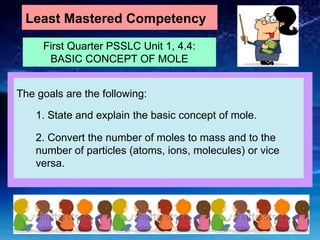
The goals are the following:
1. State and explain the basic concept of mole.
2. Convert the number of moles to mass and to the
number of particles (atoms, ions, molecules) or vice
versa.
First Quarter PSSLC Unit 1, 4.4:
BASIC CONCEPT OF MOLE
STRATEGIC INTERVENTION MATERIAL
The Strategic Intervention
Material (SIM) is an interactive,
student-centered tool in Science
that has an objective to develop
students’ awareness on intricate
topics in Science via guide cards,
activity cards ,assessment cards,
enrichment cards and reference
cards. The topic is Mole. The
teacher chose the said topic to
enhance the students’ critical
thinking skills.
LEARNING
IS FUN
WITH SIM
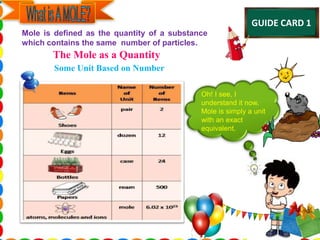
Mole is defined as the quantity of a substance
which contains the same number of particles.
Oh! I see, I
understand it now.
Mole is simply a unit
with an exact
equivalent.
The Mole as a Quantity
Some Unit Based on Number
GUIDE CARD 1
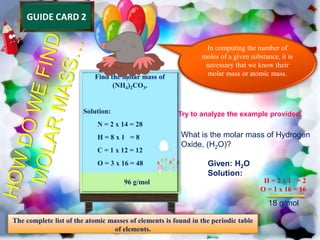
In computing the number of
moles of a given substance, it is
necessary that we know their
molar mass or atomic mass.
What is the molar mass of Hydrogen
Oxide, (H2O)?
Given: H2O
Solution:
H = 2 x 1 = 2
O = 1 x 16 = 16
18 g/mol
The complete list of the atomic masses of elements is found in the periodic table
of elements.
Find the molar mass of
(NH4)2CO3.
Solution:
N = 2 x 14 = 28
H = 8 x 1 = 8
C = 1 x 12 = 12
O = 3 x 16 = 48
96 g/mol
Try to analyze the example provided.
GUIDE CARD 2
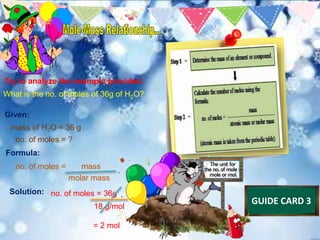
Try to analyze the example provided.
What is the no. of moles of 36g of H2O?
Given:
mass of H2O = 36 g
no. of moles = ?
Formula:
no. of moles = mass
molar mass
Solution: no. of moles = 36g
18 g/mol
= 2 mol
GUIDE CARD 3
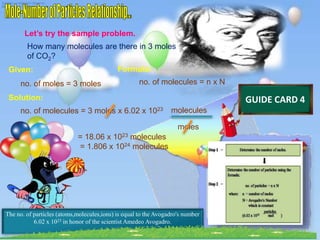
Let’s try the sample problem.
How many molecules are there in 3 moles
of CO2?
Given:
no. of moles = 3 moles
Formula:
no. of molecules = n x N
Solution:
no. of molecules = 3 moles x 6.02 x 10²³ molecules
moles
= 18.06 x 10²³ molecules
= 1.806 x 1024 molecules
The no. of particles (atoms,molecules,ions) is equal to the Avogadro's number
6.02 x 10²³ in honor of the scientist Amedeo Avogadro.
GUIDE CARD 4
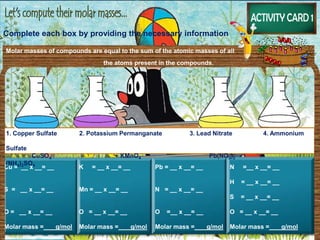
Complete each box by providing the necessary information
Cu = __ x __= __
S = __ x __= __
O = __ x __= __
Molar mass = g/mol
K = __ x __= __
Mn = __ x __= __
O = __ x __= __
Molar mass = g/mol
Pb = __ x __= __
N = __ x __= __
O =__ x __= __
Molar mass = g/mol
N =__ x __= __
H = __ x __= __
S = __ x __= __
O = __ x __= __
Molar mass = g/mol
1. Copper Sulfate 2. Potassium Permanganate 3. Lead Nitrate 4. Ammonium
Sulfate
CuSO4 KMnO4 Pb(NO3)2
(NH4)2SO4
Molar masses of compounds are equal to the sum of the atomic masses of all
the atoms present in the compounds.
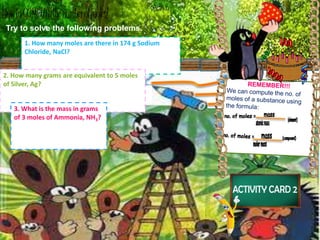
Try to solve the following problems.
1. How many moles are there in 174 g Sodium
Chloride, NaCl?
2. How many grams are equivalent to 5 moles
of Silver, Ag?
3. What is the mass in grams
of 3 moles of Ammonia, NH3?
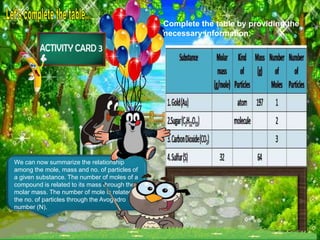
Complete the table by providing the
necessary information.
We can now summarize the relationship
among the mole, mass and no. of particles of
a given substance. The number of moles of a
compound is related to its mass through the
molar mass. The number of mole is related to
the no. of particles through the Avogadro
number (N).
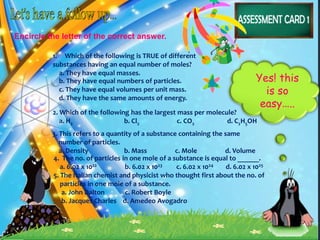
Encircle the letter of the correct answer.
1. Which of the following is TRUE of different
substances having an equal number of moles?
a. They have equal masses.
Yes! this
is so
easy…..
b. They have equal numbers of particles.
c. They have equal volumes per unit mass.
d. They have the same amounts of energy.
2. Which of the following has the largest mass per molecule?
a. H2 b. Cl2 c. CO2 d. C2H5OH
3. This refers to a quantity of a substance containing the same
number of particles.
a. Density b. Mass c. Mole d. Volume
4. The no. of particles in one mole of a substance is equal to ______.
a. 6.02 x 10²² b. 6.02 x 10²³ c. 6.02 x 1024 d. 6.02 x 1025
5. The Italian chemist and physicist who thought first about the no. of
particles in one mole of a substance.
a. John Dalton c. Robert Boyle
b. Jacques Charles d. Amedeo Avogadro
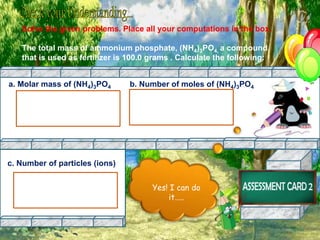
Solve the given problems. Place all your computations in the box.
The total mass of ammonium phosphate, (NH4)3PO4, a compound
that is used as fertilizer is 100.0 grams . Calculate the following:
a. Molar mass of (NH4)3PO4 b. Number of moles of (NH4)3PO4
Yes! I can do
it…..
c. Number of particles (ions)
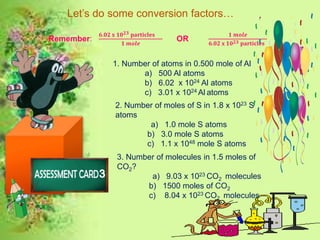
Let’s do some conversion factors…
Remember:
𝟔.𝟎𝟐 𝐱 𝟏𝟎 𝟐𝟑 𝐩𝐚𝐫𝐭𝐢𝐜𝐥𝐞𝐬
𝟏 𝒎𝒐𝒍𝒆
OR
𝟏 𝒎𝒐𝒍𝒆
𝟔.𝟎𝟐 𝐱 𝟏𝟎 𝟐𝟑 𝐩𝐚𝐫𝐭𝐢𝐜𝐥𝐞𝐬
1. Number of atoms in 0.500 mole of Al
a) 500 Al atoms
b) 6.02 x 1024 Al atoms
c) 3.01 x 1024 Al atoms
2. Number of moles of S in 1.8 x 10²³ S
atoms
a) 1.0 mole S atoms
b) 3.0 mole S atoms
c) 1.1 x 1048 mole S atoms
3. Number of molecules in 1.5 moles of
CO2?
a) 9.03 x 10²³ CO2 molecules
b) 1500 moles of CO2
c) 8.04 x 10²³ CO2 molecules
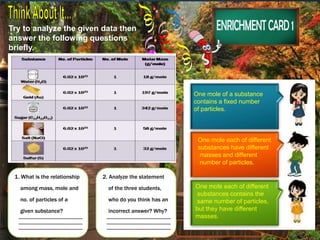
Try to analyze the given data then
answer the following questions
briefly.
One mole of a substance
contains a fixed number
of particles.
One mole each of different
substances have different
masses and different
number of particles.
One mole each of different
substances contains the
same number of particles,
but they have different
masses.
1. What is the relationship
among mass, mole and
no. of particles of a
given substance?
2. Analyze the statement
of the three students,
who do you think has an
incorrect answer? Why?
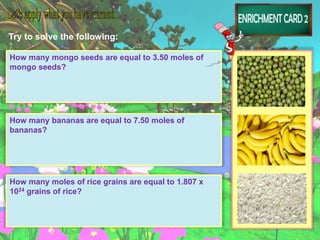
Try to solve the following:
How many mongo seeds are equal to 3.50 moles of
mongo seeds?
How many bananas are equal to 7.50 moles of
bananas?
How many moles of rice grains are equal to 1.807 x
1024 grains of rice?
3
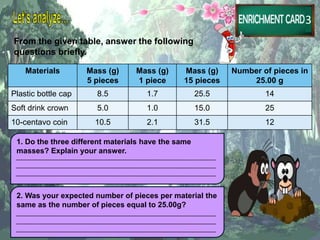
From the given table, answer the following
questions briefly.
Materials Mass (g)
5 pieces
Mass (g)
1 piece
Mass (g)
15 pieces
Number of pieces in
25.00 g
Plastic bottle cap 8.5 1.7 25.5 14
Soft drink crown 5.0 1.0 15.0 25
10-centavo coin 10.5 2.1 31.5 12
1. Do the three different materials have the same
masses? Explain your answer.
2. Was your expected number of pieces per material the
same as the number of pieces equal to 25.00g?
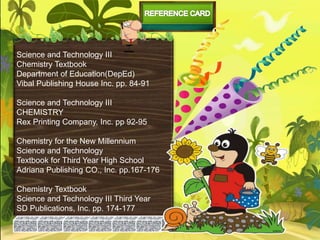
Science and Technology III
Chemistry Textbook
Department of Education(DepEd)
Vibal Publishing House Inc. pp. 84-91
Science and Technology III
CHEMISTRY
Rex Printing Company, Inc. pp 92-95
Chemistry for the New Millennium
Science and Technology
Textbook for Third Year High School
Adriana Publishing CO., Inc. pp.167-176
Chemistry Textbook
Science and Technology III Third Year
SD Publications, Inc. pp. 174-177
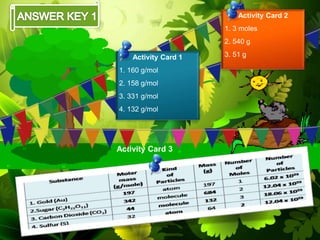
Activity Card 3
Activity Card 1
1. 160 g/mol
2. 158 g/mol
3. 331 g/mol
4. 132 g/mol
Activity Card 2
1. 3 moles
2. 540 g
3. 51 g
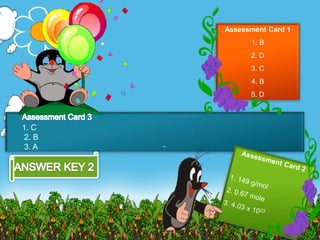
1. C
2. B
3. A
Assessment Card 1
1. B
2. D
3. C
4. B
5. D
Enrichment Card 1
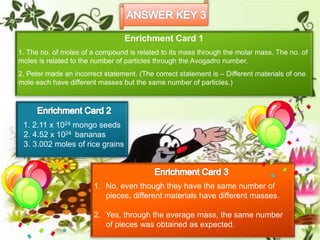
1. The no. of moles of a compound is related to its mass through the molar mass. The no. of
moles is related to the number of particles through the Avogadro number.
2. Peter made an incorrect statement. (The correct statement is – Different materials of one
mole each have different masses but the same number of particles.)
1. No, even though they have the same number of
pieces, different materials have different masses.
2. Yes, through the average mass, the same number
of pieces was obtained as expected.
1. 2.11 x 1024 mongo seeds
2. 4.52 x 1024 bananas
3. 3.002 moles of rice grains
MRS. RENEROSA G. CAMAY'S SIM

MRS. RENEROSA G. CAMAY'S SIM

  • 2.
    Least Mastered Competency Thegoals are the following: 1. State and explain the basic concept of mole. 2. Convert the number of moles to mass and to the number of particles (atoms, ions, molecules) or vice versa. First Quarter PSSLC Unit 1, 4.4: BASIC CONCEPT OF MOLE
  • 4.
    STRATEGIC INTERVENTION MATERIAL TheStrategic Intervention Material (SIM) is an interactive, student-centered tool in Science that has an objective to develop students’ awareness on intricate topics in Science via guide cards, activity cards ,assessment cards, enrichment cards and reference cards. The topic is Mole. The teacher chose the said topic to enhance the students’ critical thinking skills. LEARNING IS FUN WITH SIM
  • 5.
    Mole is definedas the quantity of a substance which contains the same number of particles. Oh! I see, I understand it now. Mole is simply a unit with an exact equivalent. The Mole as a Quantity Some Unit Based on Number GUIDE CARD 1
  • 6.
    In computing thenumber of moles of a given substance, it is necessary that we know their molar mass or atomic mass. What is the molar mass of Hydrogen Oxide, (H2O)? Given: H2O Solution: H = 2 x 1 = 2 O = 1 x 16 = 16 18 g/mol The complete list of the atomic masses of elements is found in the periodic table of elements. Find the molar mass of (NH4)2CO3. Solution: N = 2 x 14 = 28 H = 8 x 1 = 8 C = 1 x 12 = 12 O = 3 x 16 = 48 96 g/mol Try to analyze the example provided. GUIDE CARD 2
  • 7.
    Try to analyzethe example provided. What is the no. of moles of 36g of H2O? Given: mass of H2O = 36 g no. of moles = ? Formula: no. of moles = mass molar mass Solution: no. of moles = 36g 18 g/mol = 2 mol GUIDE CARD 3
  • 8.
    Let’s try thesample problem. How many molecules are there in 3 moles of CO2? Given: no. of moles = 3 moles Formula: no. of molecules = n x N Solution: no. of molecules = 3 moles x 6.02 x 10²³ molecules moles = 18.06 x 10²³ molecules = 1.806 x 1024 molecules The no. of particles (atoms,molecules,ions) is equal to the Avogadro's number 6.02 x 10²³ in honor of the scientist Amedeo Avogadro. GUIDE CARD 4
  • 9.
    Complete each boxby providing the necessary information Cu = __ x __= __ S = __ x __= __ O = __ x __= __ Molar mass = g/mol K = __ x __= __ Mn = __ x __= __ O = __ x __= __ Molar mass = g/mol Pb = __ x __= __ N = __ x __= __ O =__ x __= __ Molar mass = g/mol N =__ x __= __ H = __ x __= __ S = __ x __= __ O = __ x __= __ Molar mass = g/mol 1. Copper Sulfate 2. Potassium Permanganate 3. Lead Nitrate 4. Ammonium Sulfate CuSO4 KMnO4 Pb(NO3)2 (NH4)2SO4 Molar masses of compounds are equal to the sum of the atomic masses of all the atoms present in the compounds.
  • 10.
    Try to solvethe following problems. 1. How many moles are there in 174 g Sodium Chloride, NaCl? 2. How many grams are equivalent to 5 moles of Silver, Ag? 3. What is the mass in grams of 3 moles of Ammonia, NH3?
  • 11.
    Complete the tableby providing the necessary information. We can now summarize the relationship among the mole, mass and no. of particles of a given substance. The number of moles of a compound is related to its mass through the molar mass. The number of mole is related to the no. of particles through the Avogadro number (N).
  • 12.
    Encircle the letterof the correct answer. 1. Which of the following is TRUE of different substances having an equal number of moles? a. They have equal masses. Yes! this is so easy….. b. They have equal numbers of particles. c. They have equal volumes per unit mass. d. They have the same amounts of energy. 2. Which of the following has the largest mass per molecule? a. H2 b. Cl2 c. CO2 d. C2H5OH 3. This refers to a quantity of a substance containing the same number of particles. a. Density b. Mass c. Mole d. Volume 4. The no. of particles in one mole of a substance is equal to ______. a. 6.02 x 10²² b. 6.02 x 10²³ c. 6.02 x 1024 d. 6.02 x 1025 5. The Italian chemist and physicist who thought first about the no. of particles in one mole of a substance. a. John Dalton c. Robert Boyle b. Jacques Charles d. Amedeo Avogadro
  • 13.
    Solve the givenproblems. Place all your computations in the box. The total mass of ammonium phosphate, (NH4)3PO4, a compound that is used as fertilizer is 100.0 grams . Calculate the following: a. Molar mass of (NH4)3PO4 b. Number of moles of (NH4)3PO4 Yes! I can do it….. c. Number of particles (ions)
  • 14.
    Let’s do someconversion factors… Remember: 𝟔.𝟎𝟐 𝐱 𝟏𝟎 𝟐𝟑 𝐩𝐚𝐫𝐭𝐢𝐜𝐥𝐞𝐬 𝟏 𝒎𝒐𝒍𝒆 OR 𝟏 𝒎𝒐𝒍𝒆 𝟔.𝟎𝟐 𝐱 𝟏𝟎 𝟐𝟑 𝐩𝐚𝐫𝐭𝐢𝐜𝐥𝐞𝐬 1. Number of atoms in 0.500 mole of Al a) 500 Al atoms b) 6.02 x 1024 Al atoms c) 3.01 x 1024 Al atoms 2. Number of moles of S in 1.8 x 10²³ S atoms a) 1.0 mole S atoms b) 3.0 mole S atoms c) 1.1 x 1048 mole S atoms 3. Number of molecules in 1.5 moles of CO2? a) 9.03 x 10²³ CO2 molecules b) 1500 moles of CO2 c) 8.04 x 10²³ CO2 molecules
  • 15.
    Try to analyzethe given data then answer the following questions briefly. One mole of a substance contains a fixed number of particles. One mole each of different substances have different masses and different number of particles. One mole each of different substances contains the same number of particles, but they have different masses. 1. What is the relationship among mass, mole and no. of particles of a given substance? 2. Analyze the statement of the three students, who do you think has an incorrect answer? Why?
  • 16.
    Try to solvethe following: How many mongo seeds are equal to 3.50 moles of mongo seeds? How many bananas are equal to 7.50 moles of bananas? How many moles of rice grains are equal to 1.807 x 1024 grains of rice?
  • 17.
    3 From the giventable, answer the following questions briefly. Materials Mass (g) 5 pieces Mass (g) 1 piece Mass (g) 15 pieces Number of pieces in 25.00 g Plastic bottle cap 8.5 1.7 25.5 14 Soft drink crown 5.0 1.0 15.0 25 10-centavo coin 10.5 2.1 31.5 12 1. Do the three different materials have the same masses? Explain your answer. 2. Was your expected number of pieces per material the same as the number of pieces equal to 25.00g?
  • 18.
    Science and TechnologyIII Chemistry Textbook Department of Education(DepEd) Vibal Publishing House Inc. pp. 84-91 Science and Technology III CHEMISTRY Rex Printing Company, Inc. pp 92-95 Chemistry for the New Millennium Science and Technology Textbook for Third Year High School Adriana Publishing CO., Inc. pp.167-176 Chemistry Textbook Science and Technology III Third Year SD Publications, Inc. pp. 174-177
  • 19.
    Activity Card 3 ActivityCard 1 1. 160 g/mol 2. 158 g/mol 3. 331 g/mol 4. 132 g/mol Activity Card 2 1. 3 moles 2. 540 g 3. 51 g
  • 20.
    1. C 2. B 3.A Assessment Card 1 1. B 2. D 3. C 4. B 5. D
  • 21.
    Enrichment Card 1 1.The no. of moles of a compound is related to its mass through the molar mass. The no. of moles is related to the number of particles through the Avogadro number. 2. Peter made an incorrect statement. (The correct statement is – Different materials of one mole each have different masses but the same number of particles.) 1. No, even though they have the same number of pieces, different materials have different masses. 2. Yes, through the average mass, the same number of pieces was obtained as expected. 1. 2.11 x 1024 mongo seeds 2. 4.52 x 1024 bananas 3. 3.002 moles of rice grains