Relations 
And 
Functions
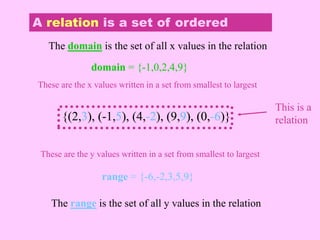
A relation is a set of ordered 
pairs. 
domain = {-1,0,2,4,9} 
These are the x values written in a set from smallest to largest 
{(2,3), (-1,5), (4,-2), (9,9), (0,-6)} 
This is a 
relation 
The domain is the set of all x values in the relation 
These are the y values written in a set from smallest to largest 
range = {-6,-2,3,5,9} 
The range is the set of all y values in the relation
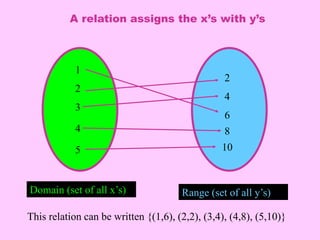
A relation assigns the xโ€™s with yโ€™s 
1 
2 
3 
4 
5 
2 
4 
6 
8 
10 
Domain (set of all xโ€™s) Range (set of all yโ€™s) 
This relation can be written {(1,6), (2,2), (3,4), (4,8), (5,10)}
A function f from set A to set B is a rule of correspondence 
that assigns to each element x in the set A exactly element y in the set B. 
A function f from set A to set B is a rule of correspondence 
that assigns to each element x in the set A exactly one 
element y in the set B. 
1 
2 
3 
4 
5 
Set A is the domain 
Whew! What 
did that say? 
2 
4 
6 
8 
10 
Set B is the range 
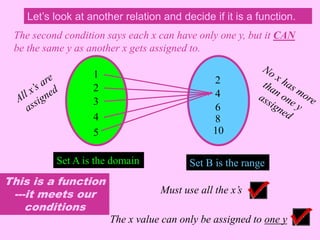
Must use all the xโ€™s 
The x value can only be assigned to one y 
This is a function 
---it meets our 
conditions
Letโ€™s look at another relation and decide if it is a function. 
The second condition says each x can have only one y, but it CAN 
be the same y as another x gets assigned to. 
1 
2 
3 
4 
5 
Set A is the domain 
2 
4 
6 
8 
10 
Set B is the range 
Must use all the xโ€™s 
The x value can only be assigned to one y 
This is a function 
---it meets our 
conditions
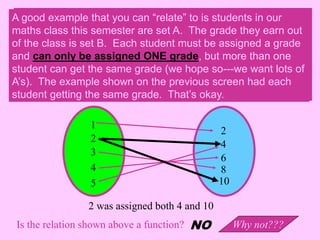
A good example that you can โ€œrelateโ€ to is students in our 
maths class this semester are set A. The grade they earn out 
of the class is set B. Each student must be assigned a grade 
and can only be assigned ONE grade, but more than one 
student can get the same grade (we hope so---we want lots 
of Aโ€™s). The example show on the previous screen had each 
student getting the same grade. Thatโ€™s okay. 
A good example that you can โ€œrelateโ€ to is students in our 
maths class this semester are set A. The grade they earn out 
of the class is set B. Each student must be assigned a grade 
and can only be ONE grade, but more than one 
student can get the same grade (we hope so---we want lots of 
Aโ€™s). The example shown on the previous screen had each 
student getting the same grade. Thatโ€™s okay. 
1 
2 
3 
4 
5 
2 
4 
6 
8 
10 
2 was assigned both 4 and 10 
Is the relation shown above a function? NO Why not???
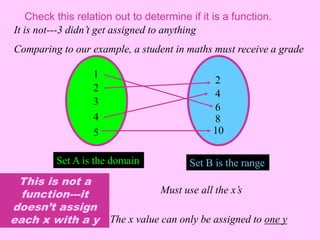
Check this relation out to determine if it is a function. 
It is not---3 didnโ€™t get assigned to anything 
Comparing to our example, a student in maths must receive a grade 
1 
2 
3 
4 
5 
Set A is the domain 
2 
4 
6 
8 
10 
Set B is the range 
Must use all the xโ€™s 
The x value can only be assigned to one y 
This is not a 
function---it 
doesnโ€™t assign 
each x with a y
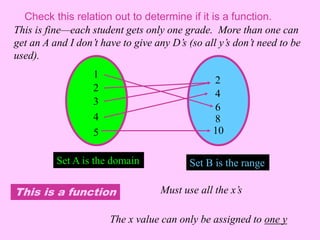
Check this relation out to determine if it is a function. 
This is fineโ€”each student gets only one grade. More than one can 
get an A and I donโ€™t have to give any Dโ€™s (so all yโ€™s donโ€™t need to be 
used). 
1 
2 
3 
4 
5 
Set A is the domain 
2 
4 
6 
8 
10 
Set B is the range 
Must use all the xโ€™s 
This is a function 
The x value can only be assigned to one y
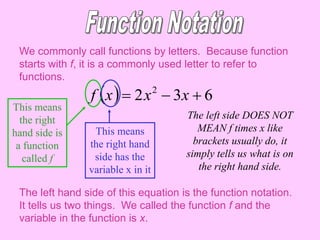
We commonly call functions by letters. Because function 
starts with f, it is a commonly used letter to refer to 
functions. 
๏€จ ๏€ฉ 2 3 6 2 f x ๏€ฝ x ๏€ญ x ๏€ซ 
This means 
the right 
hand side is 
a function 
called f 
This means 
the right hand 
side has the 
variable x in it 
The left side DOES NOT 
MEAN f times x like 
brackets usually do, it 
simply tells us what is on 
the right hand side. 
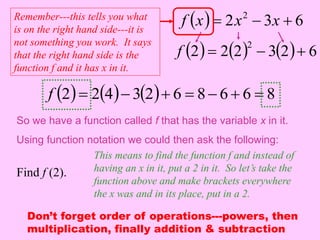
The left hand side of this equation is the function notation. 
It tells us two things. We called the function f and the 
variable in the function is x.
๏€จ ๏€ฉ 2 3 6 2 f x ๏€ฝ x ๏€ญ x ๏€ซ 
๏€จ2๏€ฉ 2๏€จ2๏€ฉ 3๏€จ2๏€ฉ 6 2 f ๏€ฝ ๏€ญ ๏€ซ 
Remember---this tells you what 
is on the right hand side---it is 
not something you work. It says 
that the right hand side is the 
function f and it has x in it. 
f ๏€จ2๏€ฉ ๏€ฝ 2๏€จ4๏€ฉ๏€ญ 3๏€จ2๏€ฉ๏€ซ 6 ๏€ฝ 8 ๏€ญ 6 ๏€ซ 6 ๏€ฝ 8 
So we have a function called f that has the variable x in it. 
Using function notation we could then ask the following: 
Find f (2). 
This means to find the function f and instead of 
having an x in it, put a 2 in it. So letโ€™s take the 
function above and make brackets everywhere 
the x was and in its place, put in a 2. 
Donโ€™t forget order of operations---powers, then 
multiplication, finally addition & subtraction
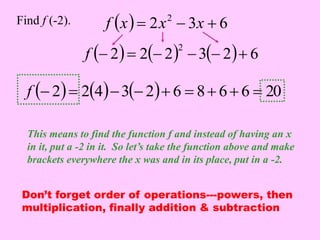
๏€จ ๏€ฉ 2 3 6 2 Find f (-2). f x ๏€ฝ x ๏€ญ x ๏€ซ 
๏€จ 2๏€ฉ 2๏€จ 2๏€ฉ 3๏€จ 2๏€ฉ 6 2 f ๏€ญ ๏€ฝ ๏€ญ ๏€ญ ๏€ญ ๏€ซ 
f ๏€จ๏€ญ 2๏€ฉ ๏€ฝ 2๏€จ4๏€ฉ๏€ญ3๏€จ๏€ญ 2๏€ฉ๏€ซ 6 ๏€ฝ 8๏€ซ 6๏€ซ 6 ๏€ฝ 20 
This means to find the function f and instead of having an x 
in it, put a -2 in it. So letโ€™s take the function above and make 
brackets everywhere the x was and in its place, put in a -2. 
Donโ€™t forget order of operations---powers, then 
multiplication, finally addition & subtraction
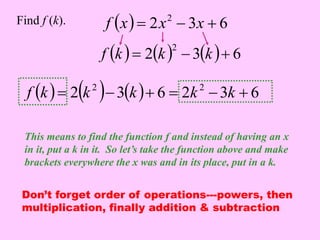
๏€จ ๏€ฉ 2 3 6 2 Find f (k). f x ๏€ฝ x ๏€ญ x ๏€ซ 
๏€จ ๏€ฉ 2๏€จ ๏€ฉ 3๏€จ ๏€ฉ 6 2 f k ๏€ฝ k ๏€ญ k ๏€ซ 
๏€จ ๏€ฉ 2๏€จ ๏€ฉ 3๏€จ ๏€ฉ 6 2 3 6 2 2 f k ๏€ฝ k ๏€ญ k ๏€ซ ๏€ฝ k ๏€ญ k ๏€ซ 
This means to find the function f and instead of having an x 
in it, put a k in it. So letโ€™s take the function above and make 
brackets everywhere the x was and in its place, put in a k. 
Donโ€™t forget order of operations---powers, then 
multiplication, finally addition & subtraction
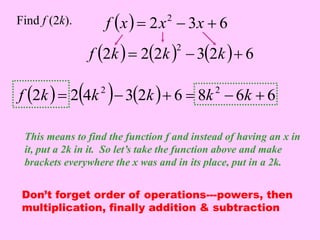
๏€จ ๏€ฉ 2 3 6 2 Find f (2k). f x ๏€ฝ x ๏€ญ x ๏€ซ 
๏€จ2 ๏€ฉ 2๏€จ2 ๏€ฉ 3๏€จ2 ๏€ฉ 6 2 f k ๏€ฝ k ๏€ญ k ๏€ซ 
๏€จ2 ๏€ฉ 2๏€จ4 ๏€ฉ 3๏€จ2 ๏€ฉ 6 8 6 6 2 2 f k ๏€ฝ k ๏€ญ k ๏€ซ ๏€ฝ k ๏€ญ k ๏€ซ 
This means to find the function f and instead of having an x in 
it, put a 2k in it. So letโ€™s take the function above and make 
brackets everywhere the x was and in its place, put in a 2k. 
Donโ€™t forget order of operations---powers, then 
multiplication, finally addition & subtraction
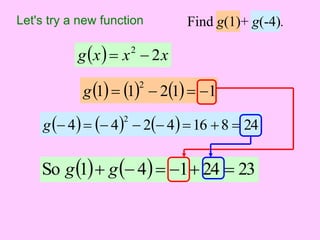
Let's try a new function 
g๏€จx๏€ฉ x 2x 2 ๏€ฝ ๏€ญ 
Find g(1)+ g(-4). 
๏€จ1๏€ฉ ๏€จ1๏€ฉ 2๏€จ1๏€ฉ 1 2 g ๏€ฝ ๏€ญ ๏€ฝ ๏€ญ 
๏€จ 4๏€ฉ ๏€จ 4๏€ฉ 2๏€จ 4๏€ฉ 16 8 24 2 g ๏€ญ ๏€ฝ ๏€ญ ๏€ญ ๏€ญ ๏€ฝ ๏€ซ ๏€ฝ 
So g๏€จ1๏€ฉ๏€ซ g๏€จ๏€ญ 4๏€ฉ ๏€ฝ ๏€ญ1๏€ซ 24 ๏€ฝ 23
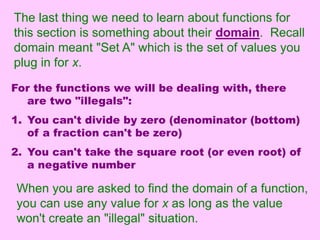
The last thing we need to learn about functions for 
this section is something about their domain. Recall 
domain meant "Set A" which is the set of values you 
plug in for x. 
For the functions we will be dealing with, there 
are two "illegals": 
1. You can't divide by zero (denominator (bottom) 
of a fraction can't be zero) 
2. You can't take the square root (or even root) of 
a negative number 
When you are asked to find the domain of a function, 
you can use any value for x as long as the value 
won't create an "illegal" situation.
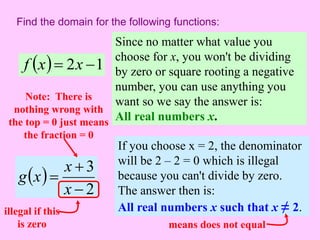
Find the domain for the following functions: 
f ๏€จx๏€ฉ ๏€ฝ 2x ๏€ญ1 
Since no matter what value you 
choose for x, you won't be dividing 
by zero or square rooting a negative 
number, you can use anything you 
want so we say the answer is: 
All real numbers x. 
Note: There is 
nothing wrong with 
the top = 0 just means 
the fraction = 0 
๏€จ ๏€ฉ 
๏€ซ 
3 
๏€ญ 
2 
๏€ฝ 
x 
x 
g x 
If you choose x = 2, the denominator 
will be 2 โ€“ 2 = 0 which is illegal 
because you can't divide by zero. 
The answer then is: 
All real numbers x such that x โ‰  2. 
means does not equal 
illegal if this 
is zero
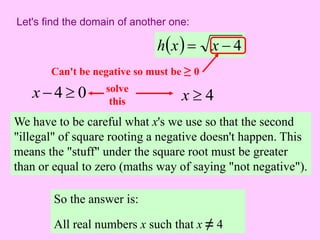
Let's find the domain of another one: 
h๏€จx๏€ฉ ๏€ฝ x ๏€ญ 4 
Can't be negative so must be โ‰ฅ 0 
0 4 ๏‚ณ ๏€ญ x solve 
this 4 ๏‚ณ x 
We have to be careful what x's we use so that the second 
"illegal" of square rooting a negative doesn't happen. This 
means the "stuff" under the square root must be greater 
than or equal to zero (maths way of saying "not negative"). 
So the answer is: 
All real numbers x such that x โ‰  4
Summary of How to Find the 
Domain of a Function 
โ€ข Look for any fractions or square roots that could cause one 
of the two "illegals" to happen. If there aren't any, then the 
domain is All real numbers x. 
โ€ข If there are fractions, figure out what values would make the 
bottom equal zero and those are the values you can't use. 
The answer would be: All real numbers x such that x โ‰  
those values. 
โ€ข If there is a square root, the "stuff" under the square root 
cannot be negative so set the stuff โ‰ฅ 0 and solve. Then 
answer would be: All real numbers x such that x โ‰  
whatever you got when you solved. 
NOTE: Of course your variable doesn't have to be x, can be 
whatever is in the problem.
Acknowledgement 
I wish to thank Shawna Haider from Salt Lake Community College, Utah 
USA for her hard work in creating this PowerPoint. 
www.slcc.edu 
Shawna has kindly given permission for this resource to be downloaded 
from www.mathxtc.com and for it to be modified to suit the Western 
Australian Mathematics Curriculum. 
Stephen Corcoran 
Head of Mathematics 
St Stephenโ€™s School โ€“ Carramar 
www.ststephens.wa.edu.au

Relations and functions

  • 1.
  • 2.
    A relation isa set of ordered pairs. domain = {-1,0,2,4,9} These are the x values written in a set from smallest to largest {(2,3), (-1,5), (4,-2), (9,9), (0,-6)} This is a relation The domain is the set of all x values in the relation These are the y values written in a set from smallest to largest range = {-6,-2,3,5,9} The range is the set of all y values in the relation
  • 3.
    A relation assignsthe xโ€™s with yโ€™s 1 2 3 4 5 2 4 6 8 10 Domain (set of all xโ€™s) Range (set of all yโ€™s) This relation can be written {(1,6), (2,2), (3,4), (4,8), (5,10)}
  • 4.
    A function ffrom set A to set B is a rule of correspondence that assigns to each element x in the set A exactly element y in the set B. A function f from set A to set B is a rule of correspondence that assigns to each element x in the set A exactly one element y in the set B. 1 2 3 4 5 Set A is the domain Whew! What did that say? 2 4 6 8 10 Set B is the range Must use all the xโ€™s The x value can only be assigned to one y This is a function ---it meets our conditions
  • 5.
    Letโ€™s look atanother relation and decide if it is a function. The second condition says each x can have only one y, but it CAN be the same y as another x gets assigned to. 1 2 3 4 5 Set A is the domain 2 4 6 8 10 Set B is the range Must use all the xโ€™s The x value can only be assigned to one y This is a function ---it meets our conditions
  • 6.
    A good examplethat you can โ€œrelateโ€ to is students in our maths class this semester are set A. The grade they earn out of the class is set B. Each student must be assigned a grade and can only be assigned ONE grade, but more than one student can get the same grade (we hope so---we want lots of Aโ€™s). The example show on the previous screen had each student getting the same grade. Thatโ€™s okay. A good example that you can โ€œrelateโ€ to is students in our maths class this semester are set A. The grade they earn out of the class is set B. Each student must be assigned a grade and can only be ONE grade, but more than one student can get the same grade (we hope so---we want lots of Aโ€™s). The example shown on the previous screen had each student getting the same grade. Thatโ€™s okay. 1 2 3 4 5 2 4 6 8 10 2 was assigned both 4 and 10 Is the relation shown above a function? NO Why not???
  • 7.
    Check this relationout to determine if it is a function. It is not---3 didnโ€™t get assigned to anything Comparing to our example, a student in maths must receive a grade 1 2 3 4 5 Set A is the domain 2 4 6 8 10 Set B is the range Must use all the xโ€™s The x value can only be assigned to one y This is not a function---it doesnโ€™t assign each x with a y
  • 8.
    Check this relationout to determine if it is a function. This is fineโ€”each student gets only one grade. More than one can get an A and I donโ€™t have to give any Dโ€™s (so all yโ€™s donโ€™t need to be used). 1 2 3 4 5 Set A is the domain 2 4 6 8 10 Set B is the range Must use all the xโ€™s This is a function The x value can only be assigned to one y
  • 9.
    We commonly callfunctions by letters. Because function starts with f, it is a commonly used letter to refer to functions. ๏€จ ๏€ฉ 2 3 6 2 f x ๏€ฝ x ๏€ญ x ๏€ซ This means the right hand side is a function called f This means the right hand side has the variable x in it The left side DOES NOT MEAN f times x like brackets usually do, it simply tells us what is on the right hand side. The left hand side of this equation is the function notation. It tells us two things. We called the function f and the variable in the function is x.
  • 10.
    ๏€จ ๏€ฉ 23 6 2 f x ๏€ฝ x ๏€ญ x ๏€ซ ๏€จ2๏€ฉ 2๏€จ2๏€ฉ 3๏€จ2๏€ฉ 6 2 f ๏€ฝ ๏€ญ ๏€ซ Remember---this tells you what is on the right hand side---it is not something you work. It says that the right hand side is the function f and it has x in it. f ๏€จ2๏€ฉ ๏€ฝ 2๏€จ4๏€ฉ๏€ญ 3๏€จ2๏€ฉ๏€ซ 6 ๏€ฝ 8 ๏€ญ 6 ๏€ซ 6 ๏€ฝ 8 So we have a function called f that has the variable x in it. Using function notation we could then ask the following: Find f (2). This means to find the function f and instead of having an x in it, put a 2 in it. So letโ€™s take the function above and make brackets everywhere the x was and in its place, put in a 2. Donโ€™t forget order of operations---powers, then multiplication, finally addition & subtraction
  • 11.
    ๏€จ ๏€ฉ 23 6 2 Find f (-2). f x ๏€ฝ x ๏€ญ x ๏€ซ ๏€จ 2๏€ฉ 2๏€จ 2๏€ฉ 3๏€จ 2๏€ฉ 6 2 f ๏€ญ ๏€ฝ ๏€ญ ๏€ญ ๏€ญ ๏€ซ f ๏€จ๏€ญ 2๏€ฉ ๏€ฝ 2๏€จ4๏€ฉ๏€ญ3๏€จ๏€ญ 2๏€ฉ๏€ซ 6 ๏€ฝ 8๏€ซ 6๏€ซ 6 ๏€ฝ 20 This means to find the function f and instead of having an x in it, put a -2 in it. So letโ€™s take the function above and make brackets everywhere the x was and in its place, put in a -2. Donโ€™t forget order of operations---powers, then multiplication, finally addition & subtraction
  • 12.
    ๏€จ ๏€ฉ 23 6 2 Find f (k). f x ๏€ฝ x ๏€ญ x ๏€ซ ๏€จ ๏€ฉ 2๏€จ ๏€ฉ 3๏€จ ๏€ฉ 6 2 f k ๏€ฝ k ๏€ญ k ๏€ซ ๏€จ ๏€ฉ 2๏€จ ๏€ฉ 3๏€จ ๏€ฉ 6 2 3 6 2 2 f k ๏€ฝ k ๏€ญ k ๏€ซ ๏€ฝ k ๏€ญ k ๏€ซ This means to find the function f and instead of having an x in it, put a k in it. So letโ€™s take the function above and make brackets everywhere the x was and in its place, put in a k. Donโ€™t forget order of operations---powers, then multiplication, finally addition & subtraction
  • 13.
    ๏€จ ๏€ฉ 23 6 2 Find f (2k). f x ๏€ฝ x ๏€ญ x ๏€ซ ๏€จ2 ๏€ฉ 2๏€จ2 ๏€ฉ 3๏€จ2 ๏€ฉ 6 2 f k ๏€ฝ k ๏€ญ k ๏€ซ ๏€จ2 ๏€ฉ 2๏€จ4 ๏€ฉ 3๏€จ2 ๏€ฉ 6 8 6 6 2 2 f k ๏€ฝ k ๏€ญ k ๏€ซ ๏€ฝ k ๏€ญ k ๏€ซ This means to find the function f and instead of having an x in it, put a 2k in it. So letโ€™s take the function above and make brackets everywhere the x was and in its place, put in a 2k. Donโ€™t forget order of operations---powers, then multiplication, finally addition & subtraction
  • 14.
    Let's try anew function g๏€จx๏€ฉ x 2x 2 ๏€ฝ ๏€ญ Find g(1)+ g(-4). ๏€จ1๏€ฉ ๏€จ1๏€ฉ 2๏€จ1๏€ฉ 1 2 g ๏€ฝ ๏€ญ ๏€ฝ ๏€ญ ๏€จ 4๏€ฉ ๏€จ 4๏€ฉ 2๏€จ 4๏€ฉ 16 8 24 2 g ๏€ญ ๏€ฝ ๏€ญ ๏€ญ ๏€ญ ๏€ฝ ๏€ซ ๏€ฝ So g๏€จ1๏€ฉ๏€ซ g๏€จ๏€ญ 4๏€ฉ ๏€ฝ ๏€ญ1๏€ซ 24 ๏€ฝ 23
  • 15.
    The last thingwe need to learn about functions for this section is something about their domain. Recall domain meant "Set A" which is the set of values you plug in for x. For the functions we will be dealing with, there are two "illegals": 1. You can't divide by zero (denominator (bottom) of a fraction can't be zero) 2. You can't take the square root (or even root) of a negative number When you are asked to find the domain of a function, you can use any value for x as long as the value won't create an "illegal" situation.
  • 16.
    Find the domainfor the following functions: f ๏€จx๏€ฉ ๏€ฝ 2x ๏€ญ1 Since no matter what value you choose for x, you won't be dividing by zero or square rooting a negative number, you can use anything you want so we say the answer is: All real numbers x. Note: There is nothing wrong with the top = 0 just means the fraction = 0 ๏€จ ๏€ฉ ๏€ซ 3 ๏€ญ 2 ๏€ฝ x x g x If you choose x = 2, the denominator will be 2 โ€“ 2 = 0 which is illegal because you can't divide by zero. The answer then is: All real numbers x such that x โ‰  2. means does not equal illegal if this is zero
  • 17.
    Let's find thedomain of another one: h๏€จx๏€ฉ ๏€ฝ x ๏€ญ 4 Can't be negative so must be โ‰ฅ 0 0 4 ๏‚ณ ๏€ญ x solve this 4 ๏‚ณ x We have to be careful what x's we use so that the second "illegal" of square rooting a negative doesn't happen. This means the "stuff" under the square root must be greater than or equal to zero (maths way of saying "not negative"). So the answer is: All real numbers x such that x โ‰  4
  • 18.
    Summary of Howto Find the Domain of a Function โ€ข Look for any fractions or square roots that could cause one of the two "illegals" to happen. If there aren't any, then the domain is All real numbers x. โ€ข If there are fractions, figure out what values would make the bottom equal zero and those are the values you can't use. The answer would be: All real numbers x such that x โ‰  those values. โ€ข If there is a square root, the "stuff" under the square root cannot be negative so set the stuff โ‰ฅ 0 and solve. Then answer would be: All real numbers x such that x โ‰  whatever you got when you solved. NOTE: Of course your variable doesn't have to be x, can be whatever is in the problem.
  • 19.
    Acknowledgement I wishto thank Shawna Haider from Salt Lake Community College, Utah USA for her hard work in creating this PowerPoint. www.slcc.edu Shawna has kindly given permission for this resource to be downloaded from www.mathxtc.com and for it to be modified to suit the Western Australian Mathematics Curriculum. Stephen Corcoran Head of Mathematics St Stephenโ€™s School โ€“ Carramar www.ststephens.wa.edu.au