HOW TO WRITE A
FABLE
Fables…
… a story that teaches a lesson
…characters are animals
…animals talk
***
Fable Elements
Many things to think about before writing a fable
• Moral – a lesson
• Animals
• Animals’ names
• Setting
• Introducing the animals/characters
• Dialogue between characters
• Sequencing events of the story
• Conclusion of story / moral
***
Moral
a life long lesson
Life-long lesson
Do to others as you would
like them to do to you.
Cheaters never win.
Don’t judge a book by its
cover.
Good lessons – but not
considered a life-long
lesson-
Not a Moral
Pick up trash on the road.
Brush your teeth three times
a day.
Don’t hit your brother or
sister.
Write down a few morals you think you can
use. ***
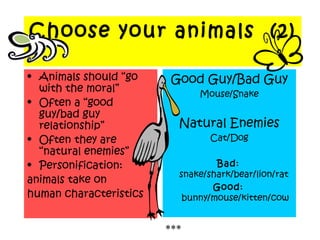
Choose your animals (2)
• Animals should “go
with the moral”
• Often a “good
guy/bad guy
relationship”
• Often they are
“natural enemies”
• Personification:
animals take on
human characteristics
Good Guy/Bad Guy
Mouse/Snake
Natural Enemies
Cat/Dog
Bad:
snake/shark/bear/lion/rat
Good:
bunny/mouse/kitten/cow
***
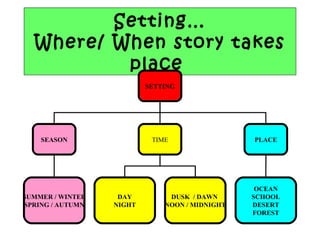
Setting…
Where/ When story takes
place
SETTING
SEASON TIME PLACE
SUMMER / WINTER
SPRING / AUTUMN
DAY
NIGHT
DUSK / DAWN
NOON / MIDNIGHT
OCEAN
SCHOOL
DESERT
FOREST
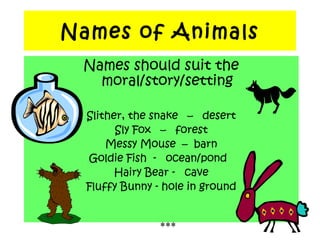
Names of Animals
Names should suit the
moral/story/setting
Slither, the snake – desert
Sly Fox – forest
Messy Mouse – barn
Goldie Fish - ocean/pond
Hairy Bear - cave
Fluffy Bunny - hole in ground
***
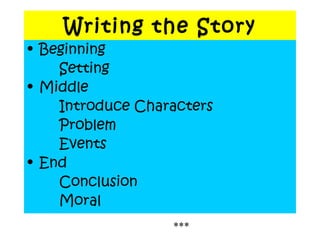
Writing the Story
• Beginning
Setting
• Middle
Introduce Characters
Problem
Events
• End
Conclusion
Moral
***
Remember Fable
Elements
There are many things to think about before writing a
fable• Moral – teaches a life-long lesson
• Animals
• Animals’ names
• Setting
• Introducing the animals/characters
• Dialogue between characters
• Sequencing events of the story
• Conclusion of story / moral
***
Remember Fable
Elements
There are many things to think about before writing a
fable• Moral – teaches a life-long lesson
• Animals
• Animals’ names
• Setting
• Introducing the animals/characters
• Dialogue between characters
• Sequencing events of the story
• Conclusion of story / moral
***

How to-write-a-fable-

  • 1.
    HOW TO WRITEA FABLE
  • 2.
    Fables… … a storythat teaches a lesson …characters are animals …animals talk ***
  • 3.
    Fable Elements Many thingsto think about before writing a fable • Moral – a lesson • Animals • Animals’ names • Setting • Introducing the animals/characters • Dialogue between characters • Sequencing events of the story • Conclusion of story / moral ***
  • 4.
    Moral a life longlesson Life-long lesson Do to others as you would like them to do to you. Cheaters never win. Don’t judge a book by its cover. Good lessons – but not considered a life-long lesson- Not a Moral Pick up trash on the road. Brush your teeth three times a day. Don’t hit your brother or sister. Write down a few morals you think you can use. ***
  • 5.
    Choose your animals(2) • Animals should “go with the moral” • Often a “good guy/bad guy relationship” • Often they are “natural enemies” • Personification: animals take on human characteristics Good Guy/Bad Guy Mouse/Snake Natural Enemies Cat/Dog Bad: snake/shark/bear/lion/rat Good: bunny/mouse/kitten/cow ***
  • 6.
    Setting… Where/ When storytakes place SETTING SEASON TIME PLACE SUMMER / WINTER SPRING / AUTUMN DAY NIGHT DUSK / DAWN NOON / MIDNIGHT OCEAN SCHOOL DESERT FOREST
  • 7.
    Names of Animals Namesshould suit the moral/story/setting Slither, the snake – desert Sly Fox – forest Messy Mouse – barn Goldie Fish - ocean/pond Hairy Bear - cave Fluffy Bunny - hole in ground ***
  • 8.
    Writing the Story •Beginning Setting • Middle Introduce Characters Problem Events • End Conclusion Moral ***
  • 9.
    Remember Fable Elements There aremany things to think about before writing a fable• Moral – teaches a life-long lesson • Animals • Animals’ names • Setting • Introducing the animals/characters • Dialogue between characters • Sequencing events of the story • Conclusion of story / moral ***
  • 10.
    Remember Fable Elements There aremany things to think about before writing a fable• Moral – teaches a life-long lesson • Animals • Animals’ names • Setting • Introducing the animals/characters • Dialogue between characters • Sequencing events of the story • Conclusion of story / moral ***