Humanistic Geography
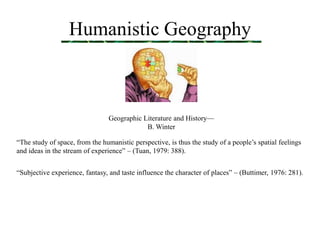
“The study of space, from the humanistic perspective, is thus the study of a people’s spatial feelings
and ideas in the stream of experience” – (Tuan, 1979: 388).
“Subjective experience, fantasy, and taste influence the character of places” – (Buttimer, 1976: 281).
Geographic Literature and History—
B. Winter
Presentation Structure
1. Overview of humanistic geography (Brief)
- Idealism
- Phenomenology
2. Addressing geographical ideas from readings
-Tuan
- Lifeworld
- Taken-for-granted world
- Insideness / outsideness
3. Larger concerns of the discipline via readings
4. Questions and comments
Humanistic Geography:
A Focus on the Individual
• Argued for a geographical focus on the individual as a decision-maker.
• Human agency
• Human creativity
• Human consciousness
• Emphasized a need for a geographical focus on the particular.
• Emerged in the 1970s as a human-based response to spatial-science and
quantitative modeling.
• Resulted in a variety of humanistic philosophies in Geography.
Roots of humanistic geography
From the Humanities:
- Relied on interpretations of history and literature.
- Focused on the meanings of places via a historiography of the cultural
archive of a place/location.
Cultural landscapes become a major focus.
From the Social Sciences:
- Traditionally has a major divide between deductive (positivist) and
inductive (grounded) approaches.
- Ethnography as preferred method.
Phenomenology
Idealism
(Guelke)
“One must discover what he believed, not why he believed it” – (Guelke, 1974 197).
“any system of ideas that man has invented, imposed, or elicited from the raw data of
sensation that makes connections with between the phenomena of the external world” –
(Guelke, 1974: 194).
Two major claims for Idealism in Humanistic Geography
1) Man’s mental activity is not “controlled by material things and processes”
2) Geographical knowledge can only be found through an individual’s subjective
experiences
Critics said (for my notes)
Omitted the consequences of social action
Difficult to be verified
Complexity of human behavior cannot guarantee a way to organize value-systems.
Phenomenology
(Relph, Buttimer, Tuan,)
a) Believe that all knowledge comes from how the world is experienced and is
not independent of that world.
b) Researchers are not to include personal ideas when trying to understand a
subject’s experiences and ideas.
c) Works at the individual level, but searches for common elements.
Major aims:
Interpretive study of human experience
Everyday life
Subject may not be aware of specific aspects of the experience
Subjectivity is focus of study
How people structure their environment (opposite of spatial science)
Addressing Geographical Ideas
from Readings
• Y.F.Tuan humanities human/nature
relations
• “Humanistic studies contribute…towards self-consciousness, towards
man’s increasing awareness of the sources of his knowledge” – (Tuan, p.
388)
• History has a limited role???
• Negotiating life/survival; experience through frustration
• “physiological conditions as material arrangements”
• The senses “give us our characteristic sense of space” (p. 390)(398-9)
• Objective reality “distinct from the one that our needs and imagination
call into being” – (p.390). (ex. Race track P. 402)
The Lifeworld
Buttimer intentionality “culturally defined spatio-temporal setting”
• “Many geographers have reflected on the experiential meaning of earth
occupance, although not the act of consciousness itself” – (Buttimer, 1976:
281).
• Sees the geographical “world” as a group of values and goods, not an
amalgam of “facts and affairs” – (p.281).
• The world is largely formed from the past “with a shared horizon” despite
individuals construing that horizon in a “uniquely personal way” – (p.281).
• Combines imaginative aspects of being with the external world.
• Differs from Tuan because “lifeworld” has emphasis on everyday life??
Taken-for-granted world
• Ley importance of everyday life “mundane experience”
• Attempted to show a “social reality” rather than an abstract scientific one.
• Focus on intersubjective meanings that form lifeworlds.
• “to locate the discussion of social geography within its philosophical
context” (p.503)
Insideness and Outsideness
(Edward Relph)
• Place and Placelessness (1976)
• Experiences have varying intensities
• Space is heterogeneous
• Our understanding of space comes from the places we inhabit
• Insideness and outsideness is core structure of understanding place
• Different places take on different identities for different individuals
Larger concerns of the discipline via
the readings
• Space v. place: Humanists brought place into a
more important role.
• Subjectivity (individual)/ objectivity
• Symbolic interactionism
• Humanistic geography a mere criticism of
spatial science? Or more?
Questions/ comments?

Humanistic geography

  • 1.
    Humanistic Geography “The studyof space, from the humanistic perspective, is thus the study of a people’s spatial feelings and ideas in the stream of experience” – (Tuan, 1979: 388). “Subjective experience, fantasy, and taste influence the character of places” – (Buttimer, 1976: 281). Geographic Literature and History— B. Winter
  • 2.
    Presentation Structure 1. Overviewof humanistic geography (Brief) - Idealism - Phenomenology 2. Addressing geographical ideas from readings -Tuan - Lifeworld - Taken-for-granted world - Insideness / outsideness 3. Larger concerns of the discipline via readings 4. Questions and comments
  • 3.
    Humanistic Geography: A Focuson the Individual • Argued for a geographical focus on the individual as a decision-maker. • Human agency • Human creativity • Human consciousness • Emphasized a need for a geographical focus on the particular. • Emerged in the 1970s as a human-based response to spatial-science and quantitative modeling. • Resulted in a variety of humanistic philosophies in Geography.
  • 4.
    Roots of humanisticgeography From the Humanities: - Relied on interpretations of history and literature. - Focused on the meanings of places via a historiography of the cultural archive of a place/location. Cultural landscapes become a major focus. From the Social Sciences: - Traditionally has a major divide between deductive (positivist) and inductive (grounded) approaches. - Ethnography as preferred method. Phenomenology
  • 5.
    Idealism (Guelke) “One must discoverwhat he believed, not why he believed it” – (Guelke, 1974 197). “any system of ideas that man has invented, imposed, or elicited from the raw data of sensation that makes connections with between the phenomena of the external world” – (Guelke, 1974: 194). Two major claims for Idealism in Humanistic Geography 1) Man’s mental activity is not “controlled by material things and processes” 2) Geographical knowledge can only be found through an individual’s subjective experiences Critics said (for my notes) Omitted the consequences of social action Difficult to be verified Complexity of human behavior cannot guarantee a way to organize value-systems.
  • 6.
    Phenomenology (Relph, Buttimer, Tuan,) a)Believe that all knowledge comes from how the world is experienced and is not independent of that world. b) Researchers are not to include personal ideas when trying to understand a subject’s experiences and ideas. c) Works at the individual level, but searches for common elements. Major aims: Interpretive study of human experience Everyday life Subject may not be aware of specific aspects of the experience Subjectivity is focus of study How people structure their environment (opposite of spatial science)
  • 7.
    Addressing Geographical Ideas fromReadings • Y.F.Tuan humanities human/nature relations • “Humanistic studies contribute…towards self-consciousness, towards man’s increasing awareness of the sources of his knowledge” – (Tuan, p. 388) • History has a limited role??? • Negotiating life/survival; experience through frustration • “physiological conditions as material arrangements” • The senses “give us our characteristic sense of space” (p. 390)(398-9) • Objective reality “distinct from the one that our needs and imagination call into being” – (p.390). (ex. Race track P. 402)
  • 8.
    The Lifeworld Buttimer intentionality“culturally defined spatio-temporal setting” • “Many geographers have reflected on the experiential meaning of earth occupance, although not the act of consciousness itself” – (Buttimer, 1976: 281). • Sees the geographical “world” as a group of values and goods, not an amalgam of “facts and affairs” – (p.281). • The world is largely formed from the past “with a shared horizon” despite individuals construing that horizon in a “uniquely personal way” – (p.281). • Combines imaginative aspects of being with the external world. • Differs from Tuan because “lifeworld” has emphasis on everyday life??
  • 9.
    Taken-for-granted world • Leyimportance of everyday life “mundane experience” • Attempted to show a “social reality” rather than an abstract scientific one. • Focus on intersubjective meanings that form lifeworlds. • “to locate the discussion of social geography within its philosophical context” (p.503)
  • 10.
    Insideness and Outsideness (EdwardRelph) • Place and Placelessness (1976) • Experiences have varying intensities • Space is heterogeneous • Our understanding of space comes from the places we inhabit • Insideness and outsideness is core structure of understanding place • Different places take on different identities for different individuals
  • 11.
    Larger concerns ofthe discipline via the readings • Space v. place: Humanists brought place into a more important role. • Subjectivity (individual)/ objectivity • Symbolic interactionism • Humanistic geography a mere criticism of spatial science? Or more?
  • 12.

Editor's Notes

  • #2 Humanistic geography was not the only tradition that sought to rearrange the dominance of spatial science during the 1970s, behvioral geography also became influential, however, it primarily followed a similar train of thought tied to positivism. Behavioral geography – geosophy/ creation of geographical knowledge. So, Offering a more critical view of positivism were humanistic geographers who emphasized the importance of individual experience as the goal. Right, so, un like spatial scientists who sought to predict and explain geographic patterns, humanistic geographers, argued for a recognition of how particular places and spaces are created, arranged, or even embodied in everyday life. So, this meant, as I THINK the readings have shown, that the world can be grounded in people’s lived world of experiences and that people are significant role players in the creation of place and space.
  • #3 My focus is on a few concepts that were introduced through the readings, but I will give a very brief over TO THE BEST OF MY ABILITY in regards to where humanistic geography comes from and what it is. SO…… go through list quickly!
  • #4 By the particular I believe they mean… particular experiences by specific groups rather than how spatial science would see human beings as plots or numbers. Particular experiences by somebody or some group can be what Buttimer said to be “a world unto itself”.
  • #5 HUAMNITIES This source of humanistic geography, I BELIEVE, focused more on how humans expressed themselves so the use of texts were important. SOCIAL SCIENCES Traditionally thought that there was such a huge difference between abstract models of human behavior which were largely based on economics Traditional studies were often conducted ethnographically So, social science had commonly held a stronger belief that people were conscious of their surroundings and made decisions based on their connection to a place.
  • #6 There is no ‘real world’ that can be known or understood independently from a man or woman’s mind. So, I THINK WHAT THIS IS, is that the scholar was to be in a dialogue with evidence (i.e. art, texts, maps maybe) so that mental constructs of the earth can be known. I’m not sure if Dr. Bosman would agree or disagree with this…? So Idealists believe that there is IN FACT a real world, compared to what our next group, phenomenologists see as experience and landscape being very much linked?
  • #7 All wee know geographically proceeds from how we as individuals experience the world. So people like Tuan or Relph might claim that the mind and the world mix to create knowledge or belonging,. So, for phenomenologists, all knowledge comes from the world of experience and cannot be seperated from that work. So, how we experience the world is the primary way to obtain geographical knowledge. subjectivity should be that of the study’s focus and not that of the researcher.
  • #8 Tuan seemed to take humanistic geography the farthest Landscapes are key for Tuan which he saw as a way of understanding what he called the essences of the societies that shaped them. Australia example?? Race track example?? I BELIEVE, that Tuan comes from a more humanities way of looking at the world than that of the social sciences. UMMMM, what is meant by his quote “physiological conditions as material arrangements” is that individuals can understand themselves through the ways they understand their world or surroundings Australia example?? Race track example?? Here, place plays a major role over space for Tuan….
  • #9  I struggled with lifeworld concept a little bit, but…. I see Buttimer’s lifeworld as more of a criticism of positivism than say a method or approach.
  • #10 Claims Vidal de la Blache had aspects of this approach in a holistic way.
  • #12 Symbolic interactionism sees the social world as a social product. So, interaction is key in determining how a place’s social life takes shape?????