RxNetty vs Tomcat
Performance Results
Brendan Gregg; Performance and Reliability Engineering
Nitesh Kant, Ben Christensen; Edge Engineering
updated: Apr 2015
Results based on
● The “Hello Netflix” benchmark (wsperflab)
● Tomcat
● RxNetty
● physical PC
○ Intel(R) Core(TM) i5-2400 CPU @ 3.10GHz: 4 cores, 1 thread per core
● OpenJDK 8
○ with frame pointer patch
● Plus testing in other environments
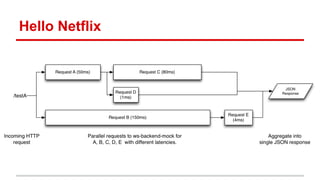
Hello Netflix
RxNetty vs Tomcat performance
In a variety of tests, RxNetty has been faster than Tomcat.
This study covers:
1. What specifically is faster?
2. By how much?
3. Why?
1. What specifically is faster?
● CPU consumption per request
○ RxNetty consumes less CPU than Tomcat
○ This also means that a given server (with fixed CPU capacity) can
deliver a higher maximum rate of requests per second
● Latency under load
○ Under high load, RxNetty has a lower latency distribution than Tomcat
2. By how much?
2. By how much?
The following 5 graphs show performance vs load (clients)
1. CPU consumption per request
2. CPU resource usage vs load
3. Request rate
4. Request average latency
5. Request maximum latency
Bear in mind these results are for this environment, and this
workload
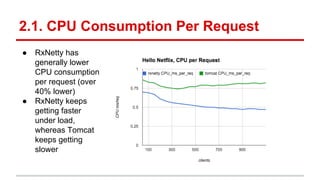
2.1. CPU Consumption Per Request
● RxNetty has
generally lower
CPU consumption
per request (over
40% lower)
● RxNetty keeps
getting faster
under load,
whereas Tomcat
keeps getting
slower
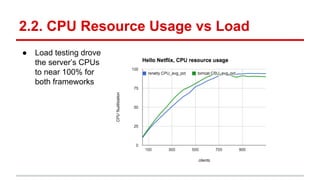
2.2. CPU Resource Usage vs Load
● Load testing drove
the server’s CPUs
to near 100% for
both frameworks
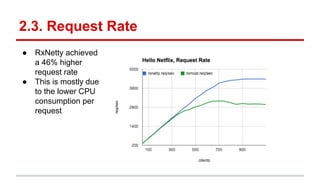
2.3. Request Rate
● RxNetty achieved
a 46% higher
request rate
● This is mostly due
to the lower CPU
consumption per
request
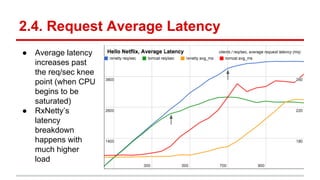
2.4. Request Average Latency
● Average latency
increases past
the req/sec knee
point (when CPU
begins to be
saturated)
● RxNetty’s
latency
breakdown
happens with
much higher
load
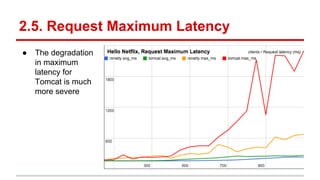
2.5. Request Maximum Latency
● The degradation
in maximum
latency for
Tomcat is much
more severe
3. Why?
3. Why?
1. CPU consumption per request
○ RxNetty is lower due to its framework code and lower object allocation
rate, which in turn reduces GC overheads
○ RxNetty also trends lower due to its event loop architecture, which
reduces thread migrations under load, which improves CPU cache
warmth and memory locality, which improves CPU Instructions Per
Cycle (IPC), which lowers CPU cycle consumption per request
2. Lower latencies under load
○ Tomcat has higher latencies under load due to its thread pool
architecture, which involves thread pool locks (and lock contention)
and thread migrations to service load
3.1. CPU Consumption Per Request
Studied using:
1. Kernel CPU flame graphs
2. User CPU flame graphs
3. Migration rates
4. Last Level Cache (LLC) Loads & IPC
5. IPC & CPU per request
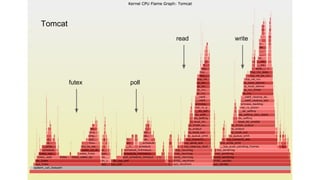
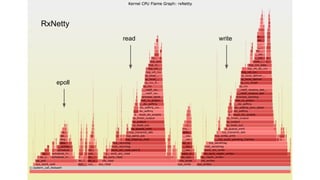
3.1.1. Kernel CPU Flame Graphs
read
futex
write
poll
Tomcat
epoll
writeread
RxNetty
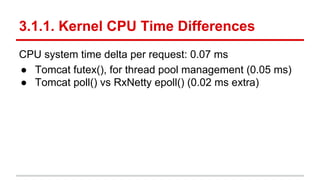
3.1.1. Kernel CPU Time Differences
CPU system time delta per request: 0.07 ms
● Tomcat futex(), for thread pool management (0.05 ms)
● Tomcat poll() vs RxNetty epoll() (0.02 ms extra)
3.1.2. User CPU Flame Graphs
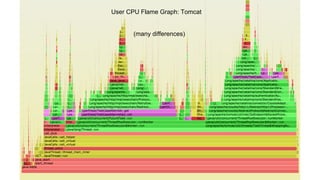
User CPU Flame Graph: Tomcat
(many differences)
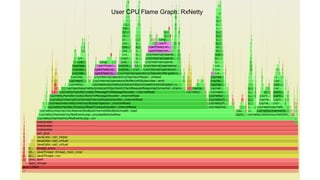
User CPU Flame Graph: RxNetty
3.1.2. User CPU Time Differences
CPU user time delta per request: 0.14 ms
Differences include:
● Extra GC time in Tomcat
● Framework code differences
● Socket read library
● Tomcat thread pool calls
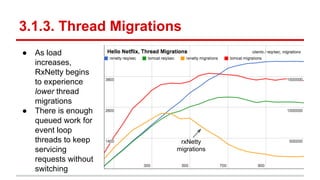
3.1.3. Thread Migrations
● As load
increases,
RxNetty begins
to experience
lower thread
migrations
● There is enough
queued work for
event loop
threads to keep
servicing
requests without
switching
rxNetty
migrations
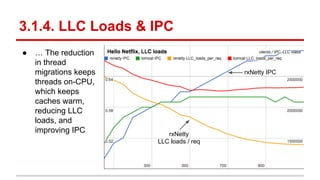
3.1.4. LLC Loads & IPC
● … The reduction
in thread
migrations keeps
threads on-CPU,
which keeps
caches warm,
reducing LLC
loads, and
improving IPC rxNetty
LLC loads / req
rxNetty IPC
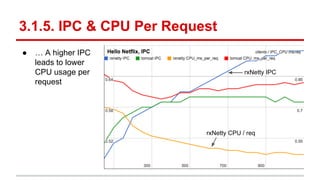
3.1.5. IPC & CPU Per Request
● … A higher IPC
leads to lower
CPU usage per
request
rxNetty CPU / req
rxNetty IPC
3.2. Lower Latencies Under Load
Studied using:
1. Migration rates (previous graph)
2. Context-switch flame graphs
3. Chain graphs
3.2.2. Context Switch Flame Graphs
● These identify the cause of context switches, and
blocking events.
○ They do not quantify the magnitude of off-CPU time; these are for
identification of targets for further study
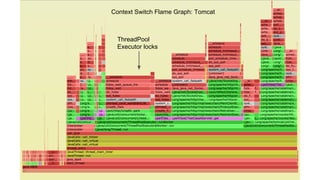
● Tomcat has additional futex context switches from
thread pool management
Context Switch Flame Graph: Tomcat
ThreadPool
Executor locks
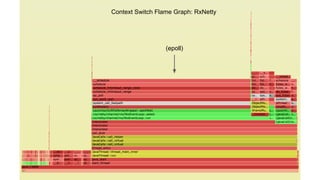
Context Switch Flame Graph: RxNetty
(epoll)
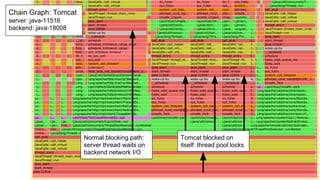
3.2.3. Chain Graphs
● These quantify the magnitude of off-CPU (blocking)
time, and show the chain of wakeup stacks that the
blocked thread was waiting on
○ x-axis: blocked time
○ y-axis: blocked stack, then wakeup stacks
Chain Graph: Tomcat
XXX
Normal blocking path:
server thread waits on
backend network I/O
Tomcat blocked on
itself: thread pool locks
Chain Graph: Tomcat
server: java-11516
backend: java-18008
Reasoning
● On a system with more CPUs (than 4), Tomcat will
perform even worse, due to the earlier effects.
● For applications which consume more CPU, the benefits
of an architecture change diminish.
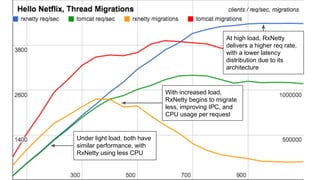
Summary
Under light load, both have
similar performance, with
RxNetty using less CPU
With increased load,
RxNetty begins to migrate
less, improving IPC, and
CPU usage per request
At high load, RxNetty
delivers a higher req rate,
with a lower latency
distribution due to its
architecture

RxNetty vs Tomcat Performance Results

  • 1.
    RxNetty vs Tomcat PerformanceResults Brendan Gregg; Performance and Reliability Engineering Nitesh Kant, Ben Christensen; Edge Engineering updated: Apr 2015
  • 2.
    Results based on ●The “Hello Netflix” benchmark (wsperflab) ● Tomcat ● RxNetty ● physical PC ○ Intel(R) Core(TM) i5-2400 CPU @ 3.10GHz: 4 cores, 1 thread per core ● OpenJDK 8 ○ with frame pointer patch ● Plus testing in other environments
  • 3.
  • 4.
    RxNetty vs Tomcatperformance In a variety of tests, RxNetty has been faster than Tomcat. This study covers: 1. What specifically is faster? 2. By how much? 3. Why?
  • 5.
  • 6.
    1. What specificallyis faster? ● CPU consumption per request ○ RxNetty consumes less CPU than Tomcat ○ This also means that a given server (with fixed CPU capacity) can deliver a higher maximum rate of requests per second ● Latency under load ○ Under high load, RxNetty has a lower latency distribution than Tomcat
  • 7.
    2. By howmuch?
  • 8.
    2. By howmuch? The following 5 graphs show performance vs load (clients) 1. CPU consumption per request 2. CPU resource usage vs load 3. Request rate 4. Request average latency 5. Request maximum latency Bear in mind these results are for this environment, and this workload
  • 9.
    2.1. CPU ConsumptionPer Request ● RxNetty has generally lower CPU consumption per request (over 40% lower) ● RxNetty keeps getting faster under load, whereas Tomcat keeps getting slower
  • 10.
    2.2. CPU ResourceUsage vs Load ● Load testing drove the server’s CPUs to near 100% for both frameworks
  • 11.
    2.3. Request Rate ●RxNetty achieved a 46% higher request rate ● This is mostly due to the lower CPU consumption per request
  • 12.
    2.4. Request AverageLatency ● Average latency increases past the req/sec knee point (when CPU begins to be saturated) ● RxNetty’s latency breakdown happens with much higher load
  • 13.
    2.5. Request MaximumLatency ● The degradation in maximum latency for Tomcat is much more severe
  • 14.
  • 15.
    3. Why? 1. CPUconsumption per request ○ RxNetty is lower due to its framework code and lower object allocation rate, which in turn reduces GC overheads ○ RxNetty also trends lower due to its event loop architecture, which reduces thread migrations under load, which improves CPU cache warmth and memory locality, which improves CPU Instructions Per Cycle (IPC), which lowers CPU cycle consumption per request 2. Lower latencies under load ○ Tomcat has higher latencies under load due to its thread pool architecture, which involves thread pool locks (and lock contention) and thread migrations to service load
  • 16.
    3.1. CPU ConsumptionPer Request Studied using: 1. Kernel CPU flame graphs 2. User CPU flame graphs 3. Migration rates 4. Last Level Cache (LLC) Loads & IPC 5. IPC & CPU per request
  • 17.
    3.1.1. Kernel CPUFlame Graphs
  • 18.
  • 19.
  • 20.
    3.1.1. Kernel CPUTime Differences CPU system time delta per request: 0.07 ms ● Tomcat futex(), for thread pool management (0.05 ms) ● Tomcat poll() vs RxNetty epoll() (0.02 ms extra)
  • 21.
    3.1.2. User CPUFlame Graphs
  • 22.
    User CPU FlameGraph: Tomcat (many differences)
  • 23.
    User CPU FlameGraph: RxNetty
  • 24.
    3.1.2. User CPUTime Differences CPU user time delta per request: 0.14 ms Differences include: ● Extra GC time in Tomcat ● Framework code differences ● Socket read library ● Tomcat thread pool calls
  • 25.
    3.1.3. Thread Migrations ●As load increases, RxNetty begins to experience lower thread migrations ● There is enough queued work for event loop threads to keep servicing requests without switching rxNetty migrations
  • 26.
    3.1.4. LLC Loads& IPC ● … The reduction in thread migrations keeps threads on-CPU, which keeps caches warm, reducing LLC loads, and improving IPC rxNetty LLC loads / req rxNetty IPC
  • 27.
    3.1.5. IPC &CPU Per Request ● … A higher IPC leads to lower CPU usage per request rxNetty CPU / req rxNetty IPC
  • 28.
    3.2. Lower LatenciesUnder Load Studied using: 1. Migration rates (previous graph) 2. Context-switch flame graphs 3. Chain graphs
  • 29.
    3.2.2. Context SwitchFlame Graphs ● These identify the cause of context switches, and blocking events. ○ They do not quantify the magnitude of off-CPU time; these are for identification of targets for further study ● Tomcat has additional futex context switches from thread pool management
  • 30.
    Context Switch FlameGraph: Tomcat ThreadPool Executor locks
  • 31.
    Context Switch FlameGraph: RxNetty (epoll)
  • 32.
    3.2.3. Chain Graphs ●These quantify the magnitude of off-CPU (blocking) time, and show the chain of wakeup stacks that the blocked thread was waiting on ○ x-axis: blocked time ○ y-axis: blocked stack, then wakeup stacks
  • 33.
    Chain Graph: Tomcat XXX Normalblocking path: server thread waits on backend network I/O Tomcat blocked on itself: thread pool locks Chain Graph: Tomcat server: java-11516 backend: java-18008
  • 34.
    Reasoning ● On asystem with more CPUs (than 4), Tomcat will perform even worse, due to the earlier effects. ● For applications which consume more CPU, the benefits of an architecture change diminish.
  • 35.
  • 36.
    Under light load,both have similar performance, with RxNetty using less CPU With increased load, RxNetty begins to migrate less, improving IPC, and CPU usage per request At high load, RxNetty delivers a higher req rate, with a lower latency distribution due to its architecture