Productive Pedagogies
The Queensland School Reform
Longitudinal Study (QSRLS)
Developed concepts of productive pedagogies,
 productive assessment and productive leadership
Central findings of the QSRLS re
pedagogies in approx 1000 classrooms
High levels of supportiveness: high mean and low
  standard deviation

Low levels of intellectual demand and connectedness:
  low mean and high standard deviation

Absence of working with and valuing difference: low
  mean and low standard deviation
Teachers with high ratings on the productive pedagogies
measure differed significantly from those with low ratings
particularly in terms of their:

• Sense of responsibility


• Efficacy in improving student learning outcomes


• Broad Conceptions of their role as teacher – in school,
  community and society, and

• Understanding of curriculum, pedagogy and assessment
  links and need for alignment
Bourdieu and the findings of the
productive pedagogies research
 The absence of intellectual demand particularly in schools serving
  disadvantaged communities has social justice implications
 Indeed, this absence of intellectual demand works in ways which
  Bourdieu suggests schools reproduce inequality, that is, by
  demanding of all that which they do not give, those with the
  requisite cultural capital are advantaged through schooling
 Also 'decontextualised' knowledge: knowledge not scaffolded and
  linked to students' life worlds
 Impact of NAPLAN. Differential impact across schools positioned
  differently in relation to NAPLAN and My School tables
 Pedagogies are a social justice issue: need redistribution of
  capitals: 'give them the code'
Alignment: Curriculum, Pedagogy and
  Assessment
Central to socially just schooling
Assessment practices and pedagogies aligned in terms of
 dimensions and with higher order purposes of curriculum
Assessment: scaffolding, 'give them the codes', criteria
 sheets, examples of essay structures, good assignments etc.
Central because this message system can steer the others
 (e.g. high stakes testing)
Alignment and assessment need to be on the equity agenda
Background to Productive Pedagogies
Part of the Queensland ‘New Basics’ project
Developed in Queensland
Being used interstate and internationally


Broad themes about what counts as good (in the
 sense of supporting student learning) teaching
Not prescriptive (or proscriptive) of certain
 approaches to teaching
Productive Pedagogies and MYS
Intended to be used at all levels of education
Have particular value for Middle Years of Schooling as a
 way of responding to perceptions that MYS is ‘dumbed
 down’ by comparison with the traditional junior high
 school approach and doesn’t adequately prepare students
 for higher level study
Help teachers to attend to high educational quality and
 excellent outcomes in combination with the key
 philosophical ideas of MYS
Embed many of the key philosophical ideas of MYS
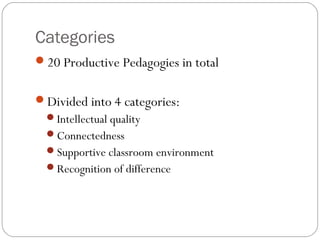
Categories
20 Productive Pedagogies in total


Divided into 4 categories:
  Intellectual quality
  Connectedness
  Supportive classroom environment
  Recognition of difference
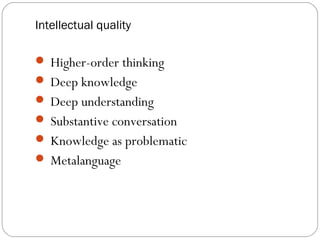
Intellectual quality

 Higher-order thinking
 Deep knowledge
 Deep understanding
 Substantive conversation
 Knowledge as problematic
 Metalanguage
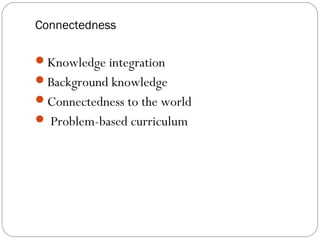
Connectedness

Knowledge integration
Background knowledge
Connectedness to the world
 Problem-based curriculum
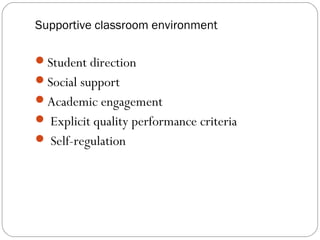
Supportive classroom environment

Student direction
Social support
Academic engagement
 Explicit quality performance criteria
 Self-regulation
Recognition of difference

Most difficult to address and observe in classrooms
Removed from the NSW adaption of Productive
 Pedagogies
Cultural knowledges
Inclusivity
Narrative
Group identity
 Active citizenship
Web Access
The Productive Pedagogies framework is
  available at:
http://education.qld.gov.au/corporate/newbasics/htm

The New Basics project more broadly, which
  offers significant teaching resources, is at:
http://education.qld.gov.au/corporate/newbasics/ind

Productive pedagogies

  • 1.
  • 2.
    The Queensland SchoolReform Longitudinal Study (QSRLS) Developed concepts of productive pedagogies, productive assessment and productive leadership
  • 3.
    Central findings ofthe QSRLS re pedagogies in approx 1000 classrooms High levels of supportiveness: high mean and low standard deviation Low levels of intellectual demand and connectedness: low mean and high standard deviation Absence of working with and valuing difference: low mean and low standard deviation
  • 4.
    Teachers with highratings on the productive pedagogies measure differed significantly from those with low ratings particularly in terms of their: • Sense of responsibility • Efficacy in improving student learning outcomes • Broad Conceptions of their role as teacher – in school, community and society, and • Understanding of curriculum, pedagogy and assessment links and need for alignment
  • 5.
    Bourdieu and thefindings of the productive pedagogies research  The absence of intellectual demand particularly in schools serving disadvantaged communities has social justice implications  Indeed, this absence of intellectual demand works in ways which Bourdieu suggests schools reproduce inequality, that is, by demanding of all that which they do not give, those with the requisite cultural capital are advantaged through schooling  Also 'decontextualised' knowledge: knowledge not scaffolded and linked to students' life worlds  Impact of NAPLAN. Differential impact across schools positioned differently in relation to NAPLAN and My School tables  Pedagogies are a social justice issue: need redistribution of capitals: 'give them the code'
  • 6.
    Alignment: Curriculum, Pedagogyand Assessment Central to socially just schooling Assessment practices and pedagogies aligned in terms of dimensions and with higher order purposes of curriculum Assessment: scaffolding, 'give them the codes', criteria sheets, examples of essay structures, good assignments etc. Central because this message system can steer the others (e.g. high stakes testing) Alignment and assessment need to be on the equity agenda
  • 7.
    Background to ProductivePedagogies Part of the Queensland ‘New Basics’ project Developed in Queensland Being used interstate and internationally Broad themes about what counts as good (in the sense of supporting student learning) teaching Not prescriptive (or proscriptive) of certain approaches to teaching
  • 8.
    Productive Pedagogies andMYS Intended to be used at all levels of education Have particular value for Middle Years of Schooling as a way of responding to perceptions that MYS is ‘dumbed down’ by comparison with the traditional junior high school approach and doesn’t adequately prepare students for higher level study Help teachers to attend to high educational quality and excellent outcomes in combination with the key philosophical ideas of MYS Embed many of the key philosophical ideas of MYS
  • 9.
    Categories 20 Productive Pedagogiesin total Divided into 4 categories: Intellectual quality Connectedness Supportive classroom environment Recognition of difference
  • 10.
    Intellectual quality  Higher-orderthinking  Deep knowledge  Deep understanding  Substantive conversation  Knowledge as problematic  Metalanguage
  • 11.
  • 12.
    Supportive classroom environment Studentdirection Social support Academic engagement  Explicit quality performance criteria  Self-regulation
  • 13.
    Recognition of difference Mostdifficult to address and observe in classrooms Removed from the NSW adaption of Productive Pedagogies Cultural knowledges Inclusivity Narrative Group identity  Active citizenship
  • 14.
    Web Access The ProductivePedagogies framework is available at: http://education.qld.gov.au/corporate/newbasics/htm The New Basics project more broadly, which offers significant teaching resources, is at: http://education.qld.gov.au/corporate/newbasics/ind