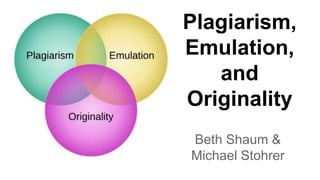
Plagiarism,
Emulation,
and
Originality
Beth Shaum &
Michael Stohrer
Lesson Objectives:
Students will be able to:
● explore the overlap between plagiarism and
original creation
● identify elements of an author’s creation that
they might want to emulate and then
emulate it
● use emulation as a stepping stone to original
creation
Demonstration Objectives:
Participants will:
● write an emulation poem
● select an element they wish to emulate and
then apply the emulation of that element to
the creative process
● observe the varying degrees of emulation in
other art forms
Core Beliefs:
We believe:
● Emulation is a natural part of the creative
process and worth celebrating.
● “Art is theft.” - Pablo Picasso
● “Art is theft. I came up with that.” – Michael Stohrer
● Certain writing situations require adherence
to the conventions of attribution.
● There is a complicated overlap between theft
and creation.
Research & Support on Plagiarism
The academic world is rife with cases of plagiarism, teachers bemoan the inability of
their students to be creative while simultaneously defending “cherished creative
geniuses” against such charges, and—most damningly— “academic work… stresses
the individual, creative thinker and writer and yet constantly emphasizes a fixed canon
of disciplinary knowledge.” (Pennycook 212-213)
Lethem, Jonathan. "The Ecstasy of Influence: A Plagiarism Mosaic." Sound Unbound: Sampling and Digital Culture.
Ed. Paul D. Miller a/k/a DJ Spooky That Subliminal Kid. 1st ed. London, England: The MIT Press, 2008. 25-51. Print.
Pennycook, Alastair. "Borrowing Others' Words: Text, Ownership, Memory and Plagiarism." TESOL Quaterly. 30.2
(1996): 201-230. Web. 10 Nov. 2013. <http://www.jstor.org/stable/3588141>.
Price, Margaret. "Beyond "Gotcha!": Situating Plagiarism in Policy and Pedagogy ." College Composition and
Communication. 54.1 (2002): 88-115. Web. 10 Nov. 2013. <http://www.jstor.org/stable/1512103>.
Goldsmith, Kenneth. "It's Not Plagiarism. in the Digital Age, It's 'Repurposing'." Chronicle of Higher Education.
(2011): Web. 10 Nov. 2013. <http://chronicle.com/article/Uncreative-Writing/128908/>.
Howard, Rebecca Moore. "Plagiarisms, Authorships, and the Academic Death Penalty." College English. 57.7
(1995): 788-806. Web. 27 Nov. 2013. <http://jstor.org/stable/378403>.
Research & Support on Emulation:
Imitating…the style of a published poet is a clear illustration of Vygotsky's “zone
of proximal development.” The student apprentices herself to a more
experienced, more accomplished other... In imitating the style of a poem,
students stretch themselves, try something they wouldn't on their own, perform
beyond their present skill and development, changing and growing as a user of
language, becoming more sophisticated in their understanding and practice of
poetry (101).
Romano, Tom. Fearless Writing: Multigenre to Motivate and Inspire. Portsmouth, NH: Heinemann,
2013. Print.
Anderson, Jeff. 10 Things Every Writer Needs to Know. Portland, Me.: Stenhouse Publishers, 2011.
Print.
Gallagher, Kelly. Write Like This: Teaching Real-World Writing through Modeling and Mentor Texts.
Portland, Me.: Stenhouse Publishers, 2011. Print.
Research & Support on Originality
All creative work builds on what came before. Nothing is completely original… If
we’re free from the burden of trying to be completely original, we can stop
trying to make something out of nothing, and we can embrace influence instead
of running away from it (7-8).
Kleon, Austin. Steal Like an Artist: 10 Things Nobody Told You about Being Creative. New York:
Workman , 2012. Print.
Also see Kleon’s TED talk on the same topic
“Plagiarism is the basis for all works of art, except, of course, the first one, which is unknown.”
- Raymond Federman, “Imagination as Plagiarism [an unfinished paper…]”
Essential Question:
How do artists use emulation and avoid
plagiarism while also creating something
“original”?
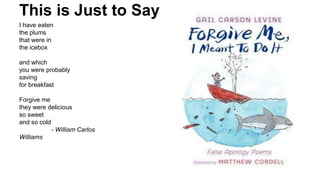
This is Just to Say
I have eaten
the plums
that were in
the icebox
and which
you were probably
saving
for breakfast
Forgive me
they were delicious
so sweet
and so cold
- William Carlos
Williams
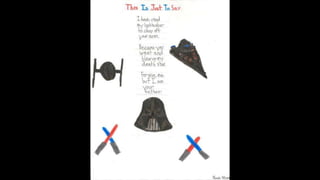
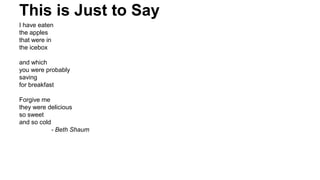
This is Just to Say
I have eaten
the apples
that were in
the icebox
and which
you were probably
saving
for breakfast
Forgive me
they were delicious
so sweet
and so cold
- Beth Shaum
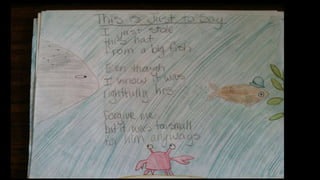
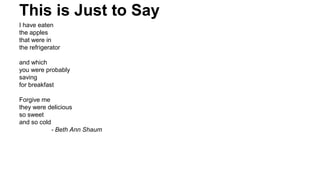
This is Just to Say
I have eaten
the apples
that were in
the refrigerator
and which
you were probably
saving
for breakfast
Forgive me
they were delicious
so sweet
and so cold
- Beth Ann Shaum
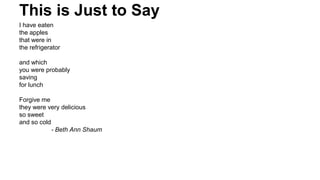
This is Just to Say
I have eaten
the apples
that were in
the refrigerator
and which
you were probably
saving
for lunch
Forgive me
they were very delicious
so sweet
and so cold
- Beth Ann Shaum
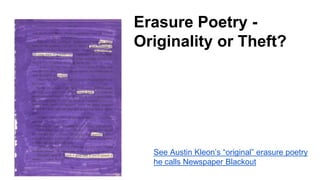
Erasure Poetry -
Originality or Theft?
See Austin Kleon’s “original” erasure poetry
he calls Newspaper Blackout
Leonardo da Vinci
Mona Lisa
1503-1505
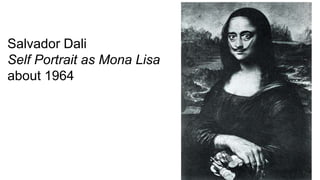
Salvador Dali
Self Portrait as Mona Lisa
about 1964
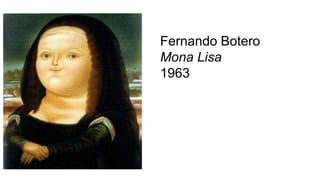
Fernando Botero
Mona Lisa
1963
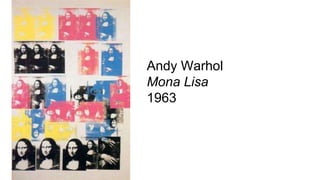
Andy Warhol
Mona Lisa
1963
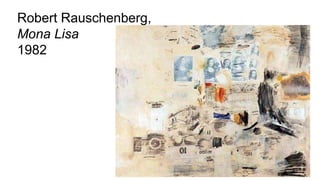
Robert Rauschenberg,
Mona Lisa
1982
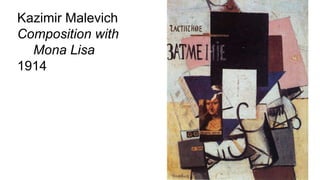
Kazimir Malevich
Composition with
Mona Lisa
1914
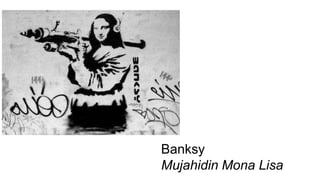
Banksy
Mujahidin Mona Lisa
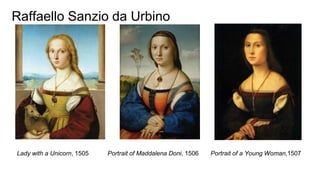
Raffaello Sanzio da Urbino
Lady with a Unicorn, 1505 Portrait of Maddalena Doni, 1506 Portrait of a Young Woman,1507
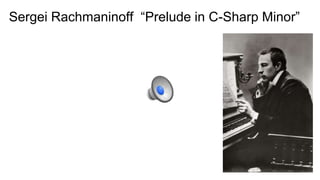
Sergei Rachmaninoff “Prelude in C-Sharp Minor”
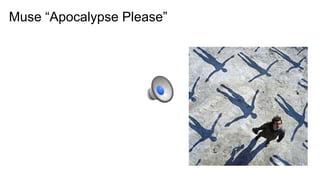
Muse “Apocalypse Please”
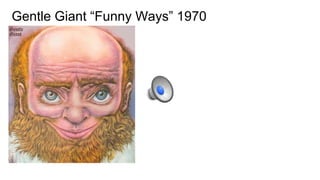
Gentle Giant “Funny Ways” 1970
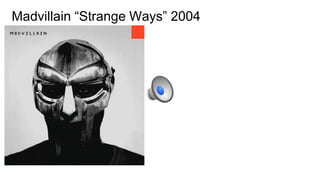
Madvillain “Strange Ways” 2004
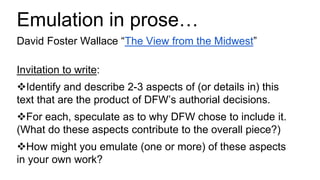
Emulation in prose…
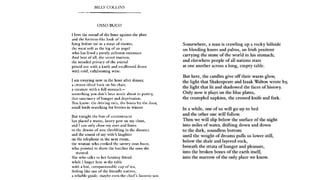
David Foster Wallace “The View from the Midwest”
Invitation to write:
Identify and describe 2-3 aspects of (or details in) this
text that are the product of DFW’s authorial decisions.
For each, speculate as to why DFW chose to include it.
(What do these aspects contribute to the overall piece?)
How might you emulate (one or more) of these aspects
in your own work?

Plagiarism, Emulation, and Originality

  • 1.
  • 2.
    Lesson Objectives: Students willbe able to: ● explore the overlap between plagiarism and original creation ● identify elements of an author’s creation that they might want to emulate and then emulate it ● use emulation as a stepping stone to original creation
  • 3.
    Demonstration Objectives: Participants will: ●write an emulation poem ● select an element they wish to emulate and then apply the emulation of that element to the creative process ● observe the varying degrees of emulation in other art forms
  • 4.
    Core Beliefs: We believe: ●Emulation is a natural part of the creative process and worth celebrating. ● “Art is theft.” - Pablo Picasso ● “Art is theft. I came up with that.” – Michael Stohrer ● Certain writing situations require adherence to the conventions of attribution. ● There is a complicated overlap between theft and creation.
  • 5.
    Research & Supporton Plagiarism The academic world is rife with cases of plagiarism, teachers bemoan the inability of their students to be creative while simultaneously defending “cherished creative geniuses” against such charges, and—most damningly— “academic work… stresses the individual, creative thinker and writer and yet constantly emphasizes a fixed canon of disciplinary knowledge.” (Pennycook 212-213) Lethem, Jonathan. "The Ecstasy of Influence: A Plagiarism Mosaic." Sound Unbound: Sampling and Digital Culture. Ed. Paul D. Miller a/k/a DJ Spooky That Subliminal Kid. 1st ed. London, England: The MIT Press, 2008. 25-51. Print. Pennycook, Alastair. "Borrowing Others' Words: Text, Ownership, Memory and Plagiarism." TESOL Quaterly. 30.2 (1996): 201-230. Web. 10 Nov. 2013. <http://www.jstor.org/stable/3588141>. Price, Margaret. "Beyond "Gotcha!": Situating Plagiarism in Policy and Pedagogy ." College Composition and Communication. 54.1 (2002): 88-115. Web. 10 Nov. 2013. <http://www.jstor.org/stable/1512103>. Goldsmith, Kenneth. "It's Not Plagiarism. in the Digital Age, It's 'Repurposing'." Chronicle of Higher Education. (2011): Web. 10 Nov. 2013. <http://chronicle.com/article/Uncreative-Writing/128908/>. Howard, Rebecca Moore. "Plagiarisms, Authorships, and the Academic Death Penalty." College English. 57.7 (1995): 788-806. Web. 27 Nov. 2013. <http://jstor.org/stable/378403>.
  • 6.
    Research & Supporton Emulation: Imitating…the style of a published poet is a clear illustration of Vygotsky's “zone of proximal development.” The student apprentices herself to a more experienced, more accomplished other... In imitating the style of a poem, students stretch themselves, try something they wouldn't on their own, perform beyond their present skill and development, changing and growing as a user of language, becoming more sophisticated in their understanding and practice of poetry (101). Romano, Tom. Fearless Writing: Multigenre to Motivate and Inspire. Portsmouth, NH: Heinemann, 2013. Print. Anderson, Jeff. 10 Things Every Writer Needs to Know. Portland, Me.: Stenhouse Publishers, 2011. Print. Gallagher, Kelly. Write Like This: Teaching Real-World Writing through Modeling and Mentor Texts. Portland, Me.: Stenhouse Publishers, 2011. Print.
  • 7.
    Research & Supporton Originality All creative work builds on what came before. Nothing is completely original… If we’re free from the burden of trying to be completely original, we can stop trying to make something out of nothing, and we can embrace influence instead of running away from it (7-8). Kleon, Austin. Steal Like an Artist: 10 Things Nobody Told You about Being Creative. New York: Workman , 2012. Print. Also see Kleon’s TED talk on the same topic “Plagiarism is the basis for all works of art, except, of course, the first one, which is unknown.” - Raymond Federman, “Imagination as Plagiarism [an unfinished paper…]”
  • 8.
    Essential Question: How doartists use emulation and avoid plagiarism while also creating something “original”?
  • 9.
    This is Justto Say I have eaten the plums that were in the icebox and which you were probably saving for breakfast Forgive me they were delicious so sweet and so cold - William Carlos Williams
  • 13.
    This is Justto Say I have eaten the apples that were in the icebox and which you were probably saving for breakfast Forgive me they were delicious so sweet and so cold - Beth Shaum
  • 14.
    This is Justto Say I have eaten the apples that were in the refrigerator and which you were probably saving for breakfast Forgive me they were delicious so sweet and so cold - Beth Ann Shaum
  • 15.
    This is Justto Say I have eaten the apples that were in the refrigerator and which you were probably saving for lunch Forgive me they were very delicious so sweet and so cold - Beth Ann Shaum
  • 16.
    Erasure Poetry - Originalityor Theft? See Austin Kleon’s “original” erasure poetry he calls Newspaper Blackout
  • 17.
    Leonardo da Vinci MonaLisa 1503-1505
  • 18.
    Salvador Dali Self Portraitas Mona Lisa about 1964
  • 19.
  • 20.
  • 21.
  • 22.
  • 23.
  • 24.
    Raffaello Sanzio daUrbino Lady with a Unicorn, 1505 Portrait of Maddalena Doni, 1506 Portrait of a Young Woman,1507
  • 25.
    Sergei Rachmaninoff “Preludein C-Sharp Minor”
  • 26.
  • 27.
  • 28.
  • 34.
    Emulation in prose… DavidFoster Wallace “The View from the Midwest” Invitation to write: Identify and describe 2-3 aspects of (or details in) this text that are the product of DFW’s authorial decisions. For each, speculate as to why DFW chose to include it. (What do these aspects contribute to the overall piece?) How might you emulate (one or more) of these aspects in your own work?