Transformative Writing InstructionCNY Reading Council Spring Conference 2011Within Classroom Walls: How Struggling Writers ThriveDonna Mahar, Ph.D. NBCTAssistant Professor, English & LiteracySUNY, Empire State CollegeDonna.Mahar@esc.edu
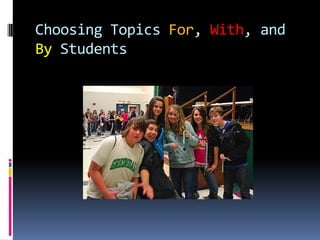
Choosing Topics For, With, and By Students
To-With-and- By-FrameworkMargaret Mooney (1990)Originally articulated as a guide to early reading instructionHelps to balance teacher direction and explicit instruction with student innovation and independent learningProvides teachers with a tool to evaluate our decision making and ensure we are providing student writers multiple chances to learn skills and strategies around topic selection that are valued in, as well as beyond, school
ScaffoldingLearners need opportunities for experts to:Write to, and in front of themWrite With themWrite by themselves         (Brunner, 1986, Dixon-Krauss, 1996, Moll,         1990- as well as other Vygotsky-influenced         scholars)
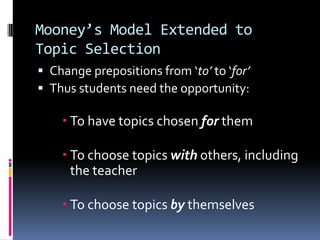
Mooney’s Model Extended to Topic SelectionChange prepositions from ‘to’ to ‘for’Thus students need the opportunity:To have topics chosen for themTo choose topics with others, including the teacherTo choose topics by themselves
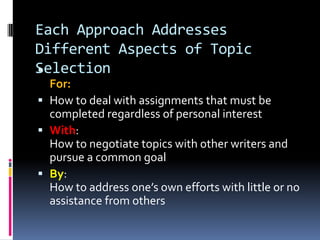
Each Approach Addresses Different Aspects of Topic SelectionFor:How to deal with assignments that must be completed regardless of personal interestWith:How to negotiate topics with other writers and pursue a common goal By:How to address one’s own efforts with little or no assistance from others
Poetry:Negotiating ‘For’ to ‘By’Linda Christensen, (2000)“Where I’m From”: Inviting Students Lives’ Into the ClassroomReading, Writing, and Rising Up: Teaching                                             About Social Justice and the Power of the                                             Written Word.
Where I’m FromGeorge Ella LyonsI am from clothespins,From Clorox and carbon-tetrachloride.I am from the dirt under the back porch.(Black, glistening     it tasted like beets.)    I am from the forsythia bush,     the Dutch elm  whose long gone limbs I remember  as if they were my very own.
George Ella LyonsI am from fudge and eyeglasses,    From Imogene and Alafair.   I’m from the know-it-alls   and the pass-it-ons,   from perk up and pipe down.   I’m from he restoreth my soul   with a cotton lamb    and ten verses I can say myself
George Ella LyonsI’m from Artemus and Billie’s Branch    fried corn and strong coffee.    From the finger my grandfather lost to the augerthe eye my father shut to keep his sight.Under my bed was a dress boxspilling old pictures,a sift of lost facesto drift beneath my dreams.I am from these moments-snapped before I budded-leaf-fallen from the family tree.
Ryan MillerGrade 7I am from swimming in Skaneateles Lake    cold, blue water at my grandparents’ camp   I am from lacrosse, and basketball,   running with friends   focused to win.I am from my parents who love me and my brother who’s okay    I am from S.U. sports and Wildcat spiritGo blue and yellow.
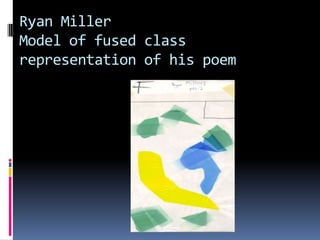
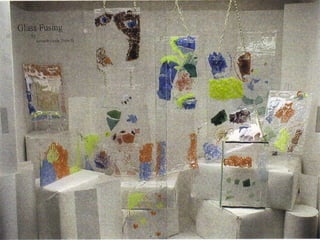
Ryan MillerModel of fused class representation of his poem
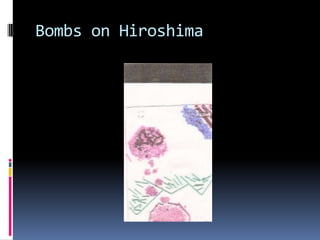
Bombs on Hiroshima
I Am FromBy Randy Galt, grade 7I am from bombs on Hiroshima   that my grandmother saw   from her school window   and cried.    I am from a time long ago,   A strong woman   Who loves me as much as I love her
Poetry With English Language LearnersDraw on Students’ BackgroundsPoetry in Translation “Students translate the work of poets from their native country or ethnic heritage, and then write and translate their own poems.”Carol McCarthy, Queens NY                          McCarthy, Academy of American Poets website                               www.poets.org/viewmedia.php/prmMID/17106
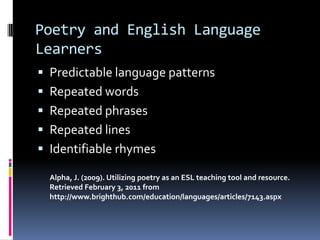
Poetry and English Language LearnersPredictable language patternsRepeated wordsRepeated phrasesRepeated linesIdentifiable rhymesAlpha, J. (2009). Utilizing poetry as an ESL teaching tool and resource. Retrieved February 3, 2011 from http://www.brighthub.com/education/languages/articles/7143.aspx
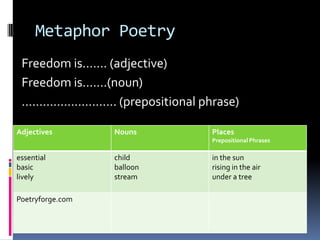
Metaphor PoetryFreedom is……. (adjective)Freedom is…….(noun)……………………… (prepositional phrase)
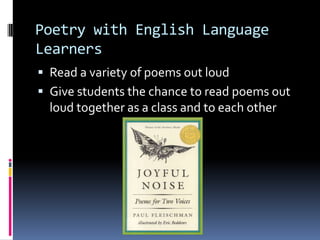
Poetry with English Language LearnersRead a variety of poems out loudGive students the chance to read poems out loud together as a class and to each other
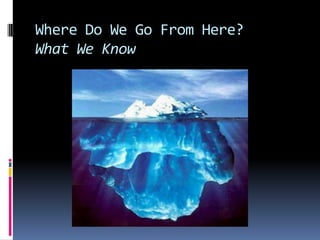
Where Do We Go From Here?What We Know
What We What to Know
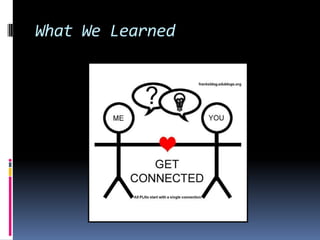
What We Learned
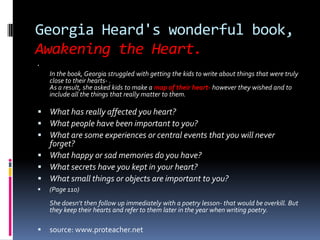
Georgia Heard's wonderful book, Awakening the Heart.In the book, Georgia struggled with getting the kids to write about things that were truly close to their hearts- .As a result, she asked kids to make a map of their heart- however they wished and to include all the things that really matter to them. What has really affected you heart?What people have been important to you?What are some experiences or central events that you will never forget?What happy or sad memories do you have?What secrets have you kept in your heart?What small things or objects are important to you?(Page 110)She doesn't then follow up immediately with a poetry lesson- that would be overkill. But they keep their hearts and refer to them later in the year when writing poetry. source: www.proteacher.net
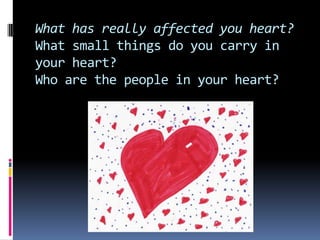
What has really affected you heart?What small things do you carry in your heart? Who are the people in your heart?
Valentine for Ernest MannBy Naomi Shihab NyeYou can’t order a poem likeyou order a taco.Walk up to the counter, say, "I'll take two"and expect it to be handed back to youon a shiny plate.     Still, I like your spirit.Anyone who says, "Here's my address,write me a poem," deserves something in reply.So I'll tell you a secret instead:poems hide. In the bottoms of our shoes,they are sleeping. They are the shadowsdrifting across our ceilings the momentbefore we wake up. What we have to dois live in a way that lets us find them.
Valentine for Ernest MannBy Naomi ShihabNye  page 2Once I knew a man who gave his wifetwo skunks for a valentine.He couldn't understand why she was crying."I thought they had such beautiful eyes."And he was serious. He was a serious manwho lived in a serious way. Nothing was uglyjust because the world said so. He reallyliked those skunks. So, he re-invented themas valentines and they became beautiful.At least, to him. And the poems that had been hidingin the eyes of skunks for centuriescrawled out and curled up at his feet.
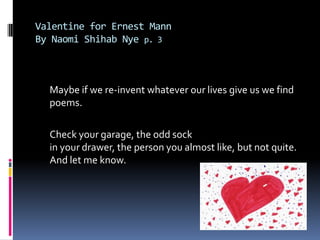
Valentine for Ernest MannBy Naomi ShihabNye p. 3	Maybe if we re-invent whatever our lives give us we find poems. Check your garage, the odd sockin your drawer, the person you almost like, but not quite.And let me know.

Cny reading council feb_5_2011

  • 1.
    Transformative Writing InstructionCNYReading Council Spring Conference 2011Within Classroom Walls: How Struggling Writers ThriveDonna Mahar, Ph.D. NBCTAssistant Professor, English & LiteracySUNY, Empire State CollegeDonna.Mahar@esc.edu
  • 2.
    Choosing Topics For,With, and By Students
  • 3.
    To-With-and- By-FrameworkMargaret Mooney(1990)Originally articulated as a guide to early reading instructionHelps to balance teacher direction and explicit instruction with student innovation and independent learningProvides teachers with a tool to evaluate our decision making and ensure we are providing student writers multiple chances to learn skills and strategies around topic selection that are valued in, as well as beyond, school
  • 4.
    ScaffoldingLearners need opportunitiesfor experts to:Write to, and in front of themWrite With themWrite by themselves (Brunner, 1986, Dixon-Krauss, 1996, Moll, 1990- as well as other Vygotsky-influenced scholars)
  • 5.
    Mooney’s Model Extendedto Topic SelectionChange prepositions from ‘to’ to ‘for’Thus students need the opportunity:To have topics chosen for themTo choose topics with others, including the teacherTo choose topics by themselves
  • 6.
    Each Approach AddressesDifferent Aspects of Topic SelectionFor:How to deal with assignments that must be completed regardless of personal interestWith:How to negotiate topics with other writers and pursue a common goal By:How to address one’s own efforts with little or no assistance from others
  • 7.
    Poetry:Negotiating ‘For’ to‘By’Linda Christensen, (2000)“Where I’m From”: Inviting Students Lives’ Into the ClassroomReading, Writing, and Rising Up: Teaching About Social Justice and the Power of the Written Word.
  • 8.
    Where I’m FromGeorgeElla LyonsI am from clothespins,From Clorox and carbon-tetrachloride.I am from the dirt under the back porch.(Black, glistening it tasted like beets.) I am from the forsythia bush, the Dutch elm whose long gone limbs I remember as if they were my very own.
  • 9.
    George Ella LyonsIam from fudge and eyeglasses, From Imogene and Alafair. I’m from the know-it-alls and the pass-it-ons, from perk up and pipe down. I’m from he restoreth my soul with a cotton lamb and ten verses I can say myself
  • 10.
    George Ella LyonsI’mfrom Artemus and Billie’s Branch fried corn and strong coffee. From the finger my grandfather lost to the augerthe eye my father shut to keep his sight.Under my bed was a dress boxspilling old pictures,a sift of lost facesto drift beneath my dreams.I am from these moments-snapped before I budded-leaf-fallen from the family tree.
  • 11.
    Ryan MillerGrade 7Iam from swimming in Skaneateles Lake cold, blue water at my grandparents’ camp I am from lacrosse, and basketball, running with friends focused to win.I am from my parents who love me and my brother who’s okay I am from S.U. sports and Wildcat spiritGo blue and yellow.
  • 12.
    Ryan MillerModel offused class representation of his poem
  • 13.
  • 14.
    I Am FromByRandy Galt, grade 7I am from bombs on Hiroshima that my grandmother saw from her school window and cried. I am from a time long ago, A strong woman Who loves me as much as I love her
  • 16.
    Poetry With EnglishLanguage LearnersDraw on Students’ BackgroundsPoetry in Translation “Students translate the work of poets from their native country or ethnic heritage, and then write and translate their own poems.”Carol McCarthy, Queens NY McCarthy, Academy of American Poets website www.poets.org/viewmedia.php/prmMID/17106
  • 17.
    Poetry and EnglishLanguage LearnersPredictable language patternsRepeated wordsRepeated phrasesRepeated linesIdentifiable rhymesAlpha, J. (2009). Utilizing poetry as an ESL teaching tool and resource. Retrieved February 3, 2011 from http://www.brighthub.com/education/languages/articles/7143.aspx
  • 18.
    Metaphor PoetryFreedom is…….(adjective)Freedom is…….(noun)……………………… (prepositional phrase)
  • 19.
    Poetry with EnglishLanguage LearnersRead a variety of poems out loudGive students the chance to read poems out loud together as a class and to each other
  • 20.
    Where Do WeGo From Here?What We Know
  • 21.
  • 22.
  • 23.
    Georgia Heard's wonderfulbook, Awakening the Heart.In the book, Georgia struggled with getting the kids to write about things that were truly close to their hearts- .As a result, she asked kids to make a map of their heart- however they wished and to include all the things that really matter to them. What has really affected you heart?What people have been important to you?What are some experiences or central events that you will never forget?What happy or sad memories do you have?What secrets have you kept in your heart?What small things or objects are important to you?(Page 110)She doesn't then follow up immediately with a poetry lesson- that would be overkill. But they keep their hearts and refer to them later in the year when writing poetry. source: www.proteacher.net
  • 24.
    What has reallyaffected you heart?What small things do you carry in your heart? Who are the people in your heart?
  • 25.
    Valentine for ErnestMannBy Naomi Shihab NyeYou can’t order a poem likeyou order a taco.Walk up to the counter, say, "I'll take two"and expect it to be handed back to youon a shiny plate. Still, I like your spirit.Anyone who says, "Here's my address,write me a poem," deserves something in reply.So I'll tell you a secret instead:poems hide. In the bottoms of our shoes,they are sleeping. They are the shadowsdrifting across our ceilings the momentbefore we wake up. What we have to dois live in a way that lets us find them.
  • 26.
    Valentine for ErnestMannBy Naomi ShihabNye page 2Once I knew a man who gave his wifetwo skunks for a valentine.He couldn't understand why she was crying."I thought they had such beautiful eyes."And he was serious. He was a serious manwho lived in a serious way. Nothing was uglyjust because the world said so. He reallyliked those skunks. So, he re-invented themas valentines and they became beautiful.At least, to him. And the poems that had been hidingin the eyes of skunks for centuriescrawled out and curled up at his feet.
  • 27.
    Valentine for ErnestMannBy Naomi ShihabNye p. 3 Maybe if we re-invent whatever our lives give us we find poems. Check your garage, the odd sockin your drawer, the person you almost like, but not quite.And let me know.