




ANALYSING AND PREDICTING
RECURRENT INTERACTIONS AMONG
LEARNERS DURING ONLINE
DISCUSSIONS IN A MOOC
Ayşe Saliha Sunar
06/11/15 ICKM 2015 Osaka @aysesCS
1
ass1a12@soton.ac.uk
@aysesCS
My background
Gazi University, TURKEY
BSc in Mathematics
Non-thesis master in Teaching mathematics to
secondary school students
06/11/15 ICKM 2015 Osaka @aysesCS 2
Nagoya University, JAPAN
MSc in Computer Supported Education
& Intelligent Tutoring Systems
University of Southampton,
UNITED KINGDOM
PhD in Learning Analytics
& Personalisation
& MOOCs
• MOOC Datasets management
• Data Analysis
• Curation:
• Academic Literature (Mendeley)
• Journalistic literature (Scoop.it)
• Blog
• Training
• Publications
06/11/15 ICKM 2015 Osaka @aysesCS 3
• MOOC Datasets management
• Data Analysis
• Curation:
• Academic Literature (Mendeley)
• Journalistic literature (Scoop.it)
• Blog
• Training
• Publications
06/11/15 ICKM 2015 Osaka @aysesCS 4
Massive
Open
Online
Courses
 Since 2007…
 Learners communicate
• MOOC Datasets management
• Data Analysis
• Curation:
• Academic Literature (Mendeley)
• Journalistic literature (Scoop.it)
• Blog
• Training
• Publications
06/11/15 ICKM 2015 Osaka @aysesCS 5
My motivation in
• Track and contribute to the development in
mass personalisation in MOOCs
06/11/15 ICKM 2015 Osaka @aysesCS 6
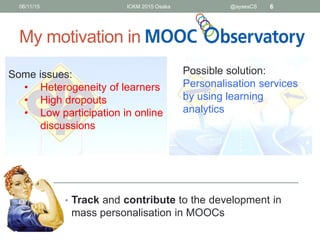
Some issues:
• Heterogeneity of learners
• High dropouts
• Low participation in online
discussions
Possible solution:
Personalisation services
by using learning
analytics
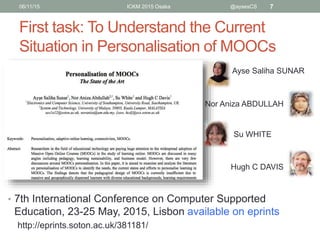
First task: To Understand the Current
Situation in Personalisation of MOOCs
• 7th International Conference on Computer Supported
Education, 23-25 May, 2015, Lisbon available on eprints
http://eprints.soton.ac.uk/381181/
06/11/15 ICKM 2015 Osaka @aysesCS 7
Ayse Saliha SUNAR
Nor Aniza ABDULLAH
Hugh C DAVIS
Su WHITE
Results from the Literature Review
• Some personalisation services aim at helping learners
through online communication
• Excessive information on discussion forums
• Less number of participants
• Difficulty in finding like-minded peer to discuss
06/11/15 ICKM 2015 Osaka @aysesCS 8
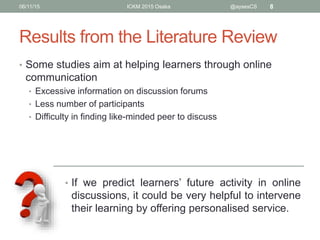
• If we predict learners’ future activity in online
discussions, it could be very helpful to intervene
their learning by offering personalised service.
And, eventually learners may even complete the
course.
Preliminary experiment: The Nature of
Social Learning Networks in MOOCs
• Focus of study:
• How much did the learners contribute to online discussions?
• Did they sustain their contribution to online discussions?
• Did recurrent interactions occur over the weeks?
• Can we predict learners’ potential relationships?
06/11/15 ICKM 2015 Osaka @aysesCS 9
It is important to understand learners’ behaviour and the
nature of their communications in MOOCs.
Methodology
• Analysis of Develop Your Research Project MOOC on
FutureLearn MOOC platform (15 September – 5 November
2014 )
• Dataset: Learners’ comments on the discussion boards (15
September – 22 November 2014
06/11/15 ICKM 2015 Osaka @aysesCS 10
• A tool is developed to
identify relationships
between learners through
their communication on
discussion board.
Identifying Social Learning Networks
06/11/15 ICKM 2015 Osaka @aysesCS 11
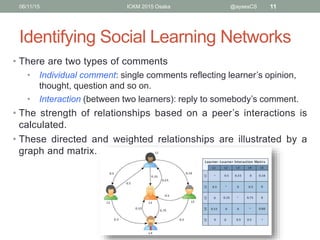
• There are two types of comments
• Individual comment: single comments reflecting learner’s opinion,
thought, question and so on.
• Interaction (between two learners): reply to somebody’s comment.
• The strength of relationships based on a peer’s interactions is
calculated.
• These directed and weighted relationships are illustrated by a
graph and matrix.
Results of General Analysis (1/4)
General Analysis of the Data
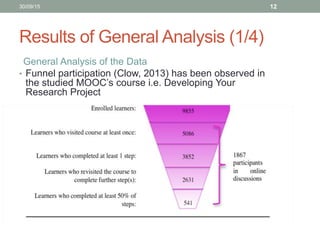
• Funnel participation (Clow, 2013) has been observed in
the studied MOOC’s course i.e. Developing Your
Research Project
30/09/15 12
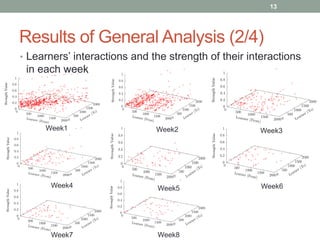
Results of General Analysis (2/4)
• Learners’ interactions and the strength of their interactions
in each week
13
Week1
Week4
Week7
Week2
Week5
Week8
Week3
Week6
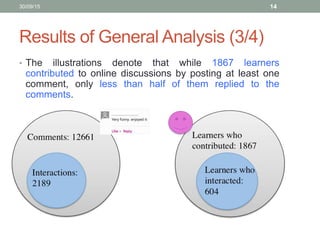
Results of General Analysis (3/4)
• The illustrations denote that while 1867 learners
contributed to online discussions by posting at least one
comment, only less than half of them replied to the
comments.
30/09/15 14
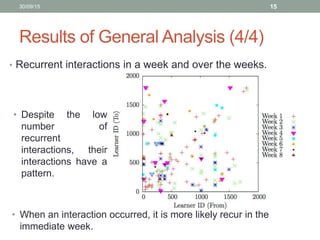
Results of General Analysis (4/4)
• Recurrent interactions in a week and over the weeks.
30/09/15 15
• Despite the low
number of
recurrent
interactions, their
interactions have a
pattern.
• When an interaction occurred, it is more likely recur in the
immediate week.
Strength of Relationships
06/11/15 ICKM 2015 Osaka @aysesCS 16
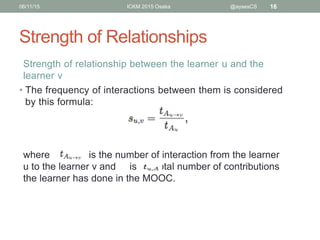
Strength of relationship between the learner u and the
learner v
• The frequency of interactions between them is considered
by this formula:
where is the number of interaction from the learner
u to the learner v and is the total number of contributions
the learner has done in the MOOC.
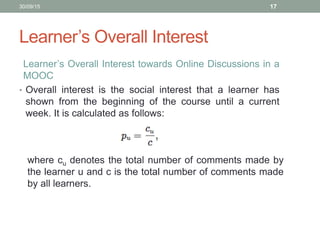
Learner’s Overall Interest
Learner’s Overall Interest towards Online Discussions in a
MOOC
• Overall interest is the social interest that a learner has
shown from the beginning of the course until a current
week. It is calculated as follows:
30/09/15 17
where cu denotes the total number of comments made by
the learner u and c is the total number of comments made
by all learners.
Prediction Method
Predicted Social Learning Networks
• If a learners has not initiate any friendship yet in the course, it
might be possible to predict their potential social learning
network.
• In order to identify a learner’s predicted social learning
networks, predicted strength of friendships with every other
learner needs to be first determined.
• However, the predicted strength of friendship between two
learners varies according to their kind of friendship history.
30/09/15 18
Prediction Method
Case 1 – friendship with zero-comment learners:
• Learners in this category have not contributed to the
online discussions yet.
• Therefore, they have no social learning network
and learning history in the MOOC.
• Thus, strength of a possible friendship cannot be
predicted.
30/09/15 19
Prediction Method
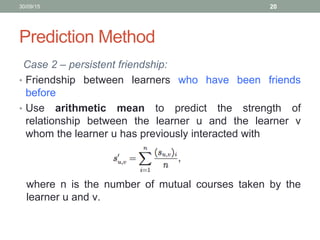
Case 2 – persistent friendship:
• Friendship between learners who have been friends
before
• Use arithmetic mean to predict the strength of
relationship between the learner u and the learner v
whom the learner u has previously interacted with
30/09/15 20
where n is the number of mutual courses taken by the
learner u and v.
Prediction Method
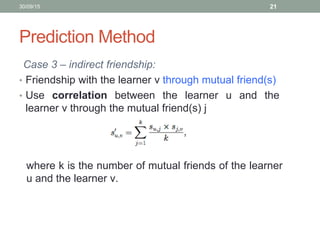
Case 3 – indirect friendship:
• Friendship with the learner v through mutual friend(s)
• Use correlation between the learner u and the
learner v through the mutual friend(s) j
30/09/15 21
where k is the number of mutual friends of the learner
u and the learner v.
Prediction Method
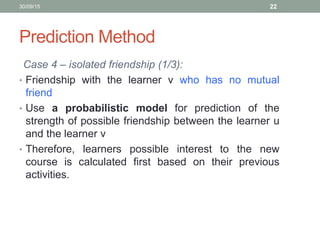
Case 4 – isolated friendship (1/3):
• Friendship with the learner v who has no mutual
friend
• Use a probabilistic model for prediction of the
strength of possible friendship between the learner u
and the learner v
• Therefore, learners possible interest to the new
course is calculated first based on their previous
activities.
30/09/15 22
Prediction Method
Case 4 – isolated friendship (2/3):
30/09/15 23
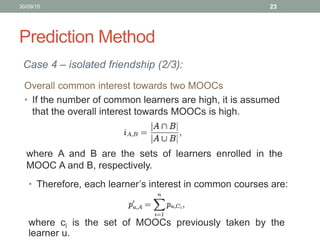
• Therefore, each learner’s interest in common courses are:
where A and B are the sets of learners enrolled in the
MOOC A and B, respectively.
Overall common interest towards two MOOCs
• If the number of common learners are high, it is assumed
that the overall interest towards MOOCs is high.
where ci is the set of MOOCs previously taken by the
learner u.
Prediction Method
Case 4 – isolated friendship (3/3):
30/09/15 24
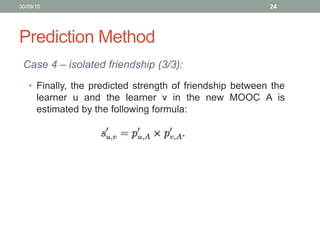
• Finally, the predicted strength of friendship between the
learner u and the learner v in the new MOOC A is
estimated by the following formula:
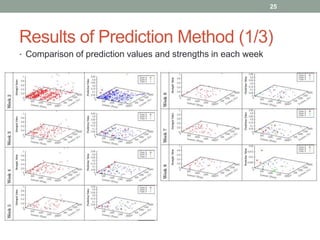
Results of Prediction Method (1/3)
• Comparison of prediction values and strengths in each week
25
Results of Prediction Method (2/3)
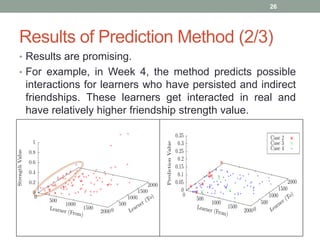
• Results are promising.
• For example, in Week 4, the method predicts possible
interactions for learners who have persisted and indirect
friendships. These learners get interacted in real and
have relatively higher friendship strength value.
26
Results of Prediction Method (3/3)
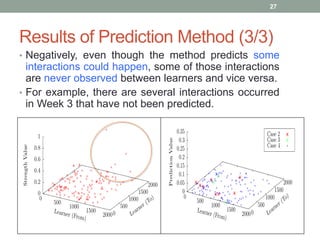
• Negatively, even though the method predicts some
interactions could happen, some of those interactions
are never observed between learners and vice versa.
• For example, there are several interactions occurred
in Week 3 that have not been predicted.
27
Conclusion and Future Work
• Most of the participations in online discussions are one-
time posting
• Interactions between learners are remarkably low in
comparison to number of comments posted to the online
discussion board
• If learners interacted with each other once, it appears
likely that they will interact again in subsequent weeks
• We are going to test our method on the other MOOCs’
discussion forums to statistically show the causality
between participation in online discussions and the
attrition rate.
06/11/15 ICKM 2015 Osaka @aysesCS 28
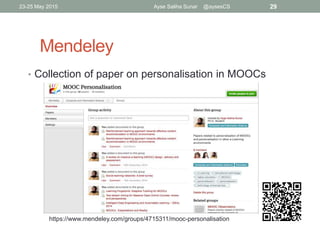
Mendeley
• Collection of paper on personalisation in MOOCs
23-25 May 2015 29Ayse Saliha Sunar @aysesCS
https://www.mendeley.com/groups/4715311/mooc-personalisation
• Find this
presentation
online!
23-25 May 2015 Ayse Saliha Sunar @aysesCS 30
http://www.slideshare.net/aysessunar/ickm-2015-analysing-predicting-recurrent-
interaction-in-moocs-forums
SlideShare
06/11/15 ICKM 2015 Osaka @aysesCS 31

ICKM 2015 - Analysing & Predicting Recurrent Interaction in MOOCs forums

  • 1.
    ANALYSING AND PREDICTING RECURRENTINTERACTIONS AMONG LEARNERS DURING ONLINE DISCUSSIONS IN A MOOC Ayşe Saliha Sunar 06/11/15 ICKM 2015 Osaka @aysesCS 1 ass1a12@soton.ac.uk @aysesCS
  • 2.
    My background Gazi University,TURKEY BSc in Mathematics Non-thesis master in Teaching mathematics to secondary school students 06/11/15 ICKM 2015 Osaka @aysesCS 2 Nagoya University, JAPAN MSc in Computer Supported Education & Intelligent Tutoring Systems University of Southampton, UNITED KINGDOM PhD in Learning Analytics & Personalisation & MOOCs
  • 3.
    • MOOC Datasetsmanagement • Data Analysis • Curation: • Academic Literature (Mendeley) • Journalistic literature (Scoop.it) • Blog • Training • Publications 06/11/15 ICKM 2015 Osaka @aysesCS 3
  • 4.
    • MOOC Datasetsmanagement • Data Analysis • Curation: • Academic Literature (Mendeley) • Journalistic literature (Scoop.it) • Blog • Training • Publications 06/11/15 ICKM 2015 Osaka @aysesCS 4 Massive Open Online Courses  Since 2007…  Learners communicate
  • 5.
    • MOOC Datasetsmanagement • Data Analysis • Curation: • Academic Literature (Mendeley) • Journalistic literature (Scoop.it) • Blog • Training • Publications 06/11/15 ICKM 2015 Osaka @aysesCS 5
  • 6.
    My motivation in •Track and contribute to the development in mass personalisation in MOOCs 06/11/15 ICKM 2015 Osaka @aysesCS 6 Some issues: • Heterogeneity of learners • High dropouts • Low participation in online discussions Possible solution: Personalisation services by using learning analytics
  • 7.
    First task: ToUnderstand the Current Situation in Personalisation of MOOCs • 7th International Conference on Computer Supported Education, 23-25 May, 2015, Lisbon available on eprints http://eprints.soton.ac.uk/381181/ 06/11/15 ICKM 2015 Osaka @aysesCS 7 Ayse Saliha SUNAR Nor Aniza ABDULLAH Hugh C DAVIS Su WHITE
  • 8.
    Results from theLiterature Review • Some personalisation services aim at helping learners through online communication • Excessive information on discussion forums • Less number of participants • Difficulty in finding like-minded peer to discuss 06/11/15 ICKM 2015 Osaka @aysesCS 8 • If we predict learners’ future activity in online discussions, it could be very helpful to intervene their learning by offering personalised service. And, eventually learners may even complete the course.
  • 9.
    Preliminary experiment: TheNature of Social Learning Networks in MOOCs • Focus of study: • How much did the learners contribute to online discussions? • Did they sustain their contribution to online discussions? • Did recurrent interactions occur over the weeks? • Can we predict learners’ potential relationships? 06/11/15 ICKM 2015 Osaka @aysesCS 9 It is important to understand learners’ behaviour and the nature of their communications in MOOCs.
  • 10.
    Methodology • Analysis ofDevelop Your Research Project MOOC on FutureLearn MOOC platform (15 September – 5 November 2014 ) • Dataset: Learners’ comments on the discussion boards (15 September – 22 November 2014 06/11/15 ICKM 2015 Osaka @aysesCS 10 • A tool is developed to identify relationships between learners through their communication on discussion board.
  • 11.
    Identifying Social LearningNetworks 06/11/15 ICKM 2015 Osaka @aysesCS 11 • There are two types of comments • Individual comment: single comments reflecting learner’s opinion, thought, question and so on. • Interaction (between two learners): reply to somebody’s comment. • The strength of relationships based on a peer’s interactions is calculated. • These directed and weighted relationships are illustrated by a graph and matrix.
  • 12.
    Results of GeneralAnalysis (1/4) General Analysis of the Data • Funnel participation (Clow, 2013) has been observed in the studied MOOC’s course i.e. Developing Your Research Project 30/09/15 12
  • 13.
    Results of GeneralAnalysis (2/4) • Learners’ interactions and the strength of their interactions in each week 13 Week1 Week4 Week7 Week2 Week5 Week8 Week3 Week6
  • 14.
    Results of GeneralAnalysis (3/4) • The illustrations denote that while 1867 learners contributed to online discussions by posting at least one comment, only less than half of them replied to the comments. 30/09/15 14
  • 15.
    Results of GeneralAnalysis (4/4) • Recurrent interactions in a week and over the weeks. 30/09/15 15 • Despite the low number of recurrent interactions, their interactions have a pattern. • When an interaction occurred, it is more likely recur in the immediate week.
  • 16.
    Strength of Relationships 06/11/15ICKM 2015 Osaka @aysesCS 16 Strength of relationship between the learner u and the learner v • The frequency of interactions between them is considered by this formula: where is the number of interaction from the learner u to the learner v and is the total number of contributions the learner has done in the MOOC.
  • 17.
    Learner’s Overall Interest Learner’sOverall Interest towards Online Discussions in a MOOC • Overall interest is the social interest that a learner has shown from the beginning of the course until a current week. It is calculated as follows: 30/09/15 17 where cu denotes the total number of comments made by the learner u and c is the total number of comments made by all learners.
  • 18.
    Prediction Method Predicted SocialLearning Networks • If a learners has not initiate any friendship yet in the course, it might be possible to predict their potential social learning network. • In order to identify a learner’s predicted social learning networks, predicted strength of friendships with every other learner needs to be first determined. • However, the predicted strength of friendship between two learners varies according to their kind of friendship history. 30/09/15 18
  • 19.
    Prediction Method Case 1– friendship with zero-comment learners: • Learners in this category have not contributed to the online discussions yet. • Therefore, they have no social learning network and learning history in the MOOC. • Thus, strength of a possible friendship cannot be predicted. 30/09/15 19
  • 20.
    Prediction Method Case 2– persistent friendship: • Friendship between learners who have been friends before • Use arithmetic mean to predict the strength of relationship between the learner u and the learner v whom the learner u has previously interacted with 30/09/15 20 where n is the number of mutual courses taken by the learner u and v.
  • 21.
    Prediction Method Case 3– indirect friendship: • Friendship with the learner v through mutual friend(s) • Use correlation between the learner u and the learner v through the mutual friend(s) j 30/09/15 21 where k is the number of mutual friends of the learner u and the learner v.
  • 22.
    Prediction Method Case 4– isolated friendship (1/3): • Friendship with the learner v who has no mutual friend • Use a probabilistic model for prediction of the strength of possible friendship between the learner u and the learner v • Therefore, learners possible interest to the new course is calculated first based on their previous activities. 30/09/15 22
  • 23.
    Prediction Method Case 4– isolated friendship (2/3): 30/09/15 23 • Therefore, each learner’s interest in common courses are: where A and B are the sets of learners enrolled in the MOOC A and B, respectively. Overall common interest towards two MOOCs • If the number of common learners are high, it is assumed that the overall interest towards MOOCs is high. where ci is the set of MOOCs previously taken by the learner u.
  • 24.
    Prediction Method Case 4– isolated friendship (3/3): 30/09/15 24 • Finally, the predicted strength of friendship between the learner u and the learner v in the new MOOC A is estimated by the following formula:
  • 25.
    Results of PredictionMethod (1/3) • Comparison of prediction values and strengths in each week 25
  • 26.
    Results of PredictionMethod (2/3) • Results are promising. • For example, in Week 4, the method predicts possible interactions for learners who have persisted and indirect friendships. These learners get interacted in real and have relatively higher friendship strength value. 26
  • 27.
    Results of PredictionMethod (3/3) • Negatively, even though the method predicts some interactions could happen, some of those interactions are never observed between learners and vice versa. • For example, there are several interactions occurred in Week 3 that have not been predicted. 27
  • 28.
    Conclusion and FutureWork • Most of the participations in online discussions are one- time posting • Interactions between learners are remarkably low in comparison to number of comments posted to the online discussion board • If learners interacted with each other once, it appears likely that they will interact again in subsequent weeks • We are going to test our method on the other MOOCs’ discussion forums to statistically show the causality between participation in online discussions and the attrition rate. 06/11/15 ICKM 2015 Osaka @aysesCS 28
  • 29.
    Mendeley • Collection ofpaper on personalisation in MOOCs 23-25 May 2015 29Ayse Saliha Sunar @aysesCS https://www.mendeley.com/groups/4715311/mooc-personalisation
  • 30.
    • Find this presentation online! 23-25May 2015 Ayse Saliha Sunar @aysesCS 30 http://www.slideshare.net/aysessunar/ickm-2015-analysing-predicting-recurrent- interaction-in-moocs-forums SlideShare
  • 31.
    06/11/15 ICKM 2015Osaka @aysesCS 31

Editor's Notes

  • #4 I am a member of MOOC Observatory in the University of Southampton. For those who may not familiar with MOOCs, I like to briefly mention about them.
  • #5 For those who may not familiar with MOOCs, I like to briefly mention about them. MOOC stands for massive open online courses. Since 2007, many universities, profit and non-profit private initiatives launched their online courses for public, free. These courses have been welcomed well by the public and we have hundred and thousands of online learners in return. Learners are able to interact with the course content and communicate each other through the course’s discussion forums and social media tools. Ikonlari ekle
  • #6 So, in MOOC Observatory group, we are doing
  • #7 Researchers and educationalists are dealing with many issues in MOOCs. Some of them are heterogeneity of learners. We have thousands of learners. Good.. We have large amounts of data produced from the learners. Because everyone is from different background, different culture, speaks different language, is used to different learning method and MOOCs are offering the same course content to everyone in the same way. This could be the cause of high dropouts and low participation in MOOCs. Possible solution could be offering personalisation services to learners. That is why, my interest and my specific role in MOOC Observatory group is to track and contribute to the the development in personalisation of massive audience’s learning activity.
  • #8 As a first task in my research, I have completed a literature survey on personalisation of MOOCs and we had critically analysed the literature with my mentor and supervisors and published the results last May.
  • #9 There were many significant results related to different issues such as personalised assessments. Some of the studies we analysed, aim at helping learners through online communication. However, they identified there is excessive information in discussion forums and they do not know what to read. Even though thousands of learners enrol in the course, only small portion of them participate in online communication. Also, when they participate, it is still difficult to find a person they may share interest on the
  • #10 Therefore, for this aim, it is important to understand learners’ behaviour and the nature of their communications in MOOCs first. We have conducted a preliminary case study to understand …
  • #11 We chose a MOOC course delivered by the university of Southampton. Also, we develop a tool to automatically identify the relationships between learners.
  • #12 Now, I like to explain how we identify social networks. First, we define two different types of comments.
  • #13 First results were not surprising.
  • #17 Those were the general analysis. Now, I like to explain how we applied the prediction method and its results.
  • #18 The ration of the number of posts posted by learner u to the all comments posted.
  • #30 You can find all the literature reviewed in this paper and more papers related to MOOCs personalisation in this Mendeley group. Also, you all are kindly invited to contribute to this collection.
  • #31 You can also find this presentation and contact me on Slideshare.