Steve Parker MSc, MRICS, MAPM, PVM, Chair of the IVM
Committee Member APM Benefits SIG and Value SIG
 Alignment between VM and BM processes and method of
application
 Critical linkages between value and benefits
 Difference between improving value and improving value for
money
 Role of the Value and Benefits Manager
 Benefits Realisation Management is one of the most
important things that an organisation needs to do ……. but
not at any cost!
 Questions and Answers
Content
© Institute of Value Management Ltd 2016
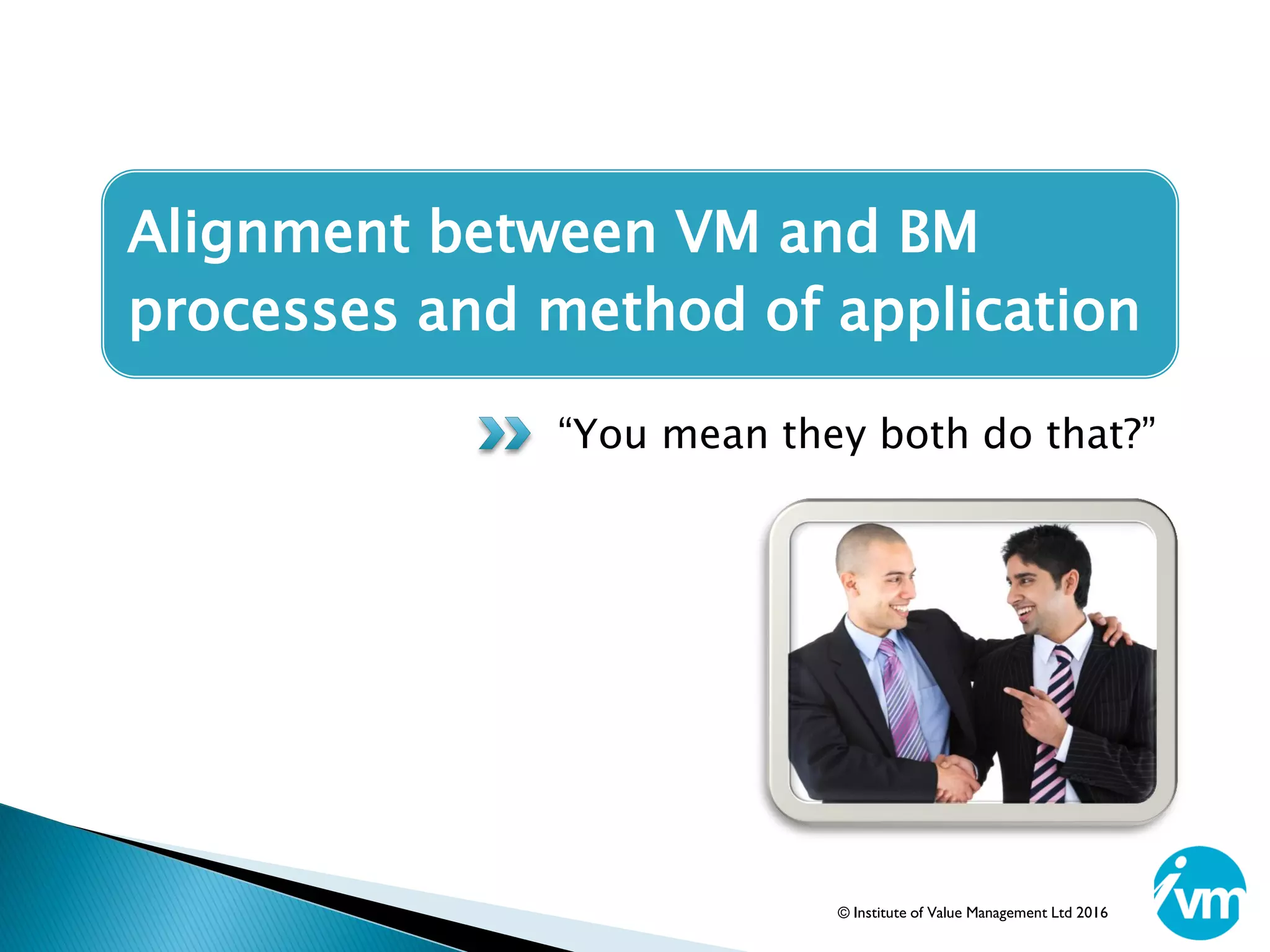
Alignment between VM and BM
processes and method of application
“You mean they both do that?”
© Institute of Value Management Ltd 2016
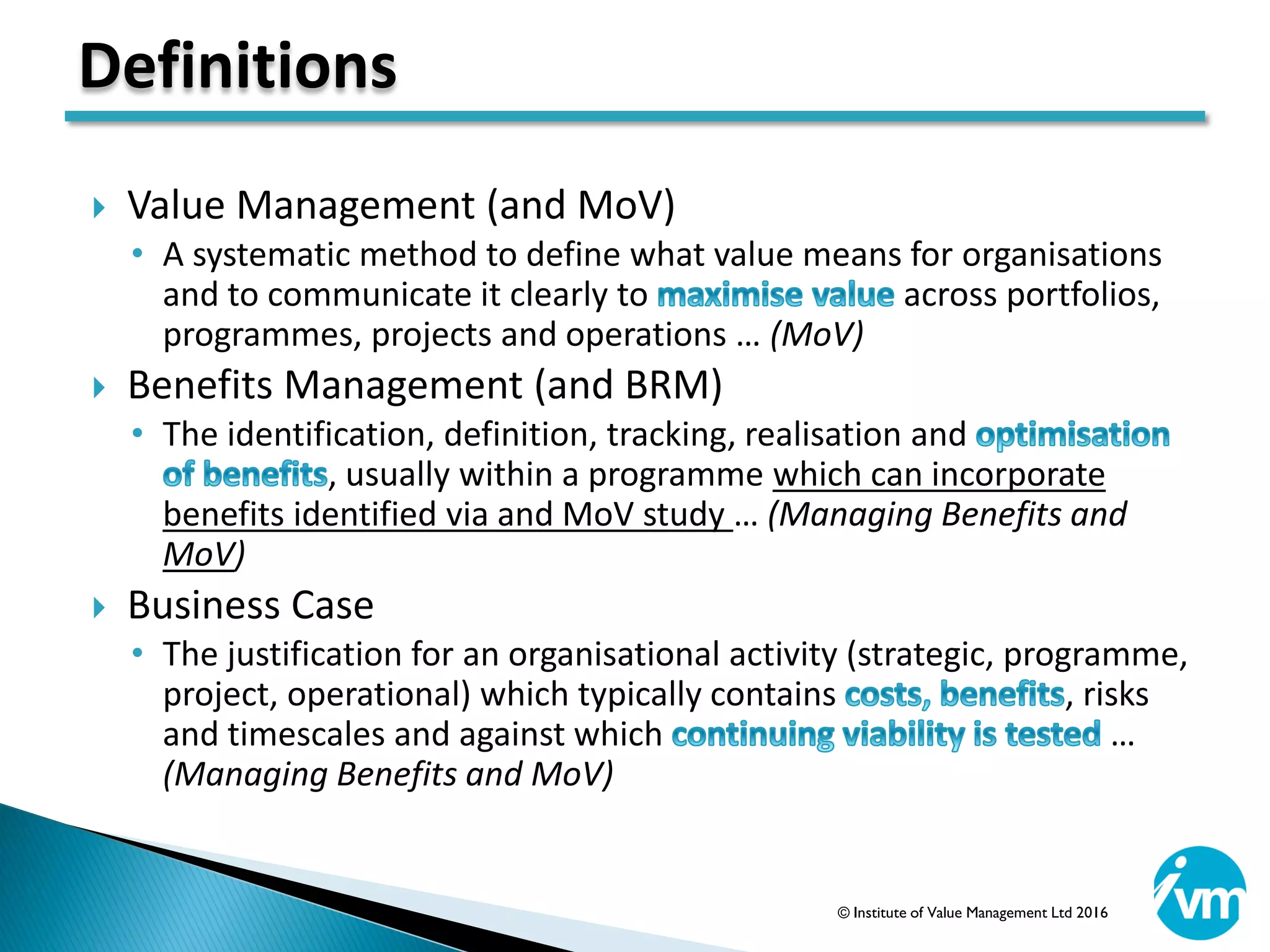
 Value Management (and MoV)
• A systematic method to define what value means for organisations
and to communicate it clearly to across portfolios,
programmes, projects and operations … (MoV)
 Benefits Management (and BRM)
• The identification, definition, tracking, realisation and
, usually within a programme which can incorporate
benefits identified via and MoV study … (Managing Benefits and
MoV)
 Business Case
• The justification for an organisational activity (strategic, programme,
project, operational) which typically contains , risks
and timescales and against which …
(Managing Benefits and MoV)
Definitions
© Institute of Value Management Ltd 2016
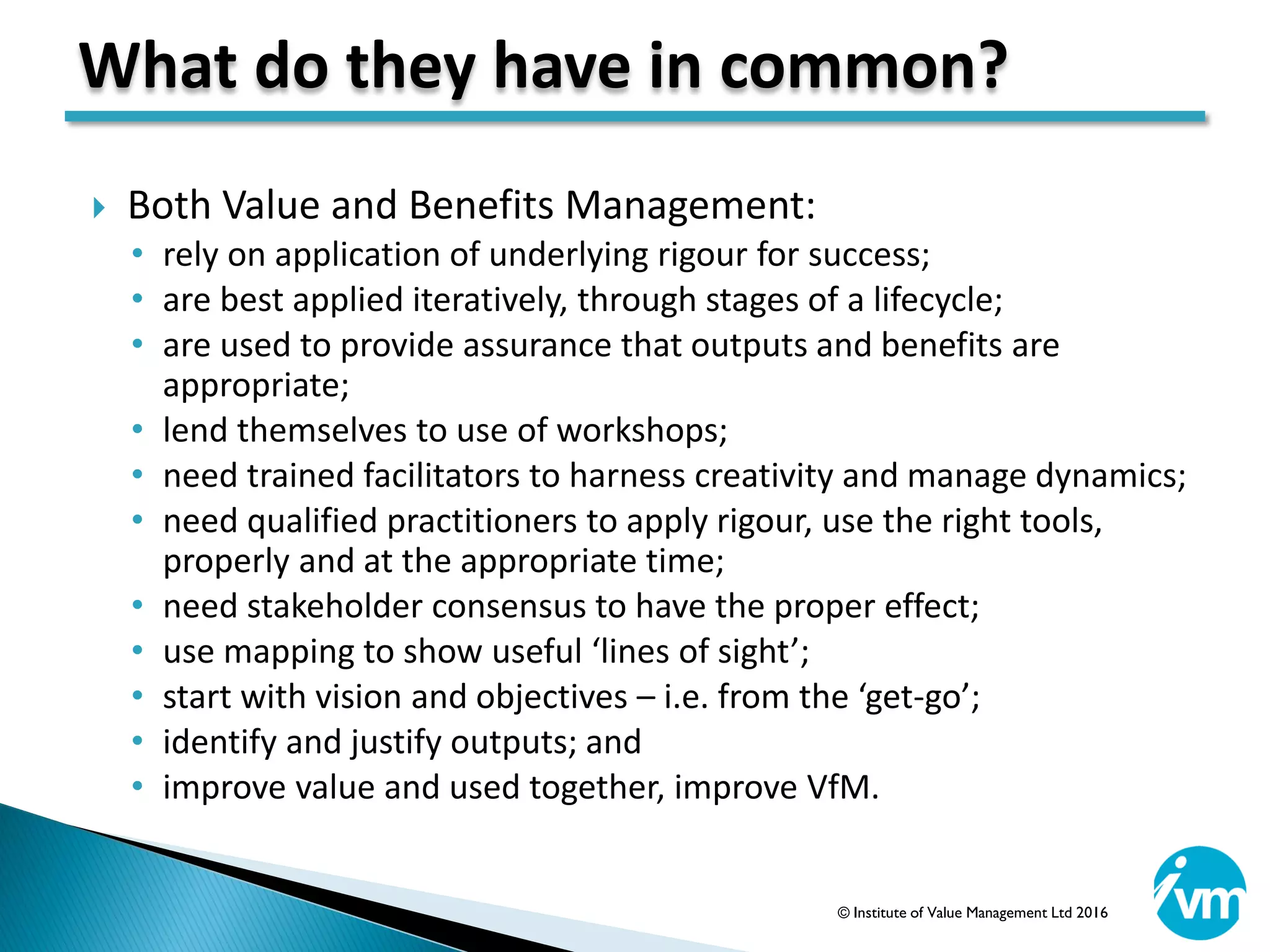
 Both Value and Benefits Management:
• rely on application of underlying rigour for success;
• are best applied iteratively, through stages of a lifecycle;
• are used to provide assurance that outputs and benefits are
appropriate;
• lend themselves to use of workshops;
• need trained facilitators to harness creativity and manage dynamics;
• need qualified practitioners to apply rigour, use the right tools,
properly and at the appropriate time;
• need stakeholder consensus to have the proper effect;
• use mapping to show useful ‘lines of sight’;
• start with vision and objectives – i.e. from the ‘get-go’;
• identify and justify outputs; and
• improve value and used together, improve VfM.
What do they have in common?
© Institute of Value Management Ltd 2016
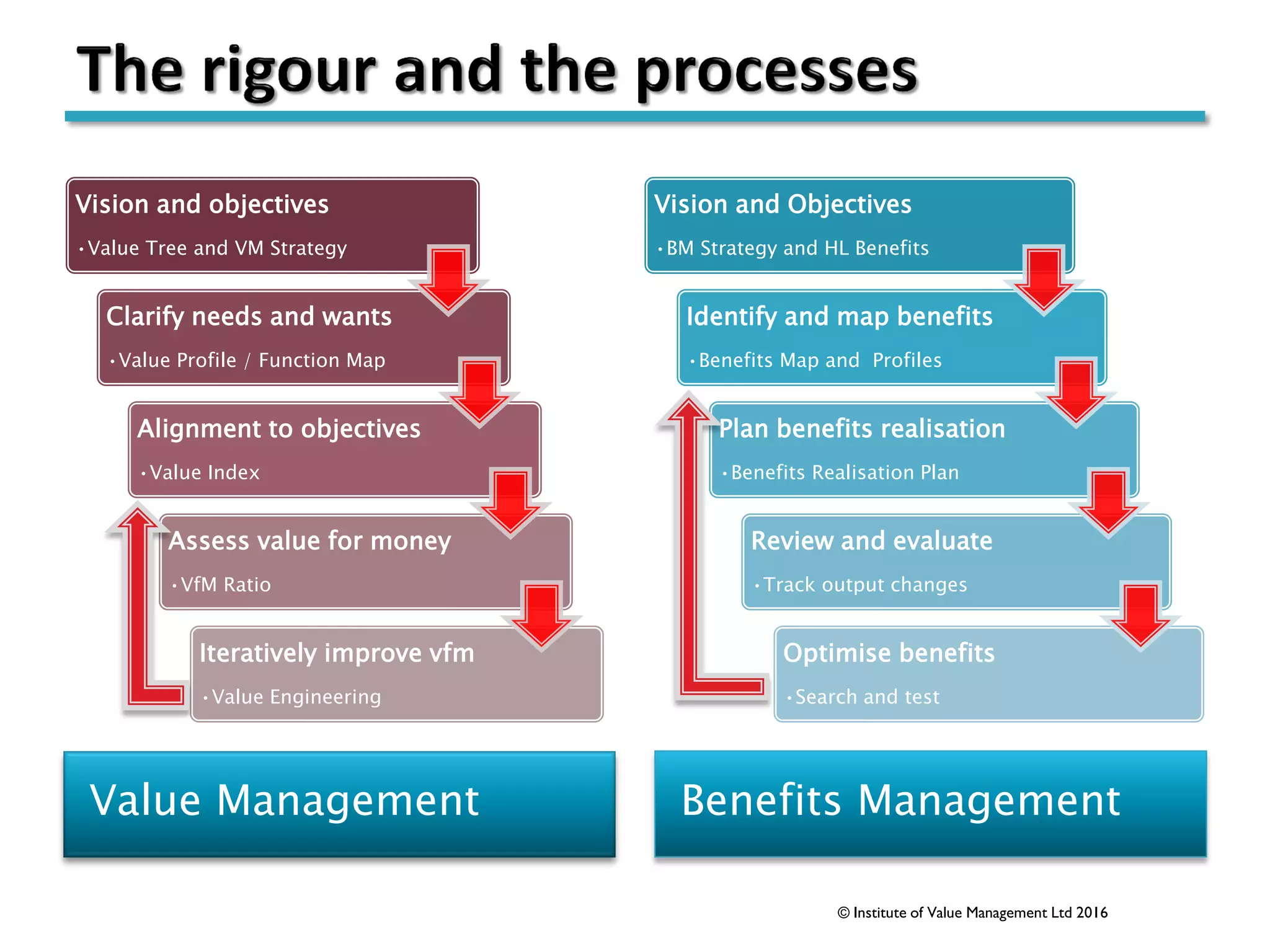
Value Management Benefits Management
Vision and objectives
•Value Tree and VM Strategy
Clarify needs and wants
•Value Profile / Function Map
Alignment to objectives
•Value Index
Assess value for money
•VfM Ratio
Iteratively improve vfm
•Value Engineering
Vision and Objectives
•BM Strategy and HL Benefits
Identify and map benefits
•Benefits Map and Profiles
Plan benefits realisation
•Benefits Realisation Plan
Review and evaluate
•Track output changes
Optimise benefits
•Search and test
© Institute of Value Management Ltd 2016
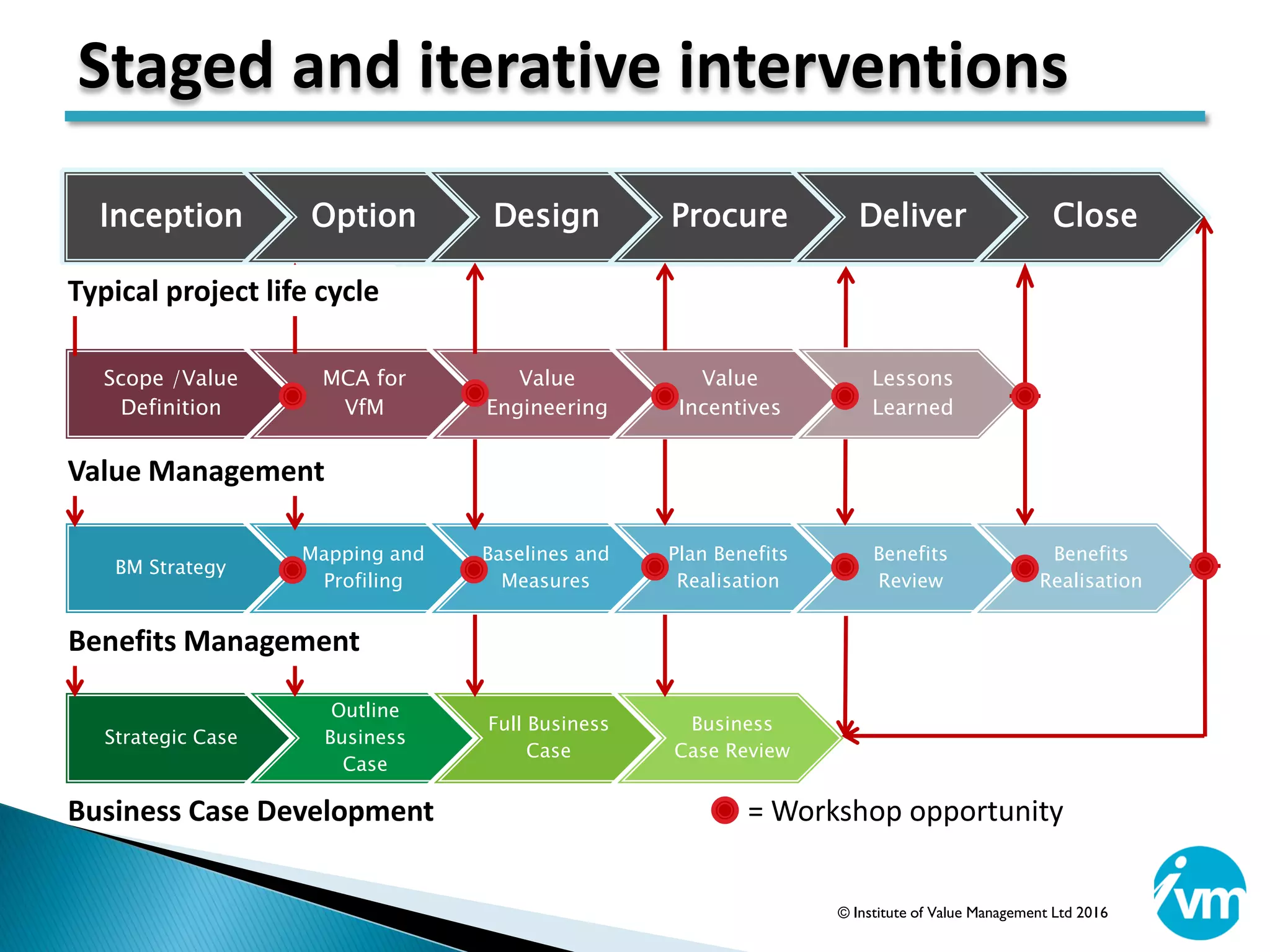
Strategic Case
Outline
Business
Case
Full Business
Case
Business
Case Review
Scope /Value
Definition
MCA for
VfM
Value
Engineering
Value
Incentives
Lessons
Learned
BM Strategy
Mapping and
Profiling
Baselines and
Measures
Plan Benefits
Realisation
Benefits
Review
Benefits
Realisation
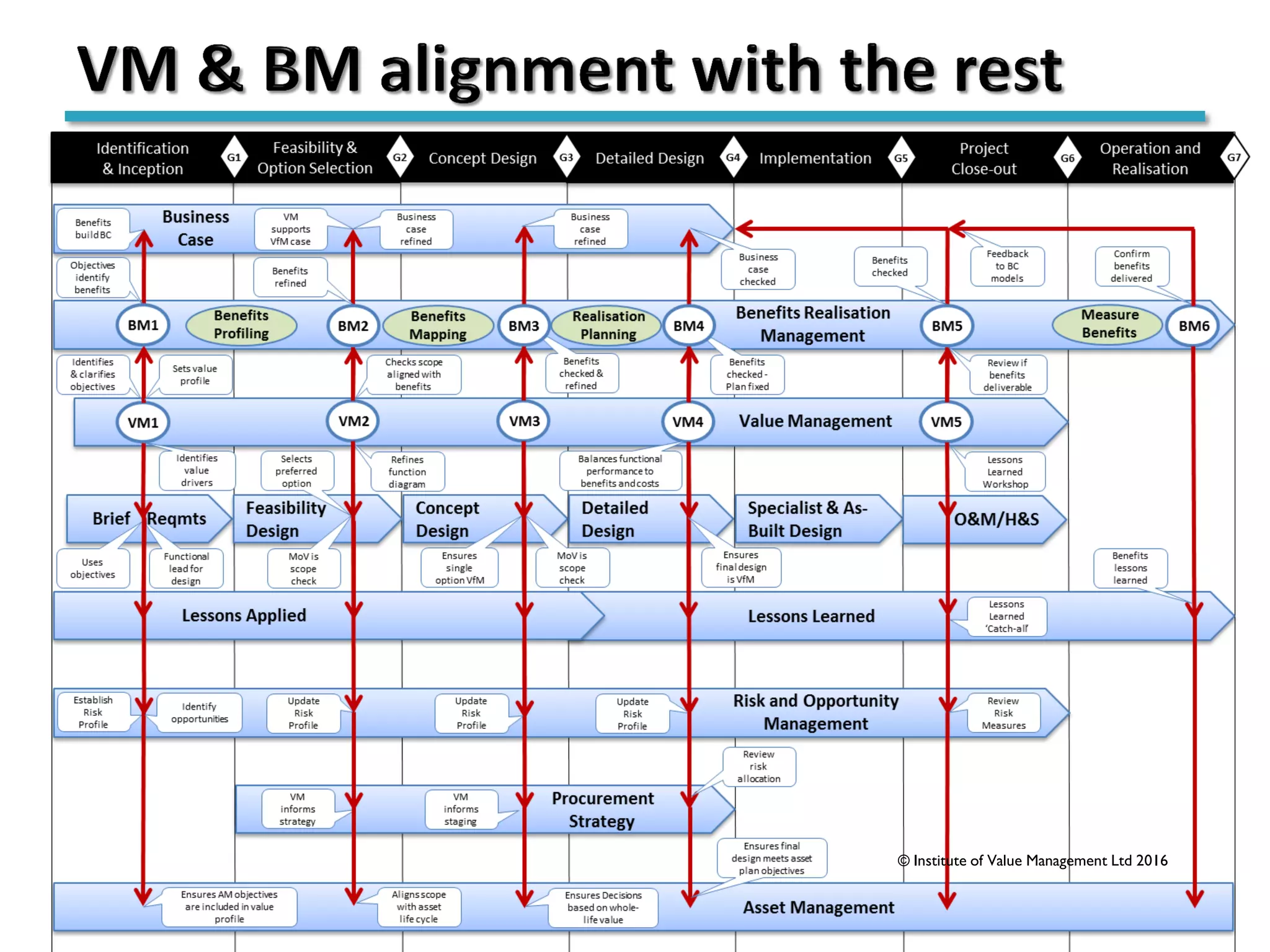
Inception Option Design Procure Deliver Close
Staged and iterative interventions
Typical project life cycle
Value Management
Benefits Management
Business Case Development = Workshop opportunity
© Institute of Value Management Ltd 2016
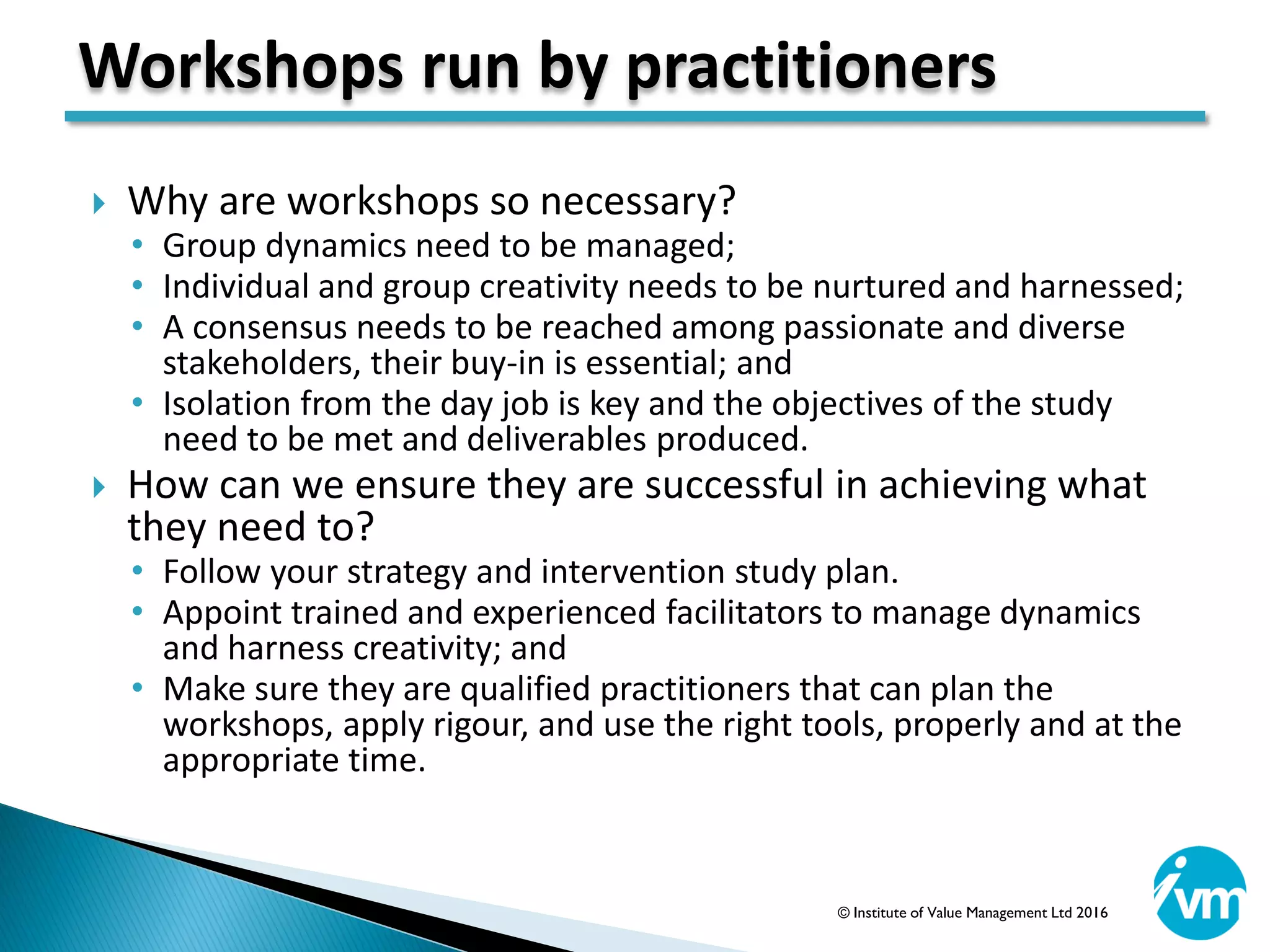
 Why are workshops so necessary?
• Group dynamics need to be managed;
• Individual and group creativity needs to be nurtured and harnessed;
• A consensus needs to be reached among passionate and diverse
stakeholders, their buy-in is essential; and
• Isolation from the day job is key and the objectives of the study
need to be met and deliverables produced.
 How can we ensure they are successful in achieving what
they need to?
• Follow your strategy and intervention study plan.
• Appoint trained and experienced facilitators to manage dynamics
and harness creativity; and
• Make sure they are qualified practitioners that can plan the
workshops, apply rigour, and use the right tools, properly and at the
appropriate time.
Workshops run by practitioners
© Institute of Value Management Ltd 2016
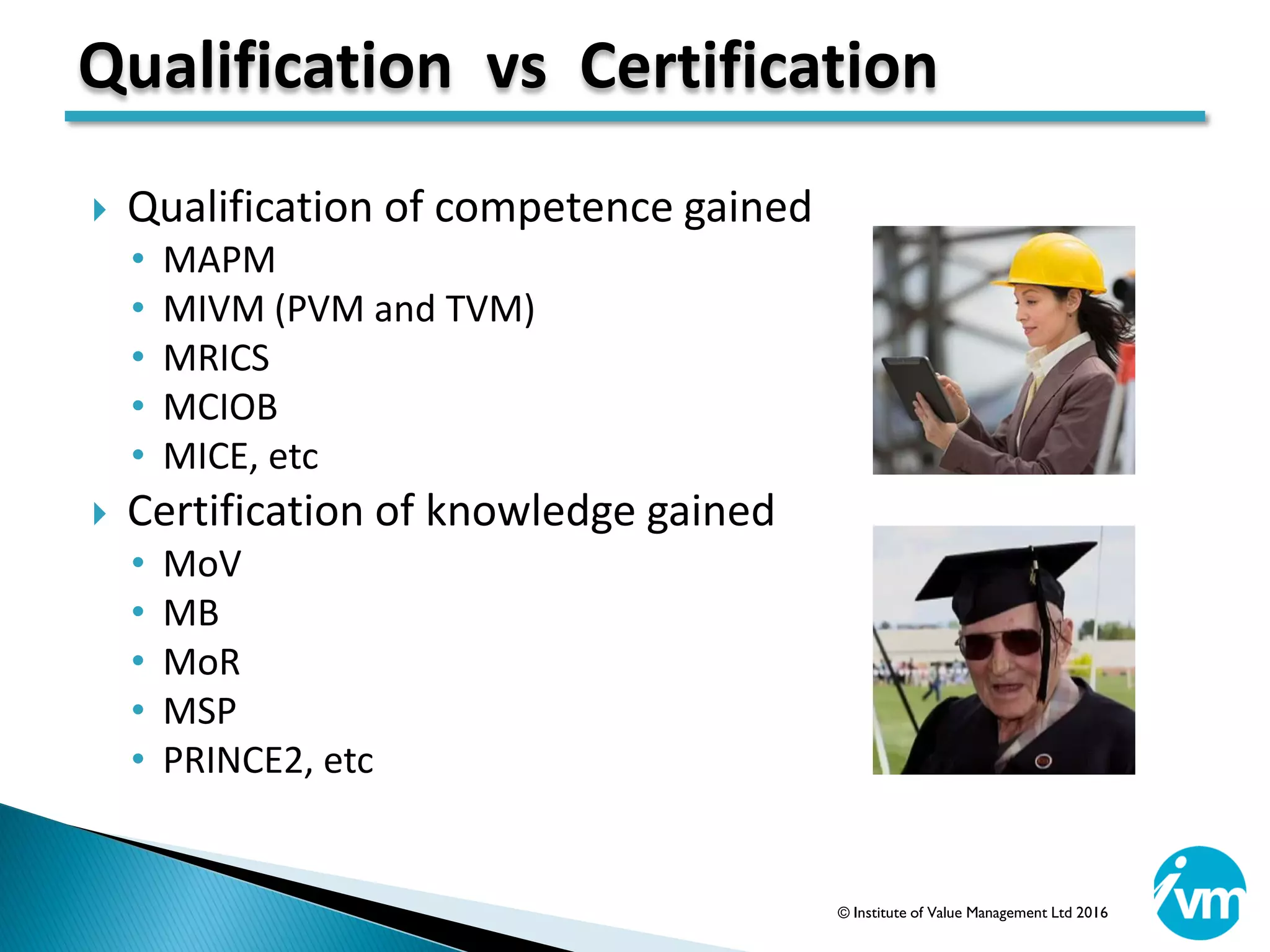
 Qualification of competence gained
• MAPM
• MIVM (PVM and TVM)
• MRICS
• MCIOB
• MICE, etc
 Certification of knowledge gained
• MoV
• MB
• MoR
• MSP
• PRINCE2, etc
Qualification vs Certification
© Institute of Value Management Ltd 2016
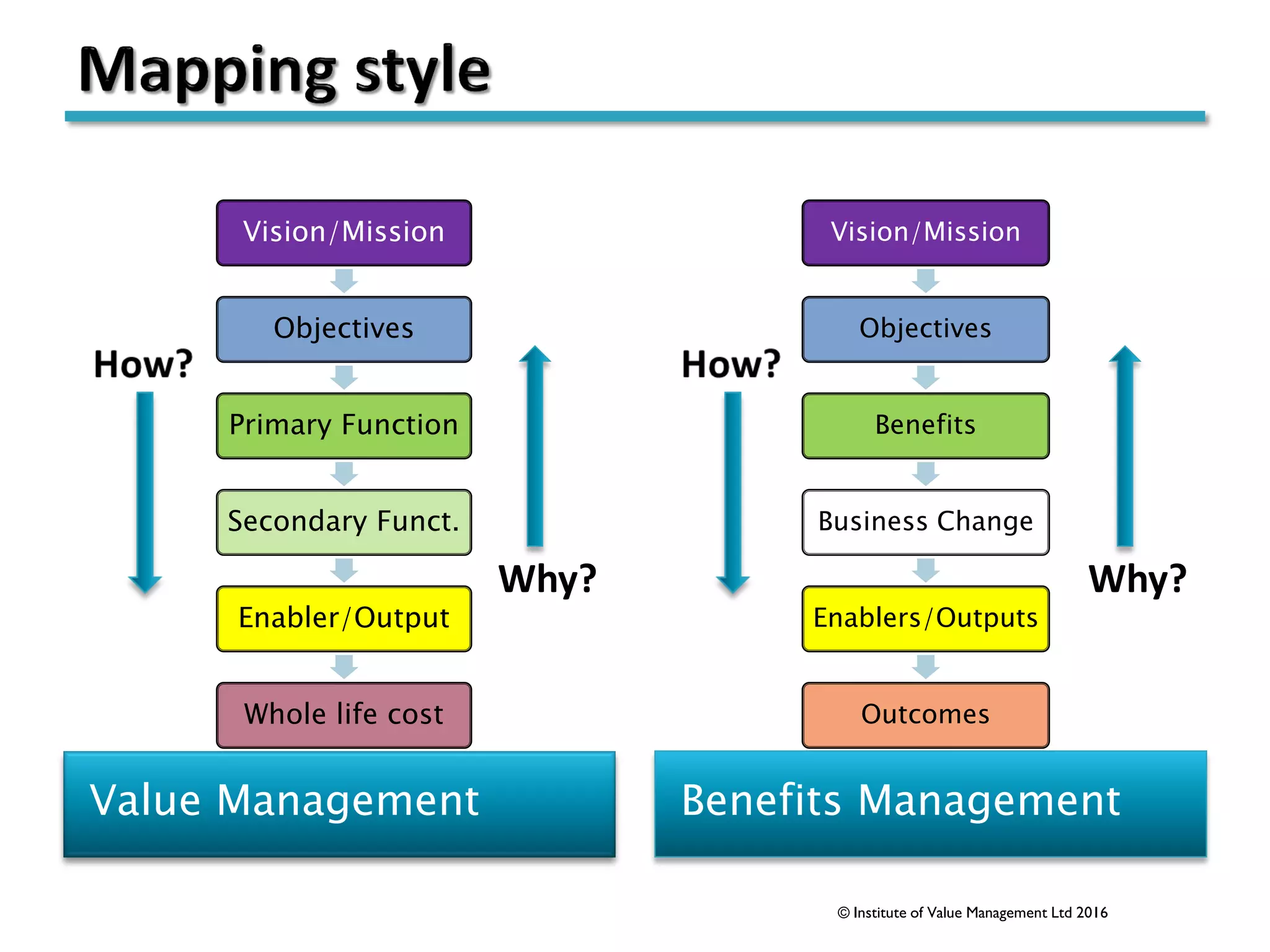
Value Management Benefits Management
Vision/Mission
Objectives
Primary Function
Secondary Funct.
Enabler/Output
Whole life cost
Vision/Mission
Objectives
Benefits
Business Change
Enablers/Outputs
Outcomes
Why? Why?
© Institute of Value Management Ltd 2016
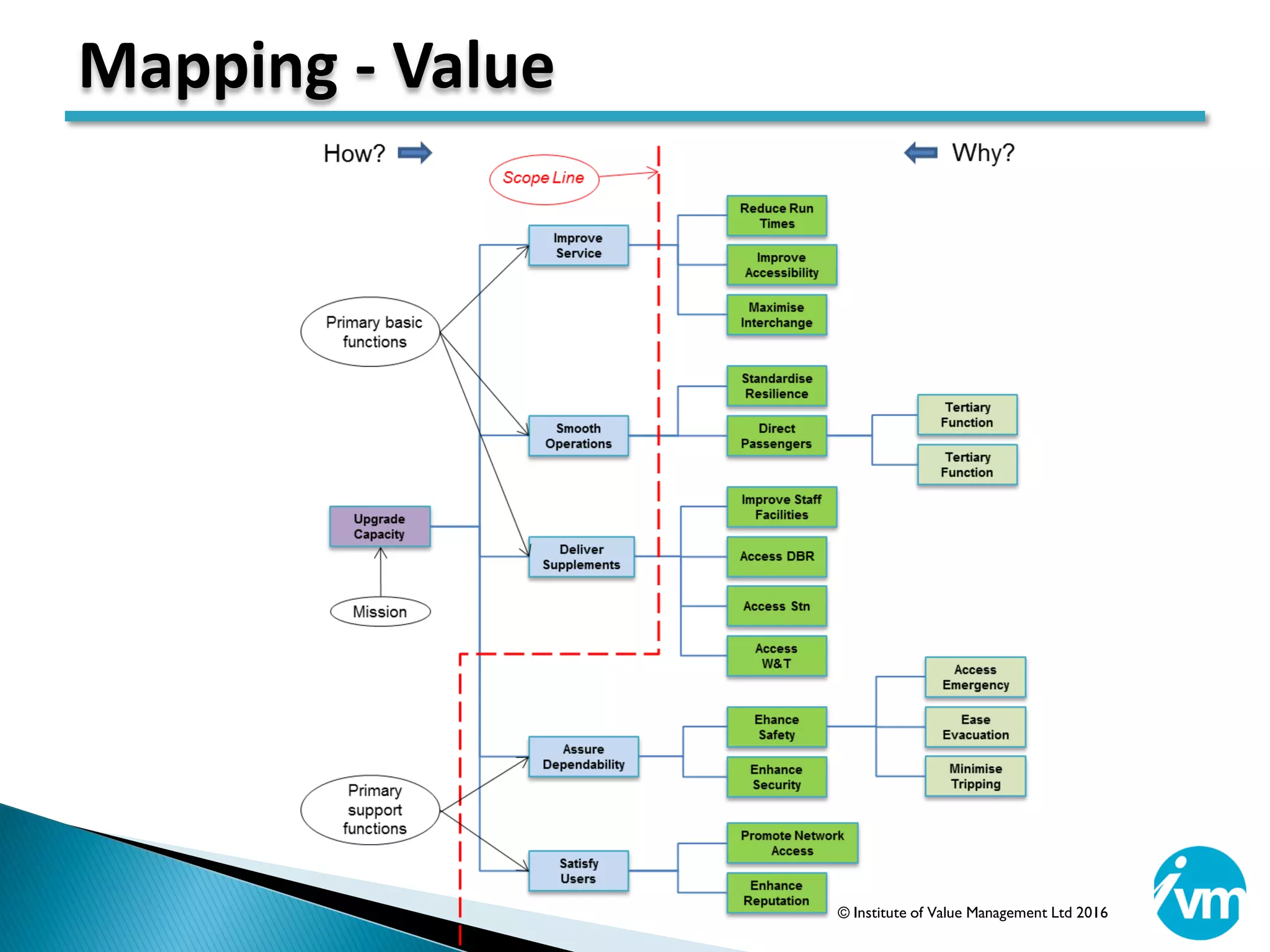
Mapping - Value
© Institute of Value Management Ltd 2016
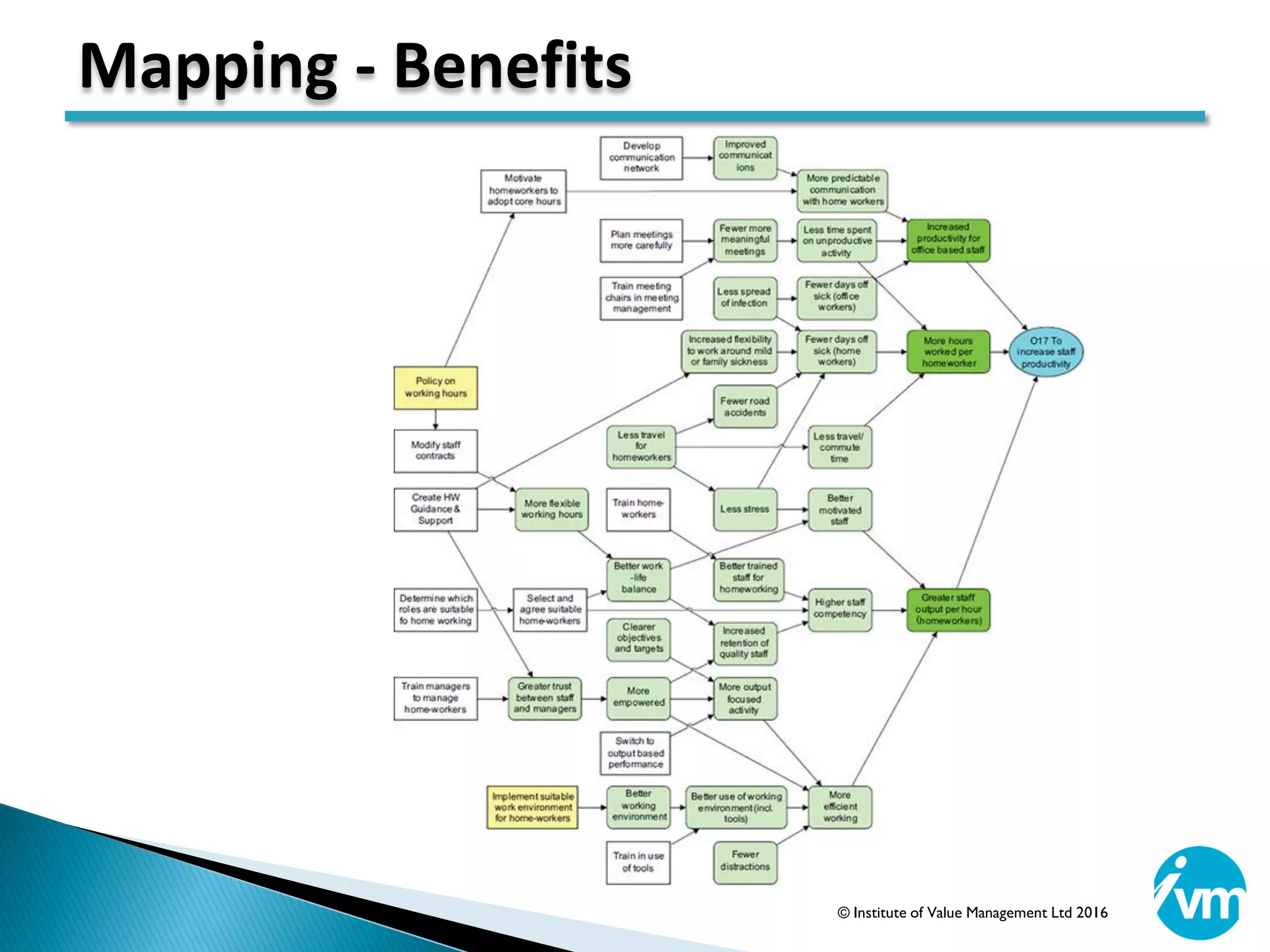
Mapping - Benefits
© Institute of Value Management Ltd 2016
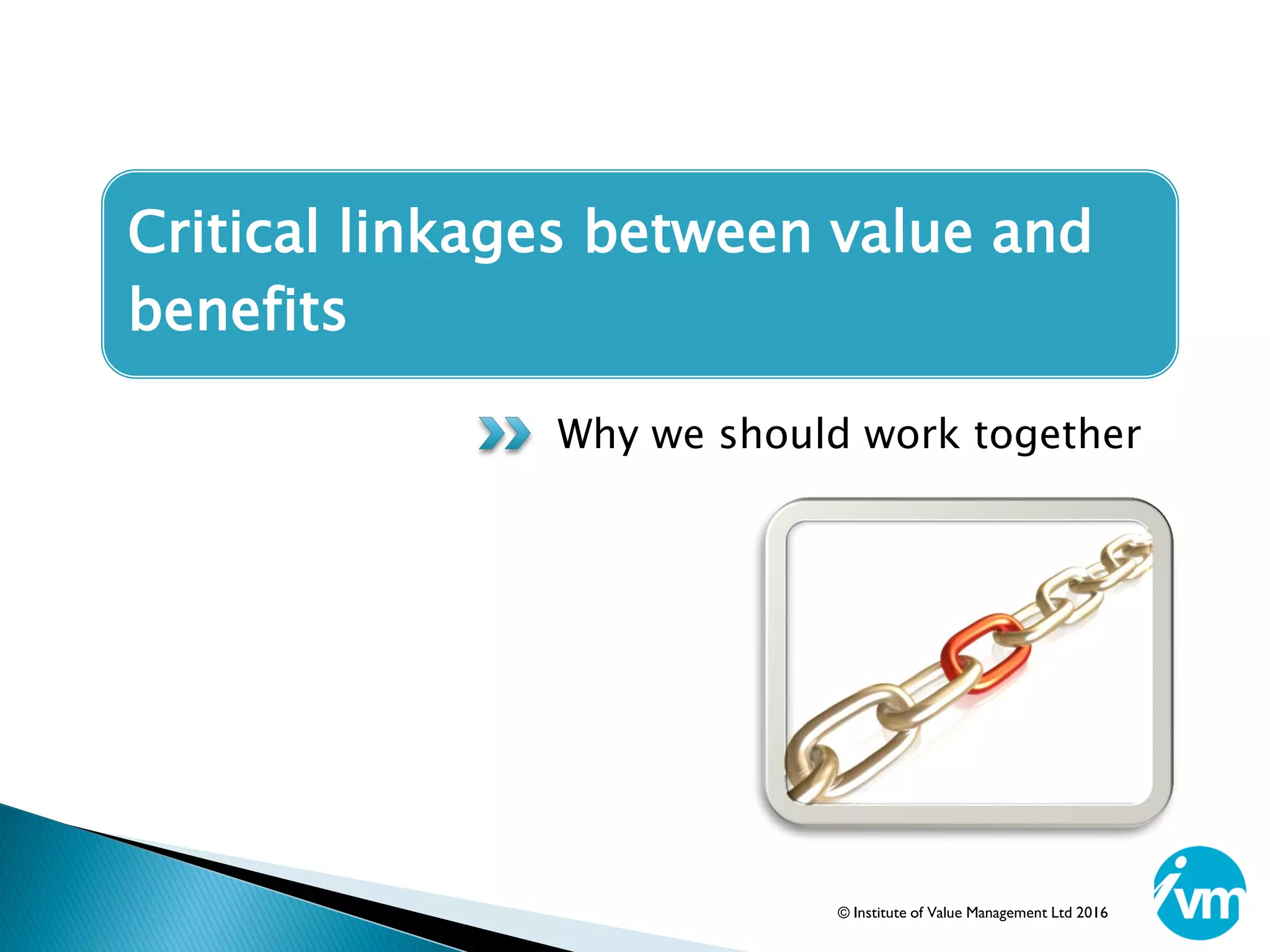
Critical linkages between value and
benefits
Why we should work together
© Institute of Value Management Ltd 2016
 The evidence of alignment is clear:
• The processes and methodologies are similar
• The times for action coincide
• The skills required are similar
• Both transcend PPM – initiation, investment management, business
case, asset management and operations
 Both VM and BM identify outputs (enablers)
• BM articulates the importance of the benefits through mapping and
profiling and transference into the business case
• But how do we know what the shape and size of the outputs
(enablers) and change initiatives need to be, to generate those
benefits when put into operation?
• How do we know how much it is worth spending on those outputs?
• We have to use VM to optimize the value of attaining benefits.
What are the critical links?
© Institute of Value Management Ltd 2016
 Both VM & BM provide assurance that outputs and
benefits are appropriate:
• Used iteratively and at stages they ‘sharpen the saw’
• The ‘line of sight’ they provide gives confidence in this
 ‘Appropriate’ or optimised means they:
• Satisfy the needs and wants of the organisation
• Align with strategy
• Contribute to building robust business cases
• Represent value for money!
More critical links
© Institute of Value Management Ltd 2016
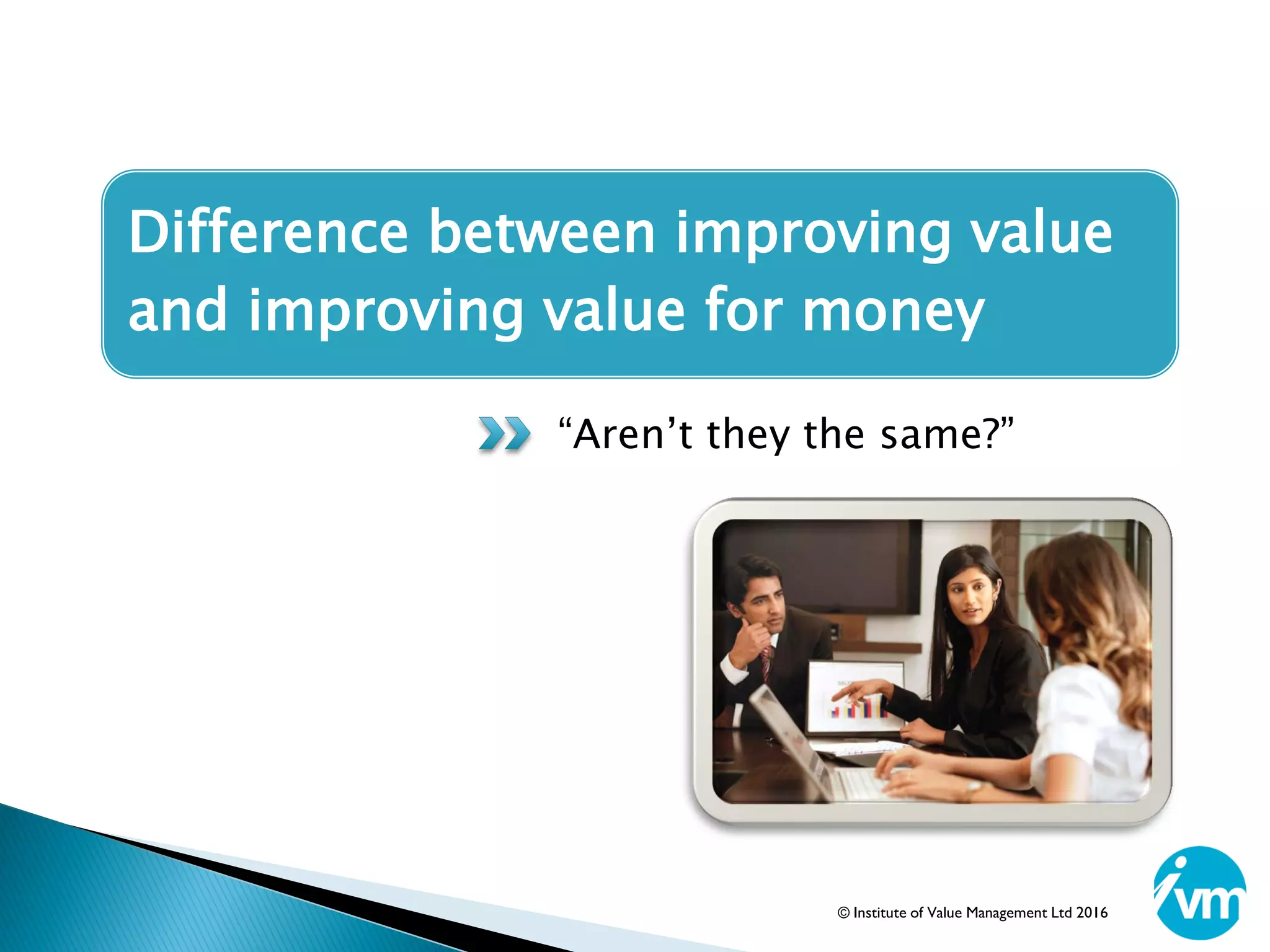
Difference between improving value
and improving value for money
“Aren’t they the same?”
© Institute of Value Management Ltd 2016
 The overwhelming case for BM is that it gives assurance
that the originally planned benefits are going to be attained
and have been attained. This is considerably “better value”
than not attaining them fully or properly, but it is not
necessarily best “value for money” at all.
 The overwhelming case for VM is that you only achieve
“value for money” if you first consider how important
something is, before you decide how much it is worth
spending on it, relative to its importance. This means that
you need optimum benefits for least cost where
affordability is an issue – which it always is these days it
seems.
The difference
© Institute of Value Management Ltd 2016
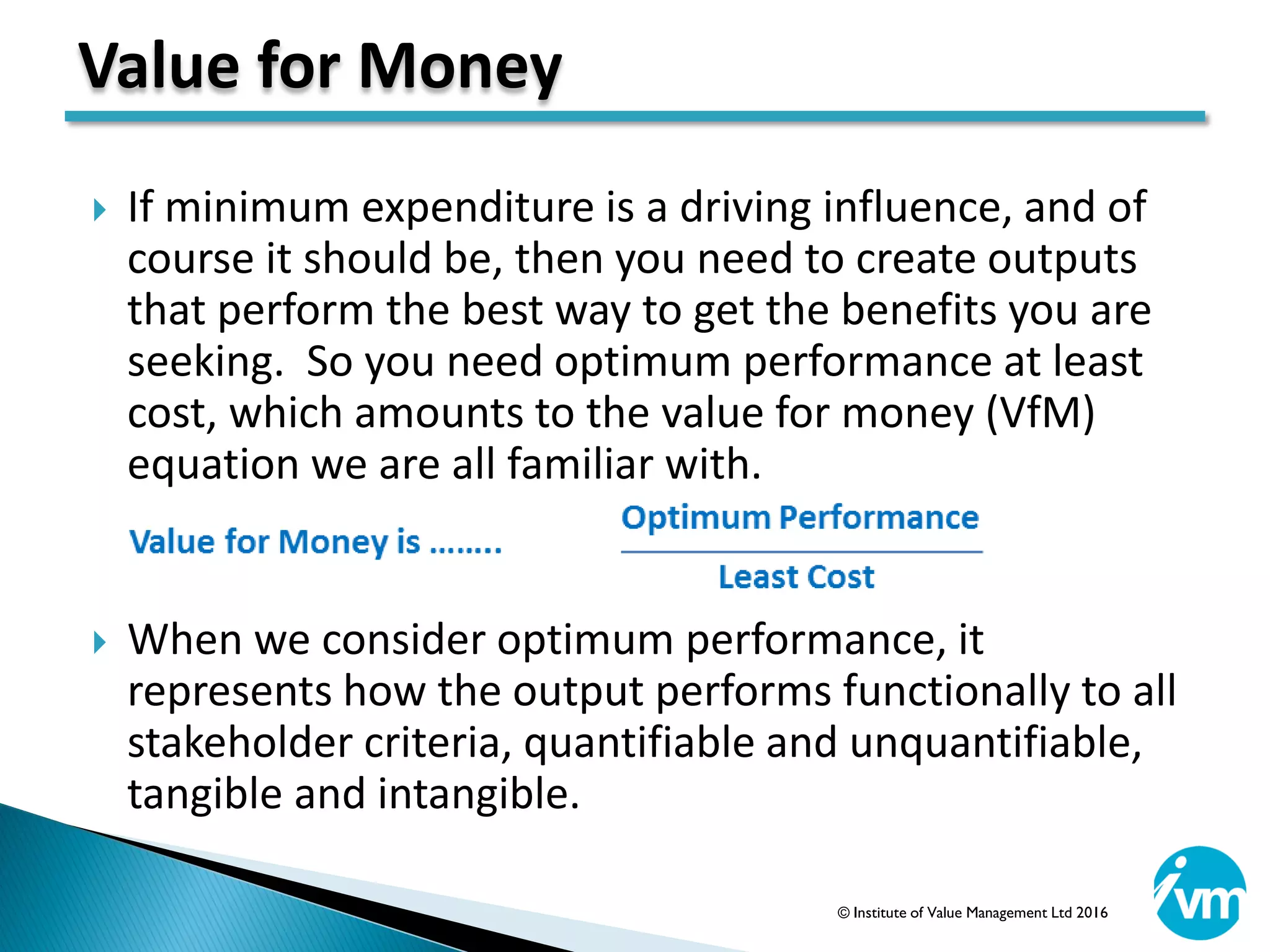
 If minimum expenditure is a driving influence, and of
course it should be, then you need to create outputs
that perform the best way to get the benefits you are
seeking. So you need optimum performance at least
cost, which amounts to the value for money (VfM)
equation we are all familiar with.
 When we consider optimum performance, it
represents how the output performs functionally to all
stakeholder criteria, quantifiable and unquantifiable,
tangible and intangible.
Value for Money
© Institute of Value Management Ltd 2016
 How outputs perform functionally is a key driver and
determines how well they enable the attainment of
benefits and to what quality level.
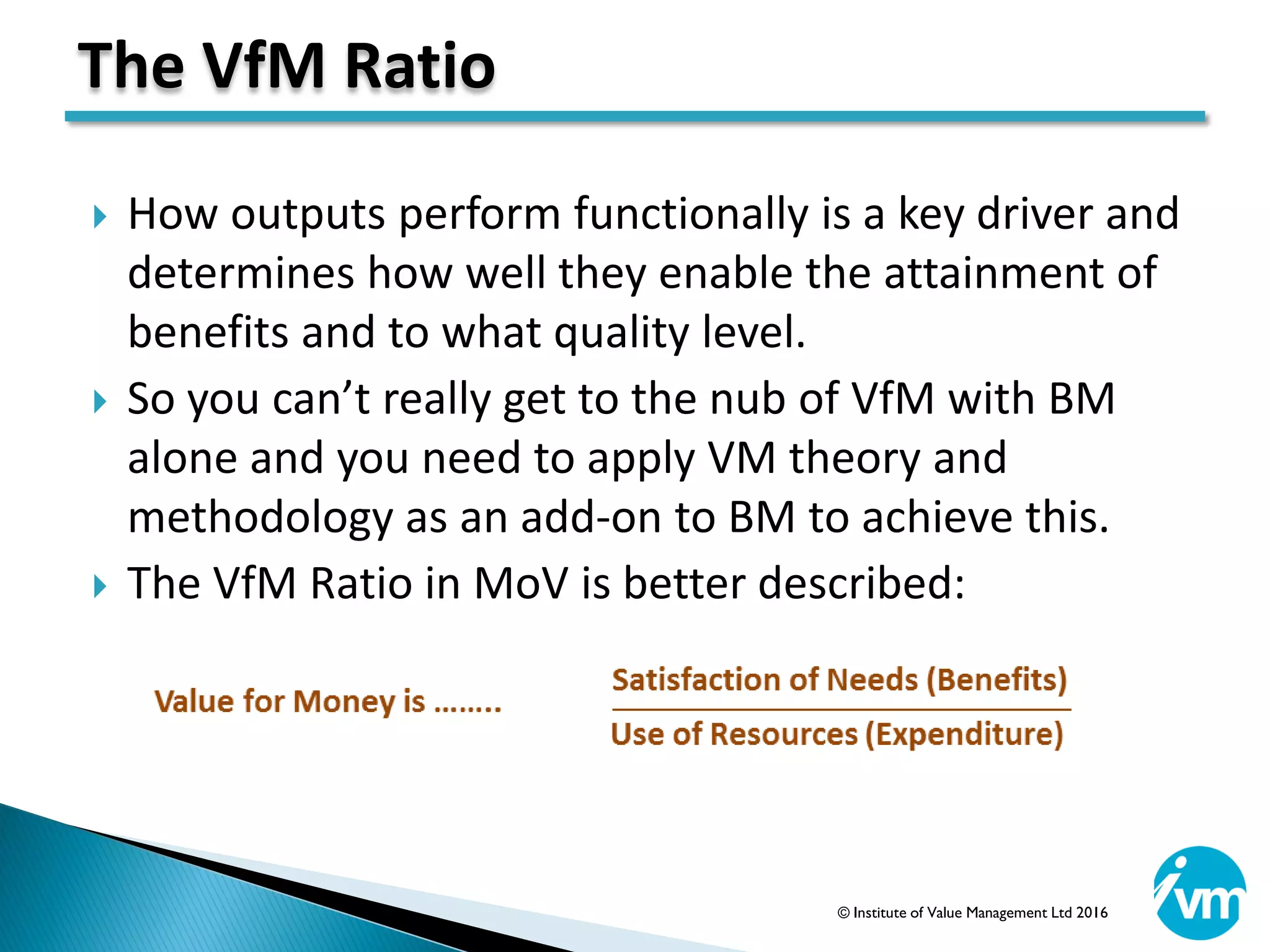
 So you can’t really get to the nub of VfM with BM
alone and you need to apply VM theory and
methodology as an add-on to BM to achieve this.
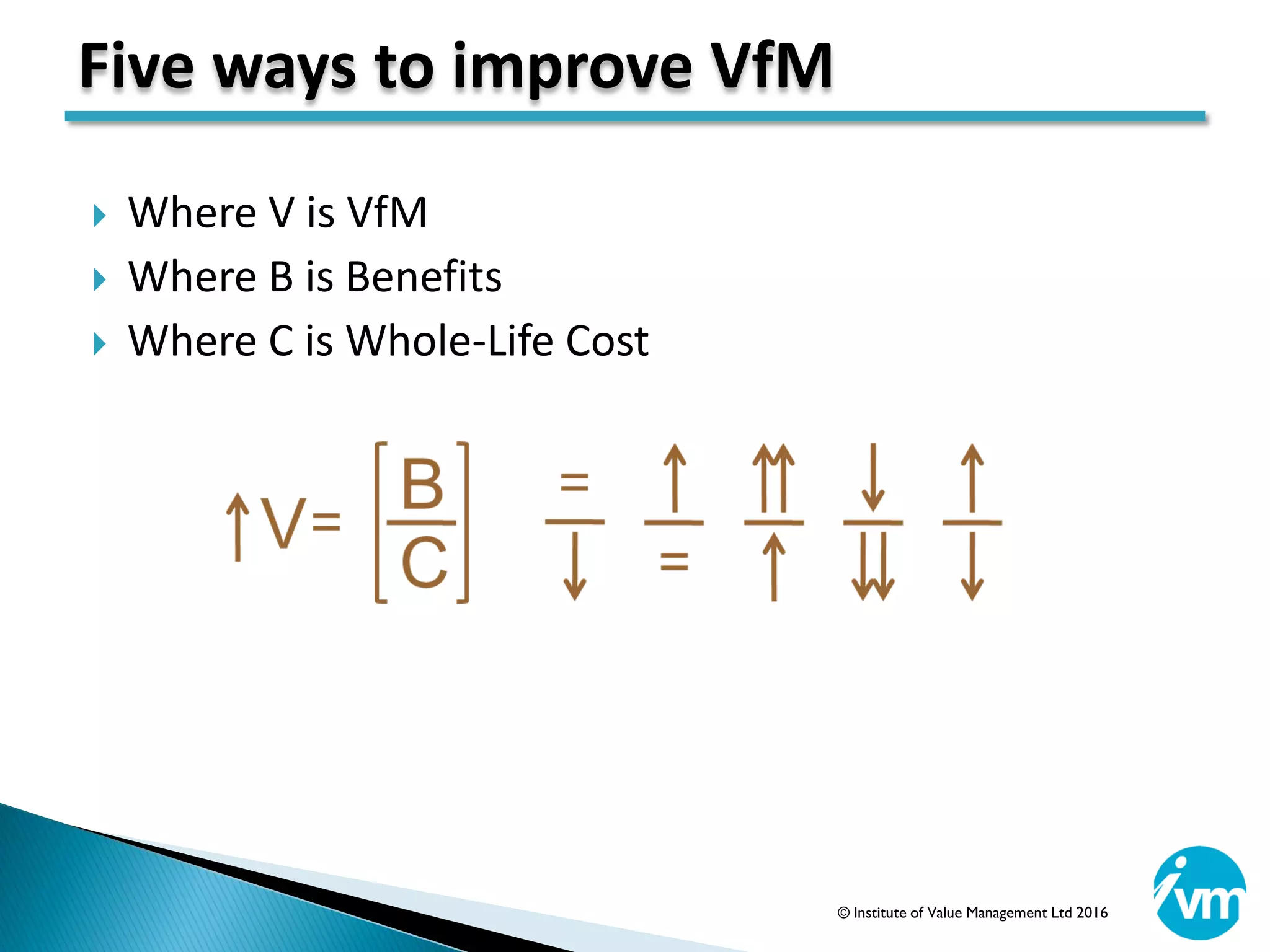
 The VfM Ratio in MoV is better described:
The VfM Ratio
© Institute of Value Management Ltd 2016
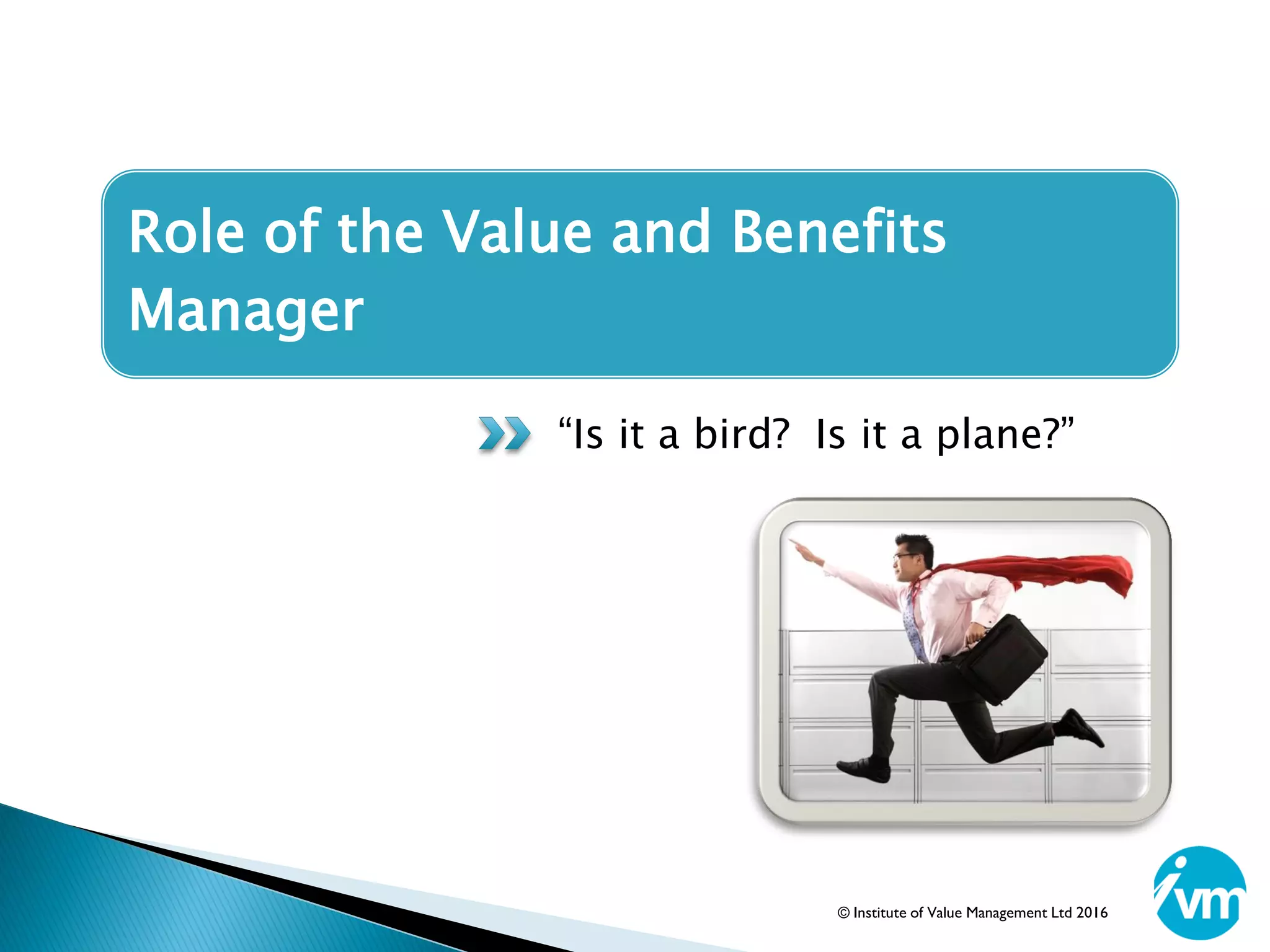
Role of the Value and Benefits
Manager
“Is it a bird? Is it a plane?”
© Institute of Value Management Ltd 2016
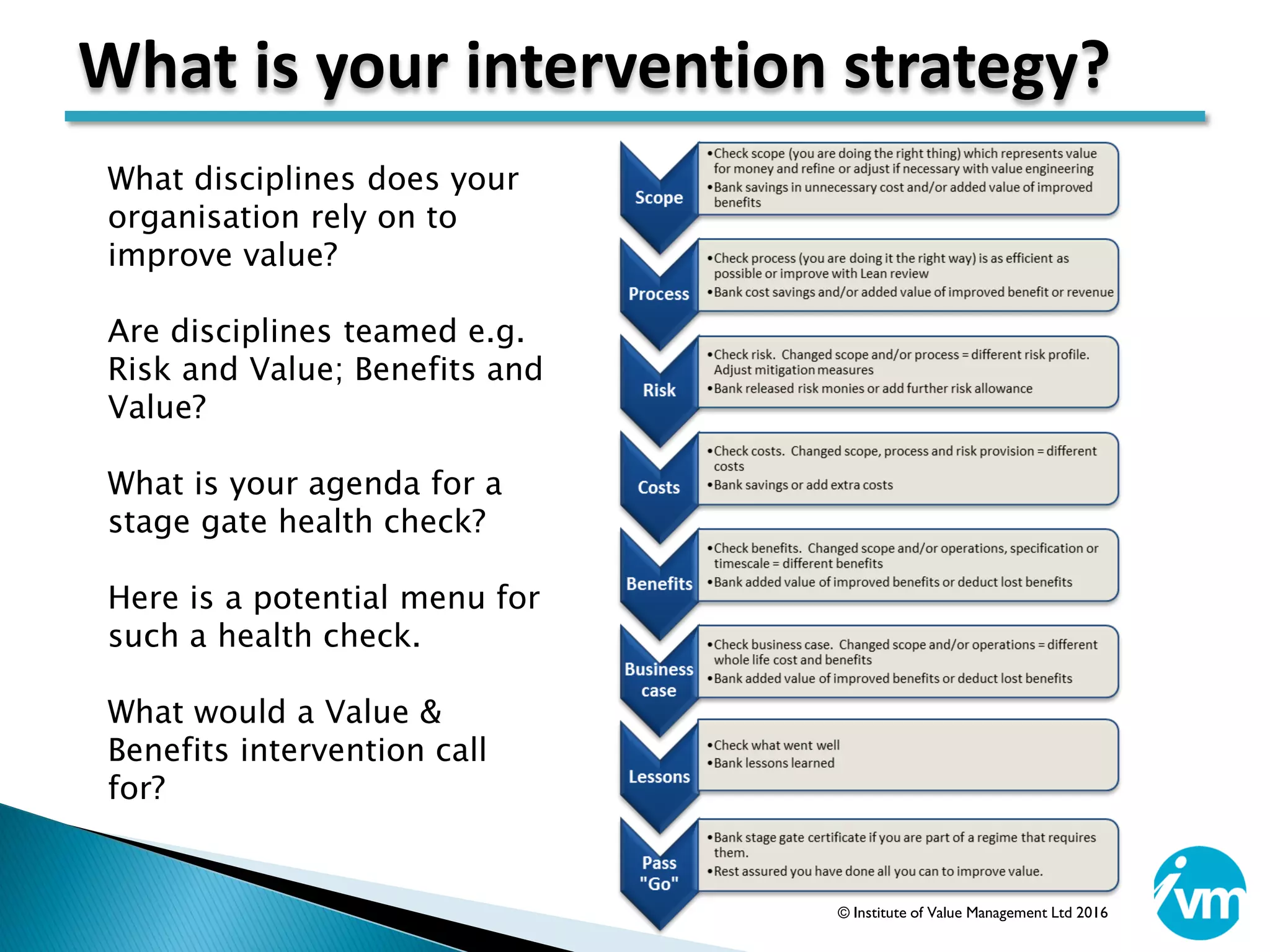
What is your intervention strategy?
What disciplines does your
organisation rely on to
improve value?
Are disciplines teamed e.g.
Risk and Value; Benefits and
Value?
What is your agenda for a
stage gate health check?
Here is a potential menu for
such a health check.
What would a Value &
Benefits intervention call
for?
© Institute of Value Management Ltd 2016
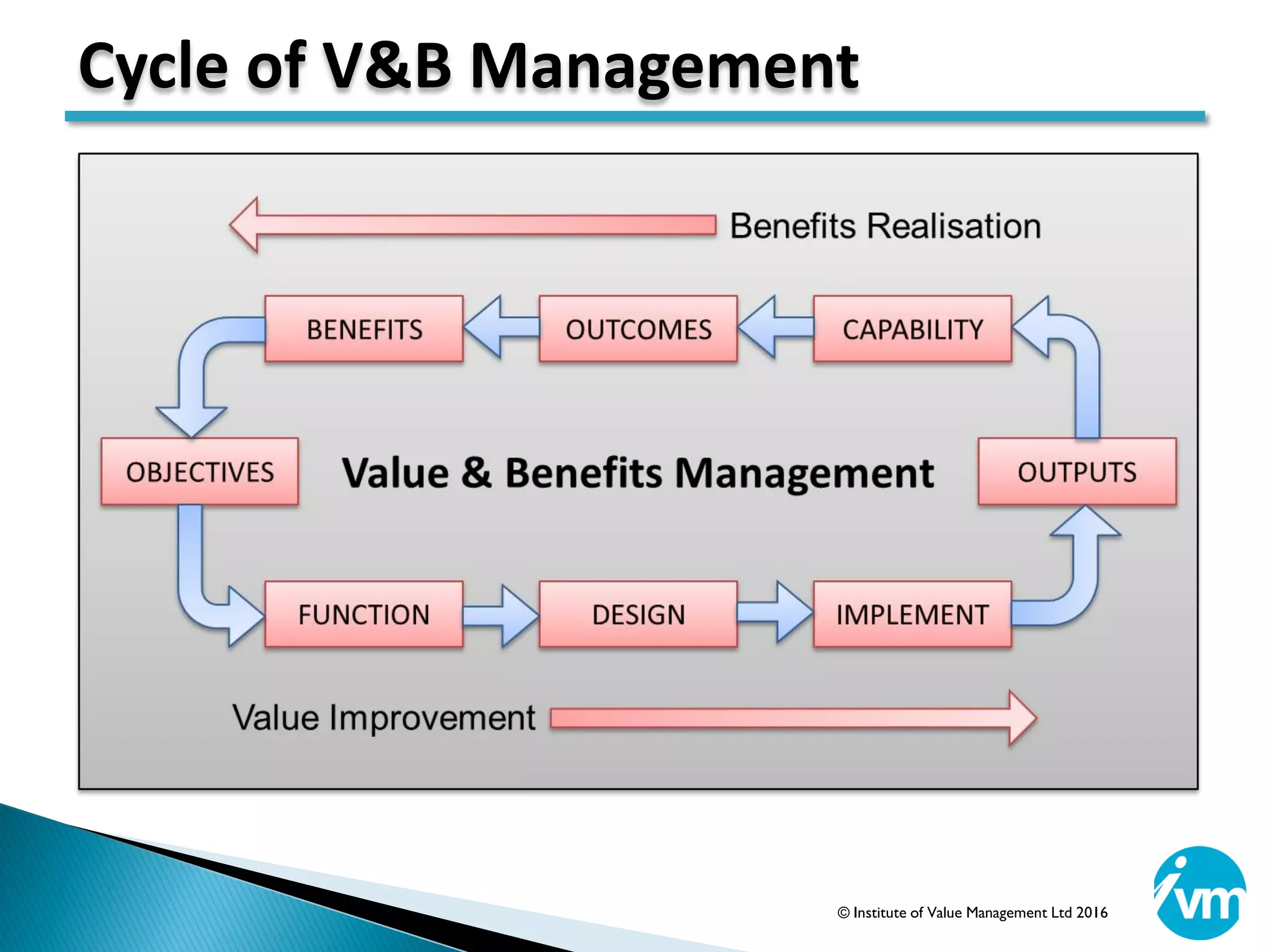
Cycle of V&B Management
© Institute of Value Management Ltd 2016
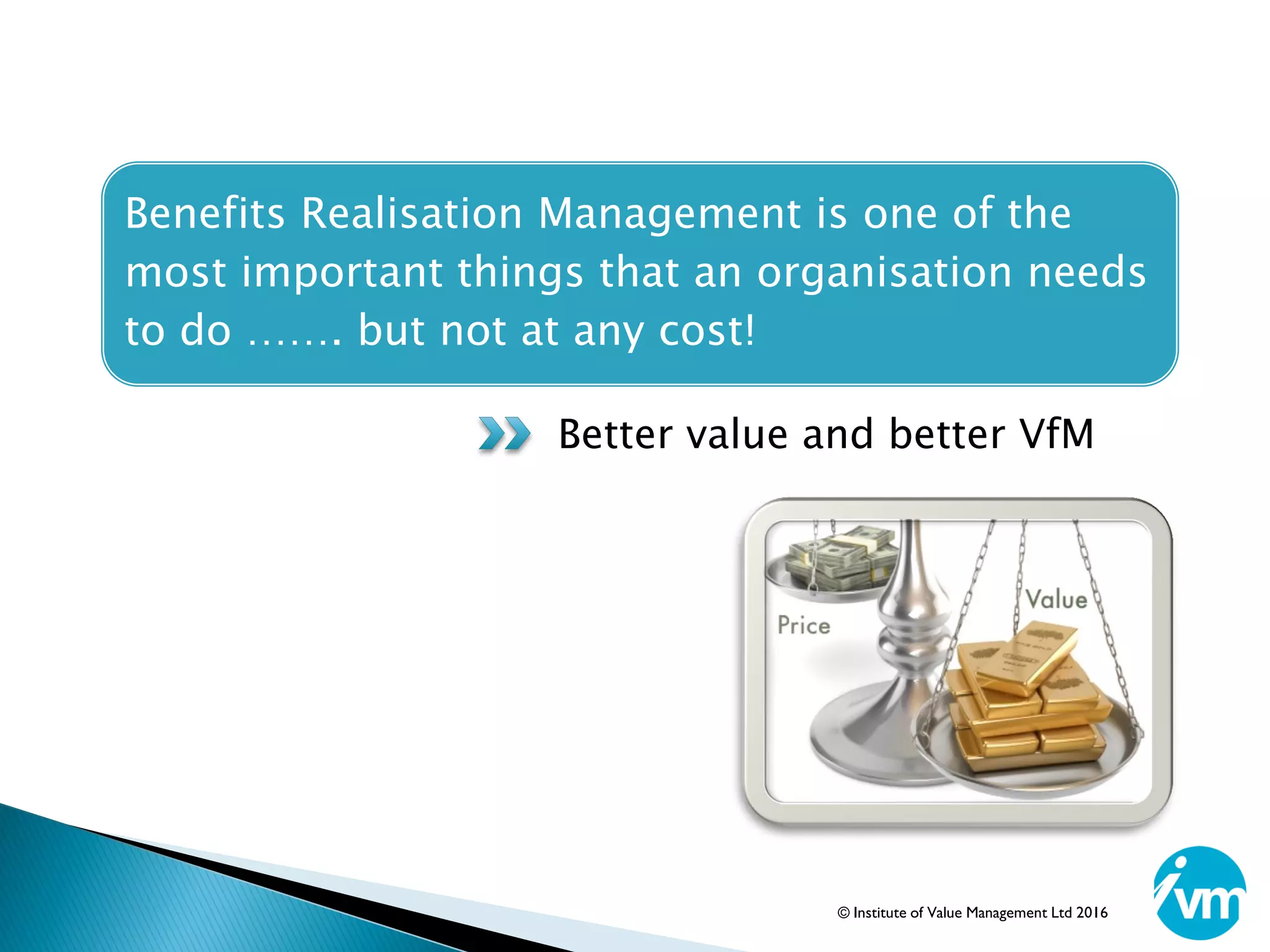
Benefits Realisation Management is one of the
most important things that an organisation needs
to do ……. but not at any cost!
Better value and better VfM
© Institute of Value Management Ltd 2016
 There is a convincing argument to integrate the VM &
BM disciplines over the project or business change life
cycle, over the asset life cycle, or wider for
organisation development and business as usual,
whichever is the breadth of focus.
 The objectives and principles of each approach need to
be carefully maintained, but they should fully interact
so that benefits can be realised that truly represent
value for money, not just improved value.
The case for V&B
© Institute of Value Management Ltd 2016
 Where V is VfM
 Where B is Benefits
 Where C is Whole-Life Cost
Five ways to improve VfM
© Institute of Value Management Ltd 2016
The future of Value Management
Might this include more BM?
© Institute of Value Management Ltd 2016
Questions and Answers
Are VM & BM closely linked?
steve@ivm.org,uk
www.ivm.org.uk
© Institute of Value Management Ltd 2016

Benefits realisation management is one of the most important things than an organisation needs to do... but not at any cost, by Steve Parker, 28th June 2016

  • 1.
    Steve Parker MSc,MRICS, MAPM, PVM, Chair of the IVM Committee Member APM Benefits SIG and Value SIG
  • 2.
     Alignment betweenVM and BM processes and method of application  Critical linkages between value and benefits  Difference between improving value and improving value for money  Role of the Value and Benefits Manager  Benefits Realisation Management is one of the most important things that an organisation needs to do ……. but not at any cost!  Questions and Answers Content © Institute of Value Management Ltd 2016
  • 3.
    Alignment between VMand BM processes and method of application “You mean they both do that?” © Institute of Value Management Ltd 2016
  • 4.
     Value Management(and MoV) • A systematic method to define what value means for organisations and to communicate it clearly to across portfolios, programmes, projects and operations … (MoV)  Benefits Management (and BRM) • The identification, definition, tracking, realisation and , usually within a programme which can incorporate benefits identified via and MoV study … (Managing Benefits and MoV)  Business Case • The justification for an organisational activity (strategic, programme, project, operational) which typically contains , risks and timescales and against which … (Managing Benefits and MoV) Definitions © Institute of Value Management Ltd 2016
  • 5.
     Both Valueand Benefits Management: • rely on application of underlying rigour for success; • are best applied iteratively, through stages of a lifecycle; • are used to provide assurance that outputs and benefits are appropriate; • lend themselves to use of workshops; • need trained facilitators to harness creativity and manage dynamics; • need qualified practitioners to apply rigour, use the right tools, properly and at the appropriate time; • need stakeholder consensus to have the proper effect; • use mapping to show useful ‘lines of sight’; • start with vision and objectives – i.e. from the ‘get-go’; • identify and justify outputs; and • improve value and used together, improve VfM. What do they have in common? © Institute of Value Management Ltd 2016
  • 6.
    Value Management BenefitsManagement Vision and objectives •Value Tree and VM Strategy Clarify needs and wants •Value Profile / Function Map Alignment to objectives •Value Index Assess value for money •VfM Ratio Iteratively improve vfm •Value Engineering Vision and Objectives •BM Strategy and HL Benefits Identify and map benefits •Benefits Map and Profiles Plan benefits realisation •Benefits Realisation Plan Review and evaluate •Track output changes Optimise benefits •Search and test © Institute of Value Management Ltd 2016
  • 7.
    Strategic Case Outline Business Case Full Business Case Business CaseReview Scope /Value Definition MCA for VfM Value Engineering Value Incentives Lessons Learned BM Strategy Mapping and Profiling Baselines and Measures Plan Benefits Realisation Benefits Review Benefits Realisation Inception Option Design Procure Deliver Close Staged and iterative interventions Typical project life cycle Value Management Benefits Management Business Case Development = Workshop opportunity © Institute of Value Management Ltd 2016
  • 8.
     Why areworkshops so necessary? • Group dynamics need to be managed; • Individual and group creativity needs to be nurtured and harnessed; • A consensus needs to be reached among passionate and diverse stakeholders, their buy-in is essential; and • Isolation from the day job is key and the objectives of the study need to be met and deliverables produced.  How can we ensure they are successful in achieving what they need to? • Follow your strategy and intervention study plan. • Appoint trained and experienced facilitators to manage dynamics and harness creativity; and • Make sure they are qualified practitioners that can plan the workshops, apply rigour, and use the right tools, properly and at the appropriate time. Workshops run by practitioners © Institute of Value Management Ltd 2016
  • 9.
     Qualification ofcompetence gained • MAPM • MIVM (PVM and TVM) • MRICS • MCIOB • MICE, etc  Certification of knowledge gained • MoV • MB • MoR • MSP • PRINCE2, etc Qualification vs Certification © Institute of Value Management Ltd 2016
  • 10.
    Value Management BenefitsManagement Vision/Mission Objectives Primary Function Secondary Funct. Enabler/Output Whole life cost Vision/Mission Objectives Benefits Business Change Enablers/Outputs Outcomes Why? Why? © Institute of Value Management Ltd 2016
  • 11.
    Mapping - Value ©Institute of Value Management Ltd 2016
  • 12.
    Mapping - Benefits ©Institute of Value Management Ltd 2016
  • 13.
    Critical linkages betweenvalue and benefits Why we should work together © Institute of Value Management Ltd 2016
  • 14.
     The evidenceof alignment is clear: • The processes and methodologies are similar • The times for action coincide • The skills required are similar • Both transcend PPM – initiation, investment management, business case, asset management and operations  Both VM and BM identify outputs (enablers) • BM articulates the importance of the benefits through mapping and profiling and transference into the business case • But how do we know what the shape and size of the outputs (enablers) and change initiatives need to be, to generate those benefits when put into operation? • How do we know how much it is worth spending on those outputs? • We have to use VM to optimize the value of attaining benefits. What are the critical links? © Institute of Value Management Ltd 2016
  • 15.
     Both VM& BM provide assurance that outputs and benefits are appropriate: • Used iteratively and at stages they ‘sharpen the saw’ • The ‘line of sight’ they provide gives confidence in this  ‘Appropriate’ or optimised means they: • Satisfy the needs and wants of the organisation • Align with strategy • Contribute to building robust business cases • Represent value for money! More critical links © Institute of Value Management Ltd 2016
  • 16.
    Difference between improvingvalue and improving value for money “Aren’t they the same?” © Institute of Value Management Ltd 2016
  • 17.
     The overwhelmingcase for BM is that it gives assurance that the originally planned benefits are going to be attained and have been attained. This is considerably “better value” than not attaining them fully or properly, but it is not necessarily best “value for money” at all.  The overwhelming case for VM is that you only achieve “value for money” if you first consider how important something is, before you decide how much it is worth spending on it, relative to its importance. This means that you need optimum benefits for least cost where affordability is an issue – which it always is these days it seems. The difference © Institute of Value Management Ltd 2016
  • 18.
     If minimumexpenditure is a driving influence, and of course it should be, then you need to create outputs that perform the best way to get the benefits you are seeking. So you need optimum performance at least cost, which amounts to the value for money (VfM) equation we are all familiar with.  When we consider optimum performance, it represents how the output performs functionally to all stakeholder criteria, quantifiable and unquantifiable, tangible and intangible. Value for Money © Institute of Value Management Ltd 2016
  • 19.
     How outputsperform functionally is a key driver and determines how well they enable the attainment of benefits and to what quality level.  So you can’t really get to the nub of VfM with BM alone and you need to apply VM theory and methodology as an add-on to BM to achieve this.  The VfM Ratio in MoV is better described: The VfM Ratio © Institute of Value Management Ltd 2016
  • 20.
    Role of theValue and Benefits Manager “Is it a bird? Is it a plane?” © Institute of Value Management Ltd 2016
  • 21.
    What is yourintervention strategy? What disciplines does your organisation rely on to improve value? Are disciplines teamed e.g. Risk and Value; Benefits and Value? What is your agenda for a stage gate health check? Here is a potential menu for such a health check. What would a Value & Benefits intervention call for? © Institute of Value Management Ltd 2016
  • 22.
    Cycle of V&BManagement © Institute of Value Management Ltd 2016
  • 23.
    Benefits Realisation Managementis one of the most important things that an organisation needs to do ……. but not at any cost! Better value and better VfM © Institute of Value Management Ltd 2016
  • 24.
     There isa convincing argument to integrate the VM & BM disciplines over the project or business change life cycle, over the asset life cycle, or wider for organisation development and business as usual, whichever is the breadth of focus.  The objectives and principles of each approach need to be carefully maintained, but they should fully interact so that benefits can be realised that truly represent value for money, not just improved value. The case for V&B © Institute of Value Management Ltd 2016
  • 25.
     Where Vis VfM  Where B is Benefits  Where C is Whole-Life Cost Five ways to improve VfM © Institute of Value Management Ltd 2016
  • 26.
    The future ofValue Management Might this include more BM? © Institute of Value Management Ltd 2016
  • 27.
    © Institute ofValue Management Ltd 2016
  • 28.
    © Institute ofValue Management Ltd 2016
  • 29.
    Questions and Answers AreVM & BM closely linked? steve@ivm.org,uk www.ivm.org.uk © Institute of Value Management Ltd 2016