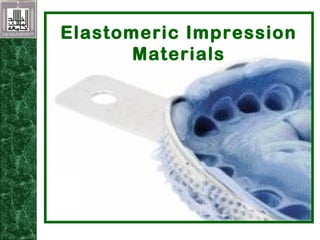
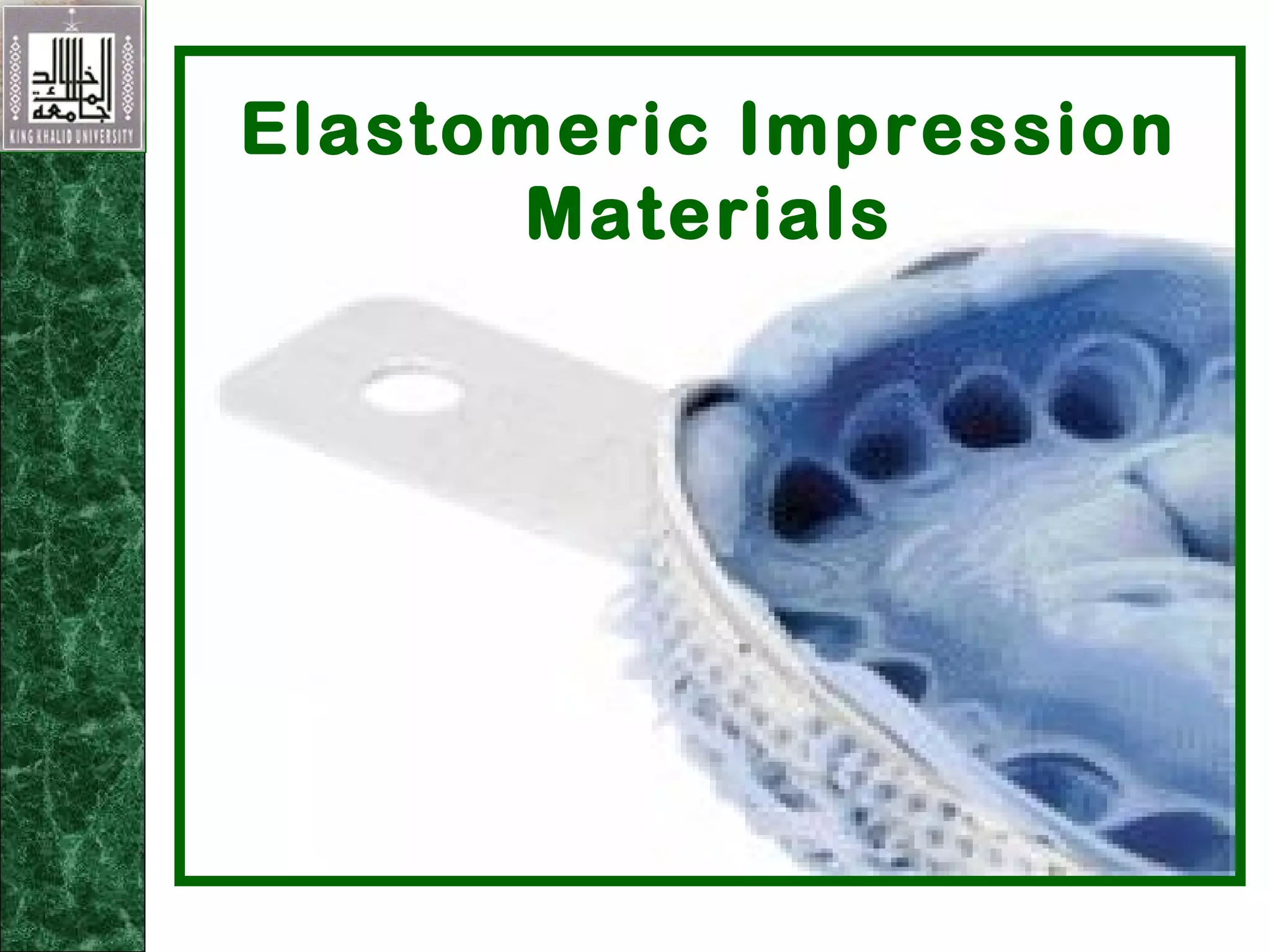
Elastomeric Impression
Materials
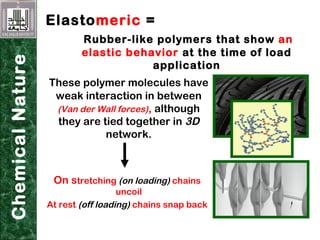
Elastomeric =
Rubber-like polymers that show an
elastic behavior at the time of load
application
These polymer molecules have
weak interaction in between
(Van der Wall forces), although
they are tied together in 3D
network.
On stretching (on loading) chains
uncoil
At rest (off loading) chains snap back
ChemicalNature
 Higher tear strength
 More stable dimensionally in
storage
(No Synersis, Imbibation or Evaporation)
 Ability to be electroplated
But, Quite Expensive !!!!But, Quite Expensive !!!!
Incomparisonto
hydrocolloids
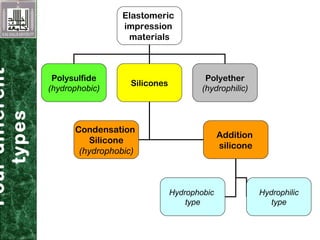
Elastomeric
impression
materials
Polysulfide
(hydrophobic)
Silicones
Polyether
(hydrophilic)
Condensation
Silicone
(hydrophobic)
Addition
silicone
Hydrophobic
type
Hydrophilic
type
Fourdifferent
types
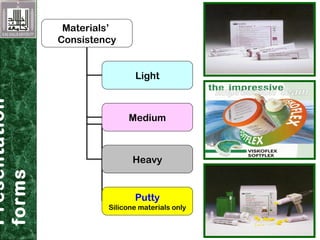
Presentation
forms Materials’
Consistency
Light
Medium
Heavy
Putty
Silicone materials only
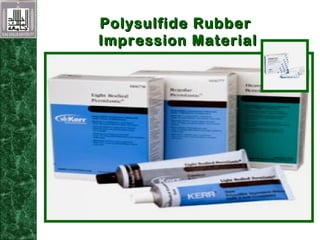
Polysulfide RubberPolysulfide Rubber
Impression MaterialImpression Material
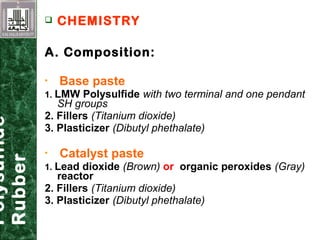
 CHEMISTRY
A. Composition:
 Base paste
1. LMW Polysulfide with two terminal and one pendant
SH groups
2. Fillers (Titanium dioxide)
3. Plasticizer (Dibutyl phethalate)
 Catalyst paste
1. Lead dioxide (Brown) or organic peroxides (Gray)
reactor
2. Fillers (Titanium dioxide)
3. Plasticizer (Dibutyl phethalate)
Polysulfide
Rubber
Polysulfide
Rubber
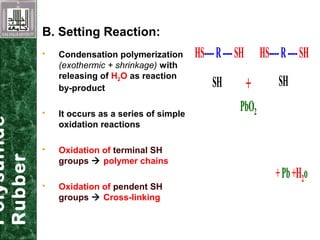
B. Setting Reaction:
+Pb+H2o
HS----R----SH HS----R----SH
SH SH+
PbO2
+Pb+H2o
HS----R----SH HS----R----SH
SH SH+
PbO2
HS----R----SH HS----R----SH
SH SH+
PbO2
 Condensation polymerization
(exothermic + shrinkage) with
releasing of H2O as reaction
by-product
 It occurs as a series of simple
oxidation reactions
 Oxidation of terminal SH
groups  polymer chains
 Oxidation of pendent SH
groups  Cross-linking
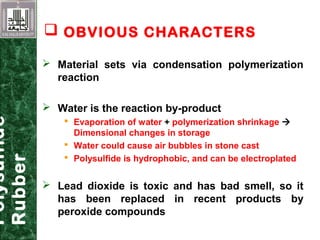
 Material sets via condensation polymerization
reaction
 Water is the reaction by-product
 Evaporation of water + polymerization shrinkage 
Dimensional changes in storage
 Water could cause air bubbles in stone cast
 Polysulfide is hydrophobic, and can be electroplated
 Lead dioxide is toxic and has bad smell, so it
has been replaced in recent products by
peroxide compounds
Polysulfide
Rubber
 OBVIOUS CHARACTERS
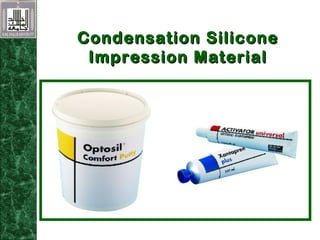
Condensation SiliconeCondensation Silicone
Impression MaterialImpression Material
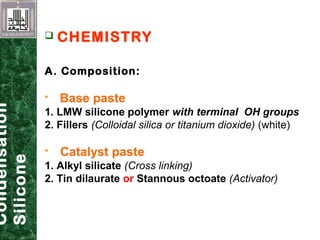
 CHEMISTRY
A. Composition:
 Base paste
1. LMW silicone polymer with terminal OH groups
2. Fillers (Colloidal silica or titanium dioxide) (white)
 Catalyst paste
1. Alkyl silicate (Cross linking)
2. Tin dilaurate or Stannous octoate (Activator)
Condensation
Silicone
HO Si - O - Si OH +
CH3
CH3 CH3
CH3
Si
C2H5OC2H5O
C2H5O C2H5O
C2H5OH+
HMW Silicon Polymer Ethyl Alcohol
Dimethyl Siloxane Alkyl Silicate
Stanous
Octoate
HO Si - O - Si OH +
CH3
CH3 CH3
CH3
Si
C2H5OC2H5O
C2H5O C2H5O
C2H5OH+
HMW Silicon Polymer Ethyl Alcohol
Dimethyl Siloxane Alkyl Silicate
Stanous
Octoate
HO Si - O - Si OH +
CH3
CH3 CH3
CH3
HO Si - O - Si OH +
CH3
CH3 CH3
CH3
Si
C2H5OC2H5O
C2H5O C2H5O
Si
C2H5OC2H5O
C2H5O C2H5O
C2H5OH+
HMW Silicon Polymer Ethyl Alcohol
Dimethyl Siloxane Alkyl Silicate
Stanous
Octoate
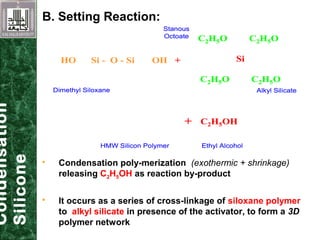
B. Setting Reaction:
 Condensation poly-merization (exothermic + shrinkage)
releasing C2H5OH as reaction by-product
 It occurs as a series of cross-linkage of siloxane polymer
to alkyl silicate in presence of the activator, to form a 3D
polymer network
Condensation
Silicone
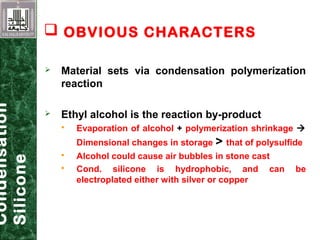
 Material sets via condensation polymerization
reaction
 Ethyl alcohol is the reaction by-product
 Evaporation of alcohol + polymerization shrinkage 
Dimensional changes in storage > that of polysulfide
 Alcohol could cause air bubbles in stone cast
 Cond. silicone is hydrophobic, and can be
electroplated either with silver or copper
Condensation
Silicone
 OBVIOUS CHARACTERS
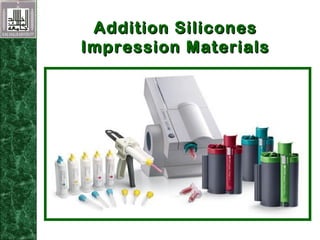
Addition SiliconesAddition Silicones
Impression MaterialsImpression Materials
AdditionSilicones  CHEMISTRY
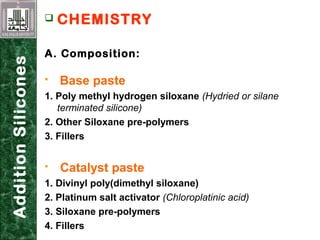
A. Composition:
 Base paste
1. Poly methyl hydrogen siloxane (Hydried or silane
terminated silicone)
2. Other Siloxane pre-polymers
3. Fillers
 Catalyst paste
1. Divinyl poly(dimethyl siloxane)
2. Platinum salt activator (Chloroplatinic acid)
3. Siloxane pre-polymers
4. Fillers
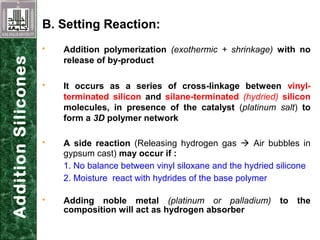
B. Setting Reaction:
 Addition polymerization (exothermic + shrinkage) with no
release of by-product
 It occurs as a series of cross-linkage between vinyl-
terminated silicon and silane-terminated (hydried) silicon
molecules, in presence of the catalyst (platinum salt) to
form a 3D polymer network
 A side reaction (Releasing hydrogen gas  Air bubbles in
gypsum cast) may occur if :
1. No balance between vinyl siloxane and the hydried silicone
2. Moisture react with hydrides of the base polymer
 Adding noble metal (platinum or palladium) to the
composition will act as hydrogen absorber
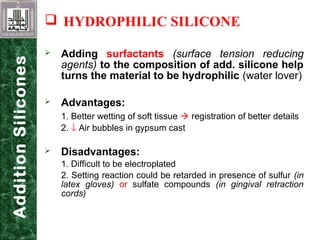
AdditionSilicones
 Adding surfactants (surface tension reducing
agents) to the composition of add. silicone help
turns the material to be hydrophilic (water lover)
 Advantages:
1. Better wetting of soft tissue  registration of better details
2. ↓ Air bubbles in gypsum cast
 Disadvantages:
1. Difficult to be electroplated
2. Setting reaction could be retarded in presence of sulfur (in
latex gloves) or sulfate compounds (in gingival retraction
cords)
 HYDROPHILIC SILICONEAdditionSilicones
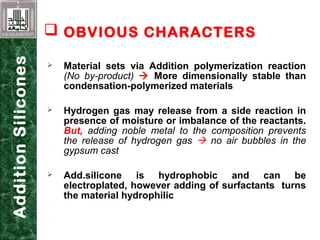
 Material sets via Addition polymerization reaction
(No by-product)  More dimensionally stable than
condensation-polymerized materials
 Hydrogen gas may release from a side reaction in
presence of moisture or imbalance of the reactants.
But, adding noble metal to the composition prevents
the release of hydrogen gas  no air bubbles in the
gypsum cast
 Add.silicone is hydrophobic and can be
electroplated, however adding of surfactants turns
the material hydrophilic
AdditionSilicones
 OBVIOUS CHARACTERS
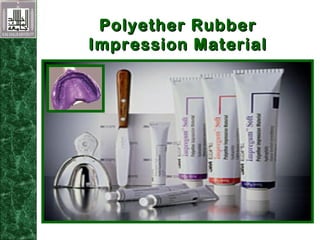
Polyether RubberPolyether Rubber
Impression MaterialImpression Material
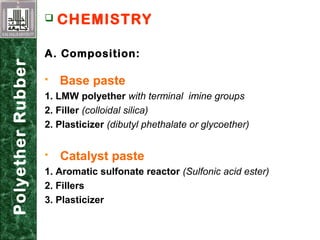
 CHEMISTRY
A. Composition:
 Base paste
1. LMW polyether with terminal imine groups
2. Filler (colloidal silica)
2. Plasticizer (dibutyl phethalate or glycoether)
 Catalyst paste
1. Aromatic sulfonate reactor (Sulfonic acid ester)
2. Fillers
3. Plasticizer
PolyetherRubber
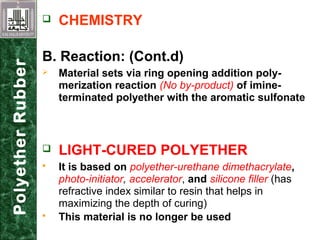
 CHEMISTRY
B. Reaction: (Cont.d)
 Material sets via ring opening addition poly-
merization reaction (No by-product) of imine-
terminated polyether with the aromatic sulfonate
 LIGHT-CURED POLYETHER
 It is based on polyether-urethane dimethacrylate,
photo-initiator, accelerator, and silicone filler (has
refractive index similar to resin that helps in
maximizing the depth of curing)
 This material is no longer be used
PolyetherRubber
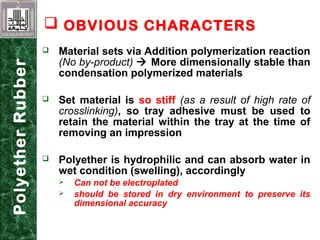
 Material sets via Addition polymerization reaction
(No by-product)  More dimensionally stable than
condensation polymerized materials
 Set material is so stiff (as a result of high rate of
crosslinking), so tray adhesive must be used to
retain the material within the tray at the time of
removing an impression
 Polyether is hydrophilic and can absorb water in
wet condition (swelling), accordingly
 Can not be electroplated
 should be stored in dry environment to preserve its
dimensional accuracy
 OBVIOUS CHARACTERSPolyetherRubber
Comparative PropertiesComparative Properties
of Elastomeric Impressionof Elastomeric Impression
MaterialsMaterials
 Biological properties:
1. Lead dioxide (polysulfide) is toxic, but following
the manufacturer’s instruction will decrease this
risk
2. Alcohol by-product (cond. Silicone) is irritant to
oral soft tissues
3. Aromatic sulfonate (polyether) is irritant, but
proper mixing will decrease this irritability
Comparative
Properties
 Interfacial properties:
1. Hydrophilicity…
 Polysulfide, cond. Silicone, & add. Silicone are
hydrophobic
 Hydrophilic silicone and polyether are Hydrophilic
2. Compatibility with model and die materials...
 Hydrophilic materials can not be electroplated
 Polysulfide could be electroplated with silver, while
silicones could be electroplated either with silver or
copper
 hydrophobic materials may cause air bubbles in stone
casts
Comparative
Properties
 Interfacial properties: (cont.d)
3. Separating media…
 There is no need (elastic materials) for separating
medium before pouring the cast
4. Detail reproduction…
 Although, hydrophilic materials show better
registration of details than hydrophobic ones,
Polysulfide is the best detail reproducer due to its
higher flow rate
Comparative
Properties
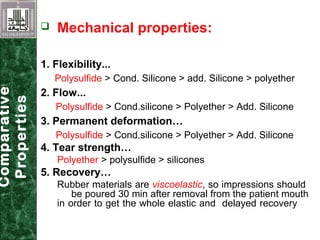
 Mechanical properties:
1. Flexibility...
Polysulfide > Cond. Silicone > add. Silicone > polyether
2. Flow...
Polysulfide > Cond.silicone > Polyether > Add. Silicone
3. Permanent deformation…
Polysulfide > Cond.silicone > Polyether > Add. Silicone
4. Tear strength…
Polyether > polysulfide > silicones
5. Recovery…
Rubber materials are viscoelastic, so impressions should
be poured 30 min after removal from the patient mouth
in order to get the whole elastic and delayed recovery of
imp.mat.
Comparative
Properties
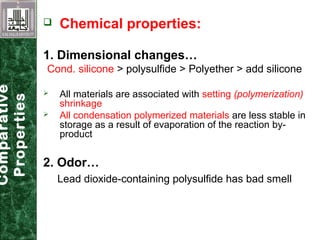
 Chemical properties:
1. Dimensional changes…
Cond. silicone > polysulfide > Polyether > add silicone
 All materials are associated with setting (polymerization)
shrinkage
 All condensation polymerized materials are less stable in
storage as a result of evaporation of the reaction by-
product
2. Odor…
Lead dioxide-containing polysulfide has bad smell
Comparative
Properties
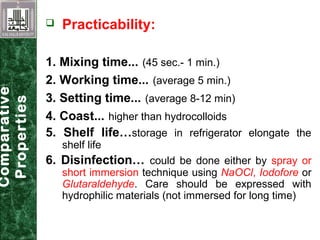
 Practicability:
1. Mixing time... (45 sec.- 1 min.)
2. Working time... (average 5 min.)
3. Setting time... (average 8-12 min)
4. Coast... higher than hydrocolloids
5. Shelf life…storage in refrigerator elongate the
shelf life
6. Disinfection… could be done either by spray or
short immersion technique using NaOCl, Iodofore or
Glutaraldehyde. Care should be expressed with
hydrophilic materials (not immersed for long time)
Comparative
Properties
Materials’ ManipulationMaterials’ Manipulation
Manipulation
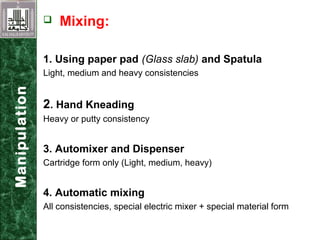
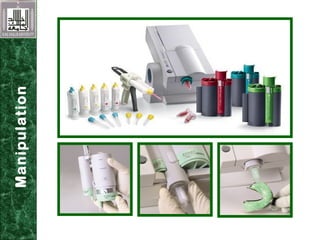
 Mixing:
1. Using paper pad (Glass slab) and Spatula
Light, medium and heavy consistencies
2. Hand Kneading
Heavy or putty consistency
3. Automixer and Dispenser
Cartridge form only (Light, medium, heavy)
4. Automatic mixing
All consistencies, special electric mixer + special material form
Manipulation
Manipulation
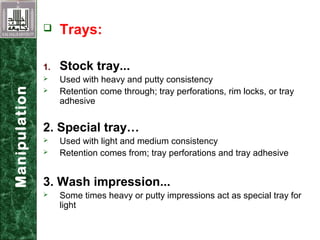
 Trays:
1. Stock tray...
 Used with heavy and putty consistency
 Retention come through; tray perforations, rim locks, or tray
adhesive
2. Special tray…
 Used with light and medium consistency
 Retention comes from; tray perforations and tray adhesive
3. Wash impression...
 Some times heavy or putty impressions act as special tray for
light consistency material
Manipulation
 Uses:
1. Impression making...
 Copper ring impression
 Monophase impression
 Double mix single phase impression
 Double mix double phase impression (over-wash impression)
 Closed mouth-double arch impression
2. Occlusal bite registration…
A specially supplied rubber material is used for this purpose
(commonly cartridge form)
Manipulation
Your CommentsYour Comments
are appreciatedare appreciated

elastomeric Impression DENTAL material

  • 1.
  • 2.
    Elastomeric = Rubber-like polymersthat show an elastic behavior at the time of load application These polymer molecules have weak interaction in between (Van der Wall forces), although they are tied together in 3D network. On stretching (on loading) chains uncoil At rest (off loading) chains snap back ChemicalNature
  • 3.
     Higher tearstrength  More stable dimensionally in storage (No Synersis, Imbibation or Evaporation)  Ability to be electroplated But, Quite Expensive !!!!But, Quite Expensive !!!! Incomparisonto hydrocolloids
  • 4.
  • 5.
  • 7.
  • 8.
     CHEMISTRY A. Composition: Base paste 1. LMW Polysulfide with two terminal and one pendant SH groups 2. Fillers (Titanium dioxide) 3. Plasticizer (Dibutyl phethalate)  Catalyst paste 1. Lead dioxide (Brown) or organic peroxides (Gray) reactor 2. Fillers (Titanium dioxide) 3. Plasticizer (Dibutyl phethalate) Polysulfide Rubber
  • 9.
    Polysulfide Rubber B. Setting Reaction: +Pb+H2o HS----R----SHHS----R----SH SH SH+ PbO2 +Pb+H2o HS----R----SH HS----R----SH SH SH+ PbO2 HS----R----SH HS----R----SH SH SH+ PbO2  Condensation polymerization (exothermic + shrinkage) with releasing of H2O as reaction by-product  It occurs as a series of simple oxidation reactions  Oxidation of terminal SH groups  polymer chains  Oxidation of pendent SH groups  Cross-linking
  • 10.
     Material setsvia condensation polymerization reaction  Water is the reaction by-product  Evaporation of water + polymerization shrinkage  Dimensional changes in storage  Water could cause air bubbles in stone cast  Polysulfide is hydrophobic, and can be electroplated  Lead dioxide is toxic and has bad smell, so it has been replaced in recent products by peroxide compounds Polysulfide Rubber  OBVIOUS CHARACTERS
  • 12.
  • 13.
     CHEMISTRY A. Composition: Base paste 1. LMW silicone polymer with terminal OH groups 2. Fillers (Colloidal silica or titanium dioxide) (white)  Catalyst paste 1. Alkyl silicate (Cross linking) 2. Tin dilaurate or Stannous octoate (Activator) Condensation Silicone
  • 14.
    HO Si -O - Si OH + CH3 CH3 CH3 CH3 Si C2H5OC2H5O C2H5O C2H5O C2H5OH+ HMW Silicon Polymer Ethyl Alcohol Dimethyl Siloxane Alkyl Silicate Stanous Octoate HO Si - O - Si OH + CH3 CH3 CH3 CH3 Si C2H5OC2H5O C2H5O C2H5O C2H5OH+ HMW Silicon Polymer Ethyl Alcohol Dimethyl Siloxane Alkyl Silicate Stanous Octoate HO Si - O - Si OH + CH3 CH3 CH3 CH3 HO Si - O - Si OH + CH3 CH3 CH3 CH3 Si C2H5OC2H5O C2H5O C2H5O Si C2H5OC2H5O C2H5O C2H5O C2H5OH+ HMW Silicon Polymer Ethyl Alcohol Dimethyl Siloxane Alkyl Silicate Stanous Octoate B. Setting Reaction:  Condensation poly-merization (exothermic + shrinkage) releasing C2H5OH as reaction by-product  It occurs as a series of cross-linkage of siloxane polymer to alkyl silicate in presence of the activator, to form a 3D polymer network Condensation Silicone
  • 15.
     Material setsvia condensation polymerization reaction  Ethyl alcohol is the reaction by-product  Evaporation of alcohol + polymerization shrinkage  Dimensional changes in storage > that of polysulfide  Alcohol could cause air bubbles in stone cast  Cond. silicone is hydrophobic, and can be electroplated either with silver or copper Condensation Silicone  OBVIOUS CHARACTERS
  • 17.
  • 18.
    AdditionSilicones  CHEMISTRY A.Composition:  Base paste 1. Poly methyl hydrogen siloxane (Hydried or silane terminated silicone) 2. Other Siloxane pre-polymers 3. Fillers  Catalyst paste 1. Divinyl poly(dimethyl siloxane) 2. Platinum salt activator (Chloroplatinic acid) 3. Siloxane pre-polymers 4. Fillers
  • 19.
    B. Setting Reaction: Addition polymerization (exothermic + shrinkage) with no release of by-product  It occurs as a series of cross-linkage between vinyl- terminated silicon and silane-terminated (hydried) silicon molecules, in presence of the catalyst (platinum salt) to form a 3D polymer network  A side reaction (Releasing hydrogen gas  Air bubbles in gypsum cast) may occur if : 1. No balance between vinyl siloxane and the hydried silicone 2. Moisture react with hydrides of the base polymer  Adding noble metal (platinum or palladium) to the composition will act as hydrogen absorber AdditionSilicones
  • 20.
     Adding surfactants(surface tension reducing agents) to the composition of add. silicone help turns the material to be hydrophilic (water lover)  Advantages: 1. Better wetting of soft tissue  registration of better details 2. ↓ Air bubbles in gypsum cast  Disadvantages: 1. Difficult to be electroplated 2. Setting reaction could be retarded in presence of sulfur (in latex gloves) or sulfate compounds (in gingival retraction cords)  HYDROPHILIC SILICONEAdditionSilicones
  • 21.
     Material setsvia Addition polymerization reaction (No by-product)  More dimensionally stable than condensation-polymerized materials  Hydrogen gas may release from a side reaction in presence of moisture or imbalance of the reactants. But, adding noble metal to the composition prevents the release of hydrogen gas  no air bubbles in the gypsum cast  Add.silicone is hydrophobic and can be electroplated, however adding of surfactants turns the material hydrophilic AdditionSilicones  OBVIOUS CHARACTERS
  • 23.
  • 24.
     CHEMISTRY A. Composition: Base paste 1. LMW polyether with terminal imine groups 2. Filler (colloidal silica) 2. Plasticizer (dibutyl phethalate or glycoether)  Catalyst paste 1. Aromatic sulfonate reactor (Sulfonic acid ester) 2. Fillers 3. Plasticizer PolyetherRubber
  • 25.
     CHEMISTRY B. Reaction:(Cont.d)  Material sets via ring opening addition poly- merization reaction (No by-product) of imine- terminated polyether with the aromatic sulfonate  LIGHT-CURED POLYETHER  It is based on polyether-urethane dimethacrylate, photo-initiator, accelerator, and silicone filler (has refractive index similar to resin that helps in maximizing the depth of curing)  This material is no longer be used PolyetherRubber
  • 26.
     Material setsvia Addition polymerization reaction (No by-product)  More dimensionally stable than condensation polymerized materials  Set material is so stiff (as a result of high rate of crosslinking), so tray adhesive must be used to retain the material within the tray at the time of removing an impression  Polyether is hydrophilic and can absorb water in wet condition (swelling), accordingly  Can not be electroplated  should be stored in dry environment to preserve its dimensional accuracy  OBVIOUS CHARACTERSPolyetherRubber
  • 27.
    Comparative PropertiesComparative Properties ofElastomeric Impressionof Elastomeric Impression MaterialsMaterials
  • 28.
     Biological properties: 1.Lead dioxide (polysulfide) is toxic, but following the manufacturer’s instruction will decrease this risk 2. Alcohol by-product (cond. Silicone) is irritant to oral soft tissues 3. Aromatic sulfonate (polyether) is irritant, but proper mixing will decrease this irritability Comparative Properties
  • 29.
     Interfacial properties: 1.Hydrophilicity…  Polysulfide, cond. Silicone, & add. Silicone are hydrophobic  Hydrophilic silicone and polyether are Hydrophilic 2. Compatibility with model and die materials...  Hydrophilic materials can not be electroplated  Polysulfide could be electroplated with silver, while silicones could be electroplated either with silver or copper  hydrophobic materials may cause air bubbles in stone casts Comparative Properties
  • 30.
     Interfacial properties:(cont.d) 3. Separating media…  There is no need (elastic materials) for separating medium before pouring the cast 4. Detail reproduction…  Although, hydrophilic materials show better registration of details than hydrophobic ones, Polysulfide is the best detail reproducer due to its higher flow rate Comparative Properties
  • 31.
     Mechanical properties: 1.Flexibility... Polysulfide > Cond. Silicone > add. Silicone > polyether 2. Flow... Polysulfide > Cond.silicone > Polyether > Add. Silicone 3. Permanent deformation… Polysulfide > Cond.silicone > Polyether > Add. Silicone 4. Tear strength… Polyether > polysulfide > silicones 5. Recovery… Rubber materials are viscoelastic, so impressions should be poured 30 min after removal from the patient mouth in order to get the whole elastic and delayed recovery of imp.mat. Comparative Properties
  • 32.
     Chemical properties: 1.Dimensional changes… Cond. silicone > polysulfide > Polyether > add silicone  All materials are associated with setting (polymerization) shrinkage  All condensation polymerized materials are less stable in storage as a result of evaporation of the reaction by- product 2. Odor… Lead dioxide-containing polysulfide has bad smell Comparative Properties
  • 33.
     Practicability: 1. Mixingtime... (45 sec.- 1 min.) 2. Working time... (average 5 min.) 3. Setting time... (average 8-12 min) 4. Coast... higher than hydrocolloids 5. Shelf life…storage in refrigerator elongate the shelf life 6. Disinfection… could be done either by spray or short immersion technique using NaOCl, Iodofore or Glutaraldehyde. Care should be expressed with hydrophilic materials (not immersed for long time) Comparative Properties
  • 34.
  • 35.
     Mixing: 1. Usingpaper pad (Glass slab) and Spatula Light, medium and heavy consistencies 2. Hand Kneading Heavy or putty consistency 3. Automixer and Dispenser Cartridge form only (Light, medium, heavy) 4. Automatic mixing All consistencies, special electric mixer + special material form Manipulation
  • 36.
  • 37.
     Trays: 1. Stocktray...  Used with heavy and putty consistency  Retention come through; tray perforations, rim locks, or tray adhesive 2. Special tray…  Used with light and medium consistency  Retention comes from; tray perforations and tray adhesive 3. Wash impression...  Some times heavy or putty impressions act as special tray for light consistency material Manipulation
  • 38.
     Uses: 1. Impressionmaking...  Copper ring impression  Monophase impression  Double mix single phase impression  Double mix double phase impression (over-wash impression)  Closed mouth-double arch impression 2. Occlusal bite registration… A specially supplied rubber material is used for this purpose (commonly cartridge form) Manipulation
  • 39.
    Your CommentsYour Comments areappreciatedare appreciated