• Thermal Contact Resistance
• Log Mean Area of the Cylinder
• Geometric Mean Area of the Sphere
• Critical Radius of Insulation
• Thermal Contact Resistance
• Log Mean Area of the Cylinder
• Geometric Mean Area of the Sphere
• Critical Radius of Insulation
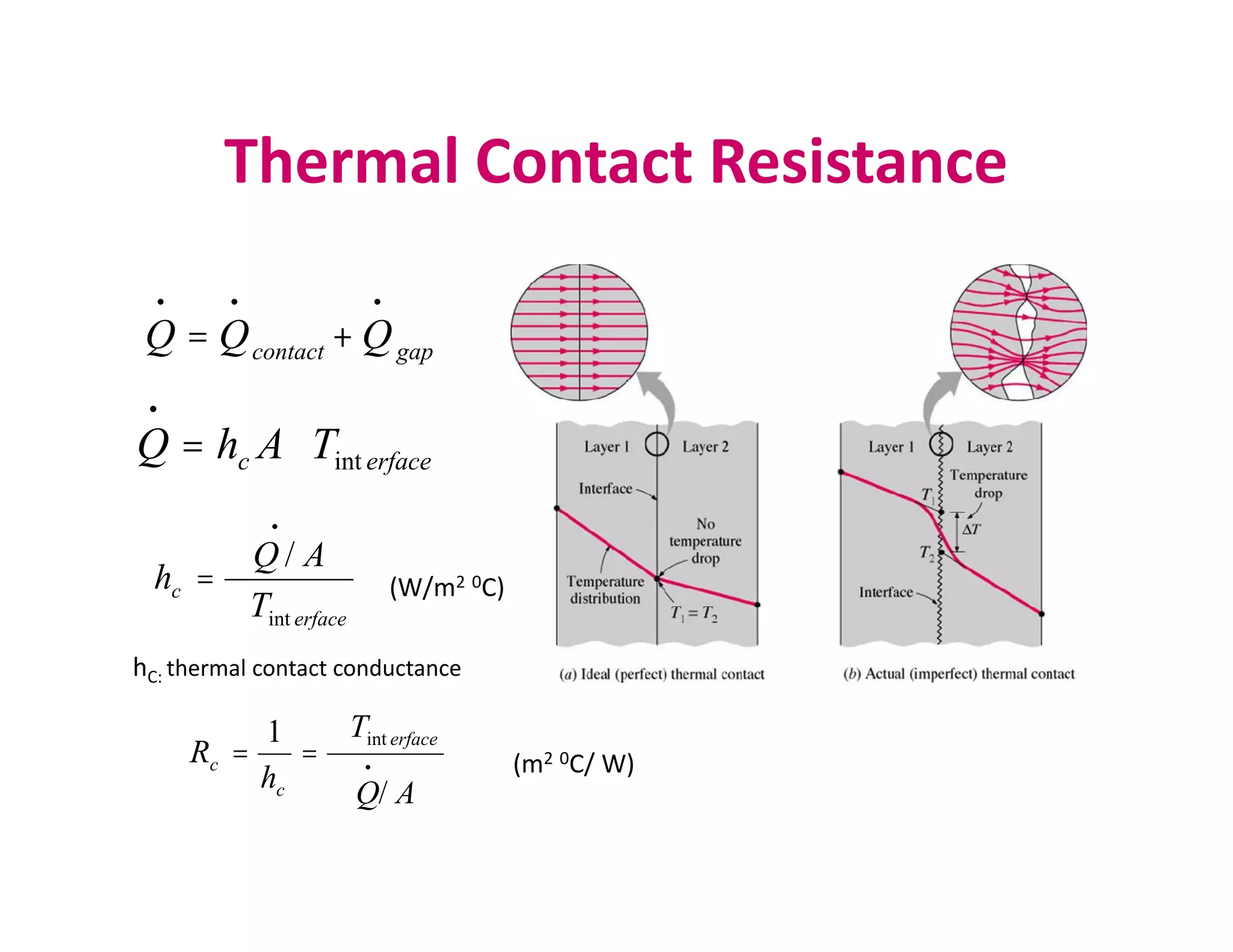
Thermal Contact Resistance
gapcontact QQQ


erfacec TAhQ int

erfacec TAhQ int

erface
c
T
AQ
h
int
/



(W/m2 0C)
(m2 0C/ W)
AQ
T
h
R
erface
c
c
/
1 int



hC: thermal contact conductance
Thermal contact resistance is inverse of
thermal contact conduction,
Depends on
• Surface roughness,
• Material properties,
• Temperature and pressure at interface,
• Type of fluid trapped at interface
Thermal contact resistance is inverse of
thermal contact conduction,
Depends on
• Surface roughness,
• Material properties,
• Temperature and pressure at interface,
• Type of fluid trapped at interface
CRITICAL RADIUS OF INSULATION
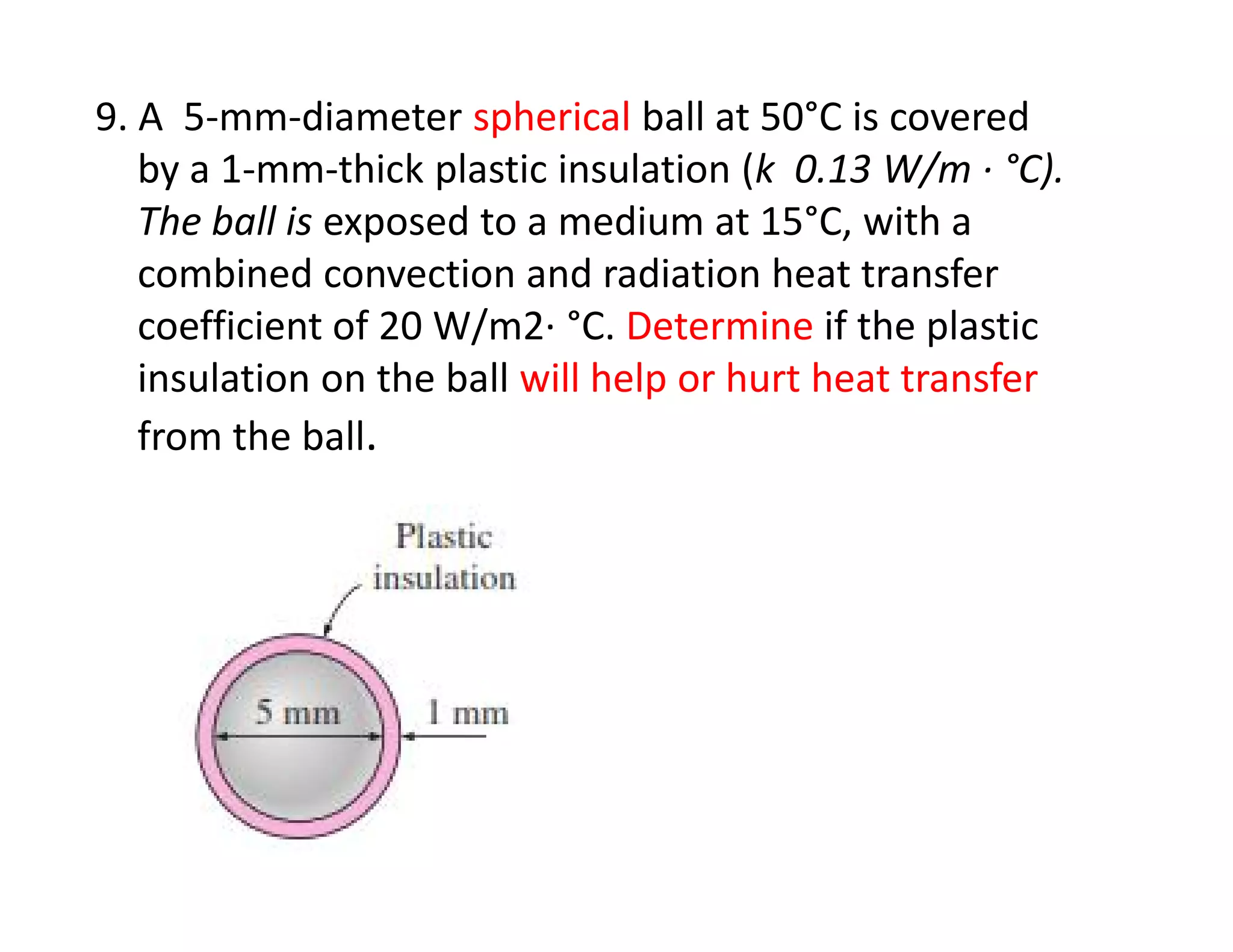
9. A 5-mm-diameter spherical ball at 50°C is covered
by a 1-mm-thick plastic insulation (k 0.13 W/m · °C).
The ball is exposed to a medium at 15°C, with a
combined convection and radiation heat transfer
coefficient of 20 W/m2· °C. Determine if the plastic
insulation on the ball will help or hurt heat transfer
from the ball.
Subsidiary laws and Fundamental Laws
Subsidiary laws
• FOURIER’S LAW OF HEAT CONDUCTION
• NEWTON’S LAW OF COOLING FOR CONVECTION
• STEFAN-BOLTZMANN LAW OF RADIATION
Fundamental Laws
• The Laws of conservation of mass
• The laws of conservation of momentum,
• The Laws of conservation of energy
Subsidiary laws
• FOURIER’S LAW OF HEAT CONDUCTION
• NEWTON’S LAW OF COOLING FOR CONVECTION
• STEFAN-BOLTZMANN LAW OF RADIATION
Fundamental Laws
• The Laws of conservation of mass
• The laws of conservation of momentum,
• The Laws of conservation of energy
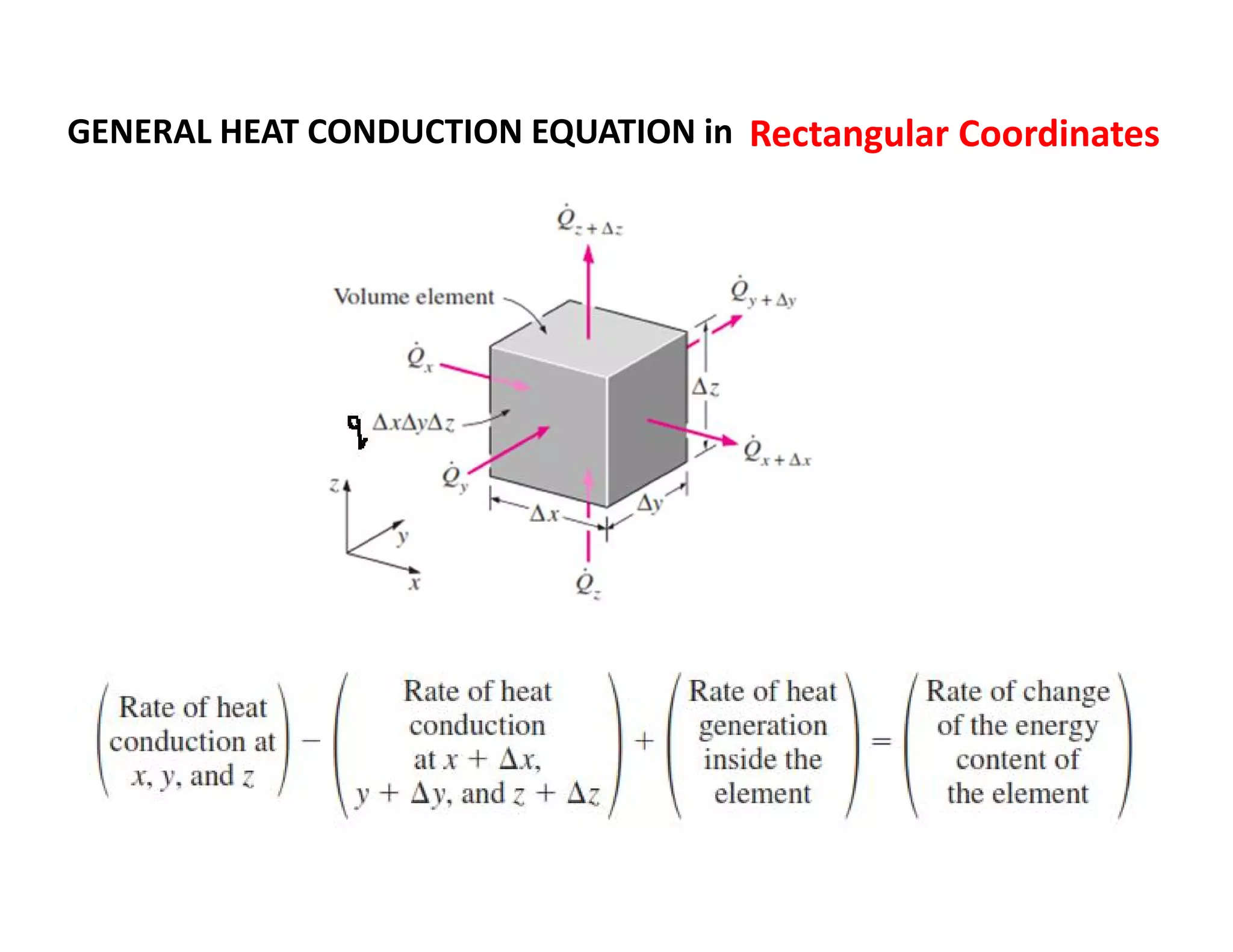
GENERAL HEAT CONDUCTION EQUATION in Rectangular Coordinates
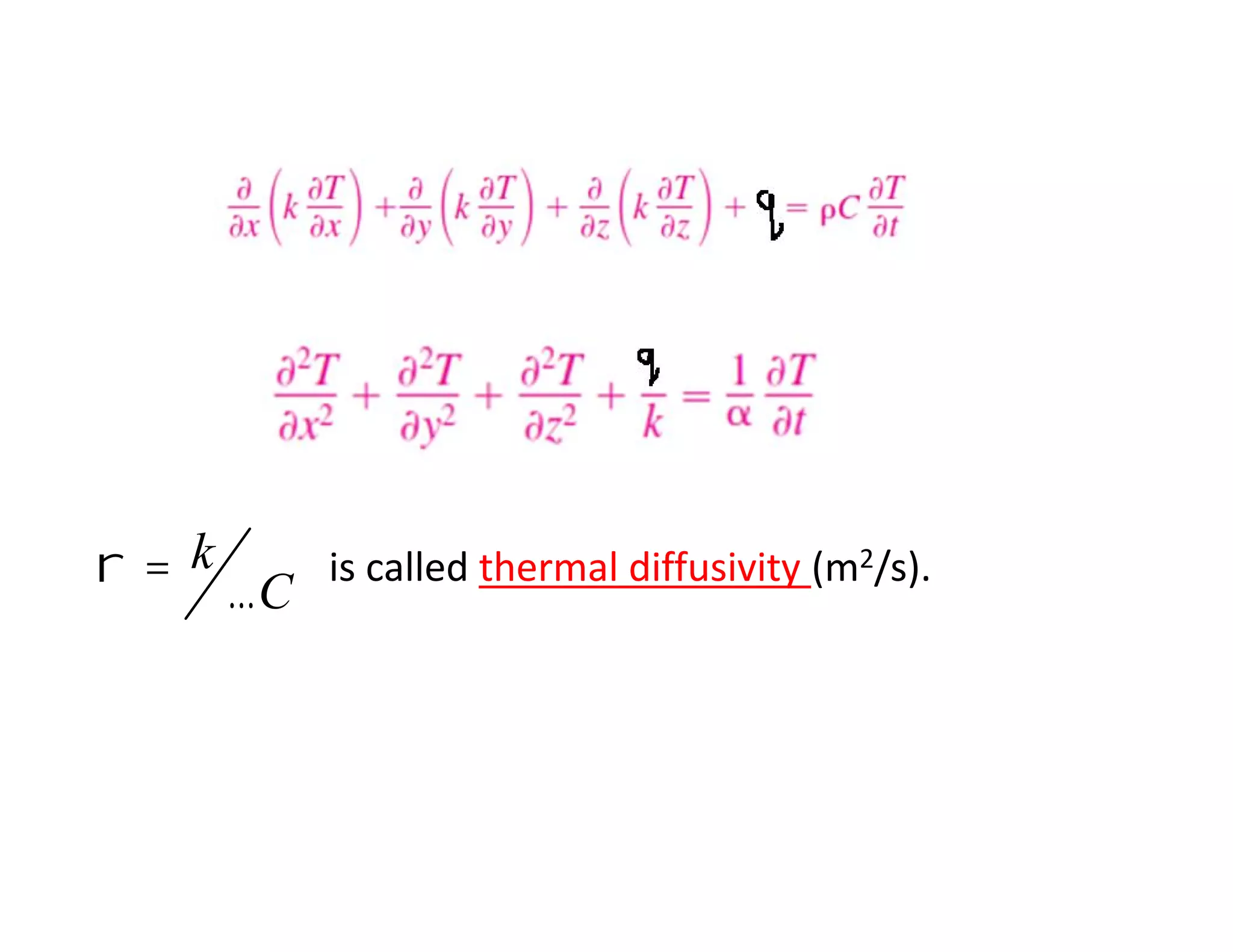
k
C


 is called thermal diffusivity (m2/s).
• The product , which is frequently encountered
in heat transfer analysis, is called the heat capacity
of a material. Both the specific heat Cp and the
heat capacity represent the heat storage
capability of a material. But Cp expresses it per unit
mass whereas expresses it per unit volume,
• Another material property that appears in the
transient heat conduction analysis is the thermal
diffusivity, which represents how fast heat
diffuses through a material and is defined as
thermal diffusivity
• The product , which is frequently encountered
in heat transfer analysis, is called the heat capacity
of a material. Both the specific heat Cp and the
heat capacity represent the heat storage
capability of a material. But Cp expresses it per unit
mass whereas expresses it per unit volume,
• Another material property that appears in the
transient heat conduction analysis is the thermal
diffusivity, which represents how fast heat
diffuses through a material and is defined as
thermal diffusivity
Check whether FL satisfies or not
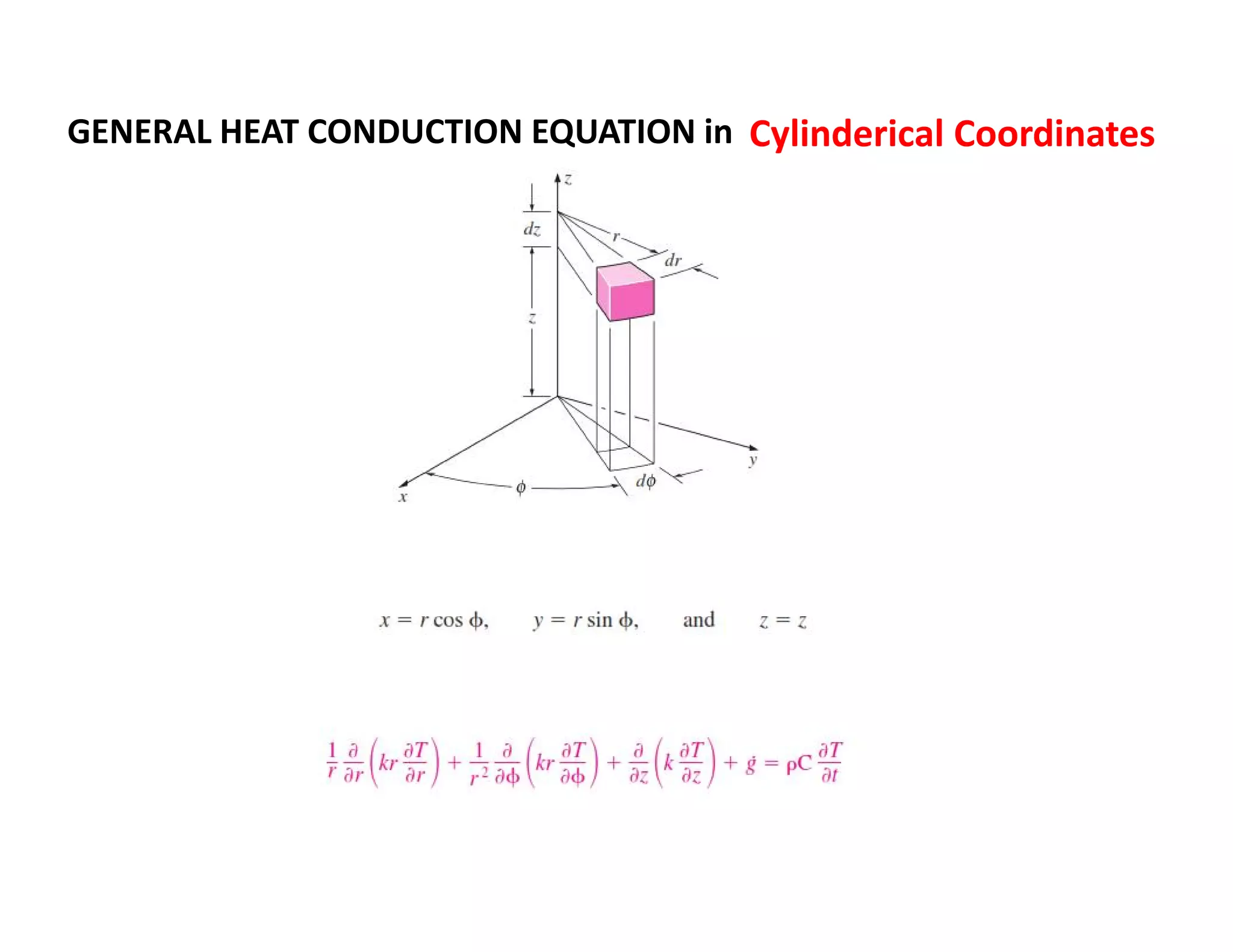
GENERAL HEAT CONDUCTION EQUATION in Cylinderical Coordinates
GENERAL HEAT CONDUCTION EQUATION in Spherical Coordinates
BOUNDARY AND INITIAL CONDITIONS
• Mathematical expressions of the thermal conditions at the
boundaries are called the boundary conditions.
• Initial condition, which is a mathematical expression for the
temperature distribution of the medium initially
1. Specified Temperature Boundary
Condition
1. Specified Temperature Boundary
Condition
2. Specified Heat Flux Boundary Condition
3. Convection Boundary Condition3. Convection Boundary Condition
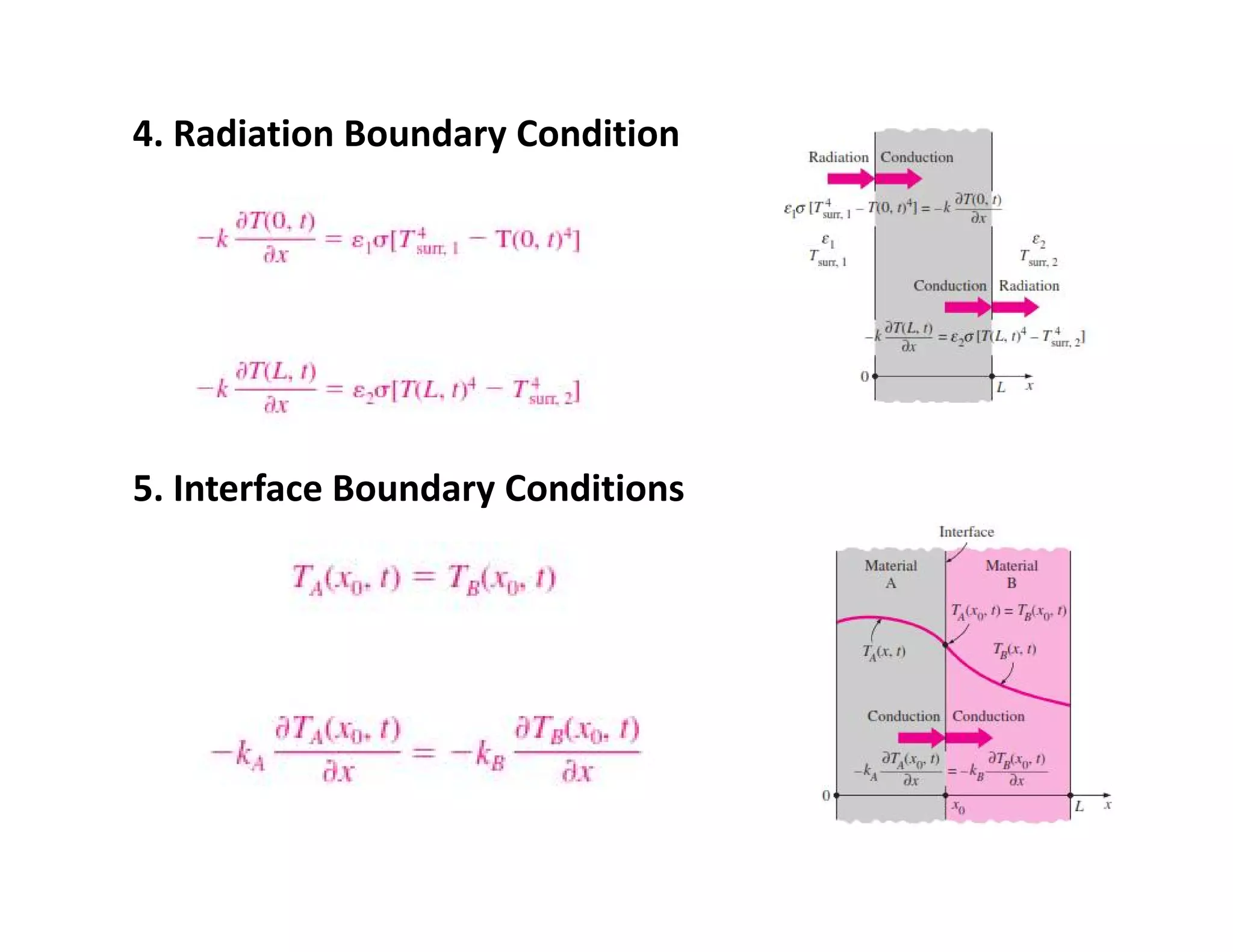
4. Radiation Boundary Condition
5. Interface Boundary Conditions5. Interface Boundary Conditions
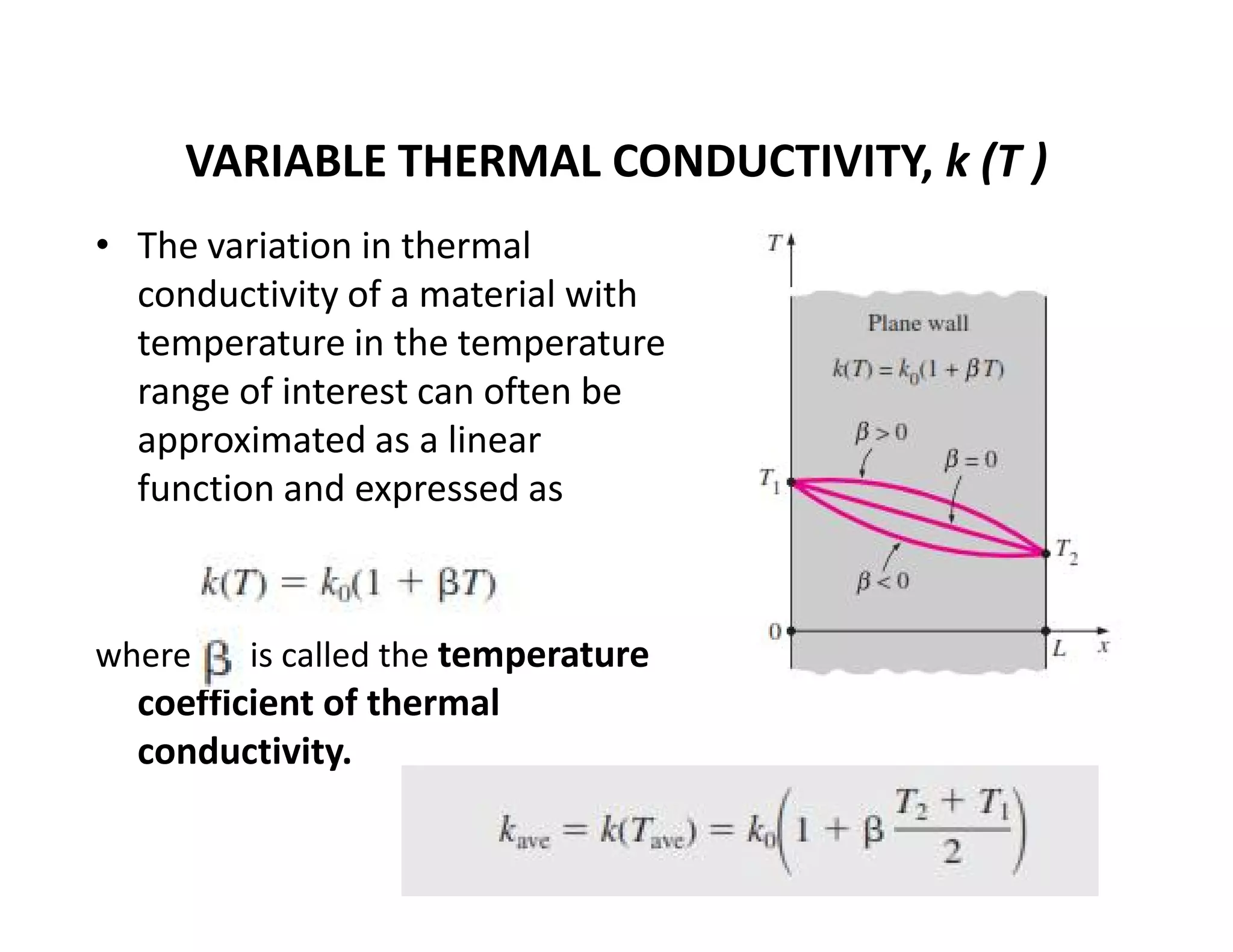
VARIABLE THERMAL CONDUCTIVITY, k (T )
• The variation in thermal
conductivity of a material with
temperature in the temperature
range of interest can often be
approximated as a linear
function and expressed as
where is called the temperature
coefficient of thermal
conductivity.
• The variation in thermal
conductivity of a material with
temperature in the temperature
range of interest can often be
approximated as a linear
function and expressed as
where is called the temperature
coefficient of thermal
conductivity.
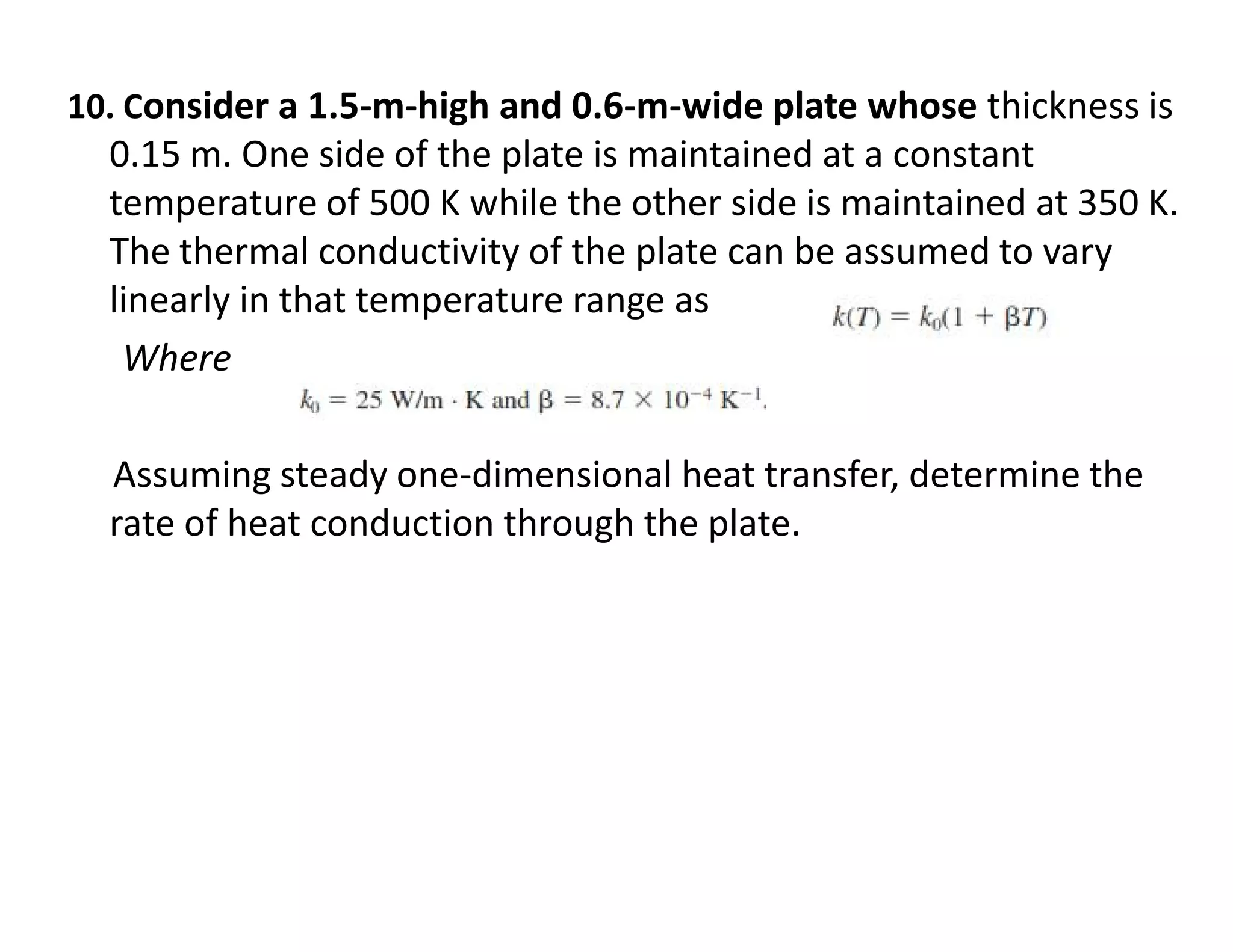
10. Consider a 1.5-m-high and 0.6-m-wide plate whose thickness is
0.15 m. One side of the plate is maintained at a constant
temperature of 500 K while the other side is maintained at 350 K.
The thermal conductivity of the plate can be assumed to vary
linearly in that temperature range as
Where
Assuming steady one-dimensional heat transfer, determine the
rate of heat conduction through the plate.
10. Consider a 1.5-m-high and 0.6-m-wide plate whose thickness is
0.15 m. One side of the plate is maintained at a constant
temperature of 500 K while the other side is maintained at 350 K.
The thermal conductivity of the plate can be assumed to vary
linearly in that temperature range as
Where
Assuming steady one-dimensional heat transfer, determine the
rate of heat conduction through the plate.
T2
k(T)
T1
KW/m24.34
2
K350)+(500
)K10(8.7+1K)W/m25(
2
1)(
1-4-
12
0aveave













 

TT
kTkk
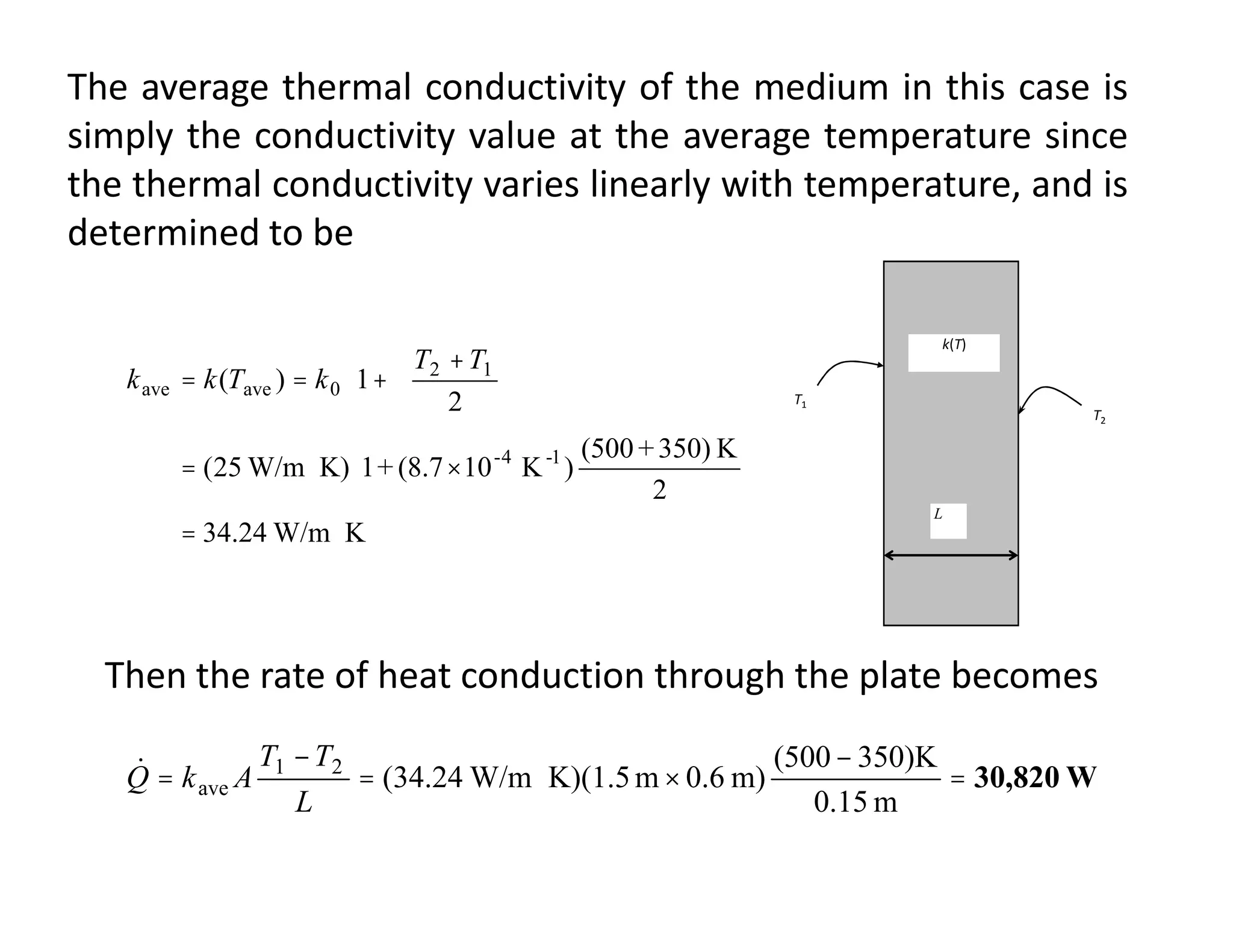
The average thermal conductivity of the medium in this case is
simply the conductivity value at the average temperature since
the thermal conductivity varies linearly with temperature, and is
determined to be
L
KW/m24.34
2
K350)+(500
)K10(8.7+1K)W/m25(
2
1)(
1-4-
12
0aveave













 

TT
kTkk
W30,820




m15.0
0)K35(500
m)0.6mK)(1.5W/m24.34(21
ave
L
TT
AkQ
Then the rate of heat conduction through the plate becomes
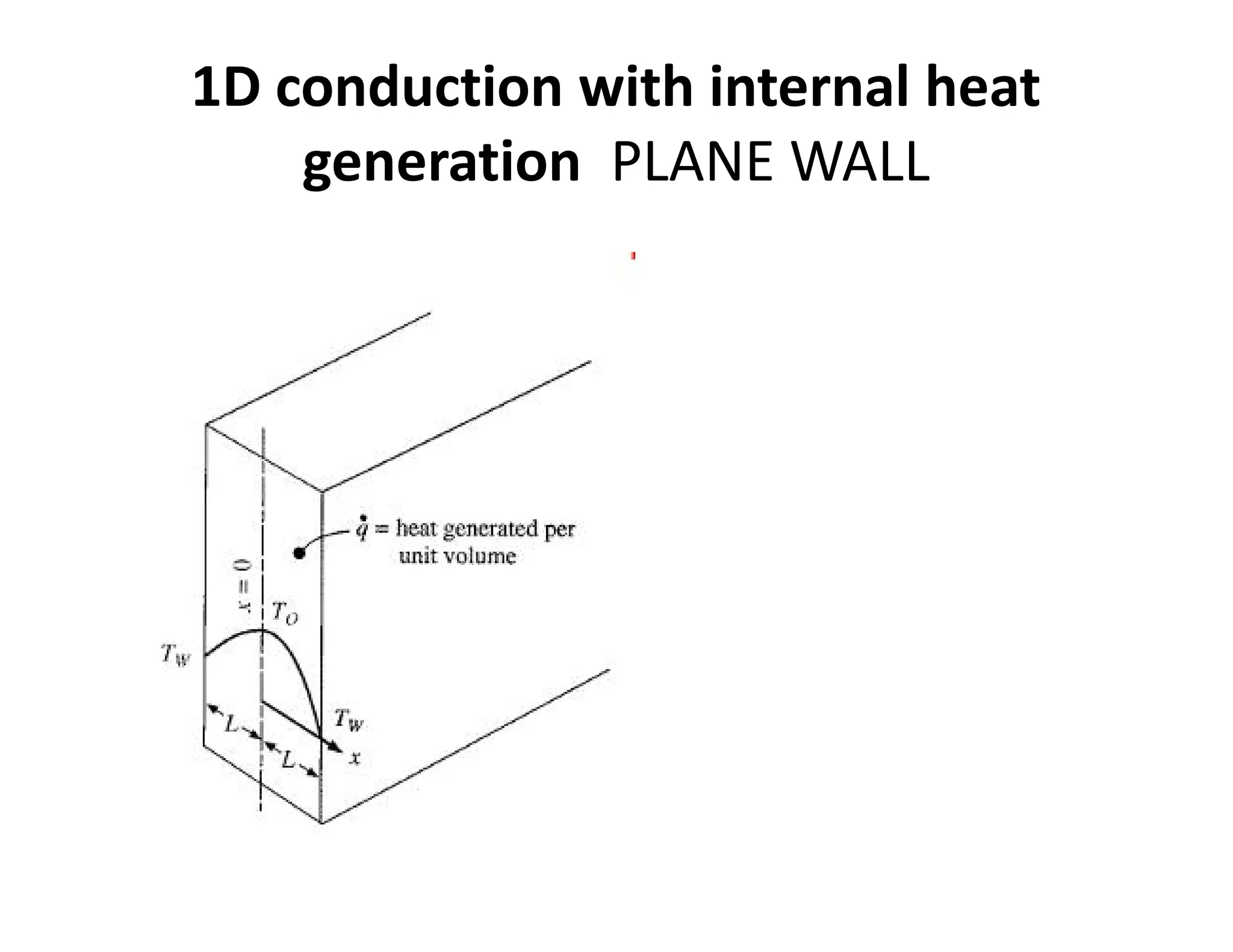
1D conduction with internal heat
generation PLANE WALL
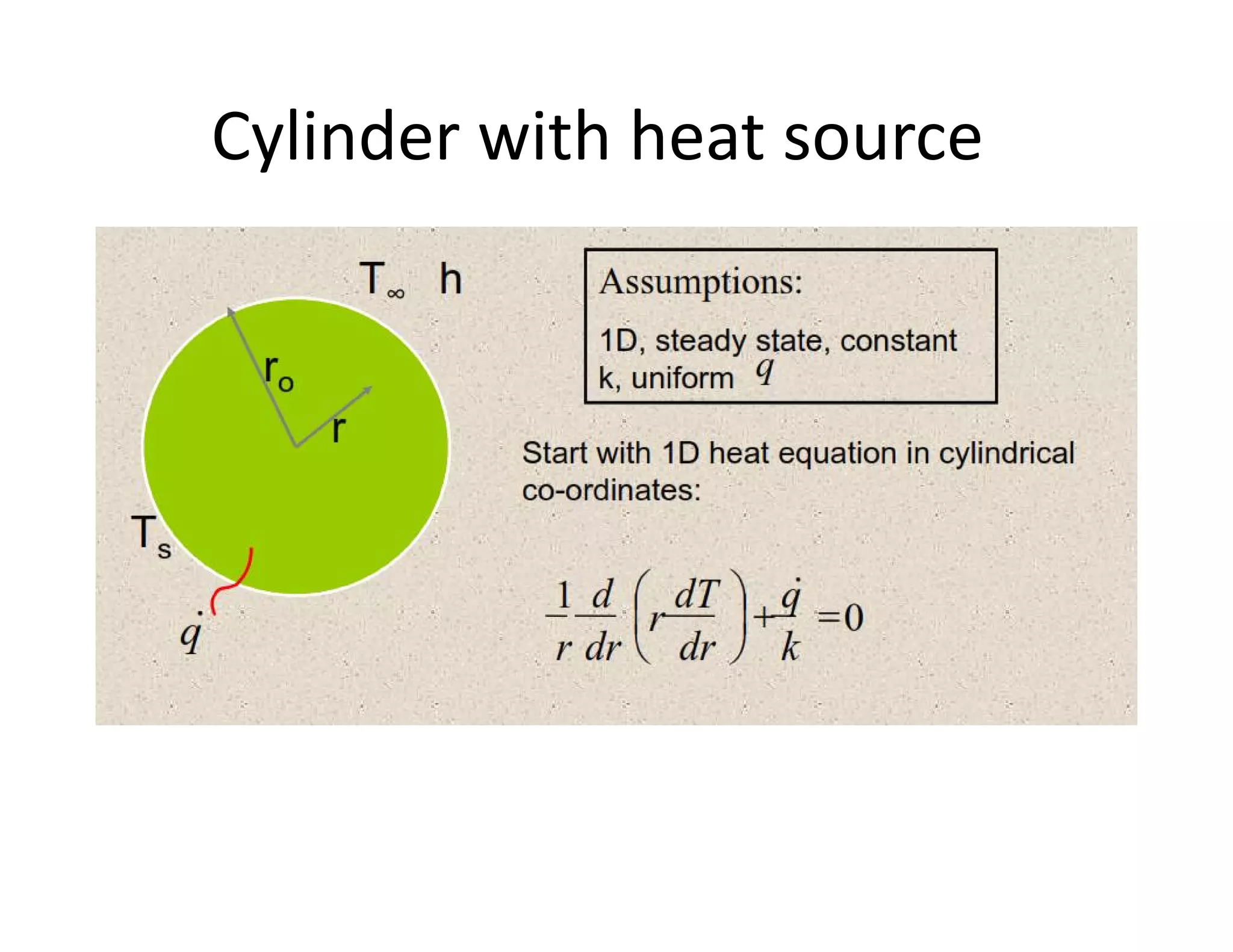
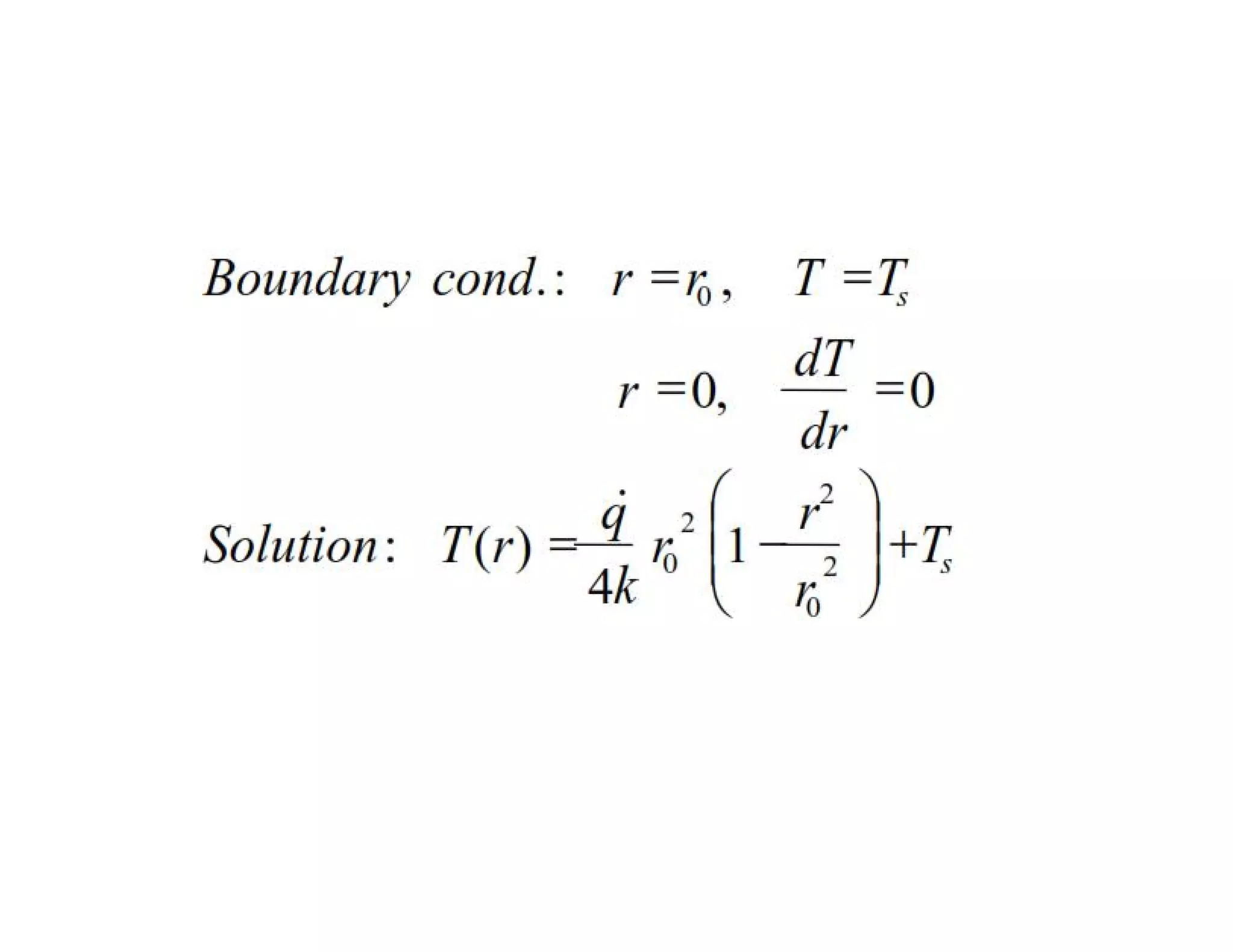
Cylinder with heat source
Hence thermal resistance concept is not
correct to use when there is internal
heat generation
No more linear
11. A plane wall 10 cm thick generates heat at the rate of 4 × 10⁴
W/ m3 when an electric current is passed through it. The
convective heat transfer coefficient between each face of the
wall and the ambient air is 50 W/m2 K. Determine (1) the surface
temperature (2) the maximum temperature in the wall. Assume
the ambient air temperature to be 20°C and thermal
conductivity of the wall material to be 15 W/m K.
12. An electrical transmission line made of a 25 mm annealed
copper wire carries 200 A and has a resistance of 0.4× 10⁻⁴
Ω/cm length. If the surface temperature is 200°C and ambient
temperature is 10°C, determine the heat transfer coefficient
between the wire surface and ambient air and the maximum
temperature in wire. Assume k = 150 W/mK.
12. An electrical transmission line made of a 25 mm annealed
copper wire carries 200 A and has a resistance of 0.4× 10⁻⁴
Ω/cm length. If the surface temperature is 200°C and ambient
temperature is 10°C, determine the heat transfer coefficient
between the wire surface and ambient air and the maximum
temperature in wire. Assume k = 150 W/mK.
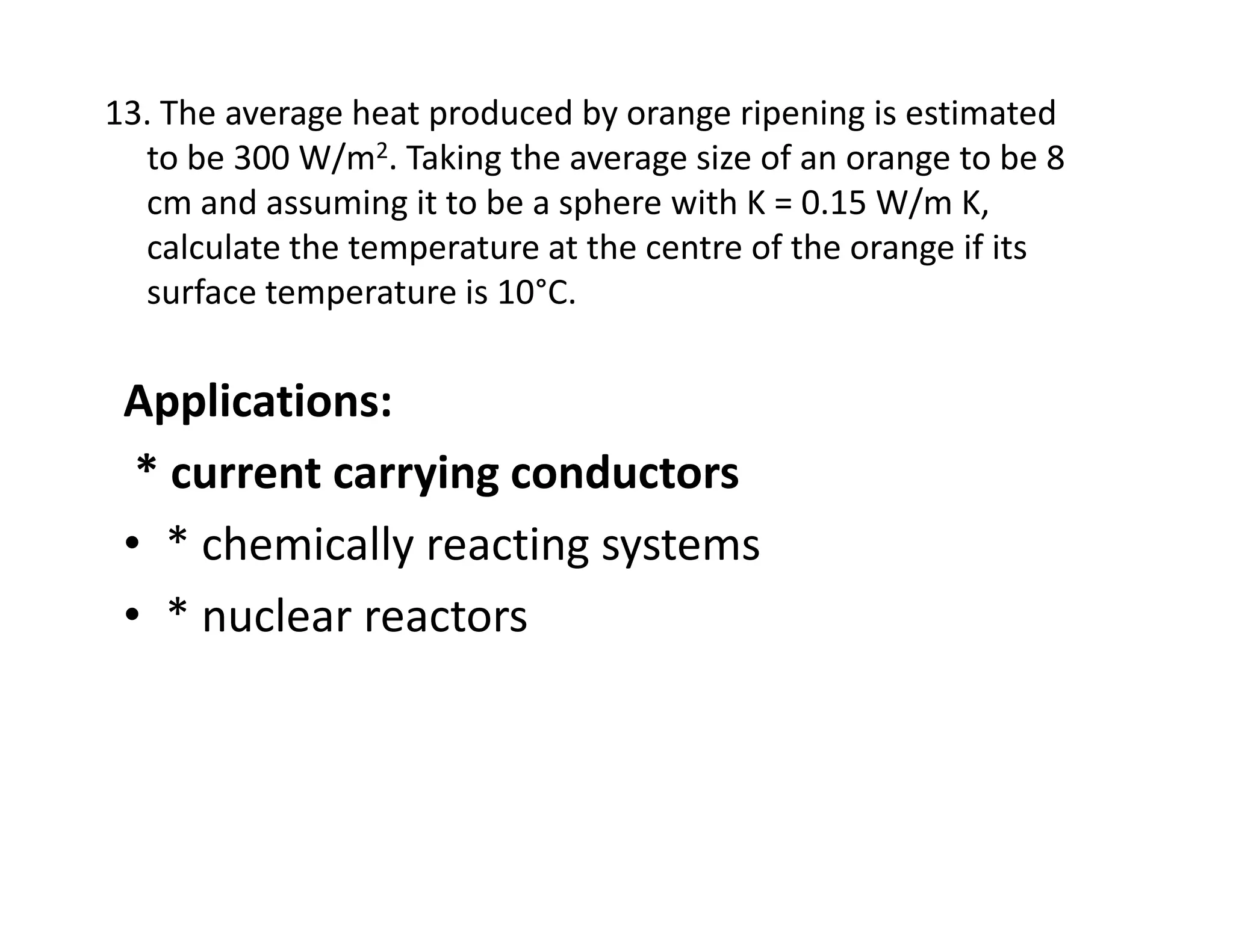
13. The average heat produced by orange ripening is estimated
to be 300 W/m2. Taking the average size of an orange to be 8
cm and assuming it to be a sphere with K = 0.15 W/m K,
calculate the temperature at the centre of the orange if its
surface temperature is 10°C.
Applications:
* current carrying conductors
• * chemically reacting systems
• * nuclear reactors
Applications:
* current carrying conductors
• * chemically reacting systems
• * nuclear reactors

General Heat Conduction Equation

  • 1.
    • Thermal ContactResistance • Log Mean Area of the Cylinder • Geometric Mean Area of the Sphere • Critical Radius of Insulation • Thermal Contact Resistance • Log Mean Area of the Cylinder • Geometric Mean Area of the Sphere • Critical Radius of Insulation
  • 2.
    Thermal Contact Resistance gapcontactQQQ   erfacec TAhQ int  erfacec TAhQ int  erface c T AQ h int /    (W/m2 0C) (m2 0C/ W) AQ T h R erface c c / 1 int    hC: thermal contact conductance
  • 3.
    Thermal contact resistanceis inverse of thermal contact conduction, Depends on • Surface roughness, • Material properties, • Temperature and pressure at interface, • Type of fluid trapped at interface Thermal contact resistance is inverse of thermal contact conduction, Depends on • Surface roughness, • Material properties, • Temperature and pressure at interface, • Type of fluid trapped at interface
  • 4.
  • 5.
    9. A 5-mm-diameterspherical ball at 50°C is covered by a 1-mm-thick plastic insulation (k 0.13 W/m · °C). The ball is exposed to a medium at 15°C, with a combined convection and radiation heat transfer coefficient of 20 W/m2· °C. Determine if the plastic insulation on the ball will help or hurt heat transfer from the ball.
  • 6.
    Subsidiary laws andFundamental Laws Subsidiary laws • FOURIER’S LAW OF HEAT CONDUCTION • NEWTON’S LAW OF COOLING FOR CONVECTION • STEFAN-BOLTZMANN LAW OF RADIATION Fundamental Laws • The Laws of conservation of mass • The laws of conservation of momentum, • The Laws of conservation of energy Subsidiary laws • FOURIER’S LAW OF HEAT CONDUCTION • NEWTON’S LAW OF COOLING FOR CONVECTION • STEFAN-BOLTZMANN LAW OF RADIATION Fundamental Laws • The Laws of conservation of mass • The laws of conservation of momentum, • The Laws of conservation of energy
  • 7.
    GENERAL HEAT CONDUCTIONEQUATION in Rectangular Coordinates
  • 9.
    k C    is calledthermal diffusivity (m2/s).
  • 10.
    • The product, which is frequently encountered in heat transfer analysis, is called the heat capacity of a material. Both the specific heat Cp and the heat capacity represent the heat storage capability of a material. But Cp expresses it per unit mass whereas expresses it per unit volume, • Another material property that appears in the transient heat conduction analysis is the thermal diffusivity, which represents how fast heat diffuses through a material and is defined as thermal diffusivity • The product , which is frequently encountered in heat transfer analysis, is called the heat capacity of a material. Both the specific heat Cp and the heat capacity represent the heat storage capability of a material. But Cp expresses it per unit mass whereas expresses it per unit volume, • Another material property that appears in the transient heat conduction analysis is the thermal diffusivity, which represents how fast heat diffuses through a material and is defined as thermal diffusivity
  • 11.
    Check whether FLsatisfies or not
  • 12.
    GENERAL HEAT CONDUCTIONEQUATION in Cylinderical Coordinates
  • 13.
    GENERAL HEAT CONDUCTIONEQUATION in Spherical Coordinates
  • 14.
    BOUNDARY AND INITIALCONDITIONS • Mathematical expressions of the thermal conditions at the boundaries are called the boundary conditions. • Initial condition, which is a mathematical expression for the temperature distribution of the medium initially 1. Specified Temperature Boundary Condition 1. Specified Temperature Boundary Condition
  • 15.
    2. Specified HeatFlux Boundary Condition 3. Convection Boundary Condition3. Convection Boundary Condition
  • 16.
    4. Radiation BoundaryCondition 5. Interface Boundary Conditions5. Interface Boundary Conditions
  • 17.
    VARIABLE THERMAL CONDUCTIVITY,k (T ) • The variation in thermal conductivity of a material with temperature in the temperature range of interest can often be approximated as a linear function and expressed as where is called the temperature coefficient of thermal conductivity. • The variation in thermal conductivity of a material with temperature in the temperature range of interest can often be approximated as a linear function and expressed as where is called the temperature coefficient of thermal conductivity.
  • 18.
    10. Consider a1.5-m-high and 0.6-m-wide plate whose thickness is 0.15 m. One side of the plate is maintained at a constant temperature of 500 K while the other side is maintained at 350 K. The thermal conductivity of the plate can be assumed to vary linearly in that temperature range as Where Assuming steady one-dimensional heat transfer, determine the rate of heat conduction through the plate. 10. Consider a 1.5-m-high and 0.6-m-wide plate whose thickness is 0.15 m. One side of the plate is maintained at a constant temperature of 500 K while the other side is maintained at 350 K. The thermal conductivity of the plate can be assumed to vary linearly in that temperature range as Where Assuming steady one-dimensional heat transfer, determine the rate of heat conduction through the plate.
  • 19.
    T2 k(T) T1 KW/m24.34 2 K350)+(500 )K10(8.7+1K)W/m25( 2 1)( 1-4- 12 0aveave                 TT kTkk The averagethermal conductivity of the medium in this case is simply the conductivity value at the average temperature since the thermal conductivity varies linearly with temperature, and is determined to be L KW/m24.34 2 K350)+(500 )K10(8.7+1K)W/m25( 2 1)( 1-4- 12 0aveave                 TT kTkk W30,820     m15.0 0)K35(500 m)0.6mK)(1.5W/m24.34(21 ave L TT AkQ Then the rate of heat conduction through the plate becomes
  • 20.
    1D conduction withinternal heat generation PLANE WALL
  • 21.
  • 22.
    Hence thermal resistanceconcept is not correct to use when there is internal heat generation No more linear
  • 24.
    11. A planewall 10 cm thick generates heat at the rate of 4 × 10⁴ W/ m3 when an electric current is passed through it. The convective heat transfer coefficient between each face of the wall and the ambient air is 50 W/m2 K. Determine (1) the surface temperature (2) the maximum temperature in the wall. Assume the ambient air temperature to be 20°C and thermal conductivity of the wall material to be 15 W/m K. 12. An electrical transmission line made of a 25 mm annealed copper wire carries 200 A and has a resistance of 0.4× 10⁻⁴ Ω/cm length. If the surface temperature is 200°C and ambient temperature is 10°C, determine the heat transfer coefficient between the wire surface and ambient air and the maximum temperature in wire. Assume k = 150 W/mK. 12. An electrical transmission line made of a 25 mm annealed copper wire carries 200 A and has a resistance of 0.4× 10⁻⁴ Ω/cm length. If the surface temperature is 200°C and ambient temperature is 10°C, determine the heat transfer coefficient between the wire surface and ambient air and the maximum temperature in wire. Assume k = 150 W/mK.
  • 25.
    13. The averageheat produced by orange ripening is estimated to be 300 W/m2. Taking the average size of an orange to be 8 cm and assuming it to be a sphere with K = 0.15 W/m K, calculate the temperature at the centre of the orange if its surface temperature is 10°C. Applications: * current carrying conductors • * chemically reacting systems • * nuclear reactors Applications: * current carrying conductors • * chemically reacting systems • * nuclear reactors