Building a GPU-enabled
OpenStack Cloud for HPC
Blair Bethwaite, Lance Wilson, (and many others)
MONASH

eRESEARCH
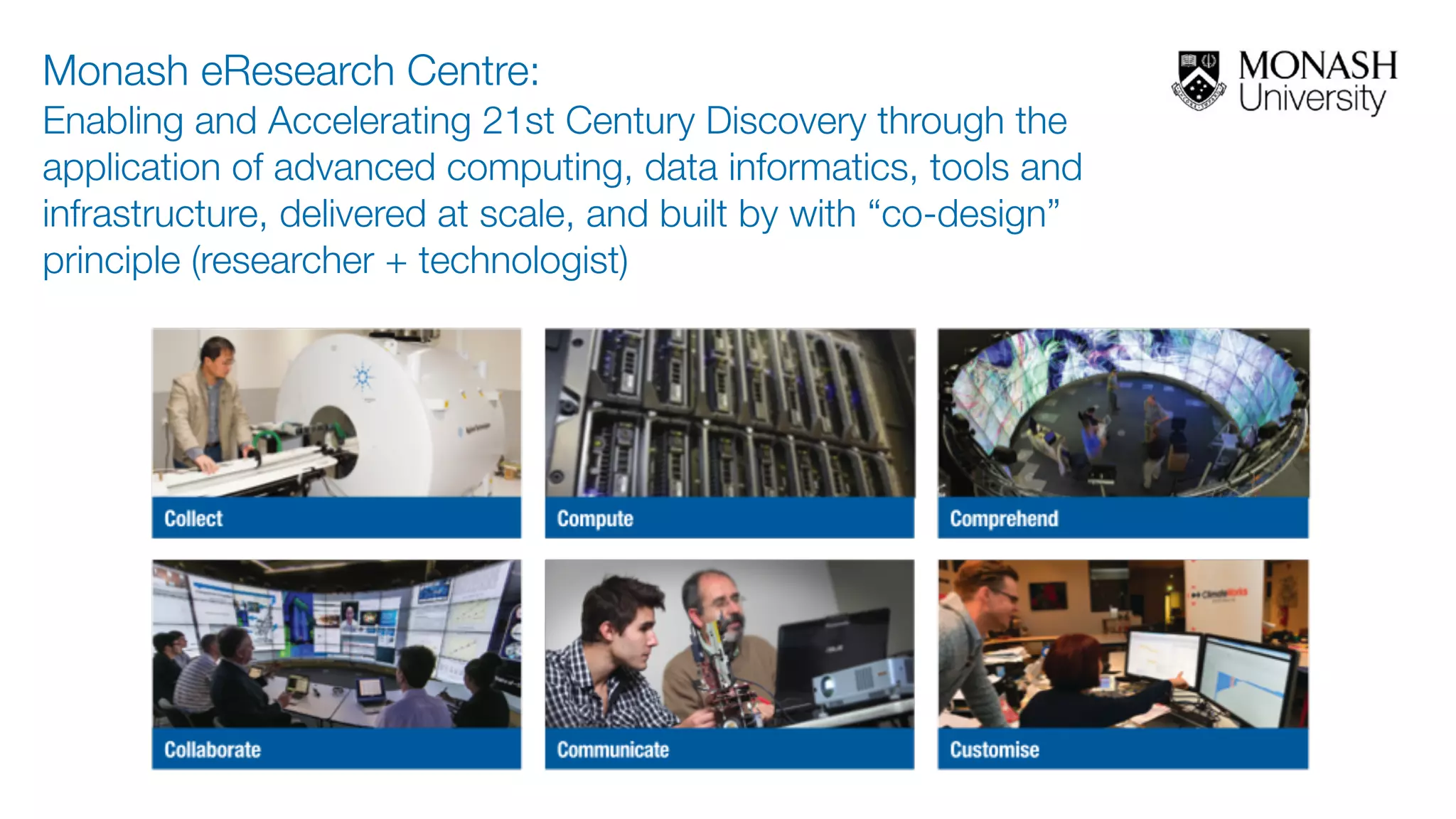
Monash eResearch Centre: 

Enabling and Accelerating 21st Century Discovery through the
application of advanced computing, data informatics, tools and
infrastructure, delivered at scale, and built by with “co-design”
principle (researcher + technologist)
bought to you by
MASSIVE Business Plan 2013 / 2014 DRAFT
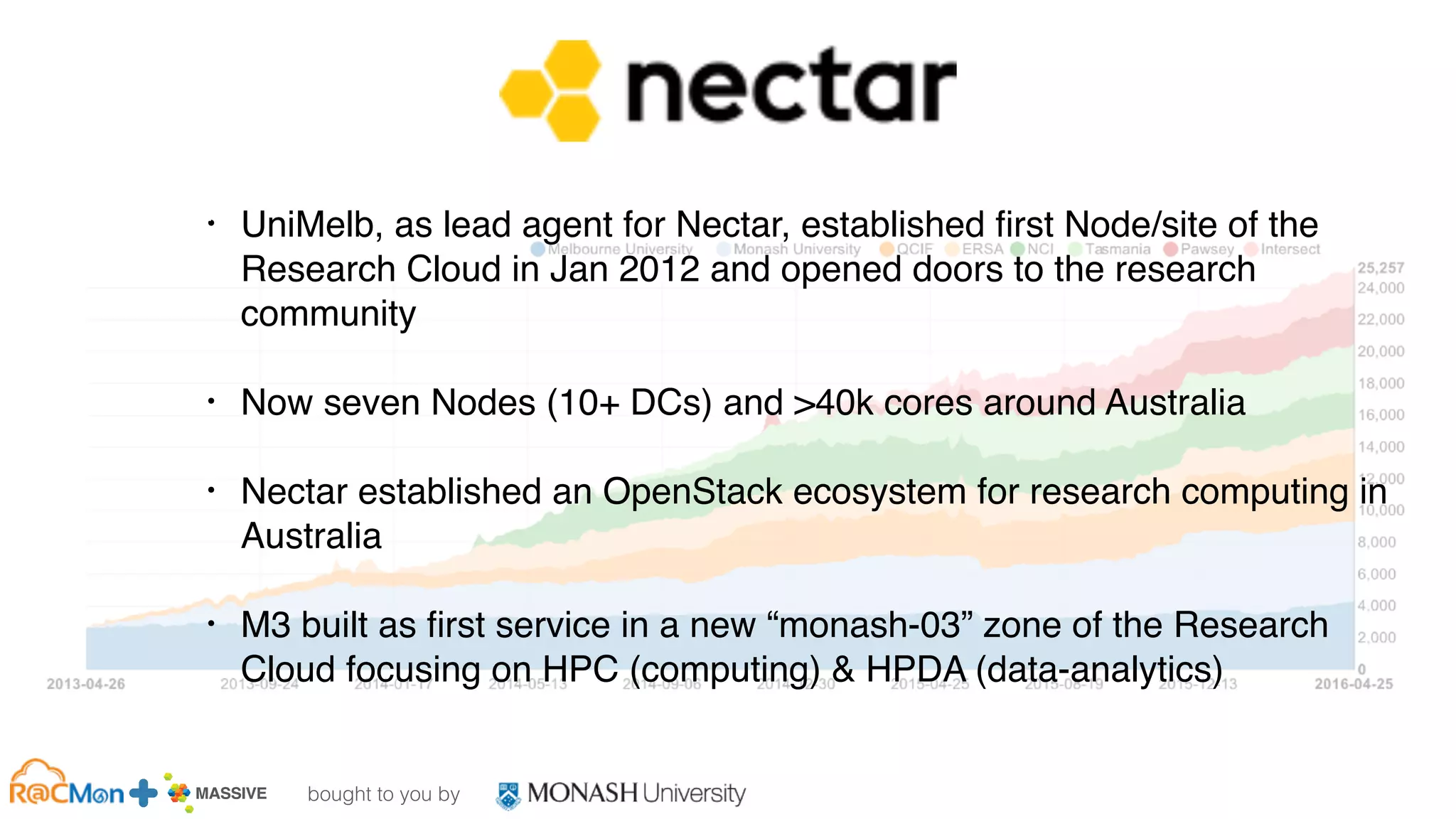
• UniMelb, as lead agent for Nectar, established first Node/site of the
Research Cloud in Jan 2012 and opened doors to the research
community
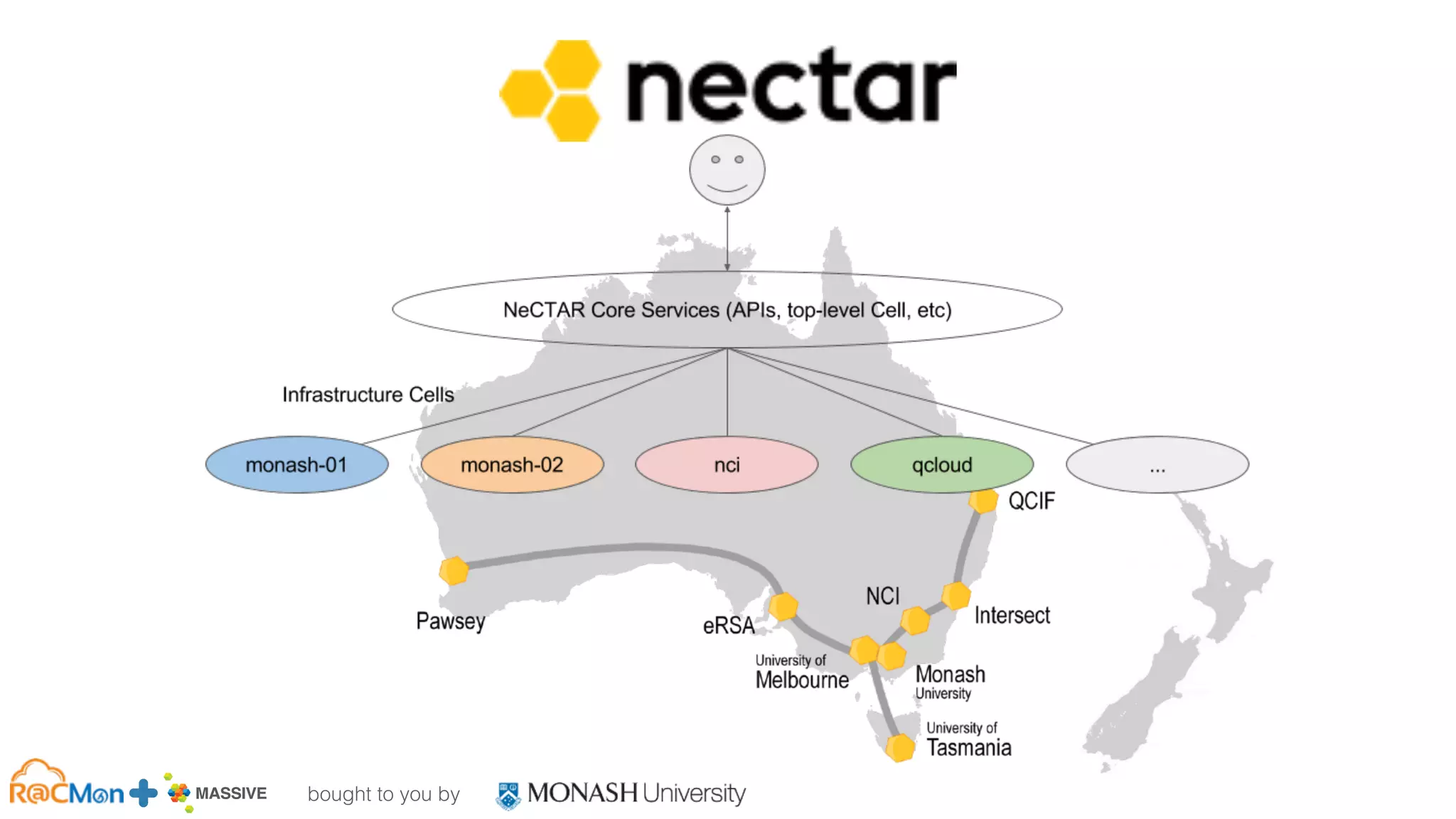
• Now seven Nodes (10+ DCs) and >40k cores around Australia
• Nectar established an OpenStack ecosystem for research computing in
Australia
• M3 built as first service in a new “monash-03” zone of the Research
Cloud focusing on HPC (computing) & HPDA (data-analytics)
bought to you by
MASSIVE Business Plan 2013 / 2014 DRAFT
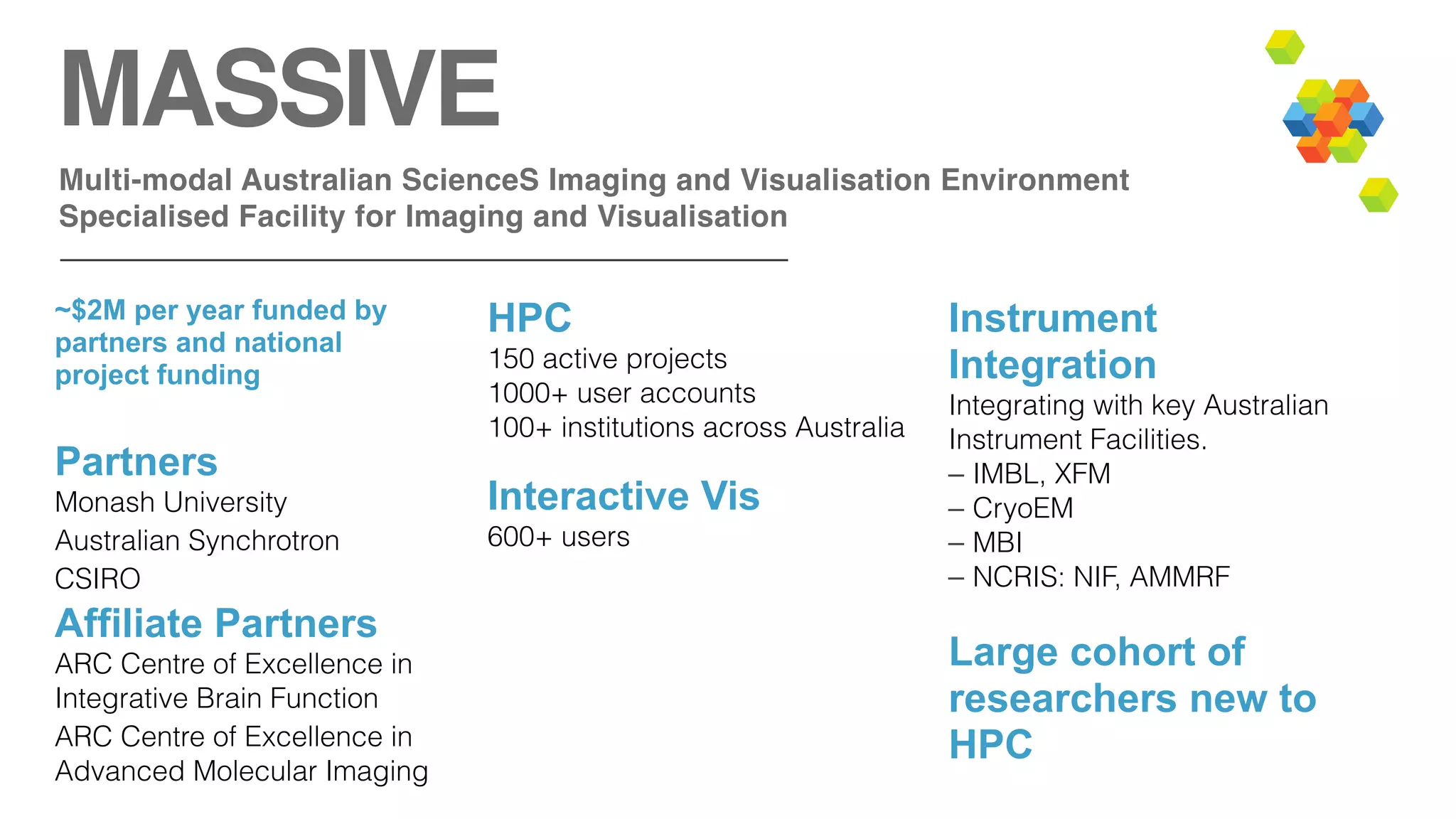
HPC
150 active projects
1000+ user accounts
100+ institutions across Australia
Interactive Vis
600+ users
Multi-modal Australian ScienceS Imaging and Visualisation Environment
Specialised Facility for Imaging and Visualisation
MASSIVE
Instrument

Integration
Integrating with key Australian
Instrument Facilities.
– IMBL, XFM
– CryoEM
– MBI
– NCRIS: NIF, AMMRF
Large cohort of
researchers new to
HPC
~$2M per year funded by
partners and national
project funding
Partners
Monash University
Australian Synchrotron
CSIRO
Affiliate Partners
ARC Centre of Excellence in
Integrative Brain Function
ARC Centre of Excellence in
Advanced Molecular Imaging
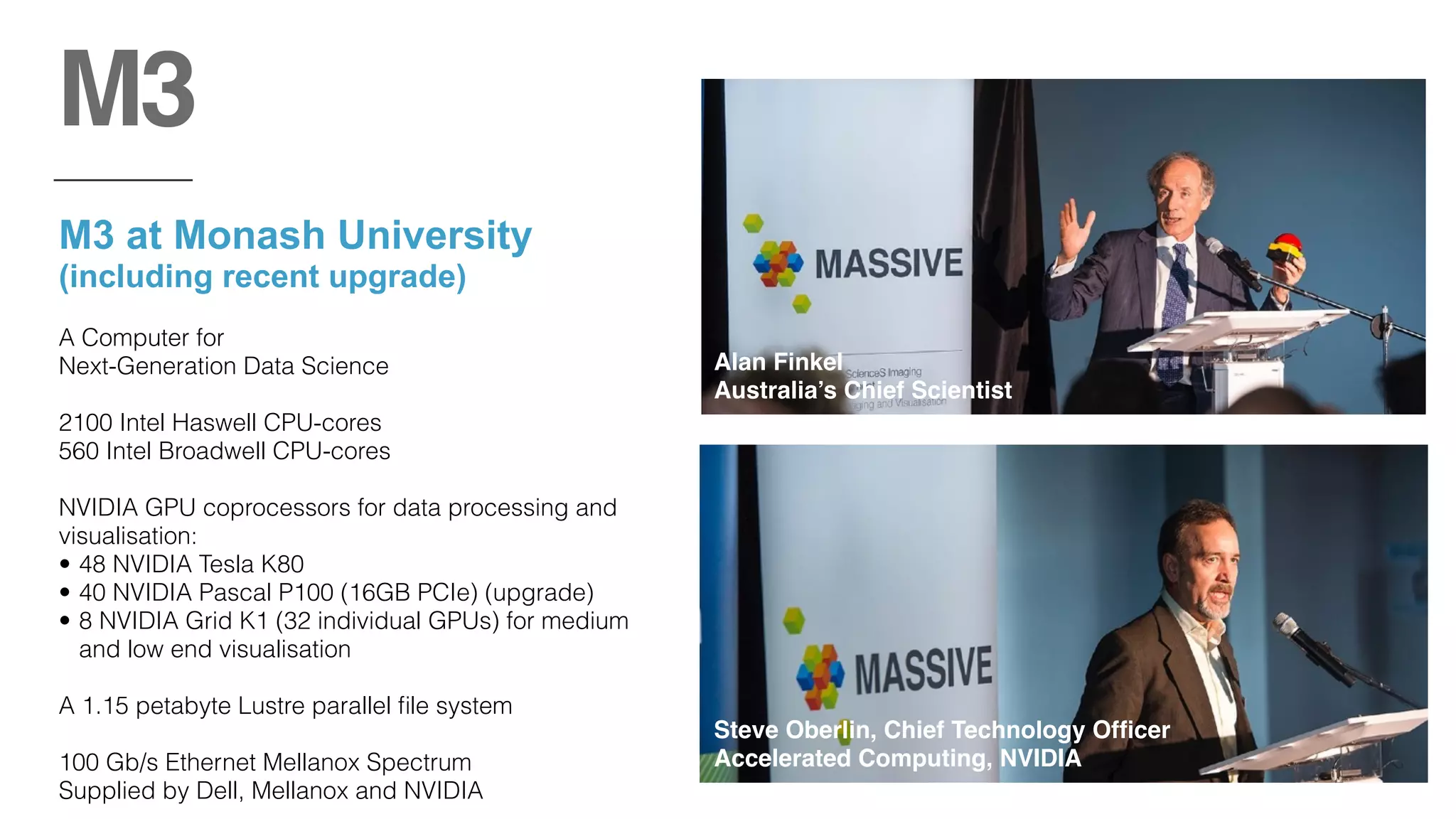
M3 at Monash University

(including recent upgrade)
A Computer for 

Next-Generation Data Science
2100 Intel Haswell CPU-cores
560 Intel Broadwell CPU-cores
NVIDIA GPU coprocessors for data processing and
visualisation:
• 48 NVIDIA Tesla K80
• 40 NVIDIA Pascal P100 (16GB PCIe) (upgrade)
• 8 NVIDIA Grid K1 (32 individual GPUs) for medium
and low end visualisation
A 1.15 petabyte Lustre parallel file system
100 Gb/s Ethernet Mellanox Spectrum
Supplied by Dell, Mellanox and NVIDIA
M3
Steve Oberlin, Chief Technology Officer
Accelerated Computing, NVIDIA
Alan Finkel 

Australia’s Chief Scientist
bought to you by
MASSIVE Business Plan 2013 / 2014 DRAFT
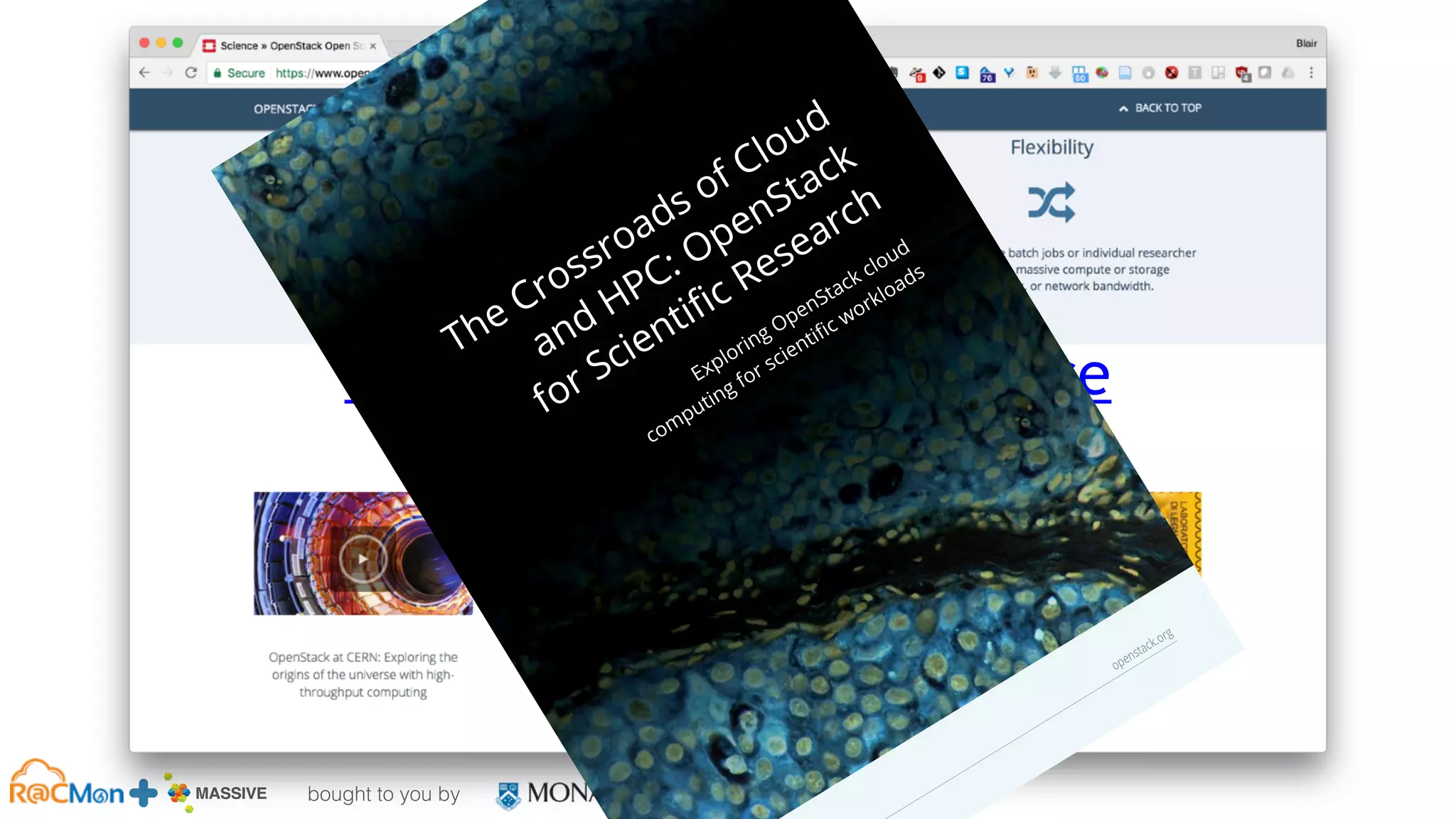
www.openstack.org/science
openstack.org
The Crossroads of Cloud
and HPC: OpenStack
for Scientific Research
Exploring OpenStack cloud
computing for scientific workloads
bought to you by
MASSIVE Business Plan 2013 / 2014 DRAFT
Why OpenStack
‣Heterogeneous user requirements
‣same underlying infrastructure can be expanded to
accommodate multiple distinct and dynamic clusters (e.g.
bioinformatics focused, Hadoop)
‣Clusters need provisioning systems anyway
‣Forcing the cluster to be cloud-provisioning and managed makes it
easier to leverage other cloud resources e.g. community science
cloud, commercial cloud
‣OpenStack is a big focus of innovation and effort in the industry -
benefits of association and osmosis
‣Business function boundaries at the APIs
?
bought to you by
MASSIVE Business Plan 2013 / 2014 DRAFT
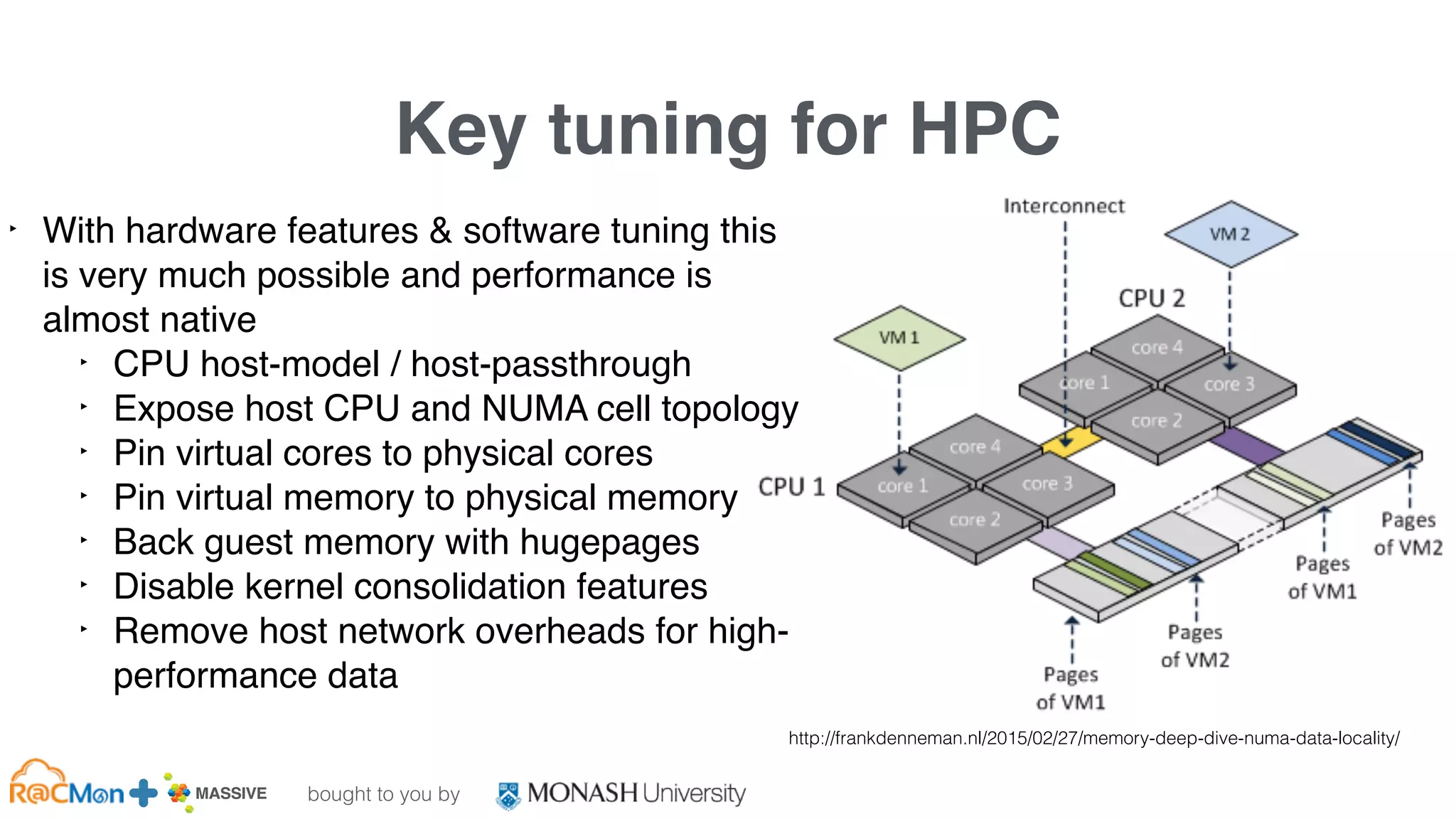
Key tuning for HPC
‣ With hardware features & software tuning this
is very much possible and performance is
almost native
‣ CPU host-model / host-passthrough
‣ Expose host CPU and NUMA cell topology
‣ Pin virtual cores to physical cores
‣ Pin virtual memory to physical memory
‣ Back guest memory with hugepages
‣ Disable kernel consolidation features
‣ Remove host network overheads for high-
performance data
http://frankdenneman.nl/2015/02/27/memory-deep-dive-numa-data-locality/
bought to you by
MASSIVE Business Plan 2013 / 2014 DRAFT
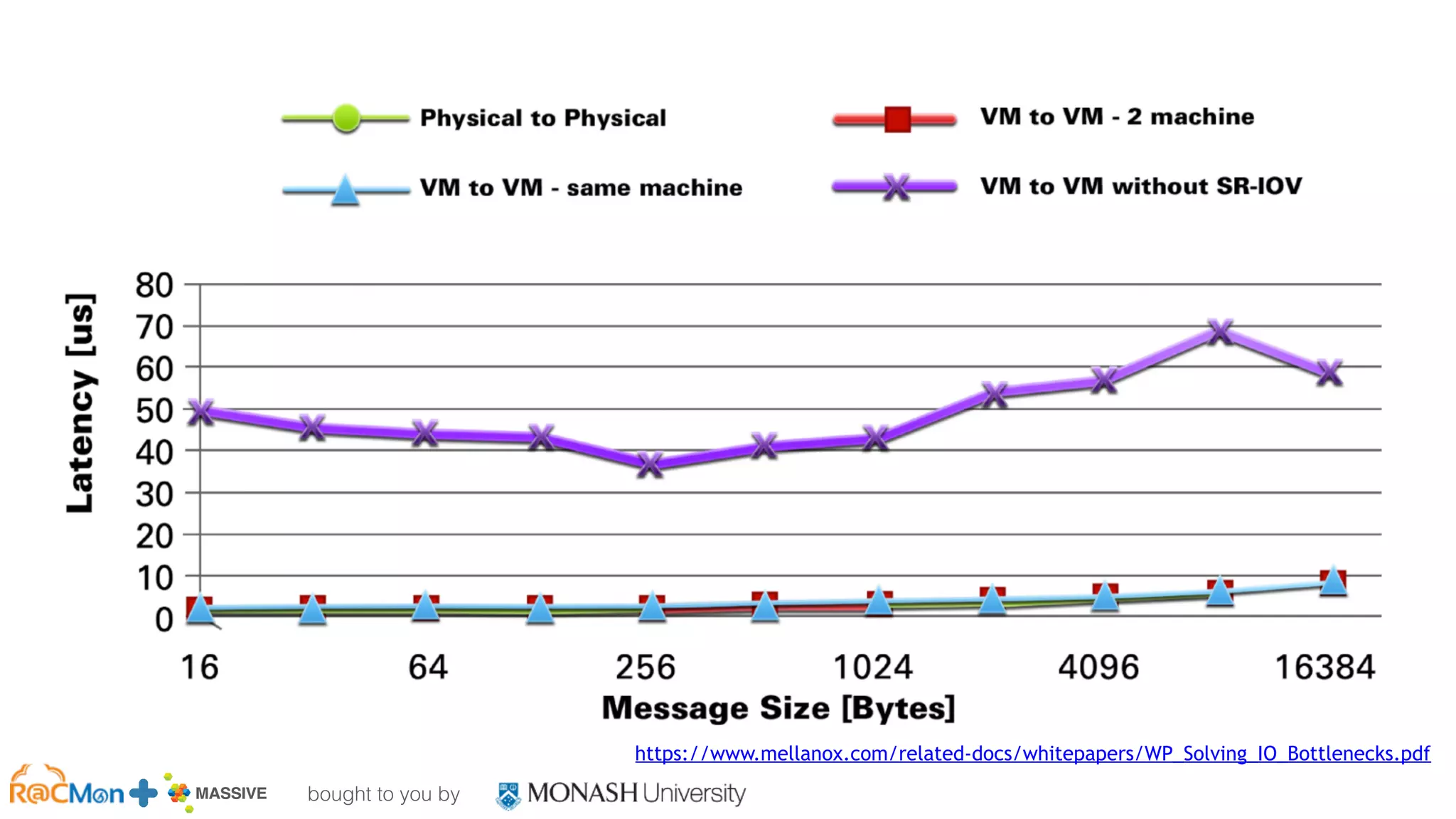
https://www.mellanox.com/related-docs/whitepapers/WP_Solving_IO_Bottlenecks.pdf
bought to you by
MASSIVE Business Plan 2013 / 2014 DRAFT
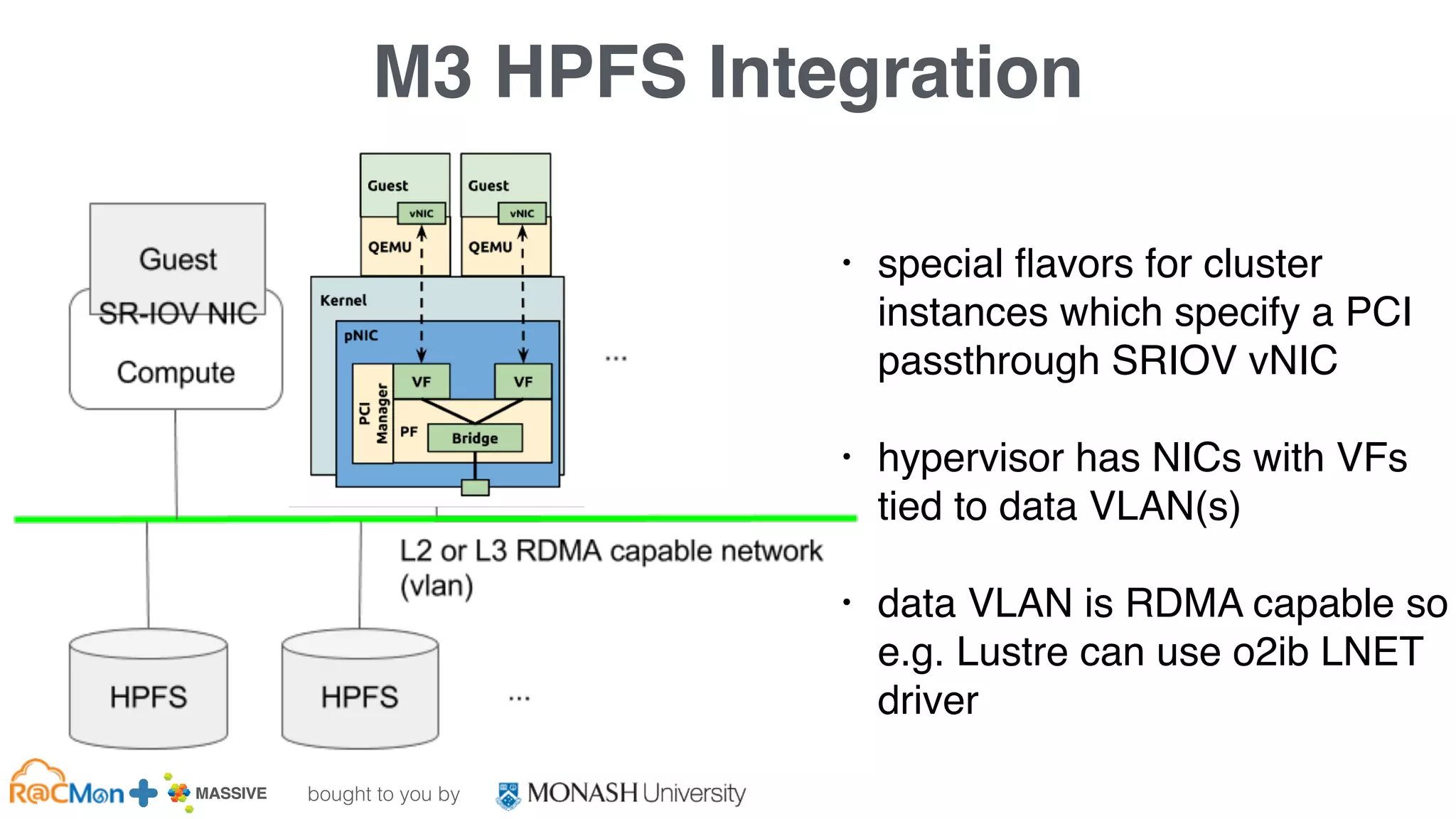
M3 HPFS Integration
• special flavors for cluster
instances which specify a PCI
passthrough SRIOV vNIC
• hypervisor has NICs with VFs
tied to data VLAN(s)
• data VLAN is RDMA capable so
e.g. Lustre can use o2ib LNET
driver
bought to you by
MASSIVE Business Plan 2013 / 2014 DRAFT
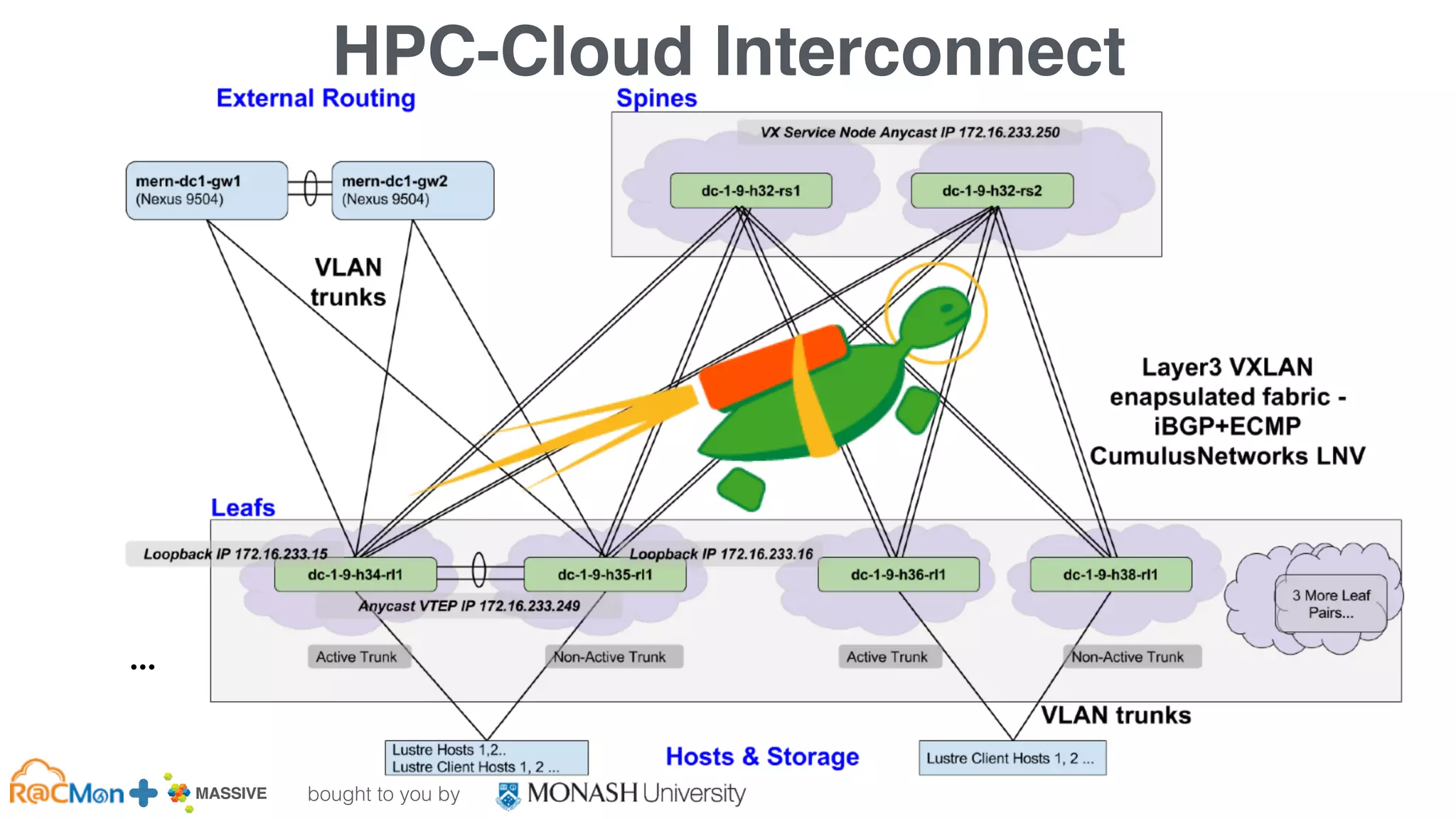
HPC-Cloud Interconnect
…
bought to you by
MASSIVE Business Plan 2013 / 2014 DRAFT
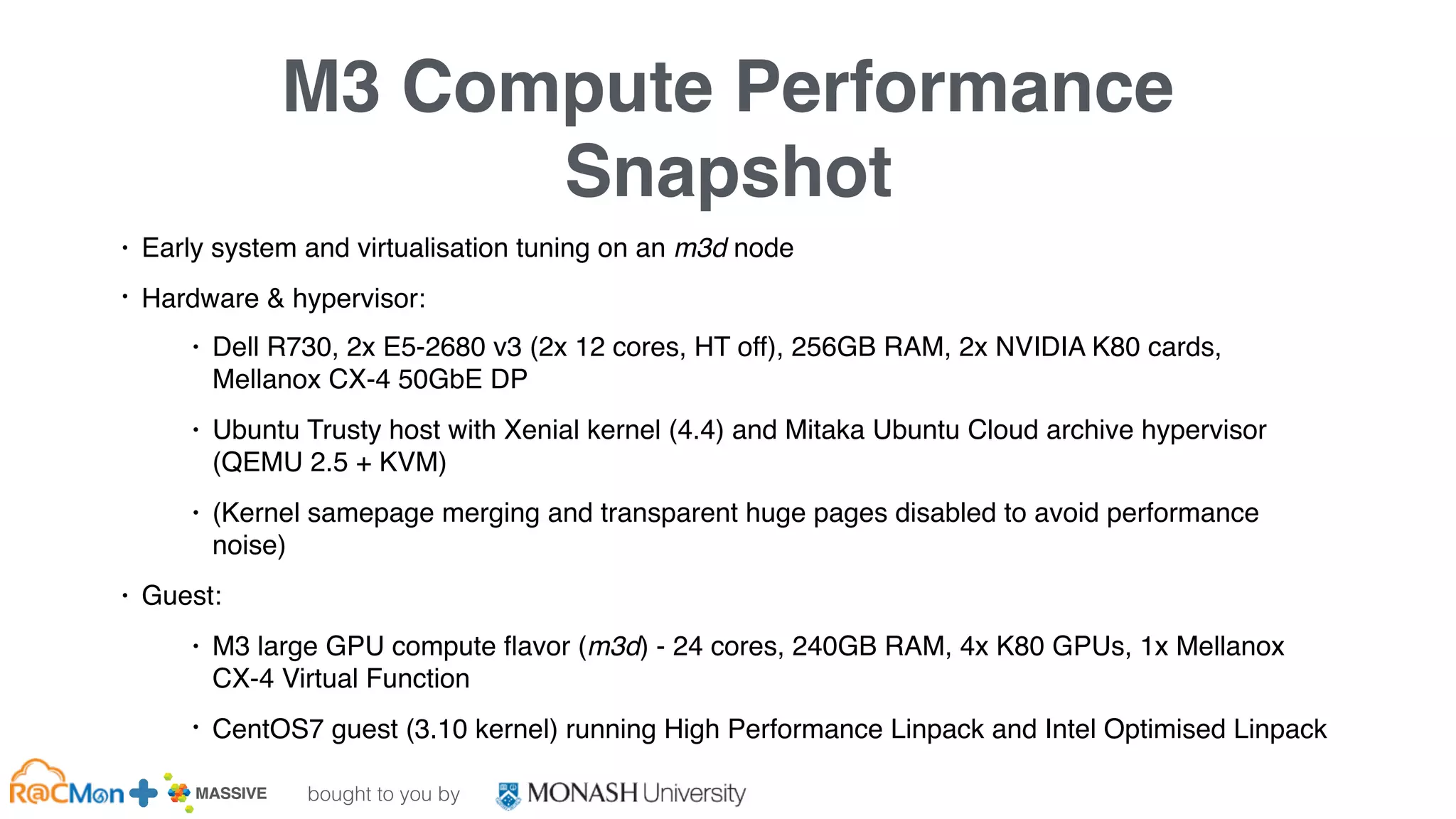
M3 Compute Performance
Snapshot
• Early system and virtualisation tuning on an m3d node
• Hardware & hypervisor:
• Dell R730, 2x E5-2680 v3 (2x 12 cores, HT off), 256GB RAM, 2x NVIDIA K80 cards,
Mellanox CX-4 50GbE DP
• Ubuntu Trusty host with Xenial kernel (4.4) and Mitaka Ubuntu Cloud archive hypervisor
(QEMU 2.5 + KVM)
• (Kernel samepage merging and transparent huge pages disabled to avoid performance
noise)
• Guest:
• M3 large GPU compute flavor (m3d) - 24 cores, 240GB RAM, 4x K80 GPUs, 1x Mellanox
CX-4 Virtual Function
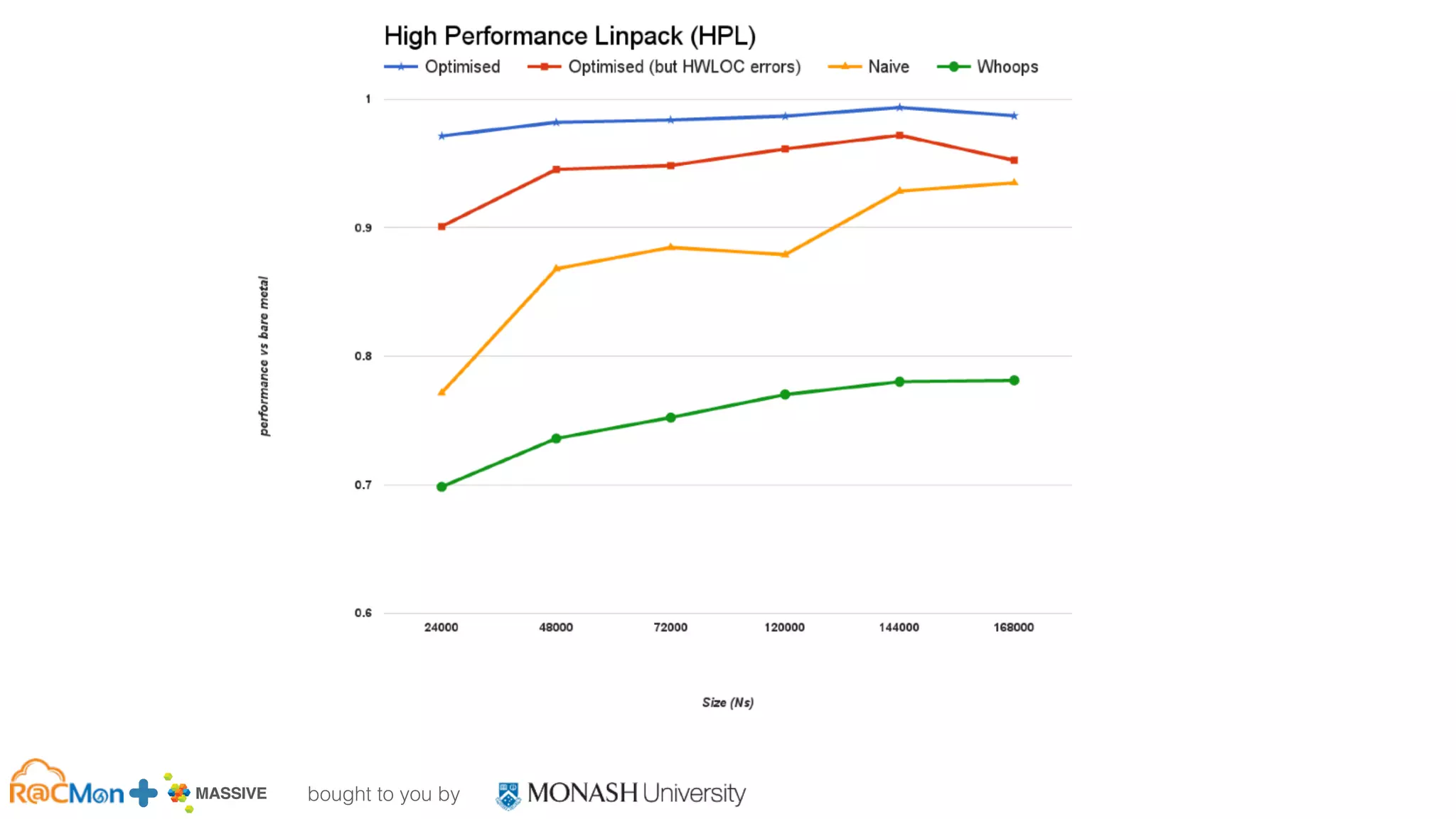
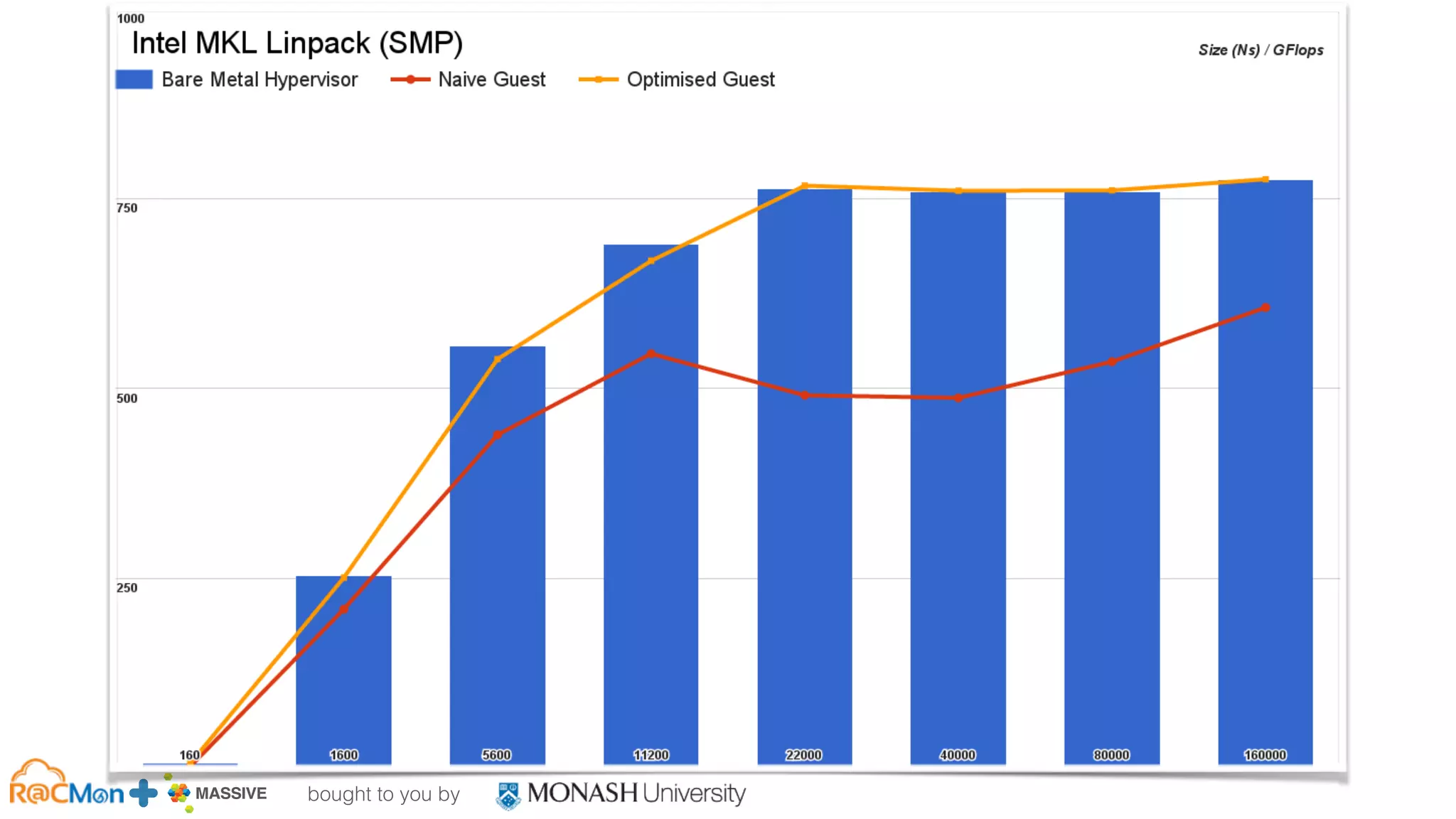
• CentOS7 guest (3.10 kernel) running High Performance Linpack and Intel Optimised Linpack
bought to you by
MASSIVE Business Plan 2013 / 2014 DRAFT
bought to you by
MASSIVE Business Plan 2013 / 2014 DRAFT
bought to you by
MASSIVE Business Plan 2013 / 2014 DRAFT
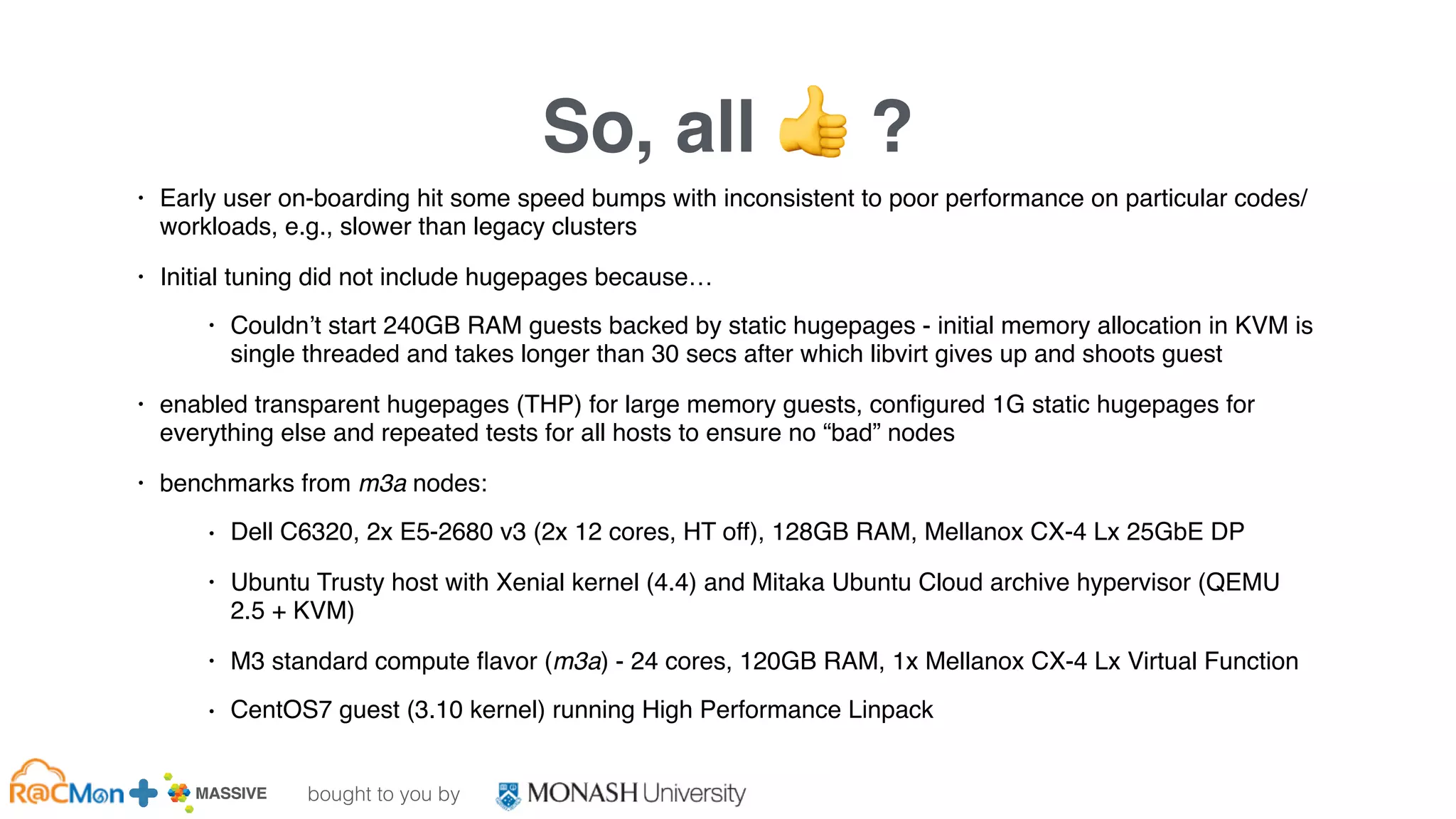
So, all 👍 ?
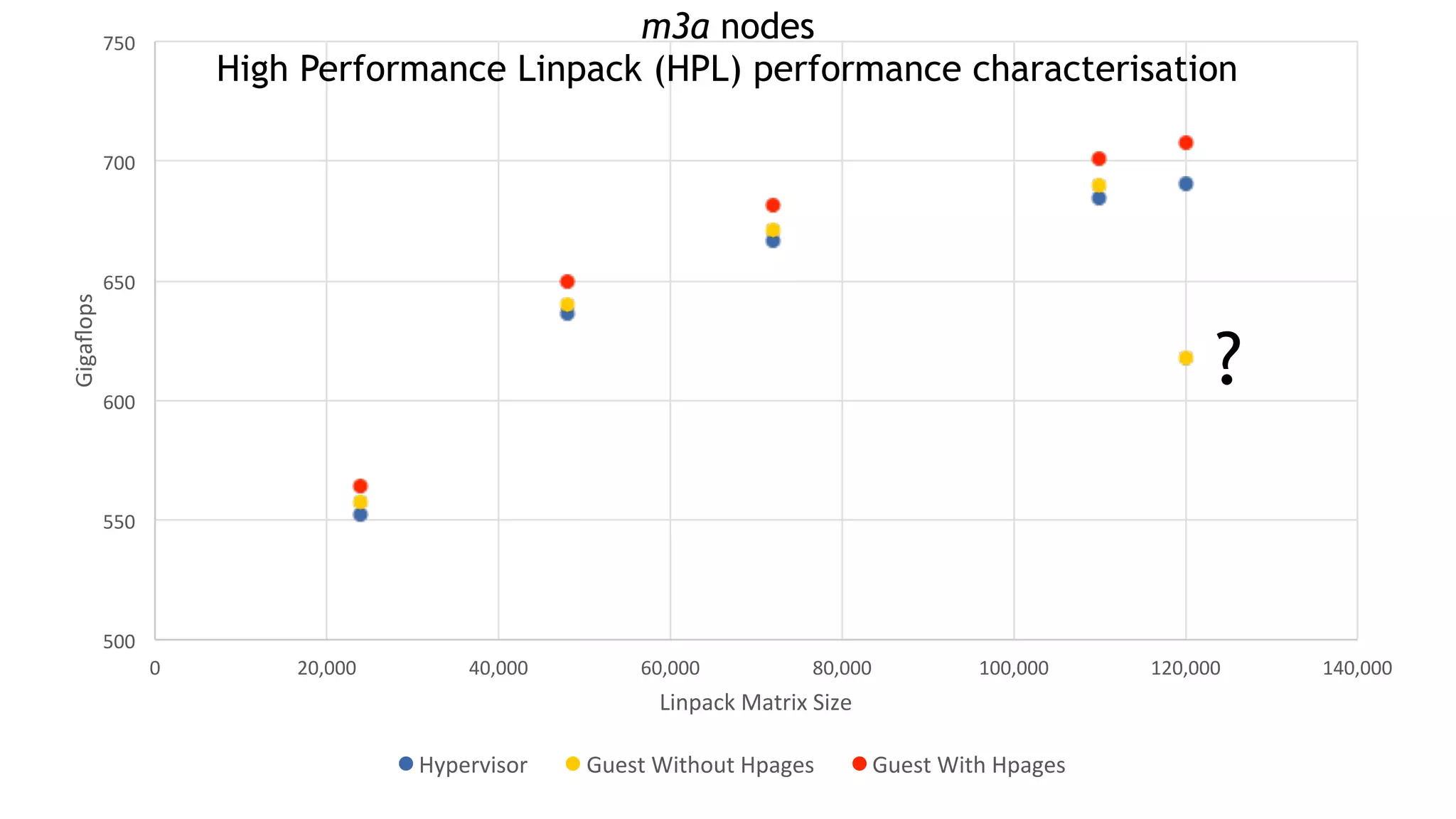
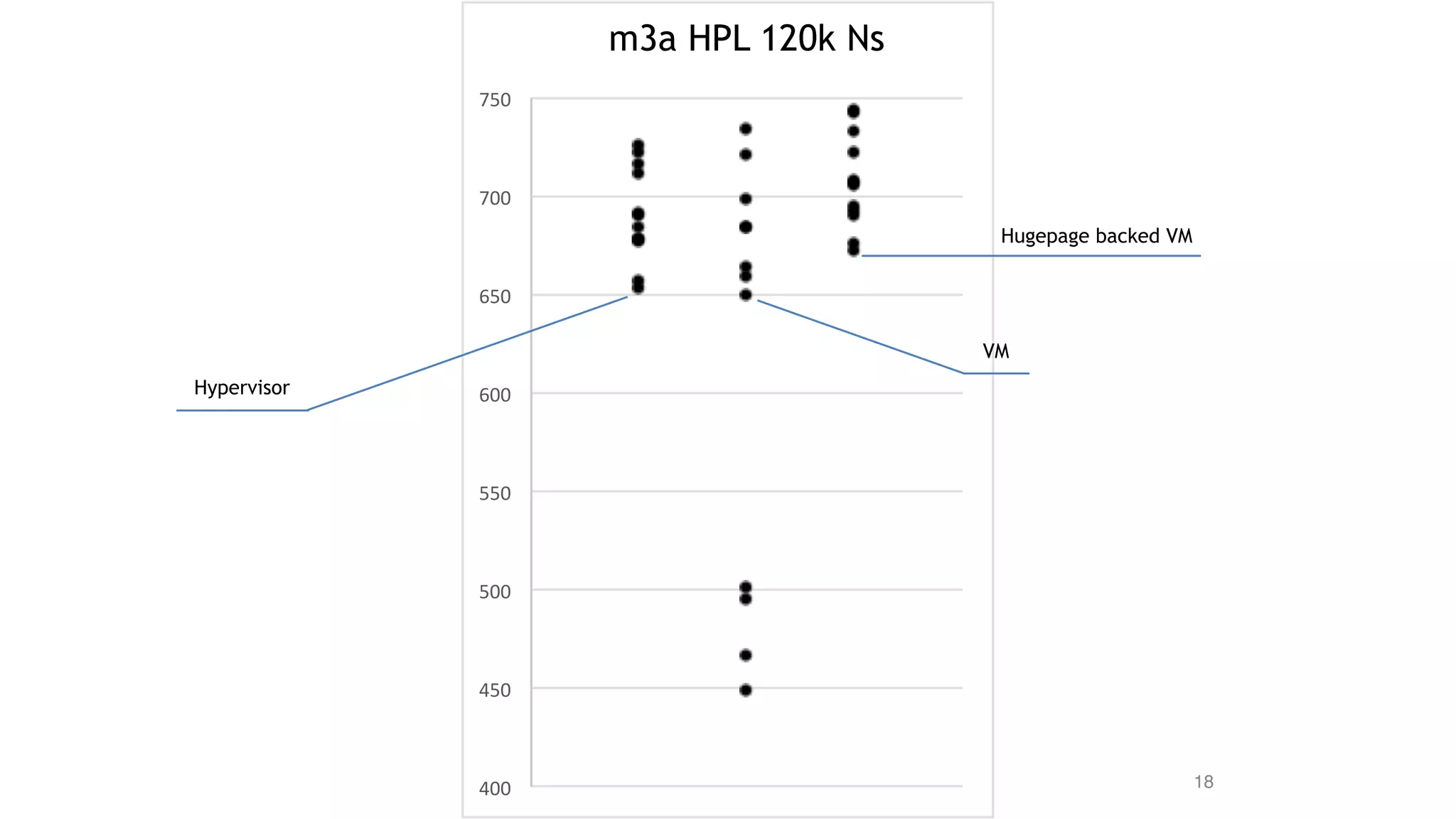
• Early user on-boarding hit some speed bumps with inconsistent to poor performance on particular codes/
workloads, e.g., slower than legacy clusters
• Initial tuning did not include hugepages because…
• Couldn’t start 240GB RAM guests backed by static hugepages - initial memory allocation in KVM is
single threaded and takes longer than 30 secs after which libvirt gives up and shoots guest
• enabled transparent hugepages (THP) for large memory guests, configured 1G static hugepages for
everything else and repeated tests for all hosts to ensure no “bad” nodes
• benchmarks from m3a nodes:
• Dell C6320, 2x E5-2680 v3 (2x 12 cores, HT off), 128GB RAM, Mellanox CX-4 Lx 25GbE DP
• Ubuntu Trusty host with Xenial kernel (4.4) and Mitaka Ubuntu Cloud archive hypervisor (QEMU
2.5 + KVM)
• M3 standard compute flavor (m3a) - 24 cores, 120GB RAM, 1x Mellanox CX-4 Lx Virtual Function
• CentOS7 guest (3.10 kernel) running High Performance Linpack
17
500	
550	
600	
650	
700	
750	
0	 20,000	 40,000	 60,000	 80,000	 100,000	 120,000	 140,000	
Gigaflops	
Linpack	Matrix	Size	
Hypervisor	 Guest	Without	Hpages	 Guest	With	Hpages	
m3a nodes
High Performance Linpack (HPL) performance characterisation
?
18400	
450	
500	
550	
600	
650	
700	
750	
120,000	
Hypervisor
VM
Hugepage backed VM
m3a HPL 120k Ns
bought to you by
MASSIVE Business Plan 2013 / 2014 DRAFT
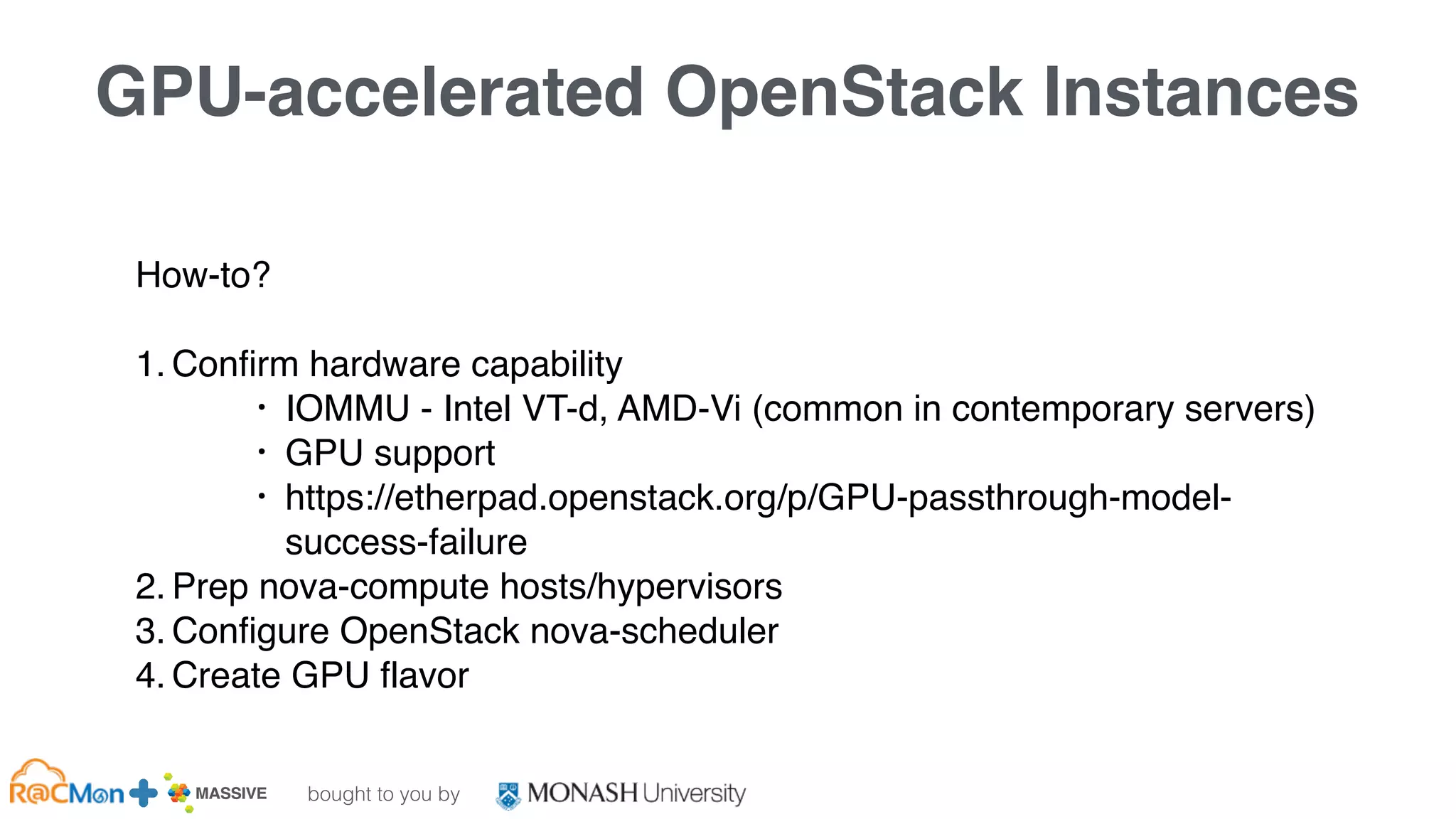
GPU-accelerated OpenStack Instances
How-to?
1. Confirm hardware capability
• IOMMU - Intel VT-d, AMD-Vi (common in contemporary servers)
• GPU support
• https://etherpad.openstack.org/p/GPU-passthrough-model-
success-failure
2. Prep nova-compute hosts/hypervisors
3. Configure OpenStack nova-scheduler
4. Create GPU flavor
bought to you by
MASSIVE Business Plan 2013 / 2014 DRAFT
GPU-accelerated OpenStack Instances
1. Confirm hardware capability
2. Prep compute hosts/hypervisors
1. ensure IOMMU is enabled in BIOS
2. enable IOMMU in Linux, e.g., for Intel:
3. ensure no other drivers/modules claim GPUs, e.g., blacklist
nouveau
4. Configure nova-compute.conf pci_passthrough_whitelist:
# in /etc/default/grub:
GRUB_CMDLINE_LINUX_DEFAULT="quiet splash intel_iommu=on iommu=pt rd.modules-
load=vfio-pci”
~$ update-grub
~$ lspci -nn | grep NVIDIA
03:00.0 3D controller [0302]: NVIDIA Corporation Device [10de:15f8] (rev a1)
82:00.0 3D controller [0302]: NVIDIA Corporation Device [10de:15f8] (rev a1)
# in /etc/nova/nova.conf:
pci_passthrough_whitelist=[{"vendor_id":"10de", "product_id":"15f8"}]
bought to you by
MASSIVE Business Plan 2013 / 2014 DRAFT
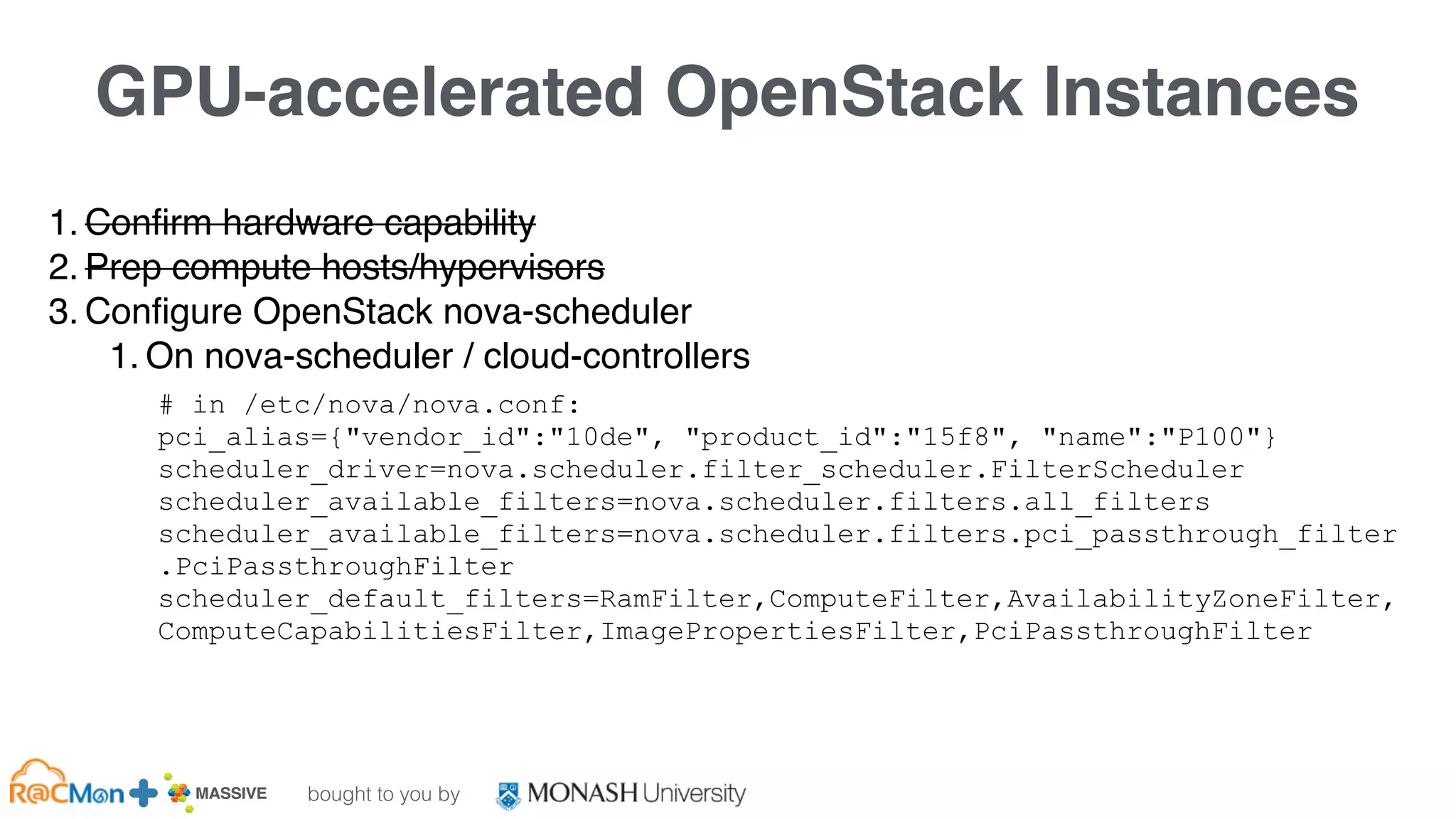
GPU-accelerated OpenStack Instances
1. Confirm hardware capability
2. Prep compute hosts/hypervisors
3. Configure OpenStack nova-scheduler
1. On nova-scheduler / cloud-controllers
# in /etc/nova/nova.conf:
pci_alias={"vendor_id":"10de", "product_id":"15f8", "name":"P100"}
scheduler_driver=nova.scheduler.filter_scheduler.FilterScheduler
scheduler_available_filters=nova.scheduler.filters.all_filters
scheduler_available_filters=nova.scheduler.filters.pci_passthrough_filter
.PciPassthroughFilter
scheduler_default_filters=RamFilter,ComputeFilter,AvailabilityZoneFilter,
ComputeCapabilitiesFilter,ImagePropertiesFilter,PciPassthroughFilter
bought to you by
MASSIVE Business Plan 2013 / 2014 DRAFT
GPU-accelerated OpenStack Instances
1. Confirm hardware capability
2. Prep compute hosts/hypervisors
3. Configure OpenStack nova-scheduler
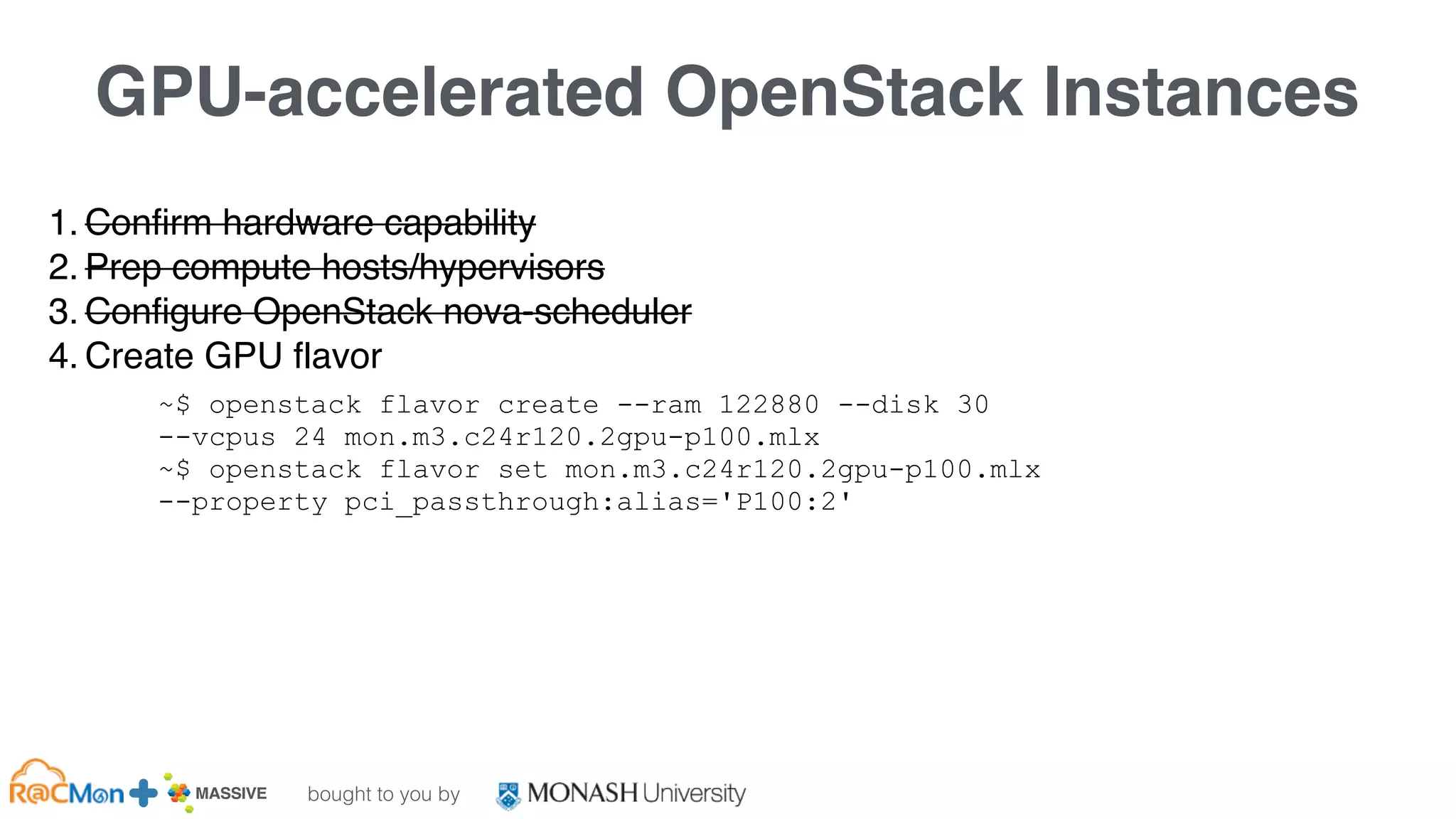
4. Create GPU flavor
~$ openstack flavor create --ram 122880 --disk 30
--vcpus 24 mon.m3.c24r120.2gpu-p100.mlx
~$ openstack flavor set mon.m3.c24r120.2gpu-p100.mlx
--property pci_passthrough:alias='P100:2'
bought to you by
MASSIVE Business Plan 2013 / 2014 DRAFT
GPU-accelerated OpenStack Instances
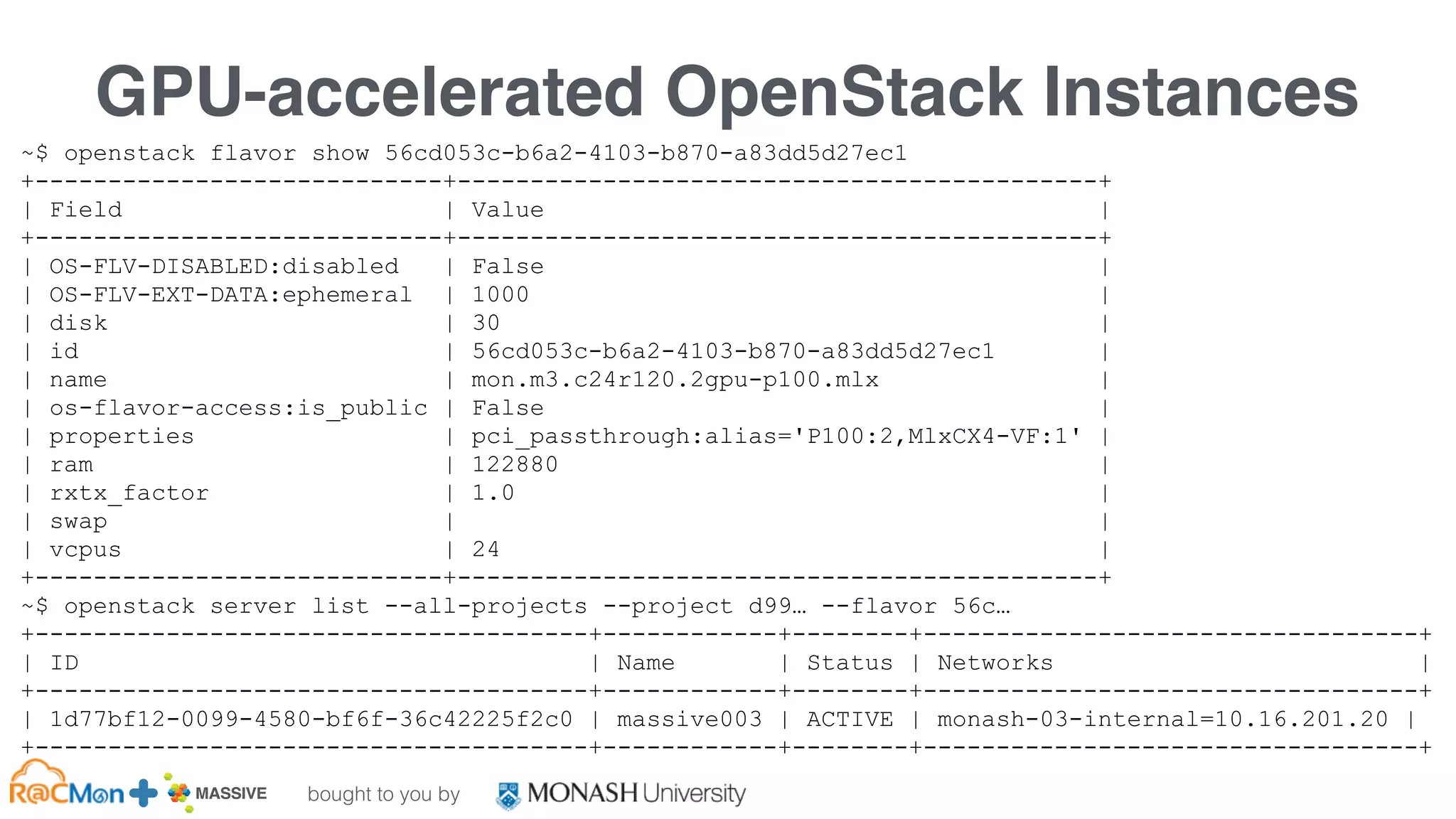
~$ openstack flavor show 56cd053c-b6a2-4103-b870-a83dd5d27ec1
+----------------------------+--------------------------------------------+
| Field | Value |
+----------------------------+--------------------------------------------+
| OS-FLV-DISABLED:disabled | False |
| OS-FLV-EXT-DATA:ephemeral | 1000 |
| disk | 30 |
| id | 56cd053c-b6a2-4103-b870-a83dd5d27ec1 |
| name | mon.m3.c24r120.2gpu-p100.mlx |
| os-flavor-access:is_public | False |
| properties | pci_passthrough:alias='P100:2,MlxCX4-VF:1' |
| ram | 122880 |
| rxtx_factor | 1.0 |
| swap | |
| vcpus | 24 |
+----------------------------+--------------------------------------------+
~$ openstack server list --all-projects --project d99… --flavor 56c…
+--------------------------------------+------------+--------+----------------------------------+
| ID | Name | Status | Networks |
+--------------------------------------+------------+--------+----------------------------------+
| 1d77bf12-0099-4580-bf6f-36c42225f2c0 | massive003 | ACTIVE | monash-03-internal=10.16.201.20 |
+--------------------------------------+------------+--------+----------------------------------+
bought to you by
MASSIVE Business Plan 2013 / 2014 DRAFT
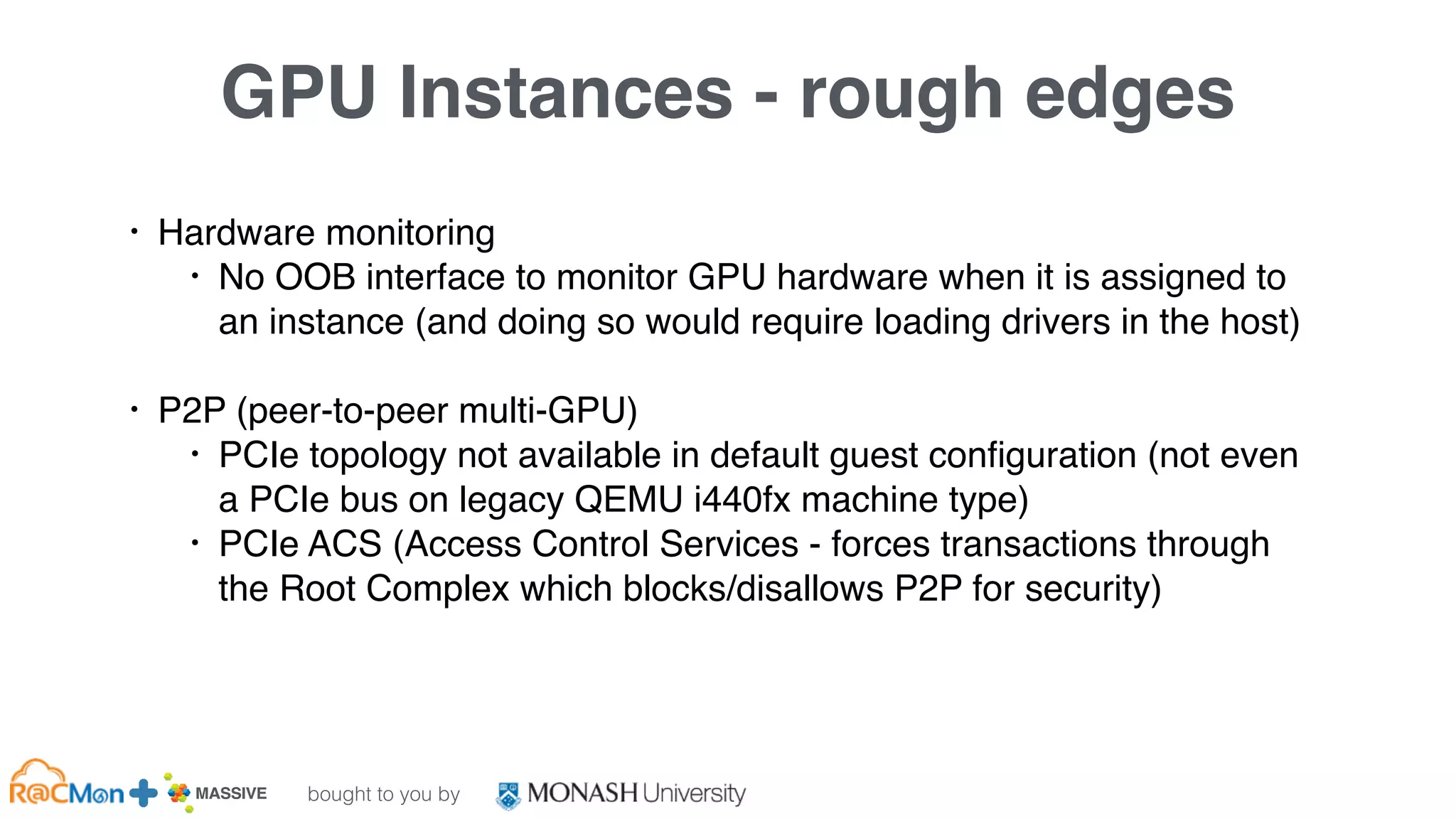
GPU Instances - rough edges
• Hardware monitoring
• No OOB interface to monitor GPU hardware when it is assigned to
an instance (and doing so would require loading drivers in the host)
• P2P (peer-to-peer multi-GPU)
• PCIe topology not available in default guest configuration (not even
a PCIe bus on legacy QEMU i440fx machine type)
• PCIe ACS (Access Control Services - forces transactions through
the Root Complex which blocks/disallows P2P for security)
bought to you by
MASSIVE Business Plan 2013 / 2014 DRAFT
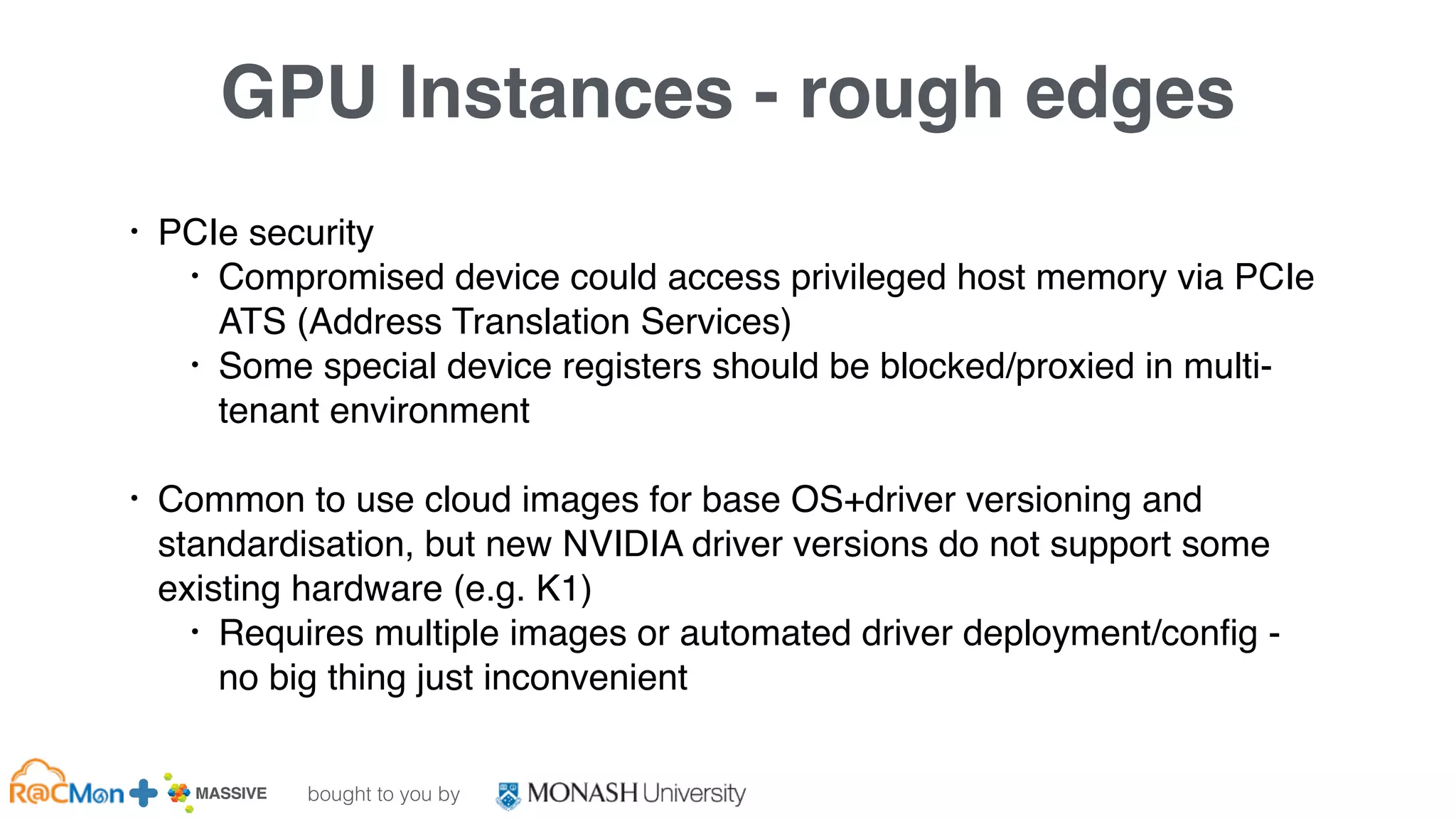
GPU Instances - rough edges
• PCIe security
• Compromised device could access privileged host memory via PCIe
ATS (Address Translation Services)
• Some special device registers should be blocked/proxied in multi-
tenant environment
• Common to use cloud images for base OS+driver versioning and
standardisation, but new NVIDIA driver versions do not support some
existing hardware (e.g. K1)
• Requires multiple images or automated driver deployment/config -
no big thing just inconvenient
bought to you by
MASSIVE Business Plan 2013 / 2014 DRAFT
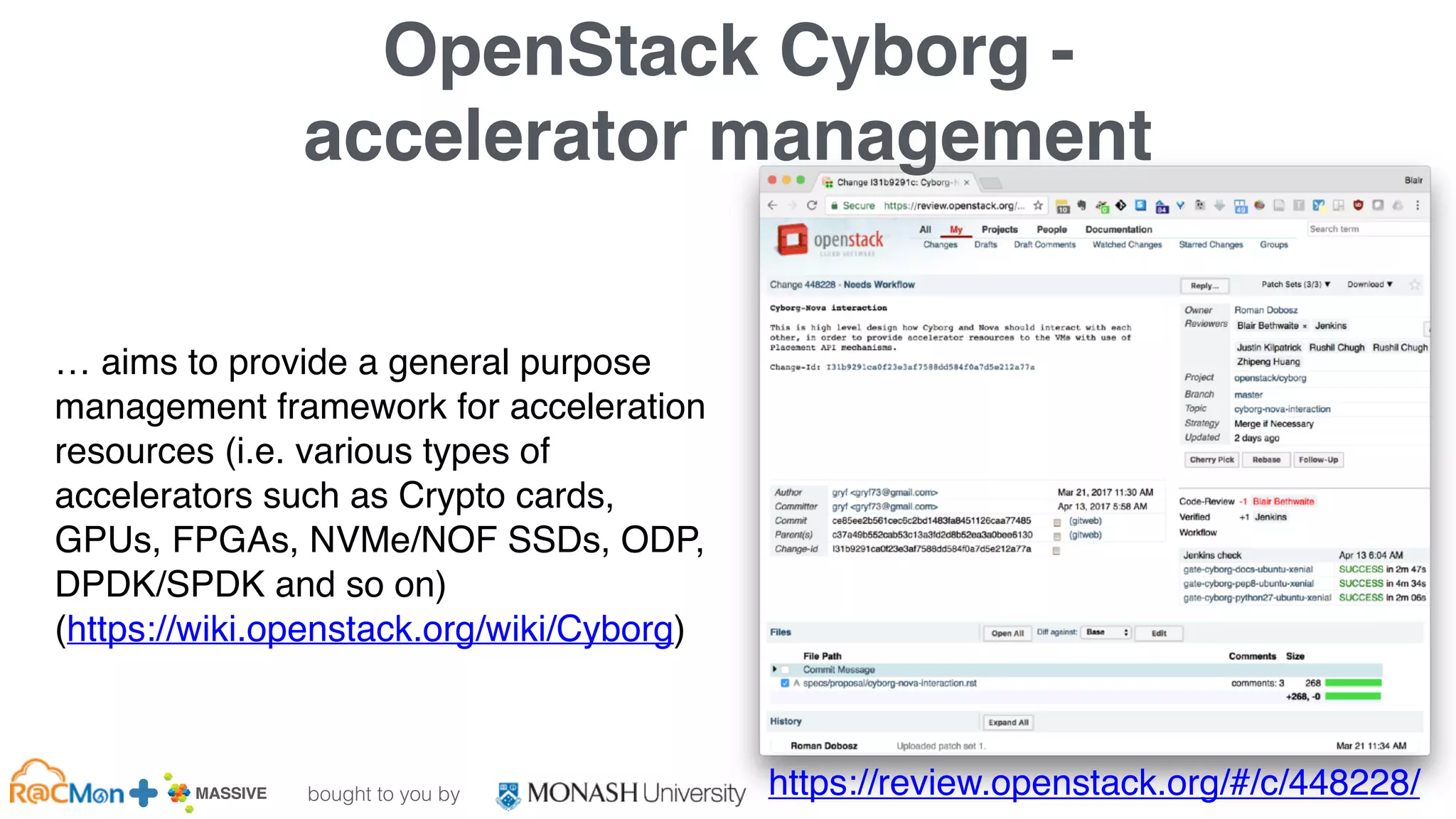
OpenStack Cyborg -
accelerator management
… aims to provide a general purpose
management framework for acceleration
resources (i.e. various types of
accelerators such as Crypto cards,
GPUs, FPGAs, NVMe/NOF SSDs, ODP,
DPDK/SPDK and so on)
(https://wiki.openstack.org/wiki/Cyborg)
https://review.openstack.org/#/c/448228/
Title: Business Plan for the Multi-modal Australian ScienceS Imaging and
Visualisation Environment (MASSIVE) 2013 / 2014
Document no: MASSIVE-BP-2.3 DRAFT
Date: June 2013
Prepared by: Name: Wojtek J Goscinski
Title: MASSIVE Coordinator
Approved by: Name: MASSIVE Steering Committee
Date:
Open IaaS:
Technology:
30/10/2015 1:59 pmMyTardis | Automatically stores your instrument data for sharing.
Menu
MyTardis Tech Group Meeting
#3
Posted on August 20, 2015August 20, 2015 by steve.androulakissteve.androulakis
It’s been months since the last one, so a wealth of activity to report on.
MyTardis
Automatically stores your instrument data for sharing.
Application layers:

Building a GPU-enabled OpenStack Cloud for HPC - Blair Bethwaite, Monash University

  • 1.
    Building a GPU-enabled OpenStackCloud for HPC Blair Bethwaite, Lance Wilson, (and many others) MONASH
 eRESEARCH
  • 2.
    Monash eResearch Centre:
 Enabling and Accelerating 21st Century Discovery through the application of advanced computing, data informatics, tools and infrastructure, delivered at scale, and built by with “co-design” principle (researcher + technologist)
  • 3.
    bought to youby MASSIVE Business Plan 2013 / 2014 DRAFT • UniMelb, as lead agent for Nectar, established first Node/site of the Research Cloud in Jan 2012 and opened doors to the research community • Now seven Nodes (10+ DCs) and >40k cores around Australia • Nectar established an OpenStack ecosystem for research computing in Australia • M3 built as first service in a new “monash-03” zone of the Research Cloud focusing on HPC (computing) & HPDA (data-analytics)
  • 4.
    bought to youby MASSIVE Business Plan 2013 / 2014 DRAFT
  • 5.
    HPC 150 active projects 1000+user accounts 100+ institutions across Australia Interactive Vis 600+ users Multi-modal Australian ScienceS Imaging and Visualisation Environment Specialised Facility for Imaging and Visualisation MASSIVE Instrument
 Integration Integrating with key Australian Instrument Facilities. – IMBL, XFM – CryoEM – MBI – NCRIS: NIF, AMMRF Large cohort of researchers new to HPC ~$2M per year funded by partners and national project funding Partners Monash University Australian Synchrotron CSIRO Affiliate Partners ARC Centre of Excellence in Integrative Brain Function ARC Centre of Excellence in Advanced Molecular Imaging
  • 6.
    M3 at MonashUniversity
 (including recent upgrade) A Computer for 
 Next-Generation Data Science 2100 Intel Haswell CPU-cores 560 Intel Broadwell CPU-cores NVIDIA GPU coprocessors for data processing and visualisation: • 48 NVIDIA Tesla K80 • 40 NVIDIA Pascal P100 (16GB PCIe) (upgrade) • 8 NVIDIA Grid K1 (32 individual GPUs) for medium and low end visualisation A 1.15 petabyte Lustre parallel file system 100 Gb/s Ethernet Mellanox Spectrum Supplied by Dell, Mellanox and NVIDIA M3 Steve Oberlin, Chief Technology Officer Accelerated Computing, NVIDIA Alan Finkel 
 Australia’s Chief Scientist
  • 7.
    bought to youby MASSIVE Business Plan 2013 / 2014 DRAFT www.openstack.org/science openstack.org The Crossroads of Cloud and HPC: OpenStack for Scientific Research Exploring OpenStack cloud computing for scientific workloads
  • 8.
    bought to youby MASSIVE Business Plan 2013 / 2014 DRAFT Why OpenStack ‣Heterogeneous user requirements ‣same underlying infrastructure can be expanded to accommodate multiple distinct and dynamic clusters (e.g. bioinformatics focused, Hadoop) ‣Clusters need provisioning systems anyway ‣Forcing the cluster to be cloud-provisioning and managed makes it easier to leverage other cloud resources e.g. community science cloud, commercial cloud ‣OpenStack is a big focus of innovation and effort in the industry - benefits of association and osmosis ‣Business function boundaries at the APIs ?
  • 9.
    bought to youby MASSIVE Business Plan 2013 / 2014 DRAFT Key tuning for HPC ‣ With hardware features & software tuning this is very much possible and performance is almost native ‣ CPU host-model / host-passthrough ‣ Expose host CPU and NUMA cell topology ‣ Pin virtual cores to physical cores ‣ Pin virtual memory to physical memory ‣ Back guest memory with hugepages ‣ Disable kernel consolidation features ‣ Remove host network overheads for high- performance data http://frankdenneman.nl/2015/02/27/memory-deep-dive-numa-data-locality/
  • 10.
    bought to youby MASSIVE Business Plan 2013 / 2014 DRAFT https://www.mellanox.com/related-docs/whitepapers/WP_Solving_IO_Bottlenecks.pdf
  • 11.
    bought to youby MASSIVE Business Plan 2013 / 2014 DRAFT M3 HPFS Integration • special flavors for cluster instances which specify a PCI passthrough SRIOV vNIC • hypervisor has NICs with VFs tied to data VLAN(s) • data VLAN is RDMA capable so e.g. Lustre can use o2ib LNET driver
  • 12.
    bought to youby MASSIVE Business Plan 2013 / 2014 DRAFT HPC-Cloud Interconnect …
  • 13.
    bought to youby MASSIVE Business Plan 2013 / 2014 DRAFT M3 Compute Performance Snapshot • Early system and virtualisation tuning on an m3d node • Hardware & hypervisor: • Dell R730, 2x E5-2680 v3 (2x 12 cores, HT off), 256GB RAM, 2x NVIDIA K80 cards, Mellanox CX-4 50GbE DP • Ubuntu Trusty host with Xenial kernel (4.4) and Mitaka Ubuntu Cloud archive hypervisor (QEMU 2.5 + KVM) • (Kernel samepage merging and transparent huge pages disabled to avoid performance noise) • Guest: • M3 large GPU compute flavor (m3d) - 24 cores, 240GB RAM, 4x K80 GPUs, 1x Mellanox CX-4 Virtual Function • CentOS7 guest (3.10 kernel) running High Performance Linpack and Intel Optimised Linpack
  • 14.
    bought to youby MASSIVE Business Plan 2013 / 2014 DRAFT
  • 15.
    bought to youby MASSIVE Business Plan 2013 / 2014 DRAFT
  • 16.
    bought to youby MASSIVE Business Plan 2013 / 2014 DRAFT So, all 👍 ? • Early user on-boarding hit some speed bumps with inconsistent to poor performance on particular codes/ workloads, e.g., slower than legacy clusters • Initial tuning did not include hugepages because… • Couldn’t start 240GB RAM guests backed by static hugepages - initial memory allocation in KVM is single threaded and takes longer than 30 secs after which libvirt gives up and shoots guest • enabled transparent hugepages (THP) for large memory guests, configured 1G static hugepages for everything else and repeated tests for all hosts to ensure no “bad” nodes • benchmarks from m3a nodes: • Dell C6320, 2x E5-2680 v3 (2x 12 cores, HT off), 128GB RAM, Mellanox CX-4 Lx 25GbE DP • Ubuntu Trusty host with Xenial kernel (4.4) and Mitaka Ubuntu Cloud archive hypervisor (QEMU 2.5 + KVM) • M3 standard compute flavor (m3a) - 24 cores, 120GB RAM, 1x Mellanox CX-4 Lx Virtual Function • CentOS7 guest (3.10 kernel) running High Performance Linpack
  • 17.
    17 500 550 600 650 700 750 0 20,000 40,000 60,000 80,000 100,000 120,000 140,000 Gigaflops Linpack Matrix Size Hypervisor Guest Without Hpages Guest With Hpages m3a nodes High Performance Linpack (HPL) performance characterisation ?
  • 18.
  • 19.
    bought to youby MASSIVE Business Plan 2013 / 2014 DRAFT GPU-accelerated OpenStack Instances How-to? 1. Confirm hardware capability • IOMMU - Intel VT-d, AMD-Vi (common in contemporary servers) • GPU support • https://etherpad.openstack.org/p/GPU-passthrough-model- success-failure 2. Prep nova-compute hosts/hypervisors 3. Configure OpenStack nova-scheduler 4. Create GPU flavor
  • 20.
    bought to youby MASSIVE Business Plan 2013 / 2014 DRAFT GPU-accelerated OpenStack Instances 1. Confirm hardware capability 2. Prep compute hosts/hypervisors 1. ensure IOMMU is enabled in BIOS 2. enable IOMMU in Linux, e.g., for Intel: 3. ensure no other drivers/modules claim GPUs, e.g., blacklist nouveau 4. Configure nova-compute.conf pci_passthrough_whitelist: # in /etc/default/grub: GRUB_CMDLINE_LINUX_DEFAULT="quiet splash intel_iommu=on iommu=pt rd.modules- load=vfio-pci” ~$ update-grub ~$ lspci -nn | grep NVIDIA 03:00.0 3D controller [0302]: NVIDIA Corporation Device [10de:15f8] (rev a1) 82:00.0 3D controller [0302]: NVIDIA Corporation Device [10de:15f8] (rev a1) # in /etc/nova/nova.conf: pci_passthrough_whitelist=[{"vendor_id":"10de", "product_id":"15f8"}]
  • 21.
    bought to youby MASSIVE Business Plan 2013 / 2014 DRAFT GPU-accelerated OpenStack Instances 1. Confirm hardware capability 2. Prep compute hosts/hypervisors 3. Configure OpenStack nova-scheduler 1. On nova-scheduler / cloud-controllers # in /etc/nova/nova.conf: pci_alias={"vendor_id":"10de", "product_id":"15f8", "name":"P100"} scheduler_driver=nova.scheduler.filter_scheduler.FilterScheduler scheduler_available_filters=nova.scheduler.filters.all_filters scheduler_available_filters=nova.scheduler.filters.pci_passthrough_filter .PciPassthroughFilter scheduler_default_filters=RamFilter,ComputeFilter,AvailabilityZoneFilter, ComputeCapabilitiesFilter,ImagePropertiesFilter,PciPassthroughFilter
  • 22.
    bought to youby MASSIVE Business Plan 2013 / 2014 DRAFT GPU-accelerated OpenStack Instances 1. Confirm hardware capability 2. Prep compute hosts/hypervisors 3. Configure OpenStack nova-scheduler 4. Create GPU flavor ~$ openstack flavor create --ram 122880 --disk 30 --vcpus 24 mon.m3.c24r120.2gpu-p100.mlx ~$ openstack flavor set mon.m3.c24r120.2gpu-p100.mlx --property pci_passthrough:alias='P100:2'
  • 23.
    bought to youby MASSIVE Business Plan 2013 / 2014 DRAFT GPU-accelerated OpenStack Instances ~$ openstack flavor show 56cd053c-b6a2-4103-b870-a83dd5d27ec1 +----------------------------+--------------------------------------------+ | Field | Value | +----------------------------+--------------------------------------------+ | OS-FLV-DISABLED:disabled | False | | OS-FLV-EXT-DATA:ephemeral | 1000 | | disk | 30 | | id | 56cd053c-b6a2-4103-b870-a83dd5d27ec1 | | name | mon.m3.c24r120.2gpu-p100.mlx | | os-flavor-access:is_public | False | | properties | pci_passthrough:alias='P100:2,MlxCX4-VF:1' | | ram | 122880 | | rxtx_factor | 1.0 | | swap | | | vcpus | 24 | +----------------------------+--------------------------------------------+ ~$ openstack server list --all-projects --project d99… --flavor 56c… +--------------------------------------+------------+--------+----------------------------------+ | ID | Name | Status | Networks | +--------------------------------------+------------+--------+----------------------------------+ | 1d77bf12-0099-4580-bf6f-36c42225f2c0 | massive003 | ACTIVE | monash-03-internal=10.16.201.20 | +--------------------------------------+------------+--------+----------------------------------+
  • 24.
    bought to youby MASSIVE Business Plan 2013 / 2014 DRAFT GPU Instances - rough edges • Hardware monitoring • No OOB interface to monitor GPU hardware when it is assigned to an instance (and doing so would require loading drivers in the host) • P2P (peer-to-peer multi-GPU) • PCIe topology not available in default guest configuration (not even a PCIe bus on legacy QEMU i440fx machine type) • PCIe ACS (Access Control Services - forces transactions through the Root Complex which blocks/disallows P2P for security)
  • 25.
    bought to youby MASSIVE Business Plan 2013 / 2014 DRAFT GPU Instances - rough edges • PCIe security • Compromised device could access privileged host memory via PCIe ATS (Address Translation Services) • Some special device registers should be blocked/proxied in multi- tenant environment • Common to use cloud images for base OS+driver versioning and standardisation, but new NVIDIA driver versions do not support some existing hardware (e.g. K1) • Requires multiple images or automated driver deployment/config - no big thing just inconvenient
  • 26.
    bought to youby MASSIVE Business Plan 2013 / 2014 DRAFT OpenStack Cyborg - accelerator management … aims to provide a general purpose management framework for acceleration resources (i.e. various types of accelerators such as Crypto cards, GPUs, FPGAs, NVMe/NOF SSDs, ODP, DPDK/SPDK and so on) (https://wiki.openstack.org/wiki/Cyborg) https://review.openstack.org/#/c/448228/
  • 27.
    Title: Business Planfor the Multi-modal Australian ScienceS Imaging and Visualisation Environment (MASSIVE) 2013 / 2014 Document no: MASSIVE-BP-2.3 DRAFT Date: June 2013 Prepared by: Name: Wojtek J Goscinski Title: MASSIVE Coordinator Approved by: Name: MASSIVE Steering Committee Date: Open IaaS: Technology: 30/10/2015 1:59 pmMyTardis | Automatically stores your instrument data for sharing. Menu MyTardis Tech Group Meeting #3 Posted on August 20, 2015August 20, 2015 by steve.androulakissteve.androulakis It’s been months since the last one, so a wealth of activity to report on. MyTardis Automatically stores your instrument data for sharing. Application layers: