Downloaded 38 times
![Module 2 (160 mins)
• Word-Vectors
• Introduction + Bigram model (25 mins)
• CBOW model (25 mins)
• SKIP-GRAM model (25 mins)
[Efficient estimation of word representations in vector space. Mikolov, et. al.
ICLR Workshop, 2013]
• Speed-Up (20 mins)
• Negative Sampling
• Hierarchical Softmax
[Distributed representations of words and phrases and their compositionality.
Mikolov, et. al. ANIPS, 2013]](https://image.slidesharecdn.com/workshop-170430093834/85/Representation-Learning-for-NLP-4-320.jpg)
![• Word-Vectors (contd)
• GLOVE model (30 mins)
[GloVe: Global Vectors for Word Representation. Pennington et. al. EMNLP
2014]
• t-SNE (15 mins)
[Visualizing Data using t-SNE. Hinton et. al. 2008
How to Use t-SNE Effectively – Distill]
• Pros and Cons of using pre-trained word vectors (5 mins)
• Q & A (20 mins)](https://image.slidesharecdn.com/workshop-170430093834/85/Representation-Learning-for-NLP-5-320.jpg)
![Module 3 (70 mins)
• Sentence2vec/Paragraph2vec/Doc2Vec
• Introduction (5 mins)
• PV-DM model (35 mins)
• PV-DBOW model
[Distributed representations of sentences and documents. Mikolov, et. al. ICML,
2014]
• Skip-Thoughts model (20 mins)
[Skip-Thought Vectors. Kiros et. al. arXiv preprint 2015]
• Pros and Cons (10 mins)](https://image.slidesharecdn.com/workshop-170430093834/85/Representation-Learning-for-NLP-6-320.jpg)
![Module 4 (70 mins)
• Char2Vec
• Introduction (5 mins)
• Introduction to RNNs, LSTMs (20 mins)
• 1-hot Encoding (30 mins)
[The Unreasonable Effectiveness of Recurrent Neural Networks. Andrej Karpathy 2015]
• Character Embeddings (20 mins)
[Character-Aware Neural Language Models. Yoon Kim et. al. AAAI 2015]
• Pros and Cons (5 mins)
• Q & A (10 mins)](https://image.slidesharecdn.com/workshop-170430093834/85/Representation-Learning-for-NLP-7-320.jpg)

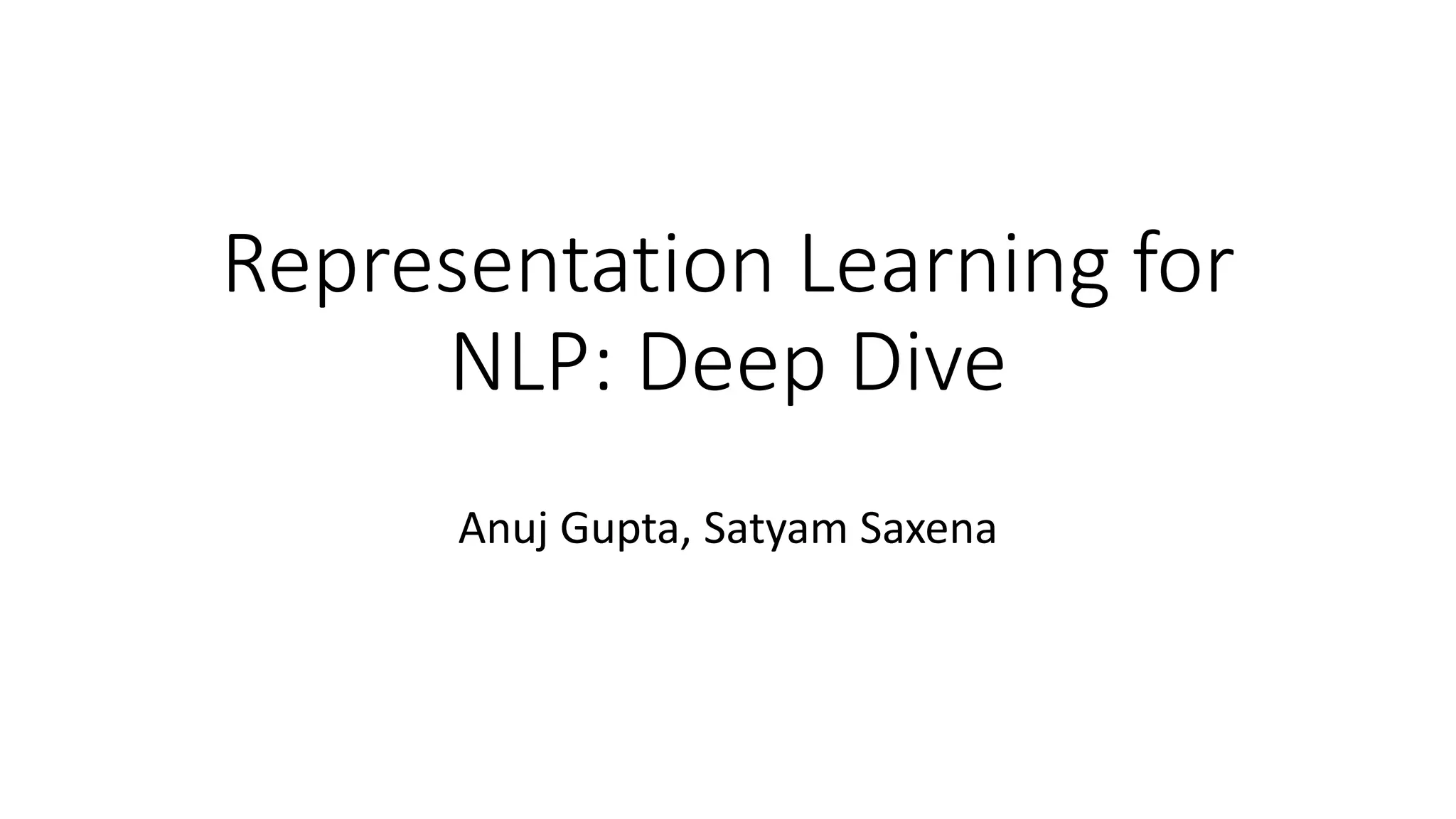
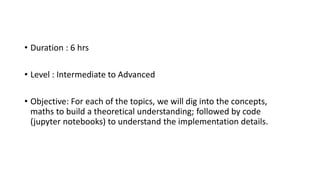
This document outlines a 6-hour course on representation learning for natural language processing. The course is divided into 4 modules that will provide both theoretical understanding and code implementations. Module 1 introduces text representation and different encoding methods. Module 2 focuses on word vectors and models like CBOW, Skip-gram, GloVe, and techniques like negative sampling and t-SNE visualization. Module 3 covers sentence and document representations with models like PV-DM, PV-DBOW, and Skip-Thoughts. Finally, Module 4 introduces character-level representations using RNNs, LSTMs, and character embeddings. The course aims to provide both conceptual understanding and hands-on coding experience of various NLP representation learning techniques.


