Stronsay Junior High Schol
Improvement Plan 2017-2018
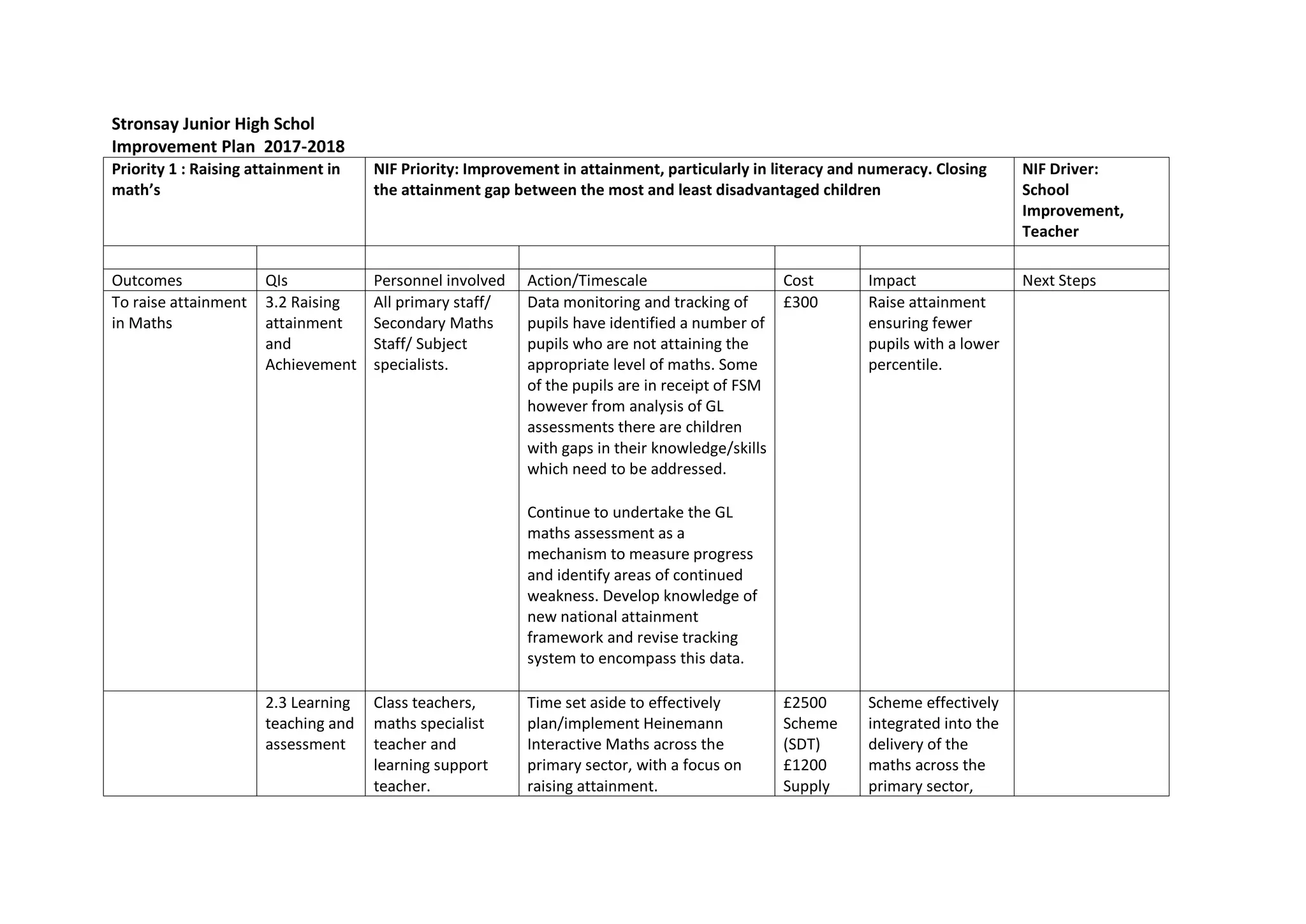
Priority 1 : Raising attainment in
math’s
NIF Priority: Improvement in attainment, particularly in literacy and numeracy. Closing
the attainment gap between the most and least disadvantaged children
NIF Driver:
School
Improvement,
Teacher
Outcomes QIs Personnel involved Action/Timescale Cost Impact Next Steps
To raise attainment
in Maths
3.2 Raising
attainment
and
Achievement
All primary staff/
Secondary Maths
Staff/ Subject
specialists.
Data monitoring and tracking of
pupils have identified a number of
pupils who are not attaining the
appropriate level of maths. Some
of the pupils are in receipt of FSM
however from analysis of GL
assessments there are children
with gaps in their knowledge/skills
which need to be addressed.
Continue to undertake the GL
maths assessment as a
mechanism to measure progress
and identify areas of continued
weakness. Develop knowledge of
new national attainment
framework and revise tracking
system to encompass this data.
£300 Raise attainment
ensuring fewer
pupils with a lower
percentile.
2.3 Learning
teaching and
assessment
Class teachers,
maths specialist
teacher and
learning support
teacher.
Time set aside to effectively
plan/implement Heinemann
Interactive Maths across the
primary sector, with a focus on
raising attainment.
£2500
Scheme
(SDT)
£1200
Supply
Scheme effectively
integrated into the
delivery of the
maths across the
primary sector,
First two days;
 13th
September
 11th
October
cover)
Equity
Fund
resulting in raising
attainment in both
Primary and in the
long term
secondary sectors.
Staff have received training on
Number talks and look towards
using this within the classroom on
a daily basis. To be followed by an
assessment of the impact of this
development on the teaching of
mental math’s. Joint work with
Sanday School.
£250 for
Number
Talk
resources
£300
(Equity
Fund)
Travel
costs
£100
Pupils develop a
confidence in
talking about
numbers- number
awareness, and to
use Higher Order
Thinking Skills
when tackling
maths problems.
Assessment of
initiative to
determine the
progress made by
the learners.
Primary and
Secondary
maths
2.3 Learning,
Teaching
and
Assessment
Primary and
Secondary Maths
teacher.
Online CPD- Active Math’s
training 4x twilights.
September/November/December
and January.
HMaths assessment through the
contexts and cross curricular
topics. How to embed problem
solving, Mental math’s Part1 +
another choice
Joint
funding
with
Sanday
School
£700
OIC In-service focusing on BGE
Maths/ moderation of levels
 16th
October
 17th
October
Travel
costs to
attend
£500
Nursery
2.3 learning,
teaching and
assessment.
3.2 Securing
children’s
progress
Yvonne Weaver
and Sarah Evans
To create a rich math’s
environment to explore math’s
concepts in the widest sense
Increased
engagement in
math’s play
activities, observed
by Yvonne
Greater use of
mathematical
language within
the pre-school as
observed and used
by Yvonne
Stronsay Junior High School
Improvement Plan 2017-2018
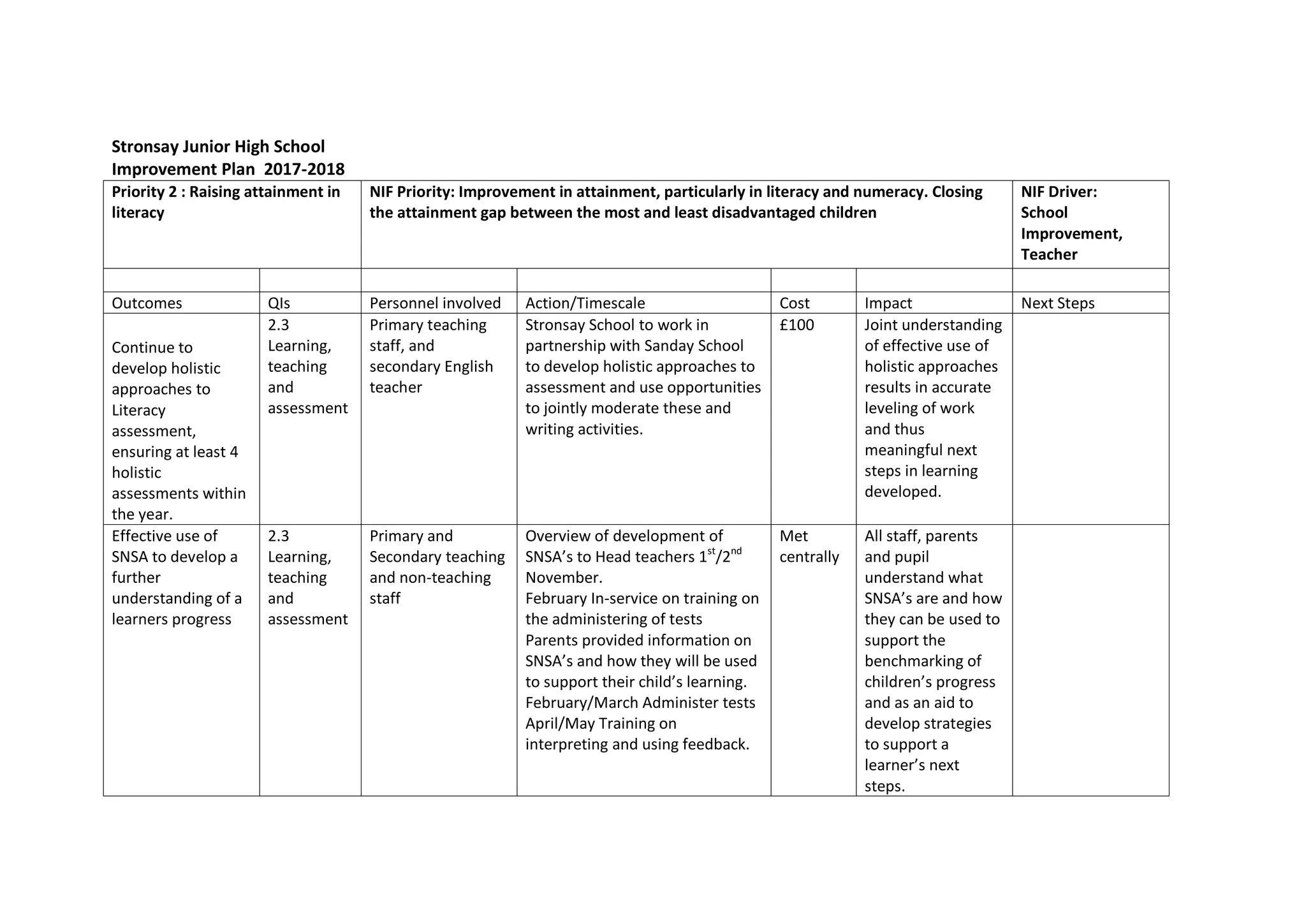
Priority 2 : Raising attainment in
literacy
NIF Priority: Improvement in attainment, particularly in literacy and numeracy. Closing
the attainment gap between the most and least disadvantaged children
NIF Driver:
School
Improvement,
Teacher
Outcomes QIs Personnel involved Action/Timescale Cost Impact Next Steps
Continue to
develop holistic
approaches to
Literacy
assessment,
ensuring at least 4
holistic
assessments within
the year.
2.3
Learning,
teaching
and
assessment
Primary teaching
staff, and
secondary English
teacher
Stronsay School to work in
partnership with Sanday School
to develop holistic approaches to
assessment and use opportunities
to jointly moderate these and
writing activities.
£100 Joint understanding
of effective use of
holistic approaches
results in accurate
leveling of work
and thus
meaningful next
steps in learning
developed.
Effective use of
SNSA to develop a
further
understanding of a
learners progress
2.3
Learning,
teaching
and
assessment
Primary and
Secondary teaching
and non-teaching
staff
Overview of development of
SNSA’s to Head teachers 1st
/2nd
November.
February In-service on training on
the administering of tests
Parents provided information on
SNSA’s and how they will be used
to support their child’s learning.
February/March Administer tests
April/May Training on
interpreting and using feedback.
Met
centrally
All staff, parents
and pupil
understand what
SNSA’s are and how
they can be used to
support the
benchmarking of
children’s progress
and as an aid to
develop strategies
to support a
learner’s next
steps.
Early Literacy
Project
2.2
Curriculum
2.3
Learning,
teaching
and
assessmemt
Sarah Evans To undertake a bespoke model of
this project due to the travel
issues/ lack of available supply
teachers on Stronsay.
PEF
funding.
At this
point due
to a
bespoke
model
needing
to be
used,
hard to
cost.
The course will
update the LP
teacher on latest
theory and
strategies to lead
literacy learning in
Early and First level.
Development of
Literacy within the
Nursery setting
2.3
learning,
teaching
and
assessment.
3.2 Securing
children’s
progress
Yvonne Weaver
Sarah Evans
Creating a rich environment for
mark making and which is also
literacy rich.
Opportunities for mark making at
their own developmental level.
Children will mark
make in different
ways.
Daily opportunities
to explore literacy
in language to
extend confidence
to communicate.
Stronsay Junior High Schol
Improvement Plan 2017-2018
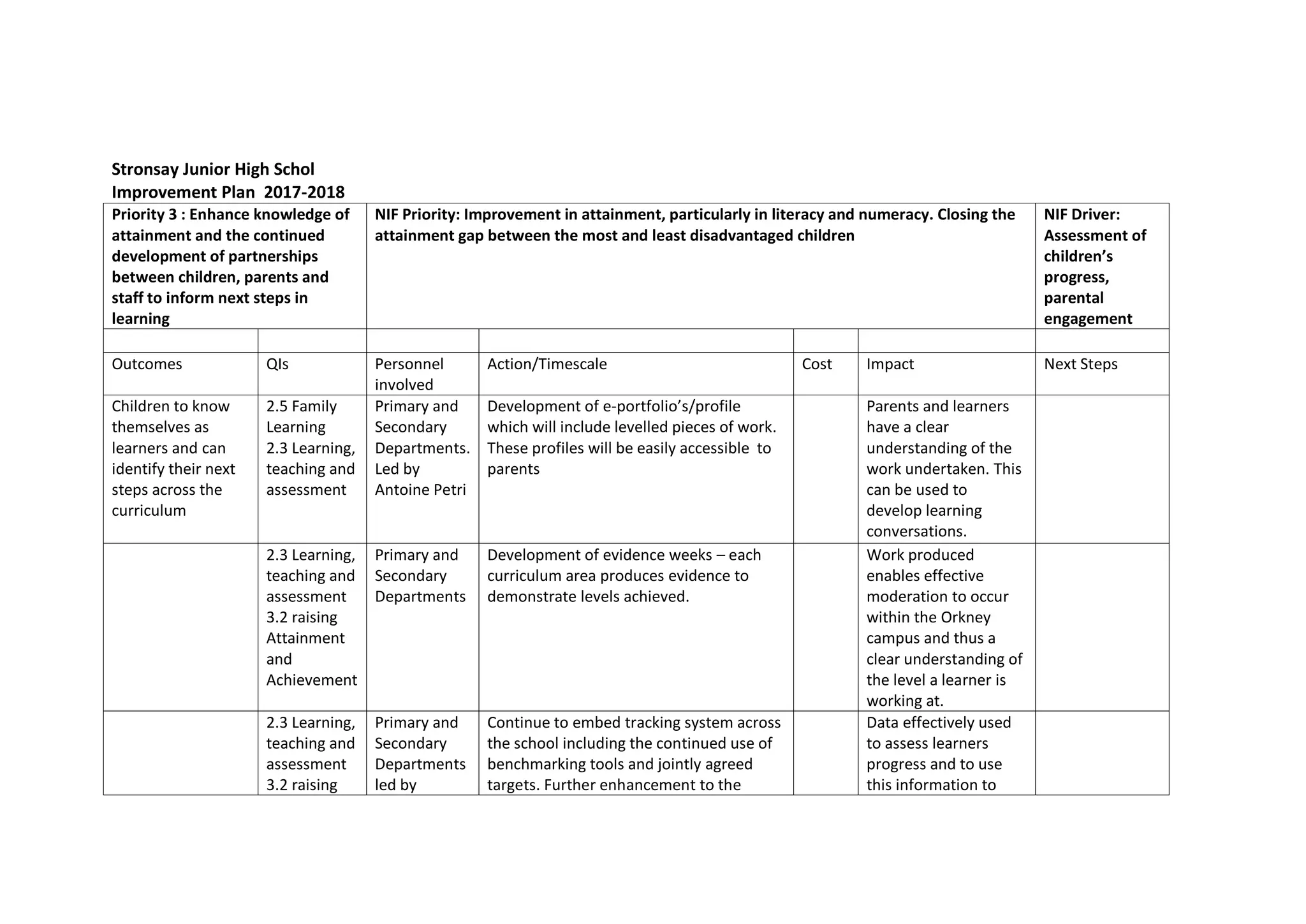
Priority 3 : Enhance knowledge of
attainment and the continued
development of partnerships
between children, parents and
staff to inform next steps in
learning
NIF Priority: Improvement in attainment, particularly in literacy and numeracy. Closing the
attainment gap between the most and least disadvantaged children
NIF Driver:
Assessment of
children’s
progress,
parental
engagement
Outcomes QIs Personnel
involved
Action/Timescale Cost Impact Next Steps
Children to know
themselves as
learners and can
identify their next
steps across the
curriculum
2.5 Family
Learning
2.3 Learning,
teaching and
assessment
Primary and
Secondary
Departments.
Led by
Antoine Petri
Development of e-portfolio’s/profile
which will include levelled pieces of work.
These profiles will be easily accessible to
parents
Parents and learners
have a clear
understanding of the
work undertaken. This
can be used to
develop learning
conversations.
2.3 Learning,
teaching and
assessment
3.2 raising
Attainment
and
Achievement
Primary and
Secondary
Departments
Development of evidence weeks – each
curriculum area produces evidence to
demonstrate levels achieved.
Work produced
enables effective
moderation to occur
within the Orkney
campus and thus a
clear understanding of
the level a learner is
working at.
2.3 Learning,
teaching and
assessment
3.2 raising
Primary and
Secondary
Departments
led by
Continue to embed tracking system across
the school including the continued use of
benchmarking tools and jointly agreed
targets. Further enhancement to the
Data effectively used
to assess learners
progress and to use
this information to
Attainment
and
Achievement
Pam Rose tracking tool to include comments linked
to general concerns/incidents, to develop
holistic view of child.
support learners in
their next steps in
learning.
2.3 Learning,
teaching and
assessment
3.2 raising
Attainment
and
Achievement
Pam Rose to
be on
authority
working
party.
Development of an authority wide tracking
and monitoring system, which will in
future include the Governments, Authority
and individual schools tracking
information.
Data effectively used
to assess learners
progress and to
benchmark this at an
authority and
government level.
2.3 Learning,
teaching and
assessment
3.2 raising
Attainment
and
Achievement
Primary and
Secondary
Departments
led by Wendy
Groat
Continue to embed target weeks in
Secondary and Primary sectors. In which
learners discuss their learning with staff to
mutually agree a target.
Learners actively
involved in their
learning and have a
clear understanding of
their next steps
2.5
Family
Learning
3.2 raising
Attainment
and
Achievement
Review with parents the most effective
mechanism to feedback on their child’s
learning and progress.
Consideration of
moving from formal
reports to regular
learning conversations
which more
responsive to meeting
the needs of the
learners.
3.1 Ensuring
wellbeing,
equality and
inclusion
2.7
Partnerships
Primary and
Secondary
Staff
Led by Donna
Blyth
Review the effectiveness of Child Plan
meetings, their format and regularity and
also the effectiveness of communication
between the school/parents and learner
of child with specific needs
New Support for
Learning teacher
reviews present
system and looks for
refining the process to
ensure individual
learners needs are
fully met.
Stronsay Junior High Schol
Improvement Plan 2017-2018
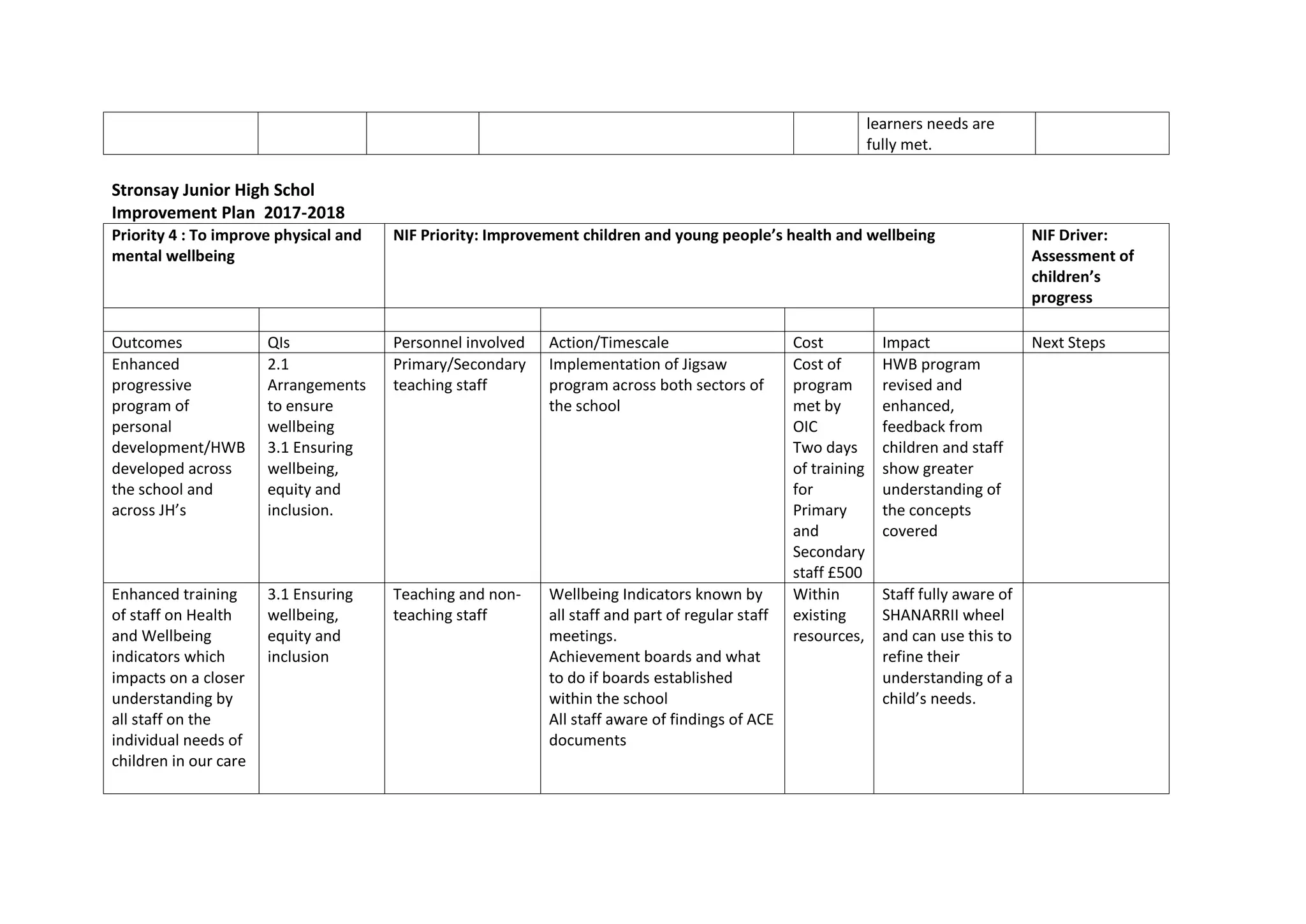
Priority 4 : To improve physical and
mental wellbeing
NIF Priority: Improvement children and young people’s health and wellbeing NIF Driver:
Assessment of
children’s
progress
Outcomes QIs Personnel involved Action/Timescale Cost Impact Next Steps
Enhanced
progressive
program of
personal
development/HWB
developed across
the school and
across JH’s
2.1
Arrangements
to ensure
wellbeing
3.1 Ensuring
wellbeing,
equity and
inclusion.
Primary/Secondary
teaching staff
Implementation of Jigsaw
program across both sectors of
the school
Cost of
program
met by
OIC
Two days
of training
for
Primary
and
Secondary
staff £500
HWB program
revised and
enhanced,
feedback from
children and staff
show greater
understanding of
the concepts
covered
Enhanced training
of staff on Health
and Wellbeing
indicators which
impacts on a closer
understanding by
all staff on the
individual needs of
children in our care
3.1 Ensuring
wellbeing,
equity and
inclusion
Teaching and non-
teaching staff
Wellbeing Indicators known by
all staff and part of regular staff
meetings.
Achievement boards and what
to do if boards established
within the school
All staff aware of findings of ACE
documents
Within
existing
resources,
Staff fully aware of
SHANARRII wheel
and can use this to
refine their
understanding of a
child’s needs.
Continue to
develop the
physical and mental
health of children
within our care
3.1 Ensuring
wellbeing,
equity and
Inclusion
Teaching and non-
teaching staff
 Introduction of walking
mile within the primary
sector
 Development of a range
of enhanced sporting
activities/ experiences
in part funded by SDT to
ensure positive attitude
towards sporting
activities
£1000
visa SDT
General HWB of
learners and staff
improved.
Secondary Sector
Led by Jane Barber
and Wendy Groat
Continued Development of
Achieve (Princes Trust)
programme to equip students
with life skills.
To develop an
induction process
for new Support for
Learning teacher
3.1 Ensuring
wellbeing,
equality, and
inclusion
2.7Partnerships
2.4
Personalised
support.
Andrew
King/Imogen Kerr
and Donna Blyth
To ensure that the new teacher
is fully aware of the structures
and systems used within Orkney
and to develop contacts within
multi agency teams to develop
effective communication links
£500 Support plans
(including child
plans) for
individual children
effectively
developed and
tailored for an
individual child’s
needs, impacting
positively on the
child’s HWB.

School improvement plan 201718

  • 1.
    Stronsay Junior HighSchol Improvement Plan 2017-2018 Priority 1 : Raising attainment in math’s NIF Priority: Improvement in attainment, particularly in literacy and numeracy. Closing the attainment gap between the most and least disadvantaged children NIF Driver: School Improvement, Teacher Outcomes QIs Personnel involved Action/Timescale Cost Impact Next Steps To raise attainment in Maths 3.2 Raising attainment and Achievement All primary staff/ Secondary Maths Staff/ Subject specialists. Data monitoring and tracking of pupils have identified a number of pupils who are not attaining the appropriate level of maths. Some of the pupils are in receipt of FSM however from analysis of GL assessments there are children with gaps in their knowledge/skills which need to be addressed. Continue to undertake the GL maths assessment as a mechanism to measure progress and identify areas of continued weakness. Develop knowledge of new national attainment framework and revise tracking system to encompass this data. £300 Raise attainment ensuring fewer pupils with a lower percentile. 2.3 Learning teaching and assessment Class teachers, maths specialist teacher and learning support teacher. Time set aside to effectively plan/implement Heinemann Interactive Maths across the primary sector, with a focus on raising attainment. £2500 Scheme (SDT) £1200 Supply Scheme effectively integrated into the delivery of the maths across the primary sector,
  • 2.
    First two days; 13th September  11th October cover) Equity Fund resulting in raising attainment in both Primary and in the long term secondary sectors. Staff have received training on Number talks and look towards using this within the classroom on a daily basis. To be followed by an assessment of the impact of this development on the teaching of mental math’s. Joint work with Sanday School. £250 for Number Talk resources £300 (Equity Fund) Travel costs £100 Pupils develop a confidence in talking about numbers- number awareness, and to use Higher Order Thinking Skills when tackling maths problems. Assessment of initiative to determine the progress made by the learners. Primary and Secondary maths 2.3 Learning, Teaching and Assessment Primary and Secondary Maths teacher. Online CPD- Active Math’s training 4x twilights. September/November/December and January. HMaths assessment through the contexts and cross curricular topics. How to embed problem solving, Mental math’s Part1 + another choice Joint funding with Sanday School £700 OIC In-service focusing on BGE Maths/ moderation of levels  16th October  17th October Travel costs to attend £500
  • 3.
    Nursery 2.3 learning, teaching and assessment. 3.2Securing children’s progress Yvonne Weaver and Sarah Evans To create a rich math’s environment to explore math’s concepts in the widest sense Increased engagement in math’s play activities, observed by Yvonne Greater use of mathematical language within the pre-school as observed and used by Yvonne
  • 4.
    Stronsay Junior HighSchool Improvement Plan 2017-2018 Priority 2 : Raising attainment in literacy NIF Priority: Improvement in attainment, particularly in literacy and numeracy. Closing the attainment gap between the most and least disadvantaged children NIF Driver: School Improvement, Teacher Outcomes QIs Personnel involved Action/Timescale Cost Impact Next Steps Continue to develop holistic approaches to Literacy assessment, ensuring at least 4 holistic assessments within the year. 2.3 Learning, teaching and assessment Primary teaching staff, and secondary English teacher Stronsay School to work in partnership with Sanday School to develop holistic approaches to assessment and use opportunities to jointly moderate these and writing activities. £100 Joint understanding of effective use of holistic approaches results in accurate leveling of work and thus meaningful next steps in learning developed. Effective use of SNSA to develop a further understanding of a learners progress 2.3 Learning, teaching and assessment Primary and Secondary teaching and non-teaching staff Overview of development of SNSA’s to Head teachers 1st /2nd November. February In-service on training on the administering of tests Parents provided information on SNSA’s and how they will be used to support their child’s learning. February/March Administer tests April/May Training on interpreting and using feedback. Met centrally All staff, parents and pupil understand what SNSA’s are and how they can be used to support the benchmarking of children’s progress and as an aid to develop strategies to support a learner’s next steps.
  • 5.
    Early Literacy Project 2.2 Curriculum 2.3 Learning, teaching and assessmemt Sarah EvansTo undertake a bespoke model of this project due to the travel issues/ lack of available supply teachers on Stronsay. PEF funding. At this point due to a bespoke model needing to be used, hard to cost. The course will update the LP teacher on latest theory and strategies to lead literacy learning in Early and First level. Development of Literacy within the Nursery setting 2.3 learning, teaching and assessment. 3.2 Securing children’s progress Yvonne Weaver Sarah Evans Creating a rich environment for mark making and which is also literacy rich. Opportunities for mark making at their own developmental level. Children will mark make in different ways. Daily opportunities to explore literacy in language to extend confidence to communicate.
  • 6.
    Stronsay Junior HighSchol Improvement Plan 2017-2018 Priority 3 : Enhance knowledge of attainment and the continued development of partnerships between children, parents and staff to inform next steps in learning NIF Priority: Improvement in attainment, particularly in literacy and numeracy. Closing the attainment gap between the most and least disadvantaged children NIF Driver: Assessment of children’s progress, parental engagement Outcomes QIs Personnel involved Action/Timescale Cost Impact Next Steps Children to know themselves as learners and can identify their next steps across the curriculum 2.5 Family Learning 2.3 Learning, teaching and assessment Primary and Secondary Departments. Led by Antoine Petri Development of e-portfolio’s/profile which will include levelled pieces of work. These profiles will be easily accessible to parents Parents and learners have a clear understanding of the work undertaken. This can be used to develop learning conversations. 2.3 Learning, teaching and assessment 3.2 raising Attainment and Achievement Primary and Secondary Departments Development of evidence weeks – each curriculum area produces evidence to demonstrate levels achieved. Work produced enables effective moderation to occur within the Orkney campus and thus a clear understanding of the level a learner is working at. 2.3 Learning, teaching and assessment 3.2 raising Primary and Secondary Departments led by Continue to embed tracking system across the school including the continued use of benchmarking tools and jointly agreed targets. Further enhancement to the Data effectively used to assess learners progress and to use this information to
  • 7.
    Attainment and Achievement Pam Rose trackingtool to include comments linked to general concerns/incidents, to develop holistic view of child. support learners in their next steps in learning. 2.3 Learning, teaching and assessment 3.2 raising Attainment and Achievement Pam Rose to be on authority working party. Development of an authority wide tracking and monitoring system, which will in future include the Governments, Authority and individual schools tracking information. Data effectively used to assess learners progress and to benchmark this at an authority and government level. 2.3 Learning, teaching and assessment 3.2 raising Attainment and Achievement Primary and Secondary Departments led by Wendy Groat Continue to embed target weeks in Secondary and Primary sectors. In which learners discuss their learning with staff to mutually agree a target. Learners actively involved in their learning and have a clear understanding of their next steps 2.5 Family Learning 3.2 raising Attainment and Achievement Review with parents the most effective mechanism to feedback on their child’s learning and progress. Consideration of moving from formal reports to regular learning conversations which more responsive to meeting the needs of the learners. 3.1 Ensuring wellbeing, equality and inclusion 2.7 Partnerships Primary and Secondary Staff Led by Donna Blyth Review the effectiveness of Child Plan meetings, their format and regularity and also the effectiveness of communication between the school/parents and learner of child with specific needs New Support for Learning teacher reviews present system and looks for refining the process to ensure individual
  • 8.
    learners needs are fullymet. Stronsay Junior High Schol Improvement Plan 2017-2018 Priority 4 : To improve physical and mental wellbeing NIF Priority: Improvement children and young people’s health and wellbeing NIF Driver: Assessment of children’s progress Outcomes QIs Personnel involved Action/Timescale Cost Impact Next Steps Enhanced progressive program of personal development/HWB developed across the school and across JH’s 2.1 Arrangements to ensure wellbeing 3.1 Ensuring wellbeing, equity and inclusion. Primary/Secondary teaching staff Implementation of Jigsaw program across both sectors of the school Cost of program met by OIC Two days of training for Primary and Secondary staff £500 HWB program revised and enhanced, feedback from children and staff show greater understanding of the concepts covered Enhanced training of staff on Health and Wellbeing indicators which impacts on a closer understanding by all staff on the individual needs of children in our care 3.1 Ensuring wellbeing, equity and inclusion Teaching and non- teaching staff Wellbeing Indicators known by all staff and part of regular staff meetings. Achievement boards and what to do if boards established within the school All staff aware of findings of ACE documents Within existing resources, Staff fully aware of SHANARRII wheel and can use this to refine their understanding of a child’s needs.
  • 9.
    Continue to develop the physicaland mental health of children within our care 3.1 Ensuring wellbeing, equity and Inclusion Teaching and non- teaching staff  Introduction of walking mile within the primary sector  Development of a range of enhanced sporting activities/ experiences in part funded by SDT to ensure positive attitude towards sporting activities £1000 visa SDT General HWB of learners and staff improved. Secondary Sector Led by Jane Barber and Wendy Groat Continued Development of Achieve (Princes Trust) programme to equip students with life skills. To develop an induction process for new Support for Learning teacher 3.1 Ensuring wellbeing, equality, and inclusion 2.7Partnerships 2.4 Personalised support. Andrew King/Imogen Kerr and Donna Blyth To ensure that the new teacher is fully aware of the structures and systems used within Orkney and to develop contacts within multi agency teams to develop effective communication links £500 Support plans (including child plans) for individual children effectively developed and tailored for an individual child’s needs, impacting positively on the child’s HWB.