MEASURING LIGHT IN
THE NIGHT
PASADENA PUBLIC LIBRARY
FEB. 27, 2020
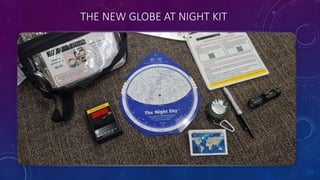
THE NEW GLOBE AT NIGHT KIT
HOW TO CHECK OUT THE
GLOBE AT NIGHT KIT
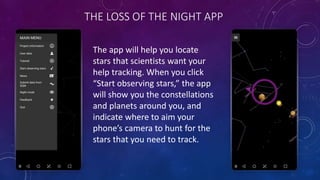
THE LOSS OF THE NIGHT APP
The app will help you locate
stars that scientists want your
help tracking. When you click
“Start observing stars,” the app
will show you the constellations
and planets around you, and
indicate where to aim your
phone’s camera to hunt for the
stars that you need to track.
THE LOSS OF THE NIGHT APP
When you see the circle
settle on a single spot and
grow larger, you’ll know
that’s the star you are
looking for. Try to find that
star with just your eyes, and
tell the app whether it is
visible or not.
THE LOSS OF THE NIGHT APP
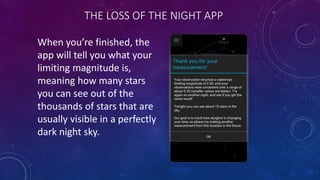
When you’re finished, the
app will tell you what your
limiting magnitude is,
meaning how many stars
you can see out of the
thousands of stars that are
usually visible in a perfectly
dark night sky.
THE LOSS OF THE NIGHT APP
You can use the Loss of the
Night app to enter the reading
from your Sky Quality Meter.
MINI GPS
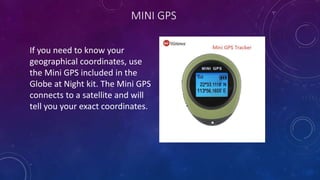
If you need to know your
geographical coordinates, use
the Mini GPS included in the
Globe at Night kit. The Mini GPS
connects to a satellite and will
tell you your exact coordinates.
GLOBE AT NIGHT WEB APP:
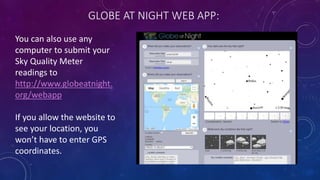
You can also use any
computer to submit your
Sky Quality Meter
readings to
http://www.globeatnight.
org/webapp
If you allow the website to
see your location, you
won’t have to enter GPS
coordinates.
PLANISPHERE
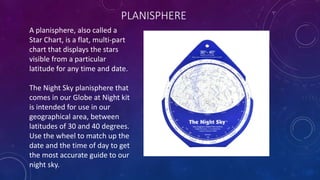
A planisphere, also called a
Star Chart, is a flat, multi-part
chart that displays the stars
visible from a particular
latitude for any time and date.
The Night Sky planisphere that
comes in our Globe at Night kit
is intended for use in our
geographical area, between
latitudes of 30 and 40 degrees.
Use the wheel to match up the
date and the time of day to get
the most accurate guide to our
night sky.
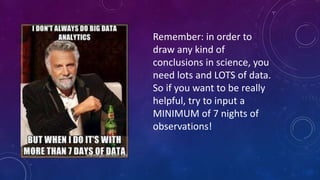
Remember: in order to
draw any kind of
conclusions in science, you
need lots and LOTS of data.
So if you want to be really
helpful, try to input a
MINIMUM of 7 nights of
observations!

Measuring Light in the Night

  • 1.
    MEASURING LIGHT IN THENIGHT PASADENA PUBLIC LIBRARY FEB. 27, 2020
  • 2.
    THE NEW GLOBEAT NIGHT KIT
  • 3.
    HOW TO CHECKOUT THE GLOBE AT NIGHT KIT
  • 4.
    THE LOSS OFTHE NIGHT APP The app will help you locate stars that scientists want your help tracking. When you click “Start observing stars,” the app will show you the constellations and planets around you, and indicate where to aim your phone’s camera to hunt for the stars that you need to track.
  • 5.
    THE LOSS OFTHE NIGHT APP When you see the circle settle on a single spot and grow larger, you’ll know that’s the star you are looking for. Try to find that star with just your eyes, and tell the app whether it is visible or not.
  • 6.
    THE LOSS OFTHE NIGHT APP
  • 7.
    THE LOSS OFTHE NIGHT APP When you’re finished, the app will tell you what your limiting magnitude is, meaning how many stars you can see out of the thousands of stars that are usually visible in a perfectly dark night sky.
  • 8.
    THE LOSS OFTHE NIGHT APP You can use the Loss of the Night app to enter the reading from your Sky Quality Meter.
  • 9.
    MINI GPS If youneed to know your geographical coordinates, use the Mini GPS included in the Globe at Night kit. The Mini GPS connects to a satellite and will tell you your exact coordinates.
  • 10.
    GLOBE AT NIGHTWEB APP: You can also use any computer to submit your Sky Quality Meter readings to http://www.globeatnight. org/webapp If you allow the website to see your location, you won’t have to enter GPS coordinates.
  • 11.
    PLANISPHERE A planisphere, alsocalled a Star Chart, is a flat, multi-part chart that displays the stars visible from a particular latitude for any time and date. The Night Sky planisphere that comes in our Globe at Night kit is intended for use in our geographical area, between latitudes of 30 and 40 degrees. Use the wheel to match up the date and the time of day to get the most accurate guide to our night sky.
  • 12.
    Remember: in orderto draw any kind of conclusions in science, you need lots and LOTS of data. So if you want to be really helpful, try to input a MINIMUM of 7 nights of observations!