Executable Papers:
   publishing science
      that works

 Anita de Waard, Elsevier Labs
HCLS Scientific Discourse Group
         June 20, 2011
Elsevier Challenges
Goals:
-  Invite and survey ideas in innovative science publishing
-  Create a community of people working on similar issues, from different
   backgrounds/viewpoints
Rules:
-  Open submission; very interdisciplinary panel of judges; open publication of
   submissions
-  IPR stays with author; if commercial development, Elsevier has right of first
   refusal
Challenges so far:
-  2008/9: Elsevier Grand Challenge for knowledge enhancement in the life
   sciences: http://www.elseviergrandchallenge.com
-  2010/11: ISMB Killer App award: rewarding bioinformatics apps that work for
   biologists http://killerapp.iscb.org/
-  2011: Elsevier Executable Paper challenge: http://www.executablepapers.com/
Executable Paper Challenge
Driven by issues in publishing computational science:

-   How can we develop a model for executable files that is compatible
    with the user’s operating system and architecture and adaptable to
    future systems?

-   How do we manage very large file sizes?

-   How do we validate data and code, and decrease the reviewer’s
    workload?

-   How to support registering and tracking of actions taken on the
    ‘executable paper?’
Coorganised with International Conf on Computational Sci http://www.iccs-
meeting.org:

- For high-performance and (geo/eco/bio/chem)‘-informatics’ fields
- Actually challenge participants were a different community!
The Finalists:
           http://www.executablepapers.com/finalists.html
1.SHARE - a web portal for creating and sharing executable research
  papers http://sites.google.com/site/executablepaper/
2.A data and code model for reproducible research and executable papers http://
  dirac.cnrs-orleans.fr/~hinsen/executable_paper_challenge.tar.gz
3.A-R-E: The Author-Review-Execute environment
  http://iwb.fluidops.com:7878/resource/AREpaper
4.Planetary System: Web 3.0 and Active Documents
  https://trac.mathweb.org/planetary/wiki/EPCDemo
5.Paper Mache: Creating Dynamic Reproducible Science
  http://oware.cse.tamu.edu:8080/
6.A Provenance Based Infrastructure for Creating Executable Papers
  http://www.vistrails.org/index.php/ExecutablePapers
7.Universal Identifier for Computation Results
  http://vcr.stanford.edu
8.R2 Platform for Reproducible Research
  http://rsquared.stat.uni-muenchen.de/
9.The Collage Authoring Environment
  http://collage.cyfronet.pl
SHARE - a web portal for creating
               and sharing executable research papers
            http://sites.google.com/site/executablepaper/
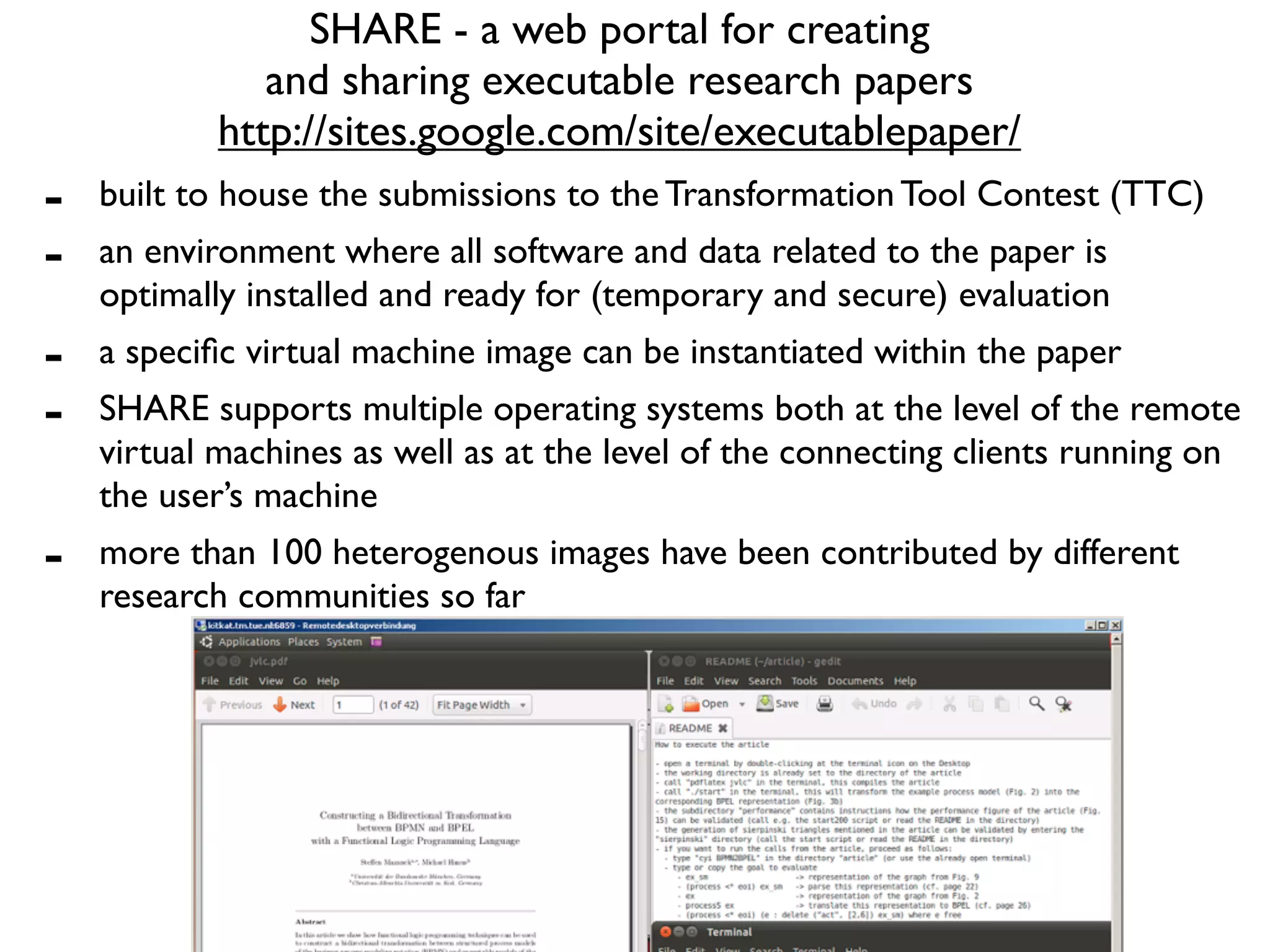
-   built to house the submissions to the Transformation Tool Contest (TTC)
-   an environment where all software and data related to the paper is
    optimally installed and ready for (temporary and secure) evaluation
-   a specific virtual machine image can be instantiated within the paper
-   SHARE supports multiple operating systems both at the level of the remote
    virtual machines as well as at the level of the connecting clients running on
    the user’s machine
-   more than 100 heterogenous images have been contributed by different
    research communities so far
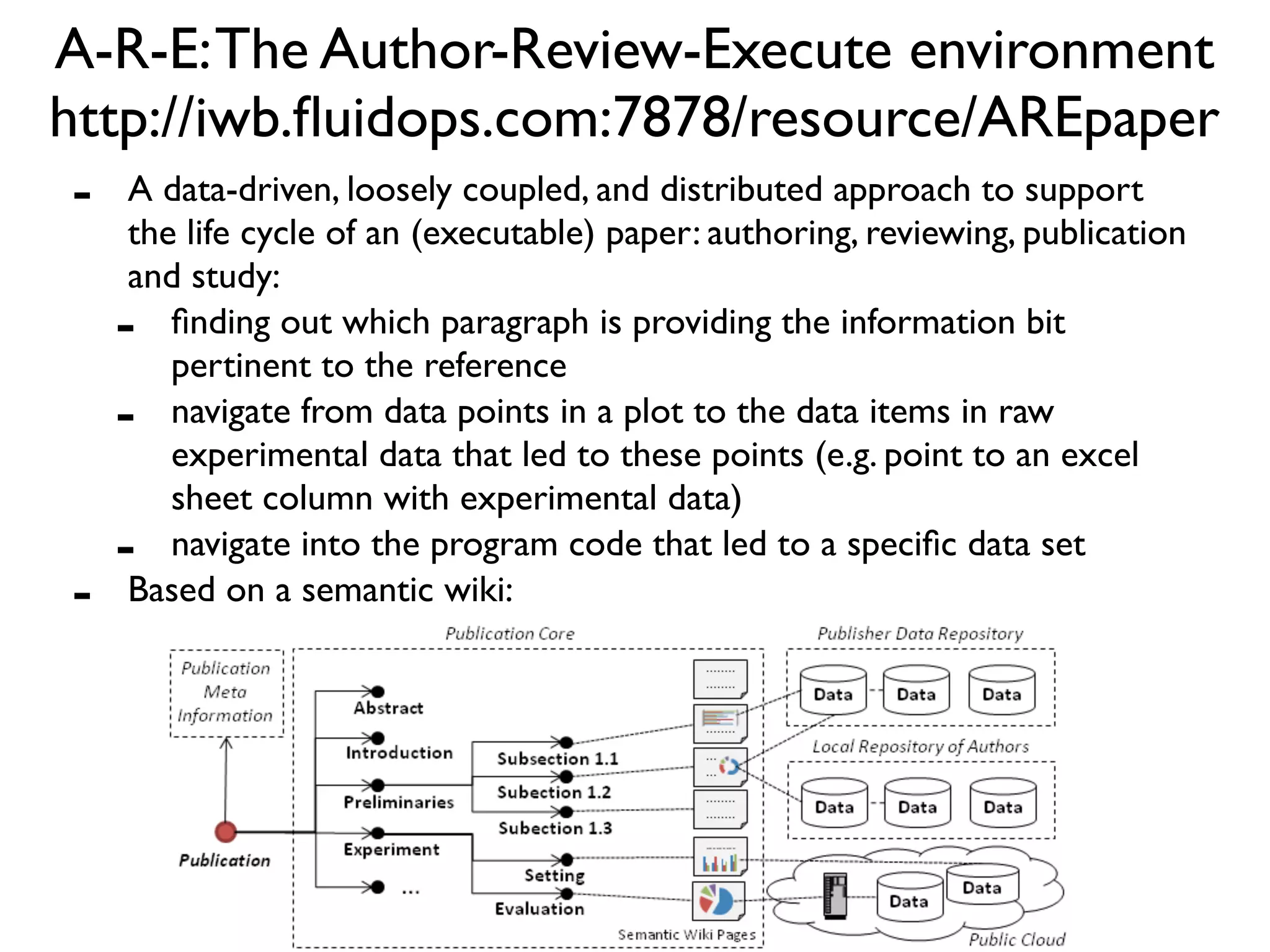
A-R-E: The Author-Review-Execute environment
http://iwb.fluidops.com:7878/resource/AREpaper
-   A data-driven, loosely coupled, and distributed approach to support
    the life cycle of an (executable) paper: authoring, reviewing, publication
    and study:
    -  finding out which paragraph is providing the information bit
       pertinent to the reference
    -  navigate from data points in a plot to the data items in raw
       experimental data that led to these points (e.g. point to an excel
       sheet column with experimental data)
    -  navigate into the program code that led to a specific data set
-   Based on a semantic wiki:
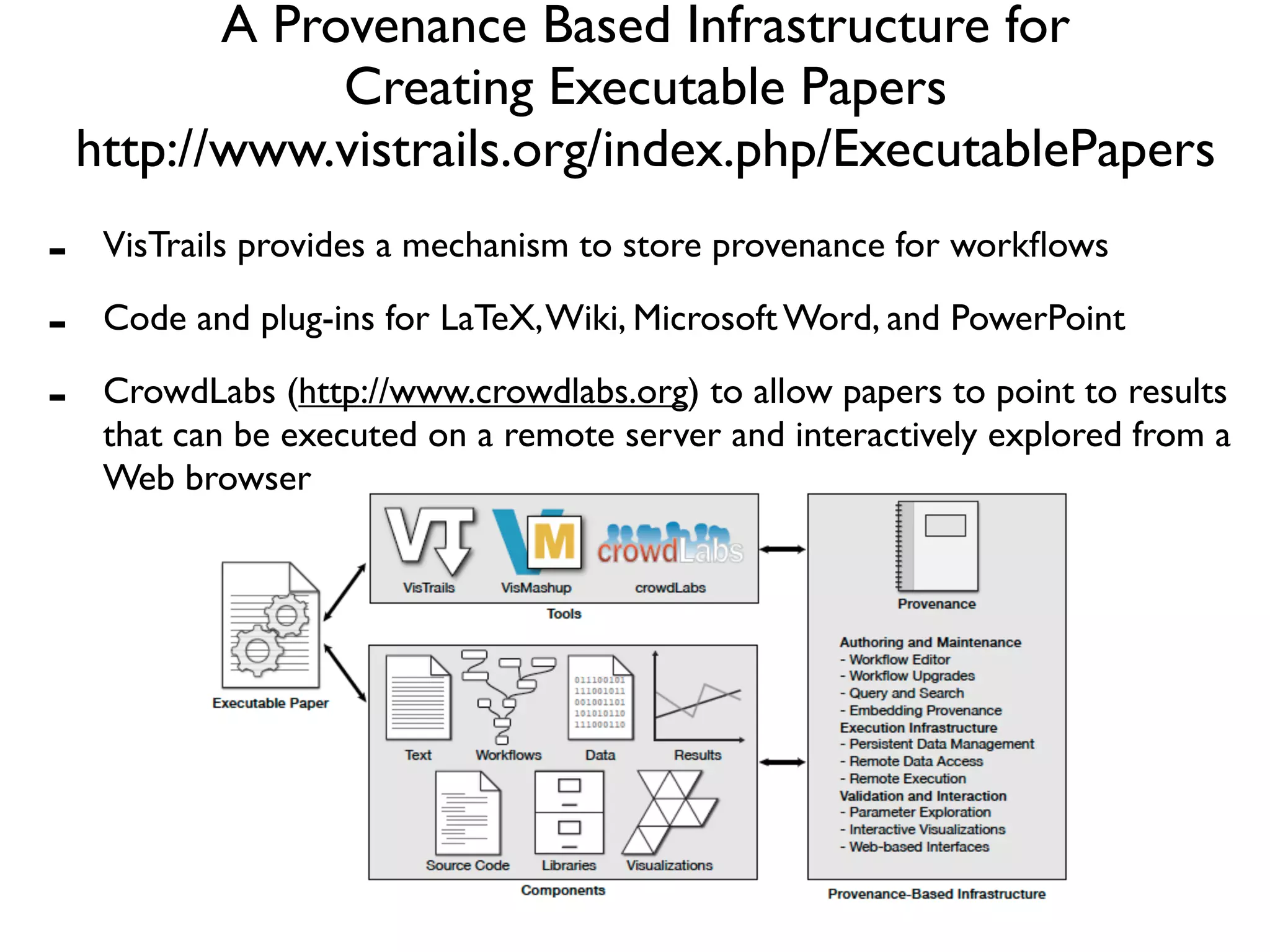
A Provenance Based Infrastructure for
                Creating Executable Papers
    http://www.vistrails.org/index.php/ExecutablePapers
-    VisTrails provides a mechanism to store provenance for workflows

-    Code and plug-ins for LaTeX, Wiki, Microsoft Word, and PowerPoint

-    CrowdLabs (http://www.crowdlabs.org) to allow papers to point to results
     that can be executed on a remote server and interactively explored from a
     Web browser
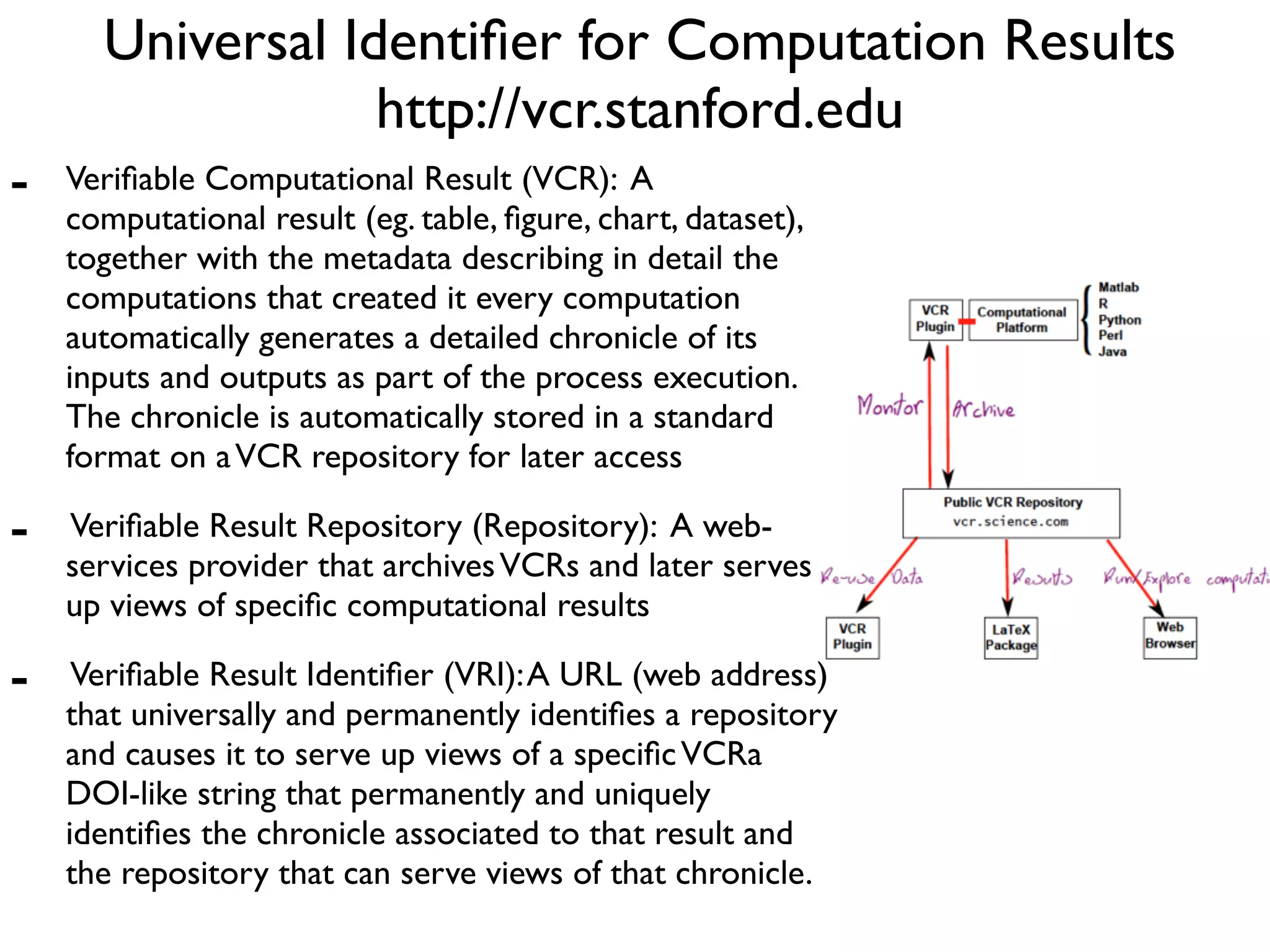
Universal Identifier for Computation Results
                  http://vcr.stanford.edu
-   Verifiable Computational Result (VCR): A
    computational result (eg. table, figure, chart, dataset),
    together with the metadata describing in detail the
    computations that created it every computation
    automatically generates a detailed chronicle of its
    inputs and outputs as part of the process execution.
    The chronicle is automatically stored in a standard
    format on a VCR repository for later access

-   Verifiable Result Repository (Repository): A web-
    services provider that archives VCRs and later serves
    up views of specific computational results

-    Verifiable Result Identifier (VRI): A URL (web address)
    that universally and permanently identifies a repository
    and causes it to serve up views of a specific VCRa
    DOI-like string that permanently and uniquely
    identifies the chronicle associated to that result and
    the repository that can serve views of that chronicle.
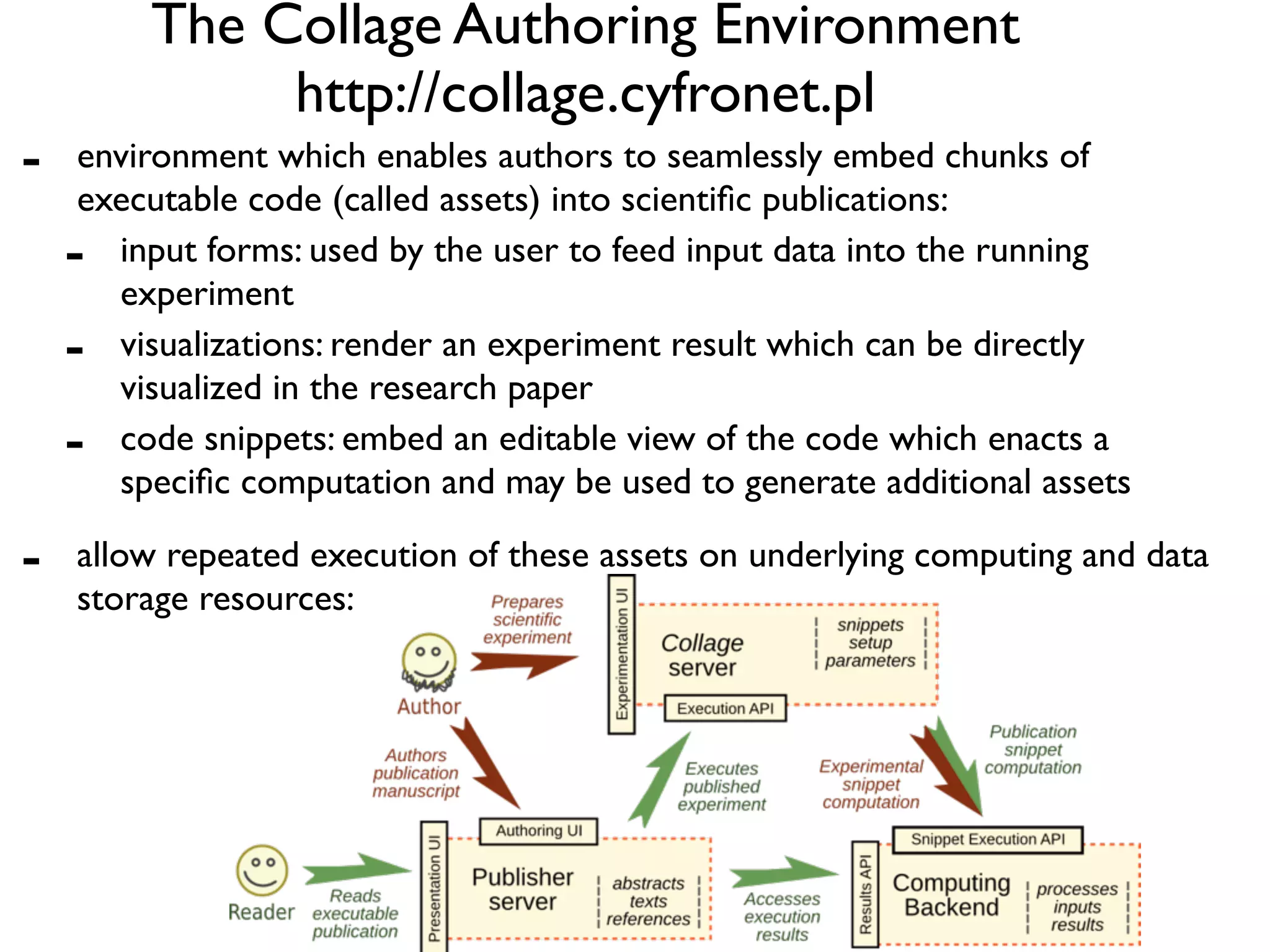
The Collage Authoring Environment
             http://collage.cyfronet.pl
-   environment which enables authors to seamlessly embed chunks of
    executable code (called assets) into scientific publications:
    - input forms: used by the user to feed input data into the running
      experiment
    - visualizations: render an experiment result which can be directly
      visualized in the research paper
    - code snippets: embed an editable view of the code which enacts a
      specific computation and may be used to generate additional assets

-   allow repeated execution of these assets on underlying computing and data
    storage resources:
Next step: The Executable Journal?

-   Ideally, we’d like all these tools to work together
-   In fact, we’d like that to be how we communicate informatics/
    computer science!
-   Submit a paper with a piece of working code
-   The code works on the platform
-   The code stays on the platform, and is available for other papers
    to run on, too!
-   Advantages:
    -   Clearer communication of software
    -   Less reinvention of the wheel
    -   More collaboration
In other words:
“I like the idea of [...] a research object corresponding to a
PhD thesis sitting on the (digital) library shelf and then being
re-executed as new data comes along.  So the thesis sits
there and new results (or papers, or research objects) pop
out. I like this example because it involves tying down the
method and letting the data flow, instead of the widely held
view that the data sits there and methods are applied to it.
[...]
These papers then become a way of distributing data and
methods in a highly usable and user-centric way [...]. So
scientists don't need to download and install tools and learn
user interfaces.They just interact with the published
executable papers...”
                 Dave De Roure, email to Wf4ever group
What does this have to do with HCLS?

-   Might be a good area to explore this in?

-   E.g. interchange of annotations that we are
    exploring w/Tim Clark’s group...

-   Next step:

    -   Funding?

    -   Format?

    -   Platform?

-   Thoughts??

Executable papers

  • 1.
    Executable Papers: publishing science that works Anita de Waard, Elsevier Labs HCLS Scientific Discourse Group June 20, 2011
  • 2.
    Elsevier Challenges Goals: - Invite and survey ideas in innovative science publishing - Create a community of people working on similar issues, from different backgrounds/viewpoints Rules: - Open submission; very interdisciplinary panel of judges; open publication of submissions - IPR stays with author; if commercial development, Elsevier has right of first refusal Challenges so far: - 2008/9: Elsevier Grand Challenge for knowledge enhancement in the life sciences: http://www.elseviergrandchallenge.com - 2010/11: ISMB Killer App award: rewarding bioinformatics apps that work for biologists http://killerapp.iscb.org/ - 2011: Elsevier Executable Paper challenge: http://www.executablepapers.com/
  • 3.
    Executable Paper Challenge Drivenby issues in publishing computational science: - How can we develop a model for executable files that is compatible with the user’s operating system and architecture and adaptable to future systems? - How do we manage very large file sizes? - How do we validate data and code, and decrease the reviewer’s workload? - How to support registering and tracking of actions taken on the ‘executable paper?’ Coorganised with International Conf on Computational Sci http://www.iccs- meeting.org: - For high-performance and (geo/eco/bio/chem)‘-informatics’ fields - Actually challenge participants were a different community!
  • 4.
    The Finalists: http://www.executablepapers.com/finalists.html 1.SHARE - a web portal for creating and sharing executable research papers http://sites.google.com/site/executablepaper/ 2.A data and code model for reproducible research and executable papers http:// dirac.cnrs-orleans.fr/~hinsen/executable_paper_challenge.tar.gz 3.A-R-E: The Author-Review-Execute environment http://iwb.fluidops.com:7878/resource/AREpaper 4.Planetary System: Web 3.0 and Active Documents https://trac.mathweb.org/planetary/wiki/EPCDemo 5.Paper Mache: Creating Dynamic Reproducible Science http://oware.cse.tamu.edu:8080/ 6.A Provenance Based Infrastructure for Creating Executable Papers http://www.vistrails.org/index.php/ExecutablePapers 7.Universal Identifier for Computation Results http://vcr.stanford.edu 8.R2 Platform for Reproducible Research http://rsquared.stat.uni-muenchen.de/ 9.The Collage Authoring Environment http://collage.cyfronet.pl
  • 5.
    SHARE - aweb portal for creating and sharing executable research papers http://sites.google.com/site/executablepaper/ - built to house the submissions to the Transformation Tool Contest (TTC) - an environment where all software and data related to the paper is optimally installed and ready for (temporary and secure) evaluation - a specific virtual machine image can be instantiated within the paper - SHARE supports multiple operating systems both at the level of the remote virtual machines as well as at the level of the connecting clients running on the user’s machine - more than 100 heterogenous images have been contributed by different research communities so far
  • 6.
    A-R-E: The Author-Review-Executeenvironment http://iwb.fluidops.com:7878/resource/AREpaper - A data-driven, loosely coupled, and distributed approach to support the life cycle of an (executable) paper: authoring, reviewing, publication and study: - finding out which paragraph is providing the information bit pertinent to the reference - navigate from data points in a plot to the data items in raw experimental data that led to these points (e.g. point to an excel sheet column with experimental data) - navigate into the program code that led to a specific data set - Based on a semantic wiki:
  • 7.
    A Provenance BasedInfrastructure for Creating Executable Papers http://www.vistrails.org/index.php/ExecutablePapers - VisTrails provides a mechanism to store provenance for workflows - Code and plug-ins for LaTeX, Wiki, Microsoft Word, and PowerPoint - CrowdLabs (http://www.crowdlabs.org) to allow papers to point to results that can be executed on a remote server and interactively explored from a Web browser
  • 8.
    Universal Identifier forComputation Results http://vcr.stanford.edu - Verifiable Computational Result (VCR): A computational result (eg. table, figure, chart, dataset), together with the metadata describing in detail the computations that created it every computation automatically generates a detailed chronicle of its inputs and outputs as part of the process execution. The chronicle is automatically stored in a standard format on a VCR repository for later access - Verifiable Result Repository (Repository): A web- services provider that archives VCRs and later serves up views of specific computational results - Verifiable Result Identifier (VRI): A URL (web address) that universally and permanently identifies a repository and causes it to serve up views of a specific VCRa DOI-like string that permanently and uniquely identifies the chronicle associated to that result and the repository that can serve views of that chronicle.
  • 9.
    The Collage AuthoringEnvironment http://collage.cyfronet.pl - environment which enables authors to seamlessly embed chunks of executable code (called assets) into scientific publications: - input forms: used by the user to feed input data into the running experiment - visualizations: render an experiment result which can be directly visualized in the research paper - code snippets: embed an editable view of the code which enacts a specific computation and may be used to generate additional assets - allow repeated execution of these assets on underlying computing and data storage resources:
  • 10.
    Next step: TheExecutable Journal? - Ideally, we’d like all these tools to work together - In fact, we’d like that to be how we communicate informatics/ computer science! - Submit a paper with a piece of working code - The code works on the platform - The code stays on the platform, and is available for other papers to run on, too! - Advantages: - Clearer communication of software - Less reinvention of the wheel - More collaboration
  • 11.
    In other words: “Ilike the idea of [...] a research object corresponding to a PhD thesis sitting on the (digital) library shelf and then being re-executed as new data comes along.  So the thesis sits there and new results (or papers, or research objects) pop out. I like this example because it involves tying down the method and letting the data flow, instead of the widely held view that the data sits there and methods are applied to it. [...] These papers then become a way of distributing data and methods in a highly usable and user-centric way [...]. So scientists don't need to download and install tools and learn user interfaces.They just interact with the published executable papers...” Dave De Roure, email to Wf4ever group
  • 12.
    What does thishave to do with HCLS? - Might be a good area to explore this in? - E.g. interchange of annotations that we are exploring w/Tim Clark’s group... - Next step: - Funding? - Format? - Platform? - Thoughts??