Electronic Proceedings
in Theoretical Computer Science
   a peer-reviewed proceedings series
    implemented as an arXiv overlay


             Rob van Glabbeek

            NICTA, Sydney, Australia

 University of New South Wales, Sydney, Australia


             23rd August 2010
Electronic Proceedings in Theoretical Computer Science (EPTCS)
is a
  ◮   refereed
  ◮   free
  ◮   open access
venue for the rapid electronic publication of proceedings.

In this talk
  ◮   ArXiv
  ◮   Archival versus Publication
  ◮   Why EPTCS?
  ◮   How?
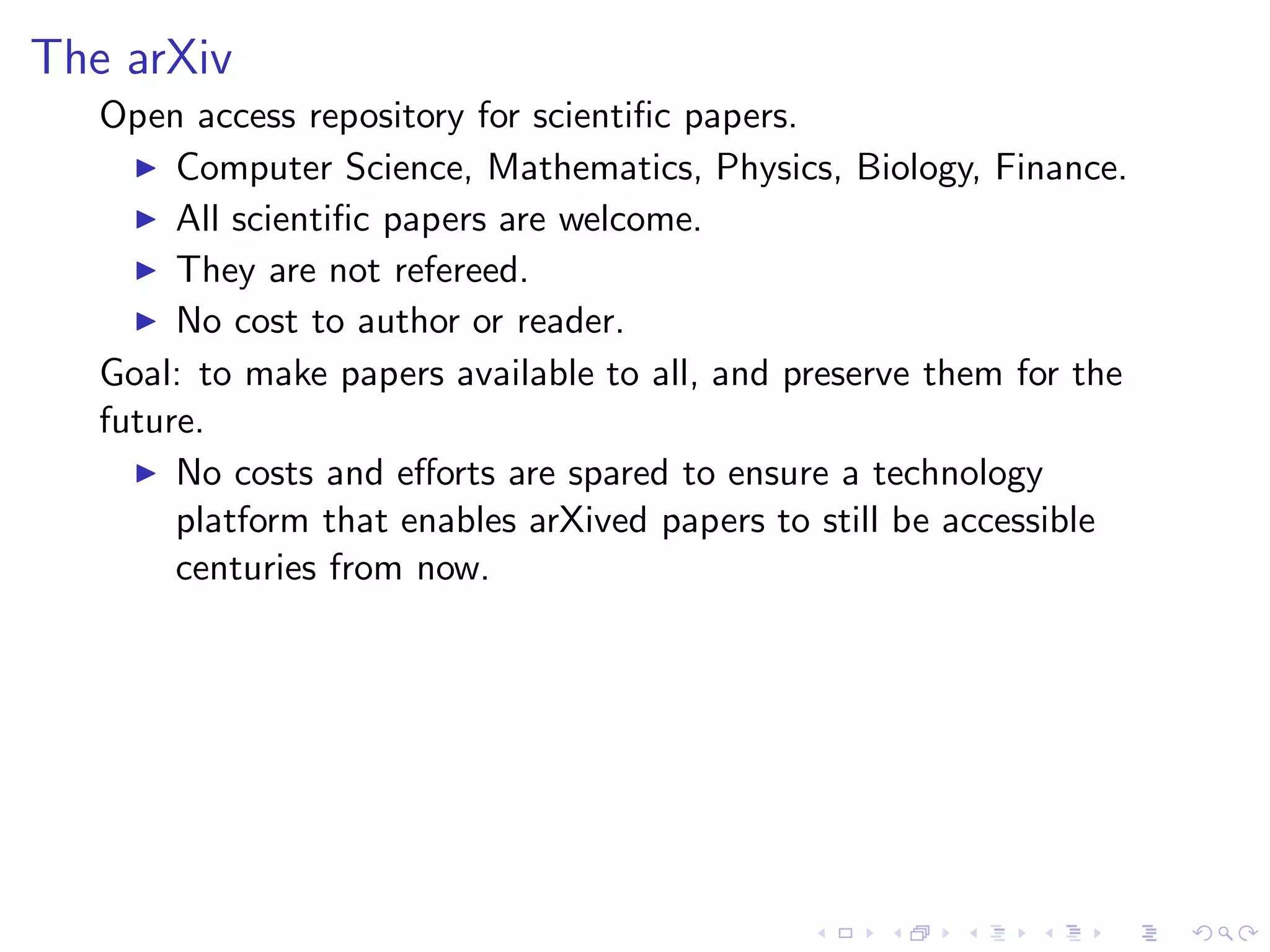
The arXiv
   Open access repository for scientific papers.
    ◮ Computer Science, Mathematics, Physics, Biology, Finance.


   Goal: to make papers available to all, and preserve them for the
   future.
The arXiv
   Open access repository for scientific papers.
     ◮ Computer Science, Mathematics, Physics, Biology, Finance.
     ◮ All scientific papers are welcome.
     ◮ They are not refereed.
     ◮ No cost to author or reader.

   Goal: to make papers available to all, and preserve them for the
   future.
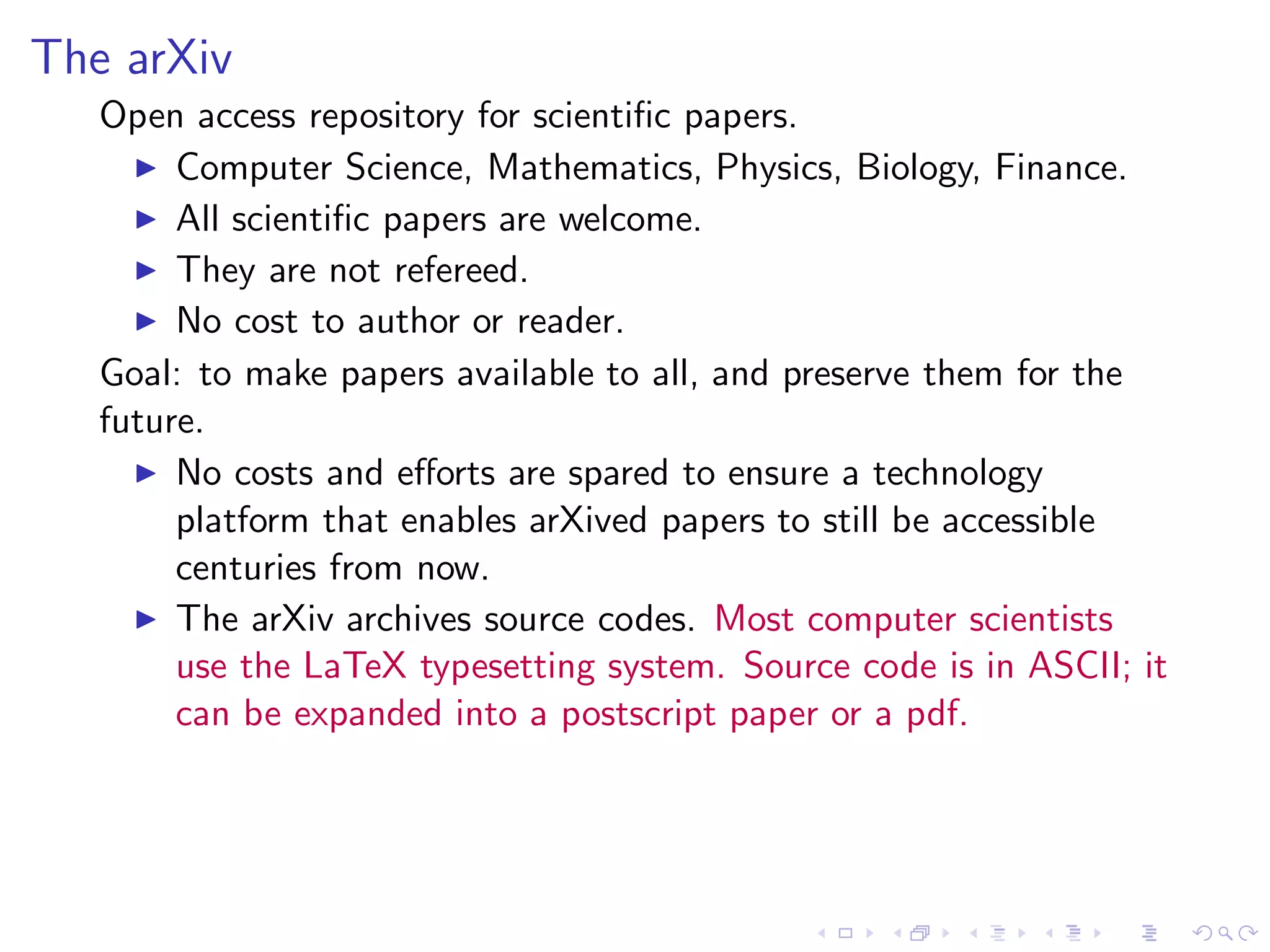
The arXiv
   Open access repository for scientific papers.
     ◮ Computer Science, Mathematics, Physics, Biology, Finance.
     ◮ All scientific papers are welcome.
     ◮ They are not refereed.
     ◮ No cost to author or reader.

   Goal: to make papers available to all, and preserve them for the
   future.
     ◮ No costs and efforts are spared to ensure a technology
        platform that enables arXived papers to still be accessible
        centuries from now.
The arXiv
   Open access repository for scientific papers.
     ◮ Computer Science, Mathematics, Physics, Biology, Finance.
     ◮ All scientific papers are welcome.
     ◮ They are not refereed.
     ◮ No cost to author or reader.

   Goal: to make papers available to all, and preserve them for the
   future.
     ◮ No costs and efforts are spared to ensure a technology
        platform that enables arXived papers to still be accessible
        centuries from now.
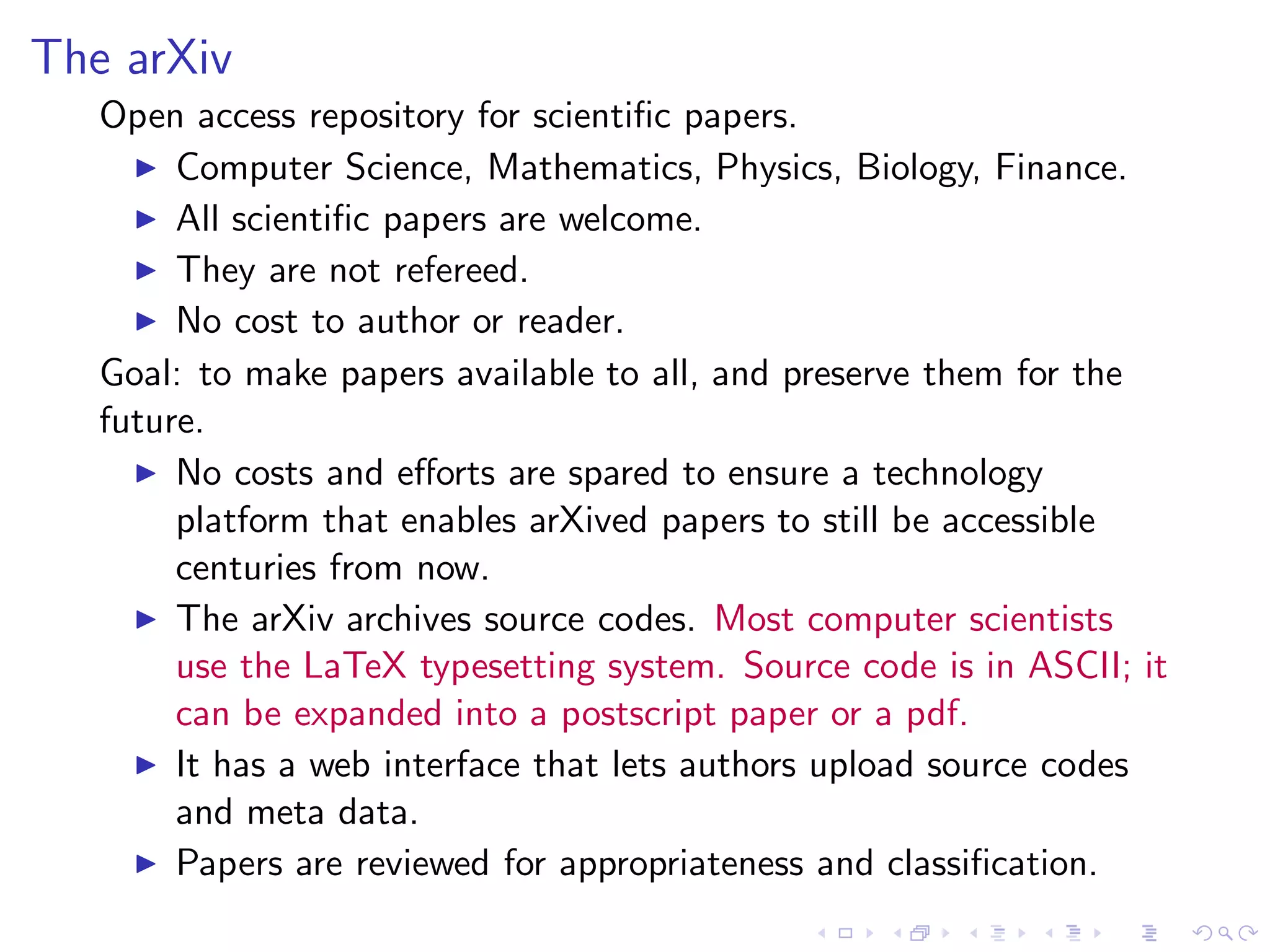
     ◮ The arXiv archives source codes. Most computer scientists
        use the LaTeX typesetting system. Source code is in ASCII; it
        can be expanded into a postscript paper or a pdf.
The arXiv
   Open access repository for scientific papers.
     ◮ Computer Science, Mathematics, Physics, Biology, Finance.
     ◮ All scientific papers are welcome.
     ◮ They are not refereed.
     ◮ No cost to author or reader.

   Goal: to make papers available to all, and preserve them for the
   future.
     ◮ No costs and efforts are spared to ensure a technology
        platform that enables arXived papers to still be accessible
        centuries from now.
     ◮ The arXiv archives source codes. Most computer scientists
        use the LaTeX typesetting system. Source code is in ASCII; it
        can be expanded into a postscript paper or a pdf.
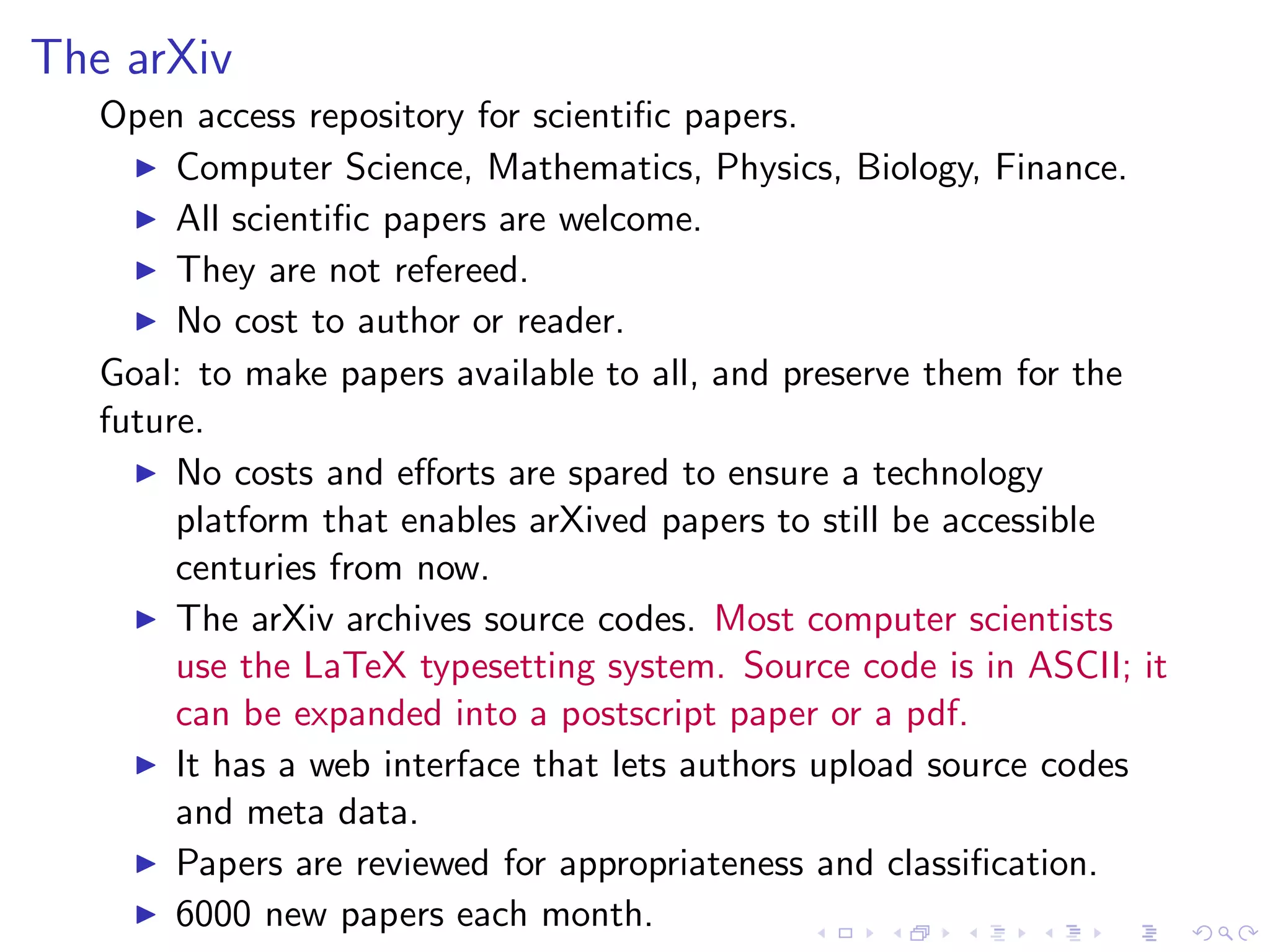
     ◮ It has a web interface that lets authors upload source codes
        and meta data.
     ◮ Papers are reviewed for appropriateness and classification.
The arXiv
   Open access repository for scientific papers.
     ◮ Computer Science, Mathematics, Physics, Biology, Finance.
     ◮ All scientific papers are welcome.
     ◮ They are not refereed.
     ◮ No cost to author or reader.

   Goal: to make papers available to all, and preserve them for the
   future.
     ◮ No costs and efforts are spared to ensure a technology
        platform that enables arXived papers to still be accessible
        centuries from now.
     ◮ The arXiv archives source codes. Most computer scientists
        use the LaTeX typesetting system. Source code is in ASCII; it
        can be expanded into a postscript paper or a pdf.
     ◮ It has a web interface that lets authors upload source codes
        and meta data.
     ◮ Papers are reviewed for appropriateness and classification.
     ◮ 6000 new papers each month.
Uniqueness of Publications


   These days, in the scientific community, Double Publication of the
   same material is not OK.
Uniqueness of Publications


   These days, in the scientific community, Double Publication of the
   same material is not OK.
     ◮   Technical reports (of universities),
     ◮   and papers on ones own webpage,
         do not count as Publications.
Uniqueness of Publications


   These days, in the scientific community, Double Publication of the
   same material is not OK.
     ◮   Technical reports (of universities),
     ◮   and papers on ones own webpage,
         do not count as Publications.
     ◮   Distinguish archival from Publication.
Computer Science


   Conference papers similar in status to journal publications.
     ◮   thoroughly reviewed
     ◮   some conferences very competitive.
     ◮   On a CV (almost) as many points as journal publications.
Workshops
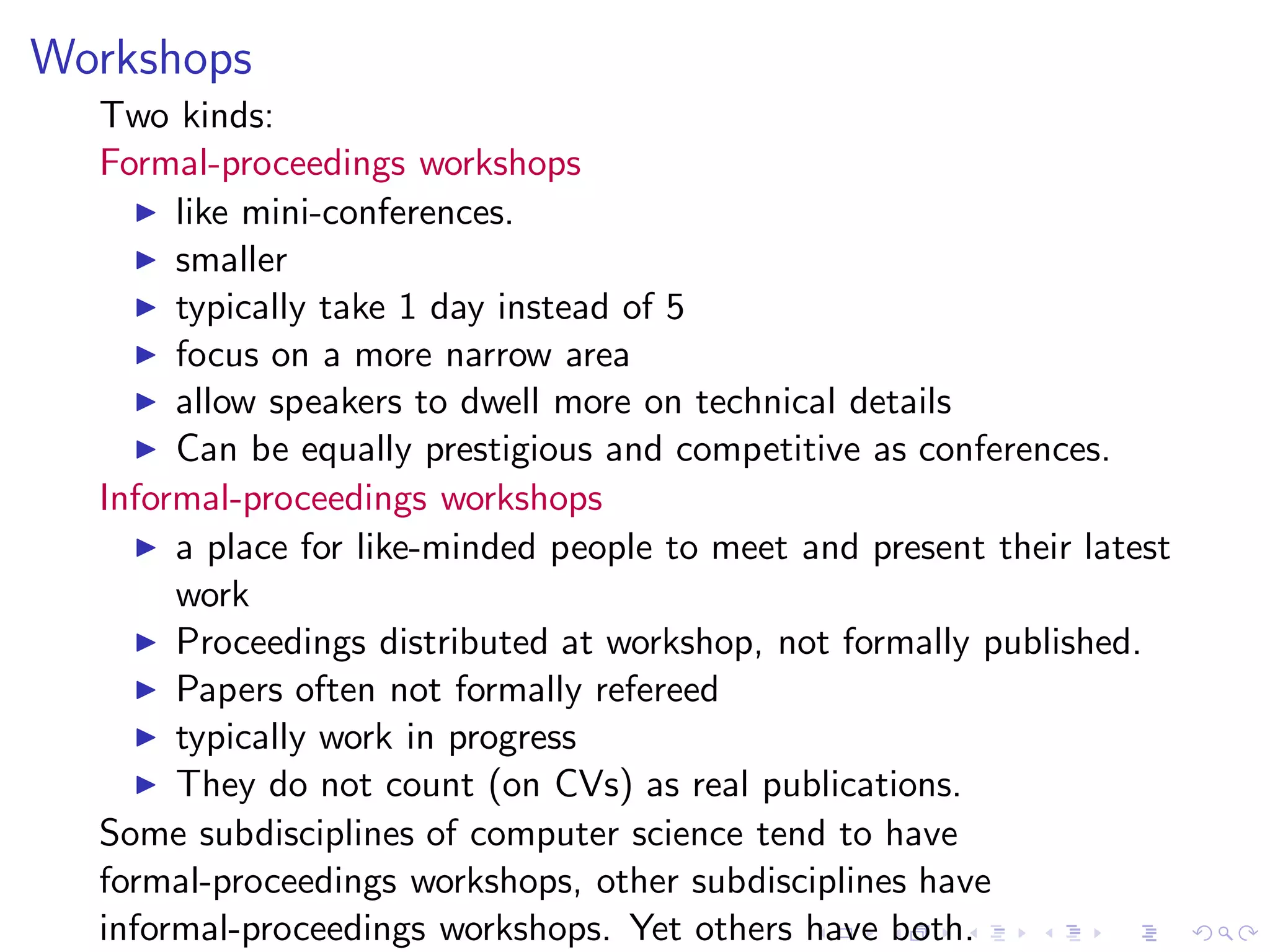
  Two kinds:
  Formal-proceedings workshops


  Informal-proceedings workshops


  Some subdisciplines of computer science tend to have
  formal-proceedings workshops, other subdisciplines have
  informal-proceedings workshops. Yet others have both.
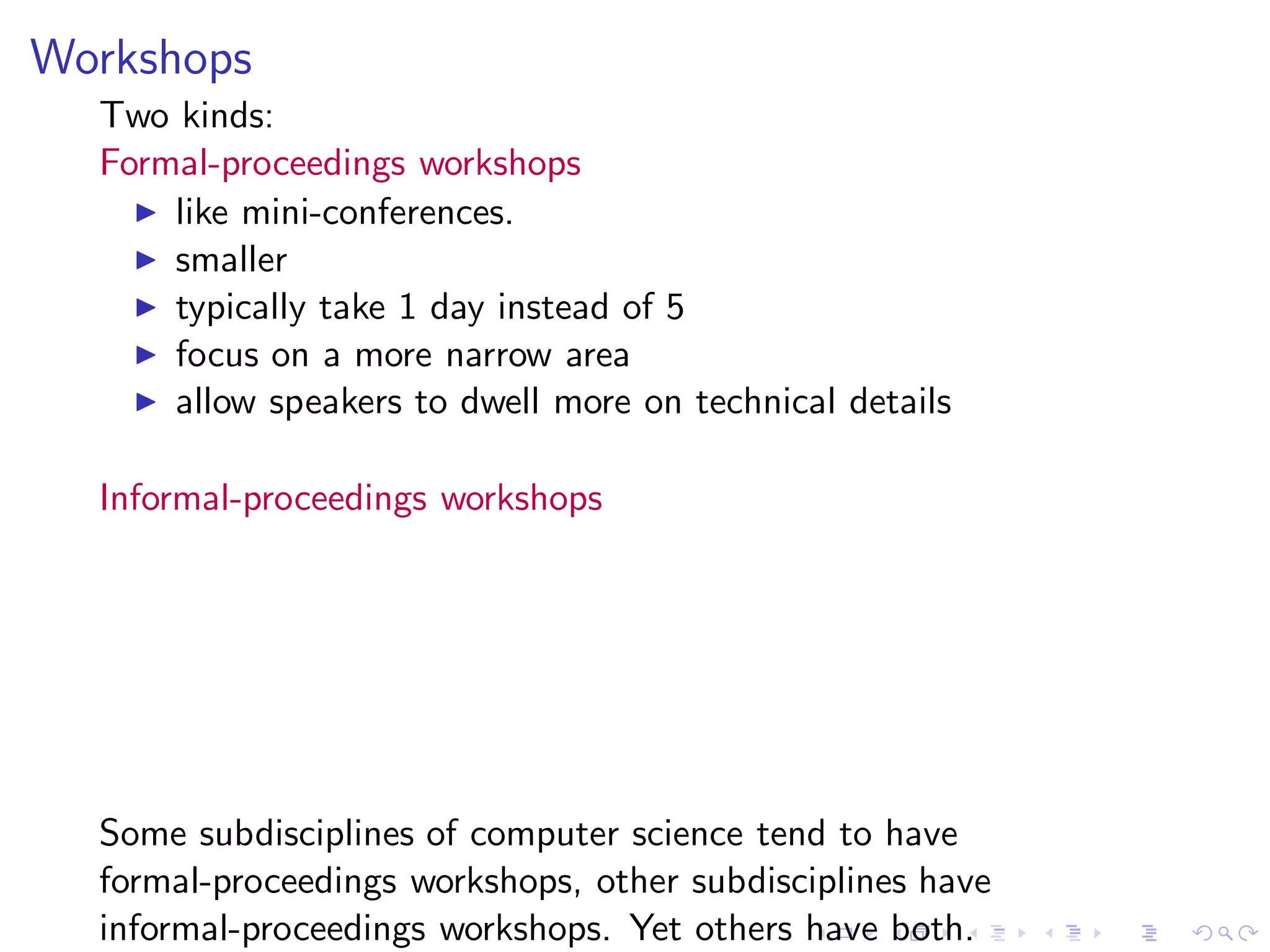
Workshops
  Two kinds:
  Formal-proceedings workshops
    ◮ like mini-conferences.
    ◮ smaller
    ◮ typically take 1 day instead of 5
    ◮ focus on a more narrow area
    ◮ allow speakers to dwell more on technical details


  Informal-proceedings workshops


  Some subdisciplines of computer science tend to have
  formal-proceedings workshops, other subdisciplines have
  informal-proceedings workshops. Yet others have both.
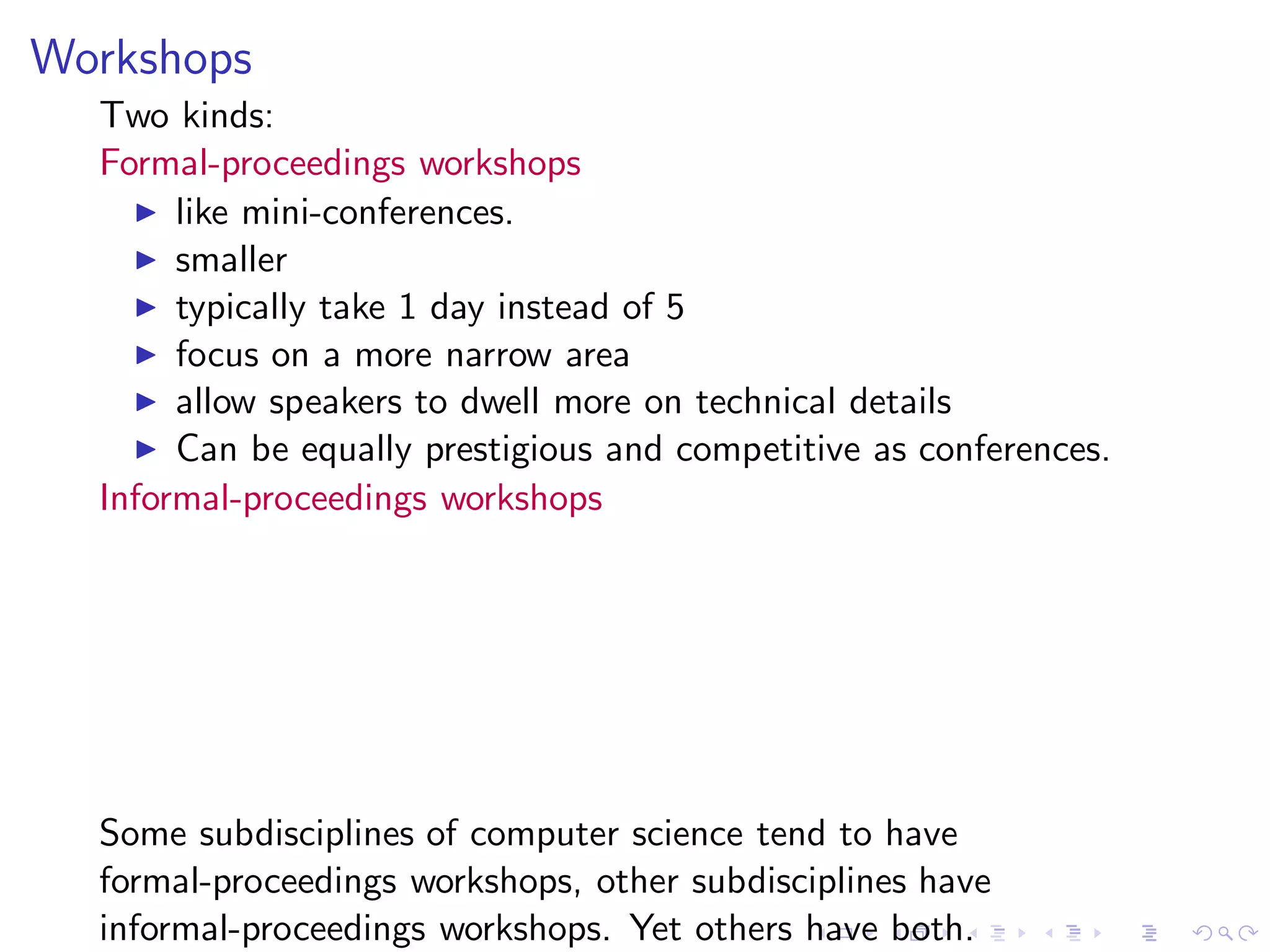
Workshops
  Two kinds:
  Formal-proceedings workshops
    ◮ like mini-conferences.
    ◮ smaller
    ◮ typically take 1 day instead of 5
    ◮ focus on a more narrow area
    ◮ allow speakers to dwell more on technical details
    ◮ Can be equally prestigious and competitive as conferences.
  Informal-proceedings workshops


  Some subdisciplines of computer science tend to have
  formal-proceedings workshops, other subdisciplines have
  informal-proceedings workshops. Yet others have both.
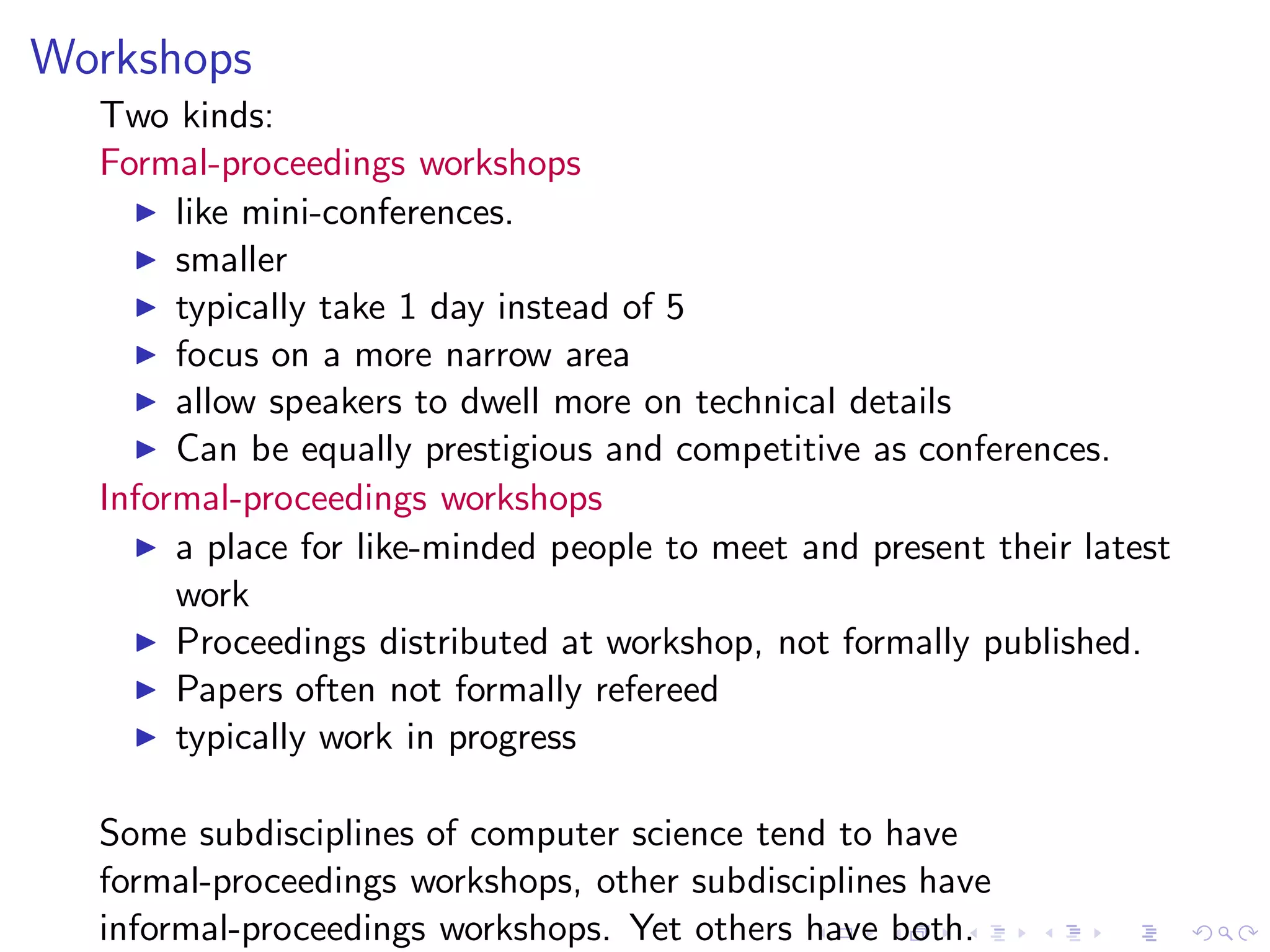
Workshops
  Two kinds:
  Formal-proceedings workshops
    ◮ like mini-conferences.
    ◮ smaller
    ◮ typically take 1 day instead of 5
    ◮ focus on a more narrow area
    ◮ allow speakers to dwell more on technical details
    ◮ Can be equally prestigious and competitive as conferences.
  Informal-proceedings workshops
    ◮ a place for like-minded people to meet and present their latest
       work
    ◮ Proceedings distributed at workshop, not formally published.
    ◮ Papers often not formally refereed
    ◮ typically work in progress


  Some subdisciplines of computer science tend to have
  formal-proceedings workshops, other subdisciplines have
  informal-proceedings workshops. Yet others have both.
Workshops
  Two kinds:
  Formal-proceedings workshops
    ◮ like mini-conferences.
    ◮ smaller
    ◮ typically take 1 day instead of 5
    ◮ focus on a more narrow area
    ◮ allow speakers to dwell more on technical details
    ◮ Can be equally prestigious and competitive as conferences.
  Informal-proceedings workshops
    ◮ a place for like-minded people to meet and present their latest
       work
    ◮ Proceedings distributed at workshop, not formally published.
    ◮ Papers often not formally refereed
    ◮ typically work in progress
    ◮ They do not count (on CVs) as real publications.
  Some subdisciplines of computer science tend to have
  formal-proceedings workshops, other subdisciplines have
  informal-proceedings workshops. Yet others have both.
EPTCS


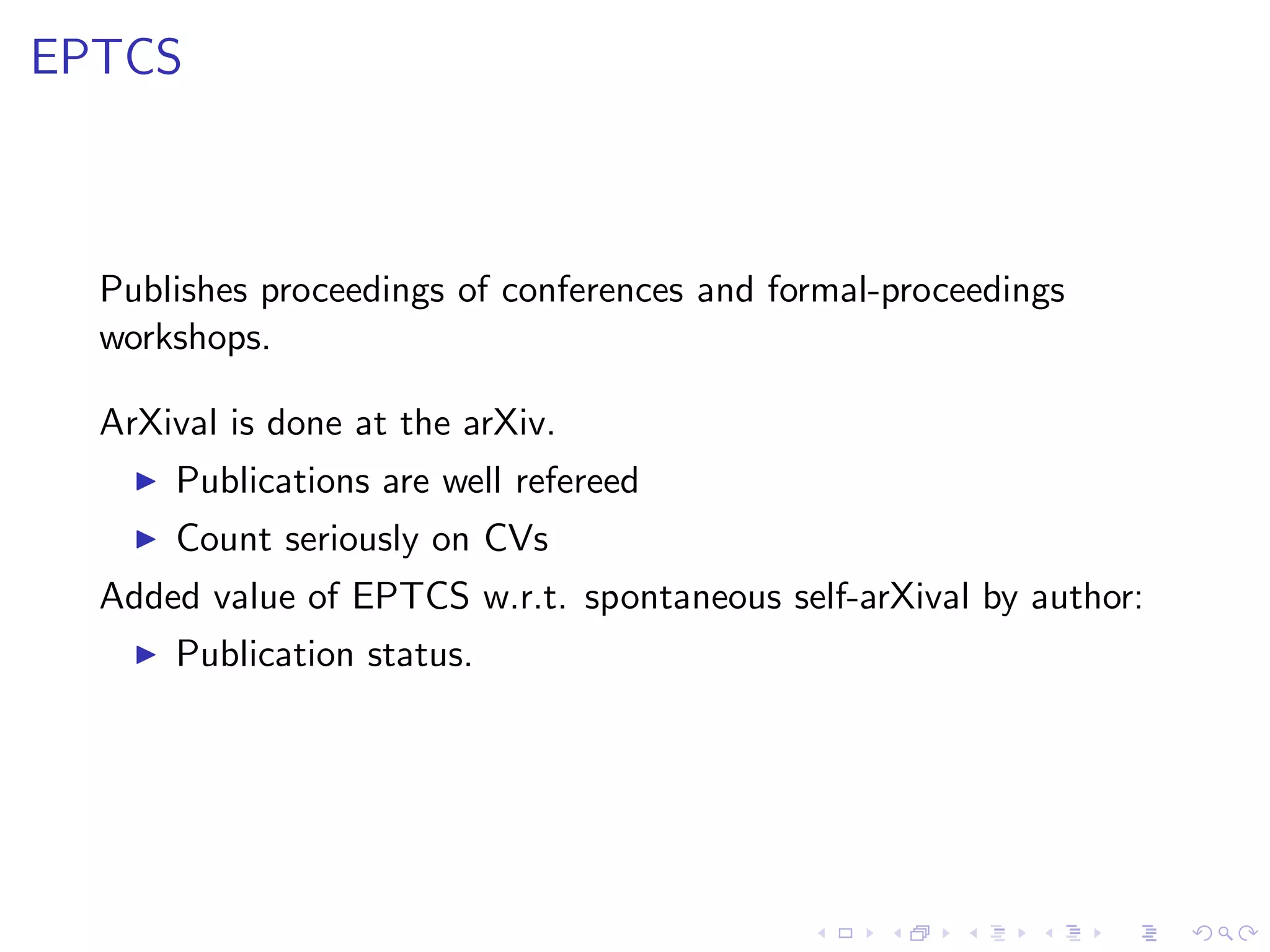
  Publishes proceedings of conferences and formal-proceedings
  workshops.

  ArXival is done at the arXiv.


  Added value of EPTCS w.r.t. spontaneous self-arXival by author:
EPTCS


  Publishes proceedings of conferences and formal-proceedings
  workshops.

  ArXival is done at the arXiv.
    ◮   Publications are well refereed
    ◮   Count seriously on CVs
  Added value of EPTCS w.r.t. spontaneous self-arXival by author:
    ◮   Publication status.
EPTCS


   ◮   Founded in 2009 because there was no free open access venue
       for publication of proceedings covering theoretical computer
       science.
EPTCS


   ◮   Founded in 2009 because there was no free open access venue
       for publication of proceedings covering theoretical computer
       science.
   ◮   Competitor: ENTCS (Elsevier): default for workshops in
       theoretical computer science.
         ◮   Not open access
         ◮   Since 2009 no longer free: $50/paper.
         ◮   36 proceedings/year
EPTCS


   ◮   Founded in 2009 because there was no free open access venue
       for publication of proceedings covering theoretical computer
       science.
   ◮   Competitor: ENTCS (Elsevier): default for workshops in
       theoretical computer science.
         ◮   Not open access
         ◮   Since 2009 no longer free: $50/paper.
         ◮   36 proceedings/year
   ◮   Other competitor: LNCS (Springer).
         ◮   Not open access
         ◮   Free for authors / conferences
         ◮   700 proceedings/year
How?


  Peer review
    ◮   Refereeing of papers is handled entirely by
        conference/workshop.
How?


  Peer review
    ◮   Refereeing of papers is handled entirely by
        conference/workshop.
    ◮   Conferences apply for publication in EPTCS by a web-form.
    ◮   Our board of editors judges the quality of the conference.
        Indirect responsibility for quality of refereeing.
How?


  Peer review
    ◮   Refereeing of papers is handled entirely by
        conference/workshop.
    ◮   Conferences apply for publication in EPTCS by a web-form.
    ◮   Our board of editors judges the quality of the conference.
        Indirect responsibility for quality of refereeing.
    ◮   26 prestigious editors, covering all of theoretical computer
        science.
    ◮   Automatic workflow for handling of applications.
How?
  Publication process
    ◮ Fully electronic workflow
        ◮   authors or volume editors upload papers as LaTeX source code
            in EPTCS style.
        ◮   Web interface for volume editors to inspect, change or approve
            papers
        ◮   and for EPTCS staff to check
              ◮   formatting requirements
              ◮   English
              ◮   Content
              ◮   and Meta data.
        ◮   All three parties needs to approve the same version of a paper.
How?
  Publication process
    ◮ Fully electronic workflow
          ◮   authors or volume editors upload papers as LaTeX source code
              in EPTCS style.
          ◮   Web interface for volume editors to inspect, change or approve
              papers
          ◮   and for EPTCS staff to check
                ◮   formatting requirements
                ◮   English
                ◮   Content
                ◮   and Meta data.
          ◮   All three parties needs to approve the same version of a paper.
    ◮   Upon publication, papers are automatically uploaded to arXiv.
        We also publish at arXiv one HTML cover page per
        proceedings, containing the table of contents, preface, and
        sometimes abstracts of invited talks.
How?
  Publication process
    ◮ Fully electronic workflow
          ◮   authors or volume editors upload papers as LaTeX source code
              in EPTCS style.
          ◮   Web interface for volume editors to inspect, change or approve
              papers
          ◮   and for EPTCS staff to check
                ◮   formatting requirements
                ◮   English
                ◮   Content
                ◮   and Meta data.
          ◮   All three parties needs to approve the same version of a paper.
    ◮   Upon publication, papers are automatically uploaded to arXiv.
        We also publish at arXiv one HTML cover page per
        proceedings, containing the table of contents, preface, and
        sometimes abstracts of invited talks.
    ◮   EPTCS also creates a pdf for each proceedings to distribute
        at the conference, or for subscribers to the hard copy edition
        of EPTCS.
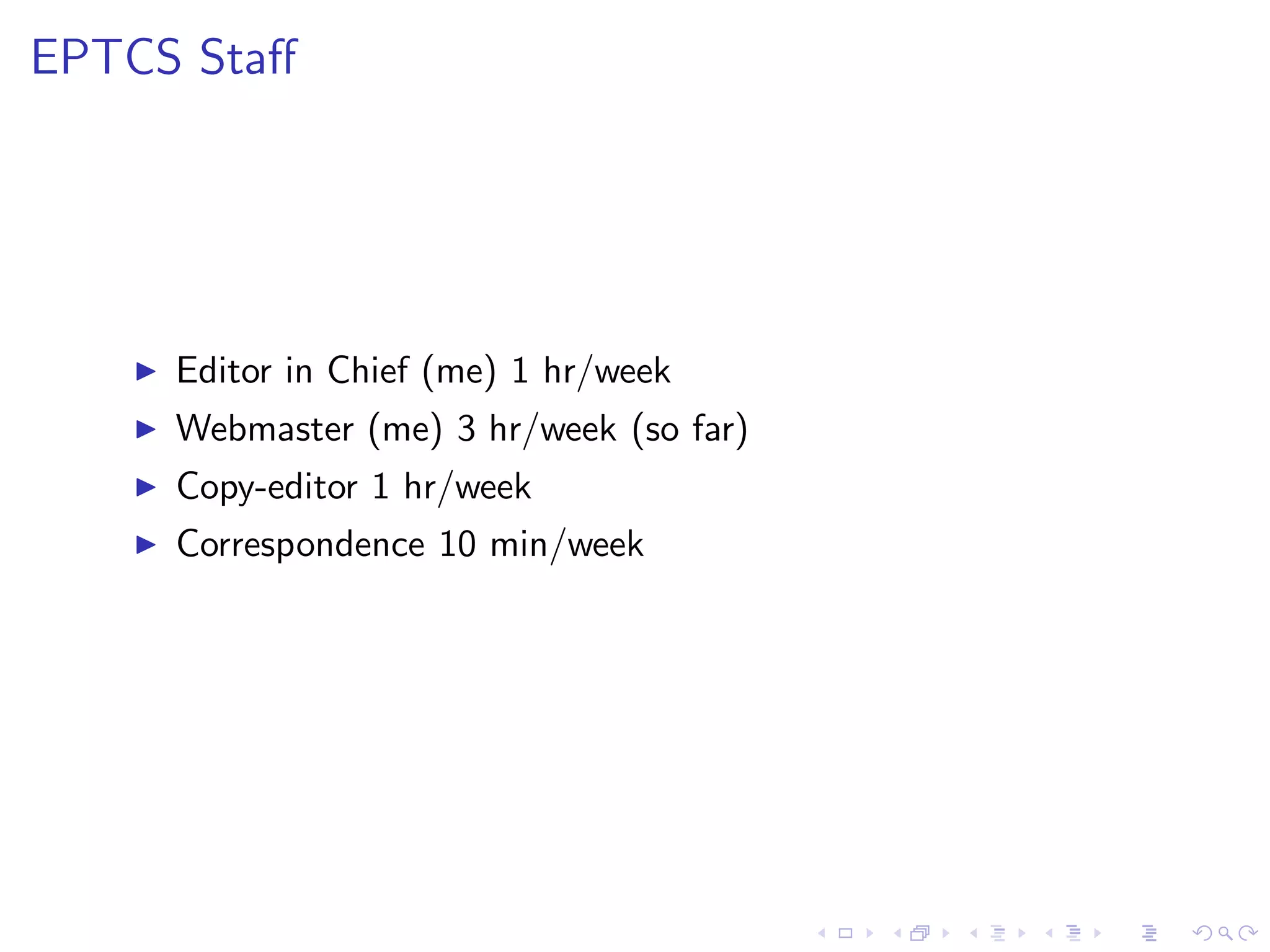
EPTCS Staff


   ◮   Editor in Chief (me) 1 hr/week
   ◮   Webmaster (me) 3 hr/week (so far)
   ◮   Copy-editor 1 hr/week
   ◮   Correspondence 10 min/week

Eptcs slides-for-coasp-2010

  • 1.
    Electronic Proceedings in TheoreticalComputer Science a peer-reviewed proceedings series implemented as an arXiv overlay Rob van Glabbeek NICTA, Sydney, Australia University of New South Wales, Sydney, Australia 23rd August 2010
  • 2.
    Electronic Proceedings inTheoretical Computer Science (EPTCS) is a ◮ refereed ◮ free ◮ open access venue for the rapid electronic publication of proceedings. In this talk ◮ ArXiv ◮ Archival versus Publication ◮ Why EPTCS? ◮ How?
  • 3.
    The arXiv Open access repository for scientific papers. ◮ Computer Science, Mathematics, Physics, Biology, Finance. Goal: to make papers available to all, and preserve them for the future.
  • 4.
    The arXiv Open access repository for scientific papers. ◮ Computer Science, Mathematics, Physics, Biology, Finance. ◮ All scientific papers are welcome. ◮ They are not refereed. ◮ No cost to author or reader. Goal: to make papers available to all, and preserve them for the future.
  • 5.
    The arXiv Open access repository for scientific papers. ◮ Computer Science, Mathematics, Physics, Biology, Finance. ◮ All scientific papers are welcome. ◮ They are not refereed. ◮ No cost to author or reader. Goal: to make papers available to all, and preserve them for the future. ◮ No costs and efforts are spared to ensure a technology platform that enables arXived papers to still be accessible centuries from now.
  • 6.
    The arXiv Open access repository for scientific papers. ◮ Computer Science, Mathematics, Physics, Biology, Finance. ◮ All scientific papers are welcome. ◮ They are not refereed. ◮ No cost to author or reader. Goal: to make papers available to all, and preserve them for the future. ◮ No costs and efforts are spared to ensure a technology platform that enables arXived papers to still be accessible centuries from now. ◮ The arXiv archives source codes. Most computer scientists use the LaTeX typesetting system. Source code is in ASCII; it can be expanded into a postscript paper or a pdf.
  • 7.
    The arXiv Open access repository for scientific papers. ◮ Computer Science, Mathematics, Physics, Biology, Finance. ◮ All scientific papers are welcome. ◮ They are not refereed. ◮ No cost to author or reader. Goal: to make papers available to all, and preserve them for the future. ◮ No costs and efforts are spared to ensure a technology platform that enables arXived papers to still be accessible centuries from now. ◮ The arXiv archives source codes. Most computer scientists use the LaTeX typesetting system. Source code is in ASCII; it can be expanded into a postscript paper or a pdf. ◮ It has a web interface that lets authors upload source codes and meta data. ◮ Papers are reviewed for appropriateness and classification.
  • 8.
    The arXiv Open access repository for scientific papers. ◮ Computer Science, Mathematics, Physics, Biology, Finance. ◮ All scientific papers are welcome. ◮ They are not refereed. ◮ No cost to author or reader. Goal: to make papers available to all, and preserve them for the future. ◮ No costs and efforts are spared to ensure a technology platform that enables arXived papers to still be accessible centuries from now. ◮ The arXiv archives source codes. Most computer scientists use the LaTeX typesetting system. Source code is in ASCII; it can be expanded into a postscript paper or a pdf. ◮ It has a web interface that lets authors upload source codes and meta data. ◮ Papers are reviewed for appropriateness and classification. ◮ 6000 new papers each month.
  • 9.
    Uniqueness of Publications These days, in the scientific community, Double Publication of the same material is not OK.
  • 10.
    Uniqueness of Publications These days, in the scientific community, Double Publication of the same material is not OK. ◮ Technical reports (of universities), ◮ and papers on ones own webpage, do not count as Publications.
  • 11.
    Uniqueness of Publications These days, in the scientific community, Double Publication of the same material is not OK. ◮ Technical reports (of universities), ◮ and papers on ones own webpage, do not count as Publications. ◮ Distinguish archival from Publication.
  • 12.
    Computer Science Conference papers similar in status to journal publications. ◮ thoroughly reviewed ◮ some conferences very competitive. ◮ On a CV (almost) as many points as journal publications.
  • 13.
    Workshops Twokinds: Formal-proceedings workshops Informal-proceedings workshops Some subdisciplines of computer science tend to have formal-proceedings workshops, other subdisciplines have informal-proceedings workshops. Yet others have both.
  • 14.
    Workshops Twokinds: Formal-proceedings workshops ◮ like mini-conferences. ◮ smaller ◮ typically take 1 day instead of 5 ◮ focus on a more narrow area ◮ allow speakers to dwell more on technical details Informal-proceedings workshops Some subdisciplines of computer science tend to have formal-proceedings workshops, other subdisciplines have informal-proceedings workshops. Yet others have both.
  • 15.
    Workshops Twokinds: Formal-proceedings workshops ◮ like mini-conferences. ◮ smaller ◮ typically take 1 day instead of 5 ◮ focus on a more narrow area ◮ allow speakers to dwell more on technical details ◮ Can be equally prestigious and competitive as conferences. Informal-proceedings workshops Some subdisciplines of computer science tend to have formal-proceedings workshops, other subdisciplines have informal-proceedings workshops. Yet others have both.
  • 16.
    Workshops Twokinds: Formal-proceedings workshops ◮ like mini-conferences. ◮ smaller ◮ typically take 1 day instead of 5 ◮ focus on a more narrow area ◮ allow speakers to dwell more on technical details ◮ Can be equally prestigious and competitive as conferences. Informal-proceedings workshops ◮ a place for like-minded people to meet and present their latest work ◮ Proceedings distributed at workshop, not formally published. ◮ Papers often not formally refereed ◮ typically work in progress Some subdisciplines of computer science tend to have formal-proceedings workshops, other subdisciplines have informal-proceedings workshops. Yet others have both.
  • 17.
    Workshops Twokinds: Formal-proceedings workshops ◮ like mini-conferences. ◮ smaller ◮ typically take 1 day instead of 5 ◮ focus on a more narrow area ◮ allow speakers to dwell more on technical details ◮ Can be equally prestigious and competitive as conferences. Informal-proceedings workshops ◮ a place for like-minded people to meet and present their latest work ◮ Proceedings distributed at workshop, not formally published. ◮ Papers often not formally refereed ◮ typically work in progress ◮ They do not count (on CVs) as real publications. Some subdisciplines of computer science tend to have formal-proceedings workshops, other subdisciplines have informal-proceedings workshops. Yet others have both.
  • 18.
    EPTCS Publishesproceedings of conferences and formal-proceedings workshops. ArXival is done at the arXiv. Added value of EPTCS w.r.t. spontaneous self-arXival by author:
  • 19.
    EPTCS Publishesproceedings of conferences and formal-proceedings workshops. ArXival is done at the arXiv. ◮ Publications are well refereed ◮ Count seriously on CVs Added value of EPTCS w.r.t. spontaneous self-arXival by author: ◮ Publication status.
  • 20.
    EPTCS ◮ Founded in 2009 because there was no free open access venue for publication of proceedings covering theoretical computer science.
  • 21.
    EPTCS ◮ Founded in 2009 because there was no free open access venue for publication of proceedings covering theoretical computer science. ◮ Competitor: ENTCS (Elsevier): default for workshops in theoretical computer science. ◮ Not open access ◮ Since 2009 no longer free: $50/paper. ◮ 36 proceedings/year
  • 22.
    EPTCS ◮ Founded in 2009 because there was no free open access venue for publication of proceedings covering theoretical computer science. ◮ Competitor: ENTCS (Elsevier): default for workshops in theoretical computer science. ◮ Not open access ◮ Since 2009 no longer free: $50/paper. ◮ 36 proceedings/year ◮ Other competitor: LNCS (Springer). ◮ Not open access ◮ Free for authors / conferences ◮ 700 proceedings/year
  • 23.
    How? Peerreview ◮ Refereeing of papers is handled entirely by conference/workshop.
  • 24.
    How? Peerreview ◮ Refereeing of papers is handled entirely by conference/workshop. ◮ Conferences apply for publication in EPTCS by a web-form. ◮ Our board of editors judges the quality of the conference. Indirect responsibility for quality of refereeing.
  • 25.
    How? Peerreview ◮ Refereeing of papers is handled entirely by conference/workshop. ◮ Conferences apply for publication in EPTCS by a web-form. ◮ Our board of editors judges the quality of the conference. Indirect responsibility for quality of refereeing. ◮ 26 prestigious editors, covering all of theoretical computer science. ◮ Automatic workflow for handling of applications.
  • 26.
    How? Publicationprocess ◮ Fully electronic workflow ◮ authors or volume editors upload papers as LaTeX source code in EPTCS style. ◮ Web interface for volume editors to inspect, change or approve papers ◮ and for EPTCS staff to check ◮ formatting requirements ◮ English ◮ Content ◮ and Meta data. ◮ All three parties needs to approve the same version of a paper.
  • 27.
    How? Publicationprocess ◮ Fully electronic workflow ◮ authors or volume editors upload papers as LaTeX source code in EPTCS style. ◮ Web interface for volume editors to inspect, change or approve papers ◮ and for EPTCS staff to check ◮ formatting requirements ◮ English ◮ Content ◮ and Meta data. ◮ All three parties needs to approve the same version of a paper. ◮ Upon publication, papers are automatically uploaded to arXiv. We also publish at arXiv one HTML cover page per proceedings, containing the table of contents, preface, and sometimes abstracts of invited talks.
  • 28.
    How? Publicationprocess ◮ Fully electronic workflow ◮ authors or volume editors upload papers as LaTeX source code in EPTCS style. ◮ Web interface for volume editors to inspect, change or approve papers ◮ and for EPTCS staff to check ◮ formatting requirements ◮ English ◮ Content ◮ and Meta data. ◮ All three parties needs to approve the same version of a paper. ◮ Upon publication, papers are automatically uploaded to arXiv. We also publish at arXiv one HTML cover page per proceedings, containing the table of contents, preface, and sometimes abstracts of invited talks. ◮ EPTCS also creates a pdf for each proceedings to distribute at the conference, or for subscribers to the hard copy edition of EPTCS.
  • 29.
    EPTCS Staff ◮ Editor in Chief (me) 1 hr/week ◮ Webmaster (me) 3 hr/week (so far) ◮ Copy-editor 1 hr/week ◮ Correspondence 10 min/week