Mechanisms These icons indicate that detailed teacher’s notes or useful web addresses are available in the Notes Page. For more detailed instructions, see the  Getting Started  presentation. This icon indicates the slide contains activities created in Flash. These activities are not editable.
Making our lives easier The aim of technology is to improve life for people.  Machines and mechanisms make it easier for us to move things. Mechanisms and machines are all around us. Look around the room that you are in at the moment. Identify an everyday machine or mechanism. How does this machine or mechanism make life easier?
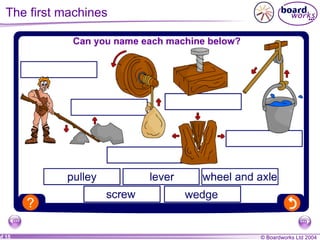
The first machines
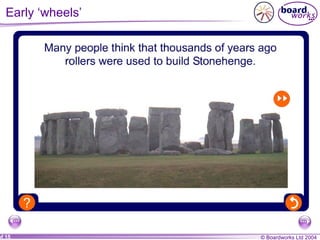
Early ‘wheels’
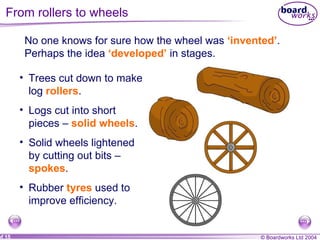
From rollers to wheels No one knows for sure how the wheel was  ‘invented’ .  Perhaps the idea  ‘developed’  in stages. Trees cut down to make log  rollers . Logs cut into short pieces –  solid wheels .   Solid wheels lightened by cutting out bits –  spokes . Rubber  tyres  used to improve efficiency.
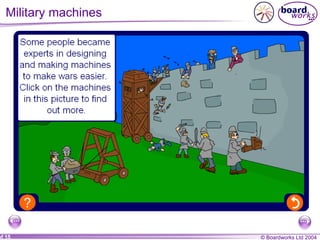
Military machines
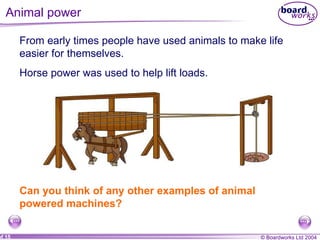
Animal power  From early times people have used animals to make life easier for themselves.  Horse power was used to help lift loads. Can you think of any other examples of animal powered machines?
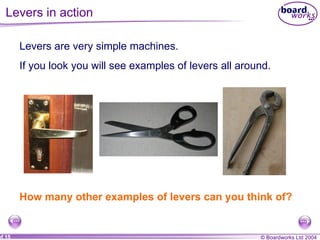
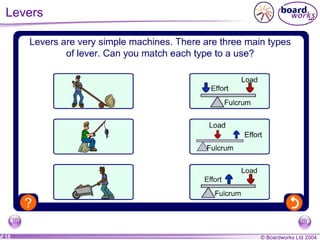
Levers in action  Levers are very simple machines. If you look you will see examples of levers all around. How many other examples of levers can you think of?
Levers
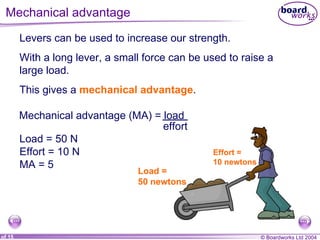
Mechanical advantage  Levers can be used to increase our strength. With a long lever, a small force can be used to raise a large load. This gives a  mechanical advantage . Load =  50 newtons Effort =  10 newtons Load = 50 N Effort = 10 N MA = 5 Mechanical advantage (MA) = load effort
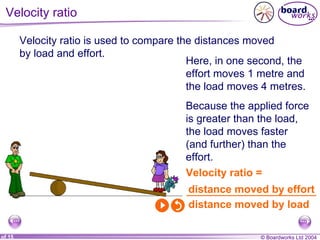
Velocity ratio Velocity ratio is used to compare the distances moved by load and effort. Velocity ratio = Here, in one second, the effort moves 1 metre and the load moves 4 metres. Because the applied force is greater than the load, the load moves faster (and further) than the effort. distance moved by effort distance moved by load
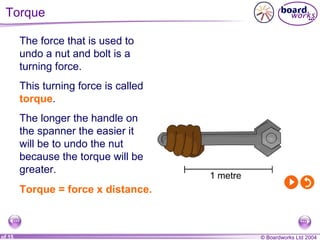
Torque  Torque = force x distance. The force that is used to undo a nut and bolt is a turning force. This turning force is called  torque . The longer the handle on the spanner the easier it will be to undo the nut because the torque will be greater.
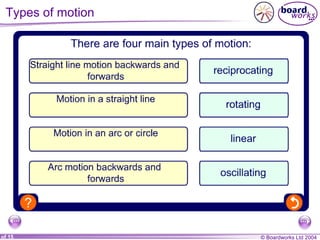
Types of motion
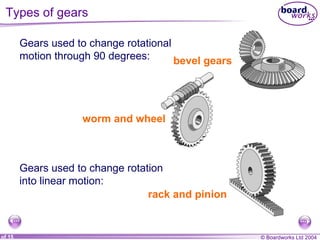
Types of gears Gears used to change rotation  into linear motion:  Gears used to change rotational motion through 90 degrees: bevel gears rack and pinion worm and wheel
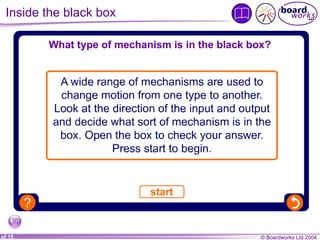
Inside the black box

Mechanisms

  • 1.
    Mechanisms These iconsindicate that detailed teacher’s notes or useful web addresses are available in the Notes Page. For more detailed instructions, see the Getting Started presentation. This icon indicates the slide contains activities created in Flash. These activities are not editable.
  • 2.
    Making our liveseasier The aim of technology is to improve life for people. Machines and mechanisms make it easier for us to move things. Mechanisms and machines are all around us. Look around the room that you are in at the moment. Identify an everyday machine or mechanism. How does this machine or mechanism make life easier?
  • 3.
  • 4.
  • 5.
    From rollers towheels No one knows for sure how the wheel was ‘invented’ . Perhaps the idea ‘developed’ in stages. Trees cut down to make log rollers . Logs cut into short pieces – solid wheels . Solid wheels lightened by cutting out bits – spokes . Rubber tyres used to improve efficiency.
  • 6.
  • 7.
    Animal power From early times people have used animals to make life easier for themselves. Horse power was used to help lift loads. Can you think of any other examples of animal powered machines?
  • 8.
    Levers in action Levers are very simple machines. If you look you will see examples of levers all around. How many other examples of levers can you think of?
  • 9.
  • 10.
    Mechanical advantage Levers can be used to increase our strength. With a long lever, a small force can be used to raise a large load. This gives a mechanical advantage . Load = 50 newtons Effort = 10 newtons Load = 50 N Effort = 10 N MA = 5 Mechanical advantage (MA) = load effort
  • 11.
    Velocity ratio Velocityratio is used to compare the distances moved by load and effort. Velocity ratio = Here, in one second, the effort moves 1 metre and the load moves 4 metres. Because the applied force is greater than the load, the load moves faster (and further) than the effort. distance moved by effort distance moved by load
  • 12.
    Torque Torque= force x distance. The force that is used to undo a nut and bolt is a turning force. This turning force is called torque . The longer the handle on the spanner the easier it will be to undo the nut because the torque will be greater.
  • 13.
  • 14.
    Types of gearsGears used to change rotation into linear motion: Gears used to change rotational motion through 90 degrees: bevel gears rack and pinion worm and wheel
  • 15.

Editor's Notes

  • #16 This activity can be used by discussing the input and output direction for each mechanism and then asking students to guess which mechanism will be revealed. Clicking on the box will then reveal the mechanism. Students can then be asked to name each mechanism, if they haven’t already, before the name is shown. At this point you may wish to discuss the workings of each mechanism in more detail. The wedge works to change linear motion through 90 degrees. The bevel gears change rotational motion through 90 degrees. The input gear is rotating anti-clockwise (if viewed from the centre of the box) while the output gear is rotating clockwise. The rack and pinion converts rotational motion into linear motion, The linkage operates using reciprocating motion.