

Sous titre
September 2015
8th European Altair Technology Conference, Paris
Abdelkader SALIM
Engineer
Innovation Department
SOGECLAIR aerospace
A New Engine Pylon Concept
Topology optimisation of a large aeronautic structure
Sous titre
Introduction : SOGECLAIR aerospace
Location : Europe (France, Spain, United Kingdom, Germany)
North Africa (Tunisia )
North America (Canada)
Aerostructures
Systems
Installation
Equipment
Configuration
Management
Manufacturing
Engineering
Aircraft Interiors
1
Sous titre
Topology optimisation of a large aeronautic structure
Content
Objectives
Engine pylon location
Main considerations
Engine pylon architecture
• Main components
• Primary structure interfaces
Topology optimisation setup
• Design & non-design zones
• Boundary conditions & loads
• Material & dimensions
• Topology optimisation results
• Geometry reconstruction
Current & optimised pylon comparison
Summary & conclusion
2
Sous titre
Topology optimisation of a large aeronautic structure
Demonstrate the feasibility of topology optimisation of a large, complex structure.
Demonstrate the functions and parts integration ability.
Compare current design against optimised design using ALTAIR Optistruct : mass,
number of parts, time.
Uncover innovative architectures.
Explore the methodology for numerical simulation of large systems and the associated
computing facilities.
Project objectives
Assert our ALM & engine pylon expertise.
Stimulate the ALM technological advances (size, simulation, integration ...).
Identify the future "technological roadblocks".
Technical objectives
3
Sous titre
Topology optimisation of a large aeronautic structure
Engine pylon location
4
Sous titre
Topology optimisation of a large aeronautic structure
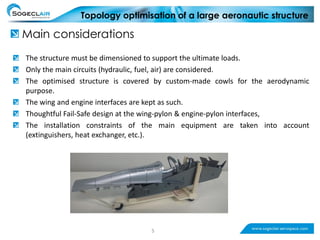
The structure must be dimensioned to support the ultimate loads.
Only the main circuits (hydraulic, fuel, air) are considered.
The optimised structure is covered by custom-made cowls for the aerodynamic
purpose.
The wing and engine interfaces are kept as such.
Thoughtful Fail-Safe design at the wing-pylon & engine-pylon interfaces,
The installation constraints of the main equipment are taken into account
(extinguishers, heat exchanger, etc.).
Main considerations
5
Sous titre
Topology optimisation of a large aeronautic structure
Engine Pylon
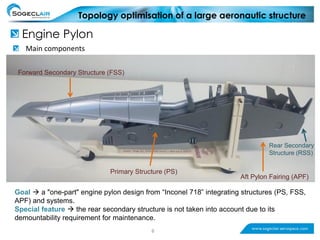
Goal  a "one-part" engine pylon design from “Inconel 718” integrating structures (PS, FSS,
APF) and systems.
Special feature  the rear secondary structure is not taken into account due to its
demountability requirement for maintenance.
Forward Secondary Structure (FSS)
Primary Structure (PS)
Rear Secondary
Structure (RSS)
Aft Pylon Fairing (APF)
Main components
6
Sous titre
Topology optimisation of a large aeronautic structure
Primary Structure interfaces
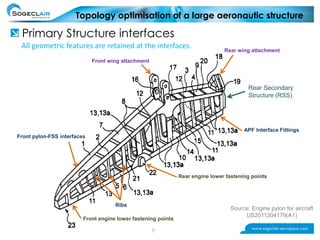
All geometric features are retained at the interfaces.
Front wing attachment
Rear wing attachment
Rear engine lower fastening points
Front engine lower fastening points
Front pylon-FSS interfaces
APF Interface Fittings
7
Source: Engine pylon for aircraft
US2011204179(A1)
Ribs
Rear Secondary
Structure (RSS)
Sous titre
Topology optimisation of a large aeronautic structure
Design & Non-Design Spaces
Non-Design Space
Engine CoG APF Resultant RSS
Resultant
Design Space
8
Sous titre
Topology optimisation of a large aeronautic structure
Hydraulic and fuel pipes : double skin concept
9
Hydraulic
pipes
Fuel pipe
The smooth flow paths allow to reduce the
pressure drops : friction and minor losses.
Design freedom of the flow paths.
Sous titre
Topology optimisation of a large aeronautic structure
Boundary Conditions & Loads
Engine CoG APF Resultant RSS
Resultant
Static Loads Inertial Loads
(gx, gy, gz)
Single Point Constraints
(SPC)
Engine Pylon without Aft Pylon Fairing (APF)
10
Sous titre
Topology optimisation of a large aeronautic structure
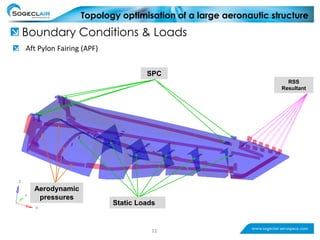
Aft Pylon Fairing (APF)
Boundary Conditions & Loads
RSS
Resultant
SPC
Static Loads
Aerodynamic
pressures
11
Sous titre
Topology optimisation of a large aeronautic structure
Material & Dimensions
Engine Pylon : ~9 108 mm3
APF : ~6.7 107 mm3
Volume to be optimised
12
Inconel 718
Density : 8.15 10-9 t/mm3
Material
The mechanical properties at 580°C are used for the numerical simulations
Engine pylon dimensions
Length > 5 m
Width > 0.7 m
Height > 1.5 m
Sous titre
Topology optimisation of a large aeronautic structure
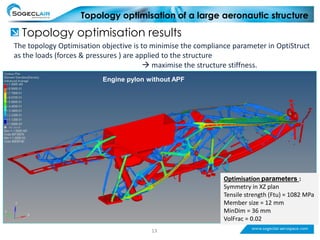
Topology optimisation results
The topology Optimisation objective is to minimise the compliance parameter in OptiStruct
as the loads (forces & pressures ) are applied to the structure
 maximise the structure stiffness.
Optimisation parameters :
Symmetry in XZ plan
Tensile strength (Ftu) = 1082 MPa
Member size = 12 mm
MinDim = 36 mm
VolFrac = 0.02
Engine pylon without APF
13
Sous titre
Topology optimisation of a large aeronautic structure
14
Topology optimisation results
Sous titre
Topology optimisation of a large aeronautic structure
Optimisation parameters :
Symmetry in XZ plan
Tensile strength (Ftu) = 1082 MPa
Member size = 12 mm
MinDim = 36 mm
VolFrac = 0.02
Localized over-stresses may be due to the model discretizations.
Engine pylon without APF
15
Topology optimisation results
Sous titre
Topology optimisation of a large aeronautic structure
Optimisation parameters :
Symmetry in XZ plan
Tensile strength (Ftu) = 1082 MPa
Member size = 5 mm
MinDim = 25 mm
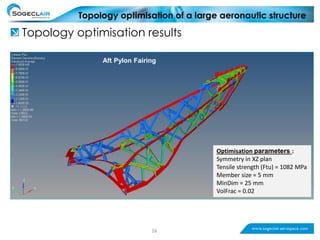
VolFrac = 0.02
Aft Pylon Fairing
16
Topology optimisation results
Sous titre
Topology optimisation of a large aeronautic structure
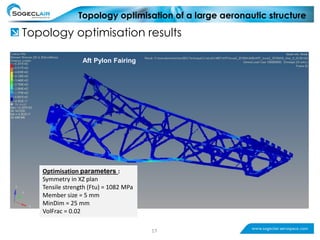
Optimisation parameters :
Symmetry in XZ plan
Tensile strength (Ftu) = 1082 MPa
Member size = 5 mm
MinDim = 25 mm
VolFrac = 0.02
17
Topology optimisation results
Aft Pylon Fairing
Sous titre
Topology optimisation of a large aeronautic structure
Geometric reconstruction
The resulting design is refined with a CAD tool and then numerically verified with OptiStruct.
18
Sous titre
Topology optimisation of a large aeronautic structure
1/8 scale model manufacturing in plastic material
19
The optimised structure is covered by custom-made cowls for the
aerodynamic purpose.
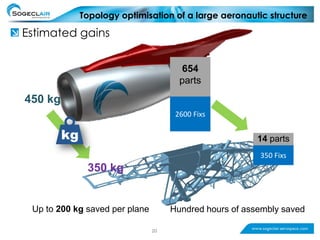
Sous titreEstimated gains
Topology optimisation of a large aeronautic structure
Up to 200 kg saved per plane
450 kg
350 kg
20
654
parts
14 parts
2600 Fixs
350 Fixs
Hundred hours of assembly saved
Sous titreSummary & conclusion
Topology optimisation of a large aeronautic structure
This study therefore demonstrate a strong interest in topology optimisation, for
Additive Layer Manufacturing, of large-scale parts across the whole aircraft.
By taking advantage of ALM technology, opportunities exist for the aerospace industry
to achieve considerable weight and cost savings.
If the simulation facilities, as OptiStruct, allow to optimise a complex large structure, a
close relation to the manufacturing process needs to be improved.
Efforts on the manufacturability of large-scale structures, via the additive layer
manufacturing process, are needed.
21
Sous titre
Topology optimisation of a large aeronautic structure
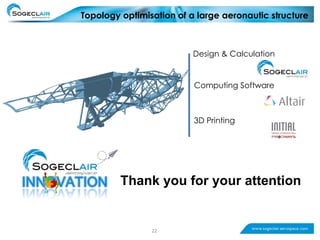
Design & Calculation
Computing Software
3D Printing
Thank you for your attention
22

Large scale topological optimisation: aircraft engine pylon case

  • 1.
    Sous titre September 2015 8thEuropean Altair Technology Conference, Paris Abdelkader SALIM Engineer Innovation Department SOGECLAIR aerospace A New Engine Pylon Concept Topology optimisation of a large aeronautic structure
  • 2.
    Sous titre Introduction :SOGECLAIR aerospace Location : Europe (France, Spain, United Kingdom, Germany) North Africa (Tunisia ) North America (Canada) Aerostructures Systems Installation Equipment Configuration Management Manufacturing Engineering Aircraft Interiors 1
  • 3.
    Sous titre Topology optimisationof a large aeronautic structure Content Objectives Engine pylon location Main considerations Engine pylon architecture • Main components • Primary structure interfaces Topology optimisation setup • Design & non-design zones • Boundary conditions & loads • Material & dimensions • Topology optimisation results • Geometry reconstruction Current & optimised pylon comparison Summary & conclusion 2
  • 4.
    Sous titre Topology optimisationof a large aeronautic structure Demonstrate the feasibility of topology optimisation of a large, complex structure. Demonstrate the functions and parts integration ability. Compare current design against optimised design using ALTAIR Optistruct : mass, number of parts, time. Uncover innovative architectures. Explore the methodology for numerical simulation of large systems and the associated computing facilities. Project objectives Assert our ALM & engine pylon expertise. Stimulate the ALM technological advances (size, simulation, integration ...). Identify the future "technological roadblocks". Technical objectives 3
  • 5.
    Sous titre Topology optimisationof a large aeronautic structure Engine pylon location 4
  • 6.
    Sous titre Topology optimisationof a large aeronautic structure The structure must be dimensioned to support the ultimate loads. Only the main circuits (hydraulic, fuel, air) are considered. The optimised structure is covered by custom-made cowls for the aerodynamic purpose. The wing and engine interfaces are kept as such. Thoughtful Fail-Safe design at the wing-pylon & engine-pylon interfaces, The installation constraints of the main equipment are taken into account (extinguishers, heat exchanger, etc.). Main considerations 5
  • 7.
    Sous titre Topology optimisationof a large aeronautic structure Engine Pylon Goal  a "one-part" engine pylon design from “Inconel 718” integrating structures (PS, FSS, APF) and systems. Special feature  the rear secondary structure is not taken into account due to its demountability requirement for maintenance. Forward Secondary Structure (FSS) Primary Structure (PS) Rear Secondary Structure (RSS) Aft Pylon Fairing (APF) Main components 6
  • 8.
    Sous titre Topology optimisationof a large aeronautic structure Primary Structure interfaces All geometric features are retained at the interfaces. Front wing attachment Rear wing attachment Rear engine lower fastening points Front engine lower fastening points Front pylon-FSS interfaces APF Interface Fittings 7 Source: Engine pylon for aircraft US2011204179(A1) Ribs Rear Secondary Structure (RSS)
  • 9.
    Sous titre Topology optimisationof a large aeronautic structure Design & Non-Design Spaces Non-Design Space Engine CoG APF Resultant RSS Resultant Design Space 8
  • 10.
    Sous titre Topology optimisationof a large aeronautic structure Hydraulic and fuel pipes : double skin concept 9 Hydraulic pipes Fuel pipe The smooth flow paths allow to reduce the pressure drops : friction and minor losses. Design freedom of the flow paths.
  • 11.
    Sous titre Topology optimisationof a large aeronautic structure Boundary Conditions & Loads Engine CoG APF Resultant RSS Resultant Static Loads Inertial Loads (gx, gy, gz) Single Point Constraints (SPC) Engine Pylon without Aft Pylon Fairing (APF) 10
  • 12.
    Sous titre Topology optimisationof a large aeronautic structure Aft Pylon Fairing (APF) Boundary Conditions & Loads RSS Resultant SPC Static Loads Aerodynamic pressures 11
  • 13.
    Sous titre Topology optimisationof a large aeronautic structure Material & Dimensions Engine Pylon : ~9 108 mm3 APF : ~6.7 107 mm3 Volume to be optimised 12 Inconel 718 Density : 8.15 10-9 t/mm3 Material The mechanical properties at 580°C are used for the numerical simulations Engine pylon dimensions Length > 5 m Width > 0.7 m Height > 1.5 m
  • 14.
    Sous titre Topology optimisationof a large aeronautic structure Topology optimisation results The topology Optimisation objective is to minimise the compliance parameter in OptiStruct as the loads (forces & pressures ) are applied to the structure  maximise the structure stiffness. Optimisation parameters : Symmetry in XZ plan Tensile strength (Ftu) = 1082 MPa Member size = 12 mm MinDim = 36 mm VolFrac = 0.02 Engine pylon without APF 13
  • 15.
    Sous titre Topology optimisationof a large aeronautic structure 14 Topology optimisation results
  • 16.
    Sous titre Topology optimisationof a large aeronautic structure Optimisation parameters : Symmetry in XZ plan Tensile strength (Ftu) = 1082 MPa Member size = 12 mm MinDim = 36 mm VolFrac = 0.02 Localized over-stresses may be due to the model discretizations. Engine pylon without APF 15 Topology optimisation results
  • 17.
    Sous titre Topology optimisationof a large aeronautic structure Optimisation parameters : Symmetry in XZ plan Tensile strength (Ftu) = 1082 MPa Member size = 5 mm MinDim = 25 mm VolFrac = 0.02 Aft Pylon Fairing 16 Topology optimisation results
  • 18.
    Sous titre Topology optimisationof a large aeronautic structure Optimisation parameters : Symmetry in XZ plan Tensile strength (Ftu) = 1082 MPa Member size = 5 mm MinDim = 25 mm VolFrac = 0.02 17 Topology optimisation results Aft Pylon Fairing
  • 19.
    Sous titre Topology optimisationof a large aeronautic structure Geometric reconstruction The resulting design is refined with a CAD tool and then numerically verified with OptiStruct. 18
  • 20.
    Sous titre Topology optimisationof a large aeronautic structure 1/8 scale model manufacturing in plastic material 19 The optimised structure is covered by custom-made cowls for the aerodynamic purpose.
  • 21.
    Sous titreEstimated gains Topologyoptimisation of a large aeronautic structure Up to 200 kg saved per plane 450 kg 350 kg 20 654 parts 14 parts 2600 Fixs 350 Fixs Hundred hours of assembly saved
  • 22.
    Sous titreSummary &conclusion Topology optimisation of a large aeronautic structure This study therefore demonstrate a strong interest in topology optimisation, for Additive Layer Manufacturing, of large-scale parts across the whole aircraft. By taking advantage of ALM technology, opportunities exist for the aerospace industry to achieve considerable weight and cost savings. If the simulation facilities, as OptiStruct, allow to optimise a complex large structure, a close relation to the manufacturing process needs to be improved. Efforts on the manufacturability of large-scale structures, via the additive layer manufacturing process, are needed. 21
  • 23.
    Sous titre Topology optimisationof a large aeronautic structure Design & Calculation Computing Software 3D Printing Thank you for your attention 22