ECONOMIC ACTIVITIES
Presented By
Alpana Gupta and Richa Gupta
CONTENTS
1) Economic Activities
2) Non Economic Activities
3) Objectives
4) Characteristics
5) Parts of Economic Activities
6) Types/Classification Of Economic
Activities
7) Sectors Of Economic Activities.
ECONOMICS ACTIVITIES
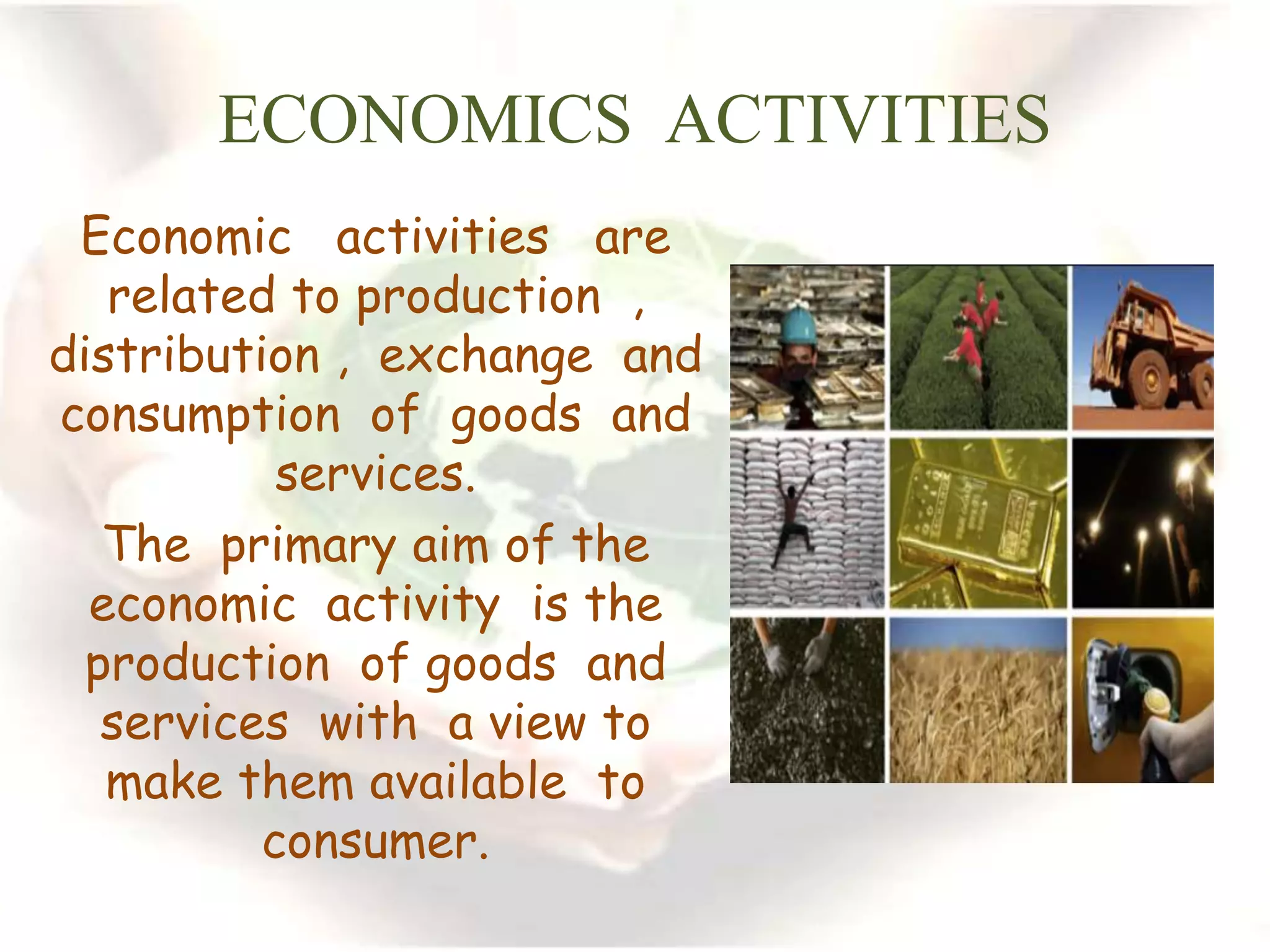
Economic activities are
related to production ,
distribution , exchange and
consumption of goods and
services.
The primary aim of the
economic activity is the
production of goods and
services with a view to
make them available to
consumer.
“Human activities which are
performed in exchange for money or
money’s worth are called economic
activities”.
In other words , economic activities
are those efforts which are under
taken by man to earn income ,
money, wealth for his life and to
secure maximum satisfaction of
wants with limited and scarce means.
•E.g. A worker works in a
factory and gets wages.
NON ECONOMIC ACTIVITIES
Activities which do not have any
economic motive and are performed
with a feeling of love, sympathy,
humanity and patriotism are known as
non - economic activities.
e.g. playing, dancing ,giving donation, a
housewife cooking food for family , or a
boy helping an old man cross the road
etc.
OBJECTIVES
Economic activities are undertaken to
produce goods and services so that human
wants are satisfied . The human efforts
are directed for the welfare of society .
All kinds of occupations and professions
are undertaken to create wealth and
satisfy human needs . Fisher gives two
objectives for economic activities , i.e.,
proper allocation of resources and optimum
use of resources.
1. Proper Allocation of Resources :
The economic resources are limited and
their requirements are many . It is
essential to make a judicious allocation of
resources so that maximum needs
satisfied. Every person assesses his needs
resources . He determines his priorities
for applying his resources . Some needs
are urgent while others may wait for some
time . An effort is made to get maximum
satisfaction out of the use of available
resources.
2. Optimum Use of Resources
The other objective of economic
activities is the optimum use of
resources. The resources should be put
their maximum use. Various factors of
production like land, labour capital, etc.
should be used in producing goods in
such a way that no part is idle. The
optimum is the level of greatest
satisfaction and nothing can go beyond
it.
CHARACTERISTICS
1. Wealth Producing Activities: The
economic activities are undertaken to
produce wealth . The wealth is
produced by productive activities. The
production may be for the consumption
of family members or for the others .
A farmer may grow vegetables for
selling in the market will fetch income
for the farmer.
2. Satisfying Human Wants: The main aim
of economic activities is to satisfy
human needs. The needs to be satisfied
may be present or future . When a
person undertakes a job to earn money
and buy necessities for his family then
it will be satisfying present needs . And
when a person saves money out of his
current earnings for satisfying his
needs after the retirement then it will
be a plan for the future.
3. Money Income : All economic activities,
these may be related to business,
profession or service , help in earning
money income. People undertake these
activities to satisfy their family needs
with the help of money earned through
productive activities. A living is possible
with money income earned from
economic activities.
4.Developmental Activities : Economic
activities not only satisfy human wants but
also become a basis for economic
development of the society. When old
needs are satisfied then new needs crop
up. The economic resources are employed
to produce new products and this process
helps in generating employment avenues
and ultimately the money income . The
social development is linked to the
economic activities undertaken there.
PARTS OF ECONOMIC ACTIVITIES
1. Market activities : These types of
activities involve remuneration to any one
who performs i.e., activity performed for
pay or profit. These include production of
goods or services including government
service.
2. Non- market activities : These activities
are the production for self-consumption.
These can be consumption and processing
of primary product and own account
production of fixed assets.
TYPES / CLASSIFICATION OF
ECONOMIC ACTIVITIES
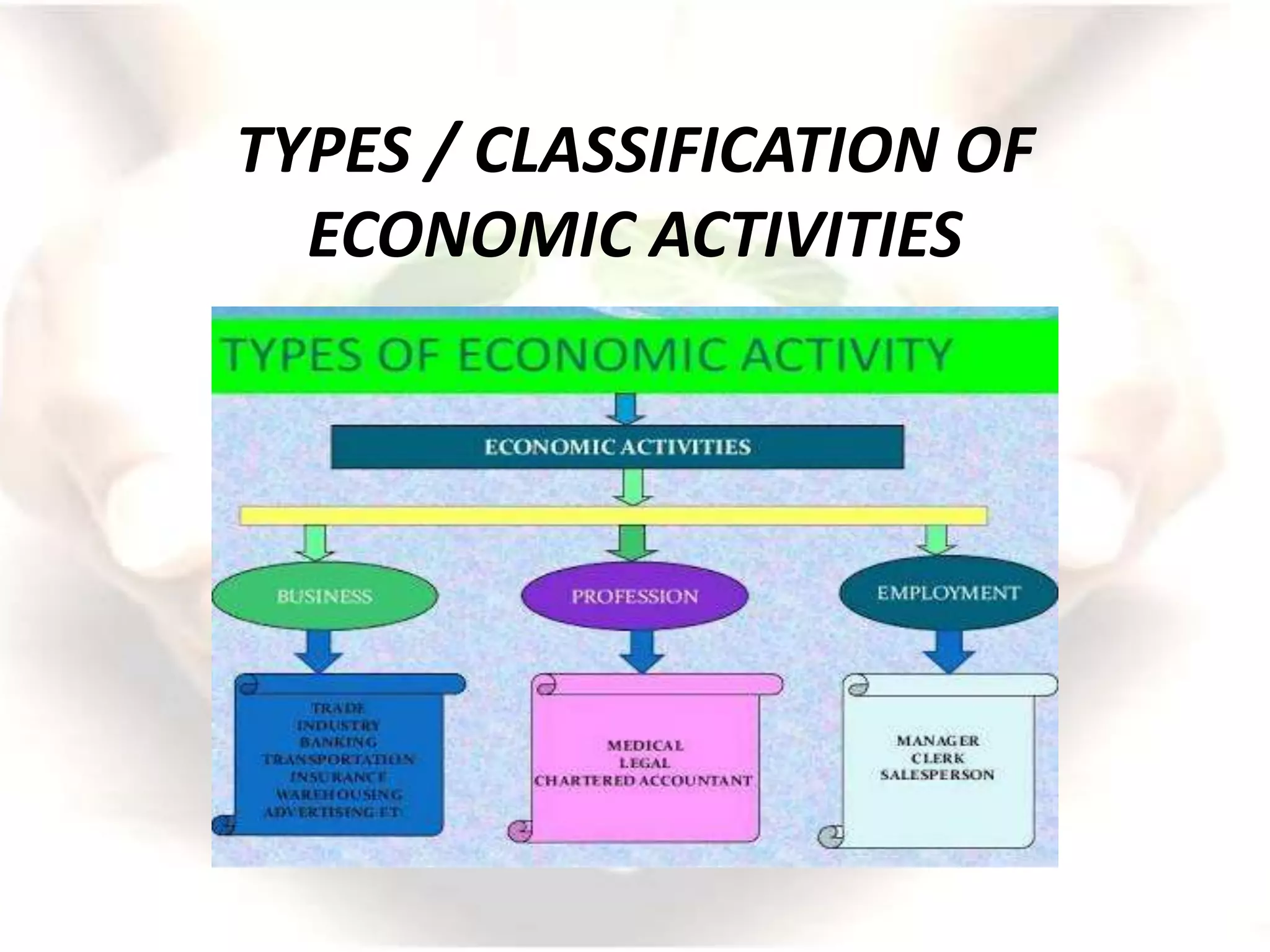
1. Business
Business is an economic activity
concerned with production and
distribution of goods and services with
the aim to earn profit. It includes all
those activities which are directly or
indirectly concerned with production,
purchase and sale of goods and services.
So the production, marketing,
advertising, warehousing, insurance,
banking, etc. are all business activities.
2. Profession
Profession is an occupation carried on
by professional people like Doctors,
Lawyers, Engineers, etc. They provide
specialized services in return for fees.
To become a professional, a man
requires specialized knowledge and
professional qualification. For e.g.
Doctor needs specialized knowledge in
medicine, a lawyer needs a degree in
law, etc.
3. Employment
Employment is a type of occupation
under which one person provides his
services, physical or mental to someone
else in return for which he gets salary
or wage. The person who is employed is
called employee or worker.
SECTORS OF ECONOMIC ACTIVITIES
Primary Sector
The primary sector of
economy is the sector of
economy making direct use
of natural resources. This
includes agriculture,
forestry, fishing and
mining. The primary sector
is usually most important
in less-developed countries
and typically less
important in industrial
country.
Secondary Sector
An economic activity
in which people use
raw material to
produce or
manufacture new
products of greater
value.
e.g. manufacturing
steel into car , or
textile into clothing.
Tertiary Sector
The tertiary sectors of the
economy is the service
industry . This sectors
provides services to the
general population and to
businesses. Activities
associated with the sectors
include retail, wholesales,
distribution,
transportation
,entertainment,
restaurants, healthcare,
law.
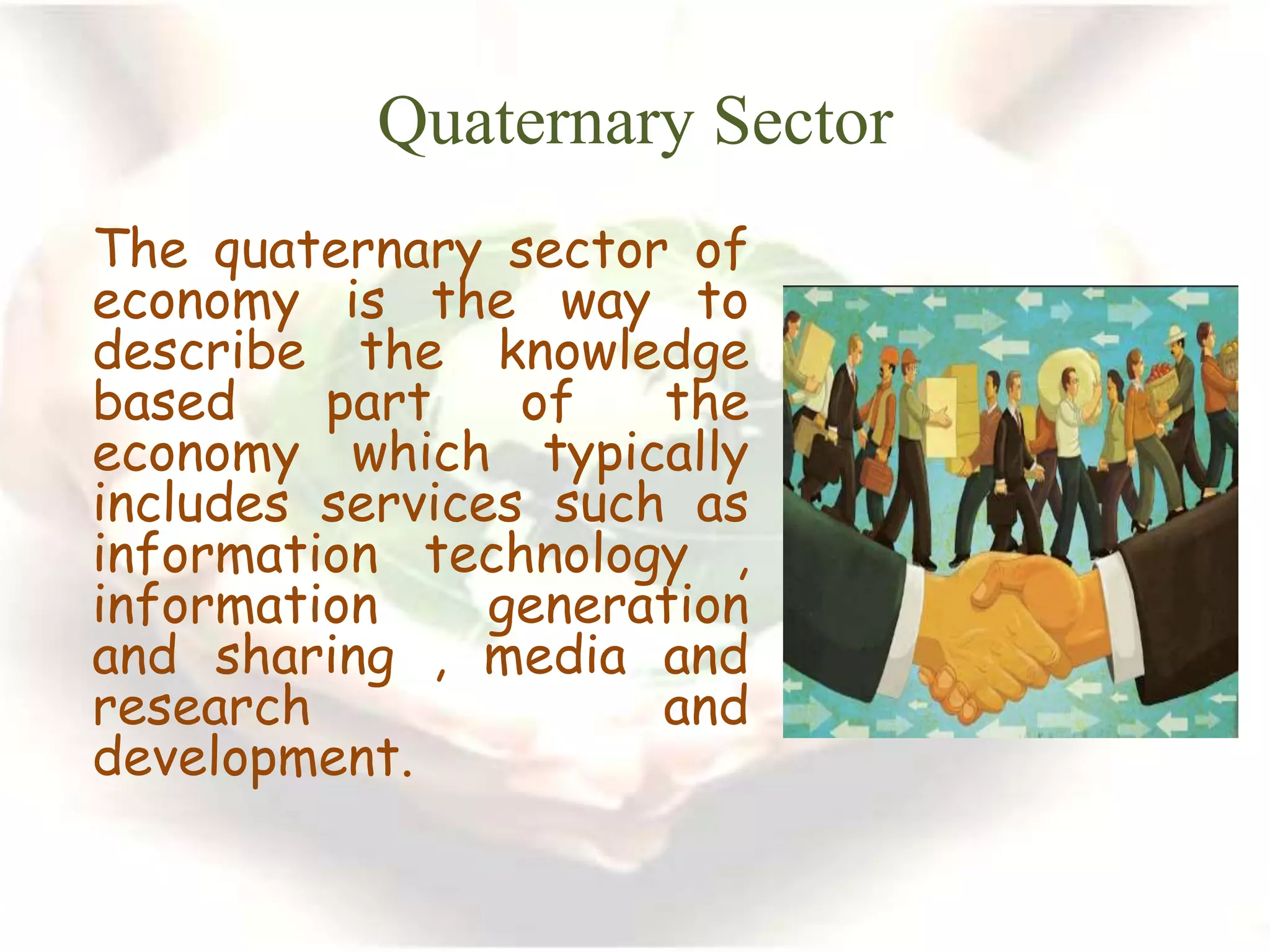
Quaternary Sector
The quaternary sector of
economy is the way to
describe the knowledge
based part of the
economy which typically
includes services such as
information technology ,
information generation
and sharing , media and
research and
development.
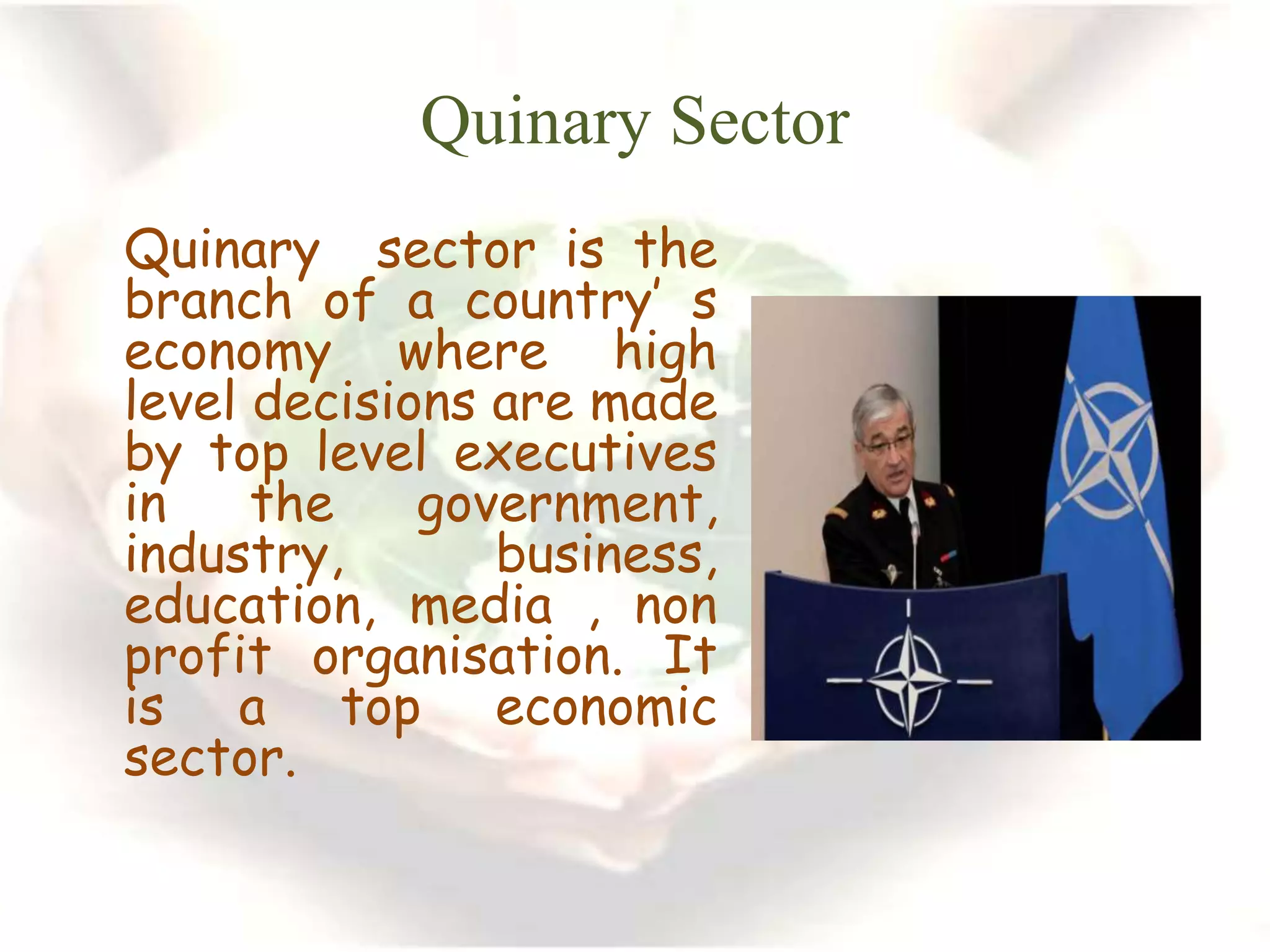
Quinary Sector
Quinary sector is the
branch of a country’ s
economy where high
level decisions are made
by top level executives
in the government,
industry, business,
education, media , non
profit organisation. It
is a top economic
sector.

Economics activities

  • 1.
  • 2.
    CONTENTS 1) Economic Activities 2)Non Economic Activities 3) Objectives 4) Characteristics 5) Parts of Economic Activities 6) Types/Classification Of Economic Activities 7) Sectors Of Economic Activities.
  • 3.
    ECONOMICS ACTIVITIES Economic activitiesare related to production , distribution , exchange and consumption of goods and services. The primary aim of the economic activity is the production of goods and services with a view to make them available to consumer.
  • 4.
    “Human activities whichare performed in exchange for money or money’s worth are called economic activities”. In other words , economic activities are those efforts which are under taken by man to earn income , money, wealth for his life and to secure maximum satisfaction of wants with limited and scarce means. •E.g. A worker works in a factory and gets wages.
  • 5.
    NON ECONOMIC ACTIVITIES Activitieswhich do not have any economic motive and are performed with a feeling of love, sympathy, humanity and patriotism are known as non - economic activities. e.g. playing, dancing ,giving donation, a housewife cooking food for family , or a boy helping an old man cross the road etc.
  • 6.
    OBJECTIVES Economic activities areundertaken to produce goods and services so that human wants are satisfied . The human efforts are directed for the welfare of society . All kinds of occupations and professions are undertaken to create wealth and satisfy human needs . Fisher gives two objectives for economic activities , i.e., proper allocation of resources and optimum use of resources.
  • 7.
    1. Proper Allocationof Resources : The economic resources are limited and their requirements are many . It is essential to make a judicious allocation of resources so that maximum needs satisfied. Every person assesses his needs resources . He determines his priorities for applying his resources . Some needs are urgent while others may wait for some time . An effort is made to get maximum satisfaction out of the use of available resources.
  • 8.
    2. Optimum Useof Resources The other objective of economic activities is the optimum use of resources. The resources should be put their maximum use. Various factors of production like land, labour capital, etc. should be used in producing goods in such a way that no part is idle. The optimum is the level of greatest satisfaction and nothing can go beyond it.
  • 9.
    CHARACTERISTICS 1. Wealth ProducingActivities: The economic activities are undertaken to produce wealth . The wealth is produced by productive activities. The production may be for the consumption of family members or for the others . A farmer may grow vegetables for selling in the market will fetch income for the farmer.
  • 10.
    2. Satisfying HumanWants: The main aim of economic activities is to satisfy human needs. The needs to be satisfied may be present or future . When a person undertakes a job to earn money and buy necessities for his family then it will be satisfying present needs . And when a person saves money out of his current earnings for satisfying his needs after the retirement then it will be a plan for the future.
  • 11.
    3. Money Income: All economic activities, these may be related to business, profession or service , help in earning money income. People undertake these activities to satisfy their family needs with the help of money earned through productive activities. A living is possible with money income earned from economic activities.
  • 12.
    4.Developmental Activities :Economic activities not only satisfy human wants but also become a basis for economic development of the society. When old needs are satisfied then new needs crop up. The economic resources are employed to produce new products and this process helps in generating employment avenues and ultimately the money income . The social development is linked to the economic activities undertaken there.
  • 13.
    PARTS OF ECONOMICACTIVITIES 1. Market activities : These types of activities involve remuneration to any one who performs i.e., activity performed for pay or profit. These include production of goods or services including government service. 2. Non- market activities : These activities are the production for self-consumption. These can be consumption and processing of primary product and own account production of fixed assets.
  • 14.
    TYPES / CLASSIFICATIONOF ECONOMIC ACTIVITIES
  • 15.
    1. Business Business isan economic activity concerned with production and distribution of goods and services with the aim to earn profit. It includes all those activities which are directly or indirectly concerned with production, purchase and sale of goods and services. So the production, marketing, advertising, warehousing, insurance, banking, etc. are all business activities.
  • 16.
    2. Profession Profession isan occupation carried on by professional people like Doctors, Lawyers, Engineers, etc. They provide specialized services in return for fees. To become a professional, a man requires specialized knowledge and professional qualification. For e.g. Doctor needs specialized knowledge in medicine, a lawyer needs a degree in law, etc.
  • 17.
    3. Employment Employment isa type of occupation under which one person provides his services, physical or mental to someone else in return for which he gets salary or wage. The person who is employed is called employee or worker.
  • 18.
  • 19.
    Primary Sector The primarysector of economy is the sector of economy making direct use of natural resources. This includes agriculture, forestry, fishing and mining. The primary sector is usually most important in less-developed countries and typically less important in industrial country.
  • 20.
    Secondary Sector An economicactivity in which people use raw material to produce or manufacture new products of greater value. e.g. manufacturing steel into car , or textile into clothing.
  • 21.
    Tertiary Sector The tertiarysectors of the economy is the service industry . This sectors provides services to the general population and to businesses. Activities associated with the sectors include retail, wholesales, distribution, transportation ,entertainment, restaurants, healthcare, law.
  • 22.
    Quaternary Sector The quaternarysector of economy is the way to describe the knowledge based part of the economy which typically includes services such as information technology , information generation and sharing , media and research and development.
  • 23.
    Quinary Sector Quinary sectoris the branch of a country’ s economy where high level decisions are made by top level executives in the government, industry, business, education, media , non profit organisation. It is a top economic sector.