G235: Critical
Perspectives in Media

Theoretical Evaluation
of Production

Question 1(b)
Representation
Aims/Objectives
•   You will be able to describe what
    representation is.
•   Be able to identify the types of groups
    that are represented?
•   You will be able to discuss
    representation in your products
Big question


• The media does not represent and
construct reality, but instead represents
                    it?
Representation - Definition
• How the media shows us things about
  society – but this is through careful
  mediation. Hence re-presentation.
• For representation to be meaningful to
  audiences there needs to be a shared
  recognition of people, situations, ideas etc.
• All representations therefore have
  ideologies behind them. Certain paradigms
  are encoded into texts and others are left
  out in order to give a preferred
  representation (Levi – Strauss, 1958).
Representation
•   Representing is about constructing reality, it is supposed to contain
    versimilitued and simplify people’s understanding of life.


•   Representation refers to the construction in any medium (especially the mass
    media) of aspects of �reality� such as people, places, objects, events, cultural
    identities and other abstract concepts. Such representations may be in speech
    or writing as well as still or moving pictures.
•   The term refers to the processes involved as well as to its products. For
    instance, in relation to the key markers of identity - Class, Age, Gender and
    Ethnicity (the 'cage' of identity) - representation involves not only how identities
    are represented (or rather constructed) within the text but also how they are
    constructed in the processes of production and reception by people whose
    identities are also differentially marked in relation to such demographic factors.
    Consider, for instance, the issue of 'the gaze'. How do men look at images of
    women, women at men, men at men and women at women?
• Richard Dyer (1983) posed a few questions
  when analysing media representations in
  general.
• 1. What sense of the world is it making?
• 2. What does it imply? Is it typical of the
  world or deviant?
• 3. Who is it speaking to? For whom? To
  whom?
• 4. What does it represent to us and why?
  How do we respond to the representation?
How do you think the following
 groups are represented in the
           media?
Types of people:
 •   Class
 •   Age
 •   Gender
 •   Ethnicity
 •   Sexuality
 •   Disability
Theories
• Particularly in relation to film – objectification of
  women’s bodies in the media has been a
  constant theme.
• Laura Mulvey (1975) argues that the dominant
  point of view is masculine. The female body is
  displayed for the male gaze in order to provide
  erotic pleasure for the male (vouyerism). Women
  are therefore objectified by the camera lens and
  whatever gender the spectator/audience is
  positioned to accept the masculine POV.
John Berger ‘Ways Of Seeing’ (1972)
“Men act and women appear”. “Men
  look at women. Women watch
  themselves being looked at”.
“Women are aware of being seen by a
  male spectator”
• Jib Fowles (1996) “in advertising, males
  gaze and females are gazed at”.
• Paul Messaris (1997) “female models
  addressed to women....appear to imply a
  male point of view”.
• In terms of magazine covers of women,
  Janice Winship (1987) has been an
  extremely influential theorist. “The gaze
  between cover model and women readers
  marks the complicity between women
  seeing themselves in the image masculine
  culture has defined”.
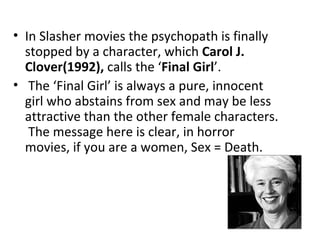
• In Slasher movies the psychopath is finally
  stopped by a character, which Carol J.
  Clover(1992), calls the ‘Final Girl’.
• The ‘Final Girl’ is always a pure, innocent
  girl who abstains from sex and may be less
  attractive than the other female characters.
   The message here is clear, in horror
  movies, if you are a women, Sex = Death.
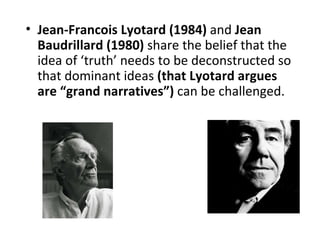
• Jean-Francois Lyotard (1984) and Jean
  Baudrillard (1980) share the belief that the
  idea of ‘truth’ needs to be deconstructed so
  that dominant ideas (that Lyotard argues
  are “grand narratives”) can be challenged.
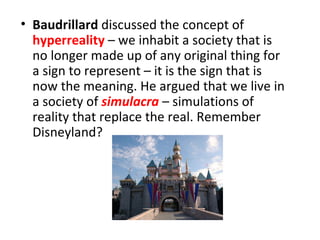
• Baudrillard discussed the concept of
  hyperreality – we inhabit a society that is
  no longer made up of any original thing for
  a sign to represent – it is the sign that is
  now the meaning. He argued that we live in
  a society of simulacra – simulations of
  reality that replace the real. Remember
  Disneyland?
• We can apply this to texts that
  claim to represent reality – social
  realist films?
• Merrin (2005) argues that “the
  media do not reflect and represent
  reality but instead produce it,
  employing this simulation to justify
  their own continuing existence”.
David Gilmore
• Man the protector
• Man the provider
• Man the impregnator
• We often judge a text’s realism against our
  own ‘situated culture’. What is ‘real’ can
  therefore become subjective.
• Stereotypes can be used to enhance
  realism - a news programme,
  documentary, film text etc about football
  hooligans, for e.g, will all use very
  conventional images that are associated
  with the realism that audiences will identify
  with such as shots of football grounds,
  public houses etc.
4. Stereotypes?
• O’Sullivan et al (1998) details that a
  stereotype is a label that involves a process
  of categorisation and evaluation.
• We can call stereotypes shorthand to
  narratives because such simplistic
  representations define our understanding
  of media texts – e.g we know who is good
  and who is evil.
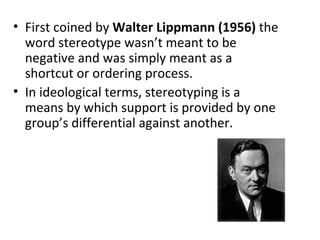
• First coined by Walter Lippmann (1956) the
  word stereotype wasn’t meant to be
  negative and was simply meant as a
  shortcut or ordering process.
• In ideological terms, stereotyping is a
  means by which support is provided by one
  group’s differential against another.
• Orrin E. Klapp's (1962) distinction between
  stereotypes and social types is helpful.
• Klapp defines social types as representations
  of those who 'belong' to society.
• They are the kinds of people that one
  expects, and is led to expect, to find in one's
  society, whereas stereotypes are those who
  do not belong, who are outside of one's
  society.
• Richard Dyer (1977) suggests Klapp’s
  distinction can be reworked in terms of the
  types produced by different social groups
  according to their sense of who belongs
  and who doesn't, who is 'in' and who is not
• Tessa Perkins (1979) says, however, that
  stereotyping is not a simple process. She
  identified that some of the many ways that
  stereotypes are assumed to operate aren’t
  true.
• They aren’t always negative (French good cooks)
• They aren’t always about minority groups or those less
  powerful (upper class twits)
• They are not always false – supported by empirical
  evidence.
• They are not always rigid and unchanging.
  Perkins argues that if stereotypes were
  always so simple then they would not work
  culturally and over time.
• Martin Barker (1989) - stereotypes are
  condemned for misrepresenting the ‘real
  world’. (e.g. Reinforcing that the (false)
  stereotype that women are available for
  sex at any time) . He also says stereotypes
  are condemned for being too close to real
  world (e.g. showing women in home
  servicing men, which many still do).
• Bears out Perkins’ point that for
  stereotypes to work they need audience
  recognition.
• Dyer (1977) details that if we are to be told
  that we are going to see a film about an
  alcoholic then we will know that it will be a
  tale either of sordid decline or of inspiring
  redemption.
• This is a particularly interesting potential use
  of stereotypes, in which the character is
  constructed, at the level of costume,
  performance, etc., as a stereotype but is
  deliberately given a narrative function that is
  not implicit in the stereotype, thus throwing
  into question the assumptions signalled by
  the stereotypical iconography.
Think of this question as the first part
          of your revision...


“Representations in media texts are often
  simplistic and reinforce dominant ideologies
  so that audiences can make sense of them”.
  Evaluate the ways that you have
  used/challenged simplistic representations
  in one of the media products you have
  produced.

Representation in your chosen media text

  • 1.
    G235: Critical Perspectives inMedia Theoretical Evaluation of Production Question 1(b) Representation
  • 2.
    Aims/Objectives • You will be able to describe what representation is. • Be able to identify the types of groups that are represented? • You will be able to discuss representation in your products
  • 3.
    Big question • Themedia does not represent and construct reality, but instead represents it?
  • 4.
    Representation - Definition •How the media shows us things about society – but this is through careful mediation. Hence re-presentation. • For representation to be meaningful to audiences there needs to be a shared recognition of people, situations, ideas etc. • All representations therefore have ideologies behind them. Certain paradigms are encoded into texts and others are left out in order to give a preferred representation (Levi – Strauss, 1958).
  • 5.
    Representation • Representing is about constructing reality, it is supposed to contain versimilitued and simplify people’s understanding of life. • Representation refers to the construction in any medium (especially the mass media) of aspects of �reality� such as people, places, objects, events, cultural identities and other abstract concepts. Such representations may be in speech or writing as well as still or moving pictures. • The term refers to the processes involved as well as to its products. For instance, in relation to the key markers of identity - Class, Age, Gender and Ethnicity (the 'cage' of identity) - representation involves not only how identities are represented (or rather constructed) within the text but also how they are constructed in the processes of production and reception by people whose identities are also differentially marked in relation to such demographic factors. Consider, for instance, the issue of 'the gaze'. How do men look at images of women, women at men, men at men and women at women?
  • 6.
    • Richard Dyer(1983) posed a few questions when analysing media representations in general. • 1. What sense of the world is it making? • 2. What does it imply? Is it typical of the world or deviant? • 3. Who is it speaking to? For whom? To whom? • 4. What does it represent to us and why? How do we respond to the representation?
  • 7.
    How do youthink the following groups are represented in the media? Types of people: • Class • Age • Gender • Ethnicity • Sexuality • Disability
  • 8.
    Theories • Particularly inrelation to film – objectification of women’s bodies in the media has been a constant theme. • Laura Mulvey (1975) argues that the dominant point of view is masculine. The female body is displayed for the male gaze in order to provide erotic pleasure for the male (vouyerism). Women are therefore objectified by the camera lens and whatever gender the spectator/audience is positioned to accept the masculine POV.
  • 9.
    John Berger ‘WaysOf Seeing’ (1972) “Men act and women appear”. “Men look at women. Women watch themselves being looked at”. “Women are aware of being seen by a male spectator”
  • 10.
    • Jib Fowles(1996) “in advertising, males gaze and females are gazed at”. • Paul Messaris (1997) “female models addressed to women....appear to imply a male point of view”. • In terms of magazine covers of women, Janice Winship (1987) has been an extremely influential theorist. “The gaze between cover model and women readers marks the complicity between women seeing themselves in the image masculine culture has defined”.
  • 11.
    • In Slashermovies the psychopath is finally stopped by a character, which Carol J. Clover(1992), calls the ‘Final Girl’. • The ‘Final Girl’ is always a pure, innocent girl who abstains from sex and may be less attractive than the other female characters. The message here is clear, in horror movies, if you are a women, Sex = Death.
  • 12.
    • Jean-Francois Lyotard(1984) and Jean Baudrillard (1980) share the belief that the idea of ‘truth’ needs to be deconstructed so that dominant ideas (that Lyotard argues are “grand narratives”) can be challenged.
  • 13.
    • Baudrillard discussedthe concept of hyperreality – we inhabit a society that is no longer made up of any original thing for a sign to represent – it is the sign that is now the meaning. He argued that we live in a society of simulacra – simulations of reality that replace the real. Remember Disneyland?
  • 14.
    • We canapply this to texts that claim to represent reality – social realist films? • Merrin (2005) argues that “the media do not reflect and represent reality but instead produce it, employing this simulation to justify their own continuing existence”.
  • 15.
    David Gilmore • Manthe protector • Man the provider • Man the impregnator
  • 16.
    • We oftenjudge a text’s realism against our own ‘situated culture’. What is ‘real’ can therefore become subjective. • Stereotypes can be used to enhance realism - a news programme, documentary, film text etc about football hooligans, for e.g, will all use very conventional images that are associated with the realism that audiences will identify with such as shots of football grounds, public houses etc.
  • 17.
    4. Stereotypes? • O’Sullivanet al (1998) details that a stereotype is a label that involves a process of categorisation and evaluation. • We can call stereotypes shorthand to narratives because such simplistic representations define our understanding of media texts – e.g we know who is good and who is evil.
  • 18.
    • First coinedby Walter Lippmann (1956) the word stereotype wasn’t meant to be negative and was simply meant as a shortcut or ordering process. • In ideological terms, stereotyping is a means by which support is provided by one group’s differential against another.
  • 19.
    • Orrin E.Klapp's (1962) distinction between stereotypes and social types is helpful. • Klapp defines social types as representations of those who 'belong' to society. • They are the kinds of people that one expects, and is led to expect, to find in one's society, whereas stereotypes are those who do not belong, who are outside of one's society.
  • 20.
    • Richard Dyer(1977) suggests Klapp’s distinction can be reworked in terms of the types produced by different social groups according to their sense of who belongs and who doesn't, who is 'in' and who is not
  • 21.
    • Tessa Perkins(1979) says, however, that stereotyping is not a simple process. She identified that some of the many ways that stereotypes are assumed to operate aren’t true. • They aren’t always negative (French good cooks) • They aren’t always about minority groups or those less powerful (upper class twits) • They are not always false – supported by empirical evidence. • They are not always rigid and unchanging. Perkins argues that if stereotypes were always so simple then they would not work culturally and over time.
  • 22.
    • Martin Barker(1989) - stereotypes are condemned for misrepresenting the ‘real world’. (e.g. Reinforcing that the (false) stereotype that women are available for sex at any time) . He also says stereotypes are condemned for being too close to real world (e.g. showing women in home servicing men, which many still do). • Bears out Perkins’ point that for stereotypes to work they need audience recognition.
  • 23.
    • Dyer (1977)details that if we are to be told that we are going to see a film about an alcoholic then we will know that it will be a tale either of sordid decline or of inspiring redemption. • This is a particularly interesting potential use of stereotypes, in which the character is constructed, at the level of costume, performance, etc., as a stereotype but is deliberately given a narrative function that is not implicit in the stereotype, thus throwing into question the assumptions signalled by the stereotypical iconography.
  • 24.
    Think of thisquestion as the first part of your revision... “Representations in media texts are often simplistic and reinforce dominant ideologies so that audiences can make sense of them”. Evaluate the ways that you have used/challenged simplistic representations in one of the media products you have produced.