Homo
heidelbergensis

Specimen Nicknames:
Heidelberg Man
Boxgrove Man
Rhodesian Man
Elvis
Total Fossil remains of
                           over 32 individuals
                              Mostly from the cave
                              Sima de los Huesos in
                              the Atapuerca
                              Mountains of Spain.


Found in:       Estimated geologic age:
      Europe          125,000 -880,000 years ago
       Africa
       Asia
Geologic
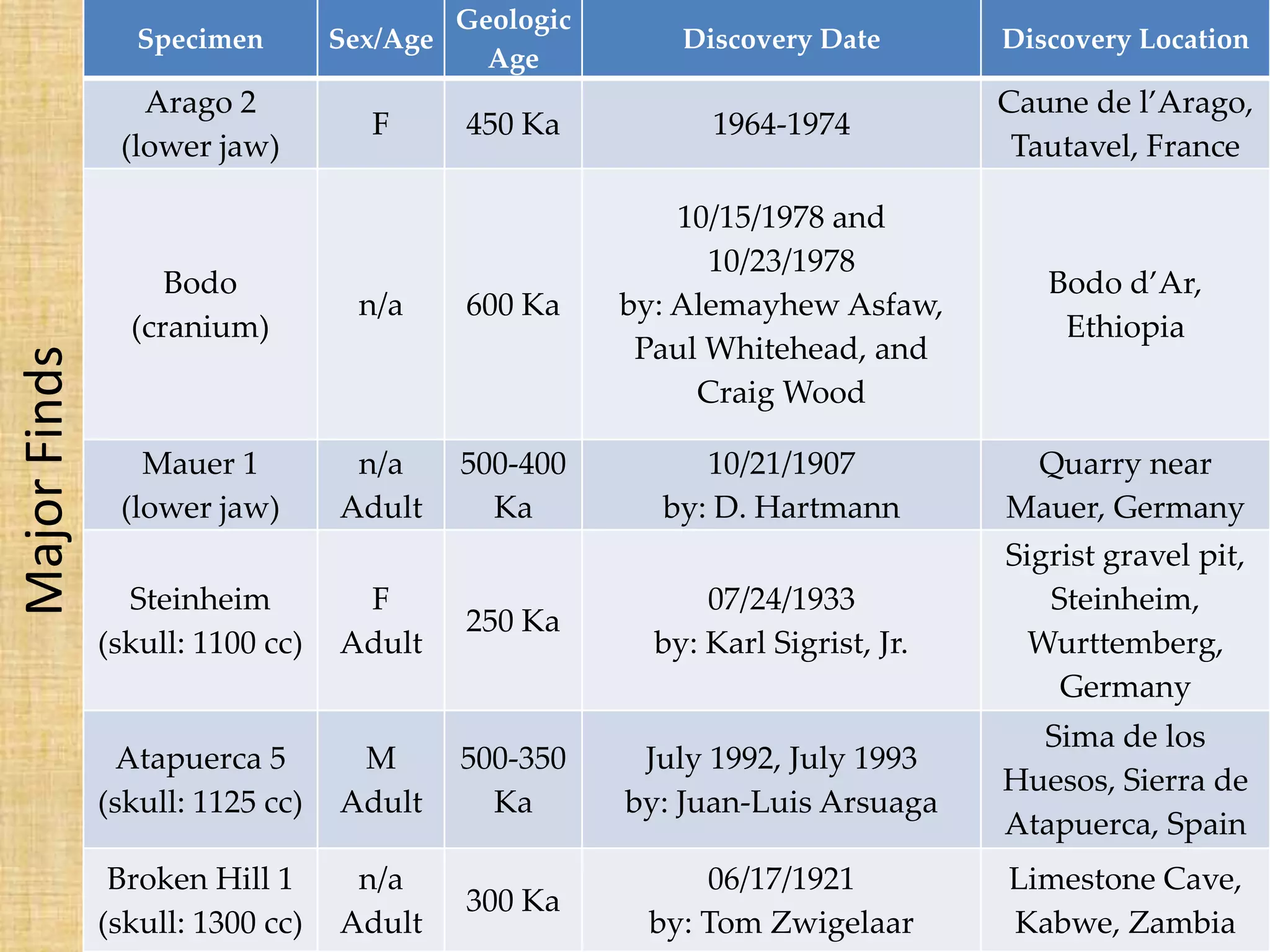
                 Specimen        Sex/Age                  Discovery Date        Discovery Location
                                             Age
                 Arago 2                                                        Caune de l’Arago,
                                   F       450 Ka           1964-1974
               (lower jaw)                                                       Tautavel, France

                                                          10/15/1978 and
                                                            10/23/1978
                   Bodo                                                            Bodo d’Ar,
                                   n/a     600 Ka     by: Alemayhew Asfaw,
                (cranium)                                                           Ethiopia
                                                       Paul Whitehead, and
Major Finds


                                                           Craig Wood

                 Mauer 1          n/a      500-400         10/21/1907            Quarry near
               (lower jaw)       Adult       Ka         by: D. Hartmann         Mauer, Germany
                                                                                Sigrist gravel pit,
                Steinheim         F                         07/24/1933             Steinheim,
                                           250 Ka
              (skull: 1100 cc)   Adult                  by: Karl Sigrist, Jr.     Wurttemberg,
                                                                                    Germany
                                                                                  Sima de los
                Atapuerca 5       M        500-350     July 1992, July 1993
                                                                                Huesos, Sierra de
              (skull: 1125 cc)   Adult       Ka       by: Juan-Luis Arsuaga
                                                                                Atapuerca, Spain
               Broken Hill 1      n/a                      06/17/1921           Limestone Cave,
                                           300 Ka
              (skull: 1300 cc)   Adult                 by: Tom Zwigelaar        Kabwe, Zambia
Sexual Dimorphism: comparable to those of modern
skeletons with the exception of greater tooth size differences.

Pelvis: similar to Neanderthals, similar gait.

     157 cm (5 ft. 2 in)               175.3 cm (5 ft. 7 in)
2-1-2-3 with thick enamel.

Wider cheek teeth and broader
lower front teeth (front to back)
        than Neanderthals.


 Wisdom teeth = earlier
 Canine development = later
  than modern humans.


                                Tooth wear suggests that diet was
                                at least 80% plant material and
                                teeth were used as a “third hand”.
Cranial Capacity
1100 cc – 1400 cc

Average: 1200 cc


Pronounced brow ridge
Wide eye sockets
Wide nose bridge
No chin
Measurements of ear
canals and base of
skull indicate modern
hearing ability.


Increased amount of
cranial flexing
suggests dimensional
change in larynx and
vocal tract and
increased capability
for speech.

                        Skull endocasts show a more
                        developed language center in the
                        brain than H. erectus.
Levallois technique
(Prepared Core)

1st step: Fagonnage
    Shape the core by
    removing flakes.

2nd step: Debitage
    Remove multiple
    sharpened flakes from the
    prepared core.


Tools for butchering, animal
skin preparation, and
woodworking found.
Nine spruce spears found in Schöningen, Germany.

Over six ft. long and balanced near the front for throwing.
Active hunting vs. scavenging

Communication needed for
group hunting.


                                Large animals with tool marks
                                on bones = butchered.

                                Carnivore teeth marks on top
                                of tool marks indicate that
                                man got to the carcasses first.
May have been cannibalistic
or performed ritualistic flesh
removal.

Did not consistently bury
their dead.

Atapuerca “Pit of Bones”:
29 of 32 individuals were
between the ages of ten and
nineteen.

Speculated epidemic or
selection of corpses.

No art or symbolic objects
found.
Altruistic

                                         Evidence of caring for
                                         the sick and elderly.


Elvis: 45 yr. old man, pelvis and spine indicate severe hunchback.
          Twelve yr. old child with deformed skull found.
        Other remains show signs of infection or abscesses.
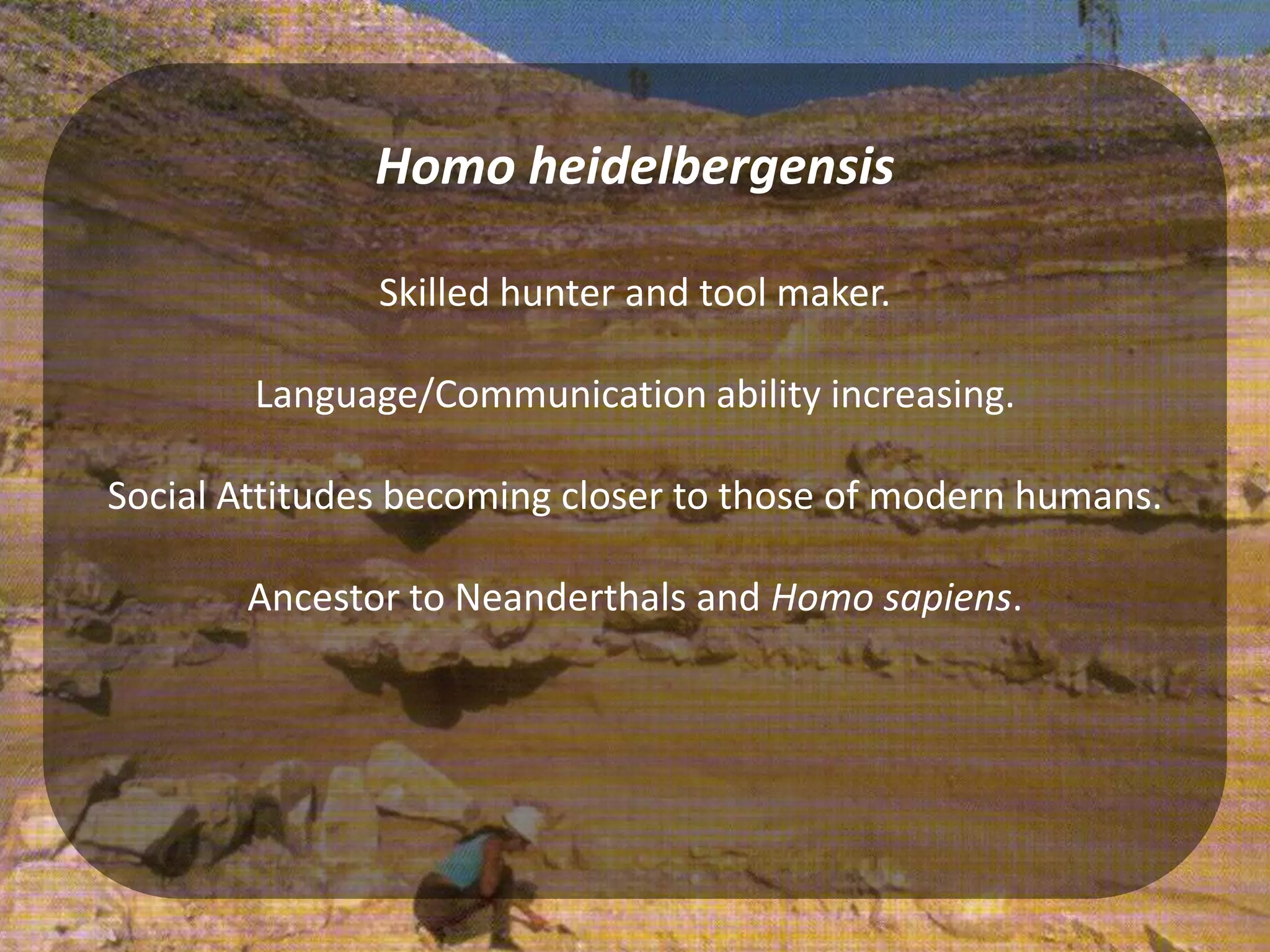
Homo heidelbergensis

               Skilled hunter and tool maker.

        Language/Communication ability increasing.

Social Attitudes becoming closer to those of modern humans.

       Ancestor to Neanderthals and Homo sapiens.
Images

Chazan, M. (1997).Redefining Levallois. Journal of Human Evolution, 33, 719-735.
    Retrieved from http://journals.ohiolink.edu/ejc/article.cgi?issn=00472484&issue=
    v33i0006&article=719_rl. Slide: 8
Evanson, T. (2012, May). Homo heidelbergensis endocast- Smithsonian Museum of
    Natural History. Retrieved from http://commons.wikimedia.org/wiki/File:
    Homo_heidelbergensis_endocast_-_Smithsonian_Museum_of_Natural_History_-
    _2012-05-17.jpg
Lynch, J., & Barrett L. (2003). Walking With Cavemen. New York, New York: DK
    Publishing, Inc. Slides: 4,9,10,11,12,13
Sawyer, G.J., & Deak, V. (2007). The Last Human, A guide to twenty-two species of extinct
    humans. New York: Nèvraumont Publishing Company. Slides: 1,2
Trueba, J. Atapuerca.tv. Retrieved from http://www.atapuerca.tv/imagenes/archivo
    /191.jpg. Slide: 6
Wagner, G. (2010, November). PNAS. Retrieved from http://www.pnas.org/content/
    107/46/19726/F1.expansion.html. Slide: 5

Homo heidelbergensis

  • 1.
  • 2.
    Total Fossil remainsof over 32 individuals Mostly from the cave Sima de los Huesos in the Atapuerca Mountains of Spain. Found in: Estimated geologic age: Europe 125,000 -880,000 years ago Africa Asia
  • 3.
    Geologic Specimen Sex/Age Discovery Date Discovery Location Age Arago 2 Caune de l’Arago, F 450 Ka 1964-1974 (lower jaw) Tautavel, France 10/15/1978 and 10/23/1978 Bodo Bodo d’Ar, n/a 600 Ka by: Alemayhew Asfaw, (cranium) Ethiopia Paul Whitehead, and Major Finds Craig Wood Mauer 1 n/a 500-400 10/21/1907 Quarry near (lower jaw) Adult Ka by: D. Hartmann Mauer, Germany Sigrist gravel pit, Steinheim F 07/24/1933 Steinheim, 250 Ka (skull: 1100 cc) Adult by: Karl Sigrist, Jr. Wurttemberg, Germany Sima de los Atapuerca 5 M 500-350 July 1992, July 1993 Huesos, Sierra de (skull: 1125 cc) Adult Ka by: Juan-Luis Arsuaga Atapuerca, Spain Broken Hill 1 n/a 06/17/1921 Limestone Cave, 300 Ka (skull: 1300 cc) Adult by: Tom Zwigelaar Kabwe, Zambia
  • 4.
    Sexual Dimorphism: comparableto those of modern skeletons with the exception of greater tooth size differences. Pelvis: similar to Neanderthals, similar gait. 157 cm (5 ft. 2 in) 175.3 cm (5 ft. 7 in)
  • 5.
    2-1-2-3 with thickenamel. Wider cheek teeth and broader lower front teeth (front to back) than Neanderthals. Wisdom teeth = earlier Canine development = later than modern humans. Tooth wear suggests that diet was at least 80% plant material and teeth were used as a “third hand”.
  • 6.
    Cranial Capacity 1100 cc– 1400 cc Average: 1200 cc Pronounced brow ridge Wide eye sockets Wide nose bridge No chin
  • 7.
    Measurements of ear canalsand base of skull indicate modern hearing ability. Increased amount of cranial flexing suggests dimensional change in larynx and vocal tract and increased capability for speech. Skull endocasts show a more developed language center in the brain than H. erectus.
  • 8.
    Levallois technique (Prepared Core) 1ststep: Fagonnage Shape the core by removing flakes. 2nd step: Debitage Remove multiple sharpened flakes from the prepared core. Tools for butchering, animal skin preparation, and woodworking found.
  • 9.
    Nine spruce spearsfound in Schöningen, Germany. Over six ft. long and balanced near the front for throwing.
  • 10.
    Active hunting vs.scavenging Communication needed for group hunting. Large animals with tool marks on bones = butchered. Carnivore teeth marks on top of tool marks indicate that man got to the carcasses first.
  • 11.
    May have beencannibalistic or performed ritualistic flesh removal. Did not consistently bury their dead. Atapuerca “Pit of Bones”: 29 of 32 individuals were between the ages of ten and nineteen. Speculated epidemic or selection of corpses. No art or symbolic objects found.
  • 12.
    Altruistic Evidence of caring for the sick and elderly. Elvis: 45 yr. old man, pelvis and spine indicate severe hunchback. Twelve yr. old child with deformed skull found. Other remains show signs of infection or abscesses.
  • 13.
    Homo heidelbergensis Skilled hunter and tool maker. Language/Communication ability increasing. Social Attitudes becoming closer to those of modern humans. Ancestor to Neanderthals and Homo sapiens.
  • 14.
    Images Chazan, M. (1997).RedefiningLevallois. Journal of Human Evolution, 33, 719-735. Retrieved from http://journals.ohiolink.edu/ejc/article.cgi?issn=00472484&issue= v33i0006&article=719_rl. Slide: 8 Evanson, T. (2012, May). Homo heidelbergensis endocast- Smithsonian Museum of Natural History. Retrieved from http://commons.wikimedia.org/wiki/File: Homo_heidelbergensis_endocast_-_Smithsonian_Museum_of_Natural_History_- _2012-05-17.jpg Lynch, J., & Barrett L. (2003). Walking With Cavemen. New York, New York: DK Publishing, Inc. Slides: 4,9,10,11,12,13 Sawyer, G.J., & Deak, V. (2007). The Last Human, A guide to twenty-two species of extinct humans. New York: Nèvraumont Publishing Company. Slides: 1,2 Trueba, J. Atapuerca.tv. Retrieved from http://www.atapuerca.tv/imagenes/archivo /191.jpg. Slide: 6 Wagner, G. (2010, November). PNAS. Retrieved from http://www.pnas.org/content/ 107/46/19726/F1.expansion.html. Slide: 5