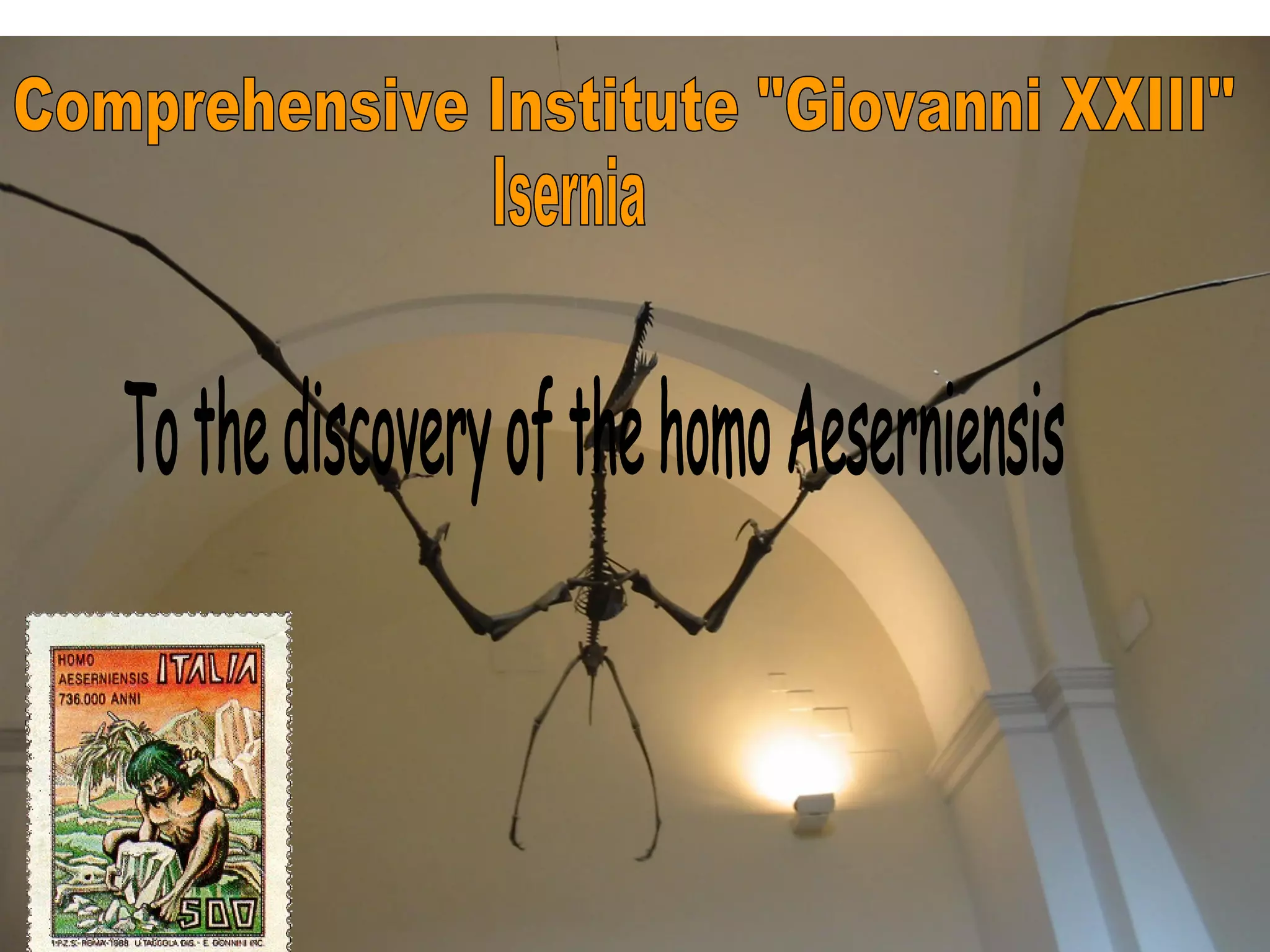
Comprehensive Institute "Giovanni XXIII"  To the discovery of the homo Aeserniensis  Isernia
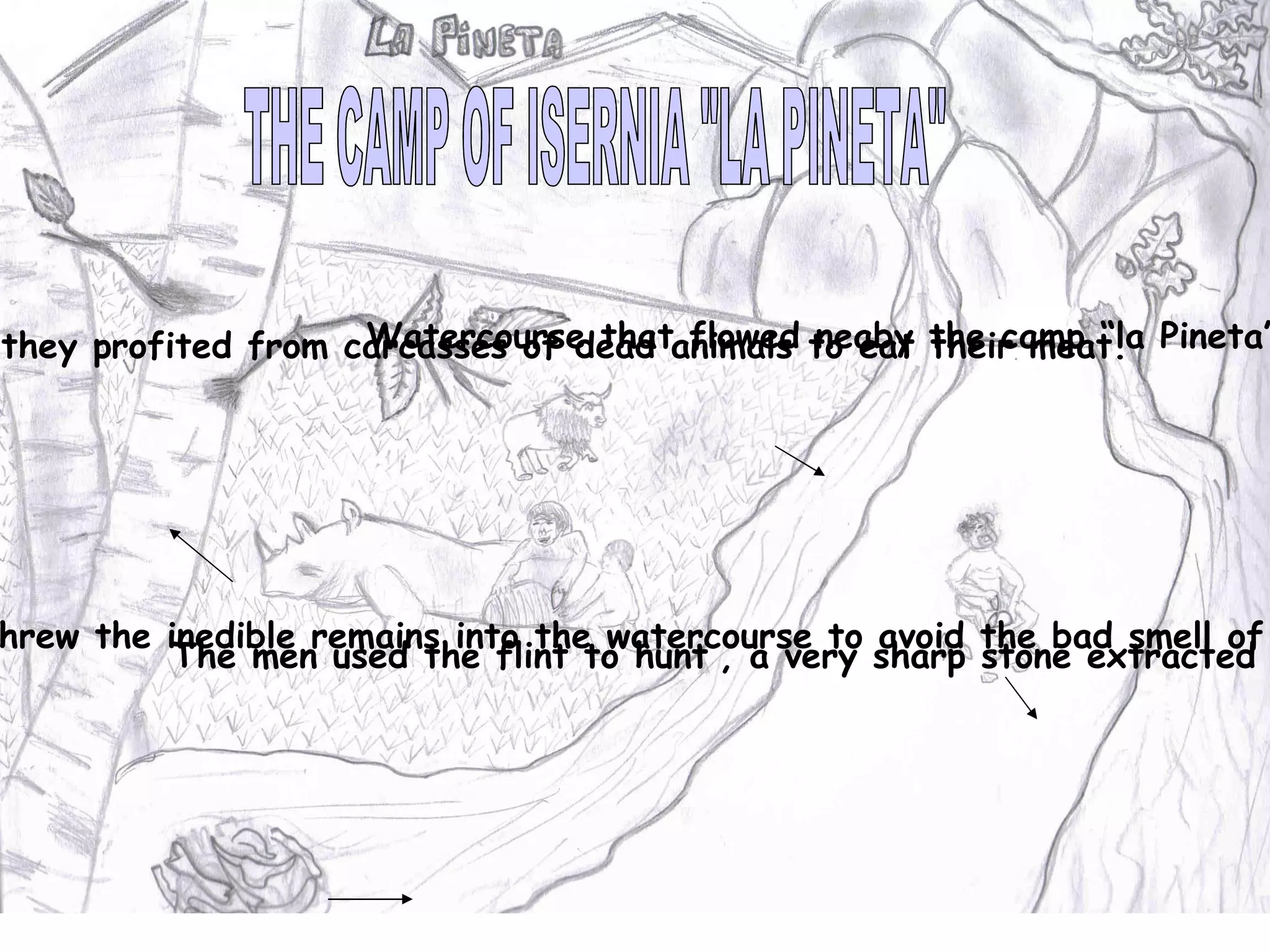
The in habitants of the camp threw the inedible remains into the watercourse to avoid the bad smell of putrefaction. The men used the flint to hunt   , a very sharp stone extracted from a rock through the percussion. Watercourse that flowed neaby the camp “la Pineta”. The men were “carognatori” that is they profited from carcasses of dead animals to eat their meat. THE CAMP OF ISERNIA "LA PINETA"
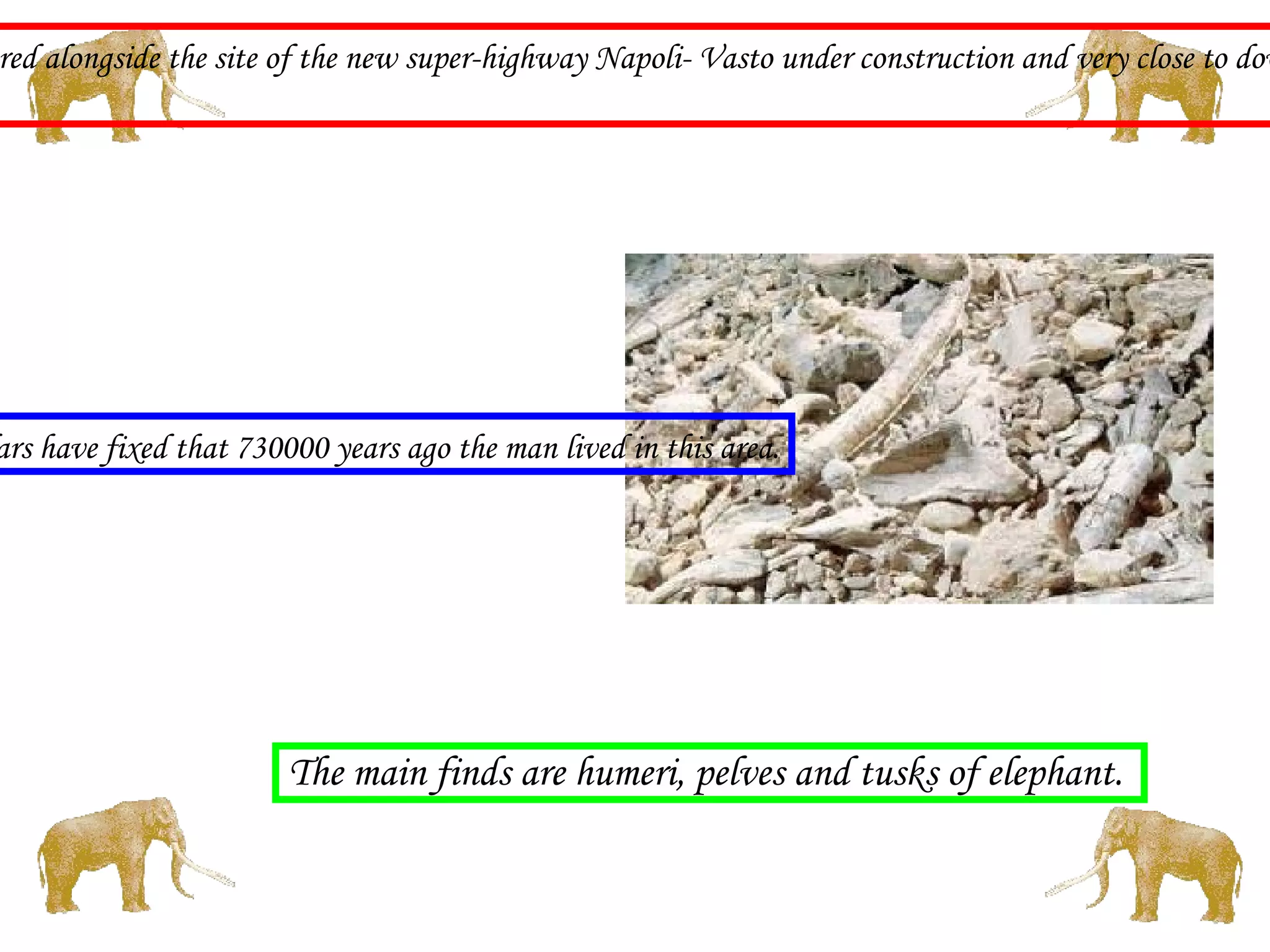
It was May 1979, when a photographer, Alberto Solinas, vacationing in the Molise area, accidentally discovered alongside the site of the new super-highway Napoli- Vasto under construction and very close to downtown Isernia, what has been claimed Europe's most important palae-anthropological discovery. Through the escavations, the scholars have fixed that 730000 years ago the man lived in this area. The main finds are humeri, pelves and tusks of elephant.
Unfortunately, the man hasn't been found yet! But the man of the Paleolithic Isernia, what did he look like?
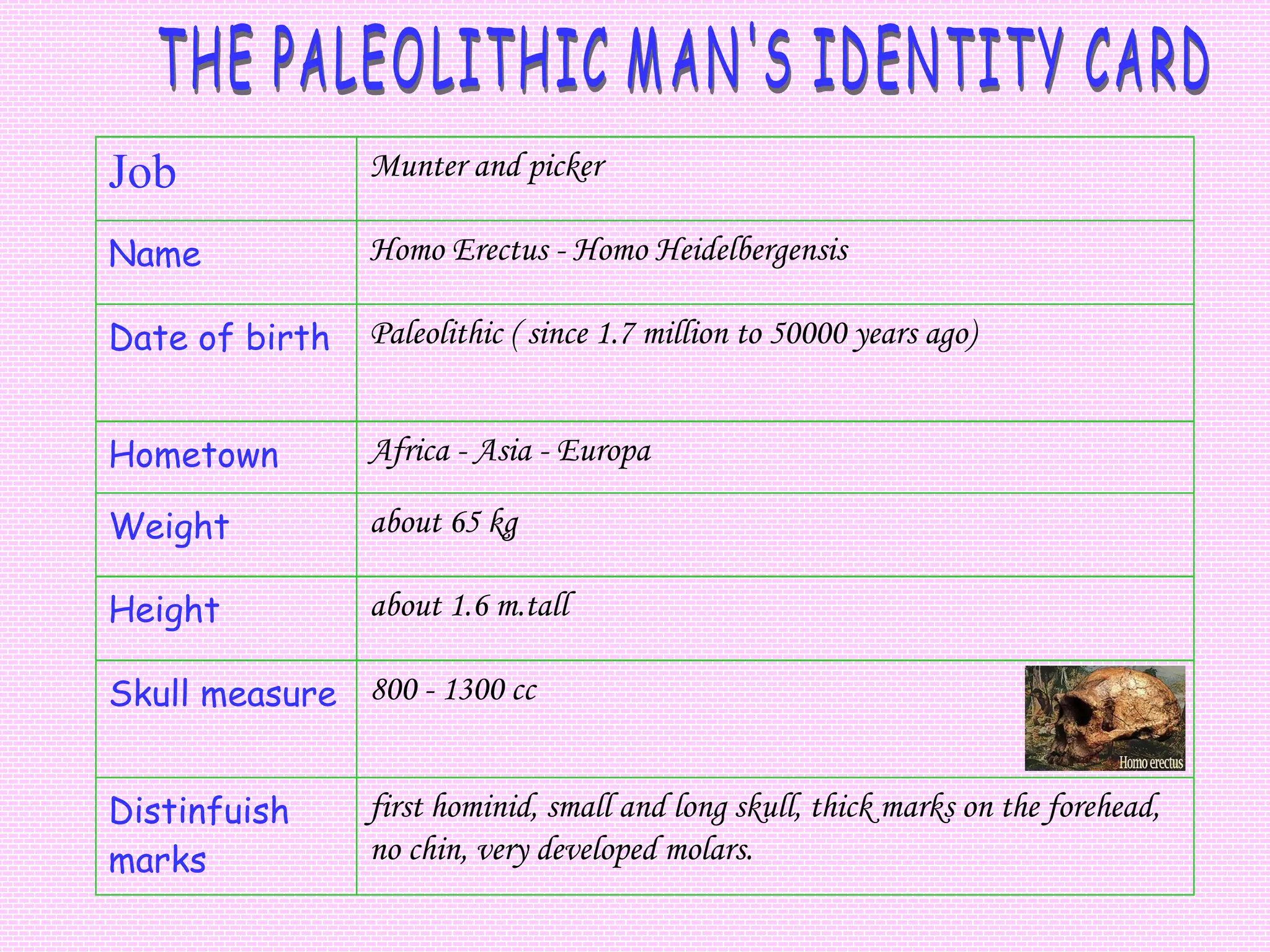
Job   Munter and picker Name Homo Erectus - Homo Heidelbergensis  Date of birth Paleolithic ( since 1.7 million to 50000 years ago) Hometown  Africa - Asia - Europa Weight about 65 kg Height about 1.6 m.tall Skull measure 800 - 1300 cc Distinfuish marks first hominid, small and long skull, thick marks on the forehead, no chin, very developed molars. THE PALEOLITHIC MAN'S IDENTITY CARD
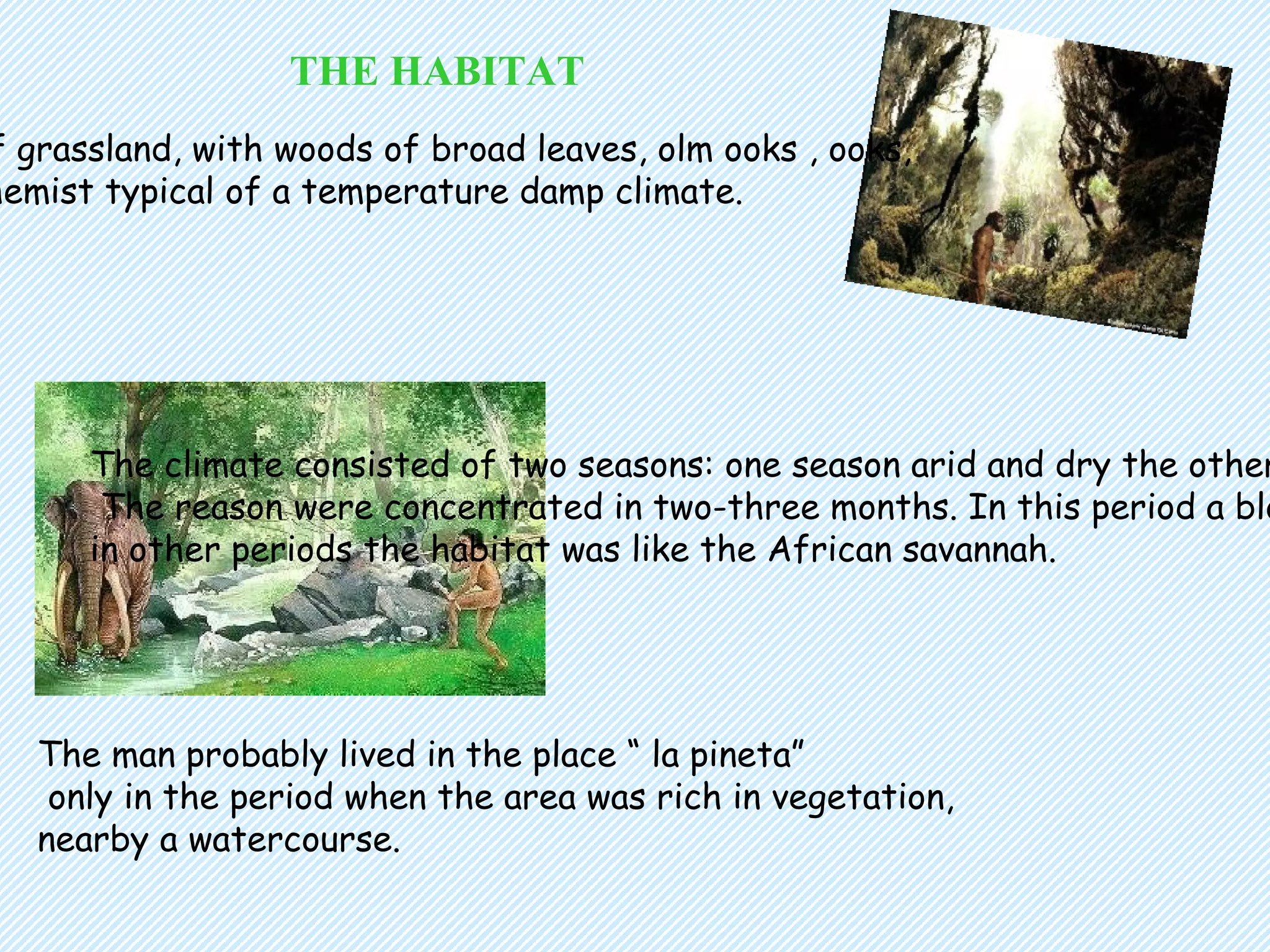
THE HABITAT    Habitat of grassland, with woods of broad leaves, olm ooks , ooks,  birches chemist typical of a temperature damp climate. The climate consisted of two seasons: one season arid and dry the other one rainy. The reason were concentrated in two-three months. In this period a blooming vegetation developed,  in other periods the habitat was like the African savannah. The man probably lived in the place “ la pineta” only in the period when the area was rich in vegetation,  nearby a watercourse.
The food was based on animal meat, on fish, but on natural food too like fruits of wood, fruits of wild plants, roots, leaves and edible tubers. THE FOOD
THE HUNTING The men of the camp didn’ t practice the hunting regularly.  The men scholars suppose they were “ carognatori” that is they carried  the dead animals neaby the camp and out them.  They hunted small animals using wooden and flint tools.  The arms were too simple and small to think they could use them for big animals.
It’s very probable that the prehistoric man would find nearby  materials needed for the manufacturing of his tools.  THE TOOLS
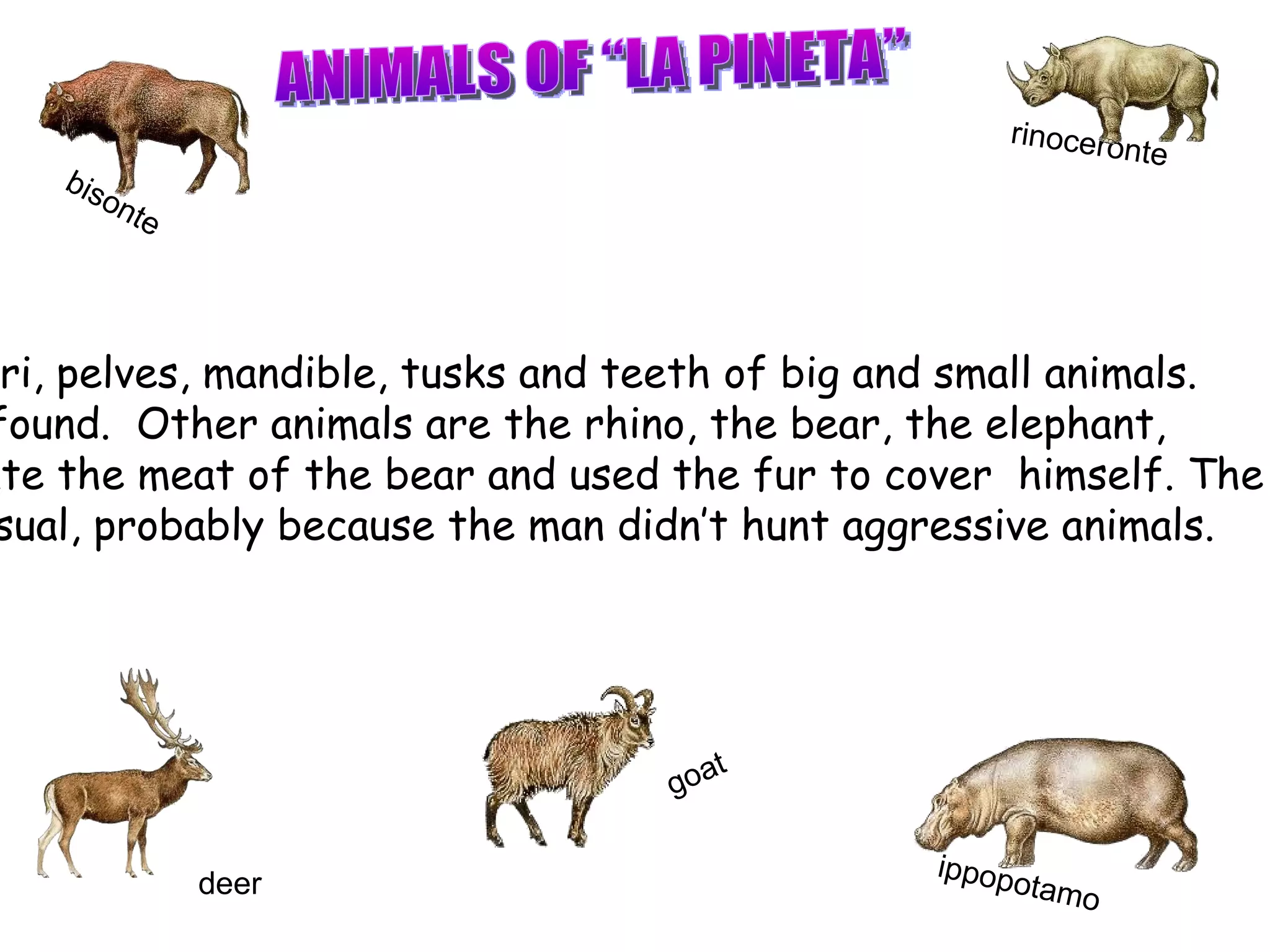
bisonte goat deer ippopotamo rinoceronte ANIMALS OF “LA PINETA” The researchers have found humeri, pelves, mandible, tusks and teeth of big and small animals. A lot of bison’s stones have been found.  Other animals are the rhino, the bear, the elephant,  the deer and the hippo. The man ate the meat of the bear and used the fur to cover  himself. The remains of carnivorous animals,  like lions and hyenas, are very unusual, probably because the man didn’t hunt aggressive animals.
At firsth scholars belived: it was a “ paving” build by the man om purpose to drain the marshland.

Copia Di Comenius I Homo Aeserniensis

  • 1.
    Comprehensive Institute "GiovanniXXIII" To the discovery of the homo Aeserniensis Isernia
  • 2.
    The in habitantsof the camp threw the inedible remains into the watercourse to avoid the bad smell of putrefaction. The men used the flint to hunt , a very sharp stone extracted from a rock through the percussion. Watercourse that flowed neaby the camp “la Pineta”. The men were “carognatori” that is they profited from carcasses of dead animals to eat their meat. THE CAMP OF ISERNIA "LA PINETA"
  • 3.
    It was May1979, when a photographer, Alberto Solinas, vacationing in the Molise area, accidentally discovered alongside the site of the new super-highway Napoli- Vasto under construction and very close to downtown Isernia, what has been claimed Europe's most important palae-anthropological discovery. Through the escavations, the scholars have fixed that 730000 years ago the man lived in this area. The main finds are humeri, pelves and tusks of elephant.
  • 4.
    Unfortunately, the manhasn't been found yet! But the man of the Paleolithic Isernia, what did he look like?
  • 5.
    Job Munter and picker Name Homo Erectus - Homo Heidelbergensis Date of birth Paleolithic ( since 1.7 million to 50000 years ago) Hometown Africa - Asia - Europa Weight about 65 kg Height about 1.6 m.tall Skull measure 800 - 1300 cc Distinfuish marks first hominid, small and long skull, thick marks on the forehead, no chin, very developed molars. THE PALEOLITHIC MAN'S IDENTITY CARD
  • 6.
    THE HABITAT   Habitat of grassland, with woods of broad leaves, olm ooks , ooks, birches chemist typical of a temperature damp climate. The climate consisted of two seasons: one season arid and dry the other one rainy. The reason were concentrated in two-three months. In this period a blooming vegetation developed, in other periods the habitat was like the African savannah. The man probably lived in the place “ la pineta” only in the period when the area was rich in vegetation, nearby a watercourse.
  • 7.
    The food wasbased on animal meat, on fish, but on natural food too like fruits of wood, fruits of wild plants, roots, leaves and edible tubers. THE FOOD
  • 8.
    THE HUNTING Themen of the camp didn’ t practice the hunting regularly. The men scholars suppose they were “ carognatori” that is they carried the dead animals neaby the camp and out them. They hunted small animals using wooden and flint tools. The arms were too simple and small to think they could use them for big animals.
  • 9.
    It’s very probablethat the prehistoric man would find nearby materials needed for the manufacturing of his tools. THE TOOLS
  • 10.
    bisonte goat deerippopotamo rinoceronte ANIMALS OF “LA PINETA” The researchers have found humeri, pelves, mandible, tusks and teeth of big and small animals. A lot of bison’s stones have been found. Other animals are the rhino, the bear, the elephant, the deer and the hippo. The man ate the meat of the bear and used the fur to cover himself. The remains of carnivorous animals, like lions and hyenas, are very unusual, probably because the man didn’t hunt aggressive animals.
  • 11.
    At firsth scholarsbelived: it was a “ paving” build by the man om purpose to drain the marshland.
  • 12.
    On the contrary,after in depth studies they concluded that the man threw the bones of animals into the watercourse to avoid their putrefaction. A PRIMITIVE DUMP The end....