INTRAVENOUS FLUID THERAPY
Dr. HASSAN ABDELRAZEK
INTERNAL MEDICINE SPECIALIST
28/3/1436
Outline
Physiology of body water
Indication of IVF therapy
Type of IVF
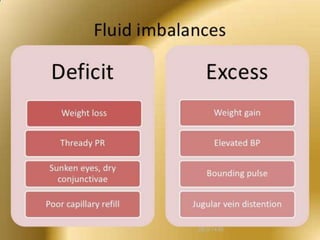
Fluid imbalance
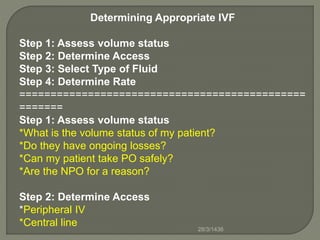
Determining Appropriate IVF
Examples
Remember
28/3/1436
Total Body Water
*Body water represent 60% of adult male body weight
and 50% of adult female body weight which distributed in
two body compartment .
*The two body compartment are IC and EC .
*The EC compartment subdivided into interstitial and IV
spaces.
*The IV space subdivided into arterial and venous side.
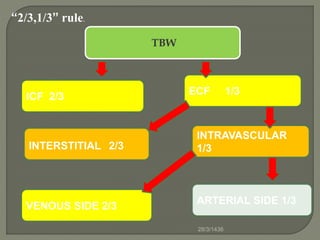
*The body water distributed in the two compartment
according to one third and two third rule.
28/3/1436
TBW
ECF 1/3
ICF 2/3
INTRAVASCULAR
1/3INTERSTITIAL 2/3
VENOUS SIDE 2/3
ARTERIAL SIDE 1/3
“2/3,1/3” rule.
28/3/1436
TBW
42 L
ECF
ICF
INTERSTITI
AL
INTRAV
ASCUL
AR
ARTE
RIAL
SIDE
VENOU
S SIDE
28 L
14 L
9 L 5 L
1.7 L3.3 L
70 kg male: TBW= 70x0.6= 42 L
(TBW = W X male 60% or female 50%)
28/3/1436
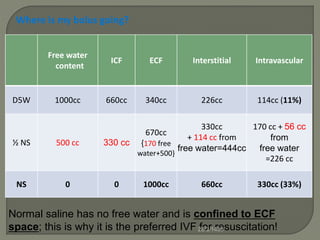
Where is my bolus going?
1L D5W distributed into Total Body Water
Free water
content
ICF ECF Interstitial Intravascular
D5W 1000cc 660cc 340cc 226cc 114cc (11%)
½ NS 500 cc 330 cc
670cc
{170 free
water+500}
330cc
+ 114 cc from
free water=444cc
170 cc + 56 cc
from
free water
=226 cc
NS 0 0 1000cc 660cc 330cc (33%)
Normal saline has no free water and is confined to ECF
space; this is why it is the preferred IVF for resuscitation!28/3/1436
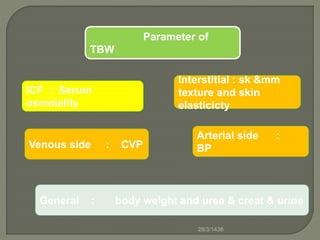
Parameter of
TBW
Interstitial : sk &mm
texture and skin
elasticicty
ICF : Serum
osmolality
Arterial side :
BPVenous side : CVP
General : body weight and urea & creat & urine
28/3/1436
28/3/1436
Water Input and Output of the “Normal” Adult
Minimal Obligatory Daily Water input:
Ingested water: 500 mL
Water content in food: 800 mL
Water from oxidation : 300 mL
TOTAL: 1600mL
Minimal Obligatory Daily water output:
Urine: 500 mL
Skin: 500 mL
Respiratory tract: 400mL
Stool: 200 mL
TOTAL: 1600mL
→ Average adult input/output is 30-35mL / kg / day
(2.4L/day)
28/3/1436
Fluid loss
Sensible loss
*Measurable e.g.: urine
Insensible Loss
*Nonmeasurable e.g.: skin & lung
*Approximately 10mL / kg per day or 30 to 50 mL /h: less
if ventilated, more if febrile.
*Fever increases insensible loss by 200 cc /day for each
degree (C) above 37( nearly 8 cc / h ).
28/3/1436
Daily Electrolyte Requirements
Na
* Na: 1-3 meq /kg/day(70 kg male requires 70-210 meq NaCl, 2600 cc fluid
per day).
* 0.45% saline contains 77 meq NaCl per liter. 2.6 x 77 = 200 meq
*Thus, 0.45% saline is usually used as MIVF assuming no other volume or
electrolyte issues.
Potassium
* Potassium: 1 meq / kg /day
*K can be added to IV fluids. Remember this increases osm load.
*20 meq / L is a common IVF additive.
* This will supply basal needs in most pts who are NPO.
*If significantly hypokalemic, order separate K supplementation.
*Oral potassium supplementation is always preferred when feasible.
Chloride: 60-150 meq Bicarb: 1 meq/kg/day
28/3/1436
Useful definitions
*Normuria : urine output about 1 – 2 L per day.
*Oliguria : urine output less than 500 mL/day.
*Anural : urine output <50 mL/day.
* Polyuria : urine output exceeding 3 L/day.
*Hemostasis : complex process which changes blood from a fluid to a solid
state.
*Homeostasis : maintenance of equilibrium state between cellular and
extracellular compartment composition.
*Serum osmolality : number of osmoles of solute per kg serum.
*Serum osmolarity : the number of osmoles of solute per litre of serum.
*Tonicity : the effective osmolality (the number of effective osmoles per kg
serum. 28/3/1436
Electrolytes
*Electrolytes are chemical compounds in solution that have the
ability
to conduct an electrical current .
*Distributed in different concentrations in IC & EC
compartment
*Two types :
1- cations : positively charged electrolytes as Na /K/ Ca/
Mg/ H ions.
2- anions : negatively charged electrolytes as cloride /
bicarbonate / phosphate /sulfate . 28/3/1436
28/3/1436
Regulation of body fluid compartment
*Homeostasis : maintenance of equilibrium state between
cellular and extracellular compartment composition.
* Homeostatic mechanism is a function of kidneys & CVS &
lung & supra renal & thyroid and parathyroid gland & pituitary
gland through RAAS & ADH and thirst & osmoreceptors and
baroreceptors & ANP.
*movement of particles through the cell membrane occurs
via the following transport mechanisms:-
1- Passive transport ( osmosis & diffusion & filtration ) .
2- Active transport as Na - K pump. 28/3/1436
Regulation of body fluid compartment
Diffusion : substances movement from area of higher
concentration to one of lower concentration eg O2 and
co2 across A-a membrane.
Filtration : passage of water and electrolytes in response
to hydrostatic & oncotic pressure e.g. as occur from
arterial capillary bed to interstitial space .
Osmosis : the movement of fluid through semipermeable
membrane from low osmolality to high osmolality.
Active transport : active movement of substances
across cell membrane against pressure gradient e.g. Na -
k pump.
28/3/1436
Osmolality and Osmolarity
*Serum osmolality: measures the body's electrolyte-water
balance.
*Osmolality and osmolarity are measures that are
technically
different, but functionally the same for normal use.
* Osmolality (with an "ℓ") is a measure of the osmoles (Osm)
of solute per kilogram of solvent (osmol / kg or Osm/kg).
*Osmolarity (with an "r") is defined as the number of
osmoles of solute per litre (L) of solution (osmol/L or Osm/L).
28/3/1436
*Serum osmolality : number of osmoles per kg serum ( normally 285
+_ 10 mosm / kg)
*Serum osmolality = 2 Na + urea/2.8 + glucose / 18 (all in mmol )
*Serum osmolarity (with an "r") is defined as the number of osmoles of
solute per litre (L) of serum (osmol/L or Osm/L).
*Osmolality of ECF and ICF is always equal.
*Effective osmoles : osmol which have osmotic pressure as Na &
Glucose .
*Non effective osmoles : osmol which have no osmotic pressure as
urea.
Tonicity : the effective osmolality and is equal to the sum of effective
osmoles in serum.
28/3/1436
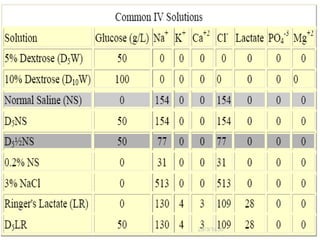
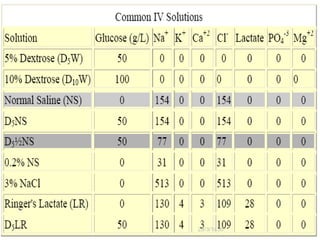
Contents of IV Fluid Preparations
Na
(mEq/L)
K
(mEq/L)
Cl
(mEq/L)
HCO3
(mEq/L)
Dextrose
(gm/L)
mOsm/L
D5W 50 278
½ NS 77 77 143
D51/2NS 77 77 50 350
NS 154 154 286
D5NS 154 154 50 564
Ringers
Lactate
(RL)
130 4 109 28 50 272
28/3/1436
Fluid shifting
1st space shifting: normal distribution of fluid between
both ECF and ICF compartment.
2nd space shifting: excesses accumulation of fluid in
interstitial space (edema).
3rd space shifting: accumulation of fluid in areas that
are normally have no or little amount of fluid and
normally not share in homeostasis (ascitis – burns –
bowel obstruction - massive bleeding into joint).
28/3/1436
Indication of IVF therapy
Purpose
The appropriate rate
Choice of replacement fluid
Replacement therapy (Resuscitation , Rehydration)
Purpose
The appropriate rate
Choice of replacement fluid
Maintenance Therapy
28/3/1436
Maintenance Therapy
Purpose
*Replace ongoing losses of water and electrolytes under normal
physiological conditions
* Used when the patient is not expected to eat or drink normally
for prolonged period of time
* In general, patients who are afebrile, not eating, not physically
active require less that 1 L of free water daily
* Patient’s with ESRD or edematous states (ex. cirrhosis, heart
failure) require less maintenance due to decreased output
and/or altered fluid distribution
28/3/1436
Maintenance Therapy
3 approaches to determine the appropriate rate:
1) Calculate maintenance based on average requirement of 35 cc / kg / day
2) “4/2/1” rule
4 ml/kg/hr for the first 10 kg (0-10kg)
2 ml/kg/ hr for the next 10kg (11-20kg)
1 ml/kg/ hr for remaining weight (21 kg and up)
3) Weight in kg + 40
EX; Pt weight 85 kg.
1- 85 kg x 35 cc/ kg / 24hr = 3L/24 hr = 125 cc / hr
2- 40 + 20 + 65 = 125cc/ hr
3- 85 + 40 = 125cc/ hr
28/3/1436
Maintenance Therapy
What type of fluid for maintenance?
* D51/2NS + 20 mEq KCl provides:
- avoid dextrose in patients with uncontrolled DM or
hypokalemia
- No much data to support addition of D5, however
can be added to prevent muscle catabolism
* Therefore, 1/2NS or D51/2NS + 20 mEq KCL would be
appropriate choices.
* adjust maintenance fluids based on serum sodium
concentration (ex. Change from 1/2NS to NS or D5NS if
hyponatremia develops)
28/3/1436
Replacement therapy
Purpose:
Correct existing abnormalities in volume
status or serum electrolytes
Objective parameters used to assess volume deficit:
• Blood pressure
• Jugular venous pressure
• Serum osmolality
• Sk &mm texture and skin elasticity
• urea & creat
• Urine sodium concentration
• Urine output
• Pre and post deficit body weight
28/3/1436
Parameter of TBW
Interstitial : sk &
mmmoisture and skin
elasticity
ICF : Serum osmolality
Arterial side : BPVenous side : CVP
General : body weight and urea & creat & urine
28/3/1436
Rate of Repletion
Severe volume depletion or hypovolemic shock
* Rapid infusion of 1-2L isotonic saline (NS), then reassess
parameters( HHS, DKA, sepsis and septic shock , hypovolemic shock)
Mild to moderate hypovolemia
* Estimate fluid losses:
– Average output 2.4 L /day for 70kg patient.
– estimate additional losses such as GI (diarrhea, vomiting) and
high fever.
* Choose rate 50-100mL/h greater than estimated losses.
* Select fluid based on type of fluid that has been lost and any co-
existing electrolyte disorders .
Replacement therapy
28/3/1436
Which Fluid to Choose?
1- Hypovolemia
* primary goal is volume expansion.
*NS or LR.
2-Dehydration (= hyperosmolality)
* primary goal is free water replacement.
*Use a hypotonic fluid usually 0.45% saline or D5W.
3-Hypernatremia use hypotonic solutions.
4- Hyponatremia use Isotonic or, in symptomatic patients,
hypertonic saline.
5- blood loss use Isotonic saline and blood .
Note: K or bicarbonate may need to be added in patients with hypokalemia o
metabolic acidosis.
28/3/1436
Type of IV solution
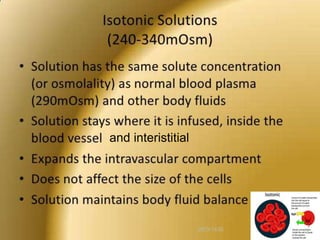
according to their tonicity
Isotonic Hypotonic Hypertonic
28/3/1436
Note: These can be dangerous in the
setting of cell dehydration.
28/3/1436
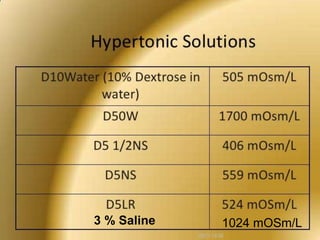
3 % Saline 1024 mOSm/L
28/3/1436
and interistitial
28/3/1436
28/3/1436
Hartmann's solution or compound sodium lactate
*crystalloid solution that is most closely isotonic with blood and
intended for intravenous administration.
*used to replace body fluid and mineral salts that may be lost for
a variety of medical reasons.
*Hartmann's IV Infusion is especially suitable when the losses
result in too much acid being present in the blood.
*Hartmann's solution is abbreviated as "CSL".
*It is very similar—though not identical to — lactated Ringer's
solution, the ionic concentrations of which differ.
*One litre of Hartmann's solution contains:
Na = 131 mmol/L& CL= 111 mmol/L & lactate = 29 mmol/L & K
= 5 mmol/L & CA = 2 mmol/L. 28/3/1436
Caution with use because sudden fluid shifts from
the IV space to cells can cause cardiovascular
collapse and increased ICP .
28/3/1436
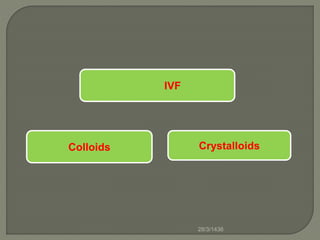
IVF
Colloids Crystalloids
28/3/1436
Colloids
*large molecular weight solutions ,may be natural or
artificial ,have MW > 30,000 Daltons, do NOT readily
cross semi-permeable membranes.
*Used to increase vascular spacs rapidly by shifting fluid
from interstitial and IC compartment.
*They work well in reducing edema (p edema or cerebral
edema) while expanding the vascular compartment.
* Dextran / Albumin / Mannitol / HES are examples.
28/3/1436
Crystalloids
*Small molecular weight solutions made up of water
& electrolyte.
*Effective volume expander for a short period of time.
*Ideal for patient who need fluid volume replacement.
*NS / LR ARE examples.
28/3/1436
28/3/1436
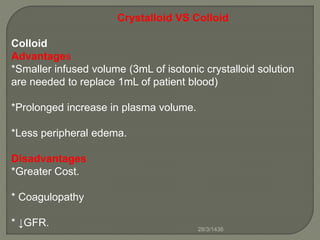
Crystalloid VS Colloid
Colloid
Advantages
*Smaller infused volume (3mL of isotonic crystalloid solution
are needed to replace 1mL of patient blood)
*Prolonged increase in plasma volume.
*Less peripheral edema.
Disadvantages
*Greater Cost.
* Coagulopathy
* ↓GFR. 28/3/1436
Crystalloid
Advantages
* Lower cost.
* Greater Urinary Flow.
* Replaces interstitial fluid.
Disadvantages-
* Transient hemodynamic improvement.
* Peripheral edema.
* Pulmonary edema.
Crystalloid VS Colloid
28/3/1436
28/3/1436
Volume depletion
Symptoms
* Three sets of symptoms may occur in hypovolemic patients:-
1-Those due to volume depletion.
2-Those related to the type of fluid lost.
3-Those due to the electrolyte and acid-base disorders which
can accompany volume depletion.
28/3/1436
Volume depletion
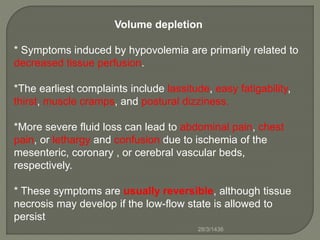
* Symptoms induced by hypovolemia are primarily related to
decreased tissue perfusion.
*The earliest complaints include lassitude, easy fatigability,
thirst, muscle cramps, and postural dizziness.
*More severe fluid loss can lead to abdominal pain, chest
pain, or lethargy and confusion due to ischemia of the
mesenteric, coronary , or cerebral vascular beds,
respectively.
* These symptoms are usually reversible, although tissue
necrosis may develop if the low-flow state is allowed to
persist
28/3/1436
Volume depletion
Physical examination
* Although relatively insensitive and nonspecific, certain
findings on physical examination may suggest volume
depletion.
*A decrease in the interstitial volume: can be detected by
the examination of the skin and mucous membranes
( decreased skin turgor- dry skin- dry axilla -dry tongue
and oral mucosa ).
*A decrease in IV volume : can be detected by Decrease
in the systemic blood pressure and Decrease in The venous
pressure in the jugular veins.
28/3/1436
Hypernatremia
Rate of fluid administration mL /h = water deficit x 10 ÷ (serum Na -
140)÷ 24
+
Obligatory water output from sweat and stool, which is approximately
30 to 40 mL /h.
*Rate of lowered serum sodium per day =10 meq /L per day
*The water deficit should be replaced over at least (serum Na -140) ÷ 10
= days, or day/24 = hours
*Obligatory water output from sweat and stool, which is approximately
30 to 40 mL /h.
Serum [Na]
*Water deficit = Current TBW x (——————— - 1)
140
*Current TBW= W X male 60% or female 50%28/3/1436
Hyponatremia
1)Na deficit (total needed) = Current TBW x (desired Na -
serum Na)
2) desired rate/hr = Amount needed to increase serum
level by 0.5 meq/L/hr = Current TBW x 0.5
3) 3% hypertonic saline contains 513 meq /Liter
[desired rate/hr]/513 x 1000 = ml/hr
4) Length of infusion = Na deficit / desired rate/hr =
hours
28/3/1436
Determining Appropriate IVF
Step 1: Assess volume status
Step 2: Determine Access
Step 3: Select Type of Fluid
Step 4: Determine Rate
==============================================
=======
Step 1: Assess volume status
*What is the volume status of my patient?
*Do they have ongoing losses?
*Can my patient take PO safely?
*Are the NPO for a reason?
Step 2: Determine Access
*Peripheral IV
*Central line 28/3/1436
Determining Appropriate IVF
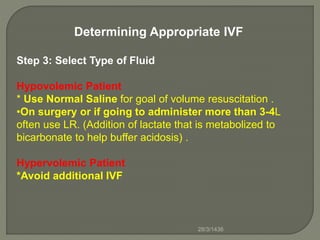
Step 3: Select Type of Fluid
Hypovolemic Patient
* Use Normal Saline for goal of volume resuscitation .
•On surgery or if going to administer more than 3-4L
often use LR. (Addition of lactate that is metabolized to
bicarbonate to help buffer acidosis) .
Hypervolemic Patient
*Avoid additional IVF
28/3/1436
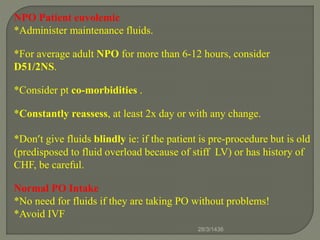
NPO Patient euvolemic
*Administer maintenance fluids.
*For average adult NPO for more than 6-12 hours, consider
D51/2NS.
*Consider pt co-morbidities .
*Constantly reassess, at least 2x day or with any change.
*Don’t give fluids blindly ie: if the patient is pre-procedure but is old
(predisposed to fluid overload because of stiff LV) or has history of
CHF, be careful.
Normal PO Intake
*No need for fluids if they are taking PO without problems!
*Avoid IVF
28/3/1436
28/3/1436
Determining Appropriate IVF
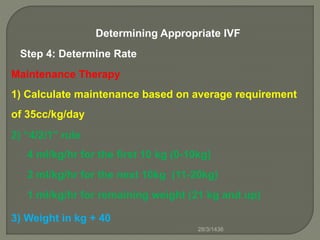
Step 4: Determine Rate
Maintenance Therapy
1) Calculate maintenance based on average requirement
of 35cc/kg/day
2) “4/2/1” rule
4 ml/kg/hr for the first 10 kg (0-10kg)
2 ml/kg/hr for the next 10kg (11-20kg)
1 ml/kg/hr for remaining weight (21 kg and up)
3) Weight in kg + 40
28/3/1436
Step 4: Determine Rate
Replacement therapy
Severe volume depletion or hypovolemic shock
* Rapid infusion of 1-2L isotonic saline (NS), then reassess parameters (
HHS, DKA, sepsis and septic shock , hypovolemic shock)
Mild to moderate hypovolemia
* Estimate fluid losses:
– Recall: Average output 2.4L/day for 70kg patient
– estimate additional losses such as GI (diarrhea, vomiting) and high
fever.
* Choose rate 50-100mL/h greater than estimated losses
* Select fluid based on type of fluid that has been lost and any co-existing
electrolyte disorders
28/3/1436
Examples
28/3/1436
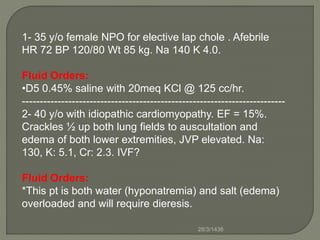
1- 35 y/o female NPO for elective lap chole . Afebrile
HR 72 BP 120/80 Wt 85 kg. Na 140 K 4.0.
Fluid Orders:
•D5 0.45% saline with 20meq KCl @ 125 cc/hr.
--------------------------------------------------------------------------
2- 40 y/o with idiopathic cardiomyopathy. EF = 15%.
Crackles ½ up both lung fields to auscultation and
edema of both lower extremities, JVP elevated. Na:
130, K: 5.1, Cr: 2.3. IVF?
Fluid Orders:
*This pt is both water (hyponatremia) and salt (edema)
overloaded and will require dieresis.
28/3/1436
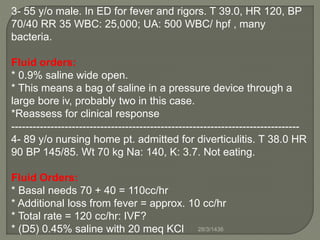
3- 55 y/o male. In ED for fever and rigors. T 39.0, HR 120, BP
70/40 RR 35 WBC: 25,000; UA: 500 WBC/ hpf , many
bacteria.
Fluid orders:
* 0.9% saline wide open.
* This means a bag of saline in a pressure device through a
large bore iv, probably two in this case.
*Reassess for clinical response
---------------------------------------------------------------------------------
4- 89 y/o nursing home pt. admitted for diverticulitis. T 38.0 HR
90 BP 145/85. Wt 70 kg Na: 140, K: 3.7. Not eating.
Fluid Orders:
* Basal needs 70 + 40 = 110cc/hr
* Additional loss from fever = approx. 10 cc/hr
* Total rate = 120 cc/hr: IVF?
* (D5) 0.45% saline with 20 meq KCl 28/3/1436
5-50 y/o with massive hematemisis, SBP 80 HR 130 IVF?
Fluid Orders:
* 0.9% saline WIDE OPEN through two large bore IVs.
*O neg STAT
*Type and cross 6 units PRBC STAT
-------------------------------------------------------------------------
6-65 y/o male hospitalized with pneumonia. Temp 38.5, HR 72,
BP 125/72. Wt 75 kg. Na:165 K: 4.0.
Fluid Orders:
*Basal needs 115 cc/hr + 12 cc/hr for fever.
Also:
* Free water deficit of (.6)(75)[(165/140) – 1] =
7.6 liters.
* IV # 1: 0.45% saline @ 130 cc/hr.
* IV # 2: D5W @ 150cc/hr for 50 hrs.
28/3/1436
7- 30 y/o male admitted for ITP. Platelets 6, T 37.0,
HR 72, BP 120/80, Wt 80 kg. Eating well.
Fluid Orders:
NO IVF orders needed.
28/3/1436
Remember
28/3/1436
1- If the gut works use it.
2- Do not use IVF if they are unnecessary
3- Your fluid orders are incomplete until you have ordered
monitoring labs (electrolyte, Cr, etc), I/O, daily weights.
4-Think about why you ordering IVF
(NPO/Volume deficit/ On going losses/Specific goal to fluid
therapy eg hydration prior contrast dye)
5-The basic fluid, i.e. isotonic, hypotonic, hypertonic,
should be clear.
6-Complications of fluid therapy
(Fluid overload/ Electrolyte disturbances/ Line infections).
28/3/1436
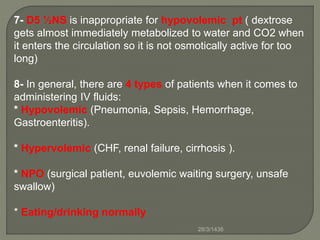
7- D5 ½NS is inappropriate for hypovolemic pt ( dextrose
gets almost immediately metabolized to water and CO2 when
it enters the circulation so it is not osmotically active for too
long)
8- In general, there are 4 types of patients when it comes to
administering IV fluids:
* Hypovolemic (Pneumonia, Sepsis, Hemorrhage,
Gastroenteritis).
* Hypervolemic (CHF, renal failure, cirrhosis ).
* NPO (surgical patient, euvolemic waiting surgery, unsafe
swallow)
* Eating/drinking normally
28/3/1436
9- Consider appropriateness of IVF daily in each pt
e g :
*Hypovolemia use Isotonic fluid as NS or LR .
*Dehydration use hypotonic fluid as 0.45% saline or D5W .
•Hypernatremia use hypotonic solutions .
*Hyponatremia use Isotonic or, in symptomatic pt, hypertonic
saline.
*blood loss use Isotonic saline then blood .
10- K may need to be added in patients with hypokalemia and
bicarbonate in severe metabolic acidosis
28/3/1436
Thank you for listening
28/3/1436

IVF

  • 1.
    INTRAVENOUS FLUID THERAPY Dr.HASSAN ABDELRAZEK INTERNAL MEDICINE SPECIALIST 28/3/1436
  • 2.
    Outline Physiology of bodywater Indication of IVF therapy Type of IVF Fluid imbalance Determining Appropriate IVF Examples Remember 28/3/1436
  • 3.
    Total Body Water *Bodywater represent 60% of adult male body weight and 50% of adult female body weight which distributed in two body compartment . *The two body compartment are IC and EC . *The EC compartment subdivided into interstitial and IV spaces. *The IV space subdivided into arterial and venous side. *The body water distributed in the two compartment according to one third and two third rule. 28/3/1436
  • 4.
    TBW ECF 1/3 ICF 2/3 INTRAVASCULAR 1/3INTERSTITIAL2/3 VENOUS SIDE 2/3 ARTERIAL SIDE 1/3 “2/3,1/3” rule. 28/3/1436
  • 5.
    TBW 42 L ECF ICF INTERSTITI AL INTRAV ASCUL AR ARTE RIAL SIDE VENOU S SIDE 28L 14 L 9 L 5 L 1.7 L3.3 L 70 kg male: TBW= 70x0.6= 42 L (TBW = W X male 60% or female 50%) 28/3/1436
  • 6.
    Where is mybolus going? 1L D5W distributed into Total Body Water Free water content ICF ECF Interstitial Intravascular D5W 1000cc 660cc 340cc 226cc 114cc (11%) ½ NS 500 cc 330 cc 670cc {170 free water+500} 330cc + 114 cc from free water=444cc 170 cc + 56 cc from free water =226 cc NS 0 0 1000cc 660cc 330cc (33%) Normal saline has no free water and is confined to ECF space; this is why it is the preferred IVF for resuscitation!28/3/1436
  • 7.
    Parameter of TBW Interstitial :sk &mm texture and skin elasticicty ICF : Serum osmolality Arterial side : BPVenous side : CVP General : body weight and urea & creat & urine 28/3/1436
  • 8.
  • 9.
    Water Input andOutput of the “Normal” Adult Minimal Obligatory Daily Water input: Ingested water: 500 mL Water content in food: 800 mL Water from oxidation : 300 mL TOTAL: 1600mL Minimal Obligatory Daily water output: Urine: 500 mL Skin: 500 mL Respiratory tract: 400mL Stool: 200 mL TOTAL: 1600mL → Average adult input/output is 30-35mL / kg / day (2.4L/day) 28/3/1436
  • 10.
    Fluid loss Sensible loss *Measurablee.g.: urine Insensible Loss *Nonmeasurable e.g.: skin & lung *Approximately 10mL / kg per day or 30 to 50 mL /h: less if ventilated, more if febrile. *Fever increases insensible loss by 200 cc /day for each degree (C) above 37( nearly 8 cc / h ). 28/3/1436
  • 11.
    Daily Electrolyte Requirements Na *Na: 1-3 meq /kg/day(70 kg male requires 70-210 meq NaCl, 2600 cc fluid per day). * 0.45% saline contains 77 meq NaCl per liter. 2.6 x 77 = 200 meq *Thus, 0.45% saline is usually used as MIVF assuming no other volume or electrolyte issues. Potassium * Potassium: 1 meq / kg /day *K can be added to IV fluids. Remember this increases osm load. *20 meq / L is a common IVF additive. * This will supply basal needs in most pts who are NPO. *If significantly hypokalemic, order separate K supplementation. *Oral potassium supplementation is always preferred when feasible. Chloride: 60-150 meq Bicarb: 1 meq/kg/day 28/3/1436
  • 12.
    Useful definitions *Normuria :urine output about 1 – 2 L per day. *Oliguria : urine output less than 500 mL/day. *Anural : urine output <50 mL/day. * Polyuria : urine output exceeding 3 L/day. *Hemostasis : complex process which changes blood from a fluid to a solid state. *Homeostasis : maintenance of equilibrium state between cellular and extracellular compartment composition. *Serum osmolality : number of osmoles of solute per kg serum. *Serum osmolarity : the number of osmoles of solute per litre of serum. *Tonicity : the effective osmolality (the number of effective osmoles per kg serum. 28/3/1436
  • 13.
    Electrolytes *Electrolytes are chemicalcompounds in solution that have the ability to conduct an electrical current . *Distributed in different concentrations in IC & EC compartment *Two types : 1- cations : positively charged electrolytes as Na /K/ Ca/ Mg/ H ions. 2- anions : negatively charged electrolytes as cloride / bicarbonate / phosphate /sulfate . 28/3/1436
  • 14.
  • 15.
    Regulation of bodyfluid compartment *Homeostasis : maintenance of equilibrium state between cellular and extracellular compartment composition. * Homeostatic mechanism is a function of kidneys & CVS & lung & supra renal & thyroid and parathyroid gland & pituitary gland through RAAS & ADH and thirst & osmoreceptors and baroreceptors & ANP. *movement of particles through the cell membrane occurs via the following transport mechanisms:- 1- Passive transport ( osmosis & diffusion & filtration ) . 2- Active transport as Na - K pump. 28/3/1436
  • 16.
    Regulation of bodyfluid compartment Diffusion : substances movement from area of higher concentration to one of lower concentration eg O2 and co2 across A-a membrane. Filtration : passage of water and electrolytes in response to hydrostatic & oncotic pressure e.g. as occur from arterial capillary bed to interstitial space . Osmosis : the movement of fluid through semipermeable membrane from low osmolality to high osmolality. Active transport : active movement of substances across cell membrane against pressure gradient e.g. Na - k pump. 28/3/1436
  • 17.
    Osmolality and Osmolarity *Serumosmolality: measures the body's electrolyte-water balance. *Osmolality and osmolarity are measures that are technically different, but functionally the same for normal use. * Osmolality (with an "ℓ") is a measure of the osmoles (Osm) of solute per kilogram of solvent (osmol / kg or Osm/kg). *Osmolarity (with an "r") is defined as the number of osmoles of solute per litre (L) of solution (osmol/L or Osm/L). 28/3/1436
  • 18.
    *Serum osmolality :number of osmoles per kg serum ( normally 285 +_ 10 mosm / kg) *Serum osmolality = 2 Na + urea/2.8 + glucose / 18 (all in mmol ) *Serum osmolarity (with an "r") is defined as the number of osmoles of solute per litre (L) of serum (osmol/L or Osm/L). *Osmolality of ECF and ICF is always equal. *Effective osmoles : osmol which have osmotic pressure as Na & Glucose . *Non effective osmoles : osmol which have no osmotic pressure as urea. Tonicity : the effective osmolality and is equal to the sum of effective osmoles in serum. 28/3/1436
  • 19.
    Contents of IVFluid Preparations Na (mEq/L) K (mEq/L) Cl (mEq/L) HCO3 (mEq/L) Dextrose (gm/L) mOsm/L D5W 50 278 ½ NS 77 77 143 D51/2NS 77 77 50 350 NS 154 154 286 D5NS 154 154 50 564 Ringers Lactate (RL) 130 4 109 28 50 272 28/3/1436
  • 20.
    Fluid shifting 1st spaceshifting: normal distribution of fluid between both ECF and ICF compartment. 2nd space shifting: excesses accumulation of fluid in interstitial space (edema). 3rd space shifting: accumulation of fluid in areas that are normally have no or little amount of fluid and normally not share in homeostasis (ascitis – burns – bowel obstruction - massive bleeding into joint). 28/3/1436
  • 21.
    Indication of IVFtherapy Purpose The appropriate rate Choice of replacement fluid Replacement therapy (Resuscitation , Rehydration) Purpose The appropriate rate Choice of replacement fluid Maintenance Therapy 28/3/1436
  • 22.
    Maintenance Therapy Purpose *Replace ongoinglosses of water and electrolytes under normal physiological conditions * Used when the patient is not expected to eat or drink normally for prolonged period of time * In general, patients who are afebrile, not eating, not physically active require less that 1 L of free water daily * Patient’s with ESRD or edematous states (ex. cirrhosis, heart failure) require less maintenance due to decreased output and/or altered fluid distribution 28/3/1436
  • 23.
    Maintenance Therapy 3 approachesto determine the appropriate rate: 1) Calculate maintenance based on average requirement of 35 cc / kg / day 2) “4/2/1” rule 4 ml/kg/hr for the first 10 kg (0-10kg) 2 ml/kg/ hr for the next 10kg (11-20kg) 1 ml/kg/ hr for remaining weight (21 kg and up) 3) Weight in kg + 40 EX; Pt weight 85 kg. 1- 85 kg x 35 cc/ kg / 24hr = 3L/24 hr = 125 cc / hr 2- 40 + 20 + 65 = 125cc/ hr 3- 85 + 40 = 125cc/ hr 28/3/1436
  • 24.
    Maintenance Therapy What typeof fluid for maintenance? * D51/2NS + 20 mEq KCl provides: - avoid dextrose in patients with uncontrolled DM or hypokalemia - No much data to support addition of D5, however can be added to prevent muscle catabolism * Therefore, 1/2NS or D51/2NS + 20 mEq KCL would be appropriate choices. * adjust maintenance fluids based on serum sodium concentration (ex. Change from 1/2NS to NS or D5NS if hyponatremia develops) 28/3/1436
  • 25.
    Replacement therapy Purpose: Correct existingabnormalities in volume status or serum electrolytes Objective parameters used to assess volume deficit: • Blood pressure • Jugular venous pressure • Serum osmolality • Sk &mm texture and skin elasticity • urea & creat • Urine sodium concentration • Urine output • Pre and post deficit body weight 28/3/1436
  • 26.
    Parameter of TBW Interstitial: sk & mmmoisture and skin elasticity ICF : Serum osmolality Arterial side : BPVenous side : CVP General : body weight and urea & creat & urine 28/3/1436
  • 27.
    Rate of Repletion Severevolume depletion or hypovolemic shock * Rapid infusion of 1-2L isotonic saline (NS), then reassess parameters( HHS, DKA, sepsis and septic shock , hypovolemic shock) Mild to moderate hypovolemia * Estimate fluid losses: – Average output 2.4 L /day for 70kg patient. – estimate additional losses such as GI (diarrhea, vomiting) and high fever. * Choose rate 50-100mL/h greater than estimated losses. * Select fluid based on type of fluid that has been lost and any co- existing electrolyte disorders . Replacement therapy 28/3/1436
  • 28.
    Which Fluid toChoose? 1- Hypovolemia * primary goal is volume expansion. *NS or LR. 2-Dehydration (= hyperosmolality) * primary goal is free water replacement. *Use a hypotonic fluid usually 0.45% saline or D5W. 3-Hypernatremia use hypotonic solutions. 4- Hyponatremia use Isotonic or, in symptomatic patients, hypertonic saline. 5- blood loss use Isotonic saline and blood . Note: K or bicarbonate may need to be added in patients with hypokalemia o metabolic acidosis. 28/3/1436
  • 29.
    Type of IVsolution according to their tonicity Isotonic Hypotonic Hypertonic 28/3/1436
  • 30.
    Note: These canbe dangerous in the setting of cell dehydration. 28/3/1436
  • 31.
    3 % Saline1024 mOSm/L 28/3/1436
  • 32.
  • 33.
  • 34.
    Hartmann's solution orcompound sodium lactate *crystalloid solution that is most closely isotonic with blood and intended for intravenous administration. *used to replace body fluid and mineral salts that may be lost for a variety of medical reasons. *Hartmann's IV Infusion is especially suitable when the losses result in too much acid being present in the blood. *Hartmann's solution is abbreviated as "CSL". *It is very similar—though not identical to — lactated Ringer's solution, the ionic concentrations of which differ. *One litre of Hartmann's solution contains: Na = 131 mmol/L& CL= 111 mmol/L & lactate = 29 mmol/L & K = 5 mmol/L & CA = 2 mmol/L. 28/3/1436
  • 35.
    Caution with usebecause sudden fluid shifts from the IV space to cells can cause cardiovascular collapse and increased ICP . 28/3/1436
  • 36.
  • 37.
    Colloids *large molecular weightsolutions ,may be natural or artificial ,have MW > 30,000 Daltons, do NOT readily cross semi-permeable membranes. *Used to increase vascular spacs rapidly by shifting fluid from interstitial and IC compartment. *They work well in reducing edema (p edema or cerebral edema) while expanding the vascular compartment. * Dextran / Albumin / Mannitol / HES are examples. 28/3/1436
  • 38.
    Crystalloids *Small molecular weightsolutions made up of water & electrolyte. *Effective volume expander for a short period of time. *Ideal for patient who need fluid volume replacement. *NS / LR ARE examples. 28/3/1436
  • 39.
  • 40.
    Crystalloid VS Colloid Colloid Advantages *Smallerinfused volume (3mL of isotonic crystalloid solution are needed to replace 1mL of patient blood) *Prolonged increase in plasma volume. *Less peripheral edema. Disadvantages *Greater Cost. * Coagulopathy * ↓GFR. 28/3/1436
  • 41.
    Crystalloid Advantages * Lower cost. *Greater Urinary Flow. * Replaces interstitial fluid. Disadvantages- * Transient hemodynamic improvement. * Peripheral edema. * Pulmonary edema. Crystalloid VS Colloid 28/3/1436
  • 42.
  • 43.
    Volume depletion Symptoms * Threesets of symptoms may occur in hypovolemic patients:- 1-Those due to volume depletion. 2-Those related to the type of fluid lost. 3-Those due to the electrolyte and acid-base disorders which can accompany volume depletion. 28/3/1436
  • 44.
    Volume depletion * Symptomsinduced by hypovolemia are primarily related to decreased tissue perfusion. *The earliest complaints include lassitude, easy fatigability, thirst, muscle cramps, and postural dizziness. *More severe fluid loss can lead to abdominal pain, chest pain, or lethargy and confusion due to ischemia of the mesenteric, coronary , or cerebral vascular beds, respectively. * These symptoms are usually reversible, although tissue necrosis may develop if the low-flow state is allowed to persist 28/3/1436
  • 45.
    Volume depletion Physical examination *Although relatively insensitive and nonspecific, certain findings on physical examination may suggest volume depletion. *A decrease in the interstitial volume: can be detected by the examination of the skin and mucous membranes ( decreased skin turgor- dry skin- dry axilla -dry tongue and oral mucosa ). *A decrease in IV volume : can be detected by Decrease in the systemic blood pressure and Decrease in The venous pressure in the jugular veins. 28/3/1436
  • 46.
    Hypernatremia Rate of fluidadministration mL /h = water deficit x 10 ÷ (serum Na - 140)÷ 24 + Obligatory water output from sweat and stool, which is approximately 30 to 40 mL /h. *Rate of lowered serum sodium per day =10 meq /L per day *The water deficit should be replaced over at least (serum Na -140) ÷ 10 = days, or day/24 = hours *Obligatory water output from sweat and stool, which is approximately 30 to 40 mL /h. Serum [Na] *Water deficit = Current TBW x (——————— - 1) 140 *Current TBW= W X male 60% or female 50%28/3/1436
  • 47.
    Hyponatremia 1)Na deficit (totalneeded) = Current TBW x (desired Na - serum Na) 2) desired rate/hr = Amount needed to increase serum level by 0.5 meq/L/hr = Current TBW x 0.5 3) 3% hypertonic saline contains 513 meq /Liter [desired rate/hr]/513 x 1000 = ml/hr 4) Length of infusion = Na deficit / desired rate/hr = hours 28/3/1436
  • 48.
    Determining Appropriate IVF Step1: Assess volume status Step 2: Determine Access Step 3: Select Type of Fluid Step 4: Determine Rate ============================================== ======= Step 1: Assess volume status *What is the volume status of my patient? *Do they have ongoing losses? *Can my patient take PO safely? *Are the NPO for a reason? Step 2: Determine Access *Peripheral IV *Central line 28/3/1436
  • 49.
    Determining Appropriate IVF Step3: Select Type of Fluid Hypovolemic Patient * Use Normal Saline for goal of volume resuscitation . •On surgery or if going to administer more than 3-4L often use LR. (Addition of lactate that is metabolized to bicarbonate to help buffer acidosis) . Hypervolemic Patient *Avoid additional IVF 28/3/1436
  • 50.
    NPO Patient euvolemic *Administermaintenance fluids. *For average adult NPO for more than 6-12 hours, consider D51/2NS. *Consider pt co-morbidities . *Constantly reassess, at least 2x day or with any change. *Don’t give fluids blindly ie: if the patient is pre-procedure but is old (predisposed to fluid overload because of stiff LV) or has history of CHF, be careful. Normal PO Intake *No need for fluids if they are taking PO without problems! *Avoid IVF 28/3/1436
  • 51.
  • 52.
    Determining Appropriate IVF Step4: Determine Rate Maintenance Therapy 1) Calculate maintenance based on average requirement of 35cc/kg/day 2) “4/2/1” rule 4 ml/kg/hr for the first 10 kg (0-10kg) 2 ml/kg/hr for the next 10kg (11-20kg) 1 ml/kg/hr for remaining weight (21 kg and up) 3) Weight in kg + 40 28/3/1436
  • 53.
    Step 4: DetermineRate Replacement therapy Severe volume depletion or hypovolemic shock * Rapid infusion of 1-2L isotonic saline (NS), then reassess parameters ( HHS, DKA, sepsis and septic shock , hypovolemic shock) Mild to moderate hypovolemia * Estimate fluid losses: – Recall: Average output 2.4L/day for 70kg patient – estimate additional losses such as GI (diarrhea, vomiting) and high fever. * Choose rate 50-100mL/h greater than estimated losses * Select fluid based on type of fluid that has been lost and any co-existing electrolyte disorders 28/3/1436
  • 54.
  • 55.
    1- 35 y/ofemale NPO for elective lap chole . Afebrile HR 72 BP 120/80 Wt 85 kg. Na 140 K 4.0. Fluid Orders: •D5 0.45% saline with 20meq KCl @ 125 cc/hr. -------------------------------------------------------------------------- 2- 40 y/o with idiopathic cardiomyopathy. EF = 15%. Crackles ½ up both lung fields to auscultation and edema of both lower extremities, JVP elevated. Na: 130, K: 5.1, Cr: 2.3. IVF? Fluid Orders: *This pt is both water (hyponatremia) and salt (edema) overloaded and will require dieresis. 28/3/1436
  • 56.
    3- 55 y/omale. In ED for fever and rigors. T 39.0, HR 120, BP 70/40 RR 35 WBC: 25,000; UA: 500 WBC/ hpf , many bacteria. Fluid orders: * 0.9% saline wide open. * This means a bag of saline in a pressure device through a large bore iv, probably two in this case. *Reassess for clinical response --------------------------------------------------------------------------------- 4- 89 y/o nursing home pt. admitted for diverticulitis. T 38.0 HR 90 BP 145/85. Wt 70 kg Na: 140, K: 3.7. Not eating. Fluid Orders: * Basal needs 70 + 40 = 110cc/hr * Additional loss from fever = approx. 10 cc/hr * Total rate = 120 cc/hr: IVF? * (D5) 0.45% saline with 20 meq KCl 28/3/1436
  • 57.
    5-50 y/o withmassive hematemisis, SBP 80 HR 130 IVF? Fluid Orders: * 0.9% saline WIDE OPEN through two large bore IVs. *O neg STAT *Type and cross 6 units PRBC STAT ------------------------------------------------------------------------- 6-65 y/o male hospitalized with pneumonia. Temp 38.5, HR 72, BP 125/72. Wt 75 kg. Na:165 K: 4.0. Fluid Orders: *Basal needs 115 cc/hr + 12 cc/hr for fever. Also: * Free water deficit of (.6)(75)[(165/140) – 1] = 7.6 liters. * IV # 1: 0.45% saline @ 130 cc/hr. * IV # 2: D5W @ 150cc/hr for 50 hrs. 28/3/1436
  • 58.
    7- 30 y/omale admitted for ITP. Platelets 6, T 37.0, HR 72, BP 120/80, Wt 80 kg. Eating well. Fluid Orders: NO IVF orders needed. 28/3/1436
  • 59.
  • 60.
    1- If thegut works use it. 2- Do not use IVF if they are unnecessary 3- Your fluid orders are incomplete until you have ordered monitoring labs (electrolyte, Cr, etc), I/O, daily weights. 4-Think about why you ordering IVF (NPO/Volume deficit/ On going losses/Specific goal to fluid therapy eg hydration prior contrast dye) 5-The basic fluid, i.e. isotonic, hypotonic, hypertonic, should be clear. 6-Complications of fluid therapy (Fluid overload/ Electrolyte disturbances/ Line infections). 28/3/1436
  • 61.
    7- D5 ½NSis inappropriate for hypovolemic pt ( dextrose gets almost immediately metabolized to water and CO2 when it enters the circulation so it is not osmotically active for too long) 8- In general, there are 4 types of patients when it comes to administering IV fluids: * Hypovolemic (Pneumonia, Sepsis, Hemorrhage, Gastroenteritis). * Hypervolemic (CHF, renal failure, cirrhosis ). * NPO (surgical patient, euvolemic waiting surgery, unsafe swallow) * Eating/drinking normally 28/3/1436
  • 62.
    9- Consider appropriatenessof IVF daily in each pt e g : *Hypovolemia use Isotonic fluid as NS or LR . *Dehydration use hypotonic fluid as 0.45% saline or D5W . •Hypernatremia use hypotonic solutions . *Hyponatremia use Isotonic or, in symptomatic pt, hypertonic saline. *blood loss use Isotonic saline then blood . 10- K may need to be added in patients with hypokalemia and bicarbonate in severe metabolic acidosis 28/3/1436
  • 63.
    Thank you forlistening 28/3/1436