Model-driven network automation
Anees Shaikh, Josh George
on behalf of Google Network Operations
2016 DevOps Networking Forum
Zero-touch networking : extreme automation
2
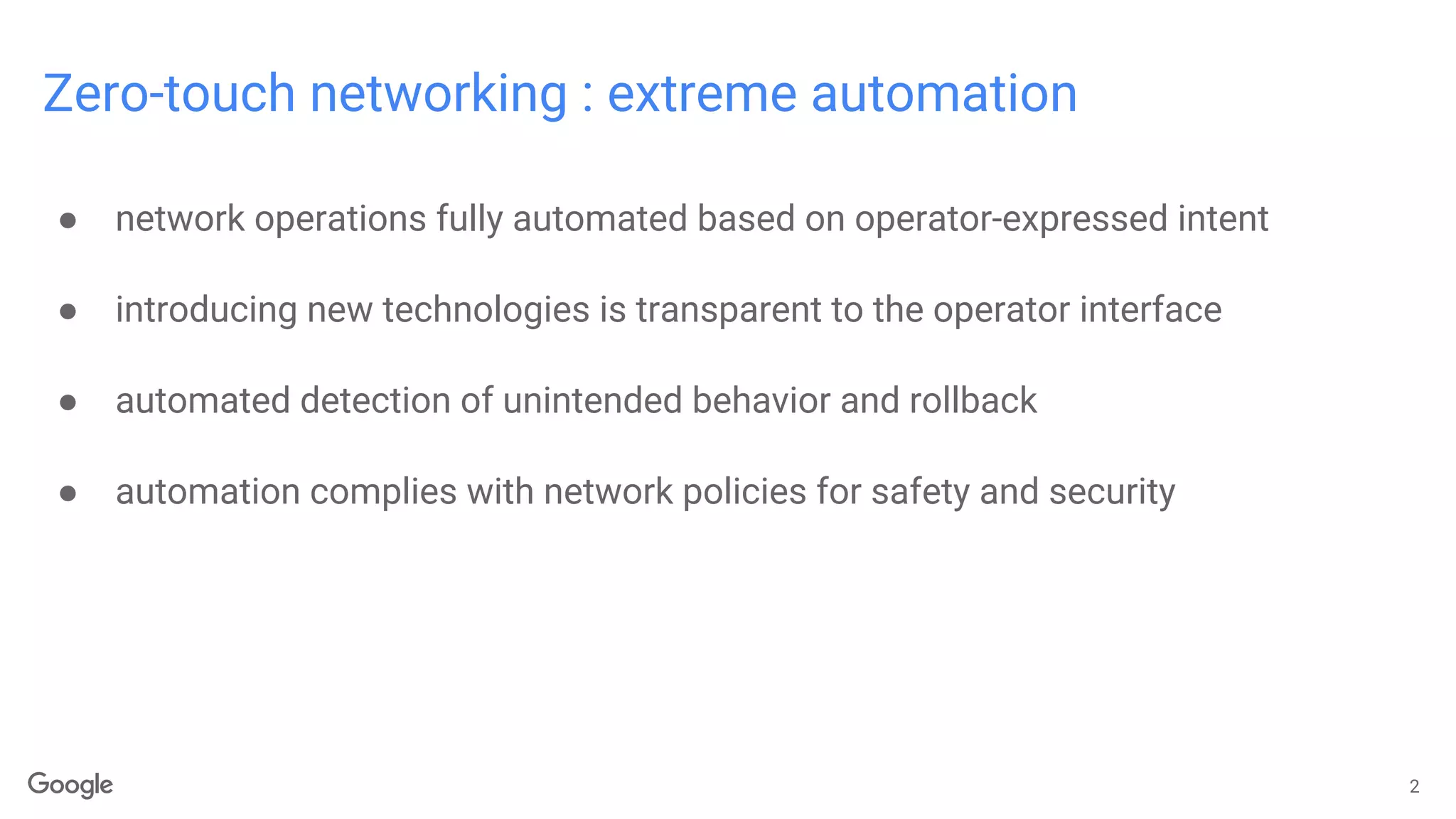
● network operations fully automated based on operator-expressed intent
● introducing new technologies is transparent to the operator interface
● automated detection of unintended behavior and rollback
● automation complies with network policies for safety and security
Network automation has come a long way ...
3
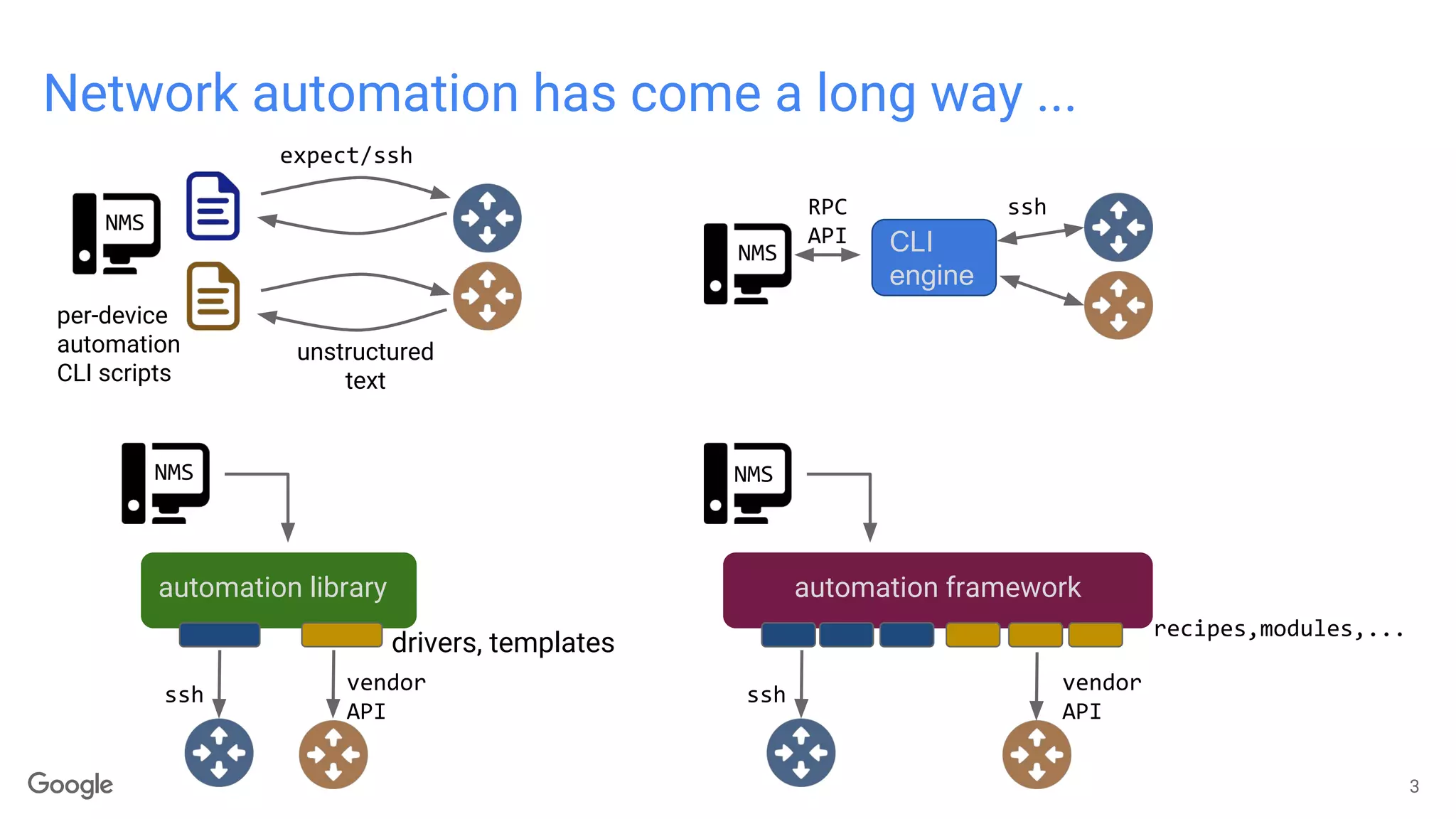
per-device
automation
CLI scripts
expect/ssh
unstructured
text
NMS
CLI
engine
sshRPC
API
NMS
automation library
drivers, templates
ssh
vendor
API
NMS
automation framework
ssh
vendor
API
recipes,modules,...
NMS
… but still work to do
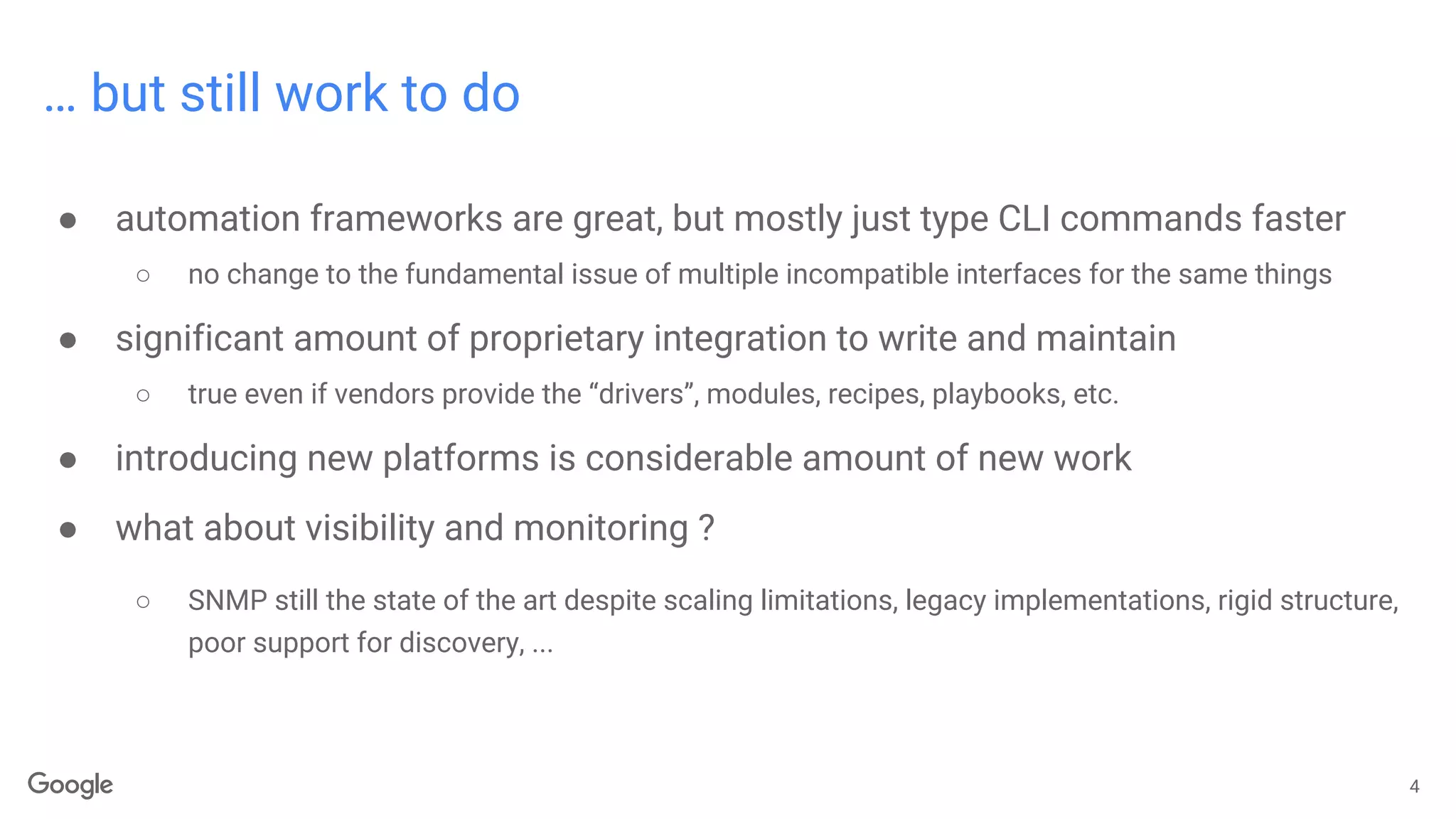
● automation frameworks are great, but mostly just type CLI commands faster
○ no change to the fundamental issue of multiple incompatible interfaces for the same things
● significant amount of proprietary integration to write and maintain
○ true even if vendors provide the “drivers”, modules, recipes, playbooks, etc.
● introducing new platforms is considerable amount of new work
● what about visibility and monitoring ?
○ SNMP still the state of the art despite scaling limitations, legacy implementations, rigid structure,
poor support for discovery, ...
4
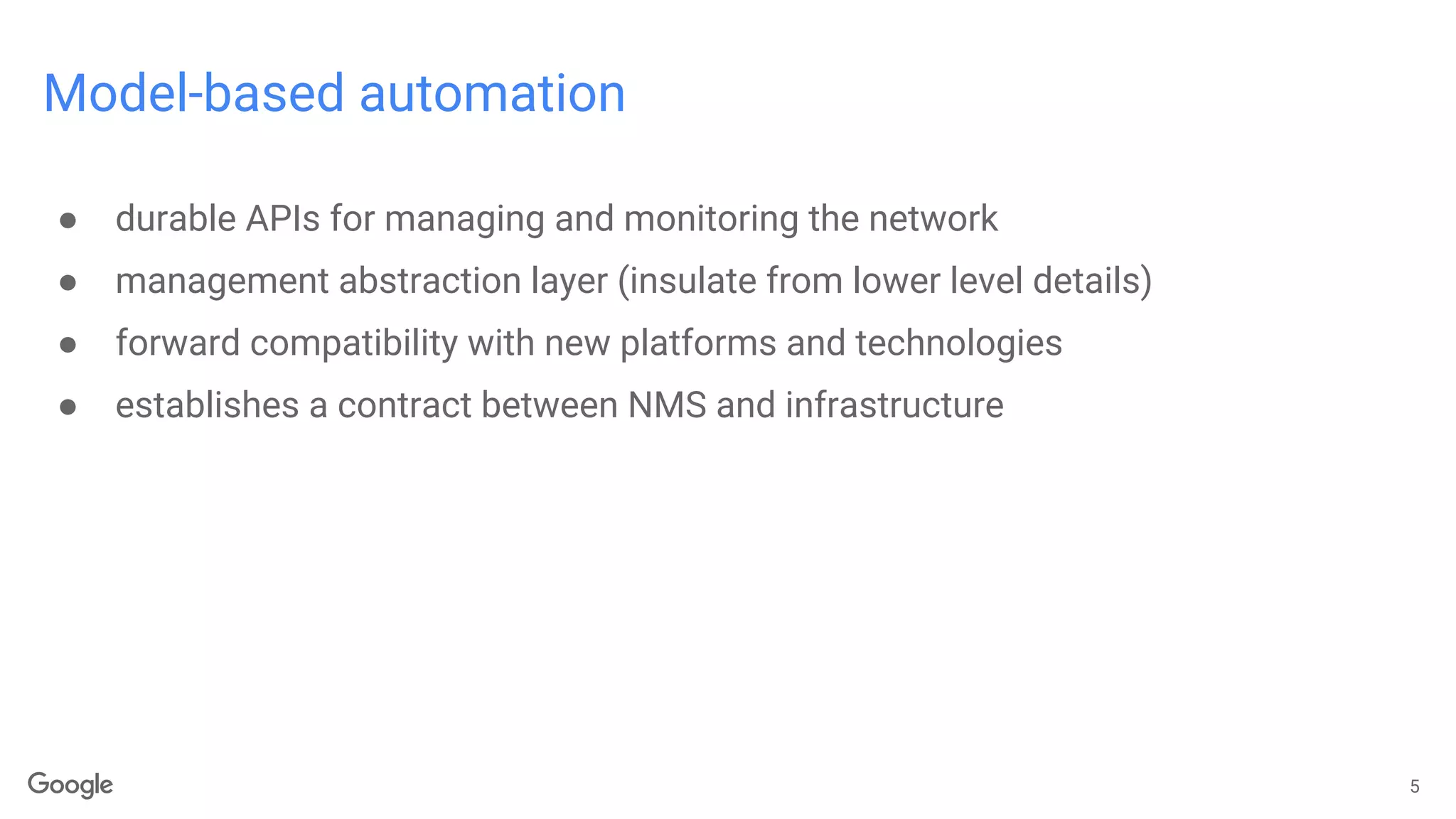
Model-based automation
5
● durable APIs for managing and monitoring the network
● management abstraction layer (insulate from lower level details)
● forward compatibility with new platforms and technologies
● establishes a contract between NMS and infrastructure
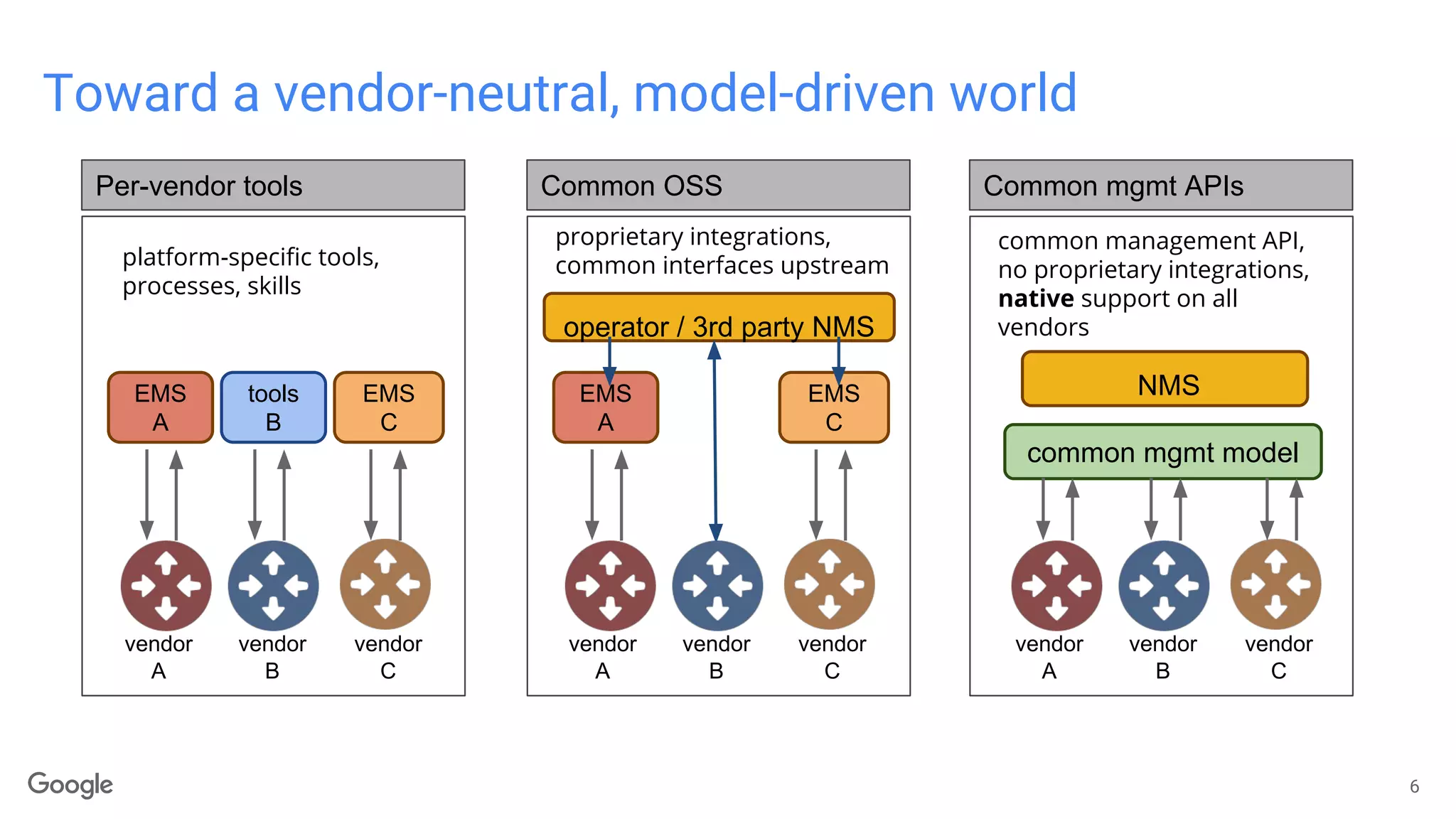
Toward a vendor-neutral, model-driven world
6
Per-vendor tools
EMS
A
platform-specific tools,
processes, skills
tools
B
EMS
C
vendor
A
vendor
B
vendor
C
Common OSS
EMS
A
proprietary integrations,
common interfaces upstream
EMS
C
operator / 3rd party NMS
vendor
A
vendor
B
vendor
C
Common mgmt APIs
common mgmt model
common management API,
no proprietary integrations,
native support on all
vendors
vendor
A
vendor
B
vendor
C
NMS
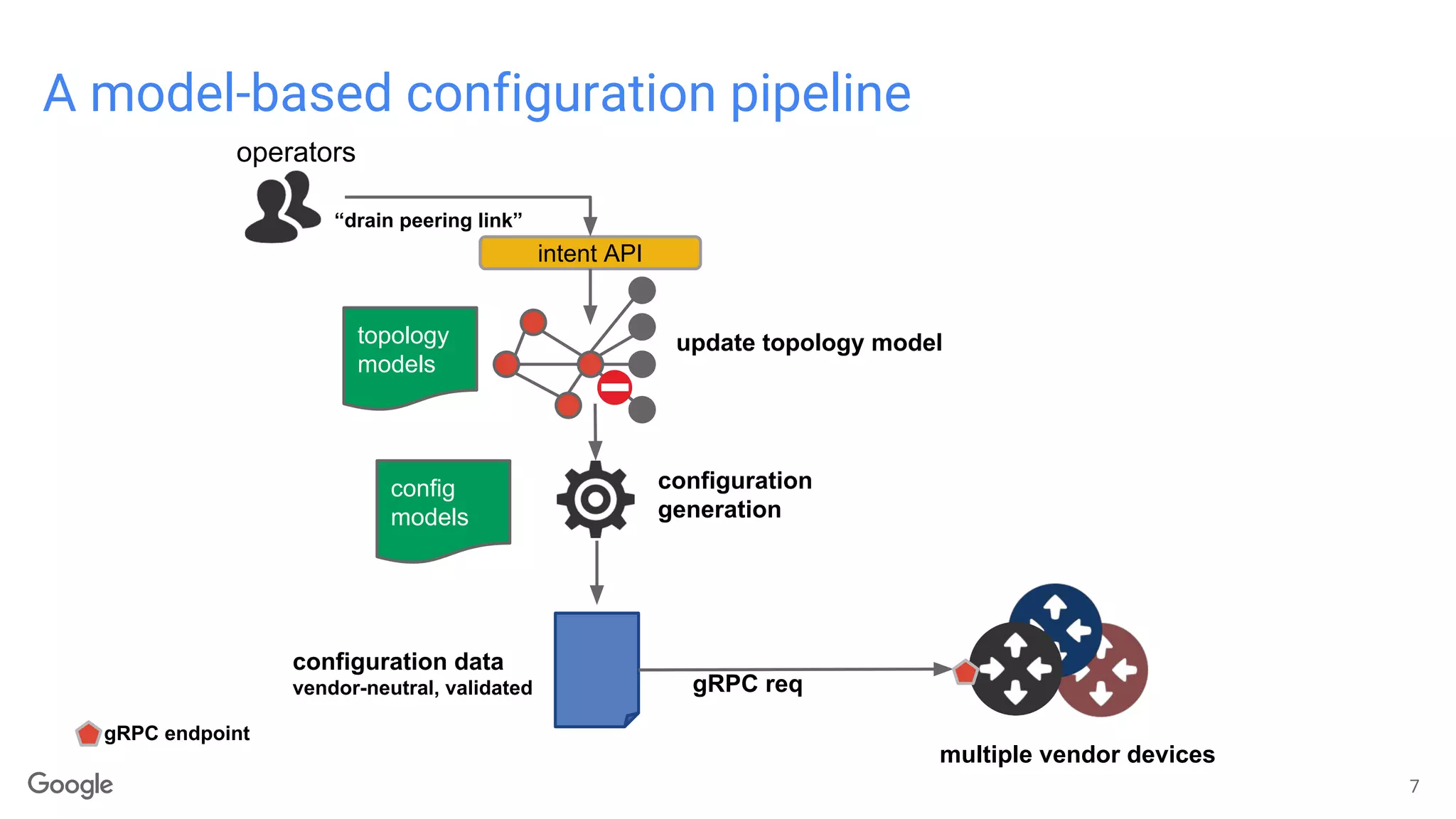
A model-based configuration pipeline
7
configuration data
vendor-neutral, validated
operators
intent API
“drain peering link”
update topology modeltopology
models
config
models
configuration
generation
multiple vendor devices
gRPC req
gRPC endpoint
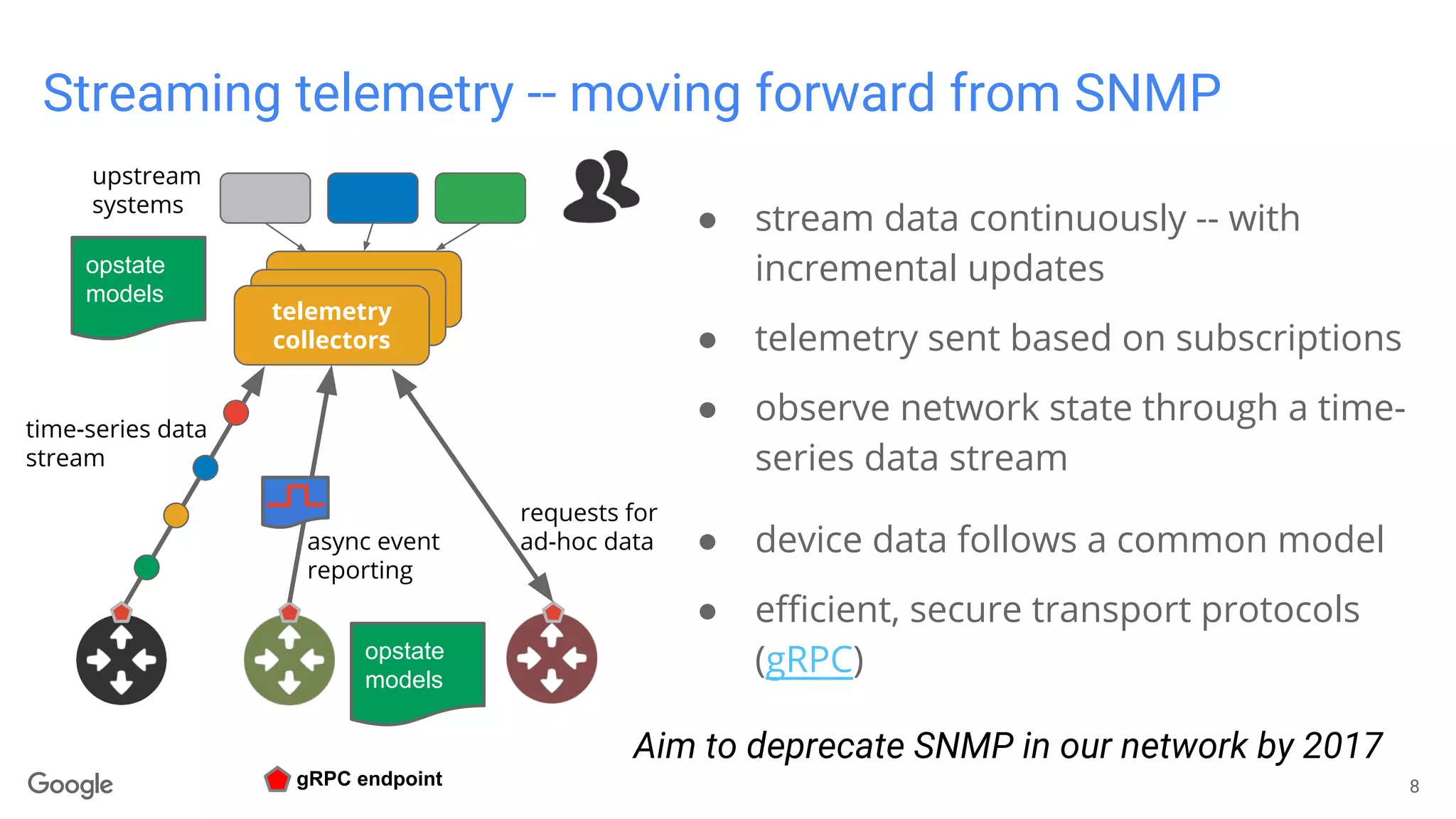
Streaming telemetry -- moving forward from SNMP
● stream data continuously -- with
incremental updates
● telemetry sent based on subscriptions
● observe network state through a time-
series data stream
● device data follows a common model
● efficient, secure transport protocols
(gRPC)
8gRPC endpoint
telemetry
collectors
upstream
systems
time-series data
stream
async event
reporting
requests for
ad-hoc data
Aim to deprecate SNMP in our network by 2017
opstate
models
opstate
models
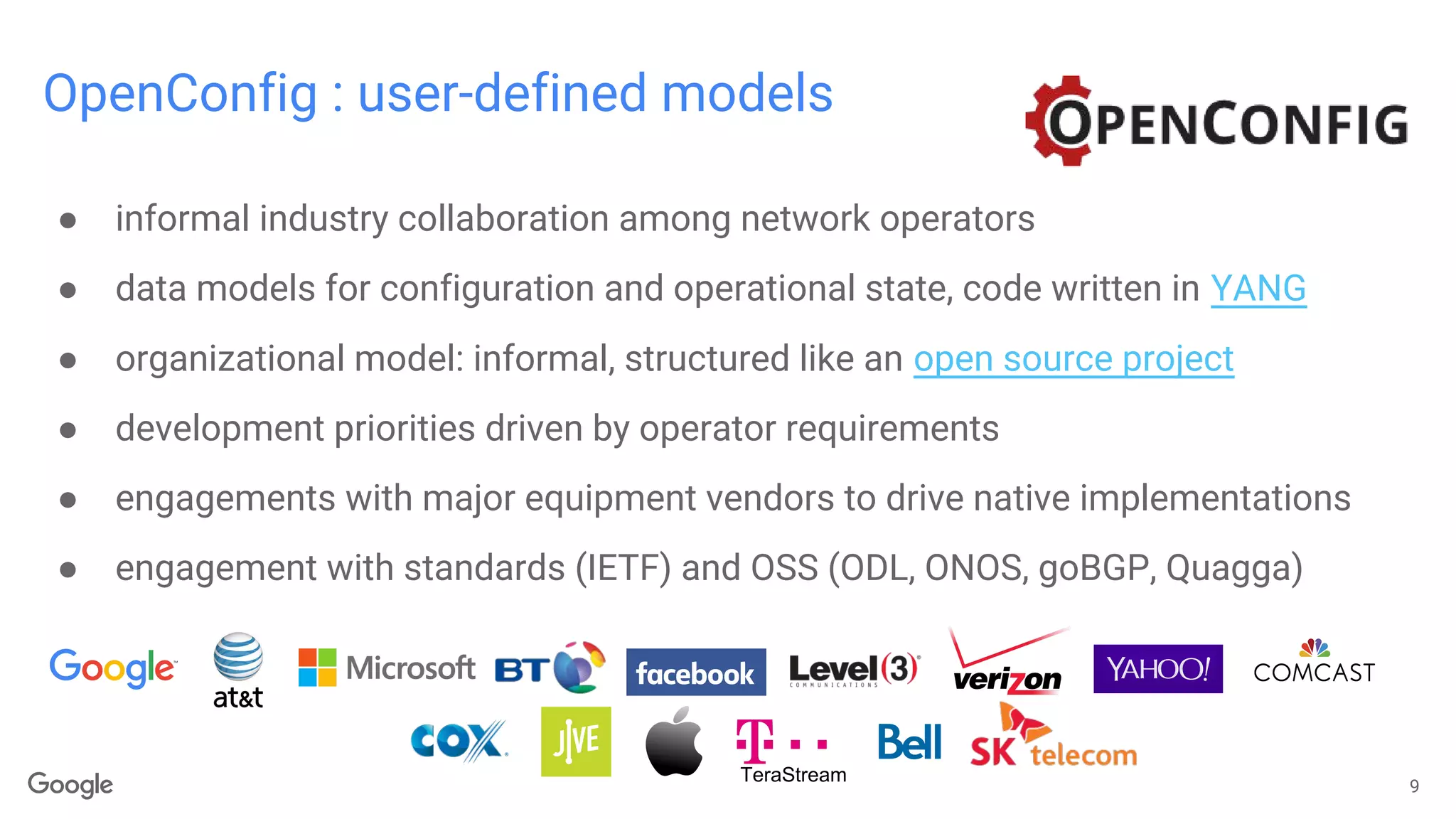
OpenConfig : user-defined models
9
● informal industry collaboration among network operators
● data models for configuration and operational state, code written in YANG
● organizational model: informal, structured like an open source project
● development priorities driven by operator requirements
● engagements with major equipment vendors to drive native implementations
● engagement with standards (IETF) and OSS (ODL, ONOS, goBGP, Quagga)
TeraStream
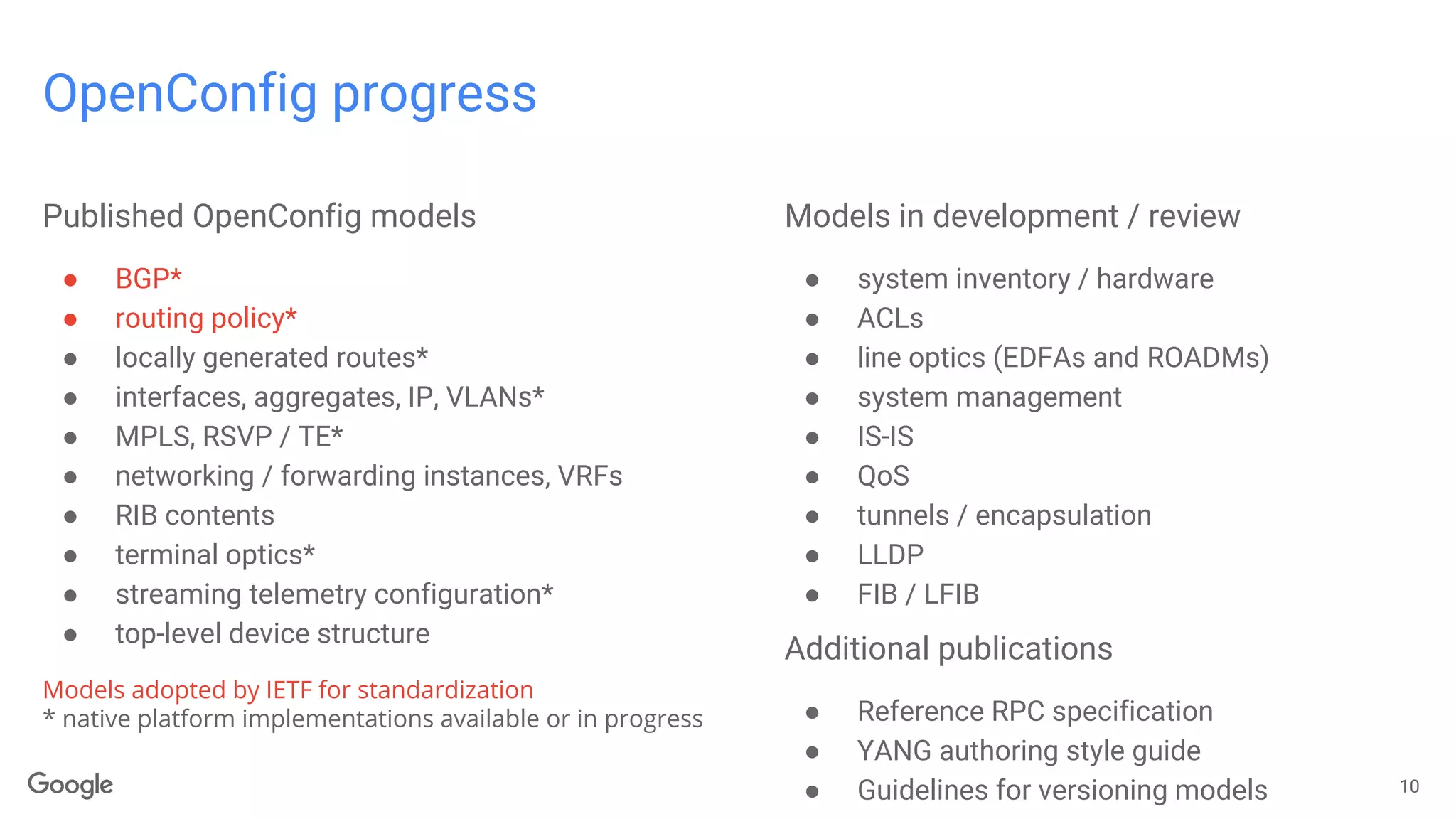
OpenConfig progress
10
Published OpenConfig models
● BGP*
● routing policy*
● locally generated routes*
● interfaces, aggregates, IP, VLANs*
● MPLS, RSVP / TE*
● networking / forwarding instances, VRFs
● RIB contents
● terminal optics*
● streaming telemetry configuration*
● top-level device structure
Models adopted by IETF for standardization
* native platform implementations available or in progress
Models in development / review
● system inventory / hardware
● ACLs
● line optics (EDFAs and ROADMs)
● system management
● IS-IS
● QoS
● tunnels / encapsulation
● LLDP
● FIB / LFIB
Additional publications
● Reference RPC specification
● YANG authoring style guide
● Guidelines for versioning models
Models structured for observing network behavior
11
+--rw interface* [name]
+--rw config
| +--rw type
| +--rw mtu?
| +--rw name?
| +--rw description?
| +--rw enabled?
+--ro state
| +--ro type
| +--ro mtu?
| +--ro name?
| +--ro description?
| +--ro enabled?
| +--ro oper-status
| +--ro last-change?
| +--ro counters
| +--ro in-octets?
| +--ro in-unicast-pkts?
| +--ro in-broadcast-pkts?
| +--ro in-multicast-pkts?
| +--ro in-discards?
| +--ro in-errors?
| +--ro in-unknown-protos?
| +--ro out-octets?
opstate = applied configuration + derived stated (counters, etc.)
data models structured to ease programmatic access to
related operational state
opstate has deterministic, explicit location in the model paths
common data model
NMS
intendedv.appliedconfig
NMS acts on streaming view of
state
quickly determine discrepancy
between intended and applied
configuration
code to exploit this pattern in
multiple operators
OSS stack for model-based programmatic configuration
OpenConfig
models
pyang
pyangbind
python class
bindings
vendor
A
vendor
B
vendor
C
template-based
translations
12
validated, vendor-neutral object representation
bgp.global.as = 15169
bgp.neighbors.neighbor.add(neighbor_addr=124.25.2.1”)
...
interfaces.interface.add("eth0")
eth0 = src_ocif.interfaces.interface["eth0"]
eth0.config.enabled = True
eth0.ethernet.config.duplex_mode = "FULL"
eth0.ethernet.config.auto_negotiate = True
config DB
vendor
A
vendor
B
vendor
C
pybindJSON.dumps(bgp.neighbors)
pybindJSON.dumps(interfaces)
gRPC /
RESTCONF
vendor neutral
data collector
(fluentd)
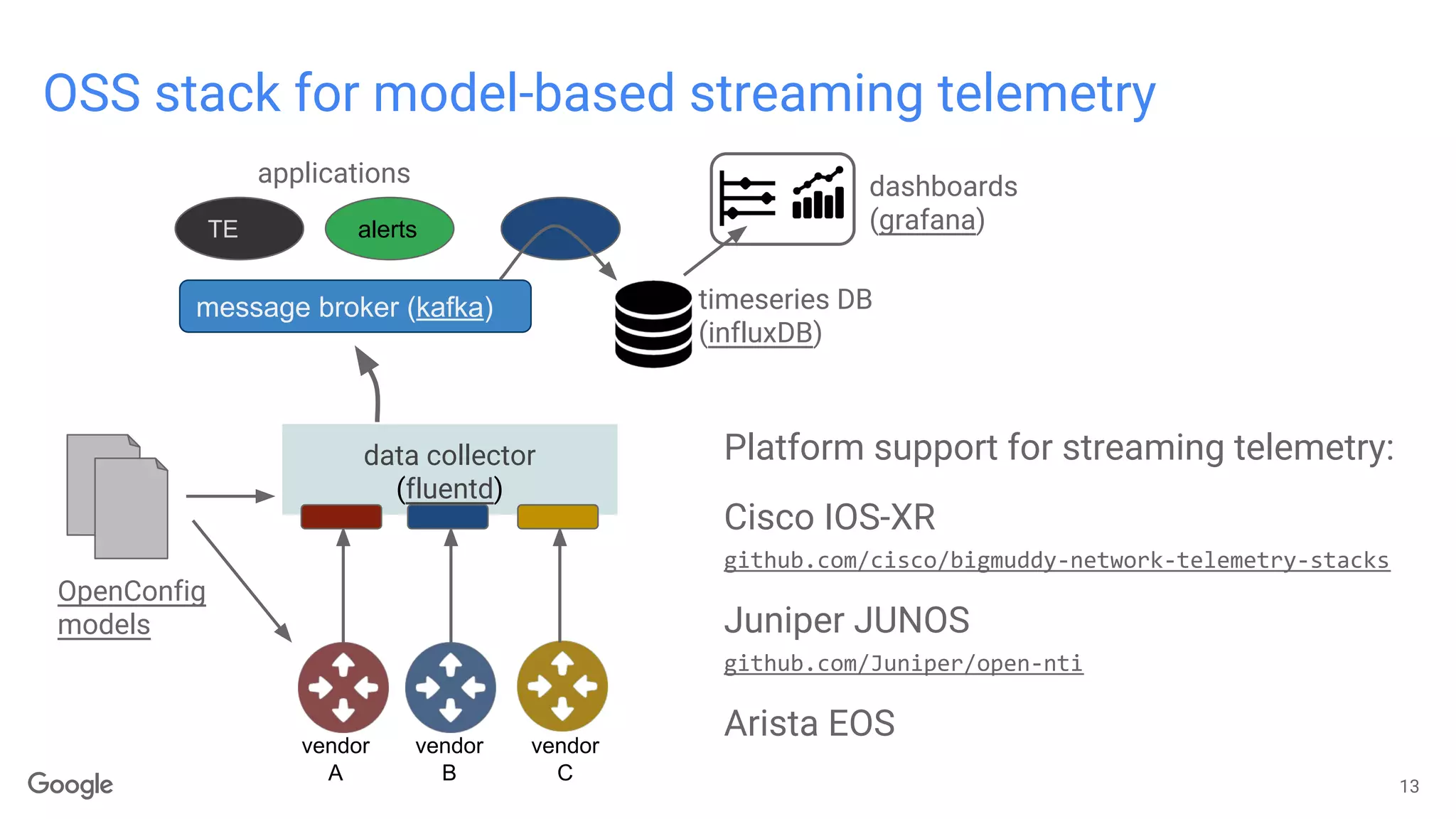
OSS stack for model-based streaming telemetry
Platform support for streaming telemetry:
Cisco IOS-XR
github.com/cisco/bigmuddy-network-telemetry-stacks
Juniper JUNOS
github.com/Juniper/open-nti
Arista EOSvendor
A
vendor
B
vendor
C
message broker (kafka)
TE alerts
applications
13
timeseries DB
(influxDB)
dashboards
(grafana)
OpenConfig
models
Challenges in thinking “model-driven”
CLI habits are hard to break
implementations are often very different (occasionally for a good reason)
models for machines or humans
what to leave out of the model
how to test for compliance by an implementation
14
Summary
Models are critical for providing abstraction, durable APIs, and tractable
checkability
topology, configuration, operational state, safety/security
OpenConfig operator group is developing and publishing data models for config
and opstate -- built by users for users
as native implementations become available, OpenConfig will dramatically
reduce proprietary integrations and simplify network telemetry, configuration,
and qualifications processes
15

Model-driven Network Automation

  • 1.
    Model-driven network automation AneesShaikh, Josh George on behalf of Google Network Operations 2016 DevOps Networking Forum
  • 2.
    Zero-touch networking :extreme automation 2 ● network operations fully automated based on operator-expressed intent ● introducing new technologies is transparent to the operator interface ● automated detection of unintended behavior and rollback ● automation complies with network policies for safety and security
  • 3.
    Network automation hascome a long way ... 3 per-device automation CLI scripts expect/ssh unstructured text NMS CLI engine sshRPC API NMS automation library drivers, templates ssh vendor API NMS automation framework ssh vendor API recipes,modules,... NMS
  • 4.
    … but stillwork to do ● automation frameworks are great, but mostly just type CLI commands faster ○ no change to the fundamental issue of multiple incompatible interfaces for the same things ● significant amount of proprietary integration to write and maintain ○ true even if vendors provide the “drivers”, modules, recipes, playbooks, etc. ● introducing new platforms is considerable amount of new work ● what about visibility and monitoring ? ○ SNMP still the state of the art despite scaling limitations, legacy implementations, rigid structure, poor support for discovery, ... 4
  • 5.
    Model-based automation 5 ● durableAPIs for managing and monitoring the network ● management abstraction layer (insulate from lower level details) ● forward compatibility with new platforms and technologies ● establishes a contract between NMS and infrastructure
  • 6.
    Toward a vendor-neutral,model-driven world 6 Per-vendor tools EMS A platform-specific tools, processes, skills tools B EMS C vendor A vendor B vendor C Common OSS EMS A proprietary integrations, common interfaces upstream EMS C operator / 3rd party NMS vendor A vendor B vendor C Common mgmt APIs common mgmt model common management API, no proprietary integrations, native support on all vendors vendor A vendor B vendor C NMS
  • 7.
    A model-based configurationpipeline 7 configuration data vendor-neutral, validated operators intent API “drain peering link” update topology modeltopology models config models configuration generation multiple vendor devices gRPC req gRPC endpoint
  • 8.
    Streaming telemetry --moving forward from SNMP ● stream data continuously -- with incremental updates ● telemetry sent based on subscriptions ● observe network state through a time- series data stream ● device data follows a common model ● efficient, secure transport protocols (gRPC) 8gRPC endpoint telemetry collectors upstream systems time-series data stream async event reporting requests for ad-hoc data Aim to deprecate SNMP in our network by 2017 opstate models opstate models
  • 9.
    OpenConfig : user-definedmodels 9 ● informal industry collaboration among network operators ● data models for configuration and operational state, code written in YANG ● organizational model: informal, structured like an open source project ● development priorities driven by operator requirements ● engagements with major equipment vendors to drive native implementations ● engagement with standards (IETF) and OSS (ODL, ONOS, goBGP, Quagga) TeraStream
  • 10.
    OpenConfig progress 10 Published OpenConfigmodels ● BGP* ● routing policy* ● locally generated routes* ● interfaces, aggregates, IP, VLANs* ● MPLS, RSVP / TE* ● networking / forwarding instances, VRFs ● RIB contents ● terminal optics* ● streaming telemetry configuration* ● top-level device structure Models adopted by IETF for standardization * native platform implementations available or in progress Models in development / review ● system inventory / hardware ● ACLs ● line optics (EDFAs and ROADMs) ● system management ● IS-IS ● QoS ● tunnels / encapsulation ● LLDP ● FIB / LFIB Additional publications ● Reference RPC specification ● YANG authoring style guide ● Guidelines for versioning models
  • 11.
    Models structured forobserving network behavior 11 +--rw interface* [name] +--rw config | +--rw type | +--rw mtu? | +--rw name? | +--rw description? | +--rw enabled? +--ro state | +--ro type | +--ro mtu? | +--ro name? | +--ro description? | +--ro enabled? | +--ro oper-status | +--ro last-change? | +--ro counters | +--ro in-octets? | +--ro in-unicast-pkts? | +--ro in-broadcast-pkts? | +--ro in-multicast-pkts? | +--ro in-discards? | +--ro in-errors? | +--ro in-unknown-protos? | +--ro out-octets? opstate = applied configuration + derived stated (counters, etc.) data models structured to ease programmatic access to related operational state opstate has deterministic, explicit location in the model paths common data model NMS intendedv.appliedconfig NMS acts on streaming view of state quickly determine discrepancy between intended and applied configuration code to exploit this pattern in multiple operators
  • 12.
    OSS stack formodel-based programmatic configuration OpenConfig models pyang pyangbind python class bindings vendor A vendor B vendor C template-based translations 12 validated, vendor-neutral object representation bgp.global.as = 15169 bgp.neighbors.neighbor.add(neighbor_addr=124.25.2.1”) ... interfaces.interface.add("eth0") eth0 = src_ocif.interfaces.interface["eth0"] eth0.config.enabled = True eth0.ethernet.config.duplex_mode = "FULL" eth0.ethernet.config.auto_negotiate = True config DB vendor A vendor B vendor C pybindJSON.dumps(bgp.neighbors) pybindJSON.dumps(interfaces) gRPC / RESTCONF vendor neutral
  • 13.
    data collector (fluentd) OSS stackfor model-based streaming telemetry Platform support for streaming telemetry: Cisco IOS-XR github.com/cisco/bigmuddy-network-telemetry-stacks Juniper JUNOS github.com/Juniper/open-nti Arista EOSvendor A vendor B vendor C message broker (kafka) TE alerts applications 13 timeseries DB (influxDB) dashboards (grafana) OpenConfig models
  • 14.
    Challenges in thinking“model-driven” CLI habits are hard to break implementations are often very different (occasionally for a good reason) models for machines or humans what to leave out of the model how to test for compliance by an implementation 14
  • 15.
    Summary Models are criticalfor providing abstraction, durable APIs, and tractable checkability topology, configuration, operational state, safety/security OpenConfig operator group is developing and publishing data models for config and opstate -- built by users for users as native implementations become available, OpenConfig will dramatically reduce proprietary integrations and simplify network telemetry, configuration, and qualifications processes 15