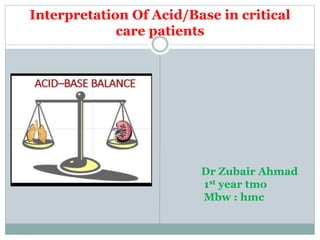
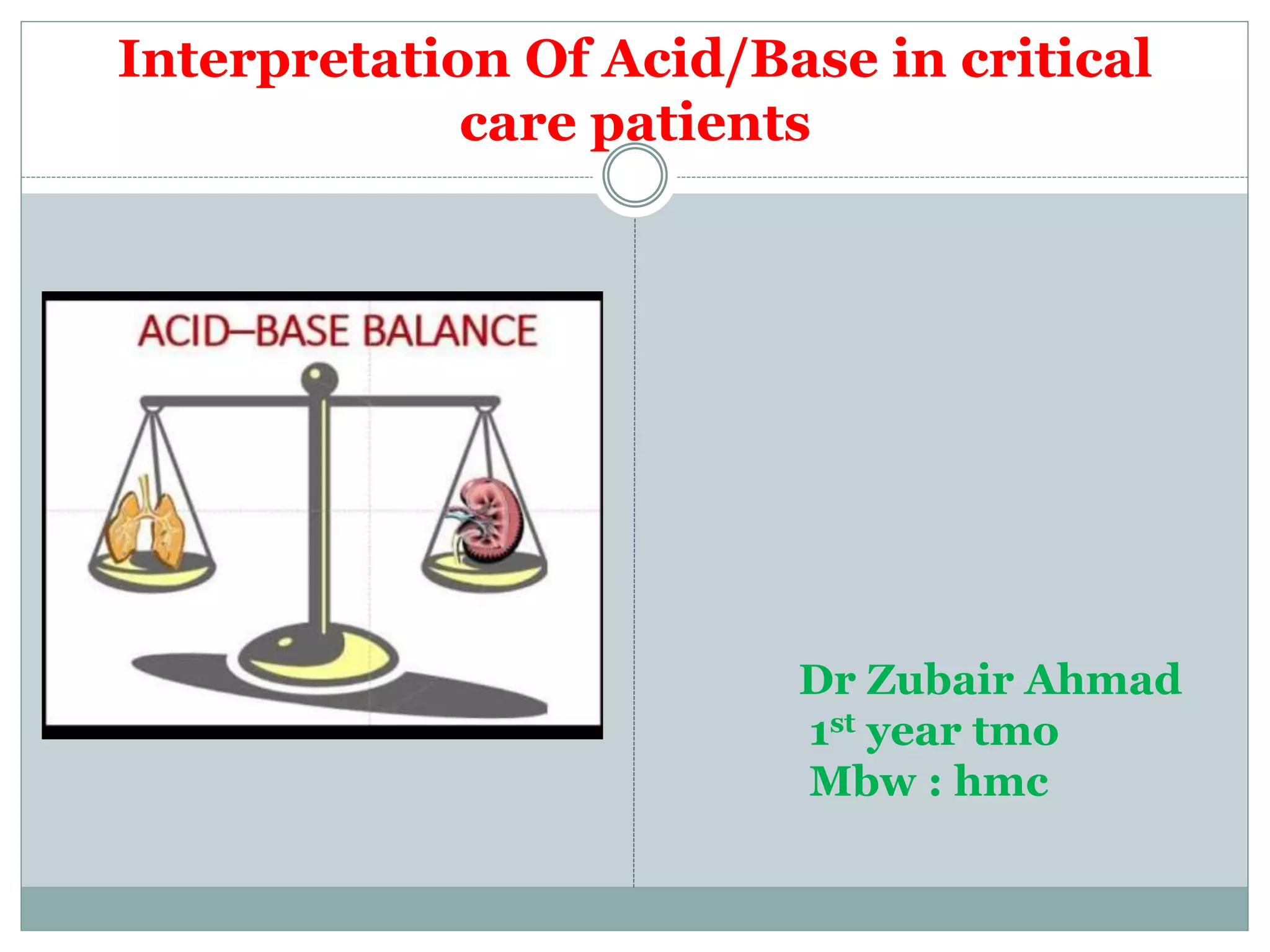
Interpretation Of Acid/Base in critical
care patients
Dr Zubair Ahmad
1st year tmo
Mbw : hmc
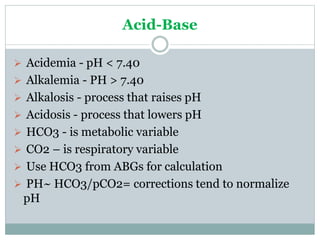
Acid-Base
 Acidemia - pH < 7.40
 Alkalemia - PH > 7.40
 Alkalosis - process that raises pH
 Acidosis - process that lowers pH
 HCO3 - is metabolic variable
 CO2 – is respiratory variable
 Use HCO3 from ABGs for calculation
 PH~ HCO3/pCO2= corrections tend to normalize
pH
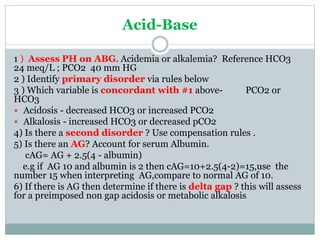
Acid-Base
1 ) Assess PH on ABG. Acidemia or alkalemia? Reference HCO3
24 meq/L ; PCO2 40 mm HG
2 ) Identify primary disorder via rules below
3 ) Which variable is concordant with #1 above- PCO2 or
HCO3
 Acidosis - decreased HCO3 or increased PCO2
 Alkalosis - increased HCO3 or decreased pCO2
4) Is there a second disorder ? Use compensation rules .
5) Is there an AG? Account for serum Albumin.
cAG= AG + 2.5(4 - albumin)
e.g if AG 10 and albumin is 2 then cAG=10+2.5(4-2)=15,use the
number 15 when interpreting AG,compare to normal AG of 10.
6) If there is AG then determine if there is delta gap ? this will assess
for a preimposed non gap acidosis or metabolic alkalosis
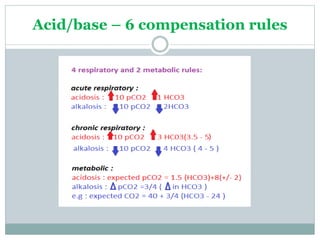
Acid/base – 6 compensation rules
Acid/base
 Ph = 7.26
HCO3 = 10
 PCO2 = 23
 Acidemia or alkalemia?
ACIDEMIA (Ph 7.26 is acidemic )
 Is HCO3 or pCO2 concordant? HCO3 moves in the
acidotic direction and is therefore concordant with
the acidemia
 HCO3 is the metabolic variable
 Dx : metobolic acidosis
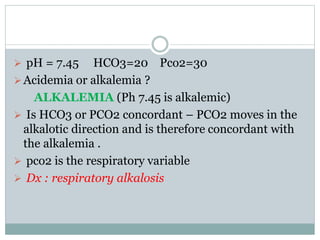
 pH = 7.45 HCO3=20 Pco2=30
Acidemia or alkalemia ?
ALKALEMIA (Ph 7.45 is alkalemic)
 Is HCO3 or PCO2 concordant – PCO2 moves in the
alkalotic direction and is therefore concordant with
the alkalemia .
 pco2 is the respiratory variable
 Dx : respiratory alkalosis
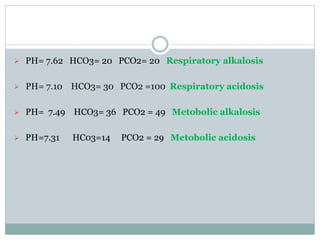
 PH= 7.62 HCO3= 20 PCO2= 20 Respiratory alkalosis
 PH= 7.10 HCO3= 30 PCO2 =100 Respiratory acidosis
 PH= 7.49 HCO3= 36 PCO2 = 49 Metobolic alkalosis
 PH=7.31 HC03=14 PCO2 = 29 Metobolic acidosis
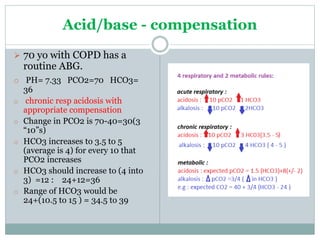
Acid/base - compensation
 70 yo with COPD has a
routine ABG.
o PH= 7.33 PCO2=70 HCO3=
36
o chronic resp acidosis with
appropriate compensation
o Change in PCO2 is 70-40=30(3
“10”s)
o HCO3 increases to 3.5 to 5
(average is 4) for every 10 that
PCO2 increases
o HCO3 should increase to (4 into
3) =12 : 24+12=36
o Range of HCO3 would be
24+(10.5 to 15 ) = 34.5 to 39
Acid/base - compensation
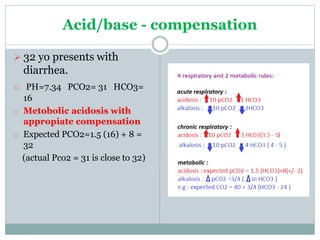
 32 yo presents with
diarrhea.
o PH=7.34 PCO2= 31 HCO3=
16
o Metobolic acidosis with
appropiate compensation
o Expected PCO2=1.5 (16) + 8 =
32
(actual Pco2 = 31 is close to 32)
Acid/base - compensation
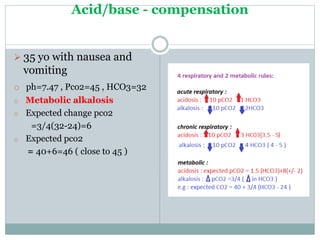
 35 yo with nausea and
vomiting
o ph=7.47 , Pco2=45 , HCO3=32
o Metabolic alkalosis
o Expected change pco2
=3/4(32-24)=6
o Expected pco2
= 40+6=46 ( close to 45 )
Acid/base - compensation
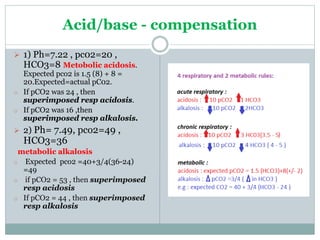
 1) Ph=7.22 , pc02=20 ,
HCO3=8 Metobolic acidosis.
Expected pco2 is 1.5 (8) + 8 =
20.Expected=actual pC02.
o If pCO2 was 24 , then
superimposed resp acidosis.
o If pCO2 was 16 ,then
superimposed resp alkalosis.
 2) Ph= 7.49, pco2=49 ,
HCO3=36
metabolic alkalosis
o Expected pco2 =40+3/4(36-24)
=49
o if pCO2 = 53 , then superimposed
resp acidosis
o If pCO2 = 44 , then superimposed
resp alkalosis
Acid/base - compensation
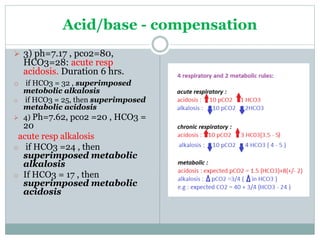
 3) ph=7.17 , pco2=80,
HCO3=28: acute resp
acidosis. Duration 6 hrs.
o if HCO3 = 32 , superimposed
metobolic alkalosis
o if HCO3 = 25, then superimposed
metabolic acidosis
 4) Ph=7.62, pco2 =20 , HCO3 =
20
acute resp alkalosis
o if HCO3 =24 , then
superimposed metabolic
alkalosis
o If HCO3 = 17 , then
superimposed metabolic
acidosis
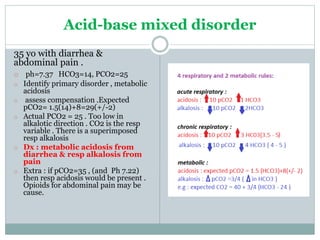
Acid-base mixed disorder
35 yo with diarrhea &
abdominal pain .
o ph=7.37 HCO3=14, PCO2=25
o Identify primary disorder , metabolic
acidosis
o assess compensation .Expected
pCO2= 1.5(14)+8=29(+/-2)
o Actual PCO2 = 25 . Too low in
alkalotic direction . CO2 is the resp
variable . There is a superimposed
resp alkalosis
o Dx : metabolic acidosis from
diarrhea & resp alkalosis from
pain
o Extra : if pCO2=35 , (and Ph 7.22)
then resp acidosis would be present .
Opioids for abdominal pain may be
cause.
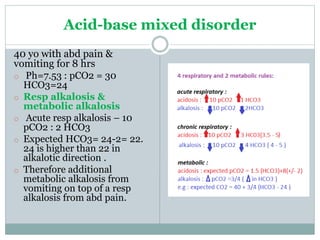
Acid-base mixed disorder
40 yo with abd pain &
vomiting for 8 hrs
o Ph=7.53 : pCO2 = 30
HCO3=24
o Resp alkalosis &
metabolic alkalosis
o Acute resp alkalosis – 10
pCO2 : 2 HCO3
o Expected HCO3= 24-2= 22.
24 is higher than 22 in
alkalotic direction .
o Therefore additional
metabolic alkalosis from
vomiting on top of a resp
alkalosis from abd pain.
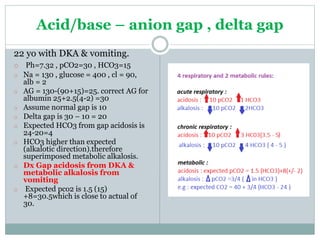
Acid/base – anion gap , delta gap
22 yo with DKA & vomiting.
o Ph=7.32 , pCO2=30 , HCO3=15
o Na = 130 , glucose = 400 , cl = 90,
alb = 2
o AG = 130-(90+15)=25. correct AG for
albumin 25+2.5(4-2) =30
o Assume normal gap is 10
o Delta gap is 30 – 10 = 20
o Expected HCO3 from gap acidosis is
24-20=4
o HCO3 higher than expected
(alkalotic direction).therefore
superimposed metabolic alkalosis.
o Dx Gap acidosis from DKA &
metabolic alkalosis from
vomiting
o Expected pco2 is 1.5 (15)
+8=30.5which is close to actual of
30.
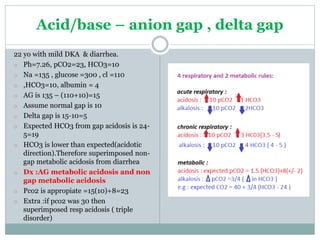
Acid/base – anion gap , delta gap
22 yo with mild DKA & diarrhea.
o Ph=7.26, pCO2=23, HCO3=10
o Na =135 , glucose =300 , cl =110
o ,HCO3=10, albumin = 4
o AG is 135 – (110+10)=15
o Assume normal gap is 10
o Delta gap is 15-10=5
o Expected HCO3 from gap acidosis is 24-
5=19
o HCO3 is lower than expected(acidotic
direction).Therefore superimposed non-
gap metabolic acidosis from diarrhea
o Dx :AG metabolic acidosis and non
gap metabolic acidosis
o Pco2 is appropiate =15(10)+8=23
o Extra :if pco2 was 30 then
superimposed resp acidosis ( triple
disorder)
Acid/base
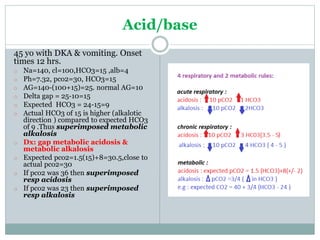
45 yo with DKA & vomiting. Onset
times 12 hrs.
o Na=140, cl=100,HCO3=15 ,alb=4
o Ph=7.32, pco2=30, HCO3=15
o AG=140-(100+15)=25. normal AG=10
o Delta gap = 25-10=15
o Expected HCO3 = 24-15=9
o Actual HCO3 of 15 is higher (alkalotic
direction ) compared to expected HCO3
of 9 .Thus superimposed metabolic
alkalosis
o Dx: gap metabolic acidosis &
metabolic alkalosis
o Expected pco2=1.5(15)+8=30.5,close to
actual pco2=30
o If pco2 was 36 then superimposed
resp acidosis
o If pco2 was 23 then superimposed
resp alkalosis
Acid/base
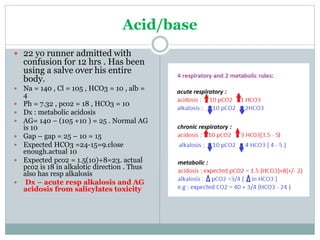
 22 yo runner admitted with
confusion for 12 hrs . Has been
using a salve over his entire
body.
 Na = 140 , Cl = 105 , HCO3 = 10 , alb =
4
 Ph = 7.32 , pco2 = 18 , HCO3 = 10
 Dx : metabolic acidosis
 AG= 140 – (105 +10 ) = 25 . Normal AG
is 10
 Gap – gap = 25 – 10 = 15
 Expected HCO3 =24-15=9.close
enough.actual 10
 Expected pco2 = 1.5(10)+8=23. actual
pco2 is 18 in alkalotic direction . Thus
also has resp alkalosis
 Dx – acute resp alkalosis and AG
acidosis from salicylates toxicity
Acid/base
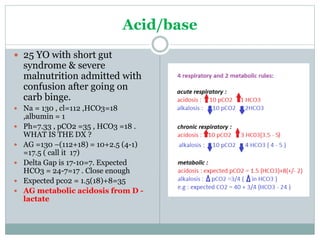
 25 YO with short gut
syndrome & severe
malnutrition admitted with
confusion after going on
carb binge.
 Na = 130 , cl=112 ,HCO3=18
,albumin = 1
 Ph=7.33 , pCO2 =35 , HCO3 =18 .
WHAT IS THE DX ?
 AG =130 –(112+18) = 10+2.5 (4-1)
=17.5 ( call it 17)
 Delta Gap is 17-10=7. Expected
HCO3 = 24-7=17 . Close enough
 Expected pco2 = 1.5(18)+8=35
 AG metabolic acidosis from D -
lactate
Importance of history and physical
examination in determining the cause
 Case — Determining the appropriate compensatory response
may be more difficult with respiratory acid-base disorders
because compensatory responses differ in acute and chronic
disturbances. Consider a patient with the following arterial
blood values: pH 7.27, PCO2 70 mmHg (9.3 kPa), and HCO3
31 mEq/L. The low pH and hypercapnia indicate that the
patient has respiratory acidosis. If this patient has acute
hypercapnia, then the 30 mmHg (4 kPa) rise in PCO2 should
increase the serum HCO3 concentration by approximately 3
mEq/L (to approximately 27 mEq/L). If this patient has
chronic hypercapnia, the serum HCO3 should increase by
approximately 12 mEq/L (to approximately 36 mEq/L). The
observed value of 31 mEq/L is between these expected levels
and could have multiple explanations, including:.
Chronic respiratory acidosis with a superimposed
metabolic acidosis that has reduced the serum HCO3
from 36 to 31 mEq/L. This might occur in a patient
with chronic obstructive pulmonary disease who
developed diarrhea due to viral gastroenteritis or
lactic acidosis from sepsis.
Acute respiratory acidosis with a superimposed
metabolic alkalosis that has increased the HCO3
from 27 to 31 mEq/L. This could occur in a patient
with respiratory depression due to a sedating drug
who also developed vomiting or was taking diuretics.
Acute respiratory acidosis superimposed on mild
chronic respiratory acidosis. Suppose, for example,
that a patient has chronic respiratory acidosis with a
PCO2 of 55 mmHg (7.3 kPa) and an appropriate
serum HCO3 of 30 mEq/L. The patient then
develops pneumonia, which acutely causes a further
increase in the PCO2 to 70 mmHg (9.3 kPa). The
serum HCO3 would rise further to approximately 31
mEq/L.
 Acute respiratory acidosis that is evolving into a chronic
disorder (between one and three days). Thus, the correct
diagnosis in a primary respiratory acid-base disorder can
be established only when correlated with the patient's
history and physical examination. This is true even when
the arterial blood values appear to represent a simple
disorder. If the serum HCO3 concentration had been 36
mEq/L in this example, the findings would have been
compatible with an uncomplicated chronic respiratory
acidosis. However, similar findings could have been
induced by acute respiratory acidosis plus metabolic
alkalosis. The history usually helps to distinguish among
the possibilities.
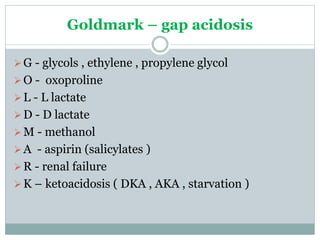
Goldmark – gap acidosis
G - glycols , ethylene , propylene glycol
O - oxoproline
L - L lactate
D - D lactate
M - methanol
A - aspirin (salicylates )
R - renal failure
K – ketoacidosis ( DKA , AKA , starvation )
Interpretation Of Acid-Base Balance

Interpretation Of Acid-Base Balance

  • 1.
    Interpretation Of Acid/Basein critical care patients Dr Zubair Ahmad 1st year tmo Mbw : hmc
  • 2.
    Acid-Base  Acidemia -pH < 7.40  Alkalemia - PH > 7.40  Alkalosis - process that raises pH  Acidosis - process that lowers pH  HCO3 - is metabolic variable  CO2 – is respiratory variable  Use HCO3 from ABGs for calculation  PH~ HCO3/pCO2= corrections tend to normalize pH
  • 3.
    Acid-Base 1 ) AssessPH on ABG. Acidemia or alkalemia? Reference HCO3 24 meq/L ; PCO2 40 mm HG 2 ) Identify primary disorder via rules below 3 ) Which variable is concordant with #1 above- PCO2 or HCO3  Acidosis - decreased HCO3 or increased PCO2  Alkalosis - increased HCO3 or decreased pCO2 4) Is there a second disorder ? Use compensation rules . 5) Is there an AG? Account for serum Albumin. cAG= AG + 2.5(4 - albumin) e.g if AG 10 and albumin is 2 then cAG=10+2.5(4-2)=15,use the number 15 when interpreting AG,compare to normal AG of 10. 6) If there is AG then determine if there is delta gap ? this will assess for a preimposed non gap acidosis or metabolic alkalosis
  • 4.
    Acid/base – 6compensation rules
  • 5.
    Acid/base  Ph =7.26 HCO3 = 10  PCO2 = 23  Acidemia or alkalemia? ACIDEMIA (Ph 7.26 is acidemic )  Is HCO3 or pCO2 concordant? HCO3 moves in the acidotic direction and is therefore concordant with the acidemia  HCO3 is the metabolic variable  Dx : metobolic acidosis
  • 6.
     pH =7.45 HCO3=20 Pco2=30 Acidemia or alkalemia ? ALKALEMIA (Ph 7.45 is alkalemic)  Is HCO3 or PCO2 concordant – PCO2 moves in the alkalotic direction and is therefore concordant with the alkalemia .  pco2 is the respiratory variable  Dx : respiratory alkalosis
  • 7.
     PH= 7.62HCO3= 20 PCO2= 20 Respiratory alkalosis  PH= 7.10 HCO3= 30 PCO2 =100 Respiratory acidosis  PH= 7.49 HCO3= 36 PCO2 = 49 Metobolic alkalosis  PH=7.31 HC03=14 PCO2 = 29 Metobolic acidosis
  • 8.
    Acid/base - compensation 70 yo with COPD has a routine ABG. o PH= 7.33 PCO2=70 HCO3= 36 o chronic resp acidosis with appropriate compensation o Change in PCO2 is 70-40=30(3 “10”s) o HCO3 increases to 3.5 to 5 (average is 4) for every 10 that PCO2 increases o HCO3 should increase to (4 into 3) =12 : 24+12=36 o Range of HCO3 would be 24+(10.5 to 15 ) = 34.5 to 39
  • 9.
    Acid/base - compensation 32 yo presents with diarrhea. o PH=7.34 PCO2= 31 HCO3= 16 o Metobolic acidosis with appropiate compensation o Expected PCO2=1.5 (16) + 8 = 32 (actual Pco2 = 31 is close to 32)
  • 10.
    Acid/base - compensation 35 yo with nausea and vomiting o ph=7.47 , Pco2=45 , HCO3=32 o Metabolic alkalosis o Expected change pco2 =3/4(32-24)=6 o Expected pco2 = 40+6=46 ( close to 45 )
  • 11.
    Acid/base - compensation 1) Ph=7.22 , pc02=20 , HCO3=8 Metobolic acidosis. Expected pco2 is 1.5 (8) + 8 = 20.Expected=actual pC02. o If pCO2 was 24 , then superimposed resp acidosis. o If pCO2 was 16 ,then superimposed resp alkalosis.  2) Ph= 7.49, pco2=49 , HCO3=36 metabolic alkalosis o Expected pco2 =40+3/4(36-24) =49 o if pCO2 = 53 , then superimposed resp acidosis o If pCO2 = 44 , then superimposed resp alkalosis
  • 12.
    Acid/base - compensation 3) ph=7.17 , pco2=80, HCO3=28: acute resp acidosis. Duration 6 hrs. o if HCO3 = 32 , superimposed metobolic alkalosis o if HCO3 = 25, then superimposed metabolic acidosis  4) Ph=7.62, pco2 =20 , HCO3 = 20 acute resp alkalosis o if HCO3 =24 , then superimposed metabolic alkalosis o If HCO3 = 17 , then superimposed metabolic acidosis
  • 13.
    Acid-base mixed disorder 35yo with diarrhea & abdominal pain . o ph=7.37 HCO3=14, PCO2=25 o Identify primary disorder , metabolic acidosis o assess compensation .Expected pCO2= 1.5(14)+8=29(+/-2) o Actual PCO2 = 25 . Too low in alkalotic direction . CO2 is the resp variable . There is a superimposed resp alkalosis o Dx : metabolic acidosis from diarrhea & resp alkalosis from pain o Extra : if pCO2=35 , (and Ph 7.22) then resp acidosis would be present . Opioids for abdominal pain may be cause.
  • 14.
    Acid-base mixed disorder 40yo with abd pain & vomiting for 8 hrs o Ph=7.53 : pCO2 = 30 HCO3=24 o Resp alkalosis & metabolic alkalosis o Acute resp alkalosis – 10 pCO2 : 2 HCO3 o Expected HCO3= 24-2= 22. 24 is higher than 22 in alkalotic direction . o Therefore additional metabolic alkalosis from vomiting on top of a resp alkalosis from abd pain.
  • 15.
    Acid/base – aniongap , delta gap 22 yo with DKA & vomiting. o Ph=7.32 , pCO2=30 , HCO3=15 o Na = 130 , glucose = 400 , cl = 90, alb = 2 o AG = 130-(90+15)=25. correct AG for albumin 25+2.5(4-2) =30 o Assume normal gap is 10 o Delta gap is 30 – 10 = 20 o Expected HCO3 from gap acidosis is 24-20=4 o HCO3 higher than expected (alkalotic direction).therefore superimposed metabolic alkalosis. o Dx Gap acidosis from DKA & metabolic alkalosis from vomiting o Expected pco2 is 1.5 (15) +8=30.5which is close to actual of 30.
  • 16.
    Acid/base – aniongap , delta gap 22 yo with mild DKA & diarrhea. o Ph=7.26, pCO2=23, HCO3=10 o Na =135 , glucose =300 , cl =110 o ,HCO3=10, albumin = 4 o AG is 135 – (110+10)=15 o Assume normal gap is 10 o Delta gap is 15-10=5 o Expected HCO3 from gap acidosis is 24- 5=19 o HCO3 is lower than expected(acidotic direction).Therefore superimposed non- gap metabolic acidosis from diarrhea o Dx :AG metabolic acidosis and non gap metabolic acidosis o Pco2 is appropiate =15(10)+8=23 o Extra :if pco2 was 30 then superimposed resp acidosis ( triple disorder)
  • 17.
    Acid/base 45 yo withDKA & vomiting. Onset times 12 hrs. o Na=140, cl=100,HCO3=15 ,alb=4 o Ph=7.32, pco2=30, HCO3=15 o AG=140-(100+15)=25. normal AG=10 o Delta gap = 25-10=15 o Expected HCO3 = 24-15=9 o Actual HCO3 of 15 is higher (alkalotic direction ) compared to expected HCO3 of 9 .Thus superimposed metabolic alkalosis o Dx: gap metabolic acidosis & metabolic alkalosis o Expected pco2=1.5(15)+8=30.5,close to actual pco2=30 o If pco2 was 36 then superimposed resp acidosis o If pco2 was 23 then superimposed resp alkalosis
  • 18.
    Acid/base  22 yorunner admitted with confusion for 12 hrs . Has been using a salve over his entire body.  Na = 140 , Cl = 105 , HCO3 = 10 , alb = 4  Ph = 7.32 , pco2 = 18 , HCO3 = 10  Dx : metabolic acidosis  AG= 140 – (105 +10 ) = 25 . Normal AG is 10  Gap – gap = 25 – 10 = 15  Expected HCO3 =24-15=9.close enough.actual 10  Expected pco2 = 1.5(10)+8=23. actual pco2 is 18 in alkalotic direction . Thus also has resp alkalosis  Dx – acute resp alkalosis and AG acidosis from salicylates toxicity
  • 19.
    Acid/base  25 YOwith short gut syndrome & severe malnutrition admitted with confusion after going on carb binge.  Na = 130 , cl=112 ,HCO3=18 ,albumin = 1  Ph=7.33 , pCO2 =35 , HCO3 =18 . WHAT IS THE DX ?  AG =130 –(112+18) = 10+2.5 (4-1) =17.5 ( call it 17)  Delta Gap is 17-10=7. Expected HCO3 = 24-7=17 . Close enough  Expected pco2 = 1.5(18)+8=35  AG metabolic acidosis from D - lactate
  • 20.
    Importance of historyand physical examination in determining the cause  Case — Determining the appropriate compensatory response may be more difficult with respiratory acid-base disorders because compensatory responses differ in acute and chronic disturbances. Consider a patient with the following arterial blood values: pH 7.27, PCO2 70 mmHg (9.3 kPa), and HCO3 31 mEq/L. The low pH and hypercapnia indicate that the patient has respiratory acidosis. If this patient has acute hypercapnia, then the 30 mmHg (4 kPa) rise in PCO2 should increase the serum HCO3 concentration by approximately 3 mEq/L (to approximately 27 mEq/L). If this patient has chronic hypercapnia, the serum HCO3 should increase by approximately 12 mEq/L (to approximately 36 mEq/L). The observed value of 31 mEq/L is between these expected levels and could have multiple explanations, including:.
  • 21.
    Chronic respiratory acidosiswith a superimposed metabolic acidosis that has reduced the serum HCO3 from 36 to 31 mEq/L. This might occur in a patient with chronic obstructive pulmonary disease who developed diarrhea due to viral gastroenteritis or lactic acidosis from sepsis.
  • 22.
    Acute respiratory acidosiswith a superimposed metabolic alkalosis that has increased the HCO3 from 27 to 31 mEq/L. This could occur in a patient with respiratory depression due to a sedating drug who also developed vomiting or was taking diuretics.
  • 23.
    Acute respiratory acidosissuperimposed on mild chronic respiratory acidosis. Suppose, for example, that a patient has chronic respiratory acidosis with a PCO2 of 55 mmHg (7.3 kPa) and an appropriate serum HCO3 of 30 mEq/L. The patient then develops pneumonia, which acutely causes a further increase in the PCO2 to 70 mmHg (9.3 kPa). The serum HCO3 would rise further to approximately 31 mEq/L.
  • 24.
     Acute respiratoryacidosis that is evolving into a chronic disorder (between one and three days). Thus, the correct diagnosis in a primary respiratory acid-base disorder can be established only when correlated with the patient's history and physical examination. This is true even when the arterial blood values appear to represent a simple disorder. If the serum HCO3 concentration had been 36 mEq/L in this example, the findings would have been compatible with an uncomplicated chronic respiratory acidosis. However, similar findings could have been induced by acute respiratory acidosis plus metabolic alkalosis. The history usually helps to distinguish among the possibilities.
  • 25.
    Goldmark – gapacidosis G - glycols , ethylene , propylene glycol O - oxoproline L - L lactate D - D lactate M - methanol A - aspirin (salicylates ) R - renal failure K – ketoacidosis ( DKA , AKA , starvation )