
PUBLICATIONS LAUNCH & DISCUSSION
• Improving Water Quality: A National Modeling Analysis on
Increasing Cost Effectiveness through Better Targeting of
U.S. Farm Conservation Funds
• Improving Water Quality: Overcoming Barriers to Better
Targeting of U.S. Farm Conservation Funds
MODERATOR: Craig Hanson, Director, Food, Forests & Water Program
JUNE 10, 2014
Mic & Speakers is usually the best
audio option but you can use the
call-in number as well.
Submit your text questions and
comments using the Questions
Panel.
We will answer questions during the
Q&A discussion session.
For more information, please email
amaddocks@wri.org.
Note: Today’s presentation is being
recorded and will be posted on
WRI’s website within a week.
Your Participation
GoToWebinar Housekeeping
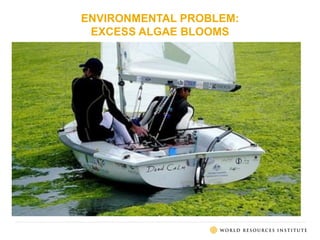
ENVIRONMENTAL PROBLEM:
EXCESS ALGAE BLOOMS
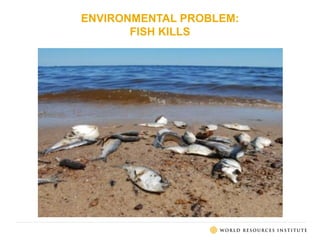
ENVIRONMENTAL PROBLEM:
FISH KILLS
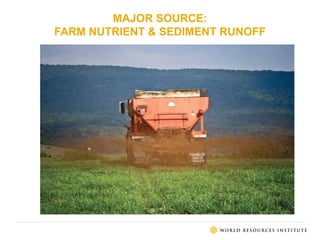
MAJOR SOURCE:
FARM NUTRIENT & SEDIMENT RUNOFF
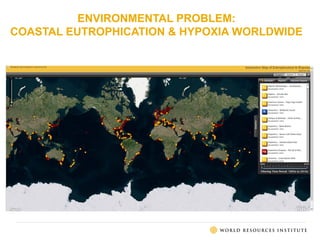
ENVIRONMENTAL PROBLEM:
COASTAL EUTROPHICATION & HYPOXIA WORLDWIDE
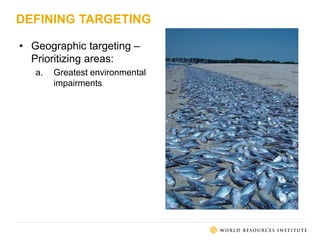
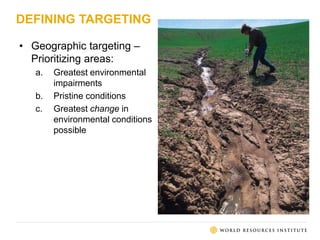
DEFINING TARGETING
• Geographic targeting –
Prioritizing areas:
a. Greatest environmental
impairments
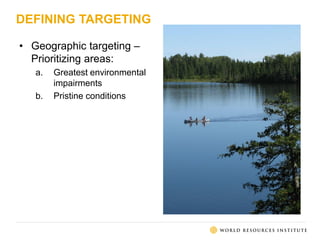
DEFINING TARGETING
• Geographic targeting –
Prioritizing areas:
a. Greatest environmental
impairments
b. Pristine conditions
DEFINING TARGETING
• Geographic targeting –
Prioritizing areas:
a. Greatest environmental
impairments
b. Pristine conditions
c. Greatest change in
environmental conditions
possible
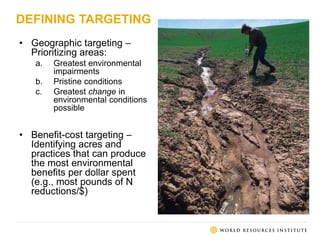
DEFINING TARGETING
• Geographic targeting –
Prioritizing areas:
a. Greatest environmental
impairments
b. Pristine conditions
c. Greatest change in
environmental conditions
possible
• Benefit-cost targeting –
Identifying acres and
practices that can produce
the most environmental
benefits per dollar spent
(e.g., most pounds of N
reductions/$)
AUTHORS
Bruce Knight
Strategic Conservation Solutions, LLC
& former chief of USDA’s NRCS, ‘02–‘06
John Stierna
American Farmland Trust
& former senior economist, NRCS, ’95-’04
Michelle Perez
Senior Associate
Mindy Selman
Senior Associate
Sara Walker
Associate
Katie Reytar
Research Associate
PANELISTS
MICHELLE PEREZ, PHD
IMPROVING WATER
QUALITY
A National Modeling Analysis on Increasing Cost
Effectiveness through Better Targeting of U.S. Farm
Conservation Funds
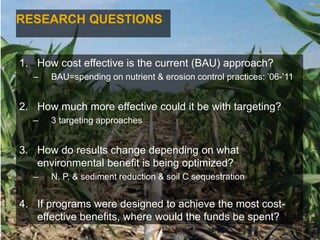
RESEARCH QUESTIONS
1. How cost effective is the current (BAU) approach?
– BAU=spending on nutrient & erosion control practices: ’06-’11
2. How much more effective could it be with targeting?
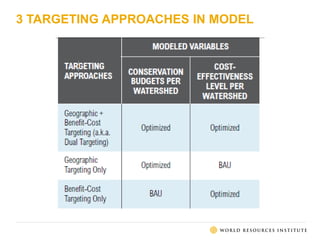
– 3 targeting approaches
3. How do results change depending on what
environmental benefit is being optimized?
– N, P, & sediment reduction & soil C sequestration
4. If programs were designed to achieve the most cost-
effective benefits, where would the funds be spent?
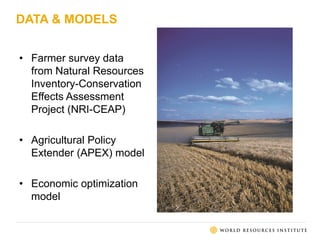
DATA & MODELS
• Farmer survey data
from Natural Resources
Inventory-Conservation
Effects Assessment
Project (NRI-CEAP)
• Agricultural Policy
Extender (APEX) model
• Economic optimization
model
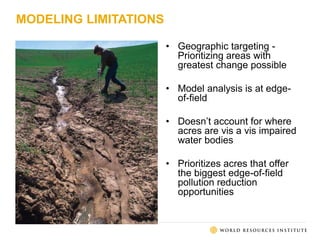
MODELING LIMITATIONS
• Geographic targeting -
Prioritizing areas with
greatest change possible
• Model analysis is at edge-
of-field
• Doesn’t account for where
acres are vis a vis impaired
water bodies
• Prioritizes acres that offer
the biggest edge-of-field
pollution reduction
opportunities
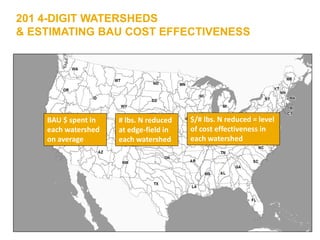
201 4-DIGIT WATERSHEDS
& ESTIMATING BAU COST EFFECTIVENESS
BAU $ spent in
each watershed
on average
# lbs. N reduced
at edge-field in
each watershed
$/# lbs. N reduced = level
of cost effectiveness in
each watershed
3 TARGETING APPROACHES IN MODEL
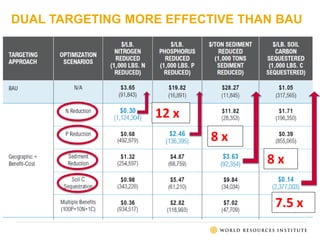
DUAL TARGETING MORE EFFECTIVE THAN BAU
12 x
8 x
8 x
7.5 x
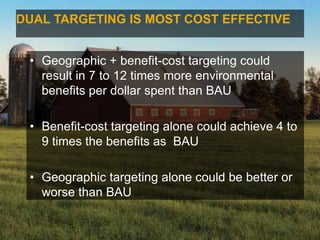
DUAL TARGETING IS MOST COST EFFECTIVE
• Geographic + benefit-cost targeting could
result in 7 to 12 times more environmental
benefits per dollar spent than BAU
• Benefit-cost targeting alone could achieve 4 to
9 times the benefits as BAU
• Geographic targeting alone could be better or
worse than BAU
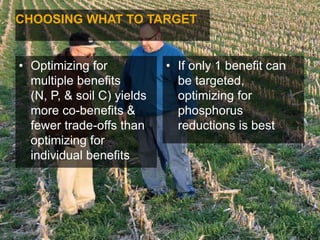
CHOOSING WHAT TO TARGET
• Optimizing for
multiple benefits
(N, P, & soil C) yields
more co-benefits &
fewer trade-offs than
optimizing for
individual benefits
• If only 1 benefit can
be targeted,
optimizing for
phosphorus
reductions is best
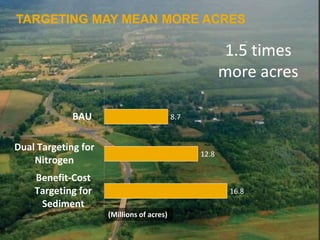
TARGETING MAY MEAN MORE ACRES
16.8
12.8
8.7
Benefit-Cost
Targeting for
Sediment
Dual Targeting for
Nitrogen
BAU
1.5 times
more acres
(Millions of acres)
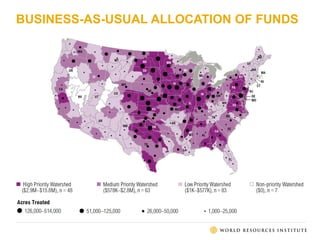
BUSINESS-AS-USUAL ALLOCATION OF FUNDS
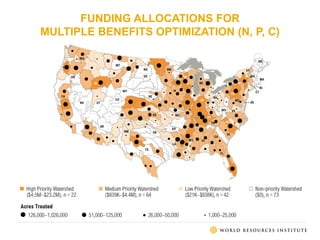
FUNDING ALLOCATIONS FOR
MULTIPLE BENEFITS OPTIMIZATION (N, P, C)
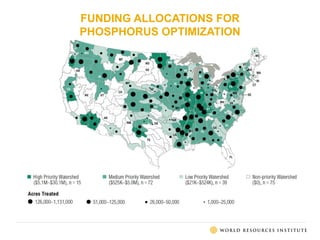
FUNDING ALLOCATIONS FOR
PHOSPHORUS OPTIMIZATION
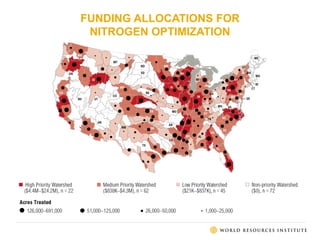
FUNDING ALLOCATIONS FOR
NITROGEN OPTIMIZATION
FUNDING ALLOCATIONS FOR
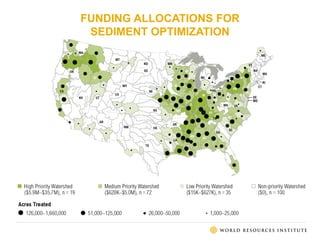
SEDIMENT OPTIMIZATION
FUNDING ALLOCATIONS FOR
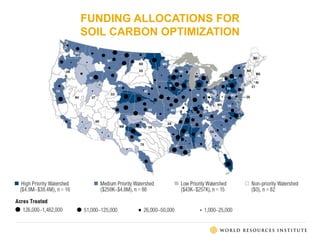
SOIL CARBON OPTIMIZATION
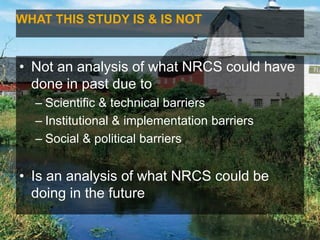
WHAT THIS STUDY IS & IS NOT
• Not an analysis of what NRCS could have
done in past due to
– Scientific & technical barriers
– Institutional & implementation barriers
– Social & political barriers
• Is an analysis of what NRCS could be
doing in the future
RECOMMENDATIONS
1. Track environmental benefits
2. Rank applications according to
benefit-cost ratios
3. Conduct pilot projects
4. Improve state funding allocation
formulas
Thank You!
Michelle Perez, PhD
202-729-7908
mperez@wri.org
SARA WALKER AND MICHELLE PEREZ
OVERCOMING
BARRIERS TO
TARGETING
June 10, 2014
3 MAJOR TYPES OF BARRIERS
1. Scientific and
Technical
2. Social and Political
3. Institutional and
Implementation
Image: Nicholas A. Tonelli
Scientific and
Technical
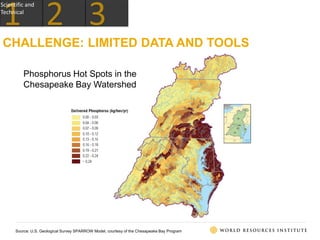
CHALLENGE: LIMITED DATA AND TOOLS
Source: U.S. Geological Survey SPARROW Model, courtesy of the Chesapeake Bay Program
Phosphorus Hot Spots in the
Chesapeake Bay Watershed
Scientific and
Technical
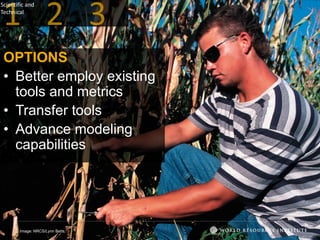
OPTIONS
• Better employ existing
tools and metrics
• Transfer tools
• Advance modeling
capabilities
Image: NRCS/Lynn Betts
Scientific and
Technical
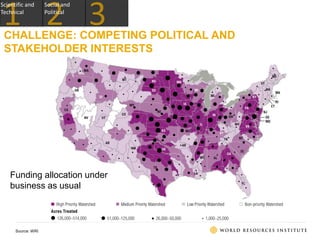
CHALLENGE: COMPETING POLITICAL AND
STAKEHOLDER INTERESTS
Source: WRI
Social and
Political
Funding allocation under
business as usual
Scientific and
Technical
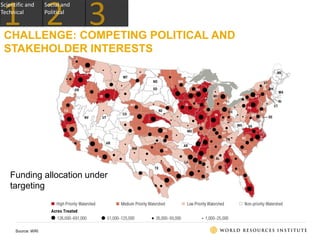
CHALLENGE: COMPETING POLITICAL AND
STAKEHOLDER INTERESTS
Source: WRI
Social and
Political
Funding allocation under
targeting
Scientific and
Technical
OPTIONS
• Set aside portion of
funds for geographic
targeting
• Focus on costs and
benefits
Image: NRCS/Tim McCabe
Social and
Political
Scientific and
Technical
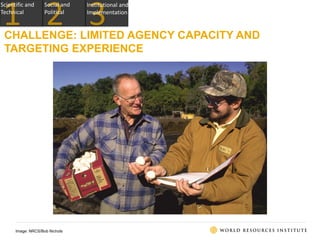
CHALLENGE: LIMITED AGENCY CAPACITY AND
TARGETING EXPERIENCE
Image: NRCS/Bob Nichols
Social and
Political
Institutional and
Implementation
Scientific and
Technical
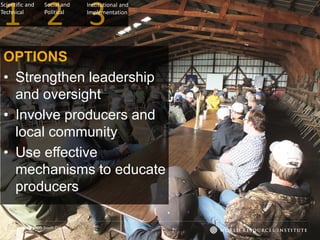
OPTIONS
• Strengthen leadership
and oversight
• Involve producers and
local community
• Use effective
mechanisms to educate
producers
Image: NRCS South Dakota
Social and
Political
Institutional and
Implementation
THANK YOU!
Sara Walker
swalker@wri.org
202-729-7824
Michelle Perez
mperez@wri.org
202-729-7908
Image: NRCS/Lynn Betts
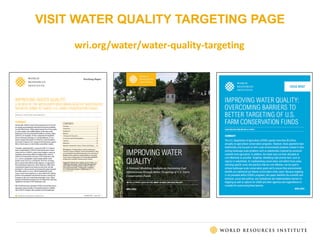
VISIT WATER QUALITY TARGETING PAGE
wri.org/water/water-quality-targeting

Improving Water Quality through Better Targeting of Farm Conservation Funds

  • 1.
    PUBLICATIONS LAUNCH &DISCUSSION • Improving Water Quality: A National Modeling Analysis on Increasing Cost Effectiveness through Better Targeting of U.S. Farm Conservation Funds • Improving Water Quality: Overcoming Barriers to Better Targeting of U.S. Farm Conservation Funds MODERATOR: Craig Hanson, Director, Food, Forests & Water Program JUNE 10, 2014
  • 2.
    Mic & Speakersis usually the best audio option but you can use the call-in number as well. Submit your text questions and comments using the Questions Panel. We will answer questions during the Q&A discussion session. For more information, please email amaddocks@wri.org. Note: Today’s presentation is being recorded and will be posted on WRI’s website within a week. Your Participation GoToWebinar Housekeeping
  • 3.
  • 4.
  • 5.
    MAJOR SOURCE: FARM NUTRIENT& SEDIMENT RUNOFF
  • 6.
  • 7.
    DEFINING TARGETING • Geographictargeting – Prioritizing areas: a. Greatest environmental impairments
  • 8.
    DEFINING TARGETING • Geographictargeting – Prioritizing areas: a. Greatest environmental impairments b. Pristine conditions
  • 9.
    DEFINING TARGETING • Geographictargeting – Prioritizing areas: a. Greatest environmental impairments b. Pristine conditions c. Greatest change in environmental conditions possible
  • 10.
    DEFINING TARGETING • Geographictargeting – Prioritizing areas: a. Greatest environmental impairments b. Pristine conditions c. Greatest change in environmental conditions possible • Benefit-cost targeting – Identifying acres and practices that can produce the most environmental benefits per dollar spent (e.g., most pounds of N reductions/$)
  • 11.
    AUTHORS Bruce Knight Strategic ConservationSolutions, LLC & former chief of USDA’s NRCS, ‘02–‘06 John Stierna American Farmland Trust & former senior economist, NRCS, ’95-’04 Michelle Perez Senior Associate Mindy Selman Senior Associate Sara Walker Associate Katie Reytar Research Associate PANELISTS
  • 12.
    MICHELLE PEREZ, PHD IMPROVINGWATER QUALITY A National Modeling Analysis on Increasing Cost Effectiveness through Better Targeting of U.S. Farm Conservation Funds
  • 13.
    RESEARCH QUESTIONS 1. Howcost effective is the current (BAU) approach? – BAU=spending on nutrient & erosion control practices: ’06-’11 2. How much more effective could it be with targeting? – 3 targeting approaches 3. How do results change depending on what environmental benefit is being optimized? – N, P, & sediment reduction & soil C sequestration 4. If programs were designed to achieve the most cost- effective benefits, where would the funds be spent?
  • 14.
    DATA & MODELS •Farmer survey data from Natural Resources Inventory-Conservation Effects Assessment Project (NRI-CEAP) • Agricultural Policy Extender (APEX) model • Economic optimization model
  • 15.
    MODELING LIMITATIONS • Geographictargeting - Prioritizing areas with greatest change possible • Model analysis is at edge- of-field • Doesn’t account for where acres are vis a vis impaired water bodies • Prioritizes acres that offer the biggest edge-of-field pollution reduction opportunities
  • 16.
    201 4-DIGIT WATERSHEDS &ESTIMATING BAU COST EFFECTIVENESS BAU $ spent in each watershed on average # lbs. N reduced at edge-field in each watershed $/# lbs. N reduced = level of cost effectiveness in each watershed
  • 17.
  • 18.
    DUAL TARGETING MOREEFFECTIVE THAN BAU 12 x 8 x 8 x 7.5 x
  • 19.
    DUAL TARGETING ISMOST COST EFFECTIVE • Geographic + benefit-cost targeting could result in 7 to 12 times more environmental benefits per dollar spent than BAU • Benefit-cost targeting alone could achieve 4 to 9 times the benefits as BAU • Geographic targeting alone could be better or worse than BAU
  • 20.
    CHOOSING WHAT TOTARGET • Optimizing for multiple benefits (N, P, & soil C) yields more co-benefits & fewer trade-offs than optimizing for individual benefits • If only 1 benefit can be targeted, optimizing for phosphorus reductions is best
  • 21.
    TARGETING MAY MEANMORE ACRES 16.8 12.8 8.7 Benefit-Cost Targeting for Sediment Dual Targeting for Nitrogen BAU 1.5 times more acres (Millions of acres)
  • 22.
  • 23.
    FUNDING ALLOCATIONS FOR MULTIPLEBENEFITS OPTIMIZATION (N, P, C)
  • 24.
  • 25.
  • 26.
  • 27.
    FUNDING ALLOCATIONS FOR SOILCARBON OPTIMIZATION
  • 28.
    WHAT THIS STUDYIS & IS NOT • Not an analysis of what NRCS could have done in past due to – Scientific & technical barriers – Institutional & implementation barriers – Social & political barriers • Is an analysis of what NRCS could be doing in the future
  • 29.
    RECOMMENDATIONS 1. Track environmentalbenefits 2. Rank applications according to benefit-cost ratios 3. Conduct pilot projects 4. Improve state funding allocation formulas
  • 30.
    Thank You! Michelle Perez,PhD 202-729-7908 mperez@wri.org
  • 31.
    SARA WALKER ANDMICHELLE PEREZ OVERCOMING BARRIERS TO TARGETING June 10, 2014
  • 32.
    3 MAJOR TYPESOF BARRIERS 1. Scientific and Technical 2. Social and Political 3. Institutional and Implementation Image: Nicholas A. Tonelli
  • 33.
    Scientific and Technical CHALLENGE: LIMITEDDATA AND TOOLS Source: U.S. Geological Survey SPARROW Model, courtesy of the Chesapeake Bay Program Phosphorus Hot Spots in the Chesapeake Bay Watershed
  • 34.
    Scientific and Technical OPTIONS • Betteremploy existing tools and metrics • Transfer tools • Advance modeling capabilities Image: NRCS/Lynn Betts
  • 35.
    Scientific and Technical CHALLENGE: COMPETINGPOLITICAL AND STAKEHOLDER INTERESTS Source: WRI Social and Political Funding allocation under business as usual
  • 36.
    Scientific and Technical CHALLENGE: COMPETINGPOLITICAL AND STAKEHOLDER INTERESTS Source: WRI Social and Political Funding allocation under targeting
  • 37.
    Scientific and Technical OPTIONS • Setaside portion of funds for geographic targeting • Focus on costs and benefits Image: NRCS/Tim McCabe Social and Political
  • 38.
    Scientific and Technical CHALLENGE: LIMITEDAGENCY CAPACITY AND TARGETING EXPERIENCE Image: NRCS/Bob Nichols Social and Political Institutional and Implementation
  • 39.
    Scientific and Technical OPTIONS • Strengthenleadership and oversight • Involve producers and local community • Use effective mechanisms to educate producers Image: NRCS South Dakota Social and Political Institutional and Implementation
  • 40.
    THANK YOU! Sara Walker swalker@wri.org 202-729-7824 MichellePerez mperez@wri.org 202-729-7908 Image: NRCS/Lynn Betts
  • 41.
    VISIT WATER QUALITYTARGETING PAGE wri.org/water/water-quality-targeting