Best Better practice of Cassandra
Cassandraに不向きなCassandraデータモデリング基礎
Hayato Tsutsumi
Works Applications
Hayato Tsutsumi
堤 勇人
Cassandra experience :
7 years (from ver.0.6)
Certification for Apache Cassandra Administarator
Data size : about 40TB
Nodes:about 40 (would increase soon...)
Twitter : 2t3
Site Reliability Engineering Div.
Works Applications Co., Ltd
自己紹介 Speaker
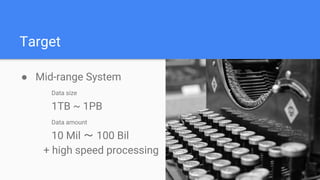
Target
● Mid-range System
Data size
1TB ~ 1PB
Data amount
10 Mil ~ 100 Bil
+ high speed processing
What is better?
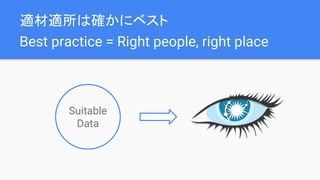
Best practice = Right people, right place
適材適所は確かにベスト
Suitable
Data
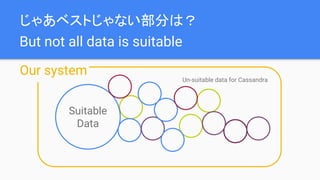
But not all data is suitable
じゃあベストじゃない部分は?
Our system
Suitable
Data
Un-suitable data for Cassandra
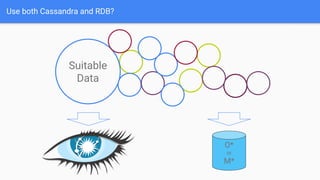
Use both Cassandra and RDB?
O*
or
M*
Suitable
Data
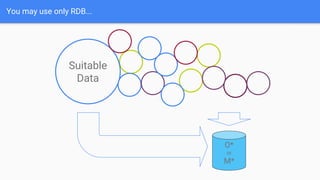
You may use only RDB...
O*
or
M*
Suitable
Data
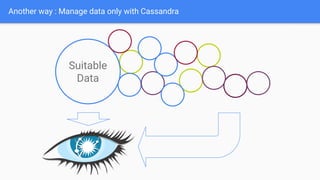
Another way : Manage data only with Cassandra
Suitable
Data
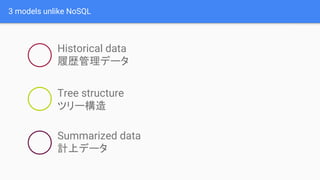
3 models unlike NoSQL
Historical data
履歴管理データ
Tree structure
ツリー構造
Summarized data
計上データ
How Cassandra
read data in 3mins
前
提
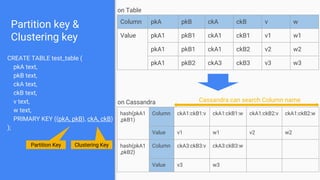
Partition key &
Clustering key
CREATE TABLE test_table (
pkA text,
pkB text,
ckA text,
ckB text,
v text,
w text,
PRIMARY KEY ((pkA, pkB), ckA, ckB)
);
Partition Key Clustering Key
hash(pkA1
,pkB1)
Column ckA1:ckB1:v ckA1:ckB1:w ckA1:ckB2:v ckA1:ckB2:w
Value v1 w1 v2 w2
hash(pkA1
,pkB2)
Column ckA3:ckB3:v ckA3:ckB3:w
Value v3 w3
Column pkA pkB ckA ckB v w
Value pkA1 pkB1 ckA1 ckB1 v1 w1
pkA1 pkB1 ckA1 ckB2 v2 w2
pkA1 pkB2 ckA3 ckB3 v3 w3
on Table
on Cassandra Cassandra can search Column name
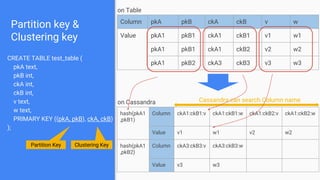
Partition key &
Clustering key
CREATE TABLE test_table (
pkA text,
pkB int,
ckA int,
ckB int,
v text,
w text,
PRIMARY KEY ((pkA, pkB), ckA, ckB)
);
Partition Key Clustering Key
hash(pkA1
,pkB1)
Column ckA1:ckB1:v ckA1:ckB1:w ckA1:ckB2:v ckA1:ckB2:w
Value v1 w1 v2 w2
hash(pkA1
,pkB2)
Column ckA3:ckB3:v ckA3:ckB3:w
Value v3 w3
Column pkA pkB ckA ckB v w
Value pkA1 pkB1 ckA1 ckB1 v1 w1
pkA1 pkB1 ckA1 ckB2 v2 w2
pkA1 pkB2 ckA3 ckB3 v3 w3
on Table
on Cassandra Cassandra can search Column name
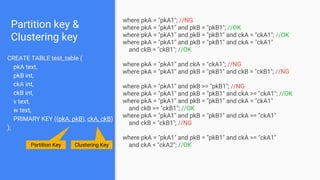
Partition key &
Clustering key
CREATE TABLE test_table (
pkA text,
pkB int,
ckA int,
ckB int,
v text,
w text,
PRIMARY KEY ((pkA, pkB), ckA, ckB)
);
Partition Key Clustering Key
where pkA = "pkA1"; //NG
where pkA = "pkA1" and pkB = "pkB1"; //OK
where pkA = "pkA1" and pkB = "pkB1" and ckA = "ckA1"; //OK
where pkA = "pkA1" and pkB = "pkB1" and ckA = "ckA1"
and ckB = "ckB1"; //OK
where pkA = "pkA1" and ckA = "ckA1"; //NG
where pkA = "pkA1" and pkB = "pkB1" and ckB = "ckB1"; //NG
where pkA = "pkA1" and pkB >= "pkB1"; //NG
where pkA = "pkA1" and pkB = "pkB1" and ckA >= "ckA1"; //OK
where pkA = "pkA1" and pkB = "pkB1" and ckA = "ckA1"
and ckB >= "ckB1"; //OK
where pkA = "pkA1" and pkB = "pkB1" and ckA >= "ckA1"
and ckB = "ckB1"; //NG
where pkA = "pkA1" and pkB = "pkB1" and ckA >= "ckA1"
and ckA < "ckA2"; //OK
Historical data
履歴管理データ
photo by Bryan Wright
(https://secure.flickr.com/photos/spidermandragon5/2922128673/)
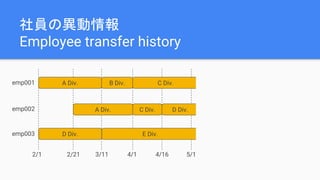
社員の異動情報
Employee transfer history
A Div. B Div. C Div.
A Div. C Div. D Div.
emp001
emp002
D Div. E Div.emp003
4/1 4/16 5/13/112/1 2/21
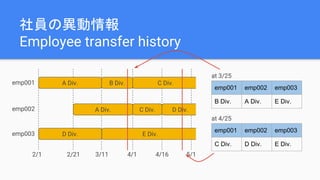
社員の異動情報
Employee transfer history
A Div. B Div. C Div.
A Div. C Div. D Div.
emp001
emp002
D Div. E Div.emp003
4/1 4/16 5/13/112/1 2/21
at 3/25
emp001 emp002 emp003
B Div. A Div. E Div.
at 4/25
emp001 emp002 emp003
C Div. D Div. E Div.
emp_history table
CREATE TABLE emp_history (
id text,
no text,
s date,
e date,
div text,
PRIMARY KEY (id, s, e, no)
);
select * from emp_history
where id = 'test' and s <= '2017/03/25' and e > ''2017/03/25''; //NG
?
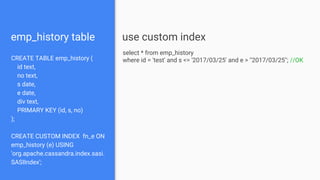
emp_history table
CREATE TABLE emp_history (
id text,
no text,
s date,
e date,
div text,
PRIMARY KEY (id, s, no)
);
CREATE CUSTOM INDEX fn_e ON
emp_history (e) USING
'org.apache.cassandra.index.sasi.
SASIIndex';
select * from emp_history
where id = 'test' and s <= '2017/03/25' and e > ''2017/03/25''; //OK
use custom index
Tree structure
ツリー構造
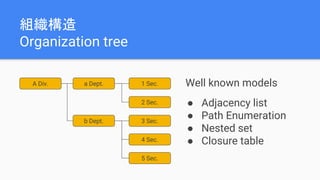
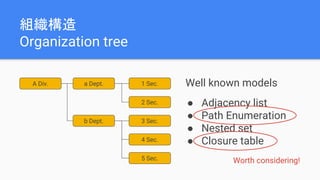
組織構造
Organization tree
A Div. a Dept.
b Dept.
1 Sec.
2 Sec.
3 Sec.
4 Sec.
5 Sec.
Well known models
● Adjacency list
● Path Enumeration
● Nested set
● Closure table
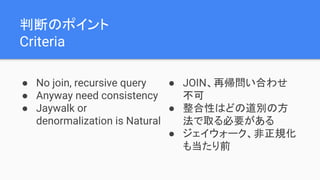
判断のポイント
Criteria
● No join, recursive query
● Anyway need consistency
● Jaywalk or
denormalization is Natural
● JOIN、再帰問い合わせ
不可
● 整合性はどの道別の方
法で取る必要がある
● ジェイウォーク、非正規化
も当たり前
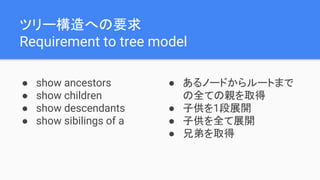
ツリー構造への要求
Requirement to tree model
● show ancestors
● show children
● show descendants
● show sibilings of a
● あるノードからルートまで
の全ての親を取得
● 子供を1段展開
● 子供を全て展開
● 兄弟を取得
組織構造
Organization tree
A Div. a Dept.
b Dept.
1 Sec.
2 Sec.
3 Sec.
4 Sec.
5 Sec.
Well known models
● Adjacency list
● Path Enumeration
● Nested set
● Closure table
Worth considering!
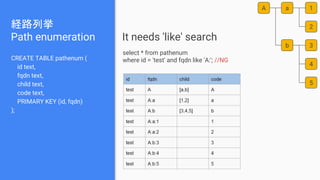
経路列挙
Path enumeration
CREATE TABLE pathenum (
id text,
fqdn text,
child text,
code text,
PRIMARY KEY (id, fqdn)
);
id fqdn child code
test A [a,b] A
test A:a [1,2] a
test A:b [3,4,5] b
test A:a:1 1
test A:a:2 2
test A:b:3 3
test A:b:4 4
test A:b:5 5
A a
b
1
2
3
4
5
経路列挙
Path enumeration
CREATE TABLE pathenum (
id text,
fqdn text,
child text,
code text,
PRIMARY KEY (id, fqdn)
);
select * from pathenum
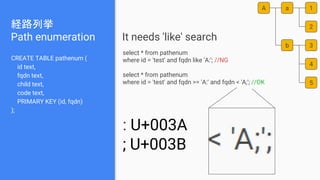
where id = 'test' and fqdn like 'A:'; //NG
It needs 'like' search
A a
b
1
2
3
4
5
経路列挙
Path enumeration
CREATE TABLE pathenum (
id text,
fqdn text,
child text,
code text,
PRIMARY KEY (id, fqdn)
);
select * from pathenum
where id = 'test' and fqdn like 'A:'; //NG
select * from pathenum
where id = 'test' and fqdn >= 'A:' and fqdn < 'A;'; //OK
: U+003A
; U+003B
It needs 'like' search
A a
b
1
2
3
4
5
経路列挙
Path enumeration
CREATE TABLE pathenum (
id text,
fqdn text,
child text,
code text,
PRIMARY KEY (id, fqdn)
);
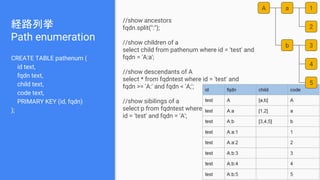
//show ancestors
fqdn.split(":");
//show children of a
select child from pathenum where id = 'test' and
fqdn = 'A:a';
//show descendants of A
select * from fqdntest where id = 'test' and
fqdn >= 'A:' and fqdn < 'A;';
//show sibilings of a
select p from fqdntest where
id = 'test' and fqdn = 'A';
A a
b
1
2
3
4
5
経路列挙
Path enumeration
CREATE TABLE pathenum (
id text,
fqdn text,
child text,
code text,
PRIMARY KEY (id, fqdn)
);
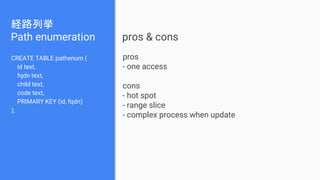
pros
- one access
cons
- hot spot
- range slice
- complex process when update
pros & cons
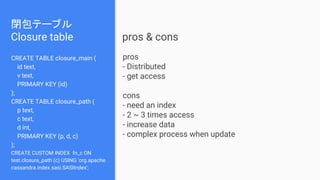
閉包テーブル
Closure table
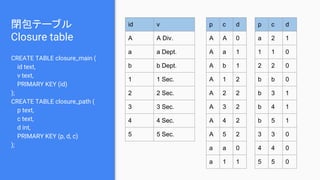
CREATE TABLE closure_main (
id text,
v text,
PRIMARY KEY (id)
);
CREATE TABLE closure_path (
p text,
c text,
d int,
PRIMARY KEY (p, d, c)
);
id v
A A Div.
a a Dept.
b b Dept.
1 1 Sec.
2 2 Sec.
3 3 Sec.
4 4 Sec.
5 5 Sec.
p c d
A A 0
A a 1
A b 1
A 1 2
A 2 2
A 3 2
A 4 2
A 5 2
a a 0
a 1 1
p c d
a 2 1
1 1 0
2 2 0
b b 0
b 3 1
b 4 1
b 5 1
3 3 0
4 4 0
5 5 0
閉包テーブル
Closure table
CREATE TABLE closure_main (
id text,
v text,
PRIMARY KEY (id)
);
CREATE TABLE closure_path (
p text,
c text,
d int,
PRIMARY KEY (p, d, c)
);
CREATE CUSTOM INDEX fn_c ON
test.closure_path (c) USING 'org.apache.
cassandra.index.sasi.SASIIndex';
p c d
A A 0
A a 1
A b 1
A 1 2
A 2 2
A 3 2
A 4 2
A 5 2
a a 0
a 1 1
p c d
a 2 1
1 1 0
2 2 0
b b 0
b 3 1
b 4 1
b 5 1
3 3 0
4 4 0
5 5 0
//show ancestors
select p from closure_path where c = '1';
select * from closure_main where id in [?];
//show children of a
select c from closure_path where p = 'a' and d
= 1;
select * from closure_main where id in [?];
//show descendants of A
select c from closure_path where p = 'A';
select * from closure_main where id in [?];
//show sibilings of a
//load a's parent = A
select * from closure_path where c = 'a';
select c from closure_path where p = 'A' and d
= 1;
select * from closure_main where id in [?];
pros
- Distributed
- get access
cons
- need an index
- 2 ~ 3 times access
- increase data
- complex process when update
pros & cons
閉包テーブル
Closure table
CREATE TABLE closure_main (
id text,
v text,
PRIMARY KEY (id)
);
CREATE TABLE closure_path (
p text,
c text,
d int,
PRIMARY KEY (p, d, c)
);
CREATE CUSTOM INDEX fn_c ON
test.closure_path (c) USING 'org.apache.
cassandra.index.sasi.SASIIndex';
pros
- Distributed
- get access
cons
- need an index
- 2 ~ 3 times access
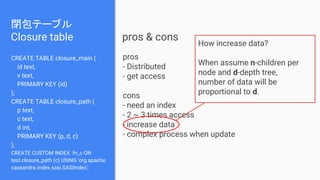
- increase data
- complex process when update
pros & cons
閉包テーブル
Closure table
CREATE TABLE closure_main (
id text,
v text,
PRIMARY KEY (id)
);
CREATE TABLE closure_path (
p text,
c text,
d int,
PRIMARY KEY (p, d, c)
);
CREATE CUSTOM INDEX fn_c ON
test.closure_path (c) USING 'org.apache.
cassandra.index.sasi.SASIIndex';
How increase data?
When assume n-children per
node and d-depth tree,
number of data will be
proportional to d.
Summarized
data
計上データ
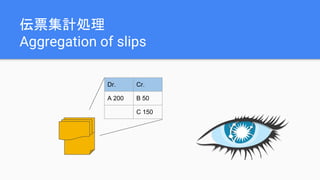
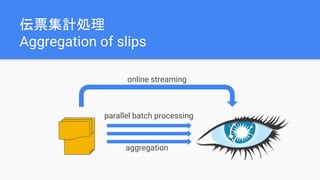
伝票集計処理
Aggregation of slips
Dr. Cr.
A 200 B 50
C 150
伝票集計処理
Aggregation of slips
parallel batch processing
aggregation
online streaming
要求水準
Requirements
● miscalculation = critical
● need parallel / streaming
processing
● need high speed
processing
● 誤計算は死
● バッチの並列処理、オン
ラインによるストリーミン
グ処理が必要
● 高速処理が求められる
● miscalculation = critical
● need parallel / streaming
processing
● need high speed
processing
● 誤計算は死
● バッチの並列処理、オン
ラインによるストリーミン
グ処理が必要
● 高速処理が求められる
= Consistency!
要求水準
Requirements
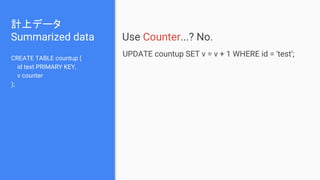
計上データ
Summarized data
CREATE TABLE countup (
id text PRIMARY KEY,
v counter
);
UPDATE countup SET v = v + 1 WHERE id = 'test';
Use Counter...? No.
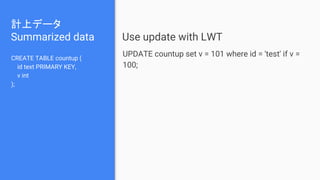
計上データ
Summarized data
CREATE TABLE countup (
id text PRIMARY KEY,
v int
);
UPDATE countup set v = 101 where id = 'test' if v =
100;
Use update with LWT
What is the best?
Thanks!

Cassandraに不向きなcassandraデータモデリング基礎 / Data Modeling concepts for NoSQL weak point

  • 1.
    Best Better practiceof Cassandra Cassandraに不向きなCassandraデータモデリング基礎 Hayato Tsutsumi Works Applications
  • 2.
    Hayato Tsutsumi 堤 勇人 Cassandraexperience : 7 years (from ver.0.6) Certification for Apache Cassandra Administarator Data size : about 40TB Nodes:about 40 (would increase soon...) Twitter : 2t3 Site Reliability Engineering Div. Works Applications Co., Ltd 自己紹介 Speaker
  • 3.
    Target ● Mid-range System Datasize 1TB ~ 1PB Data amount 10 Mil ~ 100 Bil + high speed processing
  • 4.
  • 5.
    Best practice =Right people, right place 適材適所は確かにベスト Suitable Data
  • 6.
    But not alldata is suitable じゃあベストじゃない部分は? Our system Suitable Data Un-suitable data for Cassandra
  • 7.
    Use both Cassandraand RDB? O* or M* Suitable Data
  • 8.
    You may useonly RDB... O* or M* Suitable Data
  • 9.
    Another way :Manage data only with Cassandra Suitable Data
  • 10.
    3 models unlikeNoSQL Historical data 履歴管理データ Tree structure ツリー構造 Summarized data 計上データ
  • 11.
    How Cassandra read datain 3mins 前 提
  • 12.
    Partition key & Clusteringkey CREATE TABLE test_table ( pkA text, pkB text, ckA text, ckB text, v text, w text, PRIMARY KEY ((pkA, pkB), ckA, ckB) ); Partition Key Clustering Key hash(pkA1 ,pkB1) Column ckA1:ckB1:v ckA1:ckB1:w ckA1:ckB2:v ckA1:ckB2:w Value v1 w1 v2 w2 hash(pkA1 ,pkB2) Column ckA3:ckB3:v ckA3:ckB3:w Value v3 w3 Column pkA pkB ckA ckB v w Value pkA1 pkB1 ckA1 ckB1 v1 w1 pkA1 pkB1 ckA1 ckB2 v2 w2 pkA1 pkB2 ckA3 ckB3 v3 w3 on Table on Cassandra Cassandra can search Column name
  • 13.
    Partition key & Clusteringkey CREATE TABLE test_table ( pkA text, pkB int, ckA int, ckB int, v text, w text, PRIMARY KEY ((pkA, pkB), ckA, ckB) ); Partition Key Clustering Key hash(pkA1 ,pkB1) Column ckA1:ckB1:v ckA1:ckB1:w ckA1:ckB2:v ckA1:ckB2:w Value v1 w1 v2 w2 hash(pkA1 ,pkB2) Column ckA3:ckB3:v ckA3:ckB3:w Value v3 w3 Column pkA pkB ckA ckB v w Value pkA1 pkB1 ckA1 ckB1 v1 w1 pkA1 pkB1 ckA1 ckB2 v2 w2 pkA1 pkB2 ckA3 ckB3 v3 w3 on Table on Cassandra Cassandra can search Column name
  • 14.
    Partition key & Clusteringkey CREATE TABLE test_table ( pkA text, pkB int, ckA int, ckB int, v text, w text, PRIMARY KEY ((pkA, pkB), ckA, ckB) ); Partition Key Clustering Key where pkA = "pkA1"; //NG where pkA = "pkA1" and pkB = "pkB1"; //OK where pkA = "pkA1" and pkB = "pkB1" and ckA = "ckA1"; //OK where pkA = "pkA1" and pkB = "pkB1" and ckA = "ckA1" and ckB = "ckB1"; //OK where pkA = "pkA1" and ckA = "ckA1"; //NG where pkA = "pkA1" and pkB = "pkB1" and ckB = "ckB1"; //NG where pkA = "pkA1" and pkB >= "pkB1"; //NG where pkA = "pkA1" and pkB = "pkB1" and ckA >= "ckA1"; //OK where pkA = "pkA1" and pkB = "pkB1" and ckA = "ckA1" and ckB >= "ckB1"; //OK where pkA = "pkA1" and pkB = "pkB1" and ckA >= "ckA1" and ckB = "ckB1"; //NG where pkA = "pkA1" and pkB = "pkB1" and ckA >= "ckA1" and ckA < "ckA2"; //OK
  • 15.
    Historical data 履歴管理データ photo byBryan Wright (https://secure.flickr.com/photos/spidermandragon5/2922128673/)
  • 16.
    社員の異動情報 Employee transfer history ADiv. B Div. C Div. A Div. C Div. D Div. emp001 emp002 D Div. E Div.emp003 4/1 4/16 5/13/112/1 2/21
  • 17.
    社員の異動情報 Employee transfer history ADiv. B Div. C Div. A Div. C Div. D Div. emp001 emp002 D Div. E Div.emp003 4/1 4/16 5/13/112/1 2/21 at 3/25 emp001 emp002 emp003 B Div. A Div. E Div. at 4/25 emp001 emp002 emp003 C Div. D Div. E Div.
  • 18.
    emp_history table CREATE TABLEemp_history ( id text, no text, s date, e date, div text, PRIMARY KEY (id, s, e, no) ); select * from emp_history where id = 'test' and s <= '2017/03/25' and e > ''2017/03/25''; //NG ?
  • 19.
    emp_history table CREATE TABLEemp_history ( id text, no text, s date, e date, div text, PRIMARY KEY (id, s, no) ); CREATE CUSTOM INDEX fn_e ON emp_history (e) USING 'org.apache.cassandra.index.sasi. SASIIndex'; select * from emp_history where id = 'test' and s <= '2017/03/25' and e > ''2017/03/25''; //OK use custom index
  • 20.
  • 21.
    組織構造 Organization tree A Div.a Dept. b Dept. 1 Sec. 2 Sec. 3 Sec. 4 Sec. 5 Sec. Well known models ● Adjacency list ● Path Enumeration ● Nested set ● Closure table
  • 22.
    判断のポイント Criteria ● No join,recursive query ● Anyway need consistency ● Jaywalk or denormalization is Natural ● JOIN、再帰問い合わせ 不可 ● 整合性はどの道別の方 法で取る必要がある ● ジェイウォーク、非正規化 も当たり前
  • 23.
    ツリー構造への要求 Requirement to treemodel ● show ancestors ● show children ● show descendants ● show sibilings of a ● あるノードからルートまで の全ての親を取得 ● 子供を1段展開 ● 子供を全て展開 ● 兄弟を取得
  • 24.
    組織構造 Organization tree A Div.a Dept. b Dept. 1 Sec. 2 Sec. 3 Sec. 4 Sec. 5 Sec. Well known models ● Adjacency list ● Path Enumeration ● Nested set ● Closure table Worth considering!
  • 25.
    経路列挙 Path enumeration CREATE TABLEpathenum ( id text, fqdn text, child text, code text, PRIMARY KEY (id, fqdn) ); id fqdn child code test A [a,b] A test A:a [1,2] a test A:b [3,4,5] b test A:a:1 1 test A:a:2 2 test A:b:3 3 test A:b:4 4 test A:b:5 5 A a b 1 2 3 4 5
  • 26.
    経路列挙 Path enumeration CREATE TABLEpathenum ( id text, fqdn text, child text, code text, PRIMARY KEY (id, fqdn) ); select * from pathenum where id = 'test' and fqdn like 'A:'; //NG It needs 'like' search A a b 1 2 3 4 5
  • 27.
    経路列挙 Path enumeration CREATE TABLEpathenum ( id text, fqdn text, child text, code text, PRIMARY KEY (id, fqdn) ); select * from pathenum where id = 'test' and fqdn like 'A:'; //NG select * from pathenum where id = 'test' and fqdn >= 'A:' and fqdn < 'A;'; //OK : U+003A ; U+003B It needs 'like' search A a b 1 2 3 4 5
  • 28.
    経路列挙 Path enumeration CREATE TABLEpathenum ( id text, fqdn text, child text, code text, PRIMARY KEY (id, fqdn) ); //show ancestors fqdn.split(":"); //show children of a select child from pathenum where id = 'test' and fqdn = 'A:a'; //show descendants of A select * from fqdntest where id = 'test' and fqdn >= 'A:' and fqdn < 'A;'; //show sibilings of a select p from fqdntest where id = 'test' and fqdn = 'A'; A a b 1 2 3 4 5
  • 29.
    経路列挙 Path enumeration CREATE TABLEpathenum ( id text, fqdn text, child text, code text, PRIMARY KEY (id, fqdn) ); pros - one access cons - hot spot - range slice - complex process when update pros & cons
  • 30.
    閉包テーブル Closure table CREATE TABLEclosure_main ( id text, v text, PRIMARY KEY (id) ); CREATE TABLE closure_path ( p text, c text, d int, PRIMARY KEY (p, d, c) ); id v A A Div. a a Dept. b b Dept. 1 1 Sec. 2 2 Sec. 3 3 Sec. 4 4 Sec. 5 5 Sec. p c d A A 0 A a 1 A b 1 A 1 2 A 2 2 A 3 2 A 4 2 A 5 2 a a 0 a 1 1 p c d a 2 1 1 1 0 2 2 0 b b 0 b 3 1 b 4 1 b 5 1 3 3 0 4 4 0 5 5 0
  • 31.
    閉包テーブル Closure table CREATE TABLEclosure_main ( id text, v text, PRIMARY KEY (id) ); CREATE TABLE closure_path ( p text, c text, d int, PRIMARY KEY (p, d, c) ); CREATE CUSTOM INDEX fn_c ON test.closure_path (c) USING 'org.apache. cassandra.index.sasi.SASIIndex'; p c d A A 0 A a 1 A b 1 A 1 2 A 2 2 A 3 2 A 4 2 A 5 2 a a 0 a 1 1 p c d a 2 1 1 1 0 2 2 0 b b 0 b 3 1 b 4 1 b 5 1 3 3 0 4 4 0 5 5 0 //show ancestors select p from closure_path where c = '1'; select * from closure_main where id in [?]; //show children of a select c from closure_path where p = 'a' and d = 1; select * from closure_main where id in [?]; //show descendants of A select c from closure_path where p = 'A'; select * from closure_main where id in [?]; //show sibilings of a //load a's parent = A select * from closure_path where c = 'a'; select c from closure_path where p = 'A' and d = 1; select * from closure_main where id in [?];
  • 32.
    pros - Distributed - getaccess cons - need an index - 2 ~ 3 times access - increase data - complex process when update pros & cons 閉包テーブル Closure table CREATE TABLE closure_main ( id text, v text, PRIMARY KEY (id) ); CREATE TABLE closure_path ( p text, c text, d int, PRIMARY KEY (p, d, c) ); CREATE CUSTOM INDEX fn_c ON test.closure_path (c) USING 'org.apache. cassandra.index.sasi.SASIIndex';
  • 33.
    pros - Distributed - getaccess cons - need an index - 2 ~ 3 times access - increase data - complex process when update pros & cons 閉包テーブル Closure table CREATE TABLE closure_main ( id text, v text, PRIMARY KEY (id) ); CREATE TABLE closure_path ( p text, c text, d int, PRIMARY KEY (p, d, c) ); CREATE CUSTOM INDEX fn_c ON test.closure_path (c) USING 'org.apache. cassandra.index.sasi.SASIIndex'; How increase data? When assume n-children per node and d-depth tree, number of data will be proportional to d.
  • 34.
  • 35.
  • 36.
    伝票集計処理 Aggregation of slips parallelbatch processing aggregation online streaming
  • 37.
    要求水準 Requirements ● miscalculation =critical ● need parallel / streaming processing ● need high speed processing ● 誤計算は死 ● バッチの並列処理、オン ラインによるストリーミン グ処理が必要 ● 高速処理が求められる
  • 38.
    ● miscalculation =critical ● need parallel / streaming processing ● need high speed processing ● 誤計算は死 ● バッチの並列処理、オン ラインによるストリーミン グ処理が必要 ● 高速処理が求められる = Consistency! 要求水準 Requirements
  • 39.
    計上データ Summarized data CREATE TABLEcountup ( id text PRIMARY KEY, v counter ); UPDATE countup SET v = v + 1 WHERE id = 'test'; Use Counter...? No.
  • 40.
    計上データ Summarized data CREATE TABLEcountup ( id text PRIMARY KEY, v int ); UPDATE countup set v = 101 where id = 'test' if v = 100; Use update with LWT
  • 41.
  • 42.