How to learn fast in
challenging times
Tips for optimal learning.
Billy O’Connor
Professor of Physiology
University of Limerick School of Medicine.
William.OConnor@ul.ie
May 26th 2022
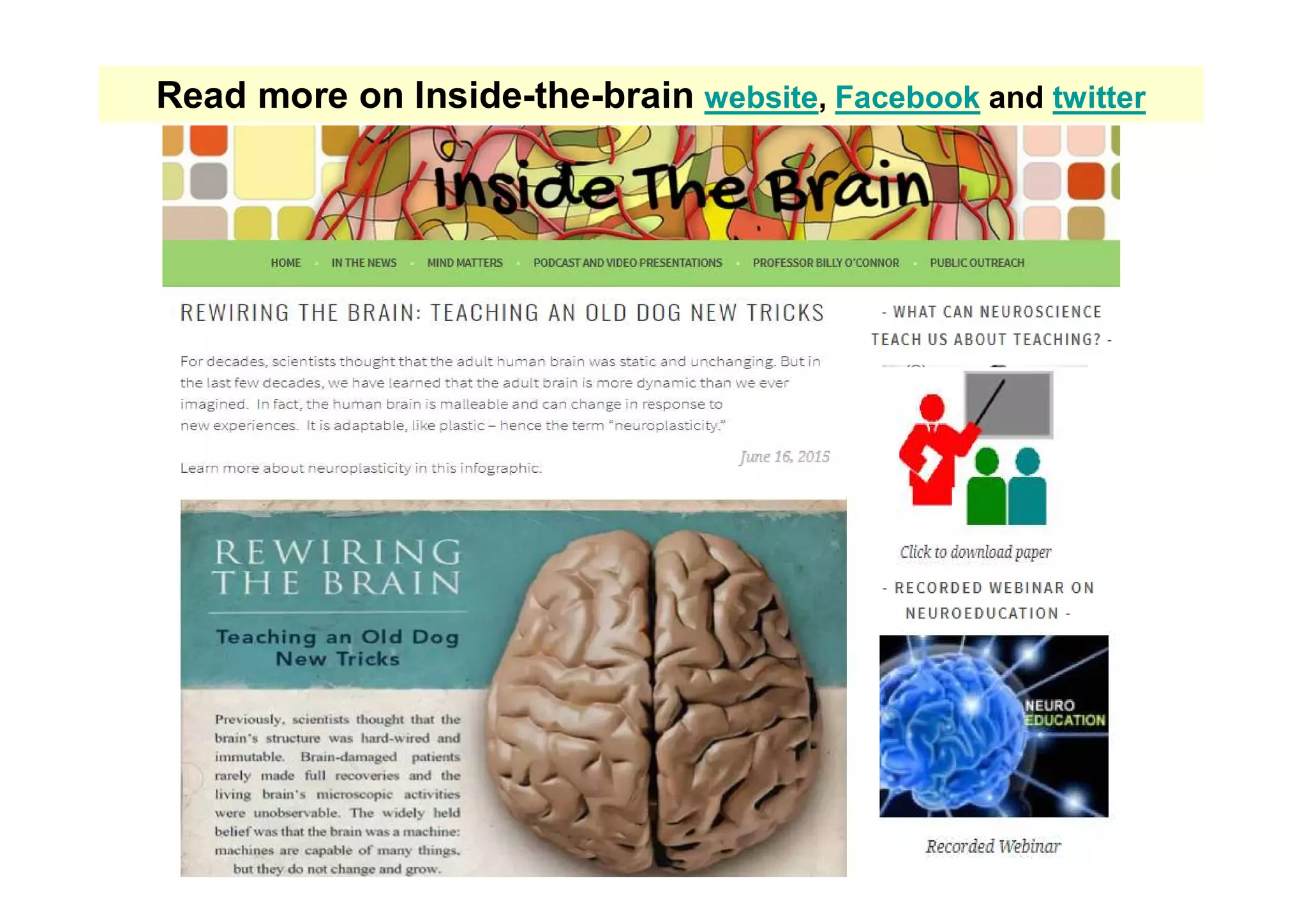
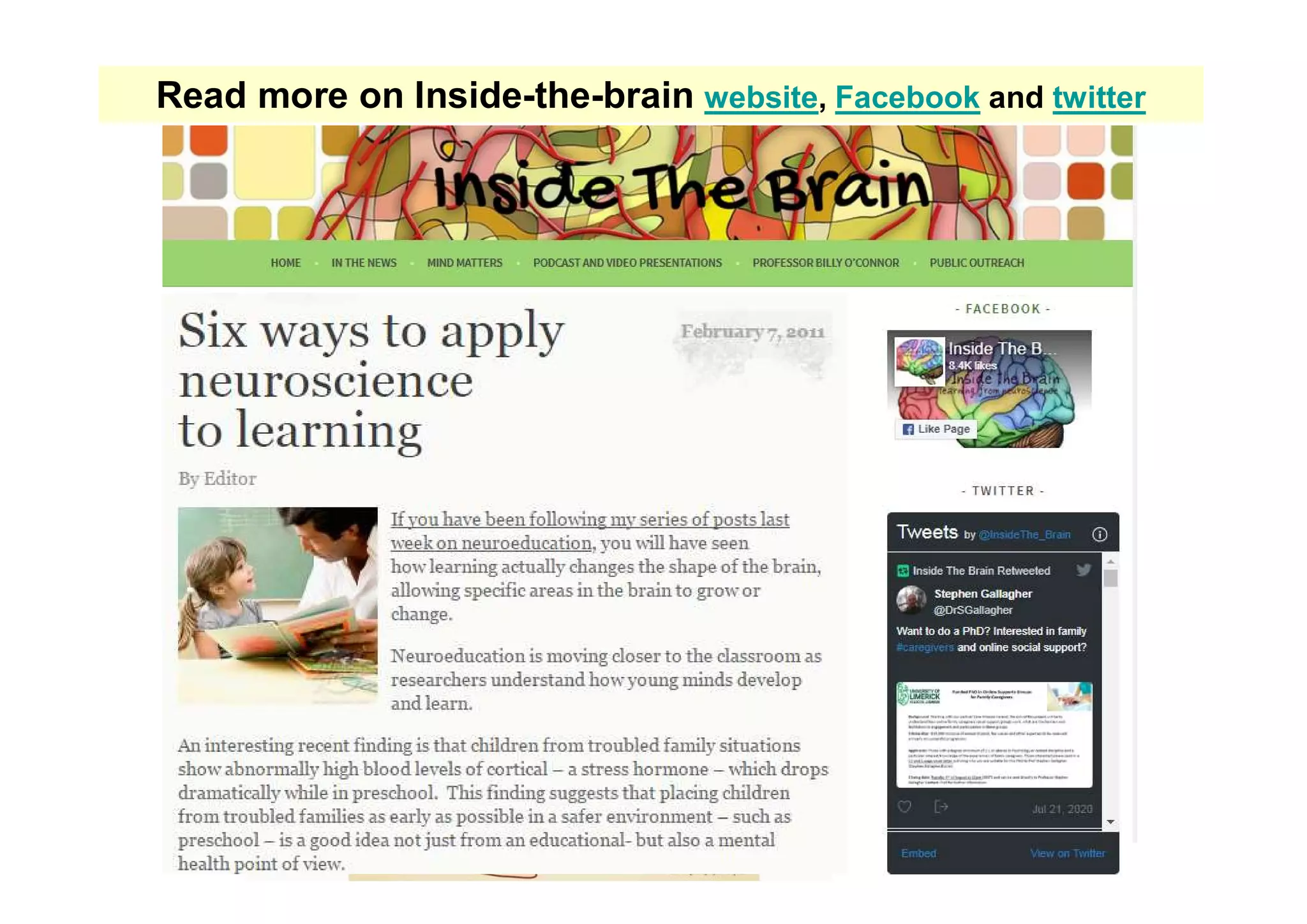
Read more on Inside-the-brain website, Facebook and twitter
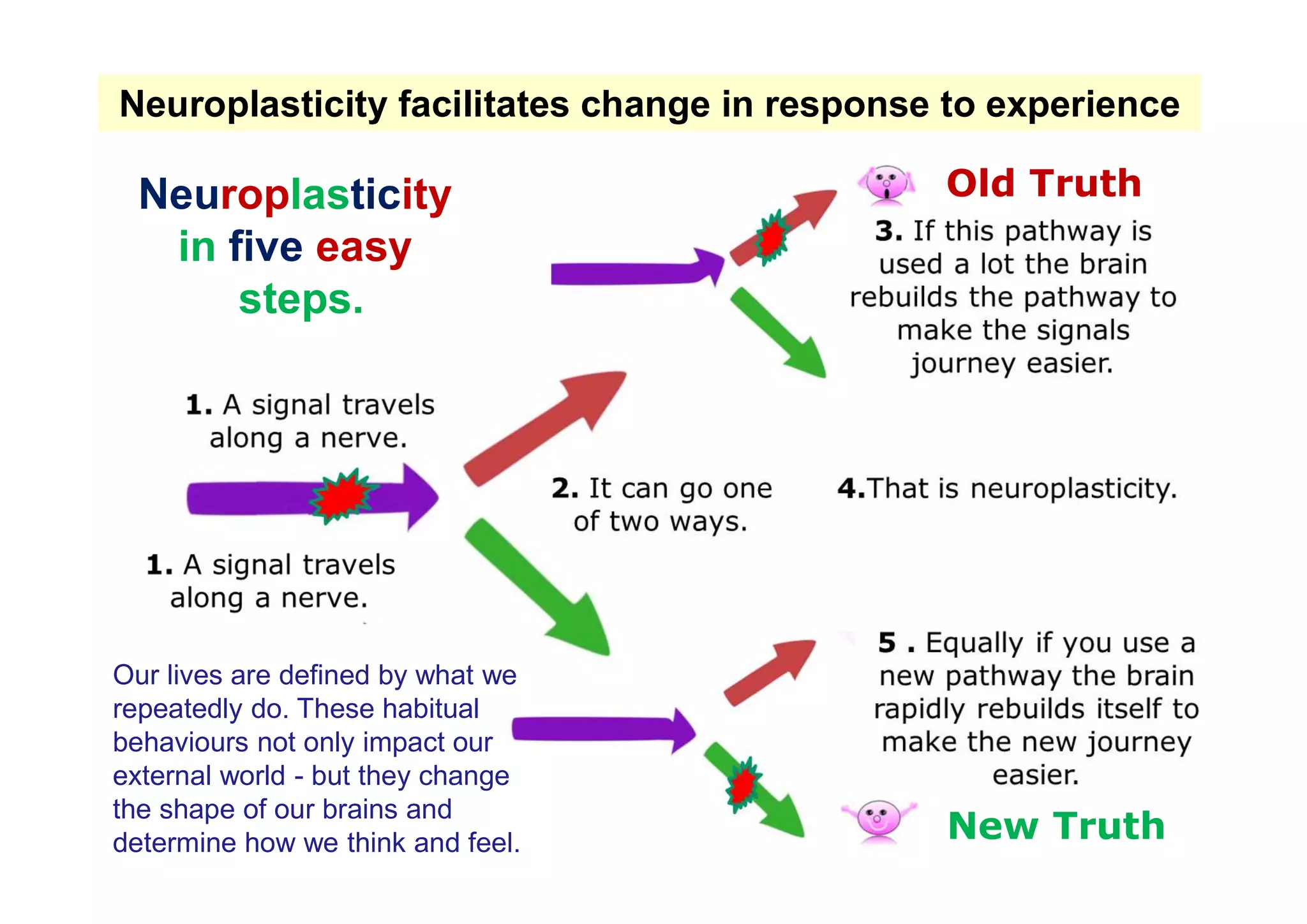
Neuroplasticity facilitates change in response to experience
Neuroplasticity
in five easy
steps.
Our lives are defined by what we
repeatedly do. These habitual
behaviours not only impact our
external world - but they change
the shape of our brains and
determine how we think and feel.
Old Truth
New Truth
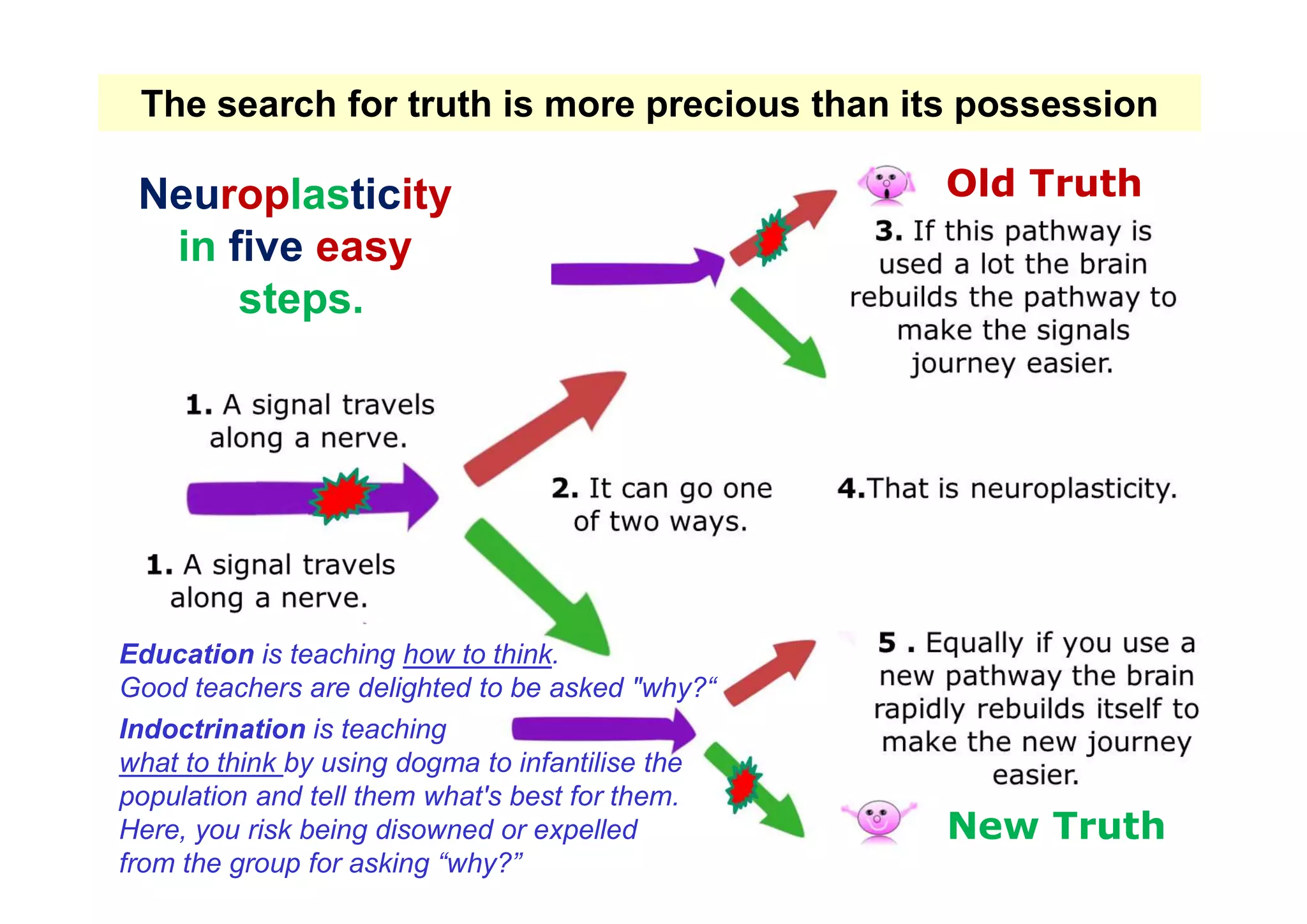
The search for truth is more precious than its possession
Neuroplasticity
in five easy
steps.
Old Truth
New Truth
Education is teaching how to think.
Good teachers are delighted to be asked "why?“
Indoctrination is teaching
what to think by using dogma to infantilise the
population and tell them what's best for them.
Here, you risk being disowned or expelled
from the group for asking “why?”
Don’t stop believing, but ensure that what you believe is
grounded in truth
Mental health is two things: (i) being in touch with reality and (ii) being open
to new experiences. But here’s the thing – there is no reality only perception.
Understand that the world is not necessarily as you perceive it. Everyone
has filters and only by acknowledging them can you begin to get a clearer
picture. Even in a close relationship the same simple act can be viewed
differently. A man will see paying all the bills as his duty while his wife will
see it as an act of love.
Appreciate that your views might be prejudices.
Most importantly make sure that the perceptions you do retain or adopt are
grounded in verifiable fact and can be tested. Otherwise any actions you
take based on your beliefs will be on shaky ground.
Source: Using Your Brain To Improve Your Own Mental Health (inside-the-brain.com)
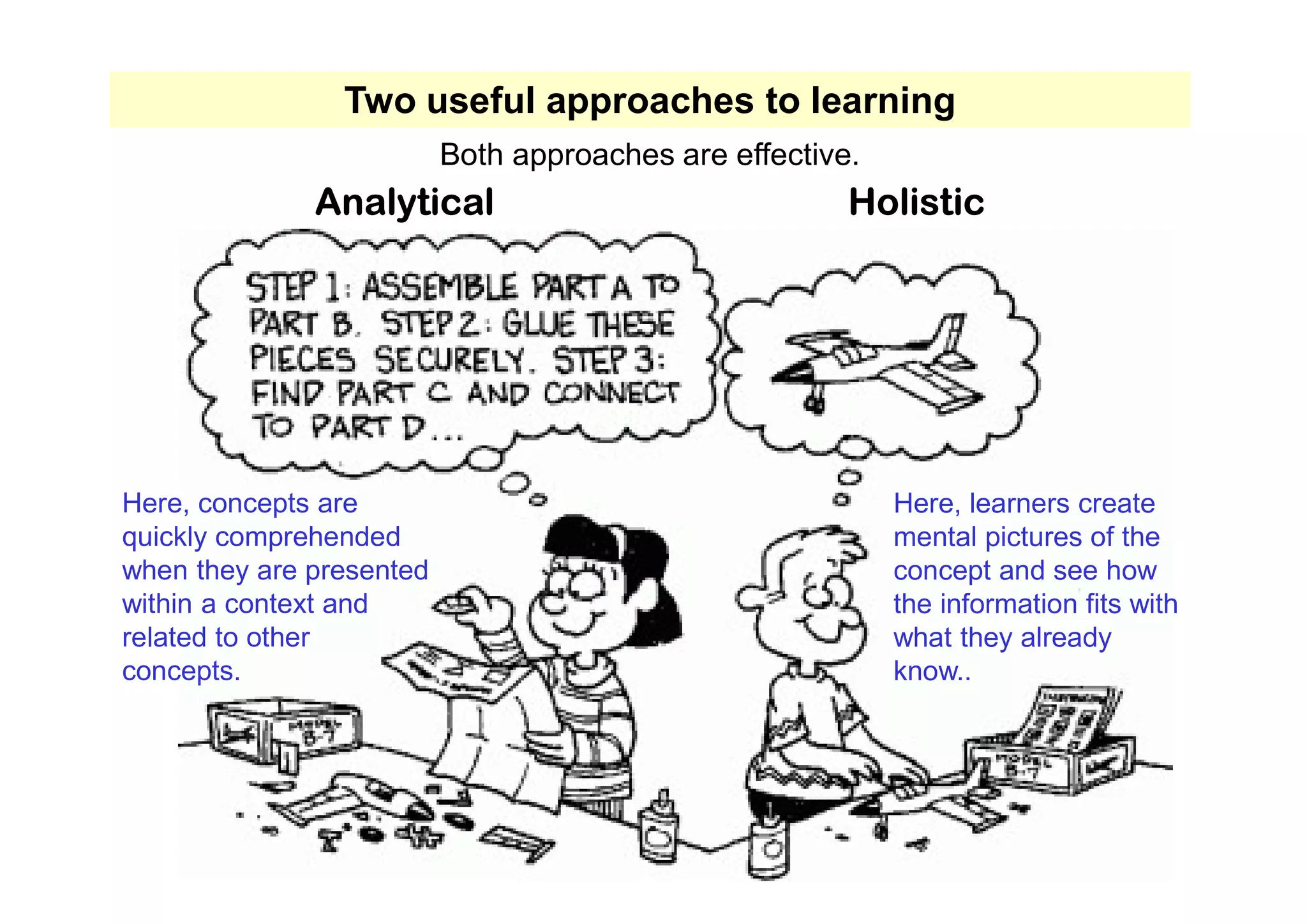
Two useful approaches to learning
Both approaches are effective.
Here, concepts are
quickly comprehended
when they are presented
within a context and
related to other
concepts.
Here, learners create
mental pictures of the
concept and see how
the information fits with
what they already
know..
Analytical Holistic
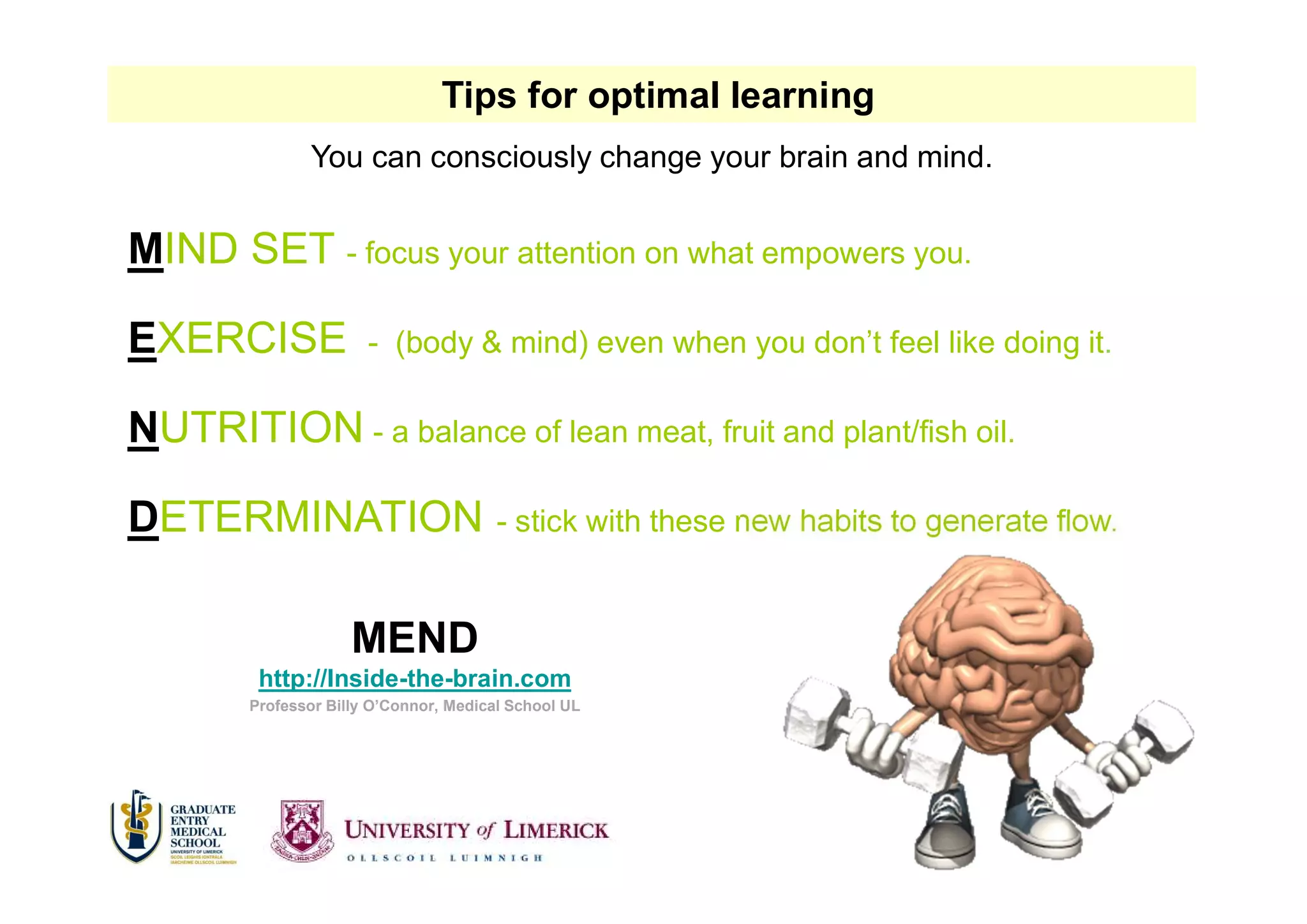
MIND SET - focus your attention on what empowers you.
EXERCISE - (body & mind) even when you don’t feel like doing it.
NUTRITION - a balance of lean meat, fruit and plant/fish oil.
DETERMINATION - stick with these new habits to generate flow.
You can consciously change your brain and mind.
Tips for optimal learning
MEND
http://Inside-the-brain.com
Professor Billy O’Connor, Medical School UL
1. Deconstruct the skill - Break the skill into smaller and
smaller manageable tasks.
2. Learn enough to self-correct - Get a handful of good
resources about what you want to learn. Learn just enough
so that you can self-correct/self-audit.
3. Remove practice barriers - Distractions such as television,
internet, etc., can get in the way of you doing the work.
4. Practice for at least 20 hours - Pre-commit to practice.
Four tips on how to learn fast
Four simple steps to rapid skill acquisition.
Source :You just need 20 hours to learn anything! ⏱ | by Afroz Chakure | Medium
1. Depending on how it is used, the brain can build new nerve
pathways, circuits, maps and systems. This is called
neuroplasticity.
2. The making and breaking of synaptic contacts is what we
call learning.
3. Two effective approaches to learning are (i) analytical
(building blocks) and (ii) holistic (big picture view).
4. Sometimes you have to take a risk in order to drive new
learning.
5. If you don’t control your attention then someone else will.
6. MEND. Mind Set, Exercise (physical and mental), Nutrition,
and Determination as well as cognition, intelligence,
memory, motivation and perception - all contribute to
learning by focussing attention.
Summary
Read more on Inside-the-brain website, Facebook and twitter
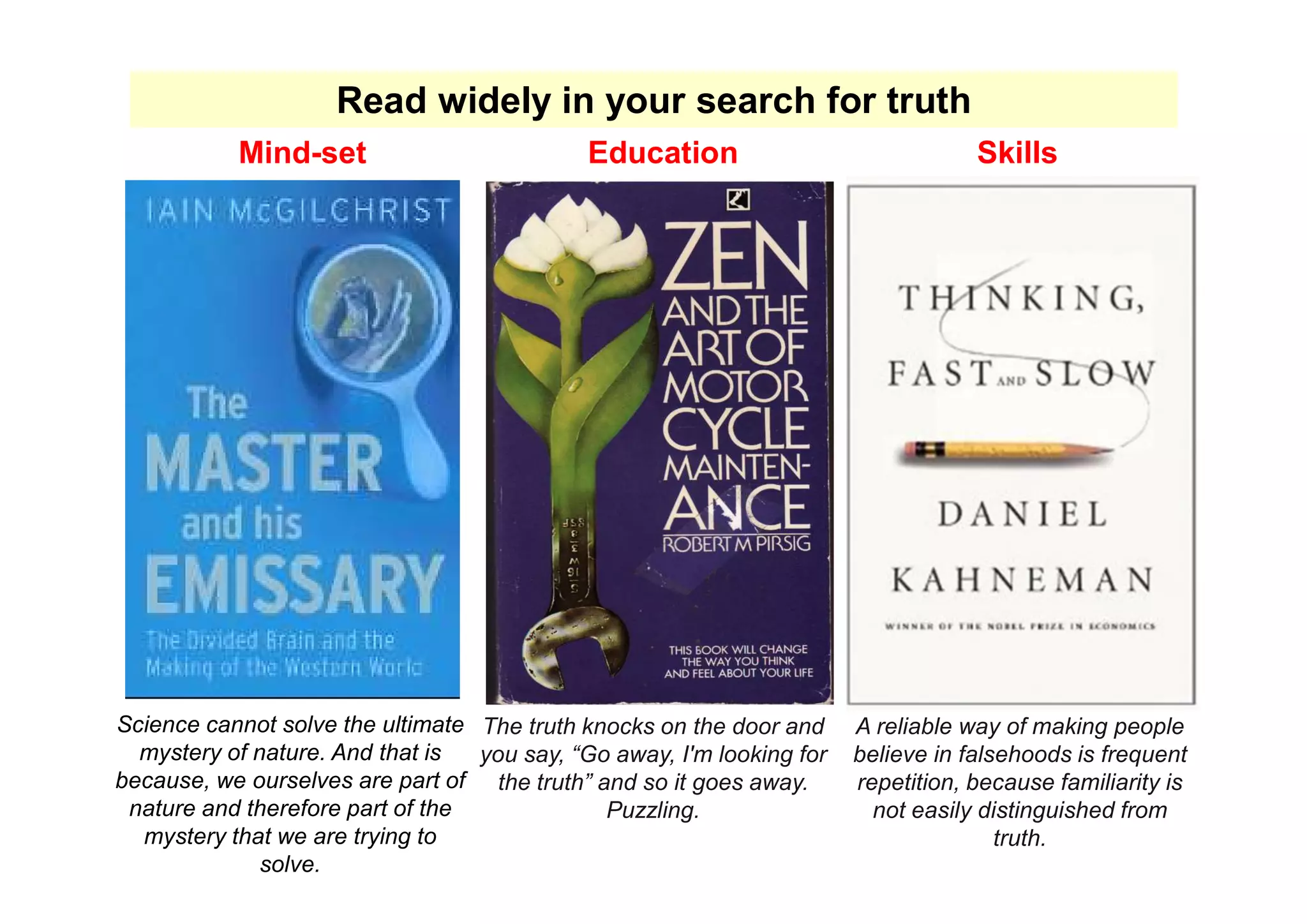
Read widely in your search for truth
Science cannot solve the ultimate
mystery of nature. And that is
because, we ourselves are part of
nature and therefore part of the
mystery that we are trying to
solve.
The truth knocks on the door and
you say, “Go away, I'm looking for
the truth” and so it goes away.
Puzzling.
A reliable way of making people
believe in falsehoods is frequent
repetition, because familiarity is
not easily distinguished from
truth.
Mind-set Education Skills

How to Learn Fast in Challenging Times.pdf

  • 1.
    How to learnfast in challenging times Tips for optimal learning. Billy O’Connor Professor of Physiology University of Limerick School of Medicine. William.OConnor@ul.ie May 26th 2022
  • 2.
    Read more onInside-the-brain website, Facebook and twitter
  • 3.
    Neuroplasticity facilitates changein response to experience Neuroplasticity in five easy steps. Our lives are defined by what we repeatedly do. These habitual behaviours not only impact our external world - but they change the shape of our brains and determine how we think and feel. Old Truth New Truth
  • 4.
    The search fortruth is more precious than its possession Neuroplasticity in five easy steps. Old Truth New Truth Education is teaching how to think. Good teachers are delighted to be asked "why?“ Indoctrination is teaching what to think by using dogma to infantilise the population and tell them what's best for them. Here, you risk being disowned or expelled from the group for asking “why?”
  • 5.
    Don’t stop believing,but ensure that what you believe is grounded in truth Mental health is two things: (i) being in touch with reality and (ii) being open to new experiences. But here’s the thing – there is no reality only perception. Understand that the world is not necessarily as you perceive it. Everyone has filters and only by acknowledging them can you begin to get a clearer picture. Even in a close relationship the same simple act can be viewed differently. A man will see paying all the bills as his duty while his wife will see it as an act of love. Appreciate that your views might be prejudices. Most importantly make sure that the perceptions you do retain or adopt are grounded in verifiable fact and can be tested. Otherwise any actions you take based on your beliefs will be on shaky ground. Source: Using Your Brain To Improve Your Own Mental Health (inside-the-brain.com)
  • 6.
    Two useful approachesto learning Both approaches are effective. Here, concepts are quickly comprehended when they are presented within a context and related to other concepts. Here, learners create mental pictures of the concept and see how the information fits with what they already know.. Analytical Holistic
  • 7.
    MIND SET -focus your attention on what empowers you. EXERCISE - (body & mind) even when you don’t feel like doing it. NUTRITION - a balance of lean meat, fruit and plant/fish oil. DETERMINATION - stick with these new habits to generate flow. You can consciously change your brain and mind. Tips for optimal learning MEND http://Inside-the-brain.com Professor Billy O’Connor, Medical School UL
  • 8.
    1. Deconstruct theskill - Break the skill into smaller and smaller manageable tasks. 2. Learn enough to self-correct - Get a handful of good resources about what you want to learn. Learn just enough so that you can self-correct/self-audit. 3. Remove practice barriers - Distractions such as television, internet, etc., can get in the way of you doing the work. 4. Practice for at least 20 hours - Pre-commit to practice. Four tips on how to learn fast Four simple steps to rapid skill acquisition. Source :You just need 20 hours to learn anything! ⏱ | by Afroz Chakure | Medium
  • 9.
    1. Depending onhow it is used, the brain can build new nerve pathways, circuits, maps and systems. This is called neuroplasticity. 2. The making and breaking of synaptic contacts is what we call learning. 3. Two effective approaches to learning are (i) analytical (building blocks) and (ii) holistic (big picture view). 4. Sometimes you have to take a risk in order to drive new learning. 5. If you don’t control your attention then someone else will. 6. MEND. Mind Set, Exercise (physical and mental), Nutrition, and Determination as well as cognition, intelligence, memory, motivation and perception - all contribute to learning by focussing attention. Summary
  • 10.
    Read more onInside-the-brain website, Facebook and twitter
  • 11.
    Read widely inyour search for truth Science cannot solve the ultimate mystery of nature. And that is because, we ourselves are part of nature and therefore part of the mystery that we are trying to solve. The truth knocks on the door and you say, “Go away, I'm looking for the truth” and so it goes away. Puzzling. A reliable way of making people believe in falsehoods is frequent repetition, because familiarity is not easily distinguished from truth. Mind-set Education Skills