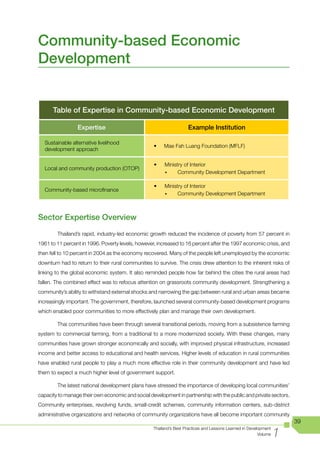
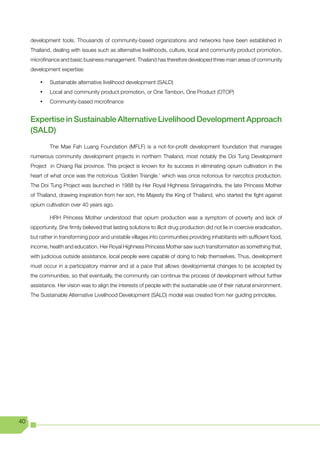
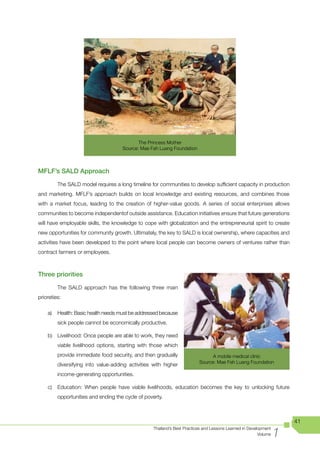
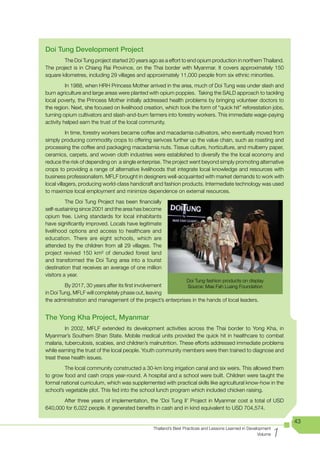
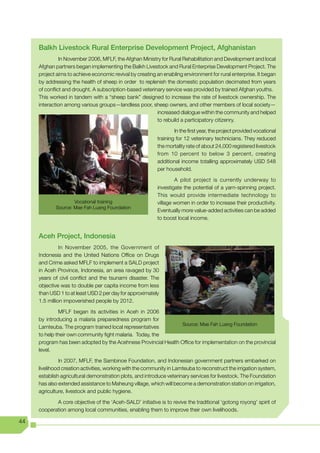
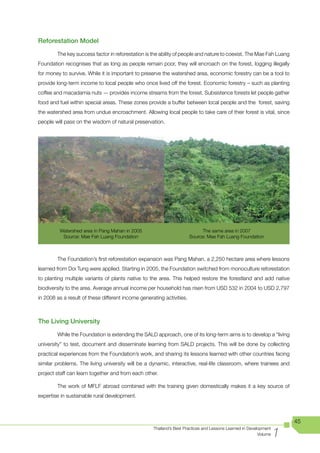
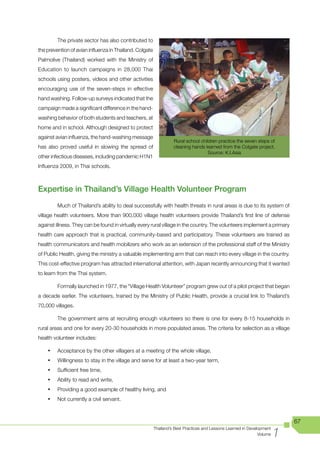
1

                                                               1
Thailand’s Best Practices and Lessons Learned in Development
                                                      Volume
Thailand’s Best Practices
and Lessons Learned in
Development
                            1
Foreword

Thailand has made remarkable progress in the fields of social and economic development in recent decades, which
enabled Thailand to become a middle-income country. According to the first Thailand Millennium Development
Goals Report, 2004, Thailand has already reached almost all targets set in the Millennium Development
Goals (MDGs). Therefore, Thailand has set more ambitious targets, called MDG Plus, that go well beyond the
internationally agreed MDG targets. The development examples of many innovative projects under the royal
patronage of His Majesty King Bhumibol Adulyadej are particularly valuable, and His Majesty’s philosophy on
“Sufficiency Economy” has become a key principle in Thailand’s national development plan and practices.

As Thailand succeeded in its development during the past four decades, The Royal Thai Government has
shared its knowledge and experiences with other developing countries, especially its neighbors in the Greater
Mekong Sub-Region (GMS), through technical cooperation and human resource development. Helping the
development of neighboring countries is among the highest priorities of Thai foreign policy. This has led to
Thailand becoming a training and resource center for development, especially for scholars and practitioners
from other developing countries.

The Thailand International Development Cooperation Agency (TICA) of the Ministry of Foreign Affairs is the main
Government’s coordinating body for technical and development assistance, including managing Thailand’s Official
Development Assistance (ODA). Working closely with TICA and supporting Thailand as an active donor of the
South is the United Nations Development Programme (UNDP) in Thailand. We at TICA would like to express
our gratitude to UNDP for its new initiatives to further strengthen Thailand’s efforts in South-South cooperation
and aid effectiveness. In recognizing the value of Thailand’s development experiences and expertise, UNDP has
provided generous support and finding to this publication on “Thailand’s Best Practices and Lessons Learned
in Development”. The publication’s provides an overview and some examples of Thailand’s areas of expertise
and development achievements (Volume 1), as well as providing and evidence-based resource mapping of
national institutions in the country, called “Sources of Expertise for Thailand’s Best Practices in Development”
(Volume 2). We also appreciate the efforts of the Kenan Institute Asia in collecting, analyzing and summarizing
Thailand’s varied and extensive development experiences. It is our hope that this publication will be useful to
the Thai Government as an advocacy tool to promote Thailand’s development achievements and its available
resource centers, as well as for strategic development cooperation programs with other developing countries
and partners.


                                                                                            Apinan Phatarathiyanon
                                                                                                     Director-General
                                                      Thailand International Development Cooperation Agency


                                                                                                                        i

                                                                                                                  1
                                                   Thailand’s Best Practices and Lessons Learned in Development
                                                                                                         Volume
Table of Contents

                         1
ii
Table of Contents

Foreword ....................................................................................................................................... i

Introduction .................................................................................................................................. 1

Agriculture and Rural Development ............................................................................................. 7

Development in Support of a Sufficiency Economy ................................................................... 23

Community-based Economic Development .............................................................................. 39

Public Health .............................................................................................................................. 57

Natural Resources, Environment, and Energy............................................................................ 75

Tourism ....................................................................................................................................... 97

Other Development Expertise Available in Thailand ................................................................ 109


                                                                                                                                                     iii

                                                                                                                                        1
                                                                   Thailand’s Best Practices and Lessons Learned in Development
                                                                                                                         Volume
Introduction

                    1
iv
Introduction

         Over the past 50 years Thailand has developed from a low-income nation that produced only basic
commodities to a middle-level, diversified economy that has balanced strengths in agriculture, industry and
services. At the same time, Thailand has developed expertise in public health, community development, and
environmental protection. As in every other country, Thailand’s development has not been without problems or
setbacks, but key organizations in Thailand have learned valuable lessons from those challenges, which they
are ready make available to other developing countries. These lessons come from too many areas of social and
economic development to document them all in a report of this length.


Therefore seven key areas of expertise have been identified for highlighting in this
report. These are:
    •	   Agriculture and rural development

    •	   Development in support of a sufficiency economy

    •	   Community-based economic development

    •	   Public health

    •	   Management of natural resources, environment, and energy

    •	   Tourism

    •	   Other development expertise available in Thailand


         Thailand’s Official Development Assistance (ODA) consists of grants and concessionary loans provided
by the Royal Thailand Government to other developing countries. The main Royal Thai Government donors of
ODA are the Thailand International Development Cooperation Agency (TICA) of the Ministry of Foreign Affairs,
the Export-Import Bank of Thailand (EXIM Thailand), and the Neighbouring Countries Economic Development
Cooperation Agency (Public Organization) (NEDA) based in the Ministry of Finance. Thailand became a donor
of ODA in 1992 after many years of providing informal technical assistance, training and scholarships to other
developing countries. This official assistance is provided by the Thai government because of its long-term
commitment to international development, regional integration, and most importantly, to the development of
Thailand’s neighbors in the Greater Mekong Sub-Region and its partners in the Association of Southeast Asian
Nations (ASEAN). Thailand also supports United Nations (UN) agencies and other international development
organizations headquartered in Thailand. Organizations such as the World Health Organization, Family Health
International, the US Agency for International Development and the Rockefeller Foundation have regional
offices in Bangkok that benefit from Thai government support and Bangkok’s strategic location. Assisting the
development of neighboring countries is one of the highest priorities of Thai foreign policy. Policy direction for

                                                                                                                       1

                                                                                                                   1
                                                    Thailand’s Best Practices and Lessons Learned in Development
                                                                                                          Volume
this assistance comes from the “Neighboring Countries Economic Development Cooperation Committee”
    chaired by the Prime Minister. Much of Thai ODA has been based on Thailand’s own development experience
    and focused on promoting public health, improving education, advancing agriculture, reducing illicit trafficking
    of people and narcotics, and building key infrastructure. Thailand’s program of international assistance is well-
    documented in the TICA publication “Thailand Official Development Assistance (ODA) Report 2007–2008.”

             TICA, however, recognizes that Thailand’s value to its developing country partners and friends goes
    well beyond official assistance and has the potential for significant increase if the expertise available in Thailand
    were better known and more easily accessed. Therefore, this report is meant to provide a broader picture of
    Thailand’s development experience and the best practices that have evolved out of that experience. Support
    for this report has come from the UN Development Programme (UNDP), indicating the value that the UNDP
    sees in Thailand’s development experience and its interest in supporting the dissemination of that experience.

             This report focuses on appropriate expertise for other developing countries that can be transferred
    through training, consultancy, site visits and materials. It is expected that some of this expertise transfer can be
    supported by UNDP and other multilateral or bilateral development agencies as well as Thailand’s ODA program.
    Transfer of expertise can also take place through TICA’s program “Friends from Thailand,” which supports Thai
    volunteers to work in partner countries. In other cases, the sources of expertise can be contacted directly for
    help, especially for training and site visits.

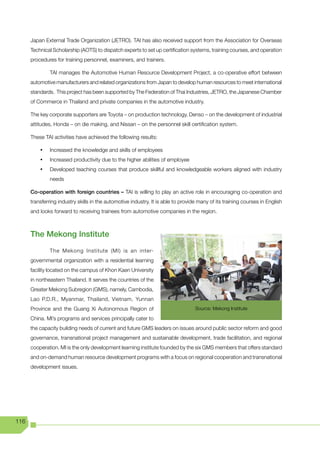
             Some of Thailand’s development expertise originated from international development projects funded by
    international development agencies, but in almost all cases, the experience of implementing projects in Thailand
    has led to adjustments and refinements that make it more applicable to the developing country situation. There
    is also a great deal of expertise that has been developed by indigenous organizations working on their own to
    find creative and appropriate solutions to development problems.

             Of particular importance are the efforts led by Thailand’s royal family and the personal commitment
    and technical expertise of His Majesty King Bhumibol Adulyadej. Truly a “development monarch,” His Majesty
    King Bhumibol has focused His Majesty considerable efforts, attention and resources on development for more
    than half a century. Those efforts have borne particular fruit in community development, small-scale agriculture,
    highland development, water resource management and rain-making. The impact of royal development projects
    has extended beyond their immediate scope because the lessons learned from those projects have been
    generously made available to all those interested, whether from Thailand or abroad.

             The types of development expertise available in Thailand are varied and the organizations that can
    transfer this expertise are many. They include government agencies, institutes, community organizations, UN
    agencies and other international development organizations, NGOs and private companies that are located in
    Thailand.

             The key areas of Thailand’s development experience addressed in this report are described briefly
    below, with more detailed information in separate sections and in the list of sources of development expertise
    in volume two of this report.


2
Agriculture and Rural Development
        With more than half of Thailand’s population involved in agriculture, this sector has been of particular
importance to national development. In the past 40 years, Thai farmers and agricultural organizations have used
research, technology and on-the-farm learning to develop their own new techniques that have helped Thailand
become one of the largest food exporters in Asia.

        Farm productivity has steadily improved and better processing and storage technologies have increased
the value of Thai agricultural products around the world. Thailand continues to maintain its position as the world’s
leading exporter of rice, rubber, canned pineapple, and tiger prawns. It is also a globally ranked producer of
fish, chicken meat, tapioca, and sugar. Thai agricultural expertise ranges from high-tech methods based on
cutting-edge research to practical small-farm methodologies that require little investment.


Development in Support of a Sufficiency Economy
        Following the 1997 economic crisis, Thailand sought ways to reduce the impact of global volatility
on its domestic development and to ensure that the rapid change within the Thai economy did not adversely
impact the natural environment or deprive the rural poor of an acceptable quality of life. This was a particular
concern of His Majesty King Bhumibol and a theme in his long and successful efforts to foster development.
Based on his extensive experience, His Majesty King Bhumibol has formulated what he calls the “sufficiency
economy” philosophy. This approach emphasizes moderation, appropriate technology, careful management of
risk and flexibility in dealing with change. Implemented in a wide range of projects and geographical areas, the
“sufficiency economy” methodology has helped hundreds of thousands of people, especially those in remote
areas with few natural advantages.

        The Thai government incorporated this philosophy into the 2002-2006 national development plan,
resulting in a positive impact on many areas of development. Royal research centers, foundations and projects
provide opportunities for other countries to learn more about this valuable approach to development.


Community-based Economic Development
        Thailand’s experience in community-based development is closely related to the sufficiency economy
concept. This type of development emphasizes strengthening communities so they can withstand external
economic shocks, such as the 1997 Asian financial crisis and the 2009 global downturn, and provide a stable
base for improving the quality of life for community members. A key element of this approach is getting active
and informed participation from the people so that development is based on their own needs and aspirations.
This “bottom-up” type of development still needs inputs, information, technology and support from outside the
community, but ensures that key decisions are under the control of the community itself. Community-based
development in Thailand has led to expertise in implementing a range of critical development mechanisms


                                                                                                                        3

                                                                                                                    1
                                                     Thailand’s Best Practices and Lessons Learned in Development
                                                                                                           Volume
that include community enterprises, revolving funds, small-credit schemes, community information centers,
    sub-district administrative organizations and networks of community organizations. Of particular importance is
    the development of expertise in “sustainable alternative livelihood development,” local and community product
    promotion and community-based microfinance.


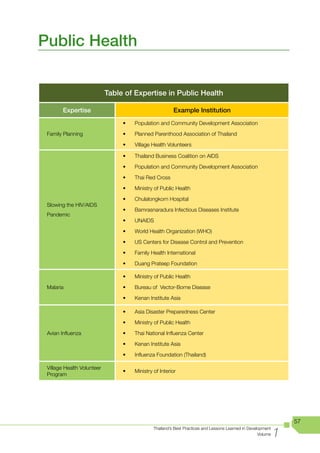
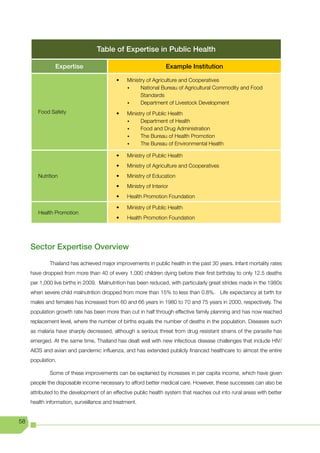
    Public Health
             While much attention has been paid to Thailand’s economic development over the past 40 years,
    improvements in public health have been at least equally striking. Infant mortality has dropped from more than
    40 deaths per every 1,000 children born to only 12.5 deaths per 1,000 in 2009. In the 20 years prior to 2000,
    the life expectancy of men increased by 17 percent and of women by 14 percent. Effective family planning
    has cut the population growth rate by more than half and women no longer need to suffer from unwanted
    pregnancy. Despite the threats from emerging diseases such as HIV/AIDS and avian and pandemic influenza
    as well as increasing drug resistance of diseases such as malaria, the impact of infectious diseases has sharply
    decreased. A new, national, publicly-financed health system has extended affordable healthcare to virtually the
    entire population. Thai expertise has been developed in areas such as family planning, HIV/AIDS treatment and
    prevention, epidemiology, infectious disease surveillance, food safety, village health volunteer programs, health
    and nutrition promotion and the adoption of a universal health coverage system.


    Natural Resources, Environment and Energy
             Concerns over the impact of Thailand’s rapid industrialization on the natural environment has led to
    the development of mechanisms and expertise in the effective management of the natural environment and
    care for key resources such as soil, water and renewable sources of energy. The development of expertise in
    renewable energy and energy conservation is due to increasing concerns about global climate change. Thailand
    has used a combination of international expertise and its own “local wisdom” in devising an efficient national
    irrigation system, effective low-tech water controls, soil conservation, community forestry, national parks and
    drought relief.


    Tourism
             Thailand’s emergence as the third largest tourist country in Asia and one of the highest rated tourist
    destinations in the world has come as a result of natural advantages, local-international cooperation and learning
    from experience. Tourist arrivals have grown from less than 50,000 in 1960 to more than 14 million in 2008.
    These arrivals provide jobs for more than 3 million Thais and supply more than 6 percent of the GDP. Thailand,
    however, has increasingly developed expertise that goes beyond attracting larger and larger numbers of tourists
    and focuses on sustainable approaches to tourism that preserve nature and local culture while contributing to
    village economies.


4
Other Development Expertise
        In addition to expertise in particular areas of development, many organizations have significant
capabilities in the design and implementation of overall and holistic development. Thailand’s public and private
universities have developed significant knowledge that they can transfer to the international community through
degree and non-degree courses, research collaboration, and consulting. Most leading Thai universities now
have international programs in English and actively seek international students. Thailand also has become
a major regional center of development expertise, with numerous regional UN offices, such as the regional
headquarters for UN Development Programme (UNDP) and the UN Economic and Social Commission for Asia
and the Pacific (UNESCAP), and headquarters for many bilaterial development agencies, such as USAID’s
Regional Development Mission for Asia (RDMA), located in Bangkok. A wide range of non-profit development
organizations are also located in Thailand. These include international NGOs as well as local organizations such
as the Mekong Institute, the Population and Community Development Association and the Kenan Institute Asia.

        Thailand, therefore, has great breadth and depth in the development expertise it can offer to other
countries. Much of this expertise has been hard-won from difficult experience and much of it has come from
collaborating with other countries. Most importantly, the many development organizations – Thai government,
international, for-profit and non-profit – understand the value of sharing their experiences with others.


                                                                                                                       5

                                                                                                                   1
                                                    Thailand’s Best Practices and Lessons Learned in Development
                                                                                                          Volume
Agriculture and
    Rural Development
                        1
6
Agriculture and Rural Development


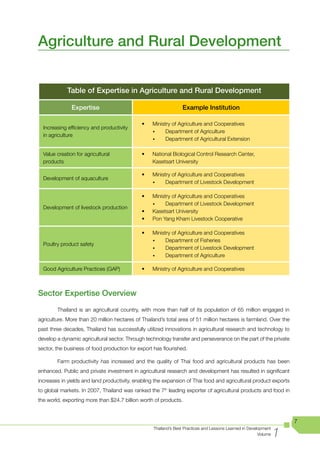
             Table of Expertise in Agriculture and Rural Development

               Expertise                                         Example Institution

                                           	 •		   Ministry	of	Agriculture	and	Cooperatives
  Increasing efficiency and productivity
                                                   w     Department of Agriculture
  in agriculture
                                                   w     Department of Agricultural Extension

  Value creation for agricultural          	 •		   National	Biological	Control	Research	Center,	
  products                                         Kasetsart University

                                           	 •		   Ministry	of	Agriculture	and	Cooperatives
  Development of aquaculture
                                                   w     Department of Livestock Development

                                           	 •		   Ministry	of	Agriculture	and	Cooperatives
                                                   w     Department of Livestock Development
  Development of livestock production
                                           	 •		   Kasetsart	University
                                           	 •		   Pon	Yang	Kham	Livestock	Cooperative	

                                           	 •		   Ministry	of	Agriculture	and	Cooperatives
                                                   w     Department of Fisheries
  Poultry product safety
                                                   w     Department of Livestock Development
                                                   w     Department of Agriculture

  Good Agriculture Practices (GAP)         	 •		   Ministry	of	Agriculture	and	Cooperatives


Sector Expertise Overview
        Thailand is an agricultural country, with more than half of its population of 65 million engaged in
agriculture. More than 20 million hectares of Thailand’s total area of 51 million hectares is farmland. Over the
past three decades, Thailand has successfully utilized innovations in agricultural research and technology to
develop a dynamic agricultural sector. Through technology transfer and perseverance on the part of the private
sector, the business of food production for export has flourished.

        Farm productivity has increased and the quality of Thai food and agricultural products has been
enhanced. Public and private investment in agricultural research and development has resulted in significant
increases in yields and land productivity, enabling the expansion of Thai food and agricultural product exports
to global markets. In 2007, Thailand was ranked the 7th leading exporter of agricultural products and food in
the world, exporting more than $24.7 billion worth of products.


                                                                                                                      7

                                                                                                                  1
                                                   Thailand’s Best Practices and Lessons Learned in Development
                                                                                                         Volume
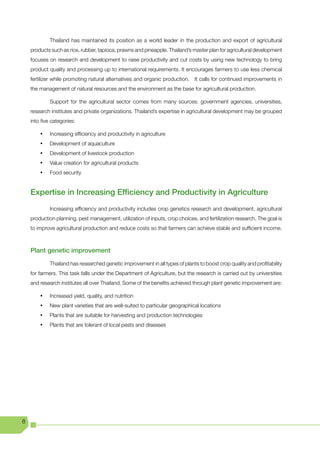
Thailand has maintained its position as a world leader in the production and export of agricultural
    products such as rice, rubber, tapioca, prawns and pineapple. Thailand’s master plan for agricultural development
    focuses on research and development to raise productivity and cut costs by using new technology to bring
    product quality and processing up to international requirements. It encourages farmers to use less chemical
    fertilizer while promoting natural alternatives and organic production. It calls for continued improvements in
    the management of natural resources and the environment as the base for agricultural production.

             Support for the agricultural sector comes from many sources: government agencies, universities,
    research institutes and private organizations. Thailand’s expertise in agricultural development may be grouped
    into five categories:

        •	   Increasing efficiency and productivity in agriculture
        •	   Development of aquaculture
        •	   Development of livestock production
        •	   Value creation for agricultural products
        •	   Food security


    Expertise in Increasing Efficiency and Productivity in Agriculture
             Increasing efficiency and productivity includes crop genetics research and development, agricultural
    production planning, pest management, utilization of inputs, crop choices, and fertilization research. The goal is
    to improve agricultural production and reduce costs so that farmers can achieve stable and sufficient income.


    Plant genetic improvement

             Thailand has researched genetic improvement in all types of plants to boost crop quality and profitability
    for farmers. This task falls under the Department of Agriculture, but the research is carried out by universities
    and research institutes all over Thailand. Some of the benefits achieved through plant genetic improvement are:

        •	   Increased yield, quality, and nutrition
        •	   New plant varieties that are well-suited to particular geographical locations
        •	   Plants that are suitable for harvesting and production technologies
        •	   Plants that are tolerant of local pests and diseases


8
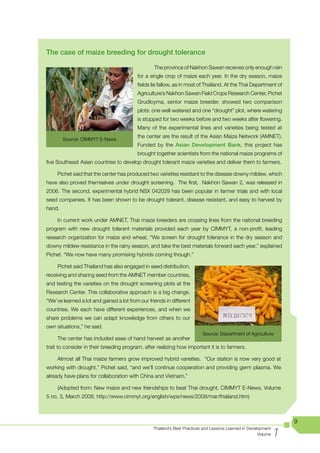
The case of maize breeding for drought tolerance

                                                  The province of Nakhon Sawan receives only enough rain
                                          for a single crop of maize each year. In the dry season, maize
                                          fields lie fallow, as in most of Thailand. At the Thai Department of
                                          Agriculture’s Nakhon Sawan Field Crops Research Center, Pichet
                                          Grudloyma, senior maize breeder, showed two comparison
                                          plots: one well-watered and one “drought” plot, where watering
                                          is stopped for two weeks before and two weeks after flowering.
                                          Many of the experimental lines and varieties being tested at
                                          the center are the result of the Asian Maize Network (AMNET).
        Source:	CIMMYT	E-News
                                          Funded by the Asian Development Bank, this project has
                                          brought together scientists from the national maize programs of
five Southeast Asian countries to develop drought tolerant maize varieties and deliver them to farmers.

     Pichet said that the center has produced two varieties resistant to the disease downy mildew, which
have also proved themselves under drought screening. The first, Nakhon Sawan 2, was released in
2006. The second, experimental hybrid NSX 042029 has been popular in farmer trials and with local
seed companies. It has been shown to be drought tolerant, disease resistant, and easy to harvest by
hand.

     In current work under AMNET, Thai maize breeders are crossing lines from the national breeding
program	 with	 new	 drought	 tolerant	 materials	 provided	 each	 year	 by	 CIMMYT,	 a	 non-profit,	 leading	
research organization for maize and wheat. “We screen for drought tolerance in the dry season and
downy mildew resistance in the rainy season, and take the best materials forward each year,” explained
Pichet. “We now have many promising hybrids coming though.”

     Pichet said Thailand has also engaged in seed distribution,
receiving and sharing seed from the AMNET member countries,
and testing the varieties on the drought screening plots at the
Research Center. This collaborative approach is a big change.
“We’ve learned a lot and gained a lot from our friends in different
countries. We each have different experiences, and when we
share problems we can adapt knowledge from others to our
own situations,” he said.
                                                                          Source: Department of Agriculture
     The center has included ease of hand harvest as another
trait to consider in their breeding program, after realizing how important it is to farmers.

     Almost all Thai maize farmers grow improved hybrid varieties. “Our station is now very good at
working with drought,” Pichet said, “and we’ll continue cooperation and providing germ plasma. We
already have plans for collaboration with China and Vietnam.”

	    (Adopted	from:	New	maize	and	new	friendships	to	beat	Thai	drought,	CIMMYT	E-News,	Volume	
5 no. 3, March 2008, http://www.cimmyt.org/english/wps/news/2008/mar/thailand.htm)


                                                                                                                    9

                                                                                                                1
                                                 Thailand’s Best Practices and Lessons Learned in Development
                                                                                                       Volume
Pest management

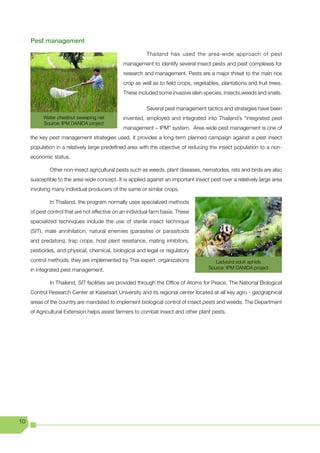
                                                          Thailand has used the area-wide approach of pest
                                               management to identify several insect pests and pest complexes for
                                               research and management. Pests are a major threat to the main rice
                                               crop as well as to field crops, vegetables, plantations and fruit trees.
                                               These included some invasive alien species, insects,weeds and snails.

                                                          Several pest management tactics and strategies have been
           Water chestnut sweeping net         invented, employed and integrated into Thailand’s “integrated pest
           Source: IPM DANIDA project
                                               management – IPM” system. Area-wide pest management is one of
     the key pest management strategies used. It provides a long-term planned campaign against a pest insect
     population in a relatively large predefined area with the objective of reducing the insect population to a non-
     economic status.

             Other non-insect agricultural pests such as weeds, plant diseases, nematodes, rats and birds are also
     susceptible to the area-wide concept. It is applied against an important insect pest over a relatively large area
     involving many individual producers of the same or similar crops.

             In Thailand, the program normally uses specialized methods
     of pest control that are not effective on an individual farm basis. These
     specialized techniques include the use of sterile insect technique
     (SIT), male annihilation, natural enemies (parasites or parasitoids
     and predators), trap crops, host plant resistance, mating inhibitors,
     pesticides, and physical, chemical, biological and legal or regulatory
     control methods; they are implemented by Thai expert organizations                 Ladybird adult aphids
     in integrated pest management.                                                  Source: IPM DANIDA project


             In Thailand, SIT facilities are provided through the Office of Atoms for Peace. The National Biological
     Control Research Center at Kasetsart University and its regional center located at all key agro - geographical
     areas of the country are mandated to implement biological control of insect pests and weeds. The Department
     of Agricultural Extension helps assist farmers to combat insect and other plant pests.


10
The case of area-wide integrated control of fruit flies

            Two species of fruit flies with an economic impact occur in Southeast Asia: the Oriental fruit
   fly, Bactrocera dorsalis, and the guava fruit fly, B. correcta, Bezzi, the key pest attacking mango trees.
   These two species attack a wide range of soft fruits, and are classified as a primary quarantine pest for
   many of Thailand’s trading partners.

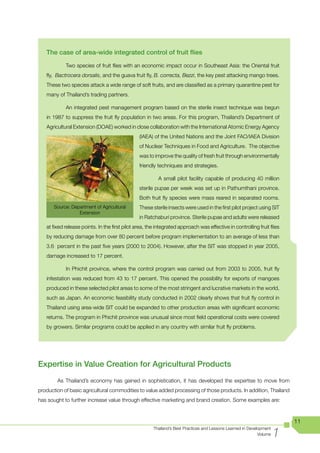
            An integrated pest management program based on the sterile insect technique was begun
   in 1987 to suppress the fruit fly population in two areas. For this program, Thailand’s Department of
   Agricultural Extension (DOAE) worked in close collaboration with the International Atomic Energy Agency
                                                (IAEA) of the United Nations and the Joint FAO/IAEA Division
                                                of Nuclear Techniques in Food and Agriculture. The objective
                                                was to improve the quality of fresh fruit through environmentally
                                                friendly techniques and strategies.

                                                         A small pilot facility capable of producing 40 million
                                                sterile pupae per week was set up in Pathumthani province.
                                                Both fruit fly species were mass reared in separated rooms.
      Source: Department of Agricultural        These sterile insects were used in the first pilot project using SIT
                 Extension
                                                in Ratchaburi province. Sterile pupae and adults were released
   at fixed release points. In the first pilot area, the integrated approach was effective in controlling fruit flies
   by reducing damage from over 80 percent before program implementation to an average of less than
   3.6 percent in the past five years (2000 to 2004). However, after the SIT was stopped in year 2005,
   damage increased to 17 percent.

            In Phichit province, where the control program was carried out from 2003 to 2005, fruit fly
   infestation was reduced from 43 to 17 percent. This opened the possibility for exports of mangoes
   produced in these selected pilot areas to some of the most stringent and lucrative markets in the world,
   such as Japan. An economic feasibility study conducted in 2002 clearly shows that fruit fly control in
   Thailand using area-wide SIT could be expanded to other production areas with significant economic
   returns. The program in Phichit province was unusual since most field operational costs were covered
   by growers. Similar programs could be applied in any country with similar fruit fly problems.


Expertise in Value Creation for Agricultural Products
        As Thailand’s economy has gained in sophistication, it has developed the expertise to move from
production of basic agricultural commodities to value added processing of those products. In addition, Thailand
has sought to further increase value through effective marketing and brand creation. Some examples are:


                                                                                                                          11

                                                                                                                      1
                                                       Thailand’s Best Practices and Lessons Learned in Development
                                                                                                             Volume
Coconut oil extraction

             The coconut palm has long been a source of food, with different parts of the plant providing value in
     their basic state, including the meat, the husk, the fronds, the water and the cream and oil that can be extracted
     from the meat.

             Thailand’s Department of Agriculture, especially its Product and Processing Research and Development
     Group and its Postharvest and Product Processing Research and Development Office, has studied various
     techniques of coconut oil extraction. This work has resulted in higher quality coconut oil as well as improvement
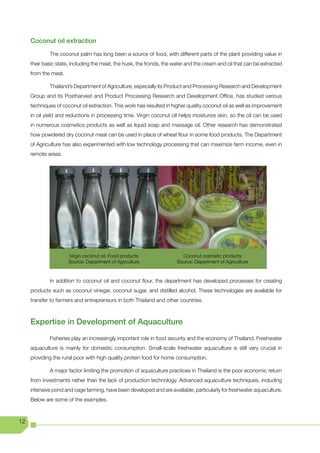
     in oil yield and reductions in processing time. Virgin coconut oil helps moisturize skin, so the oil can be used
     in numerous cosmetics products as well as liquid soap and massage oil. Other research has demonstrated
     how powdered dry coconut meat can be used in place of wheat flour in some food products. The Department
     of Agriculture has also experimented with low technology processing that can maximize farm income, even in
     remote areas.


                      Virgin coconut oil: Food products                  Coconut cosmetic products
                      Source: Department of Agriculture                Source: Department of Agriculture


             In addition to coconut oil and coconut flour, the department has developed processes for creating
     products such as coconut vinegar, coconut sugar, and distilled alcohol. These technologies are available for
     transfer to farmers and entrepreneurs in both Thailand and other countries.


     Expertise in Development of Aquaculture
             Fisheries play an increasingly important role in food security and the economy of Thailand. Freshwater
     aquaculture is mainly for domestic consumption. Small-scale freshwater aquaculture is still very crucial in
     providing the rural poor with high quality protein food for home consumption.

             A major factor limiting the promotion of aquaculture practices in Thailand is the poor economic return
     from investments rather than the lack of production technology. Advanced aquaculture techniques, including
     intensive pond and cage farming, have been developed and are available, particularly for freshwater aquaculture.
     Below are some of the examples.


12
Tilapia culture using natural materials

         Thailand has made good advances in the production of Tilapia, a species of freshwater fish that is easy
to breed, tastes good and can live in both fresh and brackish water. To reduce the costs of raising Tilapia, Thai
experts have tested methods of Tilapia production using locally available, natural materials. Such materials
reduce potential dangers from chemicals and reduce environmental impacts, and include natural fermented
fertilizer and “Efficient Microbes” (EM) solutions. Natural fermented fertilizer is made by mixing dry cow dung
with rice husks, rice bran, EM solution, molasses and water. EM is a natural technology developed over 25
years that is used around the world. It is based on lactic acid bacteria (commonly found in yogurt and cheeses),
yeast (bread and beer), and phototrophic bacteria (related to blue-green algae).


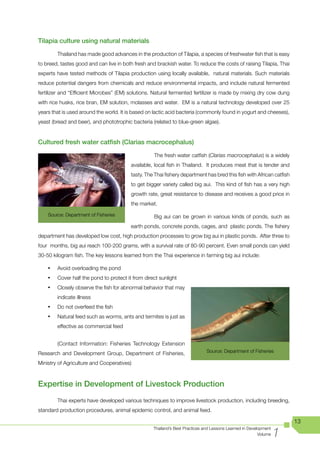
Cultured fresh water catfish (Clarias macrocephalus)

                                                    The fresh water catfish (Clarias macrocephalus) is a widely
                                          available, local fish in Thailand. It produces meat that is tender and
                                          tasty. The Thai fishery department has bred this fish with African catfish
                                          to get bigger variety called big aui. This kind of fish has a very high
                                          growth rate, great resistance to disease and receives a good price in
                                          the market.

    Source: Department of Fisheries                 Big aui can be grown in various kinds of ponds, such as
                                          earth ponds, concrete ponds, cages, and plastic ponds. The fishery
department has developed low cost, high production processes to grow big aui in plastic ponds. After three to
four months, big aui reach 100-200 grams, with a survival rate of 80-90 percent. Even small ponds can yield
30-50 kilogram fish. The key lessons learned from the Thai experience in farming big aui include:

    •	   Avoid overloading the pond
    •	   Cover half the pond to protect it from direct sunlight
    •	   Closely observe the fish for abnormal behavior that may
         indicate illness
    •	   Do not overfeed the fish
    •	   Natural feed such as worms, ants and termites is just as
         effective as commercial feed


         (Contact Information: Fisheries Technology Extension
Research and Development Group, Department of Fisheries,                       Source: Department of Fisheries

Ministry of Agriculture and Cooperatives)


Expertise in Development of Livestock Production
         Thai experts have developed various techniques to improve livestock production, including breeding,
standard production procedures, animal epidemic control, and animal feed.

                                                                                                                       13

                                                                                                                   1
                                                    Thailand’s Best Practices and Lessons Learned in Development
                                                                                                          Volume
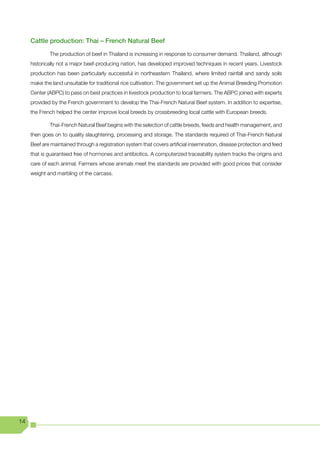
Cattle production: Thai – French Natural Beef

             The production of beef in Thailand is increasing in response to consumer demand. Thailand, although
     historically not a major beef-producing nation, has developed improved techniques in recent years. Livestock
     production has been particularly successful in northeastern Thailand, where limited rainfall and sandy soils
     make the land unsuitable for traditional rice cultivation. The government set up the Animal Breeding Promotion
     Center (ABPC) to pass on best practices in livestock production to local farmers. The ABPC joined with experts
     provided by the French government to develop the Thai-French Natural Beef system. In addition to expertise,
     the French helped the center improve local breeds by crossbreeding local cattle with European breeds.

             Thai-French Natural Beef begins with the selection of cattle breeds, feeds and health management, and
     then goes on to quality slaughtering, processing and storage. The standards required of Thai-French Natural
     Beef are maintained through a registration system that covers artificial insemination, disease protection and feed
     that is guaranteed free of hormones and antibiotics. A computerized traceability system tracks the origins and
     care of each animal. Farmers whose animals meet the standards are provided with good prices that consider
     weight and marbling of the carcass.


14
The case of Pon Yang Kham beef

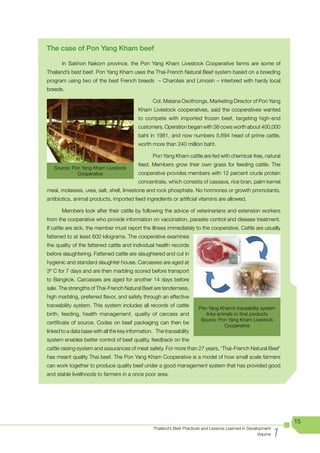
	      In	 Sakhon	 Nakorn	 province,	 the	 Pon	 Yang	 Kham	 Livestock	 Cooperative	 farms	 are	 some	 of	
Thailand’s	best	beef.	Pon	Yang	Kham	uses	the	Thai-French	Natural	Beef	system	based	on	a	breeding	
program using two of the best French breeds – Charolais and Limosin – interbred with hardy local
breeds.

                                           		     Col.	Matana	Osothongs,	Marketing	Director	of	Pon	Yang	
                                           Kham Livestock cooperatives, said the cooperatives wanted
                                           to compete with imported frozen beef, targeting high-end
                                           customers. Operation began with 38 cows worth about 400,000
                                           baht in 1981, and now numbers 5,694 head of prime cattle,
                                           worth more than 240 million baht.

                                           	      Pon	Yang	Kham	cattle	are	fed	with	chemical-free,	natural	
                                           feed. Members grow their own grass for feeding cattle. The
    Source:	Pon	Yang	Kham	Livestock	
              Cooperative                  cooperative provides members with 12 percent crude protein
                                           concentrate, which consists of cassava, rice bran, palm kernel
meal, molasses, urea, salt, shell, limestone and rock phosphate. No hormones or growth promotants,
antibiotics, animal products, imported feed ingredients or artificial vitamins are allowed.

       Members look after their cattle by following the advice of veterinarians and extension workers
from the cooperative who provide information on vaccination, parasite control and disease treatment.
If cattle are sick, the member must report the illness immediately to the cooperative. Cattle are usually
fattened to at least 600 kilograms. The cooperative examines
the quality of the fattened cattle and individual health records
before slaughtering. Fattened cattle are slaughtered and cut in
hygienic and standard slaughter house. Carcasses are aged at
3º C for 7 days and are then marbling scored before transport
to Bangkok. Carcasses are aged for another 14 days before
sale. The strengths of Thai-French Natural Beef are tenderness,
high marbling, preferred flavor, and safety through an effective
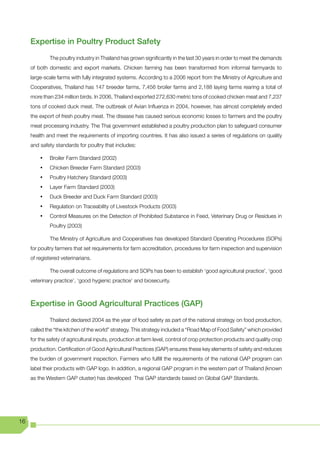
traceability system. This system includes all records of cattle          Pon	Yang	Kham’s	traceability	system	
birth, feeding, health management, quality of carcass and                   links animals to final products
                                                                          Source:	Pon	Yang	Kham	Livestock	
certificate of source. Codes on beef packaging can then be
                                                                                     Cooperative
linked to a data base with all the key information. The traceability
system enables better control of beef quality, feedback on the
cattle raising system and assurances of meat safety. For more than 27 years, ‘Thai-French Natural Beef’
has	meant	quality	Thai	beef.	The	Pon	Yang	Kham	Cooperative	is	a	model	of	how	small	scale	farmers	
can work together to produce quality beef under a good management system that has provided good
and stable livelihoods to farmers in a once poor area.


                                                                                                                     15

                                                                                                                 1
                                                  Thailand’s Best Practices and Lessons Learned in Development
                                                                                                        Volume
Expertise in Poultry Product Safety
              The poultry industry in Thailand has grown significantly in the last 30 years in order to meet the demands
     of both domestic and export markets. Chicken farming has been transformed from informal farmyards to
     large-scale farms with fully integrated systems. According to a 2006 report from the Ministry of Agriculture and
     Cooperatives, Thailand has 147 breeder farms, 7,456 broiler farms and 2,188 laying farms rearing a total of
     more than 234 million birds. In 2006, Thailand exported 272,630 metric tons of cooked chicken meat and 7,237
     tons of cooked duck meat. The outbreak of Avian Influenza in 2004, however, has almost completely ended
     the export of fresh poultry meat. The disease has caused serious economic losses to farmers and the poultry
     meat processing industry. The Thai government established a poultry production plan to safeguard consumer
     health and meet the requirements of importing countries. It has also issued a series of regulations on quality
     and safety standards for poultry that includes:

         •	   Broiler Farm Standard (2002)
         •	   Chicken Breeder Farm Standard (2003)
         •	   Poultry Hatchery Standard (2003)
         •	   Layer Farm Standard (2003)
         •	   Duck Breeder and Duck Farm Standard (2003)
         •	   Regulation on Traceability of Livestock Products (2003)
         •	   Control Measures on the Detection of Prohibited Substance in Feed, Veterinary Drug or Residues in
              Poultry (2003)

              The Ministry of Agriculture and Cooperatives has developed Standard Operating Procedures (SOPs)
     for poultry farmers that set requirements for farm accreditation, procedures for farm inspection and supervision
     of registered veterinarians.

              The overall outcome of regulations and SOPs has been to establish ‘good agricultural practice’, ‘good
     veterinary practice’, ‘good hygienic practice’ and biosecurity.


     Expertise in Good Agricultural Practices (GAP)
              Thailand declared 2004 as the year of food safety as part of the national strategy on food production,
     called the “the kitchen of the world” strategy. This strategy included a “Road Map of Food Safety” which provided
     for the safety of agricultural inputs, production at farm level, control of crop protection products and quality crop
     production. Certification of Good Agricultural Practices (GAP) ensures these key elements of safety and reduces
     the burden of government inspection. Farmers who fulfill the requirements of the national GAP program can
     label their products with GAP logo. In addition, a regional GAP program in the western part of Thailand (known
     as the Western GAP cluster) has developed Thai GAP standards based on Global GAP Standards.


16
The Department of Agriculture has set up a national GAP system for agricultural production and is
responsible for control and inspection. National GAP standards have also been developed for livestock and
fisheries. Farmers who apply for GAP certification are assessed for production processes (especially appropriate
use of agrochemicals. The standard contains eight elements:

      1. Safety of water used

      2. Site safety and sanitation

      3. Use of agrochemicals

      4. Product storage

      5. Data records

      6. Pest-free products

      7. Quality management

      8. Harvesting and post harvesting handling

        The standards also ensure that all stages of production, processing and marketing are subject to
inspection and all records are available. The objectives of the GAP program are to ensure that food crops
produced in Thailand are safe, wholesome and meet high standards while ensuring the safety of growers and
minimizing adverse impacts on the environment. By May 2008, nearly half of Thailand’s 363,946 registered
farms were certified for GAP standards, specialized for fruit vegetables, swine, poultry, cattle and aquaculture.


                                                                                                                      17

                                                                                                                  1
                                                   Thailand’s Best Practices and Lessons Learned in Development
                                                                                                         Volume
The case of western Thailand GAP for fresh vegetables

             Thailand is one of the world’s leading exporters of high value fresh vegetables, providing 85 percent
        of the world market in baby corn and serving as the world’s 7th leading exporter of asparagus. These
        exports faced increasingly stringent food safety and quality requirements from foreign markets, which
        caused difficulties for exporters. Problems with toxic residues were a particular challenge. A cluster of
        small-scale vegetable farmers, vegetable processors, exporters, government agencies and university
        agricultural experts worked together to analyze the problem. Under a “cluster development” development
        program funded by USAID, supported by TICA and managed by the Kenan Institute Asia as part of the
        Thailand Competitiveness Initiative, the project cluster decided to use the GAP standard, as it was the
        most effective way to eliminate residues without the expense and delays of government inspection of
        export shipments.

                                                          The cluster, which included Kasetsart University,
                                                   Thailand’s leading agricultural university, helped establish the Thai
                                                   GAP based on GLOBALGAP. University experts worked with
                                                   the Ministry of Agriculture and Cooperatives and the Ministry of
                                                   Commerce to develop training materials in Thai and establish a
                                                   training program that reached tens of thousands of Thai farmers.
                                                   The cluster cooperated with European supermarket chains who
                                                   are the biggest purchasers of Thai fresh vegetables to review
           GPA trainers and farmers in the field
                    Source: K.I. Asia              the standards.

                                                          From this beginning in one region of the country, the use
        of GAP standards has expanded nationwide under the Ministries of Agriculture and Commerce, with the
        private sector remaining an influential partner in the certification. The Thai GAP standard is now overseen
        by the Thai Chamber of Commerce and the Board of Trade of Thailand. Certification provides permission
        for products to have a Q (for quality) logo on their packaging. The Q mark is a legally registered certification
        mark that provides assurance that the produce is of high quality and safe for consumers. A 20 digit code
        appears below the Q mark to enable the produce to be traced back to a particular farm.

             (Sources: Development of Good Agricultural Practices (GAP) for Fruit and Vegetables in Thailand By
        WIbulwan Wannamolee Senior standards officer Office of Commodity and System Standards Accreditation
        National Bureau of Agricultural Commodity and Food Standards.)


     Good Aquaculture Practice (GAP): shrimp culture

             Thailand is a major exporter of marine shrimp, but the industry has had to overcome production and
     marketing problems in order to succeed. Pollution and disease led to major losses in the industry and poor
     environmental management led to destruction of natural mangrove forests in low-lying coastal areas. The
     government’s Department of Fisheries (DOF) has helped shrimp farmers overcome these problems and improve
     the entire production process to meet international standards. Guidelines have been established for every
     phase: from hatchery and farm rearing through processing and finally shipment to the consumer. These DOF

18
guidelines, known in the industry as the “Code of Conduct” (CoC), provide comprehensive standards for safe
and environmentally sound shrimp production.

        The CoC began in 1998 with assistance from the World Bank, which provided a consulting company to
set up workshops with operators to develop the CoC. The three main components are an operational guideline
and manual, a certification process and market incentives for shrimp produced under the CoC.

        All processes on the shrimp farm must be examined by DOF auditors for compliance with the CoC
for Responsible Fishery, with guidelines on aquaculture from the UN Food and Agriculture Organization and
the ISO14001 standard for Environmental Management System (EMS). Shrimp transporters and processors
must comply with international health and safety standards and must provide traceability of products. DOF also
certifies marine shrimp feed and issues licenses to certified producers and importers of aquatic feed. Random
checking is carried out to ensure feed quality, and antibiotic inspection is employed to detect the presence
of prohibited antibiotics. Government inspectors also inform shrimp farmers, feed producers, processors and
manufacturers, and exporters about control and prevention of antibiotic residues in shrimp products.

        To reduce diseases, Thai experts have developed the “Closed Shrimp Culture System.” This is a shrimp
culture management method in which, to prevent pond contamination, farmers do not add water from natural
sources after release of the shrimp fry (shrimp seeds). Thailand has also experimented with the “Biological
Shrimp Culture System,” which is an alternative method of managing shrimp culture problems. This system uses
biological organisms such as bacteria, phytoplankton, zooplankton, shellfish, fish, and benthic invertebrates to
control excess organic wastes and nutrients in shrimp ponds.

        Thailand’s National Center for Genetic Engineering and Biotechnology (BIOTEC) has supported
research on the prevention and treatment of viral and bacterial diseases affecting the shrimp industry since the
early 1990s. This has included research on the shrimp immune system and shrimp pathogens. This research
has led to the development of many techniques for the detection of pathogens by using highly sensitive and
specific methods which have been used to effectively monitor and test seed stocks before pond stocking.
These techniques are also useful for monitoring production ponds. Molecular studies to assist the development
of fast-growing domesticated, disease-resistant stocks are still in relatively early stages.

        Under the CoC program, DOF has established demonstration farms in Rayong, Chantaburi and Songkla
to provide hands-on training for farmers as well as on-going practical research.

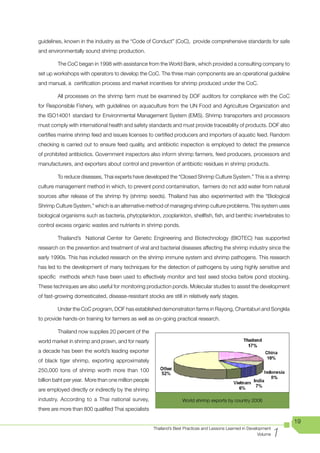
        Thailand now supplies 20 percent of the
world market in shrimp and prawn, and for nearly
a decade has been the world’s leading exporter
of black tiger shrimp, exporting approximately
250,000 tons of shrimp worth more than 100
billion baht per year. More than one million people
are employed directly or indirectly by the shrimp
industry. According to a Thai national survey,                      World shrimp exports by country 2006
there are more than 800 qualified Thai specialists

                                                                                                                         19

                                                                                                                     1
                                                      Thailand’s Best Practices and Lessons Learned in Development
                                                                                                            Volume
involved in shrimp and shrimp product research. They have produced over 300 international publications on
     shrimp. In addition, there are seven universities that provide courses and research programs focusing on shrimp.


        The case of marine shrimp farming at Kung Krabaen Bay

             The Kung Krabaen Bay Royal Development Study Centre in Chantaburi Province was established
        in 1981 in order to develop the fisheries, mangroves and other agriculture activities in the coastal area
        of the province. Its main work is promoting good shrimp culture practices for farmers in the deteriorated
        mangrove forest reserve areas around the bay. The development of black tiger shrimp culture expanded
        rapidly in the 1980s, but was soon followed by disease outbreaks, poor water quality, slow growth rate,
        low survival rate and low production. Improvement of shrimp culture practices was needed.

             The Royal Development Study Centre helped farmers change from the open system, characterized
        by low shrimp density and large volumes of water exchanged with natural waterways, to the closed
        system which has little or no water exchange during the culture period. The Centre helped design a
        seawater irrigation system which pumps high quality water from the Gulf of Thailand through a system
        of canals into the shrimp culture farms of the area. The system also treats effluent water from the ponds
        before it is discharged into the bay.

             Key tasks of the Study Centre were to produce quality shrimp fry and to certify the shrimp breeds.
        The Centre selected broodstock to produce specific characteristics of black tiger shrimp. This selection
        process raised egg quantity and quality and produced shrimp fry that grew quickly and resisted disease.
        The Centre undertook analysis of genetic variation and genetic markers in order to develop virus inspection
        techniques serving shrimp farmers. The Centre provided training and dissemination of shrimp farming
        knowledge as well as sea grass and mangrove conservation. In addition, it provided credit for shrimp
        farmers and quality shrimp operators who have won the CoC or GAP certifications so they could expand
        production.

             As a result of these changes and advances, shrimp farmers in Kung Krabaen Bay have reduced
        their risks of crop failures, generated higher incomes and improved their living conditions. The more
        sustainable practices have reduced encroachment into protected mangrove forests. This has led to
        preservation of important breeding and spawning areas for many aquatic species.


20
Development in Support
     of a Sufficiency Economy
                                1
22
Development in Support of a
Sufficiency Economy


                        Table of Expertise in Sufficiency Economy

                 Expertise                                         Example Institutions

                                                  •	 Chaipattana	Foundation
   Sufficiency economy in agricultural
   communities                                    •		 Office	of	the	Royal	Development	Projects	Board

                                                  •		 Khao	Hin	Sorn	Royal	Development	Study	Centre
   Sufficiency economy in community
                                                  •	 Kung	Krabaen	Bay	Royal	Development	Study	Centre
   development
                                                  •	 Pikun	Thong	Royal	Development	Study	Centre

                                                  •	 Puparn	Royal	Development	Study	Centre
   Royal development study centers                •	 Huai	Hong	Khrai	Royal	Development	Study	Centre

                                                  •	 Huai	Sai	Royal	Development	Study	Centre


Sector Expertise Overview
        As in many countries, the initial target of Thailand’s development was to boost economic growth with
Gross Domestic Product (GDP) as the principal indicator. From 1975 to 1996, GDP growth averaged over 8%,
largely due to exports of manufactured goods produced by companies using foreign technologies and foreign
investment capital. Thailand was able to graduate from the World Bank’s poor countries list. This success in
increasing GDP, however, was due, in part, to practices that were not sustainable. Rapid urbanization and
industrialization took place without sufficient care for the economy and environment. Air and water quality
declined, with impacts on health and natural inputs for agriculture, which still supported the majority of the Thai
population. Rapid economic growth attracted huge amounts of global capital and regulations were liberalized,
exposing the financial system to much greater impacts from external financial forces. Much of the global capital
attracted to Thailand was in the form of short term investment and short-term debt, exposing the country to
much greater financial risks, including foreign exchange risk. This risk was largely unrecognized and unregulated.
This led to the creation of a ‘bubble’ economy.

        Attacks on the baht by international currency speculators burst the ‘bubble’ economy and plunged
Thailand into economic crisis starting in 1997. The value of the baht fell 40 percent, sharply increasing value of
unhedged, dollar-denominated debt. Companies that had over-invested due to the easy availability of funds had
to cut back sharply. Unemployment rose; the stock and real estate markets collapsed; most of the country’s
financial institutions were technically bankrupt. GDP shrank by more than 10 percent.
                                                                                                                       23

                                                                                                                   1
                                                    Thailand’s Best Practices and Lessons Learned in Development
                                                                                                          Volume
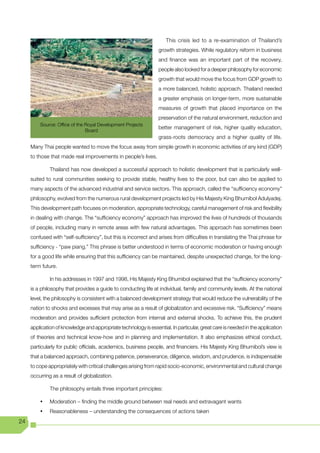
This crisis led to a re-examination of Thailand’s
                                                                  growth strategies. While regulatory reform in business
                                                                  and finance was an important part of the recovery,
                                                                  people also looked for a deeper philosophy for economic
                                                                  growth that would move the focus from GDP growth to
                                                                  a more balanced, holistic approach. Thailand needed
                                                                  a greater emphasis on longer-term, more sustainable
                                                                  measures of growth that placed importance on the
                                                                  preservation of the natural environment, reduction and
         Source: Office of the Royal Development Projects
                                                                  better management of risk, higher quality education,
                               Board
                                                                  grass-roots democracy and a higher quality of life.
     Many Thai people wanted to move the focus away from simple growth in economic activities of any kind (GDP)
     to those that made real improvements in people’s lives.

              Thailand has now developed a successful approach to holistic development that is particularly well-
     suited to rural communities seeking to provide stable, healthy lives to the poor, but can also be applied to
     many aspects of the advanced industrial and service sectors. This approach, called the “sufficiency economy”
     philosophy, evolved from the numerous rural development projects led by His Majesty King Bhumibol Adulyadej.
     This development path focuses on moderation, appropriate technology, careful management of risk and flexibility
     in dealing with change. The “sufficiency economy” approach has improved the lives of hundreds of thousands
     of people, including many in remote areas with few natural advantages. This approach has sometimes been
     confused with “self-sufficiency”, but this is incorrect and arises from difficulties in translating the Thai phrase for
     sufficiency - “paw piang.” This phrase is better understood in terms of economic moderation or having enough
     for a good life while ensuring that this sufficiency can be maintained, despite unexpected change, for the long-
     term future.

              In his addresses in 1997 and 1998, His Majesty King Bhumibol explained that the “sufficiency economy”
     is a philosophy that provides a guide to conducting life at individual, family and community levels. At the national
     level, the philosophy is consistent with a balanced development strategy that would reduce the vulnerability of the
     nation to shocks and excesses that may arise as a result of globalization and excessive risk. “Sufficiency” means
     moderation and provides sufficient protection from internal and external shocks. To achieve this, the prudent
     application of knowledge and appropriate technology is essential. In particular, great care is needed in the application
     of theories and technical know-how and in planning and implementation. It also emphasizes ethical conduct,
     particularly for public officials, academics, business people, and financiers. His Majesty King Bhumibol’s view is
     that a balanced approach, combining patience, perseverance, diligence, wisdom, and prudence, is indispensable
     to cope appropriately with critical challenges arising from rapid socio-economic, environmental and cultural change
     occurring as a result of globalization.

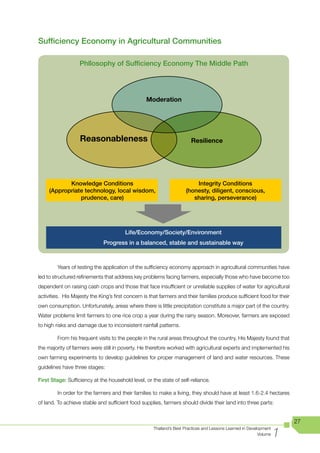
              The philosophy entails three important principles:

         •	   Moderation – finding the middle ground between real needs and extravagant wants
         •	   Reasonableness – understanding the consequences of actions taken
24
•	   Resilience through risk reduction and management – building the ability to endure shocks and adjust
         to external change, sometimes translated as “self-immunity”

         In addition to these three components, two conditions are necessary to allow the Sufficiency Economy
approach to function well. These conditions are:

    •	   Knowledge – making use of tested understanding and appropriate technology
    •	   Integrity - honesty, tolerance, perseverance, readiness to work hard and refusal to exploit others.

         His Majesty King Bhumibol stresses that development must be accomplished step by step. It should
start with building the economic basis for the people to have enough to live on and enough to eat. Once that
basis is secure, more complex and larger scale developments can be sought.

         Thailand’s National Economic and Social Development Board (NESDB) used the philosophy of sufficiency
economy as the guideline for the development in the Ninth National Economic and Social Development Plan,
which covers the period from 2002 to 2006. The Plan provides guidelines for sufficiency at various levels.

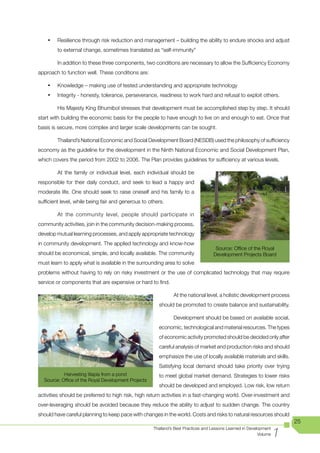
         At the family or individual level, each individual should be
responsible for their daily conduct, and seek to lead a happy and
moderate life. One should seek to raise oneself and his family to a
sufficient level, while being fair and generous to others.

         At the community level, people should participate in
community activities, join in the community decision-making process,
develop mutual learning processes, and apply appropriate technology
in community development. The applied technology and know-how
                                                                                    Source: Office of the Royal
should be economical, simple, and locally available. The community                 Development Projects Board
must learn to apply what is available in the surrounding area to solve
problems without having to rely on risky investment or the use of complicated technology that may require
service or components that are expensive or hard to find.

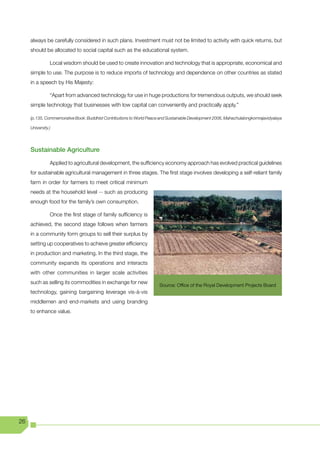
                                                               At the national level, a holistic development process
                                                       should be promoted to create balance and sustainability.

                                                               Development should be based on available social,
                                                       economic, technological and material resources. The types
                                                       of economic activity promoted should be decided only after
                                                       careful analysis of market and production risks and should
                                                       emphasize the use of locally available materials and skills.
                                                       Satisfying local demand should take priority over trying
           Harvesting tilapia from a pond              to meet global market demand. Strategies to lower risks
  Source: Office of the Royal Development Projects
                                                       should be developed and employed. Low risk, low return
activities should be preferred to high risk, high return activities in a fast-changing world. Over-investment and
over-leveraging should be avoided because they reduce the ability to adjust to sudden change. The country
should have careful planning to keep pace with changes in the world. Costs and risks to natural resources should
                                                                                                                        25

                                                                                                                    1
                                                     Thailand’s Best Practices and Lessons Learned in Development
                                                                                                           Volume
always be carefully considered in such plans. Investment must not be limited to activity with quick returns, but
     should be allocated to social capital such as the educational system.

                Local wisdom should be used to create innovation and technology that is appropriate, economical and
     simple to use. The purpose is to reduce imports of technology and dependence on other countries as stated
     in a speech by His Majesty:

                “Apart from advanced technology for use in huge productions for tremendous outputs, we should seek
     simple technology that businesses with low capital can conveniently and practically apply.”

     (p.135, Commemorative Book: Buddhist Contributions to World Peace and Sustainable Development 2006, Mahachulalongkornrajavidyalaya

     University.)


     Sustainable Agriculture

                Applied to agricultural development, the sufficiency economy approach has evolved practical guidelines
     for sustainable agricultural management in three stages. The first stage involves developing a self-reliant family
     farm in order for farmers to meet critical minimum
     needs at the household level -- such as producing
     enough food for the family’s own consumption.

                Once the first stage of family sufficiency is
     achieved, the second stage follows when farmers
     in a community form groups to sell their surplus by
     setting up cooperatives to achieve greater efficiency
     in production and marketing. In the third stage, the
     community expands its operations and interacts
     with other communities in larger scale activities
     such as selling its commodities in exchange for new
                                                                       Source: Office of the Royal Development Projects Board
     technology, gaining bargaining leverage vis-à-vis
     middlemen and end-markets and using branding
     to enhance value.


26
Sufficiency Economy in Agricultural Communities

                   Phllosophy of Sufficiency Economy The Middle Path


                                                  Moderation


                   Reasonableness                                       Resilience


            Knowledge Conditions                                         Integrity Conditions
     (Appropriate technology, local wisdom,                          (honesty, diligent, conscious,
                prudence, care)                                         sharing, perseverance)


                                        Life/Economy/Society/Environment
                              Progress in a balanced, stable and sustainable way


	        Years	of	testing	the	application	of	the	sufficiency	economy	approach	in	agricultural	communities	have	
led to structured refinements that address key problems facing farmers, especially those who have become too
dependent on raising cash crops and those that face insufficient or unreliable supplies of water for agricultural
activities. His Majesty the King’s first concern is that farmers and their families produce sufficient food for their
own consumption. Unfortunately, areas where there is little precipitation constitute a major part of the country.
Water problems limit farmers to one rice crop a year during the rainy season. Moreover, farmers are exposed
to high risks and damage due to inconsistent rainfall patterns.

         From his frequent visits to the people in the rural areas throughout the country, His Majesty found that
the majority of farmers were still in poverty. He therefore worked with agricultural experts and implemented his
own farming experiments to develop guidelines for proper management of land and water resources. These
guidelines have three stages:

First Stage: Sufficiency at the household level, or the state of self-reliance.

         In order for the farmers and their families to make a living, they should have at least 1.6-2.4 hectares
of land. To achieve stable and sufficient food supplies, farmers should divide their land into three parts:


                                                                                                                        27

                                                                                                                    1
                                                     Thailand’s Best Practices and Lessons Learned in Development
                                                                                                           Volume
•	   The first part: about 30 percent of the land is for digging a pond of four meters deep to store water for
          agricultural uses. The pond can also be used to raise fish as an important source of protein for the family.

     •	   The second part: about 60 percent of the farm is for agriculture. About half of this is for rice cultivation
          and the rest is for growing field and garden crops which may differ according to the conditions of the soil,
          the availability of water and local market demand.

     •	   The third part: about 10 percent of the land should be used for housing and other activities such as
          raising animals, both for food and as draught animals.

             This division of land into parts enables the people to make a moderate living and reduce the risks from
     a crop or market failure affecting any one part of their work. This is based on the assumption that rice farming
     in an area of slightly less than one hectare can yield sufficient rice for the family’s yearly consumption, giving
     the family food security. Any surplus can then be sold in markets to earn extra income that can be used for
     other expenses. If additional land is available, then cash crops can be raised as long as the cost of inputs such
     as seed, fertilizer and insecticide do not put the farmer at too great a risk. Many farmers using the sufficiency
     approach have succeeded in reducing their risk by using natural fertilizers and insecticide.

     Second Stage: Sufficiency at the community level, or group forming.

             After security at the family level has been achieved, the farmers in the community should form groups
     to support production and marketing. The aim is to create sufficiency at the community level by diversifying
     economic activities. This may include integrated farming, handicraft making, food processing, services and
     tourism. Once the community is strengthened, the people will be able to develop the welfare, educational and
     public health systems that enable the community to develop with stability and sustainability.

     Third Stage: Sufficiency at the national level, or opening to the outside world.

             After the community has been strengthened, the people can then proceed to the third stage which
     involves creating contacts and building networks with outside sources, and expanding their activities. The
     community is encouraged to cooperate with both the private and the public sectors, and non-governmental
     agencies in such activities as fund-raising, marketing, production, management and developing information
     systems. To successfully reach this point, the community must collaborate to create security in the community,
     to conserve natural resources and the environment, and to develop participatory processes and learning based
     on local wisdom, traditions and culture.


28
The case of the Ban Daen Samakkhee Demonstration Project

        The refined guidelines for a sufficiency economy farm were first tested in the arid northeast at Ban
  Daen Samakkhee. The project involved experimental plots to assist rice farmers who faced problems of
  insufficient water. Even when rice would grow, the ears of paddy contained too few rice grains. Therefore,
  a pond was dug on an area of 0.48 hectares with a water storage capacity of 12,000 cubic meters. This
  pond held sufficient rain water for 0.6 hectares of rice and 0.96 hectares of field crops. Even during the driest
  period, there was water left in the pond. The farm was operated on the basis of integrated farming, which
  involves intercropping plants and raising pigs together with fish. The pond provides water to the rice fields
  throughout the planting season, resulting in a 70 percent increase in rice yield. Water left from growing rice
  was used for field crops, fruit crops and vegetable cultivation. Fish were harvested when the pond water
  level was lowest, providing additional protein for family consumption. As a result, the farmers have food to
  consume all year round, and in good years had a significant surplus to sell on the local market.


Factors for the successful practice of sufficiency economy

   •	   Farmers must be diligent and determined. They each should also own a piece of land and have some
        capital available for investment in improved farming.
   •	   Farmers should have a good understanding of the sufficiency economy theory and know-how to
        practice farming and be ready to adopt new knowledge.
   •	   In practicing the sufficiency economy theory, the public sector, the private sector, the community and
        the farmers must work together.
   •	   There must be concern for the environment, and agricultural activities should be chosen in accordance
        with the climatic and geographical conditions of each area.
   •	   Activities should rely on public participation and bring about the unity of the group before expanding.


Benefits of the sufficiency economy approach

   •	   It enables the people to lead a ‘sufficient’ life that is economical, unscathed by poverty and hunger and
        unburdened by heavy financial debts.
   •	   Despite a lack of water during the dry season, cultivation of many crops, including wet rice can be
        feasible without having to rely on expensive irrigation systems because the water stored in the farm
        pond can be utilized.
   •	   In a year with plenty of rainfall, use of the sufficiency economy theory can generate higher incomes and
        consequently enhance wealth.
   •	   In case of flooding, farmers can recover from the damage without having to rely on assistance from
        the government.


                                                                                                                      29

                                                                                                                  1
                                                   Thailand’s Best Practices and Lessons Learned in Development
                                                                                                         Volume
Sufficiency Economy in Community Development
             In 2005, the Ministry of Interior made His Majesty the King’s sufficiency economy philosophy a central
     aspect of its national community development programs. These programs had six objectives:

       1. Cutting down domestic expenses through increased home production, energy conservation, the use of
           local materials, and the promotion of local markets;

       2. Increasing income by supporting local enterprises and industries;

       3. Encouraging local saving;

       4. Promoting local leadership and community-based programs;

       5. Protecting and preserving the environment; and

       6. Promoting social capital such as local welfare programs and cooperatives.

             In sum, community development based on the philosophy of the sufficiency economy is a bottom-up
     development approach aimed at strengthening communities by reducing their cash expenses and increasing
     both food security and income via the use of local resources.

             The sufficiency economy philosophy works well at the family farm level, but is not limited to that level.
     Thailand has developed a number of examples of how to build from the individual farm to a much larger scale
     that involves more complex technology, production processes and distribution chains.

             These larger scale models can involve sophisticated branding and marketing, showing that development
     using the sufficiency model does not limit people to bare subsistence. On the contrary, it provides a pathway for
     development on a secure base that can rise to higher income levels and quality of life while avoiding excessive
     risk and damage to the social and natural environment.

             The extensive development centered on the Ban Bua Community in an impoverished area of the country
     provides an interesting example of how higher levels of development can be achieved within the sufficiency
     economy approach.

             The social and environmental characteristics of different communities vary considerably, so each
     community has to work out its own ways to implement the sufficiency economy for community development.
     The following case provides another example of somewhat different path to success based on the sufficiency
     economy philosophy.


30
Kloy Luk Tak War Community, Bangkok, Thailand

    Kloy Luk Tak War is an Islamic community which has embraced the three components of the
Sufficiency Economy – moderation, reasonableness, and self-immunity or resilience.

    To achieve moderation, the community relied on Islamic principles of reasonableness and no-interest
financing. In the realm of reasonableness, residents divided themselves into two groups. The first group
worked outside the community to earn needed cash. The second group worked on their farms to reduce
household expenses for food consumption. They also set up cooperatives and provided interest-free
loans for individuals. The community reduction of risk and resistance to external shocks was attained
as the residents established welfare programs and community’s well-being surveillance systems. They
also emphasized the importance of education. The operations of the community funds were based on
the Islamic principle of distribution, so loans were only be granted to individuals who actually suffered
from economic hardship. In accordance with Islamic law, investment of the community’s savings shares
risk with the borrowers and takes a return only if the borrowers’ ventures are successful.

    A key success factor was having strong leaders who could convince the community to adopt the
sufficiency economy approach and guide public discussions leading to the exchange of information and
knowledge. Another success element was the community’s strong emphasis on Islam as a guide to living
and implementing the development programs.


                                                                                                                  31

                                                                                                              1
                                               Thailand’s Best Practices and Lessons Learned in Development
                                                                                                     Volume
Sufficiency Economy in Community Development: The Ban Bua Community

          Ban Bua is a village in the northeastern region of Thailand. Due to cash cropping and mono-cropping
     practices since the 1950s, Ban Bua villagers suffered from serious debt problems. The increased production
     costs for cassava and the decline of global cassava prices were the primary causes of excessive farm
     debt. To address the community’s ongoing problems, community leaders and local experts adopted His
     Majesty the King’s approach to sufficiency agriculture beginning in 1987.

          In the first stage, to achieve family-level food security, the Ban Bua community stopped growing
     cassava and replaced it with food crops and rattan. The Village Foundation, an NGO, provided the
     villagers with initial capital of 5,000 baht per family to buy seeds. The first year’s crop earned each family
     an average of more than 30,000 baht. The community used parts of the earnings to establish a small
     nursery to produce young rattan plants and grow backyard gardens of organic vegetables. Some villagers
     began dividing their lands according to the guidelines for production of rice, vegetables, fruit trees, fish
     ponds, mushroom nurseries and chicken coops. Within a few years, the community was able to produce
     enough for household consumption as well as sell their products to other villagers.

          In 1992, a second stage began, with Ban Bua linking to other communities in what was called the
     Inpaeng Network. In response to the expanded market provided by this network, the villagers increased
     their outputs. Some of them added new crops with potential to serve both as food and extra income.
     The community engaged in local food processing to add value to their products. This included making
     makmao (a local herb) into juice and wine, and producing shampoo and detergent from herbs. Community
     shops served as outlets for the increased varieties of products. As a result, the community paid off its
     debts while improving the community’s quality of life.

          Within the five years, a third stage was reached with the development of inter-community production
     chains. For example, local farmers sold their young makmao plants to grower groups and the latter
     sold the fruit to community factories that made makmao juice and wine. Then, the end products were
     branded and sold in community shops and outlets outside the village such as restaurants in Bangkok.
     The community created microfinance groups to mobilize savings, lend money and provide affordable
     life insurance. The villagers sought technological knowledge beyond their community and campaigned
     for environmental conservation and the use of organic fertilizers made from waste materials.

          Studies of the Inpaeng Network indicate that one key success factor was effective knowledge
     transfer. The villagers sought assistance from academic institutions, government agencies and international
     organizations and captured that knowledge in booklets, pamphlets and VCDs that villagers could use to
     improve their farming and community management practices.

          The Inpaeng Network now covers communities in four provinces, totaling about 900 villages and
     over 100,000 members. The network’s activities include agriculture, community enterprises, health care,
     environmental conservation and education.

     Sources of information: United Nations Development Program. “Thailand Human Development Report
     2007: Sufficiency Economy and Human Development”


32
The Royal Development Study Centres
         In order to experiment with variations on the sufficiency economy approach in different regions of the
country and to systematically study the outcomes of those variations, His Majesty King Bhumibol has initiated
to have six “Royal Development Study Centres.” These centers work on practical applications of the sufficiency
philosophy in close coordination with villagers, and have accumulated a great deal of understanding of best
practices in community-based agricultural development.

         These centers are also meant as mechanisms for transferring that knowledge, both inside and outside
of Thailand. Each of the centers provides training and study tours for international visitors. Visitors have come to
the Royal Development Study Centres from many countries including Afghanistan, Bangladesh, Bhutan, Burkina
Faso, Cambodia, Colombia, Djibouti, Egypt, Gambia, Guatemala, Laos, Madagascar, Mali, Mozambique, Nepal,
Papua New Guinea, Senegal, Sri Lanka and Timor-Leste.

         Visitors are encouraged to spend several days or more at the centers to acquire an in-depth understanding
of the sufficiency economy approach and the specific technologies used to implement it. While some of the
approaches and technologies are similar, each center has specialties that fit with different local characteristics
as follows:

1) The Khao Hin Sorn Royal Development Study Centre was established in 1979 in Chachoengsao Province
    in the flat central region of Thailand. The center serves as a training
    centre for farmers on agricultural technology and handicraft skills
    with emphasis on the following:

    •	   Land Development
    •	   Agricultural Education
    •	   Forestry
    •	   Livestock Development
    •	   Fresh water fisheries
    •	   Community Development
    •	   Cooperative Promotion
2) The Kung Krabaen Bay Royal Development Study Centre
    was established in 1981 in Chanthaburi Province on Thailand’s
                                                                                      Source: Office of the Royal
    southeastern coast. The activities at this center promote the
                                                                                     Development Projects Board
    effective management of coastal fisheries, as well as agricultural
    and occupational development in coastal areas. Specialties are:

    •	   Research on the problems and potential of coastal zone resources
    •	   Coastal environmental management
    •	   Agricultural extension work
    •	   Improving the quality of coastal and alluvial soils


                                                                                                                        33

                                                                                                                    1
                                                     Thailand’s Best Practices and Lessons Learned in Development
                                                                                                           Volume
3) The Pikun Thong Royal Development Study Centre was set up in 1982 in the southern province of
         Narathiwat. This center involves 23 agencies working together within the framework of the action plan of
         the Center. The plan covers:

         •	   Improvement and utilization of saline soils
         •	   Promotion of small - boat coastal fisheries
         •	   Development of animal husbandry – especially goats, the livestock favored by the local Muslim
              population
         •	   Provision and management of water resources
         •	   Promotion of agro-industry
         •	   Integrated economic and social development

     4) The Puparn Royal Development Study Centre was established in 1982 in Sakon Nakhon Province in
         Thailand’s far northeastern region near Laos. This center responds to the needs of this arid region with a focus
         on dry area agricultural techniques, forestry and simple irrigation systems. Specialties at Puparn include:

         •	   Irrigation system development and management
         •	   Soil erosion control
         •	   Model development villages
         •	   Development of water resources for fishing
         •	   Promotion of cottage industry
         •	   Study and development of forestry to preserve watersheds
         •	   Community public health

     5) The Huai Hong Khrai Royal Development Study Centre was founded in 1982 in the northern province
         of Chiang Mai. Located in a forested hill area, the center covers an area of over 3,000 acres. It was
         established to conduct studies and research on forest development, water resources development, and
         the conservation of watersheds. It also studies livestock and milch cow development. Special interests of
         the Huai Hong Khrai Centre include:

         •	   Water source development
         •	   Hill forestry
         •	   Intensive Farming
         •	   Dairy farming
         •	   Frog farming
         •	   Vetiver grass
         •	   Development-oriented educational tourism

              The hill forestry studies cover three classes of tree cultivation: for fruit, for firewood, and for sale as
     wood. The centre manages a forestry project that has served to improve the environment of the area, eliminate
     forest fires, and produce a moist climate. There are ongoing studies of industrial agriculture and fishery studies
     at check dams, as well as farms for livestock and dairy cattle. The center distributes high-quality seeds bred
     for the local environment and gives advice on practical farm techniques.
34
6) The Huai Sai Royal Development Study Centre was set up in Phetchaburi Province 1983. The center’s
    initial purpose was to rehabilitate, improve and preserve forests near the border with Myanmar, enabling an
    increase of soil moisture in the surrounding areas. It also served to resettle displaced persons coming into
    the area. Specialties of the Huai Sai Centre include:

    •	   Water resources and soil development
    •	   Forestry development
    •	   Community development
    •	   Quality of life and environmental improvement


International Interest in the Sufficiency Economy
         The development and application of the sufficiency economy philosophy has generated considerable
international interest, particularly among developing countries that share similar problems of rural and community
development. In 2004, the Thailand International Development Cooperation Agency (TICA) hosted the Ministerial
Conference on Alternative Development Sufficiency Economy Thailand, which attracted 54 ministerial level
participants from 29 developing countries. In 2006, TICA organized two study visits to give international
development officials a first-hand look at the application of the sufficiency economy approach to development.
At total of 54 officials from 29 countries took part in the visits. Participants came from as far away as Sudan and
Colombia and from as near as Cambodia. An evaluation of these study visits showed that they were beneficial
to the work of most officials. Some countries – Myanmar, Ethiopia, Sir Lanka, Vietnam, Bangladesh, Bhutan,
Burkina Faso, Mozambique, Madagascar, and Kenya – have started to include the principles of the sufficiency
economy in their own development plans.


                                                                                                                       35

                                                                                                                   1
                                                    Thailand’s Best Practices and Lessons Learned in Development
                                                                                                          Volume
Technical Cooperation between Lesotho and Thailand

             To mark the Sixtieth Anniversary Celebrations of His Majesty King Bhumibol Adulyadej’s accession
        to the throne and the official visit of the King and Queen of Lesotho to Thailand, the two governments
        launched a cooperation project on sustainable agricultural development based on the sufficiency economy
        philosophy.

             The project established a demonstration center for sustainable agricultural practices on some 43
        square kilometers of private land owned by Queen Masenate Mohato Seeiso. This area formerly grew
        paddy rice and rain-fed upland crops such as maize and fodder. The project set up a center that studies
        integrated farming and agroforestry models suitable for the conditions of the local farmers. The results
        of the studies are disseminated among the government agencies and the local farmers.

              At the center, irrigation systems and integrated farming and agroforestry are demonstrated. The
        center has shown that the yield from the irrigated areas is higher than the yields from areas that depend
        on rainfall. Integrated farming and agroforestry has been introduced as an alternative to the mono-crop,
        rain-fed farming typically conducted by small-scale farmers in the area. By growing specific groups of
        vegetables on different pieces of land each season and moving the groups around in sequence, crop
        rotation leads to fewer soil pests and diseases, minimizes deficiencies and allows the soil to replenish. The
        project also introduced to Lesotho several bamboo species from Thailand. Bamboo is a multi-purpose
        crop and all parts of bamboo can be used.

            (Adapted from “Sustainable Agricultural Development Project, Technical Cooperation between the
        Kingdom of Lesotho and the Kingdom of Thailand,” Ministry of Foreign Affairs.)


     Annual Training and Technical Cooperation on the Sufficiency Economy
     Approach
             To support this international interest, Thailand offers 25 scholarships every year for officials from
     developing countries in Asia, Africa, and the Pacific Islands to come to Thailand for deeper study in the theory
     and implementation of the sufficiency economy philosophy.

             Started in 2006, the scholarship program has helped numerous officials better understand how this
     new development paradigm can help their people achieve sustainable development.

             Thailand has also cooperated with the Kingdom of Lesotho on technical assistance on the sufficiency
     economy in agriculture, with Senegal and Mozambique on fisheries development and with Kuwait, Peru, and
     Chile on training in the sufficiency economy approach.


36
Community-based
     Economic Development
                            1
38
Community-based Economic
Development


      Table of Expertise in Community-based Economic Development

                 Expertise                                          Example Institution

  Sustainable alternative livelihood
                                                  	•	   Mae	Fah	Luang	Foundation	(MFLF)
  development approach

                                                	 •		   Ministry	of	Interior
  Local and community production (OTOP)
                                                        w     Community Development Department

                                                	 •		   Ministry	of	Interior
  Community-based microfinance
                                                        w     Community Development Department


Sector Expertise Overview
        Thailand’s rapid, industry-led economic growth reduced the incidence of poverty from 57 percent in
1961 to 11 percent in 1996. Poverty levels, however, increased to 16 percent after the 1997 economic crisis, and
then fell to 10 percent in 2004 as the economy recovered. Many of the people left unemployed by the economic
downturn had to return to their rural communities to survive. The crisis drew attention to the inherent risks of
linking to the global economic system. It also reminded people how far behind the cities the rural areas had
fallen. The combined effect was to refocus attention on grassroots community development. Strengthening a
community’s ability to withstand external shocks and narrowing the gap between rural and urban areas became
increasingly important. The government, therefore, launched several community-based development programs
which enabled poor communities to more effectively plan and manage their own development.

        Thai communities have been through several transitional periods, moving from a subsistence farming
system to commercial farming, from a traditional to a more modernized society. With these changes, many
communities have grown stronger economically and socially, with improved physical infrastructure, increased
income and better access to educational and health services. Higher levels of education in rural communities
have enabled rural people to play a much more effective role in their community development and have led
them to expect a much higher level of government support.

        The latest national development plans have stressed the importance of developing local communities’
capacity to manage their own economic and social development in partnership with the public and private sectors.
Community enterprises, revolving funds, small-credit schemes, community information centers, sub-district
administrative organizations and networks of community organizations have all become important community
                                                                                                                      39

                                                                                                                  1
                                                   Thailand’s Best Practices and Lessons Learned in Development
                                                                                                         Volume
development tools. Thousands of community-based organizations and networks have been established in
     Thailand, dealing with issues such as alternative livelihoods, culture, local and community product promotion,
     microfinance and basic business management. Thailand has therefore developed three main areas of community
     development expertise:

         •	   Sustainable alternative livelihood development (SALD)
         •	   Local and community product promotion, or One Tambon, One Product (OTOP)
         •	   Community-based microfinance


     Expertise in Sustainable Alternative Livelihood Development Approach
     (SALD)
              The Mae Fah Luang Foundation (MFLF) is a not-for-profit development foundation that manages
     numerous community development projects in northern Thailand, most notably the Doi Tung Development
     Project in Chiang Rai province. This project is known for its success in eliminating opium cultivation in the
     heart of what once was the notorious ‘Golden Triangle.’ which was once notorious for narcotics production.
     The Doi Tung Project was launched in 1988 by Her Royal Highness Srinagarindra, the late Princess Mother
     of Thailand, drawing inspiration from her son, His Majesty the King of Thailand, who started the fight against
     opium cultivation over 40 years ago.

              HRH Princess Mother understood that opium production was a symptom of poverty and lack of
     opportunity. She firmly believed that lasting solutions to illicit drug production did not lie in coercive eradication,
     but rather in transforming poor and unstable villages into communities providing inhabitants with sufficient food,
     income, health and education. Her Royal Highness Princess Mother saw such transformation as something that,
     with judicious outside assistance, local people were capable of doing to help themselves. Thus, development
     must occur in a participatory manner and at a pace that allows developmental changes to be accepted by
     the communities, so that eventually, the community can continue the process of development without further
     assistance. Her vision was to align the interests of people with the sustainable use of their natural environment.
     The Sustainable Alternative Livelihood Development (SALD) model was created from her guiding principles.


40
The Princess Mother
                                     Source: Mae Fah Luang Foundation


MFLF’s SALD Approach

         The SALD model requires a long timeline for communities to develop sufficient capacity in production
and marketing. MFLF’s approach builds on local knowledge and existing resources, and combines those
with a market focus, leading to the creation of higher-value goods. A series of social enterprises allows
communities to become independentof outside assistance. Education initiatives ensure that future generations
will have employable skills, the knowledge to cope with globalization and the entrepreneurial spirit to create
new opportunities for community growth. Ultimately, the key to SALD is local ownership, where capacities and
activities have been developed to the point where local people can become owners of ventures rather than
contract farmers or employees.


Three priorities

         The SALD approach has the following three main
prioreties:

    a)   Health: Basic health needs must be addressed because
         sick people cannot be economically productive.

    b) Livelihood: Once people are able to work, they need
         viable livelihood options, starting with those which
         provide immediate food security, and then gradually                    A mobile medical clinic
                                                                          Source: Mae Fah Luang Foundation
         diversifying into value-adding activities with higher
         income-generating opportunities.

    c)   Education: When people have viable livelihoods, education becomes the key to unlocking future
         opportunities and ending the cycle of poverty.


                                                                                                                      41

                                                                                                                  1
                                                   Thailand’s Best Practices and Lessons Learned in Development
                                                                                                         Volume
A phased approach

             The SALD approach takes place in three phases in order to maximize success. The three phases are
     as follows:

         1. The short-term phase starts with ‘Quick Hit’ activities to immediately provide the local community with
              a legal source of income within the first 10 – 150 days. This is the most crucial period because it is vital
              to gain people’s trust and confidence. Fast-growing cash crops are promoted to fill the gap before
              medium and longer-term programs bear fruit.

         2. The medium-term phase focuses on developing viable market-based livelihood alternatives and moving
              up the value chain.

         3. The long-term phase empowers people to become self-reliant, respectful of their environment, and
              able to cope with pressures of globalization. Relevant education-including knowledge of markets and
              production options—is provided. Value-added processing activities provide increased and more stable
              income.


     International outreach

             Since 2002, the Foundation has shared its SALD approach internationally, helping the many countries
     and communities that have requested assistance. The Foundation completed a project in Shan State, Myanmar
     in 2004, and currently has on-going projects in Aceh province, Indonesia and Balkh province, Afghanistan.


42
Doi Tung Development Project
        The Doi Tung project started 20 years ago as a effort to end opium production in northern Thailand.
The project is in Chiang Rai Province, on the Thai border with Myanmar. It covers approximately 150
square kilometres, including 29 villages and approximately 11,000 people from six ethnic minorities.
          In 1988, when HRH Princess Mother arrived in the area, much of Doi Tung was under slash and
burn agriculture and large areas were planted with opium poppies. Taking the SALD approach to tackling
local poverty, the Princess Mother initially addressed health problems by bringing volunteer doctors to
the region. Next, she focused on livelihood creation, which took the form of “quick hit” reforestation jobs,
turning opium cultivators and slash-and-burn farmers into forestry workers. This immediate wage-paying
activity helped earn the trust of the local community.
           In time, forestry workers became coffee and macadamia cultivators, who eventually moved from
simply producing commodity crops to offering serivces further up the value chain, such as roasting and
processing the coffee and packaging macadamia nuts. Tissue culture, horticulture, and mulberry paper,
ceramics, carpets, and woven cloth industries were established to diversify the the local economy and
reduce the risk of depending on a single enterprise. The project went beyond simply promoting alternative
crops to providing a range of alternative livelihoods that integrate local knowledge and resources with
business professionalism. MFLF brought in designers well-acquainted with market demands to work with
local villagers, producing world-class handicraft and fashion products. Intermediate technology was used
to maximize local employment and minimize dependence on external resources.
          The Doi Tung Project has been financially
self-sustaining since 2001 and the area has become
opium free. Living standards for local inhabitants
have significantly improved. Locals have legitimate
livelihood options and access to healthcare and
education. There are eight schools, which are
attended by the children from all 29 villages. The
project revived 150 km² of denuded forest land
and transformed the Doi Tung area into a tourist
destination that receives an average of one million
visitors a year.
                                                                   Doi Tung fashion products on display
         By 2017, 30 years after its first involvement       Source: Mae Fah Luang Foundation
in Doi Tung, MFLF will completely phase out, leaving
the administration and management of the project’s enterprises in the hands of local leaders.


The Yong Kha Project, Myanmar
	        In	 2002,	 MFLF	 extended	 its	 development	 activities	 across	 the	 Thai	 border	 to	 Yong	 Kha,	 in	
Myanmar’s Southern Shan State. Mobile medical units provided the quick hit in healthcare to combat
malaria, tuberculosis, scabies, and children’s malnutrition. These efforts addressed immediate problems
while	earning	the	trust	of	the	local	people.	Youth	community	members	were	then	trained	to	diagnose	and	
treat these health issues.
        The local community constructed a 30-km long irrigation canal and six weirs. This allowed them
to grow food and cash crops year-round. A hospital and a school were built. Children were taught the
formal national curriculum, which was supplemented with practical skills like agricultural know-how in the
school’s vegetable plot. This fed into the school lunch program which included chicken raising.
       After three years of implementation, the ‘Doi Tung II’ Project in Myanmar cost a total of USD
640,000 for 6,022 people. It generated benefits in cash and in kind equivalent to USD 704,574.

                                                                                                                     43

                                                                                                                 1
                                                  Thailand’s Best Practices and Lessons Learned in Development
                                                                                                        Volume
Balkh Livestock Rural Enterprise Development Project, Afghanistan
               In November 2006, MFLF, the Afghan Ministry for Rural Rehabilitation and Development and local
     Afghan partners began implementing the Balkh Livestock and Rural Enterprise Development Project. The
     project aims to achieve economic revival by creating an enabling environment for rural enterprise. It began
     by addressing the health of sheep in order to replenish the domestic population decimated from years
     of conflict and drought. A subscription-based veterinary service was provided by trained Afghan youths.
     This worked in tandem with a “sheep bank” designed to increase the rate of livestock ownership. The
     interaction among various groups—landless poor, sheep owners, and other members of local society—
                                                          increased dialogue within the community and helped
                                                          to rebuild a participatory citizenry.

                                                                   In the first year, the project provided vocational
                                                           training for 12 veterinary technicians. They reduced
                                                           the mortality rate of about 24,000 registered livestock
                                                           from 10 percent to below 3 percent, creating
                                                           additional income totalling approximately USD 548
                                                           per household.

                                                                   A pilot project is currently underway to
                                                           investigate the potential of a yarn-spinning project.
                                                           This would provide intermediate technology to
                    Vocational training                    village women in order to increase their productivity.
            Source: Mae Fah Luang Foundation
                                                           Eventually more value-added activities can be added
                                                           to boost local income.


     Aceh Project, Indonesia
               In November 2005, the Government of
     Indonesia and the United Nations Office on Drugs
     and Crime asked MFLF to implement a SALD project
     in Aceh Province, Indonesia, an area ravaged by 30
     years of civil conflict and the tsunami disaster. The
     objective was to double per capita income from less
     than USD 1 to at least USD 2 per day for approximately
     1.5 million impoverished people by 2012.

              MFLF began its activities in Aceh in 2006
     by introducing a malaria preparedness program for
                                                                Source: Mae Fah Luang Foundation
     Lamteuba. The program trained local representatives
     to help their own community fight malaria. Today, the
     program has been adopted by the Acehnese Provincial Health Office for implementation on the provincial
     level.

              In 2007, MFLF, the Sambinoe Foundation, and Indonesian government partners embarked on
     livelihood creation activities, working with the community in Lamteuba to reconstruct the irrigation system,
     establish agricultural demonstration plots, and introduce veterinary services for livestock. The Foundation
     has also extended assistance to Maheung village, which will become a demonstration station on irrigation,
     agriculture, livestock and public hygiene.

            A core objective of the ‘Aceh-SALD’ initiative is to revive the traditional ‘gotong royong’ spirit of
     cooperation among local communities, enabling them to improve their own livelihoods.

44
Reforestation Model

        The key success factor in reforestation is the ability of people and nature to coexist. The Mae Fah Luang
Foundation recognises that as long as people remain poor, they will encroach on the forest, logging illegally
for money to survive. While it is important to preserve the watershed area, economic forestry can be a tool to
provide long-term income to local people who once lived off the forest. Economic forestry – such as planting
coffee and macadamia nuts — provides income streams from the forest. Subsistence forests let people gather
food and fuel within special areas. These zones provide a buffer between local people and the forest, saving
the watershed area from undue encroachment. Allowing local people to take care of their forest is vital, since
people will pass on the wisdom of natural preservation.


         Watershed area in Pang Mahan in 2005                               The same area in 2007
          Source: Mae Fah Luang Foundation                             Source: Mae Fah Luang Foundation


        The Foundation’s first reforestation expansion was Pang Mahan, a 2,250 hectare area where lessons
learned from Doi Tung were applied. Starting in 2005, the Foundation switched from monoculture reforestation
to planting multiple variants of plants native to the area. This helped restore the forestland and add native
biodiversity to the area. Average annual income per household has risen from USD 532 in 2004 to USD 2,797
in 2008 as a result of these different income generating activities.


The Living University

        While the Foundation is extending the SALD approach, one of its long-term aims is to develop a “living
university” to test, document and disseminate learning from SALD projects. This will be done by collecting
practical experiences from the Foundation’s work, and sharing its lessons learned with other countries facing
similar problems. The living university will be a dynamic, interactive, real-life classroom, where trainees and
project staff can learn together and from each other.

        The work of MFLF abroad combined with the training given domestically makes it a key source of
expertise in sustainable rural development.


                                                                                                                       45

                                                                                                                   1
                                                    Thailand’s Best Practices and Lessons Learned in Development
                                                                                                          Volume
Expertise in Local and Community Product Promotion
             The One Tambon One Product (OTOP) program is a local entrepreneurship stimulus effort that supports
     the locally made products from each Thai tambon (subdistrict). OTOP is a means of strengthening the grass-root
     economy by encouraging collaboration with the public and private sectors. OTOP has successfully raised the
     quality of community products to standards certified by the OTOP committee at the Community Development
     Department of the Ministry of Interior.

             OTOP is based on the idea that each village has at least one native product or tourism destination
     that can provide the basis for a small business. OTOP products often reflect local knowledge that has been
     passed down through generations. The project has become a key source of extra income for local people, with
     products sold at OTOP outlets across the country.

             The OTOP project is modeled after a Japanese concept of community development policy, known as
     One Village One Product (OVOP), which has been widely replicated all over Japan. Thailand received assistance
     from the Japanese External Trade Organization to support Thailand’s development of OTOP and promote OTOP
     products in the Japanese market in 2002. The targeted products included textiles, wooden products, baskets,
     ceramics and mulberry paper.

             The two key elements in OTOP are entrepreneurs and high quality products from local materials and
     skills. The first important step is to survey and register qualified OTOP producers. These are categorized into
     three groups: community enterprises, community level sole proprietorships, and SME producers. The second
     step is product selection. OTOP products should reflect local traditional knowledge, and their production should
     employ inherited skills and use raw materials from the local area. In addition, local tourist destinations can also
     be classified as OTOP.

             One of the special features of OTOP is the government’s oversight of the project’s marketing side,
     providing advertising budgets to market OTOP products, organizing marketing events, and creating a system
     of information exchange among producers, buyers and consumers through a website at www.ThaiTambon.
     com. Government support, including 1,500 million baht in 2001 and another 460 million baht for 2003-2006,
     as well as loans at cheaper interest rates for OTOP entrepreneurs, has been a major factor in OTOP’s success.


46
OTOP Policy Management Structure


                               The National Economic and Social
                           Development Board set up policy for poverty
                            eradication and submitted to Government


                                        The Government
           Office of
                                      through the Cabinet
        Coordination for
                                       created the Project
         OTOP Project                                                          Sub-Committee
                                                                                on Standar ds
      Sub-Committee on                                                           Development
       Manufacturing                   National Committee
         Promotion
                                                                                              Sub-Committee
                                                                                               on Marketing
                                                                                                Promotion
         Sub-Committee                     Provincial
          Management                       Committee
                                                                                       Sub-Committee
                                                                                       Product Quality
                                                                                        Development
                                Amphor (District) / Sub District
                                         Committee


                                                                   Source: Modified from a presentation on “OTOP: An
                                      Tambon Committee             Implication for Poverty Reduction in Thailand” by
                                                                   ChudatipRITRUECHAI and Dr. ChaivejNUCHPRAYOON


                                                                                                                       47

                                                                                                                   1
                                              Thailand’s Best Practices and Lessons Learned in Development
                                                                                                    Volume
Distribution of duties among government agencies

        No.                            Duty                                  Responsible agency
       1            Searching for star products as well as           •	    Ministry of Interior (province, district,
                    strengthening people and community                     tambon)
       2            Strengthening production of goods, raw           •	    Ministry of Agriculture and Cooperatives
                    materials, food process, and product             •	    Ministry of Commerce
                    development
                                                                     •	    Ministry of Industry

       3            Defining standards and criteria for product      •	    Ministry of Industry
                    selection                                        •	    Ministry of Public Health

       4            Overseeing marketing and product                 •	    Ministry of Commerce
                    promotion, product distribution, and             •	    Tourism Authority of Thailand
                    intellectual property right, such as
                    trademarks.                                      •	    Office of Small and Medium Enterprises

       5            Research and development of products,
                                                                     •	    Ministry of Science and Technology
                    packaging, and design

       6            Public relation                                  •	    The Prime Minister’s Office

       7            Monitoring and evaluation                        •	    Ministry of Education
                                                                     •	    National Economic and Social
                                                                           Development Board
       8            International cooperation on technology          •	    The Prime Minister’s Office
                    transfer


                OTOP has had a sizable impact in Thailand, in both the economic and social dimensions.

     The economic dimension:

           •	   Created jobs in more than 22,762 villages
           •	   Involved more than 1,340,000 members and employees
           •	   Increased the number of entrepreneurs from 7,000 in 2001 to 37,840 in 2006
           •	   Increased sales revenue from 16.7 million baht in 2002 to 67.8 million baht in 2006
           •	   Strengthened infrastructures and communication
           •	   Raised the level of business skills
           •	   Improveed of product quality and standards


     The social dimension:

                OTOP induced greater community involvement that led to stronger communities. OTOP production
     utilized the traditional, local knowledge of the elderly, thus giving them new importance and value in the community.
     By increasing locally available income, OTOP reduced the incentive for people to leave the village in search of
     jobs. This helped keep families together and provided a more stable home environment for children.


48
The Community Development Department of the Ministry of Interior, which oversees OTOP, is ready to
receive international visitors interested in how the OTOP project was designed and managed. The department
offers a training camp package in English that allows visitors to learn about all the aspects of OTOP Thailand,
and government officials from India, Nepal and Laos have already participated in this training.


  The case of the OTOP community at Wat Phra Non Chaksi
            The tiny village of Wat Phra Non Chaksi, just two hours north of Bangkok in Singburi province, does
  not offer any natural ecotourism attractions. Unlike many other One Tambon One Product villages, there
  are no significant “traditional” products native to the village either. The village, however, was determined
  to make the best of their situation for the benefit of villagers in need by using the rich local history. Close
  to the village is the famous battle site of Bang Rachan, where Thais fought an invading Burmese army in
  1784. The story was made into a full-length movie released in 2000.

           Three years ago, a small group of entrepreneurial villagers who previously sold shirts in Bangkok
  decided to design and produce some elegant button-up shirts depicting the battle at Bang Rachan to
  generate income for themselves and others in the community. Ultimately, 20-30 villagers became involved
  in the production of the shirts, which were priced at about 150 baht (US$4.70), and sold locally, as well as
  being shipped to OTOP outlets across the country. Featuring artistic interpretations of the Battle of Bang
  Rachan, as well as elegant Thai script recounting the story of the battle, the shirts have proven to be a huge
  success. Wam Prouma, age 34, a tailor who manages the shirt project, says the project has provided a
  steady source of income for many villagers. “People in the village who would otherwise struggle now have
  a job, a source of income they can rely on. I teach them what to do, and they can make the shirts here in
  the shop or at home,” she says. The shirts, along with other OTOP products from the central region, are
  sold at the village’s OTOP market in front of the district’s famous temple - Wat Phra Non Chaksi.

            In addition to the shirts, the community uses the OTOP concept to promote its historic attractions
  and local services. In 2006, the community developed a “mini-trolley” service to transport visitors between
  the village’s two most important temple sites: Wat Phra Non Chaksi, which features one of the largest
  reclining Buddhas in Thailand; and Wat Na Prathat, a Khmer-style temple dating back to the 1400s.


                   Wam Prouma with a Bang Rachan OTOP shirt and the mini-trolley for tourists
                 Source: James Vernon. “OTOP Community in Focus: Wat Phra Non Chaksi village,”


           A group of local high school students act as tour guides, telling visitors the history of the community
  and its temple sites. In addition to a village homestay, other villagers sell food and souvenirs. Villagers also
  provide traditional Thai massage to weary tourists.


                                                                                                                        49

                                                                                                                    1
                                                     Thailand’s Best Practices and Lessons Learned in Development
                                                                                                           Volume
Kacha Majikringchanpa, age 15, and Chewe Gaoseng, age 14, have been tour guides with the
        mini-trolley service at Wat Na Prathat for one and two years, respectively. They both work during holidays
        and on the weekends.

                 “The aspect I like most is that we’re able to preserve our temple history while earning money for
        our families,” Kacha says. She said most visitors come from Bangkok.

        Sureeporn Intakul is responsible for teaching the students the history of the temples after beging taught
        herself by the Tourism Authority of Thailand (TAT).


                                          Small stand selling food and souvenirs
                      Source: James Vernon. “OTOP Community in Focus: Wat Phra Non Chaksi village”


                “I began with a batch of 16 local high school students, who are all still acting as guides today.
        We didn’t really have all that much information at the beginning, although we’ve built upon it from local
        sources; I think our guides are pretty informative now,” she says.

                 During weekends, the mini-trolley service makes about eight circuits between the temples sites,
        carrying about 40 people at a time. There is a small fee to take the trolley ride, so this OTOP initiative
        generates funds for the welfare of the community.

                (Adapted from: James Vernon. “OTOP Community in Focus: Wat Phra Non Chaksi village,”
        ThaiAsia Today.com)


     Expertise in Community-based Microfinance
             Thailand has a long history of community-based credit mechanisms that depend on trust and peer-
     based, non-collateral borrowing and repayment. Modern microfinance schemes have developed from these
     traditional mechanisms. Today, there is a wide variety of providers of microfinance, including government
     agencies, non-governmental organizations, banks, and community members or vocational groups who have
     set up their own microfinance schemes.

             The Thai government has supported community-based microcredit schemes for more than 30 years. For
     example, the Saving Groups for Production projects were launched in 1974 by the Department of Community
     Development. This scheme utilized local resources to establish community funds while inculcating five basic
     virtues – honesty, devotion, responsibility, sympathy and mutual trust – in its members. Much later, the Thai
     government launched the One Million Baht Village Fund – donating a million baht to each of Thailand’s 70,000
     villages for a village revolving fund to improve credit access for the poor. Other government plans include the

50
Poverty Alleviation Fund and the Economic Stimulus Fund, People’s Bank Programme and the Loans for Self-
Help Groups.

         Donor agencies and NGOs also play a role in supporting community-based microcredit. Some programs
are exclusively concerned with microfinance, such as savings groups and credit-union groups. Other programs use
microcredit as one of several components, such as with fertilizer and grain banks that enable farmers to participate
in new farming practices or revolving funds to help weaving group members obtain their raw materials. Community
savings groups help their members to participate in the market economy, though often not according to strict market
principles.

         The Community Development Department is in charge of teaching the concept of community-based
microfinance to local communities. The most challenging task is to convince local members to believe that
microfinance can work better for them and their communities, with only five rules to govern the system: 1)
trust, 2) honesty, 3) sacrifice, 4) responsibility, and 5) sympathy. With more than 30 years of experience, the
department staff have the necessary skills to transfer this knowledge to visitors from other countries who are
interested in Thai-style community-based microfinance.

         The community microfinance schemes below demonstrate how microfinance helps the communities
achieve their goals of economic sustainability, social security and political empowerment.


    The case of the Klong Pia Saving Group

              Klong Pia is a sub-district of Songkla province in southern Thailand. It includes 10 villages, housing
    about 7,000 people. Most villagers in Klong Pia rely on rice, fruit orchards and livestock husbandry for
    a living. The Klong Pia savings group has a long-standing reputation and serves as a role model. The
    services provided to the group’s members include funds to cover health, education, youth activities,
    occupations, welfare for the elderly, orphans and the disadvantaged, as well as funds to support the
    community’s cultural conservation, infrastructure maintenance, and life-long learning programs.

              The Klong Pia Savings Group was established in 1980 under the Savings Groups for Production
    Programme. Before the savings group was established, villagers were in chronic debt, with some unofficial,
    private lenders charging interest rates up to 20 percent per month.

              In the beginning, there were 57 members from seven villages who each deposited 50 to 100
    baht each month. The group started with 2,850 baht, which was deposited into a bank savings account.
    Members needing money could apply for a loan directly from the bank using the group’s savings as
    collateral. At the end of the first year, 25 members resigned because the dividend rate of 2 percent was
    lower than the bank’s usual savings interest rate.

              The group learned an important lesson from this and revised the group’s objectives and rules.
    More members were recruited and more deposits mobilized. The money was provided as low-interest
    loans to its members to invest in income-generation activities or to spend on their children’s education.
    By 2004, membership had increased to 7,000 and included at least one member of every household
    in the subdistrict, with a total savings of 128 million baht.


                                                                                                                          51

                                                                                                                      1
                                                       Thailand’s Best Practices and Lessons Learned in Development
                                                                                                             Volume
The group provides loans at interest rates that are lower than bank interest rates, while providing
     dividends to its members at a higher rate than any bank. Normally, no loan can exceed the member’s
     individual savings. Members who wish to borrow more, must ask other members or village committee
     members to guarantee them. There have been only five non-performing loans in the history of the group.
     Even those loans, however, were eventually returned because of the villagers’ traditional honesty. With
     a growing member base, the group expanded its services to cover more types of loans and allocated
     part of its profits as community funds to improve the life of community members.

              The Management Committee is comprised of 41 members representing the 10 villages, with
     two to five committee members from each village, depending on the size of the village. This committee
     manages the savings group, formulating policies and ensuring that they are followed. At the village level,
     they provide information regarding policies and the group’s progress, as well as receiving deposits, loan
     repayments and loan requests.


                                        Committee Chairperson


           Auditing Committee                                           Advisory Committee


                                               Secretary


                                                                             Treasurer


          Village         Village        Village         Village        Village        Village         Village
        Committee       Committee      Committee       Committee      Committee      Committee       Committee


          Source: Ministry of Foreign Affairs of Thailand and United Nations Development Programme, 2006


     The group has a simple structure:

             This committee meets at least once a month. The meetings are rotated between the 10
     villages so that villagers can be informed of the group’s activities. All three committee groups have a
     one-year term and are elected during the annual meeting. However, committee members who have
     done nothing wrong during their term of service automatically continue serving as committee members.
     Each year, only a few new committee members are elected, mostly when membership increases and
     more committee members are needed to look after them. The fact that committee members receive a
     pension after retirement is an additional incentive for their good work and honest performance. It also
     reflects a traditional community value of gratitude for the elderly.

             Membership is open to everyone. Each member pays a small entrance fee and gains a bank
     book. Most members are farmers and live in Klong Pia. Government employees working in the subdistrict


52
can be members but can only apply for a limited loan amounts because of their frequent turnover, making
it difficult to collect repayment.

         The group is managed on principles of good governance – openness, transparency,
decentralization and participation. Members are regularly informed of developments and are encouraged
to participate and monitor the performance of the committees. Because the community is closely knit,
members are often warned not to trust the committee just because they are relatives or friends, but to
closely monitor their performance.

         Through the saving group’s management, the people of Klong Pia have confidence that their
savings group will grow and will be a valuable community asset for their children. It is a community social
safety net that the Klong Pia people are proud of.

         The success of the Klong Pia Saving Group is largely due to its planning process. Every year,
the committee develops an operational plan which details its activities, timeline, the people in charge,
and expected outputs. It also includes the group’s vision, mission, rules and regulations, which everyone
refers to as guiding principles for the management of their community fund.

                                                                             The group collects deposits from
                                                                   its members on the first day of every
                                                                   month. The members bring their deposits
                                                                   to their village meeting place where the
                                                                   management committee records their
                                                                   deposits. Members wishing to receive loans
                                                                   submit their requests when making their
                                                                   deposits and receive their loans the following
                                                                   day, if approved. Villages with sufficient
                                                                   deposits provide the loans out of the newly
                                                                   received deposits. Villages with insufficient
  This villager invested in a small petrol pump after receiving    deposits borrow from the umbrella group
                      a loan from the group
                                                                   to respond to the loan requests. This
  Source: Ministry of Foreign Affairs of Thailand and United
            Nations Development Programme, 2006                    arrangement facilitates savings flows and
                                                                   support among villages.

         Over the past 24 years, the group has provided over 100 million baht in loans, half of which
have been invested in production activities, such as buying farm inputs and machines, improving farm
facilities and investing in new income-generation activities. Another 40 percent of the loans were spent
on buying land and improving housing. Loans have ranged from 2,000 to 300,000 baht.

         The Klong Pia Savings Group began its welfare activities in 1983 using three different sources
of money: money left after the dividends were given back to the members, members’ entrance fees,
and interest from the welfare fund.

         Two community businesses, a fish sauce factory and a rice mill, were established using the
savings group’s funds and a government grant. The fish sauce factory was initiated after community
analysis showed that almost every household used fish sauce and spent a lot of money doing so. The
fish sauce business continues to do well as it uses local fish and has a large share on the local market.

                                                                                                                        53

                                                                                                                    1
                                                     Thailand’s Best Practices and Lessons Learned in Development
                                                                                                           Volume
The community rice mill started in much the same way, after a similar analysis conducted under the
     master plan indicated that many households were buying rice from outside markets. The mill was bought
     using funds provided by the government and the processed rice is sold mainly for local consumption.

             Knowledge generated from their actions has become a valuable community asset. Many
     communities across the country have come to learn from the people in Klong Pia. In 2002, the group
     received funding from the Social Investment Fund to establish the Songkla Local Wisdom Transfer Institute,
     or Community University in short. It provides learning experiences for people from all walks of life.

             According to the group’s rules, any technical and financial support provided by outside sources
     should be based on the needs of the community. They will not accept assistance that does not fit their
     philosophy. Furthermore, they will not let external agents control the decisions and direction of the group.
     However, external agents can introduce information and new learning sources to enhance the community’s
     learning.


     Factors contributing to success
     Continuous improvement of the management system based on lessons learned - In the initial
     period, some members withdrew from the group because of low dividend rates. The committee therefore
     increased the dividends and reduced the repayment rates, despite disagreement from the supporting
     government agency, which was worried that this would result in non-performing loans. The committee
     believed that these adjustments would improve the members’ livelihoods.

     Decentralized management - The fact that committee members from each village have the authority
     to collect deposits and make decisions to provide loans from their village’s savings makes them proud
     and accountable. Members are satisfied with this arrangement; they feel that they have access to their
     money and that their needs are immediately attended to. The central management committee places
     high priority on the group members’ needs. They listen to their ideas and proposals made through village
     committees and develop operational plans around these ideas.

     Community vision - The people of Klong Pia have a vision of self-reliance. They want to eliminate their
     debts by reducing expenditures for production and consumption expenditures, securing their children’s
     education, improving their health, conserving the environment, and preserving local culture and wisdom.

     Social capital - The management of the Klong Pia Savings Group helps to strengthen community ties
     by increasing mutual assistance within each village and between villages. Every month, people meet to
     deposit their money, make their requests for loans, chat, and share stories of their lives, ensuring the
     community social capital becomes stronger.

     Effective group leaders - The Klong Pia Savings group was initiated by Mr. Amphon Duangpan, who
     was committed to making community savings groups work, believing that they would help people to get
     out of debt and become self-reliant. At the start, some people questioned his ability and transparency
     in managing the group, and he was challenged by lenders. However, with his commitment, vision and
     hard work over the past 20 years, he has made the group one of the most successful community savings
     groups in Thailand. Other leaders on the management committee have contributed to the group’s success
     with their accumulated experiences and hard work.


54
Problems and risks encountered
         Despite its success, the Klong Pia Savings Group has had to deal with two main problems:

    •	   A low enrolment rate in the initial period because people did not understand the importance of
         community savings. They did not believe that it would work and worried that the committee did
         not have a clear idea of how to operate it. However, this was solved as the committee learned
         from its mistakes.
    •	   Dependency on the same leaders: Although these leaders have been effective managers, they
         will eventually retire, and new leaders may not have the same knowledge and experience.
         Hence, it is important that the group involve younger leaders in its committee so that knowledge
         transfer can take place.


New challenges
         The Klong Pia Savings Group plans to expand its services to its members. The group’s future
focus will be on community enterprises for self-reliance. With this expansion, new knowledge, skills and
manpower will be needed. The challenges lie in ensuring that the villagers will be able to continue to use
their indigenous knowledge while using new technologies.

         (Adopted from: Ministry of Foreign Affairs of Thailand and United Nations Development Programme,
2006. “Community-based Microfinance: An Empowering Approach towards Poverty Alleviation and
Community Self-Reliance.”)


                                                                                                                   55

                                                                                                               1
                                                Thailand’s Best Practices and Lessons Learned in Development
                                                                                                      Volume
Public Health

                     1
56
Public Health


                            Table of Expertise in Public Health

        Expertise                                        Example Institution
                                 •	   Population	and	Community	Development	Association	

 Family Planning                 •	   Planned	Parenthood	Association	of	Thailand	

                                 •	   Village	Health	Volunteers

                                 •	   Thailand	Business	Coalition	on	AIDS

                                 •	   Population	and	Community	Development	Association	
                                 •	   Thai	Red	Cross

                                 •	   Ministry	of	Public	Health

                                 •	   Chulalongkorn	Hospital
 Slowing the HIV/AIDS
                                 •	   Bamrasnaradura	Infectious	Diseases	Institute
 Pandemic
                                 •	   UNAIDS

                                 •	   World	Health	Organization	(WHO)

                                 •	   US	Centers	for	Disease	Control	and	Prevention

                                 •	   Family	Health	International

                                 •	   Duang	Prateep	Foundation

                                 •	   Ministry	of	Public	Health

 Malaria                         •	   Bureau	of		Vector-Borne	Disease

                                 •	   Kenan	Institute	Asia

                                 •	   Asia	Disaster	Preparedness	Center

                                 •	   Ministry	of	Public	Health

 Avian Influenza                 •	   Thai	National	Influenza	Center

                                 •	   Kenan	Institute	Asia

                                 •	   Influenza	Foundation	(Thailand)

 Village Health Volunteer
                                 •	   Ministry	of	Interior
 Program


                                                                                                                  57

                                                                                                              1
                                               Thailand’s Best Practices and Lessons Learned in Development
                                                                                                     Volume
Table of Expertise in Public Health

                Expertise                                         Example Institution

                                           •	   Ministry	of	Agriculture	and	Cooperatives	
                                                w     National Bureau of Agricultural Commodity and Food
                                                      Standards
                                                w     Department of Livestock Development
        Food Safety                        •	   Ministry	of	Public	Health	
                                                w     Department of Health
                                                w     Food and Drug Administration
                                                w     The Bureau of Health Promotion
                                                w     The Bureau of Environmental Health

                                           •	   Ministry	of	Public	Health
                                           •	   Ministry	of	Agriculture	and	Cooperatives
        Nutrition                          •	   Ministry	of	Education
                                           •	   Ministry	of	Interior
                                           •	   Health	Promotion	Foundation

                                           •	   Ministry	of	Public	Health
        Health Promotion
                                           •	   Health	Promotion	Foundation


     Sector Expertise Overview
             Thailand has achieved major improvements in public health in the past 30 years. Infant mortality rates
     have dropped from more than 40 of every 1,000 children dying before their first birthday to only 12.5 deaths
     per 1,000 live births in 2009. Malnutrition has been reduced, with particularly great strides made in the 1980s
     when severe child malnutrition dropped from more than 15% to less than 0.8%. Life expectancy at birth for
     males and females has increased from 60 and 66 years in 1980 to 70 and 75 years in 2000, respectively. The
     population growth rate has been more than cut in half through effective family planning and has now reached
     replacement level, where the number of births equals the number of deaths in the population. Diseases such
     as malaria have sharply decreased, although a serious threat from drug resistant strains of the parasite has
     emerged. At the same time, Thailand has dealt well with new infectious disease challenges that include HIV/
     AIDS and avian and pandemic influenza, and has extended publicly financed healthcare to almost the entire
     population.

             Some of these improvements can be explained by increases in per capita income, which have given
     people the disposable income necessary to afford better medical care. However, these successes can also be
     attributed to the development of an effective public health system that reaches out into rural areas with better
     health information, surveillance and treatment.


58
Although there are still problems within the system, it has been particularly effective in a number of key
areas. These include family planning, HIV/AIDS treatment and prevention, water and sanitation, health care
quality, epidemiology, infectious disease surveillance, food safety, village health volunteers, health and nutrition
promotion and a universal health coverage system.


Expertise in Family Planning
        One of Thailand’s most striking successes has been a reduction in the population growth rate. Family
planning information and easily available contraception have given mothers the opportunity to decide when to
start having children, how many children they want, and how far apart in age they want them. This benefits both
mothers and children, as it allows families to ensure they have sufficient finances before having another child
as well as giving mothers the opportunity to care for their babies for a sufficient length of time before becoming
pregnant again. The ability to time and control family growth significantly reduces the financial and emotional
burdens on many families.

        After World War II, Thailand’s birth rate increased while the mortality rate simultaneously decreased. The
resulting population pressure, according to a report by the World Bank in 1959, would result in such problems
as a shortage of schools, inadequate housing, poor health care and unemployment. The report said that even if
national production could be increased significantly, it would not be sufficient to meet the needs of the country’s
growing population. These findings helped change the traditional mindset that a bigger population would lead
to a more productive, more powerful nation.

        The Ministry of Public Health launched its first trial efforts to control population growth in 1964, and
the Thai government instituted its first national family planning program in 1967. This was supported in 1970
by the first national population policy. This policy has evolved over the years and now includes maternal and
child health as well as family planning.

        In 1967, the total fertility rate (TFR), which is the average number of children born to a woman over
her lifetime, was 6.3. By 2003, Thailand’s TFR was reduced to below replacement level at 1.7. Similarly, the
population growth rate decreased from 3.3% to 0.8% in 2003 in what has been called a “reproductive revolution”.
Innovative promotion of family planning under slogans like “more children, more poverty” has led to major
changes in attitudes and behavior. NGOs such as the Population and Development Association (PDA) and the
Planned Parenthood Association of Thailand (PPAT) have been especially effective and creative. For example,
PDA’s founder, Mechai Viravaidhya, captured popular attention with campaigns that featured monks blessing
contraceptives, condom blowing contests and free “scalpel-less” vasectomies on holidays. Government and
NGO support for a wide variety of contraceptive methods has sparked a dramatic increase in the contraceptive
prevalence rate from only 14.4% in 1970 to 79.2% in 2000. Widespread distribution through clinics, NGOs,
government hospitals, village midwives and local drug stores has helped make oral contraceptives the most
popular method, followed by injectable contraceptives and condoms.


                                                                                                                        59

                                                                                                                    1
                                                     Thailand’s Best Practices and Lessons Learned in Development
                                                                                                           Volume
Success in family planning: the case of the PDA

          In 1976, the Population and Community Development
     Association (PDA) adopted a strategy of using local
     people and local distribution channels to introduce a
     community-based approach to family planning services at
     the grassroots level. At that time, rapid population growth
     was straining the education and economic systems. The
     use of grassroots motivators, coupled with an imaginative
     publicity campaign, spread practical information on family
     planning throughout the country.

          The PDA publicity included promotional items such                        Source: PDA
     as t-shirts, cigarette lighters, and other novelty items
     emblazoned with family planning slogans.

          The campaign, led by PDA’s charismatic leader, Mechai, Viravaidya, once a popular movie star, used
     a humorous, common sense approach that struck a chord with village and urban people alike. It included
     Buddhist monks blessing condoms, condom-blowing contests in schools and condoms given like after
                                              dinner mints at the PDA’s popular “Cabbages and Condoms”
                                              restaurants. This campaign also gave a boost to a parallel, albeit
                                              more staid government program. By recruiting key members of
                                              local communities as family planning advisors, including more
                                              than 300,000 rural school teachers, the PDA was able expand
                                              the program into most of rural Thailand. The PDA example has
                                              been emulated by government programs within Thailand and in
                                              many other countries. Mechai’s condom-promotion efforts were
                                              so successful that his name became another word for condom
                  Source: PDA
                                              throughout Thailand.

          The PDA established family planning clinics in several cities. These clinics provided vasectomies,
     family planning information and birth control services for the poor. Fees were generally far lower than at
     private clinics and special holidays were celebrated with free services, including mass vasectomies. In
     recent years, PDA has reported providing about 30% of the total number of vasectomies in the country.

          PDA and a group of physicians managed to convince the Medical Council of Thailand to accept
     new medical regulations effective in 2006 that permitted pregnancy termination on physical as well as
     mental health grounds. The PDA often works closely with the private sector. PDA volunteers in more
     than 400 businesses sell contraceptive devices to their fellow workers. In 1989, for example, the PDA
     sold more than 11,000 cycles of pills and 2,100 packages of 3-piece condoms through business-based
     family planning volunteers. The PDA has been happy to pass on its techniques and lessons learned to
     more than 3,000 health workers from 50 countries.


60
The national population policy aims to maintain fertility at a replacement level by:

    •	   Providing health education and information,
    •	   Integrating reproductive health and family planning,
    •	   Promoting life skills learning, sex education, family education, and equal gender roles,
    •	   Concentrating on areas where contraception acceptance is low,
    •	   Providing services to reduce adolescent pregnancy,
    •	   Encouraging women to wait three years between births,
    •	   Promoting male involvement in family planning, and
    •	   Improving service to neglected groups, such as migrant workers, tribal people, ethnic minorities and
         slum dwellers.


Expertise in Slowing the HIV/AIDS Pandemic
         When HIV/AIDS reached Thailand in the mid-1980s, little was known about the disease. Between
1988 and 1989, HIV prevalence among injection drug users rose dramatically, from virtually zero to 40%. The
prevalence among sex workers also increased, with studies in the northern city of Chiang Mai indicating that
44% of sex workers were infected with HIV. Many HIV positive sex workers then passed the virus on to their
male clients, who in turn could infect their wives and partners, and their children.

         The Thai government launched an aggressive program of information and prevention. The government
of Prime Minister Anand Panyarachun, which took office in 1991, was particularly forthright and effective in its
efforts. Anand established a National AIDS committee that he chaired himself. The committee set a target of
100% condom use and put major government resources behind the effort, increasing the HIV/AIDS prevention
budget from less than $3 million to $44 million. This campaign focused first on male homosexuals, but quickly
expanded to reach other high-risk groups including sex workers, injectable drug users, fishermen, teenagers
and ultimately the general population. Pragmatically, the government even worked with the owners of illegal
brothels to institute regular tests for HIV.

         Not surprisingly, the campaign was led by Mechai Viravaidhya, by then a minister in Prime Minister
Anand’s cabinet. Mechai enlisted not only the PDA but a variety of other NGOs, including the Thai Red Cross,
CARE, Raks Thai Foundation and the Thailand Business Coalition on AIDS in an all-out effort against the disease.
Even the army pitched in after it found that 240 new recruits tested positive for HIV. In coordination with the
government and Ministry of Public Health, the campaign used many of the information techniques Mechai had
pioneered at PDA. With his deft touch at attracting mass media coverage, the campaign quickly spread the
word about this new health threat. A 1993 study of Bangkok college students indicated that more than 94% of
students had some understanding of AIDS and 92% could cite the major modes of transmission. Condoms were
popularized as both disease prevention and contraception devices and they became available at the checkout
counters of most supermarkets, convenience stores and drugstores. In the countryside, contraceptives were
made available through free distribution at village clinics or through health related NGOs.


                                                                                                                       61

                                                                                                                   1
                                                    Thailand’s Best Practices and Lessons Learned in Development
                                                                                                          Volume
The Thai program has been highly successful. Reported condom use in brothels increased from only
     14% in 1989 to over 90% by 1994. Over the same period, the number of new sexually transmitted disease
     cases among men treated at government clinics plummeted by over 90%. Regular surveys among young male
     recruits in the Thai army revealed similar changes in infection rates, with rates peaking at 4% in 1993 before
     falling to below 1.5% in 1997.

             The AIDS pandemic, however, is far from over. Its attention diverted by the 1997 financial crisis, the
     government let spending on AIDS programs drop by about 25%. Infection rates among injectable drug users
     increased to 20%-45% nationwide. In some rural areas, HIV infection rates among sex workers rose once more.
     At the same time, the risk of infection has spread from commercial sex to unprotected casual and marital sex.
     Thailand has learned that information campaigns cannot be relaxed. Of particular importance was a government
     program monitoring mother-to-child transmission of HIV. This led to improvements in the use of short-course
     AZT (zidovudine) to prevent mother-to-child transmission of HIV and a significant reduction in the number of
     infants born with the virus.

             In 2000, Thailand adopted the use of combinations of anti-retroviral drugs to treat people infected
     with the virus. The therapy proved successful in prolonging the lives of people and delaying progression of HIV
     to full-blown AIDS. The Ministry of Public Health put these drugs on the list of standard medications provided
     through government hospitals and clinics, enabling a dramatic decrease in the number of people dying from
     complications from AIDS.

             Initially, branded drugs were used, but availability of less expensive generic drugs allowed the government
     to expand the use of anti-retrovirals by 800% while increasing the budget by only 40%. By the end of 2006, an
     estimated 88% of those needing the drugs were able to receive them. Unfortunately, the first line anti-retrovirals
     eventually became less effective and a second, patented, and therefore more expensive, line of drugs was
     needed. In 2006 and early 2007, the Thai government issued compulsory licenses for two patented anti-
     retroviral drugs in order to make them available at less cost. The move was opposed by some pharmaceutical
     companies, but championed by AIDS activists.

             By the end of 2007, national HIV prevalence was 1.4%, down from 1.8% in 2003 and more than 2%
     a decade earlier. This, however, means that an estimated 600-700,000 Thais are HIV positive.

             Thailand has also become a leader in HIV/AIDS research. It has hosted a number of clinical studies
     of treatments and vaccines that have made Thailand a leader in medical advances regarding the disease. An
     important example is the first successful trial of the efficacy of an AIDS vaccine. This six-year trial of a vaccine
     known as RV 144 was the world’s largest clinical trial of an AIDS vaccine and it showed a 32% protection rate.
     Although this was not a high enough rate to lead directly to vaccine production, it is expected to spark significant
     further work as researchers try to understand why the vaccine worked in some cases and not in others. The
     Thai government’s cooperative attitude on AIDS treatment and research has made it a center for AIDS capacity
     building.

             Thailand’s leading hospitals have achieved a high level of expertise in treating AIDS patients.
     Chulalongkorn Hospital and Bamrasnaradura Infectious Disease Hospital, for example, provide excellent

62
opportunities for international health workers to observe AIDS care. These hospitals also emphasize the need for
universal precautions to develop greater confidence among health care workers, the need for medical, nursing
and other personnel to be involved in counseling, better coordination among the different care institutions,
and the integration of preventive programs for sexually transmitted diseases and tuberculosis into an effective
HIV/AIDS care program. The Ministry of Public Health channels the latest learning on AIDS care to provincial
hospitals and clinics through initiatives such as the Northern AIDS Coordination Center.

        Thailand has become a center for international AIDS expertise by hosting offices and programs of
UNAIDS, the World Health Organization, the US Centers for Disease Control and the US-Thai Armed Forces
Research Institute of Medical Sciences. Thailand has also welcomed international NGOs working on various
aspects of the AIDS problem, such as the Program for Alternative Technologies in Health and Family Health
International. Effective grassroots Thai organizations have developed considerable expertise in the home care
of AIDS sufferers, counseling AIDS victims, helping people affected by AIDS and providing income and self-
esteem for the infected.

        In addition to its program on AIDS information and condom distribution, PDA has innovated programs
that partner an HIV-positive person with an HIV-negative person in a business venture. The partnership is given
initial funding and business assistance. These partnerships provide living proof that people can work closely
and safely with infected persons. At the same time, the project provides income to the HIV-positive people who
are often fired from their jobs when their condition becomes known.

        Many Thai NGOs provide HIV/AIDS counseling services. Access and the Hotline Center Foundation
provide examples of the different services that can be developed for different target groups. Telephone counseling
and individual counseling provided at counseling centers located at hospitals is available for persons infected
with HIV/AIDS, as well as advice for their partners and families, radio talk shows spread information and
awareness of HIV/AIDS and decrease stigma associated with the disease, support groups for people affected
by HIV/AIDS exist, as well as training programs for counselors and peer educators.

        People living with AIDS themselves have organized to help each other. Groups such as the Wednesday
Friends Club and Concrete House have emerged to support those who are infected, to keep in touch with the
latest medical developments, to mobilize resources to fight stigmatization and to promote positive attitudes
towards persons affected by HIV.

        The Duang Prateep Foundation, a slum-based community development organization, has a
prevention and education program targeted at intravenous drug users and female sex workers in the slums
and uses volunteers from the community to spread the message of safe sex and HIV prevention. NGOs, such
as the Association for the Promotion of the Status of Women, provide shelter for women who are HIV positive.
The International Network of Engaged Buddhists encourages temples to set up hospices for people infected
with AIDS and provide spiritual support to their families.


                                                                                                                       63

                                                                                                                   1
                                                    Thailand’s Best Practices and Lessons Learned in Development
                                                                                                          Volume
Getting the private sector involved: the case of the TBCA

             The Thailand Business Coalition on AIDS (TBCA) is a non-profit organization that was set up in 1993
        at the height of the AIDS crisis. A 1992 survey by the American Chamber of Commerce in Thailand
        showed while almost all companies were aware of the AIDS problem, only 1% had actually implemented
        any AIDS information or training for their employees. Most of the company managers surveyed said
        they did not know where to turn for help. Alarmed by the findings, two American businessmen provided
        financial support to set up the TBCA as a non-profit alliance serving business interests and addressing
        business concerns related to HIV and AIDS. Its immediate objectives were to mobilize resources from
        the private sector and promote the adoption of sensible, non-discriminatory workplace policies and
        education programs. The first business coalition of its kind in the world, TBCA enabled companies to
        work together to reduce the risk of AIDS to their employees, their businesses and the wider community.
        Its activities have included:

        Training: Six educational curriculums on HIV and AIDS target management and employees, teaching
        workers and managers how to protect themselves and providing managers with guidelines for developing
        non-discriminatory workplace policies towards HIV-positive workers.

        Community program: This program provides home visits, group support activities in hospitals and skills
        development to 1,300 families in Bangkok and Chiang Mai.

        Certified quality management system: TBCA provides a national quality certification program on HIV
        and AIDS prevention and management recognized by the International Labor Organization.

             Since 1993, TBCA has worked with more than 7,000 companies in Thailand to help them implement
        HIV and AIDS programs.


     Expertise in Malaria
             Thailand has also developed expertise against a much older public health threat – malaria. Through
     much of Thailand’s history, this mosquito-borne disease was a major factor in limiting population size. King
     Mongkut, one of Thailand’s most effective and celebrated monarchs, died of malaria in 1868. As late as 1949,
     malaria was the leading cause of death in Thailand, killing more than 38,000 people per year, a rate of 201.5
     per 100,000. In 1951, the government, with US assistance, developed a national Malaria Control Program that
     focused on mosquito control.

             The program steadily eroded the number of malaria infections
     with the malaria death rate dropping to 22.8 per 100,000 by 1963. In the
     1970s, with the disease eliminated in most cities, the malaria program
     focused its attention on forested areas and the rural population. New
     drugs providing more effective treatment also played a role in limiting
     malaria transmission. Total cases were halved from 200,000 in 1991 to
                                                                                       Thai students study
     only 100,000 in 1996.                                                            the science of malaria
                                                                                         Source: K.I.Asia
64
However, by 1999, the number of cases was again rising,
                                                with 128,833 Thai infections reported and nearly 80,000 cases
                                                brought into Thailand by foreign migrants. Suddenly, Thailand
                                                faced a new set of challenges to its success in dealing with
                                                malaria. Dropping infection and death rates had diverted attention
                                                and budget to other diseases. The spraying of DDT, so effective
                                                in the early malaria programs, had become unacceptable due to
                                                environmental concerns. An influx of migrant workers, especially
    A Phuket health official tests a migrant
      worker from Myanmar for malaria           from Cambodia and Myanmar, were bringing the malaria parasite
               Source: K.I.Asia
                                                with them. Malaria re-emerged in many districts where malaria
transmission had ceased. Phuket Province, for example, where malaria transmission has been eradicated for
years, reported seven confirmed indigenous cases in 1998 – all from hilly forested areas where migrant laborers
were employed. Resistance to the front-line anti-malarial drugs, especially along the Thai-Cambodian and
Thai-Myanmar borders increased the cost of treatment and threatened to make key drugs ineffective.

        Thailand’s anti-malaria program included support for both school-based and community-based
information and prevention efforts in border areas. A key effort was the distribution of insecticide-treated bed
nets. The Ministry of Public Health, with support from USAID’s Accelerating Economic Recovery in Asia (AERA)
program, set up a sentinel surveillance program to assess treatment efficacy and increased scrutiny of the
ineffective or counterfeit malaria drugs that led to drug resistance.

        The Ministry moved to new treatments using artesunate, a drug that killed the parasite more quickly
and limited the time for transmission. It also developed bio-environmental measures and more environmentally
friendly chemicals to reduce mosquito populations. Village health volunteers played a major role in providing
low-cost action against malaria in many areas.

        The Ministry, in collaboration with the Kenan Institute Asia, developed active programs of cross-border
cooperation with Thailand’s neighbors, especially Lao PDR and Cambodia. It has also established Thailand as
a training center for personnel development and malaria research in the region.


Expertise in Avian Influenza
        Since the virulent H5N1 avian influenza virus emerged in Vietnam in 2003, the virus has spread to more than
60 countries with a 60% fatality rate among confirmed human cases. It has caused the death or culling of hundreds
of millions of domestic birds, and Thailand was not immune, suffering outbreaks among both birds and people.

        The first outbreak hit Thailand in 2004. In response, the government established programs to cull at-
risk poultry populations and to compensate the owners of the birds. Four more outbreaks occurred in 2005
and 2006, but, with more effective procedures in place, the human toll was steadily reduced. The National
Strategic Plan for Avian Influenza Control in Thailand was established in 2005. This plan provided for better
compartmentalization of poultry raising, especially free-range ducks and established controls on poultry relocation,
including fighting cocks.
                                                                                                                        65

                                                                                                                    1
                                                     Thailand’s Best Practices and Lessons Learned in Development
                                                                                                           Volume
In addition to setting up effective
     domestic measures, Thailand recognized
     that international cooperation was also
     needed. With financial assistance from
     USAID’s AERA program and support from
     TICA, the Ministry of Public Health worked
     with K.I.Asia to strengthen cross-border
     collaboration for early identification and rapid
     containment of outbreaks under a project
     called “Border Action Against Microbes”.
     It worked with its neighbors to establish
                                                        Health officials from Sakaeo province screen for H5N1 infections at
     coordinated surveillance and response at its
                                                         a check point between Thailand and Cambodia Source: K.I.Asia
     borders and emphasized the importance of
     sharing good practices.

              The Ministry, working closely with K.I.Asia, set up eight strategic “twinned province” sites involving
     four provinces in Cambodia, five in Lao PDR and eight in Thailand. K.I.Asia provided technical and financial
     support to enable the sites to implement a package of activities including orientation meetings, ICT hardware
     and software for cross-border communication and functional exercises on avian and pandemic influenza.
     The program included training on joint planning and budgeting, sharing outbreak information, joint outbreak
     investigation and response, assessment of core capacities (laboratory, ICT, and checkpoint quarantine), and
     exercise management.

              This regional public health collaboration, with funds from USAID and support from TICA was extended
     for another five years beginning in 2009 under a new project called “Greater Mekong Subregion – Responses
     to Infectious Diseases” (GMS-RID).

              The Bangkok-based Asia Disaster Preparedness Center (ADPC) organized workshops to share
     experiences in conducting avian and pandemic influenza exercises, which led to development of a training
     curriculum to improve design and management of cross-border simulation exercises. Some 35 cross-border
     field exercises have been conducted with the involvement of more than 400 GMS professionals from public
     health, agriculture, livestock, quarantine, and border checkpoint offices as well as hospital staff. Results included
     establishment of standard operating procedures, knowledge about the preparedness of each site, agreements
     on how to respond to outbreaks, the set up of rapid response teams on both sides, and the capacity to manage
     joint exercises.

              With co-funding from UNICEF and USAID, the Ministry of Public Health and the Ministry of Education
     established guidelines for a school-based process for pandemic preparedness planning. With technical assistance
     from K.I.Asia, five school curriculum and instructional packages were created using a life-skills approach to avian
     and pandemic influenza. The packages were rolled-out to 33,000 schools. This has led to improved practices
     for prevention of human infection by H5N1 and response to pandemic influenza in school children, their families
     and communities.
66
The private sector has also contributed to
the prevention of avian influenza in Thailand. Colgate
Palmolive (Thailand) worked with the Ministry of
Education to launch campaigns in 28,000 Thai
schools using posters, videos and other activities
encouraging use of the seven-steps in effective
hand washing. Follow-up surveys indicated that the
campaign made a significant difference in the hand-
washing behavior of both students and teachers, at
home and in school. Although designed to protect
against avian influenza, the hand-washing message
                                                                   Rural school children practice the seven steps of
has also proved useful in slowing the spread of                    cleaning hands learned from the Colgate project.
                                                                                    Source: K.I.Asia
other infectious diseases, including pandemic H1N1
Influenza 2009, in Thai schools.


Expertise in Thailand’s Village Health Volunteer Program
         Much of Thailand’s ability to deal successfully with health threats in rural areas is due to its system of
village health volunteers. More than 900,000 village health volunteers provide Thailand’s first line of defense
against illness. They can be found in virtually every rural village in the country. The volunteers implement a primary
health care approach that is practical, community-based and participatory. These volunteers are trained as
health communicators and health mobilizers who work as an extension of the professional staff of the Ministry
of Public Health, giving the ministry a valuable implementing arm that can reach into every village in the country.
This cost-effective program has attracted international attention, with Japan recently announcing that it wanted
to learn from the Thai system.

         Formally launched in 1977, the “Village Health Volunteer” program grew out of a pilot project that began
a decade earlier. The volunteers, trained by the Ministry of Public Health, provide a crucial link to Thailand’s
70,000 villages.

         The government aims at recruiting enough volunteers so there is one for every 8-15 households in
rural areas and one for every 20-30 households in more populated areas. The criteria for selection as a village
health volunteer includes:

    •	   Acceptance by the other villagers at a meeting of the whole village,
    •	   Willingness to stay in the village and serve for at least a two-year term,
    •	   Sufficient free time,
    •	   Ability to read and write,
    •	   Providing a good example of healthy living, and
    •	   Not currently a civil servant.


                                                                                                                            67

                                                                                                                        1
                                                         Thailand’s Best Practices and Lessons Learned in Development
                                                                                                               Volume
The volunteers are offered discounts on their own health care and their children’s education, but most
     seem motivated by the opportunity to help their neighbors. Volunteers are trained at sub-district health stations
     or district hospitals. The training covers both health theory on a broad range of issues and the practical actions
     expected of them as volunteers, such as promoting good health, gathering health information, coordination with
     local officials and referring patients for treatment. The training is customized to the particular health problems
     of each locality.

              Once they have completed their training, the volunteers are assigned responsibility for specific households.
     Their performance is monitored by the village committee and government health officials.

              The critical role of the village volunteers is providing information for both health promotion and disease
     prevention. They give villagers correct, up-to-date information about health threats and also provide the
     government with details on the spread of disease in rural areas. This two-way information role is particularly
     important since government studies have shown that some 70% of rural health problems are due to
     misunderstanding of health dangers or attempts at self-treatment. The volunteers encourage villagers to seek
     proper treatment at the government’s sub-district health stations or district hospitals, but they don’t provide
     treatment themselves.

              Although increasing urbanization and easier communication and transportation have lessened the
     importance of the village volunteers in recent years, they recently played a valuable role in Thailand’s efforts to
     limit the spread of avian influenza. Volunteers were able to go house-to-house to search for suspected victims
     of the disease. They also checked for sick poultry and provided information on how villagers could protect
     themselves from infections. When a volunteer identifies a sick bird, he dons a disposable white plastic safety
     suit and face mask, puts the bird in a bag and then buries it. Then the the volunteer passes on the information
     to the government health system. This grassroots system is credited with the decline in cases of avian influenza
     in Thailand in the past three to four years.

              In some areas, village health volunteers have become critical data gatherers for computerized mapping
     of disease spread. In Thailand’s eastern provinces bordering Cambodia, for example, volunteers have been able
     to provide house-by-house health information to a provincial GIS (geographical information system). William
     Aldis, the WHO representative in Thailand, recently praised the village volunteer system saying, “This is something
     that all over the world we’ve been trying to promote. And this is probably the best example that I’ve ever seen.”


     Expertise in Food Safety
              The promotion of food safety has been one of the government’s priorities under its “Healthy Thailand”
     campaign. Responsibility for food safety is shared by the Food and Drug Administration, the Bureau of Health
     Promotion, the Bureau of Environmental Health, the National Bureau of Agriculture Commodities and Food
     Standards (ACFS), and the Department of Livestock Development.

              As a leading food exporter and prime tourist destination, food safety is critical to the national economy
     as well as national health. The ACFS was set up in 2002 as the primary agency to regulate and certify standards

68
of food for both domestic consumption and export. A key tool has been the Good Agricultural Practice (GAP)
standard that provides methods of eliminating toxic residues and identifying animal disease. Similarly, Thailand
uses the Good Manufacturing Practice (GMP) and Good Hygienic Practice (GHP) standards for food processors,
distributors and retailers. The ACFS is the accreditation body for all organizations certifying these standards. It
also issues rules on the registration and standards of agricultural commodities and food laboratories.

         Recognizing the importance of providing safe food at tens of thousands of small restaurants and street
stalls, the Department of Health joined the Tourism Authority of Thailand and the Ministry of Interior to launch
the “Clean Food, Good Taste” project. The goals of the project are to reduce the risk of food-borne disease,
promote sanitary food services and support local authorities in their inspection of all businesses serving food to
the public. The project is centrally planned and locally implemented using partnerships with the private sector
and public awareness. A central committee establishes the criteria for awarding a “Clean Food, Good Taste”
logo to locally-inspected food sellers. About 30 percent of awardees are randomly chosen each year and re-
assessed at least twice a year. If the awardees fail to maintain standards, the logo will be revoked. The project
provides training courses for local inspectors and for food service personnel. By 2008, some 122,000 food
services out of 168,000 had been awarded the “Clean Food, Good Taste” logo.


Expertise in Nutrition
         Thailand’s first five-year National Food and Nutritional Plan was launched in 1977 as a cooperative
effort among the Ministry of Public Health, Ministry of Agriculture and Cooperatives, Ministry of Education and
Ministry of Interior. This first plan raised awareness of nutrition, but did little to reduce malnutrition. An evaluation
showed that communities did not participate effectively in the plan and understanding of nutrition was low. It
also showed the direct connection between malnutrition and poverty.

         This evaluation led to more effective plans and interventions that reached out to villages, with village
health volunteers using simple tools such as scales and growth charts to show mothers whether their children
were malnourished. Children were weighed at village weighing stations every three months to identify problem
cases. The volunteers could offer both food supplements and recipes based on local ingredients that provided
proper nutrients for the malnourished.

         The Ministry also added nutrition to the national “Basic Minimum Needs” (BMN) indicators of quality
of life. These are a list of indicators used to identify situations that need improvement, set goals and monitor
progress. The BMN approach helped integrate efforts at the community level. At the same time, reduction in
poverty gave even poor families sufficient income to provide proper nutrition to their children.

         In the 1980s, Thailand used the village health volunteers and much greater community participation to
implement a number of additional measures, which included:

    •	   Promotion of breast feeding,
    •	   Correction of traditional food taboos,
    •	   Promotion of nutritious foods such as legumes, fish and poultry


                                                                                                                            69

                                                                                                                      1
                                                       Thailand’s Best Practices and Lessons Learned in Development
                                                                                                             Volume
•	   Decentralization of production and distribution of supplementary foods to the community level through
              home vegetable gardens and fruit trees,
         •	   Iodization of salt,
         •	   Wider distribution of low-cost vitamin and iron tablets, and
         •	   Establishment of school lunch programs at 5,000 schools in low-income areas.

              In 1988, a food coupon program was introduced, providing coupons for each child determined to be
     moderately or severely malnourished. These coupons could be used to purchase specific nutritious foods at
     local shops.

              These efforts made a major impact. From 1980 to 1986, Thailand’s child malnutrition rate was reduced
     from 50 percent to 25 percent. Severe child malnutrition dropped even more dramatically from 15% in 1980 to
     less than 0.8% a decade later. Malnutrition has continued to decline since then, albeit at a slower rate.


     Expertise in Health Promotion
              Thailand has recognized that health promotion is particularly cost-effective in reducing the burden of
     disease and in reducing the physical and economic impact of diseases.

              Under the umbrella of “Healthy Thailand,” the Ministry of Public Health has implemented promotion
     initiatives in nine areas:

         •	   Child Development,
         •	   School Children in Health Promoting Schools,
         •	   Healthy Families for a Healthy Thailand,
         •	   Healthy Cities,
         •	   Physical Activity and Diet for Health,
         •	   Reproductive Health,
         •	   Food Safety,
         •	   Healthy Public Toilet, and
         •	   Healthy Elderly.

              Health promotion campaigns have been launched in each of these areas, but it is also recognized that
     the promotion of good health in Thailand must go beyond the issues of disease and nutrition. Many health
     problems and deaths in Thailand are due to preventable, behavior-based causes such as smoking, alcohol
     abuse and traffic accidents.

              To bolster government health efforts, Thailand established the Thai Health Promotion Foundation in
     2001 and funded it with a 2 percent surcharge on alcohol and tobacco excise taxes. This has provided more
     than US $50 million per year to finance a wide variety of projects promoting better health, particularly to reduce
     the adverse health impacts of tobacco smoking, excess consumption of alcohol, and accidents. Many health
     promotion projects focus on the benefits of regular exercise and healthy eating. The Health Promotion Foundation
     operates an open grants program that invites proposals from all kinds of organizations interested in health

70
promotion initiatives. As a result of these promotion projects, along with legal measures to control smoking and
drinking, studies show a rise in health awareness and a drop in smoking and alcohol consumption.


Expertise in Health Policy
         Thailand has achieved nearly universal health care coverage through three major public health financing
programs. The Social Security Scheme covers formal employees in the private sector. The Civil Servants’ Medical
Benefit Scheme covers government employees, government retirees and their dependents. The government
enacted the National Health Security Act, in November 2002, to establish the Universal Healthcare Coverage
Scheme to cover the rest of the population.

         These public programs co-exist with a wide range of privately financed health insurance plans that
provide a higher level of coverage and care. The Civil Servant Medical Benefit Scheme covers about six million
government employees and their dependants; the Social Security Scheme protects approximately nine million
employees in the formal sector from non-work related health care expenditures; and the Universal Coverage
scheme covering approximately 47 million people who were not previously beneficiaries of the two previous
arrangements. Although there have been difficulties in working out the mechanism of government financial
support for the hospitals that receive the most difficult medical cases, Universal Coverage has been a major
boost to the health of the poor.

         Although the poorest tenth of the population still spend a higher percentage of their income on health
than the richest tenth, the spending of the poor has declined dramatically, from over 8 percent in 1992 to just
over 2 percent in 2004. The percentage of poor households facing impoverishment due to medical costs
dropped from 11.9 percent in 2000 to only 2.6 percent in 2004.

         Although treatment benefits are limited to a list of standard treatments, that list was extended in 2008
to include:

    •	   Dialysis,
    •	   Kidney transplants,
    •	   More expensive drugs for cancer, muscular degeneration, and fungus infections,
    •	   Flu vaccinations, and
    •	   Methadone treatment for drug addicts.

         The Universal Coverage Scheme has succeeded in providing comprehensive benefits, including both
preventive and curative health services, that, combined with the pre-existing health care schemes, cover nearly
the entire population. However, the implementation of the scheme was not without problems. Health facilities
have to register to take part and must be registered as providing primary, secondary or tertiary health care.
Beneficiaries are not allowed to go directly to secondary or tertiary care facilities without referral from the primary
medical care unit except in emergency situations. This has sometimes caused unnecessary delays in treatment.


                                                                                                                          71

                                                                                                                     1
                                                      Thailand’s Best Practices and Lessons Learned in Development
                                                                                                            Volume
Most importantly, however, Thailand has had to adjust its payment system to meet the needs of tertiary
     health care providers that typically face more complicated and expensive care needs. There were controversies
     as some hospitals facing financial losses tried to pass on more complicated cases to other hospitals.

              A per capita payment is used to cover prevention services and ambulatory care. Double counting of
     members among the three services became an issue that was ultimately resolved by synchronization of member
     registration databases. The databases of the three schemes and the personal ID database of the Ministry of
     Interior have now been linked together and are synchronized twice a month.

              Thailand’s experience has shown that publicly funded health care providers respond to different payment
     mechanisms in a similar manner to private providers. When hospitals initially received fees calculated on the
     number of local inhabitants registered to receive care from the hospital, administrators of those hospitals tended
     to seek to restrict more expensive services, such as those to the elderly. In its seven years of experience with the
     system, a number of changes have been made to set standard fee schedules, improve auditing, and account
     for the costs of investment in advanced equipment. The need for close monitoring of the quality of care has
     become apparent.

              With universal coverage, the overall cost burden to the government has nearly doubled from 2002 to
     2006. Due to an aging population, strategies to ensure healthy elders are clearly needed. Cost-effective long-
     term care is another need as life-spans have increased and family size has decreased so that the elderly can
     no longer depend on their families for care in the final stages of their lives.


     Partnership with Developing Countries
              Thailand has been active in regional and sub-regional health cooperation initiatives with other developing
     countries. Health initiatives have been carried out through the following mechanisms:

         •	   Association of South-East Asian Nations (ASEAN),
         •	   Asia-Pacific Economic Cooperation (APEC),
         •	   Greater Mekong Sub-region (GMS),
         •	   Mekong-Ganga Cooperation (MGC),
         •	   Ayeyawady-Chao Phraya-Mekong Economic Cooperation Strategy (ACMECS), and
         •	   Bay of Bengal Initiative for Multi-Sectoral Technical and Economic Cooperation (BIMST-EC).

              Thailand has actively engaged in South-South development cooperation, sharing with other countries
     its experience in improving health in a variety of dimensions. In collaboration with the UN Development Program
     (UNDP), Thailand has provided development assistance to several African countries on HIV/AIDS prevention.


72
Natural Resources,
     Environment, and Energy
                               1
74
Natural Resources, Environment,
and Energy


  Table of Expertise in Natural Resources, Environment, and Energy

            Expertise                                        Example Institution

                                       •	      Huai	Hong	Khrai	Royal	Development	Centre
 Soil Development and Conservation
                                       •	      Pikun	Thong	Royal	Development	Centre

                                       •	      Ministry	of	Natural	Resources	and	Environment	
                                                w     Royal Forest Department of Thailand (RFD)

                                                w     Department of National Parks, Wildlife and
                                                      Plant Conservation

                                                w     Community Forest Management Bureau

                                       •	      Thailand	Environmental	Institute	(TEI)
 Forest and Natural Resource           •	      Huai	Sai	Royal	Development	Centre
 Conservation
                                       •	      Huai	Hong	Khrai	Royal	Development	Centre

                                       •	      Promotion	of	Human	Resources	for	Community	

                                       •	      Development	Foundation

                                       •	      Seub	Nakhasathien	Foundation

                                       •	      Foundation	of	Education	for	Life	and	Society

                                       •	      Dhammanaat	Foundation

                                     	 •	 	     Ministry	of	Agriculture	and	Cooperatives
 Development of Water Sources and               w     Royal Irrigation Department
 Water Management                    	 •	 	     Ministry	of	Natural	Resources	and	Environment
                                                w     Department of Water Resources

                                       •	      Chaipattana	Foundation

                                       •	      Office	of	The	Royal	Development	Projects	Board
 Waste Management                      •	      Phitsanulok	Municipality

                                     	 •	 	     Ministry	of	Natural	Resources	and	Environment
                                                w     Department of Water Resources

                                     	 •	 	     Ministry	of	Energy
 Renewable Energy and Energy
                                                w     Department of Alternative Energy Development
 Conservation
                                                      and Efficiency
                                                                                                                 75

                                                                                                             1
                                              Thailand’s Best Practices and Lessons Learned in Development
                                                                                                    Volume
Sector Expertise Overview
              Thailand’s rapid industrialization and urbanization in the 1980s led to rising concern over the damage
     caused to the natural environment. The faster the country “developed”, the more the environment seemed to
     deteriorate and pollution to intensify. Population growth and rising affluence also led to increasing amounts of
     solid waste and waste water as well as greater demand for energy. Forests that, as late as the 1960s, covered
     more than half of Thailand’s land area had dwindled to about 25% in 1998. This led to fear that the forests’
     ability to perform their presumed role in regulating rainfall, water flows and water purification had been impaired.

              Soil, critical to Thailand’s food production and export, was threatened by overuse, contamination,
     erosion and degradation. Rising domestic energy demand, coupled with rising global energy prices, impacted
     the economy and further intensified pressure on natural resources. Thais, therefore, sought innovative solutions
     and expertise to deal with these environmental problems in order to limit the damage to the environment while
     allowing economic growth to continue. Many of these solutions, especially those for rural areas, have been
     inspired by the development work of His Majesty King Bhumibol Adulyadej.


     Expertise in Soil Development and Conservation
              In the past 30 years, much of Thailand’s success in increasing agricultural production has come from
     expansion of land for cultivation rather than improved productivity. Not only is this unsustainable, but it has
     come at the expense of forests and land quality. Land quality has been further reduced by erosion and soil
     degradation.


     The use of vetiver grass to prevent soil degradation and erosion
              One solution has been to use vetiver grass for soil conservation and erosion control. Known as a
     “miraculous grass”, vetiver grass grows naturally in many parts of the world. In Thailand numerous studies and
     experimental planting of the grass have shown it can solve soil degradation problems by providing a barrier to
     the loss of soil due to water runoff. The vetiver slows the water flow and allows it to be absorbed in the soil.

              Conclusions from the experimental planting, much of it in rural development projects initiated by His
     Majesty King Bhumibol, include the following:

         •	   Vetiver grass, with an extensive root system, helps filter soil sediment while keeping the soil surface
              intact.
         •	   On slopes or hillsides, vetiver grass should be grown perpendicular to the slope.
         •	   On flat plains, vetiver grass should be grown in rows alternated with rows of field crops.
         •	   Vetiver grass can be grown around ponds or reservoirs to prevent the shallowing of the pond from
              sediment eroded from the edges. It also helps revitalize the watershed area above the reservoir.
         •	   Rows of vetiver grass grown in the area above a water resource prevent soil erosion and filter the
              waste that normally flows into the water.

76
In addition, the grass helps maintain the dikes of paddy fields. Vetiver thatch is useful both at the
household level and in commercial manufacturing. Vetiver’s aromatic root can be used in wardrobes to freshen
the air and to protect clothing against moth infestation. The volatile oil in the roots is used in fragrances, such
as the French perfume Vetiver. The success of vetiver grass initiatives has been recognized by the International
Erosion Control Association (IECA) and the World Bank.


                                 Growing vetiver grass at different topographic area
                                              Source: www.ldd.go.th


Solving the soil acidity problem

        Soil acidity in southern Thailand arises from high sulfur content and often prevents cultivation. Thailand
has developed several methods of de-acidifying such soils. Alternately flooding and draining the land, mixing
lime with topsoil at 3 to 10 tons per acre, or a combination of the two methods can accelerate chemical reactions
that lower acidity. Controlling the ground-water level helps prevent the release of sulfuric acid. Acid is further
reduced with water flows. Since acidic areas are typically flat with poor drainage, it is often necessary to change
the land contours. Ultimately, selected, acid-resistant crops can be planted, turning what were once wastelands
into productive areas.


The Pikun Thong Royal Development Study Centre

        A major soil acidity reduction project in the southern Thai province of Narathiwat, supervised by the
Pikun Thong Royal Development Study Centre since 1982, has successfully implemented Thailand’s de-acidifying
techniques. The project reduced soil acidity to the point where rice can now be cultivated twice a year and the
yield has increased three to four fold. The center also studied an intercropping system, with planting of sweet
zalacca, flowers and herbal plants. Limestone dust was used to improve the pH condition in ponds, enabling
freshwater fish breeding. As a result of these practices, the annual income per household of the farmers in the
surrounding villages increased from 8,918 Baht in 1982 to 59,663 Baht in 1994.


                                                                                                                        77

                                                                                                                    1
                                                     Thailand’s Best Practices and Lessons Learned in Development
                                                                                                           Volume
Source: The Pikun Thong Royal Development Study Centre


     Expertise in Forest and Natural Resource Conservation
             In 1961, the total forested area of Thailand was 27 million hectares, covering about 53 percent of the
     country. By 1998, the percentage of forest cover had dropped to around 25 percent. Thailand’s rapid loss of
     forest was initially driven by demand for tropical hardwood, which led to extensive logging. Teak was the most
     highly sought wood, resulting in a precipitous drop in the area of natural teak forest from an estimated 2.3 million
     hectares in 1954 to only 150,000 hectares by 2000.

             In the 1980s, however, it became clear that if unrestricted logging continued, there would be little forest
     left within a few decades. The importance of maintaining forests was brought home by a series of flash floods
     in heavily logged areas that caused extensive loss of life. A comprehensive ban on logging was put in place in
     1989. This slowed the damage, but loopholes in the ban and difficulties in enforcement allowed some logging
     to continue. Since then, the main threat to the forests has shifted from logging to gradual forest encroachment
     by the growing rural population in need of agricultural land. However, while expanding villages were seen as the
     enemies of the forest, simple enforcement of forest boundaries, sometimes by evicting whole villages, proved
     ineffective and unduly harsh. To address this problem, the Royal Forest Department of Thailand began to involve
     communities in the mission to preserve forests. The idea, actively promoted by His Majesty King Bhumibol, is
     to develop ways that forests can provide economic benefits to the community and to organize the community
     so that it maintains those benefits by preserving the natural forest.

             Thailand has also established measures for protection of forests as national parks and forest reserves.
     Beginning in the 1970s, there was a rapid expansion of national parks. These serve both to protect forests and
     provide outdoor recreation to the increasingly urbanized population. These measures to restore and protect
     forests appear to have contributed to a gradual increase in the estimate of forest cover that, by 2009, was put at
     32.7 percent. A portion of this apparent improvement, however, is due to a change in the method of calculation
     and improved technical ability to identify and count smaller patches of forest.


78
National parks

           In 1979, Thailand had only 16 national parks, covering an area of 935,700 hectares. Twenty-five
years later, this had increased dramatically to 114 national parks covering an area of 6.35 million hectares with
another 38 new parks in the process of being established. There are now 55 conservation areas, 67 forest
parks (which are given a lower level of protection) and numerous no-hunting areas. In addition, 1,221 national
forest reserves have been established that cover
more than 23 million hectares. These efforts have
increased the percentage of Thailand’s land area
under some form of official protection to about 20
percent.

           National Parks, which must have an area
of at least 10 square kilometers, serve as recreation
areas for the rising number of Thais who live in
towns and cities. Approximately two-thirds of
Thailand’s domestic tourists engage in some type
of ecotourism activities, including nature study,                Waterfall	at	Khao	Yai,	Thailand’s	first	national	park
                                                              Source: Department of National Parks, Wildlife and Plant
exploring, camping, trekking, rafting and picnicking.                              Conservation
The parks also attract international tourists,
establishing Thailand as a prime eco-tourism destination. The Tourism Authority of Thailand has identified
nature-based tourism as a key area for growth.

           National parks also provide habitat for a wide range of animal, plant and insect species, with forest
plants considered to have great potential for the development of new medicines.


Community forests

           Thailand has long sought to find ways to encourage communities to take care of nearby forests. This
effort has been controversial, with committed advocates on all sides of the issue. Efforts to pass and implement
a Community Forestry Bill have not yet succeeded, but a great deal of practical experience has been gained.
It is estimated that some 1.2 to 2 million people live in or adjacent to protected forests and use forest products
for household or commercial purposes.

           As early as the 1970s, the government recognized community forestry as a strategy for sustainable
management of forest resources. In 1991, the Office of Community Forest Management was created to plan
and promote community forestry. This office involves local communities and NGOs in its work; approximately
11,400 villages are engaged in managing community forests, with half of those having formally registered their
community forest with the government. These community forests are estimated to cover an area of 196,667
hectares in both national forest reserves and other forest areas – about 1.2 percent of the total forest area.


                                                                                                                           79

                                                                                                                       1
                                                        Thailand’s Best Practices and Lessons Learned in Development
                                                                                                              Volume
Officially registered community forests must be set up and organized by members of local communities
     to manage nearby forest resources. These resources are considered community property, and must be shared
     fairly. Community members are responsible for all the planning, caring, monitoring, and development of community
     forests.
     Common factors contributing to the success of community forest management include:

         •	     There is a high sense of community, often including networks of relatives or inter-dependent neighbors.
         •	     The forest area involved has the potential for healthy recovery.
         •	     There are additional benefits from conservation, such as the protection of water sources, food or
                medicines.
         •	     There is awareness of the benefits of forest conservation.
         •	     There is strong community leadership.
         •	     A local organization is set up to represent villagers’ conservation interests.
         •	     There is a strong belief in the concept of common resources and common rights, so there is a clear
                perception that the forest belong to the community.
         •	     There is a set of enforced regulations and conditions for the use of community forests.


     The “3 Forests, 4 Benefits” concept

                The “3 Forests, 4 Benefits” concept integrates the need to conserve and rehabilitate forest resources
     with socio-economic benefits. The concept provides for three types of forests to be planted. One type gives
     wood for household use, one produces fruits, and the other, fuel. Besides providing these three economic
     benefits, these forests, or forest plantations, also provide a clear environmental benefit by enhancing soil and
     water quality and maintaining humidity through the dry season. The Huai Sai Royal Development Study Centre
     in Phetchaburi Province and the Huai Hong Khrai Royal Development Study Centre in Chiang Mai Province
     have become leaders in the use of this type of community forestry.


     The Smiling Seedling “Love the Forest and the Community” Project

                In 2008, the Royal Forest Department, together with the Ratchaburi Electricity Generating Holding PCL,
     launched	the	Kla	Yim	(Smiling	Seedling)	“Love	the	Forest	and	the	Community”	project	to	promote	harmonious	
     human-forest living and protect natural resources. This was the first partnership between the Royal Forest
     Department and a private company to develop well-managed community forests. The program is open to all
     community forests approved by the Royal Forest Department. Its goal is to identify the community forests with the
     best systematic plans, mechanisms and procedures to protect forests through strong community participation.
     The award-winning community forests serve as models and act as learning centers for other communities.

                In 2009, Baan Ta Pa Pao community forest in Lamphun Province won the “Best National Community
     Forest” award and the HRH Princess Maha Chakri Sirindhorn trophy, beating out 673 other community forests
     that applied for the award. After ten years of being nurtured by a three-party collaboration of households, temples
     and schools in adjacent villages, the 5,000-acre community forest has a rich variety of plants, including some


80
500 types of herbs. This fertile forest also provides an abundant supply of water to the community via a supply
system than runs through the surrounding mountains.

         The Love the Forest committee cited another 190 award-winning community forests, including 64
winners for the “Best Provincial Community Forests” and 120 consolation prizes awarded to other projects.
Noppol Milinthanggoon, President of Ratchaburi Electricity Generating Holding, said, “The awards are expected
to boost the spirits of these communities and encourage them to protect and preserve their natural resources
and ensure the fertility and sustainability of their food sources.”


Institutional expertise in forestry

         Thailand hosts the Regional Community Forestry Training Centre for Asia and the Pacific (RECOFTC),
an important regional organization that is focused on the development of community forestry. Growing out of
the need for increased professional skills and capabilities in the field, RECOFTC is the only international non-
profit organization that provides training, research and advisory services on community forestry.           Established
at the Forestry Faculty of Kasetsart University, it offered its first six-month certificate course in community
forestry in 1988. By the late 1990s, RECOFTC had expanded its activities to six different types of international
training courses, international seminars and workshops. In 2000, under a special Thai law, RECOFTC became
an international organization. Since then, in addition to training, RECOFTC’s work has expanded to include
analysis of key forestry issues and implementation of action research at the field level.

         In addition to the expertise of RECOFTC and the Department of National Parks, several Thai NGOs
have expertise in forest management for both environmental protection and community development. These
include the Thailand Environmental Institute, the Dhammanaat Foundation, the Foundation of Education for Life
and Society, Seub Nakhasathien Foundation, and Promotion of Human Resources for Community Development
Foundation.

         Several Thai universities offer courses related to forestry, but with different emphases. Chiang Mai
University is known for its courses on natural resource management, and Khon Kaen University for its courses on
rural development. Mae Jo University offers courses on land use and ecotourism, and Chulalongkorn University
on community forestry. Kasetsart University not only offers courses on forestry, agriculture and fisheries, but
also has the only fully fledged forestry faculty, offering BA, MA, and PhD programs in forestry.


Expertise in the Development of Water Sources and Water Management
         The development and management of water resources has been critical to the people of Thailand for
hundreds of years. Although major irrigation canals, dug by hand in the 18th and 19th centuries, are still in use,
the nation-wide, systematic development of the irrigation system did not begin until the 1960s. With assistance
from the World Bank, the centerpieces of the modern Thai irrigation system, the multipurpose Bhumibol Dam
on the Ping River and the Sirikit Dam on the Nan River, were completed by 1973. These dams impound water
in two large reservoirs in the Chao Phraya River Basin. By the end of the 1970s, nearly 1.3 million hectares of

                                                                                                                          81

                                                                                                                    1
                                                     Thailand’s Best Practices and Lessons Learned in Development
                                                                                                           Volume
Thai agricultural land had controlled water flow in the rainy season, and about 450,000 hectares had it in the
     dry season.

              Responsibility for the national irrigation system lies with the Royal Irrigation Department, which was
     set up in 1904. With most of the opportunities for large-scale water storage already developed by 2000, the
     department has focused on projects to improve irrigation efficiency, decentralize decision-making and introduce
     better technology. These efforts have included:

         •	   Automatic control and water distribution to farms.
         •	   Using hydro mechanical devices for water level and discharge control.
         •	   Telemetering systems for managing irrigation systems in response to basin runoff.
         •	   Geographic positioning system (GPS) and echo-sounding devices for reservoir sediment surveys.
         •	   Installing prefabricated canals to reduce construction time and minimize excess right of way usage.

              Thailand has created water resource development master plans for its 25 main river basins. The collective
     objective of these plans is to identify water resources for sustainable irrigation and flood protection. The plans
     also promote conservation and rehabilitation of water resources in order to develop and improve operation of
     water resources for agricultural use.

              The Royal Irrigation Department also works with farmer organizations throughout the country to establish
     and increase their participation in irrigation management. Measures include developing farmers’ decision-making
     capabilities as well as introducing cost-sharing schemes aimed at increasing farmers’ ownership in the irrigation
     systems that serve them. The cost-sharing, in particular, has proved successful, with farmers now contributing
     to the maintenance costs of many irrigation projects. The department has also developed and experimented
     with other types of management, including privatization of water resource development.

              Thailand’s development of large-scale water sources has been important for year round agriculture and
     has freed millions of farmers from dependency on uncertain rainfall. Despite this success, however, most of
     Thailand’s cultivated land, especially in the drought-prone Northeast, is still outside irrigated areas. As a result,
     crop	production	suffers	from	irregular	water	supply	and	fluctuations	of	rainfall.	Years	of	experimentation	and	
     pilot projects, particularly those under the royal family, have led to the successful development of extensive
     small-scale water resource management expertise.

     Key lessons learned from royal water projects include:

         •	   The development of water sources must fit the local topographical conditions.
         •	   Projects must suit the conditions of the natural sources of water in the locality.
         •	   The development of water sources must be appropriate to local socio-economic conditions. It must
              avoid causing trouble to one group of people while helping another group.
         •	   Local people must cooperate with officials and with one another in maintaining water projects.


82
Check dams to retain moisture

         Thailand uses two types of small check dams, both made from readily-available natural materials, to
slow the flow of water and retain moisture. One is the watershed check dam, which slows stream flow, allowing
water to seep into the soil and increase soil humidity in the area. Another is the sediment control check dam
that traps water-borne earth and sand. Both contribute to an improved hydrological cycle beneficial for effective
forest conservation and rehabilitation.


                                      Rural check dams in northern Thailand
                  Source: Check dams handbook of Huai Hong Khrai Royal Development Study Centre


Artificial rain-making

         Concerned about undependable rainfall and its impact on the rural population, His Majesty King Bhumibol
encouraged the development of expertise in artificial rain-making techniques. Beginning in 1969, Thailand has
worked to develop a three-step rain-making process. It uses a combination of eight different chemicals, both
liquid and crystal, the majority of which have the ability to absorb and change temerpature upon coming into
contact with moisture. The first step of artificial rain-making disperses chemicals in the air, stimulating the air
mass to float upward into cool altitudes, where water vapor gathers and begins to form clouds. In the second
step, operators of special rain-making planes sprinkle vapor-absorbing chemicals in circles in the air to accelerate
cloud formation. In the final step, the plane operators fly into the clouds and trigger the rain. The chemical
mixtures and flying methods of artifical rain-making change depending on whether the objective is to increase
overall rainfall in general or is to trigger rainfall over specific areas.

         In addition to directly benefiting agriculture, artificial rain-making has helped increase the volume of
water in reservoirs and dams, thereby improving irrigation and hydro-electric capabilities. The program has also
helped reduce the risk of forest fires.

         Thailand’s royal rain-making techniques have greatly benefited farmers throughout Thailand and have
won patents in 30 countries. Officials from many countries, such as Bangladesh, China, Indonesia, Malaysia,
Singapore, Sri Lanka, and Tanzania have traveled to Thailand to learn about rain-making operations in order to
help farmers in their own countries.


                                                                                                                           83

                                                                                                                       1
                                                        Thailand’s Best Practices and Lessons Learned in Development
                                                                                                              Volume
Expertise in Waste Management
             With more of Thailand’s people living in cities and more of its economy devoted to manufacturing,
     waste water management has become an increasing challenge. While high-technology waste water treatment
     systems are used in many areas, they require expensive inputs of energy and chemicals and frequently fail if not
     well-maintained. Thailand has responded to this challenge by developing a number of innovative waste water
     treatment systems that utilize natural processes in constructed wetlands.


     Waste water filtration by water hyacinth

             Bueng Makkasan is a small lake in Bangkok. Dug by the Royal Siamese Railway in 1931, it was used
     for many years to hold flood and waste water from surrounding areas, including water contaminated with used
     lubricants from the Makkasan railway workshop. Over the years the lake silted up and became highly polluted.
     In 1985, His Majesty King Bhumibol asked various agencies to help improve the lake water quality by using
     water hyacinth, an aquatic plant, to absorb the organic matter and heavy metals in the water. The hyacinth is
     cut every 10 weeks, and the removed vegetation is used to make compost or fuel, but not animal feed as it
     contains heavy metal residues. This simple and inexpensive method treats 30,000 to 100,000 cubic meters of
     polluted water daily, reducing biological oxygen demand (BOD) by 19 to 85 percent, total coliform bacteria by
     90 percent, and fecal coliform bacteria by 89 percent.


     Two-step filtration system

             The Laem Phak Bia Environmental Research and Development Project in Phetchaburi Province uses
     a local mangrove forest to assist in waste water treatment.

             Waste water from the municipal area is conveyed to a pumping station, where floating garbage is
     removed and sediment is allowed to settle. The water is then pumped into an 18-kilometre pipeline to Laem
     Phak Bia to undergo a two step treatment.

             The first step of the treatment system consists of five different ponds: one sedimentation pond, three
     oxidation ponds, and one polishing pond, which gradually treat the waste water as it flows from pond to pond.
     Next, the water is drained into a mangrove forest for secondary treatment. This second step uses natural filtration
     by channeling the water through a constructed wetland system, grass fields, and finally into a constructed
     mangrove area. Aquatic plants reduce toxins and organic matter in the water by absorption and digestion.
     After the treatment, the water quality meets acceptable standards. Similar systems have been adapted to treat
     water pollution at Nong Han and Nong Sanom in Sakon Nakhon province.


84
Constructed wetlands for beach resorts

         The Danish development agency, Danida, and COWI (named from the initials of its
founders, Christian Ostenfeld and Wriborg Jønson), an international environmental consulting
organization, have designed and built natural wastewater treatment plants on the islands of Koh
Phi Phi and Phuket. The plants replaced highly treatment plants that did not function properly.


         COWI engineers worked with the local people to convert the old plants to “constructed wetlands”,
which use nature-based waste water treatment. These new treatment plants have many advantages, including
that they were cheap to build, can be made attractive and are easy to maintain. The consultants said that this
approach is particularly well suited to islands and tourist areas where natural appearance is important and
technical staff are in short supply.

         The constructed wetland system on Koh Phi Phi has the capacity to treat 400 cubic meters of water
per day. It consists of vertical flow, horizontal subsurface flow, free water surface flow and pond units. Since
the treatment plant is surrounded by resorts, restaurants and shops, the constructed wetland systems were
designed to include scenic landscaping with trees, flowers and even benches for visitors.

         On Phuket, the system is used to treat waste water at Patong Beach, the islands most densely inhabited
resort area. The system includes a 5,000 m2 constructed wetland that takes in grey water from homes and
hotels, overflow from septic tanks and polluted water from a drainage canal. These natural systems are intended
to serve as prototype demonstration systems for appropriate wastewater management in Thailand and other
tropical countries.


Constructed wetlands for treatment of food processing waste water

         Many agro-industries in Thailand discharge untreated waste water with high organic content into natural
waterways, causing severe environmental problems. In order to prevent such problems, Phayao province uses
the constructed wetlands technology as a waste water treatment system for a fermented fish sauce production
factory. The waste water from the factory has both high biological oxygen demand (BOD) and chemical oxygen
demand (COD), as well as grease and oil at high concentrations. Pre-treatment by a grease trap and an anaerobic
process is required prior to treating water through two constructed, connected wetland beds. The first bed is a
subsurface horizontal flow bed filled with stones and planted with umbrella sedge (Cyperus flabelliformis Rottb).
The second bed is a free water surface bed planted with canna (Canna hybrida). The system is designed to
treat 10 cubic meters of waste water per day. The overall removal efficiencies of the system are over 97% for
COD, BOD, suspended solids, grease and oil, and around 70% for nitrates. The system also nearly eliminates
unpleasant odors and greatly reduces the number of flies.


                                                                                                                      85

                                                                                                                  1
                                                   Thailand’s Best Practices and Lessons Learned in Development
                                                                                                         Volume
Community-based waste management

              As the amount of solid waste increases, so do the burdens on local governments. With increasing
     urbanization and growing wealth in Thailand, the amount of waste has increased and the disposal options have
     become more difficult. Although all communities generate solid waste, few want a waste disposal site in their
     backyard. The selection of sites for waste disposal facilities is frequently met with protests and political conflict
     because community members fear the problems of stench, flies, disease and heavy traffic that sometimes
     accompany such facilities.

              In an effort to find acceptable innovative solutions to this problem, GTZ, the executing agency assigned
     by the German government to implement Thai-German development cooperation, developed community-based
     waste management (CBM) as a tool for decision makers, municipal governments, and communities. The model,
     as adapted to the situation in Thailand, involves six steps.

       1. Community members separate garbage that can be sold. A recycling mechanism, such as a waste bank
           or a waste market is set up to purchase recyclable materials.

       2. Organic waste is composted and used for fertilizer.

       3. Municipal governments stop providing free public garbage cans. Each family is required to purchase and
           clean their own bins.

       4. Each family is allowed to put out their garbage bins only at certain days and times for collection by the
           municipality.

       5. By separating waste, with much of it recycled or composted, both the amount of total waste and the
           municipal burden are reduced.

       6. Finally, the municipality works on implementing a fee for waste collection. Community members are
           educated to understand that waste management is everyone’s responsibility, and the fee is part of their
           responsibility to help cover operating costs of waste management.


86
City of Phitsanulok
                                           The CBM system in the city of Phitsanulok won a Best Practices
                                        Award from UN-Habitat in 2006. Only 11 years earlier the city had
                                        a major garbage problem, with the fast-growing city producing
                                        greater and greater volumes of garbage. Waste disposal expenses
                                        were rising quickly. The existing landfill site was nearly full and the
                                        city could not find a new site as no one wanted such a facility
                                        nearby.

                                           To solve the problem, Phitsanulok Municipality received
 Source: Department of Environmental    technical support from GTZ under the Solid Waste Management
          Quality Promotion
                                        Program for Phitsanulok. The municipal government provided
personnel and the budget for routine work while GTZ provided coordination and technical support. Together
they developed a CBM curriculum. A central government agency stepped in to cover the expense of
CBM training for all participants.

The key events were:

    •	   A public information campaign to explain CBM.
    •	   A month later, recycling and composted activities
         began.
    •	   Two months later, waste bins for organic waste and
         non-organic waste were set out.
    •	   One to two months after that, central waste bins were
         removed.
    •	   Two months later the municipality reduced the frequency
         of waste collection.                                                      Making compost
    •	   Over the next year the municipality implemented the              Source: Department of Environmental
                                                                                   Quality Promotion
         final stage – charging a fee for waste management and
         improving fee payment cooperation.

         The Phisanulok CBM program reduced the waste collected from 140 tons to 80 tons per day,
nearly a 60 percent decrease. The cost of waste management consequently dropped as well and additional
income was earned by selling recyclables and compost. With this success, CBM was replicated in other
regions of Thailand via CBM training supported by the Ministry of Natural Resources and Environment.

         The key to the success of Phitsanulok’s CBM program was the active involvement of communities
and stakeholders from the project planning stage onward. Representatives from each community were
invited to exchange ideas and take part in determining objectives and strategies of the plan. With this
type of participation, the municipality’s role switched from an implementer to a supporter.


                                                                                                                     87

                                                                                                                 1
                                                  Thailand’s Best Practices and Lessons Learned in Development
                                                                                                        Volume
Kumpaengpetch Municipality recycle waste bank
                Kumpaengpetch Municipality, made up of five communities in the southern province of Songkhla,
       faced an increasing waste problem. Therefore, at a municipality meeting, representatives from each
       community agreed to use a CBM approach and set up a recycle waste bank. With this decision to
       implement CBM, the municipality’s first priority was to train a working team on CBM and recycle waste
       bank operation. During the training, participants not only heard and learned from experts, they also had
       a chance to exchange ideas, where many raised the concern that most inhabitants were not yet ready for
       CBM. Therefore, the working team decided to implement a pilot CBM program at Baan Kumpaengpetch
       School in Community No. 5.

                Along with selling recyclable waste from the bank, the community and the school also made
       and sold bio-extract compost from organic waste. The recycle bank at the school proved so successful
       that the community expanded CBM, implementing the “no garbage bin street” concept on main streets,
       arranging instead for exact dates and times for waste collection. The success of Community No. 5 lead
       to the extention of CBM to other communities, resulting in waste reduction and fewer burdens on the
       municipality. The community also implemented various other environmentally positive activities, including
       founding the Love Rattapoom Canal network group, whose mission is keeping the local waterway clean,
       and utilizing areas within their yards to grow vegetables for their own consumption in order to reduce
       expenses.

                (Adapted from: UN-Habitat 2006 Best Practices Database http://www.unhabitat.org/
       bestpractices/2006/mainview.asp?BPID=396)


     Challenges and benefits of CBM

             While CBM can greatly benefit communities and reduce both waste and financial burdens on
     municipalities, there are also several key challenges comminities must overcome to successfully implement
     such an approach. The typical challenges of CBM include:

       1. Convincing community members that CBM will work. This task falls to the community leaders, and training
          may be necessary to build up both their communication and leadership skills.

       2. Creating awareness and understanding that CBM requires long-term planning and dedication to solve
          the waste problem. To help increase support, community members must understand that a large portion
          of their taxes goes to waste management, and that if waste management programs were made more
          efficient, then these taxes could be used for other social benefits.

       3. Recognizing that political stability in the municipality is critical to program success.

       4. Finding sufficient staff to implement CBM. However, this can be solved with a volunteer program, which
          also helps reduce the gap between the government and people.

88
5. Community members may be able to sort organic waste but may not yet be ready to make compost.
      The municipality may have to set up its own compost plant.

        In Thailand, workshops on solid waste problems for local politicians and local government staff are
offered through central government training institutions. However, there is little training for communities. The
CBM curriculum overcomes this gap by involving all related stakeholders in the municipal waste management
process. CBM training creates a common understanding among concerned stakeholders: decision makers,
municipality implementation staffs and community members.

        The Thai government has promoted CBM by holding Recycle Waste Bank contests in schools and
communities, with prizes awarded by Her Royal Highness Princess Maha Chakri Sirindhorn.


Expertise in Renewable Energy and Energy Conservation
        Thailand is largely dependent on imported energy for transportation, spending more than 10 percent
of its GDP on energy imports, at least half of which are diesel fuel. To limit foreign currency expenditures as
well as environmental impacts, the Thai government has encouraged the use of renewable energy resources.
The threat of global climate change and the need to limit the release of carbon dioxide and other greenhouse
gases has become another important driver for renewable energy and energy conservation. Biogas projects,
which capture and use methane gas, are particularly important in climate change reduction efforts. Without the
projects, the methane, a greenhouse gas that is many times more potent than carbon dioxide, would enter the
atmosphere and contribute to the acceleration of climate change.


Biodiesel from used cooking oil

        Biofuel is a liquid fuel made by mixing oil derived from plants or animals with methanol or ethanol to
form an ester resembling diesel. Thailand has abundant agricultural resources that can be used as raw materials
for biofuels. These include oil-yielding plants such as oil palm, coconut, soybean, peanut, sesame, castor, and
sunflower seeds. Annual palm oil production is about four million tons and coconut oil production is about 1.4
million tons. The raw materials for biofuel can also be obtained from plants that yield starch and sugar, such as
cassava, sugarcane, maize, sorghum, molasses, and rice straw. Diesel engines can run on biodiesel without
any modification, and biodiesel is clean, environmentally friendly, burns completely, and emits fewer pollutants
than petroleum-based diesel oil.


                                                                                                                      89

                                                                                                                  1
                                                   Thailand’s Best Practices and Lessons Learned in Development
                                                                                                         Volume
Community-level biodiesel production

          More than two decades ago, His Majesty King Bhumibol began experimenting with bio-based fuels.
     His formula, which uses palm oil as a fuel for diesel engines, won the Gold Medal with Mention at the
     2001 Brussels Eureka, a showcase for innovative new inventions held in Belgium.

          Inspired by His Majesty’s efforts, the Department of Alternative Energy Development and Efficiency,
     under the Ministry of Energy, officially launched the project “Community Biodiesel Research, Development,
     and Demonstration” in June 2004. The first phase included the establishment of a community-level
     biodiesel production system, demonstrations of biodiesel use in vehicles, studies on economic and
     environmental impacts, and public relations campaigns to educate local people.

          Located in the San Sai District in Chiang Mai province, the biodiesel
     prototype produces biodiesel for petrol stations and is the first of its kind in
     Thailand and the region. The production system, designed by Thai engineers,
     initially started with 2 percent biodiesel blended with 98 percent regular
     diesel. Three to four months later, the amount of biodiesel was raised to 5
     percent.

          Apart from oil crops, used cooking oil and animal fat have also been used to produce biodiesel.
     Taxi drivers and truck owners, however, were not convinced that biodiesel was reliable. Therefore, the
     department launched a publicity campaign to demonstrate the advantages of the new fuel.

     “Every day we visited drivers of [local] taxi pick-up trucks, talked to them, distributed posters and other
     publications to educate them everywhere, such as the Night Bazaar and the railway station,” a department
     official reported.

          Due to these campaigns, biodiesel sales are on the rise. The price of biodiesel is 0.50 baht lower
     than diesel and the project now produces more than 2,000 liters of biodiesel a day.

          The success of the project has attracted many groups of people to visit the biodiesel plant in San
     Sai. Training is offered to those interested in this technology and wishing to produce biodiesel for use in
     their own communities. Any community with at least 20 households and the raw material for biodiesel
     production may write to the Department of Alternative Energy Development and Efficiency, asking for
     the establishment of the production system. (Adapted from: Thailand Illustrated Magazine, Vol. 23 No.
     2	Year	2006	http://thailand.prd.go.th/ebook_bak/story.php?idmag=31&idstory=247)


90
Jatropha-based biodiesel production

         One of Thailand’s first community-based biodiesel production
sites is located at Wat Phayakkharam Temple in Suphanburi province.
The site uses the seeds from Jatropha plants, which grow wild in the
area. The center started operation in 2004 to help the temple reduce
expenses on fuel, while also increasing the income of local Jatropha
seed sellers. After the oil is extracted from the seeds, the waste is used
to make charcoal.

         The center’s purchase of Jatropha seeds has induced both
the temple and local farmers to plant Jatropha trees, which, if properly
watered, can produce seeds all year round without much care.                                Jatropha fruit
                                                                                  Source: www.bangkokbiznews.com
(Adapted from: http://www.squidoo.com/biodiesel-benefits)


A.T. biopower rice husk fuelled power plant

         In addition to renewable fuels for transportation, Thailand has also developed expertise in the use of
agricultural waste materials to generate electricity. The Ministry of Energy has established a policy on Small
Power Producers (SPP) to encourage small-scale private electricity generation projects. Typically, these SPPs
generate electricity from renewable sources such as rice husks, sugar cane, corn leaves, tapioca, palm shell
and woodchips and sell electricity to the Electricity Generating Authority of Thailand (EGAT). This supplements
and strengthens the existing electricity generating capacity of Thailand and reduces dependence on imported
fuel.

         The use of agricultural waste such as rice husks for energy generation not only produces electricity, but
also disposes of waste with minimal pollution and reduces the release of greenhouse gases. Burning rice husks
eliminates the methane that would be produced by leaving rice husks to decompose in the fields and provides
renewable energy with no net carbon dioxide emissions. One example of a company using such methods is
A.T. Biopower, a rice husk fueled power plant in Pichit province. Using 500 tons of rice husks, a waste product
from rice milling, the plant generates 22 megawatts of electricity, which it sells under the SPP program. It also
sells fly ash, the residue created by burning the rice husks, into markets identified by an earlier study by the
Kenan Institute Asia. As one of the world’s biggest rice producers, Thailand generates a supply of 5 million tons
of rice husk annually. If this were all used for electricity, it could generate more than 500 megawatts of electricity
and save more than 800 million liters of imported oil per year.

         In Pichit province, A.T. Biopower has entered into a social contract with the local community to jointly
develop residential areas, temples, schools and health centers with a budget of 1 million baht per year. The
project provides additional revenue to local people through long-term rice husk supply contracts with local rice
mills. This not only benefits the mills, but raises the price of rice in the area, increasing the income of many local
rice farmers.


                                                                                                                         91

                                                                                                                     1
                                                      Thailand’s Best Practices and Lessons Learned in Development
                                                                                                            Volume
Biogas

              As livestock production in Thailand has increased, so has waste
     matter, including manure, urine, feed residues and waste water. Traditional
     pig farms in Thailand normally manage their livestock wastes by dumping
     them into a pond. However, without proper controls, waste can leak into
     natural streams, causing pollution and transmitting disease. The method
     also causes significant odor problems. Through support from Germany’s
     international development aid agency, GTZ, biogas technology has been
     introduced into the swine industry as a strategic solution to these problems.   Covered waste water pond at a pig
                                                                                         farm in Chonburi Province
     The benefits of biogas are:                                                        Source: www.thaibiogas.net

           •	 Energy	produced	by	biogas.

           •	 Alleviating	waste	water	treatment	costs	and	reducing	pollution.

           •	 By-products	that	can	be	used	as	organic	fertilizer.

           •	 Reduction	in	the	emission	of	methane,	which	contributes	to	climate	change.	

                                                           From the first demonstration of biogas systems in 1992,
                                                  experience and expertise has increased rapidly. Hundreds of pig farms
                                                  now produce biogas. Most of the gas is used on site, but any excess
                                                  electricity produced from the gas can be sold into the grid under the
                                                  SPP policy.

                                                           Biogas has extended beyond pig farms to poultry farms
                                                  and other businesses dealing with animal waste. The Thai Elephant
       Biogas operated gas engines produce        Conservation Center in Lampang produces biogas from elephant
       electricity from the gas produced in the
                     covered lagoon
                                                  excrement. Six elephants provide approximately 250-300 kilograms of
             Source: www.thaibiogas.net           excrement, resulting in approximately 15-20 cubic meters of biogas,
                                                  per day. The conservation center uses biogas as fuel for cooking and
     running water pumps for agriculture.

              In the Korat Waste to Energy project in Nakhon Ratchasima, a tapioca mill uses an anaerobic system
     to produce approximately 70,000 cubic meter of biogas per day. Biogas is used in place of fuel oil in their
     production process, and the remainder is used to produce electricity.

              A palm oil refinery in Krabi province produces 3,600 cubic meter of biogas per day. The biogas is used
     as fuel for dynamo, an electrical generator. (Adapted from: http://www.thaibiogas.net/en/node/223)

              Several Thai universities provide training and advice on biogas production in livestock farms. For the
     complete list of experts, see part two of this publication.


92
Energy-efficient stoves

         Thailand’s Department of Alternative Energy Development and Efficiency supports cost-effective, clean
energy production and consumption. It finances a variety of projects to promote energy conservation and
renewable energy. One of these projects is an energy-efficient traditional stove project. Despite the availability
of gas and electric stoves, Thai traditional wood or charcoal-burning stoves are still widely used, especially in
rural areas.

         The project improved the design and materials of the traditional stove. Extra insulation on the outside
of the stove body allows it to retain heat longer. Slimmer grates increased air ventilation and make it easier to
light. The design enables it to fit nine sizes of pots. The stove has been proven to consume 15-20 percent less
firewood because of more complete combustion. The department provided training on stove production to
ten communities in the south of Thailand. Later, trainings were extended to 30 more communities. Of these,
18 communities became training centers, while seven of them also produce the stoves for sale. Use of these
more efficient stoves has a positive impact on the environment. Not only is less wood or charcoal needed for
the same amount of cooking (and therefore more trees are left to grow and absorb carbon), but less burning
means less release of carbon dioxide into the atmosphere and helps lower the impact on climate change.


           Traditional Stove                                           Newly Improved Stove
               •	   Old design                                            •	   Energy-efficient design
               •	   Cumbersome                                            •	   Light weight
               •	   Fits with limited sizes of pots                       •	   Fit 9 sizes of pots
               •	   Low ability to retain heat                            •	   High ability to retain heat
               •	   Firewood slot is too large, leading to                •	   Firewood slot has the right size to
                    excessive use                                              cook a meal
               •	   Grate of the stove is thin and easily                 •	   Grate of the stove is thicker and
                    breakable                                                  more durable
               •	   Grate of the stove is large, causing                  •	   Has extra insulation on the outer
                    low air ventilation                                        body
               •	   Little or no insulation                               •	   Produce high heat at 1,000-1,200
               •	   Produce low heat at 500-600 degree                         degree Celsius
                    Celsius                                               •	   Durability: 2 years
               •	   Durability: 1 year                                    •	   Uses less firewood
               •	   Wastes firewood


                Source: Booklet of Thailand’s Department of Alternative Energy Development and Efficiency,
                                                    Ministry of Energy


                                                                                                                                93

                                                                                                                            1
                                                             Thailand’s Best Practices and Lessons Learned in Development
                                                                                                                   Volume
The department has worked with experts from universities and research institutes to design other
     energy-efficient and environmentally friendly stoves. Commonly used in rural areas, the Economic Stove requires
     less firewood. A special smoke tunnel prevents soot and ashes from sticking to walls and ceiling and reduces
     respiratory problem in users. The Economic Stove was developed by Nakhornratchasrima Technical College.

             The Environmental Friendly Stove is another energy-efficient stove that has been specially designed. It
     utilizes double combustion, leading to less soot, and less fuel consumption and thus, is environmental friendly.


                  Source: Booklet of Thailand’s Department of Alternative Energy Development and Efficiency,
                                                      Ministry of Energy


94
Tourism

               1
96
Tourism

                                  Table of Expertise in Tourism

               Expertise                                           Example Institution

                                               	•	   Tourist	Organization	of	Thailand

    Tourism Promotion                          	•	   Ministry	of	Tourism	and	Sports

                                               	•	   ASEAN	Competitiveness	Enhancement	(ACE)	Project

                                            	 •		    Ministry	of	Natural	Resources	and	Environment
    Nature-based tourism                             w     Department of National Parks, Wildlife and Plant
                                                           Conservation

                                               	•	   Community-Based	Tourism	Institute

                                               	•	   North	Andaman	Tsunami	Relief
    Community-based tourism
                                               	•	   Population	and	Community	Development	Association

                                               	•	   Kenan	Institute	Asia

                                               	•	   Bamrungrad	Hospital
    Health Tourism
                                               	•	   Chiva-Som	International	Academy

                                               	•	   Oriental	Hotel	Thai	Cooking	School
    Thai Cuisine                               	•	   Benjarong	Cooking	Class

                                               	•	   Modern	Women	Institute


Sector Expertise Overview
        Thailand has built up its tourism industry from a very low base to become a pillar of the economy
and the third-largest tourism industry in Asia. Fifty years ago, Thailand received only about 50,000 tourists
and in 1960 earned less than 200 million baht from the tourism industry. By 2008, however, the number had
increased to over 14 million visitors, bringing in over 500 billion baht. More than 3 million Thais now earn their
main income from tourism, which constitutes more than 6 percent of Thailand’s GDP. In 2008, Thailand was
awarded the title of Best Country Brand for Value for Money by the Country Brand Index during the World Trade
Market in London. Thailand was cited for having some of the world’s best attractions in spas, golf, women-only
attractions, family-friendly destinations, beach resorts, great shopping, diving and medical tourism. While the
distinctive Thai cuisine, Buddhist religion, great national parks and traditional dance and music have added to
Thailand’s tourist allure, potentially the most alluring draw to the country is the smiling friendliness of the Thai


                                                                                                                        97

                                                                                                                    1
                                                     Thailand’s Best Practices and Lessons Learned in Development
                                                                                                           Volume
people themselves. Due to these attractions, Thailand has received many awards and recognitions in tourism,
     including:

         •	   Third Best Country Brand for Authenticity,
         •	   Fourth Best Country Brand for Shopping , and
         •	   Fourth Best Country Brand for Nightlife.

              Tourism development, however, has not always been smooth or easy. Thailand’s tourism industry has
     had to learn to be flexible and resilient in the face of a series of exterior setbacks, including the destructive
     Indian Ocean tsunami, political unrest, a flu pandemic and a global economic downturn. Thai tourism has also
     had to deal with the problems of overly rapid expansion in some tourism areas, leading to the development of
     expertise in planning, public participation, and environmental protection.

              The increasing importance of tourism in the Thai economy has led to expectations that tourism will play
     a key role in alleviating poverty and improving income distribution. With tourism well-established, the challenge
     is to make it financially, socially and environmentally sustainable in the long run.

              Tourism experts, in both the private and public sector have begun to learn from the experience of the
     past. At the Ministry of Tourism and Sports and the Tourism Authority of Thailand there is increased emphasis
     on the “quality” of the tourists attracted rather than the quantity. Tourism planners put greater emphasis on
     length of stay, spend per stay and the amount of income “leakage” – the tourism money that goes out of the
     country to pay for imported luxury items or to pay profits to foreign investors. Many tourist areas have begun
     to control the height of buildings and their distance from shorelines. Local people are invited to participate in
     tourism planning. Overall, there is growing interest and expertise in developing the types of tourism that protect
     the environment, encourage development of local culture and that bring income to the poor and rural population.

              Thailand’s tourism expertise, therefore, spans the gamut from the high-end to grass roots, from five-
     star hotels, elegant restaurants, luxurious spas, high-tech medical tourism and vibrant night-life to community-
     based tourism, eco-tourism, adventure tours and local culture. While some of this hard-earned expertise is
     kept confidential as part of competitive advantage, many Thai tourism organizations are willing to share their
     experience with visitors interested in learning from Thailand’s tourism development.


     Expertise in Tourism Promotion
              Thailand understood very early that the tourism industry needed creative and coordinated promotion.
     In many ways the expansion of Thai tourism dates back to 1960 when the Tourism Authority of Thailand (TAT)
     was established as the first organization in Thailand to be specifically responsible for the promotion of tourism.

              TAT supplies information on tourist areas to the public, publicizes Thailand with the intention of
     encouraging both Thai and international tourists to travel in Thailand, conducts studies to set development
     plans for tourist destinations, and supports the development of skilled tourism personnel. There are now 22
     TAT regional offices throughout Thailand and another 16 offices around the world. These include new offices in
     Beijing, Shanghai and Delhi to tap into the huge potential of the Chinese and Indian tourism markets.

98
TAT, with support from the Ministry of Tourism and Sports, has been the key organization in promoting
Thai	tourism	through	the	use	of	media	campaigns	such	as	“Visit	Thailand	Year,”	“Amazing	Thailand”	and	the	
“Seven Amazing Wonders of Thailand”. These campaigns are illustrated with attractive images, specially
composed songs and carefully themed messages. The focus of such campaigns is on the country’s seven
“amazing” attractions listed as:

    •	   Thainess: The art of Thai living, traditional Thai hospitality, lifestyle and culture,
    •	   Heritage and history, world heritage sites, historical attractions, temples and museums,
    •	   Popular beach resorts,
    •	   Nature: National parks, soft adventure and ecotourism products,
    •	   Health and Wellness: Medical tourism, spa and health resorts,
    •	   Boutique hotels, shopping centers, dining and night life, and
    •	   Festivals: International and Thai festivals and events.


Thailand’s tourism promotion has been alert to market niches such as:

    •	   Female tourists – increasing worldwide and influential in making family vacation decisions. Thailand
         has promoted attractions for females, such as spas, shopping and cooking schools. Female tourists
         visiting Thailand grew 29 percent in 2004.
    •	   Elderly people – who have both time and money for travel, but also have special needs for medical
         care and facility access. During the past ten years, the proportion of tourists over 55 years of age
         increased from 13.38 to 16.87 percent.
    •	   Young	 people	 –	 interested	 in	 adventure	 tours	 and	 tourism	 activities	 concerned	 with	 nature	 and	
         therefore matching Thailand’s tourism offerings.
    •	   Families – Thailand has developed tourism products to meet the needs of the family segment in an
         integrated manner.
    •	   Domestic tourists, particularly during the off-season.

         Alert to changes in information technology and social media development, TAT is spreading its promotion
attentions to websites, blogs, discussion forum, travel clubs, Twitter and mobile phone messages. Thai tourism
promotion also works with viral marketing, relationship marketing, loyalty and reward campaigns, travel promotion
packages and special offers, joint promotions with restaurants, airlines and tour operators and international
travel road shows.

         Thailand has also begun to see that cooperation and coordination of tourism efforts with other countries
can be mutually beneficial. Much work is underway to develop joint tourism projects, particularly with Lao PDR,
Vietnam, Myanmar, southern China, Malaysia and Indonesia. The Association of Southeast Asian Nations (ASEAN)
has stepped up efforts to coordinate marketing and facilitate regional tourism itineraries. In 2009, Thailand
hosted the ASEAN ministers of tourism, who reaffirmed plans for increased cooperation and coordination of
tourism marketing efforts. They pledged that national tourism organizations would work with a USAID-funded
project called ASEAN Competitiveness Enhancement (ACE) on joint marketing of ASEAN as a destination and
the promotion of “Visit ASEAN” campaign.
                                                                                                                          99

                                                                                                                      1
                                                       Thailand’s Best Practices and Lessons Learned in Development
                                                                                                             Volume
The ACE Project team, located in Bangkok, works in close collaboration with the ASEAN Working
      Group on Tourism, the ASEAN Tourism Association (ASEANTA), and the Mekong Tourism Office to enhance
      the competitiveness of the ASEAN tourism supply chains. The key objectives are:

          •	   To increase awareness and enhance the image of Southeast Asia as a regional tourist destination,
          •	   To increase awareness and enhance the image of the Mekong region as ASEAN’s Northern Tourist
               Circuit, and
          •	   To increase the number of long-stay (10+ days) and above average spending ($100+ per day), regional
               visitors.

               The ACE project is also working to establish a marketing research group and a regional destination
      marketing organization. It is also producing electronic materials for marketing tourism in the region.


      Expertise in Nature-based Tourism
               The 1992 Earth Summit in Brazil’s Rio de Janeiro called for sustainable development and proposed
      three ways to make tourism development more sustainable in the long run: preserving the environment, creating
      proper perception and experiences for hosts and guests and developing environmentally conscious human
      resources. More recently, the trend towards nature-based tourism has been accelerated by concerns over
      global climate change.

               In Thailand, tourism-related organizations have focused on these three aspects in the promotion of
      alternative tourism, which includes ecotourism, green tourism and responsible tourism. As part of this shift,
      TAT has begun to emphasize the “high quality” target market with smaller numbers of tourists rather than mass
      markets. TAT led the way in bringing ecotourism into the country, creating a framework of policies, standards and
      procedures. Local authorities, national park officials, and wildlife staff have contributed to new tourism policies
      concerning national parks. Natural tourism site enterprises, conservation NGOs and educational institutions
      that teach ecotourism have also contributed vital expertise.

               Thailand’s efforts to boost nature-based tourism include the development of a database of environmentally
      responsible tourism operators, development of green tourism destinations, organization of informational
      conferences on tourism and the environment, and a promotional campaign on the “Seven Greens” of Thai
      tourism. These are:

          •	   Green Heart: to urge tourists to be socially responsible and environmentally aware to help protect and
               preserve the environment at all tourist attractions,
          •	   Green Logistics: to encourage more environmentally-friendly tourism-related modes of transport ,
          •	   Green Destinations: to promote responsibly managed tourist sites that respect the environment,
          •	   Green Communities: to support community-based tourism that promotes conservation of the
               environment, local traditions and ways of life,
          •	   Green Activities: to promote tourism activities well-suited to local communities and takes into account
               the carrying capacity of natural destinations ,


100
•	   Green Service: to urge all tourism-related service providers to create positive first impressions for
         visitors by attaining higher quality and environmental assurance standards , and
    •	   Green CSR: to encourage Corporate Social Responsibility (CSR) among tourism operators by
         encouraging them to give back to the communities in which they operate.


Expertise Community-Based Tourism (CBT)
         Thailand’s community-based tourism industry began to develop in the 1990s during a period of
burgeoning awareness of sustainable and alternative forms of tourism. It was closely associated with conservation
tourism, which views local communities as owners of tourist sites and resources, such as waterfalls, mountains,
local culture and traditions. Therefore, these communities have the right to be involved in the conservation and
management of resources, while earning supplemental income for themselves. Local and foreign NGOs have
created greater interest in community tourism and they have identified markets, particularly in urban areas, for
this type of tourism. This has led to the establishment of at least 150 community-based tourism operations in
Thailand.

         These CBT operations have demonstrated that when communities display and share their resources
with outsiders, they take pride in and begin to conserve their resources. Although CBT does provide income for
local people, the experience so far has shown that the key benefit has been the development and protection of
community assets that leads to improved quality of life for residents. Participation in CBT has also stimulated
local people to become more active in their community and to see the advantage of learning languages, business
management and ICT.

Thailand’s CBT experience has shown that there are four components that are key to success. They are:


Community organizations

         Residents must be ready to learn and work together in an organized way. Creating a community
organization for CBT gives local people a sense of ownership and involvement in the development process.
Local experts and skilled people must be ready to share information within the organization.


Natural and cultural resources

         These are the most obvious attractions to tourists. They include natural resources, such as forests,
mountains, waterfalls, coral reefs, beaches and wild animals, and unique cultural traditions that have been
handed down from generation to generation.


Management

         In order for the community to properly manage its resources, it must have a widely-accepted leader with
vision, thought and an understanding of CBT. There must be a management mechanism that manages CBT
to encourage natural and cultural resource conservation, both among locals and tourists. It must link tourism
                                                                                                                      101

                                                                                                                  1
                                                   Thailand’s Best Practices and Lessons Learned in Development
                                                                                                         Volume
to community development while cooperating with relevant authorities. Most importantly for the community, it
      must participate in a way that is good for the whole not just a few individuals.


      Training and learning

               The community must have ways to learn new skills, formulate new ideas, debate issues, solve problems,
      make plans and coordinate with relevant authorities. It must create rules for locals and visitors to follow, and
      have a system of knowledge-exchange between locals and visitors.

               Thai CBT communities have learned that they must first evaluate their situation in terms of these
      four components mentioned above. There must be a free and open discussion to determine a vision for CBT
      that is accepted by all. The community needs to be able to establish goals in managing its resources and set
      limits that preserve the long-term value of the core community tourism resources. Too often, communities are
      enticed by visions of big profits, and oversell or overdevelop their resources. This may result in a society and
      culture that is captured by tourism and lead to a depletion or degradation of the key resources. Successful CBT
      communities have learned to be wary of this temptation and have created various safety measures. NGOs or
      state organizations that don’t profit directly from tourism can be helpful to communities in establishing limits.

               Such limits can mitigate the possible negative impacts on the environment, such as an increase in
      trash from tourists, disruption of natural water supplies, an influx of foreign ideas that may affect local culture
      and loss of privacy from having to welcome tourists. Most importantly, the individuality and uniqueness may be
      overwhelmed if the number of tourists rises beyond the community capacity to deal with them.

               There are many varieties of CBT in Thailand. Some locations are purely CBT, while others are a mix of
      CBT and other types of tourism, such as conservation tourism, ecotourism, agro-tourism, culture tourism and
      homestays. As a result, each community involved in CBT may call themselves something different. The basis,
      however, is the same – a form of tourism that is not disruptive to the natural resources of a community that is
      managed by community members and aims to benefit the community as a whole.

               A leader in providing expertise to communities is the Community-Based Tourism Institute (CBT-I), which
      provides community training on CBT as well as setting standards to help communities. Under the umbrella of
      the Thailand Research Fund Regional Office in Chiang Mai, Northern Thailand, CBT-I works to do the following:

          •	   Facilitate community-based tourism research and development initiatives,
          •	   Build the capacity of Thai Community-based Tourism Networks to cooperate with the private sector,
          •	   Advocate for tourism policy that benefits local communities,
          •	   Facilitate cooperation among stakeholders to support CBT,
          •	   Act as a Thai community based tourism information center, and
          •	   Provide community-based tourism training services.

               In addition, a number of other Thai NGOs have expertise in CBT. These include North Andaman Tsunami
      Relief, the Population and Community Development Association (PDA) and the Kenan Institute Asia (K.I.Asia).
      These organizations have worked to help communities in the tsunami-affected areas of the south as well as


102
other areas establish successful CBT programs. They can provide training, guidelines and advisory services in
English.


   The case of the Mae Kampong CBT Group

           The picturesque northern Thai village of Mae Kampong is
   only 50 kilometers from Chiang Mai City. Nestled on a hillside,
   1,300 meters above sea level and surrounded by pristine forest,
   Mae Kampong has a cool and pleasant climate. A small stream
   meanders through the village. Tea trees grow alongside Arabica
   coffee, herbal medicines and a natural forest.

           These natural assets, along with northern Thai carved teak
   houses and a traditional lifestyle have provided the key tourism
                                                                                            Source:
   resources for Mae Kampong’s community-based tourism.                        http://www.phuphiang.com/tour_
                                                                                        itineraries.asp
           Community ecotourism in Mae Kampong began in 1999 to
   provide an alternative source of income for local villagers. The headman of the village educated himself by
   attending various training programs and study tours on ecotourism supported by the Thai government.
   Based on his experiences, he saw the potential of ecotourism resources in the village. A village forum was
   organized to discuss “community ecotourism.” The villagers of Mae Kampong agreed to work together to
   form a CBT group. Members began meeting regularly to discuss tourism management and community
   preparation in terms of staff, natural resources and fair distribution of profits. Local guides were trained
   to explain Mae Kampong’s cultural and environmental practices to guests.

           With assistance from external organizations, government and non-government, the Mae Kampong
   community established village sightseeing, cultural shows and homestays for community based tourism
   that was formally launched in 2000.

           At the beginning, the community experienced difficulties as tourists did not understand the community
   way of life. The CBT group had to set and enforce tourism arrangements, rules and regulations for both
   the locals and tourists. The group also set standard prices and service fees for each activity.

           The tourism experience in Mae Kampong includes walking with community guides through the
   forest, passing tea, coffee and herbal gardens. The guides explain how the community manages its
   natural resources and harnesses small-scale hydropower from the many streams in the area. The CBT
   offers camping on a nearby mountain reachable by a three-hour trek. Guides prepare delicious jungle
   food, steamed in bamboo over a camp-fire. Traditional dances are performed by local youth. Guests also
   enjoy villagers’ performance on traditional, northern, stringed instruments. In the early morning, guests
   participate in the life of the village by offering alms to the Buddhist monks from the local temple.

           More than 30 households now are actively involved in CBT in Mae Kampong. About 1,000 tourists
   visit Ban Mae Kampong each year and 200 spend at least one night in a homestay. More than 70 percent
   of homestay guests are foreigners. Income from ecotourism is about 300,000 baht per year. Ten percent
   of this income is allocated to village development, ranging from infrastructure to forest conservation.


                                                                                                                         103

                                                                                                                     1
                                                      Thailand’s Best Practices and Lessons Learned in Development
                                                                                                            Volume
The case of community-based tourism in Leeled

               Leeled, a community in the southern Thai province of Surat Thani, is home to one of the largest
         and most fertile mangrove forests in Thailand, a nursery for sea life that supports hundreds of local fisher
         families. Over the past three years, community members have undertaken conservation activities to
         preserve and expand the forest. The villagers harvest nipa palms, catch fiddler crabs and mollusks, plant
         crab traps, and set up different types of fishing nets in the forest.

               In 2003, the Leeled community, in collaboration with the European Union and Thai Department of
         Fisheries, set up a project to find creative ways to encourage local community members to conserve the
         marine ecosystem essential for the wellbeing of local fishing families. The project established the ‘Leeled
         Community-Based Tourism for Conservation Group.’ Since 2005, Leeled has welcomed many students,
         families and adventure and cultural travelers from around the world. Income earned by the group has
         contributed to replenishing Leeled’s mangrove forests, thereby supporting sustainable local livelihoods.

               Local people serve as community guides, homestay hosts, and boat and car drivers. Guests meet
         local fishermen, explore the mangrove forests, and learn how the villagers use mangrove products in
         their everyday life. The guides show guests the forest and help them spot and identify beautiful birds.

               Leeled’s tourism group is an example of Thailand’s best practices in participatory community based
         tourism development. The group has a committee that meets each month to share ideas and experience.
         In 2005, Leeled earned 104,000 Baht and in 2006, 176,000 baht from tourism. At least10% of this income
         was donated to community funds. Leeled is now recognized as one of Thailand’s leading conservation-
         based community tourism operations.


      Expertise in Health Tourism
               Thailand’s tourist infrastructure and its high standard of medical service have enabled the country to
      attract visitors for medical treatment. The government has actively marketed tourism integrated with medical
      service. This became particularly important during the 1997 economic crisis. By 2007, TAT figures show that
      some 1.54 million people visited Thailand for medical treatments worth US$740 million. According to the
      Kasikorn Research Center, the number of medical visitors is expected to reach 2 million people in 2010.

               The five-year National Development Plan promoted medical sector internationalization under the themes
      of “Health Tourism Hub of Asia,” “Wellness Capital of Asia,” and “Thai Herbs for Health.” The development plan
      covers: medical care services, health services, and herbal products. Initial target development areas included
      Bangkok, Chiang Mai and Phuket, with ten other provinces to be developed later. The government will provide
      overall planning, marketing, monitoring services, and price standardization, certification, regulation, biotechnology
      related research and development.

               The focus of the promotion of health tourism has been “Quality Medical Services at Relatively Lower
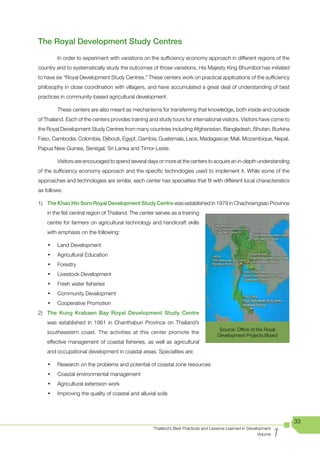
      Medical Fees.” For patients from countries with high medical costs, like the United States, the big attraction is
      lower costs. For patients with socialized medical systems, the attraction is quick service for elective procedures

104
that often require long waits in their home countries. The leader in attracting foreign clients has been Bamrungrad
Hospital, the first certified hospital in Asia, but other hospitals are actively seeking international patients. Bangkok
Hospital, for example, provides translation services in 29 languages and offer customized diets to suit the need
of patients of different cultural backgrounds.

         Another part of health tourism is “wellness” services to visitors who don’t have a particular medical
complaint, but just want to feel better. With 450 spa hydrotherapy centers, Thailand is considered the regional
center for wellness services. Thai spas have won awards as the top five best spas in the world for many years
in a row. Massage, hydrotherapy and herbal treatments are often bundled together in a health service package.
A number of Thai spas make their expertise available by teaching massage techniques and other spa therapies
to international trainees.


   The case of the Chiva-Som Spa Academy

         Chiva-Som International Academy is a department of the world-
   renowned Chiva-Som International Health Resorts Co., Ltd. The
   Academy was set up to make the group’s expertise on spa, holistic and
   aesthetic therapies available to others through highly effective training
   program.

         Chiva-Som Academy teaches both theory and practice, aiming to
   produce highly trained therapists with the knowledge and skills as well
   as the attentiveness and enthusiasm to give their clients great service. It
   seeks to produce graduates with the excellence and professionalism for
   which Chiva-Som International Health Resorts are known. The academy
   was set up to meet the growing demand for a standard training facility                   Source: Chiva-Som
                                                                                          International Academy
   dedicated to the human resource needs of the spa and wellness industry.
   Internationally accredited, the academy strives to be the region’s leading
   edge health and wellness educational institute.

         Courses and examinations are conducted either in Thai or English. Training typically starts with
   lecture explanations. Then instructors demonstrate and guide students through a step-by-step method
   of learning. Hands-on practical classes are highly supervised to ensure that everyone understands and
   completes procedures accurately. Students are required to practice among themselves during practical
   sessions.

         Graduates of Chiva-Som International Academy can seek employment at spas, cruise lines, health
   clubs, fitness centers, health and wellness facilities and beauty salons, or work as independent professional
   therapists. Those who want to launch their own businesses can enroll in the academy’s special training
   program in spa development and spa management.


                                                                                                                           105

                                                                                                                      1
                                                       Thailand’s Best Practices and Lessons Learned in Development
                                                                                                             Volume
Expertise in Promotion of Thai Cuisine
              An important part of Thailand’s tourism development has been the promotion of Thai cuisine. The spicy
      taste of Thai food has become popular around the world because it is nutritious, delicious, and inexpensive.
      According to Thailand’s Ministry of Commerce, there were some 13,000 Thai restaurants outside of Thailand in
      2009. Many Thai restaurants, ranging from elegant up-market outlets to fast-food take-aways, were set up by
      Thai expatriates living abroad, Thai wives of expatriates, and former students, as well as overseas entrepreneurs
      who simply fell in love with Thai food. This international acceptance of Thai cuisine has boosted both Thai food
      exports and attracted visitors to Thailand.

              The Thai government launched a project called “Kitchen of
      the World”, aimed at boosting both exports and food tourist arrivals.
      Thousands of foreign visitors come to Thailand each year to learn
      how to cook Thai dishes. In addition, the positive image of Thai food
      has boosted business at Thai restaurants in the country. In 2007, it
      was estimated that visitors spend an average of 730 baht per day
      on Thai food.

              To further promote Thai cuisine as a tourist attraction, the
      TAT, Department of Export Promotion, Thai Hotels Association,
      Association of Domestic Travel Agents, and Thai Restaurant
      Association launched a five-day project called “Amazing Tastes of
      Thailand” in September, 2009 in Bangkok and other major provinces.
      The project was designed to further enhance the global popularity
      of Thai cuisine, boost exports of Thai agricultural products, and help   Source: The Oriental Thai Cooking School
      visitors enjoy a higher quality of culinary experience in the kingdom.

              The project sets up travel around Thailand for participants to enjoy the traditional Thai cuisine of each
      region and see cooking demonstrations, as well as buy local condiments and ingredients and visit local traditional
      Thai arts and crafts shops, tourist attractions, and food markets.

              A number of hotels have seen the international interest in Thai cooking as an opportunity
      to attract guests and share their expertise. The top Thai cooking schools include the following:


106
The Thai Cooking School at The Oriental Hotel
        This legendary hotel on the banks of the Chao Phraya River was one of the first hotels to open
its own Thai cooking school. The courses are led by chef-lecturers and include hands-on participation
by students. Tuition is charged per class.

Benjarong Cooking Class at the Dusit Thani
        The Benjarong Royal Thai Cuisine is one of the most sophisticated Thai restaurants in Bangkok.
Its head chef runs the Benjarong Cooking Class every Saturday morning. Recipes are drawn from the
restaurant’s menu and include snacks and appetizers, soup and salad, main dishes and desserts. The
class is very hands-on and the instruction emphasizes practicality and inventiveness. The complete
course comprises 12 classes, and graduates will receive a certificate as well as a recipe book in English.

Nipa Restaurant at the Landmark Hotel
        The restaurant offers a 7-day course designed to teach beginners all the basics of Thai cooking
and enable them to prepare curries, soups, salads and other dishes that make up a Thai meal. The
restaurant’s chefs lecture on ingredients and recipes, and then let students participate in the cooking
and tasting. Nipa is famous for its authentic food, which has not been toned down to suit milder palates.
Students receive a recipe book in English or Japanese.

UFM Baking & Cooking School
        UFM offers 10-day Thai cooking course every other month. Recipes are a mix of the simple
and the sophisticated, regional specialties and national favorites. Students will receive a companion
book in English.

Modern Women Institute
        The 9-day Thai cooking course, which is run on an ongoing basis, teaches all the basic
techniques of a Thai kitchen. Fees are based on the number of recipes a student chooses. Vegetable
and fruit carving lessons are available separately.

Culinary Workshops at the Boathouse, Phuket
        The Boathouse’s Thai cooking classes, led by the resort’s executive chef, take place every
Saturday and Sunday morning. Classes are conducted in English and are very hands-on, with attendance
limited to 10 persons to ensure participation by all. Recipes have been chosen for adaptability to Western
kitchens.

Chiang Mai Cookery School
        The school offers one to three-day cooking classes in English. Recipes include Northern
specialties, and students get hands-on experience with kitchen tools. Classes include Northern-style
lunches, where students will learn the etiquette of eating at the unique khantoke table.


                                                                                                                   107

                                                                                                               1
                                                Thailand’s Best Practices and Lessons Learned in Development
                                                                                                      Volume
Other Development
      Expertise Available
      in Thailand
                            1
108
Other Development Expertise
Available in Thailand

                      Table of Expertise in Other Development Areas
                Expertise                                              Example Institution

   Research and advanced education               	•	    Thai	Universities

   Engineering and sustainable
                                                 	•	    Asian	Institute	of	Technology
   development

   Transport engineering                         	•	    Sirindhorn	International	Institute	of	Technology

   Chemical biology and environmental
                                                 	•	    Chulabhorn	Research	Institute
   toxicology

   Textile industry                              	•	    Thailand	Textile	Institute

   Automotive industry                           	•	    Thailand	Automotive	Institute

   Greater Mekong Subregion capacity
                                                 	•	    Mekong	Institute
   building

   Corporate social responsibility,
                                                 	•	    Kenan	Institute	Asia
   sustainable development

   Disaster preparedness                         	•	    Asia	Disaster	Preparedness	Center


Sector Expertise Overview
         Thailand’s rapid transformation from an agriculture-based economy to one that produces a wide
range of services and manufactured goods for global markets has required the parallel development of a great
variety of technical development expertise. Much of that expertise is available only in Thai, but increasingly Thai
universities, government agencies, technical institutes and training institutions have stepped up their ability to
provide training in English in order to serve human resource development needs beyond Thailand’s borders
and to provide Thais with international level skills.

         Much of Thailand’s expertise is available through international courses, both short courses and degree
programs, at Thai universities and other institutions of higher education. There are a total of 146 institutions of
higher education in Thailand and 19 community colleges. These include 13 autonomous state universities and
15 traditional state universities, many of which provide international programs.


                                                                                                                           109

                                                                                                                       1
                                                        Thailand’s Best Practices and Lessons Learned in Development
                                                                                                              Volume
These programs are typically taught in English and cover a wide variety of academic disciplines. The
      number of foreign students taking advantage of these programs has steadily increased, reaching more than
      11,000 by 2007. Some of these students, particularly those from countries in the Greater Mekong Subregion,
      are supported by grants or scholarships from the Thai government or international donor agencies. Thailand is
      also seeking to increase the number of students coming from ASEAN countries. Information on the international
      programs of some of the leading Thai universities is available in the second part of this report.

              Thailand has also developed expertise in research and development in a number of important areas.
      With support from the Asian Development Bank (ADB), Thailand has established seven “centers of excellence”
      in	R&D,	which	involve	researchers	from	26	universities	and	specialized	research	institutes.	

              Many international organizations use Thailand as a regional hub for development training and advisory
      services. Several United Nations Organizations have regional or country headquarters in Bangkok, many of which
      can provide experts, often Thai nationals, in a wide variety of development areas. Of particular importance are
      the recently established United Nations Development Programme - Regional Centre in Bangkok (UNDP-RCB)
      and the UN Economic and Social Commission for Asia and the Pacific (UNESCAP). In addition to the UNDP
      and UNESCAP, the list of UN or UN-related organizations with a presence in Thailand includes: the Food and
      Agriculture Organization (FAO), the International Labor Organization (ILO), the International Organization for
      Migration (IOM), the International Telecommunications Union (ITU), the UN Educational, Scientific and Cultural
      Organization (UNESCO), the UN Children’s Fund (UNICEF), the UN Industrial Development Organization (UNIDO),
      the UN Population Fund and the World Health Organization (WHO). Detailed information on these organizations
      is available under the “Structure and Organization” section of the UN website.


      Thai Universities with International Programs
              Most of Thailand’s leading universities are state-supported, including some that receive block grants
      from the government but operate autonomously. Most of the major universities were originally founded for very
      specific purposes. Chulalongkorn University, for example, was Thailand’s first university and was established
      to train civil servants. Thammasat University was established with a focus on political science, with the mission
      “to teach students to love and cherish democracy.” Kaestsart University evolved out of a college within the
      Ministry of Agriculture and initially developed expertise in agriculture and fisheries. Mahidol University was
      founded as the University of Medical Sciences closely connected with Siriraj Hospital’s medical school, and
      therefore focused on medical and health sciences. Silpakorn University was originally established as a school
      of fine arts. Srinakharinwirot University was first called the “Higher Teacher Training School” and concentrated
      on subjects related to education.

              Dhurakij Pundit University and Assumption University, two private universities, were founded
      specifically to train students for business. Unlike other Thai universities, Assumption University used English
      as the medium of instruction from the start and became a key training ground for students interested in
      international business. Other universities, such as King Mongkut’s Institute of Technology Ladkrabang and
      King Mongkut’s Institute of Technology Thonburi, were launched to train students to handle increasingly
      sophisticated industrial technologies.
110
Since their founding, however, all of these leading universities have expanded into other areas of
expertise. Although most have retained great strength in their initial areas of academic concentration, almost all
Thai universities now have multiple strengths including business schools and undergraduate faculties of liberal
arts. All have added graduate programs that offer master’s and doctoral degrees. Most have degree programs
in science, arts, social sciences, humanities, education, engineering, architecture, information technology,
business, medicine and health science.

         Another important change is that in the past 20 years all major Thai universities have developed
international programs, including full degree programs, taught in English. In some cases, the international
courses are taught within the same faculties as Thai courses. In other cases, separate international colleges
have been created, sometimes with their own campuses, to attract both students from abroad and Thais who
want to prepare for international careers.

         From modest beginnings, these international programs are now strong and numerous, covering a wide
variety of academic fields. Accompanying the degree courses are a number of short courses in specific areas.
More details on the international programs in Thai universities are provided in the second section of this report.

         Thai universities also offer international collaboration in research and development. Such collaboration
can be sought through individual universities or through seven joint “centers of excellence” in research and
development that are run as multi-university consortia.

These R&D centers of excellence are:

    •	   Center for Innovation in Chemistry
    •	   Center for Toxicology, Environmental Health and Management of Toxic Chemicals
    •	   Center for Environmental and Hazardous Waste Management
    •	   Center for Petroleum, Petrochemicals and Advanced Materials
    •	   Center for Energy Technology and Environment
    •	   Center for Agricultural Biotechnology
    •	   Center for Post Harvest Technology Innovation

         These centers have produced more than 3,000 graduates with advanced degrees, and have worked
on more than 200 research projects involving the private sector. The outputs of this research include some
3,000 articles in scholarly journals and four international patents. Some of this research has been channeled to
assist the rural economy through a government project called “Research and Innovation for Technology Transfer
to Rural Communities” that began in 2003. This project coordinates research activities with the needs of rural
communities and the local knowledge of those communities.

         In addition to the universities described above and in the second part of this report, Thailand also has
a number of institutes that provide development expertise available to other developing countries. Some of
these institutes are connected to universities, but many are independent not-for-profit organizations. Some, like
the Asian Institute of Technology, are very large, with thousands of students and staff, while others are much
smaller, but all have developed significant expertise that can be accessed through training courses, materials,
site visits or consulting.
                                                                                                                       111

                                                                                                                   1
                                                    Thailand’s Best Practices and Lessons Learned in Development
                                                                                                          Volume
Asian Institute of Technology
               The Asian Institute of Technology (AIT) is an international graduate institution for education in engineering,
      advanced technologies, business management and planning. It was founded to serve the Asia-Pacific region
      through “technological change and sustainable development.” Originally set up in 1959 under the Southeast
      Asia Treaty Organization (SEATO), it served as a regional graduate school of engineering, with support from the
      governments of Australia, France, New Zealand, the United Kingdom, the United States, Pakistan, the Philippines
      and Thailand. In 1967, the institute became independent of SEATO under special Thai legislation that changed
      its name to the Asian Institute of Technology gave it the authority to grant Thai graduate degrees.

               Since then, AIT has become a leading regional postgraduate institution and is actively working with
      public and private sector partners throughout the region, as well as with some of the top universities in the world.
      The School of Engineering and Technology focuses on three areas of study- civil and infrastructure engineering,
      Industrial systems engineering, and information and communications. The school implements a holistic academic
      approach which combines traditional engineering curriculum with subject areas such as management, economics,
      finance, environment and law. The School of Engineering and Technology is committed to developing highly
      qualified engineers and technologists who play a leading role in promoting the region’s industrial competitiveness
      and its integration into the global economy. The School of Environment, Resources and Development offers a
      variety of academic programs with the mission of achieving sustainable development and poverty alleviation while
      mitigating the effects of climate change. The School of Management has adapted its program to the needs and
      challenges of the increasingly competitive regional economies. With an increasing focus on development in the
      region, AIT is currently developing programs on sustainable cities, climate change, and geosystem exploration
      and offshore engineering. In addition to degree programs that actively recruit international students from the
      Asia and Pacific regions, AIT has an outreach program that provides short-course development training in a
      wide variety of areas, especially agriculture, environment, information and communication technologies, small
      business management, business administration, development planning, project management, infrastructure
      development and public utility management.


      Sirindhorn International Institute of Technology
               The Sirindhorn International Institute of Technology at Thammasat University (SIIT) is a good example of a
      international level research and teaching institute that has been established within a Thai university. SIIT grew out of
      cooperation among the Japanese Industrial Association, Keidanren, the Federation of Thai Industries and Thammasat
      University that began with a bachelor degree program in engineering in 1992. In 1996, with additional programs and a
      new building of its own, the institute was renamed in honor of Her Royal Highness Princess Maha Chakri Sirindhorn.


               From its beginning, SIIT established English as the medium of instruction in order to prepare Thai engineers
      for international work and to attract top students from all over the world. All faculty members hold doctoral
      degrees, work on a full-time basis, and are fully available for consultation with students. The Institute now offers


112
bachelor’s, master’s, and doctoral degree programs in engineering and technology. All graduate programs are
research oriented and the Institute operates two research centers: the Construction and Maintenance Technology
Research Center and the Transportation Research Center. In 2007 an assessment by the Thai Research Fund
showed that among the 13 participating engineering faculties and institutes, SIIT was the only institute receiving
the highest rating of “Very Good” for all indicators. In 2005, for example, the 57-member faculty published a
total of 167 research papers, including 49 in international journals.

        SIIT actively recruits international students, and support from the private sector enables the Institute
to offer substantial financial assistance to capable students in need.


Chulabhorn Research Institute
        This biomedical and chemistry research institute in Bangkok was initiated by Her Royal Highness Princess
Chulabhorn in 1987 as an independent agency funded by the Thai government. It has focused on the areas of
applied biology, chemical biology and environmental toxicology. It operates nine laboratories in biochemistry,
biotechnology, organic synthesis, pharmacology, natural products, immunology, chemical carcinogenesis
medicinal chemistry and chemical carcinogenesis.

        In addition to its research work, the Institute also offers various trainings as well as master’s and
doctoral degree programs in Environmental Toxicology, Technology and Management. The curriculum for these
international programs was designed by a team of international experts, with support from UNDP, many of
whom have remained as part of the teaching faculty. The expertise available through these programs is furthered
via international collaboration, with some courses operating as a joint-effort between CRI and leading foreign
institutions such as the Massachusetts Institute of Technology in the United States, collaborative research and
dissertation supervision efforts with various European and North American institutions, visiting professors from
leading international institutions and organizations, and a chance for PhD. candidates to study abroad. The
Institute seeks international collaboration and funding to further its research. Through training courses, seminars,
symposia, workshops and conferences, the Chulabhorn Research Institute promotes the dissemination of
information to assist local scientists in keeping abreast with new developments as well as to strengthen regional
and international co-operation. Of particular importance are the Princess Chulabhorn International Science
Congress and Distinguished Lecture Series. The international congresses were initiated to provide a forum
for the exchange of the latest information and the most recent advances in research among the international
scientific community. Congresses take place on a selected topic every four to five years, with over 1,000
participants at each previous congress. The Distinguished Lecture Series aims to promote the development of
science according to the wishes of H.R.H. Princess Chulabhorn, by providing the opportunity for scientists of
all disciplines in Thailand to benefit from the insights of renowned scientists throughout the world.


                                                                                                                        113

                                                                                                                    1
                                                     Thailand’s Best Practices and Lessons Learned in Development
                                                                                                           Volume
Thailand Textile Institute
               The Thailand Textile Institute (THTI) is
      a non-profit training organization set up by the
      Thai government to support and develop the
      textile and garment industries and help keep
      them competitive in the world market. THTI was
      founded by a Cabinet resolution in 1996, as a
      result of efforts by businesses in the textile and
                                                                        Source: Textile Development Center
      garment sector.

      The key tasks of the institute are:

          •	   To collect, publicize and develop the textile and garment industry information system.
          •	   To support research on textile production, style, standards and quality .
          •	   To train and develop human resources for the industry.
          •	   To check, analyze, test and guarantee textile quality.
          •	   To provide technical advice on textiles to businesses.
          •	   To arrange marketing promotion activities.
          •	   To coordinate public-private efforts to promote and develop the industry.


                                                                   The end of global textile and garment quotas has
                                                              greatly intensified competition in the industry. It was clear
                                                              that for the Thai textile and garment industry to survive, it
                                                              would have to provide higher value, use better technology
                Source: Textile Development Center            and employ more skilled workers and designers.

                                                              Co-operations with foreign countries – THTI places
      great importance on creating links to textile trading partner countries through institutes, organizations
      and associations. The institute’s co-operation development has included domestic and international trade
      development, investment, technology development, research and development, human resources development,
      information exchange and testing services. In the past ten years, the institute has performed four different roles
      in building co-operation with foreign countries.

      Trade and investment development – The institute has supported trading relations between Thai private
      companies and trading partners in other countries. The main objective is to maintain markets in major consuming
      countries and to expand Thai exports in countries such as China, France, Singapore, Vietnam, the Philippines,
      New Zealand and Italy.

      The Institute has also worked to improve cooperation within ASEAN. It has hosted business coordination meetings
      for the ASEAN Federation of Textile Industries (AFTEX), which represents more than 2,000 companies from all
      ten ASEAN countries. THTI also supports AFTEX by managing the AFTEX website.


114
Human resources development – As a result of cooperation with the Italian Trade Commission, THTI
coordinates training and advisory services provided by Italy on bleaching, dyeing and finishing. The Institute
also holds training and train-the-trainer courses on a variety of textile and garment manufacturing technologies
and techniques. Some of this training involves international experts and most of it can be delivered in English
for international trainees.

Quality standard and testing services development – The THTI’s Textile Testing Center has developed textile
testing services and textile counseling under the EU Eco Label (EU-Flower). The center has cooperated with the
Danish Technological Institute (DTI), the National Metal and Materials Technology Center (MTEC) and Kasetsart
University (KU) in a project for capacity building by institute and textile industries according to the EU-Eco Label
standard. The testing center helps entrepreneurs develop environment-friendly products.


The Thailand Automotive Institute
         The Thai automotive industry has expanded rapidly in
the past 15 years to become the largest automotive product
exporter in Southeast Asia. Part of the reason for this success
has been the ability of Thailand to upgrade the human resources
in the industry. While much of this is due to the efforts of the
                                                                            Source: Thailand Automotive Institute
major automobile assemblers, an important role has been
played by the Thailand Automotive Institute (TAI). This institute
was established by the Ministry of Industry to provide information, analysis and human resource development
for the industry as a whole. TAI advises the government on policy making and acts as a Cluster Development
Agency, promoting coordinated activities within key auto industry clusters. TAI coordinates with international
providers of expertise to help build Thai industry competitiveness on quality, cost, delivery, engineering and
management – QCDEM.

                                                    Automotive human resource development – TAI provides
                                                    both public and in-house training concentrating on the skills
                                                    and knowledge needed by the automotive industry. Key training
                                                    topics cover productivity, quality systems, administration and
                                                    management. Training is also provided for personnel on
                                                    technical subjects such as metal fabrication, metal molding,
                                                    plastic injection and milling.

                                                               The training and subsequent capability tests

       Participants in TAI on-site training         cover both theory and practical application. TAI’s capability
      Source: Thailand Automotive Institute         certification helps promote systematic personnel development,
                                                    and enhances personnel capability standards. TAI has
established a Skill Certification System for the more than 300,000 workers in the Thai automotive industry.
This system establishes widely accepted standards for key labor skills in the industry, with support from the

                                                                                                                        115

                                                                                                                    1
                                                     Thailand’s Best Practices and Lessons Learned in Development
                                                                                                           Volume
Japan External Trade Organization (JETRO). TAI has also received support from the Association for Overseas
      Technical Scholarship (AOTS) to dispatch experts to set up certification systems, training courses, and operation
      procedures for training personnel, examiners, and trainers.

               TAI manages the Automotive Human Resource Development Project, a co-operative effort between
      automotive manufacturers and related organizations from Japan to develop human resources to meet international
      standards. This project has been supported by The Federation of Thai Industries, JETRO, the Japanese Chamber
      of Commerce in Thailand and private companies in the automotive industry.

      The key corporate supporters are Toyota – on production technology, Denso – on the development of industrial
      attitudes, Honda – on die making, and Nissan – on the personnel skill certification system.

      These TAI activities have achieved the following results:

          •	   Increased the knowledge and skills of employees
          •	   Increased productivity due to the higher abilities of employee
          •	   Developed teaching courses that produce skillful and knowledgeable workers aligned with industry
               needs

      Co-operation with foreign countries – TAI is willing to play an active role in encouraging co-operation and
      transferring industry skills in the automotive industry. It is able to provide many of its training courses in English
      and looks forward to receiving trainees from automotive companies in the region.


      The Mekong Institute
               The Mekong Institute (MI) is an inter-
      governmental organization with a residential learning
      facility located on the campus of Khon Kaen University
      in northeastern Thailand. It serves the countries of the
      Greater Mekong Subregion (GMS), namely, Cambodia,
      Lao	 P.D.R.,	 Myanmar,	 Thailand,	 Vietnam,	 Yunnan	
      Province and the Guang Xi Autonomous Region of                               Source: Mekong Institute

      China. MI’s programs and services principally cater to
      the capacity building needs of current and future GMS leaders on issues around public sector reform and good
      governance, transnational project management and sustainable development, trade facilitation, and regional
      cooperation. MI is the only development learning institute founded by the six GMS members that offers standard
      and on-demand human resource development programs with a focus on regional cooperation and transnational
      development issues.


116
MI offers training in four areas :

    •	   Rural Development and Project Management
    •	   Leadership and Good Governance
    •	   Trade and Investment Facilitation
    •	   Effective Regional Cooperation

The MI Residential Training Center is equipped with the following training facilities:

    •	   Two conference rooms equipped with audio-visual equipment and training materials
    •	   Four class rooms
    •	   Twenty-four hour wireless internet service
    •	   A GMS Document Center with online access to the Khon Kaen University Library
    •	   A language laboratory
    •	   Thirty-eight standard hotel rooms with 24-hour wireless internet access

         MI maintains a regional network of professionals, civil society organizations, government agencies and
the private sector. It has strategic alliances with the Entrepreneurship Development Institute of India (EDII), the
GMS Business Forum and the Mekong Migration Network (MMN). In 2008, 16 regional and international learning
programs, four sub-regional research projects and seven workshops and policy dialogues were conducted,
benefiting over 600 government officials and leaders of private enterprises involved in GMS development. The
Institute also published eight working papers for its MI Working Paper Series. In 2009, MI conducted 12 learning
programs, five research activities, eight workshops and one symposium.

         MI’s major partners include UNESCO Bangkok on education policy reform, UNIAP on combating
human trafficking, MMN on trans-border labor migration management, the GMS Business Forum on trade and
investment facilitation, and EDII on entrepreneurship development.

         MI carried out a tracer study of its alumni and conducted a training need analysis for GMS development
and cooperation to assess the impact of its training programs and identify the human resource development needs
of key government agencies and state enterprises in the GMS. The study found the following:Performance

Course effectiveness: 96% of the respondents rated MI’s courses as effective in improving their knowledge and
skills, and 74% believed that MI’s courses fostered professional network development among participants. About
53% of the respondents said that they were still in contact with their batch mates from other GMS countries.

Training needs: The priority training needs identified during the study were

    •	   Trade and investment facilitation
    •	   Project management
    •	   Aid management for government officers
    •	   Monitoring of social and environmental impacts of development of infrastructure and economic
         integration in the GMS


                                                                                                                         117

                                                                                                                     1
                                                      Thailand’s Best Practices and Lessons Learned in Development
                                                                                                            Volume
Kenan Institute Asia
                                                 The Kenan Institute Asia (K.I.Asia) is a Thailand-based, non-profit
                                            organization serving the sustainable development needs of the region by
                                            providing training, project management, research and consulting services.
                                            It grew out of a United States Agency for International Development
                                            (USAID) development project and was set up with support from the US
                                            government, the Thai government (through the agency now known as
                                            The Thailand International Development Cooperation Agency – TICA) and
                                            the Kenan Charitable Trust, a private family trust in North Carolina.

                                                 K.I.Asia was established on the understanding that the challenges
                                            facing Southeast Asia could be best addressed through free enterprise
           K.I.Asia trainer assists an
      entrepreneur with her business plan   mechanisms, boundary-spanning partnerships and expertise gained
             during REAL training
                Source: K.I.Asia            through practical development experience. K.I.Asia’s team of approximately
                                            50 professionals (38 with advanced degrees) draws upon expertise and
      experience gained over more than a decade of activities to support sustainable development.

               The Institute works on the principle that human resource development and capacity building is at the
      core of economic and social development. K.I.Asia provides practical, short-course training in the following
      areas:


      Youth Development & Innovative Education

               Training for young people and teachers can be provided
      in the following areas:

          •	   Inquiry-based science education
          •	   Monitoring and evaluating educational projects
          •	   Using information technology for higher learning,
               especially through K.I.Asia’s “One Computer Classroom”
               curriculum that helps subject teachers make best use      Teachers plan inquiry-based science teaching
                                                                                     in a K.I.Asia course
               of computers when they are in limited supply                             Source: K.I.Asia

          •	   Management of community IT and learning centers,
               based on five years of practical experience in setting up and managing such centers


      Corporate Social Responsibility (CSR)

               K.I.Asia provides training for corporate executives and managers in corporate citizenship through open
      courses, executive briefings, and customized programs. K.I.Asia offers English language courses on:

          •	   Developing Strategies for Corporate Community Engagement
          •	   Building Effective Employee Volunteer Programs

118
•	   Evaluation and Measurement
    •	   Communicating	&	Branding


Entrepreneurship, Business and Economic Development

         K.I.Asia provides training and consulting services (one-on-one and group) to entrepreneurs and SME
owners and managers at all stages of a business’ life cycle. K.I.Asia human resource development services also
include training and seminars for government officials. These courses can be customized to particular needs
in the following areas of expertise:

    •	   Business plan writing – especially for small and medium-sized companies
    •	   Marketing
    •	   Business cluster development – including a handbook and training for cluster development facilitators
    •	   Franchising – effective design and business planning for franchise-based businesses
    •	   Entrepreneurship – especially for small, low-tech entrepreneurs, through a curriculum called Rural
         Entrepreneurship through Action Learning (REAL). The REAL methodology emphasizes “learning-by-
         doing” through activities and experiences following the “Experiential Learning Cycle” concept.
    •	   Financial project management - especially for small companies and NGOs
    •	   Development project design and evaluation – especially for government development officials
    •	   Financial literacy – focused on budgeting, saving and borrowing for individuals
    •	   Microfinance – focused on best practices in operating community-based microfinance organizations


Public Health

         K.I.Asia’s Public Health Program, largely funded by USAID and supported by TICA, emphasizes cross-
border collaboration on surveillance of, and response to, significant and emerging human and zoonotic infectious
diseases, preparedness for pandemic influenza, control and elimination of multi-drug resistant malaria, and
public health communication. Customized English-language training can be provided on:

    •	   Pandemic preparedness planning
    •	   Life-skills-based behavior change communication in schools and communities


The Asian Disaster Preparedness Center
         The Asian Disaster Preparedness Center (ADPC), based in Bangkok, is a non-profit organization helping
the countries build safer communities through projects that reduce the impact of disasters. Key areas of activity
include developing disaster risk management capacities, facilitating the dissemination disaster risk management
expertise, experience and information and enhancing disaster risk management knowledge and skills

         ADPC was established in 1986 at the recommendation of the UN Disaster Relief Organization with the
aim of strengthening the national disaster risk management systems in the region. In 1999, ADPC became an
independent entity, which is governed and guided by a Board of Trustees. ADPC’s areas of expertise include
the following:
                                                                                                                      119

                                                                                                                  1
                                                   Thailand’s Best Practices and Lessons Learned in Development
                                                                                                         Volume
Climate Risk Management

         •	   Reducing the vulnerabilities of communities to climate risks and applying climate information to crop
              and water resource management
         •	   Building the capacity of partner institutions to generate, interpret, translate and communicate climate
              forecast information with sufficient lead time to enable communities and governments to anticipate
              and manage risks


      Community-Based Disaster Risk Management

         •	   Institutionalization of the community-based disaster risk management in the policy, planning and
              implementation of the government
         •	   Implementation of innovative programs
         •	   Development of tools to support the work of decision-makers and practitioners
         •	   Development of databases and publications to support implementation
         •	   Development of new training tools to enhance the capacity of practitioners
         •	   Development of a regional information and technical support center


      Disaster Risk Management Systems

         •	   Strengthening the capacities of national, provincial and local disaster management systems, and
              promoting regional cooperation


      Public Health in Emergencies

         •	   Developing more effective policy, procedures and guidelines for emergency management by the health
              sector
         •	   Assisting health agencies, both government and non-government, in health emergency preparedness,
              mitigation and response


      Training Resources

         •	   Regional courses, which ADPC conducts periodically every year, to improve the knowledge and
              skills of professionals on various aspects of disaster management in the light of regional disaster
              management needs
         •	   Program based courses, under which ADPC develops and institutionalizes courses at the national
              level in different countries with the collaboration of national level training organizations on specific
              aspects of disaster management
         •	   Special courses tailored to suit the needs of particular groups of professionals to enhance their
              capabilities to meet the requirements of their disaster management programs; typically developed
              upon request from governments, international and UN agencies, NGOs and the private sector


120
Urban Disaster Risk Management (UDRM)

    •	   Reducing human, social and economic losses in cities resulting from disasters
    •	   Building stakeholders’ capacity
    •	   Facilitating structural and non-structural interventions
    •	   Effective emergency response planning process

         ADPC’s work is primarily focused on the Asian region, but its training courses have also received
participants from Africa, Australia, Europe, New Zealand, Latin America, the Middle East, the South Pacific and
the United States.

         ADPC is governed and guided by a Board of Trustees and advised by a Regional Consultative Committee
and Advisory Council. It currently has over 100 staff from 18 different countries. ADPC has country project offices
in	Dhaka,	Bangladesh;	Ho	Chi	Minh	City	and	An	Giang,	Vietnam;	Khamuane,	Lao	PDR;	Yangon,	Myanmar;	and	
                                                                                                     	
Prey Veng and Phnom Penh, Cambodia.

         ADPC also facilitates, maintains and operates a regional early warning facility to cater to differential
needs and demands of countries to address gaps in the end-end multi-hazard early warning system through
its office in Thailand.


                                                                                                                        121

                                                                                                                    1
                                                     Thailand’s Best Practices and Lessons Learned in Development
                                                                                                           Volume
Thailand’s Best Practices
and Lessons Learned

                            1
124

Thailand's best practices and lessons learned in development

  • 1.
    1 1 Thailand’s Best Practices and Lessons Learned in Development Volume
  • 2.
    Thailand’s Best Practices andLessons Learned in Development 1
  • 3.
    Foreword Thailand has maderemarkable progress in the fields of social and economic development in recent decades, which enabled Thailand to become a middle-income country. According to the first Thailand Millennium Development Goals Report, 2004, Thailand has already reached almost all targets set in the Millennium Development Goals (MDGs). Therefore, Thailand has set more ambitious targets, called MDG Plus, that go well beyond the internationally agreed MDG targets. The development examples of many innovative projects under the royal patronage of His Majesty King Bhumibol Adulyadej are particularly valuable, and His Majesty’s philosophy on “Sufficiency Economy” has become a key principle in Thailand’s national development plan and practices. As Thailand succeeded in its development during the past four decades, The Royal Thai Government has shared its knowledge and experiences with other developing countries, especially its neighbors in the Greater Mekong Sub-Region (GMS), through technical cooperation and human resource development. Helping the development of neighboring countries is among the highest priorities of Thai foreign policy. This has led to Thailand becoming a training and resource center for development, especially for scholars and practitioners from other developing countries. The Thailand International Development Cooperation Agency (TICA) of the Ministry of Foreign Affairs is the main Government’s coordinating body for technical and development assistance, including managing Thailand’s Official Development Assistance (ODA). Working closely with TICA and supporting Thailand as an active donor of the South is the United Nations Development Programme (UNDP) in Thailand. We at TICA would like to express our gratitude to UNDP for its new initiatives to further strengthen Thailand’s efforts in South-South cooperation and aid effectiveness. In recognizing the value of Thailand’s development experiences and expertise, UNDP has provided generous support and finding to this publication on “Thailand’s Best Practices and Lessons Learned in Development”. The publication’s provides an overview and some examples of Thailand’s areas of expertise and development achievements (Volume 1), as well as providing and evidence-based resource mapping of national institutions in the country, called “Sources of Expertise for Thailand’s Best Practices in Development” (Volume 2). We also appreciate the efforts of the Kenan Institute Asia in collecting, analyzing and summarizing Thailand’s varied and extensive development experiences. It is our hope that this publication will be useful to the Thai Government as an advocacy tool to promote Thailand’s development achievements and its available resource centers, as well as for strategic development cooperation programs with other developing countries and partners. Apinan Phatarathiyanon Director-General Thailand International Development Cooperation Agency i 1 Thailand’s Best Practices and Lessons Learned in Development Volume
  • 4.
  • 5.
    Table of Contents Foreword....................................................................................................................................... i Introduction .................................................................................................................................. 1 Agriculture and Rural Development ............................................................................................. 7 Development in Support of a Sufficiency Economy ................................................................... 23 Community-based Economic Development .............................................................................. 39 Public Health .............................................................................................................................. 57 Natural Resources, Environment, and Energy............................................................................ 75 Tourism ....................................................................................................................................... 97 Other Development Expertise Available in Thailand ................................................................ 109 iii 1 Thailand’s Best Practices and Lessons Learned in Development Volume
  • 6.
  • 7.
    Introduction Over the past 50 years Thailand has developed from a low-income nation that produced only basic commodities to a middle-level, diversified economy that has balanced strengths in agriculture, industry and services. At the same time, Thailand has developed expertise in public health, community development, and environmental protection. As in every other country, Thailand’s development has not been without problems or setbacks, but key organizations in Thailand have learned valuable lessons from those challenges, which they are ready make available to other developing countries. These lessons come from too many areas of social and economic development to document them all in a report of this length. Therefore seven key areas of expertise have been identified for highlighting in this report. These are: • Agriculture and rural development • Development in support of a sufficiency economy • Community-based economic development • Public health • Management of natural resources, environment, and energy • Tourism • Other development expertise available in Thailand Thailand’s Official Development Assistance (ODA) consists of grants and concessionary loans provided by the Royal Thailand Government to other developing countries. The main Royal Thai Government donors of ODA are the Thailand International Development Cooperation Agency (TICA) of the Ministry of Foreign Affairs, the Export-Import Bank of Thailand (EXIM Thailand), and the Neighbouring Countries Economic Development Cooperation Agency (Public Organization) (NEDA) based in the Ministry of Finance. Thailand became a donor of ODA in 1992 after many years of providing informal technical assistance, training and scholarships to other developing countries. This official assistance is provided by the Thai government because of its long-term commitment to international development, regional integration, and most importantly, to the development of Thailand’s neighbors in the Greater Mekong Sub-Region and its partners in the Association of Southeast Asian Nations (ASEAN). Thailand also supports United Nations (UN) agencies and other international development organizations headquartered in Thailand. Organizations such as the World Health Organization, Family Health International, the US Agency for International Development and the Rockefeller Foundation have regional offices in Bangkok that benefit from Thai government support and Bangkok’s strategic location. Assisting the development of neighboring countries is one of the highest priorities of Thai foreign policy. Policy direction for 1 1 Thailand’s Best Practices and Lessons Learned in Development Volume
  • 8.
    this assistance comesfrom the “Neighboring Countries Economic Development Cooperation Committee” chaired by the Prime Minister. Much of Thai ODA has been based on Thailand’s own development experience and focused on promoting public health, improving education, advancing agriculture, reducing illicit trafficking of people and narcotics, and building key infrastructure. Thailand’s program of international assistance is well- documented in the TICA publication “Thailand Official Development Assistance (ODA) Report 2007–2008.” TICA, however, recognizes that Thailand’s value to its developing country partners and friends goes well beyond official assistance and has the potential for significant increase if the expertise available in Thailand were better known and more easily accessed. Therefore, this report is meant to provide a broader picture of Thailand’s development experience and the best practices that have evolved out of that experience. Support for this report has come from the UN Development Programme (UNDP), indicating the value that the UNDP sees in Thailand’s development experience and its interest in supporting the dissemination of that experience. This report focuses on appropriate expertise for other developing countries that can be transferred through training, consultancy, site visits and materials. It is expected that some of this expertise transfer can be supported by UNDP and other multilateral or bilateral development agencies as well as Thailand’s ODA program. Transfer of expertise can also take place through TICA’s program “Friends from Thailand,” which supports Thai volunteers to work in partner countries. In other cases, the sources of expertise can be contacted directly for help, especially for training and site visits. Some of Thailand’s development expertise originated from international development projects funded by international development agencies, but in almost all cases, the experience of implementing projects in Thailand has led to adjustments and refinements that make it more applicable to the developing country situation. There is also a great deal of expertise that has been developed by indigenous organizations working on their own to find creative and appropriate solutions to development problems. Of particular importance are the efforts led by Thailand’s royal family and the personal commitment and technical expertise of His Majesty King Bhumibol Adulyadej. Truly a “development monarch,” His Majesty King Bhumibol has focused His Majesty considerable efforts, attention and resources on development for more than half a century. Those efforts have borne particular fruit in community development, small-scale agriculture, highland development, water resource management and rain-making. The impact of royal development projects has extended beyond their immediate scope because the lessons learned from those projects have been generously made available to all those interested, whether from Thailand or abroad. The types of development expertise available in Thailand are varied and the organizations that can transfer this expertise are many. They include government agencies, institutes, community organizations, UN agencies and other international development organizations, NGOs and private companies that are located in Thailand. The key areas of Thailand’s development experience addressed in this report are described briefly below, with more detailed information in separate sections and in the list of sources of development expertise in volume two of this report. 2
  • 9.
    Agriculture and RuralDevelopment With more than half of Thailand’s population involved in agriculture, this sector has been of particular importance to national development. In the past 40 years, Thai farmers and agricultural organizations have used research, technology and on-the-farm learning to develop their own new techniques that have helped Thailand become one of the largest food exporters in Asia. Farm productivity has steadily improved and better processing and storage technologies have increased the value of Thai agricultural products around the world. Thailand continues to maintain its position as the world’s leading exporter of rice, rubber, canned pineapple, and tiger prawns. It is also a globally ranked producer of fish, chicken meat, tapioca, and sugar. Thai agricultural expertise ranges from high-tech methods based on cutting-edge research to practical small-farm methodologies that require little investment. Development in Support of a Sufficiency Economy Following the 1997 economic crisis, Thailand sought ways to reduce the impact of global volatility on its domestic development and to ensure that the rapid change within the Thai economy did not adversely impact the natural environment or deprive the rural poor of an acceptable quality of life. This was a particular concern of His Majesty King Bhumibol and a theme in his long and successful efforts to foster development. Based on his extensive experience, His Majesty King Bhumibol has formulated what he calls the “sufficiency economy” philosophy. This approach emphasizes moderation, appropriate technology, careful management of risk and flexibility in dealing with change. Implemented in a wide range of projects and geographical areas, the “sufficiency economy” methodology has helped hundreds of thousands of people, especially those in remote areas with few natural advantages. The Thai government incorporated this philosophy into the 2002-2006 national development plan, resulting in a positive impact on many areas of development. Royal research centers, foundations and projects provide opportunities for other countries to learn more about this valuable approach to development. Community-based Economic Development Thailand’s experience in community-based development is closely related to the sufficiency economy concept. This type of development emphasizes strengthening communities so they can withstand external economic shocks, such as the 1997 Asian financial crisis and the 2009 global downturn, and provide a stable base for improving the quality of life for community members. A key element of this approach is getting active and informed participation from the people so that development is based on their own needs and aspirations. This “bottom-up” type of development still needs inputs, information, technology and support from outside the community, but ensures that key decisions are under the control of the community itself. Community-based development in Thailand has led to expertise in implementing a range of critical development mechanisms 3 1 Thailand’s Best Practices and Lessons Learned in Development Volume
  • 10.
    that include communityenterprises, revolving funds, small-credit schemes, community information centers, sub-district administrative organizations and networks of community organizations. Of particular importance is the development of expertise in “sustainable alternative livelihood development,” local and community product promotion and community-based microfinance. Public Health While much attention has been paid to Thailand’s economic development over the past 40 years, improvements in public health have been at least equally striking. Infant mortality has dropped from more than 40 deaths per every 1,000 children born to only 12.5 deaths per 1,000 in 2009. In the 20 years prior to 2000, the life expectancy of men increased by 17 percent and of women by 14 percent. Effective family planning has cut the population growth rate by more than half and women no longer need to suffer from unwanted pregnancy. Despite the threats from emerging diseases such as HIV/AIDS and avian and pandemic influenza as well as increasing drug resistance of diseases such as malaria, the impact of infectious diseases has sharply decreased. A new, national, publicly-financed health system has extended affordable healthcare to virtually the entire population. Thai expertise has been developed in areas such as family planning, HIV/AIDS treatment and prevention, epidemiology, infectious disease surveillance, food safety, village health volunteer programs, health and nutrition promotion and the adoption of a universal health coverage system. Natural Resources, Environment and Energy Concerns over the impact of Thailand’s rapid industrialization on the natural environment has led to the development of mechanisms and expertise in the effective management of the natural environment and care for key resources such as soil, water and renewable sources of energy. The development of expertise in renewable energy and energy conservation is due to increasing concerns about global climate change. Thailand has used a combination of international expertise and its own “local wisdom” in devising an efficient national irrigation system, effective low-tech water controls, soil conservation, community forestry, national parks and drought relief. Tourism Thailand’s emergence as the third largest tourist country in Asia and one of the highest rated tourist destinations in the world has come as a result of natural advantages, local-international cooperation and learning from experience. Tourist arrivals have grown from less than 50,000 in 1960 to more than 14 million in 2008. These arrivals provide jobs for more than 3 million Thais and supply more than 6 percent of the GDP. Thailand, however, has increasingly developed expertise that goes beyond attracting larger and larger numbers of tourists and focuses on sustainable approaches to tourism that preserve nature and local culture while contributing to village economies. 4
  • 11.
    Other Development Expertise In addition to expertise in particular areas of development, many organizations have significant capabilities in the design and implementation of overall and holistic development. Thailand’s public and private universities have developed significant knowledge that they can transfer to the international community through degree and non-degree courses, research collaboration, and consulting. Most leading Thai universities now have international programs in English and actively seek international students. Thailand also has become a major regional center of development expertise, with numerous regional UN offices, such as the regional headquarters for UN Development Programme (UNDP) and the UN Economic and Social Commission for Asia and the Pacific (UNESCAP), and headquarters for many bilaterial development agencies, such as USAID’s Regional Development Mission for Asia (RDMA), located in Bangkok. A wide range of non-profit development organizations are also located in Thailand. These include international NGOs as well as local organizations such as the Mekong Institute, the Population and Community Development Association and the Kenan Institute Asia. Thailand, therefore, has great breadth and depth in the development expertise it can offer to other countries. Much of this expertise has been hard-won from difficult experience and much of it has come from collaborating with other countries. Most importantly, the many development organizations – Thai government, international, for-profit and non-profit – understand the value of sharing their experiences with others. 5 1 Thailand’s Best Practices and Lessons Learned in Development Volume
  • 12.
    Agriculture and Rural Development 1 6
  • 13.
    Agriculture and RuralDevelopment Table of Expertise in Agriculture and Rural Development Expertise Example Institution • Ministry of Agriculture and Cooperatives Increasing efficiency and productivity w Department of Agriculture in agriculture w Department of Agricultural Extension Value creation for agricultural • National Biological Control Research Center, products Kasetsart University • Ministry of Agriculture and Cooperatives Development of aquaculture w Department of Livestock Development • Ministry of Agriculture and Cooperatives w Department of Livestock Development Development of livestock production • Kasetsart University • Pon Yang Kham Livestock Cooperative • Ministry of Agriculture and Cooperatives w Department of Fisheries Poultry product safety w Department of Livestock Development w Department of Agriculture Good Agriculture Practices (GAP) • Ministry of Agriculture and Cooperatives Sector Expertise Overview Thailand is an agricultural country, with more than half of its population of 65 million engaged in agriculture. More than 20 million hectares of Thailand’s total area of 51 million hectares is farmland. Over the past three decades, Thailand has successfully utilized innovations in agricultural research and technology to develop a dynamic agricultural sector. Through technology transfer and perseverance on the part of the private sector, the business of food production for export has flourished. Farm productivity has increased and the quality of Thai food and agricultural products has been enhanced. Public and private investment in agricultural research and development has resulted in significant increases in yields and land productivity, enabling the expansion of Thai food and agricultural product exports to global markets. In 2007, Thailand was ranked the 7th leading exporter of agricultural products and food in the world, exporting more than $24.7 billion worth of products. 7 1 Thailand’s Best Practices and Lessons Learned in Development Volume
  • 14.
    Thailand has maintainedits position as a world leader in the production and export of agricultural products such as rice, rubber, tapioca, prawns and pineapple. Thailand’s master plan for agricultural development focuses on research and development to raise productivity and cut costs by using new technology to bring product quality and processing up to international requirements. It encourages farmers to use less chemical fertilizer while promoting natural alternatives and organic production. It calls for continued improvements in the management of natural resources and the environment as the base for agricultural production. Support for the agricultural sector comes from many sources: government agencies, universities, research institutes and private organizations. Thailand’s expertise in agricultural development may be grouped into five categories: • Increasing efficiency and productivity in agriculture • Development of aquaculture • Development of livestock production • Value creation for agricultural products • Food security Expertise in Increasing Efficiency and Productivity in Agriculture Increasing efficiency and productivity includes crop genetics research and development, agricultural production planning, pest management, utilization of inputs, crop choices, and fertilization research. The goal is to improve agricultural production and reduce costs so that farmers can achieve stable and sufficient income. Plant genetic improvement Thailand has researched genetic improvement in all types of plants to boost crop quality and profitability for farmers. This task falls under the Department of Agriculture, but the research is carried out by universities and research institutes all over Thailand. Some of the benefits achieved through plant genetic improvement are: • Increased yield, quality, and nutrition • New plant varieties that are well-suited to particular geographical locations • Plants that are suitable for harvesting and production technologies • Plants that are tolerant of local pests and diseases 8
  • 15.
    The case ofmaize breeding for drought tolerance The province of Nakhon Sawan receives only enough rain for a single crop of maize each year. In the dry season, maize fields lie fallow, as in most of Thailand. At the Thai Department of Agriculture’s Nakhon Sawan Field Crops Research Center, Pichet Grudloyma, senior maize breeder, showed two comparison plots: one well-watered and one “drought” plot, where watering is stopped for two weeks before and two weeks after flowering. Many of the experimental lines and varieties being tested at the center are the result of the Asian Maize Network (AMNET). Source: CIMMYT E-News Funded by the Asian Development Bank, this project has brought together scientists from the national maize programs of five Southeast Asian countries to develop drought tolerant maize varieties and deliver them to farmers. Pichet said that the center has produced two varieties resistant to the disease downy mildew, which have also proved themselves under drought screening. The first, Nakhon Sawan 2, was released in 2006. The second, experimental hybrid NSX 042029 has been popular in farmer trials and with local seed companies. It has been shown to be drought tolerant, disease resistant, and easy to harvest by hand. In current work under AMNET, Thai maize breeders are crossing lines from the national breeding program with new drought tolerant materials provided each year by CIMMYT, a non-profit, leading research organization for maize and wheat. “We screen for drought tolerance in the dry season and downy mildew resistance in the rainy season, and take the best materials forward each year,” explained Pichet. “We now have many promising hybrids coming though.” Pichet said Thailand has also engaged in seed distribution, receiving and sharing seed from the AMNET member countries, and testing the varieties on the drought screening plots at the Research Center. This collaborative approach is a big change. “We’ve learned a lot and gained a lot from our friends in different countries. We each have different experiences, and when we share problems we can adapt knowledge from others to our own situations,” he said. Source: Department of Agriculture The center has included ease of hand harvest as another trait to consider in their breeding program, after realizing how important it is to farmers. Almost all Thai maize farmers grow improved hybrid varieties. “Our station is now very good at working with drought,” Pichet said, “and we’ll continue cooperation and providing germ plasma. We already have plans for collaboration with China and Vietnam.” (Adopted from: New maize and new friendships to beat Thai drought, CIMMYT E-News, Volume 5 no. 3, March 2008, http://www.cimmyt.org/english/wps/news/2008/mar/thailand.htm) 9 1 Thailand’s Best Practices and Lessons Learned in Development Volume
  • 16.
    Pest management Thailand has used the area-wide approach of pest management to identify several insect pests and pest complexes for research and management. Pests are a major threat to the main rice crop as well as to field crops, vegetables, plantations and fruit trees. These included some invasive alien species, insects,weeds and snails. Several pest management tactics and strategies have been Water chestnut sweeping net invented, employed and integrated into Thailand’s “integrated pest Source: IPM DANIDA project management – IPM” system. Area-wide pest management is one of the key pest management strategies used. It provides a long-term planned campaign against a pest insect population in a relatively large predefined area with the objective of reducing the insect population to a non- economic status. Other non-insect agricultural pests such as weeds, plant diseases, nematodes, rats and birds are also susceptible to the area-wide concept. It is applied against an important insect pest over a relatively large area involving many individual producers of the same or similar crops. In Thailand, the program normally uses specialized methods of pest control that are not effective on an individual farm basis. These specialized techniques include the use of sterile insect technique (SIT), male annihilation, natural enemies (parasites or parasitoids and predators), trap crops, host plant resistance, mating inhibitors, pesticides, and physical, chemical, biological and legal or regulatory control methods; they are implemented by Thai expert organizations Ladybird adult aphids in integrated pest management. Source: IPM DANIDA project In Thailand, SIT facilities are provided through the Office of Atoms for Peace. The National Biological Control Research Center at Kasetsart University and its regional center located at all key agro - geographical areas of the country are mandated to implement biological control of insect pests and weeds. The Department of Agricultural Extension helps assist farmers to combat insect and other plant pests. 10
  • 17.
    The case ofarea-wide integrated control of fruit flies Two species of fruit flies with an economic impact occur in Southeast Asia: the Oriental fruit fly, Bactrocera dorsalis, and the guava fruit fly, B. correcta, Bezzi, the key pest attacking mango trees. These two species attack a wide range of soft fruits, and are classified as a primary quarantine pest for many of Thailand’s trading partners. An integrated pest management program based on the sterile insect technique was begun in 1987 to suppress the fruit fly population in two areas. For this program, Thailand’s Department of Agricultural Extension (DOAE) worked in close collaboration with the International Atomic Energy Agency (IAEA) of the United Nations and the Joint FAO/IAEA Division of Nuclear Techniques in Food and Agriculture. The objective was to improve the quality of fresh fruit through environmentally friendly techniques and strategies. A small pilot facility capable of producing 40 million sterile pupae per week was set up in Pathumthani province. Both fruit fly species were mass reared in separated rooms. Source: Department of Agricultural These sterile insects were used in the first pilot project using SIT Extension in Ratchaburi province. Sterile pupae and adults were released at fixed release points. In the first pilot area, the integrated approach was effective in controlling fruit flies by reducing damage from over 80 percent before program implementation to an average of less than 3.6 percent in the past five years (2000 to 2004). However, after the SIT was stopped in year 2005, damage increased to 17 percent. In Phichit province, where the control program was carried out from 2003 to 2005, fruit fly infestation was reduced from 43 to 17 percent. This opened the possibility for exports of mangoes produced in these selected pilot areas to some of the most stringent and lucrative markets in the world, such as Japan. An economic feasibility study conducted in 2002 clearly shows that fruit fly control in Thailand using area-wide SIT could be expanded to other production areas with significant economic returns. The program in Phichit province was unusual since most field operational costs were covered by growers. Similar programs could be applied in any country with similar fruit fly problems. Expertise in Value Creation for Agricultural Products As Thailand’s economy has gained in sophistication, it has developed the expertise to move from production of basic agricultural commodities to value added processing of those products. In addition, Thailand has sought to further increase value through effective marketing and brand creation. Some examples are: 11 1 Thailand’s Best Practices and Lessons Learned in Development Volume
  • 18.
    Coconut oil extraction The coconut palm has long been a source of food, with different parts of the plant providing value in their basic state, including the meat, the husk, the fronds, the water and the cream and oil that can be extracted from the meat. Thailand’s Department of Agriculture, especially its Product and Processing Research and Development Group and its Postharvest and Product Processing Research and Development Office, has studied various techniques of coconut oil extraction. This work has resulted in higher quality coconut oil as well as improvement in oil yield and reductions in processing time. Virgin coconut oil helps moisturize skin, so the oil can be used in numerous cosmetics products as well as liquid soap and massage oil. Other research has demonstrated how powdered dry coconut meat can be used in place of wheat flour in some food products. The Department of Agriculture has also experimented with low technology processing that can maximize farm income, even in remote areas. Virgin coconut oil: Food products Coconut cosmetic products Source: Department of Agriculture Source: Department of Agriculture In addition to coconut oil and coconut flour, the department has developed processes for creating products such as coconut vinegar, coconut sugar, and distilled alcohol. These technologies are available for transfer to farmers and entrepreneurs in both Thailand and other countries. Expertise in Development of Aquaculture Fisheries play an increasingly important role in food security and the economy of Thailand. Freshwater aquaculture is mainly for domestic consumption. Small-scale freshwater aquaculture is still very crucial in providing the rural poor with high quality protein food for home consumption. A major factor limiting the promotion of aquaculture practices in Thailand is the poor economic return from investments rather than the lack of production technology. Advanced aquaculture techniques, including intensive pond and cage farming, have been developed and are available, particularly for freshwater aquaculture. Below are some of the examples. 12
  • 19.
    Tilapia culture usingnatural materials Thailand has made good advances in the production of Tilapia, a species of freshwater fish that is easy to breed, tastes good and can live in both fresh and brackish water. To reduce the costs of raising Tilapia, Thai experts have tested methods of Tilapia production using locally available, natural materials. Such materials reduce potential dangers from chemicals and reduce environmental impacts, and include natural fermented fertilizer and “Efficient Microbes” (EM) solutions. Natural fermented fertilizer is made by mixing dry cow dung with rice husks, rice bran, EM solution, molasses and water. EM is a natural technology developed over 25 years that is used around the world. It is based on lactic acid bacteria (commonly found in yogurt and cheeses), yeast (bread and beer), and phototrophic bacteria (related to blue-green algae). Cultured fresh water catfish (Clarias macrocephalus) The fresh water catfish (Clarias macrocephalus) is a widely available, local fish in Thailand. It produces meat that is tender and tasty. The Thai fishery department has bred this fish with African catfish to get bigger variety called big aui. This kind of fish has a very high growth rate, great resistance to disease and receives a good price in the market. Source: Department of Fisheries Big aui can be grown in various kinds of ponds, such as earth ponds, concrete ponds, cages, and plastic ponds. The fishery department has developed low cost, high production processes to grow big aui in plastic ponds. After three to four months, big aui reach 100-200 grams, with a survival rate of 80-90 percent. Even small ponds can yield 30-50 kilogram fish. The key lessons learned from the Thai experience in farming big aui include: • Avoid overloading the pond • Cover half the pond to protect it from direct sunlight • Closely observe the fish for abnormal behavior that may indicate illness • Do not overfeed the fish • Natural feed such as worms, ants and termites is just as effective as commercial feed (Contact Information: Fisheries Technology Extension Research and Development Group, Department of Fisheries, Source: Department of Fisheries Ministry of Agriculture and Cooperatives) Expertise in Development of Livestock Production Thai experts have developed various techniques to improve livestock production, including breeding, standard production procedures, animal epidemic control, and animal feed. 13 1 Thailand’s Best Practices and Lessons Learned in Development Volume
  • 20.
    Cattle production: Thai– French Natural Beef The production of beef in Thailand is increasing in response to consumer demand. Thailand, although historically not a major beef-producing nation, has developed improved techniques in recent years. Livestock production has been particularly successful in northeastern Thailand, where limited rainfall and sandy soils make the land unsuitable for traditional rice cultivation. The government set up the Animal Breeding Promotion Center (ABPC) to pass on best practices in livestock production to local farmers. The ABPC joined with experts provided by the French government to develop the Thai-French Natural Beef system. In addition to expertise, the French helped the center improve local breeds by crossbreeding local cattle with European breeds. Thai-French Natural Beef begins with the selection of cattle breeds, feeds and health management, and then goes on to quality slaughtering, processing and storage. The standards required of Thai-French Natural Beef are maintained through a registration system that covers artificial insemination, disease protection and feed that is guaranteed free of hormones and antibiotics. A computerized traceability system tracks the origins and care of each animal. Farmers whose animals meet the standards are provided with good prices that consider weight and marbling of the carcass. 14
  • 21.
    The case ofPon Yang Kham beef In Sakhon Nakorn province, the Pon Yang Kham Livestock Cooperative farms are some of Thailand’s best beef. Pon Yang Kham uses the Thai-French Natural Beef system based on a breeding program using two of the best French breeds – Charolais and Limosin – interbred with hardy local breeds. Col. Matana Osothongs, Marketing Director of Pon Yang Kham Livestock cooperatives, said the cooperatives wanted to compete with imported frozen beef, targeting high-end customers. Operation began with 38 cows worth about 400,000 baht in 1981, and now numbers 5,694 head of prime cattle, worth more than 240 million baht. Pon Yang Kham cattle are fed with chemical-free, natural feed. Members grow their own grass for feeding cattle. The Source: Pon Yang Kham Livestock Cooperative cooperative provides members with 12 percent crude protein concentrate, which consists of cassava, rice bran, palm kernel meal, molasses, urea, salt, shell, limestone and rock phosphate. No hormones or growth promotants, antibiotics, animal products, imported feed ingredients or artificial vitamins are allowed. Members look after their cattle by following the advice of veterinarians and extension workers from the cooperative who provide information on vaccination, parasite control and disease treatment. If cattle are sick, the member must report the illness immediately to the cooperative. Cattle are usually fattened to at least 600 kilograms. The cooperative examines the quality of the fattened cattle and individual health records before slaughtering. Fattened cattle are slaughtered and cut in hygienic and standard slaughter house. Carcasses are aged at 3º C for 7 days and are then marbling scored before transport to Bangkok. Carcasses are aged for another 14 days before sale. The strengths of Thai-French Natural Beef are tenderness, high marbling, preferred flavor, and safety through an effective traceability system. This system includes all records of cattle Pon Yang Kham’s traceability system birth, feeding, health management, quality of carcass and links animals to final products Source: Pon Yang Kham Livestock certificate of source. Codes on beef packaging can then be Cooperative linked to a data base with all the key information. The traceability system enables better control of beef quality, feedback on the cattle raising system and assurances of meat safety. For more than 27 years, ‘Thai-French Natural Beef’ has meant quality Thai beef. The Pon Yang Kham Cooperative is a model of how small scale farmers can work together to produce quality beef under a good management system that has provided good and stable livelihoods to farmers in a once poor area. 15 1 Thailand’s Best Practices and Lessons Learned in Development Volume
  • 22.
    Expertise in PoultryProduct Safety The poultry industry in Thailand has grown significantly in the last 30 years in order to meet the demands of both domestic and export markets. Chicken farming has been transformed from informal farmyards to large-scale farms with fully integrated systems. According to a 2006 report from the Ministry of Agriculture and Cooperatives, Thailand has 147 breeder farms, 7,456 broiler farms and 2,188 laying farms rearing a total of more than 234 million birds. In 2006, Thailand exported 272,630 metric tons of cooked chicken meat and 7,237 tons of cooked duck meat. The outbreak of Avian Influenza in 2004, however, has almost completely ended the export of fresh poultry meat. The disease has caused serious economic losses to farmers and the poultry meat processing industry. The Thai government established a poultry production plan to safeguard consumer health and meet the requirements of importing countries. It has also issued a series of regulations on quality and safety standards for poultry that includes: • Broiler Farm Standard (2002) • Chicken Breeder Farm Standard (2003) • Poultry Hatchery Standard (2003) • Layer Farm Standard (2003) • Duck Breeder and Duck Farm Standard (2003) • Regulation on Traceability of Livestock Products (2003) • Control Measures on the Detection of Prohibited Substance in Feed, Veterinary Drug or Residues in Poultry (2003) The Ministry of Agriculture and Cooperatives has developed Standard Operating Procedures (SOPs) for poultry farmers that set requirements for farm accreditation, procedures for farm inspection and supervision of registered veterinarians. The overall outcome of regulations and SOPs has been to establish ‘good agricultural practice’, ‘good veterinary practice’, ‘good hygienic practice’ and biosecurity. Expertise in Good Agricultural Practices (GAP) Thailand declared 2004 as the year of food safety as part of the national strategy on food production, called the “the kitchen of the world” strategy. This strategy included a “Road Map of Food Safety” which provided for the safety of agricultural inputs, production at farm level, control of crop protection products and quality crop production. Certification of Good Agricultural Practices (GAP) ensures these key elements of safety and reduces the burden of government inspection. Farmers who fulfill the requirements of the national GAP program can label their products with GAP logo. In addition, a regional GAP program in the western part of Thailand (known as the Western GAP cluster) has developed Thai GAP standards based on Global GAP Standards. 16
  • 23.
    The Department ofAgriculture has set up a national GAP system for agricultural production and is responsible for control and inspection. National GAP standards have also been developed for livestock and fisheries. Farmers who apply for GAP certification are assessed for production processes (especially appropriate use of agrochemicals. The standard contains eight elements: 1. Safety of water used 2. Site safety and sanitation 3. Use of agrochemicals 4. Product storage 5. Data records 6. Pest-free products 7. Quality management 8. Harvesting and post harvesting handling The standards also ensure that all stages of production, processing and marketing are subject to inspection and all records are available. The objectives of the GAP program are to ensure that food crops produced in Thailand are safe, wholesome and meet high standards while ensuring the safety of growers and minimizing adverse impacts on the environment. By May 2008, nearly half of Thailand’s 363,946 registered farms were certified for GAP standards, specialized for fruit vegetables, swine, poultry, cattle and aquaculture. 17 1 Thailand’s Best Practices and Lessons Learned in Development Volume
  • 24.
    The case ofwestern Thailand GAP for fresh vegetables Thailand is one of the world’s leading exporters of high value fresh vegetables, providing 85 percent of the world market in baby corn and serving as the world’s 7th leading exporter of asparagus. These exports faced increasingly stringent food safety and quality requirements from foreign markets, which caused difficulties for exporters. Problems with toxic residues were a particular challenge. A cluster of small-scale vegetable farmers, vegetable processors, exporters, government agencies and university agricultural experts worked together to analyze the problem. Under a “cluster development” development program funded by USAID, supported by TICA and managed by the Kenan Institute Asia as part of the Thailand Competitiveness Initiative, the project cluster decided to use the GAP standard, as it was the most effective way to eliminate residues without the expense and delays of government inspection of export shipments. The cluster, which included Kasetsart University, Thailand’s leading agricultural university, helped establish the Thai GAP based on GLOBALGAP. University experts worked with the Ministry of Agriculture and Cooperatives and the Ministry of Commerce to develop training materials in Thai and establish a training program that reached tens of thousands of Thai farmers. The cluster cooperated with European supermarket chains who are the biggest purchasers of Thai fresh vegetables to review GPA trainers and farmers in the field Source: K.I. Asia the standards. From this beginning in one region of the country, the use of GAP standards has expanded nationwide under the Ministries of Agriculture and Commerce, with the private sector remaining an influential partner in the certification. The Thai GAP standard is now overseen by the Thai Chamber of Commerce and the Board of Trade of Thailand. Certification provides permission for products to have a Q (for quality) logo on their packaging. The Q mark is a legally registered certification mark that provides assurance that the produce is of high quality and safe for consumers. A 20 digit code appears below the Q mark to enable the produce to be traced back to a particular farm. (Sources: Development of Good Agricultural Practices (GAP) for Fruit and Vegetables in Thailand By WIbulwan Wannamolee Senior standards officer Office of Commodity and System Standards Accreditation National Bureau of Agricultural Commodity and Food Standards.) Good Aquaculture Practice (GAP): shrimp culture Thailand is a major exporter of marine shrimp, but the industry has had to overcome production and marketing problems in order to succeed. Pollution and disease led to major losses in the industry and poor environmental management led to destruction of natural mangrove forests in low-lying coastal areas. The government’s Department of Fisheries (DOF) has helped shrimp farmers overcome these problems and improve the entire production process to meet international standards. Guidelines have been established for every phase: from hatchery and farm rearing through processing and finally shipment to the consumer. These DOF 18
  • 25.
    guidelines, known inthe industry as the “Code of Conduct” (CoC), provide comprehensive standards for safe and environmentally sound shrimp production. The CoC began in 1998 with assistance from the World Bank, which provided a consulting company to set up workshops with operators to develop the CoC. The three main components are an operational guideline and manual, a certification process and market incentives for shrimp produced under the CoC. All processes on the shrimp farm must be examined by DOF auditors for compliance with the CoC for Responsible Fishery, with guidelines on aquaculture from the UN Food and Agriculture Organization and the ISO14001 standard for Environmental Management System (EMS). Shrimp transporters and processors must comply with international health and safety standards and must provide traceability of products. DOF also certifies marine shrimp feed and issues licenses to certified producers and importers of aquatic feed. Random checking is carried out to ensure feed quality, and antibiotic inspection is employed to detect the presence of prohibited antibiotics. Government inspectors also inform shrimp farmers, feed producers, processors and manufacturers, and exporters about control and prevention of antibiotic residues in shrimp products. To reduce diseases, Thai experts have developed the “Closed Shrimp Culture System.” This is a shrimp culture management method in which, to prevent pond contamination, farmers do not add water from natural sources after release of the shrimp fry (shrimp seeds). Thailand has also experimented with the “Biological Shrimp Culture System,” which is an alternative method of managing shrimp culture problems. This system uses biological organisms such as bacteria, phytoplankton, zooplankton, shellfish, fish, and benthic invertebrates to control excess organic wastes and nutrients in shrimp ponds. Thailand’s National Center for Genetic Engineering and Biotechnology (BIOTEC) has supported research on the prevention and treatment of viral and bacterial diseases affecting the shrimp industry since the early 1990s. This has included research on the shrimp immune system and shrimp pathogens. This research has led to the development of many techniques for the detection of pathogens by using highly sensitive and specific methods which have been used to effectively monitor and test seed stocks before pond stocking. These techniques are also useful for monitoring production ponds. Molecular studies to assist the development of fast-growing domesticated, disease-resistant stocks are still in relatively early stages. Under the CoC program, DOF has established demonstration farms in Rayong, Chantaburi and Songkla to provide hands-on training for farmers as well as on-going practical research. Thailand now supplies 20 percent of the world market in shrimp and prawn, and for nearly a decade has been the world’s leading exporter of black tiger shrimp, exporting approximately 250,000 tons of shrimp worth more than 100 billion baht per year. More than one million people are employed directly or indirectly by the shrimp industry. According to a Thai national survey, World shrimp exports by country 2006 there are more than 800 qualified Thai specialists 19 1 Thailand’s Best Practices and Lessons Learned in Development Volume
  • 26.
    involved in shrimpand shrimp product research. They have produced over 300 international publications on shrimp. In addition, there are seven universities that provide courses and research programs focusing on shrimp. The case of marine shrimp farming at Kung Krabaen Bay The Kung Krabaen Bay Royal Development Study Centre in Chantaburi Province was established in 1981 in order to develop the fisheries, mangroves and other agriculture activities in the coastal area of the province. Its main work is promoting good shrimp culture practices for farmers in the deteriorated mangrove forest reserve areas around the bay. The development of black tiger shrimp culture expanded rapidly in the 1980s, but was soon followed by disease outbreaks, poor water quality, slow growth rate, low survival rate and low production. Improvement of shrimp culture practices was needed. The Royal Development Study Centre helped farmers change from the open system, characterized by low shrimp density and large volumes of water exchanged with natural waterways, to the closed system which has little or no water exchange during the culture period. The Centre helped design a seawater irrigation system which pumps high quality water from the Gulf of Thailand through a system of canals into the shrimp culture farms of the area. The system also treats effluent water from the ponds before it is discharged into the bay. Key tasks of the Study Centre were to produce quality shrimp fry and to certify the shrimp breeds. The Centre selected broodstock to produce specific characteristics of black tiger shrimp. This selection process raised egg quantity and quality and produced shrimp fry that grew quickly and resisted disease. The Centre undertook analysis of genetic variation and genetic markers in order to develop virus inspection techniques serving shrimp farmers. The Centre provided training and dissemination of shrimp farming knowledge as well as sea grass and mangrove conservation. In addition, it provided credit for shrimp farmers and quality shrimp operators who have won the CoC or GAP certifications so they could expand production. As a result of these changes and advances, shrimp farmers in Kung Krabaen Bay have reduced their risks of crop failures, generated higher incomes and improved their living conditions. The more sustainable practices have reduced encroachment into protected mangrove forests. This has led to preservation of important breeding and spawning areas for many aquatic species. 20
  • 28.
    Development in Support of a Sufficiency Economy 1 22
  • 29.
    Development in Supportof a Sufficiency Economy Table of Expertise in Sufficiency Economy Expertise Example Institutions • Chaipattana Foundation Sufficiency economy in agricultural communities • Office of the Royal Development Projects Board • Khao Hin Sorn Royal Development Study Centre Sufficiency economy in community • Kung Krabaen Bay Royal Development Study Centre development • Pikun Thong Royal Development Study Centre • Puparn Royal Development Study Centre Royal development study centers • Huai Hong Khrai Royal Development Study Centre • Huai Sai Royal Development Study Centre Sector Expertise Overview As in many countries, the initial target of Thailand’s development was to boost economic growth with Gross Domestic Product (GDP) as the principal indicator. From 1975 to 1996, GDP growth averaged over 8%, largely due to exports of manufactured goods produced by companies using foreign technologies and foreign investment capital. Thailand was able to graduate from the World Bank’s poor countries list. This success in increasing GDP, however, was due, in part, to practices that were not sustainable. Rapid urbanization and industrialization took place without sufficient care for the economy and environment. Air and water quality declined, with impacts on health and natural inputs for agriculture, which still supported the majority of the Thai population. Rapid economic growth attracted huge amounts of global capital and regulations were liberalized, exposing the financial system to much greater impacts from external financial forces. Much of the global capital attracted to Thailand was in the form of short term investment and short-term debt, exposing the country to much greater financial risks, including foreign exchange risk. This risk was largely unrecognized and unregulated. This led to the creation of a ‘bubble’ economy. Attacks on the baht by international currency speculators burst the ‘bubble’ economy and plunged Thailand into economic crisis starting in 1997. The value of the baht fell 40 percent, sharply increasing value of unhedged, dollar-denominated debt. Companies that had over-invested due to the easy availability of funds had to cut back sharply. Unemployment rose; the stock and real estate markets collapsed; most of the country’s financial institutions were technically bankrupt. GDP shrank by more than 10 percent. 23 1 Thailand’s Best Practices and Lessons Learned in Development Volume
  • 30.
    This crisis ledto a re-examination of Thailand’s growth strategies. While regulatory reform in business and finance was an important part of the recovery, people also looked for a deeper philosophy for economic growth that would move the focus from GDP growth to a more balanced, holistic approach. Thailand needed a greater emphasis on longer-term, more sustainable measures of growth that placed importance on the preservation of the natural environment, reduction and Source: Office of the Royal Development Projects better management of risk, higher quality education, Board grass-roots democracy and a higher quality of life. Many Thai people wanted to move the focus away from simple growth in economic activities of any kind (GDP) to those that made real improvements in people’s lives. Thailand has now developed a successful approach to holistic development that is particularly well- suited to rural communities seeking to provide stable, healthy lives to the poor, but can also be applied to many aspects of the advanced industrial and service sectors. This approach, called the “sufficiency economy” philosophy, evolved from the numerous rural development projects led by His Majesty King Bhumibol Adulyadej. This development path focuses on moderation, appropriate technology, careful management of risk and flexibility in dealing with change. The “sufficiency economy” approach has improved the lives of hundreds of thousands of people, including many in remote areas with few natural advantages. This approach has sometimes been confused with “self-sufficiency”, but this is incorrect and arises from difficulties in translating the Thai phrase for sufficiency - “paw piang.” This phrase is better understood in terms of economic moderation or having enough for a good life while ensuring that this sufficiency can be maintained, despite unexpected change, for the long- term future. In his addresses in 1997 and 1998, His Majesty King Bhumibol explained that the “sufficiency economy” is a philosophy that provides a guide to conducting life at individual, family and community levels. At the national level, the philosophy is consistent with a balanced development strategy that would reduce the vulnerability of the nation to shocks and excesses that may arise as a result of globalization and excessive risk. “Sufficiency” means moderation and provides sufficient protection from internal and external shocks. To achieve this, the prudent application of knowledge and appropriate technology is essential. In particular, great care is needed in the application of theories and technical know-how and in planning and implementation. It also emphasizes ethical conduct, particularly for public officials, academics, business people, and financiers. His Majesty King Bhumibol’s view is that a balanced approach, combining patience, perseverance, diligence, wisdom, and prudence, is indispensable to cope appropriately with critical challenges arising from rapid socio-economic, environmental and cultural change occurring as a result of globalization. The philosophy entails three important principles: • Moderation – finding the middle ground between real needs and extravagant wants • Reasonableness – understanding the consequences of actions taken 24
  • 31.
    Resilience through risk reduction and management – building the ability to endure shocks and adjust to external change, sometimes translated as “self-immunity” In addition to these three components, two conditions are necessary to allow the Sufficiency Economy approach to function well. These conditions are: • Knowledge – making use of tested understanding and appropriate technology • Integrity - honesty, tolerance, perseverance, readiness to work hard and refusal to exploit others. His Majesty King Bhumibol stresses that development must be accomplished step by step. It should start with building the economic basis for the people to have enough to live on and enough to eat. Once that basis is secure, more complex and larger scale developments can be sought. Thailand’s National Economic and Social Development Board (NESDB) used the philosophy of sufficiency economy as the guideline for the development in the Ninth National Economic and Social Development Plan, which covers the period from 2002 to 2006. The Plan provides guidelines for sufficiency at various levels. At the family or individual level, each individual should be responsible for their daily conduct, and seek to lead a happy and moderate life. One should seek to raise oneself and his family to a sufficient level, while being fair and generous to others. At the community level, people should participate in community activities, join in the community decision-making process, develop mutual learning processes, and apply appropriate technology in community development. The applied technology and know-how Source: Office of the Royal should be economical, simple, and locally available. The community Development Projects Board must learn to apply what is available in the surrounding area to solve problems without having to rely on risky investment or the use of complicated technology that may require service or components that are expensive or hard to find. At the national level, a holistic development process should be promoted to create balance and sustainability. Development should be based on available social, economic, technological and material resources. The types of economic activity promoted should be decided only after careful analysis of market and production risks and should emphasize the use of locally available materials and skills. Satisfying local demand should take priority over trying Harvesting tilapia from a pond to meet global market demand. Strategies to lower risks Source: Office of the Royal Development Projects should be developed and employed. Low risk, low return activities should be preferred to high risk, high return activities in a fast-changing world. Over-investment and over-leveraging should be avoided because they reduce the ability to adjust to sudden change. The country should have careful planning to keep pace with changes in the world. Costs and risks to natural resources should 25 1 Thailand’s Best Practices and Lessons Learned in Development Volume
  • 32.
    always be carefullyconsidered in such plans. Investment must not be limited to activity with quick returns, but should be allocated to social capital such as the educational system. Local wisdom should be used to create innovation and technology that is appropriate, economical and simple to use. The purpose is to reduce imports of technology and dependence on other countries as stated in a speech by His Majesty: “Apart from advanced technology for use in huge productions for tremendous outputs, we should seek simple technology that businesses with low capital can conveniently and practically apply.” (p.135, Commemorative Book: Buddhist Contributions to World Peace and Sustainable Development 2006, Mahachulalongkornrajavidyalaya University.) Sustainable Agriculture Applied to agricultural development, the sufficiency economy approach has evolved practical guidelines for sustainable agricultural management in three stages. The first stage involves developing a self-reliant family farm in order for farmers to meet critical minimum needs at the household level -- such as producing enough food for the family’s own consumption. Once the first stage of family sufficiency is achieved, the second stage follows when farmers in a community form groups to sell their surplus by setting up cooperatives to achieve greater efficiency in production and marketing. In the third stage, the community expands its operations and interacts with other communities in larger scale activities such as selling its commodities in exchange for new Source: Office of the Royal Development Projects Board technology, gaining bargaining leverage vis-à-vis middlemen and end-markets and using branding to enhance value. 26
  • 33.
    Sufficiency Economy inAgricultural Communities Phllosophy of Sufficiency Economy The Middle Path Moderation Reasonableness Resilience Knowledge Conditions Integrity Conditions (Appropriate technology, local wisdom, (honesty, diligent, conscious, prudence, care) sharing, perseverance) Life/Economy/Society/Environment Progress in a balanced, stable and sustainable way Years of testing the application of the sufficiency economy approach in agricultural communities have led to structured refinements that address key problems facing farmers, especially those who have become too dependent on raising cash crops and those that face insufficient or unreliable supplies of water for agricultural activities. His Majesty the King’s first concern is that farmers and their families produce sufficient food for their own consumption. Unfortunately, areas where there is little precipitation constitute a major part of the country. Water problems limit farmers to one rice crop a year during the rainy season. Moreover, farmers are exposed to high risks and damage due to inconsistent rainfall patterns. From his frequent visits to the people in the rural areas throughout the country, His Majesty found that the majority of farmers were still in poverty. He therefore worked with agricultural experts and implemented his own farming experiments to develop guidelines for proper management of land and water resources. These guidelines have three stages: First Stage: Sufficiency at the household level, or the state of self-reliance. In order for the farmers and their families to make a living, they should have at least 1.6-2.4 hectares of land. To achieve stable and sufficient food supplies, farmers should divide their land into three parts: 27 1 Thailand’s Best Practices and Lessons Learned in Development Volume
  • 34.
    The first part: about 30 percent of the land is for digging a pond of four meters deep to store water for agricultural uses. The pond can also be used to raise fish as an important source of protein for the family. • The second part: about 60 percent of the farm is for agriculture. About half of this is for rice cultivation and the rest is for growing field and garden crops which may differ according to the conditions of the soil, the availability of water and local market demand. • The third part: about 10 percent of the land should be used for housing and other activities such as raising animals, both for food and as draught animals. This division of land into parts enables the people to make a moderate living and reduce the risks from a crop or market failure affecting any one part of their work. This is based on the assumption that rice farming in an area of slightly less than one hectare can yield sufficient rice for the family’s yearly consumption, giving the family food security. Any surplus can then be sold in markets to earn extra income that can be used for other expenses. If additional land is available, then cash crops can be raised as long as the cost of inputs such as seed, fertilizer and insecticide do not put the farmer at too great a risk. Many farmers using the sufficiency approach have succeeded in reducing their risk by using natural fertilizers and insecticide. Second Stage: Sufficiency at the community level, or group forming. After security at the family level has been achieved, the farmers in the community should form groups to support production and marketing. The aim is to create sufficiency at the community level by diversifying economic activities. This may include integrated farming, handicraft making, food processing, services and tourism. Once the community is strengthened, the people will be able to develop the welfare, educational and public health systems that enable the community to develop with stability and sustainability. Third Stage: Sufficiency at the national level, or opening to the outside world. After the community has been strengthened, the people can then proceed to the third stage which involves creating contacts and building networks with outside sources, and expanding their activities. The community is encouraged to cooperate with both the private and the public sectors, and non-governmental agencies in such activities as fund-raising, marketing, production, management and developing information systems. To successfully reach this point, the community must collaborate to create security in the community, to conserve natural resources and the environment, and to develop participatory processes and learning based on local wisdom, traditions and culture. 28
  • 35.
    The case ofthe Ban Daen Samakkhee Demonstration Project The refined guidelines for a sufficiency economy farm were first tested in the arid northeast at Ban Daen Samakkhee. The project involved experimental plots to assist rice farmers who faced problems of insufficient water. Even when rice would grow, the ears of paddy contained too few rice grains. Therefore, a pond was dug on an area of 0.48 hectares with a water storage capacity of 12,000 cubic meters. This pond held sufficient rain water for 0.6 hectares of rice and 0.96 hectares of field crops. Even during the driest period, there was water left in the pond. The farm was operated on the basis of integrated farming, which involves intercropping plants and raising pigs together with fish. The pond provides water to the rice fields throughout the planting season, resulting in a 70 percent increase in rice yield. Water left from growing rice was used for field crops, fruit crops and vegetable cultivation. Fish were harvested when the pond water level was lowest, providing additional protein for family consumption. As a result, the farmers have food to consume all year round, and in good years had a significant surplus to sell on the local market. Factors for the successful practice of sufficiency economy • Farmers must be diligent and determined. They each should also own a piece of land and have some capital available for investment in improved farming. • Farmers should have a good understanding of the sufficiency economy theory and know-how to practice farming and be ready to adopt new knowledge. • In practicing the sufficiency economy theory, the public sector, the private sector, the community and the farmers must work together. • There must be concern for the environment, and agricultural activities should be chosen in accordance with the climatic and geographical conditions of each area. • Activities should rely on public participation and bring about the unity of the group before expanding. Benefits of the sufficiency economy approach • It enables the people to lead a ‘sufficient’ life that is economical, unscathed by poverty and hunger and unburdened by heavy financial debts. • Despite a lack of water during the dry season, cultivation of many crops, including wet rice can be feasible without having to rely on expensive irrigation systems because the water stored in the farm pond can be utilized. • In a year with plenty of rainfall, use of the sufficiency economy theory can generate higher incomes and consequently enhance wealth. • In case of flooding, farmers can recover from the damage without having to rely on assistance from the government. 29 1 Thailand’s Best Practices and Lessons Learned in Development Volume
  • 36.
    Sufficiency Economy inCommunity Development In 2005, the Ministry of Interior made His Majesty the King’s sufficiency economy philosophy a central aspect of its national community development programs. These programs had six objectives: 1. Cutting down domestic expenses through increased home production, energy conservation, the use of local materials, and the promotion of local markets; 2. Increasing income by supporting local enterprises and industries; 3. Encouraging local saving; 4. Promoting local leadership and community-based programs; 5. Protecting and preserving the environment; and 6. Promoting social capital such as local welfare programs and cooperatives. In sum, community development based on the philosophy of the sufficiency economy is a bottom-up development approach aimed at strengthening communities by reducing their cash expenses and increasing both food security and income via the use of local resources. The sufficiency economy philosophy works well at the family farm level, but is not limited to that level. Thailand has developed a number of examples of how to build from the individual farm to a much larger scale that involves more complex technology, production processes and distribution chains. These larger scale models can involve sophisticated branding and marketing, showing that development using the sufficiency model does not limit people to bare subsistence. On the contrary, it provides a pathway for development on a secure base that can rise to higher income levels and quality of life while avoiding excessive risk and damage to the social and natural environment. The extensive development centered on the Ban Bua Community in an impoverished area of the country provides an interesting example of how higher levels of development can be achieved within the sufficiency economy approach. The social and environmental characteristics of different communities vary considerably, so each community has to work out its own ways to implement the sufficiency economy for community development. The following case provides another example of somewhat different path to success based on the sufficiency economy philosophy. 30
  • 37.
    Kloy Luk TakWar Community, Bangkok, Thailand Kloy Luk Tak War is an Islamic community which has embraced the three components of the Sufficiency Economy – moderation, reasonableness, and self-immunity or resilience. To achieve moderation, the community relied on Islamic principles of reasonableness and no-interest financing. In the realm of reasonableness, residents divided themselves into two groups. The first group worked outside the community to earn needed cash. The second group worked on their farms to reduce household expenses for food consumption. They also set up cooperatives and provided interest-free loans for individuals. The community reduction of risk and resistance to external shocks was attained as the residents established welfare programs and community’s well-being surveillance systems. They also emphasized the importance of education. The operations of the community funds were based on the Islamic principle of distribution, so loans were only be granted to individuals who actually suffered from economic hardship. In accordance with Islamic law, investment of the community’s savings shares risk with the borrowers and takes a return only if the borrowers’ ventures are successful. A key success factor was having strong leaders who could convince the community to adopt the sufficiency economy approach and guide public discussions leading to the exchange of information and knowledge. Another success element was the community’s strong emphasis on Islam as a guide to living and implementing the development programs. 31 1 Thailand’s Best Practices and Lessons Learned in Development Volume
  • 38.
    Sufficiency Economy inCommunity Development: The Ban Bua Community Ban Bua is a village in the northeastern region of Thailand. Due to cash cropping and mono-cropping practices since the 1950s, Ban Bua villagers suffered from serious debt problems. The increased production costs for cassava and the decline of global cassava prices were the primary causes of excessive farm debt. To address the community’s ongoing problems, community leaders and local experts adopted His Majesty the King’s approach to sufficiency agriculture beginning in 1987. In the first stage, to achieve family-level food security, the Ban Bua community stopped growing cassava and replaced it with food crops and rattan. The Village Foundation, an NGO, provided the villagers with initial capital of 5,000 baht per family to buy seeds. The first year’s crop earned each family an average of more than 30,000 baht. The community used parts of the earnings to establish a small nursery to produce young rattan plants and grow backyard gardens of organic vegetables. Some villagers began dividing their lands according to the guidelines for production of rice, vegetables, fruit trees, fish ponds, mushroom nurseries and chicken coops. Within a few years, the community was able to produce enough for household consumption as well as sell their products to other villagers. In 1992, a second stage began, with Ban Bua linking to other communities in what was called the Inpaeng Network. In response to the expanded market provided by this network, the villagers increased their outputs. Some of them added new crops with potential to serve both as food and extra income. The community engaged in local food processing to add value to their products. This included making makmao (a local herb) into juice and wine, and producing shampoo and detergent from herbs. Community shops served as outlets for the increased varieties of products. As a result, the community paid off its debts while improving the community’s quality of life. Within the five years, a third stage was reached with the development of inter-community production chains. For example, local farmers sold their young makmao plants to grower groups and the latter sold the fruit to community factories that made makmao juice and wine. Then, the end products were branded and sold in community shops and outlets outside the village such as restaurants in Bangkok. The community created microfinance groups to mobilize savings, lend money and provide affordable life insurance. The villagers sought technological knowledge beyond their community and campaigned for environmental conservation and the use of organic fertilizers made from waste materials. Studies of the Inpaeng Network indicate that one key success factor was effective knowledge transfer. The villagers sought assistance from academic institutions, government agencies and international organizations and captured that knowledge in booklets, pamphlets and VCDs that villagers could use to improve their farming and community management practices. The Inpaeng Network now covers communities in four provinces, totaling about 900 villages and over 100,000 members. The network’s activities include agriculture, community enterprises, health care, environmental conservation and education. Sources of information: United Nations Development Program. “Thailand Human Development Report 2007: Sufficiency Economy and Human Development” 32
  • 39.
    The Royal DevelopmentStudy Centres In order to experiment with variations on the sufficiency economy approach in different regions of the country and to systematically study the outcomes of those variations, His Majesty King Bhumibol has initiated to have six “Royal Development Study Centres.” These centers work on practical applications of the sufficiency philosophy in close coordination with villagers, and have accumulated a great deal of understanding of best practices in community-based agricultural development. These centers are also meant as mechanisms for transferring that knowledge, both inside and outside of Thailand. Each of the centers provides training and study tours for international visitors. Visitors have come to the Royal Development Study Centres from many countries including Afghanistan, Bangladesh, Bhutan, Burkina Faso, Cambodia, Colombia, Djibouti, Egypt, Gambia, Guatemala, Laos, Madagascar, Mali, Mozambique, Nepal, Papua New Guinea, Senegal, Sri Lanka and Timor-Leste. Visitors are encouraged to spend several days or more at the centers to acquire an in-depth understanding of the sufficiency economy approach and the specific technologies used to implement it. While some of the approaches and technologies are similar, each center has specialties that fit with different local characteristics as follows: 1) The Khao Hin Sorn Royal Development Study Centre was established in 1979 in Chachoengsao Province in the flat central region of Thailand. The center serves as a training centre for farmers on agricultural technology and handicraft skills with emphasis on the following: • Land Development • Agricultural Education • Forestry • Livestock Development • Fresh water fisheries • Community Development • Cooperative Promotion 2) The Kung Krabaen Bay Royal Development Study Centre was established in 1981 in Chanthaburi Province on Thailand’s Source: Office of the Royal southeastern coast. The activities at this center promote the Development Projects Board effective management of coastal fisheries, as well as agricultural and occupational development in coastal areas. Specialties are: • Research on the problems and potential of coastal zone resources • Coastal environmental management • Agricultural extension work • Improving the quality of coastal and alluvial soils 33 1 Thailand’s Best Practices and Lessons Learned in Development Volume
  • 40.
    3) The PikunThong Royal Development Study Centre was set up in 1982 in the southern province of Narathiwat. This center involves 23 agencies working together within the framework of the action plan of the Center. The plan covers: • Improvement and utilization of saline soils • Promotion of small - boat coastal fisheries • Development of animal husbandry – especially goats, the livestock favored by the local Muslim population • Provision and management of water resources • Promotion of agro-industry • Integrated economic and social development 4) The Puparn Royal Development Study Centre was established in 1982 in Sakon Nakhon Province in Thailand’s far northeastern region near Laos. This center responds to the needs of this arid region with a focus on dry area agricultural techniques, forestry and simple irrigation systems. Specialties at Puparn include: • Irrigation system development and management • Soil erosion control • Model development villages • Development of water resources for fishing • Promotion of cottage industry • Study and development of forestry to preserve watersheds • Community public health 5) The Huai Hong Khrai Royal Development Study Centre was founded in 1982 in the northern province of Chiang Mai. Located in a forested hill area, the center covers an area of over 3,000 acres. It was established to conduct studies and research on forest development, water resources development, and the conservation of watersheds. It also studies livestock and milch cow development. Special interests of the Huai Hong Khrai Centre include: • Water source development • Hill forestry • Intensive Farming • Dairy farming • Frog farming • Vetiver grass • Development-oriented educational tourism The hill forestry studies cover three classes of tree cultivation: for fruit, for firewood, and for sale as wood. The centre manages a forestry project that has served to improve the environment of the area, eliminate forest fires, and produce a moist climate. There are ongoing studies of industrial agriculture and fishery studies at check dams, as well as farms for livestock and dairy cattle. The center distributes high-quality seeds bred for the local environment and gives advice on practical farm techniques. 34
  • 41.
    6) The HuaiSai Royal Development Study Centre was set up in Phetchaburi Province 1983. The center’s initial purpose was to rehabilitate, improve and preserve forests near the border with Myanmar, enabling an increase of soil moisture in the surrounding areas. It also served to resettle displaced persons coming into the area. Specialties of the Huai Sai Centre include: • Water resources and soil development • Forestry development • Community development • Quality of life and environmental improvement International Interest in the Sufficiency Economy The development and application of the sufficiency economy philosophy has generated considerable international interest, particularly among developing countries that share similar problems of rural and community development. In 2004, the Thailand International Development Cooperation Agency (TICA) hosted the Ministerial Conference on Alternative Development Sufficiency Economy Thailand, which attracted 54 ministerial level participants from 29 developing countries. In 2006, TICA organized two study visits to give international development officials a first-hand look at the application of the sufficiency economy approach to development. At total of 54 officials from 29 countries took part in the visits. Participants came from as far away as Sudan and Colombia and from as near as Cambodia. An evaluation of these study visits showed that they were beneficial to the work of most officials. Some countries – Myanmar, Ethiopia, Sir Lanka, Vietnam, Bangladesh, Bhutan, Burkina Faso, Mozambique, Madagascar, and Kenya – have started to include the principles of the sufficiency economy in their own development plans. 35 1 Thailand’s Best Practices and Lessons Learned in Development Volume
  • 42.
    Technical Cooperation betweenLesotho and Thailand To mark the Sixtieth Anniversary Celebrations of His Majesty King Bhumibol Adulyadej’s accession to the throne and the official visit of the King and Queen of Lesotho to Thailand, the two governments launched a cooperation project on sustainable agricultural development based on the sufficiency economy philosophy. The project established a demonstration center for sustainable agricultural practices on some 43 square kilometers of private land owned by Queen Masenate Mohato Seeiso. This area formerly grew paddy rice and rain-fed upland crops such as maize and fodder. The project set up a center that studies integrated farming and agroforestry models suitable for the conditions of the local farmers. The results of the studies are disseminated among the government agencies and the local farmers. At the center, irrigation systems and integrated farming and agroforestry are demonstrated. The center has shown that the yield from the irrigated areas is higher than the yields from areas that depend on rainfall. Integrated farming and agroforestry has been introduced as an alternative to the mono-crop, rain-fed farming typically conducted by small-scale farmers in the area. By growing specific groups of vegetables on different pieces of land each season and moving the groups around in sequence, crop rotation leads to fewer soil pests and diseases, minimizes deficiencies and allows the soil to replenish. The project also introduced to Lesotho several bamboo species from Thailand. Bamboo is a multi-purpose crop and all parts of bamboo can be used. (Adapted from “Sustainable Agricultural Development Project, Technical Cooperation between the Kingdom of Lesotho and the Kingdom of Thailand,” Ministry of Foreign Affairs.) Annual Training and Technical Cooperation on the Sufficiency Economy Approach To support this international interest, Thailand offers 25 scholarships every year for officials from developing countries in Asia, Africa, and the Pacific Islands to come to Thailand for deeper study in the theory and implementation of the sufficiency economy philosophy. Started in 2006, the scholarship program has helped numerous officials better understand how this new development paradigm can help their people achieve sustainable development. Thailand has also cooperated with the Kingdom of Lesotho on technical assistance on the sufficiency economy in agriculture, with Senegal and Mozambique on fisheries development and with Kuwait, Peru, and Chile on training in the sufficiency economy approach. 36
  • 44.
    Community-based Economic Development 1 38
  • 45.
    Community-based Economic Development Table of Expertise in Community-based Economic Development Expertise Example Institution Sustainable alternative livelihood • Mae Fah Luang Foundation (MFLF) development approach • Ministry of Interior Local and community production (OTOP) w Community Development Department • Ministry of Interior Community-based microfinance w Community Development Department Sector Expertise Overview Thailand’s rapid, industry-led economic growth reduced the incidence of poverty from 57 percent in 1961 to 11 percent in 1996. Poverty levels, however, increased to 16 percent after the 1997 economic crisis, and then fell to 10 percent in 2004 as the economy recovered. Many of the people left unemployed by the economic downturn had to return to their rural communities to survive. The crisis drew attention to the inherent risks of linking to the global economic system. It also reminded people how far behind the cities the rural areas had fallen. The combined effect was to refocus attention on grassroots community development. Strengthening a community’s ability to withstand external shocks and narrowing the gap between rural and urban areas became increasingly important. The government, therefore, launched several community-based development programs which enabled poor communities to more effectively plan and manage their own development. Thai communities have been through several transitional periods, moving from a subsistence farming system to commercial farming, from a traditional to a more modernized society. With these changes, many communities have grown stronger economically and socially, with improved physical infrastructure, increased income and better access to educational and health services. Higher levels of education in rural communities have enabled rural people to play a much more effective role in their community development and have led them to expect a much higher level of government support. The latest national development plans have stressed the importance of developing local communities’ capacity to manage their own economic and social development in partnership with the public and private sectors. Community enterprises, revolving funds, small-credit schemes, community information centers, sub-district administrative organizations and networks of community organizations have all become important community 39 1 Thailand’s Best Practices and Lessons Learned in Development Volume
  • 46.
    development tools. Thousandsof community-based organizations and networks have been established in Thailand, dealing with issues such as alternative livelihoods, culture, local and community product promotion, microfinance and basic business management. Thailand has therefore developed three main areas of community development expertise: • Sustainable alternative livelihood development (SALD) • Local and community product promotion, or One Tambon, One Product (OTOP) • Community-based microfinance Expertise in Sustainable Alternative Livelihood Development Approach (SALD) The Mae Fah Luang Foundation (MFLF) is a not-for-profit development foundation that manages numerous community development projects in northern Thailand, most notably the Doi Tung Development Project in Chiang Rai province. This project is known for its success in eliminating opium cultivation in the heart of what once was the notorious ‘Golden Triangle.’ which was once notorious for narcotics production. The Doi Tung Project was launched in 1988 by Her Royal Highness Srinagarindra, the late Princess Mother of Thailand, drawing inspiration from her son, His Majesty the King of Thailand, who started the fight against opium cultivation over 40 years ago. HRH Princess Mother understood that opium production was a symptom of poverty and lack of opportunity. She firmly believed that lasting solutions to illicit drug production did not lie in coercive eradication, but rather in transforming poor and unstable villages into communities providing inhabitants with sufficient food, income, health and education. Her Royal Highness Princess Mother saw such transformation as something that, with judicious outside assistance, local people were capable of doing to help themselves. Thus, development must occur in a participatory manner and at a pace that allows developmental changes to be accepted by the communities, so that eventually, the community can continue the process of development without further assistance. Her vision was to align the interests of people with the sustainable use of their natural environment. The Sustainable Alternative Livelihood Development (SALD) model was created from her guiding principles. 40
  • 47.
    The Princess Mother Source: Mae Fah Luang Foundation MFLF’s SALD Approach The SALD model requires a long timeline for communities to develop sufficient capacity in production and marketing. MFLF’s approach builds on local knowledge and existing resources, and combines those with a market focus, leading to the creation of higher-value goods. A series of social enterprises allows communities to become independentof outside assistance. Education initiatives ensure that future generations will have employable skills, the knowledge to cope with globalization and the entrepreneurial spirit to create new opportunities for community growth. Ultimately, the key to SALD is local ownership, where capacities and activities have been developed to the point where local people can become owners of ventures rather than contract farmers or employees. Three priorities The SALD approach has the following three main prioreties: a) Health: Basic health needs must be addressed because sick people cannot be economically productive. b) Livelihood: Once people are able to work, they need viable livelihood options, starting with those which provide immediate food security, and then gradually A mobile medical clinic Source: Mae Fah Luang Foundation diversifying into value-adding activities with higher income-generating opportunities. c) Education: When people have viable livelihoods, education becomes the key to unlocking future opportunities and ending the cycle of poverty. 41 1 Thailand’s Best Practices and Lessons Learned in Development Volume
  • 48.
    A phased approach The SALD approach takes place in three phases in order to maximize success. The three phases are as follows: 1. The short-term phase starts with ‘Quick Hit’ activities to immediately provide the local community with a legal source of income within the first 10 – 150 days. This is the most crucial period because it is vital to gain people’s trust and confidence. Fast-growing cash crops are promoted to fill the gap before medium and longer-term programs bear fruit. 2. The medium-term phase focuses on developing viable market-based livelihood alternatives and moving up the value chain. 3. The long-term phase empowers people to become self-reliant, respectful of their environment, and able to cope with pressures of globalization. Relevant education-including knowledge of markets and production options—is provided. Value-added processing activities provide increased and more stable income. International outreach Since 2002, the Foundation has shared its SALD approach internationally, helping the many countries and communities that have requested assistance. The Foundation completed a project in Shan State, Myanmar in 2004, and currently has on-going projects in Aceh province, Indonesia and Balkh province, Afghanistan. 42
  • 49.
    Doi Tung DevelopmentProject The Doi Tung project started 20 years ago as a effort to end opium production in northern Thailand. The project is in Chiang Rai Province, on the Thai border with Myanmar. It covers approximately 150 square kilometres, including 29 villages and approximately 11,000 people from six ethnic minorities. In 1988, when HRH Princess Mother arrived in the area, much of Doi Tung was under slash and burn agriculture and large areas were planted with opium poppies. Taking the SALD approach to tackling local poverty, the Princess Mother initially addressed health problems by bringing volunteer doctors to the region. Next, she focused on livelihood creation, which took the form of “quick hit” reforestation jobs, turning opium cultivators and slash-and-burn farmers into forestry workers. This immediate wage-paying activity helped earn the trust of the local community. In time, forestry workers became coffee and macadamia cultivators, who eventually moved from simply producing commodity crops to offering serivces further up the value chain, such as roasting and processing the coffee and packaging macadamia nuts. Tissue culture, horticulture, and mulberry paper, ceramics, carpets, and woven cloth industries were established to diversify the the local economy and reduce the risk of depending on a single enterprise. The project went beyond simply promoting alternative crops to providing a range of alternative livelihoods that integrate local knowledge and resources with business professionalism. MFLF brought in designers well-acquainted with market demands to work with local villagers, producing world-class handicraft and fashion products. Intermediate technology was used to maximize local employment and minimize dependence on external resources. The Doi Tung Project has been financially self-sustaining since 2001 and the area has become opium free. Living standards for local inhabitants have significantly improved. Locals have legitimate livelihood options and access to healthcare and education. There are eight schools, which are attended by the children from all 29 villages. The project revived 150 km² of denuded forest land and transformed the Doi Tung area into a tourist destination that receives an average of one million visitors a year. Doi Tung fashion products on display By 2017, 30 years after its first involvement Source: Mae Fah Luang Foundation in Doi Tung, MFLF will completely phase out, leaving the administration and management of the project’s enterprises in the hands of local leaders. The Yong Kha Project, Myanmar In 2002, MFLF extended its development activities across the Thai border to Yong Kha, in Myanmar’s Southern Shan State. Mobile medical units provided the quick hit in healthcare to combat malaria, tuberculosis, scabies, and children’s malnutrition. These efforts addressed immediate problems while earning the trust of the local people. Youth community members were then trained to diagnose and treat these health issues. The local community constructed a 30-km long irrigation canal and six weirs. This allowed them to grow food and cash crops year-round. A hospital and a school were built. Children were taught the formal national curriculum, which was supplemented with practical skills like agricultural know-how in the school’s vegetable plot. This fed into the school lunch program which included chicken raising. After three years of implementation, the ‘Doi Tung II’ Project in Myanmar cost a total of USD 640,000 for 6,022 people. It generated benefits in cash and in kind equivalent to USD 704,574. 43 1 Thailand’s Best Practices and Lessons Learned in Development Volume
  • 50.
    Balkh Livestock RuralEnterprise Development Project, Afghanistan In November 2006, MFLF, the Afghan Ministry for Rural Rehabilitation and Development and local Afghan partners began implementing the Balkh Livestock and Rural Enterprise Development Project. The project aims to achieve economic revival by creating an enabling environment for rural enterprise. It began by addressing the health of sheep in order to replenish the domestic population decimated from years of conflict and drought. A subscription-based veterinary service was provided by trained Afghan youths. This worked in tandem with a “sheep bank” designed to increase the rate of livestock ownership. The interaction among various groups—landless poor, sheep owners, and other members of local society— increased dialogue within the community and helped to rebuild a participatory citizenry. In the first year, the project provided vocational training for 12 veterinary technicians. They reduced the mortality rate of about 24,000 registered livestock from 10 percent to below 3 percent, creating additional income totalling approximately USD 548 per household. A pilot project is currently underway to investigate the potential of a yarn-spinning project. This would provide intermediate technology to Vocational training village women in order to increase their productivity. Source: Mae Fah Luang Foundation Eventually more value-added activities can be added to boost local income. Aceh Project, Indonesia In November 2005, the Government of Indonesia and the United Nations Office on Drugs and Crime asked MFLF to implement a SALD project in Aceh Province, Indonesia, an area ravaged by 30 years of civil conflict and the tsunami disaster. The objective was to double per capita income from less than USD 1 to at least USD 2 per day for approximately 1.5 million impoverished people by 2012. MFLF began its activities in Aceh in 2006 by introducing a malaria preparedness program for Source: Mae Fah Luang Foundation Lamteuba. The program trained local representatives to help their own community fight malaria. Today, the program has been adopted by the Acehnese Provincial Health Office for implementation on the provincial level. In 2007, MFLF, the Sambinoe Foundation, and Indonesian government partners embarked on livelihood creation activities, working with the community in Lamteuba to reconstruct the irrigation system, establish agricultural demonstration plots, and introduce veterinary services for livestock. The Foundation has also extended assistance to Maheung village, which will become a demonstration station on irrigation, agriculture, livestock and public hygiene. A core objective of the ‘Aceh-SALD’ initiative is to revive the traditional ‘gotong royong’ spirit of cooperation among local communities, enabling them to improve their own livelihoods. 44
  • 51.
    Reforestation Model The key success factor in reforestation is the ability of people and nature to coexist. The Mae Fah Luang Foundation recognises that as long as people remain poor, they will encroach on the forest, logging illegally for money to survive. While it is important to preserve the watershed area, economic forestry can be a tool to provide long-term income to local people who once lived off the forest. Economic forestry – such as planting coffee and macadamia nuts — provides income streams from the forest. Subsistence forests let people gather food and fuel within special areas. These zones provide a buffer between local people and the forest, saving the watershed area from undue encroachment. Allowing local people to take care of their forest is vital, since people will pass on the wisdom of natural preservation. Watershed area in Pang Mahan in 2005 The same area in 2007 Source: Mae Fah Luang Foundation Source: Mae Fah Luang Foundation The Foundation’s first reforestation expansion was Pang Mahan, a 2,250 hectare area where lessons learned from Doi Tung were applied. Starting in 2005, the Foundation switched from monoculture reforestation to planting multiple variants of plants native to the area. This helped restore the forestland and add native biodiversity to the area. Average annual income per household has risen from USD 532 in 2004 to USD 2,797 in 2008 as a result of these different income generating activities. The Living University While the Foundation is extending the SALD approach, one of its long-term aims is to develop a “living university” to test, document and disseminate learning from SALD projects. This will be done by collecting practical experiences from the Foundation’s work, and sharing its lessons learned with other countries facing similar problems. The living university will be a dynamic, interactive, real-life classroom, where trainees and project staff can learn together and from each other. The work of MFLF abroad combined with the training given domestically makes it a key source of expertise in sustainable rural development. 45 1 Thailand’s Best Practices and Lessons Learned in Development Volume
  • 52.
    Expertise in Localand Community Product Promotion The One Tambon One Product (OTOP) program is a local entrepreneurship stimulus effort that supports the locally made products from each Thai tambon (subdistrict). OTOP is a means of strengthening the grass-root economy by encouraging collaboration with the public and private sectors. OTOP has successfully raised the quality of community products to standards certified by the OTOP committee at the Community Development Department of the Ministry of Interior. OTOP is based on the idea that each village has at least one native product or tourism destination that can provide the basis for a small business. OTOP products often reflect local knowledge that has been passed down through generations. The project has become a key source of extra income for local people, with products sold at OTOP outlets across the country. The OTOP project is modeled after a Japanese concept of community development policy, known as One Village One Product (OVOP), which has been widely replicated all over Japan. Thailand received assistance from the Japanese External Trade Organization to support Thailand’s development of OTOP and promote OTOP products in the Japanese market in 2002. The targeted products included textiles, wooden products, baskets, ceramics and mulberry paper. The two key elements in OTOP are entrepreneurs and high quality products from local materials and skills. The first important step is to survey and register qualified OTOP producers. These are categorized into three groups: community enterprises, community level sole proprietorships, and SME producers. The second step is product selection. OTOP products should reflect local traditional knowledge, and their production should employ inherited skills and use raw materials from the local area. In addition, local tourist destinations can also be classified as OTOP. One of the special features of OTOP is the government’s oversight of the project’s marketing side, providing advertising budgets to market OTOP products, organizing marketing events, and creating a system of information exchange among producers, buyers and consumers through a website at www.ThaiTambon. com. Government support, including 1,500 million baht in 2001 and another 460 million baht for 2003-2006, as well as loans at cheaper interest rates for OTOP entrepreneurs, has been a major factor in OTOP’s success. 46
  • 53.
    OTOP Policy ManagementStructure The National Economic and Social Development Board set up policy for poverty eradication and submitted to Government The Government Office of through the Cabinet Coordination for created the Project OTOP Project Sub-Committee on Standar ds Sub-Committee on Development Manufacturing National Committee Promotion Sub-Committee on Marketing Promotion Sub-Committee Provincial Management Committee Sub-Committee Product Quality Development Amphor (District) / Sub District Committee Source: Modified from a presentation on “OTOP: An Tambon Committee Implication for Poverty Reduction in Thailand” by ChudatipRITRUECHAI and Dr. ChaivejNUCHPRAYOON 47 1 Thailand’s Best Practices and Lessons Learned in Development Volume
  • 54.
    Distribution of dutiesamong government agencies No. Duty Responsible agency 1 Searching for star products as well as • Ministry of Interior (province, district, strengthening people and community tambon) 2 Strengthening production of goods, raw • Ministry of Agriculture and Cooperatives materials, food process, and product • Ministry of Commerce development • Ministry of Industry 3 Defining standards and criteria for product • Ministry of Industry selection • Ministry of Public Health 4 Overseeing marketing and product • Ministry of Commerce promotion, product distribution, and • Tourism Authority of Thailand intellectual property right, such as trademarks. • Office of Small and Medium Enterprises 5 Research and development of products, • Ministry of Science and Technology packaging, and design 6 Public relation • The Prime Minister’s Office 7 Monitoring and evaluation • Ministry of Education • National Economic and Social Development Board 8 International cooperation on technology • The Prime Minister’s Office transfer OTOP has had a sizable impact in Thailand, in both the economic and social dimensions. The economic dimension: • Created jobs in more than 22,762 villages • Involved more than 1,340,000 members and employees • Increased the number of entrepreneurs from 7,000 in 2001 to 37,840 in 2006 • Increased sales revenue from 16.7 million baht in 2002 to 67.8 million baht in 2006 • Strengthened infrastructures and communication • Raised the level of business skills • Improveed of product quality and standards The social dimension: OTOP induced greater community involvement that led to stronger communities. OTOP production utilized the traditional, local knowledge of the elderly, thus giving them new importance and value in the community. By increasing locally available income, OTOP reduced the incentive for people to leave the village in search of jobs. This helped keep families together and provided a more stable home environment for children. 48
  • 55.
    The Community DevelopmentDepartment of the Ministry of Interior, which oversees OTOP, is ready to receive international visitors interested in how the OTOP project was designed and managed. The department offers a training camp package in English that allows visitors to learn about all the aspects of OTOP Thailand, and government officials from India, Nepal and Laos have already participated in this training. The case of the OTOP community at Wat Phra Non Chaksi The tiny village of Wat Phra Non Chaksi, just two hours north of Bangkok in Singburi province, does not offer any natural ecotourism attractions. Unlike many other One Tambon One Product villages, there are no significant “traditional” products native to the village either. The village, however, was determined to make the best of their situation for the benefit of villagers in need by using the rich local history. Close to the village is the famous battle site of Bang Rachan, where Thais fought an invading Burmese army in 1784. The story was made into a full-length movie released in 2000. Three years ago, a small group of entrepreneurial villagers who previously sold shirts in Bangkok decided to design and produce some elegant button-up shirts depicting the battle at Bang Rachan to generate income for themselves and others in the community. Ultimately, 20-30 villagers became involved in the production of the shirts, which were priced at about 150 baht (US$4.70), and sold locally, as well as being shipped to OTOP outlets across the country. Featuring artistic interpretations of the Battle of Bang Rachan, as well as elegant Thai script recounting the story of the battle, the shirts have proven to be a huge success. Wam Prouma, age 34, a tailor who manages the shirt project, says the project has provided a steady source of income for many villagers. “People in the village who would otherwise struggle now have a job, a source of income they can rely on. I teach them what to do, and they can make the shirts here in the shop or at home,” she says. The shirts, along with other OTOP products from the central region, are sold at the village’s OTOP market in front of the district’s famous temple - Wat Phra Non Chaksi. In addition to the shirts, the community uses the OTOP concept to promote its historic attractions and local services. In 2006, the community developed a “mini-trolley” service to transport visitors between the village’s two most important temple sites: Wat Phra Non Chaksi, which features one of the largest reclining Buddhas in Thailand; and Wat Na Prathat, a Khmer-style temple dating back to the 1400s. Wam Prouma with a Bang Rachan OTOP shirt and the mini-trolley for tourists Source: James Vernon. “OTOP Community in Focus: Wat Phra Non Chaksi village,” A group of local high school students act as tour guides, telling visitors the history of the community and its temple sites. In addition to a village homestay, other villagers sell food and souvenirs. Villagers also provide traditional Thai massage to weary tourists. 49 1 Thailand’s Best Practices and Lessons Learned in Development Volume
  • 56.
    Kacha Majikringchanpa, age15, and Chewe Gaoseng, age 14, have been tour guides with the mini-trolley service at Wat Na Prathat for one and two years, respectively. They both work during holidays and on the weekends. “The aspect I like most is that we’re able to preserve our temple history while earning money for our families,” Kacha says. She said most visitors come from Bangkok. Sureeporn Intakul is responsible for teaching the students the history of the temples after beging taught herself by the Tourism Authority of Thailand (TAT). Small stand selling food and souvenirs Source: James Vernon. “OTOP Community in Focus: Wat Phra Non Chaksi village” “I began with a batch of 16 local high school students, who are all still acting as guides today. We didn’t really have all that much information at the beginning, although we’ve built upon it from local sources; I think our guides are pretty informative now,” she says. During weekends, the mini-trolley service makes about eight circuits between the temples sites, carrying about 40 people at a time. There is a small fee to take the trolley ride, so this OTOP initiative generates funds for the welfare of the community. (Adapted from: James Vernon. “OTOP Community in Focus: Wat Phra Non Chaksi village,” ThaiAsia Today.com) Expertise in Community-based Microfinance Thailand has a long history of community-based credit mechanisms that depend on trust and peer- based, non-collateral borrowing and repayment. Modern microfinance schemes have developed from these traditional mechanisms. Today, there is a wide variety of providers of microfinance, including government agencies, non-governmental organizations, banks, and community members or vocational groups who have set up their own microfinance schemes. The Thai government has supported community-based microcredit schemes for more than 30 years. For example, the Saving Groups for Production projects were launched in 1974 by the Department of Community Development. This scheme utilized local resources to establish community funds while inculcating five basic virtues – honesty, devotion, responsibility, sympathy and mutual trust – in its members. Much later, the Thai government launched the One Million Baht Village Fund – donating a million baht to each of Thailand’s 70,000 villages for a village revolving fund to improve credit access for the poor. Other government plans include the 50
  • 57.
    Poverty Alleviation Fundand the Economic Stimulus Fund, People’s Bank Programme and the Loans for Self- Help Groups. Donor agencies and NGOs also play a role in supporting community-based microcredit. Some programs are exclusively concerned with microfinance, such as savings groups and credit-union groups. Other programs use microcredit as one of several components, such as with fertilizer and grain banks that enable farmers to participate in new farming practices or revolving funds to help weaving group members obtain their raw materials. Community savings groups help their members to participate in the market economy, though often not according to strict market principles. The Community Development Department is in charge of teaching the concept of community-based microfinance to local communities. The most challenging task is to convince local members to believe that microfinance can work better for them and their communities, with only five rules to govern the system: 1) trust, 2) honesty, 3) sacrifice, 4) responsibility, and 5) sympathy. With more than 30 years of experience, the department staff have the necessary skills to transfer this knowledge to visitors from other countries who are interested in Thai-style community-based microfinance. The community microfinance schemes below demonstrate how microfinance helps the communities achieve their goals of economic sustainability, social security and political empowerment. The case of the Klong Pia Saving Group Klong Pia is a sub-district of Songkla province in southern Thailand. It includes 10 villages, housing about 7,000 people. Most villagers in Klong Pia rely on rice, fruit orchards and livestock husbandry for a living. The Klong Pia savings group has a long-standing reputation and serves as a role model. The services provided to the group’s members include funds to cover health, education, youth activities, occupations, welfare for the elderly, orphans and the disadvantaged, as well as funds to support the community’s cultural conservation, infrastructure maintenance, and life-long learning programs. The Klong Pia Savings Group was established in 1980 under the Savings Groups for Production Programme. Before the savings group was established, villagers were in chronic debt, with some unofficial, private lenders charging interest rates up to 20 percent per month. In the beginning, there were 57 members from seven villages who each deposited 50 to 100 baht each month. The group started with 2,850 baht, which was deposited into a bank savings account. Members needing money could apply for a loan directly from the bank using the group’s savings as collateral. At the end of the first year, 25 members resigned because the dividend rate of 2 percent was lower than the bank’s usual savings interest rate. The group learned an important lesson from this and revised the group’s objectives and rules. More members were recruited and more deposits mobilized. The money was provided as low-interest loans to its members to invest in income-generation activities or to spend on their children’s education. By 2004, membership had increased to 7,000 and included at least one member of every household in the subdistrict, with a total savings of 128 million baht. 51 1 Thailand’s Best Practices and Lessons Learned in Development Volume
  • 58.
    The group providesloans at interest rates that are lower than bank interest rates, while providing dividends to its members at a higher rate than any bank. Normally, no loan can exceed the member’s individual savings. Members who wish to borrow more, must ask other members or village committee members to guarantee them. There have been only five non-performing loans in the history of the group. Even those loans, however, were eventually returned because of the villagers’ traditional honesty. With a growing member base, the group expanded its services to cover more types of loans and allocated part of its profits as community funds to improve the life of community members. The Management Committee is comprised of 41 members representing the 10 villages, with two to five committee members from each village, depending on the size of the village. This committee manages the savings group, formulating policies and ensuring that they are followed. At the village level, they provide information regarding policies and the group’s progress, as well as receiving deposits, loan repayments and loan requests. Committee Chairperson Auditing Committee Advisory Committee Secretary Treasurer Village Village Village Village Village Village Village Committee Committee Committee Committee Committee Committee Committee Source: Ministry of Foreign Affairs of Thailand and United Nations Development Programme, 2006 The group has a simple structure: This committee meets at least once a month. The meetings are rotated between the 10 villages so that villagers can be informed of the group’s activities. All three committee groups have a one-year term and are elected during the annual meeting. However, committee members who have done nothing wrong during their term of service automatically continue serving as committee members. Each year, only a few new committee members are elected, mostly when membership increases and more committee members are needed to look after them. The fact that committee members receive a pension after retirement is an additional incentive for their good work and honest performance. It also reflects a traditional community value of gratitude for the elderly. Membership is open to everyone. Each member pays a small entrance fee and gains a bank book. Most members are farmers and live in Klong Pia. Government employees working in the subdistrict 52
  • 59.
    can be membersbut can only apply for a limited loan amounts because of their frequent turnover, making it difficult to collect repayment. The group is managed on principles of good governance – openness, transparency, decentralization and participation. Members are regularly informed of developments and are encouraged to participate and monitor the performance of the committees. Because the community is closely knit, members are often warned not to trust the committee just because they are relatives or friends, but to closely monitor their performance. Through the saving group’s management, the people of Klong Pia have confidence that their savings group will grow and will be a valuable community asset for their children. It is a community social safety net that the Klong Pia people are proud of. The success of the Klong Pia Saving Group is largely due to its planning process. Every year, the committee develops an operational plan which details its activities, timeline, the people in charge, and expected outputs. It also includes the group’s vision, mission, rules and regulations, which everyone refers to as guiding principles for the management of their community fund. The group collects deposits from its members on the first day of every month. The members bring their deposits to their village meeting place where the management committee records their deposits. Members wishing to receive loans submit their requests when making their deposits and receive their loans the following day, if approved. Villages with sufficient deposits provide the loans out of the newly received deposits. Villages with insufficient This villager invested in a small petrol pump after receiving deposits borrow from the umbrella group a loan from the group to respond to the loan requests. This Source: Ministry of Foreign Affairs of Thailand and United Nations Development Programme, 2006 arrangement facilitates savings flows and support among villages. Over the past 24 years, the group has provided over 100 million baht in loans, half of which have been invested in production activities, such as buying farm inputs and machines, improving farm facilities and investing in new income-generation activities. Another 40 percent of the loans were spent on buying land and improving housing. Loans have ranged from 2,000 to 300,000 baht. The Klong Pia Savings Group began its welfare activities in 1983 using three different sources of money: money left after the dividends were given back to the members, members’ entrance fees, and interest from the welfare fund. Two community businesses, a fish sauce factory and a rice mill, were established using the savings group’s funds and a government grant. The fish sauce factory was initiated after community analysis showed that almost every household used fish sauce and spent a lot of money doing so. The fish sauce business continues to do well as it uses local fish and has a large share on the local market. 53 1 Thailand’s Best Practices and Lessons Learned in Development Volume
  • 60.
    The community ricemill started in much the same way, after a similar analysis conducted under the master plan indicated that many households were buying rice from outside markets. The mill was bought using funds provided by the government and the processed rice is sold mainly for local consumption. Knowledge generated from their actions has become a valuable community asset. Many communities across the country have come to learn from the people in Klong Pia. In 2002, the group received funding from the Social Investment Fund to establish the Songkla Local Wisdom Transfer Institute, or Community University in short. It provides learning experiences for people from all walks of life. According to the group’s rules, any technical and financial support provided by outside sources should be based on the needs of the community. They will not accept assistance that does not fit their philosophy. Furthermore, they will not let external agents control the decisions and direction of the group. However, external agents can introduce information and new learning sources to enhance the community’s learning. Factors contributing to success Continuous improvement of the management system based on lessons learned - In the initial period, some members withdrew from the group because of low dividend rates. The committee therefore increased the dividends and reduced the repayment rates, despite disagreement from the supporting government agency, which was worried that this would result in non-performing loans. The committee believed that these adjustments would improve the members’ livelihoods. Decentralized management - The fact that committee members from each village have the authority to collect deposits and make decisions to provide loans from their village’s savings makes them proud and accountable. Members are satisfied with this arrangement; they feel that they have access to their money and that their needs are immediately attended to. The central management committee places high priority on the group members’ needs. They listen to their ideas and proposals made through village committees and develop operational plans around these ideas. Community vision - The people of Klong Pia have a vision of self-reliance. They want to eliminate their debts by reducing expenditures for production and consumption expenditures, securing their children’s education, improving their health, conserving the environment, and preserving local culture and wisdom. Social capital - The management of the Klong Pia Savings Group helps to strengthen community ties by increasing mutual assistance within each village and between villages. Every month, people meet to deposit their money, make their requests for loans, chat, and share stories of their lives, ensuring the community social capital becomes stronger. Effective group leaders - The Klong Pia Savings group was initiated by Mr. Amphon Duangpan, who was committed to making community savings groups work, believing that they would help people to get out of debt and become self-reliant. At the start, some people questioned his ability and transparency in managing the group, and he was challenged by lenders. However, with his commitment, vision and hard work over the past 20 years, he has made the group one of the most successful community savings groups in Thailand. Other leaders on the management committee have contributed to the group’s success with their accumulated experiences and hard work. 54
  • 61.
    Problems and risksencountered Despite its success, the Klong Pia Savings Group has had to deal with two main problems: • A low enrolment rate in the initial period because people did not understand the importance of community savings. They did not believe that it would work and worried that the committee did not have a clear idea of how to operate it. However, this was solved as the committee learned from its mistakes. • Dependency on the same leaders: Although these leaders have been effective managers, they will eventually retire, and new leaders may not have the same knowledge and experience. Hence, it is important that the group involve younger leaders in its committee so that knowledge transfer can take place. New challenges The Klong Pia Savings Group plans to expand its services to its members. The group’s future focus will be on community enterprises for self-reliance. With this expansion, new knowledge, skills and manpower will be needed. The challenges lie in ensuring that the villagers will be able to continue to use their indigenous knowledge while using new technologies. (Adopted from: Ministry of Foreign Affairs of Thailand and United Nations Development Programme, 2006. “Community-based Microfinance: An Empowering Approach towards Poverty Alleviation and Community Self-Reliance.”) 55 1 Thailand’s Best Practices and Lessons Learned in Development Volume
  • 62.
  • 63.
    Public Health Table of Expertise in Public Health Expertise Example Institution • Population and Community Development Association Family Planning • Planned Parenthood Association of Thailand • Village Health Volunteers • Thailand Business Coalition on AIDS • Population and Community Development Association • Thai Red Cross • Ministry of Public Health • Chulalongkorn Hospital Slowing the HIV/AIDS • Bamrasnaradura Infectious Diseases Institute Pandemic • UNAIDS • World Health Organization (WHO) • US Centers for Disease Control and Prevention • Family Health International • Duang Prateep Foundation • Ministry of Public Health Malaria • Bureau of Vector-Borne Disease • Kenan Institute Asia • Asia Disaster Preparedness Center • Ministry of Public Health Avian Influenza • Thai National Influenza Center • Kenan Institute Asia • Influenza Foundation (Thailand) Village Health Volunteer • Ministry of Interior Program 57 1 Thailand’s Best Practices and Lessons Learned in Development Volume
  • 64.
    Table of Expertisein Public Health Expertise Example Institution • Ministry of Agriculture and Cooperatives w National Bureau of Agricultural Commodity and Food Standards w Department of Livestock Development Food Safety • Ministry of Public Health w Department of Health w Food and Drug Administration w The Bureau of Health Promotion w The Bureau of Environmental Health • Ministry of Public Health • Ministry of Agriculture and Cooperatives Nutrition • Ministry of Education • Ministry of Interior • Health Promotion Foundation • Ministry of Public Health Health Promotion • Health Promotion Foundation Sector Expertise Overview Thailand has achieved major improvements in public health in the past 30 years. Infant mortality rates have dropped from more than 40 of every 1,000 children dying before their first birthday to only 12.5 deaths per 1,000 live births in 2009. Malnutrition has been reduced, with particularly great strides made in the 1980s when severe child malnutrition dropped from more than 15% to less than 0.8%. Life expectancy at birth for males and females has increased from 60 and 66 years in 1980 to 70 and 75 years in 2000, respectively. The population growth rate has been more than cut in half through effective family planning and has now reached replacement level, where the number of births equals the number of deaths in the population. Diseases such as malaria have sharply decreased, although a serious threat from drug resistant strains of the parasite has emerged. At the same time, Thailand has dealt well with new infectious disease challenges that include HIV/ AIDS and avian and pandemic influenza, and has extended publicly financed healthcare to almost the entire population. Some of these improvements can be explained by increases in per capita income, which have given people the disposable income necessary to afford better medical care. However, these successes can also be attributed to the development of an effective public health system that reaches out into rural areas with better health information, surveillance and treatment. 58
  • 65.
    Although there arestill problems within the system, it has been particularly effective in a number of key areas. These include family planning, HIV/AIDS treatment and prevention, water and sanitation, health care quality, epidemiology, infectious disease surveillance, food safety, village health volunteers, health and nutrition promotion and a universal health coverage system. Expertise in Family Planning One of Thailand’s most striking successes has been a reduction in the population growth rate. Family planning information and easily available contraception have given mothers the opportunity to decide when to start having children, how many children they want, and how far apart in age they want them. This benefits both mothers and children, as it allows families to ensure they have sufficient finances before having another child as well as giving mothers the opportunity to care for their babies for a sufficient length of time before becoming pregnant again. The ability to time and control family growth significantly reduces the financial and emotional burdens on many families. After World War II, Thailand’s birth rate increased while the mortality rate simultaneously decreased. The resulting population pressure, according to a report by the World Bank in 1959, would result in such problems as a shortage of schools, inadequate housing, poor health care and unemployment. The report said that even if national production could be increased significantly, it would not be sufficient to meet the needs of the country’s growing population. These findings helped change the traditional mindset that a bigger population would lead to a more productive, more powerful nation. The Ministry of Public Health launched its first trial efforts to control population growth in 1964, and the Thai government instituted its first national family planning program in 1967. This was supported in 1970 by the first national population policy. This policy has evolved over the years and now includes maternal and child health as well as family planning. In 1967, the total fertility rate (TFR), which is the average number of children born to a woman over her lifetime, was 6.3. By 2003, Thailand’s TFR was reduced to below replacement level at 1.7. Similarly, the population growth rate decreased from 3.3% to 0.8% in 2003 in what has been called a “reproductive revolution”. Innovative promotion of family planning under slogans like “more children, more poverty” has led to major changes in attitudes and behavior. NGOs such as the Population and Development Association (PDA) and the Planned Parenthood Association of Thailand (PPAT) have been especially effective and creative. For example, PDA’s founder, Mechai Viravaidhya, captured popular attention with campaigns that featured monks blessing contraceptives, condom blowing contests and free “scalpel-less” vasectomies on holidays. Government and NGO support for a wide variety of contraceptive methods has sparked a dramatic increase in the contraceptive prevalence rate from only 14.4% in 1970 to 79.2% in 2000. Widespread distribution through clinics, NGOs, government hospitals, village midwives and local drug stores has helped make oral contraceptives the most popular method, followed by injectable contraceptives and condoms. 59 1 Thailand’s Best Practices and Lessons Learned in Development Volume
  • 66.
    Success in familyplanning: the case of the PDA In 1976, the Population and Community Development Association (PDA) adopted a strategy of using local people and local distribution channels to introduce a community-based approach to family planning services at the grassroots level. At that time, rapid population growth was straining the education and economic systems. The use of grassroots motivators, coupled with an imaginative publicity campaign, spread practical information on family planning throughout the country. The PDA publicity included promotional items such Source: PDA as t-shirts, cigarette lighters, and other novelty items emblazoned with family planning slogans. The campaign, led by PDA’s charismatic leader, Mechai, Viravaidya, once a popular movie star, used a humorous, common sense approach that struck a chord with village and urban people alike. It included Buddhist monks blessing condoms, condom-blowing contests in schools and condoms given like after dinner mints at the PDA’s popular “Cabbages and Condoms” restaurants. This campaign also gave a boost to a parallel, albeit more staid government program. By recruiting key members of local communities as family planning advisors, including more than 300,000 rural school teachers, the PDA was able expand the program into most of rural Thailand. The PDA example has been emulated by government programs within Thailand and in many other countries. Mechai’s condom-promotion efforts were so successful that his name became another word for condom Source: PDA throughout Thailand. The PDA established family planning clinics in several cities. These clinics provided vasectomies, family planning information and birth control services for the poor. Fees were generally far lower than at private clinics and special holidays were celebrated with free services, including mass vasectomies. In recent years, PDA has reported providing about 30% of the total number of vasectomies in the country. PDA and a group of physicians managed to convince the Medical Council of Thailand to accept new medical regulations effective in 2006 that permitted pregnancy termination on physical as well as mental health grounds. The PDA often works closely with the private sector. PDA volunteers in more than 400 businesses sell contraceptive devices to their fellow workers. In 1989, for example, the PDA sold more than 11,000 cycles of pills and 2,100 packages of 3-piece condoms through business-based family planning volunteers. The PDA has been happy to pass on its techniques and lessons learned to more than 3,000 health workers from 50 countries. 60
  • 67.
    The national populationpolicy aims to maintain fertility at a replacement level by: • Providing health education and information, • Integrating reproductive health and family planning, • Promoting life skills learning, sex education, family education, and equal gender roles, • Concentrating on areas where contraception acceptance is low, • Providing services to reduce adolescent pregnancy, • Encouraging women to wait three years between births, • Promoting male involvement in family planning, and • Improving service to neglected groups, such as migrant workers, tribal people, ethnic minorities and slum dwellers. Expertise in Slowing the HIV/AIDS Pandemic When HIV/AIDS reached Thailand in the mid-1980s, little was known about the disease. Between 1988 and 1989, HIV prevalence among injection drug users rose dramatically, from virtually zero to 40%. The prevalence among sex workers also increased, with studies in the northern city of Chiang Mai indicating that 44% of sex workers were infected with HIV. Many HIV positive sex workers then passed the virus on to their male clients, who in turn could infect their wives and partners, and their children. The Thai government launched an aggressive program of information and prevention. The government of Prime Minister Anand Panyarachun, which took office in 1991, was particularly forthright and effective in its efforts. Anand established a National AIDS committee that he chaired himself. The committee set a target of 100% condom use and put major government resources behind the effort, increasing the HIV/AIDS prevention budget from less than $3 million to $44 million. This campaign focused first on male homosexuals, but quickly expanded to reach other high-risk groups including sex workers, injectable drug users, fishermen, teenagers and ultimately the general population. Pragmatically, the government even worked with the owners of illegal brothels to institute regular tests for HIV. Not surprisingly, the campaign was led by Mechai Viravaidhya, by then a minister in Prime Minister Anand’s cabinet. Mechai enlisted not only the PDA but a variety of other NGOs, including the Thai Red Cross, CARE, Raks Thai Foundation and the Thailand Business Coalition on AIDS in an all-out effort against the disease. Even the army pitched in after it found that 240 new recruits tested positive for HIV. In coordination with the government and Ministry of Public Health, the campaign used many of the information techniques Mechai had pioneered at PDA. With his deft touch at attracting mass media coverage, the campaign quickly spread the word about this new health threat. A 1993 study of Bangkok college students indicated that more than 94% of students had some understanding of AIDS and 92% could cite the major modes of transmission. Condoms were popularized as both disease prevention and contraception devices and they became available at the checkout counters of most supermarkets, convenience stores and drugstores. In the countryside, contraceptives were made available through free distribution at village clinics or through health related NGOs. 61 1 Thailand’s Best Practices and Lessons Learned in Development Volume
  • 68.
    The Thai programhas been highly successful. Reported condom use in brothels increased from only 14% in 1989 to over 90% by 1994. Over the same period, the number of new sexually transmitted disease cases among men treated at government clinics plummeted by over 90%. Regular surveys among young male recruits in the Thai army revealed similar changes in infection rates, with rates peaking at 4% in 1993 before falling to below 1.5% in 1997. The AIDS pandemic, however, is far from over. Its attention diverted by the 1997 financial crisis, the government let spending on AIDS programs drop by about 25%. Infection rates among injectable drug users increased to 20%-45% nationwide. In some rural areas, HIV infection rates among sex workers rose once more. At the same time, the risk of infection has spread from commercial sex to unprotected casual and marital sex. Thailand has learned that information campaigns cannot be relaxed. Of particular importance was a government program monitoring mother-to-child transmission of HIV. This led to improvements in the use of short-course AZT (zidovudine) to prevent mother-to-child transmission of HIV and a significant reduction in the number of infants born with the virus. In 2000, Thailand adopted the use of combinations of anti-retroviral drugs to treat people infected with the virus. The therapy proved successful in prolonging the lives of people and delaying progression of HIV to full-blown AIDS. The Ministry of Public Health put these drugs on the list of standard medications provided through government hospitals and clinics, enabling a dramatic decrease in the number of people dying from complications from AIDS. Initially, branded drugs were used, but availability of less expensive generic drugs allowed the government to expand the use of anti-retrovirals by 800% while increasing the budget by only 40%. By the end of 2006, an estimated 88% of those needing the drugs were able to receive them. Unfortunately, the first line anti-retrovirals eventually became less effective and a second, patented, and therefore more expensive, line of drugs was needed. In 2006 and early 2007, the Thai government issued compulsory licenses for two patented anti- retroviral drugs in order to make them available at less cost. The move was opposed by some pharmaceutical companies, but championed by AIDS activists. By the end of 2007, national HIV prevalence was 1.4%, down from 1.8% in 2003 and more than 2% a decade earlier. This, however, means that an estimated 600-700,000 Thais are HIV positive. Thailand has also become a leader in HIV/AIDS research. It has hosted a number of clinical studies of treatments and vaccines that have made Thailand a leader in medical advances regarding the disease. An important example is the first successful trial of the efficacy of an AIDS vaccine. This six-year trial of a vaccine known as RV 144 was the world’s largest clinical trial of an AIDS vaccine and it showed a 32% protection rate. Although this was not a high enough rate to lead directly to vaccine production, it is expected to spark significant further work as researchers try to understand why the vaccine worked in some cases and not in others. The Thai government’s cooperative attitude on AIDS treatment and research has made it a center for AIDS capacity building. Thailand’s leading hospitals have achieved a high level of expertise in treating AIDS patients. Chulalongkorn Hospital and Bamrasnaradura Infectious Disease Hospital, for example, provide excellent 62
  • 69.
    opportunities for internationalhealth workers to observe AIDS care. These hospitals also emphasize the need for universal precautions to develop greater confidence among health care workers, the need for medical, nursing and other personnel to be involved in counseling, better coordination among the different care institutions, and the integration of preventive programs for sexually transmitted diseases and tuberculosis into an effective HIV/AIDS care program. The Ministry of Public Health channels the latest learning on AIDS care to provincial hospitals and clinics through initiatives such as the Northern AIDS Coordination Center. Thailand has become a center for international AIDS expertise by hosting offices and programs of UNAIDS, the World Health Organization, the US Centers for Disease Control and the US-Thai Armed Forces Research Institute of Medical Sciences. Thailand has also welcomed international NGOs working on various aspects of the AIDS problem, such as the Program for Alternative Technologies in Health and Family Health International. Effective grassroots Thai organizations have developed considerable expertise in the home care of AIDS sufferers, counseling AIDS victims, helping people affected by AIDS and providing income and self- esteem for the infected. In addition to its program on AIDS information and condom distribution, PDA has innovated programs that partner an HIV-positive person with an HIV-negative person in a business venture. The partnership is given initial funding and business assistance. These partnerships provide living proof that people can work closely and safely with infected persons. At the same time, the project provides income to the HIV-positive people who are often fired from their jobs when their condition becomes known. Many Thai NGOs provide HIV/AIDS counseling services. Access and the Hotline Center Foundation provide examples of the different services that can be developed for different target groups. Telephone counseling and individual counseling provided at counseling centers located at hospitals is available for persons infected with HIV/AIDS, as well as advice for their partners and families, radio talk shows spread information and awareness of HIV/AIDS and decrease stigma associated with the disease, support groups for people affected by HIV/AIDS exist, as well as training programs for counselors and peer educators. People living with AIDS themselves have organized to help each other. Groups such as the Wednesday Friends Club and Concrete House have emerged to support those who are infected, to keep in touch with the latest medical developments, to mobilize resources to fight stigmatization and to promote positive attitudes towards persons affected by HIV. The Duang Prateep Foundation, a slum-based community development organization, has a prevention and education program targeted at intravenous drug users and female sex workers in the slums and uses volunteers from the community to spread the message of safe sex and HIV prevention. NGOs, such as the Association for the Promotion of the Status of Women, provide shelter for women who are HIV positive. The International Network of Engaged Buddhists encourages temples to set up hospices for people infected with AIDS and provide spiritual support to their families. 63 1 Thailand’s Best Practices and Lessons Learned in Development Volume
  • 70.
    Getting the privatesector involved: the case of the TBCA The Thailand Business Coalition on AIDS (TBCA) is a non-profit organization that was set up in 1993 at the height of the AIDS crisis. A 1992 survey by the American Chamber of Commerce in Thailand showed while almost all companies were aware of the AIDS problem, only 1% had actually implemented any AIDS information or training for their employees. Most of the company managers surveyed said they did not know where to turn for help. Alarmed by the findings, two American businessmen provided financial support to set up the TBCA as a non-profit alliance serving business interests and addressing business concerns related to HIV and AIDS. Its immediate objectives were to mobilize resources from the private sector and promote the adoption of sensible, non-discriminatory workplace policies and education programs. The first business coalition of its kind in the world, TBCA enabled companies to work together to reduce the risk of AIDS to their employees, their businesses and the wider community. Its activities have included: Training: Six educational curriculums on HIV and AIDS target management and employees, teaching workers and managers how to protect themselves and providing managers with guidelines for developing non-discriminatory workplace policies towards HIV-positive workers. Community program: This program provides home visits, group support activities in hospitals and skills development to 1,300 families in Bangkok and Chiang Mai. Certified quality management system: TBCA provides a national quality certification program on HIV and AIDS prevention and management recognized by the International Labor Organization. Since 1993, TBCA has worked with more than 7,000 companies in Thailand to help them implement HIV and AIDS programs. Expertise in Malaria Thailand has also developed expertise against a much older public health threat – malaria. Through much of Thailand’s history, this mosquito-borne disease was a major factor in limiting population size. King Mongkut, one of Thailand’s most effective and celebrated monarchs, died of malaria in 1868. As late as 1949, malaria was the leading cause of death in Thailand, killing more than 38,000 people per year, a rate of 201.5 per 100,000. In 1951, the government, with US assistance, developed a national Malaria Control Program that focused on mosquito control. The program steadily eroded the number of malaria infections with the malaria death rate dropping to 22.8 per 100,000 by 1963. In the 1970s, with the disease eliminated in most cities, the malaria program focused its attention on forested areas and the rural population. New drugs providing more effective treatment also played a role in limiting malaria transmission. Total cases were halved from 200,000 in 1991 to Thai students study only 100,000 in 1996. the science of malaria Source: K.I.Asia 64
  • 71.
    However, by 1999,the number of cases was again rising, with 128,833 Thai infections reported and nearly 80,000 cases brought into Thailand by foreign migrants. Suddenly, Thailand faced a new set of challenges to its success in dealing with malaria. Dropping infection and death rates had diverted attention and budget to other diseases. The spraying of DDT, so effective in the early malaria programs, had become unacceptable due to environmental concerns. An influx of migrant workers, especially A Phuket health official tests a migrant worker from Myanmar for malaria from Cambodia and Myanmar, were bringing the malaria parasite Source: K.I.Asia with them. Malaria re-emerged in many districts where malaria transmission had ceased. Phuket Province, for example, where malaria transmission has been eradicated for years, reported seven confirmed indigenous cases in 1998 – all from hilly forested areas where migrant laborers were employed. Resistance to the front-line anti-malarial drugs, especially along the Thai-Cambodian and Thai-Myanmar borders increased the cost of treatment and threatened to make key drugs ineffective. Thailand’s anti-malaria program included support for both school-based and community-based information and prevention efforts in border areas. A key effort was the distribution of insecticide-treated bed nets. The Ministry of Public Health, with support from USAID’s Accelerating Economic Recovery in Asia (AERA) program, set up a sentinel surveillance program to assess treatment efficacy and increased scrutiny of the ineffective or counterfeit malaria drugs that led to drug resistance. The Ministry moved to new treatments using artesunate, a drug that killed the parasite more quickly and limited the time for transmission. It also developed bio-environmental measures and more environmentally friendly chemicals to reduce mosquito populations. Village health volunteers played a major role in providing low-cost action against malaria in many areas. The Ministry, in collaboration with the Kenan Institute Asia, developed active programs of cross-border cooperation with Thailand’s neighbors, especially Lao PDR and Cambodia. It has also established Thailand as a training center for personnel development and malaria research in the region. Expertise in Avian Influenza Since the virulent H5N1 avian influenza virus emerged in Vietnam in 2003, the virus has spread to more than 60 countries with a 60% fatality rate among confirmed human cases. It has caused the death or culling of hundreds of millions of domestic birds, and Thailand was not immune, suffering outbreaks among both birds and people. The first outbreak hit Thailand in 2004. In response, the government established programs to cull at- risk poultry populations and to compensate the owners of the birds. Four more outbreaks occurred in 2005 and 2006, but, with more effective procedures in place, the human toll was steadily reduced. The National Strategic Plan for Avian Influenza Control in Thailand was established in 2005. This plan provided for better compartmentalization of poultry raising, especially free-range ducks and established controls on poultry relocation, including fighting cocks. 65 1 Thailand’s Best Practices and Lessons Learned in Development Volume
  • 72.
    In addition tosetting up effective domestic measures, Thailand recognized that international cooperation was also needed. With financial assistance from USAID’s AERA program and support from TICA, the Ministry of Public Health worked with K.I.Asia to strengthen cross-border collaboration for early identification and rapid containment of outbreaks under a project called “Border Action Against Microbes”. It worked with its neighbors to establish Health officials from Sakaeo province screen for H5N1 infections at coordinated surveillance and response at its a check point between Thailand and Cambodia Source: K.I.Asia borders and emphasized the importance of sharing good practices. The Ministry, working closely with K.I.Asia, set up eight strategic “twinned province” sites involving four provinces in Cambodia, five in Lao PDR and eight in Thailand. K.I.Asia provided technical and financial support to enable the sites to implement a package of activities including orientation meetings, ICT hardware and software for cross-border communication and functional exercises on avian and pandemic influenza. The program included training on joint planning and budgeting, sharing outbreak information, joint outbreak investigation and response, assessment of core capacities (laboratory, ICT, and checkpoint quarantine), and exercise management. This regional public health collaboration, with funds from USAID and support from TICA was extended for another five years beginning in 2009 under a new project called “Greater Mekong Subregion – Responses to Infectious Diseases” (GMS-RID). The Bangkok-based Asia Disaster Preparedness Center (ADPC) organized workshops to share experiences in conducting avian and pandemic influenza exercises, which led to development of a training curriculum to improve design and management of cross-border simulation exercises. Some 35 cross-border field exercises have been conducted with the involvement of more than 400 GMS professionals from public health, agriculture, livestock, quarantine, and border checkpoint offices as well as hospital staff. Results included establishment of standard operating procedures, knowledge about the preparedness of each site, agreements on how to respond to outbreaks, the set up of rapid response teams on both sides, and the capacity to manage joint exercises. With co-funding from UNICEF and USAID, the Ministry of Public Health and the Ministry of Education established guidelines for a school-based process for pandemic preparedness planning. With technical assistance from K.I.Asia, five school curriculum and instructional packages were created using a life-skills approach to avian and pandemic influenza. The packages were rolled-out to 33,000 schools. This has led to improved practices for prevention of human infection by H5N1 and response to pandemic influenza in school children, their families and communities. 66
  • 73.
    The private sectorhas also contributed to the prevention of avian influenza in Thailand. Colgate Palmolive (Thailand) worked with the Ministry of Education to launch campaigns in 28,000 Thai schools using posters, videos and other activities encouraging use of the seven-steps in effective hand washing. Follow-up surveys indicated that the campaign made a significant difference in the hand- washing behavior of both students and teachers, at home and in school. Although designed to protect against avian influenza, the hand-washing message Rural school children practice the seven steps of has also proved useful in slowing the spread of cleaning hands learned from the Colgate project. Source: K.I.Asia other infectious diseases, including pandemic H1N1 Influenza 2009, in Thai schools. Expertise in Thailand’s Village Health Volunteer Program Much of Thailand’s ability to deal successfully with health threats in rural areas is due to its system of village health volunteers. More than 900,000 village health volunteers provide Thailand’s first line of defense against illness. They can be found in virtually every rural village in the country. The volunteers implement a primary health care approach that is practical, community-based and participatory. These volunteers are trained as health communicators and health mobilizers who work as an extension of the professional staff of the Ministry of Public Health, giving the ministry a valuable implementing arm that can reach into every village in the country. This cost-effective program has attracted international attention, with Japan recently announcing that it wanted to learn from the Thai system. Formally launched in 1977, the “Village Health Volunteer” program grew out of a pilot project that began a decade earlier. The volunteers, trained by the Ministry of Public Health, provide a crucial link to Thailand’s 70,000 villages. The government aims at recruiting enough volunteers so there is one for every 8-15 households in rural areas and one for every 20-30 households in more populated areas. The criteria for selection as a village health volunteer includes: • Acceptance by the other villagers at a meeting of the whole village, • Willingness to stay in the village and serve for at least a two-year term, • Sufficient free time, • Ability to read and write, • Providing a good example of healthy living, and • Not currently a civil servant. 67 1 Thailand’s Best Practices and Lessons Learned in Development Volume
  • 74.
    The volunteers areoffered discounts on their own health care and their children’s education, but most seem motivated by the opportunity to help their neighbors. Volunteers are trained at sub-district health stations or district hospitals. The training covers both health theory on a broad range of issues and the practical actions expected of them as volunteers, such as promoting good health, gathering health information, coordination with local officials and referring patients for treatment. The training is customized to the particular health problems of each locality. Once they have completed their training, the volunteers are assigned responsibility for specific households. Their performance is monitored by the village committee and government health officials. The critical role of the village volunteers is providing information for both health promotion and disease prevention. They give villagers correct, up-to-date information about health threats and also provide the government with details on the spread of disease in rural areas. This two-way information role is particularly important since government studies have shown that some 70% of rural health problems are due to misunderstanding of health dangers or attempts at self-treatment. The volunteers encourage villagers to seek proper treatment at the government’s sub-district health stations or district hospitals, but they don’t provide treatment themselves. Although increasing urbanization and easier communication and transportation have lessened the importance of the village volunteers in recent years, they recently played a valuable role in Thailand’s efforts to limit the spread of avian influenza. Volunteers were able to go house-to-house to search for suspected victims of the disease. They also checked for sick poultry and provided information on how villagers could protect themselves from infections. When a volunteer identifies a sick bird, he dons a disposable white plastic safety suit and face mask, puts the bird in a bag and then buries it. Then the the volunteer passes on the information to the government health system. This grassroots system is credited with the decline in cases of avian influenza in Thailand in the past three to four years. In some areas, village health volunteers have become critical data gatherers for computerized mapping of disease spread. In Thailand’s eastern provinces bordering Cambodia, for example, volunteers have been able to provide house-by-house health information to a provincial GIS (geographical information system). William Aldis, the WHO representative in Thailand, recently praised the village volunteer system saying, “This is something that all over the world we’ve been trying to promote. And this is probably the best example that I’ve ever seen.” Expertise in Food Safety The promotion of food safety has been one of the government’s priorities under its “Healthy Thailand” campaign. Responsibility for food safety is shared by the Food and Drug Administration, the Bureau of Health Promotion, the Bureau of Environmental Health, the National Bureau of Agriculture Commodities and Food Standards (ACFS), and the Department of Livestock Development. As a leading food exporter and prime tourist destination, food safety is critical to the national economy as well as national health. The ACFS was set up in 2002 as the primary agency to regulate and certify standards 68
  • 75.
    of food forboth domestic consumption and export. A key tool has been the Good Agricultural Practice (GAP) standard that provides methods of eliminating toxic residues and identifying animal disease. Similarly, Thailand uses the Good Manufacturing Practice (GMP) and Good Hygienic Practice (GHP) standards for food processors, distributors and retailers. The ACFS is the accreditation body for all organizations certifying these standards. It also issues rules on the registration and standards of agricultural commodities and food laboratories. Recognizing the importance of providing safe food at tens of thousands of small restaurants and street stalls, the Department of Health joined the Tourism Authority of Thailand and the Ministry of Interior to launch the “Clean Food, Good Taste” project. The goals of the project are to reduce the risk of food-borne disease, promote sanitary food services and support local authorities in their inspection of all businesses serving food to the public. The project is centrally planned and locally implemented using partnerships with the private sector and public awareness. A central committee establishes the criteria for awarding a “Clean Food, Good Taste” logo to locally-inspected food sellers. About 30 percent of awardees are randomly chosen each year and re- assessed at least twice a year. If the awardees fail to maintain standards, the logo will be revoked. The project provides training courses for local inspectors and for food service personnel. By 2008, some 122,000 food services out of 168,000 had been awarded the “Clean Food, Good Taste” logo. Expertise in Nutrition Thailand’s first five-year National Food and Nutritional Plan was launched in 1977 as a cooperative effort among the Ministry of Public Health, Ministry of Agriculture and Cooperatives, Ministry of Education and Ministry of Interior. This first plan raised awareness of nutrition, but did little to reduce malnutrition. An evaluation showed that communities did not participate effectively in the plan and understanding of nutrition was low. It also showed the direct connection between malnutrition and poverty. This evaluation led to more effective plans and interventions that reached out to villages, with village health volunteers using simple tools such as scales and growth charts to show mothers whether their children were malnourished. Children were weighed at village weighing stations every three months to identify problem cases. The volunteers could offer both food supplements and recipes based on local ingredients that provided proper nutrients for the malnourished. The Ministry also added nutrition to the national “Basic Minimum Needs” (BMN) indicators of quality of life. These are a list of indicators used to identify situations that need improvement, set goals and monitor progress. The BMN approach helped integrate efforts at the community level. At the same time, reduction in poverty gave even poor families sufficient income to provide proper nutrition to their children. In the 1980s, Thailand used the village health volunteers and much greater community participation to implement a number of additional measures, which included: • Promotion of breast feeding, • Correction of traditional food taboos, • Promotion of nutritious foods such as legumes, fish and poultry 69 1 Thailand’s Best Practices and Lessons Learned in Development Volume
  • 76.
    Decentralization of production and distribution of supplementary foods to the community level through home vegetable gardens and fruit trees, • Iodization of salt, • Wider distribution of low-cost vitamin and iron tablets, and • Establishment of school lunch programs at 5,000 schools in low-income areas. In 1988, a food coupon program was introduced, providing coupons for each child determined to be moderately or severely malnourished. These coupons could be used to purchase specific nutritious foods at local shops. These efforts made a major impact. From 1980 to 1986, Thailand’s child malnutrition rate was reduced from 50 percent to 25 percent. Severe child malnutrition dropped even more dramatically from 15% in 1980 to less than 0.8% a decade later. Malnutrition has continued to decline since then, albeit at a slower rate. Expertise in Health Promotion Thailand has recognized that health promotion is particularly cost-effective in reducing the burden of disease and in reducing the physical and economic impact of diseases. Under the umbrella of “Healthy Thailand,” the Ministry of Public Health has implemented promotion initiatives in nine areas: • Child Development, • School Children in Health Promoting Schools, • Healthy Families for a Healthy Thailand, • Healthy Cities, • Physical Activity and Diet for Health, • Reproductive Health, • Food Safety, • Healthy Public Toilet, and • Healthy Elderly. Health promotion campaigns have been launched in each of these areas, but it is also recognized that the promotion of good health in Thailand must go beyond the issues of disease and nutrition. Many health problems and deaths in Thailand are due to preventable, behavior-based causes such as smoking, alcohol abuse and traffic accidents. To bolster government health efforts, Thailand established the Thai Health Promotion Foundation in 2001 and funded it with a 2 percent surcharge on alcohol and tobacco excise taxes. This has provided more than US $50 million per year to finance a wide variety of projects promoting better health, particularly to reduce the adverse health impacts of tobacco smoking, excess consumption of alcohol, and accidents. Many health promotion projects focus on the benefits of regular exercise and healthy eating. The Health Promotion Foundation operates an open grants program that invites proposals from all kinds of organizations interested in health 70
  • 77.
    promotion initiatives. Asa result of these promotion projects, along with legal measures to control smoking and drinking, studies show a rise in health awareness and a drop in smoking and alcohol consumption. Expertise in Health Policy Thailand has achieved nearly universal health care coverage through three major public health financing programs. The Social Security Scheme covers formal employees in the private sector. The Civil Servants’ Medical Benefit Scheme covers government employees, government retirees and their dependents. The government enacted the National Health Security Act, in November 2002, to establish the Universal Healthcare Coverage Scheme to cover the rest of the population. These public programs co-exist with a wide range of privately financed health insurance plans that provide a higher level of coverage and care. The Civil Servant Medical Benefit Scheme covers about six million government employees and their dependants; the Social Security Scheme protects approximately nine million employees in the formal sector from non-work related health care expenditures; and the Universal Coverage scheme covering approximately 47 million people who were not previously beneficiaries of the two previous arrangements. Although there have been difficulties in working out the mechanism of government financial support for the hospitals that receive the most difficult medical cases, Universal Coverage has been a major boost to the health of the poor. Although the poorest tenth of the population still spend a higher percentage of their income on health than the richest tenth, the spending of the poor has declined dramatically, from over 8 percent in 1992 to just over 2 percent in 2004. The percentage of poor households facing impoverishment due to medical costs dropped from 11.9 percent in 2000 to only 2.6 percent in 2004. Although treatment benefits are limited to a list of standard treatments, that list was extended in 2008 to include: • Dialysis, • Kidney transplants, • More expensive drugs for cancer, muscular degeneration, and fungus infections, • Flu vaccinations, and • Methadone treatment for drug addicts. The Universal Coverage Scheme has succeeded in providing comprehensive benefits, including both preventive and curative health services, that, combined with the pre-existing health care schemes, cover nearly the entire population. However, the implementation of the scheme was not without problems. Health facilities have to register to take part and must be registered as providing primary, secondary or tertiary health care. Beneficiaries are not allowed to go directly to secondary or tertiary care facilities without referral from the primary medical care unit except in emergency situations. This has sometimes caused unnecessary delays in treatment. 71 1 Thailand’s Best Practices and Lessons Learned in Development Volume
  • 78.
    Most importantly, however,Thailand has had to adjust its payment system to meet the needs of tertiary health care providers that typically face more complicated and expensive care needs. There were controversies as some hospitals facing financial losses tried to pass on more complicated cases to other hospitals. A per capita payment is used to cover prevention services and ambulatory care. Double counting of members among the three services became an issue that was ultimately resolved by synchronization of member registration databases. The databases of the three schemes and the personal ID database of the Ministry of Interior have now been linked together and are synchronized twice a month. Thailand’s experience has shown that publicly funded health care providers respond to different payment mechanisms in a similar manner to private providers. When hospitals initially received fees calculated on the number of local inhabitants registered to receive care from the hospital, administrators of those hospitals tended to seek to restrict more expensive services, such as those to the elderly. In its seven years of experience with the system, a number of changes have been made to set standard fee schedules, improve auditing, and account for the costs of investment in advanced equipment. The need for close monitoring of the quality of care has become apparent. With universal coverage, the overall cost burden to the government has nearly doubled from 2002 to 2006. Due to an aging population, strategies to ensure healthy elders are clearly needed. Cost-effective long- term care is another need as life-spans have increased and family size has decreased so that the elderly can no longer depend on their families for care in the final stages of their lives. Partnership with Developing Countries Thailand has been active in regional and sub-regional health cooperation initiatives with other developing countries. Health initiatives have been carried out through the following mechanisms: • Association of South-East Asian Nations (ASEAN), • Asia-Pacific Economic Cooperation (APEC), • Greater Mekong Sub-region (GMS), • Mekong-Ganga Cooperation (MGC), • Ayeyawady-Chao Phraya-Mekong Economic Cooperation Strategy (ACMECS), and • Bay of Bengal Initiative for Multi-Sectoral Technical and Economic Cooperation (BIMST-EC). Thailand has actively engaged in South-South development cooperation, sharing with other countries its experience in improving health in a variety of dimensions. In collaboration with the UN Development Program (UNDP), Thailand has provided development assistance to several African countries on HIV/AIDS prevention. 72
  • 80.
    Natural Resources, Environment, and Energy 1 74
  • 81.
    Natural Resources, Environment, andEnergy Table of Expertise in Natural Resources, Environment, and Energy Expertise Example Institution • Huai Hong Khrai Royal Development Centre Soil Development and Conservation • Pikun Thong Royal Development Centre • Ministry of Natural Resources and Environment w Royal Forest Department of Thailand (RFD) w Department of National Parks, Wildlife and Plant Conservation w Community Forest Management Bureau • Thailand Environmental Institute (TEI) Forest and Natural Resource • Huai Sai Royal Development Centre Conservation • Huai Hong Khrai Royal Development Centre • Promotion of Human Resources for Community • Development Foundation • Seub Nakhasathien Foundation • Foundation of Education for Life and Society • Dhammanaat Foundation • Ministry of Agriculture and Cooperatives Development of Water Sources and w Royal Irrigation Department Water Management • Ministry of Natural Resources and Environment w Department of Water Resources • Chaipattana Foundation • Office of The Royal Development Projects Board Waste Management • Phitsanulok Municipality • Ministry of Natural Resources and Environment w Department of Water Resources • Ministry of Energy Renewable Energy and Energy w Department of Alternative Energy Development Conservation and Efficiency 75 1 Thailand’s Best Practices and Lessons Learned in Development Volume
  • 82.
    Sector Expertise Overview Thailand’s rapid industrialization and urbanization in the 1980s led to rising concern over the damage caused to the natural environment. The faster the country “developed”, the more the environment seemed to deteriorate and pollution to intensify. Population growth and rising affluence also led to increasing amounts of solid waste and waste water as well as greater demand for energy. Forests that, as late as the 1960s, covered more than half of Thailand’s land area had dwindled to about 25% in 1998. This led to fear that the forests’ ability to perform their presumed role in regulating rainfall, water flows and water purification had been impaired. Soil, critical to Thailand’s food production and export, was threatened by overuse, contamination, erosion and degradation. Rising domestic energy demand, coupled with rising global energy prices, impacted the economy and further intensified pressure on natural resources. Thais, therefore, sought innovative solutions and expertise to deal with these environmental problems in order to limit the damage to the environment while allowing economic growth to continue. Many of these solutions, especially those for rural areas, have been inspired by the development work of His Majesty King Bhumibol Adulyadej. Expertise in Soil Development and Conservation In the past 30 years, much of Thailand’s success in increasing agricultural production has come from expansion of land for cultivation rather than improved productivity. Not only is this unsustainable, but it has come at the expense of forests and land quality. Land quality has been further reduced by erosion and soil degradation. The use of vetiver grass to prevent soil degradation and erosion One solution has been to use vetiver grass for soil conservation and erosion control. Known as a “miraculous grass”, vetiver grass grows naturally in many parts of the world. In Thailand numerous studies and experimental planting of the grass have shown it can solve soil degradation problems by providing a barrier to the loss of soil due to water runoff. The vetiver slows the water flow and allows it to be absorbed in the soil. Conclusions from the experimental planting, much of it in rural development projects initiated by His Majesty King Bhumibol, include the following: • Vetiver grass, with an extensive root system, helps filter soil sediment while keeping the soil surface intact. • On slopes or hillsides, vetiver grass should be grown perpendicular to the slope. • On flat plains, vetiver grass should be grown in rows alternated with rows of field crops. • Vetiver grass can be grown around ponds or reservoirs to prevent the shallowing of the pond from sediment eroded from the edges. It also helps revitalize the watershed area above the reservoir. • Rows of vetiver grass grown in the area above a water resource prevent soil erosion and filter the waste that normally flows into the water. 76
  • 83.
    In addition, thegrass helps maintain the dikes of paddy fields. Vetiver thatch is useful both at the household level and in commercial manufacturing. Vetiver’s aromatic root can be used in wardrobes to freshen the air and to protect clothing against moth infestation. The volatile oil in the roots is used in fragrances, such as the French perfume Vetiver. The success of vetiver grass initiatives has been recognized by the International Erosion Control Association (IECA) and the World Bank. Growing vetiver grass at different topographic area Source: www.ldd.go.th Solving the soil acidity problem Soil acidity in southern Thailand arises from high sulfur content and often prevents cultivation. Thailand has developed several methods of de-acidifying such soils. Alternately flooding and draining the land, mixing lime with topsoil at 3 to 10 tons per acre, or a combination of the two methods can accelerate chemical reactions that lower acidity. Controlling the ground-water level helps prevent the release of sulfuric acid. Acid is further reduced with water flows. Since acidic areas are typically flat with poor drainage, it is often necessary to change the land contours. Ultimately, selected, acid-resistant crops can be planted, turning what were once wastelands into productive areas. The Pikun Thong Royal Development Study Centre A major soil acidity reduction project in the southern Thai province of Narathiwat, supervised by the Pikun Thong Royal Development Study Centre since 1982, has successfully implemented Thailand’s de-acidifying techniques. The project reduced soil acidity to the point where rice can now be cultivated twice a year and the yield has increased three to four fold. The center also studied an intercropping system, with planting of sweet zalacca, flowers and herbal plants. Limestone dust was used to improve the pH condition in ponds, enabling freshwater fish breeding. As a result of these practices, the annual income per household of the farmers in the surrounding villages increased from 8,918 Baht in 1982 to 59,663 Baht in 1994. 77 1 Thailand’s Best Practices and Lessons Learned in Development Volume
  • 84.
    Source: The PikunThong Royal Development Study Centre Expertise in Forest and Natural Resource Conservation In 1961, the total forested area of Thailand was 27 million hectares, covering about 53 percent of the country. By 1998, the percentage of forest cover had dropped to around 25 percent. Thailand’s rapid loss of forest was initially driven by demand for tropical hardwood, which led to extensive logging. Teak was the most highly sought wood, resulting in a precipitous drop in the area of natural teak forest from an estimated 2.3 million hectares in 1954 to only 150,000 hectares by 2000. In the 1980s, however, it became clear that if unrestricted logging continued, there would be little forest left within a few decades. The importance of maintaining forests was brought home by a series of flash floods in heavily logged areas that caused extensive loss of life. A comprehensive ban on logging was put in place in 1989. This slowed the damage, but loopholes in the ban and difficulties in enforcement allowed some logging to continue. Since then, the main threat to the forests has shifted from logging to gradual forest encroachment by the growing rural population in need of agricultural land. However, while expanding villages were seen as the enemies of the forest, simple enforcement of forest boundaries, sometimes by evicting whole villages, proved ineffective and unduly harsh. To address this problem, the Royal Forest Department of Thailand began to involve communities in the mission to preserve forests. The idea, actively promoted by His Majesty King Bhumibol, is to develop ways that forests can provide economic benefits to the community and to organize the community so that it maintains those benefits by preserving the natural forest. Thailand has also established measures for protection of forests as national parks and forest reserves. Beginning in the 1970s, there was a rapid expansion of national parks. These serve both to protect forests and provide outdoor recreation to the increasingly urbanized population. These measures to restore and protect forests appear to have contributed to a gradual increase in the estimate of forest cover that, by 2009, was put at 32.7 percent. A portion of this apparent improvement, however, is due to a change in the method of calculation and improved technical ability to identify and count smaller patches of forest. 78
  • 85.
    National parks In 1979, Thailand had only 16 national parks, covering an area of 935,700 hectares. Twenty-five years later, this had increased dramatically to 114 national parks covering an area of 6.35 million hectares with another 38 new parks in the process of being established. There are now 55 conservation areas, 67 forest parks (which are given a lower level of protection) and numerous no-hunting areas. In addition, 1,221 national forest reserves have been established that cover more than 23 million hectares. These efforts have increased the percentage of Thailand’s land area under some form of official protection to about 20 percent. National Parks, which must have an area of at least 10 square kilometers, serve as recreation areas for the rising number of Thais who live in towns and cities. Approximately two-thirds of Thailand’s domestic tourists engage in some type of ecotourism activities, including nature study, Waterfall at Khao Yai, Thailand’s first national park Source: Department of National Parks, Wildlife and Plant exploring, camping, trekking, rafting and picnicking. Conservation The parks also attract international tourists, establishing Thailand as a prime eco-tourism destination. The Tourism Authority of Thailand has identified nature-based tourism as a key area for growth. National parks also provide habitat for a wide range of animal, plant and insect species, with forest plants considered to have great potential for the development of new medicines. Community forests Thailand has long sought to find ways to encourage communities to take care of nearby forests. This effort has been controversial, with committed advocates on all sides of the issue. Efforts to pass and implement a Community Forestry Bill have not yet succeeded, but a great deal of practical experience has been gained. It is estimated that some 1.2 to 2 million people live in or adjacent to protected forests and use forest products for household or commercial purposes. As early as the 1970s, the government recognized community forestry as a strategy for sustainable management of forest resources. In 1991, the Office of Community Forest Management was created to plan and promote community forestry. This office involves local communities and NGOs in its work; approximately 11,400 villages are engaged in managing community forests, with half of those having formally registered their community forest with the government. These community forests are estimated to cover an area of 196,667 hectares in both national forest reserves and other forest areas – about 1.2 percent of the total forest area. 79 1 Thailand’s Best Practices and Lessons Learned in Development Volume
  • 86.
    Officially registered communityforests must be set up and organized by members of local communities to manage nearby forest resources. These resources are considered community property, and must be shared fairly. Community members are responsible for all the planning, caring, monitoring, and development of community forests. Common factors contributing to the success of community forest management include: • There is a high sense of community, often including networks of relatives or inter-dependent neighbors. • The forest area involved has the potential for healthy recovery. • There are additional benefits from conservation, such as the protection of water sources, food or medicines. • There is awareness of the benefits of forest conservation. • There is strong community leadership. • A local organization is set up to represent villagers’ conservation interests. • There is a strong belief in the concept of common resources and common rights, so there is a clear perception that the forest belong to the community. • There is a set of enforced regulations and conditions for the use of community forests. The “3 Forests, 4 Benefits” concept The “3 Forests, 4 Benefits” concept integrates the need to conserve and rehabilitate forest resources with socio-economic benefits. The concept provides for three types of forests to be planted. One type gives wood for household use, one produces fruits, and the other, fuel. Besides providing these three economic benefits, these forests, or forest plantations, also provide a clear environmental benefit by enhancing soil and water quality and maintaining humidity through the dry season. The Huai Sai Royal Development Study Centre in Phetchaburi Province and the Huai Hong Khrai Royal Development Study Centre in Chiang Mai Province have become leaders in the use of this type of community forestry. The Smiling Seedling “Love the Forest and the Community” Project In 2008, the Royal Forest Department, together with the Ratchaburi Electricity Generating Holding PCL, launched the Kla Yim (Smiling Seedling) “Love the Forest and the Community” project to promote harmonious human-forest living and protect natural resources. This was the first partnership between the Royal Forest Department and a private company to develop well-managed community forests. The program is open to all community forests approved by the Royal Forest Department. Its goal is to identify the community forests with the best systematic plans, mechanisms and procedures to protect forests through strong community participation. The award-winning community forests serve as models and act as learning centers for other communities. In 2009, Baan Ta Pa Pao community forest in Lamphun Province won the “Best National Community Forest” award and the HRH Princess Maha Chakri Sirindhorn trophy, beating out 673 other community forests that applied for the award. After ten years of being nurtured by a three-party collaboration of households, temples and schools in adjacent villages, the 5,000-acre community forest has a rich variety of plants, including some 80
  • 87.
    500 types ofherbs. This fertile forest also provides an abundant supply of water to the community via a supply system than runs through the surrounding mountains. The Love the Forest committee cited another 190 award-winning community forests, including 64 winners for the “Best Provincial Community Forests” and 120 consolation prizes awarded to other projects. Noppol Milinthanggoon, President of Ratchaburi Electricity Generating Holding, said, “The awards are expected to boost the spirits of these communities and encourage them to protect and preserve their natural resources and ensure the fertility and sustainability of their food sources.” Institutional expertise in forestry Thailand hosts the Regional Community Forestry Training Centre for Asia and the Pacific (RECOFTC), an important regional organization that is focused on the development of community forestry. Growing out of the need for increased professional skills and capabilities in the field, RECOFTC is the only international non- profit organization that provides training, research and advisory services on community forestry. Established at the Forestry Faculty of Kasetsart University, it offered its first six-month certificate course in community forestry in 1988. By the late 1990s, RECOFTC had expanded its activities to six different types of international training courses, international seminars and workshops. In 2000, under a special Thai law, RECOFTC became an international organization. Since then, in addition to training, RECOFTC’s work has expanded to include analysis of key forestry issues and implementation of action research at the field level. In addition to the expertise of RECOFTC and the Department of National Parks, several Thai NGOs have expertise in forest management for both environmental protection and community development. These include the Thailand Environmental Institute, the Dhammanaat Foundation, the Foundation of Education for Life and Society, Seub Nakhasathien Foundation, and Promotion of Human Resources for Community Development Foundation. Several Thai universities offer courses related to forestry, but with different emphases. Chiang Mai University is known for its courses on natural resource management, and Khon Kaen University for its courses on rural development. Mae Jo University offers courses on land use and ecotourism, and Chulalongkorn University on community forestry. Kasetsart University not only offers courses on forestry, agriculture and fisheries, but also has the only fully fledged forestry faculty, offering BA, MA, and PhD programs in forestry. Expertise in the Development of Water Sources and Water Management The development and management of water resources has been critical to the people of Thailand for hundreds of years. Although major irrigation canals, dug by hand in the 18th and 19th centuries, are still in use, the nation-wide, systematic development of the irrigation system did not begin until the 1960s. With assistance from the World Bank, the centerpieces of the modern Thai irrigation system, the multipurpose Bhumibol Dam on the Ping River and the Sirikit Dam on the Nan River, were completed by 1973. These dams impound water in two large reservoirs in the Chao Phraya River Basin. By the end of the 1970s, nearly 1.3 million hectares of 81 1 Thailand’s Best Practices and Lessons Learned in Development Volume
  • 88.
    Thai agricultural landhad controlled water flow in the rainy season, and about 450,000 hectares had it in the dry season. Responsibility for the national irrigation system lies with the Royal Irrigation Department, which was set up in 1904. With most of the opportunities for large-scale water storage already developed by 2000, the department has focused on projects to improve irrigation efficiency, decentralize decision-making and introduce better technology. These efforts have included: • Automatic control and water distribution to farms. • Using hydro mechanical devices for water level and discharge control. • Telemetering systems for managing irrigation systems in response to basin runoff. • Geographic positioning system (GPS) and echo-sounding devices for reservoir sediment surveys. • Installing prefabricated canals to reduce construction time and minimize excess right of way usage. Thailand has created water resource development master plans for its 25 main river basins. The collective objective of these plans is to identify water resources for sustainable irrigation and flood protection. The plans also promote conservation and rehabilitation of water resources in order to develop and improve operation of water resources for agricultural use. The Royal Irrigation Department also works with farmer organizations throughout the country to establish and increase their participation in irrigation management. Measures include developing farmers’ decision-making capabilities as well as introducing cost-sharing schemes aimed at increasing farmers’ ownership in the irrigation systems that serve them. The cost-sharing, in particular, has proved successful, with farmers now contributing to the maintenance costs of many irrigation projects. The department has also developed and experimented with other types of management, including privatization of water resource development. Thailand’s development of large-scale water sources has been important for year round agriculture and has freed millions of farmers from dependency on uncertain rainfall. Despite this success, however, most of Thailand’s cultivated land, especially in the drought-prone Northeast, is still outside irrigated areas. As a result, crop production suffers from irregular water supply and fluctuations of rainfall. Years of experimentation and pilot projects, particularly those under the royal family, have led to the successful development of extensive small-scale water resource management expertise. Key lessons learned from royal water projects include: • The development of water sources must fit the local topographical conditions. • Projects must suit the conditions of the natural sources of water in the locality. • The development of water sources must be appropriate to local socio-economic conditions. It must avoid causing trouble to one group of people while helping another group. • Local people must cooperate with officials and with one another in maintaining water projects. 82
  • 89.
    Check dams toretain moisture Thailand uses two types of small check dams, both made from readily-available natural materials, to slow the flow of water and retain moisture. One is the watershed check dam, which slows stream flow, allowing water to seep into the soil and increase soil humidity in the area. Another is the sediment control check dam that traps water-borne earth and sand. Both contribute to an improved hydrological cycle beneficial for effective forest conservation and rehabilitation. Rural check dams in northern Thailand Source: Check dams handbook of Huai Hong Khrai Royal Development Study Centre Artificial rain-making Concerned about undependable rainfall and its impact on the rural population, His Majesty King Bhumibol encouraged the development of expertise in artificial rain-making techniques. Beginning in 1969, Thailand has worked to develop a three-step rain-making process. It uses a combination of eight different chemicals, both liquid and crystal, the majority of which have the ability to absorb and change temerpature upon coming into contact with moisture. The first step of artificial rain-making disperses chemicals in the air, stimulating the air mass to float upward into cool altitudes, where water vapor gathers and begins to form clouds. In the second step, operators of special rain-making planes sprinkle vapor-absorbing chemicals in circles in the air to accelerate cloud formation. In the final step, the plane operators fly into the clouds and trigger the rain. The chemical mixtures and flying methods of artifical rain-making change depending on whether the objective is to increase overall rainfall in general or is to trigger rainfall over specific areas. In addition to directly benefiting agriculture, artificial rain-making has helped increase the volume of water in reservoirs and dams, thereby improving irrigation and hydro-electric capabilities. The program has also helped reduce the risk of forest fires. Thailand’s royal rain-making techniques have greatly benefited farmers throughout Thailand and have won patents in 30 countries. Officials from many countries, such as Bangladesh, China, Indonesia, Malaysia, Singapore, Sri Lanka, and Tanzania have traveled to Thailand to learn about rain-making operations in order to help farmers in their own countries. 83 1 Thailand’s Best Practices and Lessons Learned in Development Volume
  • 90.
    Expertise in WasteManagement With more of Thailand’s people living in cities and more of its economy devoted to manufacturing, waste water management has become an increasing challenge. While high-technology waste water treatment systems are used in many areas, they require expensive inputs of energy and chemicals and frequently fail if not well-maintained. Thailand has responded to this challenge by developing a number of innovative waste water treatment systems that utilize natural processes in constructed wetlands. Waste water filtration by water hyacinth Bueng Makkasan is a small lake in Bangkok. Dug by the Royal Siamese Railway in 1931, it was used for many years to hold flood and waste water from surrounding areas, including water contaminated with used lubricants from the Makkasan railway workshop. Over the years the lake silted up and became highly polluted. In 1985, His Majesty King Bhumibol asked various agencies to help improve the lake water quality by using water hyacinth, an aquatic plant, to absorb the organic matter and heavy metals in the water. The hyacinth is cut every 10 weeks, and the removed vegetation is used to make compost or fuel, but not animal feed as it contains heavy metal residues. This simple and inexpensive method treats 30,000 to 100,000 cubic meters of polluted water daily, reducing biological oxygen demand (BOD) by 19 to 85 percent, total coliform bacteria by 90 percent, and fecal coliform bacteria by 89 percent. Two-step filtration system The Laem Phak Bia Environmental Research and Development Project in Phetchaburi Province uses a local mangrove forest to assist in waste water treatment. Waste water from the municipal area is conveyed to a pumping station, where floating garbage is removed and sediment is allowed to settle. The water is then pumped into an 18-kilometre pipeline to Laem Phak Bia to undergo a two step treatment. The first step of the treatment system consists of five different ponds: one sedimentation pond, three oxidation ponds, and one polishing pond, which gradually treat the waste water as it flows from pond to pond. Next, the water is drained into a mangrove forest for secondary treatment. This second step uses natural filtration by channeling the water through a constructed wetland system, grass fields, and finally into a constructed mangrove area. Aquatic plants reduce toxins and organic matter in the water by absorption and digestion. After the treatment, the water quality meets acceptable standards. Similar systems have been adapted to treat water pollution at Nong Han and Nong Sanom in Sakon Nakhon province. 84
  • 91.
    Constructed wetlands forbeach resorts The Danish development agency, Danida, and COWI (named from the initials of its founders, Christian Ostenfeld and Wriborg Jønson), an international environmental consulting organization, have designed and built natural wastewater treatment plants on the islands of Koh Phi Phi and Phuket. The plants replaced highly treatment plants that did not function properly. COWI engineers worked with the local people to convert the old plants to “constructed wetlands”, which use nature-based waste water treatment. These new treatment plants have many advantages, including that they were cheap to build, can be made attractive and are easy to maintain. The consultants said that this approach is particularly well suited to islands and tourist areas where natural appearance is important and technical staff are in short supply. The constructed wetland system on Koh Phi Phi has the capacity to treat 400 cubic meters of water per day. It consists of vertical flow, horizontal subsurface flow, free water surface flow and pond units. Since the treatment plant is surrounded by resorts, restaurants and shops, the constructed wetland systems were designed to include scenic landscaping with trees, flowers and even benches for visitors. On Phuket, the system is used to treat waste water at Patong Beach, the islands most densely inhabited resort area. The system includes a 5,000 m2 constructed wetland that takes in grey water from homes and hotels, overflow from septic tanks and polluted water from a drainage canal. These natural systems are intended to serve as prototype demonstration systems for appropriate wastewater management in Thailand and other tropical countries. Constructed wetlands for treatment of food processing waste water Many agro-industries in Thailand discharge untreated waste water with high organic content into natural waterways, causing severe environmental problems. In order to prevent such problems, Phayao province uses the constructed wetlands technology as a waste water treatment system for a fermented fish sauce production factory. The waste water from the factory has both high biological oxygen demand (BOD) and chemical oxygen demand (COD), as well as grease and oil at high concentrations. Pre-treatment by a grease trap and an anaerobic process is required prior to treating water through two constructed, connected wetland beds. The first bed is a subsurface horizontal flow bed filled with stones and planted with umbrella sedge (Cyperus flabelliformis Rottb). The second bed is a free water surface bed planted with canna (Canna hybrida). The system is designed to treat 10 cubic meters of waste water per day. The overall removal efficiencies of the system are over 97% for COD, BOD, suspended solids, grease and oil, and around 70% for nitrates. The system also nearly eliminates unpleasant odors and greatly reduces the number of flies. 85 1 Thailand’s Best Practices and Lessons Learned in Development Volume
  • 92.
    Community-based waste management As the amount of solid waste increases, so do the burdens on local governments. With increasing urbanization and growing wealth in Thailand, the amount of waste has increased and the disposal options have become more difficult. Although all communities generate solid waste, few want a waste disposal site in their backyard. The selection of sites for waste disposal facilities is frequently met with protests and political conflict because community members fear the problems of stench, flies, disease and heavy traffic that sometimes accompany such facilities. In an effort to find acceptable innovative solutions to this problem, GTZ, the executing agency assigned by the German government to implement Thai-German development cooperation, developed community-based waste management (CBM) as a tool for decision makers, municipal governments, and communities. The model, as adapted to the situation in Thailand, involves six steps. 1. Community members separate garbage that can be sold. A recycling mechanism, such as a waste bank or a waste market is set up to purchase recyclable materials. 2. Organic waste is composted and used for fertilizer. 3. Municipal governments stop providing free public garbage cans. Each family is required to purchase and clean their own bins. 4. Each family is allowed to put out their garbage bins only at certain days and times for collection by the municipality. 5. By separating waste, with much of it recycled or composted, both the amount of total waste and the municipal burden are reduced. 6. Finally, the municipality works on implementing a fee for waste collection. Community members are educated to understand that waste management is everyone’s responsibility, and the fee is part of their responsibility to help cover operating costs of waste management. 86
  • 93.
    City of Phitsanulok The CBM system in the city of Phitsanulok won a Best Practices Award from UN-Habitat in 2006. Only 11 years earlier the city had a major garbage problem, with the fast-growing city producing greater and greater volumes of garbage. Waste disposal expenses were rising quickly. The existing landfill site was nearly full and the city could not find a new site as no one wanted such a facility nearby. To solve the problem, Phitsanulok Municipality received Source: Department of Environmental technical support from GTZ under the Solid Waste Management Quality Promotion Program for Phitsanulok. The municipal government provided personnel and the budget for routine work while GTZ provided coordination and technical support. Together they developed a CBM curriculum. A central government agency stepped in to cover the expense of CBM training for all participants. The key events were: • A public information campaign to explain CBM. • A month later, recycling and composted activities began. • Two months later, waste bins for organic waste and non-organic waste were set out. • One to two months after that, central waste bins were removed. • Two months later the municipality reduced the frequency of waste collection. Making compost • Over the next year the municipality implemented the Source: Department of Environmental Quality Promotion final stage – charging a fee for waste management and improving fee payment cooperation. The Phisanulok CBM program reduced the waste collected from 140 tons to 80 tons per day, nearly a 60 percent decrease. The cost of waste management consequently dropped as well and additional income was earned by selling recyclables and compost. With this success, CBM was replicated in other regions of Thailand via CBM training supported by the Ministry of Natural Resources and Environment. The key to the success of Phitsanulok’s CBM program was the active involvement of communities and stakeholders from the project planning stage onward. Representatives from each community were invited to exchange ideas and take part in determining objectives and strategies of the plan. With this type of participation, the municipality’s role switched from an implementer to a supporter. 87 1 Thailand’s Best Practices and Lessons Learned in Development Volume
  • 94.
    Kumpaengpetch Municipality recyclewaste bank Kumpaengpetch Municipality, made up of five communities in the southern province of Songkhla, faced an increasing waste problem. Therefore, at a municipality meeting, representatives from each community agreed to use a CBM approach and set up a recycle waste bank. With this decision to implement CBM, the municipality’s first priority was to train a working team on CBM and recycle waste bank operation. During the training, participants not only heard and learned from experts, they also had a chance to exchange ideas, where many raised the concern that most inhabitants were not yet ready for CBM. Therefore, the working team decided to implement a pilot CBM program at Baan Kumpaengpetch School in Community No. 5. Along with selling recyclable waste from the bank, the community and the school also made and sold bio-extract compost from organic waste. The recycle bank at the school proved so successful that the community expanded CBM, implementing the “no garbage bin street” concept on main streets, arranging instead for exact dates and times for waste collection. The success of Community No. 5 lead to the extention of CBM to other communities, resulting in waste reduction and fewer burdens on the municipality. The community also implemented various other environmentally positive activities, including founding the Love Rattapoom Canal network group, whose mission is keeping the local waterway clean, and utilizing areas within their yards to grow vegetables for their own consumption in order to reduce expenses. (Adapted from: UN-Habitat 2006 Best Practices Database http://www.unhabitat.org/ bestpractices/2006/mainview.asp?BPID=396) Challenges and benefits of CBM While CBM can greatly benefit communities and reduce both waste and financial burdens on municipalities, there are also several key challenges comminities must overcome to successfully implement such an approach. The typical challenges of CBM include: 1. Convincing community members that CBM will work. This task falls to the community leaders, and training may be necessary to build up both their communication and leadership skills. 2. Creating awareness and understanding that CBM requires long-term planning and dedication to solve the waste problem. To help increase support, community members must understand that a large portion of their taxes goes to waste management, and that if waste management programs were made more efficient, then these taxes could be used for other social benefits. 3. Recognizing that political stability in the municipality is critical to program success. 4. Finding sufficient staff to implement CBM. However, this can be solved with a volunteer program, which also helps reduce the gap between the government and people. 88
  • 95.
    5. Community membersmay be able to sort organic waste but may not yet be ready to make compost. The municipality may have to set up its own compost plant. In Thailand, workshops on solid waste problems for local politicians and local government staff are offered through central government training institutions. However, there is little training for communities. The CBM curriculum overcomes this gap by involving all related stakeholders in the municipal waste management process. CBM training creates a common understanding among concerned stakeholders: decision makers, municipality implementation staffs and community members. The Thai government has promoted CBM by holding Recycle Waste Bank contests in schools and communities, with prizes awarded by Her Royal Highness Princess Maha Chakri Sirindhorn. Expertise in Renewable Energy and Energy Conservation Thailand is largely dependent on imported energy for transportation, spending more than 10 percent of its GDP on energy imports, at least half of which are diesel fuel. To limit foreign currency expenditures as well as environmental impacts, the Thai government has encouraged the use of renewable energy resources. The threat of global climate change and the need to limit the release of carbon dioxide and other greenhouse gases has become another important driver for renewable energy and energy conservation. Biogas projects, which capture and use methane gas, are particularly important in climate change reduction efforts. Without the projects, the methane, a greenhouse gas that is many times more potent than carbon dioxide, would enter the atmosphere and contribute to the acceleration of climate change. Biodiesel from used cooking oil Biofuel is a liquid fuel made by mixing oil derived from plants or animals with methanol or ethanol to form an ester resembling diesel. Thailand has abundant agricultural resources that can be used as raw materials for biofuels. These include oil-yielding plants such as oil palm, coconut, soybean, peanut, sesame, castor, and sunflower seeds. Annual palm oil production is about four million tons and coconut oil production is about 1.4 million tons. The raw materials for biofuel can also be obtained from plants that yield starch and sugar, such as cassava, sugarcane, maize, sorghum, molasses, and rice straw. Diesel engines can run on biodiesel without any modification, and biodiesel is clean, environmentally friendly, burns completely, and emits fewer pollutants than petroleum-based diesel oil. 89 1 Thailand’s Best Practices and Lessons Learned in Development Volume
  • 96.
    Community-level biodiesel production More than two decades ago, His Majesty King Bhumibol began experimenting with bio-based fuels. His formula, which uses palm oil as a fuel for diesel engines, won the Gold Medal with Mention at the 2001 Brussels Eureka, a showcase for innovative new inventions held in Belgium. Inspired by His Majesty’s efforts, the Department of Alternative Energy Development and Efficiency, under the Ministry of Energy, officially launched the project “Community Biodiesel Research, Development, and Demonstration” in June 2004. The first phase included the establishment of a community-level biodiesel production system, demonstrations of biodiesel use in vehicles, studies on economic and environmental impacts, and public relations campaigns to educate local people. Located in the San Sai District in Chiang Mai province, the biodiesel prototype produces biodiesel for petrol stations and is the first of its kind in Thailand and the region. The production system, designed by Thai engineers, initially started with 2 percent biodiesel blended with 98 percent regular diesel. Three to four months later, the amount of biodiesel was raised to 5 percent. Apart from oil crops, used cooking oil and animal fat have also been used to produce biodiesel. Taxi drivers and truck owners, however, were not convinced that biodiesel was reliable. Therefore, the department launched a publicity campaign to demonstrate the advantages of the new fuel. “Every day we visited drivers of [local] taxi pick-up trucks, talked to them, distributed posters and other publications to educate them everywhere, such as the Night Bazaar and the railway station,” a department official reported. Due to these campaigns, biodiesel sales are on the rise. The price of biodiesel is 0.50 baht lower than diesel and the project now produces more than 2,000 liters of biodiesel a day. The success of the project has attracted many groups of people to visit the biodiesel plant in San Sai. Training is offered to those interested in this technology and wishing to produce biodiesel for use in their own communities. Any community with at least 20 households and the raw material for biodiesel production may write to the Department of Alternative Energy Development and Efficiency, asking for the establishment of the production system. (Adapted from: Thailand Illustrated Magazine, Vol. 23 No. 2 Year 2006 http://thailand.prd.go.th/ebook_bak/story.php?idmag=31&idstory=247) 90
  • 97.
    Jatropha-based biodiesel production One of Thailand’s first community-based biodiesel production sites is located at Wat Phayakkharam Temple in Suphanburi province. The site uses the seeds from Jatropha plants, which grow wild in the area. The center started operation in 2004 to help the temple reduce expenses on fuel, while also increasing the income of local Jatropha seed sellers. After the oil is extracted from the seeds, the waste is used to make charcoal. The center’s purchase of Jatropha seeds has induced both the temple and local farmers to plant Jatropha trees, which, if properly watered, can produce seeds all year round without much care. Jatropha fruit Source: www.bangkokbiznews.com (Adapted from: http://www.squidoo.com/biodiesel-benefits) A.T. biopower rice husk fuelled power plant In addition to renewable fuels for transportation, Thailand has also developed expertise in the use of agricultural waste materials to generate electricity. The Ministry of Energy has established a policy on Small Power Producers (SPP) to encourage small-scale private electricity generation projects. Typically, these SPPs generate electricity from renewable sources such as rice husks, sugar cane, corn leaves, tapioca, palm shell and woodchips and sell electricity to the Electricity Generating Authority of Thailand (EGAT). This supplements and strengthens the existing electricity generating capacity of Thailand and reduces dependence on imported fuel. The use of agricultural waste such as rice husks for energy generation not only produces electricity, but also disposes of waste with minimal pollution and reduces the release of greenhouse gases. Burning rice husks eliminates the methane that would be produced by leaving rice husks to decompose in the fields and provides renewable energy with no net carbon dioxide emissions. One example of a company using such methods is A.T. Biopower, a rice husk fueled power plant in Pichit province. Using 500 tons of rice husks, a waste product from rice milling, the plant generates 22 megawatts of electricity, which it sells under the SPP program. It also sells fly ash, the residue created by burning the rice husks, into markets identified by an earlier study by the Kenan Institute Asia. As one of the world’s biggest rice producers, Thailand generates a supply of 5 million tons of rice husk annually. If this were all used for electricity, it could generate more than 500 megawatts of electricity and save more than 800 million liters of imported oil per year. In Pichit province, A.T. Biopower has entered into a social contract with the local community to jointly develop residential areas, temples, schools and health centers with a budget of 1 million baht per year. The project provides additional revenue to local people through long-term rice husk supply contracts with local rice mills. This not only benefits the mills, but raises the price of rice in the area, increasing the income of many local rice farmers. 91 1 Thailand’s Best Practices and Lessons Learned in Development Volume
  • 98.
    Biogas As livestock production in Thailand has increased, so has waste matter, including manure, urine, feed residues and waste water. Traditional pig farms in Thailand normally manage their livestock wastes by dumping them into a pond. However, without proper controls, waste can leak into natural streams, causing pollution and transmitting disease. The method also causes significant odor problems. Through support from Germany’s international development aid agency, GTZ, biogas technology has been introduced into the swine industry as a strategic solution to these problems. Covered waste water pond at a pig farm in Chonburi Province The benefits of biogas are: Source: www.thaibiogas.net • Energy produced by biogas. • Alleviating waste water treatment costs and reducing pollution. • By-products that can be used as organic fertilizer. • Reduction in the emission of methane, which contributes to climate change. From the first demonstration of biogas systems in 1992, experience and expertise has increased rapidly. Hundreds of pig farms now produce biogas. Most of the gas is used on site, but any excess electricity produced from the gas can be sold into the grid under the SPP policy. Biogas has extended beyond pig farms to poultry farms and other businesses dealing with animal waste. The Thai Elephant Biogas operated gas engines produce Conservation Center in Lampang produces biogas from elephant electricity from the gas produced in the covered lagoon excrement. Six elephants provide approximately 250-300 kilograms of Source: www.thaibiogas.net excrement, resulting in approximately 15-20 cubic meters of biogas, per day. The conservation center uses biogas as fuel for cooking and running water pumps for agriculture. In the Korat Waste to Energy project in Nakhon Ratchasima, a tapioca mill uses an anaerobic system to produce approximately 70,000 cubic meter of biogas per day. Biogas is used in place of fuel oil in their production process, and the remainder is used to produce electricity. A palm oil refinery in Krabi province produces 3,600 cubic meter of biogas per day. The biogas is used as fuel for dynamo, an electrical generator. (Adapted from: http://www.thaibiogas.net/en/node/223) Several Thai universities provide training and advice on biogas production in livestock farms. For the complete list of experts, see part two of this publication. 92
  • 99.
    Energy-efficient stoves Thailand’s Department of Alternative Energy Development and Efficiency supports cost-effective, clean energy production and consumption. It finances a variety of projects to promote energy conservation and renewable energy. One of these projects is an energy-efficient traditional stove project. Despite the availability of gas and electric stoves, Thai traditional wood or charcoal-burning stoves are still widely used, especially in rural areas. The project improved the design and materials of the traditional stove. Extra insulation on the outside of the stove body allows it to retain heat longer. Slimmer grates increased air ventilation and make it easier to light. The design enables it to fit nine sizes of pots. The stove has been proven to consume 15-20 percent less firewood because of more complete combustion. The department provided training on stove production to ten communities in the south of Thailand. Later, trainings were extended to 30 more communities. Of these, 18 communities became training centers, while seven of them also produce the stoves for sale. Use of these more efficient stoves has a positive impact on the environment. Not only is less wood or charcoal needed for the same amount of cooking (and therefore more trees are left to grow and absorb carbon), but less burning means less release of carbon dioxide into the atmosphere and helps lower the impact on climate change. Traditional Stove Newly Improved Stove • Old design • Energy-efficient design • Cumbersome • Light weight • Fits with limited sizes of pots • Fit 9 sizes of pots • Low ability to retain heat • High ability to retain heat • Firewood slot is too large, leading to • Firewood slot has the right size to excessive use cook a meal • Grate of the stove is thin and easily • Grate of the stove is thicker and breakable more durable • Grate of the stove is large, causing • Has extra insulation on the outer low air ventilation body • Little or no insulation • Produce high heat at 1,000-1,200 • Produce low heat at 500-600 degree degree Celsius Celsius • Durability: 2 years • Durability: 1 year • Uses less firewood • Wastes firewood Source: Booklet of Thailand’s Department of Alternative Energy Development and Efficiency, Ministry of Energy 93 1 Thailand’s Best Practices and Lessons Learned in Development Volume
  • 100.
    The department hasworked with experts from universities and research institutes to design other energy-efficient and environmentally friendly stoves. Commonly used in rural areas, the Economic Stove requires less firewood. A special smoke tunnel prevents soot and ashes from sticking to walls and ceiling and reduces respiratory problem in users. The Economic Stove was developed by Nakhornratchasrima Technical College. The Environmental Friendly Stove is another energy-efficient stove that has been specially designed. It utilizes double combustion, leading to less soot, and less fuel consumption and thus, is environmental friendly. Source: Booklet of Thailand’s Department of Alternative Energy Development and Efficiency, Ministry of Energy 94
  • 102.
  • 103.
    Tourism Table of Expertise in Tourism Expertise Example Institution • Tourist Organization of Thailand Tourism Promotion • Ministry of Tourism and Sports • ASEAN Competitiveness Enhancement (ACE) Project • Ministry of Natural Resources and Environment Nature-based tourism w Department of National Parks, Wildlife and Plant Conservation • Community-Based Tourism Institute • North Andaman Tsunami Relief Community-based tourism • Population and Community Development Association • Kenan Institute Asia • Bamrungrad Hospital Health Tourism • Chiva-Som International Academy • Oriental Hotel Thai Cooking School Thai Cuisine • Benjarong Cooking Class • Modern Women Institute Sector Expertise Overview Thailand has built up its tourism industry from a very low base to become a pillar of the economy and the third-largest tourism industry in Asia. Fifty years ago, Thailand received only about 50,000 tourists and in 1960 earned less than 200 million baht from the tourism industry. By 2008, however, the number had increased to over 14 million visitors, bringing in over 500 billion baht. More than 3 million Thais now earn their main income from tourism, which constitutes more than 6 percent of Thailand’s GDP. In 2008, Thailand was awarded the title of Best Country Brand for Value for Money by the Country Brand Index during the World Trade Market in London. Thailand was cited for having some of the world’s best attractions in spas, golf, women-only attractions, family-friendly destinations, beach resorts, great shopping, diving and medical tourism. While the distinctive Thai cuisine, Buddhist religion, great national parks and traditional dance and music have added to Thailand’s tourist allure, potentially the most alluring draw to the country is the smiling friendliness of the Thai 97 1 Thailand’s Best Practices and Lessons Learned in Development Volume
  • 104.
    people themselves. Dueto these attractions, Thailand has received many awards and recognitions in tourism, including: • Third Best Country Brand for Authenticity, • Fourth Best Country Brand for Shopping , and • Fourth Best Country Brand for Nightlife. Tourism development, however, has not always been smooth or easy. Thailand’s tourism industry has had to learn to be flexible and resilient in the face of a series of exterior setbacks, including the destructive Indian Ocean tsunami, political unrest, a flu pandemic and a global economic downturn. Thai tourism has also had to deal with the problems of overly rapid expansion in some tourism areas, leading to the development of expertise in planning, public participation, and environmental protection. The increasing importance of tourism in the Thai economy has led to expectations that tourism will play a key role in alleviating poverty and improving income distribution. With tourism well-established, the challenge is to make it financially, socially and environmentally sustainable in the long run. Tourism experts, in both the private and public sector have begun to learn from the experience of the past. At the Ministry of Tourism and Sports and the Tourism Authority of Thailand there is increased emphasis on the “quality” of the tourists attracted rather than the quantity. Tourism planners put greater emphasis on length of stay, spend per stay and the amount of income “leakage” – the tourism money that goes out of the country to pay for imported luxury items or to pay profits to foreign investors. Many tourist areas have begun to control the height of buildings and their distance from shorelines. Local people are invited to participate in tourism planning. Overall, there is growing interest and expertise in developing the types of tourism that protect the environment, encourage development of local culture and that bring income to the poor and rural population. Thailand’s tourism expertise, therefore, spans the gamut from the high-end to grass roots, from five- star hotels, elegant restaurants, luxurious spas, high-tech medical tourism and vibrant night-life to community- based tourism, eco-tourism, adventure tours and local culture. While some of this hard-earned expertise is kept confidential as part of competitive advantage, many Thai tourism organizations are willing to share their experience with visitors interested in learning from Thailand’s tourism development. Expertise in Tourism Promotion Thailand understood very early that the tourism industry needed creative and coordinated promotion. In many ways the expansion of Thai tourism dates back to 1960 when the Tourism Authority of Thailand (TAT) was established as the first organization in Thailand to be specifically responsible for the promotion of tourism. TAT supplies information on tourist areas to the public, publicizes Thailand with the intention of encouraging both Thai and international tourists to travel in Thailand, conducts studies to set development plans for tourist destinations, and supports the development of skilled tourism personnel. There are now 22 TAT regional offices throughout Thailand and another 16 offices around the world. These include new offices in Beijing, Shanghai and Delhi to tap into the huge potential of the Chinese and Indian tourism markets. 98
  • 105.
    TAT, with supportfrom the Ministry of Tourism and Sports, has been the key organization in promoting Thai tourism through the use of media campaigns such as “Visit Thailand Year,” “Amazing Thailand” and the “Seven Amazing Wonders of Thailand”. These campaigns are illustrated with attractive images, specially composed songs and carefully themed messages. The focus of such campaigns is on the country’s seven “amazing” attractions listed as: • Thainess: The art of Thai living, traditional Thai hospitality, lifestyle and culture, • Heritage and history, world heritage sites, historical attractions, temples and museums, • Popular beach resorts, • Nature: National parks, soft adventure and ecotourism products, • Health and Wellness: Medical tourism, spa and health resorts, • Boutique hotels, shopping centers, dining and night life, and • Festivals: International and Thai festivals and events. Thailand’s tourism promotion has been alert to market niches such as: • Female tourists – increasing worldwide and influential in making family vacation decisions. Thailand has promoted attractions for females, such as spas, shopping and cooking schools. Female tourists visiting Thailand grew 29 percent in 2004. • Elderly people – who have both time and money for travel, but also have special needs for medical care and facility access. During the past ten years, the proportion of tourists over 55 years of age increased from 13.38 to 16.87 percent. • Young people – interested in adventure tours and tourism activities concerned with nature and therefore matching Thailand’s tourism offerings. • Families – Thailand has developed tourism products to meet the needs of the family segment in an integrated manner. • Domestic tourists, particularly during the off-season. Alert to changes in information technology and social media development, TAT is spreading its promotion attentions to websites, blogs, discussion forum, travel clubs, Twitter and mobile phone messages. Thai tourism promotion also works with viral marketing, relationship marketing, loyalty and reward campaigns, travel promotion packages and special offers, joint promotions with restaurants, airlines and tour operators and international travel road shows. Thailand has also begun to see that cooperation and coordination of tourism efforts with other countries can be mutually beneficial. Much work is underway to develop joint tourism projects, particularly with Lao PDR, Vietnam, Myanmar, southern China, Malaysia and Indonesia. The Association of Southeast Asian Nations (ASEAN) has stepped up efforts to coordinate marketing and facilitate regional tourism itineraries. In 2009, Thailand hosted the ASEAN ministers of tourism, who reaffirmed plans for increased cooperation and coordination of tourism marketing efforts. They pledged that national tourism organizations would work with a USAID-funded project called ASEAN Competitiveness Enhancement (ACE) on joint marketing of ASEAN as a destination and the promotion of “Visit ASEAN” campaign. 99 1 Thailand’s Best Practices and Lessons Learned in Development Volume
  • 106.
    The ACE Projectteam, located in Bangkok, works in close collaboration with the ASEAN Working Group on Tourism, the ASEAN Tourism Association (ASEANTA), and the Mekong Tourism Office to enhance the competitiveness of the ASEAN tourism supply chains. The key objectives are: • To increase awareness and enhance the image of Southeast Asia as a regional tourist destination, • To increase awareness and enhance the image of the Mekong region as ASEAN’s Northern Tourist Circuit, and • To increase the number of long-stay (10+ days) and above average spending ($100+ per day), regional visitors. The ACE project is also working to establish a marketing research group and a regional destination marketing organization. It is also producing electronic materials for marketing tourism in the region. Expertise in Nature-based Tourism The 1992 Earth Summit in Brazil’s Rio de Janeiro called for sustainable development and proposed three ways to make tourism development more sustainable in the long run: preserving the environment, creating proper perception and experiences for hosts and guests and developing environmentally conscious human resources. More recently, the trend towards nature-based tourism has been accelerated by concerns over global climate change. In Thailand, tourism-related organizations have focused on these three aspects in the promotion of alternative tourism, which includes ecotourism, green tourism and responsible tourism. As part of this shift, TAT has begun to emphasize the “high quality” target market with smaller numbers of tourists rather than mass markets. TAT led the way in bringing ecotourism into the country, creating a framework of policies, standards and procedures. Local authorities, national park officials, and wildlife staff have contributed to new tourism policies concerning national parks. Natural tourism site enterprises, conservation NGOs and educational institutions that teach ecotourism have also contributed vital expertise. Thailand’s efforts to boost nature-based tourism include the development of a database of environmentally responsible tourism operators, development of green tourism destinations, organization of informational conferences on tourism and the environment, and a promotional campaign on the “Seven Greens” of Thai tourism. These are: • Green Heart: to urge tourists to be socially responsible and environmentally aware to help protect and preserve the environment at all tourist attractions, • Green Logistics: to encourage more environmentally-friendly tourism-related modes of transport , • Green Destinations: to promote responsibly managed tourist sites that respect the environment, • Green Communities: to support community-based tourism that promotes conservation of the environment, local traditions and ways of life, • Green Activities: to promote tourism activities well-suited to local communities and takes into account the carrying capacity of natural destinations , 100
  • 107.
    Green Service: to urge all tourism-related service providers to create positive first impressions for visitors by attaining higher quality and environmental assurance standards , and • Green CSR: to encourage Corporate Social Responsibility (CSR) among tourism operators by encouraging them to give back to the communities in which they operate. Expertise Community-Based Tourism (CBT) Thailand’s community-based tourism industry began to develop in the 1990s during a period of burgeoning awareness of sustainable and alternative forms of tourism. It was closely associated with conservation tourism, which views local communities as owners of tourist sites and resources, such as waterfalls, mountains, local culture and traditions. Therefore, these communities have the right to be involved in the conservation and management of resources, while earning supplemental income for themselves. Local and foreign NGOs have created greater interest in community tourism and they have identified markets, particularly in urban areas, for this type of tourism. This has led to the establishment of at least 150 community-based tourism operations in Thailand. These CBT operations have demonstrated that when communities display and share their resources with outsiders, they take pride in and begin to conserve their resources. Although CBT does provide income for local people, the experience so far has shown that the key benefit has been the development and protection of community assets that leads to improved quality of life for residents. Participation in CBT has also stimulated local people to become more active in their community and to see the advantage of learning languages, business management and ICT. Thailand’s CBT experience has shown that there are four components that are key to success. They are: Community organizations Residents must be ready to learn and work together in an organized way. Creating a community organization for CBT gives local people a sense of ownership and involvement in the development process. Local experts and skilled people must be ready to share information within the organization. Natural and cultural resources These are the most obvious attractions to tourists. They include natural resources, such as forests, mountains, waterfalls, coral reefs, beaches and wild animals, and unique cultural traditions that have been handed down from generation to generation. Management In order for the community to properly manage its resources, it must have a widely-accepted leader with vision, thought and an understanding of CBT. There must be a management mechanism that manages CBT to encourage natural and cultural resource conservation, both among locals and tourists. It must link tourism 101 1 Thailand’s Best Practices and Lessons Learned in Development Volume
  • 108.
    to community developmentwhile cooperating with relevant authorities. Most importantly for the community, it must participate in a way that is good for the whole not just a few individuals. Training and learning The community must have ways to learn new skills, formulate new ideas, debate issues, solve problems, make plans and coordinate with relevant authorities. It must create rules for locals and visitors to follow, and have a system of knowledge-exchange between locals and visitors. Thai CBT communities have learned that they must first evaluate their situation in terms of these four components mentioned above. There must be a free and open discussion to determine a vision for CBT that is accepted by all. The community needs to be able to establish goals in managing its resources and set limits that preserve the long-term value of the core community tourism resources. Too often, communities are enticed by visions of big profits, and oversell or overdevelop their resources. This may result in a society and culture that is captured by tourism and lead to a depletion or degradation of the key resources. Successful CBT communities have learned to be wary of this temptation and have created various safety measures. NGOs or state organizations that don’t profit directly from tourism can be helpful to communities in establishing limits. Such limits can mitigate the possible negative impacts on the environment, such as an increase in trash from tourists, disruption of natural water supplies, an influx of foreign ideas that may affect local culture and loss of privacy from having to welcome tourists. Most importantly, the individuality and uniqueness may be overwhelmed if the number of tourists rises beyond the community capacity to deal with them. There are many varieties of CBT in Thailand. Some locations are purely CBT, while others are a mix of CBT and other types of tourism, such as conservation tourism, ecotourism, agro-tourism, culture tourism and homestays. As a result, each community involved in CBT may call themselves something different. The basis, however, is the same – a form of tourism that is not disruptive to the natural resources of a community that is managed by community members and aims to benefit the community as a whole. A leader in providing expertise to communities is the Community-Based Tourism Institute (CBT-I), which provides community training on CBT as well as setting standards to help communities. Under the umbrella of the Thailand Research Fund Regional Office in Chiang Mai, Northern Thailand, CBT-I works to do the following: • Facilitate community-based tourism research and development initiatives, • Build the capacity of Thai Community-based Tourism Networks to cooperate with the private sector, • Advocate for tourism policy that benefits local communities, • Facilitate cooperation among stakeholders to support CBT, • Act as a Thai community based tourism information center, and • Provide community-based tourism training services. In addition, a number of other Thai NGOs have expertise in CBT. These include North Andaman Tsunami Relief, the Population and Community Development Association (PDA) and the Kenan Institute Asia (K.I.Asia). These organizations have worked to help communities in the tsunami-affected areas of the south as well as 102
  • 109.
    other areas establishsuccessful CBT programs. They can provide training, guidelines and advisory services in English. The case of the Mae Kampong CBT Group The picturesque northern Thai village of Mae Kampong is only 50 kilometers from Chiang Mai City. Nestled on a hillside, 1,300 meters above sea level and surrounded by pristine forest, Mae Kampong has a cool and pleasant climate. A small stream meanders through the village. Tea trees grow alongside Arabica coffee, herbal medicines and a natural forest. These natural assets, along with northern Thai carved teak houses and a traditional lifestyle have provided the key tourism Source: resources for Mae Kampong’s community-based tourism. http://www.phuphiang.com/tour_ itineraries.asp Community ecotourism in Mae Kampong began in 1999 to provide an alternative source of income for local villagers. The headman of the village educated himself by attending various training programs and study tours on ecotourism supported by the Thai government. Based on his experiences, he saw the potential of ecotourism resources in the village. A village forum was organized to discuss “community ecotourism.” The villagers of Mae Kampong agreed to work together to form a CBT group. Members began meeting regularly to discuss tourism management and community preparation in terms of staff, natural resources and fair distribution of profits. Local guides were trained to explain Mae Kampong’s cultural and environmental practices to guests. With assistance from external organizations, government and non-government, the Mae Kampong community established village sightseeing, cultural shows and homestays for community based tourism that was formally launched in 2000. At the beginning, the community experienced difficulties as tourists did not understand the community way of life. The CBT group had to set and enforce tourism arrangements, rules and regulations for both the locals and tourists. The group also set standard prices and service fees for each activity. The tourism experience in Mae Kampong includes walking with community guides through the forest, passing tea, coffee and herbal gardens. The guides explain how the community manages its natural resources and harnesses small-scale hydropower from the many streams in the area. The CBT offers camping on a nearby mountain reachable by a three-hour trek. Guides prepare delicious jungle food, steamed in bamboo over a camp-fire. Traditional dances are performed by local youth. Guests also enjoy villagers’ performance on traditional, northern, stringed instruments. In the early morning, guests participate in the life of the village by offering alms to the Buddhist monks from the local temple. More than 30 households now are actively involved in CBT in Mae Kampong. About 1,000 tourists visit Ban Mae Kampong each year and 200 spend at least one night in a homestay. More than 70 percent of homestay guests are foreigners. Income from ecotourism is about 300,000 baht per year. Ten percent of this income is allocated to village development, ranging from infrastructure to forest conservation. 103 1 Thailand’s Best Practices and Lessons Learned in Development Volume
  • 110.
    The case ofcommunity-based tourism in Leeled Leeled, a community in the southern Thai province of Surat Thani, is home to one of the largest and most fertile mangrove forests in Thailand, a nursery for sea life that supports hundreds of local fisher families. Over the past three years, community members have undertaken conservation activities to preserve and expand the forest. The villagers harvest nipa palms, catch fiddler crabs and mollusks, plant crab traps, and set up different types of fishing nets in the forest. In 2003, the Leeled community, in collaboration with the European Union and Thai Department of Fisheries, set up a project to find creative ways to encourage local community members to conserve the marine ecosystem essential for the wellbeing of local fishing families. The project established the ‘Leeled Community-Based Tourism for Conservation Group.’ Since 2005, Leeled has welcomed many students, families and adventure and cultural travelers from around the world. Income earned by the group has contributed to replenishing Leeled’s mangrove forests, thereby supporting sustainable local livelihoods. Local people serve as community guides, homestay hosts, and boat and car drivers. Guests meet local fishermen, explore the mangrove forests, and learn how the villagers use mangrove products in their everyday life. The guides show guests the forest and help them spot and identify beautiful birds. Leeled’s tourism group is an example of Thailand’s best practices in participatory community based tourism development. The group has a committee that meets each month to share ideas and experience. In 2005, Leeled earned 104,000 Baht and in 2006, 176,000 baht from tourism. At least10% of this income was donated to community funds. Leeled is now recognized as one of Thailand’s leading conservation- based community tourism operations. Expertise in Health Tourism Thailand’s tourist infrastructure and its high standard of medical service have enabled the country to attract visitors for medical treatment. The government has actively marketed tourism integrated with medical service. This became particularly important during the 1997 economic crisis. By 2007, TAT figures show that some 1.54 million people visited Thailand for medical treatments worth US$740 million. According to the Kasikorn Research Center, the number of medical visitors is expected to reach 2 million people in 2010. The five-year National Development Plan promoted medical sector internationalization under the themes of “Health Tourism Hub of Asia,” “Wellness Capital of Asia,” and “Thai Herbs for Health.” The development plan covers: medical care services, health services, and herbal products. Initial target development areas included Bangkok, Chiang Mai and Phuket, with ten other provinces to be developed later. The government will provide overall planning, marketing, monitoring services, and price standardization, certification, regulation, biotechnology related research and development. The focus of the promotion of health tourism has been “Quality Medical Services at Relatively Lower Medical Fees.” For patients from countries with high medical costs, like the United States, the big attraction is lower costs. For patients with socialized medical systems, the attraction is quick service for elective procedures 104
  • 111.
    that often requirelong waits in their home countries. The leader in attracting foreign clients has been Bamrungrad Hospital, the first certified hospital in Asia, but other hospitals are actively seeking international patients. Bangkok Hospital, for example, provides translation services in 29 languages and offer customized diets to suit the need of patients of different cultural backgrounds. Another part of health tourism is “wellness” services to visitors who don’t have a particular medical complaint, but just want to feel better. With 450 spa hydrotherapy centers, Thailand is considered the regional center for wellness services. Thai spas have won awards as the top five best spas in the world for many years in a row. Massage, hydrotherapy and herbal treatments are often bundled together in a health service package. A number of Thai spas make their expertise available by teaching massage techniques and other spa therapies to international trainees. The case of the Chiva-Som Spa Academy Chiva-Som International Academy is a department of the world- renowned Chiva-Som International Health Resorts Co., Ltd. The Academy was set up to make the group’s expertise on spa, holistic and aesthetic therapies available to others through highly effective training program. Chiva-Som Academy teaches both theory and practice, aiming to produce highly trained therapists with the knowledge and skills as well as the attentiveness and enthusiasm to give their clients great service. It seeks to produce graduates with the excellence and professionalism for which Chiva-Som International Health Resorts are known. The academy was set up to meet the growing demand for a standard training facility Source: Chiva-Som International Academy dedicated to the human resource needs of the spa and wellness industry. Internationally accredited, the academy strives to be the region’s leading edge health and wellness educational institute. Courses and examinations are conducted either in Thai or English. Training typically starts with lecture explanations. Then instructors demonstrate and guide students through a step-by-step method of learning. Hands-on practical classes are highly supervised to ensure that everyone understands and completes procedures accurately. Students are required to practice among themselves during practical sessions. Graduates of Chiva-Som International Academy can seek employment at spas, cruise lines, health clubs, fitness centers, health and wellness facilities and beauty salons, or work as independent professional therapists. Those who want to launch their own businesses can enroll in the academy’s special training program in spa development and spa management. 105 1 Thailand’s Best Practices and Lessons Learned in Development Volume
  • 112.
    Expertise in Promotionof Thai Cuisine An important part of Thailand’s tourism development has been the promotion of Thai cuisine. The spicy taste of Thai food has become popular around the world because it is nutritious, delicious, and inexpensive. According to Thailand’s Ministry of Commerce, there were some 13,000 Thai restaurants outside of Thailand in 2009. Many Thai restaurants, ranging from elegant up-market outlets to fast-food take-aways, were set up by Thai expatriates living abroad, Thai wives of expatriates, and former students, as well as overseas entrepreneurs who simply fell in love with Thai food. This international acceptance of Thai cuisine has boosted both Thai food exports and attracted visitors to Thailand. The Thai government launched a project called “Kitchen of the World”, aimed at boosting both exports and food tourist arrivals. Thousands of foreign visitors come to Thailand each year to learn how to cook Thai dishes. In addition, the positive image of Thai food has boosted business at Thai restaurants in the country. In 2007, it was estimated that visitors spend an average of 730 baht per day on Thai food. To further promote Thai cuisine as a tourist attraction, the TAT, Department of Export Promotion, Thai Hotels Association, Association of Domestic Travel Agents, and Thai Restaurant Association launched a five-day project called “Amazing Tastes of Thailand” in September, 2009 in Bangkok and other major provinces. The project was designed to further enhance the global popularity of Thai cuisine, boost exports of Thai agricultural products, and help Source: The Oriental Thai Cooking School visitors enjoy a higher quality of culinary experience in the kingdom. The project sets up travel around Thailand for participants to enjoy the traditional Thai cuisine of each region and see cooking demonstrations, as well as buy local condiments and ingredients and visit local traditional Thai arts and crafts shops, tourist attractions, and food markets. A number of hotels have seen the international interest in Thai cooking as an opportunity to attract guests and share their expertise. The top Thai cooking schools include the following: 106
  • 113.
    The Thai CookingSchool at The Oriental Hotel This legendary hotel on the banks of the Chao Phraya River was one of the first hotels to open its own Thai cooking school. The courses are led by chef-lecturers and include hands-on participation by students. Tuition is charged per class. Benjarong Cooking Class at the Dusit Thani The Benjarong Royal Thai Cuisine is one of the most sophisticated Thai restaurants in Bangkok. Its head chef runs the Benjarong Cooking Class every Saturday morning. Recipes are drawn from the restaurant’s menu and include snacks and appetizers, soup and salad, main dishes and desserts. The class is very hands-on and the instruction emphasizes practicality and inventiveness. The complete course comprises 12 classes, and graduates will receive a certificate as well as a recipe book in English. Nipa Restaurant at the Landmark Hotel The restaurant offers a 7-day course designed to teach beginners all the basics of Thai cooking and enable them to prepare curries, soups, salads and other dishes that make up a Thai meal. The restaurant’s chefs lecture on ingredients and recipes, and then let students participate in the cooking and tasting. Nipa is famous for its authentic food, which has not been toned down to suit milder palates. Students receive a recipe book in English or Japanese. UFM Baking & Cooking School UFM offers 10-day Thai cooking course every other month. Recipes are a mix of the simple and the sophisticated, regional specialties and national favorites. Students will receive a companion book in English. Modern Women Institute The 9-day Thai cooking course, which is run on an ongoing basis, teaches all the basic techniques of a Thai kitchen. Fees are based on the number of recipes a student chooses. Vegetable and fruit carving lessons are available separately. Culinary Workshops at the Boathouse, Phuket The Boathouse’s Thai cooking classes, led by the resort’s executive chef, take place every Saturday and Sunday morning. Classes are conducted in English and are very hands-on, with attendance limited to 10 persons to ensure participation by all. Recipes have been chosen for adaptability to Western kitchens. Chiang Mai Cookery School The school offers one to three-day cooking classes in English. Recipes include Northern specialties, and students get hands-on experience with kitchen tools. Classes include Northern-style lunches, where students will learn the etiquette of eating at the unique khantoke table. 107 1 Thailand’s Best Practices and Lessons Learned in Development Volume
  • 114.
    Other Development Expertise Available in Thailand 1 108
  • 115.
    Other Development Expertise Availablein Thailand Table of Expertise in Other Development Areas Expertise Example Institution Research and advanced education • Thai Universities Engineering and sustainable • Asian Institute of Technology development Transport engineering • Sirindhorn International Institute of Technology Chemical biology and environmental • Chulabhorn Research Institute toxicology Textile industry • Thailand Textile Institute Automotive industry • Thailand Automotive Institute Greater Mekong Subregion capacity • Mekong Institute building Corporate social responsibility, • Kenan Institute Asia sustainable development Disaster preparedness • Asia Disaster Preparedness Center Sector Expertise Overview Thailand’s rapid transformation from an agriculture-based economy to one that produces a wide range of services and manufactured goods for global markets has required the parallel development of a great variety of technical development expertise. Much of that expertise is available only in Thai, but increasingly Thai universities, government agencies, technical institutes and training institutions have stepped up their ability to provide training in English in order to serve human resource development needs beyond Thailand’s borders and to provide Thais with international level skills. Much of Thailand’s expertise is available through international courses, both short courses and degree programs, at Thai universities and other institutions of higher education. There are a total of 146 institutions of higher education in Thailand and 19 community colleges. These include 13 autonomous state universities and 15 traditional state universities, many of which provide international programs. 109 1 Thailand’s Best Practices and Lessons Learned in Development Volume
  • 116.
    These programs aretypically taught in English and cover a wide variety of academic disciplines. The number of foreign students taking advantage of these programs has steadily increased, reaching more than 11,000 by 2007. Some of these students, particularly those from countries in the Greater Mekong Subregion, are supported by grants or scholarships from the Thai government or international donor agencies. Thailand is also seeking to increase the number of students coming from ASEAN countries. Information on the international programs of some of the leading Thai universities is available in the second part of this report. Thailand has also developed expertise in research and development in a number of important areas. With support from the Asian Development Bank (ADB), Thailand has established seven “centers of excellence” in R&D, which involve researchers from 26 universities and specialized research institutes. Many international organizations use Thailand as a regional hub for development training and advisory services. Several United Nations Organizations have regional or country headquarters in Bangkok, many of which can provide experts, often Thai nationals, in a wide variety of development areas. Of particular importance are the recently established United Nations Development Programme - Regional Centre in Bangkok (UNDP-RCB) and the UN Economic and Social Commission for Asia and the Pacific (UNESCAP). In addition to the UNDP and UNESCAP, the list of UN or UN-related organizations with a presence in Thailand includes: the Food and Agriculture Organization (FAO), the International Labor Organization (ILO), the International Organization for Migration (IOM), the International Telecommunications Union (ITU), the UN Educational, Scientific and Cultural Organization (UNESCO), the UN Children’s Fund (UNICEF), the UN Industrial Development Organization (UNIDO), the UN Population Fund and the World Health Organization (WHO). Detailed information on these organizations is available under the “Structure and Organization” section of the UN website. Thai Universities with International Programs Most of Thailand’s leading universities are state-supported, including some that receive block grants from the government but operate autonomously. Most of the major universities were originally founded for very specific purposes. Chulalongkorn University, for example, was Thailand’s first university and was established to train civil servants. Thammasat University was established with a focus on political science, with the mission “to teach students to love and cherish democracy.” Kaestsart University evolved out of a college within the Ministry of Agriculture and initially developed expertise in agriculture and fisheries. Mahidol University was founded as the University of Medical Sciences closely connected with Siriraj Hospital’s medical school, and therefore focused on medical and health sciences. Silpakorn University was originally established as a school of fine arts. Srinakharinwirot University was first called the “Higher Teacher Training School” and concentrated on subjects related to education. Dhurakij Pundit University and Assumption University, two private universities, were founded specifically to train students for business. Unlike other Thai universities, Assumption University used English as the medium of instruction from the start and became a key training ground for students interested in international business. Other universities, such as King Mongkut’s Institute of Technology Ladkrabang and King Mongkut’s Institute of Technology Thonburi, were launched to train students to handle increasingly sophisticated industrial technologies. 110
  • 117.
    Since their founding,however, all of these leading universities have expanded into other areas of expertise. Although most have retained great strength in their initial areas of academic concentration, almost all Thai universities now have multiple strengths including business schools and undergraduate faculties of liberal arts. All have added graduate programs that offer master’s and doctoral degrees. Most have degree programs in science, arts, social sciences, humanities, education, engineering, architecture, information technology, business, medicine and health science. Another important change is that in the past 20 years all major Thai universities have developed international programs, including full degree programs, taught in English. In some cases, the international courses are taught within the same faculties as Thai courses. In other cases, separate international colleges have been created, sometimes with their own campuses, to attract both students from abroad and Thais who want to prepare for international careers. From modest beginnings, these international programs are now strong and numerous, covering a wide variety of academic fields. Accompanying the degree courses are a number of short courses in specific areas. More details on the international programs in Thai universities are provided in the second section of this report. Thai universities also offer international collaboration in research and development. Such collaboration can be sought through individual universities or through seven joint “centers of excellence” in research and development that are run as multi-university consortia. These R&D centers of excellence are: • Center for Innovation in Chemistry • Center for Toxicology, Environmental Health and Management of Toxic Chemicals • Center for Environmental and Hazardous Waste Management • Center for Petroleum, Petrochemicals and Advanced Materials • Center for Energy Technology and Environment • Center for Agricultural Biotechnology • Center for Post Harvest Technology Innovation These centers have produced more than 3,000 graduates with advanced degrees, and have worked on more than 200 research projects involving the private sector. The outputs of this research include some 3,000 articles in scholarly journals and four international patents. Some of this research has been channeled to assist the rural economy through a government project called “Research and Innovation for Technology Transfer to Rural Communities” that began in 2003. This project coordinates research activities with the needs of rural communities and the local knowledge of those communities. In addition to the universities described above and in the second part of this report, Thailand also has a number of institutes that provide development expertise available to other developing countries. Some of these institutes are connected to universities, but many are independent not-for-profit organizations. Some, like the Asian Institute of Technology, are very large, with thousands of students and staff, while others are much smaller, but all have developed significant expertise that can be accessed through training courses, materials, site visits or consulting. 111 1 Thailand’s Best Practices and Lessons Learned in Development Volume
  • 118.
    Asian Institute ofTechnology The Asian Institute of Technology (AIT) is an international graduate institution for education in engineering, advanced technologies, business management and planning. It was founded to serve the Asia-Pacific region through “technological change and sustainable development.” Originally set up in 1959 under the Southeast Asia Treaty Organization (SEATO), it served as a regional graduate school of engineering, with support from the governments of Australia, France, New Zealand, the United Kingdom, the United States, Pakistan, the Philippines and Thailand. In 1967, the institute became independent of SEATO under special Thai legislation that changed its name to the Asian Institute of Technology gave it the authority to grant Thai graduate degrees. Since then, AIT has become a leading regional postgraduate institution and is actively working with public and private sector partners throughout the region, as well as with some of the top universities in the world. The School of Engineering and Technology focuses on three areas of study- civil and infrastructure engineering, Industrial systems engineering, and information and communications. The school implements a holistic academic approach which combines traditional engineering curriculum with subject areas such as management, economics, finance, environment and law. The School of Engineering and Technology is committed to developing highly qualified engineers and technologists who play a leading role in promoting the region’s industrial competitiveness and its integration into the global economy. The School of Environment, Resources and Development offers a variety of academic programs with the mission of achieving sustainable development and poverty alleviation while mitigating the effects of climate change. The School of Management has adapted its program to the needs and challenges of the increasingly competitive regional economies. With an increasing focus on development in the region, AIT is currently developing programs on sustainable cities, climate change, and geosystem exploration and offshore engineering. In addition to degree programs that actively recruit international students from the Asia and Pacific regions, AIT has an outreach program that provides short-course development training in a wide variety of areas, especially agriculture, environment, information and communication technologies, small business management, business administration, development planning, project management, infrastructure development and public utility management. Sirindhorn International Institute of Technology The Sirindhorn International Institute of Technology at Thammasat University (SIIT) is a good example of a international level research and teaching institute that has been established within a Thai university. SIIT grew out of cooperation among the Japanese Industrial Association, Keidanren, the Federation of Thai Industries and Thammasat University that began with a bachelor degree program in engineering in 1992. In 1996, with additional programs and a new building of its own, the institute was renamed in honor of Her Royal Highness Princess Maha Chakri Sirindhorn. From its beginning, SIIT established English as the medium of instruction in order to prepare Thai engineers for international work and to attract top students from all over the world. All faculty members hold doctoral degrees, work on a full-time basis, and are fully available for consultation with students. The Institute now offers 112
  • 119.
    bachelor’s, master’s, anddoctoral degree programs in engineering and technology. All graduate programs are research oriented and the Institute operates two research centers: the Construction and Maintenance Technology Research Center and the Transportation Research Center. In 2007 an assessment by the Thai Research Fund showed that among the 13 participating engineering faculties and institutes, SIIT was the only institute receiving the highest rating of “Very Good” for all indicators. In 2005, for example, the 57-member faculty published a total of 167 research papers, including 49 in international journals. SIIT actively recruits international students, and support from the private sector enables the Institute to offer substantial financial assistance to capable students in need. Chulabhorn Research Institute This biomedical and chemistry research institute in Bangkok was initiated by Her Royal Highness Princess Chulabhorn in 1987 as an independent agency funded by the Thai government. It has focused on the areas of applied biology, chemical biology and environmental toxicology. It operates nine laboratories in biochemistry, biotechnology, organic synthesis, pharmacology, natural products, immunology, chemical carcinogenesis medicinal chemistry and chemical carcinogenesis. In addition to its research work, the Institute also offers various trainings as well as master’s and doctoral degree programs in Environmental Toxicology, Technology and Management. The curriculum for these international programs was designed by a team of international experts, with support from UNDP, many of whom have remained as part of the teaching faculty. The expertise available through these programs is furthered via international collaboration, with some courses operating as a joint-effort between CRI and leading foreign institutions such as the Massachusetts Institute of Technology in the United States, collaborative research and dissertation supervision efforts with various European and North American institutions, visiting professors from leading international institutions and organizations, and a chance for PhD. candidates to study abroad. The Institute seeks international collaboration and funding to further its research. Through training courses, seminars, symposia, workshops and conferences, the Chulabhorn Research Institute promotes the dissemination of information to assist local scientists in keeping abreast with new developments as well as to strengthen regional and international co-operation. Of particular importance are the Princess Chulabhorn International Science Congress and Distinguished Lecture Series. The international congresses were initiated to provide a forum for the exchange of the latest information and the most recent advances in research among the international scientific community. Congresses take place on a selected topic every four to five years, with over 1,000 participants at each previous congress. The Distinguished Lecture Series aims to promote the development of science according to the wishes of H.R.H. Princess Chulabhorn, by providing the opportunity for scientists of all disciplines in Thailand to benefit from the insights of renowned scientists throughout the world. 113 1 Thailand’s Best Practices and Lessons Learned in Development Volume
  • 120.
    Thailand Textile Institute The Thailand Textile Institute (THTI) is a non-profit training organization set up by the Thai government to support and develop the textile and garment industries and help keep them competitive in the world market. THTI was founded by a Cabinet resolution in 1996, as a result of efforts by businesses in the textile and Source: Textile Development Center garment sector. The key tasks of the institute are: • To collect, publicize and develop the textile and garment industry information system. • To support research on textile production, style, standards and quality . • To train and develop human resources for the industry. • To check, analyze, test and guarantee textile quality. • To provide technical advice on textiles to businesses. • To arrange marketing promotion activities. • To coordinate public-private efforts to promote and develop the industry. The end of global textile and garment quotas has greatly intensified competition in the industry. It was clear that for the Thai textile and garment industry to survive, it would have to provide higher value, use better technology Source: Textile Development Center and employ more skilled workers and designers. Co-operations with foreign countries – THTI places great importance on creating links to textile trading partner countries through institutes, organizations and associations. The institute’s co-operation development has included domestic and international trade development, investment, technology development, research and development, human resources development, information exchange and testing services. In the past ten years, the institute has performed four different roles in building co-operation with foreign countries. Trade and investment development – The institute has supported trading relations between Thai private companies and trading partners in other countries. The main objective is to maintain markets in major consuming countries and to expand Thai exports in countries such as China, France, Singapore, Vietnam, the Philippines, New Zealand and Italy. The Institute has also worked to improve cooperation within ASEAN. It has hosted business coordination meetings for the ASEAN Federation of Textile Industries (AFTEX), which represents more than 2,000 companies from all ten ASEAN countries. THTI also supports AFTEX by managing the AFTEX website. 114
  • 121.
    Human resources development– As a result of cooperation with the Italian Trade Commission, THTI coordinates training and advisory services provided by Italy on bleaching, dyeing and finishing. The Institute also holds training and train-the-trainer courses on a variety of textile and garment manufacturing technologies and techniques. Some of this training involves international experts and most of it can be delivered in English for international trainees. Quality standard and testing services development – The THTI’s Textile Testing Center has developed textile testing services and textile counseling under the EU Eco Label (EU-Flower). The center has cooperated with the Danish Technological Institute (DTI), the National Metal and Materials Technology Center (MTEC) and Kasetsart University (KU) in a project for capacity building by institute and textile industries according to the EU-Eco Label standard. The testing center helps entrepreneurs develop environment-friendly products. The Thailand Automotive Institute The Thai automotive industry has expanded rapidly in the past 15 years to become the largest automotive product exporter in Southeast Asia. Part of the reason for this success has been the ability of Thailand to upgrade the human resources in the industry. While much of this is due to the efforts of the Source: Thailand Automotive Institute major automobile assemblers, an important role has been played by the Thailand Automotive Institute (TAI). This institute was established by the Ministry of Industry to provide information, analysis and human resource development for the industry as a whole. TAI advises the government on policy making and acts as a Cluster Development Agency, promoting coordinated activities within key auto industry clusters. TAI coordinates with international providers of expertise to help build Thai industry competitiveness on quality, cost, delivery, engineering and management – QCDEM. Automotive human resource development – TAI provides both public and in-house training concentrating on the skills and knowledge needed by the automotive industry. Key training topics cover productivity, quality systems, administration and management. Training is also provided for personnel on technical subjects such as metal fabrication, metal molding, plastic injection and milling. The training and subsequent capability tests Participants in TAI on-site training cover both theory and practical application. TAI’s capability Source: Thailand Automotive Institute certification helps promote systematic personnel development, and enhances personnel capability standards. TAI has established a Skill Certification System for the more than 300,000 workers in the Thai automotive industry. This system establishes widely accepted standards for key labor skills in the industry, with support from the 115 1 Thailand’s Best Practices and Lessons Learned in Development Volume
  • 122.
    Japan External TradeOrganization (JETRO). TAI has also received support from the Association for Overseas Technical Scholarship (AOTS) to dispatch experts to set up certification systems, training courses, and operation procedures for training personnel, examiners, and trainers. TAI manages the Automotive Human Resource Development Project, a co-operative effort between automotive manufacturers and related organizations from Japan to develop human resources to meet international standards. This project has been supported by The Federation of Thai Industries, JETRO, the Japanese Chamber of Commerce in Thailand and private companies in the automotive industry. The key corporate supporters are Toyota – on production technology, Denso – on the development of industrial attitudes, Honda – on die making, and Nissan – on the personnel skill certification system. These TAI activities have achieved the following results: • Increased the knowledge and skills of employees • Increased productivity due to the higher abilities of employee • Developed teaching courses that produce skillful and knowledgeable workers aligned with industry needs Co-operation with foreign countries – TAI is willing to play an active role in encouraging co-operation and transferring industry skills in the automotive industry. It is able to provide many of its training courses in English and looks forward to receiving trainees from automotive companies in the region. The Mekong Institute The Mekong Institute (MI) is an inter- governmental organization with a residential learning facility located on the campus of Khon Kaen University in northeastern Thailand. It serves the countries of the Greater Mekong Subregion (GMS), namely, Cambodia, Lao P.D.R., Myanmar, Thailand, Vietnam, Yunnan Province and the Guang Xi Autonomous Region of Source: Mekong Institute China. MI’s programs and services principally cater to the capacity building needs of current and future GMS leaders on issues around public sector reform and good governance, transnational project management and sustainable development, trade facilitation, and regional cooperation. MI is the only development learning institute founded by the six GMS members that offers standard and on-demand human resource development programs with a focus on regional cooperation and transnational development issues. 116
  • 123.
    MI offers trainingin four areas : • Rural Development and Project Management • Leadership and Good Governance • Trade and Investment Facilitation • Effective Regional Cooperation The MI Residential Training Center is equipped with the following training facilities: • Two conference rooms equipped with audio-visual equipment and training materials • Four class rooms • Twenty-four hour wireless internet service • A GMS Document Center with online access to the Khon Kaen University Library • A language laboratory • Thirty-eight standard hotel rooms with 24-hour wireless internet access MI maintains a regional network of professionals, civil society organizations, government agencies and the private sector. It has strategic alliances with the Entrepreneurship Development Institute of India (EDII), the GMS Business Forum and the Mekong Migration Network (MMN). In 2008, 16 regional and international learning programs, four sub-regional research projects and seven workshops and policy dialogues were conducted, benefiting over 600 government officials and leaders of private enterprises involved in GMS development. The Institute also published eight working papers for its MI Working Paper Series. In 2009, MI conducted 12 learning programs, five research activities, eight workshops and one symposium. MI’s major partners include UNESCO Bangkok on education policy reform, UNIAP on combating human trafficking, MMN on trans-border labor migration management, the GMS Business Forum on trade and investment facilitation, and EDII on entrepreneurship development. MI carried out a tracer study of its alumni and conducted a training need analysis for GMS development and cooperation to assess the impact of its training programs and identify the human resource development needs of key government agencies and state enterprises in the GMS. The study found the following:Performance Course effectiveness: 96% of the respondents rated MI’s courses as effective in improving their knowledge and skills, and 74% believed that MI’s courses fostered professional network development among participants. About 53% of the respondents said that they were still in contact with their batch mates from other GMS countries. Training needs: The priority training needs identified during the study were • Trade and investment facilitation • Project management • Aid management for government officers • Monitoring of social and environmental impacts of development of infrastructure and economic integration in the GMS 117 1 Thailand’s Best Practices and Lessons Learned in Development Volume
  • 124.
    Kenan Institute Asia The Kenan Institute Asia (K.I.Asia) is a Thailand-based, non-profit organization serving the sustainable development needs of the region by providing training, project management, research and consulting services. It grew out of a United States Agency for International Development (USAID) development project and was set up with support from the US government, the Thai government (through the agency now known as The Thailand International Development Cooperation Agency – TICA) and the Kenan Charitable Trust, a private family trust in North Carolina. K.I.Asia was established on the understanding that the challenges facing Southeast Asia could be best addressed through free enterprise K.I.Asia trainer assists an entrepreneur with her business plan mechanisms, boundary-spanning partnerships and expertise gained during REAL training Source: K.I.Asia through practical development experience. K.I.Asia’s team of approximately 50 professionals (38 with advanced degrees) draws upon expertise and experience gained over more than a decade of activities to support sustainable development. The Institute works on the principle that human resource development and capacity building is at the core of economic and social development. K.I.Asia provides practical, short-course training in the following areas: Youth Development & Innovative Education Training for young people and teachers can be provided in the following areas: • Inquiry-based science education • Monitoring and evaluating educational projects • Using information technology for higher learning, especially through K.I.Asia’s “One Computer Classroom” curriculum that helps subject teachers make best use Teachers plan inquiry-based science teaching in a K.I.Asia course of computers when they are in limited supply Source: K.I.Asia • Management of community IT and learning centers, based on five years of practical experience in setting up and managing such centers Corporate Social Responsibility (CSR) K.I.Asia provides training for corporate executives and managers in corporate citizenship through open courses, executive briefings, and customized programs. K.I.Asia offers English language courses on: • Developing Strategies for Corporate Community Engagement • Building Effective Employee Volunteer Programs 118
  • 125.
    Evaluation and Measurement • Communicating & Branding Entrepreneurship, Business and Economic Development K.I.Asia provides training and consulting services (one-on-one and group) to entrepreneurs and SME owners and managers at all stages of a business’ life cycle. K.I.Asia human resource development services also include training and seminars for government officials. These courses can be customized to particular needs in the following areas of expertise: • Business plan writing – especially for small and medium-sized companies • Marketing • Business cluster development – including a handbook and training for cluster development facilitators • Franchising – effective design and business planning for franchise-based businesses • Entrepreneurship – especially for small, low-tech entrepreneurs, through a curriculum called Rural Entrepreneurship through Action Learning (REAL). The REAL methodology emphasizes “learning-by- doing” through activities and experiences following the “Experiential Learning Cycle” concept. • Financial project management - especially for small companies and NGOs • Development project design and evaluation – especially for government development officials • Financial literacy – focused on budgeting, saving and borrowing for individuals • Microfinance – focused on best practices in operating community-based microfinance organizations Public Health K.I.Asia’s Public Health Program, largely funded by USAID and supported by TICA, emphasizes cross- border collaboration on surveillance of, and response to, significant and emerging human and zoonotic infectious diseases, preparedness for pandemic influenza, control and elimination of multi-drug resistant malaria, and public health communication. Customized English-language training can be provided on: • Pandemic preparedness planning • Life-skills-based behavior change communication in schools and communities The Asian Disaster Preparedness Center The Asian Disaster Preparedness Center (ADPC), based in Bangkok, is a non-profit organization helping the countries build safer communities through projects that reduce the impact of disasters. Key areas of activity include developing disaster risk management capacities, facilitating the dissemination disaster risk management expertise, experience and information and enhancing disaster risk management knowledge and skills ADPC was established in 1986 at the recommendation of the UN Disaster Relief Organization with the aim of strengthening the national disaster risk management systems in the region. In 1999, ADPC became an independent entity, which is governed and guided by a Board of Trustees. ADPC’s areas of expertise include the following: 119 1 Thailand’s Best Practices and Lessons Learned in Development Volume
  • 126.
    Climate Risk Management • Reducing the vulnerabilities of communities to climate risks and applying climate information to crop and water resource management • Building the capacity of partner institutions to generate, interpret, translate and communicate climate forecast information with sufficient lead time to enable communities and governments to anticipate and manage risks Community-Based Disaster Risk Management • Institutionalization of the community-based disaster risk management in the policy, planning and implementation of the government • Implementation of innovative programs • Development of tools to support the work of decision-makers and practitioners • Development of databases and publications to support implementation • Development of new training tools to enhance the capacity of practitioners • Development of a regional information and technical support center Disaster Risk Management Systems • Strengthening the capacities of national, provincial and local disaster management systems, and promoting regional cooperation Public Health in Emergencies • Developing more effective policy, procedures and guidelines for emergency management by the health sector • Assisting health agencies, both government and non-government, in health emergency preparedness, mitigation and response Training Resources • Regional courses, which ADPC conducts periodically every year, to improve the knowledge and skills of professionals on various aspects of disaster management in the light of regional disaster management needs • Program based courses, under which ADPC develops and institutionalizes courses at the national level in different countries with the collaboration of national level training organizations on specific aspects of disaster management • Special courses tailored to suit the needs of particular groups of professionals to enhance their capabilities to meet the requirements of their disaster management programs; typically developed upon request from governments, international and UN agencies, NGOs and the private sector 120
  • 127.
    Urban Disaster RiskManagement (UDRM) • Reducing human, social and economic losses in cities resulting from disasters • Building stakeholders’ capacity • Facilitating structural and non-structural interventions • Effective emergency response planning process ADPC’s work is primarily focused on the Asian region, but its training courses have also received participants from Africa, Australia, Europe, New Zealand, Latin America, the Middle East, the South Pacific and the United States. ADPC is governed and guided by a Board of Trustees and advised by a Regional Consultative Committee and Advisory Council. It currently has over 100 staff from 18 different countries. ADPC has country project offices in Dhaka, Bangladesh; Ho Chi Minh City and An Giang, Vietnam; Khamuane, Lao PDR; Yangon, Myanmar; and Prey Veng and Phnom Penh, Cambodia. ADPC also facilitates, maintains and operates a regional early warning facility to cater to differential needs and demands of countries to address gaps in the end-end multi-hazard early warning system through its office in Thailand. 121 1 Thailand’s Best Practices and Lessons Learned in Development Volume
  • 129.
  • 130.