Transformational
science


Life Sciences in Thailand
SPONSOR PROFILE


  Think Asia, Invest Thailand
  By the year 2020, it is projected that Asia will comprise almost half of the world’s economy.
  How can businesses take advantage of this emerging Asian Century? They must find the
  gateway to Asia.


  STRATEGIC LOCATION                                                      EXCELLENT INFRASTRUCTURE
  Thailand’s strategic location at the heart of Asia makes it ideal for   Thailand has developed the country’s infrastructure to world-
  businesses to capture a huge market. The fast growing Southeast         class standards, which supports the growth of key economic
  Asian region, to which Thailand belongs, is home to more than           sectors and has led to the development of comprehensive indus-
  580 million consumers. Add to that, Thailand’s friendly trade           trial clusters. Modern industrial estates, state-of-the-art trans-
  relations and expanding free trade agreements with such strong          portation, communication facilities, and logistics system help
  economies as China, India, Australia, and New Zealand and you           achieve cost-effective business operations.
  have access to three billion consumers.                                     Today, there are almost 60 industrial estates, industrial zones,
                                                                          and industrial parks spread across every region in Thailand. Many
  STRONG ECONOMIC FUNDAMENTALS                                            of Thailand’s industrial estates are truly world-class, offering a
  Thailand itself is a big market of 65 million consumers. The            comprehensive range of services and infrastructure such as elec-
  overall economy and several key sectors continue to grow.               tricity, water supply, flood protection, waste water treatment, solid
      Thailand is the world’s largest natural rubber producer and         waste disposal, communication facilities, and security systems, etc.
  the #2 exporting country for sugar. It is the world’s largest hard      Some estates also have customs offices, schools, hospitals, shop-
  disk drives producer with over one third of the world market, and       ping centers, and other facilities needed by investors and workers.
  is well on the way to be among the world’s top ten auto manufac-
  turing countries. At the same time, it ranks 18th on the world’s        SKILLED WORKFORCE
  largest tourist receipts list and the world’s 19th largest in pur-      The Thai government understands the need to provide a skilled
  chasing power.                                                          workforce and has taken vital steps to further upgrade the quality
                                                                          of the country’s workforce. Human resources development and
skills training are promoted to enable Thai workers to keep pace        BUSINESS START-UP
with modern technology and competition.                                 Starting a business in Thailand is easy. For investors interested
                                                                        in investing in Thailand, the BOI offers investors a wide range
PROACTIVE AND LIBERAL                                                   of investment-related services and maintains the One Start One
GOVERNMENT POLICIES                                                     Stop Investment Center (OSOS), which consolidates staff from 21
Through the Thailand Board of Investment (BOI), the govern-             investment-related agencies at one permanent location. Through
ment offers a range of tax and non-tax incentives and support           the One-Stop Service Center for Visas and Work Permits, BOI-
services. Examples of tax incentives offered to BOI promoted            promoted investors can receive their work permits and visas
companies are three to eight years of corporate income tax holi-        within three hours, and the BOI can introduce investors to busi-
days, and exemption or reduction on import duties for machinery         ness partners, including parts and component manufacturers and
and raw materials. Non-tax incentives include permission to own         service providers. All of this contributes towards making it easy
land and facilitation in bringing in foreign experts.                   to do business in Thailand.
    In addition to the many incentives offered directly by the BOI,
the government also facilitates foreign investment in a number          HELP AT HAND
of ways. For instance, there are no foreign equity restrictions in      Investors interested in learning more about BOI incentives and
the manufacturing sector, no local content requirements, and no         the application process can contact the BOI through either its
export requirement.                                                     main office in Bangkok or its regional offices throughout the
                                                                        country. The BOI also runs a number of overseas offices in the
RENOWNED HOSPITALITY                                                    United States, France, Germany, Sweden, Japan, China, Taiwan,
Thailand’s culture, service-oriented attitude and renowned hos-         Korea, and Australia.
pitality further differentiate the country from other investment
destinations. Accommodation and leisure facilities are great
and varied and the country is famous for beautiful sceneries,
tourist attractions, and colorful festivals. In addition, health care
is among the best in the world and the country’s international
schools are truly world class.

EASE OF DOING BUSINESS
Thailand has maintained an investor-friendly environment. In
its 2010 Ease of Doing Business survey, the World Bank ranked
Thailand #12 worldwide.
    The Thai government supports investors through the Thai-
land Board of Investment (BOI). The BOI actively promotes and                               BOI OFFICES AT YOUR SERVICE
implements fast and efficient services to investors, including pro-       Bangkok • Beijing • Frankfurt • Guangzhou • Los Angeles • New York
motional privileges that help make them globally competitive.            Osaka • Paris • Seoul • Shanghai • Stockholm • Sydney • Taipei • Tokyo
SPONSOR PROFILE


  NSTDA
  Accelerating Science, Technology, and Innovation Development in Thailand


  W
              ith the ultimate goal of becoming a knowledge-based        to develop innovative products and services that meet the ever-
              society, Thailand sees opportunity in the midst of an      changing needs of industry and society,” added Dr. Bhumiratana.
              economic crisis where science, technology, and inno-
  vation can play a vital role in achieving an economic turn-around      KITCHEN OF THE WORLD
  and sustainable growth over the long term. With an abundance           For most of the last decade, Thailand was ranked among the top
  of natural resources coupled with a strategic geographical loca-       10 of food-producing countries worldwide. The country is cur-
  tion, education and research will be the tools used to transform       rently the world’s largest rice exporter, contributing around 10
  these indigenous resources into products in high demand in the         million tons of the annual 30 million tons of international rice
  global marketplace.                                                    trade. The country is the world’s largest rubber producer and sec-
      “Our role is to help our nation prosper in an increasingly com-    ond-largest sugar exporter, and also Asia’s top exporter of chicken
  petitive global economy by enabling the industrial, agricultural,      meat, shrimp and several other commodities, thus feeding more
  and services sectors to do things better and smarter through           than four times its own population.
  research and innovation,” said Dr. Sakarindr Bhumiratana,                  NSTDA’s R&D stronghold in the areas of agriculture and food
  president of the National Science and Technology Development           through its four National Research Centers ranges from seeds,
  Agency (NSTDA), an autonomous state agency that is responsible         rice, cassava, algae, post-harvest processing, greenhouse, and
  for building Thailand’s science and technology capacity.               longer shelf life food packaging for export to agricultural produce
      NSTDA’s mission is to promote and bring to fruition research       quality assurance. Advancement in biotechnology for probiotics,
  and innovation via competitive R&D funding; effective knowl-           neutraceutical foods, herbal medicine, and pharmacogenomics
  edge and technology transfer; highly qualified human resources         is also expected to contribute to the growth of the functional
  development; and building first rate S&T infrastructure.               foods industry.
                                                                             NSTDA’s contributions, in partnership with other govern-
  TRUE VALUE OF INNOVATION                                               mental and academic institutions, include cracking the code
  Good innovation must bring added value to existing products and        of jasmine rice genes; drought, flood and salinity-resistant rice
  services, while generating a positive socio-economic impact on         varieties; smart greenhouse; smart farming; new environmen-
  the wealth and quality of life for the people of Thailand.             tally-friendly chemicals for processing of liquid latex; and seed
      NSTDA pursues a cluster-based approach to its funding              improvement technology, and help to boost productivity in the
  and management of R&D. The eight national clusters are food            agriculture sector. Some of these technologies have been trans-
  and agriculture; medicine and public health; renewable energy;         ferred to the rural agricultural communities for their self-reliance.
  software, microchips, and electronics; automotives and traffic;        Others are prototyped products that are made affordable and/or
  environment; textiles; and rural communities and the under-            accessible to farmers. Some have been licensed, transferred, and
  privileged. The selection of these clusters reflects national social   made ready for commercialization.
  and economic priorities. The clusters are supported by a range of
  technology platforms designed to meet the needs of Thai indus-         DEALING WITH CLIMATE CHANGE
  try. The research output of the various clusters is closely moni-      As a net importer of hydrocarbons with the gap between demand
  tored to ensure ongoing industrial relevance. “This new approach       and supply expected to grow in the future, for the past decade
  to R&D management is fostering a research culture at NSTDA             Thailand has advocated energy conservation and initiated pro-
  where scientists work closely with a number of key stakehold-          grams to develop renewable sources of energy. Biofuels have been
  ers including universities, state agencies, and the private sector     increasingly appraised as alternative sources of energy, opening
                                                                         new income opportunity for farmers.


  111 Thailand Science Park, Paholyothin Rd | Klong 1, Klong Luang,
  Pathumthani 12120, Thailand | T: +66 (0) 2564 7000
  F: +66 (0) 2564 7001 | www.nstda.or.th
By encouraging the development and investment in biofu-              Today, Thailand Science Park houses NSTDA, BIOTEC,
els, research on this front is being pursued at NSTDA—from the        NECTEC, MTEC, NANOTEC, TMC and 60 private compa-
plantation to production and to quality assurance. NSTDA care-        nies, whose economic impact is worth US$ 100 million, while
fully chooses to investigate oil palm and jatropha as the second      employing a skilled workforce of over 500 (60 percent of whom
generation energy feed stocks. The breeding technology gives          are directly involved in R&D).
higher yield to these crops and makes them more adaptable to              To meet the rapidly growing demands, NSTDA has started
different soil surfaces.                                              construction of Thailand Science Park, Phase II, which will
     Solar energy research is another area promoted by NSTDA.         be called Innovation Cluster II (or INC II). This new phase is
R&D focus is placed on thin-film technology of amorphous              expected to be fully operational by 2011. By encouraging closer
silicon, microcrystalline silicon, and dye-sensitized organic solar   interactions within the research community, Thailand Science
cells. Emphasis is given to the scale up from laboratory to an        Park will accelerate the establishment of knowledge-based enter-
industrial scaled prototype. Fast progress has been made in Thai-     prises, create new markets, and drive economic growth forward
land for its switching to cleaner energy resources, and several       through cooperation between the public and private sectors.
active international research collaborations on advanced clean
energy technologies are being pursued. “Thailand’s commitment         ABOUT NSTDA
to the mitigation of climate change will not only reduce the coun-    NSTDA helps Thailand prosper in the global economy by enabling
try’s carbon emissions but will also contribute to the promotion of   the industry, agriculture, and services sectors to do things better
Green Energy in the region,” remarked Dr. Bhumiratana.                through superior capabilities utilizing science and technology.
                                                                      Research contributions and capability building are accomplished
THAILAND’S HUB OF SCIENCE, TECHNOLOGY                                 by promoting and pooling our strengths together through four
AND INNOVATION                                                        National Research Centers: BIOTEC, MTEC, NECTEC, and
Bridging the gap between research and the marketplace, through        NANOTEC, and one Technology Management Center: TMC.
alliances with universities, industry, and government, NSTDA          Close collaboration with other government agencies, universi-
engages with the private sector through joint R&D, knowledge          ties, and the private sector leads to valuable strategic partnerships
and technology transfer, and S&T related services in an effort to     and innovation alliances NSTDA and its Centers are operated by
stimulate the growth of knowledge-based businesses. In “Thai-         more than 2,500 scientists, researchers, and support staffs. The
land Science Park”, research tenants have access to NSTDA’s           goal is to accelerate and streamline the transition from research
scientists and the most advanced R&D infrastructure including         to a marketable product.
laboratories and equipment, pilot plants, and testing units of
NSTDA’s four National Centers.


NSTDA has four affiliate National Centers and one Center dedicated to Technology Management. All are focused on building Thailand’s S&T
capacity where research becomes the foundation for the country’s future. Key areas of research focus for these Centers are:

BIOTEC – Genomic Technology & Cell Factory Technology
MTEC – Design and Simulation for Materials and Manufacturing & Materials Design and Production
NANOTEC – Nanocoating, Nanoencapsulation, & Functional Nanostructures
NECTEC – Sensor Technology, Knowledge Engineering Technology, & Information Security Technology
TMC – Technology Transfer & Commercialization of Discoveries and Technologies
Policy                                                              agriculture and
                                                                     food technology

16 Mapping the Terrain                                              38 The Future of Farms |              Thana Poopat
    Thana Poopat & Nantiya Tangwisutijit                                How Thai scientists, policymakers, business leaders, and
    Thailand’s first National Biotechnology Policy Framework            farmers are feeding the world.
    served as a roadmap for significant progress.
                                                                    41 White Knight | Kamo Sukin
21 The Next Generation               | Weena Yoswangjai                 How Thailand’s organic marketplace is being saved by an
    Thailand grooms young talent to secure its position in the          unlikely ally—biotech.
    era of science-based economies.
                                                                    42 Hold the Pork | Kornchanok Raksaseri
22 Thailand Science Park               | Weena Yoswangjai               With its seal of approval, a unique science center helps
    The R&D hub pays immediate dividends.                               millions of Muslims determine what is safe to eat.

23 Success Stories | Pennapa Hongthong                              45 opinion: Private Sector Power
    Pharma giant Novartis and the East West Seed Company                Rutjawate Taharnklaew
    offer success stories for international companies.                  R&D, and our competitive strategy for the future
                                                                        economic growth and sustainability.
24 Public Fears May Fuel Regulation
    Kamol Sukin                                                     48 A Better Shrimp |            Anchalee Kongrut
    “Leakage” of genetically modified papaya questions the              Seeking seafood that’s fitter, healthier, and more productive.
    state’s ability to oversee research.
                                                                    50 profile: Wan’s Wonders
25 opinion: Miles to Go |             Somsak Chunharas                  Vasana Chinvarakorn
    Stronger policies are needed if Thailand is to reach its full       How one farmer with little education and no tools
    potential as a global center of biotechnology.                      developed (and named) two prize-winning rice strains.

28 Investment Strategies |                 Thana Poopat             52 profile: One to Watch
    Boosting Thailand’s investment of public funds in biotech           Klomjit Chandrapanya
    will take educating political leaders, and rice farmers, too.       She is just a few years out of school, and already Nitsara
                                                                        Karoonuthaisiri is head of the government’s first
30 profile: Amaret Bhumiratana                                          microarray lab, and helping the next wave of even younger
    Klomjit Chandrapanya                                                scientists achieve the same success.
    An accomplished academic scientist believes innovation
    in the private sector is the key to Thailand’s future.

31 profile: Kanyawim Kirtikara
    Klomjit Chandrapanya
    A young scientist leads Thailand’s premier biotechnology
    organization with a mix of passion and practicality.
health and                                                        Energy and
 Infectious disease                                                the Environment

60 Spreading Influence |            Pennapa Hongthong             78 Biotechnology in the
   As the source of many mosquito-borne diseases, Thailand            Era of Climate Change
   is becoming a source of new treatment strategies as well.          Nantiya Tangwisutijit
                                                                      Climate change threatens Thailand’s farmlands and the
63 Life Sciences Meets                                                country’s valuable biodiversity. Scientists are working to
   Universal Health Care                                              predict future changes and minimize their impact.
   Pennapa Hongthong
   Thailand extends public health care to all of its 64 million   81 Clearing the Air | Pennapa Hongthong
   citizens in 2001.                                                  Biotechnology may help turn Thailand’s spring fires from
                                                                      a hazard to a resource.
65 opinion: A Shot in the Arm
   Vitoon Vonghangool and Hong Thai Pham                          84 The Biogas Boom
   OPINION: Government incentives and other factors are               Apiradee Treerutkuarkual
   helping make Thailand attractive to vaccine developers.            Technology developed by Thai scientists to process waste-
                                                                      water into biogas is rapidly becoming the industry standard.
68 Diagnostic Tools for the Masses
   Apiradee Treerutkuarkual                                       85 profile: Dr. Anond Snidvongs
   After developing rapid tests for H5N1 and HIV, can Thai            Nantiya Tangwisutijit
   researchers compete with the multinationals?                       On the front lines of climate change.

70 profile: A Policy Pioneer
                                                                       Transformational            ON THE COVER
   Klomjit Chandrapanya                                                science                     The four paintings reproduced here and on
   Yongyuth Yuthavong is not your ordinary biochemist.                                             each section page are the creation of three
                                                                                                   elephants—Japati, Prathida, and Look Gob
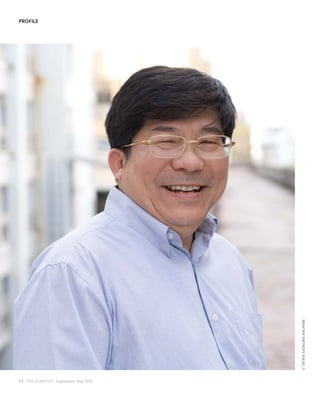
72 profile: Watchara Kasinrerk                                                                     – trained in Thailand’s Elephant Art Project.
   Klomjit Chandrapanya                                                                            The project is a nonprofit organization dedi-
                                                                       Life Sciences in Thailand
                                                                                                   cated to saving the diminishing number of
   The head of Chiang Mai University’s Biomedical
                                                                                                   Asian elephants. Funds for this mission are
   Technology Research Center breaks down the walls                                                raised partly through the sale of art created
   between the university’s scientists.                                                            by elephants.


                                        SUPPLEMENT EDITORS            PUBLISHER                                   DESIGN AND PRODUCTION
                                        Nantiya Tangwisutijit         Jane Hunter                                 art director
                                        Sarah Greene                                                              Ash Ayman Shairzay
   400 Market Street, Suite 1250                                      BUSINESS DEVELOPMENT                        senior designer
   Philadelphia, PA 19106-2501
   Phone: (215) 351-1660                DEPUTY EDITORS                DIRECTORS                                   Lisa Modica
   Fax: (215) 351-1146                  Pennapa Hongthong             Mark Greene                                 production
   E-mail: info@the-scientist.com
   www.the-scientist.com                Alison McCook                 Richard Gallagher                           Kate Fodor
                                                                                                                  Joe Santangelo
                                                                                                                  Tatree Saengmee-arnuparb
SPONSOR PROFILE


  BIOTEC
  Excellence in Science, Relevance to National Agenda


  E
        stablished in 1983, BIOTEC is one of four centers under the      ➞ Developing throughput biological assays
        umbrella of the National Science and Technology Devel-           ➞ Natural product chemistry
        opment Agency (NSTDA), an autonomous government                  ➞ Pre-pilot scale production of commercially valuable
  body. The Center serves as an effective channel for biotechnology        bioproducts
  transfer and development, supporting the industrial, agricultural,     ➞ Enzyme discovery
  ecological, economic, and social development of Thailand.              ➞ Recombinant expression systems
                                                                         ➞ Biodiversity and ecology of plants, animals, and
  FORGING STRONGER RESEARCH CAPABILITY                                     microorganisms
  BIOTEC has three thematic research programs focusing on the
  industrial sector, namely Agriculture and Food Biotechnology,          Medical Biotechnology
  Bioresources Technology, and Medical Biotechnology. Platform           Focus is on research and development to advance knowledge
  technologies have been created to strengthen capacity in certain       on neglected diseases such as malaria, tuberculosis, and dengue
  technologies and subsequently provide knowledge platforms for          fever, which are still prevalent in Thailand. Malaria research aims
  the thematic research programs.                                        to understand the mechanisms of drug resistance and synthesize
                                                                         new drugs. The main strategies involve rational drug design and
  Agriculture and Food Biotechnology                                     the synthesis of new effective antimalarials based on the structures
  Focus is on research and development of food, plant, and animal        of the drug targets. Tuberculosis research focuses on drug target
  biotechnology, with a special emphasis on using biotechnology to       identification, validation, and drug screening. Dengue research
  improve yield and quality. Plant Biotechnology focuses on three        focuses on the molecular and immunological processes involved
  economicly important plants: rice, cassava, and oil palm. Animal       in the pathogenesis of dengue hemorrhagic fever (DHF) and its
  biotechnology at BIOTEC focuses on shrimp and dairy cow. The           more severe form, dengue shock syndrome (DSS), and its future
  aim of this research is to understand the molecular biology of         application for better diagnosis and prevention of the disease. The
  reproductive maturation, growth, and the immune system of the          two main approaches are the development of dengue infectious
  black tiger shrimp in order to improve farming sustainability,         cDNA clone models to generate mutant viruses and the applica-
  including genetic improvement. Food Biotechnology aims to              tion of these models, such as dengue diagnostic technology. In
  improve and upgrade the processing and quality of fermented            addition, the live attenuated vaccines generated by mutation of
  food. Three main research areas are food safety and risk assess-       selected polyprotein cleavage sites using site-directed mutagen-
  ment, food chemistry, and starter culture technology.                  esis are being tested in animal models for their vaccine potential.

  Bioresources Technology                                                Platform Technologies
  Bioresources Technology focuses on research and development            Platform technologies focus on building capacity in technologies
  for the preservation, utilization, and conservation of bioresources.   and subsequently providing knowledge platforms for the the-
  The program has a special emphasis on the utilization of biotech-      matic research programs. Platform technologies include:
  nology as a core technology to increase the value of commercial        ➞ Metagenomic technology. Metagenomics provides a new
  products, such as food and feed products, enzyme products, drug           way of examining the microbial community by using the
  and bioactive compounds, and biocontrol products. Research                power of genomic analysis and bypassing the need to isolate
  topics include:                                                           and culture individual bacterial community members. In
  ➞ Taxonomy of microorganisms especially fungi, yeasts, and                order to search for microbial producing enzymes from the
      actinomycetes                                                         unusual environment for enzyme discovery, metagenomics


  113 Thailand Science Park, Paholyothin Rd | Klong 1, Klong Luang,
  Pathumthani 12120, Thailand | T: +66 (0) 2564 6700
  F: +66 (0) 2564 6705 | www.biotec.or.th
technology has been recently established to provide a facility      ➞   BIOTEC Central Research Unit
  for research, especially for a bioresource utilization theme.       ➞   Bioresources Technology Unit
➞ Gene expression system for recombinant protein produc-              ➞   Genome Institute
  tion. BIOTEC aims to develop heterologous gene expres-              ➞   Biochemical Engineering and Pilot Plant Research and
  sion systems in various hosts, such as Bacillus, yeast, and             Development Unit
  filamentous fungi for production of recombinant proteins,           ➞   Excellent Center of Waste Utilization and Management
  including enzymes. Currently our researchers have success-              (ECoWaste)
  fully developed a Pichia pastoris yeast expression system for       ➞   Cassava and Starch Technology Research Unit
  surface protein expression. In addition, a multi-copy expres-       ➞   Rice Gene Discovery Unit
  sion system in yeast is also being developed. This expression       ➞   Medical Biotechnology Research Unit
  technology will play a significant role for the production of       ➞   Biomedical Technology Research Center
  valuable products from newly discovered genes.                      ➞   Center of Excellence for Marine Biotechnology
➞ Genomics technology. The objectives of the Genomics Tech-           ➞   Center of Excellence for Shrimp Molecular Biology and
  nology platform are to improve the capacity of genomics and             Biotechnology
  post-genomics research in Thailand, to strengthen the infra-        ➞   Center of Excellence for Molecular Biology and Genomics
  structure and human resources and to facilitate the applica-            of Shrimp
  tion for agricultural, medical, industrial, and environmental       ➞   Shrimp Genetic Improvement Centers
  solutions. Founded in 2007, the Genome Institute focuses on         ➞   Peat Swamp and Rainforest Research Station
  research and development of technologies related to genom-
  ics, high-throughput sequencing, proteomics, bioinformatics,        MEMBER OF THE GLOBAL SCIENCE COMMUNITY
  and systems biology. The GI also provides scientific assistance     With well-equipped infrastructure and capable researchers,
  in high-performance computing (HPC) as an infrastructure            BIOTEC has actively participated in several international sci-
  for scientific communities in Thailand. Currently, GI houses        entific networks and consortia, for instance the International
  the following genomic EST and genomic databases: rice,              Rice Genome Sequencing Project, Pan-Asian SNP Consortium,
  shrimp, cassava, spirulina and ThaiSNP, accessible through          Generation Challenge Program (GCP), WHO-TDR South-South
  the Internet.                                                       Initiative for Tropical Diseases Research (SSI), Medicines for
➞ Microarray technology. Microarray is the latest additional          Malaria Venture (MMV), Asia-Pacific International Molecular
  technology to complete the study at both gene and gene func-        Biology Network (A-IMBN), and Asian Consortium for the Con-
  tion levels. BIOTEC’s microarray laboratory is equipped with        servation and Sustainable Use of Microbial Resources.
  technologies to fabricate array chips in-house, as well as apply-       Although the majority of the research funding is provided
  ing them in various aspects of research and development.            by the Thai Government, BIOTEC also obtains support from
                                                                      international funding agencies such as the World Health Orga-
HIGH-CALIBER SCIENTISTS, HI-TECH FACILITIES                           nization, Medicine for Malaria Venture (MMV), Howard Hughes
BIOTEC has established laboratories for research and/or for           Medical Institute (HHMI), the Generation Challenge Programme
providing technical services. Some act as independent research        (GCP), The Wellcome Trust, Medical Research Council (MRC),
centers while others are collaborative ventures with government       UNESCO-L’OREAL for Women in Science Program, UNESCO
agencies and universities. Currently, BIOTEC employs almost           Man and Biosphere (MAB) Program, and the Swedish Research
150 researchers, with doctorate degrees in core technologies from     Council, demonstrating that the quality of BIOTEC’s research
overseas, and 200 technicians and laboratory staff. All work in       is on a par with international standards. Two scientists were
close collaboration with academic staff and experts across the        awarded the Grand Challenges Explorations (GCE) grant from
country through any of the following units:                           the Bill & Melinda Gates Foundation in 2009.
SPONSOR PROFILE


  East-West Seed
  Better Seeds for Better Yields


  E
         ast-West Seed has grown from a young vegetable seed           center in Chiang Mai, Thailand houses the central biotechnol-
         company, established in 1982 in the Philippines, into the     ogy laboratory, providing support to the various research units
         market-leading supplier of tropical vegetable seeds in just   of the East-West Seed group. The company has one of the fore-
  25 years. As a result of its strong emphasis on plant breeding       most tropical vegetable germplasm collections in the world, an
  research and seed quality, East-West has helped transform the        important foundation of the company’s plant breeding programs.
  traditional, trading-oriented vegetable seed markets of South-           East-West Seed’s recent acquisition of shares in Dutch biotech
  east Asia into a major market for quality seeds. The reliability     company, Genetwister Technologies BV, is expected to provide a
  and quality of the East-West Seed product range has had a direct     strong impulse to further develop innovative technologies and
  impact on improving the lives of millions of small farmers. The      applications for the benefit of its breeding programs. East-West
  more than 200 billion seeds East-West Seed sells annually are        Seed’s present research network includes facilities and projects in
  planted by an estimated 30 million farmers.                          the Philippines, Thailand, Indonesia, Vietnam, India, China, and
      The two-pronged approach of intensive interaction with           Tanzania. Market development specialists are exploring opportu-
  farmers, traders, and consumers and developing varieties adapted     nities to repeat the company’s success in other geographical areas
  to local conditions has been the key to East-West Seed’s success.    in the tropical and subtropical belt.
  The company’s hands-on exchange of knowledge and experi-                 Bittergourd (Momordica charantia), an important tropical
  ences with farmers has benefitted both the farmer-customers          Asian cucurbit, is the flagship crop in the East-West Seed product
  and the business. Through a network of field representatives, the    range. The crop is not just a healthy vegetable but is also known for
  company is able to understand firsthand the challenges farmers       its medicinal properties, particularly its anti-diabetic properties.
  face, and at the same time assist growers in achieving better        Development of new hybrid markets started in many countries
  results with East-West seeds.                                        with successful introduction of hybrid bittergourd varieties: Jade
      Teams of experienced plant breeders, supported by experts        Star and Galaxy in the Philippines, Palee in Bangladesh and India,
  in plant pathology, cell biology, and molecular biology, focus on    and hybrids 241 and 242 in Vietnam. Main breeding objectives
  improving disease and pest resistance to increase yields and to      include improved fruit quality and resistance to major diseases
  reduce excessive chemical inputs. The company’s new research         such as Fusarium wilt, various viruses, and powdery mildew.


  50/1 Moo 2, Sainoi-Bangbuathong Rd | Sainoi, Nonthaburi 11150, Thailand
  T: +66 (0) 2831 7700 | F : +66 (0) 2923 7794
  inter@eastwestseed.com | www.eastwestseed.com
EDITORIAL


Thailand’s
Transformational Science
T
        here’s no arguing that Thailand is emerging as     scientists the tools they need to move on to the next          SUPPLEMENT
        a world-class player in the arena of biotech-      generation of R&D.                                               EDITORIAL
        nology research. Last September, the country           This episode and other politically charged inci-       ADVISORY BOARD
made international headlines for hosting the world’s       dents have challenged this newly robust industrial                     Amaret
largest HIV vaccine trial. Based on HIV strains that       nation and highlight the importance of environmen-               Bhumiratana
commonly circulate in Thailand, the RV144 vaccine          tal concerns. Sustainable energy and the protection         Faculty of Science,
trial involved 16,000 participants and demonstrated        of Thailand’s biodiversity are perhaps the two most         Mahidol University
a lowered rate of infection by 31 percent. Another         critical issues. As climate change threatens the fragile
                                                                                                                      Somsak Chunharas
milestone was reached last year when a government          countryside, scientists are hard at work trying to          Secretary General,
agency produced a local version of the H1N1 vaccine,       lessen its impact (see “Biotechnology in the Era of           National Health
now in trial (see “Spreading Influence,” p. 60).           Climate Change, p. 78). Changing weather patterns,                 Foundation
    The exciting news is that these aren’t random          water shortages, and the shift from a predominantly
or lucky outcomes, but results based on strategic          agrarian society have all contributed to the disrup-       Kanyawim Kirtikara
                                                                                                                       Executive Director,
planning. The best and brightest of Thailand’s bio-        tion of an ecosystem. However, scientists are trying                   BIOTEC
technology community established the National              to understand these changes to devise new ways of
Biotechnology Policy Framework in 2003, covering           reducing fossil fuel consumption and the resulting           Jakkrit Kuanpoth
business development, agriculture, medicine, renew-        CO2 emissions.                                                  Faculty of Law,
able energy, a self-sufficient economy, and human              One such preventive measure has been strict laws              University of
                                                                                                                             Wollongong,
resources. The success of the Framework depended           against deforestation. While this has been a boon to                  Australia
on supporting a young generation of professionals (see     the surviving wildlife, it left over 4,000 elephants
“Mapping the Terrain,” p. 12). Remarkably, it worked:      that had worked in the lumber industry homeless and                    Pornchai
now Thailand is a leading research center for dis-         unemployed. This spurred the founding of the Thai             Matankasombut
eases that plague developing countries—e.g., malaria,      Elephant Orchestra by Richard Lair and performer/          Chairman, Thailand
                                                                                                                      Centre of Excellence
dengue fever, tuberculosis, HIV, and thalassemia.          composer Dave Sulzer, a neuroscientist at Columbia            for Life Sciences
    Not to mention strides in agriculture and fisher-      University. And conceptual artists Komar & Melamid                     (TCELS)
ies (see “The Future of Farms,” p. 28). For example, a     founded the Asian Elephant Art and Conservation
young biologist recently employed microarray tech-         Project. Three of their most talented prodigy – Japati,                Ajarin
nology to develop a more disease-resistant and faster-     Prathida, and Look Gob – are featured in these pages.         Pattanapanchai
                                                                                                                        Deputy Secretary
growing black tiger shrimp—an export vital to the              We acknowledge and thank the many sponsors of                General, BOI
Thai economy. And not only the latest biotech has put      this supplement, without whose support this publica-
Thailand on the map, but also old-fashioned grass-         tion would not have been possible.                                     Apichart
roots experimentation. Using tools no more sophisti-                                                                          Vannavichit
cated than a needle, scissors, and paper, a local farmer                                                               Director, Rice Gene
                                                                                                                        Discovery Center,
developed a blast-resistant rice strain that has seen                                                                 Kasetsart University
widespread use throughout the countryside.
    As might be expected, there have been missteps                            Nantiya Tangwisutijit                         Tada Yipintsoi
along the way. “Leakage” of genetically modified                              Supplement Editor                          Prince of Songkla
papaya created a firestorm of public protest and                                                                                University
threatened the nation’s food supply, public health, and                                                                         Yongyuth
the future of scientific research in Thailand. The gov-                                                                        Yuthavong
ernment initially responded with denial and attempts                                                                      Former Science
to manipulate the truth. However, with legislation                            Sarah Greene                            Minister of Thailand
currently pending, strict controls and oversight will                         Editor-in-Chief, The Scientist             Senior Scientist,
                                                                                                                                   BIOTEC
likely be implemented to reassure the public and give
SPONSOR PROFILE


  Science-Driven
  Innovation for
  Food Safety
  One Player Leads the Way in Thailand


  M
              ore than forty years ago, what is today the Betagro         driven technology, especially in the all important area of food
              Group, one of the leading players in Thailand’s inte-       safety and product traceability, has long been at the heart of the
              grated agricultural business, began life a short distance   group’s growth strategy, leading to pioneering innovations in its
  from Bangkok as an animal feed producer and distributor. Today          various operations that continue to show the way for others in
  some 31 companies operate under the group’s umbrella in areas           the industry.
  that include regional and feed business, poultry business, swine            For example, Betagro’s SPF (Specific Pathogen Free) pig pro-
  business, food business, and animal health business.                    duction joint venture with the Japanese company Sumitomo,
      More recently, Betagro has also turned its attention to expand-     established in 2004, was in fact the culmination of a previous
  ing its joint-venture Japanese restaurant chain in Thailand and         Betagro SPF program of breeding and finishing technology
  establishing a foothold in the retail market with own-brand prod-       that aimed to meet the strict Japanese import regulations for
  ucts. That the Betagro story is one of continuous success over a        pork meat. Achieving fully compliant SPF pig production is no
  forty-year-plus period is evidenced today by the scale of the group’s   easy task, and at Betagro’s special facility in Lop Buri province,
  operations and its clear ability not only to survive the slings and     meticulous procedures are followed that begin with the culling
  arrows of economic misfortune, but to thrive. This is exemplified by    of parent sows after one litter and ensuring piglets are raised free
  new factory and processing plant openings and expansion of over-        from antibiotics.
  seas markets, whilst continuing to serve its home base customers.           Some 600 farms within a 200 Km radius supply the Lop Buri
      However, there is more to this success story than wise stew-        plant with pigs raised in strict accordance with the SPF criteria
  ardship and entrepreneurial acumen. The application of science          and provided with full ‘traceable’ documentation. A comprehen-


  Betagro Group | Betagro Tower (North Park) | 323 Vibhavadi Rangsit Rd
  Lak Si, Bangkok 10210, Thailand | T: +66 (0) 2833 8000
  F : +66 (0) 2833 8001 | vwww.betagro.com
Left: The Betagro Group’s
                                                                      headquarters set in lush
                                                                      surroundings.

                                                                      Right: Betagro’s pioneering
                                                                      ventilation system.


sive and thorough disease inspection process prior to slaughter            An integral part of Betagro’s longstanding commitment to
includes precluding atrophic rhinitis, Aujeszky’s disease, swine      food safety has been its pioneering application of a practical and
dysentery, toxoplasmosis, and brucellosis. Handling up to 1,600       effective traceability system.
pigs per day, the Betagro facility is able to provide meat for the         Responsible food manufacturers and producers around the
Japanese market, which after cooking, is sold as Chashu, Sliced       world have long made food safety and hygiene a top priority as a
Chashu, Buta Kakuni, Kushi Katsu and Tonkatsu. Other pork             matter of principle and to increase customer confidence in their
meat, marketed under the “S-Pure” brand is reserved for the           products. Regulatory authorities too have established a raft of
top-end local Thai market.                                            controls and standards that apply both locally and internationally
    Betagro currently has 45,000 breeders in its wholly operated      in an effort to achieve the same goal.
farms and contracted farms, and 350,000 breeders being raised              Since the advent of computer-based technology and the huge
by farmers hired by contract. The “S-Pure” concept also applies       technological developments it has driven, the concept of “trace-
to Betagro’s massive poultry operations in which S-Pure Chicken       ability”—first introduced by the European Union in 2002 but
products are produced under international standards of assured        implemented as a practical tool in 2005—is playing an increas-
chicken production (ACP) and regulations of the Royal Society         ingly important role in many aspects of the food production
for the Prevention of Cruelty to Animals (RSPCA) laid down by         chain. The EU defines “traceability” as “the ability to trace and
the United Kingdom. Objectives of these schemes are to monitor        follow a food, feed, food-producing animal or substance intended
and drive continuing improvement in animal welfare standards          to be, or expected to be incorporated into a food or feed, through
and food safety. With the additional criteria that all chicken meat   all stages of production, processing, and distribution.”
must be produced free from antibiotics and growth promoters,               Although costly and time consuming to fully implement,
poultry is raised in accordance with carefully defined rules on       especially across a wide range of food products and operations,
stocking density and that a system of total traceability must be      traceability’s many benefits have led to its recognition as an indis-
in place.                                                             pensable aid to improving food safety throughout the industry.
    All Betagro S-Pure Chicken products are also Halal certified           When in 2002 Betagro developed and installed its own
that the birds are slaughtered in the most humane way, with no        e-traceability system, its significance was quickly realized by the
unnecessary pain and suffering.                                       industry, both locally and internationally, by regulatory bodies
SPONSOR PROFILE


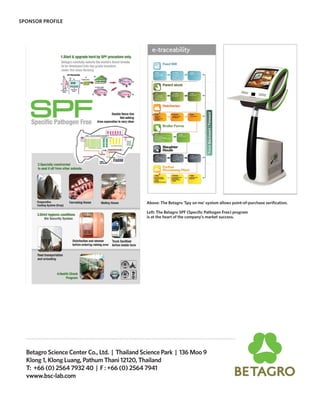
                                               Above: The Betagro ‘Spy on me’ system allows point-of-purchase verification.

                                               Left: The Betagro SPF (Specific Pathogen Free) program
                                               is at the heart of the company’s market success.


  Betagro Science Center Co., Ltd. | Thailand Science Park | 136 Moo 9
  Klong 1, Klong Luang, Pathum Thani 12120, Thailand
  T: +66 (0) 2564 7932 40 | F : +66 (0) 2564 7941
  vwww.bsc-lab.com
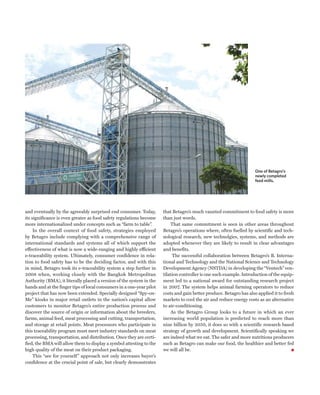
One of Betagro’s
                                                                                                                     newly completed
                                                                                                                     feed mills.


and eventually by the agreeably surprised end consumer. Today,        that Betagro’s much vaunted commitment to food safety is more
its significance is even greater as food safety regulations become    than just words.
more internationalized under concepts such as “farm to table”.            That same commitment is seen in other areas throughout
     In the overall context of food safety, strategies employed       Betagro’s operations where, often fuelled by scientific and tech-
by Betagro include complying with a comprehensive range of            nological research, new technolgies, systems, and methods are
international standards and systems all of which support the          adopted whenever they are likely to result in clear advantages
effectiveness of what is now a wide-ranging and highly efficient      and benefits.
e-traceability system. Ultimately, consumer confidence in rela-            The successful collaboration between Betagro’s B. Interna-
tion to food safety has to be the deciding factor, and with this      tional and Technology and the National Science and Technology
in mind, Betagro took its e-traceability system a step further in     Development Agency (NSTDA) in developing the “Ventech” ven-
2008 when, working closely with the Bangkok Metropolitan              tilation controller is one such example. Introduction of the equip-
Authority (BMA), it literally placed a version of the system in the   ment led to a national award for outstanding research project
hands and at the finger tips of local consumers in a one-year pilot   in 2007. The system helps animal farming operators to reduce
project that has now been extended. Specially designed “Spy-on-       costs and gain better produce. Betagro has also applied it to fresh
Me” kiosks in major retail outlets in the nation’s capital allow      markets to cool the air and reduce energy costs as an alternative
customers to monitor Betagro’s entire production process and          to air-conditioning.
discover the source of origin or information about the breeders,          As the Betagro Group looks to a future in which an ever
farms, animal feed, meat processing and cutting, transportation,      increasing world population is predicted to reach more than
and storage at retail points. Meat processors who participate in      nine billion by 2050, it does so with a scientific research based
this traceability program must meet industry standards on meat        strategy of growth and development. Scientifically speaking we
processing, transportation, and distribution. Once they are certi-    are indeed what we eat. The safer and more nutritious producers
fied, the BMA will allow them to display a symbol attesting to the    such as Betagro can make our food, the healthier and better fed
high quality of the meat on their product packaging.                  we will all be.
     This “see for yourself ” approach not only increases buyer’s
confidence at the crucial point of sale, but clearly demonstrates
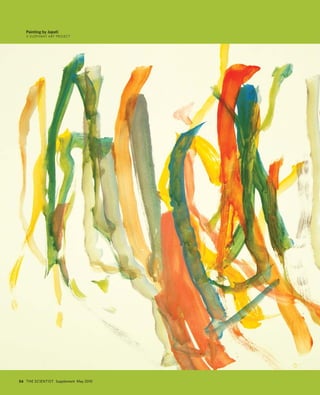
Painting by Japati
   © ELEPHANT ART PROJECT


1 4 THE SCIENTIST Supplement May 2010
1. policy
OVERVIEW


   Mapping the Terrain
   Thailand’s first National Biotechnology Policy Framework served as a
   roadmap for significant progress, but it had a rocky start. A look back
   at the Framework provides signposts to guide the way forward.
   by Thana Poopat and Nantiya Tangwisutijit


                                                                           THE EARLY DAYS

   D
            uring the past 3 decades, Thailand has increasingly pri-
            oritized biotechnology investment. From medicine to            When United Nations consultants traveled to Bangkok in the
            food to plastics to energy, Thailand has emerged as a          early 1980s searching for a location for the International Center
   key player in biotechnology research and development in Asia.           for Genetic Engineering and Biotechnology, the country’s sci-
   Well before many countries paid any attention to the role biotech-      entific community was abuzz. Thailand’s status as a high-tech
   nology would play in their institutions, economies, and lifestyles,     research hub was validated when the country was shortlisted for
   Thailand realized the importance of getting organized or being          the new facility. But once the search committee chose India, prin-
   left behind.                                                            cipally because Thailand lacked a dedicated national biotechnol-
        Today’s Thailand has a vast pool of trained researchers and        ogy agency, the euphoria turned to despair.
   technicians with wage rates among the most competitive in the               “That was the clinching moment,” recalls Yongyuth Yuthavong,
   world, a rich reservoir of untapped biodiversity resources, a legal     NSTDA’s senior advisor. “Top policy makers and chief scientists
   framework supportive of creative research, and among the most           decided right there and then that Thailand must have its own
   generous biotechnology investment incentives of any country in          National Center for Genetic Engineering and Biotechnology.”
   the world.                                                                  When it opened in 1983, the National Center for Genetic
        Thailand’s biotechnology strategy aims to make the country         Engineering and Biotechnology (BIOTEC) already had at its
   a global leader, but it does so with a philosophy that is inher-        disposal established scientific institutions and researchers active
   ently Thai, says Sakarindr Bhumiratana, president of Thailand’s         in the basic life sciences, medicine, and agriculture.
   National Science and Technology Development Agency (NSTDA).                 In fact, the roots of the pioneering thalassemia research Thai-
        “Where possible, we emphasize research that will improve the       land is engaged in now go back to groundbreaking work begun 2
   livelihood and quality of life of our citizens across the board. That   decades before BIOTEC’s conception. In 1964, Prawase Wasi dis-
   is why we’ve become a key player in infectious disease research,        covered the genetic mechanism of hemoglobin H disease, proving
   agricultural biotechnology to help farmers, and alternative             that it is related to α-thalassemia. His work was published in the
   energy from abundant biomass,” says Sakarindr. “We really do            British scientific journal Nature, and two genes are now known
   want to see the whole society benefit as we grow this segment of        as Wasi’s α-thalassemia-1 and Wasi α-thalassemia-2.
   our economy.”                                                               By the early 1980s, Thai scientists had already mastered the
                                                                           basics of plant-cell culture technique and clonal propagation,


1 6 THE SCIENTIST Supplement May 2010
May 2010 Supplement THE SCIENTIST   17
OVERVIEW


   which they applied to improving orchids and other cut flowers.         and highly talented scientists with a broad experience in natural
   Rapee Sagrik’s work on the art of hybridization in orchids helped      products research and beyond,” says Frank Petersen, executive
   launch Thailand’s orchid export industry, which now generates          director, Natural Products Unit, Novartis Institutes for Biomedi-
   $60 million annually.                                                  cal Research. “Such a decisive governmental objective is an ideal
       Rapee’s creative use of natural and human resources exem-          situation for an industry partner to initiate sustainable capacity
   plified BIOTEC’s mandate to further Thailand’s economic and            building in a respective country.”
   social development through the application of science. In its first        NSTDA’s Sakarindr had hoped his agency’s recruiting efforts
   decade, BIOTEC focused on establishing networks of experts to          would encourage more of the industry’s multinational players to
   facilitate collaboration, while also supporting the development        consider Thailand as the base for their regional activities, but
   of laboratories at academic institutions. In the 1990s, relevant       he says the country’s unsettled political climate, with one coup
   policy and regulatory frameworks were strengthened, and                and three changes in government since the Framework was
   increased attention was paid to intellectual property manage-          launched, has often been a deterrent. “Once the (political) situa-
   ment, biosafety guidelines, and public education and outreach.         tion improves, things could take a turn for the better in no time,”
       While BIOTEC was getting organized during its first 2              he says. “One thing we’ve got in the pipeline is utilizing the pro-
   decades, a lot of valuable research was already under way, says        curement process to provide additional incentives for large inter-
   Yongyuth, notably the development of new crop varieties with           national suppliers that are also willing to invest in biotechnology
   resistance to a wide array of biotic and abiotic stresses, medical     R&D here.”
   research into tropical diseases, and studies of new ways to turn           Additional benefits are available to companies that set
   biomass and agricultural byproducts into biofuels.                     up operations at NSTDA’s Thailand Science Park, a high-tech
                                                                          campus that opened in 2002 and houses BIOTEC, three other
   A VISION FOR BIOTECHNOLOGY                                             technology agencies, and more than 60 private companies. A
   Leading figures in Thai biotechnology convened intermittently          120,000-square-meter second phase will be opening next year
   over 6 months in 2003 to develop the country’s first National Bio-     and is expected to house 200 companies.
   technology Policy Framework. Spanning the years 2004–2009,
   the Framework included goals in six main categories: business          Agriculture
   development, agriculture, medicine, renewable energy, self-            Employing 40 percent of the country’s workforce and generat-
   sufficient economy, and human resources. A retrospective shows         ing $20 billion in export earnings, agriculture is a major target
   that in the 5 years covered by the Framework, the country made         for biotechnology resources in Thailand. Under the banner
   significant strides, although there is clearly work left to be done.   “Kitchen of the World,” the Framework outlined strategies to
                                                                          improve output from the country’s core crops as well as to stimu-
   Business Development                                                   late increased investment in the production and export of value-
   Thailand hoped to see the emergence of no less than 100 new            added products like mineral-enriched rice and processed fruits.
   biotechnology companies established by 2010, but it came up                A visit to any one of the specialized rice, shrimp, cassava, or
   a bit short. Ninety new companies were established during the          sugar research stations dotting the country would reveal that sci-
   period covered by the Framework, bringing the country’s total          entists have been productive fulfilling the first aim. Using gene
   to approximately 170. Many companies have taken advantage of           pyramiding, researchers have created new rice varieties that are
   the incentives BIOTEC has arranged through Thailand’s Board            more disease resistant and flood and drought tolerant, and those
   of Investment (BoI), including an 8-year exemption on corporate        products are making their way to the fields. Through nucleus
   income tax, exemptions on machinery import duties, and deduc-          breeding, efforts are now under way to keep Thailand a leader in
   tions for energy, transportation, and facility construction fees.      shrimp exports by developing the world’s highest-quality black
       “Biotechnology is classified as priority activity, which has       tiger shrimp. Some researchers are developing new sugar cane
   special importance and benefits to the country,” says Ajarin Pat-      and cassava varieties, while others are finding ways to more effi-
   tanapanchai, BoI’s deputy secretary general, adding that the           ciently extract energy from the byproducts generated when these
   agency pays special attention to investment in R&D in the areas        crops are processed for their sugar and starch.
   of the seed industry; plant and animal improvement; biophar-               One concern, says Morakot Tanticharoen, vice president
   maceutical agents; diagnostic kits for health, agriculture, food,      of NSTDA, is that restrictions on field testing, cultivation, and
   and the environment; and bimolecular and bioactive compounds           export of genetically modified organisms have been limiting
   using microorganisms, plant cells, and animal cells.                   Thai scientists’ progress. “Other major agricultural producers
       Debate remains about whether the government has done               have been working with GMO crops for years,” says Morakot.
   enough for the business of biotech, but clear progress has been        “Thailand needs to join them. The door may be open for case-
   made. “The efforts of Thailand to foster the scientific education      by-case GMO field trials, but the Biosafety Bill needs to get out
   during the last 2 decades resulted in a new generation of young        of Parliament.”

1 8 THE SCIENTIST Supplement May 2010
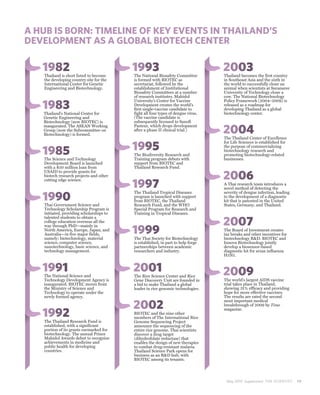
A HUB IS BORN: TIMELINE OF KEY EVENTS IN THAILAND’S
DEVELOPMENT AS A GLOBAL BIOTECH CENTER

   1982
    Thailand is short listed to become
                                           1993
                                           The National Biosafety Committee
                                                                                   2003
                                                                                   Thailand becomes the first country
    the developing country site for the    is formed with BIOTEC as                in Southeast Asia and the sixth in
    International Center for Genetic       secretariat, followed by the            the world to successfully clone an
    Engineering and Biotechnology.         establishment of Institutional          animal when scientists at Suranaree
                                           Biosafety Committees at a number        University of Technology clone a
                                           of research institutes. Mahidol         cow. The National Biotechnology

   1983
                                           University’s Center for Vaccine         Policy Framework (2004–2009) is
                                           Development creates the world’s         released as a roadmap for
                                           first single-vaccine candidate to       developing Thailand as a global
   Thailand’s National Center for          fight all four types of dengue virus.   biotechnology center.
   Genetic Engineering and                 (The vaccine candidate is
   Biotechnology (now BIOTEC) is           subsequently licensed to Sanofi
   inaugurated. The ASEAN Working
   Group (now the Subcommittee on
   Biotechnology) is formed.
                                           Pasteur, which drops development
                                           after a phase II clinical trial.)       2004
                                                                                   The Thailand Center of Excellence

                                           1995
                                                                                   for Life Sciences is established for

   1985
                                                                                   the purpose of commercializing
                                                                                   biotechnology research and
                                           The Biodiversity Research and           promoting biotechnology-related
   The Science and Technology              Training program debuts with            businesses.
   Development Board is launched           support from BIOTEC and
   with a $50 million loan from            Thailand Research Fund.

                                                                                   2006
   USAID to provide grants for
   biotech research projects and other

                                           1997
   cutting edge science.
                                                                                   A Thai research team introduces a
                                                                                   novel method of detecting the

   1990
                                           The Thailand Tropical Diseases          severity of dengue infection, leading
                                           program is launched with support        to the development of a diagnostic
                                           from BIOTEC, the Thailand               kit that is patented in the United
    Thai Government Science and            Research Fund, and the WHO              States, Germany, and Thailand.
    Technology Scholarship Program is      Special Program for Research and
    initiated, providing scholarships to   Training in Tropical Diseases.

                                                                                   2007
    talented students to obtain a
    college education overseas all the

                                           1999
    way through PhD—mainly in
    North America, Europe, Japan, and                                              The Board of Investment creates
    Australia—in five major fields,                                                tax breaks and other incentives for
    namely: biotechnology, material        The Thai Society for Biotechnology      biotechnology R&D. BIOTEC and
    science, computer science,             is established, in part to help forge   Innova Biotechnology jointly
    nanotechnology, basic science, and     partnerships between academic           develop a biosensor-based
    technology management.                 researchers and industry.               diagnostic kit for avian influenza
                                                                                   H5N1.


   1991
   The National Science and
                                           2001
                                           The Rice Science Center and Rice
                                                                                   2009
   Technology Development Agency is        Gene Discovery Unit are founded in      The world’s largest AIDS vaccine
   inaugurated. BIOTEC moves from          a bid to make Thailand a global         trial takes place in Thailand,
   the Ministry of Science and             leader in rice genomic technologies.    showing 31% efficacy and providing
   Technology to operate under the                                                 hope for more effective vaccines.
   newly formed agency.                                                            The results are rated the second

                                           2002
                                                                                   most important medical
                                                                                   breakthrough of 2009 by Time

   1992
    The Thailand Research Fund is
                                           BIOTEC and the nine other
                                           members of The International Rice
                                                                                   magazine.


                                           Genome Sequencing Project
    established, with a significant        announce the sequencing of the
    portion of its grants earmarked for    entire rice genome. Thai scientists
    biotechnology. The annual Prince       discover a drug target
    Mahidol Awards debut to recognize      (dihydrofolate reductase) that
    achievements in medicine and           enables the design of new therapies
    public health for developing           to combat drug-resistant malaria.
    countries.                             Thailand Science Park opens for
                                           business as an R&D hub, with
                                           BIOTEC among its tenants.


                                                                                    May 2010 Supplement THE SCIENTIST      19
OVERVIEW


                                        © FRANK VAN DEN BERGH
                                        © SURA NUALPRADID


2 0 THE SCIENTIST Supplement May 2010
New value-added products from Thai agriculture were ini-               however, tropical diseases are being found in northern latitudes,
tially slow to develop under the Framework, but recent develop-            so we may find huge markets overseas in the years to come.”
ments in the area of bioplastics ramped things up. The 2008–                   A major growth area under the Framework has been the
2012 bioplastics road map has stimulated research on sugarcane,            development and production of diagnostic test kits, principally
cassava, and corn.                                                         for the domestic market, fueled largely by government R&D and
    “With global plastic production at 250 million tons a year,            financial support. Thailand has the manufacturing competitive-
less than a million tons now come from biosources. There is a              ness to grow this industry overseas, but so far there’s been little
lot of room for bioplastics to grow to penetrate this market,” says        effort toward developing a medical device certification process
Wantanee Chongkum, director of the Innovation Management                   that would give confidence to international buyers, says Komkrit.
Department at the National Innovation Agency. “As the world’s                  Thailand has also emerged as a competitive location for large-
eighth-largest plastics manufacturer, with high agricultural pro-          scale clinical drug trials. Most recently, the world’s largest HIV
ductivity, we’re well positioned to fuse these two ingredients to          vaccine clinical trials were conducted in Thailand in 2009. “As
become the center of the world’s bioplastics production.”                  the cost for trials continues to escalate, I think we are going to be
                                                                           seeing a lot more companies looking to Thailand as among the most
Medicine                                                                   competitive locations to conduct this research,” says Sutee Yoksan,
Over the past decade, Thailand has become a leader in research             director of Mahidol University’s Center for Vaccine Development.
on diseases that plague developing countries such as malaria,                  Surrounding all this activity is a medical care infrastructure
dengue fever, tuberculosis, HIV, and thalassemia. “It does seem to         that is among the best in Southeast Asia, attracting 1.2 million
be a niche market that we now occupy,” says Komkrit Sajjaanan-             medical tourists in 2009. The National Institute of Development
takul, managing director of I+MED Laboratories. “Increasingly,             Administration found that the combination of treatment quality,


THE NEXT GENERATION
by Weena Yoswangjai


W
               hen Jariya Sakayaroj first peered   science, nanotechnology, basic science,          Thailand Graduate Institute of Science and
               into a microscope during a          and technology management—to supply to           Technology program since it began in 1998.
               biology class, she had no idea      universities, research institutes, and govern-   Overall, NTSDA awards 3,000 scholar-
she was looking at her future. The thought         ment agencies, including NSTDA. Talented         ships annually for students pursuing science
of a girl from her rural village becoming a        high-school students were recruited from         degrees, many of whom come from the coun-
serious scientist was too farfetched for her       all over the country to receive overseas uni-    try’s special science-focused high schools.
to imagine. But 20 years later, as one of          versity education, all the way to PhD, mainly         For younger scholars, NTSDA operates
BIOTEC’s principle microbiologists, Jariya is      in North America, Europe, Japan, and Aus-        Sirindhorn Science House at its Thailand
leading efforts to unravel the secrets of local    tralia. More than 3,000 scholarships were        Science Park campus, where students from
microorganisms for pharmaceutical applica-         granted through 2009. So far, the program        across the country participate in short-term
tions in collaboration with Novartis.              has produced over 100 PhD graduates in           immersion programs with working scien-
     Thailand’s research institutes are full of    biotech-related fields.                          tists. The facility includes a laboratory and a
stories like Jariya’s, the result of an expand-         “Grooming young talent to become sci-       live-in center for 200 participants.
ing network of programs across the country         entists is the best way to secure Thailand’s          In addition, BIOTEC has initiated the
that are designed to nurture the brightest         positioning in the era of science-based econ-    Human Resource Development Program in
scientific minds to increase the talent pool       omies,” says Morakot Tanticharoen, vice          Biotechnology for Neighboring Countries.
for the life-sciences industry.                    president of the National Science and Tech-      The program, which is funded by The Asso-
     Starting in 1990, the Royal Thai Govern-      nology Development Agency (NSTDA). “The          ciation of Southeast Asian Nations (ASEAN)
ment set up a Thai Government Science              country’s demand for scientists is growing       and the New Zealand UNESCO Commission,
and Technology Scholarship Program, with           in both government research institutes and       has trained a steady stream of researchers
an objective to generate a critical mass of        within private-sector R&D.”                      from ASEAN countries and provides a net-
scientists and academics in 6 major fields—             Jariya is among more than 1,000 par-        working platform for ASEAN researchers.
biotechnology, material science, computer          ticipants to enroll in the NSTDA-initiated


                                                                                                             May 2010 Supplement THE SCIENTIST        21
OVERVIEW


   THAILAND SCIENCE PARK
   by Weena Yoswangjai


   N
            ot long after Thailand Science Park    Technology Center, and National Nanotech-              A core objective for TSP management
            (TSP) opened for business in 2002,     nology Center. Three of Thailand’s leading        is to offer both lab-to-market and market-
            one of its tenants began making        universities are nearby, contributing to a cre-   to-lab services to tenants, according to
   international headlines for a biotechnol-       ative synergy that has attracted 62 private       Chatchanat Thebtaranonth, Director of
   ogy breakthrough. From their labs at TSP,       tenants to TSP, 30 of which are headquar-         TSP’s Technology Management Center. “If
   researchers at BIOTEC spent days answering      tered in other countries.                         companies have problems introducing their
   phone calls and emails about their ground-          “The atmosphere here is excellent.            products to the market, we help them get
   breaking work on an immunochromota-             Everyone talks about science, which continu-      these problems solved,” she stresses.
   graphic strip test for alpha-thalassemia-1.     ously motivates our R&D team,” says Vanus              The fully-integrated R&D hub has proved
       While the roots of that achievement         Taepaisitphongse, CEO of Betragro, one of         so popular that NSTDA has broken ground
   were in more antiquated facilities elsewhere,   Thailand’s leading agribusiness groups.           on an additional 120,000m2 complex
   the discovery drew attention to the ultra-          Pramote Techasupatkul, President of           scheduled to be completed next year. When
   modern, 32-hectare TSP campus and the           Siam Cement Group, is also enthusiastic           the new doors open, much of that space is
   research quality and intellectual rigor that    about the scientific climate at TSP. “The         expected to be occupied, given the special
   can be found there.                             establishment of our Green Nanomateri-            tax breaks and other incentives offered to
       TSP, which is run by Thailand’s National    als Research Center at Thailand Science           companies that occupy the Park. It will be
   Science and Technology Development              Park reflects our research and development        interesting to see which one of them makes
   Agency (NSTDA), is also home to the             mission and offers SCG researchers [the           headlines first.
   National Metal and Materials Technology         chance] to work among Thailand’s leading
   Center, National Electronics and Computer       scientists,” he says.


22 THE SCIENTIST Supplement May 2010
price, and atmosphere attracts more foreign patients to Thailand        still new to scientists, many of these species are quite familiar to
than to its two regional competitors, India and Singapore.              the locals in Thailand’s rural communities, so it’s not surprising
                                                                        that the biotechnology framework paid special attention to sus-
Renewable Energy                                                        tainable development.
The past 5 years have seen a huge increase in the number of                  The Framework included biodiversity protection programs
biogas and ethanol plants across Thailand, which are aimed at           to minimize the likelihood that species will disappear. It also
getting the most power possible from agricultural products.             focused on opportunities for local residents to partner in the col-
    “Bioenergy has probably been among the most impacted by             lection and exploration of plants and to share their indigenous
biotechnology under the Framework,” says energy expert Suvit            knowledge, creating new ways to support rural livelihoods.
Tia of King Mongkut’s University of Technology Thonburi. “As a               In addition, the Framework called for the development of
relatively new sector, there’s been a lot more room for science to      organic fertilizers specific to local areas, methods for biogas gen-
affect change as compared to something researchers have been            eration, and the development of new crop and aqua culture vari-
experimenting with for generations.”                                    eties to help small farmers maintain competitiveness.
    However, care must be taken to ensure that this progress                 “For example, in areas where there are huge quantities of
doesn’t come at too high a cost, Suvit maintains. “Like many            agricultural waste such as rice, straw, and maize husk, certain
other countries, the one issue we need to watch out for is that         enzymes can be used to speed up their decomposition so that
our alternative energy generation does not take food off our table.     they can be used as biofertilizers instead of being disposed of by
Assistance for the further expansion of this industry should not        burning,” says Kanyawim Kirtikara, BIOTEC’s executive director.
come at the expense of higher domestic food prices,” he says.
                                                                        Human Resources
Self-sufficient Economy                                                 Thailand aims to become a “knowledge-based” economy. The
Thailand’s rich biological diversity is a major attraction for bio-     continued growth in the scientific capabilities of its students and
technology companies. The country is home to about 10 percent           workforce is seen as paramount, not only for biotechnology but for
of the world’s total plant species and microorganisms, and drug         technology generally, says Morakot Tanticharoen, vice president
makers in particular are keen to explore these resources. While         of NSTDA. The government is opening new colleges every few


SUCCESS STORIES
by Pennapa Hongthong


F
        or international companies seeking          From 2005 to 2008, Novartis worked               “Thailand has some good agricultural
        to establish a base for biotech R&D     to develop the capacity of Thai scientists in   universities and research institutes that we
        or manufacturing in Thailand, the       two areas: the application of microbiological   can work with in identifying good people and
pharma giant Novartis and the East West         technologies and concepts, and natural-         knowledge exchange,” de Hoop says. But he
Seed Company offer success stories that         products research to produce new molecules      notes that practical, applied plant breeding
may serve as models.                            from novel microorganisms of high diversity     is not as well developed as it should be in an
     Alexandre F. Jetzer, a member of Novar-    for drug discovery. Now in its second 3-year    agricultural country of Thailand’s size.
tis’s board of directors, says the company      tranche, the partnership is working to expand        East West Seed president Joost Pekel-
created an R&D partnership with Thailand’s      the acquisition of strains to increase access   haring says Thailand should invest in a
National Center for Genetic Engineering and     to the diversity of the microbial substances.   university program for plant breeders.
Biotechnology (BIOTEC) to explore natural           The East West Seed Company has been         “With the current university graduates, the
substances derived from the country’s rich      taking advantage of Thailand’s research         company has to work from scratch to train
microbial diversity, which have great poten-    climate for nearly 3 decades. The company’s     them to become good breeders, which takes
tial to be developed into new drugs.            vice president of R&D, Simon Jan de Hoop,       at least 6 to 7 years,” he says.
     “Thailand has a fantastic potential. You   says Thailand’s central location in Southeast        Both Novartis and East West Seed
have a pool of great scientific talents and     Asia, the size of its domestic market, the      benefit from government incentives that
a strong knowledge base,” Jetzer says. “I       availability of good seed-producing farmers,    include exemptions for import duty on
believe in the country’s strong future as an    and the country’s business incentives have      machinery and tax holidays with no exemp-
investment destination for R&D.”                served his company well.                        tion caps on investments in biotech R&D.


                                                                                                         May 2010 Supplement THE SCIENTIST       23
OVERVIEW


   years, working closely with foreign scholars in overseas research              The Framework also suffered from insufficient dedicated
   institutes, and providing more scholarships to science students.           funding. Biotechnology programs relied mostly on the annual
       With the proliferation of graduate programs at home, fewer             budgets of the relevant government agencies to achieve the Frame-
   students need to attend foreign universities, says Uthaiwan Grud-          work’s objectives. The supplemental public funds that many agen-
   loyma, manager of BIOTEC’s Policy Studies and Biosafety Divi-              cies and research institutions believed would be forthcoming did
   sion. “We are still supporting students going abroad, but they are         not materialize. “Some perfectly good plans become unrealistic
   on the whole pursuing higher-caliber studies and more special-             because of limited resources available to us,” Sakarindr says.
   ized research.”                                                                These issues will almost certainly be discussed when the
       “Brain drain” is a problem for Thailand, as it is for most devel-      nation’s scientists convene in June to begin planning the next
   oping countries. Many talented scientists take posts overseas, and         iteration of a national biotechnology strategy. While the work
   within Thailand, researchers often migrate out of public labora-           will begin with a clean slate, BIOTEC’s Uthaiwan says some of
   tories and hospitals to the private sector, where the wages are            the priorities will undoubtedly remain the same.
   higher. But an increasingly larger pool of scientists should help              “The big sector is agriculture. Food always comes first,”
   counteract the problem, says BIOTEC’s Uthaiwan. In fact, the               stresses Uthaiwan. “Bioenergy and the environment are also high
   agency supports its researchers moving to the private sector to            on the agenda. The direction to go is to make the best use of our
   strengthen the link between public and private entities, he says.          rich biodiversity for the well-being of our people and for environ-
                                                                              mental protection. We will also see a convergence of technologies
   THE ROAD AHEAD                                                             around biotech for better handling of these key issues of national
   Despite the gains made under the Framework, many feel some of              importance under the new framework.”
   its elements were overambitious and detracted from its integrity.              The process cannot start soon enough, say some scientists.
   For example, agriculture revenues skyrocketed, propelling Thai-            They feel it’s time for the scientific community and policy makers
   land from 12th place to fifth among the world’s leading agricul-           to recognize the gains made under the Framework but to accept
   tural exporting nations in just 6 years. During the same period,           that not all of its goals may have been achievable. “Absent the
   hospitals and medical care in Bangkok became the most sought               Framework, we would not have come this far,” says Uthaiwan.
   after in Asia.                                                             “We’re definitely ready to embark on another planning process
                                                                              to take us further.”


   PUBLIC FEARS MAY FUEL REGULATION
   by Kamol Sukin


   I
       n 2004, the “leakage” of genetically         paredness,” warns Saree Ongsomwang, sec-           tion, the public could be exposed to exagger-
       modified (GM) papaya from test fields        retary general of the Foundation for Consum-       ated marketing,” says Yot Teerawattananon
       aroused public concern among Thais           ers. “Not only [does it have] potential health     of Thailand’s Health Intervention and Tech-
   about the potential social and environmental     impacts on consumers, [but] GM material            nology Assessment Program, citing private
   impacts of biotechnology. During field trials    contamination may also threaten the coun-          hospitals’ marketing of costly cord blood
   in a state-owned research center in Khon         try’s food security and biodiversity resources.”   banking for future stem cell treatments.
   Kaen province, the GM papayas managed to              Public outcry has led to the drafting of          The Medical Council of Thailand recently
   migrate more than 1,000 kilometers to take       biosafety legislation now under consideration      released recommendations that stem cell
   root in many provinces across the nation.        by the Council of State. If the legislation is     use in Thailand be limited to research pur-
        When GM papayas started showing up          passed, a new system of controls and over-         poses. Saree would like to see a more com-
   in public markets unbeknownst to buyers          sight would apply to research, testing, deploy-    prehensive approach similar to the health
   and sellers, the public questioned the state’s   ment, and exporting of GM seeds and crops.         technology assessment bodies in Europe.
   capability to oversee biotech research. It            In the health care arena, stem cell           “What Thailand needs is an independent
   didn’t help that the Department of Agricul-      research has also been the subject of              body to oversee, screen, and control the
   ture denied any responsibility and attempted     public debate, with concerns being raised          research and application of biotechnology,”
   to use the judicial system to silence those      about safety as well as marketing claims.          she asserts.
   who exposed the leak.                            “Although stem cell technology opens the
        “The potential damages could be huge if     door for treatment of some health problems,
   we introduce GM crops with improper pre-         it’s not a magic wand. Absent any protec-


24 THE SCIENTIST Supplement May 2010
OPINION


Miles to Go
Stronger policies are needed if Thailand is to reach
its full potential as a global center of biotechnology.
by Somsak Chunharas


T
         hailand has been working with support from various              government terms. This seems to be the most fundamental and
         international agencies to develop its scientific and tech-      crucial challenge when it comes to political support for long-term
         nological bases in biotechnology for more than 3 decades,       development in science and technology.
but the country is still badly lacking the strong government poli-            Political commitment and continuity aside, there is a need
cies that will effectively bridge the demand and the supply sides        for improved capacity and mechanisms to move scientific prod-
of science and technology.                                               ucts down the value chain. Currently, the private sector appears
     Explicit governmental policies in biotechnology started with        reluctant to take risks, and scientists are not willing or able to take
the establishment of the National Center for Genetic Engineer-           further steps towards “research translation.” Existing research
ing and Biotechnology in 1983, which aimed primarily at capac-           incentives for the private sector have not been effective enough
ity building. The Office of Science and Technology Development           to bridge this gap.
Board was established in 1985 with initial support from USAID                 One option for the future is the establishment of “semi-
to ensure that biotechnology would contribute to the country’s           governmental agencies” to move promising scientific products
development in agriculture, health, and energy. However, Thai-           forward. For example, the Government Pharmaceutical Organi-
land has yet to fully benefit from that vision.                          zation has recently been revitalized to take up this challenge as it
     Much of Thailand’s growth as a biotech hub is the result of         relates to pandemic flu. However, clear and effective policies have
the scientific community’s advocacy, spurred by the belief that the      yet to be identified to both stimulate private industry and ensure
future of the country depends on a strong foothold in advanced           the development of treatments for diseases that may not deliver
life-science technology. But industry has yet to match the enthu-        enough financial return for the private sector.
siasm of the scientific community. Although overall investment                Public investment and management in research is still far
in R&D from the private sector has increased gradually, the three        from ideal. On one hand, it needs to help direct efforts towards
areas of potential application for biotech have not followed the         selected areas of development in addition to “general research
same pattern. Agriculture has the strongest ties to private indus-       supports.” It is time for public research funds to strike a balance
try, but the biotech energy and health industries are still in their     between “goal-oriented” and “researcher-initiated” research. On
infancies in Thailand compared to other developing economies.            the other hand, public investment should aim to stimulate private
     Conventional wisdom dictates that advances in science and           investment in research. This can be realized through improve-
technology need to be linked to the private business sector for          ment in research management at all levels, from policy develop-
meaningful economic return, but Thailand also faces the chal-            ment to budget and grants management to oversight of research
lenge of reorienting its scientific bases and capacity to better serve   institutions and support for the private sector. A technology
the needs of the relatively disadvantaged. In the areas of agricul-      policy-making body is needed to strategically analyze and iden-
ture and energy, farmers and communities are in need of help. In         tify specific areas of great potential and then to mobilize existing
the health care arena, biotech can yield treatments for neglected        partners to work together, while also working towards building
tropical diseases.                                                       new capacity and finding new partners.
     Whether it is to create a high-tech private business sector              Strong and continuous political support, along with clear
or to meet the needs of the disadvantaged, development of bio-           technology policy direction with proactive and professional man-
technology can hardly be left to market forces for three simple          agement of both the supply and demand sides, are badly needed
reasons: the relative unpreparedness of the private sector; the          if Thailand is to reap the full potential of its natural and human
working culture of the scientific community; and weaknesses in           resources in biotechnology.
research management. Strong government policies need to be put
in place, and management must be continued through multiple              Somsak Chunharas is the Chairman, Medical and Health Cluster of NSTDA.


                                                                                                            May 2010 Supplement THE SCIENTIST      25
SPONSOR PROFILE


  Mahidol
  University
  Wisdom of the Land


  W
               ith its goal of being the “Wisdom of the Land,”
               Mahidol University continuously strives for educa-
               tional excellence, outstanding research, leadership in
  healthcare services, and global outlook.
      Mahidol University originates from Thailand’s first hospital,
  Siriraj Hospital, founded in 1888. Later becoming the University       cholera, rotavirus, poliomyelitis, malaria, varicella, human papil-
  of Medical Sciences in 1942, the University was renamed with           loma virus, and HIV.
  great honor in 1969 by H.M. King Bhumibol Adulyadej after his              In the sciences, Mahidol University has been instrumental
  own father, H.R.H. Prince Mahidol of Songkla.                          in introducing novel technologies to Thailand, including genetic
      In Thailand, Mahidol University was ranked top for research        engineering almost 30 years ago and protein crystallography
  and teaching in 2006 and was selected as one of the nine National      eight years ago. In addition to our research groups, our Centers
  Research Universities in 2009 by the Thai Commission on Higher         of Excellence on chemistry, mathematics, environmental toxicol-
  Education. In the THE-QS World University Rankings, Mahidol            ogy, and physics perform forefront research, many with poten-
  University has been ranked as one of the top two universities          tial applications. Research in food biotechnology, neutraceuti-
  in the country from 2007 to 2009. The University’s prominent           cal foods, herbal medicine, nanotechnology, and pharmacoge-
  strength lies in its research excellence, and its staff members have   nomics are also our R&D strengths. Among many outstanding
  not only won numerous awards at the national level, including          projects, our research on shrimp biotechnology is of particular
  18 Outstanding Scientist of Thailand Awards, but also several          significance, as it has led to the improvement of test kits for viral
  awards at the international level, including the Magsaysay Award       diseases and the enhanced reproductive performance of shrimp,
  and the Rolex Award for Enterprise.                                    resulting in the stability and growth of the shrimp industry in
      Mahidol University has been at the forefront of Thailand’s         Thailand. Our research on the conservation of hornbills and
  scientific and medical research from the beginning. Postgraduate       promotion of community involvement in wildlife preservation
  training also plays an important part in this research, not only       has also brought great benefits to our country, and our work has
  in producing the researchers of the future, but also the research      received the Chevron Conservation Award.
  publications of today. Thus Mahidol University has also initiated          Mahidol University has several campuses, with one subur-
  strong master’s and PhD. programs since 1948 and 1960 respec-          ban campus, two older inner campuses and a downtown high-
  tively, many of which are international degree programs.               rise office site in Bangkok. The University is also expanding to
                                                                         other parts of the country, with new campuses in Kanchanaburi,
  RESEARCH EXCELLENCE                                                    Nakhon Sawan, and Amnaj Charoen provinces.
  Mahidol University has been a key player in the fight against              Mahidol University’s motto attanam uppamam kare in the
  worldwide infectious and neglected diseases such as malaria, and       ancient language of Pali, translates into “One should care about
  was the first to raise awareness of drug-resistance in malaria, and    others as one cares about oneself.” This philosophy is the underly-
  to develop artesunate–mefloquine drug combination therapy as           ing theme pervading the university’s activities as it endeavors to
  the first line of treatment for uncomplicated falciparum malaria.      imbue graduates with the conviction that, apart from academic
  Mahidol University has also been a leader in the development           achievement, they have equal responsibility to improve the
  of new vaccines, and has served as an important vaccine trial          quality of life of their fellow human beings and make the world
  center for more than 25 years, conducting trials of vaccines for       a better place to live in.


  272 Rama VI Rd | Ratchathewi, Bangkok 10400, Thailand
  T: +66 (0) 2849 6230 | opinter@diamond.mahidol.ac.th | www.mahidol.ac.th
SPONSOR PROFILE


Cell Signaling
Research
A Key to the Future of Medical Sciences


R
        emarkable achievements in biosciences during the past
        decade have increased our understanding of the disease
        process and opened new ways of therapeutic intervention.
Identification of the human genome and new developments in
nanotechnology and stem cell technologies have offered new
solutions to improve the quality of life. Mechanisms involved
in intercellular and intracellular communication have largely
formed the basis of modern medical research, which is a conflu-
ence of both basic and applied research to help in the develop-
ment of new drugs and improve their safety and efficacy.                 Novabiochem®, another important brand of Merck, KGaA/
    Rapid advances in basic and clinical sciences and the vast       EMD, has set the standard for quality and innovative reagents
number of publications in these areas may create a delusion that     for peptide synthesis, high-throughput organic chemistry, labeled
we understand everything about cells and their interactions, but     peptides, and custom manufactured products. Their catalog
the reality is that we know only a fraction of what we want to       offers over 960 products with detailed protocols, applications,
know. In spite of the remarkable progress in diagnosis and treat-    and practical advice. Hence, it is considered an essential resource
ment of cancer, diabetes, and hypertension, the incidence of these   for many researchers involved in peptide synthesis and combina-
diseases have increased significantly in the industrialized world.   torial chemistry.
    Merck, KGaA/EMD (with its Calbiochem® and Novagen®                   The future of biosciences holds great promise. The conver-
brands), a global leader in developing bioscience research prod-     gence of genomics, proteomics, and kinomics and the promise
ucts, has made significant contributions to facilitate the prog-     of regenerative medicine and stem cell research offer significant
ress of signal transduction research. Their Inhibitor SourceBook,    opportunities and challenges. Merck/EMD products are utilized
Antibody SourceBook, and the recently published book, Signal         by researches all over the world to conduct research and develop
Transduction: A Short Overview of Its Role in Health and Disease,    new drugs to treat cancer, diabetes, hypertension, cardiovascular
on the are unique sources of information for scientists working on   complications, and other debilitating diseases. Their contribu-
various aspects of cell signaling. Based on the number of publica-   tions to the bioscience communities continues with the intro-
tions reporting the use of inhibitors from the Calbiochem® brand     duction of state of the art technologies, such as their new Wide-
of Merck/EMD they are regarded as one of the top suppliers of        Screen™ assays for multi-analyte analysis, and inhibitor libraries
cell signaling research products. Although activation of enzymes     and inhibitor panels for various protein kinases.
has been exploited therapeutically, most drugs are based on
enzyme inhibition that normalizes an overactive pathway. Years       Merck KGaA of Darmstadt, Germany wishes to clarify that it has no
                                                                     connection with Merck & Co. of Whitehouse Station, New Jersey. The historic
of research has shown that inhibitors are useful for mechanistic
                                                                     roots of both companies are the same and began 340 years ago in Germany.
studies aimed at understanding how enzymes interact with their       Although the two companies still share the same name, they are no longer
substrates, the role of inhibitors in enzyme regulation, and the     associated with each other. Merck KGaA owns worldwide rights to the name
structure–activity relationship of enzymes that forms the basis      except in the USA and Canada, where it uses EMD. Merck & Co. uses the name
for developing drugs to inhibit aberrant biochemical reactions.      in North America and MSD in the rest of the world.


Merck Thailand is a joint venture between Merck KGaA (Germany) and B. Grimm (Thailand).
biosciences@merck.co.th | www.merck4biosciences.com/thailand
FEATURE


   Investment Strategies
   Boosting Thailand’s investment of public funds in biotech
   will take educating political leaders, and rice farmers, too.
   by Thana Poopat


   C
            hief scientists, policy makers, and key stakeholders in       following a thorough assessment to ensure that the publicly
            science and technology development agree that biotech-        financed research will benefit society at large, not just the balance
            nology has the potential to transform every aspect of Thai-   sheets of the private partners.
   land’s economic and social life for the better. But the promise of          Rutjawate Taharnklaew, director of Betagro Group’s R&D
   biotechnology cannot be realized, they argue, unless it is guided by   Center, maintains that it is not just government officials but also
   a clear vision, a strong sense of purpose, and broad public appeal.    scientists themselves who need to increase their commitment
       Most critical is the paltry level of government investment.        to growing Thailand’s biotech industry. “Until very recently, to
   Thailand’s public expenditures on research and development             many scientists, getting scientific articles published in interna-
   rank fifty-first among 53 countries surveyed by the World Com-         tional peer-reviewed journals appeared to be more important
   petitive Yearbook in 2008. Total Thai expenditures on R&D are          than producing research that is actually useful and commercially
   0.24 percent of GDP, about a third of Malaysia’s levels and a tenth    viable,” he says.
   of Singapore’s.                                                             The 2008 World Competitiveness Yearbook reinforces Rut-
       “Thailand has been investing in biotechnology research as if       jawate’s concerns. Researchers from Thailand published 1,249
   we were a small-time player,” says Pongthep Akratanakul of the         scientific articles in international journals that year, while the
   Center for Agricultural Biotechnology. “We’re one of the world’s       number of international patents granted to Thai residents
   agricultural powerhouses. There must be something seriously            was only 59. In contrast, Taiwan published 10,841 articles and
   wrong about our self-perception or self-esteem.”                       obtained 36,538 international patents.
       “It’s actually somewhat impressive what we are achieving                Striking the right biotechnology investment balance, says
   despite this relative indifference by the government toward what       Yongyuth Yuthavong, senior advisor at the National Center for
   we are doing,” observes Prasit Palittapholgarnpim, vice president      Genetic Engineering and Biotechnology (BIOTEC), will enable
   of the National Science and Technology Development Agency.             Thailand to go beyond its aging agricultural export economic
   “Especially in the area of emerging diseases research, our scien-      model to develop a much broader set of products and services
   tists are second only to Japan and China in Asia.”                     beneficial to both domestic and international markets.
       Thai scientists have been advocating for years that R&D                 “Politicians in particular need to recognize that our agricul-
   expenditure be increased to 1 percent of GDP, or about US$2.1          tural society must also adapt to the demands of a changing world.
   billion. Prime Minister Abhisit Vejjajiva has expressed support        The government must send a clear signal of its intention to shift
   for such growth, but stresses that any increase would be gradual       toward a bioeconomy to enable Thailand to deliver the ecological-
   and requires private-sector participation.                             sensitive products and services that both markets and regulators
       Science and Technology Minister Kalaya Sophonpanich,               demand,” he says.
   herself a nuclear physicist, believes increased collaboration with          However, additional research support may be insufficient on
   the private sector is key. “We have had scientists working on bio-     its own. Strengthening the country’s capacity to get a product to
   technology research for many years. They are now starting to           market is also important. Currently, the country has a limited
   produce good results. But much of the research is not exploited        ability to scale up new discoveries to the manufacturing stage.
   commercially because of weak linkage with the private sector,”         Bioprocessing and manufacturing require huge investments in
   she says.                                                              equipment and manpower that Thailand cannot yet be relied on
       While partnerships are beneficial, there is the caveat for many    to deliver consistently.
   government leaders that additional public funds must only flow


2 8 THE SCIENTIST Supplement May 2010
Education also needs attention. While continuing to encour-      farmers get comfortable with the technology coming out of sci-
age Thai science students to study abroad is important, Thailand     entific laboratories.
must boost its own capacity to produce enough scientists at the          “Part of our effort recently is geared to help farmers gain
masters and doctorate levels, as well as revamping its approach      access to new technology, including marker-assisted breeding of
to early education, urges Pongthep.                                  new rice varieties with resistance to diseases, insect pests, and
    “If we really want to compete and innovate, we must be nur-      drought…and letting them decide for themselves whether they
turing curiosity and teaching creative thinking at an early age,”    would like to adopt them,” says Samruay, who describes himself
Pongthep says. “Our education system needs to abandon the            as a social entrepreneur.
‘repeat after me’ approach to learning, and start encouraging our        With farmers and scientists working side by side, Samruay
children to learn problem-solving skills and rational discussion.”   stresses, farmers more quickly familiarize themselves with the
    Scientists must also get better at educating the public about    science behind new breeding techniques, and scientists learn
the importance of their work, says Yongyuth. “Many scientists are    more about local plant varieties and cultivation practices they
too self-absorbed with their work and do not pay enough atten-       might want to incorporate into their research.
tion to the society around them. If they want society to support         Kanyawim Kirtikara, executive director of BIOTEC, says edu-
them, they need to spend more time developing solutions to           cation all around is what’s needed. If the government recognizes
urgent problems, and letting the public know how and why they        the value of bioscience, and public demand increases as well, the
are doing it.”                                                       level of public investment may change. “So it really does fall back
    A more outspoken scientific community and scientifically lit-    on us to be doing a better job of getting these messages out to
erate populace would go a long way toward addressing another         stimulate the rational public discourse, which can, in turn (influ-
constraint, says Samruay Padphol, head of Joko Community             ence) politicians, scientists, and the business community to do
Learning Center, an NGO working with subsistent farmers in the       the right thing,” she asserts.
northern province of Nan. He spends much of his time helping


                                                                                                     May 2010 Supplement THE SCIENTIST     29
PROFILE


  Amaret
  Bhumiratana
   An accomplished academic scientist believes
   innovation in the private sector is the key to
   Thailand’s future.
   by Klomjit Chandrapanya


   A
             maret Bhumiratana believes that one of the key factors        ers. The initial stage of the project was supported by the Thailand
             missing in Thailand’s advancement in science and tech-        Research Fund, a governmental agency, with the consortium con-
             nology is the lack of entrepreneurial spirit among young      tributing more funding later on.
   Thais. A product of American education, Amaret admires the                   Amaret believes the success of the soybean project illustrates
   can-do American character and the new ideas and businesses              the importance of collaboration between Thailand’s public
   it spawns.                                                              and private sectors, and he’d like to see more of it. “The Thai
       “Thai students think about where they can apply for work,           private sector has been too reliant on imported technology,” he
   while American students ask themselves what they can do or              says. “They should be investing more in research and developing
   create that they can call their own,” says Amaret, who has spent        homegrown technology. If they aren’t ready yet, then this is where
   36 years teaching and conducting research at Mahidol Univer-            the government can intervene and get things started: lower taxes
   sity’s Faculty of Science.                                              for research material and equipment, provide research grants, or
       Amaret, who received his PhD in microbiology from Michi-            co-fund research with private companies.”
   gan State University when he was only 26, knew he wanted a                   The 62-year-old professor is doing his bit. He was instru-
   career in science and chose Mahidol because of the science that         mental in creating a new course offered by his Biotechnology
   was being done there. One of his research projects focused on the       Department this year called Biotechnology Commercialization.
   physiology and genetics of the bacterium Bacillus thuringiensis.        He wants to encourage a business culture and push his students
   His work on improved strains of this bacterium has been devel-          to start thinking about creating new business sectors based on
   oped into the manufacture of effective biopesticides.                   their innovations.
       However, he is best known for his research on Aspergillus                The course covers the evolution of the biotechnology industry,
   oryzae, a fungus used to ferment soybeans for Thai soups, stir fries,   its impact on existing Thai industries and society, and building
   and sauces. A typical Thai cupboard has at least one sweet soya         a business based on intellectual property. It touches on technol-
   sauce, one salty, and one with chunks of soya beans floating in the     ogy licensing agreements, business development, and starting
   bottle. Amaret is credited with improving the quality of soybean        up companies.
   fermentation and manufacturing techniques for these products.                Until recently, Amaret served as dean of the Faculty of Science,
                                                                                                                                                   © TATREE SAENGME-ANUPARB


       The soybean industry, dominated by family-run, small-to-            but he says university regulations that prohibit professors over
   medium–sized producers, used to rely on manufacturing tech-             the age of 60 from holding administrative positions have freed
   niques that were passed down from generation to generation              him to do the work he has always wanted to do. He still oversees
   with little or no improvement. The lack of personnel and financial      some research projects along with teaching basic genetics and
   investment meant that little was put into research and develop-         the physiology of microorganisms to undergraduates. However, it
   ment. Results from Amaret’s work were transferred to businesses         was while talking about plans to get students to be more creative
   through the Quality Control and Training Center for Soybean             and think like entrepreneurs that he was positively beaming.
   Fermentation, a consortium of small- and medium-scale produc-


3 0 THE SCIENTIST Supplement May 2010
PROFILE


                                                                                                               Kanyawim
                                                                                                                Kirtikara
                                                                                                                  A young scientist leads Thailand’s
                                                                                                                premier biotechnology organization
                                                                                                               with a mix of passion and practicality.
                                                                                                                                              by Klomjit Chandrapanya


                           F
                                   riends and family members tell Kanyawim Kirtikara, the         budgets to fully utilize their assets for science. Even with their
                                   head of the National Center for Genetic Engineering and        treasure trove of accumulated knowledge gathered from coun-
                                   Biotechnology (BIOTEC), that she has changed since she         try-wide branches and young staff sent abroad to learn new
                           became the leader of the country’s premier biotech research            technology, they might not be able to invest enough on infra-
                           institute in mid-2008. “They all say I’m much more willing to          structures to support these people when they return. “That fire
                           negotiate than I was before,” the 46-year-old geneticist-turned-       they have can just die out pretty quickly,” says the young and
                           policymaker says wryly.                                                energetic Kanyawim.
                                Kanyawim joined BIOTEC in 1998 after receiving a PhD in               Being the head of BIOTEC means Kanyawim has to spend
                           genetics from the University of Connecticut and spending post-         a good amount of time dealing with not terribly science-savvy
                           doctoral stints studying oxidative stress in a fungus and complex      politicians, but she has developed a positive approach. “I just try
                           regulations of genes involved in prostaglandin synthesis. After        to see them as who they are: literally representatives of the wider
                           only seven years on the research bench at BIOTEC, she was pro-         population that are not science-literate, and it is my duty to inter-
                           moted to director of the group’s Central Research Unit in 2005. A      act with them and educate them that science is valuable,” she says.
                           few short years later, she rose up to head the entire organization.        Despite the challenges, Kanyawim believes Thailand’s repu-
                                For someone who once loved nothing more than being in the lab     tation as an up-and-coming biotechnology player is well earned.
                           and left alone to concentrate on her projects, Kanyawim now finds      The country might not be able to invest in scientific equipment
                           her days filled with meetings and balancing the needs of her scien-    and other infrastructures as lavishly as other countries, but its
                           tists, collaborating with other institutions, and leading an organi-   wealth lies in its accumulated knowledge, she maintains
                           zation quite different than the one she grew up in as a researcher.        “In addition to our rich biodiversity, we have so much knowl-
                                BIOTEC was established in 1983 under the Ministry of              edge from long years of research in the country. Our breeders
                           Science, Technology and Energy. It later became one of the sci-        and researchers in government agencies or universities have col-
                           entific centers under the National Science and Technology Devel-       lected so many different breeds of animals and types of plants.
                           opment Agency (NSTDA), operating outside the normal frame-             So, when we work together and apply new technology into these
                           work of civil service and state enterprises and acting as a funding    resources, we can really speed up the learning process,” she says
© TATREE SAENGME-ANUPARB


                           agency as well as an implementing agency with its own labs. In         with conviction.
                           2006, NSTDA introduced a cluster-based approach to its opera-              Being so young in a position with term limits, Kanyawim is
                           tions to foster closer cooperation among government, academia,         looking forward to a long career back in her lab at the end of her
                           and the private sector.                                                tenure. She says administrators of research centers like BIOTEC
                                “I feel like sometimes people don’t even think about bio-         need to have done scientific work of their own to understand the
                           technology as a possible solution to problems they’re working          researcher’s spirit, which she believes is like an artist’s. “Without
                           on,” Kanyawim notes, adding that government line ministries,           creativity, there won’t be anything new in science.”
                           in particular, are too constrained by their year-to-year annual


                                                                                                                                   May 2010 Supplement THE SCIENTIST      31
SPONSOR PROFILE


  Khon Kaen
  University
  From Isan Wisdom to Globalization:
  Health Scenario


  K
          hon Kaen University (KKU), the first public university        established to cover three major fields: science and technology;
          to be established in the Northeast of Thailand, has the       health sciences; and humanities and social sciences. In addition,
          vision of being a learning-based, research-based, and         some research centers have been collaborating with other univer-
  quality-based university that is focused both on regional and         sities and private organizations.
  national development.                                                      Utilizing the results of research is regarded as a crucial activ-
      Over the past 46 years, the university has been following a       ity, and for KKU this has played a great role in its operations. The
  strategy to drive its operations to achieve objectives according      university has set up a department to take responsibility for each
  to this vision. Research, in particular, is seen as a crucial task    mission, such as: the Academic Services Center, the Khon Kaen
  that the university emphasizes in order to create work or new         University Science Park, and the Srinagarind Hospital, which is
  knowledge in each field in response to the needs of communities       the largest hospital in the region.
  and society.                                                               KKU has entered into collaboration with over 200 organi-
      KKU is one of nine institutions selected to pioneer the Thai-     zations, educational institutes and international research insti-
  land National Research University project which has the aim of        tutes, in more than 25 countries. This includes cooperation with
  raising the standard of Thailand’s universities to an international   international organizations such as: the Mekong Institute, the
  level through research and development. This marks an impor-          Greater Mekong Sub-region Academic and Research Network
  tant milestone in the history of higher education for Thailand.       (GM-SARN), and Greater Mekong Sub-region Tertiary Educa-
      Various activities have been vital in driving KKU to become       tion Consortium Trust (GMSTEC).
  a research-based university. A major project has been the estab-           Cooperating with communities in proj-
  lishment of the 40-year Khon Kaen University Research Fund            ects that promote sustainable development
  along with 12 specialist research centers in 2002. An additional      is another crucial role that the university
  24 research centers and 15 research specialist groups were later      continues to perform. KKU cooperates with


  Mittraparp Highway, Muang District | Khon Kaen, Thailand 40002
  T: +66 (0) 4320 2222 42 | www.kku.ac.th
communities in the Northeastern region and communities in                riences on plant breeding research for people in the Northeast
other regions of the country. KKU has also transferred knowl-            region of Thailand, aiming to enhance sustainability and self-
edge and research experience to promote sustainable develop-             reliability of the people and support the local agro industry.
ment with neighboring countries.
    Life Science is one of the strongest research fields of Khon         The Centre for Research and Development
Kaen University. Several research projects and technology trans-         Medical Diagnostic Laboratories (CMDL)
fers have been conducted in order to continuously fulfill the            The CMDL was developed in 2002 from a consortium of research
needs of the northeastern part of Thailand’s population, as well         groups at the Faculty of Associated Medical Sciences, aiming in
as those of the Greater Mekong Sub-region’s (GMS’s). Further-            research and development at both basic and applied levels. Based
more, researches aiming to discover new knowledge have also              upon basic knowledge gained locally on local health problems,
been explored for future development. Examples of researches             it is anticipated that targeted medical diagnostic kits could be
mentioned are as follow:                                                 produced and finally manufactured in the country, reducing
                                                                         imported products and leading to self-sustainability and an excel-
Plant Breeding Research Center for                                       lent research center for the region.
Sustainable Agriculture (PBRCSA)                                              With the good track record of the research groups at the
Although Thailand is the cradle of agriculture covered with high         Faculty of Associated Medical Science, the CMDL emphasis is on
diversification of useful plants for basic necessities, it is not per-   four areas of research and development: prevention and control
petual. Research on plant breeding of these plants is urgently           of thalassemia, cancer, transplantation, and molecular immunol-
needed to ensure farmers have a sustainable way of living by devel-      ogy and laboratory diagnosis of infectious diseases.
oping new varieties which are higher-yielding, resistant to pests
and diseases, drought-resistant, or regionally adapted to different      Tropical Feed Resources Research
environments and growing conditions. Plant breeders are trained          and Development Center (TROFREC)
and encouraged to use locally available techniques with self-suffi-      Feed is an important factor attributing to livestock production
cient resources and awareness of environmental protection.               systems to increase efficiency and/or to lower cost of production.
    PBCSA was established in 2002 by academic staff members              In Thailand, there are many kinds of feedstuffs with diversity in
of the Faculty of Agriculture, Khon Kaen University. It was the          quantity and quality. Their uses in producing meat, milk, and
result of a meeting among the academics to share ideas and expe-         eggs can be exploited efficiently. Moreover, development of value-
SPONSOR PROFILE
added feed products can be further exported to foreign markets             Thailand is an agro-industrial-based country, while “fermen-
as a means to obtain national income. Thailand is situated in          tation technology” is an important technology for the produc-
a tropical area and shares many similarities with a number of          tion of diverse commercial products. Envisaging this vital and
tropical countries. Research works generated in Thailand can be        significant role, FerVAAP was established in 2002 with the main
transferred and modified for application in other countries. The       objective to become one of the “excellence centers” among the 12
main objective of establishing TROFREC is to conduct relevant          research centers initiated. FerVAAP has been currently mandated
research activities with feed development and utilization improv-      to focus on R&D activities in the areas of fermented foods, alco-
ing livestock production in tropical areas, and to foster and          holic beverages, fine biochemicals and other bioproducts, and
strengthen collaborations with other institutions in Thailand and      renewable energy.
other countries. Therefore, the Department of Animal Science,
Faculty of Agriculture, Khon Kaen University has deemed neces-         Applied Taxonomic Research Center (ATRC)
sary and promoted the importance of TROFREC in accordance              Thailand’s tropical forests are the biologically diverse habitats
with increasing needs of feed resources and their uses for efficient   of approximately 20,000 species of plants and 87,500 species of
animal production.                                                     animals. However, to date only 8,000 species of plants and 18,000
                                                                       species of animals have been identified, i.e., the majority of these
Fermentation Research Center for                                       living organisms are waiting to be studied. The results obtained
Value Added Agriculture (FerVAAP)                                      are certainly are vital for the existence of people not only in this
Fermentation technology is one of the core technologies, which         region but for the entire environmentally deteriorating world.
plays an important role in agro-industry, especially the bioman-           The ATRC was established in 2002. One of the center’s mis-
ufacturing industry. It requires multidisciplinary collaboration       sions is conducting basic and applied taxonomic research on
across disciplines aiming at the improvement of the production         medicinal herbs and fungi, identification of human allergy-caus-
processes, and the innovation of bioprocesses and products to          ing pollen, classification of bioindicators (zooplankton, aquatic
obtain high value-added products with high efficiency.                 insects, and algae) for environmental assessment, and character-
                                                                       istics of DNA fingerprinting for agricultural crops.
Painting by Japati
   © ELEPHANT ART PROJECT


3 6 THE SCIENTIST Supplement May 2010
2. Agriculture
   and Food
   Technology
OVERVIEW


   The Future of Farms
   How Thai scientists, policymakers, business leaders, and farmers are feeding the world.
   by Thana Poopat


   M
               ing Saree-on has never heard about genomics or               were a major contribution to the world’s agricultural science at
               quantitative trait loci. What he is all too familiar with,   the time, and Phraya Phojakara applied them when he assumed
               though, is blast, a fungal disease that wilts his rice and   the role of chief breeder at the Rangsit Rice Experiment Station.
   income along with it. So when agricultural researchers showed                In 1917, the country’s top rice-producing regions submitted
   up in his village asking if he wanted to test a new variety of rice      samples with desirable traits for use as potential parent varieties
   with blast resistance, he felt he had nothing to lose.                   for subsequent breeding. The first target was regular table rice.
       He and subsistence farmers like him have long been the back-         After years of perseverance experimenting with open-pollinated
   bone of Thai society. But they are now struggling against a myriad       breeding (traditional breeding that relies on natural mechanisms,
   of forces—such as the rise of commercial agriculture, and the            like insects, birds, and wind in an isolated patch to produce seeds
   migration of young people away from farming—which are threat-            that can be saved for replanting), Phraya Phojakara’s efforts were
   ening their way of life and a critical segment of Thailand’s economy.    recognized on the international stage. Thailand took first prize
       Thailand may be a medium-sized, middle-income develop-               and swept 10 other prizes for grain quality at the World Grain
   ing country, but it’s among the agricultural heavyweights. Led           Exhibition Conference in Regina, Canada, in August 1933.
   by agricultural and food products—such as rice, natural rubber,              To this day, Thai rice—particularly jasmine—is world
   tapioca, shrimp, and chicken—farmers like Ming help Thailand             renowned. What’s less known is Thailand’s contribution to
   remain among the world’s top 15 agricultural and food-exporting          maize—specifically, the discovery of a gene that provides resis-
   countries, contributing $20 billion per year in export earnings.         tance to downy mildew that led to the development of the
       For decades, Thai farmers’ traditional skills and their judi-        Suwan-1 maize variety.
   cious application of science and technology, pragmatic public                “Developed by Thai researchers for Thai farmers, Suwan-1
   policies, and a forward-looking private sector have been the agri-       went on to become a major Thai contribution to the world,” Pong-
   cultural sector’s recipe for success. Unfortunately, this formula        thep Akratanakul, chief of the Center for Agricultural Biotechnol-
   is rapidly becoming unbalanced. Biotechnology solutions like             ogy, part of Kasetsart University, says. “Virtually all maize vari-
   blast-resistant rice are increasingly seen as the pivotal variable       eties grown in the world’s tropical areas today carry the downy
   to ensure that Ming and other Thai farmers continue to thrive.           mildew-resistant gene that traces back to Suwan-1.”
                                                                                Now, under the direction of the 2004–2011 National Biotech-
   A LONGTIME TOOL                                                          nology Policy Framework, science is playing an even stronger role
   Science has played a valuable role in Thai agriculture for nearly        in Thailand’s agriculture and food industries. The Framework
   a century. In 1914, one of the first students dispatched by King         emphasizes applying core technologies such as genomics, bioin-
   Rama V to study agriculture abroad, Phraya Phojakara, returned           formatics, and breeding using DNA markers to select desirable
   from Cornell University with a head full of new ideas to share with      traits to improve productivity.
   farmers. The rediscovery of the genetic theories of Gregor Mendel


3 8 THE SCIENTIST Supplement May 2010
Rice farm nestled
between mountain
            peaks
© SARUN LAOWONG


                     May 2010 Supplement THE SCIENTIST   39
OVERVIEW


                                                                                                                                                © NILS KAHLE
       After nearly a decade of debate, the government is poised         to the agricultural labor force are dwindling as children from
   to release clearer guidelines for researchers to more aggres-         farming families spend more years in school, then secure employ-
   sively pursue field trials of genetically modified crops. Given the   ment in industrial and services sectors, never to return to their
   ongoing uncertainty as to the direction GMO products may take         farming roots. Thailand’s agricultural workforce has shrunk from
   in the global marketplace, and the integral role the agricultural     60 percent of the country’s total labor force in 1982 to only 40
   economy plays in Thai society, policy makers have proceeded cau-      percent in 2007. Meanwhile, the average age of a Thai farmer has
   tiously. For the time being, main food products, especially rice,     increased to 51 years.
   will remain off limits to GM technologies, but a host of other            In response, government policy makers, members of the
   products such as genetically modified maize and soybean, which        private sector, and the scientific community have reached a con-
   are used mainly as animal feed, can be grown locally as well          sensus that an export-oriented agricultural production system
   as imported. The National Biosafety Bill now winding its way          and subsistence farming shall not be mutually exclusive. The
   through the legislative process will generate strict controls on      full force of Thailand’s biotechnological capabilities should be
   laboratory research and open-field trials of GMOs.                    brought to bear on protecting local farmers, says Theerayut
       “GM-crop development is important if Thailand’s competi-          Toojinda, a leading plant breeder from BIOTEC.
   tiveness as one of the world’s major agricultural and food export-        Several years ago, Theerayut began working with farmers in
   ers is to be maintained,” says Morakot Tanticharoen, senior           the rain-fed lowlands of the North and Northeast. Their fields
   advisor of the National Center for Genetic Engineering and Bio-       had become less fertile and their world-famous jasmine rice,
   technology (BIOTEC).                                                  Khao Dok Mali (KDML 105) and glutinous jasmine rice (Kor
                                                                         Khor 6), were frequently impacted by diseases and pests. Main
   FOOD 3.0                                                              scourges included blast, bacterial blight, and abiotic stresses such
   In recent years, the rise of modern commercial agriculture has        as flooding, drought, and salinity.
   threatened to squeeze out subsistence farming. New entrants


4 0 THE SCIENTIST Supplement May 2010
WHITE KNIGHT
How Thailand’s organic marketplace is being saved by an unlikely ally—biotech.
by Kamol Sukin


N
           ot so long ago, the mere utterance   $300,000 in annual profit thanks to the fer-      beef with enriched conjugated linoleic acid,
           of the word “biotechnology” amid     tilizer technology provided by NIA’s network      a potent cancer-fighting substance; and the
           Thailand’s organic farmers evoked    of biotechnologists. Three species of bacteria    cultivation of organic pomelo, passion fruit,
a call to arms because of the general nega-     were applied to his company’s biofertilizer       and coconut flour. NIA is also helping with
tive public perception against products like    production to increase productivity and           nonfood items such as ecofriendly herbal
genetically modified organisms (GMOs).          reduce input costs: photosynthetic bacterium      soap and diapers.
But with rapid growth of the organic farming    group and two other bacterium specie—Azo-              Khongkaphan’s organic fertilizer is an
market and leadership from the Thai gov-        tobactor sp. and Azospirillium sp.                excellent example, says Supachai. Once
ernment, biotechnology is now seen as a              “Since 2008, we have generated               biotechnology had identified the organic
critical ingredient to a promising future for   25 new investment projects worth $6.1             fertilizer ingredients to improve the previous
the country’s domestic and export organic       million related to organic farming from the       production process, local wisdom and exper-
markets.                                        $700,000 we [originally invested],” explains      tise were relied on to develop the production
     The global organic market is booming—      NIA director Supachai Lorlawhakarn, who           process, and NIA assured that a solid busi-
worth US$30 million in 2009, and growing        expects he can sponsor 10 new organic busi-       ness model was put in place.
by 10 percent each year. Taking its lead from   nesses annually.                                       However, both Supachai and Wanlop
the adoption in 2008 of the country’s first          Wanlop Pitpongsa, president of the Thai-     agree that additional government leader-
national organic agriculture plan, “Think       land Organic Farming Association, throws          ship is urgently needed to fully realize the
Organic, Think Thailand,” the National Inno-    his full support behind NIA. “The situation       goals of “Think Organic, Think Thailand.”
vation Agency (NIA) is committed to dem-        has changed. Organic production can no            Specifically, they believe that the priorities
onstrating how biotechnology can benefit        longer rely strictly on traditional farming       should be to develop financial incentives for
organic farmers.                                methods. Biotechnology can play a signifi-        conventional farmers to transition to organic
     “Without NIA’s biotechnology, my busi-     cant role if it adheres to strict international   production methods and a domestic organic
ness would not have survived to realize the     standards, especially GMO-free criteria,”         certification system.
good fortune we’re experiencing today,”         Wanlop offers.                                         “Most of all, the national direction of
explains Khongkaphan Siriwan, owner of               Supachai confirms NIA’s farming              biotechnology research and development
Poothon Agriculture Industrial Company, a       technology is non-GMO. Apart from the             must realign its support to emphasize pro-
biofertilizer factory.                          biofertilizer, other NIA-assisted innovations     organic agriculture. [The NIA] is not enough.
     In just 2 years, Khongkaphan’s company     include high-antioxidant organic honey            Political will, with foresight, is needed for
has transformed $30,000 of debt into some       production; production protocols for organic      this industry to thrive,” Supachai says.


    Theerayut’s team applied a decade’s worth of research to the         resistant to flood, diseases, insects, salinity, and drought, while
problem, during which they identified genomic regions associated         at the same time retaining cooking quality/aroma, and be ready
with important positive traits targeted for improvement, such as         by 2015, if not earlier.
cooking quality, aroma, and tolerance to pests and diseases, as              Ming Saree-on is plenty happy with the results so far on his
well as flooding, drought, and salty soil. They then proceeded to        tiny (0.2-hectare) plot. In July 2008, his village in Nan Province’s
locate the positions of these genes based on their respective func-      Chiang Klang district was abuzz with rumors about an “upgraded”
tions in the rice genome with the help of DNA markers.                   blast-resistant Kor Khor 6 variety that Ming had planted. Three
    “We found that most of the genes that determine cooking              months later, when an outbreak of blast occurred, there was no
quality, aroma, and the targeted traits can be manipulated               hiding the outcome. Much of the conventional variety rice sur-
without causing negative impacts on grain yield and its compo-           rounding Ming’s plot either wilted or fell flat to the ground.
nents,” Theerayut says.                                                      “I never expected that the experiment would pay off big time,
    Apichart Vanavichit, director of the Rice Gene Discovery             the first time I did it,” he says. “One neighbor described my crop
Unit, is confident that the “Super Jasmine” variety that Theerayut       as the only sober person left standing in a room full of drunkards.”
and the Rice Gene Discovery Unit are developing jointly will be


                                                                                                           May 2010 Supplement THE SCIENTIST       41
OVERVIEW


       Researchers are also exploring varieties that might offer             for us and what we should be planting in our fields,” says farmer
   higher nutritional value and more bioactive ingredients. For              Pitak Yapuang, who like Ming is known as a community researcher.
   example, nutrition experts at Mahidol University, in coopera-             “Now we get to try new varieties and decide for ourselves.”
   tion with the Rice Science Center, have identified varieties rich
   in antioxidants and iron. These are being targeted for further            MORE CASH PER CROP
   development as “functional food” to promote good nutrition, as            While propping up small farmers is important, Paiboon Pon-
   well as to address specific health requirements, such as anemia.          suwanna, Vice Chairman of the Federation of Thai Industries and
       “These programs are exactly what we need. In the past, all we         Executive Director of Transmut Food, a major seafood exporter,
   did was wait for the government to tell us what rice variety is good


   HOLD THE PORK
   With its seal of approval, a unique science center helps
   millions of Muslims determine what is safe to eat.
   by Kornchanok Raksaseri


   A
               lthough rum raisin has been a            “When it is in the form of non–red meat             HAL-Q was developed from Halal–GMP/
               longtime favorite flavor among ice   food, people in Muslim countries have no          HACCP (Good Manufacturing Practice/
               cream aficionados, it sounds con-    way to know if imported food is contami-          Hazard Analysis and Critical Control Point)
   siderably less scrumptious to devout Muslim      nated with Haram. The complexity in pro-          to ensure that Halal food or products are
   consumers, who do not drink alcohol.             duction processes makes it hard to tell what      prepared, processed, transported, and
        So Sajja Sujjaporamest, an export mar-      are the seasonings in canned pineapple,           stored properly.
   keting executive at ice cream and frozen         tuna, and sauces,” Winai says.                          “HAL-Q is one of a kind, as it combines
   food company Bouno (Thailand), turned to             To address these concerns, the center         standards, regulations, and the production
   the Halal Science Center at Bangkok’s Chu-       introduced the use of science to determine if     system together. While standards and regu-
   lalongkorn University for help in marketing      the food is pure Halal.                           lations can be compared to a recipe, HAL-Q
   the flavor to Muslims.                               The center’s experts can trace the            is like sending a professional chef to teach
        The center has equipment to test and        ingredients of products, food and non-food,       someone to cook with real understanding,”
   assure that Bouno’s rum raisin ice cream         to their origins with advanced analytical         Winai says.
   contains no alcohol. “Also, we used to use       techniques such as combination of high-per-             It takes from 4 to 8 months to get
   gelatin from pigs. The Halal Science Center      formance liquid or gas chromatography and         HAL-Q assurance.
   gave us information and told us to switch to     mass spectrometry to detect and identify                Bouno is one of over 80 manufactur-
   gelatin from plants,” Sajja says.                animal fatty acids, animal proteins and DNA,      ing plants that have already earned HAL-Q
        The center was established with the         and alcohol.                                      assurance, and more than 100 factories have
   world’s first independent Halal-testing labo-        It also examines the hormones present         joined the program.
   ratory to ensure that Muslims anywhere can       in meat to find out whether an animal was               Sajja says consumers in Malaysia and
   be certain in telling the difference between     slaughtered without torture, as stated in the     Indonesia, where Bouno has been exporting
   what is Halal (allowed) and what is Haram        Qur’an.                                           for 3 years, trust the HAL-Q certificate. He
   (prohibited).                                        Examination by the Halal Science Center       is expanding the market to the Middle East
        As a Muslim and former Halal food           is part of the procedures for obtaining the       and believes having both Halal and HAL-Q
   auditor in a major food exporting country        Halal logo and Halal slaughtering certifica-      signs is to his benefit.
   like Thailand, Winai Dahlan, founder and         tion in Thailand. The center is also accepted           HAL-Q is now accepted in Asia, South
   director of the center, wants to protect         by Muslim countries around the world.             Africa, Canada, Jordan, Palestine, and Israel.
   Muslims “to the spiritual level.”                    The Halal Science Center, which already       Scientists from Turkey, Bangladesh, and
        Muslims do not always refrain from rum      boasts the first Halal laboratory in the world,   Brunei participated in the HAL-Q’s official
   raisin ice cream, as it is widely made with      also premiered a Halal assurance mark, the        launch last year, Wanai says.
   artificial flavor, Winai says. But there are     HAL-Q.
   more concerns in other food.


4 2 THE SCIENTIST Supplement May 2010
stresses that to stay competitive, Thailand must transform a
portion of its agriculture into industrial-scale farming.
    Contract farming, or agricultural production based on an agree-
ment between farmers and buyers that sets conditions, usually at
predetermined prices, is the way to go, not just for staple cereal
crops, but also for cassava, a promising new source of biofuels,
according to Klanarong Sriroth, head of the Kasetsart Agricultural
and Agro-Industrial Product Improvement Institute.
    “Once the cassava ethanol industry takes off, the producers
need to be able to control the whole production process, includ-
ing deciding from whom to buy and what production method
is required in order to ensure quality consistency and optimal
production efficiency,” he stresses.
    At the current output of 30 million metric tons per year,
Thailand’s cassava-related products, including flour and tapioca,
account for 75 percent of the world market. Applied biotechnology
has resulted in new varieties with enhanced starch yield, starch
quality, earlier harvests, and greater tolerance to pest and diseases.
    Thai researchers are looking at the enzymes involved in starch
biosynthesis in different cassava cultivars with varying storage
starch levels as a way to increase starch content.
    In addition, Thai scientists have adapted and refined an
existing fermentation process used to turn cassava into ethanol,
which significantly decreases the costs and increases the effi-
ciency. “While the fermentation efficiency and conversion ratio
is comparable to conventional methods, the production time of
the new process is about 25 percent faster, which translates into
considerable savings in energy consumption and production
costs,” Klanarong says.
    Thailand is currently ranked number 2 in the world in sugar
exports; Thai scientists are also exploring novel methods to
increase profits from this crop. Prasert Chatwachirawong, head
of Kasetsart University’s Sugarcane Research Station, is working
on new varieties with harvest intervals of 8 months, 2 months
shorter than average. Prasert is also trying to nearly double the
amount of bagasse, a byproduct of sugar production that can be
used in feed for power plants and ethanol production, as well as
pulp and paper products and building materials.
    “We are probably most interested in improving the sucrose
content as well as sugarcane yield,” says Prasert. The current
program is aimed at increasing refined sugar output from 106
kg to 130 kg per ton of raw sugarcane.
    Another goal of the sugarcane research station’s BIOTEC-
funded work is to uncover the molecular details of sugarcane
germplasm (protoplasm of the germ cells that contains genetic
material), based on microsatellite markers, morphology, agro-
nomic traits, reaction to certain diseases, and pedigrees. The
process is crucial given the highly polyploid nature of the sugar-
                                                                         Damnoen Saduak
cane genome. The greater the number of informative markers,               Floating Market
the greater the impact they can have on breeding.                         © DAVID JOYNER
    His team has also been applying marker-assisted selection to
increase efficiency of conventional breeding to develop new vari-

                                                                                            May 2010 Supplement THE SCIENTIST   43
OVERVIEW


                                                                                                                         Rice terrace field in
                                                                                                                        Chiangmai, Thailand
                                                                                                                              © THANATHAM
                                                                                                                         PIRIYAKARNJANAKUL


   eties with desirable qualities and sweetness as well as resistance       He cites Betagro’s recently completed microarray technology
   to diseases and insect pests.                                        for food microbial analysis designed to detect and identify specific
                                                                        serotypes of salmonella. The procedure is part of the company’s
   PRIVATE SECTOR POWER                                                 preparation to ensure compliance with more stringent EU regu-
   Pipat Weerathaworn, Director of the Sugarcane Research Center        lations for salmonella control that will come into force in 2012.
   at Mitr Phol, Thailand’s leading sugar producer and exporter, has        “In partnership with our micorarray manufacturer, we have
   been pleased with the longstanding commitment the government         gained valuable knowledge for customizing a platform that is
   has made to develop sugarcane varieties. But he’s also aware of      suitable for our chicken export operations,” says Rutjawate. The
   the constraints under which public sector researchers work.          company now plans to develop microarray platforms for other
       “We continue to cooperate with government scientists on          food-borne pathogens as well.
   certain programs of mutual interest,” Pipat says. “However, we           The country cannot increase its production by bringing addi-
   realize that public sector research institutes have to serve many    tional farmland online, since the government has capped agri-
   stakeholders, and with intense competition in the international      culture land use at 20.8 million hectares to maintain sufficient
   market, we know we need our own R&D capability.”                     forest cover and ensure watershed conservation. Regardless of
       Mitr Phol grossed $1.5 billion in 2009. Its research center      whether research and development comes from the public or
   operates with a staff of 55 working on high-yielding, high-sugar-    private sector, Thailand is now fully reliant on R&D to sustain
   content, disease-resistant sugar cane varieties to suit its own      its position among the world’s top agriculture exporters.
   farms as well as those of its contract farmers.                          To stay ahead of the competition, says Sakarindr Bhumi-
       “In collaboration with BIOTEC, we are now in the process of      ratana, President of the National Science and Technology Devel-
   planning to use molecular biology, particularly marker-assisted      opment Agency (NSTDA), a vigorous and systematic application
   selection, to develop new varieties with resistance to smut, a       of science and technology, particularly biotechnology, in agricul-
   fungal disease,” says Pipat.                                         ture is imperative.
       Similar research and development is being conducted by               “It’s not just a question of the what, when, and where bio-
   Betagro Group, one of Thailand’s largest integrated agro-indus-      technology should be utilized for the greatest good, but also how
   trial companies, with $1.35 billion in annual revenue.               wisely it is applied,” Sakarindr says.
       Biotechnology research has been recognized as one of the             Farmer Ming and his neighbors are quite happy with the
   most important factors contributing to the company’s com-            direction the science is headed now, adding, “We certainly know
   petitiveness, says Rutjawate Taharnklaew, General Manager of         how nature works, and that some day new problems we’ve never
   Betagro Science Center.                                              experienced before will pop up. It’s good to know we can count
       “Biotechnology offers many ways to keep production cost          on scientists to help us overcome them.”
   down and to improve quality while at the same time to meet the
   highest standards in the global marketplace,” says Rutjawate.


4 4 THE SCIENTIST Supplement May 2010
OPINION


Private Sector
Power
R&D, and our competitive strategy for the
future economic growth and sustainability.
by Rutjawate Taharnklaew


“…At the macro level the role of R&D can be viewed as a basis of competitive advantage, which is the
basis of international trade. At the firm level, the objective is to change the market conditions in its
favor under which it operates. This plays an important part of the competitive strategy of the firm. It
may also help the firms to grow and diversify (Hay and Morris, 1991).”


T
        he above statement is quite true for developing countries,        For Thailand, the money spent on R&D by the private sector
        including Thailand, which need to rethink the country’s       is relatively small compared to developed countries in Asia.
        economic strategy, as well as its positioning in the global   Therefore, the private sector must increase R&D expenditures
market. Globalization makes international trade competitive and       in order to gain back competitive advantages that we have lost
exporting countries have to face cost competition and uncertainty.    due to globalization, free trade, and competition from early inno-
    Thailand’s economy depends very much on our core compe-           vators such as Vietnam. Investments can be short- or long-term,
tency: agriculture. Many governments try to transform our com-        internal or by partnering with a university.
petency into industry, to make Thailand a manufacturing base of           Founded in 2005, Betagro Science Center (BSC) was the
choice for investors as an original equipment (OEM) contractor        brainchild of the Betagro Group in collaboration with the
or business partner. However, what the government should con-         National Science and Technology Development Agency (NSTDA).
sider very seriously is how to turn OEM to original design manu-      The objective was to create a think tank on R&D in science and
facturing (ODM), and then to brand name products before shift-        technology, as well as establish a first-class laboratory capable
ing ultimately to a total system and services. The transforming       of testing food and feed quality, monitoring animal health, and
process requires innovation through research and development.         diagnosing infectious diseases. Knowledge and outputs created in
    R&D is an important component of competitive advantage,           this center help improve production procedures, their efficiency,
as long as it involves the creation of marketable innovations. The    and the production of high-quality and safe food.
incentives of R&D activities are better quality, lower cost, and          R&D in the private sector has totally different objectives and
faster time to market. The combination of these three outcomes        uses key performance indicators (KPIs) that will reflect the return
will boost the country’s competitive position, and eventually         on investment. Simply put, it must be aligned with business poli-
profits and stability.                                                cies and directions, and focused on specific outcomes. One of
    Expenditure on R&D is a key indicator of government and           BSC’s strategies for establishing R&D capability within the firm
private sector efforts to obtain competitive advantage in science     is to build up networking with well-known research institutes
and technology. The parameter used for international compari-         and universities. That is why BSC is located at Thailand Science
sons is gross domestic expenditure on R&D. The amount of GDP          Park (TSP)—to show other private companies in Thailand that
spent on R&D in Thailand during 2001–2006 was quite stable,           commitment to R&D is one of the factors that will help the firm
from 0.24 to 0.26 percent. However, that figure is much smaller       grow and maintain competitiveness.
than the percent of GDP spent on R&D by Japan (3.39), Korea               “Locating at TSP is also a very good corporate image and we
(3.22), Malaysia (0.64), and most other countries in the region.      strongly believe that the ‘science’ atmosphere and ’learning’ envi-
Furthermore, in 2007, the amount of GDP dedicated to R&D              ronment in TSP will motivate our R&D staff to be able to deliver
by Thailand decreased by 16 percent, to 0.21 percent. In devel-       innovative outcomes within a timely manner.”
oped countries, however, business expenditure on R&D is always        — Mr. Vanus Taepaisitphongse, President of Betagro Group
higher than the government’s, so an investment in R&D from the
private sector is key to driving the country’s competitiveness in     Rutjawate Taharnklaew, DVM, EMBA, is the General Manager, Betagro
                                                                      Science Center Co., Ltd, and R&D Director, Betagro Group.
science and technology.


                                                                                                        May 2010 Supplement THE SCIENTIST   45
SPONSOR PROFILE


  KMUTT
  Working with Biotechnology Industry


  T
          he main campus of King Mongkut’s University of Tech-            tant bioscience centers have been established, including the Bio-
          nology Thonburi (KMUTT) is located in an industrial             chemical Engineering and Pilot Plant Research and Development
          area on the Thonburi side of Bangkok. The university            Unit, as well as an Excellent Center for Waste Utilization and
  has a history of working closely with industrial partners since         Management (ECoWaste). The Industrial Park provides excellent
  first being established 50 years ago. In addition to collaborative      facilities for bioentrepreneurs including pilot plant fermentation
  research, major companies such as Castrol and Mercedes Benz             in addition to testing and analysis services. To date, the focus has
  chose to locate their training facilities on campus. KMUTT is also      been on microbial bioprocess development and algal biotechnol-
  active in Practice School programs, using industrial partners for       ogy. The National Center for Genetic Engineering and Biotech-
  on-site education.                                                      nology (BIOTEC) is a major partner in many of these activities.
      More recently, there is an increasing trend for this collabora-     Bangkhuntien is also home to KMUTT’s School of Bioresources
  tion to feature the life sciences. KMUTT made the breakthrough          and Technology. The combination of scientists and engineers
  for the commercial production of Spirulina in Thailand, in addi-        helps to provide ideal solutions for private sector partners, while
  tion to a long history of assisting the food industry in waste treat-   developing pilot plants reduces the risk and high investment nor-
  ment and recovery. This led to the establishment of a new campus        mally required for establishing a bio-business.
  at Bangkhuntien, which in turn led to higher interest from major            The KMUTT Industrial Park welcomes inquiries from foreign
  research institutes and eventually the establishment of an Indus-       investors who are considering establishing a bio-business or joint
  trial Park. KMUTT is the only university in Thailand to invest          venture in Thailand and are looking for support through facilities
  in an industrial park, providing incubator units, facilities, and       and research. KMUTT sees the future focus as being biopharma-
  research and training support.                                          ceutical science and engineering and is actively seeking interna-
      The Bangkhuntien campus sits on a piece of reclaimed land           tional collaboration in this area.
  on the very outskirts of Bangkok. Already a number of impor-


  83 Moo 8 Thakham | Bangkuntien, Bangkok 10150, Thailand
  T: +66 (0) 2470 7400 | F: +66 (0) 2452 3455
  technical_service@pdti.kmutt.ac.th | www2.ipc.kmutt.ac.th
Biopharmaceutical cGMP Pilot Plant


K
         MUTT has watched with keen interest as more univer-              a country such as Thailand, government support to the fledgling
         sities in the United States and other countries invest in        bio-industry is crucial considering the high cost of investment
         cGMP (current Good Manufacturing Practice) facilities.           required for a bio-business start up. Appropriately, the Biophar-
These facilities not only provide for education and research, but         maceutical cGMP plant will be located in the KMUTT Industrial
help save industry-significant investment and testing costs, while        Park on the Bangkhuntien campus, where best use can be made
at the same time providing an important source of revenue for             of KMUTT’s strong industry linkages. Companies interested in
the university. The benefits for education are significant as cGMP        advanced biotechnology and products can avail themselves of ser-
provides hands-on facilities for students who will help to fill the       vices via collaborative research and development, contract R&D,
increasing manpower needs of the biopharmaceutical industry.              process optimization, and contract manufacturing according to
    Thus, in partnership with BIOTEC, KMUTT has decided to                the client’s needs. The plant will ensure that international stan-
invest in a cGMP plant to service the needs of the biopharmaceu-          dards for good manufacturing practice and safety are met.
tical industry in SE Asia. When completed in 2010, it will be the             KMUTT’s cGMP Bioprocess Pilot Plant will be composed
only university-based facility of its kind in the country. The plant      of two suites, each dedicated for microbial and cell culture fer-
will provide for scale-up study and production of recombinant             mentation systems up to 500L and 100L bioreactors, respec-
proteins for clinical trials (phases I and II), as well as for training   tively. Both are supported by separation and purification pro-
manpower. Students will have the unique opportunity of working            cesses and the plant has been designed to comply with interna-
with a large-scale manufacturing facility, from design to opera-          tional standards. KMUTT is already collaborating with other
tion and management. Because of the considerable investment               biopharmaceutical research groups within the country, such
costs involved, the university can provide services that can be           as the Government Pharmaceutical Organization, which will
shared by industry at a fraction of the costs they would need to          lead to the formation of multidisciplinary teams making use
invest themselves or to make use of private contract facilities. For      of the facility.


For more information on Biopharmaceutical cGMP Pilot Plant, contact the Biochemical Engineering and
Pilot Plant Research and Development Unit at KMUTT at bec_info@pdti.kmutt.ac.th.
FEATURE


   A Better Shrimp
   Seeking seafood that’s fitter, healthier, and more productive.
   by Anchalee Kongrut


   B
           unjonk Nissapawanich’s shrimp farm appears no different           smaller than wild species,’’ said Bunjonk. But Morakot is pleased
           from the tens of thousands of similar operations found in         that the shrimp remain healthy and is confident that further
           and adjacent to Thailand’s aquatic areas. But were one            efforts will yield a desirable size.
   to take note of the constant stream of researchers who regularly
   visit his 18-hectare facility, it’s clear that something significant is   FINDING A NICHE
   under way here.                                                           Also known as giant or jumbo tiger shrimp, black tiger shrimp are
       Indeed, nothing less than the maintenance of Thailand’s               the largest in the world, growing up to 36 cm long, and weighing
   worldwide leadership in shrimp exports, valued at $2.64 billion in        up to 650 grams. They were once the mainstay for Thai shrimp
   2009, is tied up in Bunjonk’s rows of concrete tanks and earthen          farmers until disease and declines in natural broodstock brought
   ponds located 100 km east of Bangkok. Specifically, efforts are           production to a standstill in 2002.
   under way to produce black tiger shrimp (Penaeus monodon) that                This forced farmers to switch to Pacific White shrimp (Penaeus
   are faster growing, more disease resistant and of more uniform            vannamei) and to use broodstock imported from Hawaii. Smaller
   size than anywhere else in the world.                                     and less expensive to raise, Pacific White shrimp now represents
       “Our dream is to have other countries depend on us when they          98 percent of shrimp farmed and exported from Thailand.
   look for good disease-free black tiger shrimp,’’ says Morakot Tan-            However, fierce competition among shrimp exporters from
   ticharoen, vice president of the National Science and Technology          other countries has caused BIOTEC to emphasize research on
   Development Agency (NSTDA).                                               the pricier black tiger shrimp as a strategy for Thailand to stay
       The NSTDA Shrimp Research Program provides Bunjonk’s                  one step ahead. While Thailand’s yield per hectare in both Pacific
   domesticated stock that originates from the Gulf of Thailand              White and black tiger shrimp remains one of the highest in the
   and the Andaman Sea. The shrimp that reach him have gone                  world, the sector is facing increased competition from Vietnam,
   through extensive selection and breeding to ensure SPF (specific          China, India, and Indonesia.
   pathogen-free) stock and growth quality.                                      “In the long run, Thailand will be unable to sell shrimp as a
       First, workers quarantine the candidate breeding stock at a           commodity because competitors will have lower labor costs. We
   research facility in Nakhon Si Thammarat province, where they             have to sell a premium product to a high-end, niche market,’’
   are screened and reared to produce SPF shrimp. The Nucleus                says Morakot.
   Breeding Center, another laboratory in Surat Thani province,                  Pacific White shrimp currently commands $6–$7 per kilo-
   evaluates the genetic traits of the SPF stocks. Currently, there          gram, while black tiger shrimp can fetch upwards of two to three
   are 30 distinct SPF breeding stock (broodstock) families, and             times this price.
   BIOTEC (the life science research arm of NSTDA) plans to                      The Thai government also hopes that BIOTEC’s shrimp
   expand the collection to 200. Cross-breeding is aided by genetic          program will strengthen the country’s food safety image, some-
   analysis and DNA markers. SPF broodstock prototypes are then              thing that is becoming increasingly important to importers. BIO-
   sent to another facility in Chanthaburi province, where they              TEC’s broodstock will have an advantage should countries place
   reproduce, before arriving at Bunjonk’s in Chacheongsao and               bans on wild shrimp due to environmental or disease concerns,
   a companion’s farm in Surat Thani province in the South, and              since it’s much easier to test domesticated farmed shrimp brood-
   Chantaburi and Chachoengsao provinces in the East, for rearing            stock for food safety.
   and circulation to commercial farmers.                                        “In the future we hope farmers can open a catalogue that high-
       Since 2007, these two hatchery farms have helped distribute           lights our black tiger shrimp broodstock and order shrimp that
   more than 3,000 broodstock and 30 million postlarvae. “So far             represent the quality, size, and weight they want,’’ adds Morakot.
   the feedback from the local farmers is not great, as the shrimp are


4 8 THE SCIENTIST Supplement May 2010
Shrimp Farm, Sam
                                                                                                                    Roi Yot National Park


RESEARCH LEADERS                                                     into shrimp cells, dropping mortality rates from 100 percent
Biotechnology has been at work in Thailand’s shrimp indus-           down to 15 percent.
try since the 1980s. Notably, the outbreak of yellow-head virus          Combined, Thai researchers have secured 15 patents on
(YHV) in the early 1990s dramatically reduced production             shrimp technology on such things as diet, diagnostic kits, and
nationwide, and prompted scientists to ramp up research pro-         wastewater treatment systems that can treat nitrogen and facili-
grams to better understand the species. In 1996, Chulalongkorn       tate water recycling. Only the United States, European Union,
University started the genetic work on shrimp, with the study of     and Japan have more patents related to shrimp aquaculture.
DNA of black tiger shrimp in the Gulf of Thailand and Andaman            But not everyone views such developments as positive. Too
Sea, along with their migration patterns and mating behavior.        much emphasis is being placed on black tiger shrimp, says
    The same year, biologists at Mahidol University produced the     Sathit Panich, an independent supplier to shrimp farmers. “In
first diagnostic kit to test for YHV by employing PCR to magnify     future, shrimp will become an increasingly important protein
the viral DNA up to one billion times. Last year, a less expensive   source worldwide and Pacific White Shrimp can fill that need
and simpler diagnostic kit emerged that uses loop-mediated DNA       more easily, at less cost, and utilizing less land,” asserts Sathit. He
amplification (LAMP) and gel strips.                                 wants to see the government develop products and technologies
    BIOTEC researchers at the Center of Excellence for Marine        for Pacific White shrimp farmers as well.
Biotechnology, a BIOTEC satellite lab at Chulalongkorn Univer-           Morakot acknowledges Sathit’s concern, noting that the
sity, have recently begun extracting and commercializing hor-        government is not avoiding efforts that might improve the com-
mones from sea worms (Polychaetes) as a dietary supplement to        petitiveness of Pacific White shrimp farmers. Indeed, most of
enhance gonad development in both male and female shrimp,            BIOTEC shrimp technologies such as diagnosis kits and waste-
resulting in more rapid fertilization and spawning frequency.        water treatment can and are being used for Pacific White shrimp
    In 2007, BIOTEC researchers at the Center of Excellence for      farms. “It’s just that in the long run, we feel the industry as a
Shrimp Molecular Biology and Biotechnology (Centex Shrimp),          whole will benefit most by leading the world in black tiger shrimp
based at Mahidol University, isolated the protein PmRab7 in          production,” she asserts.
shrimp that can block the White Spot Syndrome Virus’s entry


                                                                                                       May 2010 Supplement THE SCIENTIST       49
PROFILE


  Wan’s Wonders
   How one farmer with little education and no tools
   developed (and named) two prize-winning rice strains.
   by Vasana Chinvarakorn


   M
                ost farmers would only dream of growing a rice variety          The first step is to cut open the “Mother” flower and remove
                that is both scrumptious and robust. But that’s not        the stamen, leaving only the solitary pistil inside. Next, the
                enough for farmer–rice breeder Wan Ruengtue, who           “Father” inflorescence flower is introduced, gently brushing off
   has developed new strains and had them named after him.                 the stamen’s pollen so that it falls right onto the “Mother.” The
        Among the small-scale farmers in Thailand’s northern and           pollinated flower will then be wrapped up in the white paper.
   northeastern regions, the names of Wan 1 and Wan 2 have in              Usually the germinated grain will come out in about a week or
   recent years become a trustworthy brand for glutinous rice, a           two, but it may take as long as a month and a half before the new
   staple crop consumed in every household for generations. Wan 1,         seedlings are ready for transplant.
   a mix of government-promoted jasmine rice known as Kor Khor                  More daunting and laborious, says Wan, is the process of
   6, and an indigenous variety named Hom Thung, is known for              sifting and screening the subsequent generations of rice grains.
   its chewy, fragrant grains and resistance to blast, a common rice       It takes about seven to eight seasons—and a tremendous amount
   disease. Wan 2, boasts the breeder from Nan province, has even          of patience and determination—before he manages to achieve the
   surpassed the Kor Khor 6 in its aromatic appeal. In two local taste     stable, desirable traits of his choice. According to Suksan Kantree,
   competitions, both varieties have beaten the prevalent Kor Khor         technical specialist of Kwao Kwan Foundation, which promotes
   6 without much difficulty, he quickly adds.                             sustainable agriculture in Thailand, Wan is one of the country’s
        For all his efforts, Wan seeks no patent rights for his “inven-    extremely few farmers who have been successfully breeding their
   tions” and even offers to teach fellow farmers how to breed the         own rice seeds.
   varieties of their choice.                                                   Wan’s efforts have apparently paid off, though not in the mate-
        “I just want to share [knowledge] more than to make money          rial sense (he does not sell his seeds). His bitter experiences from
   out of it,” says the 40-something-year-old farmer. “It is a [source     growing maize commercially—when the seed prices controlled
   of ] pride for breeders if their works have been used by others who     by agro-conglomerates jumped from $0.09 to a hundred baht
   take a liking to them.”                                                 ($3.03) per kilogram—are another factor that prompted him to
        Wan’s achievement is intriguing, considering that he has           seek ways to be self-reliant in seed supply, especially in rice, which
   only 6 years of formal schooling and has received neither state         he says is far more important than maize.
   funding nor state-of-the-art technology to help in his experi-               “I personally don’t think much about GM [genetically modi-
   ments. In 1998, a nongovernmental organization named Hak                fied] rice,” Wan adds. “I was once invited to give a talk to officers
   Muang Nan sponsored him and two other farmers for a study               from the Rice Department, and I raised questions about why they
   trip to the Philippines, where Wan learned a simple rice breeding       even had to bother with introducing GM varieties when we have
   technique from a local NGO. Back home, the enthusiastic man             so many indigenous varieties that we could develop further here.
   immediately tried it out on his fields at Ban Had Khed.                 Everyone in the room just went quiet.”
        The breeding process, says Wan, is actually very simple. You            With about 20-plus indigenous varieties at his nonchemical
   need a pair of scissors, a needle, a piece of white porous paper, and   farm, Wan says there are countless possibilities for future breeding.
   dexterous hands. For Wan, the best time of the year for the “rice       Over the last few years, he has been working on Wan 4, which will
   matching” is October 20 since the crops will usually be flowering       address the problems of drought, a more worrying concern due to
   simultaneously then. (He has, however, set up a special demon-          climate change, he notes. At any rate, Wan is not in a hurry. “Even
   stration site at his farm where he can show the technique to visi-      the fully fledged researchers cannot release new varieties every
   tors all year round.)                                                   year. I want to make the utmost certainty of my ‘variety’ before I
                                                                           let her walk onto the public stage,” he says with a laugh.


5 0 THE SCIENTIST Supplement May 2010
© TATREE SAENGME-ANUPARB


                           May 2010 Supplement THE SCIENTIST   51
PROFILE


                                        © TATREE SAENGME-ANUPARB


5 2 THE SCIENTIST Supplement May 2010
One to Watch
She is just a few years out of school, and already Nitsara Karoonuthaisiri is head of the
government’s first microarray lab, and helping the next wave of even younger scientists
achieve the same success.
by Klomjit Chandrapanya


A
          t 32, Nitsara Karoonuthaisiri is already 3 years into              Back in Thailand in 2004, she felt welcomed, but the culture
          heading the Microarray Laboratory at the National              shock of switching from studying to working and living in Bangkok
          Center for Genetic Engineering and Biotechnology               was rough. Nevertheless, she was soon thriving. BIOTEC had
(BIOTEC), has filed five patents, and been invited by the Inter          a policy of nurturing new researchers by first putting them in
Academy Panel, a global network of the world’s science acad-             established groups; Nitsara helped make DNA chips for teams
emies, to mentor other young scientists in the world.                    working on malaria and shrimp. Without the microarray spotting
    In this last capacity, Nitsara was first selected to attend an       machine, however, in the beginning she had to trek back to her
inaugural young scientists meeting in 2008, which ran parallel to        alma mater at Stanford and Columbia to make the chips.
the World Economic Forum summer meeting in Tianjin, China.                   Now that the Microarray Laboratory is established here, Nit-
She has now been elected to be one of the founding co-chairs of          sara’s group is busy using array technology as a platform to serve
the Global Young Academy (GYA) whose members will be from                different kinds of research needs for the country. Her team of
the top 200 young scientists from around the world. The goal is          seven is making arrays as a diagnostic kit to detect food-borne
to be “the voice of young scientists around the world” by creating       pathogens, “because to be the world’s kitchen, we have to ensure
a forum for young scientists to better interact with each other          people that our food is safe.”
to promote knowledge sharing and networking opportunities,                   Another project is focused on the reproductive system of black
especially for those in countries where science currently receives       tiger shrimps, an important Thai export. According to the Thai
low support.                                                             Shrimp Association, shrimp exports earned US$2.2 billion in the
    Nitsara, however, is quite happy with conditions in Thailand,        first 10 months of 2009, and are expected to rise to $3.01 billion
giving credit to understanding executives at BIOTEC and the              this year. However, the industry is plagued with various problems,
Ministry of Science and Technology’s aggressiveness in raising           including disease outbreaks, slow growth, and sluggish matura-
public awareness about science in everyday life.                         tion of breeders in captivity.
    “Thai children are much more aware about scientific research             With the lack of genome sequencing of shrimps, Nitsara says
than when I was a kid. They know to seek scientific solutions to         the project is still in its early stages, trying to get as many genes
their problems. I think a country can only grow if its people can        as possible on the microarray. “The good thing about this is we’re
think rationally and not be so superstitious,” says Nitsara, a recipi-   creating new knowledge all the time because not many people in
ent of a prestigious government scholarship.                             the world are studying shrimps.”
    She spent 10 years in the United States studying chemical                When she heard that she is being touted as one of Thailand’s
engineering and obtained a BS with honors from Columbia Uni-             brightest stars, Nitsara professed that a lot of that had to do with
versity. She later completed her MS-PhD from Stanford, conduct-          more senior scientists’ kindness, something she hopes to replicate
ing research on the antibiotic-producing bacterium Streptomyces          now. “I want to do the same for younger scientists—treat them
coelicolor, using DNA microarray technology.                             with respect, support them, and sincerely wish them well.”


                                                                                                          May 2010 Supplement THE SCIENTIST      53
SPONSOR PROFILE


  Kasetsart
  University
  An International Agricultural Education Hub


  K
          asetsart University (KU) established in 1943, was the first
          higher educational institution with the primary goal to          vegetable/field crop sciences, including advance molecular bio-
          promote the study of agricultural sciences in Thailand.          technology. As such, the university has attracted funding and
  Kasetsart literally means “agricultural sciences”. In addition to        partnerships with government and private sectors enabling the
  its academic functions, the university prides itself as a working        continual flow of outstanding academic achievement. The success
  university for the betterment of Thai farmers’ livelihood and            is stemmed from strong networking of national and international
  the augmentation of productivity/quality of their produce.               peer institutions allowing excellent opportunities for students to
  Throughout the years, it has firmly developed facilities and             partake in every facet of the academic process.
  human resources, with satellite campuses and research stations                In the late 1980’s, the Thai government chose to promote
  strategically located in all parts of the country to synergize efforts   research and graduate study by initiating seven centers of excel-
  toward its vision/mission.                                               lence. KU-KPS was chosen to host the only center for agriculture,
      By the genuine visionary guidance of the university leaders,         the Agricultural Biotechnology Center (CAB). Since opening, new
  Kamphaeng Saen Campus (KPS) was established 30 years ago                 discoveries, publications, patents, and awards have been made
  in the heartland of Thai agriculture, 80 km west of Bangkok in           year after year. The center has seen hundreds of students gradu-
  Kamphaeng Saen district, Nakhon Pathom province. The area is             ating with MSc and PhD degrees, who have then moved on to
  well-known for its abundant and diversified agricultural practices,      further contribute not only in scientific communities but the agri-
  ranging from rice and sugarcane to famous tropical fruits, veg-          cultural community at large.
  etables, orchids, and decorative plants; from swine, poultry, beef/           The Advance Rice Research Center and Rice Gene Discovery
  dairy cattle, and goats to aquaculture including ornamental fish.        Unit is not only a research facility but acts as Thailand’s promi-
  Most importantly, it is primed by the most intensive irrigational        nent rice gene bank. The center’s research spans to cover a wide
  system and good logistic infrastructure with easy access to both         range of domains, from fragrance control gene identification and
  national and international markets. With these excellent support-        drought-flood tolerance varieties to special nutritious varieties,
  ing environments, Kasetsart University, Kamphaen Saen Campus             including but not limited to rice rich in antioxidant, iron, iodine,
  (KU-KPS) has attracted renowned scholars, scientists, staff, and         and complex starches for diabetic patients.
  students who dedicate themselves to propelling KU-KPS to swiftly              Another KU-KPS hallmark, Kamphaeng Saen Beef, is a result
  become a leading university for agricultural sciences.                   of decades of research and development. This beef cattle is the
      KU-KPS occupies an area of approximately 1,272 hectares,             only Thai breed developed for the tropical environment and pro-
  carefully divided to serve and promote academic excellence in            duction system in the country. The meat is lean and of high quality,
  parallel with quality campus life. Academic buildings, sophis-           with acceptable growth performance without the aid of hormones.
  ticated research facilities, vegetable and field crops including              Kasetsart University has traditionally been deep rooted in
  animal pastures, indoor and outdoor sport complexes, and staff           agriculture, however, it offers its students opportunities to study
  and student housing, are all a part of the picturesque landscaping,      in a variety of disciplines such as engineering, architecture,
  with a wonderful blend of plants, animals and wild bird species.         liberal arts, humanities, social sciences, economics, education,
      KU-KPS is one of the major educational incubators for                etc. Whether academic functions, research, or community out-
  research and graduate study in all aspects of agriculture sciences:      reach, KU strives to maintain its position as an internationally
  animal husbandry, novel disease diagnostic technology, and fruit/        recognized educational hub.


  Kasetsart University Kamphaengsaen Campus | Nakhonpathom,
  73140 Thailand | T: +66 (0) 3428 2494-8 | agrclh@ku.ac.th
  dnatec.kps.ku.ac.th
SPONSOR PROFILE


CAB
Center of Excellence on
Agricultural Biotechnology


T
        he Center of Excellence on Agricultural Biotechnology
        (AG/BIO-PERDO) is a consortium of 10 universities with           plants under field settings. Research results help solve the fruit
        a mission to foster a collaborative research between state       quality problems of mangosteen and salacca, yield increase in oil
universities and the agricultural production sector, and to upgrade      palm, and minimizing chlorosis in eucalyptus on alkaline soils
higher education in agricultural biotechnology. It is financially sup-   and bottlenecks in several other crop production.
ported by the Sciences & Technology Postgraduate Education and               Plant-Microbe Interactions. Facilities are available for eval-
Research Development Office, Commission on Higher Education              uation of the molecular basis of plant defense and the identifica-
of Thailand. The Center for Agricultural Biotechnology (CAB) at          tion and detection of plant pathogens and symbionts. Emphasis is
Kasetsart University, Kamphaeng Saen is the flagship coordinator.        on the monitoring of disease epidemic and pathogen surveillance.
    CAB strengthens the cooperation among researchers and pro-               Biosafety. The recent outbreaks of SARS and H5N1 bird flu
vides teaching and research capabilities. The research activities        verify that early detection and effective monitoring is essential for
focus on basic and advanced biotechnology and aims to alleviate          their containment. Researchers in the group are at the forefront
production bottlenecks in the agricultural sector. Clusters of spe-      in this rapidly changing field. Biosafety assessments are currently
cialized laboratories are set up in six areas:                           conducted in genetically modified papaya for resistance to the
    Plant Biotechnology. The research includes the study of              papaya ringspot virus and low ethylene production in genetically
genetic diversity in germplasm, introducing traits from wild rel-        modified orchid plants.
atives, molecular markers, cells and tissue culture, and genetic
engineering. Economic crops such as rice, legumes, solanaceous           RESEARCH PUBLICATION
crops, eucalyptus, and oil palm are intensively studied. This            Research outputs are published in peer-reviewed journals, and
cluster is collaborating with the Global Partnership Initiative          reported at local and international conferences. At present more
Project in Plant Breeding (GIPB) project in launching short- and         than a thousand communications have been disseminated by
medium-term trainings in plant breeding.                                 CAB researchers.
    Animal Biotechnology. The Faculties of Veterinary Medi-
cines and Agriculture work closely in developing vaccines, tech-         GRADUATE STUDY AT CAB
niques in detecting pathogens, and marker-assisted animal                CAB offers MSc and PhD degrees in agricultural biotechnology.
breeding. Laboratories are equipped for research on embryo tech-         CAB has a well-equipped central teaching laboratory facility that
nology and artificial insemination of wildlife such as elephants,        can host up to 50 students, where students can try their hands at
tigers, and deer, along with felids and domesticated animals.            a variety of protocols of modern molecular biotechnology during
    Fisheries Biotechnology. This group offers expertise in              an intensive 4-week training. The facility has also been used for
molecular marker and genomics technologies for fish breeding             training of external parties such as the International Seed Testing
and disease diagnostics. DNA markers are used in the assess-             Association (ISTA) with support of FAO and the Future Harvest
ment of genetic diversity, sustainable management of fisheries           Project of Biodiversity International/CGIAR.
resources, and management of hatchery brood stock.                           CAB and its member institutes have awarded degrees to the
    Plant Biophysics and Biochemistry. This cluster bridges              largest number of students in the field of agricultural biotechnol-
disciplines of plant biophysics and biochemistry in verifying the        ogy in Southeast Asia. Close to 900 MSc and PhD students have
limitation factors that control the growth and development of            been admitted up to the present.


Kasetsart University Kamphaengsaen Campus | Nakhonpathom,
73140 Thailand | T: +66 (0) 3428 2494-8 | agrsrc@ku.ac.th
www.cab.ku.ac.th
SPONSOR PROFILE


  DNA Technology
  for Agribusiness


  D
          NATEC was established in 2001 as the first government-      markers, especially micro-satellite and AFLP markers. DNATEC
          funded key service center providing advanced diagnostic     also provides fast and reliable services in marker-aided selec-
          tools using DNA technology. The service center, located     tion (MAS).
  at Kasetsart University (KU) Kamphangsaen campus, was col-
  laboratively founded by the National Science and Technology         DNA FINGERPRINTING
  Development Agency (NSTDA) and Kasetsart University.                DNATEC provides certificates of purity for hybrid seeds and its
                                                                      parental seeds. The verification of plant or animal species, espe-
  GENETICALLY MODIFIED ORGANISM (GMO)                                 cially species of tuna fish, have become the major trade barrier.
  GMO has become the big issue for the “kitchen of the world”,        Recently, DNATEC plays an important role in prohibited import-
  Thailand. Taking into consideration the fast turnaround time and    ing of cattle produced from BSE infected countries.
  its low detection limit (0.1%), DNATEC laboratory was the first
  and the most reliable laboratory for the quantitative analysis of   PURITY TESTING OF AROMATIC RICE
  GMO testing services in Thailand.                                   In order to keep a premium standard of all aromatic rice exported
                                                                      from Thailand, purity testing for the exported Thai Hom Mali
  DNA MARKER DEVELOPMENT                                              (Jasmine) and Thai Hom Pathum rice is rigid. DNATEC is one
  For plants and animals with no molecular marker information,        of the national assigned laboratories associated with the Depart-
  DNATEC also provides full-scale services for developing DNA         ment of Product Standardization.


  DNA Technology Laboratory | Kasetsart University Kamphaengsaen
  Campus | Nakhonpathom, 73140 Thailand | T: +66 (0) 3435 5193
  vanavichit@gmail.com | dnatec.kps.ku.ac.th
SPONSOR PROFILE


The Guardian
of the Thai
Jasmine
Rice


T
        hailand’s participation in the Inter-
        national Rice Genome Sequencing
        Project (IRGSP) has brought genomic
                                   ought
innovation into rice breeding. To drive Thailand
further into the post-genomic era, the Rice Gene Dis-
                                  a,
covery (RGD) Unit was established in April 2001, a col-
laboration between NSTDA and Kasetsart University (KU);
seven years later, the Rice Science Center, KU’s research network   cant implication for the country’s rice breeding programs and
at Kamphangsaen campus, was established. The ultimate goal of       genetic conservation. Now, rice breeders can make a “cosmetic”
the twin centers is bridging functional genomics and rice breed-    improvement of Thai Jasmine rice without disturbing the supe-
ing. We start from genetic map position to map-based cloning        rior grain quality. Even more ambitious is to recombine all kinds
in order to design the most efficient marker-assisted selection.    of resistance into the so-called “Super Jasmine”. We are re-engi-
The highlight is the map-based cloning of aromatic gene from        neering the new aromatic rice to become more nutritious, in
Jasmine rice that eventually became the universal aromatic gene     trend with the new lifestyle of modern society. The innovative
of the entire plant kingdom.                                        rice strains will support Thailand’s rice industry from grassroots
    The technology has been granted a US patent to protect its      to the competitiveness of the global market.
intellectual property. The breakthrough discovery has a signifi-


Rice Science Center & Rice Gene Discovery Unit | Kasetsart University
Kamphaengsaen Campus | Nakhonpathom, 73140 Thailand
T: +66 (0) 3435 5193 | vanavichit@gmail.com | dna.kps.ku.ac.th
Painting by Look Gob
   © ELEPHANT ART PROJECT


5 8 THE SCIENTIST Supplement May 2010
3. Health and
   infectious
   diseases
OVERVIEW


   Spreading Influence
   As the source of many mosquito-borne diseases, Thailand
   is becoming a source of new treatment strategies as well.
   by Pennapa Hongthong


   E
          very year, Juthatip Mongkolsapaya packs up her research        population density, international travel, and global warming,
          from Bangkok’s Mahidol University and heads to Lon-            among other factors.
          don’s Imperial College. “In Thailand we have an excellent          “Malaria is a global threat, especially since we are running out
   repository of specimens and associated clinical information, but      of effective drugs,” says Yongyuth Yuthavong, senior biochemist of
   London has better labs,” says the immunology researcher.              the National Center of Genetic Engineering and Biotechnology
       Juthatip is one of a new generation of Thai scientists who find   (BIOTEC), who works on malaria research. “What we’re doing
   themselves globetrotting more and more as the country’s capacity      does not only benefit Thais.”
   in infectious disease research gains recognition. But Thailand’s
   contributions toward battling so-called “neglected” diseases such     MOSQUITOES MALADIES
   as dengue fever and malaria goes even further, to tackling HIV,       No insect causes greater human suffering than the mosquito. More
   tuberculosis, and thalassemia.                                        than one million people die from mosquito-borne diseases annu-
       Dengue hemorrhagic fever won’t be found outside Juthatip’s        ally. Topping the list are dengue fever and malaria. Fifty million
   London lab, but the tropical disease infects 170 Thais every day,     people are infected with the dengue virus every year, approxi-
   and remains a health threat to 40 percent of the world’s popula-      mately 20 percent of whom develop dengue hemorrhagic fever/
   tion. Her work is just a small part of Thailand’s effort to address   dengue shock syndrome (DHF/DSS), which causes internal bleed-
   such diseases, whether through improved diagnosis, treatment,         ing and potentially shock. Once shock occurs, dengue patients
   or vaccine development and production.                                have a 50 percent chance of survival if left untreated. Another 250
       Thailand’s commitment to these diseases is driven by a desire     million people are newly afflicted with malaria annually.
   to improve the quality of life for its own population, the benefits       Besides having no effective treatments or vaccines, these
   of which may find their way to other developing countries, and        diseases are also difficult to diagnose. With dengue fever, for
   even some wealthier nations.                                          instance, physicians are often unable to verify the presence of
       Many mosquito-borne diseases—including malaria, dengue,           the disease until severe DHF symptoms emerge.
   and West Nile virus—are endemic to tropical countries, but are            These issues with diagnosis and treatment are what prompted
   increasingly appearing in northern latitudes and reappearing in       the Mahidol University’s Medical Biotechnology Unit (MBU), in
   countries where they were eradicated, the result of growing urban     collaboration with BIOTEC, to launch the Dengue Clinical Data-


6 0 THE SCIENTIST Supplement May 2010
Loi Krathong festival in
  Chiang Mai, Thailand


                           May 2010 Supplement THE SCIENTIST   61
OVERVIEW


   base (DCD) project with Imperial College and Oxford University          problem from another angle. By attenuating dengue virus through
   8 years ago. The MBU is the project leader, and receives labora-        serial passage in certified primary cell cultures, Sutee’s team has
   tory support from the London partners.                                  developed live attenuated dengue vaccine that potentially can be
       “This project is the most powerful weapon to affect real            manufactured. “Right now we have a candidate vaccine in pre-
   change in the way we address the disease’s diagnosis and treat-         clinical trials, and we hope to move to clinical trials within one
   ment,” says Prida Malasit, who leads the DCD project. As part           year,” he says.
   of the project, Juthatip probes the virus’s cellular immunology,            Promising dengue vaccine research is also taking place at
   while colleagues at Siriraj Hospital collaborate with Chiang Mai        Chiang Mai University’s Faculty of Medicine, where a team led by
   University to look at how the complement system interacts with          Nopporn Sittisombut is developing a vaccine in which he inserts
   the virus, and use locally produced monoclonal antibodies to            pieces of the dengue virus envelope protein into a flavivirus.
   develop diagnostic tests. Other researchers are looking into the            With financial support from the National Science and Tech-
   genetics behind various clinical phenotypes and the protein struc-      nology Development Agency (NSTDA), Nopporn has been able
   ture of the dengue virus.                                               to develop almost 100 vaccine candidates. About 15 have passed
       So far, these efforts have helped elucidate the complement          early in vitro testing, and are now in animal testing.
   system’s role in the pathogenesis of internal bleeding and shock,           Prasit Palittapongarnpim, NSTDA’s vice president, hopes to
   as well as the molecular mechanisms behind the interactions of          see at least 200 potential candidates, of which at least one will be
   the dengue virus and host protein. Now, the researchers have            a viable candidate to prevent transmission of the dengue virus.
   established a method for determining the risk of developing hem-            But Nopporn and Sutee have competition. Sanofi-Pasteur, in
   orrhagic fever and shock syndrome, by comparing the levels of           cooperation with the Thai Public Health Ministry, has recruited
   the dengue virus protein NS1 and the levels, or absence, of the         4,000 Thais to participate in clinical trials of a recombinant live
   terminal complement complex (SC5b-9).                                   attenuated dengue vaccine. Establishing the capacity to host such
       “This discovery will enable doctors to differentiate between        clinical trials has been one of the building blocks of Thailand’s
   those dengue-infected patients who require hospital care from           overall vaccine development program. In September 2009, Thai-
   those who are unlikely to develop complications,” says Prida. All       land made international headlines for hosting the world’s largest
   that’s needed now is for the private sector to step in and develop      HIV/AIDS vaccine trial. Some 16,000 Thais participated in what
   a rapid test kit, he adds.                                              many feel is among the most promising steps to date in devel-
       While Prida’s team has been tackling the detection of dengue,       oping a defense against HIV. The trial of RV144 HIV vaccine,
   a group of malaria researchers are focusing on treatment. For           which was developed based on HIV strains that commonly cir-
   decades, science has waged a back-and-forth battle with the             culate in Thailand, demonstrated that it was modestly effective
   malaria parasite. All successful treatments eventually wane in          in preventing HIV infection, lowering the rate of HIV infection
   effectiveness due to eventual resistance.                               by 31.2 percent.
       In 2002, with financial support from Medicines for Malaria              Last year, Thailand’s vaccine production achieved another
   Venture, Wellcome Trust, the European Union, and the World              milestone when the Government Pharmaceutical Organization
   Health Organization, Yongyuth and his team were able to deter-          (GPO), a state enterprise under the Ministry of Public Health, in
   mine the structure of an antimalarial drug target, the enzyme           collaboration with NSTDA, produced a local version of the H1N1
   dihydrofolate reductase (DHFR). A number of antimalarials               vaccine, now undergoing trials.
   act by inhibiting this enzyme, but eventually mutations caused
   the parasite to resist the drugs. Knowing the structure of the          MINDING THE GENE GAPS
   enzyme—including how it changed through mutations—enabled               The achievement of the Human Genome Project accelerated Thai
   his group, together with international collaborators, to design         scientists to step up work in genomic medicine. In 2002, they
   and make drug candidates that are effective against the resistant       launched the Thai Single Nucleotide Polymorphism (SNP) Project
   parasites. Yongyuth is now embarking on a new effort to limit the       to isolate and map 30,000 polymorphisms in Thais. The project
   parasite’s ability to mutate and develop further resistance.            has helped Thai scientists identify disease-associated genes and
                                                                           work on pharmacogenomics. New research on thalassemia, tuber-
   VYING FOR VACCINES                                                      culosis (TB), acute leukemia, cancer, HIV, and post-traumatic
   Thailand’s efforts in the battle against dengue fever go even           stress disorder have all benefited from the Thai SNP project.
   further—to stop the disease altogether. Vaccine research on                 Thalassemia has become a particular concern to Thai health
   the disease is yielding promising results, reinforcing Thailand’s       officials, because an estimated one-third of the Thai population
   growing role in the global vaccine hunt to fight infectious diseases.   carry thalassemia genes. While only three percent of Thai carri-
       Not far from where Prida spends his time searching for              ers have contracted this inherited blood disease in its severe form,
   dengue diagnostic clues, Sutee Yoksan, director of Mahidol Uni-         public health experts fear that, with such prevalence in the country’s
   versity’s Center for Vaccine Development, is tackling the dengue        DNA, the percentage of severely afflicted carriers could skyrocket.

6 2 THE SCIENTIST Supplement May 2010
Genomics has been a welcome tool in Suthat Fucharoen’s                    Only 10 percent of all TB carriers become symptomatic.
20-year effort to diagnose and treat the disease. From his lab            Researchers have speculated that immune system differences
at Mahidol University’s Institute of Science and Technology for           play a crucial role in TB susceptibility. Surakameth’s research
Research, he has been developing a diagnostic method for detect-          confirms this suspicion—genotyping of 195 TB patients from 93
ing fetal abnormality. A novel approach to managing and treat-            families revealed that a region on chromosome 5q is associated
ing newborn thalassemia patients using anticoagulation drugs,             with developing symptoms of TB.
including aspirin, is also being tested and shows promising results.          However, it is too early to identify specific genes associated
    Given the rate of blood transfusions required for thalassemia         with protective immunity, he cautions. “We’re still working
patients, the burden on the public health budget is tremendous.           toward that goal so we can provide a method to differentiate indi-
As a result, authorities estimate that Suthat’s efforts will help con-    viduals who are genetically predisposed to succumbing to TB to
tribute to nearly $1 billion in savings over 5 years under a govern-      aid in the disease’s prevention and treatment,” he says.
ment program to better diagnose and treat thalassemia patients.
    In 2003, Surakameth Mahasirimongkol, medical researcher               GOING GENERIC
with Thailand’s Public Health Ministry’s Medical Sciences                 In 2002, Thailand made a major contribution to HIV patients in
Department, assembled a team to study Thai genetic suscepti-              the developing world when the GPO released GPO-Vir, a single
bility to TB. The project became the first in Asia to study genome-       tablet that contained the three antiretroviral (ARV) drugs—
wide, SNP-based linkage analysis of TB patients.                          nevirapine, lamivudine, and stavudine. Costing 10 percent of


LIFE SCIENCES MEETS UNIVERSAL HEALTH CARE
by Pennapa Hongthong


A
          fter more than two decades of          fully identified genetic traits responsible for   years before it finally recommended the BCG
          public organizing, in 2001 Thailand    adverse reactions to five drugs used to treat     tuberculosis vaccine for children.
          joined an elite group of developing    HIV, epilepsy, and gout.                               Wasan Chantratita, head of Mahidol
countries to extend public health care to all         Presently, genomic tests for allergic        University’s Ramathibodi Hospital pharma-
of its 64 million citizens. At the same time,    reactions to the HIV drug nevirapine, which       cogenomics project, says he is certain that
Thai researchers were gearing up to enter        induces skin rashes, and the epilepsy drug        genomic medicine such as allergy tests will
the era of genomics, with the hope that soon     carbamazepine, which can cause Steven             one day prove itself to save costs over the
next-generation information technology           Johnson Syndrome, are available for public        long term.
products developed and built by Thais would      use. Unfortunately, they are not yet covered           Of course, the cheaper personalized
be commonplace in public health services.        by the government health plan.                    diagnostic aids become, the more likely the
     “We were looking for future technol-             “We were ready to include genetic tests      universal coverage (UC) system will accept
ogy that could create a more cost-effective      for adverse reactions to carbamazepine, but       them. The price of sequencing equipment
healthcare system, with greater treatment        the benefit package committee was not con-        is dropping rapidly, and the ability to afford
efficiency and fewer side effects,” says         vinced,” says Wittaya. The committee was          such equipment is a major barrier for Thai-
Wittaya Tonsuwonnont, director of the            concerned that should they allow such tests       land. When such equipment becomes com-
Bureau of Human Resources and Change             now, it could open the door for a vast array      monplace within the diagnostics industry,
Management for the National Health Secu-         of similar requests, for which they are not       that too is going to drive costs down and
rity Office (NHSO).                              yet prepared to handle, he notes.                 accelerate the use of genomics by the public
     In 2003, the Thailand Center of Excel-           The NHSO’s reluctance to pay for these       health system, says Prasit.
lence in Life Sciences (TCELS) launched the      genetic tests does not surprise Prasit Palit-          While it remains unclear when the UC
Single Nucleotide Polymorphism project           tapongarnpim, vice president of the National      system will be able to take full advantage of
to aid Thai scientists in their pharmaceuti-     Scientist and Technology Development              genomics, Thai people are already benefiting
cal research. So far, they have identified       Agency. The public health system is seldom        from the country’s biotechnology pipeline,
genetic traits associated with susceptibility    the first to adapt interventions related to       says Wasan—HIV genotyping is commonly
to thalassemia, tuberculosis, acute leuke-       biomedical research, he says, noting it took      used to test resistance to antiretrovirals and
mia, cancer, HIV, and post-traumatic stress      the World Health Organization more than 25        viral loads.
disorder. Researchers have also success-


                                                                                                            May 2010 Supplement THE SCIENTIST       63
OVERVIEW


                                                                              “It would be regrettable if business models impede scientists’
                                                                         discoveries from benefiting the public,” says Somsak. Intellectual
                                                                         property protection is a cornerstone of the drug industry, he con-
                                                                         cedes, but not when it makes valuable drugs inaccessible because
                                                                         of their high prices.
                                                                              Somsak’s views are not universal within Thailand’s scientific
                                                                         community, but as CL is established government policy, local sci-
                                                                         entists are reluctant to express their sentiments publicly. “There’s
                                                                         a balance somewhere that can ensure appropriate profits are
                                                                         made, and equitable treatments are delivered; we just need to find
                                                                         it,” expresses one senior researcher, who asked not to be named.

                                                                         THE MISSING LINK
                                                                         While there may be disagreements on the CL, there is one area
                                                                         where Thai scientists see eye to eye: the need to address the lack
                                                                         of public and private investment funds to support products gen-
                                                                         erated by local researchers.
   the market price of the three drugs individually, GPO-Vir was a           The efforts of Mahidol University’s Medical Biotechnology
   major breakthrough in generic drug manufacturing, causing new         Unit to detect the severity of dengue infections is a case in point.
   facilities to emerge in Africa and Asia.                              “We may have the patent, but as a state institution we have no
       “While our capacity to develop new drugs may be limited,          capital to invest. And so far, no one from the private sector is
   we take pride in our ability to push the boundaries of gener-         stepping forward since there is no guaranteed market,” says Prida.
   ics and giving the world its first generic AIDS cocktail,” says           Arpornpun Pochanukul, Managing Director of Bio-Genomed
   Achara Eksaengsri, director of GPO’s Research and Develop-            Co Ltd, adds that she would like to expand her laboratory equip-
   ment Institute.                                                       ment company to include such test kits, but the lack of any signal
       GPO-Vir has given hundreds of thousands of AIDS patients          from the government that the kits would be utilized in the public
   in developing countries access to treatment that they other-          health systems gives her pause.
   wise would have gone without, says Achara. It’s a critical first-         If the government took steps to guarantee investors that there
   line defense; but unfortunately, GPO-Vir is not effective for all     would be a market for such devices, it would send a strong signal
   patients, she says, and the longer patients stay on it, the greater   to investors that there is money to be made in Thailand. “Attain-
   the likelihood that resistance will develop.                          ing worldwide recognition in emerging disease research is not yet
       In response to this resistance, the GPO is manufacturing the      enough to stimulate the level of investment that is clearly war-
   generic version of two second-tier HIV treatments—efavirenz,          ranted if Thailand is serious about integrating medical science
   and lopinavir combined with ritonavir. But the GPO’s decision         into economic development,” says Arpornpun.
   has sparked intense international controversy, as both these              As tough as it may be, the government needs to assert greater
   drugs are under patent. The Thai government asserts that it is        leadership in the development of biomedical products, and the
   within its right to grant what’s known as Compulsory Licensing        “Made in Thailand” brand. Until such time as Thailand has estab-
   (CL) for generic manufacturing of these drugs, since HIV has          lished credibility in this marketplace, Arpornpun argues, custom-
   been defined as a “health emergency” in Thailand, in accordance       ers in developed countries in particular will remain off limits.
   with policies from the World Trade Organization.                          There are several different investment methods governments
       Pharmaceutical companies and many Western countries dis-          are using, says Somsak, including serving as a guaranteed cus-
   agree with Thailand’s claim, however, and argue that as a lower-      tomer, or “picking the winner” of research breakthroughs.
   middle-income country, Thailand should be able to afford to pay a         “I don’t know which model is the most suitable for our
   “reasonable price” for these drugs, and not exercise the emergency    country, but all sectors have to talk and get something underway.
   condition to produce them generically.                                The only thing of which I am quite certain is we urgently need
       However, Somsak Chunharas, secretary of NSTDA’s Medical           stronger partnerships between research and development and
   and Public Health Cluster, looks at CL as an appropriate tool for     manufacturing if we’re going to fully realize the benefits of our
   countries like Thailand to exercise.                                  home-grown medical science,” he says.


6 4 THE SCIENTIST Supplement May 2010
OPINION


A Shot in
the Arm
Government incentives and other
             t
factors are helping make Thailand
              elping
                p g
attractive to vaccine developers.
by Vitoon Vonghangool
                ngool
and Dr. Pham Hong Thai
                g


T
        he world vaccine market is growing at the very fast pace of   nontax incentives such as an 8-year income tax exemption, a 200
        15 percent annually, with the key drivers being increased     percent tax credit on R&D activities, and permission to bring
        demand, the accelerated introduction of new vaccines,         in foreign workers. Only time will tell whether these measures
mergers and acquisitions, the emergence of new vaccine players,       have created a favorable enough environment or whether more
and the growth of the biotech sector through new technologies.        incentives are needed to attract pharma and biotech companies
    The vaccine market in Thailand has also grown fast, reaching      to the country.
around THB 4.0 billion ($US120 million), with the Ministry of             Considerations for biotech start-ups developing vaccines
Public Health (MOH) being the major customer. The MOH pur-            include product technology, location of development operations,
chases for its National Immunization Program mainly pediatric         skills of the development and operation team, and opportunities
vaccines but also vaccines for women and travelers and for postex-    for local public–private partnerships. The production of vaccines
posure rabies treatment. Vaccines are also available on the private   requires very large investments, therefore new companies should
market and mainly imported as finished products, though some          thoroughly assess their manufacturing and business strategies,
are imported in bulk form or in naked vials to be filled and packed   including production capacity, competency of the local workforce,
by GPO-MBP, a local joint venture between the GPO (Govern-            product needs for both domestic and export markets, and options
ment Pharmaceutical Organization) and a multinational. A few          for funding.
traditional vaccines are also produced by two local organizations:        While progress in attracting foreign bioindustries in Thailand
the Queen Saovabha Memorial Institute (QSMI), which is part of        has been remarkable, so far not many biotech companies have set
the Thai Red Cross Society, and the GPO.                              up their development or manufacturing facilities in the country
    Thus Thailand is one of only three out of the 10 members          apart from Thai-owned pharmaceutical companies upgrading
of the Association of South East Asian Nations (ASEAN) that           their plants or investing in new projects.
produces vaccines.                                                        BioNet has started a research program on an acellular per-
    Thailand is also known for its academic research on vaccines      tussis vaccine in collaboration with Mahidol University and is
against diseases prevalent in the country and as a top location       exploring various public–private partnerships with other institu-
for conducting clinical trials of vaccines against diseases such as   tions and organizations in the field of vaccine R&D.
Japanese encephalitis and dengue.
    Thailand’s government has recently made some efforts to           Vitoon Vonghangool is the Managing Director, and Dr. Pham Hong Thai is the
                                                                      Joint-Managing Director, BioNet-Asia Co., Ltd.
strengthen the pharmaceutical biotech industry with tax and


                                                                                                          May 2010 Supplement THE SCIENTIST        65
SPONSOR PROFILE


  The Bioindustry in Thailand
  Opportunities for Green and Sustainable Investment


  T
           he global market for green and clean industry has            trial manufacturing processes and from organic municipal solid
           expanded rapidly as society in general is becoming           waste offers incredible opportunities to small-scale producers.
           increasingly concerned about issues such as climate              Bioplastics. In addition to its abundance of raw materials
  change and the impact of rising energy prices. Thailand is no         that can be used for bioplastics production, Thailand has a well-
  exception. In fact, the Thai government has already put into place    established plastics industry—with 4,500 factories producing a
  a 15-year plan for exploring and developing sources of alternative    wide range of products for overseas customers. It is the number
  energy to cope with higher oil prices in the future, with a special   one plastics exporter in ASEAN and the eighth largest plastics
  focus on biofuels.                                                    exporter worldwide. The bioplastics sector can capitalize on the
       Thailand is constantly improving and building upon its capa-     existing capabilities, network, and resources of this industry to
  bilities. To sustain and augment biofuel production, the country      hasten its own development and growth.
  is investigating and supporting biotechnology opportunities in            There are tremendous opportunities for Thailand to
  order to increase the yield of raw materials such as sugarcane,       tackle the country’s growing waste management and disposal
  cassava and palm oil. Thailand will leverage its abundant natural     problem through the production of bioplastics. Greater adop-
  advantages to develop the country’s clean energy sector and, thus,    tion of bioplastics will result in cost saving as well as better
  is in an excellent position to become the regional hub for biofuel    waste disposal practices.
  and bioplastic production and export.                                     Microbial Utilization. Thailand is also carving a niche as
       Furthermore, there is growing interest from local industries     a bio-resource for new bioactive compounds discovery. Thai-
  in adopting wastewater treatment technologies that are coupled        land is home to various distinct species of fungi, microorgan-
  with biogas production. More than 2,300 bioreactor systems have       isms, insects, and plants, and Thai researchers from the National
  been deployed since 2007 in agro-industry, at bio-refineries and at   Center for Genetic Engineering and Biotechnology (BIOTEC)
  various municipal level facilities.                                   have discovered bioactive compounds that can fight diseases such
       The clean energy sector is an important pillar of Thailand’s     as cancer, malaria, and tuberculosis.
  bio-industry and is a target sector for investment promotion              BIOTEC is running a Bioresources Utilization Program to
  in Thailand.                                                          preserve, utilize, and manage the country’s rich microbial diver-
                                                                        sity. Its mission is to exploit and transform the unique microbial
  NATURAL ADVANTAGES                                                    resources available in Thailand into value-added ingredients that
  Biofuel: Ethanol & Biodiesel. The major crops used for ethanol        can be used in the pharmaceutical, food and feed, and enzyme
  production in Thailand are sugarcane and cassava. Currently,          industries. It is also tasked with developing platform and innova-
  Thailand is the largest producer of sugarcane in Southeast Asia,      tive technologies, as well as building up the national R&D infra-
  with annual production of about 73 million tons. Cassava is con-      structure for bioresources utilization.
  sidered one of the best raw materials for ethanol production.
  Thailand is the number one cassava exporter and the number            LEADING MEDICAL SERVICES
  two sugar exporter in the world.                                      Thailand is the world’s leader in medical tourism, offering world-
      Biomass. Thanks to its strong agricultural base and ranking       class technology infrastructure and quality of care at a fraction
  among the world’s top exporters of several key agricultural com-      of the cost of similar procedures in developed countries. Nearly
  modities, biomass has traditionally been one of the more per-         2 million foreign patients visit Thailand each year for the range
  vasive sources of alternative energy in Thailand, accounting for      of health care services, including sophisticated procedures like
  approximately 80% of Thailand’s alternative energy. The Thai          stem cell treatment. As a result, the domestic drugs and medical
  government has been promoting the supporting infrastructure           market has grown to over US$1 billion.
  for this energy source for years.                                         In addition to being the premium health care service provider,
      Biogas. Thailand has approximately 10,000 food factories          Thailand is also known as a leader in biotechnology research pro-
  and 20 million head of livestock generating waste and wastewa-        grams, especially in emerging diseases (e.g., avian flu), re-emerg-
  ter that can be utilized for biogas production. The top sources of    ing diseases (e.g., HIV and tuberculosis) and tropical diseases
  feedstock for biogas production are cow manure, cassava pulp,         (e.g., malaria and dengue).
  wastewater from cassava-starch, palm oil, and tapioca production          Pharmaceutical Products. BIOTECH-Novartis Interna-
  facilities. Biogas produced from various agricultural and indus-      tional Pharmaceutical Drug Discovery Partnership: A three-year
partnership was initiated in 2005 with the goal of identifying         engaged in scientific and technological research. It serves as a hub
potential uses of micro-organisms and natural compounds as             for R&D and facilitates collaboration among academia, industry
sources for innovative medicine. The research partnership has          researchers, and the NSTDA. About a third of the companies
recently been extended for another three years to May 2011.            within the park are biotechnology based. The TSP facility works
    Diagnostic Kits/Service. Thailand has been successful in           with many world-leading biotechnological companies such as
the development of the world’s first commercial biosensors for         Ecolab, Air Products, Alltech Biotechnology, Shiseido, and Maine
avian influenza H5. Biosensor products include Avian Influenza,        Biotechnology.
the Alpha Thalassemia immunochromatographic strip test and                 Thailand Center of Excellence for Life Sciences (TCELS).
simple CD4+ lymphocytes test kits used to count CD4 lympho-            In 2003, TCELS was established as a center of knowledge man-
cytes or T-cells for HIV patients.                                     agement to add value in health biosciences. Its primary functions
    In the service industry, there are now at least three companies    are to support the establishment of bioscience companies in Thai-
providing genetic testing services. These services are beneficial in   land; develop the basic infrastructure to increase product value,
the prediction of diseases and prevention of the side effects from     service and investment; set up funding for business; and bridge
taking medicine.                                                       the public and private sectors in the development of products,
    Stem Cell Technology. In July of 2008, the transplant of           business, and investment.
bone marrow blood stem cells for leukemia became the only
authorized use of stem cells in Thailand.                              ENHANCING HUMAN CAPITAL
                                                                       To ensure the future development of the biotechnology industry in
SUPPORTIVE INFRASTRUCTURE                                              Thailand, the National Biotechnology Policy Framework (NBPF)
An extensive public infrastructure is already in place to support      estimates future demand for an additional 500 biotech managers
biotechnology and science research. With more than 15 research         and 10,000 biotech university students. Twenty four of Thailand’s
centers involved in conducting research into alternative energy        universities have the combined annual capacity to supply 800-900
and biotechnology, Thailand is looking to be a leading force in this   individuals with undergraduate biotechnology degrees, 300-400
movement. Of particular note is the work being done by:                MScs and 50 PhDs. BIOTEC is also conducting a regional capacity
    National Science and Technology Development Agency                 building program to enhance the skill and availability of human
(NSTDA). The NSTDA is an independent government organi-                resources for Thailand’s biotechnology industry.
zation providing technical assistance, research, and development
services to Thai industry. It provides R&D grants in the public and
private sector and implements in-house research at four national
research centers (BIOTEC, NECTEC, MTEC, NANOTEC). The
Technology Management Center (TMC) and Thailand Science
Park (TSP) under NSTDA provide a range of services, e.g. intel-
lectual property management, incubation facilities, industrial
consulting and technological upgrading in the private sector. Cur-
rently there are seven legal acts protecting IP rights in Thailand.
    Thailand Science Park (TSP). TSP was established in 2002
as a one-stop service center to assist foreign and local companies


            BOI Head Office | 555 Vibhavadi-Rangsit Rd | Chatuchak, Bangkok 10900, Thailand
             T: +66 (0) 2537 8111, +66 (0) 2537 8555 | F: +66 (0) 2537 8177 | head@boi.go.th
FEATURE


   Diagnostic Tools
   for the Masses
   After developing rapid tests for H5N1 and HIV, can
   Thai researchers compete with the multinationals?
   by Apiradee Treerutkuarkual


   A
            nxiety”—that’s how Jittra Cheng describes genetic testing         Diabetes test kits allow patients to monitor blood sugar
            in advance of having a child. “If the results indicated       levels at home, reducing the burden on hospitals and improving
            that either my husband or I were thalassemia carriers, it     patients’ quality of life, particularly those in remote areas. More
   might dash our plans to have a baby forever,” she says.                frequent and effective testing on the front end could also reduce
       While it’s unlikely that the worry factor can ever be removed,     or eliminate treatments downstream.
   Thai researchers have been able to simplify and increase access to         Right now, Thailand spends roughly $100 million on diagnos-
   this important diagnostic test. Instead of waiting weeks, couples      tic supplies, a small fraction of the ballooning budget for phar-
   receive results on their genetic markers for this debilitating blood   maceuticals, says Sirirurg Songsivilai, director of the National
   disease in minutes. Moreover, these rapid tests are more afford-       Nanotechnology Center. He would like to see this trend reversed.
   able—about $3 compared to $30–40 for laboratory blood work.                Even greater savings can occur by manufacturing more of
       Thalassemia is common not only in Thailand but also in             these diagnostic devices in Thailand. “Local versions of these test
   Southeast Asia, China, India, the Middle East, and in the Medi-        kits could enable us to reduce costs from imported products and
   terranean region. In Thailand, around one percent of the esti-         develop national sustainability in terms of medical and scientific
   mated 65 million Thais suffer from the blood disorder, while           R&D,” says Sirirurg, who is also cofounder of the diagnostic man-
   around 40 percent are carriers of the thalassemia trait.               ufacturer Innova Biotechnology, a joint venture with NSTDA and
       Thalassemia test strips are just one of the point-of-care diag-    The National Center for Genetic Engineering and Biotechnology
   nostic tools Thai researchers have developed recently for com-         (BIOTEC) and the private sector.
   mercial use. Others include the world’s first antibody strip test          But he and many others concede that while the world knows
   for HIV/AIDS and a rapid test for H5N1 influenza in humans.            Thailand has the capacity to develop these products, it has not
       Prasit Palittapongarnpim, Vice President of the National           yet developed the capacity to sustain an industry around them.
   Science and Technology Development Agency (NSTDA),                         “It makes more sense for Thailand to further develop its
   believes the further development of Thailand’s diagnostics             point-of-care diagnostics industry because it requires much less
   industry can revolutionize disease control among developing            investment than the billions of dollars necessary for pharmaceuti-
   countries like Thailand.                                               cal research,” says Sirirurg. Moreover, he advises, with additional
       First and foremost, he points out, the kits save money. Similar    government leadership, local manufacturers could begin to take
   to the thalassemia test, those developed for counting CD4 protein      a slice of the growing global diagnostics market.
   for HIV/AIDS patients cut costs by a third, down to $10, because           The problem, says clinical immunologist Watchara, is that
   they do not require the use of cytometers. Both cytometers and         most local companies wait to receive technological transfers in
   the reagents used with them are expensive, so only about 30            the form of “ready products” from government researchers.
   major hospitals in Thailand are able to have them. Those without           Prasit wants to see the government do more to stimulate
   have to send blood specimens to hospitals that have cytometers,        investment. The $5 million annual fund for diagnostics research
   and wait days for the results.                                         at universities and medical institutions is clearly insufficient, he
       The so-called “CD4 select” was developed by Watchara Kasin-        argues. Furthermore, Thailand’s healthcare system lacks policies
   rerk, professor of microbiology and immunology at Chiang Mai           to promote or prioritize the use of locally made diagnostic tools at
   University, and his team. It can be used with a hematoanalyzer,        public hospitals. Without these ingredients, it’s difficult to get the
   a common laboratory device found in general hospitals. “Any            private sector to improve the quality and effectiveness of test kits.
   medical laboratory technician can deal with it,” says Watchara.

6 8 THE SCIENTIST Supplement May 2010
To compete internationally, Sirirurg, adds, Thai companies         list his diagnostic test company with the Stock Exchange of Thai-
face even greater challenges. A whole range of additional regula-       land. With the new capital, I+MED will establish its own R&D
tions and standards need to be met, as well as potentially more         facilities to supplement the technological transfers it receives
advanced manufacturing facilities. Domestic companies develop-          from governmental agencies.
ing both lab-based and point-of-care diagnostic equipment lack               I+MED is currently fulfilling an order for up to 300,000 thal-
the resources of their international counterparts in the United         assemia test strips to be used by public hospitals. Iran, which
States and Europe.                                                      like Thailand also has a high incidence of the blood disease, has
     “The competition gap between multinational and local diag-         expressed interest in purchasing the product as well.
nostic manufacturers is getting bigger. They have much more                  Carving out Thailand’s own market segment is essential,
money and introduce new products more quickly. The govern-              stresses Komkrit. He wants to see the necessary government
ment needs to support academic institutions, but also private           investment to ensure Thai companies can capitalize on the coun-
sector R&D so it can develop and improve product quality,” says         try’s leadership in tropical disease research, especially malaria
Sirirurg. “Otherwise researchers don’t know how long their inno-        and dengue fever.
vations will last in the market.”                                            “Surely, Thailand cannot compete with Western drug makers
     Prasit also believes there’s more the private sector could do on   or mass producers like China. We have to be more unique and
its own after receiving technological transfer from R&D agencies,       niche oriented. I still believe in this business model. As long as
such as develop ways to improve packaging design, and make              we’re eager to differentiate ourselves, we’ll find opportunities
products more user friendly and attractive to the market.               and a solid position for us to stand in the global market,” con-
     But not all Thai manufacturers are complacent. Komkrit Saj-        cludes Komkrit.
jaanantakul, managing director of I+MED Laboratories, plans to


                                                                                                        May 2010 Supplement THE SCIENTIST     69
PROFILE


   A Policy Pioneer
   Yongyuth Yuthavong is not your ordinary biochemist.
   by Klomjit Chandrapanya


   H
              olding 7,000 Thai baht (about $300) in his hands,              sis and Malaria, almost half the world’s population is at risk for
              Yongyuth Yuthavong had an epiphany. It was the late            malaria, and the situation is getting worse because of poor health
              1960s and he was a fresh-faced researcher, back in Thai-       systems as well as growing drug and insecticide resistance, among
   land with a doctorate degree from Oxford, and about to embark             other reasons.
   on his own research project studying enzymes from papaya. The                  In 2003, Yongyuth and his team discovered the structure of
   research grant from the National Research Council of Thai-                the malaria parasite enzyme DHFR, which enables it to become
   land was small, but the council had little to give. The process           drug resistant—a finding that was met with much excitement.
   of obtaining even this tiny amount involved using connections             This breakthrough has led to new directions in designing effec-
   and powers-that-be to push the proposal through. Eventually,              tive antimalarial drugs that directly target the enzyme. Today,
   a government employee counted out and handed Yongyuth 70                  Yongyuth, officially BIOTEC’s senior research fellow and advisor,
   one-hundred baht bills.                                                   leaves most of the lab work to his colleagues and focuses on plan-
        “I was a bit bewildered. There really was no system to govern        ning and providing guidance. One of the drugs developed by his
   any of it. I knew then that if I were to just keep to my lab I would be   Thai team is at the advanced preclinical trial phase.
   of little help to Thailand,” says the vibrant 66-year-old Yongyuth.            “We should be so proud. It’s the first time Thais have devel-
        Thus, the biochemist decided to use his energy and talent            oped a drug that has reached this level. We used to only conduct
   to assist his country so that other scientists could more easily          clinical trials using other people’s products.”
   follow in his footsteps. He pursued a dual-track career in scien-              Yongyuth is also one of a handful of members of the scien-
   tific research and policy making, and was a part of the team that         tific board of the Grand Challenges in Global Health (GCGH)
   established the Ministry of Science and Technology in 1979. He            who is from a developing country. GCGH, supported by the Bill
   wrote a three-page proposal that set up the National Center for           and Melinda Gates Foundation, is focused on discovering and
   Genetic Engineering and Biotechnology (BIOTEC) in 1983, and               developing new ideas to fight major global health problems that
   drafted the legislation that would create the Thailand Research           may be neglected by large pharmaceutical companies. Ever the
   Fund in 1992. When he became Minister of Science and Tech-                cheerleader for new scientists and small science, Yongyuth is even
   nology in 2006, he tried unsuccessfully to raise the level of R&D         more excited about GCGH’s new initiative called the Grand Chal-
   funding to one percent of GDP. He did, however, help set up the           lenges Explorations, which awards smaller grants and is more
   National Science, Technology and Innovation Policy Office dedi-           accessible to smaller-scale scientists, inventors, and entrepre-
   cated to science policy development.                                      neurs. Two BIOTEC researchers have already received grants
        One of the reasons why Yongyuth has remained vigilant in             from this program.
   establishing efficient, clear, and transparent systems for research-           “Things are gradually getting better for scientists in Thai-
   ers may have to do with his prolific career in the lab, especially        land,“ says Yongyuth, comparing current conditions to what he
   his work on malaria parasites. Malaria is one of the world’s most         faced when he first started working as a researcher, standing
   common and serious tropical diseases, causing nearly one million          at the beginning of his career holding 7,000 baht in his hands.
   deaths each year, mostly among young children under 5 years of            “There’s a system, good governance, better infrastructures and
   age. According to the Global Fund to Fight AIDS, Tuberculo-               opportunities. I’m hopeful. Always have been.”

70 THE SCIENTIST Supplement May 2010
© TATREE SAENGME-ANUPARB


                           May 2010 Supplement THE SCIENTIST   71
PROFILE


                                       © TATREE SAENGME-ANUPARB


72 THE SCIENTIST Supplement May 2010
Watchara Kasinrerk
The head of Chiang Mai University’s Biomedical Technology Research
Center has broken down the walls between the university’s scientists,
producing impressive and marketable results.
by Klomjit Chandrapanya


W
             atchara Kasinrerk almost cancelled his interview. He      microbiology. He began his academic career in CMU’s Depart-
             wasn’t sure he wanted to talk about himself so much.      ment of Medical Technology, Faculty of Associated Medical Sci-
             It was not until he was assured that the focus would      ences, where he remains today. He received a PhD in immunology
be on his work that the award-winning immunologist relaxed             from Universitat fur Bodenkultur Wien in Vienna in 1992.
and displayed the enthusiasm that fuels him as he lectures to              In the past 3 years, two of Watchara’s discoveries have been
undergraduates three times a week while also maintaining an            adapted into products and licensed to a local company. The first is
active research career.                                                a simple method for screening for carriers of the genetic blood dis-
    Watchara uncovered a new leukocyte surface molecule,               order α-thalassemia-1. Watchara’s team developed the immuno-
CD298, in 2004. He has already applied results from his basic          chromatographic strip, which takes 3 minutes and costs less than
research to develop diagnostic tools that have the potential to save   a tenth of a DNA assay, using a generated monoclonal antibody.
significant time and money for healthcare systems in developing            Warchara’s team also produced a unique monoclonal anti-
countries like Thailand. Yet asked if he would rather spend more       body against CD4 protein, which was then applied as a new
time conducting research, he shakes his head emphatically. “I          method and reagent for enumeration of CD4 lymphocytes. The
wouldn’t do this if I couldn’t both teach and do research,” he says.   method requires only an automatic hematoanalyzer, as opposed
    As the director of the Biomedical Technology Research Center       to conventional methods, which require an expensive flow cytom-
at Chiang Mai University (CMU), Watchara is known for research         eter that must be run by a specialist. The new method can be
on the use of monoclonal antibodies. His team at the university is     conducted locally at small facilities and yields results in less than
focusing on technologies for the production of protein antigens        an hour. It is a boon for a country like Thailand, which has a gen-
and antibodies, as well as basic research on gene therapy and bio-     eralized HIV epidemic. Plans are already underway to market a
chemical characterizations, and functional studies of leukocyte        commercial form to other high-burden countries.
surface molecules. They are also developing high-performance               Watchara’s current pipeline includes immunodiagnostics for
immunodiagnostic kits.                                                 α-thalassemia-1 Southeast Asian type, which is the most common
    Watchara founded the center in 2006 to encourage collabora-        genetic disorder in the Asian population. He is confident that he
tion between scientists. “People from different parts of the univer-   will have a final product within the year.
sity were separately working on their projects, and I broke down           He is also pleased with his team’s progress on an antibody
the walls,” he recounts. “I said. ‘Let’s work together as a team. I    being developed into a TB diagnostic, which he believes will
have space. I have the equipment. Come use it anytime.’”               improve on current methods that are cumbersome, time con-
    Watchara received his BS in medical technology from CMU,           suming, and frequently yield false negatives. He is less gung-ho
but after spending a year as a medical technologist in a hospital,     at the moment about his research into a protein believed to be a
he knew “daily routine work was not me.” Having long been fas-         tumor marker—but ever the striver and optimist, he believes that
cinated by immunology, he returned to his alma mater’s medical         the work will eventually yield a product that will be used as part
school and immersed himself in the subject, acquiring an MS in         of patients’ routine annual medical checkups.


                                                                                                        May 2010 Supplement THE SCIENTIST      73
SPONSOR PROFILE


  MTEC
  Materials Research, Development, and
  Engineering for Better Living                                       Unfortunately, fully equipped biodiesel testing facilities are not
                                                                      available to all producers, especially community-level ones, due
                                                                      to the fact that the facilities are only located in major cities.
                                                                          MTEC through Bioenergy Group has developed biodiesel test


  F
         ounded in 1986, the National Metal and Materials Technol-    kits for community level biodiesel quality control. The biodiesel
         ogy Center (MTEC) is operating as one of the four technol-   test kits are developed to measure fundamental properties such
         ogy centers under National Science and Technology Devel-     as density, viscosity, acid value, and iodine value. The biodiesel
  opment Agency (NSTDA), Ministry of Science and Technology           test kits are handy, easy to use and relatively inexpensive, which
  (MOST).                                                             makes it a practical tool for probing preliminary biodiesel proper-
      MTEC supports and carries out research, development, and        ties. All biodiesel test kits have been filed for patents and currently
  engineering (RD&E) in metal and materials to support indus-         tested in the field. Feedbacks and comments from users have been
  tries, together with the development of technological infra-        collected and assessed in order to improve the test kits quality
  structure and human resources for RD&E by working with the          and design to accommodate users’ demand. Technology transfer
  international organization network such as the World Materials      and production of the biodiesel test kits will help upgrading and
  Research Institute Forum (WMRIF) and International Energy           strengthening biodiesel production capability in Thailand. For
  Agency (IEA).                                                       further information, please contact nuwongc@mtec.or.th.
      MTEC drives RD&E in materials technology through nine               Biomedical Engineering Research Unit. The focal point
  research units and two platform technology programs.                of our research at the National Metal and Materials Technology
                                                                                            Center (MTEC) is to develop effective, custom-
  Research Units                                                                            ized implants and medical devices using one of
  1.   Computer-aided Technology Research Unit                                              our core technologies—medical rapid prototyp-
  2.   Design and Engineering Research Unit                                                 ing (MRP). Here at MTEC, the applications of
  3.   Ceramics Technology Research Unit                                                    medical image-based RP models and custom-
  4.   Polymer Research Unit                                                                ized implants have been introduced for over
  5.   Biomedical Engineering Research Unit                                                 10 years in the fields of neurosurgery, plastic
  6.   Materials for Energy Research Unit                                                   and reconstructive surgery, oral and maxillo-
  7.   Materials Reliability Research Unit                                                  facial surgery, orthopaedic surgery, etc. The
  8.   Environmental Research Unit                                                          use of these medical models and implants not
  9.   Analytical and Testing Research Unit                                                 only enhances the quality of surgery in terms
                                                                                            of accuracy and precision, but also operation
  Platform Technology Program                                                               duration and minimization of operational risk.
  1. Design and Simulation for Materials and                                                    The fabricated RP implants and devices
     Manufacturing                                                                          have dimensions that perfectly fit the patients’
  2. Materials Design and Production                                                        anatomy. We are currently branching out the
                                                                      applications of MRP technology into a tissue engineering field,
  Flagship Products                                                   developing well-defined 3-D porous scaffolds for culturing of
  Bioenergy Laboratory: Biodiesel Testkits. Thailand’s biodiesel      stem cells and other cells, e.g., osteoblasts and chondrocytes for
  specification announced by the Department of Energy Business,       bone and cartilage engineering applications. We are now pur-
  Ministry of Energy includes specifications for community and        suing international collaborations in research on biomedical
  industrial scale production. Both specifications identify testing   engineering, especially, but not limited to, MRP and tissue engi-
  and analytical methods, which require expensive analytical          neering areas. For further information, please send inquiries to
  instruments and experienced technicians to perform the tests.       wanidaj@mtec.or.th or kriskrs@mtec.or.th.


  114 Thailand Science Park, Paholyothin Rd | Klong 1, Klong Luang,
  Pathumthani 12120, Thailand | T: +66 (0) 2564 6500
  F: +66 (0) 2564 6501 to 5 | www.mtec.or.th
SPONSOR PROFILE


NANOTEC

A Hub of Nanotechnology Development and Nanobiotechnology in South East Asia


T
        he National Nanotechnology Center (NANOTEC) was               goal of NANOTEC is to be a “Solution Provider in Nanotechnol-
        founded in 2003 as one of the four national research          ogy”; and therefore numbers of nanotechnology research were
        centers under the umbrella of the National Science and        applied to industry, for example, textiles (antimicrobial fabric,
Technology Development Agency (NSTDA). NANOTEC aims to                self-cleaning and water repellent fabric), cosmeceuticals (nano-
be an internationally recognized nanotechnology institute con-        emulsions, controlled release nano-capsule), and food (e-nose
ducting R&D, which has a major impact on the development              sensor for quality control process). Approximately 14,000 testing
of the Thai economy and society. Initially, the fundamentals of       services were provided for industries and researchers each year.
nanoscience were emphasized and strengthened, along with the          Nanosafety initiatives were also developed with the compliance
capacity to build high-precision equipment, the essential tools for   of international standard and global network via SAICM, OECD,
nanotechnology research. NANOTEC has a dual role as a national        and UNITAR.
R&D center and as a granting agency that provides support to              On nano-biotechnology and life science aspects, NANOTEC
universities and other research institutes. It has established        is conducting research on nano-delivery systems, nano-molec-
strong links with other institutes in Thailand, covering more than    ular sensors, and nano-cosmeceuticals. For delivery Systems,
400 nanotechnologists, as well as with other leading nanotech-        NANOTEC aims to develop the platform for drug delivery by
nology centers around the world.                                      using nano-encapsulation and molecular complexation tech-
    Currently, NANOTEC has 11 central laboratories established        niques for the controlled release and targeted delivery of bioactive
at the Thailand Science Park:                                         compounds. With this approach, various types of nano-carriers
➞ Hybrid Nanostructure and Nanocomposites (NanoHybrid)                were investigated—e.g., core-shell nanoparticles, self-assembly
➞ Nanomaterials for Energy and Catalysis (NanoEnergy & Cat.)          nanoparticles, polymer conjugates, nanoemulsion, and molecular
➞ Nano Delivery System (NanoDelivery)                                 inclusion complexes. Also, various types of targeting moieties are
➞ Nano-molecular Target Discovery (Target Discovery)                  explored—e.g., peptide, magnetic, and antibody.
➞ Nano-Cosmeceuticals (NanoCosme)                                         For nano-molecular target discovery, the design and devel-
➞ Nano Safety and Risk Assessment (NanoSafety)                        opment of antibody fragments for targeting of infectious dis-
➞ Nano-molecular Sensor (NanoSens)                                    eases and cancer are being investigated. Focus is on therapeutic
➞ Nanoscale Simulation (NanoSim)                                      antibody-based nanomolecules and molecular diagnostic tests.
➞ Organic Nanodevice (NanoOrg)                                        For nano-cosmeceuticals, novel nano-cosmeceutical products
➞ Testing and Service Laboratory (TSL)                                encapsulated with Thai medicinal herbs are the focus. Core
➞ Bi-component Spinning Fiber Pilot Plant                             strengths are on formulation, especially encapsulation in
    Eight leading universities in Thailand are partnering with        nanoparticle, nanoliposome, and nanoemulsion. Capabilities
NANOTEC and have formed the Center of Excellence in Nano-             also include testing of activity, efficacy for moisturization, anti-
technology (COE). Currently there are approximately 400 nano-         aging, whitening, anti-acne, anti-septic, and anti-inflamma-
technologists in Thailand working full time on research. One          tory applications.


111 Thailand Science Park, Paholyothin Rd | Klong 1, Klong Luang,
Pathumthani 12120, Thailand | T: +66 (0) 2564 7100
F: +66 (0) 2564 6985 | www.nanotec.or.th
Painting by Prathida
   © ELEPHANT ART PROJECT


76 THE SCIENTIST Supplement May 2010
4. energy
   and the
   environment
OVERVIEW


  Biotechnology in the
  Era of Climate Change
   Climate change threatens Thailand’s farmlands and the country’s
   valuable biodiversity. Scientists are working to predict future
   changes and minimize their impact.
   by Nantiya Tangwisutijit


   A
             month before world leaders gathered in Copenhagen last     adapt to these changes as well as contribute to global CO2 emis-
             December to haggle over CO2 emissions, another green-      sions reduction efforts.
             house gas made headlines briefly. The NASA Goddard             Biotechnology is an integral tool in this process. Bioindication
   Institute for Space Studies released findings that methane (CH4)     from changing plants and wildlife behaviors helps to improve
   was potentially a more serious contributor to climate change         understanding of the changes already occurring; gene pyramid-
   than previously thought. Though less abundant than CO2, CH4’s        ing is helping to devise crops for the new climate regime; and
   impacts on atmospheric warming are 21 times greater, and so it       advances in biofuels and bioplastics are helping to reduce fossil
   has been gaining traction as the next greenhouse gas targeted for    fuel consumption and CO2 emissions.
   global regulation. This worries Thailand. Rice paddies, which are        “We’re even capturing methane from residential and
   integral to Thailand’s society and economy, generate 20 percent      livestock waste, as part of our biofuels effort, but a different
   of the world’s methane.                                              approach will certainly be needed if we have to reduce methane
        “Our scientists are aware of this issue and are exploring       from our rice fields,” says Saijit Jawana, an independent com-
   more integrated approaches to rice paddy irrigation and fertil-      munity biogas consultant.
   izer application, and the need for new rice varieties that might
   bring substantial reductions in methane emissions, but it’s not      MAPPING A FARMING LANDSCAPE
   our highest priority right now,” says Chitnucha Buddabun, senior     Crop production as a food source and for export revenues will be
   researcher of the National Rice Department.                          strongly affected by hydrological change caused by atmospheric
        Like many Thai researchers, Chitnucha’s hands are full deter-   CO2 concentrations, says Krirk Pannengpetch of Khon Kaen Uni-
   mining how best to respond to the impacts climate change has         versity’s Faculty of Agriculture. Changes in the duration of wet
   already sent their way, including warmer temperatures, more          and dry seasons, as well as in precipitation patterns, may have
   erratic rainfall, and droughts. Thailand and much of Southeast       strong impacts on crop yields and crop cycles as radiation (day-
   Asia face a disproportionate share of global impacts as atmo-        light), moisture, and distribution of rainfall over time may change
   spheric temperatures rise. From the lack of glacial melt feeding     in the future. The generally shorter and more intense rainy season
   the Mekong headwaters to seawater encroachment into Thai-            implies that the varieties of rice and other crops currently grown
   land’s vast coastal zones, the country will not escape the impacts   may not be as productive in the future.
   of climate change.                                                       To better understand how climate change would impact
        “We’ve got to prepare for changes in storm patterns and rain-   Thailand’s agriculture, Krirk applied regional climate modeling
   fall that could have far-reaching impacts throughout the country,”   to simulations for major crops including rice, corn, cassava, and
   says Chitnucha. “More frequent natural disasters, disruption of      sugar cane. The Intergovernmental Panel on Climate Change’s
   historical farming patterns, and water shortages are a few of        A2 scenario was used, which assumes atmospheric CO2 concen-
   the impacts that we will likely experience in many parts of the      trations of 330 ppm in 1980, rising to 833 ppm in 2099. The
   country. Coastal communities, especially Bangkok’s metropolitan      findings revealed different trends for each of the four crops.
   area, will face additional challenges due to storm surges and sea    Increases in CO2 and temperature had a severe impact on cassava,
   level rise.”                                                         showing a 43 percent reduction in productivity. Corn production
        Thailand leads regional climate modeling efforts. Thai scien-   decreased by 15 percent. Irrigated rice production fell by 9–18
   tists are also trying to understand how the country should evolve    percent, while rain-fed rice and sugar cane both saw a five percent
   its agricultural sector, land-use planning, and energy strategy to   increase in productivity.


78 THE SCIENTIST Supplement May 2010
Erawan Falls near
Kanchanaburi, Thailand
       © SANDER KAMP


                         May 2010 Supplement THE SCIENTIST   79
OVERVIEW


        However, the results for all crops were highly variable, both               There is one caveat, however. Thailand’s Agricultural Minis-
   geographically and temporally. One northern region, for example,             try has been slow to accept Krirk’s findings, and has yet to incor-
   saw the percentage of low productivity cassava plantations                   porate climate-change modeling and adaptation planning into
   increasing from 0.7 percent in 1989 to 79 percent by the 2090s.              its operations.
   Low-productivity rice fields increased from 4.9 percent in 1989                  “It’s not that we doubt climate change is coming, it’s just that
   to 6.5 percent in the 2090s.                                                 nobody wants to endeavor into something new unless policy
        “There’s little doubt that climate change is going to keep our          makers give the nod, accompanied by budgets,” Sahaschai says.
   agricultural researchers busy,” says Sahaschai Kongthon, senior              “Most government agencies’ responses to climate change now are
   advisor in the Agricultural Soil Management Department. “More-               merely to add the terminology into their vocabulary.”
   over, we have to communicate these risks to farmers, who are expe-               Agency foot dragging on climate change may come to an end
   riencing and bewildered by today’s climate variability anyway.”              soon. Thailand is in the process of preparing a 10-year National
        While concerned, Sahaschai believes that Thailand can be as             Science, Technology and Innovation Policy Framework that is
   prepared as any nation to adapt its crops to rising temperatures.            heavily influenced by the need for the government to develop a
   “I’m not saying it’s going to be easy, but we’ve had a fairly solid          coordinated response to climate change. High on the agenda will
   research infrastructure in place to support the development of               be innovations to enhance climate-modeling capacity, agriculture
   more advanced varieties of nearly all our major crops.”                      for food and energy security, and emerging diseases, says Sura-
        Theerayut Toojinda, a leading plant breeder at the National             chai Sathitkunarak, Policy Researcher at the National Science
   Center for Genetic Engineering and Biotechnology (BIOTEC), is                Technology and Innovation Policy Office.
   currently working at the Rice Gene Discovery Unit, using gene
   pyramiding to develop what he calls Super Jasmine Rice, a variety            TANGIBLE EVIDENCE
   that is highly disease- and pest-resistant, as well as more resilient        Computer modeling and simulations are unnecessary for
   to floods and drought. He sees climate change as merely an exten-            biologist Visut Baimai to know that climate change has a real
   sion of what he’s already been doing.                                        impact. He sees it in the responses of plants and animals to the
                                                                                higher ambient temperatures of their habitats. Visut coordi-


   CLEARING THE AIR
   Biotechnology may help turn Thailand’s spring fires from a hazard to a resource.
   by Nantiya Tangwisutijit


   W
                   hen April arrives in Thailand,       of creating health problems and contributing    munities themselves, so he is experiment-
                   so do the fires. Individually, the   to global warming.”                             ing with a host of microorganisms that are
                   blazes aren’t large, just a farmer        That help may be on the way. EcoWaste,     readily available, as opposed to commercial
   burning off a previous crop’s worth of corn          an agricultural waste-management technol-       products.
   or rice stalks before planting again. Added          ogy research center at the King Mongkut’s            Meanwhile, community biogas technol-
   together, they send a biomass into the atmo-         University of Technology Thonburi, is experi-   ogy using livestock and household organic
   sphere that can close local airports and fill        menting with turning cellulose into biogas.     waste is becoming popular. Anaerobic fixed
   doctors’ offices with patients suffering from             “Currently, the cost is still too high     domes are used to concentrate methane
   respiratory difficulties.                            because we need to digest the cellulose         that is then used to fuel community
        “It’s too bad that despite the growing          in a large reactor, and it takes more time      members’ kitchen stoves. The technology
   number of community-level, small-scale               than when digesting starch,” says Suvit Tia,    has been in high demand by communities
   power projects and the technological solu-           Senior Advisor at the National Center for       surrounding small pig farms to address a
   tion going into larger-scale biogas projects,        Genetic Engineering and Biotechnology           less harmful respiratory annoyance.
   there’s not some solution to merge the two,”         (BIOTEC). “But we’re working on a shortcut           “It’s a win-win situation to help pig farms
   says Winai Somsap, a community leader in             by identifying an effective enzyme to hasten    coexist nicely with the community,” says
   Chiang Mai province. “We really need help            the process.”                                   Saijit Jawana, an independent, community-
   putting this waste to good use, too, instead              Ideally, Suvit would like to discover an   based, renewable energy expert.
                                                        enzyme that is easily obtainable by the com-


8 0 THE SCIENTIST Supplement May 2010
nates a growing network of field biologists who operate long-         than they are [with] graphs and charts. For better or worse, they
term research stations and share their data with his Biodiver-        need to see these kinds of impacts before they will feel compelled
sity Research and Training Program (BRT), established jointly         to act,” he says.
between BIOTEC and Thailand Research Fund (TRF).
     Phillip Round, one of Thailand’s most prominent ornitholo-       BIOMASS BREAKS
gists, says he started to sense something was amiss nearly 25         By 2022, Thailand plans to meet 14 percent of its total energy
years ago when he began monitoring Siamese firebacks (Lophura         demand with renewable energy. Much of this transition is antici-
diardi), a type of pheasant, at Thailand’s oldest national park,      pated to come through converting the county’s extensive amounts
Khao Yai. Historically, the birds were never found above 700          of fibrous biomass materials from its agriculture sector into elec-
meters, but gradually they began living at higher altitudes, and      tricity and liquid biofuels.
now they are seldom seen below 800 meters, says Round, who is              More than 60 million tons of biomass is generated annually
with Mahidol University’s Department of Biology.                      from Thailand’s agriculture sector, especially sugarcane bagasse,
     Temperature gauges surrounding the park have recorded a          rice straw, corn stover, and cassava pulp. While about one-third
2ºC increase in the minimum mean temperature over that same           is used for fertilizers, animal feed, and construction material, the
period, Round adds. He has observed no other changes in the           remainder offers the theoretical equivalent of 70 million barrels
species’ habitat that might account for their move upward.            of crude oil. While Thai scientists do not expect ever to reach that
     Chutiorn Savinee, another ornithologist with Mahidol Univer-     level of efficiency, they are nonetheless working to squeeze as
sity, has been studying the rare great hornbill (Buceros bicornis)    much energy as possible from this valuable resource, especially as
and suspects that warming temperatures at Khao Yai are respon-        its natural decomposition adds to atmospheric CO2 concentration.
sible for lengthening the incubation and rearing periods for fledg-        In conjunction with Thailand’s efforts to support self-suffi-
ling birds. “It’s grown from 120 to about 140 days now, largely,      cient economies at the community level, ethanol production from
we believe, because their food supply has diminished due to the       local agricultural byproducts has been promoted. The concept
warmer and drier climate here,” she states in a recent report.        for community ethanol is based on small-scale production of
     Another species in the park that may be affected by chang-       ethanol from local lignocellulosic feedstock with onsite-produced
ing food supplies is the white-handed gibbon (Hylobates lar). In      enzymes for reducing the cost of transporting bulky biomass. The
a recent report to the BRT, researchers noted that distribution       ethanol will then be partially concentrated and transported to
of wild rambutan (Nephelium maingayi) has moved to higher             ethanol plants for upgrading to high-grade biofuel. Researchers
latitudes. “This fruit plant is usually found in shady areas with     at BIOTEC have developed an enhanced method for ethanol pro-
cool climates, so they might be escaping the increasing heat and      duction from bagasse—the leftover cane stalk after the sucrose
stronger sunlight exposure in the lower altitude,” Visut says.        is pressed out—that is as efficient as conventional processes, but
     Round suspects that solar heat may also affect regeneration      simpler and more environmentally friendly.
of plant species in Khao Yai. At the same research field where             First, simple ball milling is used in a pretreatment process
the pheasants were observed, the research team found reduced          to increase the efficiency of the enzymes used when converting
numbers of wild plant saplings. Within a 10-hectare observation       the bagasse cellulose and hemicelluloses into sugars. Second,
area, of the 143 gambir trees, only seven had new saplings nearby.    the biomass hydrolysis—the conversion of cellulose and hemi-
The coral trees of the Erythrina genus and Sapium baccatum            celluloses into sugar—is performed with enzymes produced from
Roxb. demonstrate similar patterns of sapling reduction.              selected microbial strains from BIOTEC’s culture collection with
     Closer to the equator, changes are also being observed in one    a simple fermentation process, reinforcing local biodiversity pro-
of Thailand’s rare cloud forests. Visut says the forest’s moisture    tection for biotechnology purposes.
content is declining, so he is now funding researchers to establish        “Conventional fermentation process only converts glucose to
monitoring stations to better document the changes. Researchers       ethanol, but ours results in more ethanol obtained, because we
in Malaysia and Indonesia have been reporting declining mois-         use Thai-isolated yeast strains that can utilize both glucose and
ture content in their cloud forests for more than a decade. Glob-     xylose,” says Lily Eurwilaichitr, Director of Bioresources Technol-
ally, cloud forests are seen as important bioindicators, and many     ogy Unit at BIOTEC.
are targets of international conservation efforts.                         The most interesting and challenging aspect is the screening
     “All the evidence coming in seems to point to rising tem-        and production of active lignocellulolytic enzymes from micro-
peratures,” says Visut. “Individually, we might be able to argue      bial strains for efficient hydrolysis of local biomass. Although the
away the relationships, but in the aggregate, the cause and effect    locally made enzyme is not much better than the commercially
appears rather stark.”                                                available enzyme, a concept of onsite enzyme production that
     He believes that further documentation of such trends will       uses local fungal isolates and inexpensive agroindustrial wastes
help accelerate public support for more aggressive climate-           as substrates for enzyme production makes this new process eco-
change policies. “Thai people are more concerned with animals         nomically attractive, says Lily. The on-site enzyme production

                                                                                                       May 2010 Supplement THE SCIENTIST     81
OVERVIEW


   also results in minimal carbon footprint compared to commercial               Driving the increased demand is the fact that nonbiodegrad-
   enzymes, which are imported from overseas as Thailand has no             able plastic waste is littering the planet and affecting the poten-
   enzyme production industry.                                              tial survival of many species, Wantanee stresses. “We’re trying to
       Although Lily’s integrated process is not so much of a break-        engineer materials that are strong when needed, but break down
   through discovery, she offers an improvement to the conventional         quickly when their useful life is over,” she says.
   process by using mechanical pretreatment rather than chemical
   to minimize environmental impact, as well as the utilization of          FUNGUS FUTURES
   local microorganisms for the fermentation process and enzyme             Plastic in the waste stream is something Jariya Sakayaroj, micro-
   production. Current research activity is focusing on further             biologist with BIOTEC’s Bioresources Technology Unit (BTU),
   improvement of a more economically feasible process in bioreac-          knows all too well. She sees it nearly every time she wades into
   tor scale based on this concept. The study is still at a lab scale and   Thailand’s coastal areas in search of fungi that may harbor bio-
   will need pilot demonstration. However, it is a promising alterna-       active compounds to help battle heart disease, cancer, or osteo-
   tive for bioethanol production that will save cost and minimize          porosis. Penicillin introduced the world to fungi’s value to medi-
   carbon footprint in the long run.                                        cine more than 60 years ago, but only in the past 15 years have
                                                                            pharmaceutical companies been more aggressive in combing the
   GREENER CONTAINERS                                                       planet for new fungi and bacteria.
   Thai researchers are also utilizing surplus biomass to mine raw               The Swiss pharmaceutical company Novartis came to Thai-
   materials for organic plastics or bioplastics. Pursuing bioplastics      land in 2005 to partner with BIOTEC in the quest for new micro-
   offers multiple benefits, including reducing the petroleum typi-         organisms in which valuable natural compounds might be found.
   cally used for plastics manufacturing, generating products that          It is estimated that ten percent of the world’s microorganisms and
   degrade more efficiently, and creating opportunities to supply           fungi can be found in Thailand, which is why Novartis and other
   both raw material and finished products to the export market.            pharmaceutical companies are interested in conducting research
       “We may be just coming out of our infancy with this technol-         in the country.
   ogy, but we’ve got the complete manufacturing process operat-                 “The unique ecology of mangroves, with their brackish water
   ing in Thailand now,” says Wantanee Chongkum, director of the            rising and falling twice daily, represents a particularly hostile
   Innovation Management Department at the National Innovation              environment for fungi, making their resilience particularly
   Agency. “All that’s needed to scale up production and bring costs        attractive to pharmaceutical companies,” says Jariya. Of the 549
   down is sufficient government support and more private investors.”       high-marine fungi species known to exist in the world, 180 are
       Wantanee emphasizes that this is big business for Thailand.          found in Thailand. Forty of these are new species her marine
   Coming in behind only China and Japan in Asia, Thailand is the           fungi unit has discovered over the past decade.
   world’s eighth leading exporter of plastic, and is now utilizing its          In total, 15 BIOTEC researchers probing marine, freshwater,
   agricultural muscle and biotech expertise to play a leading role         and forest ecosystems have studied 2,500 microbial isolates and
   in bioplastics research, development, and manufacturing. Global          investigated 70 pure compounds. Some of these are now in col-
   demand for bioplastics is forecasted to nearly triple over the next      laborative research between BIOTEC and Novartis, to screen for
   4 years to 1.5 million tons, worth $2.5 billion. By 2020, the United     substances that may be effective in treating disease.
   States market alone is expected to be worth $10 billion.                      Novartis has also provided capacity-building for BTU scien-
       Renewable sources, such as starch from cassava or sugar-             tists to improve systems for chemical extraction and screening
   cane, are particularly desirable to manufacturers, and Thailand          of compounds, as well as to identify and isolate different strains
   grows both. Many of the country’s top producers of conventional          of microorganisms. This has benefited BTU’s overall effort to
   petroleum-based plastics have already diversified their opera-           more efficiently catalog Thailand’s microorganisms and identify
   tions to include bioplastics manufacturing. In 2007, the Cabinet         ways to utilize them in the country’s agriculture, energy, and
   approved and funded the 2008–2010 bioplastics road map to                medical sectors.
   prioritize the industry’s further development.                                With climate change advancing, BTU’s work is becoming
       Wantanee explains that Thai manufacturers keep scientists            more urgent, says Jariya. Only about 10 percent of the world’s
   busy in their constant search for feedstock with higher starch           estimated 1.5 million microorganisms have been identified, and
   contents and for more efficient fermentation processes to lower          she fears that many may be disappearing.
   manufacturing costs. In 2001, scientists at the Suranaree Univer-             “We will never know which ones we might be losing, and the
   sity of Technology identified and developed two starch-ferment-          benefits along with them,” she says. “Yes, there are big changes
   ing bacterium isolates, SUT1 and SUT5, which convert glucose             taking place out there that we need to address, but the micro-
   to lactic acid, a principle biodegradable polymer for bioplastics,       scopic ones need attention, too.”
   at a rate of 90 percent.


8 2 THE SCIENTIST Supplement May 2010
SPONSOR PROFILE


NECTEC
T
         he National Electronics and Computer Technology
         Center (NECTEC) is a statutory government organiza-
         tion under the National Science and Technology Devel-
opment Agency (NSTDA), Ministry of Science and Technology.
NECTEC was established on 16 September 1986, then organized          cially in art and culture, into digital form to preserve the nation’s
into a national center under the National Science and Technol-       heritage and provide access for the Thai population. In addition,
ogy Development Agency (NSTDA) in 1991. Its main responsi-           digitizing information will support the nation’s policy to drive the
bilities are to undertake, support, and promote the development      country into creative economy.
of electronics and computer technologies through research and            Smart Health. The concept of Smart Health is to use IT as
development activities. NECTEC also provides linkage between         an important tool to facilitate the implementation of National
research communities and industries through the established          Health Policy of Thailand more efficiently and effectively. The
industrial clusters.                                                 early stage of implementation is to develop the standardization
    NECTEC contributes to the development of Thailand’s capa-        of the national heath information systems, which will be utilized
bility in electronics and computer technologies through:             by all concerned health organizations in the country.
➞ Research, development, design, and engineering                         Smart Farm. The concept of Smart Farm is to apply IT and elec-
➞ Technology transfer to industries and communities                  tronics technologies in the agricultural sector, in order to amplify
➞ Human resource development                                         the productivity and quality of agricultural products. It is hoped
➞ Policy research and industrial intelligence and knowledge          that ultimately this will raise the quality of living of farmers and
    infrastructure                                                   maintain the ranking of being the main food exporter of the world.
    NECTEC has organized the research and development func-              To pursue the NSTDA’s vision of being a key partner in
tion units into nine groups:                                         developing a knowledge-based society through the application
Research Unit                                                        of science and technology, creating global and local partnerships
➞ Digital Media and Human Interface                                  is a key strategy. Not only public and private sectors, but also
➞ IT Cryptography & Security                                         academies and societies will be considered as NECTEC’s partners
➞ Advanced Industrial Electronics & Automation                       for researching and developing technological capability aimed at
➞ Informatics & Communication                                        national economic and social development. The mode of coopera-
➞ Intelligent Devices                                                tion may include joint research projects, exchange of researchers
➞ Policy Research                                                    and experts, and other collaborations.
Development, Engineering & Services Unit                                 NECTEC has promoted and supported both bilateral and
➞ Microelectronics Fabrication Engineering                           multilateral cooperations with strategic partners through various
➞ Assistive Technology Development                                   forms such as the memorandum of understanding (MoU), mem-
➞ Product Development, Engineering & Testing                         orandum of cooperation (MoC), agreement, and contracts.

FLAGSHIP PROJECTS                                                    MULTILATERAL COOPERATION
NECTEC has initiated program-based researches in three flag-         NECTEC has actively participated in many international forums
ships which are “Digitized Thailand,” “Smart Health,” and “Smart     such as the Association of Southeast Asian Nations (ASEAN),
Farm.” The main objective of the flagship programs is to drive       Asia-Pacific Economic Cooperation (APEC), and European
NECTEC’s research works into applications relevant to the            Union (EU). In addition, NECTEC’s efficient performance has
nation’s problems. The flagship strategy will ensure our direction   been recognized by UNECSO and the Economic and Social Com-
to apply E-C-T-I technology into nation’s problems.                  mission for Asia and the Pacific (ESCAP), both of which have
    Digitized Thailand. The concept of Digitized Thailand is to      cooperated with NECTEC in many ICT research projects aimed
create and organize the national information and archives, espe-     at creating a knowledge-based society.


112 Thailand Science Park, Paholyothin Rd | Klong 1, Klong Luang,
Pathumthani 12120, Thailand | T: +66 (0) 2564 6900
info@nectec.or.th | www.nectec.or.th
FEATURE


   The Biogas Boom
   Technology developed by Thai scientists to process wastewater
   into biogas is rapidly becoming the industry standard.
   by Janjira Pongrai and Urisara Kowitdamrong


   N
             arin Kajohnchalearmsak couldn’t be happier with the          non, managing director of Northeast Starch Company, another
             $1.3 million investment he made to his tapioca starch        early AFFR adapter.
             factory 9 years ago. He installed what’s called an anaero-       The AFFR process allows Northeast Starch to generate 17,000
   bic fixed film reactor (AFFR) to process wastewater into biogas.       cm2 of biogas daily, replacing about 6,900 kilos of liquefied petro-
   Within 3 years of completion, the reactor had saved his Chol           leum gas, realizing an annual savings of about $460,000.
   Chareon Company $2 million in fuel oil costs.                              Eleven AFFRs are now in operation in food processing facto-
        Chol Chareon is one of Thailand’s largest tapioca starch fac-     ries, says Morakot, and the process has spawned a sister technol-
   tories, exporting about 500,000 tons of tapioca starch annually,       ogy. EcoWaste, an agricultural waste management center oper-
   generating $6 million in revenue. It is one of four such facilities    ated jointly by KMUTT and BIOTEC, has developed what’s called
   the National Center for Genetic Engineering and Biotechnology          an Anaerobic Hybrid Reactor (AHR), which combines AFFR
   (BIOTEC) and King Mongkut’s University of Technology Thon-             with a granular sludge system.
   buri (KMUTT) worked with to deploy the novel wastewater treat-             A new AHR installation at the Tha Chana Palm Oil Company
   ment process in 2001.                                                  is slated to treat 230 m3 of wastewater with a COD of 90,000
        The AFFR technology is the result of research undertaken          daily and to generate 1.31 m3 of biogas annually.
   in 1984 by two scientists, Morakot Tanticharoen and Sakarindr              The success of these technologies has motivated the Thai
   Bhumiratana, who were then working at KMUTT.                           government to offer additional incentive programs, including
        Back then, biogas, and renewable energy generally, did not        subsidies and soft loans to encourage more widespread adoption
   receive the attention they are getting now, nor did they offer the     of the equipment. The government intends to introduce AFFR,
   CO2 savings currently possible, adds Morakot. But increasingly         AHR, and other biogas technologies to all 60 tapioca starch fac-
   such technologies are being seen as the industry standard for          tories and all 40 of the country’s palm oil factories. Additionally,
   factories like Chol Chareon in Thailand.                               many preserved-fruit factories are now shifting their open ponds
        The AFFR method utilizes a net-like device fabricated with        to biogas technologies.
   local materials that is layered inside an anaerobic reactor to trap        Pawinee Chaiprasert, a researcher with EcoWaste, says one of
   and concentrate the microorganisms so that they can consume            the main reasons for the increased interest in the technology is
   the wastewater’s organic compounds.                                    the potential for capturing marketable carbon credits. The CO2
        Bacteria inside the reactor break down the wastewater’s car-      savings from replacing fossil fuel inputs with biogas may render
   bohydrates, proteins and fats into smaller organic compounds,          factories eligible for carbon credits offered through the United
   releasing acetic acid and hydrogen as byproducts. Methanogenic         Nations’ Clean Development Mechanism. Companies in developed
   bacteria then generate methane and CO2, which are captured and         countries can purchase these credits to offset their CO2 emissions.
   used as biogas.                                                            In 2009, the average price per ton of carbon on the Euro-
        The process takes much less time and requires far less space      pean Climate Exchange was €12.25. Once certified, a facility like
   than an open-pond system. Moreover, the treated water is of suf-       Chol Chareon might be able to claim up to 24,000 tons in credit
   ficient quality to be safely used for irrigation. AFFR reduces the     annually, Narin estimates. Presently, more than half of 94 CDM
   chemical oxygen demand (COD) level in Chol Chareon’s wastewater        projects at different stages of approval by Thailand’s Greenhouse
   by more than 90 percent, from 24,000 mg/L to just 2,000 mg/L.          Gas Management Organization are tapioca and palm oil factories.
        “The economics were far too enticing to pass up,” says Narin.         Thailand’s wastewater treatment methods are also finding
   When he first considered AFFR, he had $700,000 in annual               their way overseas. In 2005, Nigeria’s “Cows to Kilowatts”
   fuel oil expenses. Had he delayed, these costs likely would have       program received a United Nations Development Program SEED
   doubled or tripled as global oil prices increased.                     award for eliminating environmentally hazardous effluent from
        “Environmentally speaking, AFFR efficiently treats the waste-     slaughterhouses using AHR technology designed by EcoWaste.
   water to a point that odors are nearly gone and the water is much      “One never knows where one’s research might lead,” says Marakot
   cleaner than what we produced before,” says Anuwat Ruethaiya-          with a smile.

8 4 THE SCIENTIST Supplement May 2010
PROFILE


                           Dr. Anond
                           Snidvongs
                           On the Front Lines of Climate Change
                           by Nantiya Tangwisutijit


                           D
                                     r. Anond Snidvongs is Thailand’s Al Gore. The hard-               He notes that research on salt tolerance in rice by BIOTEC
                                     charging, 50-year-old director of Southeast Asia’s            has yielded varieties that can thrive in saline areas of the country,
                                     START program has arguably done more to advance               which are expected to expand as a result of climate change. More
                           regional climate science over the past decade than anyone else          productive agricultural yields also mean less farming area, reduc-
                           in Southeast Asia.                                                      ing the necessary scale of climate adaptation in the future.
                                An oceanographer by training, Dr. Anond recognized in                  None of this would have been possible without Dr. Anond’s
                           the 1980s that changes in the ocean environment could only be           passion and influence, says Dr. Attachai Jintrawet, associate pro-
                           understood with a solid grounding in climate science. As he began       fessor of Soil Science and Conservation at Chiang Mai University.
                           to familiarize himself with the discipline and with the intricacies     “We can’t come up with solutions until we have a solid under-
                           of atmosphere–ocean modeling for the region, he discovered it           standing of the problem,” he says. “Anond’s work has kindled the
                           was lonely work.                                                        fire that’s got many of us bringing our resources to the table, and
                                “Back then, only a few scholars ever mentioned climate             eventually, some products to market.”
                           change here,” he says. “The challenge was not only to get more sci-         Dr. Anond’s influence also spills beyond Thailand. He assists
                           entists involved, but for policy makers, the media, and the public      researchers in Vietnam, Lao PDR, Myanmar, the Philippines, and
                           to recognize the gravity of the situation and to start formulating      Cambodia in undertaking their own downscaling. He encour-
                           a response.”                                                            ages the scientists to organize community consultations to create
                                Dr. Anond’s efforts finally gained significant traction in 2002,   feedback loops that enhance the quality of both the forecasting
                           when his team undertook the first regional downscaling of a             and the response.
                           global climate model. “It’s all well and good for global models to          “This is not a linear equation working from the top down, but
                           say it might get a bit warmer in Southeast Asia and rain patterns       really two sides of a coin working together to improve our inputs
                           may change, but absent more localized forecasts, it’s difficult to      and understanding of what’s actually happening,” Dr. Anond says.
                           garner people’s interest,” he says.                                     “Local communities can provide the indigenous data and knowl-
                                With higher-resolution results identifying specific areas          edge to better constrain the regional models, and communities
                           where droughts and floods could be expected, public concern             can utilize these results in their own scenario planning for devel-
                           grew. In 2007, Dr. Anond was charged with aiding in the cre-            opment purposes.”
                           ation of initial climate change action plans for Thailand and the           Like Al Gore, Dr. Anond recognizes the importance of using
© TATREE SAENGME-ANUPARB


                           Bangkok metropolitan area.                                              the media to stress the urgency of combating climate change to
                                What’s key, he stresses, is that both the public and private       the public. Channel 3 TV documentary producer Jittima Ban-
                           sectors engage fully to work toward mitigation and adaptation           srang notes that Dr. Anond is known for his accessibility to
                           measures, including the application of biotechnology.                   reporters. “So many researchers have little time for journalists…
                                “You don’t have to look far to see the biotech gears grinding      to help us understand the modeling and science behind the warn-
                           away on climate change problems,” he observes. “Climate-friendly        ings,” says Jittima. “But for Anond, no question is too stupid and
                           bioenergy, increased food security, and public health advances are      no request for an interview or public comment is denied, so his
                           all accelerating here thanks to those in the biotech field.”            message gets out.”

                                                                                                                                    May 2010 Supplement THE SCIENTIST      85
SPONSOR PROFILE


  Prince of Songkla
  University
  A National Research University


  P
          rince of Songkla University (PSU) has been selected to be                                                              PSU carpal
          one of the nine Thailand National Research Universities                                                            tunnel retractor
          in 2009. The ultimate goal of PSU is to nurture students
  to be good and well-educated citizens ready to serve society, to
  build wisdom and knowledge through research, and to transfer          have received continuous funding from leading grant agencies,
  knowledge to students and society for the sake of mankind.            international and domestic. These include the World Health
      Prince of Songkla University was named after the father of        Organization (WHO), National Institutes of Health (NIH),
  current King, Bhumibol Adulyadej. The name was graciously             Japan Society for the Promotion of Science (JSPS), the Thailand
  granted on September 22, 1967, by King Bhumibol Adulyadej.            Research Fund (TRF), National Science and Technology Develop-
  PSU consists of five campuses all located in the south of Thai-       ment Agency (NSTDA), and Agricultural Research Development
  land. The main campus is based in Hat Yai, Songkhla province, a       Agency (ARDA).
  large trading city in the south. Others are located in the Pattani,       PSU research has consistently contributed to the wealth of the
  Phuket, Surat Thani, and Trang provinces.                             nation and local communities. The research successes that have
      PSU is a comprehensive public university with areas of            been commercialized include: the Songkla Uterine Manipulator,
  research focusing on all disciplines, including natural science and   and a later version named Tintara Uterine manipulator, which
  technology, medical science, and social sciences and humanities.      has been marketed and used in hospitals worldwide; the poor
  The south of Thailand forms a long peninsular sandwiched by           laryngeal elevation disorder treating apparatus; the PSU carpal
  lengthy shores on both sides, all of which have abundant natural      tunnel retractor, which is designed to save time in surgery and
  assets. These include natural rubber, oil palm, coastal and marine    to reduce the size of the surgical wound; scar TMTD and ZnO
  resources, and biological diversity. Inefficient exploitation of      test kits for natural rubber concentrate analyses; HB brightening
  these resources will only accelerate their depletion. Man’s inva-     cream from natural rubber latex; a Braille computer keyboard
  sion of nature creates multi-dimensional problems for society         and display units suitable for the visually impaired; and biodiesel
  and the environment. The great challenge is for the university to     production plants that use palm oil. In addition, many products
  apply the knowledge gained through research to maximize the           of research are used in local communities to enhance peoples’
  value of these resources, as well as decelerate the deterioration     living standards. Some of these are the portable biodiesel produc-
  of the environment.                                                   tion unit, utilization of oil palm residue for cow and goat feeding,
      To enhance research capacity, PSU has set up more than 25         the development of medicinal plant conservation and rehabili-
  Centers of Excellence and Research Centers in the university.         tation centers in the local community and eco-tourism in local
  These includes Centers of Excellence in Natural Rubber Tech-          villages in southern Thailand.
  nology, Genomics and Bioinformatics, Nutraceuticals and Func-             Constant research funding and output make Prince of Songkla
  tional Food, Nanotechnology, Drug Delivery, Biodiversity and          University one of the most prominent universities in Thailand.
  Biotechnology in Agriculture, and Research Centers in Oil Palm        PSU is geared towards excellence in research for the sake of the
  and Palm Oil, Biodiesel, Energy Technology, Material Engineer-        wellbeing of people to go along with the determination in our
  ing, Membrane Technology, Biosensors, Rehabilitation Engineer-        motto – Our Soul is for the Benefit of Mankind – which has been
  ing, Phytomedicine and Oral Disease and Multicultural Manage-         instilled into all PSU hearts by the Prince of Songkla, the father
  ment, to name but a few. Through the years, PSU researchers           of King Bhumibol Adulyadej.


  15 Karnjanavanich Rd | Hat Yai, Songkhla, 90110, Thailand
  T: +66 (0) 7428 2000 | F: +66 (0) 7421 2828
  www.psu.ac.th | rdo.psu.ac.th
SPONSOR PROFILE


Thailand
Science Park
Phase II


T
         o strengthen the research and development infrastruc-
         ture in the country, the National Science and Technology
         Development Agency (NSTDA) has set aside 2 billion
baht for the expansion of Thailand Science Park (TSP). With the
planned enlargement, the park will be the largest fully-integrated
research and development hub in Thailand.                                manufacture of hard drives, uses TSP as a base to develop human
    NSTDA established the first phase of Thailand Science Park           resources for hard disk drive producers through Industry-Aca-
(TSP), the country’s first science and technology park, in 2002          demic-Government linkage. PolyPlastics has set up an Asian
with the aim of promoting innovation development and R&D                 Technical Solution Center for engineering plastics to support
activities in the private sector. TSP is a key infrastructure built to   their customers in the region. TUV SUD PSB supports science
support technology-intensive businesses. In addition to advanced         and technology companies through product testing, inspection
facilities and business space, TSP offers a full range of value-         and certification services. These corporate tenants hire a com-
added services targeted at technology intensive companies.               bined workforce of over 500 skilled workers, of which 60% are
    The park is situated close to the Asian Institute of Technol-        involved directly in R&D. Together, these companies contribute
ogy, Thammasat University and the Sirindhorn International               an approximate US$100 million to the economy.
Institute of Technology as well as housing NSTDA’s four national             To meet rapidly growing demands, the NSTDA has started the
research centers, i.e. National Center for Genetic Engineering           construction of new facilities for TSP Phase II since 2008. This
and Biotechnology (BIOTEC), National Metal and materials                 Phase II complex is named Innovation Cluster 2 (INC 2), and is
Technology Center (MTEC), National Electronics and Computer              expected to be operational by 2011.
Technology Center (NECTEC) and National Nanotechnology                       INC 2 will total 127,000 square meters with approximately
Center (NANOTEC). This proximity provides the opportunity                72,000 square meters for occupation. It comprises four inter-
for corporate tenants to gain access to highly-skilled personnel         connected towers built around the concept of “Work-Life Integra-
including 1,600 full-time NSTDA researchers, of which around             tion” to create a conducive environment where today’s knowledge
400 are Ph.D. scientists.                                                workers can live, work and play.
    Phase 1 of TSP, with 140,000 square meters of built-up space,            The four buildings are interconnected by walkways on every
is fully occupied by the four national research centers and over         floor. Numerous green spaces have also been created throughout
60 corporate tenants. Around 30 percent of the corporate tenants         the buildings. These and other enhancements have been made
are international companies, from Japan, the United States,              to facilitate interactions and encourage networking among the
Germany and France. The distribution of tenants fall into the            occupants, so as to promote the exchange of ideas across various
electronics & computer technology cluster (30%), metal and               disciplines and collaborations among different groups.
material technology cluster (25%) and biotechnology cluster                  The NSTDA believes that the expansion of the TSP will accel-
(20%). As a hub for science and technology research, TSP is the          erate the pace of new innovation development and strengthen
preferred location for many world-leading high-tech companies.           collaborations among the government sector, private sector and
    International biotechnology companies who have regional              research institutions, hence stimulating and driving private
research centers located within the park include Ecolab, Air             sector research and development activities, which in turn will
Products, Alltech Biotechnology, Shiseido and Maine Biotech-             contribute towards Thailand’s goal of becoming a knowledge-
nology. Western Digital, a global leader in the development and          based economy.


111 Thailand Science Park, Paholyothin Rd | Klong 1, Klong Luang,
Pathumthani 12120, Thailand | T: +66 (0) 2564 7200 x5360-5364
customerrelation@sciencepark.or.th | www.sciencepark.or.th
SPONSOR PROFILE


  Thailand Center of
  Excellence for Life Sciences
                                                                              “TCELS’ role is to
  T
          he Thailand Center of Excellence for Life Sciences
          (TCELS) foresees Thailand to be a world leader in life              position Thailand
          sciences via three strategies:
  1. Developing and adding value to health product and services
                                                                               in the global life
     with emphasis on improving infrastructures, sources of                   sciences industry
     funding, human resource, technology, and new standards to                    and services.”
     meet international requirements.
                                                                                        Prof. Pornchai
  2. Promoting the development of business and investment in                        Matangkasombut,
     the life sciences.                                                      The Board Advisor, TCELS
  3. Developing and strengthening the cooperation among domes-
     tic and international organizations.
     TCELS is a fully integrated bio and pharmaceutical services
  provider offering preclinical, clinical, commercial, consulting,      with Japanese biotech
  and capital solutions. In just four years there has been widely       company, Riken Genesis.
  recognized accomplishments supporting and driving research            The prototype of the lab
  areas described below.                                                chip and machine are being
                                                                        validated with 2,200 HIV-1 patients who have taken the antiret-
  PHARMACOGENOMICS                                                      roviral drug cocktail, GPOvir (3TC+d4T+Nevirapine). A major
  Thailand has recently launched a genotyping initiative. TCELS’        factor that makes it difficult for patients to take antiretrovi-
  Pharmacogenomics project—in collaboration with Ramathibodi            ral drugs on schedule as prescribed is adverse drug reactions.
  hospital, Mahidol University, Thai Ministry of Public Health, and     Missing just two drug doses can result in increased levels of virus
  RIKEN Center of Genomic Medicine in Japan—uses a Genome-              in the body, or resistance to the drug, derailing their effectiveness
  Wide Association Study (GWAS). Here, two groups of partici-           and causing treatment failure and waste of financial resources.
  pants are required: people with an adverse drug reaction (cases)      Patients then need to switch to costlier second-line drugs. Phar-
  and similar people without (controls). After genotyping each          macogenetic testing could minimize adverse drug reactions and
  participant, the set of million markers such as SNPs is scanned       thus increase compliance with drug treatment. This will directly
  into computers. Then bioinformatics is applied to survey par-         increase durability of first-line antiretroviral drugs.
  ticipants’ genomes for markers of genetic variation. For instance,
  different adverse reactions to the antiretroviral drugs nevirapine    GENETIC SERVICE PROJECT
  and stavudine were found to be associated with specific genetic       The Center for Medical Genetics Research at Rajanukul Insti-
  variations (HLA-B*3505 and SNPs in the CCHCR1 gene for the            tute, Bangkok, takes its pride as the sole genetic laboratory of
  former, and HLA-B*4001 for the latter). These associated varia-       the Department of Mental Health, the Ministry of Public Health
  tions then point to the region of the human genome where the          of Thailand. The Center’s main missions cover both facets of
  cause of the adverse reaction is likely to reside. Since the entire   medical sciences: researching the cause of mental disorders and
  genome is analyzed for genetic associations of particular adverse     providing genetic diagnostic services to clinicians.
  drug reactions, this technique allows a disease to be investigated        Currently, the Center is collaborating with the Riken Insti-
  in a non-hypothesis-driven manner. With the discovery described       tute of Japan to conduct a genome-wide association study.
  above, a low-price lab chip is being developed in collaboration       The main objective is to discover genes responsible for major


  22nd Fl, CMMU Bldg, 69 Vibhavadi Rangsit Rd | Samsennai,
  Phayathai, Bangkok, 10400 Thailand | T: +66 (0) 2644 5499
  F: +66 (0) 2644 9538 | www.tcels.or.th
depres- sive disorder, especially in Thai and Asian populations.        THE Hb EXTRACT FOR IMPROVING SKIN HEALTH
The Center also collaborates with leading medical universities in       Rubber trees are wounded almost everyday by tapping. This
Thailand in a pharmacogenetic study. The expected result is to          repetitive wounding stress assists in signaling the tree to produce
improve the efficacy of antidepressant treatment.                       special phytochemicals that facilitate rapid wound-healing
   For genetic services, the Center provides comprehensive              and new tissue generation to replace the old tissue damaged
genetic testing, ranging from a chromosome study to DNA                 by tapping. It is thus feasible that natural rubber latex will be
                                                                        very rich in various phytochemicals such as protease inhibitors;
                                                                        organic acids AHA, BHA and AA; the sugars sucrose, fructose,
                                      “With my work in                  and quebrachitol; the super antioxidant ergothioneine; vitamins
                                      natural latex rubber,             B2 and B5; the minerals Cr, Cu, Mn, Se, and Zn; and tannins—most
                                                                        of which have been included in expensive skin health care prod-
                                      I am very pleased                 ucts from reputable “beauty care” companies. Accordingly, an Hb
                                      that TCELS has given              extract, with a characteristic 1H-NMR spectrum, was prepared
                                      the support so we                 from fresh latex serum. Following the OECD Test Guidelines,
                                      can finally come up               using animal models, upon applying this Hb extract onto skin, no
                                                                        adverse effects were observed in irritation and skin sensitization
                                      with the whitening                tests. The microbial load of the Hb extract was within the standard
                                      product from natural              limits allowed by the FDA. Moreover, an Hb cream, containing 5
                                      latex.”                           gram % of the Hb dried powder extract, was shown to improve
                                                                        the skin health of several volunteers. After nine weeks of topical
                                      Prof. Dr. Rapepun
                                      Wititsuwannakul, Project          application, the self-assessment data collected from those with
                                      Investigator, Prince of Songkla   facial melasma (n=64) indicated positive effects on skin whiten-
                                      University                        ing (98.4%), melasma fading (96.8% ), skin smoothening (92.2%)
                                                                        and reduction of sebum level (53.1%). For those with facial acne
analysis. All tests provided are ISO15189: 2007 certified. This         (n=36), 100% of sufferers reported reduction of skin inflamma-
reflects our commitment to deliver the highest quality services         tion, 100% reduction of acne, 88.9% reduction of sebum level, and
to the users.                                                           86.1% reduction of the intensity of acne scarring.
    To achieve our vision in improving patient care, the Center is
widely open to collaboration, either from private or public sectors.    PRE-CLINICAL, CLINICAL AND
Our fields of interest include, but are not limited to, genetics and    RESEARCH INFRASTRUCTURE
mental disorders, genetic and developmental disorders, and neu-         As a member, and a national focal point in life sciences, TCELS
rogenetic disorder.                                                     has been assigned by APEC Life Sciences Innovation Forum Stra-
                                                                        tegic Plan to work on a technology platform for pre-clinical and
PTSD                                                                    clinical research. The following is the infrastructure established
Posttraumatic stress disorder (PTSD) is a chronic mental dis-           in Thailand:
order which is a state of anxiety that can develop after exposure       ➞ Laboratory Animals Breeding (AAALAC)
to one or more traumatic events. PTSD mostly develops among             ➞ Laboratory Animals Monitoring Center (Standard
survivors from great natural disasters. TCELS provided benefits             ISO/IEC 17025)
for patients from the 2004 tsunami in the south of Thailand and         ➞ Safety Testing and Toxicology laboratories service Unit
extended its support to the work of Chulalongkorn University and            (OECD GLP)
Rajanukul Institute. This resulted in the collection of more than       ➞ OECD GLP Accreditation Body
3,000 genetic samples and in-depth information of the survivors         ➞ Clinical Research Collaboration Network (CRCN)
from the tsunami and their relatives. This data has been analyzed           facilitating multi-site studies
and the researchers are on the verge of identifying the genetic         ➞ Joint Research Ethical Committees (JREC) for
marker that leads to PTSD. The hope is to ultimately reduce                 multi-center studies
Thailand’s relatively high budget allocated for treating mental         ➞ CRO, Destination for medical outsourcing
patients. Now the project is cooperating with an international          ➞ International standard clinical trial sites
organization to further study this area, and has also attracted         ➞ Standard Data Management Units (DMU)
the interest from the Department of Mental Health to extend the         ➞ Tsunami PTSD Genomics Center
scope of the project to benefit a larger group of people.               ➞ The Alzheimer Foundation of Thailand
                                                                        ➞ Mental Health Genetic Development Foundation
                                                                        ➞ International Anti-Aging Institute
WWW.THE-SCIENTIST.COM
400 MARKET STREET, SUITE 330
 PHILADELPHIA, PA 19106-2501

Life Sciences in Thailand

  • 1.
  • 2.
    SPONSOR PROFILE Think Asia, Invest Thailand By the year 2020, it is projected that Asia will comprise almost half of the world’s economy. How can businesses take advantage of this emerging Asian Century? They must find the gateway to Asia. STRATEGIC LOCATION EXCELLENT INFRASTRUCTURE Thailand’s strategic location at the heart of Asia makes it ideal for Thailand has developed the country’s infrastructure to world- businesses to capture a huge market. The fast growing Southeast class standards, which supports the growth of key economic Asian region, to which Thailand belongs, is home to more than sectors and has led to the development of comprehensive indus- 580 million consumers. Add to that, Thailand’s friendly trade trial clusters. Modern industrial estates, state-of-the-art trans- relations and expanding free trade agreements with such strong portation, communication facilities, and logistics system help economies as China, India, Australia, and New Zealand and you achieve cost-effective business operations. have access to three billion consumers. Today, there are almost 60 industrial estates, industrial zones, and industrial parks spread across every region in Thailand. Many STRONG ECONOMIC FUNDAMENTALS of Thailand’s industrial estates are truly world-class, offering a Thailand itself is a big market of 65 million consumers. The comprehensive range of services and infrastructure such as elec- overall economy and several key sectors continue to grow. tricity, water supply, flood protection, waste water treatment, solid Thailand is the world’s largest natural rubber producer and waste disposal, communication facilities, and security systems, etc. the #2 exporting country for sugar. It is the world’s largest hard Some estates also have customs offices, schools, hospitals, shop- disk drives producer with over one third of the world market, and ping centers, and other facilities needed by investors and workers. is well on the way to be among the world’s top ten auto manufac- turing countries. At the same time, it ranks 18th on the world’s SKILLED WORKFORCE largest tourist receipts list and the world’s 19th largest in pur- The Thai government understands the need to provide a skilled chasing power. workforce and has taken vital steps to further upgrade the quality of the country’s workforce. Human resources development and
  • 3.
    skills training arepromoted to enable Thai workers to keep pace BUSINESS START-UP with modern technology and competition. Starting a business in Thailand is easy. For investors interested in investing in Thailand, the BOI offers investors a wide range PROACTIVE AND LIBERAL of investment-related services and maintains the One Start One GOVERNMENT POLICIES Stop Investment Center (OSOS), which consolidates staff from 21 Through the Thailand Board of Investment (BOI), the govern- investment-related agencies at one permanent location. Through ment offers a range of tax and non-tax incentives and support the One-Stop Service Center for Visas and Work Permits, BOI- services. Examples of tax incentives offered to BOI promoted promoted investors can receive their work permits and visas companies are three to eight years of corporate income tax holi- within three hours, and the BOI can introduce investors to busi- days, and exemption or reduction on import duties for machinery ness partners, including parts and component manufacturers and and raw materials. Non-tax incentives include permission to own service providers. All of this contributes towards making it easy land and facilitation in bringing in foreign experts. to do business in Thailand. In addition to the many incentives offered directly by the BOI, the government also facilitates foreign investment in a number HELP AT HAND of ways. For instance, there are no foreign equity restrictions in Investors interested in learning more about BOI incentives and the manufacturing sector, no local content requirements, and no the application process can contact the BOI through either its export requirement. main office in Bangkok or its regional offices throughout the country. The BOI also runs a number of overseas offices in the RENOWNED HOSPITALITY United States, France, Germany, Sweden, Japan, China, Taiwan, Thailand’s culture, service-oriented attitude and renowned hos- Korea, and Australia. pitality further differentiate the country from other investment destinations. Accommodation and leisure facilities are great and varied and the country is famous for beautiful sceneries, tourist attractions, and colorful festivals. In addition, health care is among the best in the world and the country’s international schools are truly world class. EASE OF DOING BUSINESS Thailand has maintained an investor-friendly environment. In its 2010 Ease of Doing Business survey, the World Bank ranked Thailand #12 worldwide. The Thai government supports investors through the Thai- land Board of Investment (BOI). The BOI actively promotes and BOI OFFICES AT YOUR SERVICE implements fast and efficient services to investors, including pro- Bangkok • Beijing • Frankfurt • Guangzhou • Los Angeles • New York motional privileges that help make them globally competitive. Osaka • Paris • Seoul • Shanghai • Stockholm • Sydney • Taipei • Tokyo
  • 4.
    SPONSOR PROFILE NSTDA Accelerating Science, Technology, and Innovation Development in Thailand W ith the ultimate goal of becoming a knowledge-based to develop innovative products and services that meet the ever- society, Thailand sees opportunity in the midst of an changing needs of industry and society,” added Dr. Bhumiratana. economic crisis where science, technology, and inno- vation can play a vital role in achieving an economic turn-around KITCHEN OF THE WORLD and sustainable growth over the long term. With an abundance For most of the last decade, Thailand was ranked among the top of natural resources coupled with a strategic geographical loca- 10 of food-producing countries worldwide. The country is cur- tion, education and research will be the tools used to transform rently the world’s largest rice exporter, contributing around 10 these indigenous resources into products in high demand in the million tons of the annual 30 million tons of international rice global marketplace. trade. The country is the world’s largest rubber producer and sec- “Our role is to help our nation prosper in an increasingly com- ond-largest sugar exporter, and also Asia’s top exporter of chicken petitive global economy by enabling the industrial, agricultural, meat, shrimp and several other commodities, thus feeding more and services sectors to do things better and smarter through than four times its own population. research and innovation,” said Dr. Sakarindr Bhumiratana, NSTDA’s R&D stronghold in the areas of agriculture and food president of the National Science and Technology Development through its four National Research Centers ranges from seeds, Agency (NSTDA), an autonomous state agency that is responsible rice, cassava, algae, post-harvest processing, greenhouse, and for building Thailand’s science and technology capacity. longer shelf life food packaging for export to agricultural produce NSTDA’s mission is to promote and bring to fruition research quality assurance. Advancement in biotechnology for probiotics, and innovation via competitive R&D funding; effective knowl- neutraceutical foods, herbal medicine, and pharmacogenomics edge and technology transfer; highly qualified human resources is also expected to contribute to the growth of the functional development; and building first rate S&T infrastructure. foods industry. NSTDA’s contributions, in partnership with other govern- TRUE VALUE OF INNOVATION mental and academic institutions, include cracking the code Good innovation must bring added value to existing products and of jasmine rice genes; drought, flood and salinity-resistant rice services, while generating a positive socio-economic impact on varieties; smart greenhouse; smart farming; new environmen- the wealth and quality of life for the people of Thailand. tally-friendly chemicals for processing of liquid latex; and seed NSTDA pursues a cluster-based approach to its funding improvement technology, and help to boost productivity in the and management of R&D. The eight national clusters are food agriculture sector. Some of these technologies have been trans- and agriculture; medicine and public health; renewable energy; ferred to the rural agricultural communities for their self-reliance. software, microchips, and electronics; automotives and traffic; Others are prototyped products that are made affordable and/or environment; textiles; and rural communities and the under- accessible to farmers. Some have been licensed, transferred, and privileged. The selection of these clusters reflects national social made ready for commercialization. and economic priorities. The clusters are supported by a range of technology platforms designed to meet the needs of Thai indus- DEALING WITH CLIMATE CHANGE try. The research output of the various clusters is closely moni- As a net importer of hydrocarbons with the gap between demand tored to ensure ongoing industrial relevance. “This new approach and supply expected to grow in the future, for the past decade to R&D management is fostering a research culture at NSTDA Thailand has advocated energy conservation and initiated pro- where scientists work closely with a number of key stakehold- grams to develop renewable sources of energy. Biofuels have been ers including universities, state agencies, and the private sector increasingly appraised as alternative sources of energy, opening new income opportunity for farmers. 111 Thailand Science Park, Paholyothin Rd | Klong 1, Klong Luang, Pathumthani 12120, Thailand | T: +66 (0) 2564 7000 F: +66 (0) 2564 7001 | www.nstda.or.th
  • 5.
    By encouraging thedevelopment and investment in biofu- Today, Thailand Science Park houses NSTDA, BIOTEC, els, research on this front is being pursued at NSTDA—from the NECTEC, MTEC, NANOTEC, TMC and 60 private compa- plantation to production and to quality assurance. NSTDA care- nies, whose economic impact is worth US$ 100 million, while fully chooses to investigate oil palm and jatropha as the second employing a skilled workforce of over 500 (60 percent of whom generation energy feed stocks. The breeding technology gives are directly involved in R&D). higher yield to these crops and makes them more adaptable to To meet the rapidly growing demands, NSTDA has started different soil surfaces. construction of Thailand Science Park, Phase II, which will Solar energy research is another area promoted by NSTDA. be called Innovation Cluster II (or INC II). This new phase is R&D focus is placed on thin-film technology of amorphous expected to be fully operational by 2011. By encouraging closer silicon, microcrystalline silicon, and dye-sensitized organic solar interactions within the research community, Thailand Science cells. Emphasis is given to the scale up from laboratory to an Park will accelerate the establishment of knowledge-based enter- industrial scaled prototype. Fast progress has been made in Thai- prises, create new markets, and drive economic growth forward land for its switching to cleaner energy resources, and several through cooperation between the public and private sectors. active international research collaborations on advanced clean energy technologies are being pursued. “Thailand’s commitment ABOUT NSTDA to the mitigation of climate change will not only reduce the coun- NSTDA helps Thailand prosper in the global economy by enabling try’s carbon emissions but will also contribute to the promotion of the industry, agriculture, and services sectors to do things better Green Energy in the region,” remarked Dr. Bhumiratana. through superior capabilities utilizing science and technology. Research contributions and capability building are accomplished THAILAND’S HUB OF SCIENCE, TECHNOLOGY by promoting and pooling our strengths together through four AND INNOVATION National Research Centers: BIOTEC, MTEC, NECTEC, and Bridging the gap between research and the marketplace, through NANOTEC, and one Technology Management Center: TMC. alliances with universities, industry, and government, NSTDA Close collaboration with other government agencies, universi- engages with the private sector through joint R&D, knowledge ties, and the private sector leads to valuable strategic partnerships and technology transfer, and S&T related services in an effort to and innovation alliances NSTDA and its Centers are operated by stimulate the growth of knowledge-based businesses. In “Thai- more than 2,500 scientists, researchers, and support staffs. The land Science Park”, research tenants have access to NSTDA’s goal is to accelerate and streamline the transition from research scientists and the most advanced R&D infrastructure including to a marketable product. laboratories and equipment, pilot plants, and testing units of NSTDA’s four National Centers. NSTDA has four affiliate National Centers and one Center dedicated to Technology Management. All are focused on building Thailand’s S&T capacity where research becomes the foundation for the country’s future. Key areas of research focus for these Centers are: BIOTEC – Genomic Technology & Cell Factory Technology MTEC – Design and Simulation for Materials and Manufacturing & Materials Design and Production NANOTEC – Nanocoating, Nanoencapsulation, & Functional Nanostructures NECTEC – Sensor Technology, Knowledge Engineering Technology, & Information Security Technology TMC – Technology Transfer & Commercialization of Discoveries and Technologies
  • 6.
    Policy agriculture and food technology 16 Mapping the Terrain 38 The Future of Farms | Thana Poopat Thana Poopat & Nantiya Tangwisutijit How Thai scientists, policymakers, business leaders, and Thailand’s first National Biotechnology Policy Framework farmers are feeding the world. served as a roadmap for significant progress. 41 White Knight | Kamo Sukin 21 The Next Generation | Weena Yoswangjai How Thailand’s organic marketplace is being saved by an Thailand grooms young talent to secure its position in the unlikely ally—biotech. era of science-based economies. 42 Hold the Pork | Kornchanok Raksaseri 22 Thailand Science Park | Weena Yoswangjai With its seal of approval, a unique science center helps The R&D hub pays immediate dividends. millions of Muslims determine what is safe to eat. 23 Success Stories | Pennapa Hongthong 45 opinion: Private Sector Power Pharma giant Novartis and the East West Seed Company Rutjawate Taharnklaew offer success stories for international companies. R&D, and our competitive strategy for the future economic growth and sustainability. 24 Public Fears May Fuel Regulation Kamol Sukin 48 A Better Shrimp | Anchalee Kongrut “Leakage” of genetically modified papaya questions the Seeking seafood that’s fitter, healthier, and more productive. state’s ability to oversee research. 50 profile: Wan’s Wonders 25 opinion: Miles to Go | Somsak Chunharas Vasana Chinvarakorn Stronger policies are needed if Thailand is to reach its full How one farmer with little education and no tools potential as a global center of biotechnology. developed (and named) two prize-winning rice strains. 28 Investment Strategies | Thana Poopat 52 profile: One to Watch Boosting Thailand’s investment of public funds in biotech Klomjit Chandrapanya will take educating political leaders, and rice farmers, too. She is just a few years out of school, and already Nitsara Karoonuthaisiri is head of the government’s first 30 profile: Amaret Bhumiratana microarray lab, and helping the next wave of even younger Klomjit Chandrapanya scientists achieve the same success. An accomplished academic scientist believes innovation in the private sector is the key to Thailand’s future. 31 profile: Kanyawim Kirtikara Klomjit Chandrapanya A young scientist leads Thailand’s premier biotechnology organization with a mix of passion and practicality.
  • 7.
    health and Energy and Infectious disease the Environment 60 Spreading Influence | Pennapa Hongthong 78 Biotechnology in the As the source of many mosquito-borne diseases, Thailand Era of Climate Change is becoming a source of new treatment strategies as well. Nantiya Tangwisutijit Climate change threatens Thailand’s farmlands and the 63 Life Sciences Meets country’s valuable biodiversity. Scientists are working to Universal Health Care predict future changes and minimize their impact. Pennapa Hongthong Thailand extends public health care to all of its 64 million 81 Clearing the Air | Pennapa Hongthong citizens in 2001. Biotechnology may help turn Thailand’s spring fires from a hazard to a resource. 65 opinion: A Shot in the Arm Vitoon Vonghangool and Hong Thai Pham 84 The Biogas Boom OPINION: Government incentives and other factors are Apiradee Treerutkuarkual helping make Thailand attractive to vaccine developers. Technology developed by Thai scientists to process waste- water into biogas is rapidly becoming the industry standard. 68 Diagnostic Tools for the Masses Apiradee Treerutkuarkual 85 profile: Dr. Anond Snidvongs After developing rapid tests for H5N1 and HIV, can Thai Nantiya Tangwisutijit researchers compete with the multinationals? On the front lines of climate change. 70 profile: A Policy Pioneer Transformational ON THE COVER Klomjit Chandrapanya science The four paintings reproduced here and on Yongyuth Yuthavong is not your ordinary biochemist. each section page are the creation of three elephants—Japati, Prathida, and Look Gob 72 profile: Watchara Kasinrerk – trained in Thailand’s Elephant Art Project. Klomjit Chandrapanya The project is a nonprofit organization dedi- Life Sciences in Thailand cated to saving the diminishing number of The head of Chiang Mai University’s Biomedical Asian elephants. Funds for this mission are Technology Research Center breaks down the walls raised partly through the sale of art created between the university’s scientists. by elephants. SUPPLEMENT EDITORS PUBLISHER DESIGN AND PRODUCTION Nantiya Tangwisutijit Jane Hunter art director Sarah Greene Ash Ayman Shairzay 400 Market Street, Suite 1250 BUSINESS DEVELOPMENT senior designer Philadelphia, PA 19106-2501 Phone: (215) 351-1660 DEPUTY EDITORS DIRECTORS Lisa Modica Fax: (215) 351-1146 Pennapa Hongthong Mark Greene production E-mail: info@the-scientist.com www.the-scientist.com Alison McCook Richard Gallagher Kate Fodor Joe Santangelo Tatree Saengmee-arnuparb
  • 8.
    SPONSOR PROFILE BIOTEC Excellence in Science, Relevance to National Agenda E stablished in 1983, BIOTEC is one of four centers under the ➞ Developing throughput biological assays umbrella of the National Science and Technology Devel- ➞ Natural product chemistry opment Agency (NSTDA), an autonomous government ➞ Pre-pilot scale production of commercially valuable body. The Center serves as an effective channel for biotechnology bioproducts transfer and development, supporting the industrial, agricultural, ➞ Enzyme discovery ecological, economic, and social development of Thailand. ➞ Recombinant expression systems ➞ Biodiversity and ecology of plants, animals, and FORGING STRONGER RESEARCH CAPABILITY microorganisms BIOTEC has three thematic research programs focusing on the industrial sector, namely Agriculture and Food Biotechnology, Medical Biotechnology Bioresources Technology, and Medical Biotechnology. Platform Focus is on research and development to advance knowledge technologies have been created to strengthen capacity in certain on neglected diseases such as malaria, tuberculosis, and dengue technologies and subsequently provide knowledge platforms for fever, which are still prevalent in Thailand. Malaria research aims the thematic research programs. to understand the mechanisms of drug resistance and synthesize new drugs. The main strategies involve rational drug design and Agriculture and Food Biotechnology the synthesis of new effective antimalarials based on the structures Focus is on research and development of food, plant, and animal of the drug targets. Tuberculosis research focuses on drug target biotechnology, with a special emphasis on using biotechnology to identification, validation, and drug screening. Dengue research improve yield and quality. Plant Biotechnology focuses on three focuses on the molecular and immunological processes involved economicly important plants: rice, cassava, and oil palm. Animal in the pathogenesis of dengue hemorrhagic fever (DHF) and its biotechnology at BIOTEC focuses on shrimp and dairy cow. The more severe form, dengue shock syndrome (DSS), and its future aim of this research is to understand the molecular biology of application for better diagnosis and prevention of the disease. The reproductive maturation, growth, and the immune system of the two main approaches are the development of dengue infectious black tiger shrimp in order to improve farming sustainability, cDNA clone models to generate mutant viruses and the applica- including genetic improvement. Food Biotechnology aims to tion of these models, such as dengue diagnostic technology. In improve and upgrade the processing and quality of fermented addition, the live attenuated vaccines generated by mutation of food. Three main research areas are food safety and risk assess- selected polyprotein cleavage sites using site-directed mutagen- ment, food chemistry, and starter culture technology. esis are being tested in animal models for their vaccine potential. Bioresources Technology Platform Technologies Bioresources Technology focuses on research and development Platform technologies focus on building capacity in technologies for the preservation, utilization, and conservation of bioresources. and subsequently providing knowledge platforms for the the- The program has a special emphasis on the utilization of biotech- matic research programs. Platform technologies include: nology as a core technology to increase the value of commercial ➞ Metagenomic technology. Metagenomics provides a new products, such as food and feed products, enzyme products, drug way of examining the microbial community by using the and bioactive compounds, and biocontrol products. Research power of genomic analysis and bypassing the need to isolate topics include: and culture individual bacterial community members. In ➞ Taxonomy of microorganisms especially fungi, yeasts, and order to search for microbial producing enzymes from the actinomycetes unusual environment for enzyme discovery, metagenomics 113 Thailand Science Park, Paholyothin Rd | Klong 1, Klong Luang, Pathumthani 12120, Thailand | T: +66 (0) 2564 6700 F: +66 (0) 2564 6705 | www.biotec.or.th
  • 9.
    technology has beenrecently established to provide a facility ➞ BIOTEC Central Research Unit for research, especially for a bioresource utilization theme. ➞ Bioresources Technology Unit ➞ Gene expression system for recombinant protein produc- ➞ Genome Institute tion. BIOTEC aims to develop heterologous gene expres- ➞ Biochemical Engineering and Pilot Plant Research and sion systems in various hosts, such as Bacillus, yeast, and Development Unit filamentous fungi for production of recombinant proteins, ➞ Excellent Center of Waste Utilization and Management including enzymes. Currently our researchers have success- (ECoWaste) fully developed a Pichia pastoris yeast expression system for ➞ Cassava and Starch Technology Research Unit surface protein expression. In addition, a multi-copy expres- ➞ Rice Gene Discovery Unit sion system in yeast is also being developed. This expression ➞ Medical Biotechnology Research Unit technology will play a significant role for the production of ➞ Biomedical Technology Research Center valuable products from newly discovered genes. ➞ Center of Excellence for Marine Biotechnology ➞ Genomics technology. The objectives of the Genomics Tech- ➞ Center of Excellence for Shrimp Molecular Biology and nology platform are to improve the capacity of genomics and Biotechnology post-genomics research in Thailand, to strengthen the infra- ➞ Center of Excellence for Molecular Biology and Genomics structure and human resources and to facilitate the applica- of Shrimp tion for agricultural, medical, industrial, and environmental ➞ Shrimp Genetic Improvement Centers solutions. Founded in 2007, the Genome Institute focuses on ➞ Peat Swamp and Rainforest Research Station research and development of technologies related to genom- ics, high-throughput sequencing, proteomics, bioinformatics, MEMBER OF THE GLOBAL SCIENCE COMMUNITY and systems biology. The GI also provides scientific assistance With well-equipped infrastructure and capable researchers, in high-performance computing (HPC) as an infrastructure BIOTEC has actively participated in several international sci- for scientific communities in Thailand. Currently, GI houses entific networks and consortia, for instance the International the following genomic EST and genomic databases: rice, Rice Genome Sequencing Project, Pan-Asian SNP Consortium, shrimp, cassava, spirulina and ThaiSNP, accessible through Generation Challenge Program (GCP), WHO-TDR South-South the Internet. Initiative for Tropical Diseases Research (SSI), Medicines for ➞ Microarray technology. Microarray is the latest additional Malaria Venture (MMV), Asia-Pacific International Molecular technology to complete the study at both gene and gene func- Biology Network (A-IMBN), and Asian Consortium for the Con- tion levels. BIOTEC’s microarray laboratory is equipped with servation and Sustainable Use of Microbial Resources. technologies to fabricate array chips in-house, as well as apply- Although the majority of the research funding is provided ing them in various aspects of research and development. by the Thai Government, BIOTEC also obtains support from international funding agencies such as the World Health Orga- HIGH-CALIBER SCIENTISTS, HI-TECH FACILITIES nization, Medicine for Malaria Venture (MMV), Howard Hughes BIOTEC has established laboratories for research and/or for Medical Institute (HHMI), the Generation Challenge Programme providing technical services. Some act as independent research (GCP), The Wellcome Trust, Medical Research Council (MRC), centers while others are collaborative ventures with government UNESCO-L’OREAL for Women in Science Program, UNESCO agencies and universities. Currently, BIOTEC employs almost Man and Biosphere (MAB) Program, and the Swedish Research 150 researchers, with doctorate degrees in core technologies from Council, demonstrating that the quality of BIOTEC’s research overseas, and 200 technicians and laboratory staff. All work in is on a par with international standards. Two scientists were close collaboration with academic staff and experts across the awarded the Grand Challenges Explorations (GCE) grant from country through any of the following units: the Bill & Melinda Gates Foundation in 2009.
  • 10.
    SPONSOR PROFILE East-West Seed Better Seeds for Better Yields E ast-West Seed has grown from a young vegetable seed center in Chiang Mai, Thailand houses the central biotechnol- company, established in 1982 in the Philippines, into the ogy laboratory, providing support to the various research units market-leading supplier of tropical vegetable seeds in just of the East-West Seed group. The company has one of the fore- 25 years. As a result of its strong emphasis on plant breeding most tropical vegetable germplasm collections in the world, an research and seed quality, East-West has helped transform the important foundation of the company’s plant breeding programs. traditional, trading-oriented vegetable seed markets of South- East-West Seed’s recent acquisition of shares in Dutch biotech east Asia into a major market for quality seeds. The reliability company, Genetwister Technologies BV, is expected to provide a and quality of the East-West Seed product range has had a direct strong impulse to further develop innovative technologies and impact on improving the lives of millions of small farmers. The applications for the benefit of its breeding programs. East-West more than 200 billion seeds East-West Seed sells annually are Seed’s present research network includes facilities and projects in planted by an estimated 30 million farmers. the Philippines, Thailand, Indonesia, Vietnam, India, China, and The two-pronged approach of intensive interaction with Tanzania. Market development specialists are exploring opportu- farmers, traders, and consumers and developing varieties adapted nities to repeat the company’s success in other geographical areas to local conditions has been the key to East-West Seed’s success. in the tropical and subtropical belt. The company’s hands-on exchange of knowledge and experi- Bittergourd (Momordica charantia), an important tropical ences with farmers has benefitted both the farmer-customers Asian cucurbit, is the flagship crop in the East-West Seed product and the business. Through a network of field representatives, the range. The crop is not just a healthy vegetable but is also known for company is able to understand firsthand the challenges farmers its medicinal properties, particularly its anti-diabetic properties. face, and at the same time assist growers in achieving better Development of new hybrid markets started in many countries results with East-West seeds. with successful introduction of hybrid bittergourd varieties: Jade Teams of experienced plant breeders, supported by experts Star and Galaxy in the Philippines, Palee in Bangladesh and India, in plant pathology, cell biology, and molecular biology, focus on and hybrids 241 and 242 in Vietnam. Main breeding objectives improving disease and pest resistance to increase yields and to include improved fruit quality and resistance to major diseases reduce excessive chemical inputs. The company’s new research such as Fusarium wilt, various viruses, and powdery mildew. 50/1 Moo 2, Sainoi-Bangbuathong Rd | Sainoi, Nonthaburi 11150, Thailand T: +66 (0) 2831 7700 | F : +66 (0) 2923 7794 inter@eastwestseed.com | www.eastwestseed.com
  • 11.
    EDITORIAL Thailand’s Transformational Science T here’s no arguing that Thailand is emerging as scientists the tools they need to move on to the next SUPPLEMENT a world-class player in the arena of biotech- generation of R&D. EDITORIAL nology research. Last September, the country This episode and other politically charged inci- ADVISORY BOARD made international headlines for hosting the world’s dents have challenged this newly robust industrial Amaret largest HIV vaccine trial. Based on HIV strains that nation and highlight the importance of environmen- Bhumiratana commonly circulate in Thailand, the RV144 vaccine tal concerns. Sustainable energy and the protection Faculty of Science, trial involved 16,000 participants and demonstrated of Thailand’s biodiversity are perhaps the two most Mahidol University a lowered rate of infection by 31 percent. Another critical issues. As climate change threatens the fragile Somsak Chunharas milestone was reached last year when a government countryside, scientists are hard at work trying to Secretary General, agency produced a local version of the H1N1 vaccine, lessen its impact (see “Biotechnology in the Era of National Health now in trial (see “Spreading Influence,” p. 60). Climate Change, p. 78). Changing weather patterns, Foundation The exciting news is that these aren’t random water shortages, and the shift from a predominantly or lucky outcomes, but results based on strategic agrarian society have all contributed to the disrup- Kanyawim Kirtikara Executive Director, planning. The best and brightest of Thailand’s bio- tion of an ecosystem. However, scientists are trying BIOTEC technology community established the National to understand these changes to devise new ways of Biotechnology Policy Framework in 2003, covering reducing fossil fuel consumption and the resulting Jakkrit Kuanpoth business development, agriculture, medicine, renew- CO2 emissions. Faculty of Law, able energy, a self-sufficient economy, and human One such preventive measure has been strict laws University of Wollongong, resources. The success of the Framework depended against deforestation. While this has been a boon to Australia on supporting a young generation of professionals (see the surviving wildlife, it left over 4,000 elephants “Mapping the Terrain,” p. 12). Remarkably, it worked: that had worked in the lumber industry homeless and Pornchai now Thailand is a leading research center for dis- unemployed. This spurred the founding of the Thai Matankasombut eases that plague developing countries—e.g., malaria, Elephant Orchestra by Richard Lair and performer/ Chairman, Thailand Centre of Excellence dengue fever, tuberculosis, HIV, and thalassemia. composer Dave Sulzer, a neuroscientist at Columbia for Life Sciences Not to mention strides in agriculture and fisher- University. And conceptual artists Komar & Melamid (TCELS) ies (see “The Future of Farms,” p. 28). For example, a founded the Asian Elephant Art and Conservation young biologist recently employed microarray tech- Project. Three of their most talented prodigy – Japati, Ajarin nology to develop a more disease-resistant and faster- Prathida, and Look Gob – are featured in these pages. Pattanapanchai Deputy Secretary growing black tiger shrimp—an export vital to the We acknowledge and thank the many sponsors of General, BOI Thai economy. And not only the latest biotech has put this supplement, without whose support this publica- Thailand on the map, but also old-fashioned grass- tion would not have been possible. Apichart roots experimentation. Using tools no more sophisti- Vannavichit cated than a needle, scissors, and paper, a local farmer Director, Rice Gene Discovery Center, developed a blast-resistant rice strain that has seen Kasetsart University widespread use throughout the countryside. As might be expected, there have been missteps Nantiya Tangwisutijit Tada Yipintsoi along the way. “Leakage” of genetically modified Supplement Editor Prince of Songkla papaya created a firestorm of public protest and University threatened the nation’s food supply, public health, and Yongyuth the future of scientific research in Thailand. The gov- Yuthavong ernment initially responded with denial and attempts Former Science to manipulate the truth. However, with legislation Sarah Greene Minister of Thailand currently pending, strict controls and oversight will Editor-in-Chief, The Scientist Senior Scientist, BIOTEC likely be implemented to reassure the public and give
  • 12.
    SPONSOR PROFILE Science-Driven Innovation for Food Safety One Player Leads the Way in Thailand M ore than forty years ago, what is today the Betagro driven technology, especially in the all important area of food Group, one of the leading players in Thailand’s inte- safety and product traceability, has long been at the heart of the grated agricultural business, began life a short distance group’s growth strategy, leading to pioneering innovations in its from Bangkok as an animal feed producer and distributor. Today various operations that continue to show the way for others in some 31 companies operate under the group’s umbrella in areas the industry. that include regional and feed business, poultry business, swine For example, Betagro’s SPF (Specific Pathogen Free) pig pro- business, food business, and animal health business. duction joint venture with the Japanese company Sumitomo, More recently, Betagro has also turned its attention to expand- established in 2004, was in fact the culmination of a previous ing its joint-venture Japanese restaurant chain in Thailand and Betagro SPF program of breeding and finishing technology establishing a foothold in the retail market with own-brand prod- that aimed to meet the strict Japanese import regulations for ucts. That the Betagro story is one of continuous success over a pork meat. Achieving fully compliant SPF pig production is no forty-year-plus period is evidenced today by the scale of the group’s easy task, and at Betagro’s special facility in Lop Buri province, operations and its clear ability not only to survive the slings and meticulous procedures are followed that begin with the culling arrows of economic misfortune, but to thrive. This is exemplified by of parent sows after one litter and ensuring piglets are raised free new factory and processing plant openings and expansion of over- from antibiotics. seas markets, whilst continuing to serve its home base customers. Some 600 farms within a 200 Km radius supply the Lop Buri However, there is more to this success story than wise stew- plant with pigs raised in strict accordance with the SPF criteria ardship and entrepreneurial acumen. The application of science and provided with full ‘traceable’ documentation. A comprehen- Betagro Group | Betagro Tower (North Park) | 323 Vibhavadi Rangsit Rd Lak Si, Bangkok 10210, Thailand | T: +66 (0) 2833 8000 F : +66 (0) 2833 8001 | vwww.betagro.com
  • 13.
    Left: The BetagroGroup’s headquarters set in lush surroundings. Right: Betagro’s pioneering ventilation system. sive and thorough disease inspection process prior to slaughter An integral part of Betagro’s longstanding commitment to includes precluding atrophic rhinitis, Aujeszky’s disease, swine food safety has been its pioneering application of a practical and dysentery, toxoplasmosis, and brucellosis. Handling up to 1,600 effective traceability system. pigs per day, the Betagro facility is able to provide meat for the Responsible food manufacturers and producers around the Japanese market, which after cooking, is sold as Chashu, Sliced world have long made food safety and hygiene a top priority as a Chashu, Buta Kakuni, Kushi Katsu and Tonkatsu. Other pork matter of principle and to increase customer confidence in their meat, marketed under the “S-Pure” brand is reserved for the products. Regulatory authorities too have established a raft of top-end local Thai market. controls and standards that apply both locally and internationally Betagro currently has 45,000 breeders in its wholly operated in an effort to achieve the same goal. farms and contracted farms, and 350,000 breeders being raised Since the advent of computer-based technology and the huge by farmers hired by contract. The “S-Pure” concept also applies technological developments it has driven, the concept of “trace- to Betagro’s massive poultry operations in which S-Pure Chicken ability”—first introduced by the European Union in 2002 but products are produced under international standards of assured implemented as a practical tool in 2005—is playing an increas- chicken production (ACP) and regulations of the Royal Society ingly important role in many aspects of the food production for the Prevention of Cruelty to Animals (RSPCA) laid down by chain. The EU defines “traceability” as “the ability to trace and the United Kingdom. Objectives of these schemes are to monitor follow a food, feed, food-producing animal or substance intended and drive continuing improvement in animal welfare standards to be, or expected to be incorporated into a food or feed, through and food safety. With the additional criteria that all chicken meat all stages of production, processing, and distribution.” must be produced free from antibiotics and growth promoters, Although costly and time consuming to fully implement, poultry is raised in accordance with carefully defined rules on especially across a wide range of food products and operations, stocking density and that a system of total traceability must be traceability’s many benefits have led to its recognition as an indis- in place. pensable aid to improving food safety throughout the industry. All Betagro S-Pure Chicken products are also Halal certified When in 2002 Betagro developed and installed its own that the birds are slaughtered in the most humane way, with no e-traceability system, its significance was quickly realized by the unnecessary pain and suffering. industry, both locally and internationally, by regulatory bodies
  • 14.
    SPONSOR PROFILE Above: The Betagro ‘Spy on me’ system allows point-of-purchase verification. Left: The Betagro SPF (Specific Pathogen Free) program is at the heart of the company’s market success. Betagro Science Center Co., Ltd. | Thailand Science Park | 136 Moo 9 Klong 1, Klong Luang, Pathum Thani 12120, Thailand T: +66 (0) 2564 7932 40 | F : +66 (0) 2564 7941 vwww.bsc-lab.com
  • 15.
    One of Betagro’s newly completed feed mills. and eventually by the agreeably surprised end consumer. Today, that Betagro’s much vaunted commitment to food safety is more its significance is even greater as food safety regulations become than just words. more internationalized under concepts such as “farm to table”. That same commitment is seen in other areas throughout In the overall context of food safety, strategies employed Betagro’s operations where, often fuelled by scientific and tech- by Betagro include complying with a comprehensive range of nological research, new technolgies, systems, and methods are international standards and systems all of which support the adopted whenever they are likely to result in clear advantages effectiveness of what is now a wide-ranging and highly efficient and benefits. e-traceability system. Ultimately, consumer confidence in rela- The successful collaboration between Betagro’s B. Interna- tion to food safety has to be the deciding factor, and with this tional and Technology and the National Science and Technology in mind, Betagro took its e-traceability system a step further in Development Agency (NSTDA) in developing the “Ventech” ven- 2008 when, working closely with the Bangkok Metropolitan tilation controller is one such example. Introduction of the equip- Authority (BMA), it literally placed a version of the system in the ment led to a national award for outstanding research project hands and at the finger tips of local consumers in a one-year pilot in 2007. The system helps animal farming operators to reduce project that has now been extended. Specially designed “Spy-on- costs and gain better produce. Betagro has also applied it to fresh Me” kiosks in major retail outlets in the nation’s capital allow markets to cool the air and reduce energy costs as an alternative customers to monitor Betagro’s entire production process and to air-conditioning. discover the source of origin or information about the breeders, As the Betagro Group looks to a future in which an ever farms, animal feed, meat processing and cutting, transportation, increasing world population is predicted to reach more than and storage at retail points. Meat processors who participate in nine billion by 2050, it does so with a scientific research based this traceability program must meet industry standards on meat strategy of growth and development. Scientifically speaking we processing, transportation, and distribution. Once they are certi- are indeed what we eat. The safer and more nutritious producers fied, the BMA will allow them to display a symbol attesting to the such as Betagro can make our food, the healthier and better fed high quality of the meat on their product packaging. we will all be. This “see for yourself ” approach not only increases buyer’s confidence at the crucial point of sale, but clearly demonstrates
  • 16.
    Painting by Japati © ELEPHANT ART PROJECT 1 4 THE SCIENTIST Supplement May 2010
  • 17.
  • 18.
    OVERVIEW Mapping the Terrain Thailand’s first National Biotechnology Policy Framework served as a roadmap for significant progress, but it had a rocky start. A look back at the Framework provides signposts to guide the way forward. by Thana Poopat and Nantiya Tangwisutijit THE EARLY DAYS D uring the past 3 decades, Thailand has increasingly pri- oritized biotechnology investment. From medicine to When United Nations consultants traveled to Bangkok in the food to plastics to energy, Thailand has emerged as a early 1980s searching for a location for the International Center key player in biotechnology research and development in Asia. for Genetic Engineering and Biotechnology, the country’s sci- Well before many countries paid any attention to the role biotech- entific community was abuzz. Thailand’s status as a high-tech nology would play in their institutions, economies, and lifestyles, research hub was validated when the country was shortlisted for Thailand realized the importance of getting organized or being the new facility. But once the search committee chose India, prin- left behind. cipally because Thailand lacked a dedicated national biotechnol- Today’s Thailand has a vast pool of trained researchers and ogy agency, the euphoria turned to despair. technicians with wage rates among the most competitive in the “That was the clinching moment,” recalls Yongyuth Yuthavong, world, a rich reservoir of untapped biodiversity resources, a legal NSTDA’s senior advisor. “Top policy makers and chief scientists framework supportive of creative research, and among the most decided right there and then that Thailand must have its own generous biotechnology investment incentives of any country in National Center for Genetic Engineering and Biotechnology.” the world. When it opened in 1983, the National Center for Genetic Thailand’s biotechnology strategy aims to make the country Engineering and Biotechnology (BIOTEC) already had at its a global leader, but it does so with a philosophy that is inher- disposal established scientific institutions and researchers active ently Thai, says Sakarindr Bhumiratana, president of Thailand’s in the basic life sciences, medicine, and agriculture. National Science and Technology Development Agency (NSTDA). In fact, the roots of the pioneering thalassemia research Thai- “Where possible, we emphasize research that will improve the land is engaged in now go back to groundbreaking work begun 2 livelihood and quality of life of our citizens across the board. That decades before BIOTEC’s conception. In 1964, Prawase Wasi dis- is why we’ve become a key player in infectious disease research, covered the genetic mechanism of hemoglobin H disease, proving agricultural biotechnology to help farmers, and alternative that it is related to α-thalassemia. His work was published in the energy from abundant biomass,” says Sakarindr. “We really do British scientific journal Nature, and two genes are now known want to see the whole society benefit as we grow this segment of as Wasi’s α-thalassemia-1 and Wasi α-thalassemia-2. our economy.” By the early 1980s, Thai scientists had already mastered the basics of plant-cell culture technique and clonal propagation, 1 6 THE SCIENTIST Supplement May 2010
  • 19.
    May 2010 SupplementTHE SCIENTIST 17
  • 20.
    OVERVIEW which they applied to improving orchids and other cut flowers. and highly talented scientists with a broad experience in natural Rapee Sagrik’s work on the art of hybridization in orchids helped products research and beyond,” says Frank Petersen, executive launch Thailand’s orchid export industry, which now generates director, Natural Products Unit, Novartis Institutes for Biomedi- $60 million annually. cal Research. “Such a decisive governmental objective is an ideal Rapee’s creative use of natural and human resources exem- situation for an industry partner to initiate sustainable capacity plified BIOTEC’s mandate to further Thailand’s economic and building in a respective country.” social development through the application of science. In its first NSTDA’s Sakarindr had hoped his agency’s recruiting efforts decade, BIOTEC focused on establishing networks of experts to would encourage more of the industry’s multinational players to facilitate collaboration, while also supporting the development consider Thailand as the base for their regional activities, but of laboratories at academic institutions. In the 1990s, relevant he says the country’s unsettled political climate, with one coup policy and regulatory frameworks were strengthened, and and three changes in government since the Framework was increased attention was paid to intellectual property manage- launched, has often been a deterrent. “Once the (political) situa- ment, biosafety guidelines, and public education and outreach. tion improves, things could take a turn for the better in no time,” While BIOTEC was getting organized during its first 2 he says. “One thing we’ve got in the pipeline is utilizing the pro- decades, a lot of valuable research was already under way, says curement process to provide additional incentives for large inter- Yongyuth, notably the development of new crop varieties with national suppliers that are also willing to invest in biotechnology resistance to a wide array of biotic and abiotic stresses, medical R&D here.” research into tropical diseases, and studies of new ways to turn Additional benefits are available to companies that set biomass and agricultural byproducts into biofuels. up operations at NSTDA’s Thailand Science Park, a high-tech campus that opened in 2002 and houses BIOTEC, three other A VISION FOR BIOTECHNOLOGY technology agencies, and more than 60 private companies. A Leading figures in Thai biotechnology convened intermittently 120,000-square-meter second phase will be opening next year over 6 months in 2003 to develop the country’s first National Bio- and is expected to house 200 companies. technology Policy Framework. Spanning the years 2004–2009, the Framework included goals in six main categories: business Agriculture development, agriculture, medicine, renewable energy, self- Employing 40 percent of the country’s workforce and generat- sufficient economy, and human resources. A retrospective shows ing $20 billion in export earnings, agriculture is a major target that in the 5 years covered by the Framework, the country made for biotechnology resources in Thailand. Under the banner significant strides, although there is clearly work left to be done. “Kitchen of the World,” the Framework outlined strategies to improve output from the country’s core crops as well as to stimu- Business Development late increased investment in the production and export of value- Thailand hoped to see the emergence of no less than 100 new added products like mineral-enriched rice and processed fruits. biotechnology companies established by 2010, but it came up A visit to any one of the specialized rice, shrimp, cassava, or a bit short. Ninety new companies were established during the sugar research stations dotting the country would reveal that sci- period covered by the Framework, bringing the country’s total entists have been productive fulfilling the first aim. Using gene to approximately 170. Many companies have taken advantage of pyramiding, researchers have created new rice varieties that are the incentives BIOTEC has arranged through Thailand’s Board more disease resistant and flood and drought tolerant, and those of Investment (BoI), including an 8-year exemption on corporate products are making their way to the fields. Through nucleus income tax, exemptions on machinery import duties, and deduc- breeding, efforts are now under way to keep Thailand a leader in tions for energy, transportation, and facility construction fees. shrimp exports by developing the world’s highest-quality black “Biotechnology is classified as priority activity, which has tiger shrimp. Some researchers are developing new sugar cane special importance and benefits to the country,” says Ajarin Pat- and cassava varieties, while others are finding ways to more effi- tanapanchai, BoI’s deputy secretary general, adding that the ciently extract energy from the byproducts generated when these agency pays special attention to investment in R&D in the areas crops are processed for their sugar and starch. of the seed industry; plant and animal improvement; biophar- One concern, says Morakot Tanticharoen, vice president maceutical agents; diagnostic kits for health, agriculture, food, of NSTDA, is that restrictions on field testing, cultivation, and and the environment; and bimolecular and bioactive compounds export of genetically modified organisms have been limiting using microorganisms, plant cells, and animal cells. Thai scientists’ progress. “Other major agricultural producers Debate remains about whether the government has done have been working with GMO crops for years,” says Morakot. enough for the business of biotech, but clear progress has been “Thailand needs to join them. The door may be open for case- made. “The efforts of Thailand to foster the scientific education by-case GMO field trials, but the Biosafety Bill needs to get out during the last 2 decades resulted in a new generation of young of Parliament.” 1 8 THE SCIENTIST Supplement May 2010
  • 21.
    A HUB ISBORN: TIMELINE OF KEY EVENTS IN THAILAND’S DEVELOPMENT AS A GLOBAL BIOTECH CENTER 1982 Thailand is short listed to become 1993 The National Biosafety Committee 2003 Thailand becomes the first country the developing country site for the is formed with BIOTEC as in Southeast Asia and the sixth in International Center for Genetic secretariat, followed by the the world to successfully clone an Engineering and Biotechnology. establishment of Institutional animal when scientists at Suranaree Biosafety Committees at a number University of Technology clone a of research institutes. Mahidol cow. The National Biotechnology 1983 University’s Center for Vaccine Policy Framework (2004–2009) is Development creates the world’s released as a roadmap for first single-vaccine candidate to developing Thailand as a global Thailand’s National Center for fight all four types of dengue virus. biotechnology center. Genetic Engineering and (The vaccine candidate is Biotechnology (now BIOTEC) is subsequently licensed to Sanofi inaugurated. The ASEAN Working Group (now the Subcommittee on Biotechnology) is formed. Pasteur, which drops development after a phase II clinical trial.) 2004 The Thailand Center of Excellence 1995 for Life Sciences is established for 1985 the purpose of commercializing biotechnology research and The Biodiversity Research and promoting biotechnology-related The Science and Technology Training program debuts with businesses. Development Board is launched support from BIOTEC and with a $50 million loan from Thailand Research Fund. 2006 USAID to provide grants for biotech research projects and other 1997 cutting edge science. A Thai research team introduces a novel method of detecting the 1990 The Thailand Tropical Diseases severity of dengue infection, leading program is launched with support to the development of a diagnostic from BIOTEC, the Thailand kit that is patented in the United Thai Government Science and Research Fund, and the WHO States, Germany, and Thailand. Technology Scholarship Program is Special Program for Research and initiated, providing scholarships to Training in Tropical Diseases. 2007 talented students to obtain a college education overseas all the 1999 way through PhD—mainly in North America, Europe, Japan, and The Board of Investment creates Australia—in five major fields, tax breaks and other incentives for namely: biotechnology, material The Thai Society for Biotechnology biotechnology R&D. BIOTEC and science, computer science, is established, in part to help forge Innova Biotechnology jointly nanotechnology, basic science, and partnerships between academic develop a biosensor-based technology management. researchers and industry. diagnostic kit for avian influenza H5N1. 1991 The National Science and 2001 The Rice Science Center and Rice 2009 Technology Development Agency is Gene Discovery Unit are founded in The world’s largest AIDS vaccine inaugurated. BIOTEC moves from a bid to make Thailand a global trial takes place in Thailand, the Ministry of Science and leader in rice genomic technologies. showing 31% efficacy and providing Technology to operate under the hope for more effective vaccines. newly formed agency. The results are rated the second 2002 most important medical breakthrough of 2009 by Time 1992 The Thailand Research Fund is BIOTEC and the nine other members of The International Rice magazine. Genome Sequencing Project established, with a significant announce the sequencing of the portion of its grants earmarked for entire rice genome. Thai scientists biotechnology. The annual Prince discover a drug target Mahidol Awards debut to recognize (dihydrofolate reductase) that achievements in medicine and enables the design of new therapies public health for developing to combat drug-resistant malaria. countries. Thailand Science Park opens for business as an R&D hub, with BIOTEC among its tenants. May 2010 Supplement THE SCIENTIST 19
  • 22.
    OVERVIEW © FRANK VAN DEN BERGH © SURA NUALPRADID 2 0 THE SCIENTIST Supplement May 2010
  • 23.
    New value-added productsfrom Thai agriculture were ini- however, tropical diseases are being found in northern latitudes, tially slow to develop under the Framework, but recent develop- so we may find huge markets overseas in the years to come.” ments in the area of bioplastics ramped things up. The 2008– A major growth area under the Framework has been the 2012 bioplastics road map has stimulated research on sugarcane, development and production of diagnostic test kits, principally cassava, and corn. for the domestic market, fueled largely by government R&D and “With global plastic production at 250 million tons a year, financial support. Thailand has the manufacturing competitive- less than a million tons now come from biosources. There is a ness to grow this industry overseas, but so far there’s been little lot of room for bioplastics to grow to penetrate this market,” says effort toward developing a medical device certification process Wantanee Chongkum, director of the Innovation Management that would give confidence to international buyers, says Komkrit. Department at the National Innovation Agency. “As the world’s Thailand has also emerged as a competitive location for large- eighth-largest plastics manufacturer, with high agricultural pro- scale clinical drug trials. Most recently, the world’s largest HIV ductivity, we’re well positioned to fuse these two ingredients to vaccine clinical trials were conducted in Thailand in 2009. “As become the center of the world’s bioplastics production.” the cost for trials continues to escalate, I think we are going to be seeing a lot more companies looking to Thailand as among the most Medicine competitive locations to conduct this research,” says Sutee Yoksan, Over the past decade, Thailand has become a leader in research director of Mahidol University’s Center for Vaccine Development. on diseases that plague developing countries such as malaria, Surrounding all this activity is a medical care infrastructure dengue fever, tuberculosis, HIV, and thalassemia. “It does seem to that is among the best in Southeast Asia, attracting 1.2 million be a niche market that we now occupy,” says Komkrit Sajjaanan- medical tourists in 2009. The National Institute of Development takul, managing director of I+MED Laboratories. “Increasingly, Administration found that the combination of treatment quality, THE NEXT GENERATION by Weena Yoswangjai W hen Jariya Sakayaroj first peered science, nanotechnology, basic science, Thailand Graduate Institute of Science and into a microscope during a and technology management—to supply to Technology program since it began in 1998. biology class, she had no idea universities, research institutes, and govern- Overall, NTSDA awards 3,000 scholar- she was looking at her future. The thought ment agencies, including NSTDA. Talented ships annually for students pursuing science of a girl from her rural village becoming a high-school students were recruited from degrees, many of whom come from the coun- serious scientist was too farfetched for her all over the country to receive overseas uni- try’s special science-focused high schools. to imagine. But 20 years later, as one of versity education, all the way to PhD, mainly For younger scholars, NTSDA operates BIOTEC’s principle microbiologists, Jariya is in North America, Europe, Japan, and Aus- Sirindhorn Science House at its Thailand leading efforts to unravel the secrets of local tralia. More than 3,000 scholarships were Science Park campus, where students from microorganisms for pharmaceutical applica- granted through 2009. So far, the program across the country participate in short-term tions in collaboration with Novartis. has produced over 100 PhD graduates in immersion programs with working scien- Thailand’s research institutes are full of biotech-related fields. tists. The facility includes a laboratory and a stories like Jariya’s, the result of an expand- “Grooming young talent to become sci- live-in center for 200 participants. ing network of programs across the country entists is the best way to secure Thailand’s In addition, BIOTEC has initiated the that are designed to nurture the brightest positioning in the era of science-based econ- Human Resource Development Program in scientific minds to increase the talent pool omies,” says Morakot Tanticharoen, vice Biotechnology for Neighboring Countries. for the life-sciences industry. president of the National Science and Tech- The program, which is funded by The Asso- Starting in 1990, the Royal Thai Govern- nology Development Agency (NSTDA). “The ciation of Southeast Asian Nations (ASEAN) ment set up a Thai Government Science country’s demand for scientists is growing and the New Zealand UNESCO Commission, and Technology Scholarship Program, with in both government research institutes and has trained a steady stream of researchers an objective to generate a critical mass of within private-sector R&D.” from ASEAN countries and provides a net- scientists and academics in 6 major fields— Jariya is among more than 1,000 par- working platform for ASEAN researchers. biotechnology, material science, computer ticipants to enroll in the NSTDA-initiated May 2010 Supplement THE SCIENTIST 21
  • 24.
    OVERVIEW THAILAND SCIENCE PARK by Weena Yoswangjai N ot long after Thailand Science Park Technology Center, and National Nanotech- A core objective for TSP management (TSP) opened for business in 2002, nology Center. Three of Thailand’s leading is to offer both lab-to-market and market- one of its tenants began making universities are nearby, contributing to a cre- to-lab services to tenants, according to international headlines for a biotechnol- ative synergy that has attracted 62 private Chatchanat Thebtaranonth, Director of ogy breakthrough. From their labs at TSP, tenants to TSP, 30 of which are headquar- TSP’s Technology Management Center. “If researchers at BIOTEC spent days answering tered in other countries. companies have problems introducing their phone calls and emails about their ground- “The atmosphere here is excellent. products to the market, we help them get breaking work on an immunochromota- Everyone talks about science, which continu- these problems solved,” she stresses. graphic strip test for alpha-thalassemia-1. ously motivates our R&D team,” says Vanus The fully-integrated R&D hub has proved While the roots of that achievement Taepaisitphongse, CEO of Betragro, one of so popular that NSTDA has broken ground were in more antiquated facilities elsewhere, Thailand’s leading agribusiness groups. on an additional 120,000m2 complex the discovery drew attention to the ultra- Pramote Techasupatkul, President of scheduled to be completed next year. When modern, 32-hectare TSP campus and the Siam Cement Group, is also enthusiastic the new doors open, much of that space is research quality and intellectual rigor that about the scientific climate at TSP. “The expected to be occupied, given the special can be found there. establishment of our Green Nanomateri- tax breaks and other incentives offered to TSP, which is run by Thailand’s National als Research Center at Thailand Science companies that occupy the Park. It will be Science and Technology Development Park reflects our research and development interesting to see which one of them makes Agency (NSTDA), is also home to the mission and offers SCG researchers [the headlines first. National Metal and Materials Technology chance] to work among Thailand’s leading Center, National Electronics and Computer scientists,” he says. 22 THE SCIENTIST Supplement May 2010
  • 25.
    price, and atmosphereattracts more foreign patients to Thailand still new to scientists, many of these species are quite familiar to than to its two regional competitors, India and Singapore. the locals in Thailand’s rural communities, so it’s not surprising that the biotechnology framework paid special attention to sus- Renewable Energy tainable development. The past 5 years have seen a huge increase in the number of The Framework included biodiversity protection programs biogas and ethanol plants across Thailand, which are aimed at to minimize the likelihood that species will disappear. It also getting the most power possible from agricultural products. focused on opportunities for local residents to partner in the col- “Bioenergy has probably been among the most impacted by lection and exploration of plants and to share their indigenous biotechnology under the Framework,” says energy expert Suvit knowledge, creating new ways to support rural livelihoods. Tia of King Mongkut’s University of Technology Thonburi. “As a In addition, the Framework called for the development of relatively new sector, there’s been a lot more room for science to organic fertilizers specific to local areas, methods for biogas gen- affect change as compared to something researchers have been eration, and the development of new crop and aqua culture vari- experimenting with for generations.” eties to help small farmers maintain competitiveness. However, care must be taken to ensure that this progress “For example, in areas where there are huge quantities of doesn’t come at too high a cost, Suvit maintains. “Like many agricultural waste such as rice, straw, and maize husk, certain other countries, the one issue we need to watch out for is that enzymes can be used to speed up their decomposition so that our alternative energy generation does not take food off our table. they can be used as biofertilizers instead of being disposed of by Assistance for the further expansion of this industry should not burning,” says Kanyawim Kirtikara, BIOTEC’s executive director. come at the expense of higher domestic food prices,” he says. Human Resources Self-sufficient Economy Thailand aims to become a “knowledge-based” economy. The Thailand’s rich biological diversity is a major attraction for bio- continued growth in the scientific capabilities of its students and technology companies. The country is home to about 10 percent workforce is seen as paramount, not only for biotechnology but for of the world’s total plant species and microorganisms, and drug technology generally, says Morakot Tanticharoen, vice president makers in particular are keen to explore these resources. While of NSTDA. The government is opening new colleges every few SUCCESS STORIES by Pennapa Hongthong F or international companies seeking From 2005 to 2008, Novartis worked “Thailand has some good agricultural to establish a base for biotech R&D to develop the capacity of Thai scientists in universities and research institutes that we or manufacturing in Thailand, the two areas: the application of microbiological can work with in identifying good people and pharma giant Novartis and the East West technologies and concepts, and natural- knowledge exchange,” de Hoop says. But he Seed Company offer success stories that products research to produce new molecules notes that practical, applied plant breeding may serve as models. from novel microorganisms of high diversity is not as well developed as it should be in an Alexandre F. Jetzer, a member of Novar- for drug discovery. Now in its second 3-year agricultural country of Thailand’s size. tis’s board of directors, says the company tranche, the partnership is working to expand East West Seed president Joost Pekel- created an R&D partnership with Thailand’s the acquisition of strains to increase access haring says Thailand should invest in a National Center for Genetic Engineering and to the diversity of the microbial substances. university program for plant breeders. Biotechnology (BIOTEC) to explore natural The East West Seed Company has been “With the current university graduates, the substances derived from the country’s rich taking advantage of Thailand’s research company has to work from scratch to train microbial diversity, which have great poten- climate for nearly 3 decades. The company’s them to become good breeders, which takes tial to be developed into new drugs. vice president of R&D, Simon Jan de Hoop, at least 6 to 7 years,” he says. “Thailand has a fantastic potential. You says Thailand’s central location in Southeast Both Novartis and East West Seed have a pool of great scientific talents and Asia, the size of its domestic market, the benefit from government incentives that a strong knowledge base,” Jetzer says. “I availability of good seed-producing farmers, include exemptions for import duty on believe in the country’s strong future as an and the country’s business incentives have machinery and tax holidays with no exemp- investment destination for R&D.” served his company well. tion caps on investments in biotech R&D. May 2010 Supplement THE SCIENTIST 23
  • 26.
    OVERVIEW years, working closely with foreign scholars in overseas research The Framework also suffered from insufficient dedicated institutes, and providing more scholarships to science students. funding. Biotechnology programs relied mostly on the annual With the proliferation of graduate programs at home, fewer budgets of the relevant government agencies to achieve the Frame- students need to attend foreign universities, says Uthaiwan Grud- work’s objectives. The supplemental public funds that many agen- loyma, manager of BIOTEC’s Policy Studies and Biosafety Divi- cies and research institutions believed would be forthcoming did sion. “We are still supporting students going abroad, but they are not materialize. “Some perfectly good plans become unrealistic on the whole pursuing higher-caliber studies and more special- because of limited resources available to us,” Sakarindr says. ized research.” These issues will almost certainly be discussed when the “Brain drain” is a problem for Thailand, as it is for most devel- nation’s scientists convene in June to begin planning the next oping countries. Many talented scientists take posts overseas, and iteration of a national biotechnology strategy. While the work within Thailand, researchers often migrate out of public labora- will begin with a clean slate, BIOTEC’s Uthaiwan says some of tories and hospitals to the private sector, where the wages are the priorities will undoubtedly remain the same. higher. But an increasingly larger pool of scientists should help “The big sector is agriculture. Food always comes first,” counteract the problem, says BIOTEC’s Uthaiwan. In fact, the stresses Uthaiwan. “Bioenergy and the environment are also high agency supports its researchers moving to the private sector to on the agenda. The direction to go is to make the best use of our strengthen the link between public and private entities, he says. rich biodiversity for the well-being of our people and for environ- mental protection. We will also see a convergence of technologies THE ROAD AHEAD around biotech for better handling of these key issues of national Despite the gains made under the Framework, many feel some of importance under the new framework.” its elements were overambitious and detracted from its integrity. The process cannot start soon enough, say some scientists. For example, agriculture revenues skyrocketed, propelling Thai- They feel it’s time for the scientific community and policy makers land from 12th place to fifth among the world’s leading agricul- to recognize the gains made under the Framework but to accept tural exporting nations in just 6 years. During the same period, that not all of its goals may have been achievable. “Absent the hospitals and medical care in Bangkok became the most sought Framework, we would not have come this far,” says Uthaiwan. after in Asia. “We’re definitely ready to embark on another planning process to take us further.” PUBLIC FEARS MAY FUEL REGULATION by Kamol Sukin I n 2004, the “leakage” of genetically paredness,” warns Saree Ongsomwang, sec- tion, the public could be exposed to exagger- modified (GM) papaya from test fields retary general of the Foundation for Consum- ated marketing,” says Yot Teerawattananon aroused public concern among Thais ers. “Not only [does it have] potential health of Thailand’s Health Intervention and Tech- about the potential social and environmental impacts on consumers, [but] GM material nology Assessment Program, citing private impacts of biotechnology. During field trials contamination may also threaten the coun- hospitals’ marketing of costly cord blood in a state-owned research center in Khon try’s food security and biodiversity resources.” banking for future stem cell treatments. Kaen province, the GM papayas managed to Public outcry has led to the drafting of The Medical Council of Thailand recently migrate more than 1,000 kilometers to take biosafety legislation now under consideration released recommendations that stem cell root in many provinces across the nation. by the Council of State. If the legislation is use in Thailand be limited to research pur- When GM papayas started showing up passed, a new system of controls and over- poses. Saree would like to see a more com- in public markets unbeknownst to buyers sight would apply to research, testing, deploy- prehensive approach similar to the health and sellers, the public questioned the state’s ment, and exporting of GM seeds and crops. technology assessment bodies in Europe. capability to oversee biotech research. It In the health care arena, stem cell “What Thailand needs is an independent didn’t help that the Department of Agricul- research has also been the subject of body to oversee, screen, and control the ture denied any responsibility and attempted public debate, with concerns being raised research and application of biotechnology,” to use the judicial system to silence those about safety as well as marketing claims. she asserts. who exposed the leak. “Although stem cell technology opens the “The potential damages could be huge if door for treatment of some health problems, we introduce GM crops with improper pre- it’s not a magic wand. Absent any protec- 24 THE SCIENTIST Supplement May 2010
  • 27.
    OPINION Miles to Go Strongerpolicies are needed if Thailand is to reach its full potential as a global center of biotechnology. by Somsak Chunharas T hailand has been working with support from various government terms. This seems to be the most fundamental and international agencies to develop its scientific and tech- crucial challenge when it comes to political support for long-term nological bases in biotechnology for more than 3 decades, development in science and technology. but the country is still badly lacking the strong government poli- Political commitment and continuity aside, there is a need cies that will effectively bridge the demand and the supply sides for improved capacity and mechanisms to move scientific prod- of science and technology. ucts down the value chain. Currently, the private sector appears Explicit governmental policies in biotechnology started with reluctant to take risks, and scientists are not willing or able to take the establishment of the National Center for Genetic Engineer- further steps towards “research translation.” Existing research ing and Biotechnology in 1983, which aimed primarily at capac- incentives for the private sector have not been effective enough ity building. The Office of Science and Technology Development to bridge this gap. Board was established in 1985 with initial support from USAID One option for the future is the establishment of “semi- to ensure that biotechnology would contribute to the country’s governmental agencies” to move promising scientific products development in agriculture, health, and energy. However, Thai- forward. For example, the Government Pharmaceutical Organi- land has yet to fully benefit from that vision. zation has recently been revitalized to take up this challenge as it Much of Thailand’s growth as a biotech hub is the result of relates to pandemic flu. However, clear and effective policies have the scientific community’s advocacy, spurred by the belief that the yet to be identified to both stimulate private industry and ensure future of the country depends on a strong foothold in advanced the development of treatments for diseases that may not deliver life-science technology. But industry has yet to match the enthu- enough financial return for the private sector. siasm of the scientific community. Although overall investment Public investment and management in research is still far in R&D from the private sector has increased gradually, the three from ideal. On one hand, it needs to help direct efforts towards areas of potential application for biotech have not followed the selected areas of development in addition to “general research same pattern. Agriculture has the strongest ties to private indus- supports.” It is time for public research funds to strike a balance try, but the biotech energy and health industries are still in their between “goal-oriented” and “researcher-initiated” research. On infancies in Thailand compared to other developing economies. the other hand, public investment should aim to stimulate private Conventional wisdom dictates that advances in science and investment in research. This can be realized through improve- technology need to be linked to the private business sector for ment in research management at all levels, from policy develop- meaningful economic return, but Thailand also faces the chal- ment to budget and grants management to oversight of research lenge of reorienting its scientific bases and capacity to better serve institutions and support for the private sector. A technology the needs of the relatively disadvantaged. In the areas of agricul- policy-making body is needed to strategically analyze and iden- ture and energy, farmers and communities are in need of help. In tify specific areas of great potential and then to mobilize existing the health care arena, biotech can yield treatments for neglected partners to work together, while also working towards building tropical diseases. new capacity and finding new partners. Whether it is to create a high-tech private business sector Strong and continuous political support, along with clear or to meet the needs of the disadvantaged, development of bio- technology policy direction with proactive and professional man- technology can hardly be left to market forces for three simple agement of both the supply and demand sides, are badly needed reasons: the relative unpreparedness of the private sector; the if Thailand is to reap the full potential of its natural and human working culture of the scientific community; and weaknesses in resources in biotechnology. research management. Strong government policies need to be put in place, and management must be continued through multiple Somsak Chunharas is the Chairman, Medical and Health Cluster of NSTDA. May 2010 Supplement THE SCIENTIST 25
  • 28.
    SPONSOR PROFILE Mahidol University Wisdom of the Land W ith its goal of being the “Wisdom of the Land,” Mahidol University continuously strives for educa- tional excellence, outstanding research, leadership in healthcare services, and global outlook. Mahidol University originates from Thailand’s first hospital, Siriraj Hospital, founded in 1888. Later becoming the University cholera, rotavirus, poliomyelitis, malaria, varicella, human papil- of Medical Sciences in 1942, the University was renamed with loma virus, and HIV. great honor in 1969 by H.M. King Bhumibol Adulyadej after his In the sciences, Mahidol University has been instrumental own father, H.R.H. Prince Mahidol of Songkla. in introducing novel technologies to Thailand, including genetic In Thailand, Mahidol University was ranked top for research engineering almost 30 years ago and protein crystallography and teaching in 2006 and was selected as one of the nine National eight years ago. In addition to our research groups, our Centers Research Universities in 2009 by the Thai Commission on Higher of Excellence on chemistry, mathematics, environmental toxicol- Education. In the THE-QS World University Rankings, Mahidol ogy, and physics perform forefront research, many with poten- University has been ranked as one of the top two universities tial applications. Research in food biotechnology, neutraceuti- in the country from 2007 to 2009. The University’s prominent cal foods, herbal medicine, nanotechnology, and pharmacoge- strength lies in its research excellence, and its staff members have nomics are also our R&D strengths. Among many outstanding not only won numerous awards at the national level, including projects, our research on shrimp biotechnology is of particular 18 Outstanding Scientist of Thailand Awards, but also several significance, as it has led to the improvement of test kits for viral awards at the international level, including the Magsaysay Award diseases and the enhanced reproductive performance of shrimp, and the Rolex Award for Enterprise. resulting in the stability and growth of the shrimp industry in Mahidol University has been at the forefront of Thailand’s Thailand. Our research on the conservation of hornbills and scientific and medical research from the beginning. Postgraduate promotion of community involvement in wildlife preservation training also plays an important part in this research, not only has also brought great benefits to our country, and our work has in producing the researchers of the future, but also the research received the Chevron Conservation Award. publications of today. Thus Mahidol University has also initiated Mahidol University has several campuses, with one subur- strong master’s and PhD. programs since 1948 and 1960 respec- ban campus, two older inner campuses and a downtown high- tively, many of which are international degree programs. rise office site in Bangkok. The University is also expanding to other parts of the country, with new campuses in Kanchanaburi, RESEARCH EXCELLENCE Nakhon Sawan, and Amnaj Charoen provinces. Mahidol University has been a key player in the fight against Mahidol University’s motto attanam uppamam kare in the worldwide infectious and neglected diseases such as malaria, and ancient language of Pali, translates into “One should care about was the first to raise awareness of drug-resistance in malaria, and others as one cares about oneself.” This philosophy is the underly- to develop artesunate–mefloquine drug combination therapy as ing theme pervading the university’s activities as it endeavors to the first line of treatment for uncomplicated falciparum malaria. imbue graduates with the conviction that, apart from academic Mahidol University has also been a leader in the development achievement, they have equal responsibility to improve the of new vaccines, and has served as an important vaccine trial quality of life of their fellow human beings and make the world center for more than 25 years, conducting trials of vaccines for a better place to live in. 272 Rama VI Rd | Ratchathewi, Bangkok 10400, Thailand T: +66 (0) 2849 6230 | opinter@diamond.mahidol.ac.th | www.mahidol.ac.th
  • 29.
    SPONSOR PROFILE Cell Signaling Research AKey to the Future of Medical Sciences R emarkable achievements in biosciences during the past decade have increased our understanding of the disease process and opened new ways of therapeutic intervention. Identification of the human genome and new developments in nanotechnology and stem cell technologies have offered new solutions to improve the quality of life. Mechanisms involved in intercellular and intracellular communication have largely formed the basis of modern medical research, which is a conflu- ence of both basic and applied research to help in the develop- ment of new drugs and improve their safety and efficacy. Novabiochem®, another important brand of Merck, KGaA/ Rapid advances in basic and clinical sciences and the vast EMD, has set the standard for quality and innovative reagents number of publications in these areas may create a delusion that for peptide synthesis, high-throughput organic chemistry, labeled we understand everything about cells and their interactions, but peptides, and custom manufactured products. Their catalog the reality is that we know only a fraction of what we want to offers over 960 products with detailed protocols, applications, know. In spite of the remarkable progress in diagnosis and treat- and practical advice. Hence, it is considered an essential resource ment of cancer, diabetes, and hypertension, the incidence of these for many researchers involved in peptide synthesis and combina- diseases have increased significantly in the industrialized world. torial chemistry. Merck, KGaA/EMD (with its Calbiochem® and Novagen® The future of biosciences holds great promise. The conver- brands), a global leader in developing bioscience research prod- gence of genomics, proteomics, and kinomics and the promise ucts, has made significant contributions to facilitate the prog- of regenerative medicine and stem cell research offer significant ress of signal transduction research. Their Inhibitor SourceBook, opportunities and challenges. Merck/EMD products are utilized Antibody SourceBook, and the recently published book, Signal by researches all over the world to conduct research and develop Transduction: A Short Overview of Its Role in Health and Disease, new drugs to treat cancer, diabetes, hypertension, cardiovascular on the are unique sources of information for scientists working on complications, and other debilitating diseases. Their contribu- various aspects of cell signaling. Based on the number of publica- tions to the bioscience communities continues with the intro- tions reporting the use of inhibitors from the Calbiochem® brand duction of state of the art technologies, such as their new Wide- of Merck/EMD they are regarded as one of the top suppliers of Screen™ assays for multi-analyte analysis, and inhibitor libraries cell signaling research products. Although activation of enzymes and inhibitor panels for various protein kinases. has been exploited therapeutically, most drugs are based on enzyme inhibition that normalizes an overactive pathway. Years Merck KGaA of Darmstadt, Germany wishes to clarify that it has no connection with Merck & Co. of Whitehouse Station, New Jersey. The historic of research has shown that inhibitors are useful for mechanistic roots of both companies are the same and began 340 years ago in Germany. studies aimed at understanding how enzymes interact with their Although the two companies still share the same name, they are no longer substrates, the role of inhibitors in enzyme regulation, and the associated with each other. Merck KGaA owns worldwide rights to the name structure–activity relationship of enzymes that forms the basis except in the USA and Canada, where it uses EMD. Merck & Co. uses the name for developing drugs to inhibit aberrant biochemical reactions. in North America and MSD in the rest of the world. Merck Thailand is a joint venture between Merck KGaA (Germany) and B. Grimm (Thailand). biosciences@merck.co.th | www.merck4biosciences.com/thailand
  • 30.
    FEATURE Investment Strategies Boosting Thailand’s investment of public funds in biotech will take educating political leaders, and rice farmers, too. by Thana Poopat C hief scientists, policy makers, and key stakeholders in following a thorough assessment to ensure that the publicly science and technology development agree that biotech- financed research will benefit society at large, not just the balance nology has the potential to transform every aspect of Thai- sheets of the private partners. land’s economic and social life for the better. But the promise of Rutjawate Taharnklaew, director of Betagro Group’s R&D biotechnology cannot be realized, they argue, unless it is guided by Center, maintains that it is not just government officials but also a clear vision, a strong sense of purpose, and broad public appeal. scientists themselves who need to increase their commitment Most critical is the paltry level of government investment. to growing Thailand’s biotech industry. “Until very recently, to Thailand’s public expenditures on research and development many scientists, getting scientific articles published in interna- rank fifty-first among 53 countries surveyed by the World Com- tional peer-reviewed journals appeared to be more important petitive Yearbook in 2008. Total Thai expenditures on R&D are than producing research that is actually useful and commercially 0.24 percent of GDP, about a third of Malaysia’s levels and a tenth viable,” he says. of Singapore’s. The 2008 World Competitiveness Yearbook reinforces Rut- “Thailand has been investing in biotechnology research as if jawate’s concerns. Researchers from Thailand published 1,249 we were a small-time player,” says Pongthep Akratanakul of the scientific articles in international journals that year, while the Center for Agricultural Biotechnology. “We’re one of the world’s number of international patents granted to Thai residents agricultural powerhouses. There must be something seriously was only 59. In contrast, Taiwan published 10,841 articles and wrong about our self-perception or self-esteem.” obtained 36,538 international patents. “It’s actually somewhat impressive what we are achieving Striking the right biotechnology investment balance, says despite this relative indifference by the government toward what Yongyuth Yuthavong, senior advisor at the National Center for we are doing,” observes Prasit Palittapholgarnpim, vice president Genetic Engineering and Biotechnology (BIOTEC), will enable of the National Science and Technology Development Agency. Thailand to go beyond its aging agricultural export economic “Especially in the area of emerging diseases research, our scien- model to develop a much broader set of products and services tists are second only to Japan and China in Asia.” beneficial to both domestic and international markets. Thai scientists have been advocating for years that R&D “Politicians in particular need to recognize that our agricul- expenditure be increased to 1 percent of GDP, or about US$2.1 tural society must also adapt to the demands of a changing world. billion. Prime Minister Abhisit Vejjajiva has expressed support The government must send a clear signal of its intention to shift for such growth, but stresses that any increase would be gradual toward a bioeconomy to enable Thailand to deliver the ecological- and requires private-sector participation. sensitive products and services that both markets and regulators Science and Technology Minister Kalaya Sophonpanich, demand,” he says. herself a nuclear physicist, believes increased collaboration with However, additional research support may be insufficient on the private sector is key. “We have had scientists working on bio- its own. Strengthening the country’s capacity to get a product to technology research for many years. They are now starting to market is also important. Currently, the country has a limited produce good results. But much of the research is not exploited ability to scale up new discoveries to the manufacturing stage. commercially because of weak linkage with the private sector,” Bioprocessing and manufacturing require huge investments in she says. equipment and manpower that Thailand cannot yet be relied on While partnerships are beneficial, there is the caveat for many to deliver consistently. government leaders that additional public funds must only flow 2 8 THE SCIENTIST Supplement May 2010
  • 31.
    Education also needsattention. While continuing to encour- farmers get comfortable with the technology coming out of sci- age Thai science students to study abroad is important, Thailand entific laboratories. must boost its own capacity to produce enough scientists at the “Part of our effort recently is geared to help farmers gain masters and doctorate levels, as well as revamping its approach access to new technology, including marker-assisted breeding of to early education, urges Pongthep. new rice varieties with resistance to diseases, insect pests, and “If we really want to compete and innovate, we must be nur- drought…and letting them decide for themselves whether they turing curiosity and teaching creative thinking at an early age,” would like to adopt them,” says Samruay, who describes himself Pongthep says. “Our education system needs to abandon the as a social entrepreneur. ‘repeat after me’ approach to learning, and start encouraging our With farmers and scientists working side by side, Samruay children to learn problem-solving skills and rational discussion.” stresses, farmers more quickly familiarize themselves with the Scientists must also get better at educating the public about science behind new breeding techniques, and scientists learn the importance of their work, says Yongyuth. “Many scientists are more about local plant varieties and cultivation practices they too self-absorbed with their work and do not pay enough atten- might want to incorporate into their research. tion to the society around them. If they want society to support Kanyawim Kirtikara, executive director of BIOTEC, says edu- them, they need to spend more time developing solutions to cation all around is what’s needed. If the government recognizes urgent problems, and letting the public know how and why they the value of bioscience, and public demand increases as well, the are doing it.” level of public investment may change. “So it really does fall back A more outspoken scientific community and scientifically lit- on us to be doing a better job of getting these messages out to erate populace would go a long way toward addressing another stimulate the rational public discourse, which can, in turn (influ- constraint, says Samruay Padphol, head of Joko Community ence) politicians, scientists, and the business community to do Learning Center, an NGO working with subsistent farmers in the the right thing,” she asserts. northern province of Nan. He spends much of his time helping May 2010 Supplement THE SCIENTIST 29
  • 32.
    PROFILE Amaret Bhumiratana An accomplished academic scientist believes innovation in the private sector is the key to Thailand’s future. by Klomjit Chandrapanya A maret Bhumiratana believes that one of the key factors ers. The initial stage of the project was supported by the Thailand missing in Thailand’s advancement in science and tech- Research Fund, a governmental agency, with the consortium con- nology is the lack of entrepreneurial spirit among young tributing more funding later on. Thais. A product of American education, Amaret admires the Amaret believes the success of the soybean project illustrates can-do American character and the new ideas and businesses the importance of collaboration between Thailand’s public it spawns. and private sectors, and he’d like to see more of it. “The Thai “Thai students think about where they can apply for work, private sector has been too reliant on imported technology,” he while American students ask themselves what they can do or says. “They should be investing more in research and developing create that they can call their own,” says Amaret, who has spent homegrown technology. If they aren’t ready yet, then this is where 36 years teaching and conducting research at Mahidol Univer- the government can intervene and get things started: lower taxes sity’s Faculty of Science. for research material and equipment, provide research grants, or Amaret, who received his PhD in microbiology from Michi- co-fund research with private companies.” gan State University when he was only 26, knew he wanted a The 62-year-old professor is doing his bit. He was instru- career in science and chose Mahidol because of the science that mental in creating a new course offered by his Biotechnology was being done there. One of his research projects focused on the Department this year called Biotechnology Commercialization. physiology and genetics of the bacterium Bacillus thuringiensis. He wants to encourage a business culture and push his students His work on improved strains of this bacterium has been devel- to start thinking about creating new business sectors based on oped into the manufacture of effective biopesticides. their innovations. However, he is best known for his research on Aspergillus The course covers the evolution of the biotechnology industry, oryzae, a fungus used to ferment soybeans for Thai soups, stir fries, its impact on existing Thai industries and society, and building and sauces. A typical Thai cupboard has at least one sweet soya a business based on intellectual property. It touches on technol- sauce, one salty, and one with chunks of soya beans floating in the ogy licensing agreements, business development, and starting bottle. Amaret is credited with improving the quality of soybean up companies. fermentation and manufacturing techniques for these products. Until recently, Amaret served as dean of the Faculty of Science, © TATREE SAENGME-ANUPARB The soybean industry, dominated by family-run, small-to- but he says university regulations that prohibit professors over medium–sized producers, used to rely on manufacturing tech- the age of 60 from holding administrative positions have freed niques that were passed down from generation to generation him to do the work he has always wanted to do. He still oversees with little or no improvement. The lack of personnel and financial some research projects along with teaching basic genetics and investment meant that little was put into research and develop- the physiology of microorganisms to undergraduates. However, it ment. Results from Amaret’s work were transferred to businesses was while talking about plans to get students to be more creative through the Quality Control and Training Center for Soybean and think like entrepreneurs that he was positively beaming. Fermentation, a consortium of small- and medium-scale produc- 3 0 THE SCIENTIST Supplement May 2010
  • 33.
    PROFILE Kanyawim Kirtikara A young scientist leads Thailand’s premier biotechnology organization with a mix of passion and practicality. by Klomjit Chandrapanya F riends and family members tell Kanyawim Kirtikara, the budgets to fully utilize their assets for science. Even with their head of the National Center for Genetic Engineering and treasure trove of accumulated knowledge gathered from coun- Biotechnology (BIOTEC), that she has changed since she try-wide branches and young staff sent abroad to learn new became the leader of the country’s premier biotech research technology, they might not be able to invest enough on infra- institute in mid-2008. “They all say I’m much more willing to structures to support these people when they return. “That fire negotiate than I was before,” the 46-year-old geneticist-turned- they have can just die out pretty quickly,” says the young and policymaker says wryly. energetic Kanyawim. Kanyawim joined BIOTEC in 1998 after receiving a PhD in Being the head of BIOTEC means Kanyawim has to spend genetics from the University of Connecticut and spending post- a good amount of time dealing with not terribly science-savvy doctoral stints studying oxidative stress in a fungus and complex politicians, but she has developed a positive approach. “I just try regulations of genes involved in prostaglandin synthesis. After to see them as who they are: literally representatives of the wider only seven years on the research bench at BIOTEC, she was pro- population that are not science-literate, and it is my duty to inter- moted to director of the group’s Central Research Unit in 2005. A act with them and educate them that science is valuable,” she says. few short years later, she rose up to head the entire organization. Despite the challenges, Kanyawim believes Thailand’s repu- For someone who once loved nothing more than being in the lab tation as an up-and-coming biotechnology player is well earned. and left alone to concentrate on her projects, Kanyawim now finds The country might not be able to invest in scientific equipment her days filled with meetings and balancing the needs of her scien- and other infrastructures as lavishly as other countries, but its tists, collaborating with other institutions, and leading an organi- wealth lies in its accumulated knowledge, she maintains zation quite different than the one she grew up in as a researcher. “In addition to our rich biodiversity, we have so much knowl- BIOTEC was established in 1983 under the Ministry of edge from long years of research in the country. Our breeders Science, Technology and Energy. It later became one of the sci- and researchers in government agencies or universities have col- entific centers under the National Science and Technology Devel- lected so many different breeds of animals and types of plants. opment Agency (NSTDA), operating outside the normal frame- So, when we work together and apply new technology into these work of civil service and state enterprises and acting as a funding resources, we can really speed up the learning process,” she says © TATREE SAENGME-ANUPARB agency as well as an implementing agency with its own labs. In with conviction. 2006, NSTDA introduced a cluster-based approach to its opera- Being so young in a position with term limits, Kanyawim is tions to foster closer cooperation among government, academia, looking forward to a long career back in her lab at the end of her and the private sector. tenure. She says administrators of research centers like BIOTEC “I feel like sometimes people don’t even think about bio- need to have done scientific work of their own to understand the technology as a possible solution to problems they’re working researcher’s spirit, which she believes is like an artist’s. “Without on,” Kanyawim notes, adding that government line ministries, creativity, there won’t be anything new in science.” in particular, are too constrained by their year-to-year annual May 2010 Supplement THE SCIENTIST 31
  • 34.
    SPONSOR PROFILE Khon Kaen University From Isan Wisdom to Globalization: Health Scenario K hon Kaen University (KKU), the first public university established to cover three major fields: science and technology; to be established in the Northeast of Thailand, has the health sciences; and humanities and social sciences. In addition, vision of being a learning-based, research-based, and some research centers have been collaborating with other univer- quality-based university that is focused both on regional and sities and private organizations. national development. Utilizing the results of research is regarded as a crucial activ- Over the past 46 years, the university has been following a ity, and for KKU this has played a great role in its operations. The strategy to drive its operations to achieve objectives according university has set up a department to take responsibility for each to this vision. Research, in particular, is seen as a crucial task mission, such as: the Academic Services Center, the Khon Kaen that the university emphasizes in order to create work or new University Science Park, and the Srinagarind Hospital, which is knowledge in each field in response to the needs of communities the largest hospital in the region. and society. KKU has entered into collaboration with over 200 organi- KKU is one of nine institutions selected to pioneer the Thai- zations, educational institutes and international research insti- land National Research University project which has the aim of tutes, in more than 25 countries. This includes cooperation with raising the standard of Thailand’s universities to an international international organizations such as: the Mekong Institute, the level through research and development. This marks an impor- Greater Mekong Sub-region Academic and Research Network tant milestone in the history of higher education for Thailand. (GM-SARN), and Greater Mekong Sub-region Tertiary Educa- Various activities have been vital in driving KKU to become tion Consortium Trust (GMSTEC). a research-based university. A major project has been the estab- Cooperating with communities in proj- lishment of the 40-year Khon Kaen University Research Fund ects that promote sustainable development along with 12 specialist research centers in 2002. An additional is another crucial role that the university 24 research centers and 15 research specialist groups were later continues to perform. KKU cooperates with Mittraparp Highway, Muang District | Khon Kaen, Thailand 40002 T: +66 (0) 4320 2222 42 | www.kku.ac.th
  • 35.
    communities in theNortheastern region and communities in riences on plant breeding research for people in the Northeast other regions of the country. KKU has also transferred knowl- region of Thailand, aiming to enhance sustainability and self- edge and research experience to promote sustainable develop- reliability of the people and support the local agro industry. ment with neighboring countries. Life Science is one of the strongest research fields of Khon The Centre for Research and Development Kaen University. Several research projects and technology trans- Medical Diagnostic Laboratories (CMDL) fers have been conducted in order to continuously fulfill the The CMDL was developed in 2002 from a consortium of research needs of the northeastern part of Thailand’s population, as well groups at the Faculty of Associated Medical Sciences, aiming in as those of the Greater Mekong Sub-region’s (GMS’s). Further- research and development at both basic and applied levels. Based more, researches aiming to discover new knowledge have also upon basic knowledge gained locally on local health problems, been explored for future development. Examples of researches it is anticipated that targeted medical diagnostic kits could be mentioned are as follow: produced and finally manufactured in the country, reducing imported products and leading to self-sustainability and an excel- Plant Breeding Research Center for lent research center for the region. Sustainable Agriculture (PBRCSA) With the good track record of the research groups at the Although Thailand is the cradle of agriculture covered with high Faculty of Associated Medical Science, the CMDL emphasis is on diversification of useful plants for basic necessities, it is not per- four areas of research and development: prevention and control petual. Research on plant breeding of these plants is urgently of thalassemia, cancer, transplantation, and molecular immunol- needed to ensure farmers have a sustainable way of living by devel- ogy and laboratory diagnosis of infectious diseases. oping new varieties which are higher-yielding, resistant to pests and diseases, drought-resistant, or regionally adapted to different Tropical Feed Resources Research environments and growing conditions. Plant breeders are trained and Development Center (TROFREC) and encouraged to use locally available techniques with self-suffi- Feed is an important factor attributing to livestock production cient resources and awareness of environmental protection. systems to increase efficiency and/or to lower cost of production. PBCSA was established in 2002 by academic staff members In Thailand, there are many kinds of feedstuffs with diversity in of the Faculty of Agriculture, Khon Kaen University. It was the quantity and quality. Their uses in producing meat, milk, and result of a meeting among the academics to share ideas and expe- eggs can be exploited efficiently. Moreover, development of value-
  • 36.
  • 37.
    added feed productscan be further exported to foreign markets Thailand is an agro-industrial-based country, while “fermen- as a means to obtain national income. Thailand is situated in tation technology” is an important technology for the produc- a tropical area and shares many similarities with a number of tion of diverse commercial products. Envisaging this vital and tropical countries. Research works generated in Thailand can be significant role, FerVAAP was established in 2002 with the main transferred and modified for application in other countries. The objective to become one of the “excellence centers” among the 12 main objective of establishing TROFREC is to conduct relevant research centers initiated. FerVAAP has been currently mandated research activities with feed development and utilization improv- to focus on R&D activities in the areas of fermented foods, alco- ing livestock production in tropical areas, and to foster and holic beverages, fine biochemicals and other bioproducts, and strengthen collaborations with other institutions in Thailand and renewable energy. other countries. Therefore, the Department of Animal Science, Faculty of Agriculture, Khon Kaen University has deemed neces- Applied Taxonomic Research Center (ATRC) sary and promoted the importance of TROFREC in accordance Thailand’s tropical forests are the biologically diverse habitats with increasing needs of feed resources and their uses for efficient of approximately 20,000 species of plants and 87,500 species of animal production. animals. However, to date only 8,000 species of plants and 18,000 species of animals have been identified, i.e., the majority of these Fermentation Research Center for living organisms are waiting to be studied. The results obtained Value Added Agriculture (FerVAAP) are certainly are vital for the existence of people not only in this Fermentation technology is one of the core technologies, which region but for the entire environmentally deteriorating world. plays an important role in agro-industry, especially the bioman- The ATRC was established in 2002. One of the center’s mis- ufacturing industry. It requires multidisciplinary collaboration sions is conducting basic and applied taxonomic research on across disciplines aiming at the improvement of the production medicinal herbs and fungi, identification of human allergy-caus- processes, and the innovation of bioprocesses and products to ing pollen, classification of bioindicators (zooplankton, aquatic obtain high value-added products with high efficiency. insects, and algae) for environmental assessment, and character- istics of DNA fingerprinting for agricultural crops.
  • 38.
    Painting by Japati © ELEPHANT ART PROJECT 3 6 THE SCIENTIST Supplement May 2010
  • 39.
    2. Agriculture and Food Technology
  • 40.
    OVERVIEW The Future of Farms How Thai scientists, policymakers, business leaders, and farmers are feeding the world. by Thana Poopat M ing Saree-on has never heard about genomics or were a major contribution to the world’s agricultural science at quantitative trait loci. What he is all too familiar with, the time, and Phraya Phojakara applied them when he assumed though, is blast, a fungal disease that wilts his rice and the role of chief breeder at the Rangsit Rice Experiment Station. income along with it. So when agricultural researchers showed In 1917, the country’s top rice-producing regions submitted up in his village asking if he wanted to test a new variety of rice samples with desirable traits for use as potential parent varieties with blast resistance, he felt he had nothing to lose. for subsequent breeding. The first target was regular table rice. He and subsistence farmers like him have long been the back- After years of perseverance experimenting with open-pollinated bone of Thai society. But they are now struggling against a myriad breeding (traditional breeding that relies on natural mechanisms, of forces—such as the rise of commercial agriculture, and the like insects, birds, and wind in an isolated patch to produce seeds migration of young people away from farming—which are threat- that can be saved for replanting), Phraya Phojakara’s efforts were ening their way of life and a critical segment of Thailand’s economy. recognized on the international stage. Thailand took first prize Thailand may be a medium-sized, middle-income develop- and swept 10 other prizes for grain quality at the World Grain ing country, but it’s among the agricultural heavyweights. Led Exhibition Conference in Regina, Canada, in August 1933. by agricultural and food products—such as rice, natural rubber, To this day, Thai rice—particularly jasmine—is world tapioca, shrimp, and chicken—farmers like Ming help Thailand renowned. What’s less known is Thailand’s contribution to remain among the world’s top 15 agricultural and food-exporting maize—specifically, the discovery of a gene that provides resis- countries, contributing $20 billion per year in export earnings. tance to downy mildew that led to the development of the For decades, Thai farmers’ traditional skills and their judi- Suwan-1 maize variety. cious application of science and technology, pragmatic public “Developed by Thai researchers for Thai farmers, Suwan-1 policies, and a forward-looking private sector have been the agri- went on to become a major Thai contribution to the world,” Pong- cultural sector’s recipe for success. Unfortunately, this formula thep Akratanakul, chief of the Center for Agricultural Biotechnol- is rapidly becoming unbalanced. Biotechnology solutions like ogy, part of Kasetsart University, says. “Virtually all maize vari- blast-resistant rice are increasingly seen as the pivotal variable eties grown in the world’s tropical areas today carry the downy to ensure that Ming and other Thai farmers continue to thrive. mildew-resistant gene that traces back to Suwan-1.” Now, under the direction of the 2004–2011 National Biotech- A LONGTIME TOOL nology Policy Framework, science is playing an even stronger role Science has played a valuable role in Thai agriculture for nearly in Thailand’s agriculture and food industries. The Framework a century. In 1914, one of the first students dispatched by King emphasizes applying core technologies such as genomics, bioin- Rama V to study agriculture abroad, Phraya Phojakara, returned formatics, and breeding using DNA markers to select desirable from Cornell University with a head full of new ideas to share with traits to improve productivity. farmers. The rediscovery of the genetic theories of Gregor Mendel 3 8 THE SCIENTIST Supplement May 2010
  • 41.
    Rice farm nestled betweenmountain peaks © SARUN LAOWONG May 2010 Supplement THE SCIENTIST 39
  • 42.
    OVERVIEW © NILS KAHLE After nearly a decade of debate, the government is poised to the agricultural labor force are dwindling as children from to release clearer guidelines for researchers to more aggres- farming families spend more years in school, then secure employ- sively pursue field trials of genetically modified crops. Given the ment in industrial and services sectors, never to return to their ongoing uncertainty as to the direction GMO products may take farming roots. Thailand’s agricultural workforce has shrunk from in the global marketplace, and the integral role the agricultural 60 percent of the country’s total labor force in 1982 to only 40 economy plays in Thai society, policy makers have proceeded cau- percent in 2007. Meanwhile, the average age of a Thai farmer has tiously. For the time being, main food products, especially rice, increased to 51 years. will remain off limits to GM technologies, but a host of other In response, government policy makers, members of the products such as genetically modified maize and soybean, which private sector, and the scientific community have reached a con- are used mainly as animal feed, can be grown locally as well sensus that an export-oriented agricultural production system as imported. The National Biosafety Bill now winding its way and subsistence farming shall not be mutually exclusive. The through the legislative process will generate strict controls on full force of Thailand’s biotechnological capabilities should be laboratory research and open-field trials of GMOs. brought to bear on protecting local farmers, says Theerayut “GM-crop development is important if Thailand’s competi- Toojinda, a leading plant breeder from BIOTEC. tiveness as one of the world’s major agricultural and food export- Several years ago, Theerayut began working with farmers in ers is to be maintained,” says Morakot Tanticharoen, senior the rain-fed lowlands of the North and Northeast. Their fields advisor of the National Center for Genetic Engineering and Bio- had become less fertile and their world-famous jasmine rice, technology (BIOTEC). Khao Dok Mali (KDML 105) and glutinous jasmine rice (Kor Khor 6), were frequently impacted by diseases and pests. Main FOOD 3.0 scourges included blast, bacterial blight, and abiotic stresses such In recent years, the rise of modern commercial agriculture has as flooding, drought, and salinity. threatened to squeeze out subsistence farming. New entrants 4 0 THE SCIENTIST Supplement May 2010
  • 43.
    WHITE KNIGHT How Thailand’sorganic marketplace is being saved by an unlikely ally—biotech. by Kamol Sukin N ot so long ago, the mere utterance $300,000 in annual profit thanks to the fer- beef with enriched conjugated linoleic acid, of the word “biotechnology” amid tilizer technology provided by NIA’s network a potent cancer-fighting substance; and the Thailand’s organic farmers evoked of biotechnologists. Three species of bacteria cultivation of organic pomelo, passion fruit, a call to arms because of the general nega- were applied to his company’s biofertilizer and coconut flour. NIA is also helping with tive public perception against products like production to increase productivity and nonfood items such as ecofriendly herbal genetically modified organisms (GMOs). reduce input costs: photosynthetic bacterium soap and diapers. But with rapid growth of the organic farming group and two other bacterium specie—Azo- Khongkaphan’s organic fertilizer is an market and leadership from the Thai gov- tobactor sp. and Azospirillium sp. excellent example, says Supachai. Once ernment, biotechnology is now seen as a “Since 2008, we have generated biotechnology had identified the organic critical ingredient to a promising future for 25 new investment projects worth $6.1 fertilizer ingredients to improve the previous the country’s domestic and export organic million related to organic farming from the production process, local wisdom and exper- markets. $700,000 we [originally invested],” explains tise were relied on to develop the production The global organic market is booming— NIA director Supachai Lorlawhakarn, who process, and NIA assured that a solid busi- worth US$30 million in 2009, and growing expects he can sponsor 10 new organic busi- ness model was put in place. by 10 percent each year. Taking its lead from nesses annually. However, both Supachai and Wanlop the adoption in 2008 of the country’s first Wanlop Pitpongsa, president of the Thai- agree that additional government leader- national organic agriculture plan, “Think land Organic Farming Association, throws ship is urgently needed to fully realize the Organic, Think Thailand,” the National Inno- his full support behind NIA. “The situation goals of “Think Organic, Think Thailand.” vation Agency (NIA) is committed to dem- has changed. Organic production can no Specifically, they believe that the priorities onstrating how biotechnology can benefit longer rely strictly on traditional farming should be to develop financial incentives for organic farmers. methods. Biotechnology can play a signifi- conventional farmers to transition to organic “Without NIA’s biotechnology, my busi- cant role if it adheres to strict international production methods and a domestic organic ness would not have survived to realize the standards, especially GMO-free criteria,” certification system. good fortune we’re experiencing today,” Wanlop offers. “Most of all, the national direction of explains Khongkaphan Siriwan, owner of Supachai confirms NIA’s farming biotechnology research and development Poothon Agriculture Industrial Company, a technology is non-GMO. Apart from the must realign its support to emphasize pro- biofertilizer factory. biofertilizer, other NIA-assisted innovations organic agriculture. [The NIA] is not enough. In just 2 years, Khongkaphan’s company include high-antioxidant organic honey Political will, with foresight, is needed for has transformed $30,000 of debt into some production; production protocols for organic this industry to thrive,” Supachai says. Theerayut’s team applied a decade’s worth of research to the resistant to flood, diseases, insects, salinity, and drought, while problem, during which they identified genomic regions associated at the same time retaining cooking quality/aroma, and be ready with important positive traits targeted for improvement, such as by 2015, if not earlier. cooking quality, aroma, and tolerance to pests and diseases, as Ming Saree-on is plenty happy with the results so far on his well as flooding, drought, and salty soil. They then proceeded to tiny (0.2-hectare) plot. In July 2008, his village in Nan Province’s locate the positions of these genes based on their respective func- Chiang Klang district was abuzz with rumors about an “upgraded” tions in the rice genome with the help of DNA markers. blast-resistant Kor Khor 6 variety that Ming had planted. Three “We found that most of the genes that determine cooking months later, when an outbreak of blast occurred, there was no quality, aroma, and the targeted traits can be manipulated hiding the outcome. Much of the conventional variety rice sur- without causing negative impacts on grain yield and its compo- rounding Ming’s plot either wilted or fell flat to the ground. nents,” Theerayut says. “I never expected that the experiment would pay off big time, Apichart Vanavichit, director of the Rice Gene Discovery the first time I did it,” he says. “One neighbor described my crop Unit, is confident that the “Super Jasmine” variety that Theerayut as the only sober person left standing in a room full of drunkards.” and the Rice Gene Discovery Unit are developing jointly will be May 2010 Supplement THE SCIENTIST 41
  • 44.
    OVERVIEW Researchers are also exploring varieties that might offer for us and what we should be planting in our fields,” says farmer higher nutritional value and more bioactive ingredients. For Pitak Yapuang, who like Ming is known as a community researcher. example, nutrition experts at Mahidol University, in coopera- “Now we get to try new varieties and decide for ourselves.” tion with the Rice Science Center, have identified varieties rich in antioxidants and iron. These are being targeted for further MORE CASH PER CROP development as “functional food” to promote good nutrition, as While propping up small farmers is important, Paiboon Pon- well as to address specific health requirements, such as anemia. suwanna, Vice Chairman of the Federation of Thai Industries and “These programs are exactly what we need. In the past, all we Executive Director of Transmut Food, a major seafood exporter, did was wait for the government to tell us what rice variety is good HOLD THE PORK With its seal of approval, a unique science center helps millions of Muslims determine what is safe to eat. by Kornchanok Raksaseri A lthough rum raisin has been a “When it is in the form of non–red meat HAL-Q was developed from Halal–GMP/ longtime favorite flavor among ice food, people in Muslim countries have no HACCP (Good Manufacturing Practice/ cream aficionados, it sounds con- way to know if imported food is contami- Hazard Analysis and Critical Control Point) siderably less scrumptious to devout Muslim nated with Haram. The complexity in pro- to ensure that Halal food or products are consumers, who do not drink alcohol. duction processes makes it hard to tell what prepared, processed, transported, and So Sajja Sujjaporamest, an export mar- are the seasonings in canned pineapple, stored properly. keting executive at ice cream and frozen tuna, and sauces,” Winai says. “HAL-Q is one of a kind, as it combines food company Bouno (Thailand), turned to To address these concerns, the center standards, regulations, and the production the Halal Science Center at Bangkok’s Chu- introduced the use of science to determine if system together. While standards and regu- lalongkorn University for help in marketing the food is pure Halal. lations can be compared to a recipe, HAL-Q the flavor to Muslims. The center’s experts can trace the is like sending a professional chef to teach The center has equipment to test and ingredients of products, food and non-food, someone to cook with real understanding,” assure that Bouno’s rum raisin ice cream to their origins with advanced analytical Winai says. contains no alcohol. “Also, we used to use techniques such as combination of high-per- It takes from 4 to 8 months to get gelatin from pigs. The Halal Science Center formance liquid or gas chromatography and HAL-Q assurance. gave us information and told us to switch to mass spectrometry to detect and identify Bouno is one of over 80 manufactur- gelatin from plants,” Sajja says. animal fatty acids, animal proteins and DNA, ing plants that have already earned HAL-Q The center was established with the and alcohol. assurance, and more than 100 factories have world’s first independent Halal-testing labo- It also examines the hormones present joined the program. ratory to ensure that Muslims anywhere can in meat to find out whether an animal was Sajja says consumers in Malaysia and be certain in telling the difference between slaughtered without torture, as stated in the Indonesia, where Bouno has been exporting what is Halal (allowed) and what is Haram Qur’an. for 3 years, trust the HAL-Q certificate. He (prohibited). Examination by the Halal Science Center is expanding the market to the Middle East As a Muslim and former Halal food is part of the procedures for obtaining the and believes having both Halal and HAL-Q auditor in a major food exporting country Halal logo and Halal slaughtering certifica- signs is to his benefit. like Thailand, Winai Dahlan, founder and tion in Thailand. The center is also accepted HAL-Q is now accepted in Asia, South director of the center, wants to protect by Muslim countries around the world. Africa, Canada, Jordan, Palestine, and Israel. Muslims “to the spiritual level.” The Halal Science Center, which already Scientists from Turkey, Bangladesh, and Muslims do not always refrain from rum boasts the first Halal laboratory in the world, Brunei participated in the HAL-Q’s official raisin ice cream, as it is widely made with also premiered a Halal assurance mark, the launch last year, Wanai says. artificial flavor, Winai says. But there are HAL-Q. more concerns in other food. 4 2 THE SCIENTIST Supplement May 2010
  • 45.
    stresses that tostay competitive, Thailand must transform a portion of its agriculture into industrial-scale farming. Contract farming, or agricultural production based on an agree- ment between farmers and buyers that sets conditions, usually at predetermined prices, is the way to go, not just for staple cereal crops, but also for cassava, a promising new source of biofuels, according to Klanarong Sriroth, head of the Kasetsart Agricultural and Agro-Industrial Product Improvement Institute. “Once the cassava ethanol industry takes off, the producers need to be able to control the whole production process, includ- ing deciding from whom to buy and what production method is required in order to ensure quality consistency and optimal production efficiency,” he stresses. At the current output of 30 million metric tons per year, Thailand’s cassava-related products, including flour and tapioca, account for 75 percent of the world market. Applied biotechnology has resulted in new varieties with enhanced starch yield, starch quality, earlier harvests, and greater tolerance to pest and diseases. Thai researchers are looking at the enzymes involved in starch biosynthesis in different cassava cultivars with varying storage starch levels as a way to increase starch content. In addition, Thai scientists have adapted and refined an existing fermentation process used to turn cassava into ethanol, which significantly decreases the costs and increases the effi- ciency. “While the fermentation efficiency and conversion ratio is comparable to conventional methods, the production time of the new process is about 25 percent faster, which translates into considerable savings in energy consumption and production costs,” Klanarong says. Thailand is currently ranked number 2 in the world in sugar exports; Thai scientists are also exploring novel methods to increase profits from this crop. Prasert Chatwachirawong, head of Kasetsart University’s Sugarcane Research Station, is working on new varieties with harvest intervals of 8 months, 2 months shorter than average. Prasert is also trying to nearly double the amount of bagasse, a byproduct of sugar production that can be used in feed for power plants and ethanol production, as well as pulp and paper products and building materials. “We are probably most interested in improving the sucrose content as well as sugarcane yield,” says Prasert. The current program is aimed at increasing refined sugar output from 106 kg to 130 kg per ton of raw sugarcane. Another goal of the sugarcane research station’s BIOTEC- funded work is to uncover the molecular details of sugarcane germplasm (protoplasm of the germ cells that contains genetic material), based on microsatellite markers, morphology, agro- nomic traits, reaction to certain diseases, and pedigrees. The process is crucial given the highly polyploid nature of the sugar- Damnoen Saduak cane genome. The greater the number of informative markers, Floating Market the greater the impact they can have on breeding. © DAVID JOYNER His team has also been applying marker-assisted selection to increase efficiency of conventional breeding to develop new vari- May 2010 Supplement THE SCIENTIST 43
  • 46.
    OVERVIEW Rice terrace field in Chiangmai, Thailand © THANATHAM PIRIYAKARNJANAKUL eties with desirable qualities and sweetness as well as resistance He cites Betagro’s recently completed microarray technology to diseases and insect pests. for food microbial analysis designed to detect and identify specific serotypes of salmonella. The procedure is part of the company’s PRIVATE SECTOR POWER preparation to ensure compliance with more stringent EU regu- Pipat Weerathaworn, Director of the Sugarcane Research Center lations for salmonella control that will come into force in 2012. at Mitr Phol, Thailand’s leading sugar producer and exporter, has “In partnership with our micorarray manufacturer, we have been pleased with the longstanding commitment the government gained valuable knowledge for customizing a platform that is has made to develop sugarcane varieties. But he’s also aware of suitable for our chicken export operations,” says Rutjawate. The the constraints under which public sector researchers work. company now plans to develop microarray platforms for other “We continue to cooperate with government scientists on food-borne pathogens as well. certain programs of mutual interest,” Pipat says. “However, we The country cannot increase its production by bringing addi- realize that public sector research institutes have to serve many tional farmland online, since the government has capped agri- stakeholders, and with intense competition in the international culture land use at 20.8 million hectares to maintain sufficient market, we know we need our own R&D capability.” forest cover and ensure watershed conservation. Regardless of Mitr Phol grossed $1.5 billion in 2009. Its research center whether research and development comes from the public or operates with a staff of 55 working on high-yielding, high-sugar- private sector, Thailand is now fully reliant on R&D to sustain content, disease-resistant sugar cane varieties to suit its own its position among the world’s top agriculture exporters. farms as well as those of its contract farmers. To stay ahead of the competition, says Sakarindr Bhumi- “In collaboration with BIOTEC, we are now in the process of ratana, President of the National Science and Technology Devel- planning to use molecular biology, particularly marker-assisted opment Agency (NSTDA), a vigorous and systematic application selection, to develop new varieties with resistance to smut, a of science and technology, particularly biotechnology, in agricul- fungal disease,” says Pipat. ture is imperative. Similar research and development is being conducted by “It’s not just a question of the what, when, and where bio- Betagro Group, one of Thailand’s largest integrated agro-indus- technology should be utilized for the greatest good, but also how trial companies, with $1.35 billion in annual revenue. wisely it is applied,” Sakarindr says. Biotechnology research has been recognized as one of the Farmer Ming and his neighbors are quite happy with the most important factors contributing to the company’s com- direction the science is headed now, adding, “We certainly know petitiveness, says Rutjawate Taharnklaew, General Manager of how nature works, and that some day new problems we’ve never Betagro Science Center. experienced before will pop up. It’s good to know we can count “Biotechnology offers many ways to keep production cost on scientists to help us overcome them.” down and to improve quality while at the same time to meet the highest standards in the global marketplace,” says Rutjawate. 4 4 THE SCIENTIST Supplement May 2010
  • 47.
    OPINION Private Sector Power R&D, andour competitive strategy for the future economic growth and sustainability. by Rutjawate Taharnklaew “…At the macro level the role of R&D can be viewed as a basis of competitive advantage, which is the basis of international trade. At the firm level, the objective is to change the market conditions in its favor under which it operates. This plays an important part of the competitive strategy of the firm. It may also help the firms to grow and diversify (Hay and Morris, 1991).” T he above statement is quite true for developing countries, For Thailand, the money spent on R&D by the private sector including Thailand, which need to rethink the country’s is relatively small compared to developed countries in Asia. economic strategy, as well as its positioning in the global Therefore, the private sector must increase R&D expenditures market. Globalization makes international trade competitive and in order to gain back competitive advantages that we have lost exporting countries have to face cost competition and uncertainty. due to globalization, free trade, and competition from early inno- Thailand’s economy depends very much on our core compe- vators such as Vietnam. Investments can be short- or long-term, tency: agriculture. Many governments try to transform our com- internal or by partnering with a university. petency into industry, to make Thailand a manufacturing base of Founded in 2005, Betagro Science Center (BSC) was the choice for investors as an original equipment (OEM) contractor brainchild of the Betagro Group in collaboration with the or business partner. However, what the government should con- National Science and Technology Development Agency (NSTDA). sider very seriously is how to turn OEM to original design manu- The objective was to create a think tank on R&D in science and facturing (ODM), and then to brand name products before shift- technology, as well as establish a first-class laboratory capable ing ultimately to a total system and services. The transforming of testing food and feed quality, monitoring animal health, and process requires innovation through research and development. diagnosing infectious diseases. Knowledge and outputs created in R&D is an important component of competitive advantage, this center help improve production procedures, their efficiency, as long as it involves the creation of marketable innovations. The and the production of high-quality and safe food. incentives of R&D activities are better quality, lower cost, and R&D in the private sector has totally different objectives and faster time to market. The combination of these three outcomes uses key performance indicators (KPIs) that will reflect the return will boost the country’s competitive position, and eventually on investment. Simply put, it must be aligned with business poli- profits and stability. cies and directions, and focused on specific outcomes. One of Expenditure on R&D is a key indicator of government and BSC’s strategies for establishing R&D capability within the firm private sector efforts to obtain competitive advantage in science is to build up networking with well-known research institutes and technology. The parameter used for international compari- and universities. That is why BSC is located at Thailand Science sons is gross domestic expenditure on R&D. The amount of GDP Park (TSP)—to show other private companies in Thailand that spent on R&D in Thailand during 2001–2006 was quite stable, commitment to R&D is one of the factors that will help the firm from 0.24 to 0.26 percent. However, that figure is much smaller grow and maintain competitiveness. than the percent of GDP spent on R&D by Japan (3.39), Korea “Locating at TSP is also a very good corporate image and we (3.22), Malaysia (0.64), and most other countries in the region. strongly believe that the ‘science’ atmosphere and ’learning’ envi- Furthermore, in 2007, the amount of GDP dedicated to R&D ronment in TSP will motivate our R&D staff to be able to deliver by Thailand decreased by 16 percent, to 0.21 percent. In devel- innovative outcomes within a timely manner.” oped countries, however, business expenditure on R&D is always — Mr. Vanus Taepaisitphongse, President of Betagro Group higher than the government’s, so an investment in R&D from the private sector is key to driving the country’s competitiveness in Rutjawate Taharnklaew, DVM, EMBA, is the General Manager, Betagro Science Center Co., Ltd, and R&D Director, Betagro Group. science and technology. May 2010 Supplement THE SCIENTIST 45
  • 48.
    SPONSOR PROFILE KMUTT Working with Biotechnology Industry T he main campus of King Mongkut’s University of Tech- tant bioscience centers have been established, including the Bio- nology Thonburi (KMUTT) is located in an industrial chemical Engineering and Pilot Plant Research and Development area on the Thonburi side of Bangkok. The university Unit, as well as an Excellent Center for Waste Utilization and has a history of working closely with industrial partners since Management (ECoWaste). The Industrial Park provides excellent first being established 50 years ago. In addition to collaborative facilities for bioentrepreneurs including pilot plant fermentation research, major companies such as Castrol and Mercedes Benz in addition to testing and analysis services. To date, the focus has chose to locate their training facilities on campus. KMUTT is also been on microbial bioprocess development and algal biotechnol- active in Practice School programs, using industrial partners for ogy. The National Center for Genetic Engineering and Biotech- on-site education. nology (BIOTEC) is a major partner in many of these activities. More recently, there is an increasing trend for this collabora- Bangkhuntien is also home to KMUTT’s School of Bioresources tion to feature the life sciences. KMUTT made the breakthrough and Technology. The combination of scientists and engineers for the commercial production of Spirulina in Thailand, in addi- helps to provide ideal solutions for private sector partners, while tion to a long history of assisting the food industry in waste treat- developing pilot plants reduces the risk and high investment nor- ment and recovery. This led to the establishment of a new campus mally required for establishing a bio-business. at Bangkhuntien, which in turn led to higher interest from major The KMUTT Industrial Park welcomes inquiries from foreign research institutes and eventually the establishment of an Indus- investors who are considering establishing a bio-business or joint trial Park. KMUTT is the only university in Thailand to invest venture in Thailand and are looking for support through facilities in an industrial park, providing incubator units, facilities, and and research. KMUTT sees the future focus as being biopharma- research and training support. ceutical science and engineering and is actively seeking interna- The Bangkhuntien campus sits on a piece of reclaimed land tional collaboration in this area. on the very outskirts of Bangkok. Already a number of impor- 83 Moo 8 Thakham | Bangkuntien, Bangkok 10150, Thailand T: +66 (0) 2470 7400 | F: +66 (0) 2452 3455 technical_service@pdti.kmutt.ac.th | www2.ipc.kmutt.ac.th
  • 49.
    Biopharmaceutical cGMP PilotPlant K MUTT has watched with keen interest as more univer- a country such as Thailand, government support to the fledgling sities in the United States and other countries invest in bio-industry is crucial considering the high cost of investment cGMP (current Good Manufacturing Practice) facilities. required for a bio-business start up. Appropriately, the Biophar- These facilities not only provide for education and research, but maceutical cGMP plant will be located in the KMUTT Industrial help save industry-significant investment and testing costs, while Park on the Bangkhuntien campus, where best use can be made at the same time providing an important source of revenue for of KMUTT’s strong industry linkages. Companies interested in the university. The benefits for education are significant as cGMP advanced biotechnology and products can avail themselves of ser- provides hands-on facilities for students who will help to fill the vices via collaborative research and development, contract R&D, increasing manpower needs of the biopharmaceutical industry. process optimization, and contract manufacturing according to Thus, in partnership with BIOTEC, KMUTT has decided to the client’s needs. The plant will ensure that international stan- invest in a cGMP plant to service the needs of the biopharmaceu- dards for good manufacturing practice and safety are met. tical industry in SE Asia. When completed in 2010, it will be the KMUTT’s cGMP Bioprocess Pilot Plant will be composed only university-based facility of its kind in the country. The plant of two suites, each dedicated for microbial and cell culture fer- will provide for scale-up study and production of recombinant mentation systems up to 500L and 100L bioreactors, respec- proteins for clinical trials (phases I and II), as well as for training tively. Both are supported by separation and purification pro- manpower. Students will have the unique opportunity of working cesses and the plant has been designed to comply with interna- with a large-scale manufacturing facility, from design to opera- tional standards. KMUTT is already collaborating with other tion and management. Because of the considerable investment biopharmaceutical research groups within the country, such costs involved, the university can provide services that can be as the Government Pharmaceutical Organization, which will shared by industry at a fraction of the costs they would need to lead to the formation of multidisciplinary teams making use invest themselves or to make use of private contract facilities. For of the facility. For more information on Biopharmaceutical cGMP Pilot Plant, contact the Biochemical Engineering and Pilot Plant Research and Development Unit at KMUTT at bec_info@pdti.kmutt.ac.th.
  • 50.
    FEATURE A Better Shrimp Seeking seafood that’s fitter, healthier, and more productive. by Anchalee Kongrut B unjonk Nissapawanich’s shrimp farm appears no different smaller than wild species,’’ said Bunjonk. But Morakot is pleased from the tens of thousands of similar operations found in that the shrimp remain healthy and is confident that further and adjacent to Thailand’s aquatic areas. But were one efforts will yield a desirable size. to take note of the constant stream of researchers who regularly visit his 18-hectare facility, it’s clear that something significant is FINDING A NICHE under way here. Also known as giant or jumbo tiger shrimp, black tiger shrimp are Indeed, nothing less than the maintenance of Thailand’s the largest in the world, growing up to 36 cm long, and weighing worldwide leadership in shrimp exports, valued at $2.64 billion in up to 650 grams. They were once the mainstay for Thai shrimp 2009, is tied up in Bunjonk’s rows of concrete tanks and earthen farmers until disease and declines in natural broodstock brought ponds located 100 km east of Bangkok. Specifically, efforts are production to a standstill in 2002. under way to produce black tiger shrimp (Penaeus monodon) that This forced farmers to switch to Pacific White shrimp (Penaeus are faster growing, more disease resistant and of more uniform vannamei) and to use broodstock imported from Hawaii. Smaller size than anywhere else in the world. and less expensive to raise, Pacific White shrimp now represents “Our dream is to have other countries depend on us when they 98 percent of shrimp farmed and exported from Thailand. look for good disease-free black tiger shrimp,’’ says Morakot Tan- However, fierce competition among shrimp exporters from ticharoen, vice president of the National Science and Technology other countries has caused BIOTEC to emphasize research on Development Agency (NSTDA). the pricier black tiger shrimp as a strategy for Thailand to stay The NSTDA Shrimp Research Program provides Bunjonk’s one step ahead. While Thailand’s yield per hectare in both Pacific domesticated stock that originates from the Gulf of Thailand White and black tiger shrimp remains one of the highest in the and the Andaman Sea. The shrimp that reach him have gone world, the sector is facing increased competition from Vietnam, through extensive selection and breeding to ensure SPF (specific China, India, and Indonesia. pathogen-free) stock and growth quality. “In the long run, Thailand will be unable to sell shrimp as a First, workers quarantine the candidate breeding stock at a commodity because competitors will have lower labor costs. We research facility in Nakhon Si Thammarat province, where they have to sell a premium product to a high-end, niche market,’’ are screened and reared to produce SPF shrimp. The Nucleus says Morakot. Breeding Center, another laboratory in Surat Thani province, Pacific White shrimp currently commands $6–$7 per kilo- evaluates the genetic traits of the SPF stocks. Currently, there gram, while black tiger shrimp can fetch upwards of two to three are 30 distinct SPF breeding stock (broodstock) families, and times this price. BIOTEC (the life science research arm of NSTDA) plans to The Thai government also hopes that BIOTEC’s shrimp expand the collection to 200. Cross-breeding is aided by genetic program will strengthen the country’s food safety image, some- analysis and DNA markers. SPF broodstock prototypes are then thing that is becoming increasingly important to importers. BIO- sent to another facility in Chanthaburi province, where they TEC’s broodstock will have an advantage should countries place reproduce, before arriving at Bunjonk’s in Chacheongsao and bans on wild shrimp due to environmental or disease concerns, a companion’s farm in Surat Thani province in the South, and since it’s much easier to test domesticated farmed shrimp brood- Chantaburi and Chachoengsao provinces in the East, for rearing stock for food safety. and circulation to commercial farmers. “In the future we hope farmers can open a catalogue that high- Since 2007, these two hatchery farms have helped distribute lights our black tiger shrimp broodstock and order shrimp that more than 3,000 broodstock and 30 million postlarvae. “So far represent the quality, size, and weight they want,’’ adds Morakot. the feedback from the local farmers is not great, as the shrimp are 4 8 THE SCIENTIST Supplement May 2010
  • 51.
    Shrimp Farm, Sam Roi Yot National Park RESEARCH LEADERS into shrimp cells, dropping mortality rates from 100 percent Biotechnology has been at work in Thailand’s shrimp indus- down to 15 percent. try since the 1980s. Notably, the outbreak of yellow-head virus Combined, Thai researchers have secured 15 patents on (YHV) in the early 1990s dramatically reduced production shrimp technology on such things as diet, diagnostic kits, and nationwide, and prompted scientists to ramp up research pro- wastewater treatment systems that can treat nitrogen and facili- grams to better understand the species. In 1996, Chulalongkorn tate water recycling. Only the United States, European Union, University started the genetic work on shrimp, with the study of and Japan have more patents related to shrimp aquaculture. DNA of black tiger shrimp in the Gulf of Thailand and Andaman But not everyone views such developments as positive. Too Sea, along with their migration patterns and mating behavior. much emphasis is being placed on black tiger shrimp, says The same year, biologists at Mahidol University produced the Sathit Panich, an independent supplier to shrimp farmers. “In first diagnostic kit to test for YHV by employing PCR to magnify future, shrimp will become an increasingly important protein the viral DNA up to one billion times. Last year, a less expensive source worldwide and Pacific White Shrimp can fill that need and simpler diagnostic kit emerged that uses loop-mediated DNA more easily, at less cost, and utilizing less land,” asserts Sathit. He amplification (LAMP) and gel strips. wants to see the government develop products and technologies BIOTEC researchers at the Center of Excellence for Marine for Pacific White shrimp farmers as well. Biotechnology, a BIOTEC satellite lab at Chulalongkorn Univer- Morakot acknowledges Sathit’s concern, noting that the sity, have recently begun extracting and commercializing hor- government is not avoiding efforts that might improve the com- mones from sea worms (Polychaetes) as a dietary supplement to petitiveness of Pacific White shrimp farmers. Indeed, most of enhance gonad development in both male and female shrimp, BIOTEC shrimp technologies such as diagnosis kits and waste- resulting in more rapid fertilization and spawning frequency. water treatment can and are being used for Pacific White shrimp In 2007, BIOTEC researchers at the Center of Excellence for farms. “It’s just that in the long run, we feel the industry as a Shrimp Molecular Biology and Biotechnology (Centex Shrimp), whole will benefit most by leading the world in black tiger shrimp based at Mahidol University, isolated the protein PmRab7 in production,” she asserts. shrimp that can block the White Spot Syndrome Virus’s entry May 2010 Supplement THE SCIENTIST 49
  • 52.
    PROFILE Wan’sWonders How one farmer with little education and no tools developed (and named) two prize-winning rice strains. by Vasana Chinvarakorn M ost farmers would only dream of growing a rice variety The first step is to cut open the “Mother” flower and remove that is both scrumptious and robust. But that’s not the stamen, leaving only the solitary pistil inside. Next, the enough for farmer–rice breeder Wan Ruengtue, who “Father” inflorescence flower is introduced, gently brushing off has developed new strains and had them named after him. the stamen’s pollen so that it falls right onto the “Mother.” The Among the small-scale farmers in Thailand’s northern and pollinated flower will then be wrapped up in the white paper. northeastern regions, the names of Wan 1 and Wan 2 have in Usually the germinated grain will come out in about a week or recent years become a trustworthy brand for glutinous rice, a two, but it may take as long as a month and a half before the new staple crop consumed in every household for generations. Wan 1, seedlings are ready for transplant. a mix of government-promoted jasmine rice known as Kor Khor More daunting and laborious, says Wan, is the process of 6, and an indigenous variety named Hom Thung, is known for sifting and screening the subsequent generations of rice grains. its chewy, fragrant grains and resistance to blast, a common rice It takes about seven to eight seasons—and a tremendous amount disease. Wan 2, boasts the breeder from Nan province, has even of patience and determination—before he manages to achieve the surpassed the Kor Khor 6 in its aromatic appeal. In two local taste stable, desirable traits of his choice. According to Suksan Kantree, competitions, both varieties have beaten the prevalent Kor Khor technical specialist of Kwao Kwan Foundation, which promotes 6 without much difficulty, he quickly adds. sustainable agriculture in Thailand, Wan is one of the country’s For all his efforts, Wan seeks no patent rights for his “inven- extremely few farmers who have been successfully breeding their tions” and even offers to teach fellow farmers how to breed the own rice seeds. varieties of their choice. Wan’s efforts have apparently paid off, though not in the mate- “I just want to share [knowledge] more than to make money rial sense (he does not sell his seeds). His bitter experiences from out of it,” says the 40-something-year-old farmer. “It is a [source growing maize commercially—when the seed prices controlled of ] pride for breeders if their works have been used by others who by agro-conglomerates jumped from $0.09 to a hundred baht take a liking to them.” ($3.03) per kilogram—are another factor that prompted him to Wan’s achievement is intriguing, considering that he has seek ways to be self-reliant in seed supply, especially in rice, which only 6 years of formal schooling and has received neither state he says is far more important than maize. funding nor state-of-the-art technology to help in his experi- “I personally don’t think much about GM [genetically modi- ments. In 1998, a nongovernmental organization named Hak fied] rice,” Wan adds. “I was once invited to give a talk to officers Muang Nan sponsored him and two other farmers for a study from the Rice Department, and I raised questions about why they trip to the Philippines, where Wan learned a simple rice breeding even had to bother with introducing GM varieties when we have technique from a local NGO. Back home, the enthusiastic man so many indigenous varieties that we could develop further here. immediately tried it out on his fields at Ban Had Khed. Everyone in the room just went quiet.” The breeding process, says Wan, is actually very simple. You With about 20-plus indigenous varieties at his nonchemical need a pair of scissors, a needle, a piece of white porous paper, and farm, Wan says there are countless possibilities for future breeding. dexterous hands. For Wan, the best time of the year for the “rice Over the last few years, he has been working on Wan 4, which will matching” is October 20 since the crops will usually be flowering address the problems of drought, a more worrying concern due to simultaneously then. (He has, however, set up a special demon- climate change, he notes. At any rate, Wan is not in a hurry. “Even stration site at his farm where he can show the technique to visi- the fully fledged researchers cannot release new varieties every tors all year round.) year. I want to make the utmost certainty of my ‘variety’ before I let her walk onto the public stage,” he says with a laugh. 5 0 THE SCIENTIST Supplement May 2010
  • 53.
    © TATREE SAENGME-ANUPARB May 2010 Supplement THE SCIENTIST 51
  • 54.
    PROFILE © TATREE SAENGME-ANUPARB 5 2 THE SCIENTIST Supplement May 2010
  • 55.
    One to Watch Sheis just a few years out of school, and already Nitsara Karoonuthaisiri is head of the government’s first microarray lab, and helping the next wave of even younger scientists achieve the same success. by Klomjit Chandrapanya A t 32, Nitsara Karoonuthaisiri is already 3 years into Back in Thailand in 2004, she felt welcomed, but the culture heading the Microarray Laboratory at the National shock of switching from studying to working and living in Bangkok Center for Genetic Engineering and Biotechnology was rough. Nevertheless, she was soon thriving. BIOTEC had (BIOTEC), has filed five patents, and been invited by the Inter a policy of nurturing new researchers by first putting them in Academy Panel, a global network of the world’s science acad- established groups; Nitsara helped make DNA chips for teams emies, to mentor other young scientists in the world. working on malaria and shrimp. Without the microarray spotting In this last capacity, Nitsara was first selected to attend an machine, however, in the beginning she had to trek back to her inaugural young scientists meeting in 2008, which ran parallel to alma mater at Stanford and Columbia to make the chips. the World Economic Forum summer meeting in Tianjin, China. Now that the Microarray Laboratory is established here, Nit- She has now been elected to be one of the founding co-chairs of sara’s group is busy using array technology as a platform to serve the Global Young Academy (GYA) whose members will be from different kinds of research needs for the country. Her team of the top 200 young scientists from around the world. The goal is seven is making arrays as a diagnostic kit to detect food-borne to be “the voice of young scientists around the world” by creating pathogens, “because to be the world’s kitchen, we have to ensure a forum for young scientists to better interact with each other people that our food is safe.” to promote knowledge sharing and networking opportunities, Another project is focused on the reproductive system of black especially for those in countries where science currently receives tiger shrimps, an important Thai export. According to the Thai low support. Shrimp Association, shrimp exports earned US$2.2 billion in the Nitsara, however, is quite happy with conditions in Thailand, first 10 months of 2009, and are expected to rise to $3.01 billion giving credit to understanding executives at BIOTEC and the this year. However, the industry is plagued with various problems, Ministry of Science and Technology’s aggressiveness in raising including disease outbreaks, slow growth, and sluggish matura- public awareness about science in everyday life. tion of breeders in captivity. “Thai children are much more aware about scientific research With the lack of genome sequencing of shrimps, Nitsara says than when I was a kid. They know to seek scientific solutions to the project is still in its early stages, trying to get as many genes their problems. I think a country can only grow if its people can as possible on the microarray. “The good thing about this is we’re think rationally and not be so superstitious,” says Nitsara, a recipi- creating new knowledge all the time because not many people in ent of a prestigious government scholarship. the world are studying shrimps.” She spent 10 years in the United States studying chemical When she heard that she is being touted as one of Thailand’s engineering and obtained a BS with honors from Columbia Uni- brightest stars, Nitsara professed that a lot of that had to do with versity. She later completed her MS-PhD from Stanford, conduct- more senior scientists’ kindness, something she hopes to replicate ing research on the antibiotic-producing bacterium Streptomyces now. “I want to do the same for younger scientists—treat them coelicolor, using DNA microarray technology. with respect, support them, and sincerely wish them well.” May 2010 Supplement THE SCIENTIST 53
  • 56.
    SPONSOR PROFILE Kasetsart University An International Agricultural Education Hub K asetsart University (KU) established in 1943, was the first higher educational institution with the primary goal to vegetable/field crop sciences, including advance molecular bio- promote the study of agricultural sciences in Thailand. technology. As such, the university has attracted funding and Kasetsart literally means “agricultural sciences”. In addition to partnerships with government and private sectors enabling the its academic functions, the university prides itself as a working continual flow of outstanding academic achievement. The success university for the betterment of Thai farmers’ livelihood and is stemmed from strong networking of national and international the augmentation of productivity/quality of their produce. peer institutions allowing excellent opportunities for students to Throughout the years, it has firmly developed facilities and partake in every facet of the academic process. human resources, with satellite campuses and research stations In the late 1980’s, the Thai government chose to promote strategically located in all parts of the country to synergize efforts research and graduate study by initiating seven centers of excel- toward its vision/mission. lence. KU-KPS was chosen to host the only center for agriculture, By the genuine visionary guidance of the university leaders, the Agricultural Biotechnology Center (CAB). Since opening, new Kamphaeng Saen Campus (KPS) was established 30 years ago discoveries, publications, patents, and awards have been made in the heartland of Thai agriculture, 80 km west of Bangkok in year after year. The center has seen hundreds of students gradu- Kamphaeng Saen district, Nakhon Pathom province. The area is ating with MSc and PhD degrees, who have then moved on to well-known for its abundant and diversified agricultural practices, further contribute not only in scientific communities but the agri- ranging from rice and sugarcane to famous tropical fruits, veg- cultural community at large. etables, orchids, and decorative plants; from swine, poultry, beef/ The Advance Rice Research Center and Rice Gene Discovery dairy cattle, and goats to aquaculture including ornamental fish. Unit is not only a research facility but acts as Thailand’s promi- Most importantly, it is primed by the most intensive irrigational nent rice gene bank. The center’s research spans to cover a wide system and good logistic infrastructure with easy access to both range of domains, from fragrance control gene identification and national and international markets. With these excellent support- drought-flood tolerance varieties to special nutritious varieties, ing environments, Kasetsart University, Kamphaen Saen Campus including but not limited to rice rich in antioxidant, iron, iodine, (KU-KPS) has attracted renowned scholars, scientists, staff, and and complex starches for diabetic patients. students who dedicate themselves to propelling KU-KPS to swiftly Another KU-KPS hallmark, Kamphaeng Saen Beef, is a result become a leading university for agricultural sciences. of decades of research and development. This beef cattle is the KU-KPS occupies an area of approximately 1,272 hectares, only Thai breed developed for the tropical environment and pro- carefully divided to serve and promote academic excellence in duction system in the country. The meat is lean and of high quality, parallel with quality campus life. Academic buildings, sophis- with acceptable growth performance without the aid of hormones. ticated research facilities, vegetable and field crops including Kasetsart University has traditionally been deep rooted in animal pastures, indoor and outdoor sport complexes, and staff agriculture, however, it offers its students opportunities to study and student housing, are all a part of the picturesque landscaping, in a variety of disciplines such as engineering, architecture, with a wonderful blend of plants, animals and wild bird species. liberal arts, humanities, social sciences, economics, education, KU-KPS is one of the major educational incubators for etc. Whether academic functions, research, or community out- research and graduate study in all aspects of agriculture sciences: reach, KU strives to maintain its position as an internationally animal husbandry, novel disease diagnostic technology, and fruit/ recognized educational hub. Kasetsart University Kamphaengsaen Campus | Nakhonpathom, 73140 Thailand | T: +66 (0) 3428 2494-8 | agrclh@ku.ac.th dnatec.kps.ku.ac.th
  • 57.
    SPONSOR PROFILE CAB Center ofExcellence on Agricultural Biotechnology T he Center of Excellence on Agricultural Biotechnology (AG/BIO-PERDO) is a consortium of 10 universities with plants under field settings. Research results help solve the fruit a mission to foster a collaborative research between state quality problems of mangosteen and salacca, yield increase in oil universities and the agricultural production sector, and to upgrade palm, and minimizing chlorosis in eucalyptus on alkaline soils higher education in agricultural biotechnology. It is financially sup- and bottlenecks in several other crop production. ported by the Sciences & Technology Postgraduate Education and Plant-Microbe Interactions. Facilities are available for eval- Research Development Office, Commission on Higher Education uation of the molecular basis of plant defense and the identifica- of Thailand. The Center for Agricultural Biotechnology (CAB) at tion and detection of plant pathogens and symbionts. Emphasis is Kasetsart University, Kamphaeng Saen is the flagship coordinator. on the monitoring of disease epidemic and pathogen surveillance. CAB strengthens the cooperation among researchers and pro- Biosafety. The recent outbreaks of SARS and H5N1 bird flu vides teaching and research capabilities. The research activities verify that early detection and effective monitoring is essential for focus on basic and advanced biotechnology and aims to alleviate their containment. Researchers in the group are at the forefront production bottlenecks in the agricultural sector. Clusters of spe- in this rapidly changing field. Biosafety assessments are currently cialized laboratories are set up in six areas: conducted in genetically modified papaya for resistance to the Plant Biotechnology. The research includes the study of papaya ringspot virus and low ethylene production in genetically genetic diversity in germplasm, introducing traits from wild rel- modified orchid plants. atives, molecular markers, cells and tissue culture, and genetic engineering. Economic crops such as rice, legumes, solanaceous RESEARCH PUBLICATION crops, eucalyptus, and oil palm are intensively studied. This Research outputs are published in peer-reviewed journals, and cluster is collaborating with the Global Partnership Initiative reported at local and international conferences. At present more Project in Plant Breeding (GIPB) project in launching short- and than a thousand communications have been disseminated by medium-term trainings in plant breeding. CAB researchers. Animal Biotechnology. The Faculties of Veterinary Medi- cines and Agriculture work closely in developing vaccines, tech- GRADUATE STUDY AT CAB niques in detecting pathogens, and marker-assisted animal CAB offers MSc and PhD degrees in agricultural biotechnology. breeding. Laboratories are equipped for research on embryo tech- CAB has a well-equipped central teaching laboratory facility that nology and artificial insemination of wildlife such as elephants, can host up to 50 students, where students can try their hands at tigers, and deer, along with felids and domesticated animals. a variety of protocols of modern molecular biotechnology during Fisheries Biotechnology. This group offers expertise in an intensive 4-week training. The facility has also been used for molecular marker and genomics technologies for fish breeding training of external parties such as the International Seed Testing and disease diagnostics. DNA markers are used in the assess- Association (ISTA) with support of FAO and the Future Harvest ment of genetic diversity, sustainable management of fisheries Project of Biodiversity International/CGIAR. resources, and management of hatchery brood stock. CAB and its member institutes have awarded degrees to the Plant Biophysics and Biochemistry. This cluster bridges largest number of students in the field of agricultural biotechnol- disciplines of plant biophysics and biochemistry in verifying the ogy in Southeast Asia. Close to 900 MSc and PhD students have limitation factors that control the growth and development of been admitted up to the present. Kasetsart University Kamphaengsaen Campus | Nakhonpathom, 73140 Thailand | T: +66 (0) 3428 2494-8 | agrsrc@ku.ac.th www.cab.ku.ac.th
  • 58.
    SPONSOR PROFILE DNA Technology for Agribusiness D NATEC was established in 2001 as the first government- markers, especially micro-satellite and AFLP markers. DNATEC funded key service center providing advanced diagnostic also provides fast and reliable services in marker-aided selec- tools using DNA technology. The service center, located tion (MAS). at Kasetsart University (KU) Kamphangsaen campus, was col- laboratively founded by the National Science and Technology DNA FINGERPRINTING Development Agency (NSTDA) and Kasetsart University. DNATEC provides certificates of purity for hybrid seeds and its parental seeds. The verification of plant or animal species, espe- GENETICALLY MODIFIED ORGANISM (GMO) cially species of tuna fish, have become the major trade barrier. GMO has become the big issue for the “kitchen of the world”, Recently, DNATEC plays an important role in prohibited import- Thailand. Taking into consideration the fast turnaround time and ing of cattle produced from BSE infected countries. its low detection limit (0.1%), DNATEC laboratory was the first and the most reliable laboratory for the quantitative analysis of PURITY TESTING OF AROMATIC RICE GMO testing services in Thailand. In order to keep a premium standard of all aromatic rice exported from Thailand, purity testing for the exported Thai Hom Mali DNA MARKER DEVELOPMENT (Jasmine) and Thai Hom Pathum rice is rigid. DNATEC is one For plants and animals with no molecular marker information, of the national assigned laboratories associated with the Depart- DNATEC also provides full-scale services for developing DNA ment of Product Standardization. DNA Technology Laboratory | Kasetsart University Kamphaengsaen Campus | Nakhonpathom, 73140 Thailand | T: +66 (0) 3435 5193 vanavichit@gmail.com | dnatec.kps.ku.ac.th
  • 59.
    SPONSOR PROFILE The Guardian ofthe Thai Jasmine Rice T hailand’s participation in the Inter- national Rice Genome Sequencing Project (IRGSP) has brought genomic ought innovation into rice breeding. To drive Thailand further into the post-genomic era, the Rice Gene Dis- a, covery (RGD) Unit was established in April 2001, a col- laboration between NSTDA and Kasetsart University (KU); seven years later, the Rice Science Center, KU’s research network cant implication for the country’s rice breeding programs and at Kamphangsaen campus, was established. The ultimate goal of genetic conservation. Now, rice breeders can make a “cosmetic” the twin centers is bridging functional genomics and rice breed- improvement of Thai Jasmine rice without disturbing the supe- ing. We start from genetic map position to map-based cloning rior grain quality. Even more ambitious is to recombine all kinds in order to design the most efficient marker-assisted selection. of resistance into the so-called “Super Jasmine”. We are re-engi- The highlight is the map-based cloning of aromatic gene from neering the new aromatic rice to become more nutritious, in Jasmine rice that eventually became the universal aromatic gene trend with the new lifestyle of modern society. The innovative of the entire plant kingdom. rice strains will support Thailand’s rice industry from grassroots The technology has been granted a US patent to protect its to the competitiveness of the global market. intellectual property. The breakthrough discovery has a signifi- Rice Science Center & Rice Gene Discovery Unit | Kasetsart University Kamphaengsaen Campus | Nakhonpathom, 73140 Thailand T: +66 (0) 3435 5193 | vanavichit@gmail.com | dna.kps.ku.ac.th
  • 60.
    Painting by LookGob © ELEPHANT ART PROJECT 5 8 THE SCIENTIST Supplement May 2010
  • 61.
    3. Health and infectious diseases
  • 62.
    OVERVIEW Spreading Influence As the source of many mosquito-borne diseases, Thailand is becoming a source of new treatment strategies as well. by Pennapa Hongthong E very year, Juthatip Mongkolsapaya packs up her research population density, international travel, and global warming, from Bangkok’s Mahidol University and heads to Lon- among other factors. don’s Imperial College. “In Thailand we have an excellent “Malaria is a global threat, especially since we are running out repository of specimens and associated clinical information, but of effective drugs,” says Yongyuth Yuthavong, senior biochemist of London has better labs,” says the immunology researcher. the National Center of Genetic Engineering and Biotechnology Juthatip is one of a new generation of Thai scientists who find (BIOTEC), who works on malaria research. “What we’re doing themselves globetrotting more and more as the country’s capacity does not only benefit Thais.” in infectious disease research gains recognition. But Thailand’s contributions toward battling so-called “neglected” diseases such MOSQUITOES MALADIES as dengue fever and malaria goes even further, to tackling HIV, No insect causes greater human suffering than the mosquito. More tuberculosis, and thalassemia. than one million people die from mosquito-borne diseases annu- Dengue hemorrhagic fever won’t be found outside Juthatip’s ally. Topping the list are dengue fever and malaria. Fifty million London lab, but the tropical disease infects 170 Thais every day, people are infected with the dengue virus every year, approxi- and remains a health threat to 40 percent of the world’s popula- mately 20 percent of whom develop dengue hemorrhagic fever/ tion. Her work is just a small part of Thailand’s effort to address dengue shock syndrome (DHF/DSS), which causes internal bleed- such diseases, whether through improved diagnosis, treatment, ing and potentially shock. Once shock occurs, dengue patients or vaccine development and production. have a 50 percent chance of survival if left untreated. Another 250 Thailand’s commitment to these diseases is driven by a desire million people are newly afflicted with malaria annually. to improve the quality of life for its own population, the benefits Besides having no effective treatments or vaccines, these of which may find their way to other developing countries, and diseases are also difficult to diagnose. With dengue fever, for even some wealthier nations. instance, physicians are often unable to verify the presence of Many mosquito-borne diseases—including malaria, dengue, the disease until severe DHF symptoms emerge. and West Nile virus—are endemic to tropical countries, but are These issues with diagnosis and treatment are what prompted increasingly appearing in northern latitudes and reappearing in the Mahidol University’s Medical Biotechnology Unit (MBU), in countries where they were eradicated, the result of growing urban collaboration with BIOTEC, to launch the Dengue Clinical Data- 6 0 THE SCIENTIST Supplement May 2010
  • 63.
    Loi Krathong festivalin Chiang Mai, Thailand May 2010 Supplement THE SCIENTIST 61
  • 64.
    OVERVIEW base (DCD) project with Imperial College and Oxford University problem from another angle. By attenuating dengue virus through 8 years ago. The MBU is the project leader, and receives labora- serial passage in certified primary cell cultures, Sutee’s team has tory support from the London partners. developed live attenuated dengue vaccine that potentially can be “This project is the most powerful weapon to affect real manufactured. “Right now we have a candidate vaccine in pre- change in the way we address the disease’s diagnosis and treat- clinical trials, and we hope to move to clinical trials within one ment,” says Prida Malasit, who leads the DCD project. As part year,” he says. of the project, Juthatip probes the virus’s cellular immunology, Promising dengue vaccine research is also taking place at while colleagues at Siriraj Hospital collaborate with Chiang Mai Chiang Mai University’s Faculty of Medicine, where a team led by University to look at how the complement system interacts with Nopporn Sittisombut is developing a vaccine in which he inserts the virus, and use locally produced monoclonal antibodies to pieces of the dengue virus envelope protein into a flavivirus. develop diagnostic tests. Other researchers are looking into the With financial support from the National Science and Tech- genetics behind various clinical phenotypes and the protein struc- nology Development Agency (NSTDA), Nopporn has been able ture of the dengue virus. to develop almost 100 vaccine candidates. About 15 have passed So far, these efforts have helped elucidate the complement early in vitro testing, and are now in animal testing. system’s role in the pathogenesis of internal bleeding and shock, Prasit Palittapongarnpim, NSTDA’s vice president, hopes to as well as the molecular mechanisms behind the interactions of see at least 200 potential candidates, of which at least one will be the dengue virus and host protein. Now, the researchers have a viable candidate to prevent transmission of the dengue virus. established a method for determining the risk of developing hem- But Nopporn and Sutee have competition. Sanofi-Pasteur, in orrhagic fever and shock syndrome, by comparing the levels of cooperation with the Thai Public Health Ministry, has recruited the dengue virus protein NS1 and the levels, or absence, of the 4,000 Thais to participate in clinical trials of a recombinant live terminal complement complex (SC5b-9). attenuated dengue vaccine. Establishing the capacity to host such “This discovery will enable doctors to differentiate between clinical trials has been one of the building blocks of Thailand’s those dengue-infected patients who require hospital care from overall vaccine development program. In September 2009, Thai- those who are unlikely to develop complications,” says Prida. All land made international headlines for hosting the world’s largest that’s needed now is for the private sector to step in and develop HIV/AIDS vaccine trial. Some 16,000 Thais participated in what a rapid test kit, he adds. many feel is among the most promising steps to date in devel- While Prida’s team has been tackling the detection of dengue, oping a defense against HIV. The trial of RV144 HIV vaccine, a group of malaria researchers are focusing on treatment. For which was developed based on HIV strains that commonly cir- decades, science has waged a back-and-forth battle with the culate in Thailand, demonstrated that it was modestly effective malaria parasite. All successful treatments eventually wane in in preventing HIV infection, lowering the rate of HIV infection effectiveness due to eventual resistance. by 31.2 percent. In 2002, with financial support from Medicines for Malaria Last year, Thailand’s vaccine production achieved another Venture, Wellcome Trust, the European Union, and the World milestone when the Government Pharmaceutical Organization Health Organization, Yongyuth and his team were able to deter- (GPO), a state enterprise under the Ministry of Public Health, in mine the structure of an antimalarial drug target, the enzyme collaboration with NSTDA, produced a local version of the H1N1 dihydrofolate reductase (DHFR). A number of antimalarials vaccine, now undergoing trials. act by inhibiting this enzyme, but eventually mutations caused the parasite to resist the drugs. Knowing the structure of the MINDING THE GENE GAPS enzyme—including how it changed through mutations—enabled The achievement of the Human Genome Project accelerated Thai his group, together with international collaborators, to design scientists to step up work in genomic medicine. In 2002, they and make drug candidates that are effective against the resistant launched the Thai Single Nucleotide Polymorphism (SNP) Project parasites. Yongyuth is now embarking on a new effort to limit the to isolate and map 30,000 polymorphisms in Thais. The project parasite’s ability to mutate and develop further resistance. has helped Thai scientists identify disease-associated genes and work on pharmacogenomics. New research on thalassemia, tuber- VYING FOR VACCINES culosis (TB), acute leukemia, cancer, HIV, and post-traumatic Thailand’s efforts in the battle against dengue fever go even stress disorder have all benefited from the Thai SNP project. further—to stop the disease altogether. Vaccine research on Thalassemia has become a particular concern to Thai health the disease is yielding promising results, reinforcing Thailand’s officials, because an estimated one-third of the Thai population growing role in the global vaccine hunt to fight infectious diseases. carry thalassemia genes. While only three percent of Thai carri- Not far from where Prida spends his time searching for ers have contracted this inherited blood disease in its severe form, dengue diagnostic clues, Sutee Yoksan, director of Mahidol Uni- public health experts fear that, with such prevalence in the country’s versity’s Center for Vaccine Development, is tackling the dengue DNA, the percentage of severely afflicted carriers could skyrocket. 6 2 THE SCIENTIST Supplement May 2010
  • 65.
    Genomics has beena welcome tool in Suthat Fucharoen’s Only 10 percent of all TB carriers become symptomatic. 20-year effort to diagnose and treat the disease. From his lab Researchers have speculated that immune system differences at Mahidol University’s Institute of Science and Technology for play a crucial role in TB susceptibility. Surakameth’s research Research, he has been developing a diagnostic method for detect- confirms this suspicion—genotyping of 195 TB patients from 93 ing fetal abnormality. A novel approach to managing and treat- families revealed that a region on chromosome 5q is associated ing newborn thalassemia patients using anticoagulation drugs, with developing symptoms of TB. including aspirin, is also being tested and shows promising results. However, it is too early to identify specific genes associated Given the rate of blood transfusions required for thalassemia with protective immunity, he cautions. “We’re still working patients, the burden on the public health budget is tremendous. toward that goal so we can provide a method to differentiate indi- As a result, authorities estimate that Suthat’s efforts will help con- viduals who are genetically predisposed to succumbing to TB to tribute to nearly $1 billion in savings over 5 years under a govern- aid in the disease’s prevention and treatment,” he says. ment program to better diagnose and treat thalassemia patients. In 2003, Surakameth Mahasirimongkol, medical researcher GOING GENERIC with Thailand’s Public Health Ministry’s Medical Sciences In 2002, Thailand made a major contribution to HIV patients in Department, assembled a team to study Thai genetic suscepti- the developing world when the GPO released GPO-Vir, a single bility to TB. The project became the first in Asia to study genome- tablet that contained the three antiretroviral (ARV) drugs— wide, SNP-based linkage analysis of TB patients. nevirapine, lamivudine, and stavudine. Costing 10 percent of LIFE SCIENCES MEETS UNIVERSAL HEALTH CARE by Pennapa Hongthong A fter more than two decades of fully identified genetic traits responsible for years before it finally recommended the BCG public organizing, in 2001 Thailand adverse reactions to five drugs used to treat tuberculosis vaccine for children. joined an elite group of developing HIV, epilepsy, and gout. Wasan Chantratita, head of Mahidol countries to extend public health care to all Presently, genomic tests for allergic University’s Ramathibodi Hospital pharma- of its 64 million citizens. At the same time, reactions to the HIV drug nevirapine, which cogenomics project, says he is certain that Thai researchers were gearing up to enter induces skin rashes, and the epilepsy drug genomic medicine such as allergy tests will the era of genomics, with the hope that soon carbamazepine, which can cause Steven one day prove itself to save costs over the next-generation information technology Johnson Syndrome, are available for public long term. products developed and built by Thais would use. Unfortunately, they are not yet covered Of course, the cheaper personalized be commonplace in public health services. by the government health plan. diagnostic aids become, the more likely the “We were looking for future technol- “We were ready to include genetic tests universal coverage (UC) system will accept ogy that could create a more cost-effective for adverse reactions to carbamazepine, but them. The price of sequencing equipment healthcare system, with greater treatment the benefit package committee was not con- is dropping rapidly, and the ability to afford efficiency and fewer side effects,” says vinced,” says Wittaya. The committee was such equipment is a major barrier for Thai- Wittaya Tonsuwonnont, director of the concerned that should they allow such tests land. When such equipment becomes com- Bureau of Human Resources and Change now, it could open the door for a vast array monplace within the diagnostics industry, Management for the National Health Secu- of similar requests, for which they are not that too is going to drive costs down and rity Office (NHSO). yet prepared to handle, he notes. accelerate the use of genomics by the public In 2003, the Thailand Center of Excel- The NHSO’s reluctance to pay for these health system, says Prasit. lence in Life Sciences (TCELS) launched the genetic tests does not surprise Prasit Palit- While it remains unclear when the UC Single Nucleotide Polymorphism project tapongarnpim, vice president of the National system will be able to take full advantage of to aid Thai scientists in their pharmaceuti- Scientist and Technology Development genomics, Thai people are already benefiting cal research. So far, they have identified Agency. The public health system is seldom from the country’s biotechnology pipeline, genetic traits associated with susceptibility the first to adapt interventions related to says Wasan—HIV genotyping is commonly to thalassemia, tuberculosis, acute leuke- biomedical research, he says, noting it took used to test resistance to antiretrovirals and mia, cancer, HIV, and post-traumatic stress the World Health Organization more than 25 viral loads. disorder. Researchers have also success- May 2010 Supplement THE SCIENTIST 63
  • 66.
    OVERVIEW “It would be regrettable if business models impede scientists’ discoveries from benefiting the public,” says Somsak. Intellectual property protection is a cornerstone of the drug industry, he con- cedes, but not when it makes valuable drugs inaccessible because of their high prices. Somsak’s views are not universal within Thailand’s scientific community, but as CL is established government policy, local sci- entists are reluctant to express their sentiments publicly. “There’s a balance somewhere that can ensure appropriate profits are made, and equitable treatments are delivered; we just need to find it,” expresses one senior researcher, who asked not to be named. THE MISSING LINK While there may be disagreements on the CL, there is one area where Thai scientists see eye to eye: the need to address the lack of public and private investment funds to support products gen- erated by local researchers. the market price of the three drugs individually, GPO-Vir was a The efforts of Mahidol University’s Medical Biotechnology major breakthrough in generic drug manufacturing, causing new Unit to detect the severity of dengue infections is a case in point. facilities to emerge in Africa and Asia. “We may have the patent, but as a state institution we have no “While our capacity to develop new drugs may be limited, capital to invest. And so far, no one from the private sector is we take pride in our ability to push the boundaries of gener- stepping forward since there is no guaranteed market,” says Prida. ics and giving the world its first generic AIDS cocktail,” says Arpornpun Pochanukul, Managing Director of Bio-Genomed Achara Eksaengsri, director of GPO’s Research and Develop- Co Ltd, adds that she would like to expand her laboratory equip- ment Institute. ment company to include such test kits, but the lack of any signal GPO-Vir has given hundreds of thousands of AIDS patients from the government that the kits would be utilized in the public in developing countries access to treatment that they other- health systems gives her pause. wise would have gone without, says Achara. It’s a critical first- If the government took steps to guarantee investors that there line defense; but unfortunately, GPO-Vir is not effective for all would be a market for such devices, it would send a strong signal patients, she says, and the longer patients stay on it, the greater to investors that there is money to be made in Thailand. “Attain- the likelihood that resistance will develop. ing worldwide recognition in emerging disease research is not yet In response to this resistance, the GPO is manufacturing the enough to stimulate the level of investment that is clearly war- generic version of two second-tier HIV treatments—efavirenz, ranted if Thailand is serious about integrating medical science and lopinavir combined with ritonavir. But the GPO’s decision into economic development,” says Arpornpun. has sparked intense international controversy, as both these As tough as it may be, the government needs to assert greater drugs are under patent. The Thai government asserts that it is leadership in the development of biomedical products, and the within its right to grant what’s known as Compulsory Licensing “Made in Thailand” brand. Until such time as Thailand has estab- (CL) for generic manufacturing of these drugs, since HIV has lished credibility in this marketplace, Arpornpun argues, custom- been defined as a “health emergency” in Thailand, in accordance ers in developed countries in particular will remain off limits. with policies from the World Trade Organization. There are several different investment methods governments Pharmaceutical companies and many Western countries dis- are using, says Somsak, including serving as a guaranteed cus- agree with Thailand’s claim, however, and argue that as a lower- tomer, or “picking the winner” of research breakthroughs. middle-income country, Thailand should be able to afford to pay a “I don’t know which model is the most suitable for our “reasonable price” for these drugs, and not exercise the emergency country, but all sectors have to talk and get something underway. condition to produce them generically. The only thing of which I am quite certain is we urgently need However, Somsak Chunharas, secretary of NSTDA’s Medical stronger partnerships between research and development and and Public Health Cluster, looks at CL as an appropriate tool for manufacturing if we’re going to fully realize the benefits of our countries like Thailand to exercise. home-grown medical science,” he says. 6 4 THE SCIENTIST Supplement May 2010
  • 67.
    OPINION A Shot in theArm Government incentives and other t factors are helping make Thailand elping p g attractive to vaccine developers. by Vitoon Vonghangool ngool and Dr. Pham Hong Thai g T he world vaccine market is growing at the very fast pace of nontax incentives such as an 8-year income tax exemption, a 200 15 percent annually, with the key drivers being increased percent tax credit on R&D activities, and permission to bring demand, the accelerated introduction of new vaccines, in foreign workers. Only time will tell whether these measures mergers and acquisitions, the emergence of new vaccine players, have created a favorable enough environment or whether more and the growth of the biotech sector through new technologies. incentives are needed to attract pharma and biotech companies The vaccine market in Thailand has also grown fast, reaching to the country. around THB 4.0 billion ($US120 million), with the Ministry of Considerations for biotech start-ups developing vaccines Public Health (MOH) being the major customer. The MOH pur- include product technology, location of development operations, chases for its National Immunization Program mainly pediatric skills of the development and operation team, and opportunities vaccines but also vaccines for women and travelers and for postex- for local public–private partnerships. The production of vaccines posure rabies treatment. Vaccines are also available on the private requires very large investments, therefore new companies should market and mainly imported as finished products, though some thoroughly assess their manufacturing and business strategies, are imported in bulk form or in naked vials to be filled and packed including production capacity, competency of the local workforce, by GPO-MBP, a local joint venture between the GPO (Govern- product needs for both domestic and export markets, and options ment Pharmaceutical Organization) and a multinational. A few for funding. traditional vaccines are also produced by two local organizations: While progress in attracting foreign bioindustries in Thailand the Queen Saovabha Memorial Institute (QSMI), which is part of has been remarkable, so far not many biotech companies have set the Thai Red Cross Society, and the GPO. up their development or manufacturing facilities in the country Thus Thailand is one of only three out of the 10 members apart from Thai-owned pharmaceutical companies upgrading of the Association of South East Asian Nations (ASEAN) that their plants or investing in new projects. produces vaccines. BioNet has started a research program on an acellular per- Thailand is also known for its academic research on vaccines tussis vaccine in collaboration with Mahidol University and is against diseases prevalent in the country and as a top location exploring various public–private partnerships with other institu- for conducting clinical trials of vaccines against diseases such as tions and organizations in the field of vaccine R&D. Japanese encephalitis and dengue. Thailand’s government has recently made some efforts to Vitoon Vonghangool is the Managing Director, and Dr. Pham Hong Thai is the Joint-Managing Director, BioNet-Asia Co., Ltd. strengthen the pharmaceutical biotech industry with tax and May 2010 Supplement THE SCIENTIST 65
  • 68.
    SPONSOR PROFILE The Bioindustry in Thailand Opportunities for Green and Sustainable Investment T he global market for green and clean industry has trial manufacturing processes and from organic municipal solid expanded rapidly as society in general is becoming waste offers incredible opportunities to small-scale producers. increasingly concerned about issues such as climate Bioplastics. In addition to its abundance of raw materials change and the impact of rising energy prices. Thailand is no that can be used for bioplastics production, Thailand has a well- exception. In fact, the Thai government has already put into place established plastics industry—with 4,500 factories producing a a 15-year plan for exploring and developing sources of alternative wide range of products for overseas customers. It is the number energy to cope with higher oil prices in the future, with a special one plastics exporter in ASEAN and the eighth largest plastics focus on biofuels. exporter worldwide. The bioplastics sector can capitalize on the Thailand is constantly improving and building upon its capa- existing capabilities, network, and resources of this industry to bilities. To sustain and augment biofuel production, the country hasten its own development and growth. is investigating and supporting biotechnology opportunities in There are tremendous opportunities for Thailand to order to increase the yield of raw materials such as sugarcane, tackle the country’s growing waste management and disposal cassava and palm oil. Thailand will leverage its abundant natural problem through the production of bioplastics. Greater adop- advantages to develop the country’s clean energy sector and, thus, tion of bioplastics will result in cost saving as well as better is in an excellent position to become the regional hub for biofuel waste disposal practices. and bioplastic production and export. Microbial Utilization. Thailand is also carving a niche as Furthermore, there is growing interest from local industries a bio-resource for new bioactive compounds discovery. Thai- in adopting wastewater treatment technologies that are coupled land is home to various distinct species of fungi, microorgan- with biogas production. More than 2,300 bioreactor systems have isms, insects, and plants, and Thai researchers from the National been deployed since 2007 in agro-industry, at bio-refineries and at Center for Genetic Engineering and Biotechnology (BIOTEC) various municipal level facilities. have discovered bioactive compounds that can fight diseases such The clean energy sector is an important pillar of Thailand’s as cancer, malaria, and tuberculosis. bio-industry and is a target sector for investment promotion BIOTEC is running a Bioresources Utilization Program to in Thailand. preserve, utilize, and manage the country’s rich microbial diver- sity. Its mission is to exploit and transform the unique microbial NATURAL ADVANTAGES resources available in Thailand into value-added ingredients that Biofuel: Ethanol & Biodiesel. The major crops used for ethanol can be used in the pharmaceutical, food and feed, and enzyme production in Thailand are sugarcane and cassava. Currently, industries. It is also tasked with developing platform and innova- Thailand is the largest producer of sugarcane in Southeast Asia, tive technologies, as well as building up the national R&D infra- with annual production of about 73 million tons. Cassava is con- structure for bioresources utilization. sidered one of the best raw materials for ethanol production. Thailand is the number one cassava exporter and the number LEADING MEDICAL SERVICES two sugar exporter in the world. Thailand is the world’s leader in medical tourism, offering world- Biomass. Thanks to its strong agricultural base and ranking class technology infrastructure and quality of care at a fraction among the world’s top exporters of several key agricultural com- of the cost of similar procedures in developed countries. Nearly modities, biomass has traditionally been one of the more per- 2 million foreign patients visit Thailand each year for the range vasive sources of alternative energy in Thailand, accounting for of health care services, including sophisticated procedures like approximately 80% of Thailand’s alternative energy. The Thai stem cell treatment. As a result, the domestic drugs and medical government has been promoting the supporting infrastructure market has grown to over US$1 billion. for this energy source for years. In addition to being the premium health care service provider, Biogas. Thailand has approximately 10,000 food factories Thailand is also known as a leader in biotechnology research pro- and 20 million head of livestock generating waste and wastewa- grams, especially in emerging diseases (e.g., avian flu), re-emerg- ter that can be utilized for biogas production. The top sources of ing diseases (e.g., HIV and tuberculosis) and tropical diseases feedstock for biogas production are cow manure, cassava pulp, (e.g., malaria and dengue). wastewater from cassava-starch, palm oil, and tapioca production Pharmaceutical Products. BIOTECH-Novartis Interna- facilities. Biogas produced from various agricultural and indus- tional Pharmaceutical Drug Discovery Partnership: A three-year
  • 69.
    partnership was initiatedin 2005 with the goal of identifying engaged in scientific and technological research. It serves as a hub potential uses of micro-organisms and natural compounds as for R&D and facilitates collaboration among academia, industry sources for innovative medicine. The research partnership has researchers, and the NSTDA. About a third of the companies recently been extended for another three years to May 2011. within the park are biotechnology based. The TSP facility works Diagnostic Kits/Service. Thailand has been successful in with many world-leading biotechnological companies such as the development of the world’s first commercial biosensors for Ecolab, Air Products, Alltech Biotechnology, Shiseido, and Maine avian influenza H5. Biosensor products include Avian Influenza, Biotechnology. the Alpha Thalassemia immunochromatographic strip test and Thailand Center of Excellence for Life Sciences (TCELS). simple CD4+ lymphocytes test kits used to count CD4 lympho- In 2003, TCELS was established as a center of knowledge man- cytes or T-cells for HIV patients. agement to add value in health biosciences. Its primary functions In the service industry, there are now at least three companies are to support the establishment of bioscience companies in Thai- providing genetic testing services. These services are beneficial in land; develop the basic infrastructure to increase product value, the prediction of diseases and prevention of the side effects from service and investment; set up funding for business; and bridge taking medicine. the public and private sectors in the development of products, Stem Cell Technology. In July of 2008, the transplant of business, and investment. bone marrow blood stem cells for leukemia became the only authorized use of stem cells in Thailand. ENHANCING HUMAN CAPITAL To ensure the future development of the biotechnology industry in SUPPORTIVE INFRASTRUCTURE Thailand, the National Biotechnology Policy Framework (NBPF) An extensive public infrastructure is already in place to support estimates future demand for an additional 500 biotech managers biotechnology and science research. With more than 15 research and 10,000 biotech university students. Twenty four of Thailand’s centers involved in conducting research into alternative energy universities have the combined annual capacity to supply 800-900 and biotechnology, Thailand is looking to be a leading force in this individuals with undergraduate biotechnology degrees, 300-400 movement. Of particular note is the work being done by: MScs and 50 PhDs. BIOTEC is also conducting a regional capacity National Science and Technology Development Agency building program to enhance the skill and availability of human (NSTDA). The NSTDA is an independent government organi- resources for Thailand’s biotechnology industry. zation providing technical assistance, research, and development services to Thai industry. It provides R&D grants in the public and private sector and implements in-house research at four national research centers (BIOTEC, NECTEC, MTEC, NANOTEC). The Technology Management Center (TMC) and Thailand Science Park (TSP) under NSTDA provide a range of services, e.g. intel- lectual property management, incubation facilities, industrial consulting and technological upgrading in the private sector. Cur- rently there are seven legal acts protecting IP rights in Thailand. Thailand Science Park (TSP). TSP was established in 2002 as a one-stop service center to assist foreign and local companies BOI Head Office | 555 Vibhavadi-Rangsit Rd | Chatuchak, Bangkok 10900, Thailand T: +66 (0) 2537 8111, +66 (0) 2537 8555 | F: +66 (0) 2537 8177 | head@boi.go.th
  • 70.
    FEATURE Diagnostic Tools for the Masses After developing rapid tests for H5N1 and HIV, can Thai researchers compete with the multinationals? by Apiradee Treerutkuarkual A nxiety”—that’s how Jittra Cheng describes genetic testing Diabetes test kits allow patients to monitor blood sugar in advance of having a child. “If the results indicated levels at home, reducing the burden on hospitals and improving that either my husband or I were thalassemia carriers, it patients’ quality of life, particularly those in remote areas. More might dash our plans to have a baby forever,” she says. frequent and effective testing on the front end could also reduce While it’s unlikely that the worry factor can ever be removed, or eliminate treatments downstream. Thai researchers have been able to simplify and increase access to Right now, Thailand spends roughly $100 million on diagnos- this important diagnostic test. Instead of waiting weeks, couples tic supplies, a small fraction of the ballooning budget for phar- receive results on their genetic markers for this debilitating blood maceuticals, says Sirirurg Songsivilai, director of the National disease in minutes. Moreover, these rapid tests are more afford- Nanotechnology Center. He would like to see this trend reversed. able—about $3 compared to $30–40 for laboratory blood work. Even greater savings can occur by manufacturing more of Thalassemia is common not only in Thailand but also in these diagnostic devices in Thailand. “Local versions of these test Southeast Asia, China, India, the Middle East, and in the Medi- kits could enable us to reduce costs from imported products and terranean region. In Thailand, around one percent of the esti- develop national sustainability in terms of medical and scientific mated 65 million Thais suffer from the blood disorder, while R&D,” says Sirirurg, who is also cofounder of the diagnostic man- around 40 percent are carriers of the thalassemia trait. ufacturer Innova Biotechnology, a joint venture with NSTDA and Thalassemia test strips are just one of the point-of-care diag- The National Center for Genetic Engineering and Biotechnology nostic tools Thai researchers have developed recently for com- (BIOTEC) and the private sector. mercial use. Others include the world’s first antibody strip test But he and many others concede that while the world knows for HIV/AIDS and a rapid test for H5N1 influenza in humans. Thailand has the capacity to develop these products, it has not Prasit Palittapongarnpim, Vice President of the National yet developed the capacity to sustain an industry around them. Science and Technology Development Agency (NSTDA), “It makes more sense for Thailand to further develop its believes the further development of Thailand’s diagnostics point-of-care diagnostics industry because it requires much less industry can revolutionize disease control among developing investment than the billions of dollars necessary for pharmaceuti- countries like Thailand. cal research,” says Sirirurg. Moreover, he advises, with additional First and foremost, he points out, the kits save money. Similar government leadership, local manufacturers could begin to take to the thalassemia test, those developed for counting CD4 protein a slice of the growing global diagnostics market. for HIV/AIDS patients cut costs by a third, down to $10, because The problem, says clinical immunologist Watchara, is that they do not require the use of cytometers. Both cytometers and most local companies wait to receive technological transfers in the reagents used with them are expensive, so only about 30 the form of “ready products” from government researchers. major hospitals in Thailand are able to have them. Those without Prasit wants to see the government do more to stimulate have to send blood specimens to hospitals that have cytometers, investment. The $5 million annual fund for diagnostics research and wait days for the results. at universities and medical institutions is clearly insufficient, he The so-called “CD4 select” was developed by Watchara Kasin- argues. Furthermore, Thailand’s healthcare system lacks policies rerk, professor of microbiology and immunology at Chiang Mai to promote or prioritize the use of locally made diagnostic tools at University, and his team. It can be used with a hematoanalyzer, public hospitals. Without these ingredients, it’s difficult to get the a common laboratory device found in general hospitals. “Any private sector to improve the quality and effectiveness of test kits. medical laboratory technician can deal with it,” says Watchara. 6 8 THE SCIENTIST Supplement May 2010
  • 71.
    To compete internationally,Sirirurg, adds, Thai companies list his diagnostic test company with the Stock Exchange of Thai- face even greater challenges. A whole range of additional regula- land. With the new capital, I+MED will establish its own R&D tions and standards need to be met, as well as potentially more facilities to supplement the technological transfers it receives advanced manufacturing facilities. Domestic companies develop- from governmental agencies. ing both lab-based and point-of-care diagnostic equipment lack I+MED is currently fulfilling an order for up to 300,000 thal- the resources of their international counterparts in the United assemia test strips to be used by public hospitals. Iran, which States and Europe. like Thailand also has a high incidence of the blood disease, has “The competition gap between multinational and local diag- expressed interest in purchasing the product as well. nostic manufacturers is getting bigger. They have much more Carving out Thailand’s own market segment is essential, money and introduce new products more quickly. The govern- stresses Komkrit. He wants to see the necessary government ment needs to support academic institutions, but also private investment to ensure Thai companies can capitalize on the coun- sector R&D so it can develop and improve product quality,” says try’s leadership in tropical disease research, especially malaria Sirirurg. “Otherwise researchers don’t know how long their inno- and dengue fever. vations will last in the market.” “Surely, Thailand cannot compete with Western drug makers Prasit also believes there’s more the private sector could do on or mass producers like China. We have to be more unique and its own after receiving technological transfer from R&D agencies, niche oriented. I still believe in this business model. As long as such as develop ways to improve packaging design, and make we’re eager to differentiate ourselves, we’ll find opportunities products more user friendly and attractive to the market. and a solid position for us to stand in the global market,” con- But not all Thai manufacturers are complacent. Komkrit Saj- cludes Komkrit. jaanantakul, managing director of I+MED Laboratories, plans to May 2010 Supplement THE SCIENTIST 69
  • 72.
    PROFILE A Policy Pioneer Yongyuth Yuthavong is not your ordinary biochemist. by Klomjit Chandrapanya H olding 7,000 Thai baht (about $300) in his hands, sis and Malaria, almost half the world’s population is at risk for Yongyuth Yuthavong had an epiphany. It was the late malaria, and the situation is getting worse because of poor health 1960s and he was a fresh-faced researcher, back in Thai- systems as well as growing drug and insecticide resistance, among land with a doctorate degree from Oxford, and about to embark other reasons. on his own research project studying enzymes from papaya. The In 2003, Yongyuth and his team discovered the structure of research grant from the National Research Council of Thai- the malaria parasite enzyme DHFR, which enables it to become land was small, but the council had little to give. The process drug resistant—a finding that was met with much excitement. of obtaining even this tiny amount involved using connections This breakthrough has led to new directions in designing effec- and powers-that-be to push the proposal through. Eventually, tive antimalarial drugs that directly target the enzyme. Today, a government employee counted out and handed Yongyuth 70 Yongyuth, officially BIOTEC’s senior research fellow and advisor, one-hundred baht bills. leaves most of the lab work to his colleagues and focuses on plan- “I was a bit bewildered. There really was no system to govern ning and providing guidance. One of the drugs developed by his any of it. I knew then that if I were to just keep to my lab I would be Thai team is at the advanced preclinical trial phase. of little help to Thailand,” says the vibrant 66-year-old Yongyuth. “We should be so proud. It’s the first time Thais have devel- Thus, the biochemist decided to use his energy and talent oped a drug that has reached this level. We used to only conduct to assist his country so that other scientists could more easily clinical trials using other people’s products.” follow in his footsteps. He pursued a dual-track career in scien- Yongyuth is also one of a handful of members of the scien- tific research and policy making, and was a part of the team that tific board of the Grand Challenges in Global Health (GCGH) established the Ministry of Science and Technology in 1979. He who is from a developing country. GCGH, supported by the Bill wrote a three-page proposal that set up the National Center for and Melinda Gates Foundation, is focused on discovering and Genetic Engineering and Biotechnology (BIOTEC) in 1983, and developing new ideas to fight major global health problems that drafted the legislation that would create the Thailand Research may be neglected by large pharmaceutical companies. Ever the Fund in 1992. When he became Minister of Science and Tech- cheerleader for new scientists and small science, Yongyuth is even nology in 2006, he tried unsuccessfully to raise the level of R&D more excited about GCGH’s new initiative called the Grand Chal- funding to one percent of GDP. He did, however, help set up the lenges Explorations, which awards smaller grants and is more National Science, Technology and Innovation Policy Office dedi- accessible to smaller-scale scientists, inventors, and entrepre- cated to science policy development. neurs. Two BIOTEC researchers have already received grants One of the reasons why Yongyuth has remained vigilant in from this program. establishing efficient, clear, and transparent systems for research- “Things are gradually getting better for scientists in Thai- ers may have to do with his prolific career in the lab, especially land,“ says Yongyuth, comparing current conditions to what he his work on malaria parasites. Malaria is one of the world’s most faced when he first started working as a researcher, standing common and serious tropical diseases, causing nearly one million at the beginning of his career holding 7,000 baht in his hands. deaths each year, mostly among young children under 5 years of “There’s a system, good governance, better infrastructures and age. According to the Global Fund to Fight AIDS, Tuberculo- opportunities. I’m hopeful. Always have been.” 70 THE SCIENTIST Supplement May 2010
  • 73.
    © TATREE SAENGME-ANUPARB May 2010 Supplement THE SCIENTIST 71
  • 74.
    PROFILE © TATREE SAENGME-ANUPARB 72 THE SCIENTIST Supplement May 2010
  • 75.
    Watchara Kasinrerk The headof Chiang Mai University’s Biomedical Technology Research Center has broken down the walls between the university’s scientists, producing impressive and marketable results. by Klomjit Chandrapanya W atchara Kasinrerk almost cancelled his interview. He microbiology. He began his academic career in CMU’s Depart- wasn’t sure he wanted to talk about himself so much. ment of Medical Technology, Faculty of Associated Medical Sci- It was not until he was assured that the focus would ences, where he remains today. He received a PhD in immunology be on his work that the award-winning immunologist relaxed from Universitat fur Bodenkultur Wien in Vienna in 1992. and displayed the enthusiasm that fuels him as he lectures to In the past 3 years, two of Watchara’s discoveries have been undergraduates three times a week while also maintaining an adapted into products and licensed to a local company. The first is active research career. a simple method for screening for carriers of the genetic blood dis- Watchara uncovered a new leukocyte surface molecule, order α-thalassemia-1. Watchara’s team developed the immuno- CD298, in 2004. He has already applied results from his basic chromatographic strip, which takes 3 minutes and costs less than research to develop diagnostic tools that have the potential to save a tenth of a DNA assay, using a generated monoclonal antibody. significant time and money for healthcare systems in developing Warchara’s team also produced a unique monoclonal anti- countries like Thailand. Yet asked if he would rather spend more body against CD4 protein, which was then applied as a new time conducting research, he shakes his head emphatically. “I method and reagent for enumeration of CD4 lymphocytes. The wouldn’t do this if I couldn’t both teach and do research,” he says. method requires only an automatic hematoanalyzer, as opposed As the director of the Biomedical Technology Research Center to conventional methods, which require an expensive flow cytom- at Chiang Mai University (CMU), Watchara is known for research eter that must be run by a specialist. The new method can be on the use of monoclonal antibodies. His team at the university is conducted locally at small facilities and yields results in less than focusing on technologies for the production of protein antigens an hour. It is a boon for a country like Thailand, which has a gen- and antibodies, as well as basic research on gene therapy and bio- eralized HIV epidemic. Plans are already underway to market a chemical characterizations, and functional studies of leukocyte commercial form to other high-burden countries. surface molecules. They are also developing high-performance Watchara’s current pipeline includes immunodiagnostics for immunodiagnostic kits. α-thalassemia-1 Southeast Asian type, which is the most common Watchara founded the center in 2006 to encourage collabora- genetic disorder in the Asian population. He is confident that he tion between scientists. “People from different parts of the univer- will have a final product within the year. sity were separately working on their projects, and I broke down He is also pleased with his team’s progress on an antibody the walls,” he recounts. “I said. ‘Let’s work together as a team. I being developed into a TB diagnostic, which he believes will have space. I have the equipment. Come use it anytime.’” improve on current methods that are cumbersome, time con- Watchara received his BS in medical technology from CMU, suming, and frequently yield false negatives. He is less gung-ho but after spending a year as a medical technologist in a hospital, at the moment about his research into a protein believed to be a he knew “daily routine work was not me.” Having long been fas- tumor marker—but ever the striver and optimist, he believes that cinated by immunology, he returned to his alma mater’s medical the work will eventually yield a product that will be used as part school and immersed himself in the subject, acquiring an MS in of patients’ routine annual medical checkups. May 2010 Supplement THE SCIENTIST 73
  • 76.
    SPONSOR PROFILE MTEC Materials Research, Development, and Engineering for Better Living Unfortunately, fully equipped biodiesel testing facilities are not available to all producers, especially community-level ones, due to the fact that the facilities are only located in major cities. MTEC through Bioenergy Group has developed biodiesel test F ounded in 1986, the National Metal and Materials Technol- kits for community level biodiesel quality control. The biodiesel ogy Center (MTEC) is operating as one of the four technol- test kits are developed to measure fundamental properties such ogy centers under National Science and Technology Devel- as density, viscosity, acid value, and iodine value. The biodiesel opment Agency (NSTDA), Ministry of Science and Technology test kits are handy, easy to use and relatively inexpensive, which (MOST). makes it a practical tool for probing preliminary biodiesel proper- MTEC supports and carries out research, development, and ties. All biodiesel test kits have been filed for patents and currently engineering (RD&E) in metal and materials to support indus- tested in the field. Feedbacks and comments from users have been tries, together with the development of technological infra- collected and assessed in order to improve the test kits quality structure and human resources for RD&E by working with the and design to accommodate users’ demand. Technology transfer international organization network such as the World Materials and production of the biodiesel test kits will help upgrading and Research Institute Forum (WMRIF) and International Energy strengthening biodiesel production capability in Thailand. For Agency (IEA). further information, please contact nuwongc@mtec.or.th. MTEC drives RD&E in materials technology through nine Biomedical Engineering Research Unit. The focal point research units and two platform technology programs. of our research at the National Metal and Materials Technology Center (MTEC) is to develop effective, custom- Research Units ized implants and medical devices using one of 1. Computer-aided Technology Research Unit our core technologies—medical rapid prototyp- 2. Design and Engineering Research Unit ing (MRP). Here at MTEC, the applications of 3. Ceramics Technology Research Unit medical image-based RP models and custom- 4. Polymer Research Unit ized implants have been introduced for over 5. Biomedical Engineering Research Unit 10 years in the fields of neurosurgery, plastic 6. Materials for Energy Research Unit and reconstructive surgery, oral and maxillo- 7. Materials Reliability Research Unit facial surgery, orthopaedic surgery, etc. The 8. Environmental Research Unit use of these medical models and implants not 9. Analytical and Testing Research Unit only enhances the quality of surgery in terms of accuracy and precision, but also operation Platform Technology Program duration and minimization of operational risk. 1. Design and Simulation for Materials and The fabricated RP implants and devices Manufacturing have dimensions that perfectly fit the patients’ 2. Materials Design and Production anatomy. We are currently branching out the applications of MRP technology into a tissue engineering field, Flagship Products developing well-defined 3-D porous scaffolds for culturing of Bioenergy Laboratory: Biodiesel Testkits. Thailand’s biodiesel stem cells and other cells, e.g., osteoblasts and chondrocytes for specification announced by the Department of Energy Business, bone and cartilage engineering applications. We are now pur- Ministry of Energy includes specifications for community and suing international collaborations in research on biomedical industrial scale production. Both specifications identify testing engineering, especially, but not limited to, MRP and tissue engi- and analytical methods, which require expensive analytical neering areas. For further information, please send inquiries to instruments and experienced technicians to perform the tests. wanidaj@mtec.or.th or kriskrs@mtec.or.th. 114 Thailand Science Park, Paholyothin Rd | Klong 1, Klong Luang, Pathumthani 12120, Thailand | T: +66 (0) 2564 6500 F: +66 (0) 2564 6501 to 5 | www.mtec.or.th
  • 77.
    SPONSOR PROFILE NANOTEC A Hubof Nanotechnology Development and Nanobiotechnology in South East Asia T he National Nanotechnology Center (NANOTEC) was goal of NANOTEC is to be a “Solution Provider in Nanotechnol- founded in 2003 as one of the four national research ogy”; and therefore numbers of nanotechnology research were centers under the umbrella of the National Science and applied to industry, for example, textiles (antimicrobial fabric, Technology Development Agency (NSTDA). NANOTEC aims to self-cleaning and water repellent fabric), cosmeceuticals (nano- be an internationally recognized nanotechnology institute con- emulsions, controlled release nano-capsule), and food (e-nose ducting R&D, which has a major impact on the development sensor for quality control process). Approximately 14,000 testing of the Thai economy and society. Initially, the fundamentals of services were provided for industries and researchers each year. nanoscience were emphasized and strengthened, along with the Nanosafety initiatives were also developed with the compliance capacity to build high-precision equipment, the essential tools for of international standard and global network via SAICM, OECD, nanotechnology research. NANOTEC has a dual role as a national and UNITAR. R&D center and as a granting agency that provides support to On nano-biotechnology and life science aspects, NANOTEC universities and other research institutes. It has established is conducting research on nano-delivery systems, nano-molec- strong links with other institutes in Thailand, covering more than ular sensors, and nano-cosmeceuticals. For delivery Systems, 400 nanotechnologists, as well as with other leading nanotech- NANOTEC aims to develop the platform for drug delivery by nology centers around the world. using nano-encapsulation and molecular complexation tech- Currently, NANOTEC has 11 central laboratories established niques for the controlled release and targeted delivery of bioactive at the Thailand Science Park: compounds. With this approach, various types of nano-carriers ➞ Hybrid Nanostructure and Nanocomposites (NanoHybrid) were investigated—e.g., core-shell nanoparticles, self-assembly ➞ Nanomaterials for Energy and Catalysis (NanoEnergy & Cat.) nanoparticles, polymer conjugates, nanoemulsion, and molecular ➞ Nano Delivery System (NanoDelivery) inclusion complexes. Also, various types of targeting moieties are ➞ Nano-molecular Target Discovery (Target Discovery) explored—e.g., peptide, magnetic, and antibody. ➞ Nano-Cosmeceuticals (NanoCosme) For nano-molecular target discovery, the design and devel- ➞ Nano Safety and Risk Assessment (NanoSafety) opment of antibody fragments for targeting of infectious dis- ➞ Nano-molecular Sensor (NanoSens) eases and cancer are being investigated. Focus is on therapeutic ➞ Nanoscale Simulation (NanoSim) antibody-based nanomolecules and molecular diagnostic tests. ➞ Organic Nanodevice (NanoOrg) For nano-cosmeceuticals, novel nano-cosmeceutical products ➞ Testing and Service Laboratory (TSL) encapsulated with Thai medicinal herbs are the focus. Core ➞ Bi-component Spinning Fiber Pilot Plant strengths are on formulation, especially encapsulation in Eight leading universities in Thailand are partnering with nanoparticle, nanoliposome, and nanoemulsion. Capabilities NANOTEC and have formed the Center of Excellence in Nano- also include testing of activity, efficacy for moisturization, anti- technology (COE). Currently there are approximately 400 nano- aging, whitening, anti-acne, anti-septic, and anti-inflamma- technologists in Thailand working full time on research. One tory applications. 111 Thailand Science Park, Paholyothin Rd | Klong 1, Klong Luang, Pathumthani 12120, Thailand | T: +66 (0) 2564 7100 F: +66 (0) 2564 6985 | www.nanotec.or.th
  • 78.
    Painting by Prathida © ELEPHANT ART PROJECT 76 THE SCIENTIST Supplement May 2010
  • 79.
    4. energy and the environment
  • 80.
    OVERVIEW Biotechnologyin the Era of Climate Change Climate change threatens Thailand’s farmlands and the country’s valuable biodiversity. Scientists are working to predict future changes and minimize their impact. by Nantiya Tangwisutijit A month before world leaders gathered in Copenhagen last adapt to these changes as well as contribute to global CO2 emis- December to haggle over CO2 emissions, another green- sions reduction efforts. house gas made headlines briefly. The NASA Goddard Biotechnology is an integral tool in this process. Bioindication Institute for Space Studies released findings that methane (CH4) from changing plants and wildlife behaviors helps to improve was potentially a more serious contributor to climate change understanding of the changes already occurring; gene pyramid- than previously thought. Though less abundant than CO2, CH4’s ing is helping to devise crops for the new climate regime; and impacts on atmospheric warming are 21 times greater, and so it advances in biofuels and bioplastics are helping to reduce fossil has been gaining traction as the next greenhouse gas targeted for fuel consumption and CO2 emissions. global regulation. This worries Thailand. Rice paddies, which are “We’re even capturing methane from residential and integral to Thailand’s society and economy, generate 20 percent livestock waste, as part of our biofuels effort, but a different of the world’s methane. approach will certainly be needed if we have to reduce methane “Our scientists are aware of this issue and are exploring from our rice fields,” says Saijit Jawana, an independent com- more integrated approaches to rice paddy irrigation and fertil- munity biogas consultant. izer application, and the need for new rice varieties that might bring substantial reductions in methane emissions, but it’s not MAPPING A FARMING LANDSCAPE our highest priority right now,” says Chitnucha Buddabun, senior Crop production as a food source and for export revenues will be researcher of the National Rice Department. strongly affected by hydrological change caused by atmospheric Like many Thai researchers, Chitnucha’s hands are full deter- CO2 concentrations, says Krirk Pannengpetch of Khon Kaen Uni- mining how best to respond to the impacts climate change has versity’s Faculty of Agriculture. Changes in the duration of wet already sent their way, including warmer temperatures, more and dry seasons, as well as in precipitation patterns, may have erratic rainfall, and droughts. Thailand and much of Southeast strong impacts on crop yields and crop cycles as radiation (day- Asia face a disproportionate share of global impacts as atmo- light), moisture, and distribution of rainfall over time may change spheric temperatures rise. From the lack of glacial melt feeding in the future. The generally shorter and more intense rainy season the Mekong headwaters to seawater encroachment into Thai- implies that the varieties of rice and other crops currently grown land’s vast coastal zones, the country will not escape the impacts may not be as productive in the future. of climate change. To better understand how climate change would impact “We’ve got to prepare for changes in storm patterns and rain- Thailand’s agriculture, Krirk applied regional climate modeling fall that could have far-reaching impacts throughout the country,” to simulations for major crops including rice, corn, cassava, and says Chitnucha. “More frequent natural disasters, disruption of sugar cane. The Intergovernmental Panel on Climate Change’s historical farming patterns, and water shortages are a few of A2 scenario was used, which assumes atmospheric CO2 concen- the impacts that we will likely experience in many parts of the trations of 330 ppm in 1980, rising to 833 ppm in 2099. The country. Coastal communities, especially Bangkok’s metropolitan findings revealed different trends for each of the four crops. area, will face additional challenges due to storm surges and sea Increases in CO2 and temperature had a severe impact on cassava, level rise.” showing a 43 percent reduction in productivity. Corn production Thailand leads regional climate modeling efforts. Thai scien- decreased by 15 percent. Irrigated rice production fell by 9–18 tists are also trying to understand how the country should evolve percent, while rain-fed rice and sugar cane both saw a five percent its agricultural sector, land-use planning, and energy strategy to increase in productivity. 78 THE SCIENTIST Supplement May 2010
  • 81.
    Erawan Falls near Kanchanaburi,Thailand © SANDER KAMP May 2010 Supplement THE SCIENTIST 79
  • 82.
    OVERVIEW However, the results for all crops were highly variable, both There is one caveat, however. Thailand’s Agricultural Minis- geographically and temporally. One northern region, for example, try has been slow to accept Krirk’s findings, and has yet to incor- saw the percentage of low productivity cassava plantations porate climate-change modeling and adaptation planning into increasing from 0.7 percent in 1989 to 79 percent by the 2090s. its operations. Low-productivity rice fields increased from 4.9 percent in 1989 “It’s not that we doubt climate change is coming, it’s just that to 6.5 percent in the 2090s. nobody wants to endeavor into something new unless policy “There’s little doubt that climate change is going to keep our makers give the nod, accompanied by budgets,” Sahaschai says. agricultural researchers busy,” says Sahaschai Kongthon, senior “Most government agencies’ responses to climate change now are advisor in the Agricultural Soil Management Department. “More- merely to add the terminology into their vocabulary.” over, we have to communicate these risks to farmers, who are expe- Agency foot dragging on climate change may come to an end riencing and bewildered by today’s climate variability anyway.” soon. Thailand is in the process of preparing a 10-year National While concerned, Sahaschai believes that Thailand can be as Science, Technology and Innovation Policy Framework that is prepared as any nation to adapt its crops to rising temperatures. heavily influenced by the need for the government to develop a “I’m not saying it’s going to be easy, but we’ve had a fairly solid coordinated response to climate change. High on the agenda will research infrastructure in place to support the development of be innovations to enhance climate-modeling capacity, agriculture more advanced varieties of nearly all our major crops.” for food and energy security, and emerging diseases, says Sura- Theerayut Toojinda, a leading plant breeder at the National chai Sathitkunarak, Policy Researcher at the National Science Center for Genetic Engineering and Biotechnology (BIOTEC), is Technology and Innovation Policy Office. currently working at the Rice Gene Discovery Unit, using gene pyramiding to develop what he calls Super Jasmine Rice, a variety TANGIBLE EVIDENCE that is highly disease- and pest-resistant, as well as more resilient Computer modeling and simulations are unnecessary for to floods and drought. He sees climate change as merely an exten- biologist Visut Baimai to know that climate change has a real sion of what he’s already been doing. impact. He sees it in the responses of plants and animals to the higher ambient temperatures of their habitats. Visut coordi- CLEARING THE AIR Biotechnology may help turn Thailand’s spring fires from a hazard to a resource. by Nantiya Tangwisutijit W hen April arrives in Thailand, of creating health problems and contributing munities themselves, so he is experiment- so do the fires. Individually, the to global warming.” ing with a host of microorganisms that are blazes aren’t large, just a farmer That help may be on the way. EcoWaste, readily available, as opposed to commercial burning off a previous crop’s worth of corn an agricultural waste-management technol- products. or rice stalks before planting again. Added ogy research center at the King Mongkut’s Meanwhile, community biogas technol- together, they send a biomass into the atmo- University of Technology Thonburi, is experi- ogy using livestock and household organic sphere that can close local airports and fill menting with turning cellulose into biogas. waste is becoming popular. Anaerobic fixed doctors’ offices with patients suffering from “Currently, the cost is still too high domes are used to concentrate methane respiratory difficulties. because we need to digest the cellulose that is then used to fuel community “It’s too bad that despite the growing in a large reactor, and it takes more time members’ kitchen stoves. The technology number of community-level, small-scale than when digesting starch,” says Suvit Tia, has been in high demand by communities power projects and the technological solu- Senior Advisor at the National Center for surrounding small pig farms to address a tion going into larger-scale biogas projects, Genetic Engineering and Biotechnology less harmful respiratory annoyance. there’s not some solution to merge the two,” (BIOTEC). “But we’re working on a shortcut “It’s a win-win situation to help pig farms says Winai Somsap, a community leader in by identifying an effective enzyme to hasten coexist nicely with the community,” says Chiang Mai province. “We really need help the process.” Saijit Jawana, an independent, community- putting this waste to good use, too, instead Ideally, Suvit would like to discover an based, renewable energy expert. enzyme that is easily obtainable by the com- 8 0 THE SCIENTIST Supplement May 2010
  • 83.
    nates a growingnetwork of field biologists who operate long- than they are [with] graphs and charts. For better or worse, they term research stations and share their data with his Biodiver- need to see these kinds of impacts before they will feel compelled sity Research and Training Program (BRT), established jointly to act,” he says. between BIOTEC and Thailand Research Fund (TRF). Phillip Round, one of Thailand’s most prominent ornitholo- BIOMASS BREAKS gists, says he started to sense something was amiss nearly 25 By 2022, Thailand plans to meet 14 percent of its total energy years ago when he began monitoring Siamese firebacks (Lophura demand with renewable energy. Much of this transition is antici- diardi), a type of pheasant, at Thailand’s oldest national park, pated to come through converting the county’s extensive amounts Khao Yai. Historically, the birds were never found above 700 of fibrous biomass materials from its agriculture sector into elec- meters, but gradually they began living at higher altitudes, and tricity and liquid biofuels. now they are seldom seen below 800 meters, says Round, who is More than 60 million tons of biomass is generated annually with Mahidol University’s Department of Biology. from Thailand’s agriculture sector, especially sugarcane bagasse, Temperature gauges surrounding the park have recorded a rice straw, corn stover, and cassava pulp. While about one-third 2ºC increase in the minimum mean temperature over that same is used for fertilizers, animal feed, and construction material, the period, Round adds. He has observed no other changes in the remainder offers the theoretical equivalent of 70 million barrels species’ habitat that might account for their move upward. of crude oil. While Thai scientists do not expect ever to reach that Chutiorn Savinee, another ornithologist with Mahidol Univer- level of efficiency, they are nonetheless working to squeeze as sity, has been studying the rare great hornbill (Buceros bicornis) much energy as possible from this valuable resource, especially as and suspects that warming temperatures at Khao Yai are respon- its natural decomposition adds to atmospheric CO2 concentration. sible for lengthening the incubation and rearing periods for fledg- In conjunction with Thailand’s efforts to support self-suffi- ling birds. “It’s grown from 120 to about 140 days now, largely, cient economies at the community level, ethanol production from we believe, because their food supply has diminished due to the local agricultural byproducts has been promoted. The concept warmer and drier climate here,” she states in a recent report. for community ethanol is based on small-scale production of Another species in the park that may be affected by chang- ethanol from local lignocellulosic feedstock with onsite-produced ing food supplies is the white-handed gibbon (Hylobates lar). In enzymes for reducing the cost of transporting bulky biomass. The a recent report to the BRT, researchers noted that distribution ethanol will then be partially concentrated and transported to of wild rambutan (Nephelium maingayi) has moved to higher ethanol plants for upgrading to high-grade biofuel. Researchers latitudes. “This fruit plant is usually found in shady areas with at BIOTEC have developed an enhanced method for ethanol pro- cool climates, so they might be escaping the increasing heat and duction from bagasse—the leftover cane stalk after the sucrose stronger sunlight exposure in the lower altitude,” Visut says. is pressed out—that is as efficient as conventional processes, but Round suspects that solar heat may also affect regeneration simpler and more environmentally friendly. of plant species in Khao Yai. At the same research field where First, simple ball milling is used in a pretreatment process the pheasants were observed, the research team found reduced to increase the efficiency of the enzymes used when converting numbers of wild plant saplings. Within a 10-hectare observation the bagasse cellulose and hemicelluloses into sugars. Second, area, of the 143 gambir trees, only seven had new saplings nearby. the biomass hydrolysis—the conversion of cellulose and hemi- The coral trees of the Erythrina genus and Sapium baccatum celluloses into sugar—is performed with enzymes produced from Roxb. demonstrate similar patterns of sapling reduction. selected microbial strains from BIOTEC’s culture collection with Closer to the equator, changes are also being observed in one a simple fermentation process, reinforcing local biodiversity pro- of Thailand’s rare cloud forests. Visut says the forest’s moisture tection for biotechnology purposes. content is declining, so he is now funding researchers to establish “Conventional fermentation process only converts glucose to monitoring stations to better document the changes. Researchers ethanol, but ours results in more ethanol obtained, because we in Malaysia and Indonesia have been reporting declining mois- use Thai-isolated yeast strains that can utilize both glucose and ture content in their cloud forests for more than a decade. Glob- xylose,” says Lily Eurwilaichitr, Director of Bioresources Technol- ally, cloud forests are seen as important bioindicators, and many ogy Unit at BIOTEC. are targets of international conservation efforts. The most interesting and challenging aspect is the screening “All the evidence coming in seems to point to rising tem- and production of active lignocellulolytic enzymes from micro- peratures,” says Visut. “Individually, we might be able to argue bial strains for efficient hydrolysis of local biomass. Although the away the relationships, but in the aggregate, the cause and effect locally made enzyme is not much better than the commercially appears rather stark.” available enzyme, a concept of onsite enzyme production that He believes that further documentation of such trends will uses local fungal isolates and inexpensive agroindustrial wastes help accelerate public support for more aggressive climate- as substrates for enzyme production makes this new process eco- change policies. “Thai people are more concerned with animals nomically attractive, says Lily. The on-site enzyme production May 2010 Supplement THE SCIENTIST 81
  • 84.
    OVERVIEW also results in minimal carbon footprint compared to commercial Driving the increased demand is the fact that nonbiodegrad- enzymes, which are imported from overseas as Thailand has no able plastic waste is littering the planet and affecting the poten- enzyme production industry. tial survival of many species, Wantanee stresses. “We’re trying to Although Lily’s integrated process is not so much of a break- engineer materials that are strong when needed, but break down through discovery, she offers an improvement to the conventional quickly when their useful life is over,” she says. process by using mechanical pretreatment rather than chemical to minimize environmental impact, as well as the utilization of FUNGUS FUTURES local microorganisms for the fermentation process and enzyme Plastic in the waste stream is something Jariya Sakayaroj, micro- production. Current research activity is focusing on further biologist with BIOTEC’s Bioresources Technology Unit (BTU), improvement of a more economically feasible process in bioreac- knows all too well. She sees it nearly every time she wades into tor scale based on this concept. The study is still at a lab scale and Thailand’s coastal areas in search of fungi that may harbor bio- will need pilot demonstration. However, it is a promising alterna- active compounds to help battle heart disease, cancer, or osteo- tive for bioethanol production that will save cost and minimize porosis. Penicillin introduced the world to fungi’s value to medi- carbon footprint in the long run. cine more than 60 years ago, but only in the past 15 years have pharmaceutical companies been more aggressive in combing the GREENER CONTAINERS planet for new fungi and bacteria. Thai researchers are also utilizing surplus biomass to mine raw The Swiss pharmaceutical company Novartis came to Thai- materials for organic plastics or bioplastics. Pursuing bioplastics land in 2005 to partner with BIOTEC in the quest for new micro- offers multiple benefits, including reducing the petroleum typi- organisms in which valuable natural compounds might be found. cally used for plastics manufacturing, generating products that It is estimated that ten percent of the world’s microorganisms and degrade more efficiently, and creating opportunities to supply fungi can be found in Thailand, which is why Novartis and other both raw material and finished products to the export market. pharmaceutical companies are interested in conducting research “We may be just coming out of our infancy with this technol- in the country. ogy, but we’ve got the complete manufacturing process operat- “The unique ecology of mangroves, with their brackish water ing in Thailand now,” says Wantanee Chongkum, director of the rising and falling twice daily, represents a particularly hostile Innovation Management Department at the National Innovation environment for fungi, making their resilience particularly Agency. “All that’s needed to scale up production and bring costs attractive to pharmaceutical companies,” says Jariya. Of the 549 down is sufficient government support and more private investors.” high-marine fungi species known to exist in the world, 180 are Wantanee emphasizes that this is big business for Thailand. found in Thailand. Forty of these are new species her marine Coming in behind only China and Japan in Asia, Thailand is the fungi unit has discovered over the past decade. world’s eighth leading exporter of plastic, and is now utilizing its In total, 15 BIOTEC researchers probing marine, freshwater, agricultural muscle and biotech expertise to play a leading role and forest ecosystems have studied 2,500 microbial isolates and in bioplastics research, development, and manufacturing. Global investigated 70 pure compounds. Some of these are now in col- demand for bioplastics is forecasted to nearly triple over the next laborative research between BIOTEC and Novartis, to screen for 4 years to 1.5 million tons, worth $2.5 billion. By 2020, the United substances that may be effective in treating disease. States market alone is expected to be worth $10 billion. Novartis has also provided capacity-building for BTU scien- Renewable sources, such as starch from cassava or sugar- tists to improve systems for chemical extraction and screening cane, are particularly desirable to manufacturers, and Thailand of compounds, as well as to identify and isolate different strains grows both. Many of the country’s top producers of conventional of microorganisms. This has benefited BTU’s overall effort to petroleum-based plastics have already diversified their opera- more efficiently catalog Thailand’s microorganisms and identify tions to include bioplastics manufacturing. In 2007, the Cabinet ways to utilize them in the country’s agriculture, energy, and approved and funded the 2008–2010 bioplastics road map to medical sectors. prioritize the industry’s further development. With climate change advancing, BTU’s work is becoming Wantanee explains that Thai manufacturers keep scientists more urgent, says Jariya. Only about 10 percent of the world’s busy in their constant search for feedstock with higher starch estimated 1.5 million microorganisms have been identified, and contents and for more efficient fermentation processes to lower she fears that many may be disappearing. manufacturing costs. In 2001, scientists at the Suranaree Univer- “We will never know which ones we might be losing, and the sity of Technology identified and developed two starch-ferment- benefits along with them,” she says. “Yes, there are big changes ing bacterium isolates, SUT1 and SUT5, which convert glucose taking place out there that we need to address, but the micro- to lactic acid, a principle biodegradable polymer for bioplastics, scopic ones need attention, too.” at a rate of 90 percent. 8 2 THE SCIENTIST Supplement May 2010
  • 85.
    SPONSOR PROFILE NECTEC T he National Electronics and Computer Technology Center (NECTEC) is a statutory government organiza- tion under the National Science and Technology Devel- opment Agency (NSTDA), Ministry of Science and Technology. NECTEC was established on 16 September 1986, then organized cially in art and culture, into digital form to preserve the nation’s into a national center under the National Science and Technol- heritage and provide access for the Thai population. In addition, ogy Development Agency (NSTDA) in 1991. Its main responsi- digitizing information will support the nation’s policy to drive the bilities are to undertake, support, and promote the development country into creative economy. of electronics and computer technologies through research and Smart Health. The concept of Smart Health is to use IT as development activities. NECTEC also provides linkage between an important tool to facilitate the implementation of National research communities and industries through the established Health Policy of Thailand more efficiently and effectively. The industrial clusters. early stage of implementation is to develop the standardization NECTEC contributes to the development of Thailand’s capa- of the national heath information systems, which will be utilized bility in electronics and computer technologies through: by all concerned health organizations in the country. ➞ Research, development, design, and engineering Smart Farm. The concept of Smart Farm is to apply IT and elec- ➞ Technology transfer to industries and communities tronics technologies in the agricultural sector, in order to amplify ➞ Human resource development the productivity and quality of agricultural products. It is hoped ➞ Policy research and industrial intelligence and knowledge that ultimately this will raise the quality of living of farmers and infrastructure maintain the ranking of being the main food exporter of the world. NECTEC has organized the research and development func- To pursue the NSTDA’s vision of being a key partner in tion units into nine groups: developing a knowledge-based society through the application Research Unit of science and technology, creating global and local partnerships ➞ Digital Media and Human Interface is a key strategy. Not only public and private sectors, but also ➞ IT Cryptography & Security academies and societies will be considered as NECTEC’s partners ➞ Advanced Industrial Electronics & Automation for researching and developing technological capability aimed at ➞ Informatics & Communication national economic and social development. The mode of coopera- ➞ Intelligent Devices tion may include joint research projects, exchange of researchers ➞ Policy Research and experts, and other collaborations. Development, Engineering & Services Unit NECTEC has promoted and supported both bilateral and ➞ Microelectronics Fabrication Engineering multilateral cooperations with strategic partners through various ➞ Assistive Technology Development forms such as the memorandum of understanding (MoU), mem- ➞ Product Development, Engineering & Testing orandum of cooperation (MoC), agreement, and contracts. FLAGSHIP PROJECTS MULTILATERAL COOPERATION NECTEC has initiated program-based researches in three flag- NECTEC has actively participated in many international forums ships which are “Digitized Thailand,” “Smart Health,” and “Smart such as the Association of Southeast Asian Nations (ASEAN), Farm.” The main objective of the flagship programs is to drive Asia-Pacific Economic Cooperation (APEC), and European NECTEC’s research works into applications relevant to the Union (EU). In addition, NECTEC’s efficient performance has nation’s problems. The flagship strategy will ensure our direction been recognized by UNECSO and the Economic and Social Com- to apply E-C-T-I technology into nation’s problems. mission for Asia and the Pacific (ESCAP), both of which have Digitized Thailand. The concept of Digitized Thailand is to cooperated with NECTEC in many ICT research projects aimed create and organize the national information and archives, espe- at creating a knowledge-based society. 112 Thailand Science Park, Paholyothin Rd | Klong 1, Klong Luang, Pathumthani 12120, Thailand | T: +66 (0) 2564 6900 info@nectec.or.th | www.nectec.or.th
  • 86.
    FEATURE The Biogas Boom Technology developed by Thai scientists to process wastewater into biogas is rapidly becoming the industry standard. by Janjira Pongrai and Urisara Kowitdamrong N arin Kajohnchalearmsak couldn’t be happier with the non, managing director of Northeast Starch Company, another $1.3 million investment he made to his tapioca starch early AFFR adapter. factory 9 years ago. He installed what’s called an anaero- The AFFR process allows Northeast Starch to generate 17,000 bic fixed film reactor (AFFR) to process wastewater into biogas. cm2 of biogas daily, replacing about 6,900 kilos of liquefied petro- Within 3 years of completion, the reactor had saved his Chol leum gas, realizing an annual savings of about $460,000. Chareon Company $2 million in fuel oil costs. Eleven AFFRs are now in operation in food processing facto- Chol Chareon is one of Thailand’s largest tapioca starch fac- ries, says Morakot, and the process has spawned a sister technol- tories, exporting about 500,000 tons of tapioca starch annually, ogy. EcoWaste, an agricultural waste management center oper- generating $6 million in revenue. It is one of four such facilities ated jointly by KMUTT and BIOTEC, has developed what’s called the National Center for Genetic Engineering and Biotechnology an Anaerobic Hybrid Reactor (AHR), which combines AFFR (BIOTEC) and King Mongkut’s University of Technology Thon- with a granular sludge system. buri (KMUTT) worked with to deploy the novel wastewater treat- A new AHR installation at the Tha Chana Palm Oil Company ment process in 2001. is slated to treat 230 m3 of wastewater with a COD of 90,000 The AFFR technology is the result of research undertaken daily and to generate 1.31 m3 of biogas annually. in 1984 by two scientists, Morakot Tanticharoen and Sakarindr The success of these technologies has motivated the Thai Bhumiratana, who were then working at KMUTT. government to offer additional incentive programs, including Back then, biogas, and renewable energy generally, did not subsidies and soft loans to encourage more widespread adoption receive the attention they are getting now, nor did they offer the of the equipment. The government intends to introduce AFFR, CO2 savings currently possible, adds Morakot. But increasingly AHR, and other biogas technologies to all 60 tapioca starch fac- such technologies are being seen as the industry standard for tories and all 40 of the country’s palm oil factories. Additionally, factories like Chol Chareon in Thailand. many preserved-fruit factories are now shifting their open ponds The AFFR method utilizes a net-like device fabricated with to biogas technologies. local materials that is layered inside an anaerobic reactor to trap Pawinee Chaiprasert, a researcher with EcoWaste, says one of and concentrate the microorganisms so that they can consume the main reasons for the increased interest in the technology is the wastewater’s organic compounds. the potential for capturing marketable carbon credits. The CO2 Bacteria inside the reactor break down the wastewater’s car- savings from replacing fossil fuel inputs with biogas may render bohydrates, proteins and fats into smaller organic compounds, factories eligible for carbon credits offered through the United releasing acetic acid and hydrogen as byproducts. Methanogenic Nations’ Clean Development Mechanism. Companies in developed bacteria then generate methane and CO2, which are captured and countries can purchase these credits to offset their CO2 emissions. used as biogas. In 2009, the average price per ton of carbon on the Euro- The process takes much less time and requires far less space pean Climate Exchange was €12.25. Once certified, a facility like than an open-pond system. Moreover, the treated water is of suf- Chol Chareon might be able to claim up to 24,000 tons in credit ficient quality to be safely used for irrigation. AFFR reduces the annually, Narin estimates. Presently, more than half of 94 CDM chemical oxygen demand (COD) level in Chol Chareon’s wastewater projects at different stages of approval by Thailand’s Greenhouse by more than 90 percent, from 24,000 mg/L to just 2,000 mg/L. Gas Management Organization are tapioca and palm oil factories. “The economics were far too enticing to pass up,” says Narin. Thailand’s wastewater treatment methods are also finding When he first considered AFFR, he had $700,000 in annual their way overseas. In 2005, Nigeria’s “Cows to Kilowatts” fuel oil expenses. Had he delayed, these costs likely would have program received a United Nations Development Program SEED doubled or tripled as global oil prices increased. award for eliminating environmentally hazardous effluent from “Environmentally speaking, AFFR efficiently treats the waste- slaughterhouses using AHR technology designed by EcoWaste. water to a point that odors are nearly gone and the water is much “One never knows where one’s research might lead,” says Marakot cleaner than what we produced before,” says Anuwat Ruethaiya- with a smile. 8 4 THE SCIENTIST Supplement May 2010
  • 87.
    PROFILE Dr. Anond Snidvongs On the Front Lines of Climate Change by Nantiya Tangwisutijit D r. Anond Snidvongs is Thailand’s Al Gore. The hard- He notes that research on salt tolerance in rice by BIOTEC charging, 50-year-old director of Southeast Asia’s has yielded varieties that can thrive in saline areas of the country, START program has arguably done more to advance which are expected to expand as a result of climate change. More regional climate science over the past decade than anyone else productive agricultural yields also mean less farming area, reduc- in Southeast Asia. ing the necessary scale of climate adaptation in the future. An oceanographer by training, Dr. Anond recognized in None of this would have been possible without Dr. Anond’s the 1980s that changes in the ocean environment could only be passion and influence, says Dr. Attachai Jintrawet, associate pro- understood with a solid grounding in climate science. As he began fessor of Soil Science and Conservation at Chiang Mai University. to familiarize himself with the discipline and with the intricacies “We can’t come up with solutions until we have a solid under- of atmosphere–ocean modeling for the region, he discovered it standing of the problem,” he says. “Anond’s work has kindled the was lonely work. fire that’s got many of us bringing our resources to the table, and “Back then, only a few scholars ever mentioned climate eventually, some products to market.” change here,” he says. “The challenge was not only to get more sci- Dr. Anond’s influence also spills beyond Thailand. He assists entists involved, but for policy makers, the media, and the public researchers in Vietnam, Lao PDR, Myanmar, the Philippines, and to recognize the gravity of the situation and to start formulating Cambodia in undertaking their own downscaling. He encour- a response.” ages the scientists to organize community consultations to create Dr. Anond’s efforts finally gained significant traction in 2002, feedback loops that enhance the quality of both the forecasting when his team undertook the first regional downscaling of a and the response. global climate model. “It’s all well and good for global models to “This is not a linear equation working from the top down, but say it might get a bit warmer in Southeast Asia and rain patterns really two sides of a coin working together to improve our inputs may change, but absent more localized forecasts, it’s difficult to and understanding of what’s actually happening,” Dr. Anond says. garner people’s interest,” he says. “Local communities can provide the indigenous data and knowl- With higher-resolution results identifying specific areas edge to better constrain the regional models, and communities where droughts and floods could be expected, public concern can utilize these results in their own scenario planning for devel- grew. In 2007, Dr. Anond was charged with aiding in the cre- opment purposes.” ation of initial climate change action plans for Thailand and the Like Al Gore, Dr. Anond recognizes the importance of using © TATREE SAENGME-ANUPARB Bangkok metropolitan area. the media to stress the urgency of combating climate change to What’s key, he stresses, is that both the public and private the public. Channel 3 TV documentary producer Jittima Ban- sectors engage fully to work toward mitigation and adaptation srang notes that Dr. Anond is known for his accessibility to measures, including the application of biotechnology. reporters. “So many researchers have little time for journalists… “You don’t have to look far to see the biotech gears grinding to help us understand the modeling and science behind the warn- away on climate change problems,” he observes. “Climate-friendly ings,” says Jittima. “But for Anond, no question is too stupid and bioenergy, increased food security, and public health advances are no request for an interview or public comment is denied, so his all accelerating here thanks to those in the biotech field.” message gets out.” May 2010 Supplement THE SCIENTIST 85
  • 88.
    SPONSOR PROFILE Prince of Songkla University A National Research University P rince of Songkla University (PSU) has been selected to be PSU carpal one of the nine Thailand National Research Universities tunnel retractor in 2009. The ultimate goal of PSU is to nurture students to be good and well-educated citizens ready to serve society, to build wisdom and knowledge through research, and to transfer have received continuous funding from leading grant agencies, knowledge to students and society for the sake of mankind. international and domestic. These include the World Health Prince of Songkla University was named after the father of Organization (WHO), National Institutes of Health (NIH), current King, Bhumibol Adulyadej. The name was graciously Japan Society for the Promotion of Science (JSPS), the Thailand granted on September 22, 1967, by King Bhumibol Adulyadej. Research Fund (TRF), National Science and Technology Develop- PSU consists of five campuses all located in the south of Thai- ment Agency (NSTDA), and Agricultural Research Development land. The main campus is based in Hat Yai, Songkhla province, a Agency (ARDA). large trading city in the south. Others are located in the Pattani, PSU research has consistently contributed to the wealth of the Phuket, Surat Thani, and Trang provinces. nation and local communities. The research successes that have PSU is a comprehensive public university with areas of been commercialized include: the Songkla Uterine Manipulator, research focusing on all disciplines, including natural science and and a later version named Tintara Uterine manipulator, which technology, medical science, and social sciences and humanities. has been marketed and used in hospitals worldwide; the poor The south of Thailand forms a long peninsular sandwiched by laryngeal elevation disorder treating apparatus; the PSU carpal lengthy shores on both sides, all of which have abundant natural tunnel retractor, which is designed to save time in surgery and assets. These include natural rubber, oil palm, coastal and marine to reduce the size of the surgical wound; scar TMTD and ZnO resources, and biological diversity. Inefficient exploitation of test kits for natural rubber concentrate analyses; HB brightening these resources will only accelerate their depletion. Man’s inva- cream from natural rubber latex; a Braille computer keyboard sion of nature creates multi-dimensional problems for society and display units suitable for the visually impaired; and biodiesel and the environment. The great challenge is for the university to production plants that use palm oil. In addition, many products apply the knowledge gained through research to maximize the of research are used in local communities to enhance peoples’ value of these resources, as well as decelerate the deterioration living standards. Some of these are the portable biodiesel produc- of the environment. tion unit, utilization of oil palm residue for cow and goat feeding, To enhance research capacity, PSU has set up more than 25 the development of medicinal plant conservation and rehabili- Centers of Excellence and Research Centers in the university. tation centers in the local community and eco-tourism in local These includes Centers of Excellence in Natural Rubber Tech- villages in southern Thailand. nology, Genomics and Bioinformatics, Nutraceuticals and Func- Constant research funding and output make Prince of Songkla tional Food, Nanotechnology, Drug Delivery, Biodiversity and University one of the most prominent universities in Thailand. Biotechnology in Agriculture, and Research Centers in Oil Palm PSU is geared towards excellence in research for the sake of the and Palm Oil, Biodiesel, Energy Technology, Material Engineer- wellbeing of people to go along with the determination in our ing, Membrane Technology, Biosensors, Rehabilitation Engineer- motto – Our Soul is for the Benefit of Mankind – which has been ing, Phytomedicine and Oral Disease and Multicultural Manage- instilled into all PSU hearts by the Prince of Songkla, the father ment, to name but a few. Through the years, PSU researchers of King Bhumibol Adulyadej. 15 Karnjanavanich Rd | Hat Yai, Songkhla, 90110, Thailand T: +66 (0) 7428 2000 | F: +66 (0) 7421 2828 www.psu.ac.th | rdo.psu.ac.th
  • 89.
    SPONSOR PROFILE Thailand Science Park PhaseII T o strengthen the research and development infrastruc- ture in the country, the National Science and Technology Development Agency (NSTDA) has set aside 2 billion baht for the expansion of Thailand Science Park (TSP). With the planned enlargement, the park will be the largest fully-integrated research and development hub in Thailand. manufacture of hard drives, uses TSP as a base to develop human NSTDA established the first phase of Thailand Science Park resources for hard disk drive producers through Industry-Aca- (TSP), the country’s first science and technology park, in 2002 demic-Government linkage. PolyPlastics has set up an Asian with the aim of promoting innovation development and R&D Technical Solution Center for engineering plastics to support activities in the private sector. TSP is a key infrastructure built to their customers in the region. TUV SUD PSB supports science support technology-intensive businesses. In addition to advanced and technology companies through product testing, inspection facilities and business space, TSP offers a full range of value- and certification services. These corporate tenants hire a com- added services targeted at technology intensive companies. bined workforce of over 500 skilled workers, of which 60% are The park is situated close to the Asian Institute of Technol- involved directly in R&D. Together, these companies contribute ogy, Thammasat University and the Sirindhorn International an approximate US$100 million to the economy. Institute of Technology as well as housing NSTDA’s four national To meet rapidly growing demands, the NSTDA has started the research centers, i.e. National Center for Genetic Engineering construction of new facilities for TSP Phase II since 2008. This and Biotechnology (BIOTEC), National Metal and materials Phase II complex is named Innovation Cluster 2 (INC 2), and is Technology Center (MTEC), National Electronics and Computer expected to be operational by 2011. Technology Center (NECTEC) and National Nanotechnology INC 2 will total 127,000 square meters with approximately Center (NANOTEC). This proximity provides the opportunity 72,000 square meters for occupation. It comprises four inter- for corporate tenants to gain access to highly-skilled personnel connected towers built around the concept of “Work-Life Integra- including 1,600 full-time NSTDA researchers, of which around tion” to create a conducive environment where today’s knowledge 400 are Ph.D. scientists. workers can live, work and play. Phase 1 of TSP, with 140,000 square meters of built-up space, The four buildings are interconnected by walkways on every is fully occupied by the four national research centers and over floor. Numerous green spaces have also been created throughout 60 corporate tenants. Around 30 percent of the corporate tenants the buildings. These and other enhancements have been made are international companies, from Japan, the United States, to facilitate interactions and encourage networking among the Germany and France. The distribution of tenants fall into the occupants, so as to promote the exchange of ideas across various electronics & computer technology cluster (30%), metal and disciplines and collaborations among different groups. material technology cluster (25%) and biotechnology cluster The NSTDA believes that the expansion of the TSP will accel- (20%). As a hub for science and technology research, TSP is the erate the pace of new innovation development and strengthen preferred location for many world-leading high-tech companies. collaborations among the government sector, private sector and International biotechnology companies who have regional research institutions, hence stimulating and driving private research centers located within the park include Ecolab, Air sector research and development activities, which in turn will Products, Alltech Biotechnology, Shiseido and Maine Biotech- contribute towards Thailand’s goal of becoming a knowledge- nology. Western Digital, a global leader in the development and based economy. 111 Thailand Science Park, Paholyothin Rd | Klong 1, Klong Luang, Pathumthani 12120, Thailand | T: +66 (0) 2564 7200 x5360-5364 customerrelation@sciencepark.or.th | www.sciencepark.or.th
  • 90.
    SPONSOR PROFILE Thailand Center of Excellence for Life Sciences “TCELS’ role is to T he Thailand Center of Excellence for Life Sciences (TCELS) foresees Thailand to be a world leader in life position Thailand sciences via three strategies: 1. Developing and adding value to health product and services in the global life with emphasis on improving infrastructures, sources of sciences industry funding, human resource, technology, and new standards to and services.” meet international requirements. Prof. Pornchai 2. Promoting the development of business and investment in Matangkasombut, the life sciences. The Board Advisor, TCELS 3. Developing and strengthening the cooperation among domes- tic and international organizations. TCELS is a fully integrated bio and pharmaceutical services provider offering preclinical, clinical, commercial, consulting, with Japanese biotech and capital solutions. In just four years there has been widely company, Riken Genesis. recognized accomplishments supporting and driving research The prototype of the lab areas described below. chip and machine are being validated with 2,200 HIV-1 patients who have taken the antiret- PHARMACOGENOMICS roviral drug cocktail, GPOvir (3TC+d4T+Nevirapine). A major Thailand has recently launched a genotyping initiative. TCELS’ factor that makes it difficult for patients to take antiretrovi- Pharmacogenomics project—in collaboration with Ramathibodi ral drugs on schedule as prescribed is adverse drug reactions. hospital, Mahidol University, Thai Ministry of Public Health, and Missing just two drug doses can result in increased levels of virus RIKEN Center of Genomic Medicine in Japan—uses a Genome- in the body, or resistance to the drug, derailing their effectiveness Wide Association Study (GWAS). Here, two groups of partici- and causing treatment failure and waste of financial resources. pants are required: people with an adverse drug reaction (cases) Patients then need to switch to costlier second-line drugs. Phar- and similar people without (controls). After genotyping each macogenetic testing could minimize adverse drug reactions and participant, the set of million markers such as SNPs is scanned thus increase compliance with drug treatment. This will directly into computers. Then bioinformatics is applied to survey par- increase durability of first-line antiretroviral drugs. ticipants’ genomes for markers of genetic variation. For instance, different adverse reactions to the antiretroviral drugs nevirapine GENETIC SERVICE PROJECT and stavudine were found to be associated with specific genetic The Center for Medical Genetics Research at Rajanukul Insti- variations (HLA-B*3505 and SNPs in the CCHCR1 gene for the tute, Bangkok, takes its pride as the sole genetic laboratory of former, and HLA-B*4001 for the latter). These associated varia- the Department of Mental Health, the Ministry of Public Health tions then point to the region of the human genome where the of Thailand. The Center’s main missions cover both facets of cause of the adverse reaction is likely to reside. Since the entire medical sciences: researching the cause of mental disorders and genome is analyzed for genetic associations of particular adverse providing genetic diagnostic services to clinicians. drug reactions, this technique allows a disease to be investigated Currently, the Center is collaborating with the Riken Insti- in a non-hypothesis-driven manner. With the discovery described tute of Japan to conduct a genome-wide association study. above, a low-price lab chip is being developed in collaboration The main objective is to discover genes responsible for major 22nd Fl, CMMU Bldg, 69 Vibhavadi Rangsit Rd | Samsennai, Phayathai, Bangkok, 10400 Thailand | T: +66 (0) 2644 5499 F: +66 (0) 2644 9538 | www.tcels.or.th
  • 91.
    depres- sive disorder,especially in Thai and Asian populations. THE Hb EXTRACT FOR IMPROVING SKIN HEALTH The Center also collaborates with leading medical universities in Rubber trees are wounded almost everyday by tapping. This Thailand in a pharmacogenetic study. The expected result is to repetitive wounding stress assists in signaling the tree to produce improve the efficacy of antidepressant treatment. special phytochemicals that facilitate rapid wound-healing For genetic services, the Center provides comprehensive and new tissue generation to replace the old tissue damaged genetic testing, ranging from a chromosome study to DNA by tapping. It is thus feasible that natural rubber latex will be very rich in various phytochemicals such as protease inhibitors; organic acids AHA, BHA and AA; the sugars sucrose, fructose, “With my work in and quebrachitol; the super antioxidant ergothioneine; vitamins natural latex rubber, B2 and B5; the minerals Cr, Cu, Mn, Se, and Zn; and tannins—most of which have been included in expensive skin health care prod- I am very pleased ucts from reputable “beauty care” companies. Accordingly, an Hb that TCELS has given extract, with a characteristic 1H-NMR spectrum, was prepared the support so we from fresh latex serum. Following the OECD Test Guidelines, can finally come up using animal models, upon applying this Hb extract onto skin, no adverse effects were observed in irritation and skin sensitization with the whitening tests. The microbial load of the Hb extract was within the standard product from natural limits allowed by the FDA. Moreover, an Hb cream, containing 5 latex.” gram % of the Hb dried powder extract, was shown to improve the skin health of several volunteers. After nine weeks of topical Prof. Dr. Rapepun Wititsuwannakul, Project application, the self-assessment data collected from those with Investigator, Prince of Songkla facial melasma (n=64) indicated positive effects on skin whiten- University ing (98.4%), melasma fading (96.8% ), skin smoothening (92.2%) and reduction of sebum level (53.1%). For those with facial acne analysis. All tests provided are ISO15189: 2007 certified. This (n=36), 100% of sufferers reported reduction of skin inflamma- reflects our commitment to deliver the highest quality services tion, 100% reduction of acne, 88.9% reduction of sebum level, and to the users. 86.1% reduction of the intensity of acne scarring. To achieve our vision in improving patient care, the Center is widely open to collaboration, either from private or public sectors. PRE-CLINICAL, CLINICAL AND Our fields of interest include, but are not limited to, genetics and RESEARCH INFRASTRUCTURE mental disorders, genetic and developmental disorders, and neu- As a member, and a national focal point in life sciences, TCELS rogenetic disorder. has been assigned by APEC Life Sciences Innovation Forum Stra- tegic Plan to work on a technology platform for pre-clinical and PTSD clinical research. The following is the infrastructure established Posttraumatic stress disorder (PTSD) is a chronic mental dis- in Thailand: order which is a state of anxiety that can develop after exposure ➞ Laboratory Animals Breeding (AAALAC) to one or more traumatic events. PTSD mostly develops among ➞ Laboratory Animals Monitoring Center (Standard survivors from great natural disasters. TCELS provided benefits ISO/IEC 17025) for patients from the 2004 tsunami in the south of Thailand and ➞ Safety Testing and Toxicology laboratories service Unit extended its support to the work of Chulalongkorn University and (OECD GLP) Rajanukul Institute. This resulted in the collection of more than ➞ OECD GLP Accreditation Body 3,000 genetic samples and in-depth information of the survivors ➞ Clinical Research Collaboration Network (CRCN) from the tsunami and their relatives. This data has been analyzed facilitating multi-site studies and the researchers are on the verge of identifying the genetic ➞ Joint Research Ethical Committees (JREC) for marker that leads to PTSD. The hope is to ultimately reduce multi-center studies Thailand’s relatively high budget allocated for treating mental ➞ CRO, Destination for medical outsourcing patients. Now the project is cooperating with an international ➞ International standard clinical trial sites organization to further study this area, and has also attracted ➞ Standard Data Management Units (DMU) the interest from the Department of Mental Health to extend the ➞ Tsunami PTSD Genomics Center scope of the project to benefit a larger group of people. ➞ The Alzheimer Foundation of Thailand ➞ Mental Health Genetic Development Foundation ➞ International Anti-Aging Institute
  • 92.
    WWW.THE-SCIENTIST.COM 400 MARKET STREET,SUITE 330 PHILADELPHIA, PA 19106-2501