DATABASE SYSTEM ARCHITECTURE
Prepared by,
Mr. K.Vignesh Saravanan
Assistant Professor
Department of Computer Science and Engineering
Ramco Institute of Technology
Rajapalayam
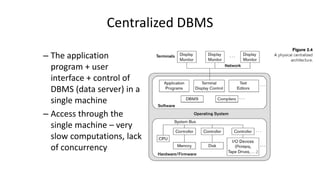
Centralized DBMS
– The application
program + user
interface + control of
DBMS (data server) in a
single machine
– Access through the
single machine – very
slow computations, lack
of concurrency
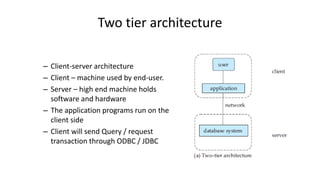
Two tier architecture
– Client-server architecture
– Client – machine used by end-user.
– Server – high end machine holds
software and hardware
– The application programs run on the
client side
– Client will send Query / request
transaction through ODBC / JDBC
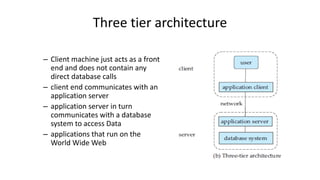
Three tier architecture
– Client machine just acts as a front
end and does not contain any
direct database calls
– client end communicates with an
application server
– application server in turn
communicates with a database
system to access Data
– applications that run on the
World Wide Web
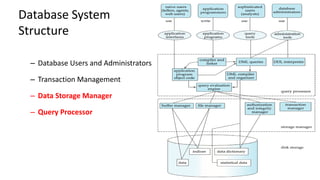
Database System
Structure
– Database Users and Administrators
– Transaction Management
– Data Storage Manager
– Query Processor
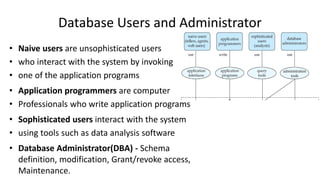
Database Users and Administrator
• Naive users are unsophisticated users
• who interact with the system by invoking
• one of the application programs
• Application programmers are computer
• Professionals who write application programs
• Sophisticated users interact with the system
• using tools such as data analysis software
• Database Administrator(DBA) - Schema
definition, modification, Grant/revoke access,
Maintenance.
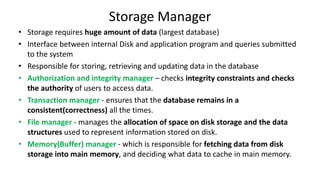
Storage Manager
• Storage requires huge amount of data (largest database)
• Interface between internal Disk and application program and queries submitted
to the system
• Responsible for storing, retrieving and updating data in the database
• Authorization and integrity manager – checks integrity constraints and checks
the authority of users to access data.
• Transaction manager - ensures that the database remains in a
consistent(correctness) all the times.
• File manager - manages the allocation of space on disk storage and the data
structures used to represent information stored on disk.
• Memory(Buffer) manager - which is responsible for fetching data from disk
storage into main memory, and deciding what data to cache in main memory.
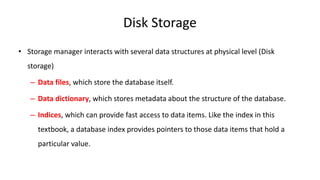
Disk Storage
• Storage manager interacts with several data structures at physical level (Disk
storage)
– Data files, which store the database itself.
– Data dictionary, which stores metadata about the structure of the database.
– Indices, which can provide fast access to data items. Like the index in this
textbook, a database index provides pointers to those data items that hold a
particular value.
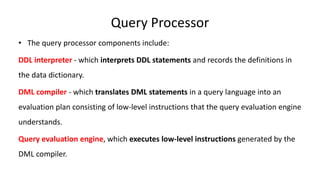
Query Processor
• The query processor components include:
DDL interpreter - which interprets DDL statements and records the definitions in
the data dictionary.
DML compiler - which translates DML statements in a query language into an
evaluation plan consisting of low-level instructions that the query evaluation engine
understands.
Query evaluation engine, which executes low-level instructions generated by the
DML compiler.
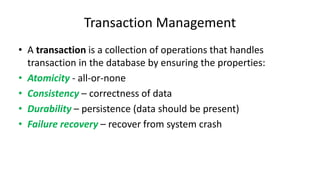
Transaction Management
• A transaction is a collection of operations that handles
transaction in the database by ensuring the properties:
• Atomicity - all-or-none
• Consistency – correctness of data
• Durability – persistence (data should be present)
• Failure recovery – recover from system crash

Database System Architecture

  • 1.
    DATABASE SYSTEM ARCHITECTURE Preparedby, Mr. K.Vignesh Saravanan Assistant Professor Department of Computer Science and Engineering Ramco Institute of Technology Rajapalayam
  • 2.
    Centralized DBMS – Theapplication program + user interface + control of DBMS (data server) in a single machine – Access through the single machine – very slow computations, lack of concurrency
  • 3.
    Two tier architecture –Client-server architecture – Client – machine used by end-user. – Server – high end machine holds software and hardware – The application programs run on the client side – Client will send Query / request transaction through ODBC / JDBC
  • 4.
    Three tier architecture –Client machine just acts as a front end and does not contain any direct database calls – client end communicates with an application server – application server in turn communicates with a database system to access Data – applications that run on the World Wide Web
  • 5.
    Database System Structure – DatabaseUsers and Administrators – Transaction Management – Data Storage Manager – Query Processor
  • 6.
    Database Users andAdministrator • Naive users are unsophisticated users • who interact with the system by invoking • one of the application programs • Application programmers are computer • Professionals who write application programs • Sophisticated users interact with the system • using tools such as data analysis software • Database Administrator(DBA) - Schema definition, modification, Grant/revoke access, Maintenance.
  • 7.
    Storage Manager • Storagerequires huge amount of data (largest database) • Interface between internal Disk and application program and queries submitted to the system • Responsible for storing, retrieving and updating data in the database • Authorization and integrity manager – checks integrity constraints and checks the authority of users to access data. • Transaction manager - ensures that the database remains in a consistent(correctness) all the times. • File manager - manages the allocation of space on disk storage and the data structures used to represent information stored on disk. • Memory(Buffer) manager - which is responsible for fetching data from disk storage into main memory, and deciding what data to cache in main memory.
  • 8.
    Disk Storage • Storagemanager interacts with several data structures at physical level (Disk storage) – Data files, which store the database itself. – Data dictionary, which stores metadata about the structure of the database. – Indices, which can provide fast access to data items. Like the index in this textbook, a database index provides pointers to those data items that hold a particular value.
  • 9.
    Query Processor • Thequery processor components include: DDL interpreter - which interprets DDL statements and records the definitions in the data dictionary. DML compiler - which translates DML statements in a query language into an evaluation plan consisting of low-level instructions that the query evaluation engine understands. Query evaluation engine, which executes low-level instructions generated by the DML compiler.
  • 10.
    Transaction Management • Atransaction is a collection of operations that handles transaction in the database by ensuring the properties: • Atomicity - all-or-none • Consistency – correctness of data • Durability – persistence (data should be present) • Failure recovery – recover from system crash