CLICK
CHEMISTRY
VARINDER KHEPAR
PhD Chemistry
Concept of Click Chemistry
“Click chemistry” is a chemical
philosophy introducded by K.B.
Sharpless in 2001, which describes the
chemistry that can generate substances
quickly and reliably by joining small units
together with high thermodynamic force.
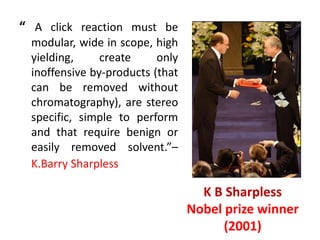
“ A click reaction must be
modular, wide in scope, high
yielding, create only
inoffensive by-products (that
can be removed without
chromatography), are stereo
specific, simple to perform
and that require benign or
easily removed solvent.”–
K.Barry Sharpless
K B Sharpless
Nobel prize winner
(2001)
Characteristics of click reaction
• Modularity
• Insensitivity to solvent parameters
• High chemical yields
• Insensitivity towards oxygen and water
• Regiospecificity and stereospecificity
• Require a large thermodynamic driving force
to favor a reaction
• Single reaction product or no byproducts
Conditions for click process
• Have simple reaction conditions
• Use readily available starting materials and
reagents
• Use no solvent or use a solvent that is easily
removed (preferably water)
• Provide simple product isolation by non-
chromatographic methods
(crystallisation or distillation)
• Have high atom economy
Copper(I)-catalyzed azide-alkyne
cycloaddition (CuAAC)
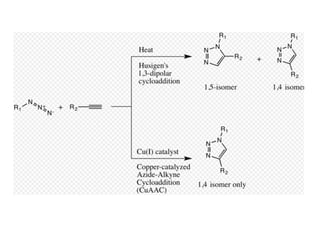
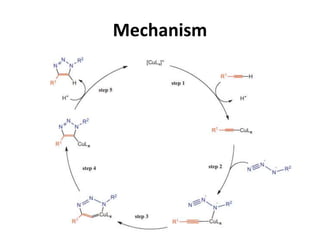
• It is the copper-catalyzed reaction of an azide
with an alkyne to form a 5-
membered heteroatom ring
• Thermodynamic and kinetically favorable (50 and
26 kcal/mol, respectively)
• Regiospecific and chemoselective
• 107 rate enhancement over noncatalyzed
reaction
• Triazole stable to oxidation and acid hydrolysis
Mechanism
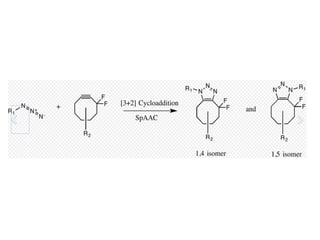
Strain-promoted azide-alkyne
cycloaddition (SPAAC)
• Instead of using Cu(I) to activate the alkyne,
the alkyne is introduced in a strained
difluorooctyne (DIFO), having electron-with
• This reaction proceeds as a concerted [3+2]
cycloaddition drawing fluorines destabilize
the alkyne.
• The reaction rate is slower than CuAAC.
Moreover, because the synthesis of
cyclooctynes often gives low yield.
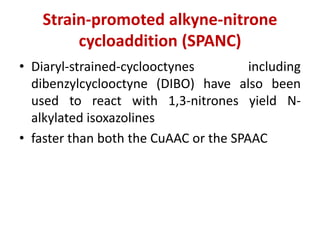
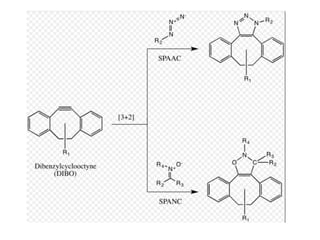
Strain-promoted alkyne-nitrone
cycloaddition (SPANC)
• Diaryl-strained-cyclooctynes including
dibenzylcyclooctyne (DIBO) have also been
used to react with 1,3-nitrones yield N-
alkylated isoxazolines
• faster than both the CuAAC or the SPAAC
APPLICATIONS OF CLICK CHEMISTRY
• 2-D gel electrophoresis separation
• Preparative organic synthesis of 1,4-substituted triazoles
• Modification of natural products and pharmaceuticals
• Natural product discovery
• Drug discovery
• Macrocyclizations using Cu(I) catalyzed triazole couplings
• Modification of DNA and nucleotides by triazole ligation
• Dendrimer design
• Polymers and biopolymers
• Material science
• Nanotechnology
REFERENCES
• Liang L and Astruc D (2011) The copper(I)-catalyzed
alkyne-azide cycloaddition (CuAAC) “click” reaction
and its applications. An overview. Coordination
Chemistry Reviews. 255 (23): 2933-45.
• https://en.wikipedia.org/wiki/Click_chemistry
• Cox, Courtney L, Tietz, Jonathan I, Sokolowski, Karol,
Melby, Joel O, Doroghazi, James R, Mitchell and
Douglas (2014) Nucleophilic 1,4-Additions for Natural
Product Discovery. ACS Chemi. Bio. 9(9):2014-22.
CLICK CHEMISTRY

CLICK CHEMISTRY

  • 1.
  • 2.
    Concept of ClickChemistry “Click chemistry” is a chemical philosophy introducded by K.B. Sharpless in 2001, which describes the chemistry that can generate substances quickly and reliably by joining small units together with high thermodynamic force.
  • 3.
    “ A clickreaction must be modular, wide in scope, high yielding, create only inoffensive by-products (that can be removed without chromatography), are stereo specific, simple to perform and that require benign or easily removed solvent.”– K.Barry Sharpless K B Sharpless Nobel prize winner (2001)
  • 4.
    Characteristics of clickreaction • Modularity • Insensitivity to solvent parameters • High chemical yields • Insensitivity towards oxygen and water • Regiospecificity and stereospecificity • Require a large thermodynamic driving force to favor a reaction • Single reaction product or no byproducts
  • 5.
    Conditions for clickprocess • Have simple reaction conditions • Use readily available starting materials and reagents • Use no solvent or use a solvent that is easily removed (preferably water) • Provide simple product isolation by non- chromatographic methods (crystallisation or distillation) • Have high atom economy
  • 6.
    Copper(I)-catalyzed azide-alkyne cycloaddition (CuAAC) •It is the copper-catalyzed reaction of an azide with an alkyne to form a 5- membered heteroatom ring • Thermodynamic and kinetically favorable (50 and 26 kcal/mol, respectively) • Regiospecific and chemoselective • 107 rate enhancement over noncatalyzed reaction • Triazole stable to oxidation and acid hydrolysis
  • 8.
  • 9.
    Strain-promoted azide-alkyne cycloaddition (SPAAC) •Instead of using Cu(I) to activate the alkyne, the alkyne is introduced in a strained difluorooctyne (DIFO), having electron-with • This reaction proceeds as a concerted [3+2] cycloaddition drawing fluorines destabilize the alkyne. • The reaction rate is slower than CuAAC. Moreover, because the synthesis of cyclooctynes often gives low yield.
  • 11.
    Strain-promoted alkyne-nitrone cycloaddition (SPANC) •Diaryl-strained-cyclooctynes including dibenzylcyclooctyne (DIBO) have also been used to react with 1,3-nitrones yield N- alkylated isoxazolines • faster than both the CuAAC or the SPAAC
  • 13.
    APPLICATIONS OF CLICKCHEMISTRY • 2-D gel electrophoresis separation • Preparative organic synthesis of 1,4-substituted triazoles • Modification of natural products and pharmaceuticals • Natural product discovery • Drug discovery • Macrocyclizations using Cu(I) catalyzed triazole couplings • Modification of DNA and nucleotides by triazole ligation • Dendrimer design • Polymers and biopolymers • Material science • Nanotechnology
  • 14.
    REFERENCES • Liang Land Astruc D (2011) The copper(I)-catalyzed alkyne-azide cycloaddition (CuAAC) “click” reaction and its applications. An overview. Coordination Chemistry Reviews. 255 (23): 2933-45. • https://en.wikipedia.org/wiki/Click_chemistry • Cox, Courtney L, Tietz, Jonathan I, Sokolowski, Karol, Melby, Joel O, Doroghazi, James R, Mitchell and Douglas (2014) Nucleophilic 1,4-Additions for Natural Product Discovery. ACS Chemi. Bio. 9(9):2014-22.