Applying profilers to MySQL
From PMP to perf, and why Performance Schema is not a
replacement in all cases
Valerii Kravchuk, Principal Support Engineer
valerii.kravchuk@mariadb.com
1
www.percona.com
Who am I?
Valerii (aka Valeriy) Kravchuk:
● MySQL Support Engineer in MySQL AB, Sun and Oracle, 2005 - 2012
● Principal Support Engineer in Percona, 2012 - 2016
● Principal Support Engineer in MariaDB Corporation since March 2016
● http://mysqlentomologist.blogspot.com - my blog about MySQL (a lot about
MySQL bugs, but some HowTos as well)
● https://www.facebook.com/valerii.kravchuk - my Facebook page, a lot about
MySQL (mostly bugs…)
● http://bugs.mysql.com - my personal playground. 308 bugs reported in total,
20 since February, 2016
● I like FOSDEM, see slides from my previous talks:
○ http://www.slideshare.net/valeriikravchuk1/fosdem2015-gdb-tips-and-tricks-for-my-sql-db-as
○ http://www.slideshare.net/ValeriyKravchuk/more-on-gdb-for-my-sql-db-as-fosdem-2016
2
www.percona.com
What is this session about?
● It’s about profiling MySQL and some tools (“profilers”)
MySQL DBA can use for profiling in production on Linux:
○ Oprofile (including opcontrol, opreport and operf)
○ perf (I think it’s the best and easiest to use now)
○ Few words on PMP (pt-pmp)
● Some real life use case, along the lines of Bug #39630, Bug
#68079 (including studying similar use case with MyRocks),
Bug #83912 and maybe more...
● Why not about gprof, Callgrind, Massif, dtrace, SystemTap?
● Why not about Performance Schema?
● Performance impact of profiling
3
www.percona.com
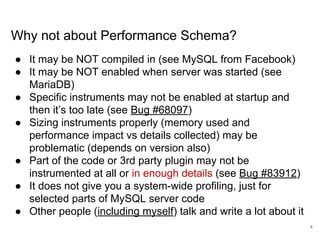
Why not about Performance Schema?
● It may be NOT compiled in (see MySQL from Facebook)
● It may be NOT enabled when server was started (see
MariaDB)
● Specific instruments may not be enabled at startup and
then it’s too late (see Bug #68097)
● Sizing instruments properly (memory used and
performance impact vs details collected) may be
problematic (depends on version also)
● Part of the code or 3rd party plugin may not be
instrumented at all or in enough details (see Bug #83912)
● It does not give you a system-wide profiling, just for
selected parts of MySQL server code
● Other people (including myself) talk and write a lot about it
4
www.percona.com
Not Enough Details in Performance Schema
Samples: 52K of event 'cpu-clock', Event
count (approx.): 13037500000
Overhead Command Shared Object Symbol
43.75% mysqld mysqld [.]
Item_func_mul::int_op
16.97% mysqld mysqld [.]
Item_func_benchmark::val_int
14.10% mysqld mysqld [.]
Item_int::val_int
13.50% mysqld mysqld [.]
Item_func_numhybrid::val_int
...
2.58% mysqld mysqld [.]
Item_func_numhybrid::result_type
...
30 SELECT `benchmark` ( ?, ... * ? )
(13055172.39?)
30 stage/sql/init (51.56?)
30 stage/sql/checking permissions
(2.27?)
30 stage/sql/Opening tables (1.00?)
30 stage/sql/After opening tables
(0.62?)
30 stage/sql/init (9.32?)
30 stage/sql/optimizing (7.41?)
30 stage/sql/executing (13055061.32?)
30 stage/sql/end (3.98?)
30 stage/sql/query end (2.34?)
30 stage/sql/closing tables (1.73?)
30 stage/sql/freeing items (4.22?)
30 stage/sql/cleaning up (1.13?)
● Yes, this is for primitive select benchmark(500000000,2*2) from Bug #39630
● Performance Schema query is like 25 lines long to make it readable
5
www.percona.com
Not Enough Details in Performance Schema
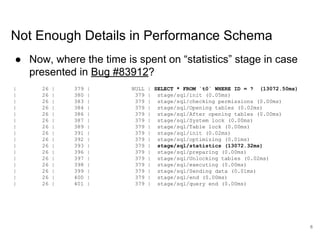
● Now, where the time is spent on “statistics” stage in case
presented in Bug #83912?
| 26 | 379 | NULL | SELECT * FROM `t0` WHERE ID = ? (13072.50ms)
| 26 | 380 | 379 | stage/sql/init (0.05ms)
| 26 | 383 | 379 | stage/sql/checking permissions (0.00ms)
| 26 | 384 | 379 | stage/sql/Opening tables (0.02ms)
| 26 | 386 | 379 | stage/sql/After opening tables (0.00ms)
| 26 | 387 | 379 | stage/sql/System lock (0.00ms)
| 26 | 389 | 379 | stage/sql/Table lock (0.00ms)
| 26 | 391 | 379 | stage/sql/init (0.02ms)
| 26 | 392 | 379 | stage/sql/optimizing (0.01ms)
| 26 | 393 | 379 | stage/sql/statistics (13072.32ms)
| 26 | 396 | 379 | stage/sql/preparing (0.00ms)
| 26 | 397 | 379 | stage/sql/Unlocking tables (0.02ms)
| 26 | 398 | 379 | stage/sql/executing (0.00ms)
| 26 | 399 | 379 | stage/sql/Sending data (0.01ms)
| 26 | 400 | 379 | stage/sql/end (0.00ms)
| 26 | 401 | 379 | stage/sql/query end (0.00ms)
6
www.percona.com
Oprofile - Success Stories
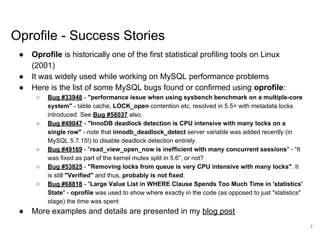
● Oprofile is historically one of the first statistical profiling tools on Linux
(2001)
● It was widely used while working on MySQL performance problems
● Here is the list of some MySQL bugs found or confirmed using oprofile:
○ Bug #33948 - "performance issue when using sysbench benchmark on a multiple-core
system" - table cache, LOCK_open contention etc, resolved in 5.5+ with metadata locks
introduced. See Bug #58037 also.
○ Bug #49047 - "InnoDB deadlock detection is CPU intensive with many locks on a
single row" - note that innodb_deadlock_detect server variable was added recently (in
MySQL 5.7.15!) to disable deadlock detection entirely.
○ Bug #49169 - "read_view_open_now is inefficient with many concurrent sessions" - “It
was fixed as part of the kernel mutex split in 5.6”, or not?
○ Bug #53825 - "Removing locks from queue is very CPU intensive with many locks". It
is still "Verified" and thus, probably is not fixed.
○ Bug #68818 - "Large Value List in WHERE Clause Spends Too Much Time in 'statistics'
State" - oprofile was used to show where exactly in the code (as opposed to just "statistics"
stage) the time was spent
● More examples and details are presented in my blog post
7
www.percona.com
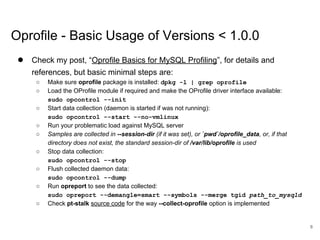
Oprofile - Basic Usage of Versions < 1.0.0
● Check my post, “Oprofile Basics for MySQL Profiling”, for details and
references, but basic minimal steps are:
○ Make sure oprofile package is installed: dpkg -l | grep oprofile
○ Load the OProfile module if required and make the OProfile driver interface available:
sudo opcontrol --init
○ Start data collection (daemon is started if was not running):
sudo opcontrol --start --no-vmlinux
○ Run your problematic load against MySQL server
○ Samples are collected in --session-dir (if it was set), or `pwd`/oprofile_data, or, if that
directory does not exist, the standard session-dir of /var/lib/oprofile is used
○ Stop data collection:
sudo opcontrol --stop
○ Flush collected daemon data:
sudo opcontrol --dump
○ Run opreport to see the data collected:
sudo opreport --demangle=smart --symbols --merge tgid path_to_mysqld
○ Check pt-stalk source code for the way --collect-oprofile option is implemented
8
www.percona.com
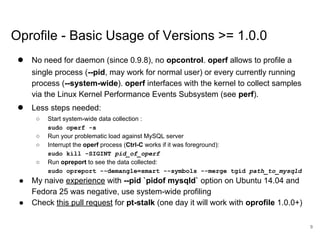
Oprofile - Basic Usage of Versions >= 1.0.0
● No need for daemon (since 0.9.8), no opcontrol. operf allows to profile a
single process (--pid, may work for normal user) or every currently running
process (--system-wide). operf interfaces with the kernel to collect samples
via the Linux Kernel Performance Events Subsystem (see perf).
● Less steps needed:
○ Start system-wide data collection :
sudo operf -s
○ Run your problematic load against MySQL server
○ Interrupt the operf process (Ctrl-C works if it was foreground):
sudo kill -SIGINT pid_of_operf
○ Run opreport to see the data collected:
sudo opreport --demangle=smart --symbols --merge tgid path_to_mysqld
● My naive experience with --pid `pidof mysqld` option on Ubuntu 14.04 and
Fedora 25 was negative, use system-wide profiling
● Check this pull request for pt-stalk (one day it will work with oprofile 1.0.0+)
9
www.percona.com
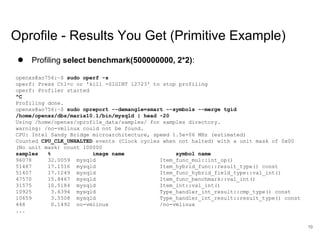
Oprofile - Results You Get (Primitive Example)
● Profiling select benchmark(500000000, 2*2):
openxs@ao756:~$ sudo operf -s
operf: Press Ctl-c or 'kill -SIGINT 12723' to stop profiling
operf: Profiler started
^C
Profiling done.
openxs@ao756:~$ sudo opreport --demangle=smart --symbols --merge tgid
/home/openxs/dbs/maria10.1/bin/mysqld | head -20
Using /home/openxs/oprofile_data/samples/ for samples directory.
warning: /no-vmlinux could not be found.
CPU: Intel Sandy Bridge microarchitecture, speed 1.5e+06 MHz (estimated)
Counted CPU_CLK_UNHALTED events (Clock cycles when not halted) with a unit mask of 0x00
(No unit mask) count 100000
samples % image name symbol name
96078 32.0059 mysqld Item_func_mul::int_op()
51487 17.1516 mysqld Item_hybrid_func::result_type() const
51407 17.1249 mysqld Item_func_hybrid_field_type::val_int()
47570 15.8467 mysqld Item_func_benchmark::val_int()
31575 10.5184 mysqld Item_int::val_int()
10925 3.6394 mysqld Type_handler_int_result::cmp_type() const
10659 3.5508 mysqld Type_handler_int_result::result_type() const
448 0.1492 no-vmlinux /no-vmlinux
...
10
www.percona.com
pt-pmp (Poor Man’s Profiler)
● http://www.percona.com/doc/percona-toolkit/2.2/pt-pmp.html
pt-pmp [-i 1] [-s 0] [-b mysqld] [-p pidofmysqld] [-l 0] [-k file] [--version]
● It is based on original idea by Domas, http://poormansprofiler.org/
● One of the recent examples how it is used: Bug #78277 - InnoDB deadlock,
thread stuck on kernel calls from transparent page compression, “Open”
● When mysqld hangs or is slow, you can get some insight quickly: for
example, Bug #75028 (HandlerSocket “hangs” on shutdown)
● When there are stalls, use pt-pmp to find out why (or what threads mostly
do at the moment): Bug #69810
● Use in production as a last resort (may hang mysqld, --SIGCONT)
● pt-pmp surely slows server down :) Hints:
○ https://bugs.launchpad.net/percona-toolkit/+bug/1320168 - partial
workaround
○ Use quickstack instead of gdb (check this discussion)
11
www.percona.com
pt-pmp Applied to “statistics” Case of Bug #83912
MariaDB [test]> select * from t0 where id = 15;
+----+------+--------------------+
| id | c1 | c2 |
+----+------+--------------------+
| 15 | 290 | 0.7441205286831786 |
+----+------+--------------------+
1 row in set ( 52.27 sec)
1
select(libc.so.6), os_thread_sleep(os0thread.cc:303), srv_conc_enter_innodb_wi
th_atomics(srv0conc.cc:298),srv_conc_enter_innodb(srv0conc.cc:298),innobase
_srv_conc_enter_innodb(ha_innodb.cc:1906), ha_innobase::index_read(ha_innodb.
cc:1906),handler::index_read_idx_map(handler.cc:5441),handler::ha_index_rea
d_idx_map(handler.cc:2646),join_read_(handler.cc:2646),join_read__table(han
dler.cc:2646), make_join_statistics(sql_select.cc:3935),JOIN::optimize_inner(
sql_select.cc:1366), JOIN::optimize(sql_select.cc:1045), mysql_select(sql_sele
ct.cc:3430),handle_select(sql_select.cc:372),execute_sqlcom_select(sql_pars
e.cc:5896),mysql_execute_command(sql_parse.cc:2971),mysql_parse(sql_parse.c
c:7319),dispatch_command(sql_parse.cc:1488),do_command(sql_parse.cc:1109),d
o_handle_one_connection(sql_connect.cc:1349),handle_one_connection(sql_conn
ect.cc:1261),pfs_spawn_thread(pfs.cc:1860),start_thread(libpthread.so.0),cl
one(libc.so.6)
...
12
www.percona.com
Is PMP Always Useful?
[openxs@fc23 ~]$ pt-pmp
Fri Jan 27 10:53:28 EET 2017
10
__io_getevents_0_4(libaio.so.1),os_aio_linux_collect(os0file.cc:5432),os_ai
o_linux_handle(os0file.cc:5432),fil_aio_wait(fil0fil.cc:6231),io_handler_th
read(srv0start.cc:546),start_thread(libpthread.so.0),clone(libc.so.6)
1
Type_handler_hybrid_field_type::cmp_type,Item_hybrid_func::cmp_type, Item_fu
nc_hybrid_field_type::val_int,Item_func_benchmark::val_int(item_func.cc:4482)
,Item::send(item.cc:6561),Protocol::send_result_set_row(protocol.cc:914),se
lect_send::send_data(sql_class.cc:2830),JOIN::exec_inner(sql_select.cc:2589
),JOIN::exec(sql_select.cc:2510),mysql_select(sql_select.cc:3444),handle_se
lect(sql_select.cc:372),execute_sqlcom_select(sql_parse.cc:5896),mysql_exec
ute_command(sql_parse.cc:2971),mysql_parse(sql_parse.cc:7319),dispatch_comm
and(sql_parse.cc:1488),do_command(sql_parse.cc:1109),do_handle_one_connecti
on(sql_connect.cc:1349),handle_one_connection(sql_connect.cc:1261),pfs_spaw
n_thread(pfs.cc:1860),start_thread(libpthread.so.0),clone(libc.so.6)
...
1
select(libc.so.6),os_thread_sleep(os0thread.cc:303),srv_master_sleep(srv0sr
v.cc:3139),srv_master_thread(srv0srv.cc:3139),start_thread(libpthread.so.0)
,clone(libc.so.6)
...
13
www.percona.com
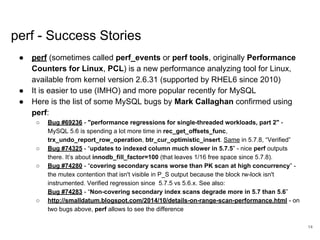
perf - Success Stories
● perf (sometimes called perf_events or perf tools, originally Performance
Counters for Linux, PCL) is a new performance analyzing tool for Linux,
available from kernel version 2.6.31 (supported by RHEL6 since 2010)
● It is easier to use (IMHO) and more popular recently for MySQL
● Here is the list of some MySQL bugs by Mark Callaghan confirmed using
perf:
○ Bug #69236 - "performance regressions for single-threaded workloads, part 2" -
MySQL 5.6 is spending a lot more time in rec_get_offsets_func,
trx_undo_report_row_operation, btr_cur_optimistic_insert. Same in 5.7.8, “Verified”
○ Bug #74325 - “updates to indexed column much slower in 5.7.5” - nice perf outputs
there. It’s about innodb_fill_factor=100 (that leaves 1/16 free space since 5.7.8).
○ Bug #74280 - “covering secondary scans worse than PK scan at high concurrency” -
the mutex contention that isn't visible in P_S output because the block rw-lock isn't
instrumented. Verified regression since 5.7.5 vs 5.6.x. See also:
Bug #74283 - “Non-covering secondary index scans degrade more in 5.7 than 5.6”
○ http://smalldatum.blogspot.com/2014/10/details-on-range-scan-performance.html - on
two bugs above, perf allows to see the difference
14
www.percona.com
perf - Basic Usage
● Check my post, “perf Basics for MySQL Profiling”, for details and references,
but basic minimal steps are:
○ Make sure perf-related packages are installed (perf with RPMs) for your kernel:
sudo apt-get install linux-tools-generic
○ Make sure debug symbols are installed and software is built with -fno-omit-frame-pointer
○ Start data collection for some time using perf record:
sudo perf record -a [-g] [-F99] [-p `pidof mysqld`] sleep 30
Run your problematic load against MySQL server
○ Samples are collected in `pwd`/perf.data by default
○ Process samples and display the profile using perf report:
sudo perf report [-n] [-g] --stdio
● Alternatively, run in foreground and interrupt any time with Ctrl-C:
[root@centos ~]# perf record -ag
^C
● Or run in background and send -SIGINT when done:
[root@centos ~]# perf record -ag &
[1] 2353
[root@centos ~]# kill -sigint 2353
● Let’s see how it works alive… (demo). We’ll see perf top, perf record -g etc
15
www.percona.com
perf - Call Graphs
Use -g option of perf record to get call graphs/backtraces with perf, then:
openxs@ao756:~/dbs/maria10.1$ sudo perf report --stdio
...
31.02% mysqld mysqld [.] Item_func_mul::int_op()
|
--- Item_func_mul::int_op()
|
|--94.56%-- Item_func_hybrid_field_type::val_int()
| Item_func_benchmark::val_int()
| Item::send(Protocol*, String*)
| Protocol::send_result_set_row(List<Item>*)
| select_send::send_data(List<Item>&)
| JOIN::exec_inner()
| JOIN::exec()
| mysql_select(THD*, Item***, TABLE_LIST*, ...
| handle_select(THD*, LEX*, select_result*, unsigned
long)
| execute_sqlcom_select(THD*, TABLE_LIST*)
| mysql_execute_command(THD*)
| mysql_parse(THD*, char*, unsigned int, Parser_state*)
| dispatch_command(enum_server_command, THD*, char*,
...)
| do_command(THD*)
...
16
www.percona.com
On perf vs Oprofile
● These days perf is, IMHO, better than oprofile/operf for MySQL profiling:
○ perf has a lot of features and requires less steps for basic usage
○ Call graphs are easier to get and more useful with perf
○ Classical oprofile (with daemon etc) has more severe impact on performance
○ In some environments operf just doesn’t work (while perf does):
[root@centos ~]# operf --version
Your kernel's Performance Events Subsystem does not support your processor
type.
Please use the opcontrol command instead of operf.
● Check the following blog post and discussion:
○ “perf: the good, the bad, the ugly”, by Robert Haas
○ Oprofile vs Perf from oprofile-list@lists.sf.net
● --collect-oprofile in pt-stalk may not work well for Galera (see lp:1152571)
● Time to add --collect-perf to pt-stalk!
● PMP is special (ease of use for specific tasks vs performance impact/hangs)
17
www.percona.com
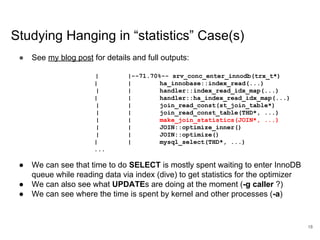
Studying Hanging in “statistics” Case(s)
● See my blog post for details and full outputs:
| |--71.70%-- srv_conc_enter_innodb(trx_t*)
| | ha_innobase::index_read(...)
| | handler::index_read_idx_map(...)
| | handler::ha_index_read_idx_map(...)
| | join_read_const(st_join_table*)
| | join_read_const_table(THD*, ...)
| | make_join_statistics(JOIN*, ...)
| | JOIN::optimize_inner()
| | JOIN::optimize()
| | mysql_select(THD*, ...)
...
● We can see that time to do SELECT is mostly spent waiting to enter InnoDB
queue while reading data via index (dive) to get statistics for the optimizer
● We can also see what UPDATEs are doing at the moment (-g caller ?)
● We can see where the time is spent by kernel and other processes (-a)
18
www.percona.com
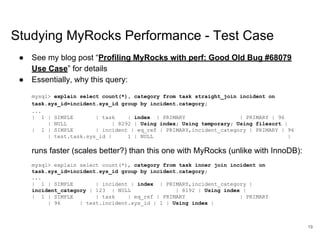
Studying MyRocks Performance - Test Case
● See my blog post “Profiling MyRocks with perf: Good Old Bug #68079
Use Case” for details
● Essentially, why this query:
mysql> explain select count(*), category from task straight_join incident on
task.sys_id=incident.sys_id group by incident.category;
...
| 1 | SIMPLE | task | index | PRIMARY | PRIMARY | 96
| NULL | 8292 | Using index; Using temporary; Using filesort |
| 1 | SIMPLE | incident | eq_ref | PRIMARY,incident_category | PRIMARY | 96
| test.task.sys_id | 1 | NULL |
runs faster (scales better?) than this one with MyRocks (unlike with InnoDB):
mysql> explain select count(*), category from task inner join incident on
task.sys_id=incident.sys_id group by incident.category;
...
| 1 | SIMPLE | incident | index | PRIMARY,incident_category |
incident_category | 123 | NULL | 8192 | Using index |
| 1 | SIMPLE | task | eq_ref | PRIMARY | PRIMARY
| 96 | test.incident.sys_id | 1 | Using index |
19
www.percona.com
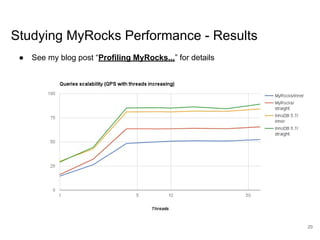
Studying MyRocks Performance - Results
● See my blog post “Profiling MyRocks...” for details
20
www.percona.com
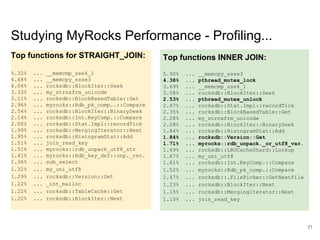
Studying MyRocks Performance - Profiling...
Top functions for STRAIGHT_JOIN:
5.32% ... __memcmp_sse4_1
4.68% ... __memcpy_ssse3
4.04% ... rocksdb::BlockIter::Seek
3.33% ... my_strnxfrm_unicode
3.11% ... rocksdb::BlockBasedTable::Get
2.96% ... myrocks::Rdb_pk_comp..::Compare
2.54% ... rocksdb::BlockIter::BinarySeek
2.14% ... rocksdb::Int.KeyComp.::Compare
2.00% ... rocksdb::Stat.Impl::recordTick
1.99% ... rocksdb::MergingIterator::Next
1.95% ... rocksdb::HistogramStat::Add
1.51% ... join_read_key
1.51% ... myrocks::rdb_unpack_utf8_str
1.41% ... myrocks::Rdb_key_def::unp._rec.
1.36% ... sub_select
1.32% ... my_uni_utf8
1.29% ... rocksdb::Version::Get
1.22% ... _int_malloc
1.22% ... rocksdb::TableCache::Get
1.22% ... rocksdb::BlockIter::Next
21
Top functions INNER JOIN:
5.90% ... __memcpy_ssse3
4.38% ... pthread_mutex_lock
3.69% ... __memcmp_sse4_1
3.58% ... rocksdb::BlockIter::Seek
2.53% ... pthread_mutex_unlock
2.47% ... rocksdb::Stat.Impl::recordTick
2.35% ... rocksdb::BlockBasedTable::Get
2.28% ... my_strnxfrm_unicode
2.08% ... rocksdb::BlockIter::BinarySeek
1.84% ... rocksdb::HistogramStat::Add
1.84% ... rocksdb::Version::Get
1.71% ... myrocks::rdb_unpack._or_utf8_var.
1.69% ... rocksdb::LRUCacheShard::Lookup
1.67% ... my_uni_utf8
1.61% ... rocksdb::Int.KeyComp.::Compare
1.52% ... myrocks::Rdb_pk_comp.::Compare
1.47% ... rocksdb::.FilePicker::GetNextFile
1.23% ... rocksdb::BlockIter::Next
1.15% ... rocksdb::MergingIterator::Next
1.10% ... join_read_key
www.percona.com
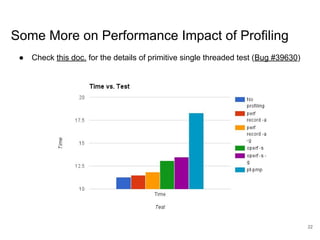
Some More on Performance Impact of Profiling
● Check this doc. for the details of primitive single threaded test (Bug #39630)
22
www.percona.com
Thank you!
Questions and Answers?
Please, report bugs at:
http://bugs.mysql.com
https://jira.mariadb.org
23

Applying profilers to my sql (fosdem 2017)

  • 1.
    Applying profilers toMySQL From PMP to perf, and why Performance Schema is not a replacement in all cases Valerii Kravchuk, Principal Support Engineer valerii.kravchuk@mariadb.com 1
  • 2.
    www.percona.com Who am I? Valerii(aka Valeriy) Kravchuk: ● MySQL Support Engineer in MySQL AB, Sun and Oracle, 2005 - 2012 ● Principal Support Engineer in Percona, 2012 - 2016 ● Principal Support Engineer in MariaDB Corporation since March 2016 ● http://mysqlentomologist.blogspot.com - my blog about MySQL (a lot about MySQL bugs, but some HowTos as well) ● https://www.facebook.com/valerii.kravchuk - my Facebook page, a lot about MySQL (mostly bugs…) ● http://bugs.mysql.com - my personal playground. 308 bugs reported in total, 20 since February, 2016 ● I like FOSDEM, see slides from my previous talks: ○ http://www.slideshare.net/valeriikravchuk1/fosdem2015-gdb-tips-and-tricks-for-my-sql-db-as ○ http://www.slideshare.net/ValeriyKravchuk/more-on-gdb-for-my-sql-db-as-fosdem-2016 2
  • 3.
    www.percona.com What is thissession about? ● It’s about profiling MySQL and some tools (“profilers”) MySQL DBA can use for profiling in production on Linux: ○ Oprofile (including opcontrol, opreport and operf) ○ perf (I think it’s the best and easiest to use now) ○ Few words on PMP (pt-pmp) ● Some real life use case, along the lines of Bug #39630, Bug #68079 (including studying similar use case with MyRocks), Bug #83912 and maybe more... ● Why not about gprof, Callgrind, Massif, dtrace, SystemTap? ● Why not about Performance Schema? ● Performance impact of profiling 3
  • 4.
    www.percona.com Why not aboutPerformance Schema? ● It may be NOT compiled in (see MySQL from Facebook) ● It may be NOT enabled when server was started (see MariaDB) ● Specific instruments may not be enabled at startup and then it’s too late (see Bug #68097) ● Sizing instruments properly (memory used and performance impact vs details collected) may be problematic (depends on version also) ● Part of the code or 3rd party plugin may not be instrumented at all or in enough details (see Bug #83912) ● It does not give you a system-wide profiling, just for selected parts of MySQL server code ● Other people (including myself) talk and write a lot about it 4
  • 5.
    www.percona.com Not Enough Detailsin Performance Schema Samples: 52K of event 'cpu-clock', Event count (approx.): 13037500000 Overhead Command Shared Object Symbol 43.75% mysqld mysqld [.] Item_func_mul::int_op 16.97% mysqld mysqld [.] Item_func_benchmark::val_int 14.10% mysqld mysqld [.] Item_int::val_int 13.50% mysqld mysqld [.] Item_func_numhybrid::val_int ... 2.58% mysqld mysqld [.] Item_func_numhybrid::result_type ... 30 SELECT `benchmark` ( ?, ... * ? ) (13055172.39?) 30 stage/sql/init (51.56?) 30 stage/sql/checking permissions (2.27?) 30 stage/sql/Opening tables (1.00?) 30 stage/sql/After opening tables (0.62?) 30 stage/sql/init (9.32?) 30 stage/sql/optimizing (7.41?) 30 stage/sql/executing (13055061.32?) 30 stage/sql/end (3.98?) 30 stage/sql/query end (2.34?) 30 stage/sql/closing tables (1.73?) 30 stage/sql/freeing items (4.22?) 30 stage/sql/cleaning up (1.13?) ● Yes, this is for primitive select benchmark(500000000,2*2) from Bug #39630 ● Performance Schema query is like 25 lines long to make it readable 5
  • 6.
    www.percona.com Not Enough Detailsin Performance Schema ● Now, where the time is spent on “statistics” stage in case presented in Bug #83912? | 26 | 379 | NULL | SELECT * FROM `t0` WHERE ID = ? (13072.50ms) | 26 | 380 | 379 | stage/sql/init (0.05ms) | 26 | 383 | 379 | stage/sql/checking permissions (0.00ms) | 26 | 384 | 379 | stage/sql/Opening tables (0.02ms) | 26 | 386 | 379 | stage/sql/After opening tables (0.00ms) | 26 | 387 | 379 | stage/sql/System lock (0.00ms) | 26 | 389 | 379 | stage/sql/Table lock (0.00ms) | 26 | 391 | 379 | stage/sql/init (0.02ms) | 26 | 392 | 379 | stage/sql/optimizing (0.01ms) | 26 | 393 | 379 | stage/sql/statistics (13072.32ms) | 26 | 396 | 379 | stage/sql/preparing (0.00ms) | 26 | 397 | 379 | stage/sql/Unlocking tables (0.02ms) | 26 | 398 | 379 | stage/sql/executing (0.00ms) | 26 | 399 | 379 | stage/sql/Sending data (0.01ms) | 26 | 400 | 379 | stage/sql/end (0.00ms) | 26 | 401 | 379 | stage/sql/query end (0.00ms) 6
  • 7.
    www.percona.com Oprofile - SuccessStories ● Oprofile is historically one of the first statistical profiling tools on Linux (2001) ● It was widely used while working on MySQL performance problems ● Here is the list of some MySQL bugs found or confirmed using oprofile: ○ Bug #33948 - "performance issue when using sysbench benchmark on a multiple-core system" - table cache, LOCK_open contention etc, resolved in 5.5+ with metadata locks introduced. See Bug #58037 also. ○ Bug #49047 - "InnoDB deadlock detection is CPU intensive with many locks on a single row" - note that innodb_deadlock_detect server variable was added recently (in MySQL 5.7.15!) to disable deadlock detection entirely. ○ Bug #49169 - "read_view_open_now is inefficient with many concurrent sessions" - “It was fixed as part of the kernel mutex split in 5.6”, or not? ○ Bug #53825 - "Removing locks from queue is very CPU intensive with many locks". It is still "Verified" and thus, probably is not fixed. ○ Bug #68818 - "Large Value List in WHERE Clause Spends Too Much Time in 'statistics' State" - oprofile was used to show where exactly in the code (as opposed to just "statistics" stage) the time was spent ● More examples and details are presented in my blog post 7
  • 8.
    www.percona.com Oprofile - BasicUsage of Versions < 1.0.0 ● Check my post, “Oprofile Basics for MySQL Profiling”, for details and references, but basic minimal steps are: ○ Make sure oprofile package is installed: dpkg -l | grep oprofile ○ Load the OProfile module if required and make the OProfile driver interface available: sudo opcontrol --init ○ Start data collection (daemon is started if was not running): sudo opcontrol --start --no-vmlinux ○ Run your problematic load against MySQL server ○ Samples are collected in --session-dir (if it was set), or `pwd`/oprofile_data, or, if that directory does not exist, the standard session-dir of /var/lib/oprofile is used ○ Stop data collection: sudo opcontrol --stop ○ Flush collected daemon data: sudo opcontrol --dump ○ Run opreport to see the data collected: sudo opreport --demangle=smart --symbols --merge tgid path_to_mysqld ○ Check pt-stalk source code for the way --collect-oprofile option is implemented 8
  • 9.
    www.percona.com Oprofile - BasicUsage of Versions >= 1.0.0 ● No need for daemon (since 0.9.8), no opcontrol. operf allows to profile a single process (--pid, may work for normal user) or every currently running process (--system-wide). operf interfaces with the kernel to collect samples via the Linux Kernel Performance Events Subsystem (see perf). ● Less steps needed: ○ Start system-wide data collection : sudo operf -s ○ Run your problematic load against MySQL server ○ Interrupt the operf process (Ctrl-C works if it was foreground): sudo kill -SIGINT pid_of_operf ○ Run opreport to see the data collected: sudo opreport --demangle=smart --symbols --merge tgid path_to_mysqld ● My naive experience with --pid `pidof mysqld` option on Ubuntu 14.04 and Fedora 25 was negative, use system-wide profiling ● Check this pull request for pt-stalk (one day it will work with oprofile 1.0.0+) 9
  • 10.
    www.percona.com Oprofile - ResultsYou Get (Primitive Example) ● Profiling select benchmark(500000000, 2*2): openxs@ao756:~$ sudo operf -s operf: Press Ctl-c or 'kill -SIGINT 12723' to stop profiling operf: Profiler started ^C Profiling done. openxs@ao756:~$ sudo opreport --demangle=smart --symbols --merge tgid /home/openxs/dbs/maria10.1/bin/mysqld | head -20 Using /home/openxs/oprofile_data/samples/ for samples directory. warning: /no-vmlinux could not be found. CPU: Intel Sandy Bridge microarchitecture, speed 1.5e+06 MHz (estimated) Counted CPU_CLK_UNHALTED events (Clock cycles when not halted) with a unit mask of 0x00 (No unit mask) count 100000 samples % image name symbol name 96078 32.0059 mysqld Item_func_mul::int_op() 51487 17.1516 mysqld Item_hybrid_func::result_type() const 51407 17.1249 mysqld Item_func_hybrid_field_type::val_int() 47570 15.8467 mysqld Item_func_benchmark::val_int() 31575 10.5184 mysqld Item_int::val_int() 10925 3.6394 mysqld Type_handler_int_result::cmp_type() const 10659 3.5508 mysqld Type_handler_int_result::result_type() const 448 0.1492 no-vmlinux /no-vmlinux ... 10
  • 11.
    www.percona.com pt-pmp (Poor Man’sProfiler) ● http://www.percona.com/doc/percona-toolkit/2.2/pt-pmp.html pt-pmp [-i 1] [-s 0] [-b mysqld] [-p pidofmysqld] [-l 0] [-k file] [--version] ● It is based on original idea by Domas, http://poormansprofiler.org/ ● One of the recent examples how it is used: Bug #78277 - InnoDB deadlock, thread stuck on kernel calls from transparent page compression, “Open” ● When mysqld hangs or is slow, you can get some insight quickly: for example, Bug #75028 (HandlerSocket “hangs” on shutdown) ● When there are stalls, use pt-pmp to find out why (or what threads mostly do at the moment): Bug #69810 ● Use in production as a last resort (may hang mysqld, --SIGCONT) ● pt-pmp surely slows server down :) Hints: ○ https://bugs.launchpad.net/percona-toolkit/+bug/1320168 - partial workaround ○ Use quickstack instead of gdb (check this discussion) 11
  • 12.
    www.percona.com pt-pmp Applied to“statistics” Case of Bug #83912 MariaDB [test]> select * from t0 where id = 15; +----+------+--------------------+ | id | c1 | c2 | +----+------+--------------------+ | 15 | 290 | 0.7441205286831786 | +----+------+--------------------+ 1 row in set ( 52.27 sec) 1 select(libc.so.6), os_thread_sleep(os0thread.cc:303), srv_conc_enter_innodb_wi th_atomics(srv0conc.cc:298),srv_conc_enter_innodb(srv0conc.cc:298),innobase _srv_conc_enter_innodb(ha_innodb.cc:1906), ha_innobase::index_read(ha_innodb. cc:1906),handler::index_read_idx_map(handler.cc:5441),handler::ha_index_rea d_idx_map(handler.cc:2646),join_read_(handler.cc:2646),join_read__table(han dler.cc:2646), make_join_statistics(sql_select.cc:3935),JOIN::optimize_inner( sql_select.cc:1366), JOIN::optimize(sql_select.cc:1045), mysql_select(sql_sele ct.cc:3430),handle_select(sql_select.cc:372),execute_sqlcom_select(sql_pars e.cc:5896),mysql_execute_command(sql_parse.cc:2971),mysql_parse(sql_parse.c c:7319),dispatch_command(sql_parse.cc:1488),do_command(sql_parse.cc:1109),d o_handle_one_connection(sql_connect.cc:1349),handle_one_connection(sql_conn ect.cc:1261),pfs_spawn_thread(pfs.cc:1860),start_thread(libpthread.so.0),cl one(libc.so.6) ... 12
  • 13.
    www.percona.com Is PMP AlwaysUseful? [openxs@fc23 ~]$ pt-pmp Fri Jan 27 10:53:28 EET 2017 10 __io_getevents_0_4(libaio.so.1),os_aio_linux_collect(os0file.cc:5432),os_ai o_linux_handle(os0file.cc:5432),fil_aio_wait(fil0fil.cc:6231),io_handler_th read(srv0start.cc:546),start_thread(libpthread.so.0),clone(libc.so.6) 1 Type_handler_hybrid_field_type::cmp_type,Item_hybrid_func::cmp_type, Item_fu nc_hybrid_field_type::val_int,Item_func_benchmark::val_int(item_func.cc:4482) ,Item::send(item.cc:6561),Protocol::send_result_set_row(protocol.cc:914),se lect_send::send_data(sql_class.cc:2830),JOIN::exec_inner(sql_select.cc:2589 ),JOIN::exec(sql_select.cc:2510),mysql_select(sql_select.cc:3444),handle_se lect(sql_select.cc:372),execute_sqlcom_select(sql_parse.cc:5896),mysql_exec ute_command(sql_parse.cc:2971),mysql_parse(sql_parse.cc:7319),dispatch_comm and(sql_parse.cc:1488),do_command(sql_parse.cc:1109),do_handle_one_connecti on(sql_connect.cc:1349),handle_one_connection(sql_connect.cc:1261),pfs_spaw n_thread(pfs.cc:1860),start_thread(libpthread.so.0),clone(libc.so.6) ... 1 select(libc.so.6),os_thread_sleep(os0thread.cc:303),srv_master_sleep(srv0sr v.cc:3139),srv_master_thread(srv0srv.cc:3139),start_thread(libpthread.so.0) ,clone(libc.so.6) ... 13
  • 14.
    www.percona.com perf - SuccessStories ● perf (sometimes called perf_events or perf tools, originally Performance Counters for Linux, PCL) is a new performance analyzing tool for Linux, available from kernel version 2.6.31 (supported by RHEL6 since 2010) ● It is easier to use (IMHO) and more popular recently for MySQL ● Here is the list of some MySQL bugs by Mark Callaghan confirmed using perf: ○ Bug #69236 - "performance regressions for single-threaded workloads, part 2" - MySQL 5.6 is spending a lot more time in rec_get_offsets_func, trx_undo_report_row_operation, btr_cur_optimistic_insert. Same in 5.7.8, “Verified” ○ Bug #74325 - “updates to indexed column much slower in 5.7.5” - nice perf outputs there. It’s about innodb_fill_factor=100 (that leaves 1/16 free space since 5.7.8). ○ Bug #74280 - “covering secondary scans worse than PK scan at high concurrency” - the mutex contention that isn't visible in P_S output because the block rw-lock isn't instrumented. Verified regression since 5.7.5 vs 5.6.x. See also: Bug #74283 - “Non-covering secondary index scans degrade more in 5.7 than 5.6” ○ http://smalldatum.blogspot.com/2014/10/details-on-range-scan-performance.html - on two bugs above, perf allows to see the difference 14
  • 15.
    www.percona.com perf - BasicUsage ● Check my post, “perf Basics for MySQL Profiling”, for details and references, but basic minimal steps are: ○ Make sure perf-related packages are installed (perf with RPMs) for your kernel: sudo apt-get install linux-tools-generic ○ Make sure debug symbols are installed and software is built with -fno-omit-frame-pointer ○ Start data collection for some time using perf record: sudo perf record -a [-g] [-F99] [-p `pidof mysqld`] sleep 30 Run your problematic load against MySQL server ○ Samples are collected in `pwd`/perf.data by default ○ Process samples and display the profile using perf report: sudo perf report [-n] [-g] --stdio ● Alternatively, run in foreground and interrupt any time with Ctrl-C: [root@centos ~]# perf record -ag ^C ● Or run in background and send -SIGINT when done: [root@centos ~]# perf record -ag & [1] 2353 [root@centos ~]# kill -sigint 2353 ● Let’s see how it works alive… (demo). We’ll see perf top, perf record -g etc 15
  • 16.
    www.percona.com perf - CallGraphs Use -g option of perf record to get call graphs/backtraces with perf, then: openxs@ao756:~/dbs/maria10.1$ sudo perf report --stdio ... 31.02% mysqld mysqld [.] Item_func_mul::int_op() | --- Item_func_mul::int_op() | |--94.56%-- Item_func_hybrid_field_type::val_int() | Item_func_benchmark::val_int() | Item::send(Protocol*, String*) | Protocol::send_result_set_row(List<Item>*) | select_send::send_data(List<Item>&) | JOIN::exec_inner() | JOIN::exec() | mysql_select(THD*, Item***, TABLE_LIST*, ... | handle_select(THD*, LEX*, select_result*, unsigned long) | execute_sqlcom_select(THD*, TABLE_LIST*) | mysql_execute_command(THD*) | mysql_parse(THD*, char*, unsigned int, Parser_state*) | dispatch_command(enum_server_command, THD*, char*, ...) | do_command(THD*) ... 16
  • 17.
    www.percona.com On perf vsOprofile ● These days perf is, IMHO, better than oprofile/operf for MySQL profiling: ○ perf has a lot of features and requires less steps for basic usage ○ Call graphs are easier to get and more useful with perf ○ Classical oprofile (with daemon etc) has more severe impact on performance ○ In some environments operf just doesn’t work (while perf does): [root@centos ~]# operf --version Your kernel's Performance Events Subsystem does not support your processor type. Please use the opcontrol command instead of operf. ● Check the following blog post and discussion: ○ “perf: the good, the bad, the ugly”, by Robert Haas ○ Oprofile vs Perf from oprofile-list@lists.sf.net ● --collect-oprofile in pt-stalk may not work well for Galera (see lp:1152571) ● Time to add --collect-perf to pt-stalk! ● PMP is special (ease of use for specific tasks vs performance impact/hangs) 17
  • 18.
    www.percona.com Studying Hanging in“statistics” Case(s) ● See my blog post for details and full outputs: | |--71.70%-- srv_conc_enter_innodb(trx_t*) | | ha_innobase::index_read(...) | | handler::index_read_idx_map(...) | | handler::ha_index_read_idx_map(...) | | join_read_const(st_join_table*) | | join_read_const_table(THD*, ...) | | make_join_statistics(JOIN*, ...) | | JOIN::optimize_inner() | | JOIN::optimize() | | mysql_select(THD*, ...) ... ● We can see that time to do SELECT is mostly spent waiting to enter InnoDB queue while reading data via index (dive) to get statistics for the optimizer ● We can also see what UPDATEs are doing at the moment (-g caller ?) ● We can see where the time is spent by kernel and other processes (-a) 18
  • 19.
    www.percona.com Studying MyRocks Performance- Test Case ● See my blog post “Profiling MyRocks with perf: Good Old Bug #68079 Use Case” for details ● Essentially, why this query: mysql> explain select count(*), category from task straight_join incident on task.sys_id=incident.sys_id group by incident.category; ... | 1 | SIMPLE | task | index | PRIMARY | PRIMARY | 96 | NULL | 8292 | Using index; Using temporary; Using filesort | | 1 | SIMPLE | incident | eq_ref | PRIMARY,incident_category | PRIMARY | 96 | test.task.sys_id | 1 | NULL | runs faster (scales better?) than this one with MyRocks (unlike with InnoDB): mysql> explain select count(*), category from task inner join incident on task.sys_id=incident.sys_id group by incident.category; ... | 1 | SIMPLE | incident | index | PRIMARY,incident_category | incident_category | 123 | NULL | 8192 | Using index | | 1 | SIMPLE | task | eq_ref | PRIMARY | PRIMARY | 96 | test.incident.sys_id | 1 | Using index | 19
  • 20.
    www.percona.com Studying MyRocks Performance- Results ● See my blog post “Profiling MyRocks...” for details 20
  • 21.
    www.percona.com Studying MyRocks Performance- Profiling... Top functions for STRAIGHT_JOIN: 5.32% ... __memcmp_sse4_1 4.68% ... __memcpy_ssse3 4.04% ... rocksdb::BlockIter::Seek 3.33% ... my_strnxfrm_unicode 3.11% ... rocksdb::BlockBasedTable::Get 2.96% ... myrocks::Rdb_pk_comp..::Compare 2.54% ... rocksdb::BlockIter::BinarySeek 2.14% ... rocksdb::Int.KeyComp.::Compare 2.00% ... rocksdb::Stat.Impl::recordTick 1.99% ... rocksdb::MergingIterator::Next 1.95% ... rocksdb::HistogramStat::Add 1.51% ... join_read_key 1.51% ... myrocks::rdb_unpack_utf8_str 1.41% ... myrocks::Rdb_key_def::unp._rec. 1.36% ... sub_select 1.32% ... my_uni_utf8 1.29% ... rocksdb::Version::Get 1.22% ... _int_malloc 1.22% ... rocksdb::TableCache::Get 1.22% ... rocksdb::BlockIter::Next 21 Top functions INNER JOIN: 5.90% ... __memcpy_ssse3 4.38% ... pthread_mutex_lock 3.69% ... __memcmp_sse4_1 3.58% ... rocksdb::BlockIter::Seek 2.53% ... pthread_mutex_unlock 2.47% ... rocksdb::Stat.Impl::recordTick 2.35% ... rocksdb::BlockBasedTable::Get 2.28% ... my_strnxfrm_unicode 2.08% ... rocksdb::BlockIter::BinarySeek 1.84% ... rocksdb::HistogramStat::Add 1.84% ... rocksdb::Version::Get 1.71% ... myrocks::rdb_unpack._or_utf8_var. 1.69% ... rocksdb::LRUCacheShard::Lookup 1.67% ... my_uni_utf8 1.61% ... rocksdb::Int.KeyComp.::Compare 1.52% ... myrocks::Rdb_pk_comp.::Compare 1.47% ... rocksdb::.FilePicker::GetNextFile 1.23% ... rocksdb::BlockIter::Next 1.15% ... rocksdb::MergingIterator::Next 1.10% ... join_read_key
  • 22.
    www.percona.com Some More onPerformance Impact of Profiling ● Check this doc. for the details of primitive single threaded test (Bug #39630) 22
  • 23.
    www.percona.com Thank you! Questions andAnswers? Please, report bugs at: http://bugs.mysql.com https://jira.mariadb.org 23