How to Calibrate an RTD Using a
Dry-block Calibrator
Presenter: Travis Porter, Fluke Calibration
Fluke Calibration
Web Seminar Series
Principles and practical tips
about temperature, humidity, electrical, flow,
pressure, and RF calibration
How to Calibrate an RTD Using a
Dry-block Calibrator
© 2018 Fluke Corporation
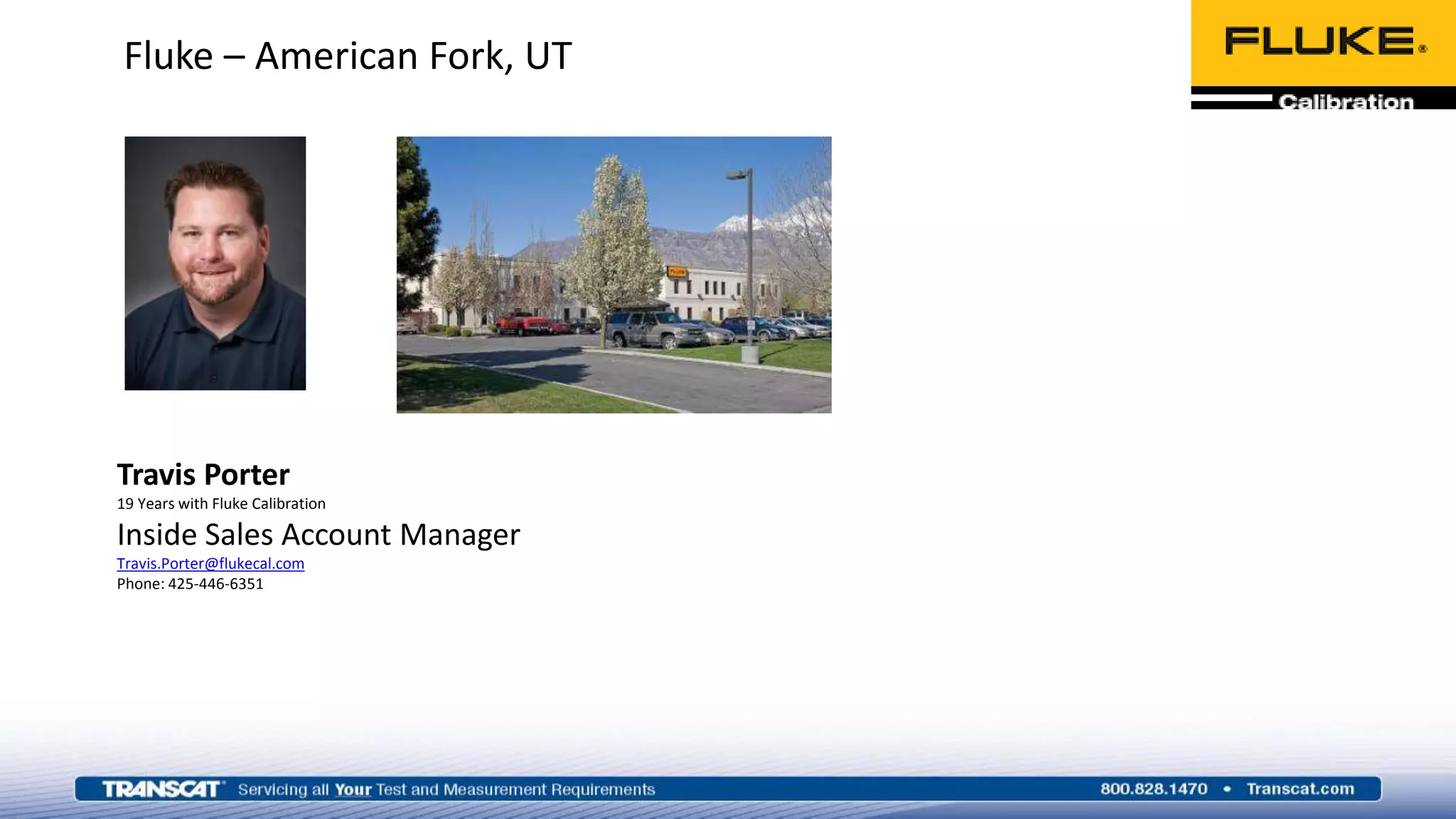
Fluke – American Fork, UT
Travis Porter
19 Years with Fluke Calibration
Inside Sales Account Manager
Travis.Porter@flukecal.com
Phone: 425-446-6351
Agenda
How to Calibrate an RTD Using a Dry-Block Calibrator
• Quick Dry-block introduction
• Dry-block sources of error
• Finding solutions for common errors and problems
• Calculating uncertainties
• How to calibrate probes with odd shapes and sizes
• Temperature range concerns
• Liquid-in-glass thermometers
• RTD calibration example
• Dry-block maintenance
• Summary
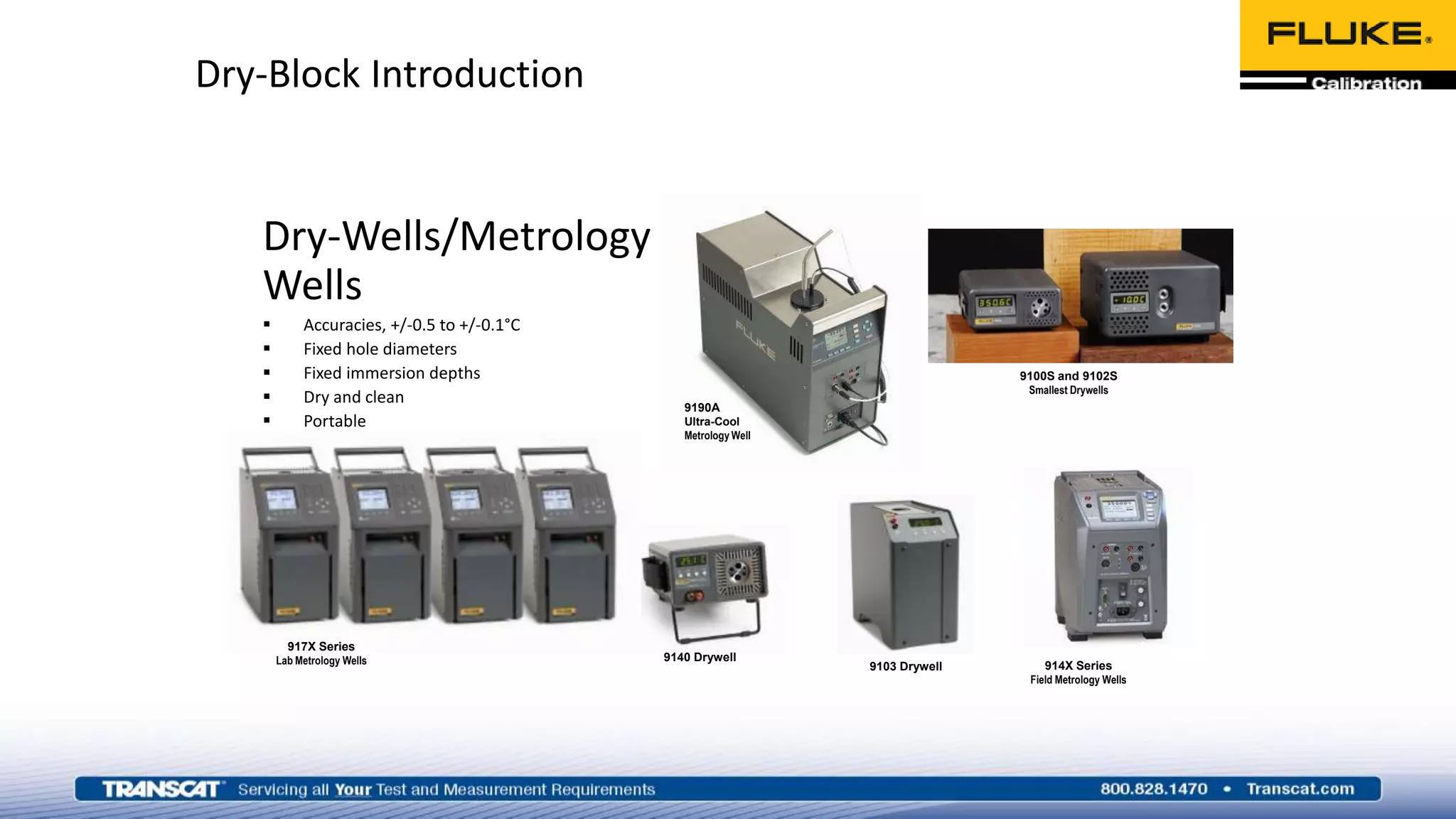
Dry-Block Introduction
Dry-Wells/Metrology
Wells
 Accuracies, +/-0.5 to +/-0.1°C
 Fixed hole diameters
 Fixed immersion depths
 Dry and clean
 Portable
 Fast temperature changes
 Internal reference probe
9190A
Ultra-Cool
Metrology Well
914X Series
Field Metrology Wells
917X Series
Lab Metrology Wells 9140 Drywell
9103 Drywell
9100S and 9102S
Smallest Drywells
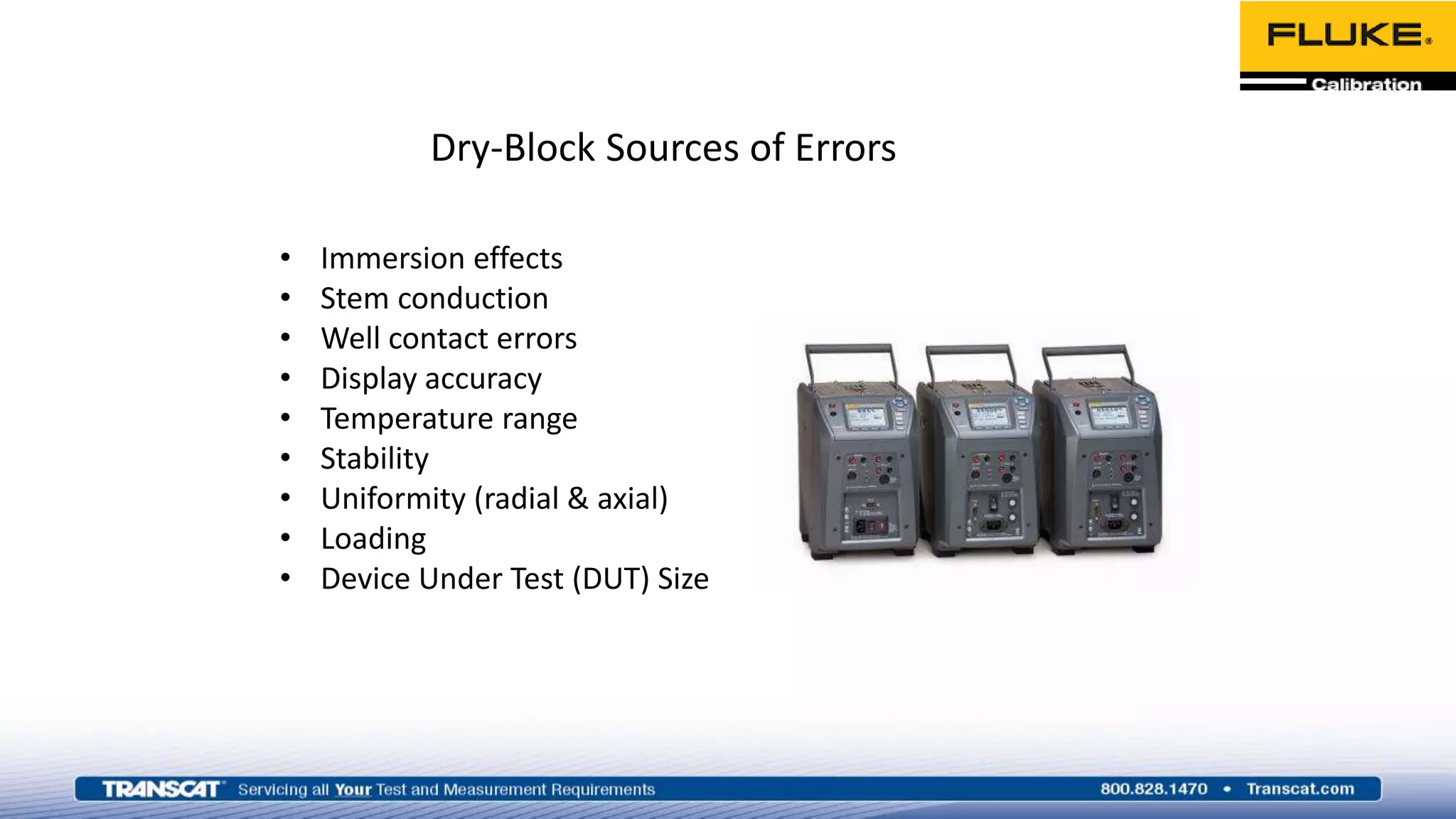
Dry-Block Sources of Errors
• Immersion effects
• Stem conduction
• Well contact errors
• Display accuracy
• Temperature range
• Stability
• Uniformity (radial & axial)
• Loading
• Device Under Test (DUT) Size
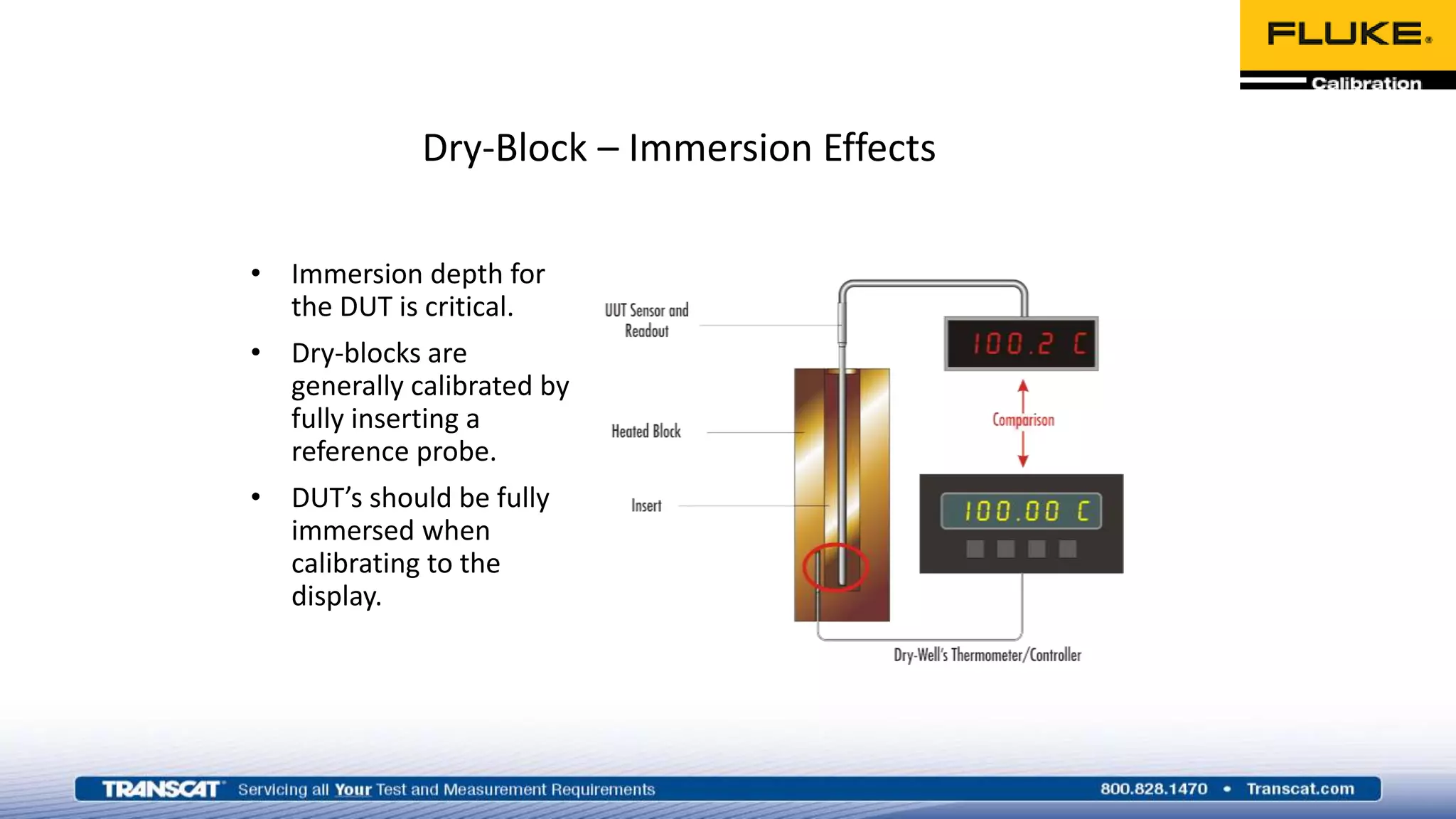
Dry-Block – Immersion Effects
• Immersion depth for
the DUT is critical.
• Dry-blocks are
generally calibrated by
fully inserting a
reference probe.
• DUT’s should be fully
immersed when
calibrating to the
display.
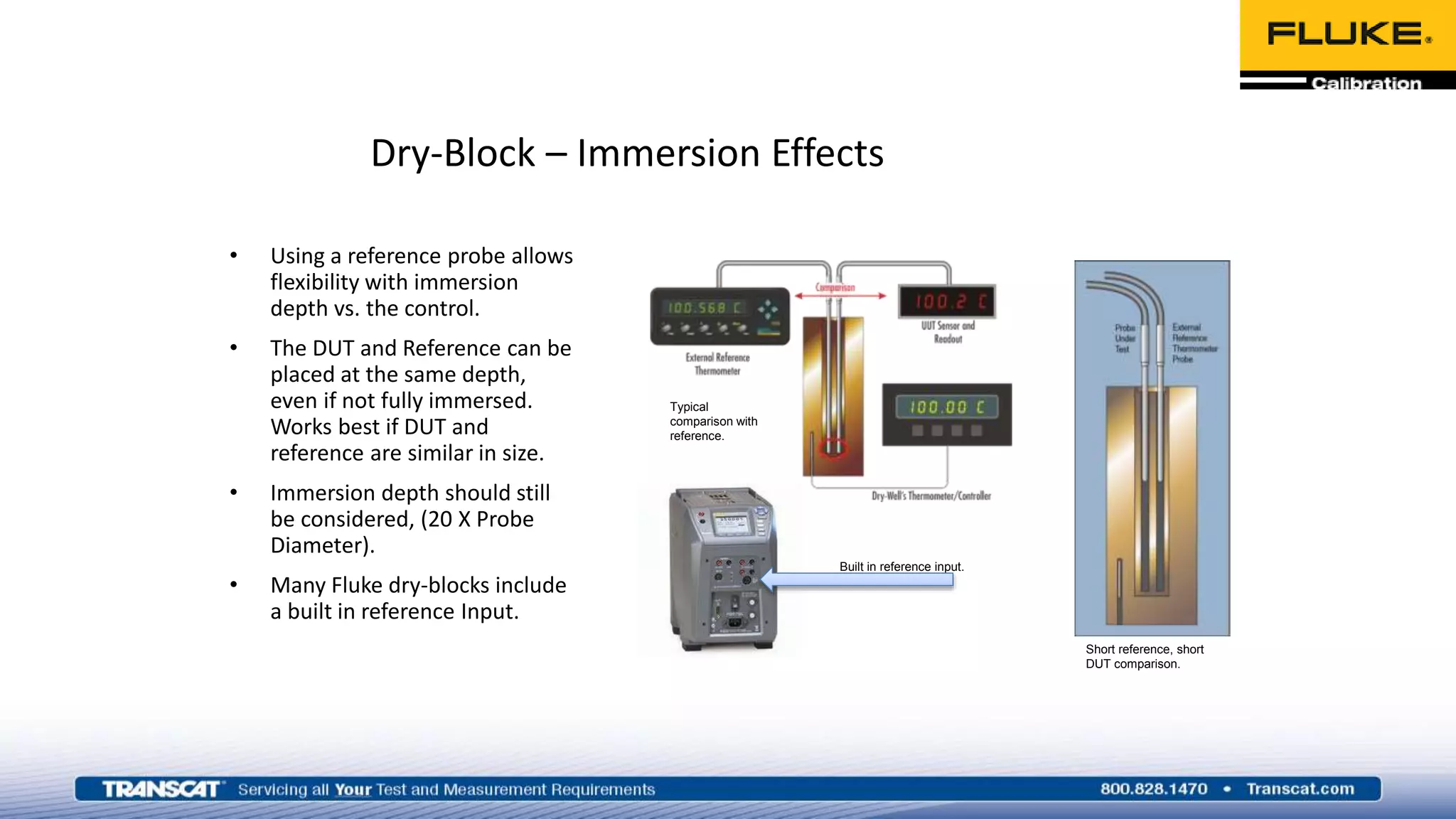
Dry-Block – Immersion Effects
• Using a reference probe allows
flexibility with immersion
depth vs. the control.
• The DUT and Reference can be
placed at the same depth,
even if not fully immersed.
Works best if DUT and
reference are similar in size.
• Immersion depth should still
be considered, (20 X Probe
Diameter).
• Many Fluke dry-blocks include
a built in reference Input.
Short reference, short
DUT comparison.
Typical
comparison with
reference.
Built in reference input.
Dry-Block – Stem Conduction
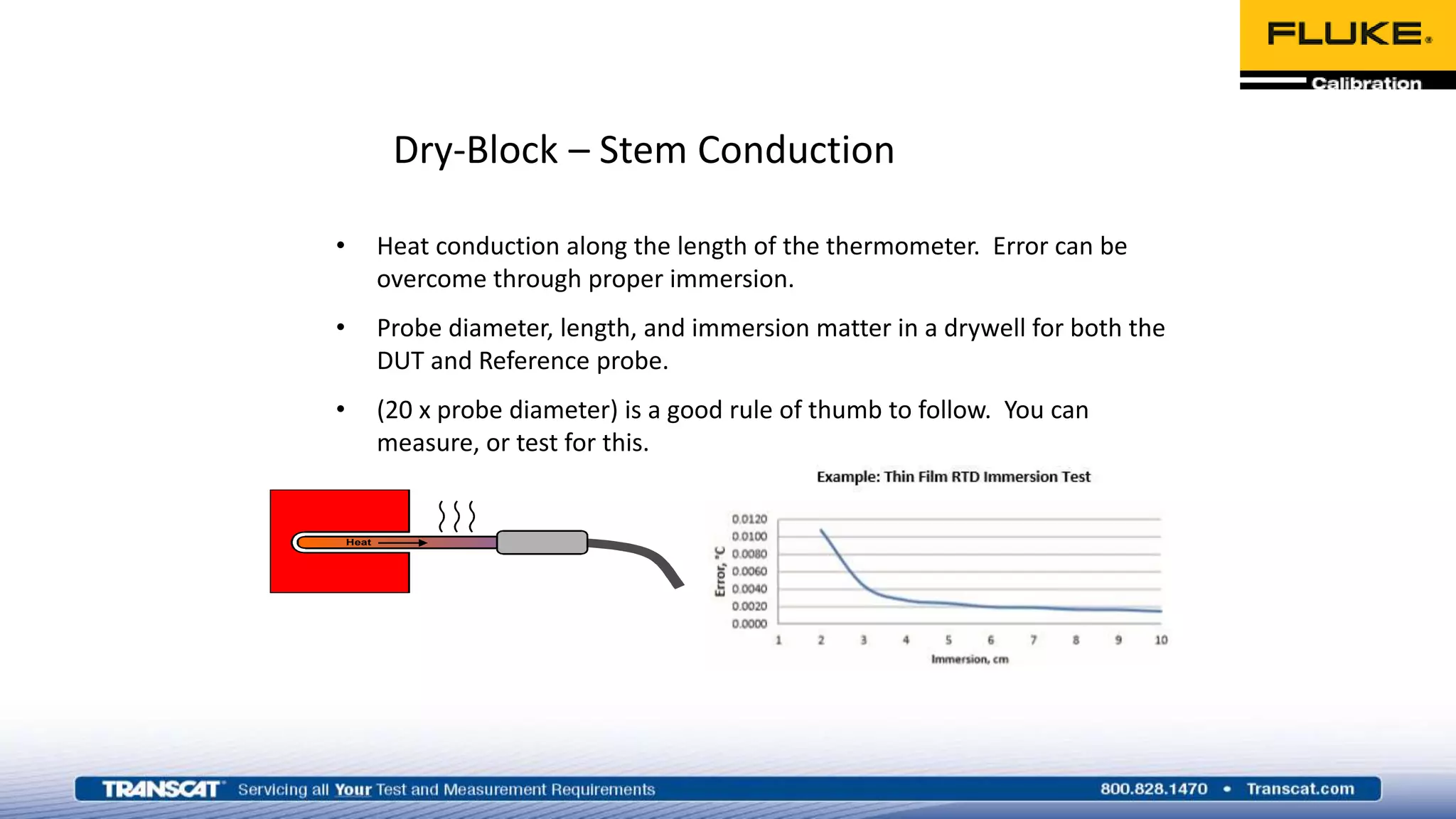
• Heat conduction along the length of the thermometer. Error can be
overcome through proper immersion.
• Probe diameter, length, and immersion matter in a drywell for both the
DUT and Reference probe.
• (20 x probe diameter) is a good rule of thumb to follow. You can
measure, or test for this.
Heat
Dry-Block – Well Contact Errors
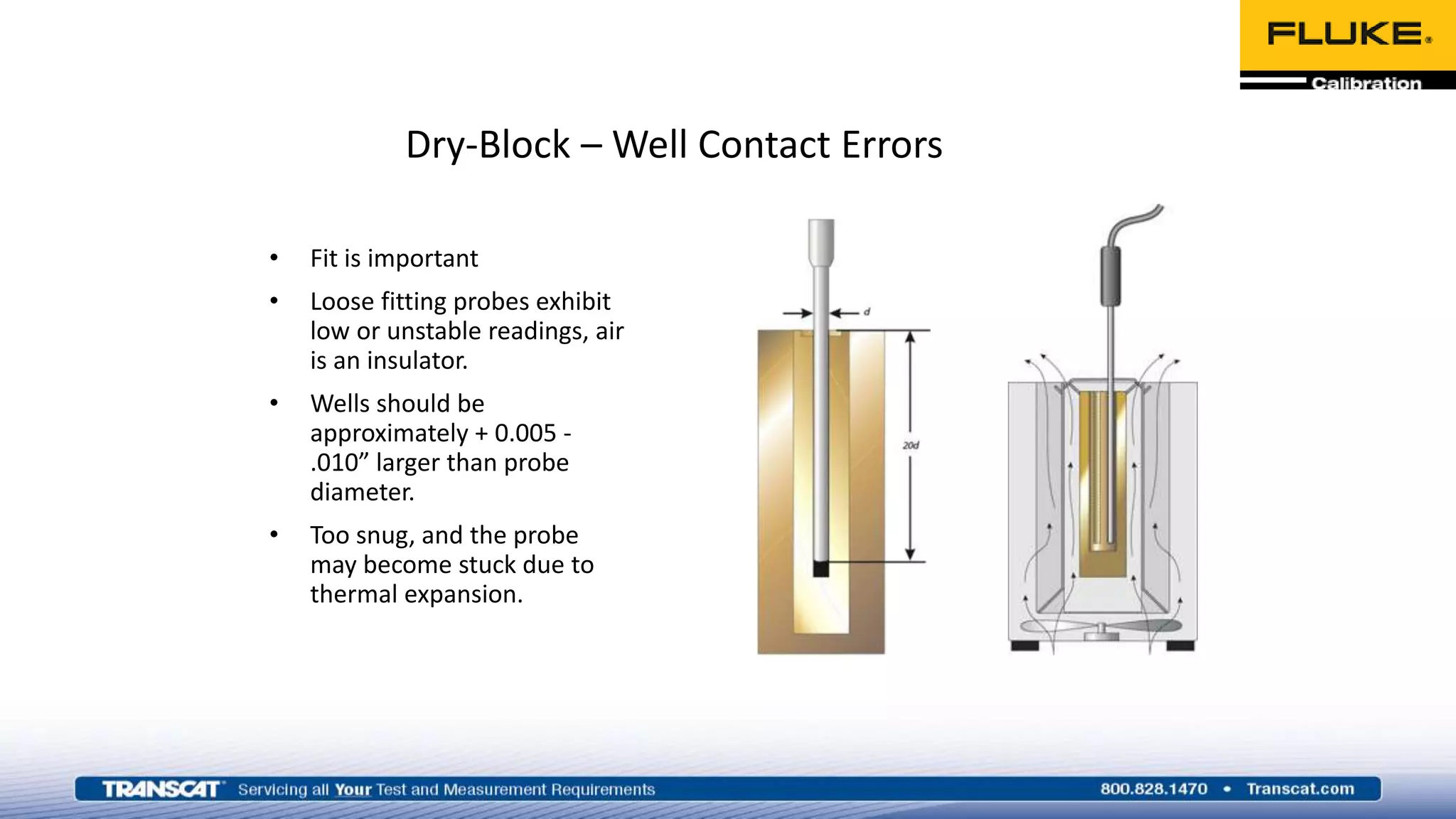
• Fit is important
• Loose fitting probes exhibit
low or unstable readings, air
is an insulator.
• Wells should be
approximately + 0.005 -
.010” larger than probe
diameter.
• Too snug, and the probe
may become stuck due to
thermal expansion.
Dry-Block – Display Accuracy
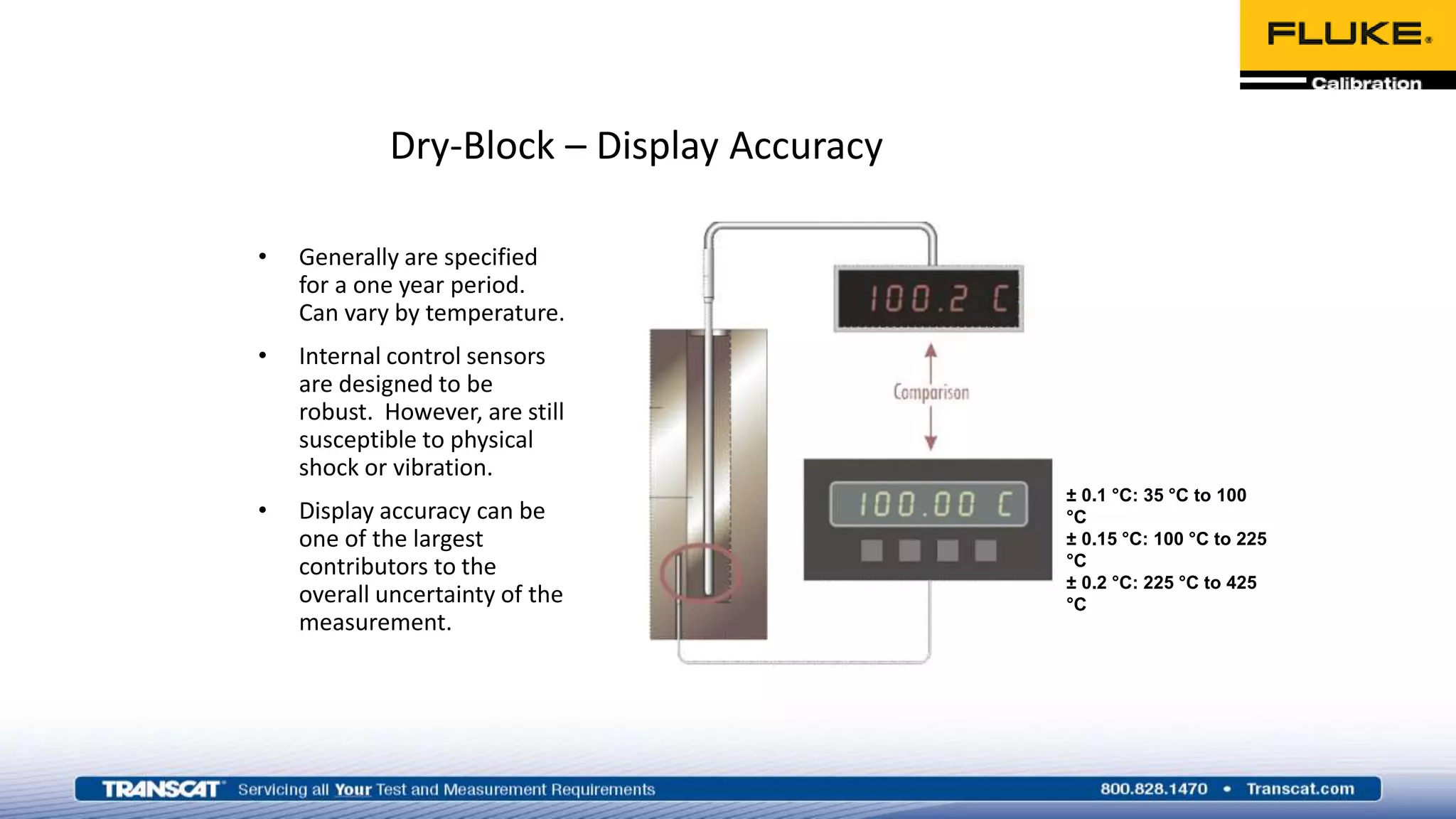
• Generally are specified
for a one year period.
Can vary by temperature.
• Internal control sensors
are designed to be
robust. However, are still
susceptible to physical
shock or vibration.
• Display accuracy can be
one of the largest
contributors to the
overall uncertainty of the
measurement.
± 0.1 °C: 35 °C to 100
°C
± 0.15 °C: 100 °C to 225
°C
± 0.2 °C: 225 °C to 425
°C
Dry-Block – Stability
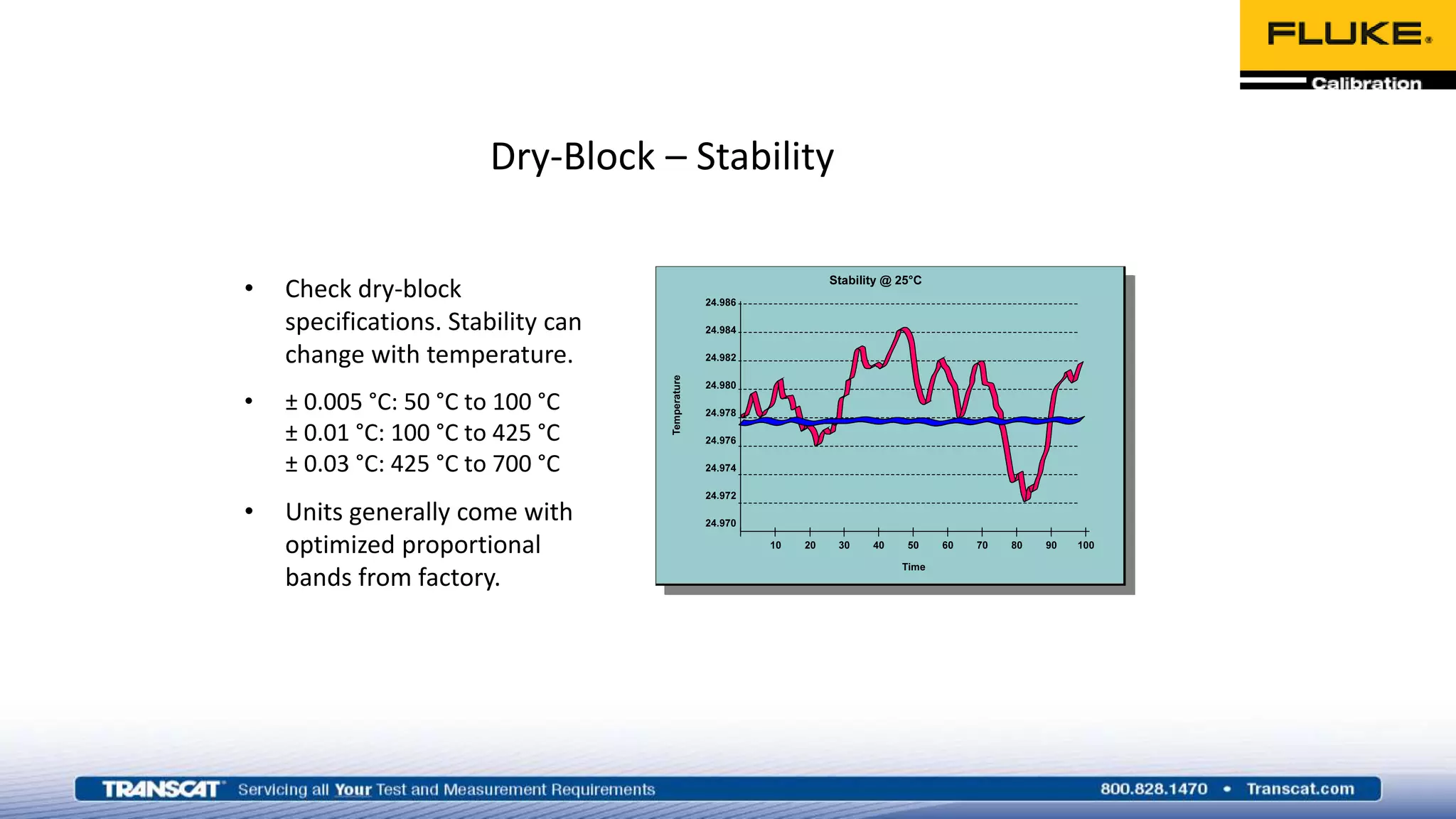
• Check dry-block
specifications. Stability can
change with temperature.
• ± 0.005 °C: 50 °C to 100 °C
± 0.01 °C: 100 °C to 425 °C
± 0.03 °C: 425 °C to 700 °C
• Units generally come with
optimized proportional
bands from factory.
Dry-Block – Axial Uniformity
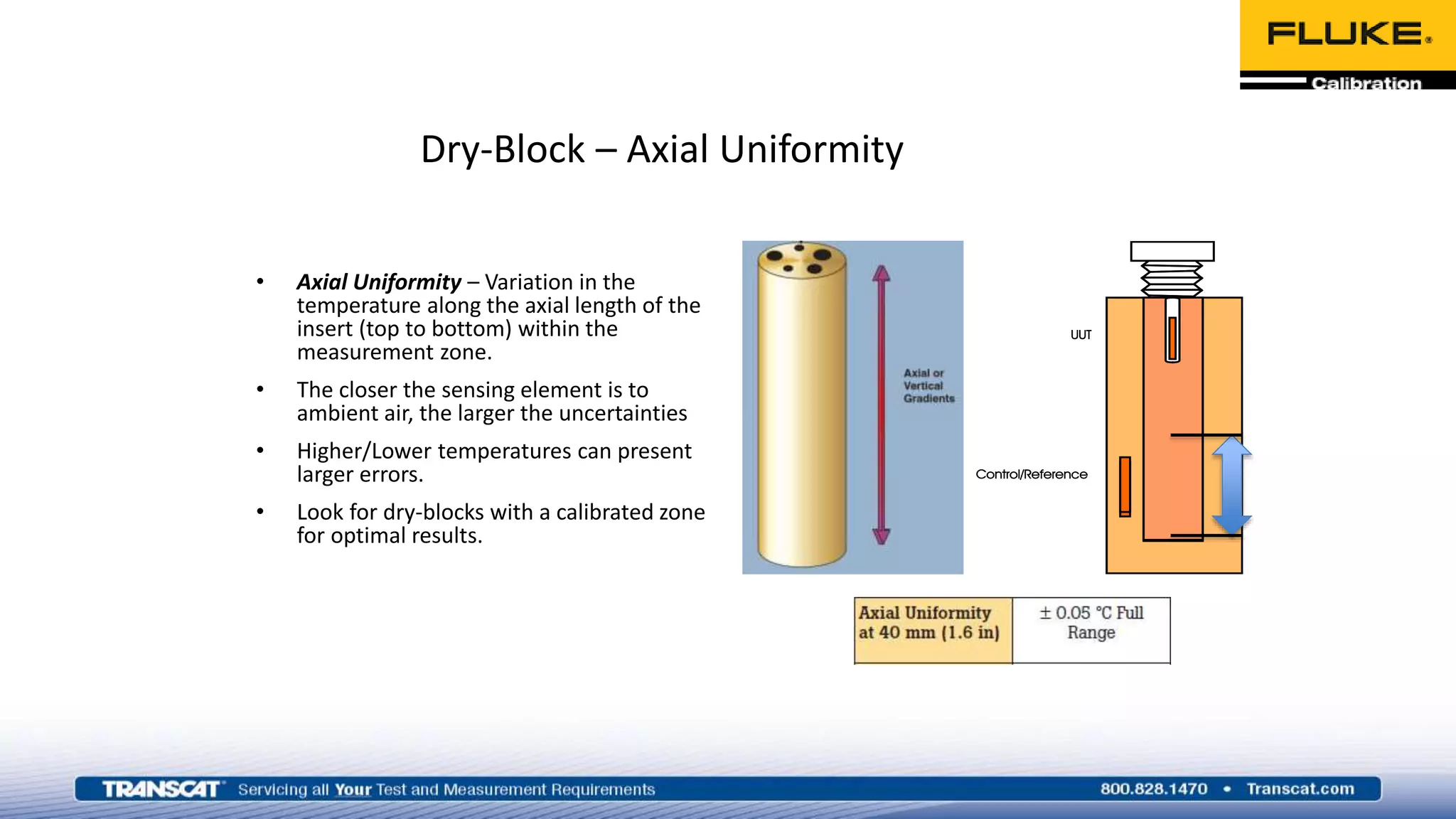
• Axial Uniformity – Variation in the
temperature along the axial length of the
insert (top to bottom) within the
measurement zone.
• The closer the sensing element is to
ambient air, the larger the uncertainties
• Higher/Lower temperatures can present
larger errors.
• Look for dry-blocks with a calibrated zone
for optimal results.
Dry-Block – Radial Uniformity
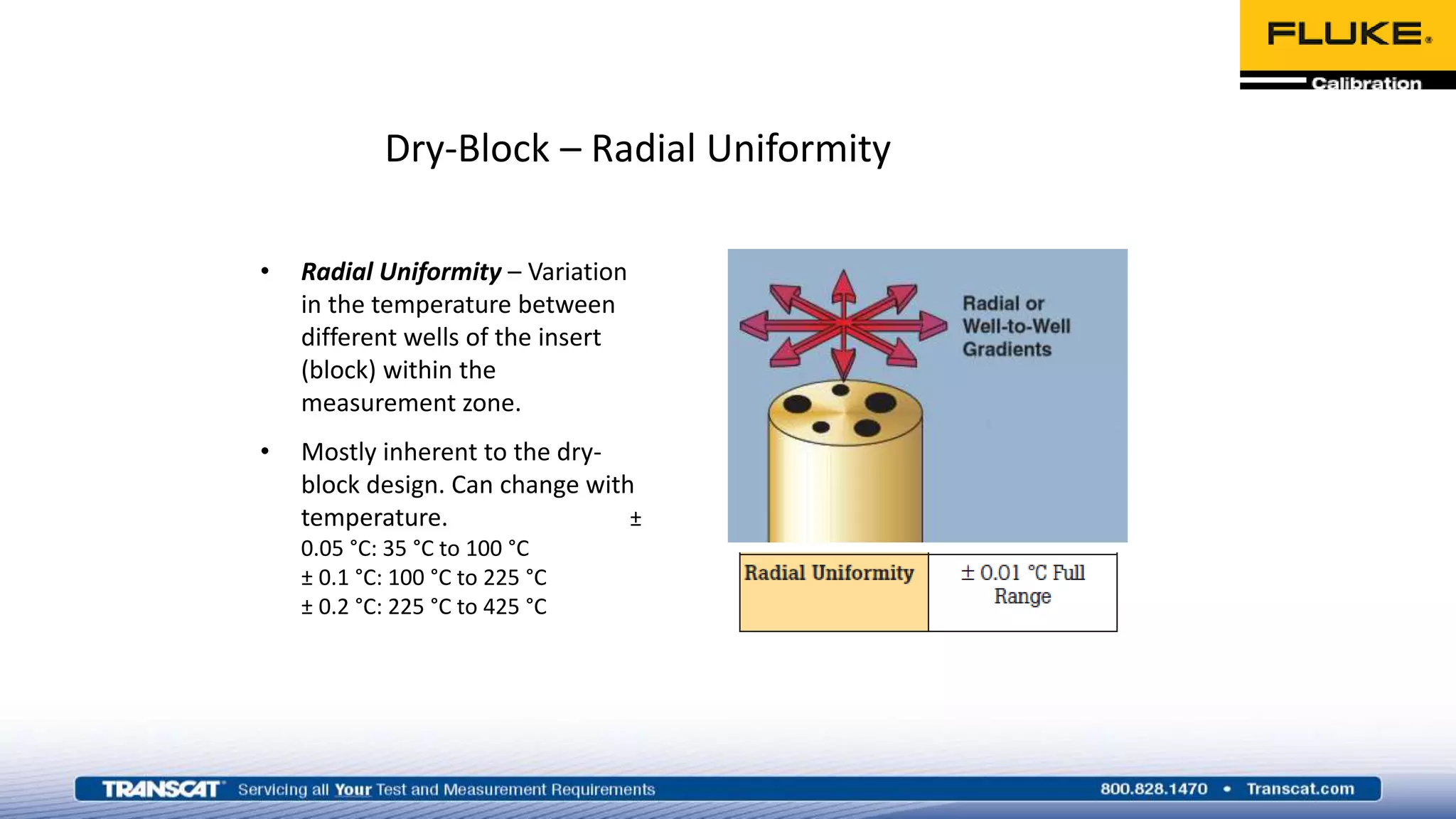
• Radial Uniformity – Variation
in the temperature between
different wells of the insert
(block) within the
measurement zone.
• Mostly inherent to the dry-
block design. Can change with
temperature. ±
0.05 °C: 35 °C to 100 °C
± 0.1 °C: 100 °C to 225 °C
± 0.2 °C: 225 °C to 425 °C
Dry-Block – Loading
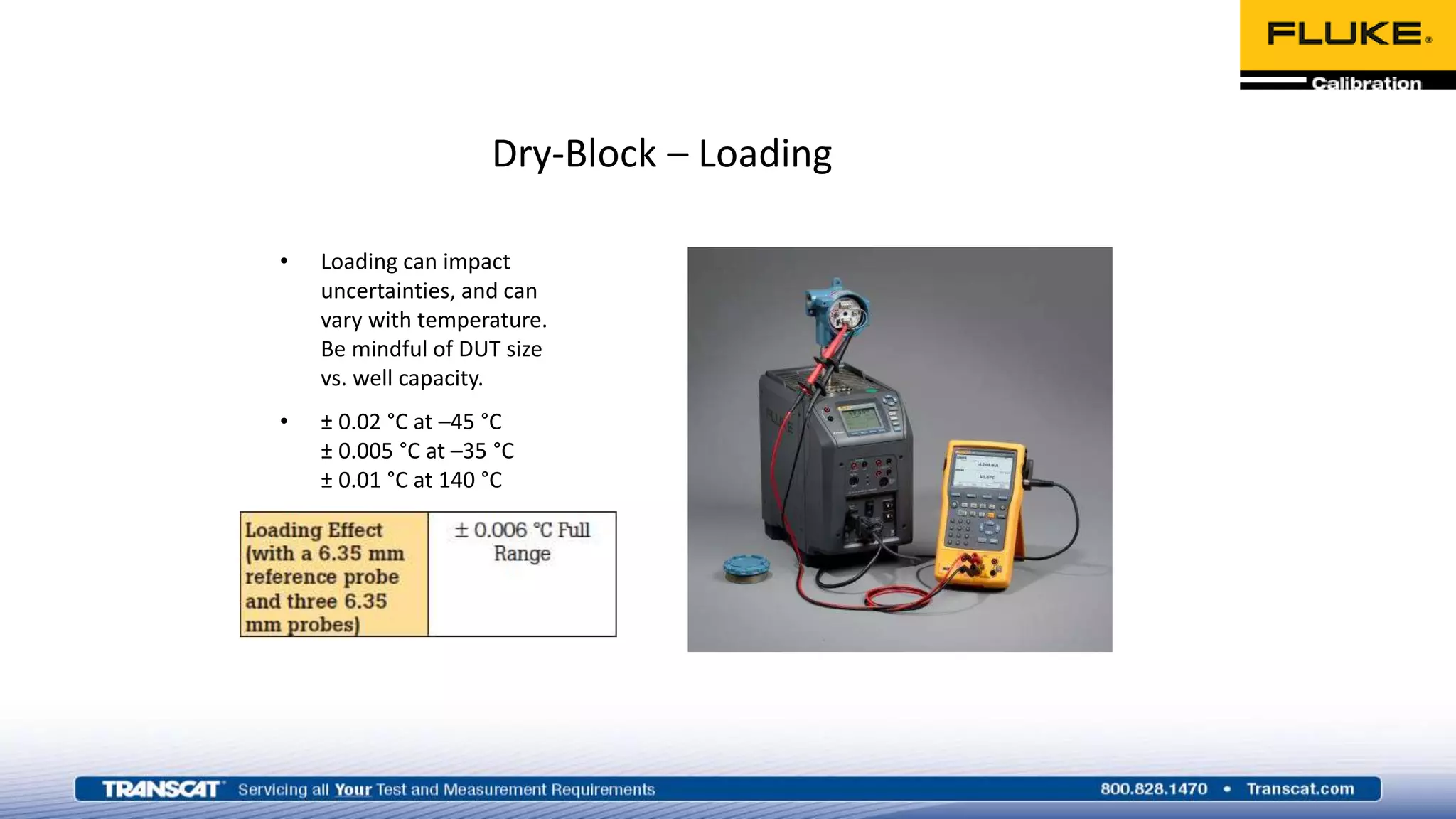
• Loading can impact
uncertainties, and can
vary with temperature.
Be mindful of DUT size
vs. well capacity.
• ± 0.02 °C at –45 °C
± 0.005 °C at –35 °C
± 0.01 °C at 140 °C
• Some models have a
specification, see below.
Calculating Uncertainties
RSS method is generally used to calculate
uncertainties when using a reference
2
3
2
2
2
1 )()()( bbbbtotal 
222
)()()( uniformitystabilityrefbtotal 
222
)02.0()1.0()05.0(113.0 CCCC 
Calculating Uncertainties
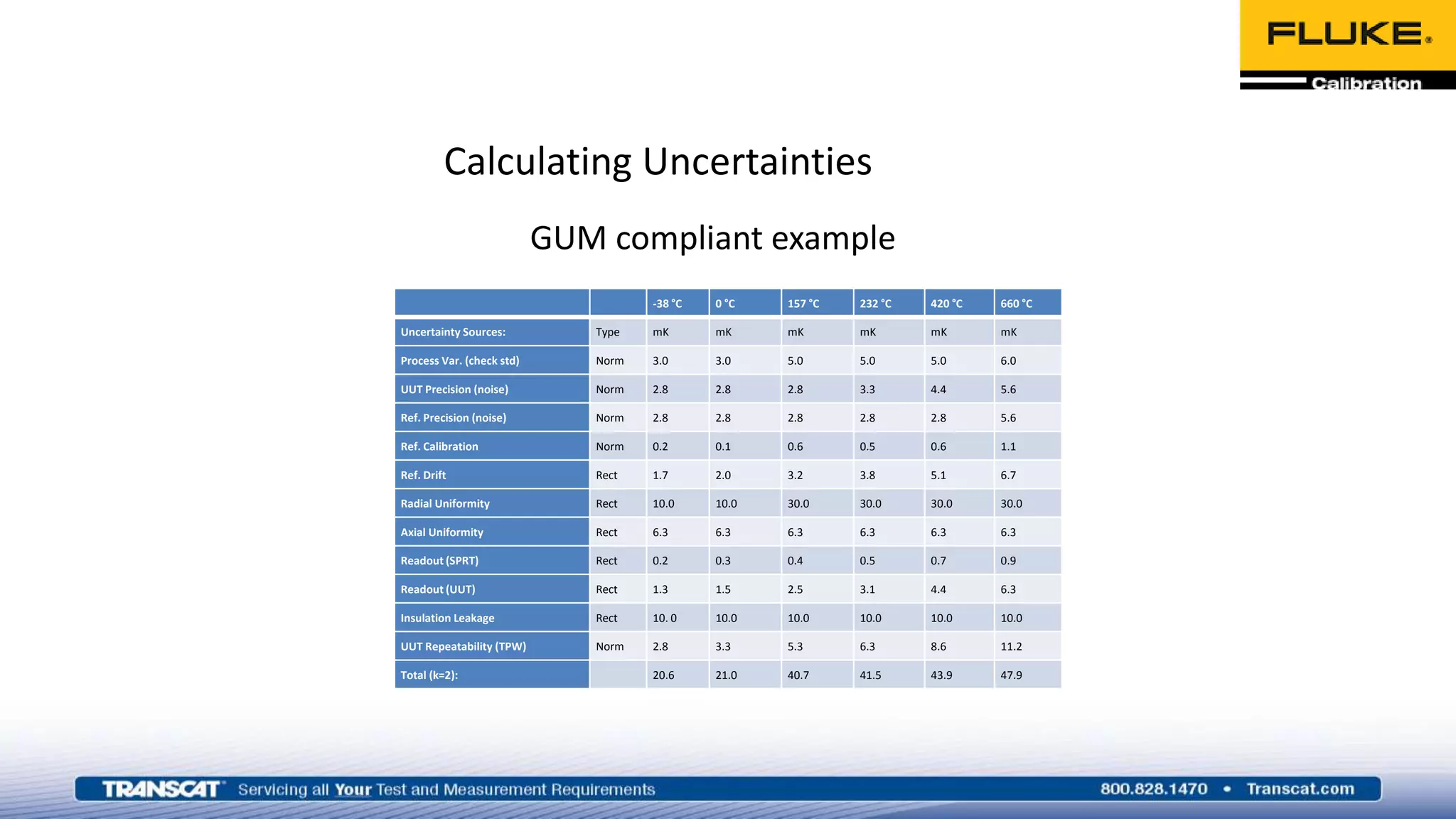
GUM compliant example
-38 °C 0 °C 157 °C 232 °C 420 °C 660 °C
Uncertainty Sources: Type mK mK mK mK mK mK
Process Var. (check std) Norm 3.0 3.0 5.0 5.0 5.0 6.0
UUT Precision (noise) Norm 2.8 2.8 2.8 3.3 4.4 5.6
Ref. Precision (noise) Norm 2.8 2.8 2.8 2.8 2.8 5.6
Ref. Calibration Norm 0.2 0.1 0.6 0.5 0.6 1.1
Ref. Drift Rect 1.7 2.0 3.2 3.8 5.1 6.7
Radial Uniformity Rect 10.0 10.0 30.0 30.0 30.0 30.0
Axial Uniformity Rect 6.3 6.3 6.3 6.3 6.3 6.3
Readout (SPRT) Rect 0.2 0.3 0.4 0.5 0.7 0.9
Readout (UUT) Rect 1.3 1.5 2.5 3.1 4.4 6.3
Insulation Leakage Rect 10. 0 10.0 10.0 10.0 10.0 10.0
UUT Repeatability (TPW) Norm 2.8 3.3 5.3 6.3 8.6 11.2
Total (k=2): 20.6 21.0 40.7 41.5 43.9 47.9
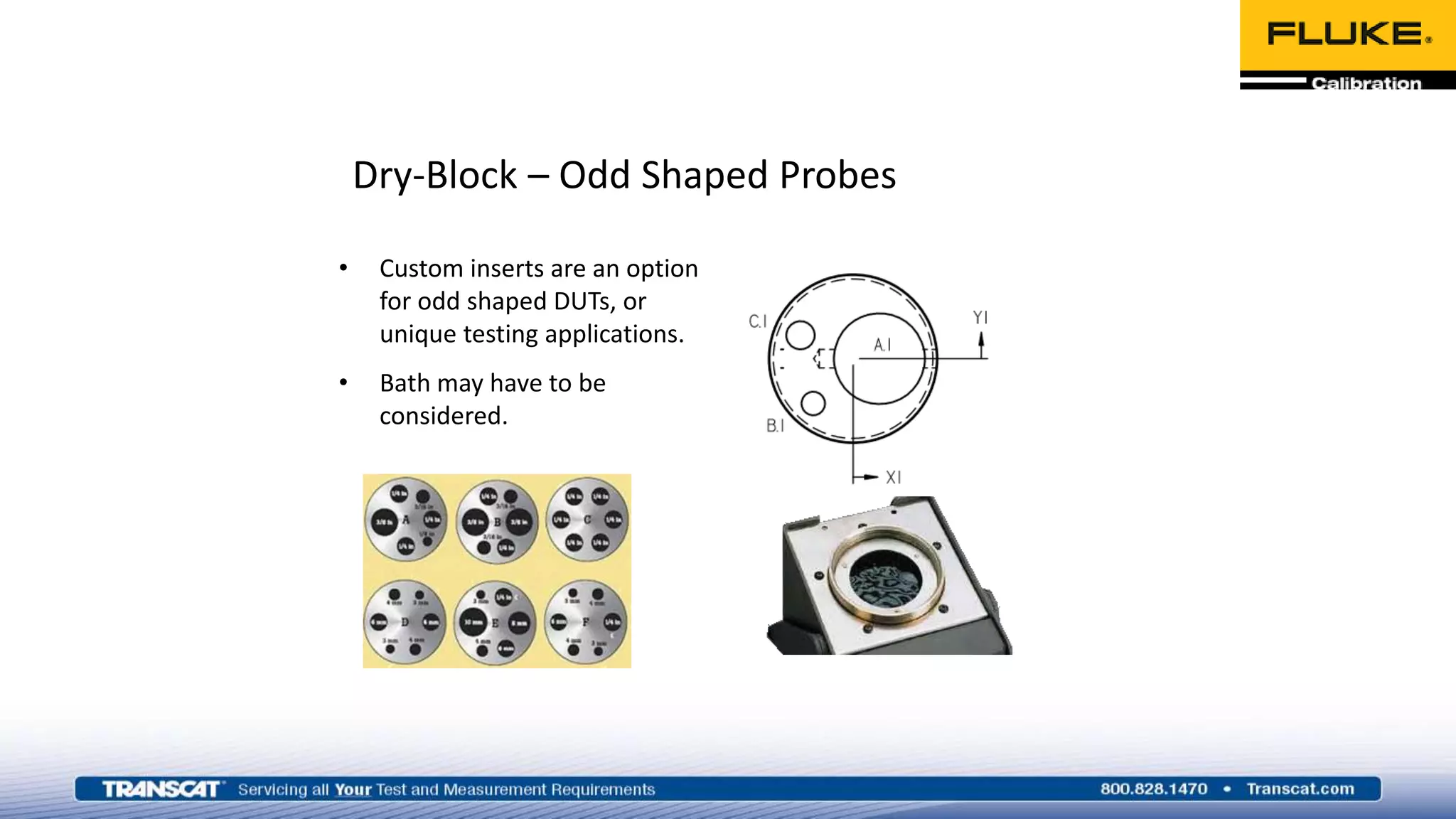
Dry-Block – Odd Shaped Probes
• Custom inserts are an option
for odd shaped DUTs, or
unique testing applications.
• Bath may have to be
considered.
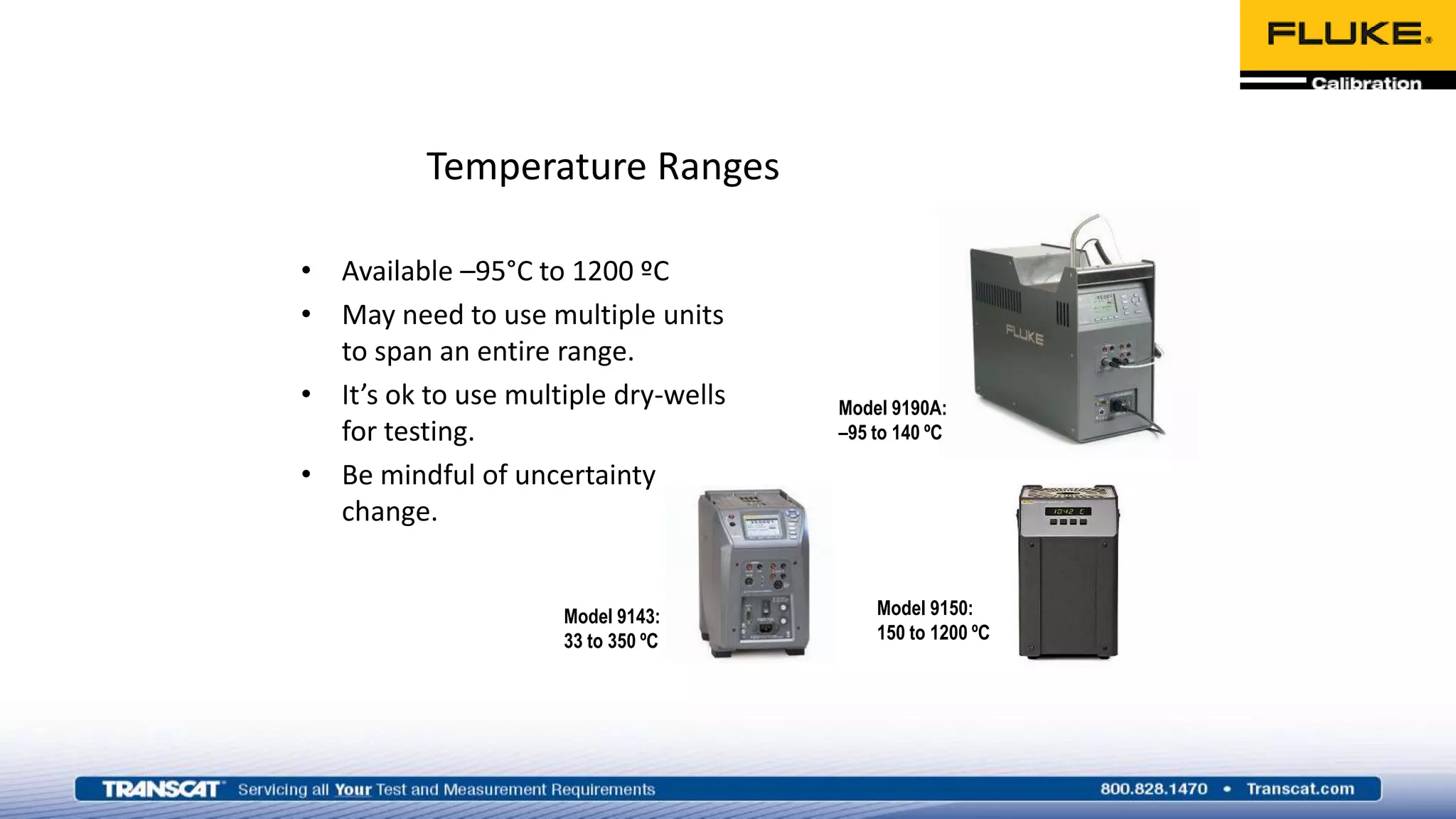
Temperature Ranges
• Available –95°C to 1200 ºC
• May need to use multiple units
to span an entire range.
• It’s ok to use multiple dry-wells
for testing.
• Be mindful of uncertainty
change.
Model 9190A:
–95 to 140 ºC
Model 9143:
33 to 350 ºC
Model 9150:
150 to 1200 ºC
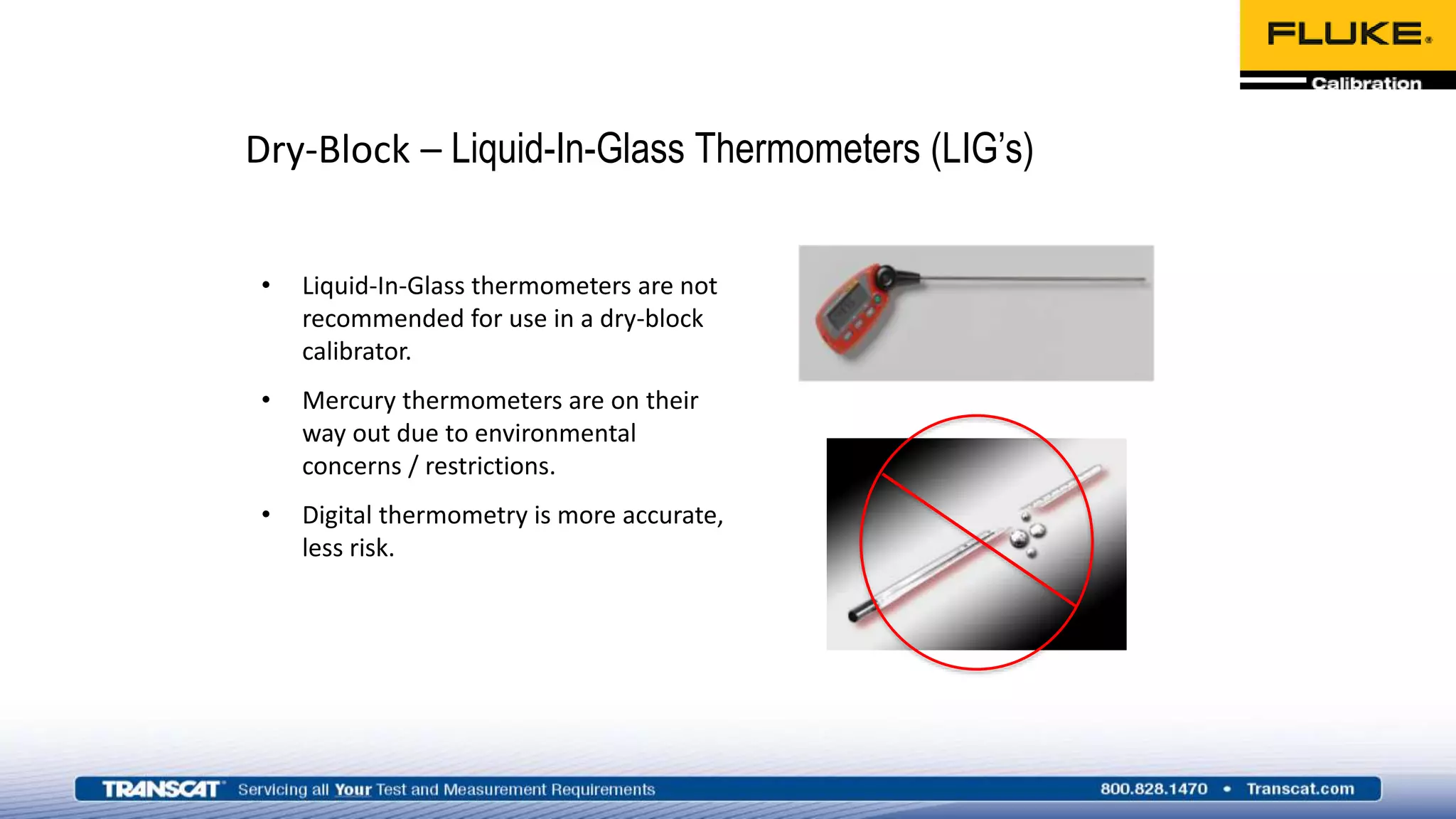
Dry-Block – Liquid-In-Glass Thermometers (LIG’s)
• Liquid-In-Glass thermometers are not
recommended for use in a dry-block
calibrator.
• Mercury thermometers are on their
way out due to environmental
concerns / restrictions.
• Digital thermometry is more accurate,
less risk.
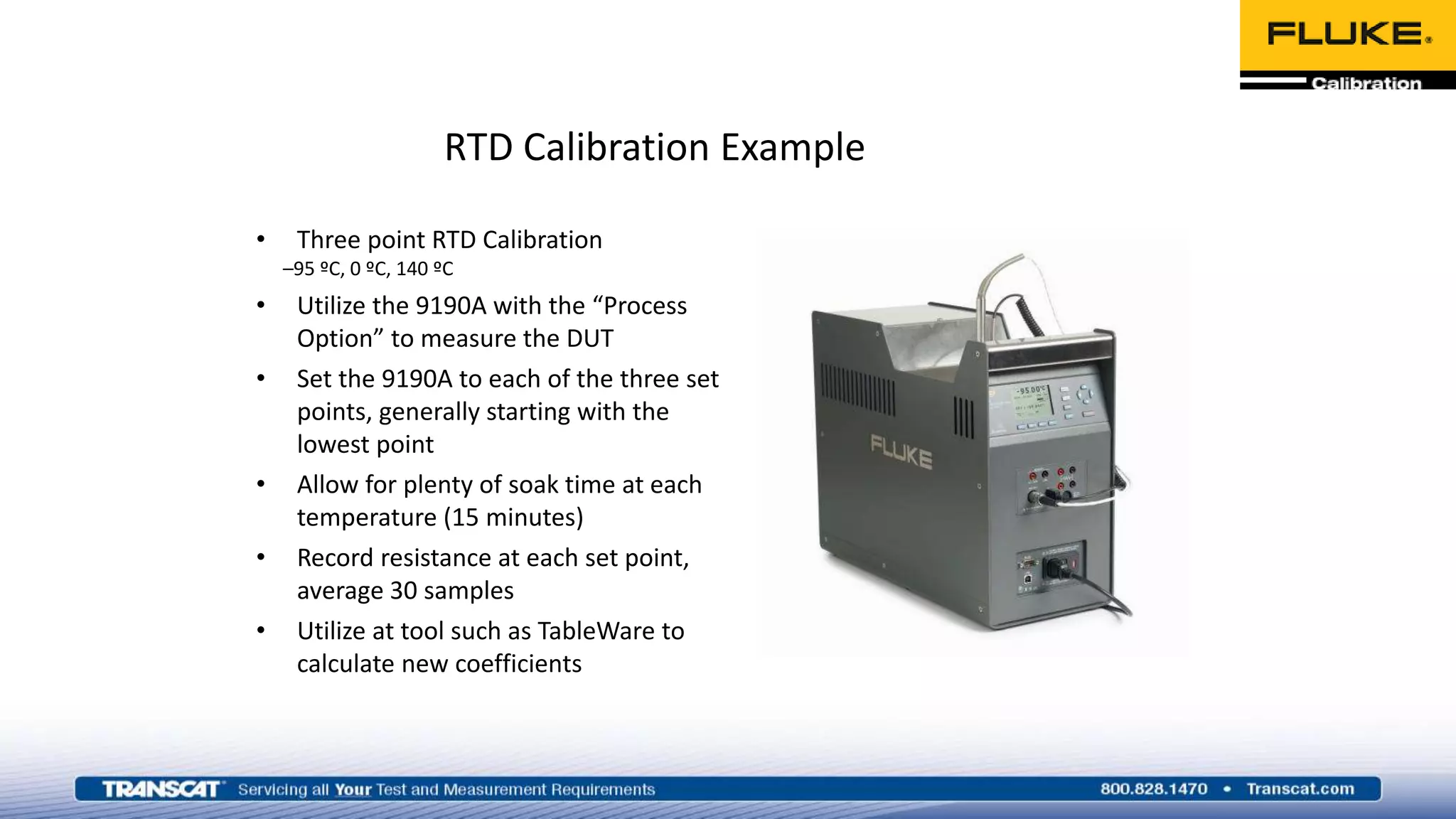
RTD Calibration Example
• Three point RTD Calibration
–95 ºC, 0 ºC, 140 ºC
• Utilize the 9190A with the “Process
Option” to measure the DUT
• Set the 9190A to each of the three set
points, generally starting with the
lowest point
• Allow for plenty of soak time at each
temperature (15 minutes)
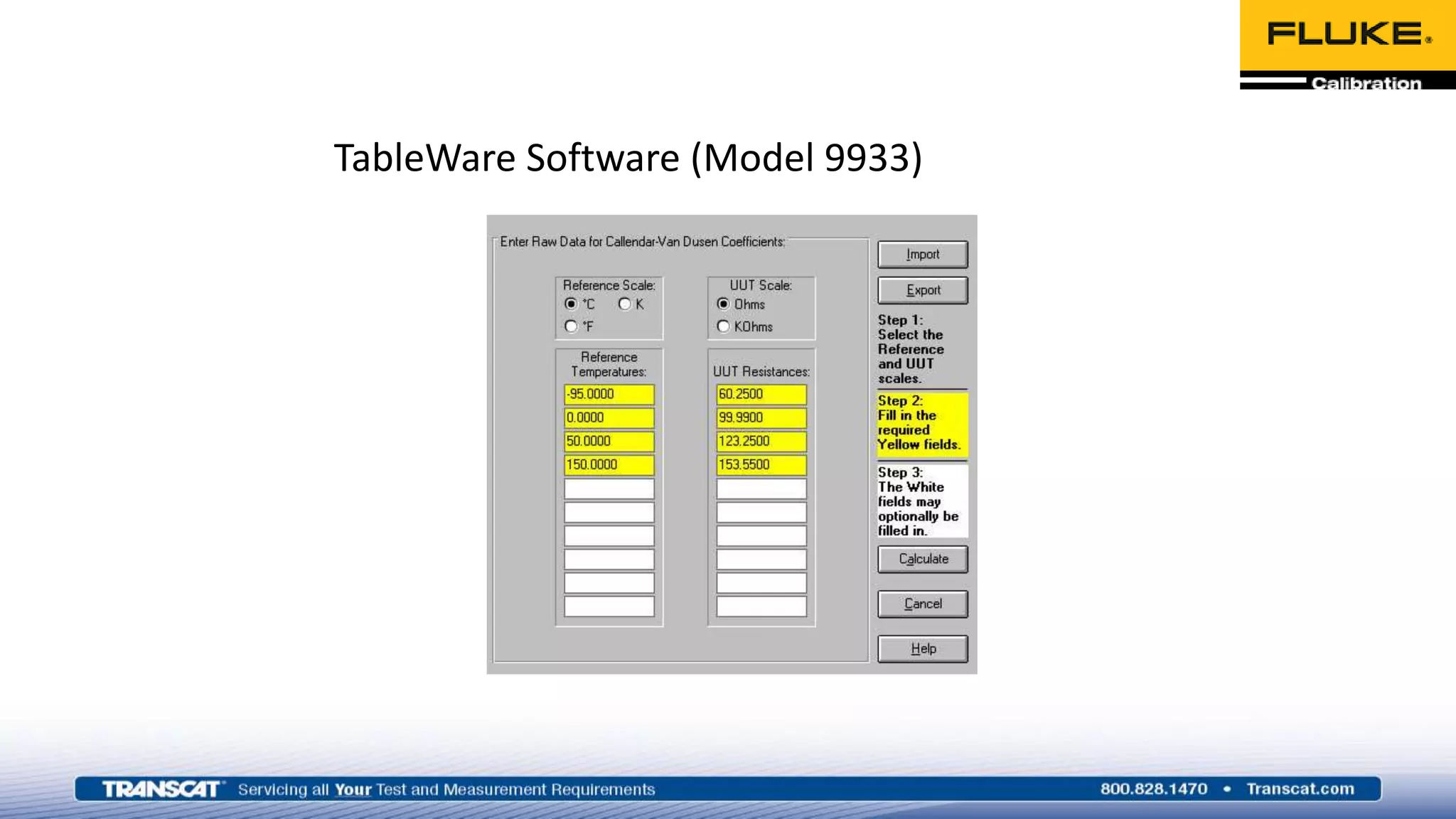
• Record resistance at each set point,
average 30 samples
• Utilize at tool such as TableWare to
calculate new coefficients
TableWare Software (Model 9933)
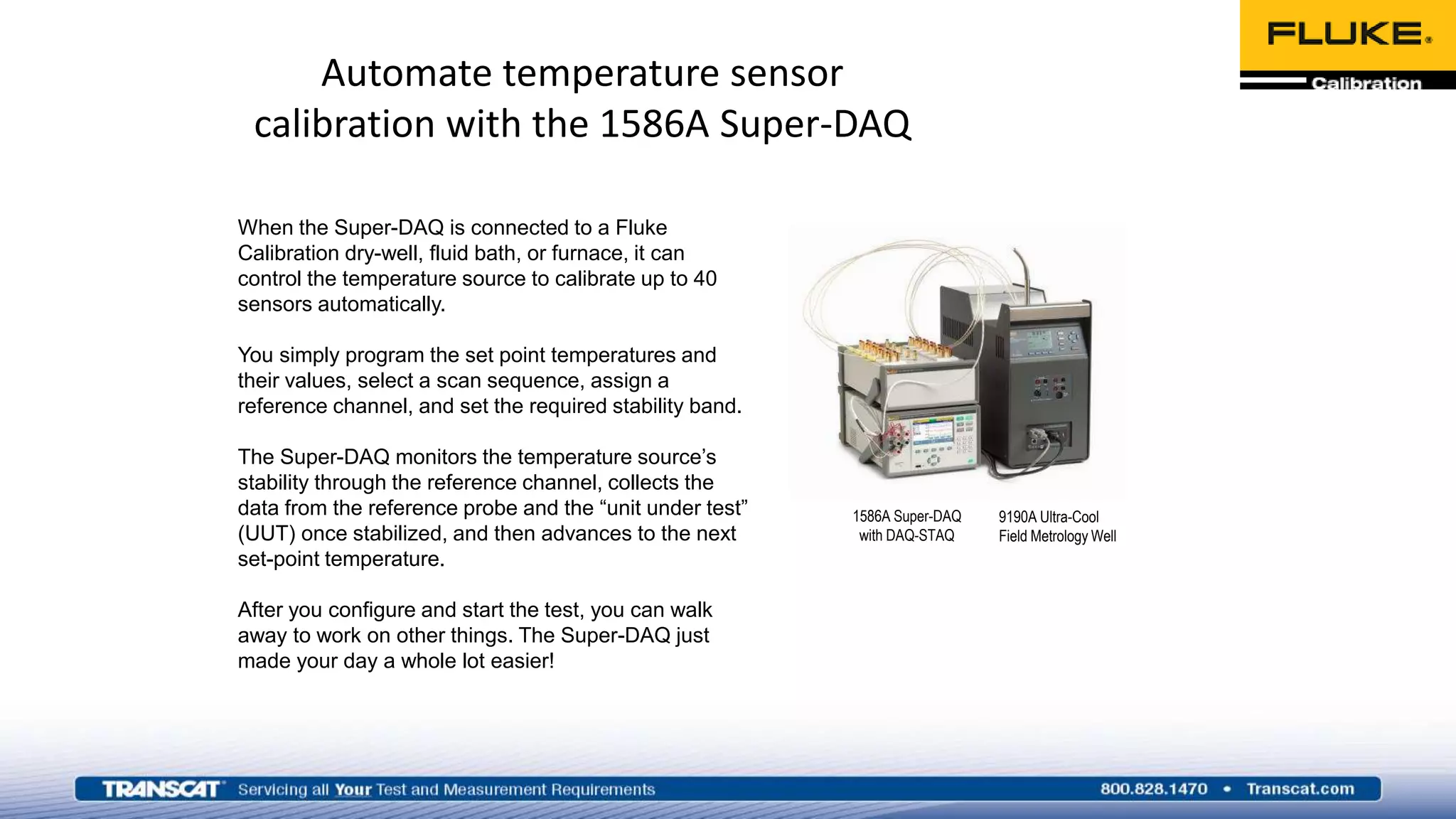
When the Super-DAQ is connected to a Fluke
Calibration dry-well, fluid bath, or furnace, it can
control the temperature source to calibrate up to 40
sensors automatically.
You simply program the set point temperatures and
their values, select a scan sequence, assign a
reference channel, and set the required stability band.
The Super-DAQ monitors the temperature source’s
stability through the reference channel, collects the
data from the reference probe and the “unit under test”
(UUT) once stabilized, and then advances to the next
set-point temperature.
After you configure and start the test, you can walk
away to work on other things. The Super-DAQ just
made your day a whole lot easier!
Automate temperature sensor
calibration with the 1586A Super-DAQ
9190A Ultra-Cool
Field Metrology Well
1586A Super-DAQ
with DAQ-STAQ
Application Note and Video
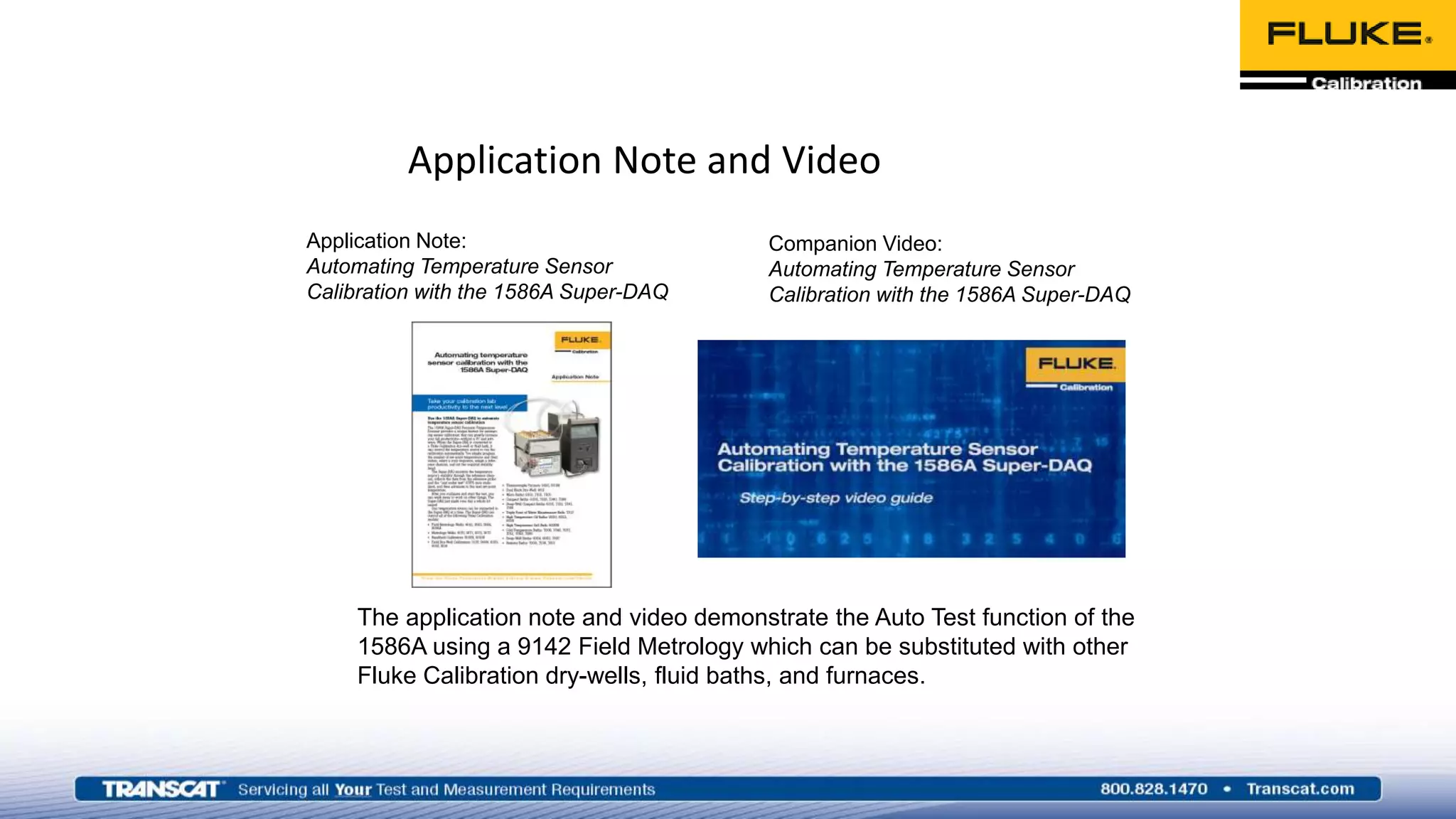
Application Note:
Automating Temperature Sensor
Calibration with the 1586A Super-DAQ
Companion Video:
Automating Temperature Sensor
Calibration with the 1586A Super-DAQ
The application note and video demonstrate the Auto Test function of the
1586A using a 9142 Field Metrology which can be substituted with other
Fluke Calibration dry-wells, fluid baths, and furnaces.
Dry-Block – Maintenance
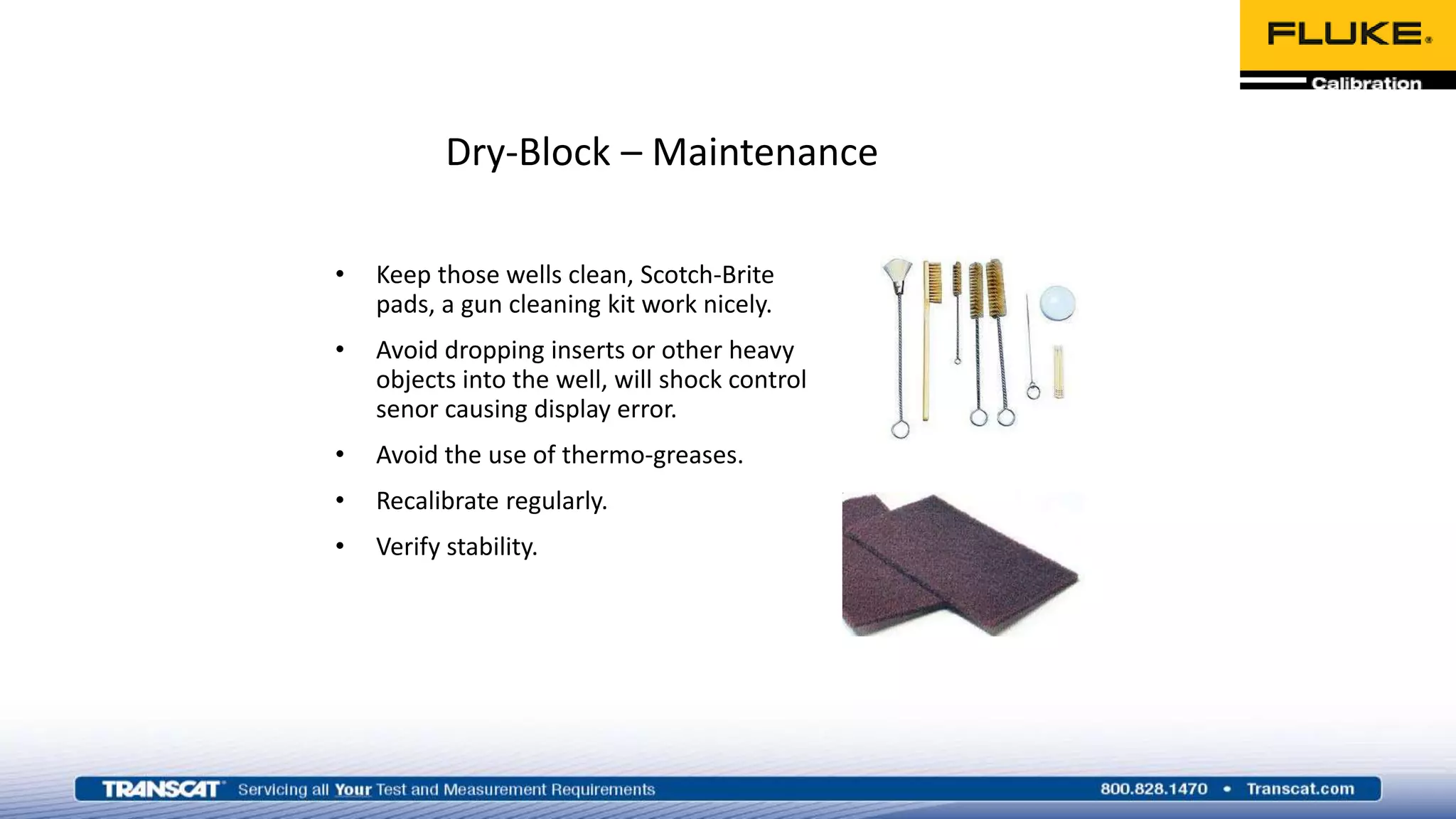
• Keep those wells clean, Scotch-Brite
pads, a gun cleaning kit work nicely.
• Avoid dropping inserts or other heavy
objects into the well, will shock control
senor causing display error.
• Avoid the use of thermo-greases.
• Recalibrate regularly.
• Verify stability.
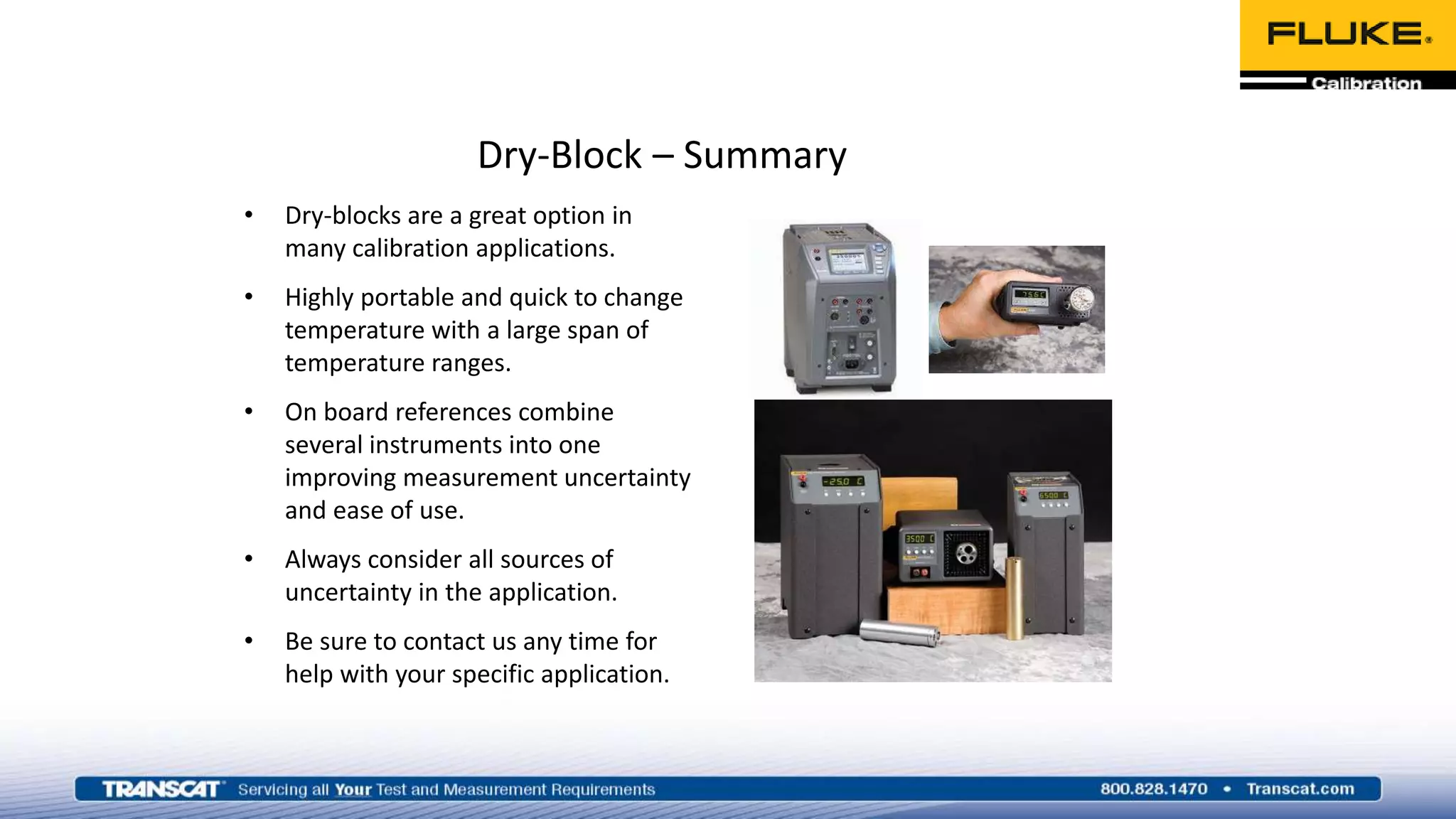
Dry-Block – Summary
• Dry-blocks are a great option in
many calibration applications.
• Highly portable and quick to change
temperature with a large span of
temperature ranges.
• On board references combine
several instruments into one
improving measurement uncertainty
and ease of use.
• Always consider all sources of
uncertainty in the application.
• Be sure to contact us any time for
help with your specific application.
Questions or Comments?
Email Nicole VanWert-Quinzi
nvanwert@Transcat.com
Transcat: 800-800-5001
www.Transcat.com
For related product information, go to:
www.Transcat.com/Fluke
Questions?
Thank you

Fluke Calibration on How to Calibrate an RTD Using a Dry block Calibrator Webinar

  • 1.
    How to Calibratean RTD Using a Dry-block Calibrator Presenter: Travis Porter, Fluke Calibration
  • 2.
    Fluke Calibration Web SeminarSeries Principles and practical tips about temperature, humidity, electrical, flow, pressure, and RF calibration How to Calibrate an RTD Using a Dry-block Calibrator © 2018 Fluke Corporation
  • 3.
    Fluke – AmericanFork, UT Travis Porter 19 Years with Fluke Calibration Inside Sales Account Manager Travis.Porter@flukecal.com Phone: 425-446-6351
  • 4.
    Agenda How to Calibratean RTD Using a Dry-Block Calibrator • Quick Dry-block introduction • Dry-block sources of error • Finding solutions for common errors and problems • Calculating uncertainties • How to calibrate probes with odd shapes and sizes • Temperature range concerns • Liquid-in-glass thermometers • RTD calibration example • Dry-block maintenance • Summary
  • 5.
    Dry-Block Introduction Dry-Wells/Metrology Wells  Accuracies,+/-0.5 to +/-0.1°C  Fixed hole diameters  Fixed immersion depths  Dry and clean  Portable  Fast temperature changes  Internal reference probe 9190A Ultra-Cool Metrology Well 914X Series Field Metrology Wells 917X Series Lab Metrology Wells 9140 Drywell 9103 Drywell 9100S and 9102S Smallest Drywells
  • 6.
    Dry-Block Sources ofErrors • Immersion effects • Stem conduction • Well contact errors • Display accuracy • Temperature range • Stability • Uniformity (radial & axial) • Loading • Device Under Test (DUT) Size
  • 7.
    Dry-Block – ImmersionEffects • Immersion depth for the DUT is critical. • Dry-blocks are generally calibrated by fully inserting a reference probe. • DUT’s should be fully immersed when calibrating to the display.
  • 8.
    Dry-Block – ImmersionEffects • Using a reference probe allows flexibility with immersion depth vs. the control. • The DUT and Reference can be placed at the same depth, even if not fully immersed. Works best if DUT and reference are similar in size. • Immersion depth should still be considered, (20 X Probe Diameter). • Many Fluke dry-blocks include a built in reference Input. Short reference, short DUT comparison. Typical comparison with reference. Built in reference input.
  • 9.
    Dry-Block – StemConduction • Heat conduction along the length of the thermometer. Error can be overcome through proper immersion. • Probe diameter, length, and immersion matter in a drywell for both the DUT and Reference probe. • (20 x probe diameter) is a good rule of thumb to follow. You can measure, or test for this. Heat
  • 10.
    Dry-Block – WellContact Errors • Fit is important • Loose fitting probes exhibit low or unstable readings, air is an insulator. • Wells should be approximately + 0.005 - .010” larger than probe diameter. • Too snug, and the probe may become stuck due to thermal expansion.
  • 11.
    Dry-Block – DisplayAccuracy • Generally are specified for a one year period. Can vary by temperature. • Internal control sensors are designed to be robust. However, are still susceptible to physical shock or vibration. • Display accuracy can be one of the largest contributors to the overall uncertainty of the measurement. ± 0.1 °C: 35 °C to 100 °C ± 0.15 °C: 100 °C to 225 °C ± 0.2 °C: 225 °C to 425 °C
  • 12.
    Dry-Block – Stability •Check dry-block specifications. Stability can change with temperature. • ± 0.005 °C: 50 °C to 100 °C ± 0.01 °C: 100 °C to 425 °C ± 0.03 °C: 425 °C to 700 °C • Units generally come with optimized proportional bands from factory.
  • 13.
    Dry-Block – AxialUniformity • Axial Uniformity – Variation in the temperature along the axial length of the insert (top to bottom) within the measurement zone. • The closer the sensing element is to ambient air, the larger the uncertainties • Higher/Lower temperatures can present larger errors. • Look for dry-blocks with a calibrated zone for optimal results.
  • 14.
    Dry-Block – RadialUniformity • Radial Uniformity – Variation in the temperature between different wells of the insert (block) within the measurement zone. • Mostly inherent to the dry- block design. Can change with temperature. ± 0.05 °C: 35 °C to 100 °C ± 0.1 °C: 100 °C to 225 °C ± 0.2 °C: 225 °C to 425 °C
  • 15.
    Dry-Block – Loading •Loading can impact uncertainties, and can vary with temperature. Be mindful of DUT size vs. well capacity. • ± 0.02 °C at –45 °C ± 0.005 °C at –35 °C ± 0.01 °C at 140 °C • Some models have a specification, see below.
  • 16.
    Calculating Uncertainties RSS methodis generally used to calculate uncertainties when using a reference 2 3 2 2 2 1 )()()( bbbbtotal  222 )()()( uniformitystabilityrefbtotal  222 )02.0()1.0()05.0(113.0 CCCC 
  • 17.
    Calculating Uncertainties GUM compliantexample -38 °C 0 °C 157 °C 232 °C 420 °C 660 °C Uncertainty Sources: Type mK mK mK mK mK mK Process Var. (check std) Norm 3.0 3.0 5.0 5.0 5.0 6.0 UUT Precision (noise) Norm 2.8 2.8 2.8 3.3 4.4 5.6 Ref. Precision (noise) Norm 2.8 2.8 2.8 2.8 2.8 5.6 Ref. Calibration Norm 0.2 0.1 0.6 0.5 0.6 1.1 Ref. Drift Rect 1.7 2.0 3.2 3.8 5.1 6.7 Radial Uniformity Rect 10.0 10.0 30.0 30.0 30.0 30.0 Axial Uniformity Rect 6.3 6.3 6.3 6.3 6.3 6.3 Readout (SPRT) Rect 0.2 0.3 0.4 0.5 0.7 0.9 Readout (UUT) Rect 1.3 1.5 2.5 3.1 4.4 6.3 Insulation Leakage Rect 10. 0 10.0 10.0 10.0 10.0 10.0 UUT Repeatability (TPW) Norm 2.8 3.3 5.3 6.3 8.6 11.2 Total (k=2): 20.6 21.0 40.7 41.5 43.9 47.9
  • 18.
    Dry-Block – OddShaped Probes • Custom inserts are an option for odd shaped DUTs, or unique testing applications. • Bath may have to be considered.
  • 19.
    Temperature Ranges • Available–95°C to 1200 ºC • May need to use multiple units to span an entire range. • It’s ok to use multiple dry-wells for testing. • Be mindful of uncertainty change. Model 9190A: –95 to 140 ºC Model 9143: 33 to 350 ºC Model 9150: 150 to 1200 ºC
  • 20.
    Dry-Block – Liquid-In-GlassThermometers (LIG’s) • Liquid-In-Glass thermometers are not recommended for use in a dry-block calibrator. • Mercury thermometers are on their way out due to environmental concerns / restrictions. • Digital thermometry is more accurate, less risk.
  • 21.
    RTD Calibration Example •Three point RTD Calibration –95 ºC, 0 ºC, 140 ºC • Utilize the 9190A with the “Process Option” to measure the DUT • Set the 9190A to each of the three set points, generally starting with the lowest point • Allow for plenty of soak time at each temperature (15 minutes) • Record resistance at each set point, average 30 samples • Utilize at tool such as TableWare to calculate new coefficients
  • 22.
  • 23.
    When the Super-DAQis connected to a Fluke Calibration dry-well, fluid bath, or furnace, it can control the temperature source to calibrate up to 40 sensors automatically. You simply program the set point temperatures and their values, select a scan sequence, assign a reference channel, and set the required stability band. The Super-DAQ monitors the temperature source’s stability through the reference channel, collects the data from the reference probe and the “unit under test” (UUT) once stabilized, and then advances to the next set-point temperature. After you configure and start the test, you can walk away to work on other things. The Super-DAQ just made your day a whole lot easier! Automate temperature sensor calibration with the 1586A Super-DAQ 9190A Ultra-Cool Field Metrology Well 1586A Super-DAQ with DAQ-STAQ
  • 24.
    Application Note andVideo Application Note: Automating Temperature Sensor Calibration with the 1586A Super-DAQ Companion Video: Automating Temperature Sensor Calibration with the 1586A Super-DAQ The application note and video demonstrate the Auto Test function of the 1586A using a 9142 Field Metrology which can be substituted with other Fluke Calibration dry-wells, fluid baths, and furnaces.
  • 25.
    Dry-Block – Maintenance •Keep those wells clean, Scotch-Brite pads, a gun cleaning kit work nicely. • Avoid dropping inserts or other heavy objects into the well, will shock control senor causing display error. • Avoid the use of thermo-greases. • Recalibrate regularly. • Verify stability.
  • 26.
    Dry-Block – Summary •Dry-blocks are a great option in many calibration applications. • Highly portable and quick to change temperature with a large span of temperature ranges. • On board references combine several instruments into one improving measurement uncertainty and ease of use. • Always consider all sources of uncertainty in the application. • Be sure to contact us any time for help with your specific application.
  • 27.
    Questions or Comments? EmailNicole VanWert-Quinzi nvanwert@Transcat.com Transcat: 800-800-5001 www.Transcat.com For related product information, go to: www.Transcat.com/Fluke
  • 28.
  • 29.