Evidence on Graduation
in Practice: Concern
Worldwide’s Graduation
Programme in Rwanda
Rachel Sabates-Wheeler
IDS
Transfer Project Workshop, Arusha
2 April 2019
Concern Rwanda’s “Graduation
Programme”
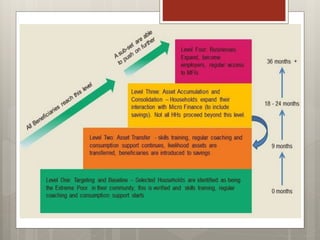
 Overall aim: Enable sustained exit from
extreme poverty of poor households
 Launched in May 2011, ran until Dec 2015
 Supported extremely poor households with:
 Cash transfer & enhanced savings
 Skills development
 Coaching and mentoring
 Seed capital for investment in enterprise
development
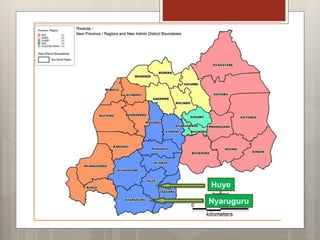
Huye
Nyaruguru
The Research
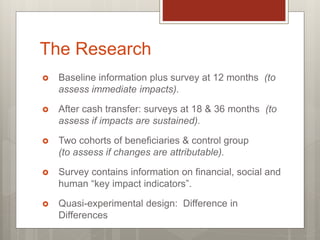
 Baseline information plus survey at 12 months (to
assess immediate impacts).
 After cash transfer: surveys at 18 & 36 months (to
assess if impacts are sustained).
 Two cohorts of beneficiaries & control group
(to assess if changes are attributable).
 Survey contains information on financial, social and
human “key impact indicators”.
 Quasi-experimental design: Difference in
Differences
The Average Impact
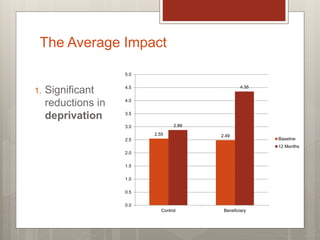
1. Significant
reductions in
deprivation
2.55 2.49
2.88
4.35
0.0
0.5
1.0
1.5
2.0
2.5
3.0
3.5
4.0
4.5
5.0
Control Beneficiary
Baseline
12 Months
2. Increased ownership of livestock
 Cows (+)
 Goats (+)
 Pigs (+)
 Chickens (+)
3. Increased ownership of productive assets
 Mobile phone (+)
 Radios (+)
 Registered land (+)
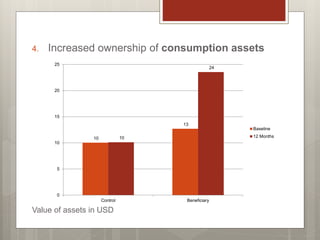
4. Increased ownership of consumption assets
10
13
10
24
0
5
10
15
20
25
Control Beneficiary
Baseline
12 Months
Value of assets in USD
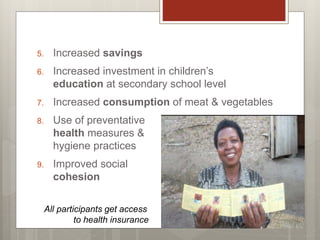
5. Increased savings
6. Increased investment in children’s
education at secondary school level
7. Increased consumption of meat & vegetables
8. Use of preventative
health measures &
hygiene practices
9. Improved social
cohesion
All participants get access
to health insurance
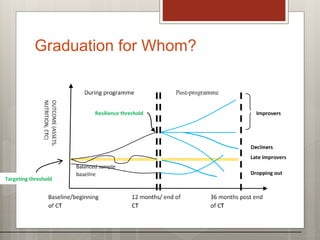
Graduation for Whom?
Sabates-Wheeler, R., R. Sabates and S. Devereux (2018).
‘Enabling graduation for whom? Identifying and explaining
heterogeneity in livelihood trajectories post-cash transfer exposure’,
Journal of International Development.
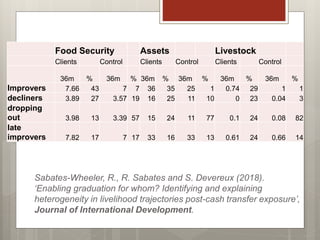
Food Security Assets Livestock
Clients Control Clients Control Clients Control
36m % 36m % 36m % 36m % 36m % 36m %
Improvers 7.66 43 7 7 36 35 25 1 0.74 29 1 1
decliners 3.89 27 3.57 19 16 25 11 10 0 23 0.04 3
dropping
out 3.98 13 3.39 57 15 24 11 77 0.1 24 0.08 82
late
improvers 7.82 17 7 17 33 16 33 13 0.61 24 0.66 14
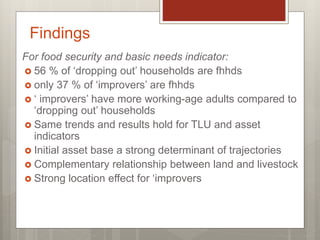
For food security and basic needs indicator:
 56 % of ‘dropping out’ households are fhhds
 only 37 % of ‘improvers’ are fhhds
 ‘ improvers’ have more working-age adults compared to
‘dropping out’ households
 Same trends and results hold for TLU and asset
indicators
 Initial asset base a strong determinant of trajectories
 Complementary relationship between land and livestock
 Strong location effect for ‘improvers
Findings
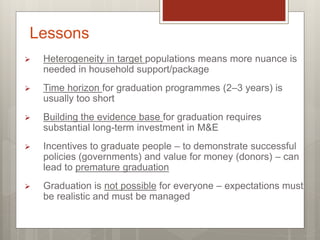
 Heterogeneity in target populations means more nuance is
needed in household support/package
 Time horizon for graduation programmes (2–3 years) is
usually too short
 Building the evidence base for graduation requires
substantial long-term investment in M&E
 Incentives to graduate people – to demonstrate successful
policies (governments) and value for money (donors) – can
lead to premature graduation
 Graduation is not possible for everyone – expectations must
be realistic and must be managed
Lessons

Evidence on Graduation in Practice: Concern Worldwide's Graduation Programme in Rwanda

  • 1.
    Evidence on Graduation inPractice: Concern Worldwide’s Graduation Programme in Rwanda Rachel Sabates-Wheeler IDS Transfer Project Workshop, Arusha 2 April 2019
  • 2.
    Concern Rwanda’s “Graduation Programme” Overall aim: Enable sustained exit from extreme poverty of poor households  Launched in May 2011, ran until Dec 2015  Supported extremely poor households with:  Cash transfer & enhanced savings  Skills development  Coaching and mentoring  Seed capital for investment in enterprise development
  • 3.
  • 5.
    The Research  Baselineinformation plus survey at 12 months (to assess immediate impacts).  After cash transfer: surveys at 18 & 36 months (to assess if impacts are sustained).  Two cohorts of beneficiaries & control group (to assess if changes are attributable).  Survey contains information on financial, social and human “key impact indicators”.  Quasi-experimental design: Difference in Differences
  • 6.
    The Average Impact 1.Significant reductions in deprivation 2.55 2.49 2.88 4.35 0.0 0.5 1.0 1.5 2.0 2.5 3.0 3.5 4.0 4.5 5.0 Control Beneficiary Baseline 12 Months
  • 7.
    2. Increased ownershipof livestock  Cows (+)  Goats (+)  Pigs (+)  Chickens (+) 3. Increased ownership of productive assets  Mobile phone (+)  Radios (+)  Registered land (+)
  • 8.
    4. Increased ownershipof consumption assets 10 13 10 24 0 5 10 15 20 25 Control Beneficiary Baseline 12 Months Value of assets in USD
  • 9.
    5. Increased savings 6.Increased investment in children’s education at secondary school level 7. Increased consumption of meat & vegetables 8. Use of preventative health measures & hygiene practices 9. Improved social cohesion All participants get access to health insurance
  • 10.
  • 11.
    Sabates-Wheeler, R., R.Sabates and S. Devereux (2018). ‘Enabling graduation for whom? Identifying and explaining heterogeneity in livelihood trajectories post-cash transfer exposure’, Journal of International Development. Food Security Assets Livestock Clients Control Clients Control Clients Control 36m % 36m % 36m % 36m % 36m % 36m % Improvers 7.66 43 7 7 36 35 25 1 0.74 29 1 1 decliners 3.89 27 3.57 19 16 25 11 10 0 23 0.04 3 dropping out 3.98 13 3.39 57 15 24 11 77 0.1 24 0.08 82 late improvers 7.82 17 7 17 33 16 33 13 0.61 24 0.66 14
  • 12.
    For food securityand basic needs indicator:  56 % of ‘dropping out’ households are fhhds  only 37 % of ‘improvers’ are fhhds  ‘ improvers’ have more working-age adults compared to ‘dropping out’ households  Same trends and results hold for TLU and asset indicators  Initial asset base a strong determinant of trajectories  Complementary relationship between land and livestock  Strong location effect for ‘improvers Findings
  • 13.
     Heterogeneity intarget populations means more nuance is needed in household support/package  Time horizon for graduation programmes (2–3 years) is usually too short  Building the evidence base for graduation requires substantial long-term investment in M&E  Incentives to graduate people – to demonstrate successful policies (governments) and value for money (donors) – can lead to premature graduation  Graduation is not possible for everyone – expectations must be realistic and must be managed Lessons

Editor's Notes

  • #11 livelihood trajectories can be highly heterogeneous even for what programme implementers assume to be ‘similar’ beneficiaries
  • #12 Treatment (800) and control (200) households Strong programme effects for food security, livestock asset accumulation and productive assets