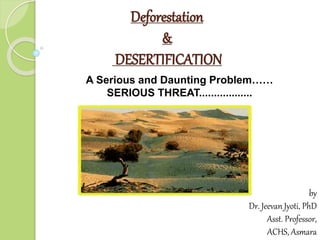
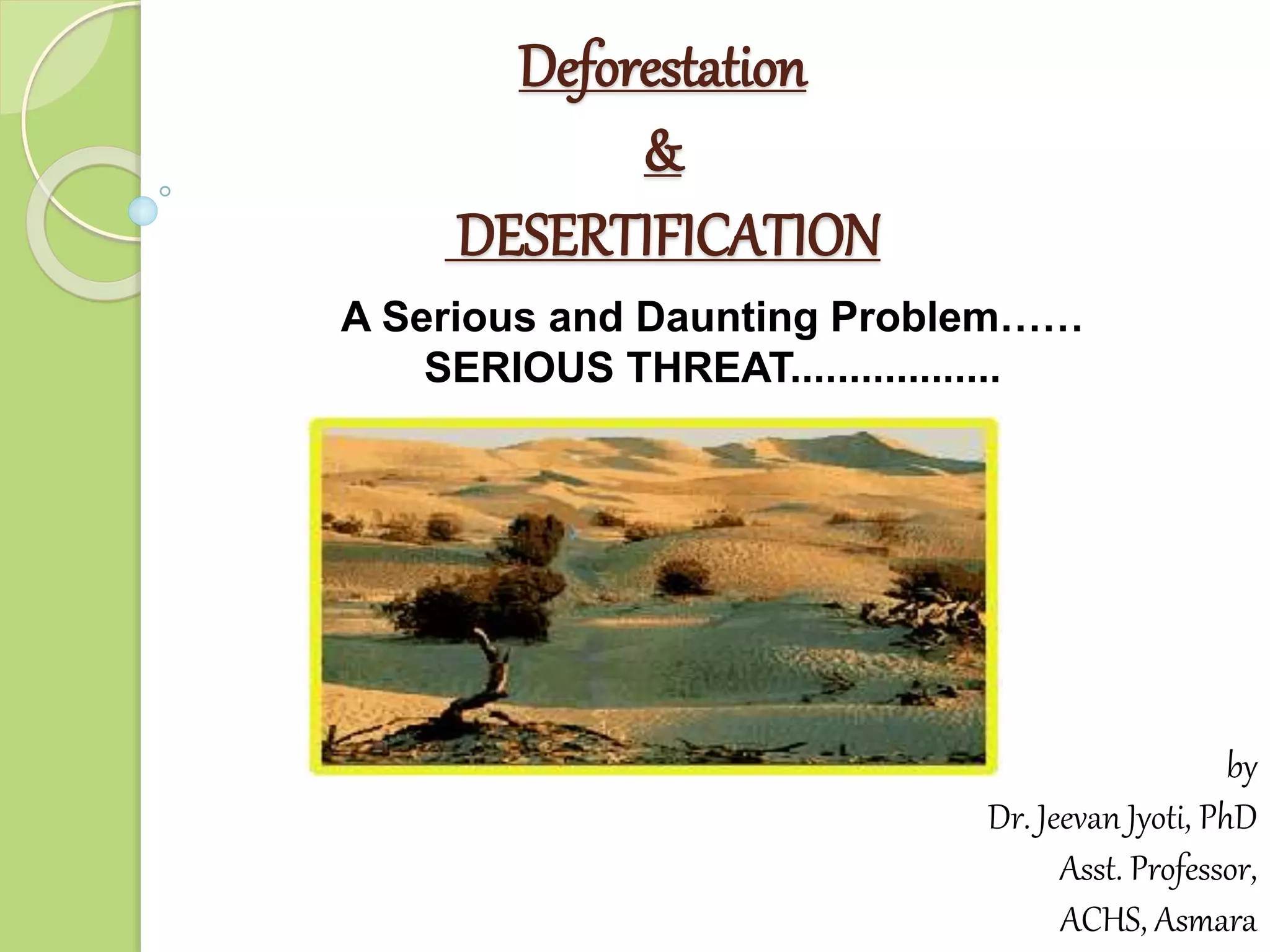
Deforestation
&
DESERTIFICATION
A Serious and Daunting Problem……
SERIOUS THREAT..................
by
Dr. Jeevan Jyoti, PhD
Asst. Professor,
ACHS, Asmara
Whatis deforestation?
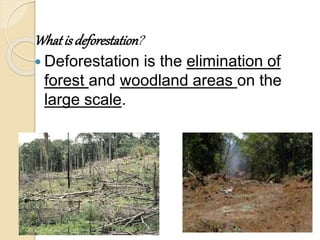
 Deforestation is the elimination of
forest and woodland areas on the
large scale.
Why is it a problem?
Deforestation causes problems on both
the ecological and evolutionary scales.
Ecological: Deforestation
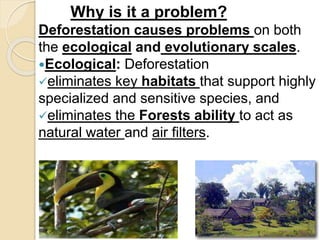
eliminates key habitats that support highly
specialized and sensitive species, and
eliminates the Forests ability to act as
natural water and air filters.
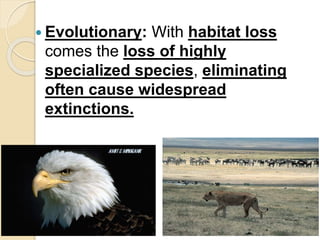
 Evolutionary: With habitat loss
comes the loss of highly
specialized species, eliminating
often cause widespread
extinctions.
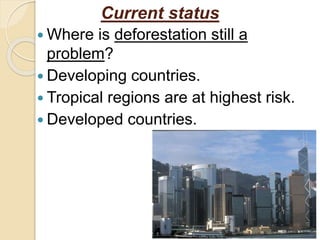
Current status
 Where is deforestation still a
problem?
 Developing countries.
 Tropical regions are at highest risk.
 Developed countries.
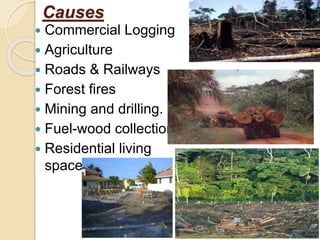
Causes
 Commercial Logging
 Agriculture
 Roads & Railways
 Forest fires
 Mining and drilling.
 Fuel-wood collection
 Residential living
space.
Preventive measures
 Plantation
 Alternate energy sources
Desertification
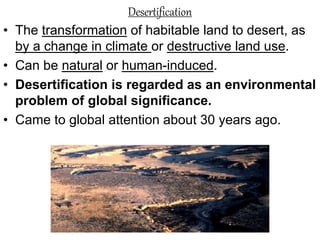
• The transformation of habitable land to desert, as
by a change in climate or destructive land use.
• Can be natural or human-induced.
• Desertification is regarded as an environmental
problem of global significance.
• Came to global attention about 30 years ago.
SOME FACTS
 Desertification is a worldwide
phenomenon causing land
degradation.
 It is mainly considered as a
combination of natural/ climatic
processes and human
interferences.
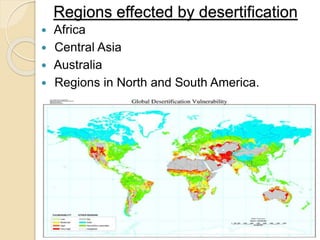
Regions effected by desertification
 Africa
 Central Asia
 Australia
 Regions in North and South America.
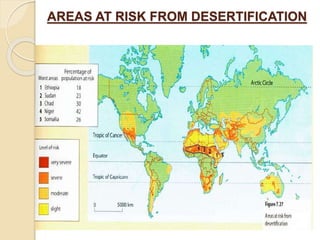
AREAS AT RISK FROM DESERTIFICATION
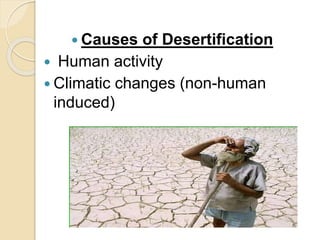
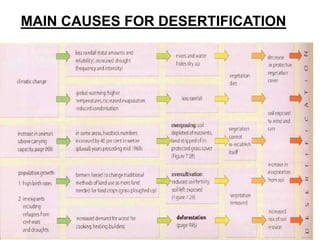
 Causes of Desertification
 Human activity
 Climatic changes (non-human
induced)
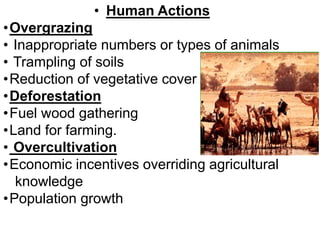
• Human Actions
•Overgrazing
• Inappropriate numbers or types of animals
• Trampling of soils
•Reduction of vegetative cover
•Deforestation
•Fuel wood gathering
•Land for farming.
• Overcultivation
•Economic incentives overriding agricultural
knowledge
•Population growth
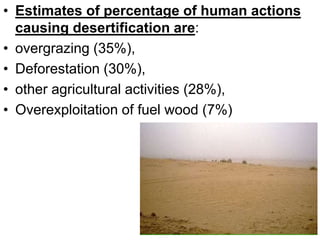
• Estimates of percentage of human actions
causing desertification are:
• overgrazing (35%),
• Deforestation (30%),
• other agricultural activities (28%),
• Overexploitation of fuel wood (7%)
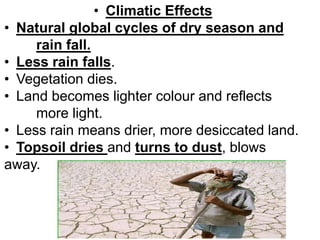
• Climatic Effects
• Natural global cycles of dry season and
rain fall.
• Less rain falls.
• Vegetation dies.
• Land becomes lighter colour and reflects
more light.
• Less rain means drier, more desiccated land.
• Topsoil dries and turns to dust, blows
away.
MAIN CAUSES FOR DESERTIFICATION
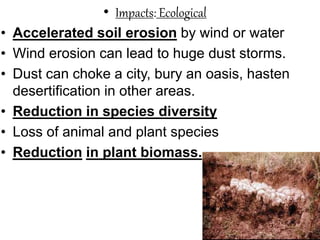
• Impacts: Ecological
• Accelerated soil erosion by wind or water
• Wind erosion can lead to huge dust storms.
• Dust can choke a city, bury an oasis, hasten
desertification in other areas.
• Reduction in species diversity
• Loss of animal and plant species
• Reduction in plant biomass.
Impacts: Economic
• Loss of fertility and productivity in soils.
• In China alone, about $6.5 billion annually
is lost to the effects of desertification.
• Worldwide $300-600 billion lost annually.
• Since 1985, Kazakhstan has lost 12.5
million acres of grain-growing land.
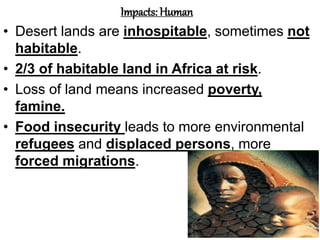
Impacts: Human
• Desert lands are inhospitable, sometimes not
habitable.
• 2/3 of habitable land in Africa at risk.
• Loss of land means increased poverty,
famine.
• Food insecurity leads to more environmental
refugees and displaced persons, more
forced migrations.
 Current Numbers
 Worldwide, desertification is making
approximately 12 million hectares
useless for cultivation every year. This
is equal to 10% of the total area of
South Africa.
 South Africa losing approximately 300-
400 million tons of topsoil every year.
 The Sahara desert is creeping
southward at a rate of 1km/year.
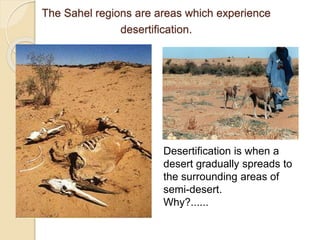
The Sahel regions are areas which experience
desertification.
Desertification is when a
desert gradually spreads to
the surrounding areas of
semi-desert.
Why?......
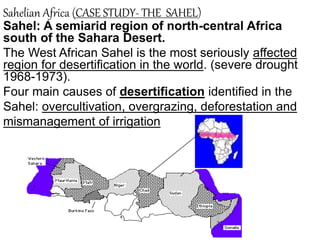
Sahelian Africa (CASE STUDY- THE SAHEL)
Sahel: A semiarid region of north-central Africa
south of the Sahara Desert.
The West African Sahel is the most seriously affected
region for desertification in the world. (severe drought
1968-1973).
Four main causes of desertification identified in the
Sahel: overcultivation, overgrazing, deforestation and
mismanagement of irrigation
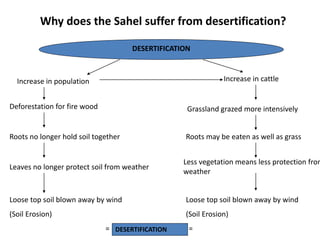
Why does the Sahel suffer from desertification?
DESERTIFICATION
Increase in population Increase in cattle
Deforestation for fire wood Grassland grazed more intensively
Roots no longer hold soil together Roots may be eaten as well as grass
Leaves no longer protect soil from weather
Less vegetation means less protection from
weather
Loose top soil blown away by wind
(Soil Erosion)
=
Loose top soil blown away by wind
(Soil Erosion)
=
DESERTIFICATION
Preventive measures
 Tree planting
-Wind breaks
-Prevent erosion, trap airborne dirt
 Improved farming
-Less soil disturbance
 Alternative energy (to relieve fuel wood
pressure).
-Solar cookers for food
-Wind turbines yield energy and wind
breaks
26

DESERTIFICATION lect-8.pptx

  • 1.
    Deforestation & DESERTIFICATION A Serious andDaunting Problem…… SERIOUS THREAT.................. by Dr. Jeevan Jyoti, PhD Asst. Professor, ACHS, Asmara
  • 2.
    Whatis deforestation?  Deforestationis the elimination of forest and woodland areas on the large scale.
  • 3.
    Why is ita problem? Deforestation causes problems on both the ecological and evolutionary scales. Ecological: Deforestation eliminates key habitats that support highly specialized and sensitive species, and eliminates the Forests ability to act as natural water and air filters.
  • 4.
     Evolutionary: Withhabitat loss comes the loss of highly specialized species, eliminating often cause widespread extinctions.
  • 5.
    Current status  Whereis deforestation still a problem?  Developing countries.  Tropical regions are at highest risk.  Developed countries.
  • 6.
    Causes  Commercial Logging Agriculture  Roads & Railways  Forest fires  Mining and drilling.  Fuel-wood collection  Residential living space.
  • 7.
  • 8.
    Desertification • The transformationof habitable land to desert, as by a change in climate or destructive land use. • Can be natural or human-induced. • Desertification is regarded as an environmental problem of global significance. • Came to global attention about 30 years ago.
  • 9.
    SOME FACTS  Desertificationis a worldwide phenomenon causing land degradation.  It is mainly considered as a combination of natural/ climatic processes and human interferences.
  • 10.
    Regions effected bydesertification  Africa  Central Asia  Australia  Regions in North and South America.
  • 11.
    AREAS AT RISKFROM DESERTIFICATION
  • 12.
     Causes ofDesertification  Human activity  Climatic changes (non-human induced)
  • 13.
    • Human Actions •Overgrazing •Inappropriate numbers or types of animals • Trampling of soils •Reduction of vegetative cover •Deforestation •Fuel wood gathering •Land for farming. • Overcultivation •Economic incentives overriding agricultural knowledge •Population growth
  • 14.
    • Estimates ofpercentage of human actions causing desertification are: • overgrazing (35%), • Deforestation (30%), • other agricultural activities (28%), • Overexploitation of fuel wood (7%)
  • 15.
    • Climatic Effects •Natural global cycles of dry season and rain fall. • Less rain falls. • Vegetation dies. • Land becomes lighter colour and reflects more light. • Less rain means drier, more desiccated land. • Topsoil dries and turns to dust, blows away.
  • 16.
    MAIN CAUSES FORDESERTIFICATION
  • 17.
    • Impacts: Ecological •Accelerated soil erosion by wind or water • Wind erosion can lead to huge dust storms. • Dust can choke a city, bury an oasis, hasten desertification in other areas. • Reduction in species diversity • Loss of animal and plant species • Reduction in plant biomass.
  • 18.
    Impacts: Economic • Lossof fertility and productivity in soils. • In China alone, about $6.5 billion annually is lost to the effects of desertification. • Worldwide $300-600 billion lost annually. • Since 1985, Kazakhstan has lost 12.5 million acres of grain-growing land.
  • 19.
    Impacts: Human • Desertlands are inhospitable, sometimes not habitable. • 2/3 of habitable land in Africa at risk. • Loss of land means increased poverty, famine. • Food insecurity leads to more environmental refugees and displaced persons, more forced migrations.
  • 20.
     Current Numbers Worldwide, desertification is making approximately 12 million hectares useless for cultivation every year. This is equal to 10% of the total area of South Africa.  South Africa losing approximately 300- 400 million tons of topsoil every year.  The Sahara desert is creeping southward at a rate of 1km/year.
  • 21.
    The Sahel regionsare areas which experience desertification. Desertification is when a desert gradually spreads to the surrounding areas of semi-desert. Why?......
  • 22.
    Sahelian Africa (CASESTUDY- THE SAHEL) Sahel: A semiarid region of north-central Africa south of the Sahara Desert. The West African Sahel is the most seriously affected region for desertification in the world. (severe drought 1968-1973). Four main causes of desertification identified in the Sahel: overcultivation, overgrazing, deforestation and mismanagement of irrigation
  • 23.
    Why does theSahel suffer from desertification? DESERTIFICATION Increase in population Increase in cattle Deforestation for fire wood Grassland grazed more intensively Roots no longer hold soil together Roots may be eaten as well as grass Leaves no longer protect soil from weather Less vegetation means less protection from weather Loose top soil blown away by wind (Soil Erosion) = Loose top soil blown away by wind (Soil Erosion) = DESERTIFICATION
  • 24.
    Preventive measures  Treeplanting -Wind breaks -Prevent erosion, trap airborne dirt  Improved farming -Less soil disturbance  Alternative energy (to relieve fuel wood pressure). -Solar cookers for food -Wind turbines yield energy and wind breaks
  • 25.

Editor's Notes

  • #12 Figure 1 : Waugh, D,1995
  • #16 Not induced by human actions, but can work in combination with them.
  • #23 Four main causes of desertification identified in the Sahel: overcultivation, overgrazing, deforestation and mismanagement of irrigation