Japan
International Menu
Project
For: Jim Stone
By: Manshi Agrawal, Deserée Panday,
Ankita Patel & Shivani Prajapati,
Due Date: February 13/14
1
History
Although there is limited data on early Japanese history, it is said that the Japanese
people were a Mongoloid race of migrants from China, Korea and Manchuria. Early
inhabitants were hunters and gatherers. Jimmu Tenno, the leader of the Yamato clan,
believed he was a descendant of the sun goddess and in the seventh century became the
first Emperor of the Imperial line (Shelly, Yong & Mok, 2002). Today, Japan is a democracy
with a Prime Minister as well as an Emperor who lead the country.
Japan was then in constant conflict between regions until unification in the 16th
century. The first ships from the West arrived in Japan shortly after the people became
united. With the appearance of these ships, Christian missionaries arrived and quickly
began converting the populace. By the mid 1800’s, Japan was beginning to accept new
concepts and technologies introduced by the West (Shelly, et al., 2002).
Over the years Japan was seen as a military threat as they warred and battled with
several powerful nations including China, Russia and America. Specifically, the Japanese is
known for their military involvement in World War II when they allied with Nazi Germany
and Italy. On August 6th 1945, America was responsible for dropping an atomic bomb on
Hiroshima. Russia declared war on Japan on August 8th, and a second atomic bomb was
dropped on Nagasaki on August 9th. After several other attacks, Japan surrendered on
August 14th 1945, ending their involvement with World War II. During the seven years of
American occupation, Japan was restored and underwent a major transformation where
the foundation was set up in areas such as the constitution, the legal system, and language.
It became one of the major industrial nations in the world (Shelly, et al., 2002).
Food and History
Dry rice was harvested as early as 1000 BC in the region of Kyushu. As fishing had
become a main source of nourishment at that time, the emergence of rice was key to the
survival of the Japanese people. The practice of rice harvesting was then spread throughout
other regions of the country. Around 300 BC, the Yayoi period, wet rice agriculture was
introduced. This was an innovation that led to a massive impact on Japanese society. It
2
provided a high level of food production which led to the increase of population which
therefore headed to settlement in new areas (Andressen, 2002).
Western influences was a dominant factor in Japanese art, music and literature. As a
result, the diet of the nation began to change as well. Beer was first produced in Japan in
the 1870’s and beef consumption began to grow. Japan did not face any other major
changes in terms of food until the 1940’s. During the Second World War, Japan nearly came
to a state of starvation (Andressen, 2002). Following the war, the Japanese government and
politicians stepped in to encourage people to support farmers which resulted in substantial
growth of agriculture that has persevered until today.
Religion and Food
Religion is part of everyday life in Japan. It is a regular practice for the people and is
an integral part of their daily routine. The primary religions in Japan are Shinto and
Buddhism. Most Japanese people follow both religions without conflict or believing one
religion is right or true over the other (Shelly, Yong & Mok, 2002). It is believed that Shinto
takes care of one’s daily living whereas Buddhism takes care of one’s afterlife. However, the
leading Religion in Japan is Shinto.
In 500 A.D, Buddhism was introduced to the nation. People found an intellectual
satisfaction is Buddhist philosophy that could not be quenched with Shinto (Shelly, et al.,
2002). Due to the nature of this religion there was a tremendous influence of food within
Japan. Buddhism discouraged meat eating within one’s way of life. As the religion became
more widespread, so did meat substitutes specifically soybeans. Tofu and Soybeans are
widely popular today in Japan due Buddhist beliefs and can be said that Japanese food
would not be the same without it (Shelly, et al., 2002).
Other than the Buddhist influence on eating tofu and soybeans, there was no other
relationship found between Religious beliefs and Japanese food.
3
Health Beliefs and Practices
Individuals in Japan are known to have the oldest life expectancy in the world. This
is due to their health conscious lifestyle and diet choices. Their health beliefs and practices
are as follows:
 More fish products are eaten rather than any other choice of meat. Japanese people
prefer staying away from red meat, as red meat is higher in cholesterol and there are
higher chances to have a heart attack or a stroke (Koichi, 2010).
 Less dairy products (Ex. milk, butter, cheese) are consumed because most Japanese
people are lactose intolerant (Noguchi, 2014).
 Seaweed, rice, tofu, soy and vegetables are usually eaten as different meal
combinations. They are all high in nutrients, protein, and are helped to fight against
many kinds of cancer. In addition, soy products are used as an alternative to milk, meat
and other items that are considered to be unhealthy (Koichi, 2010).
 Smaller plates are used in the Japanese culture because Japanese people believe there is
a correlation between the plate size and the amount one eats. They believe the smaller
the plate sizes, the smaller the portions, ultimately causing people to eat less (Koichi,
2010).
Meal Customs
Food is said to reflect the character and culture of the Japanese. Presentation and
taste are the two main factors when it comes to preparing a Japanese meal. Plates are
designed to “please the eye and whet the appetite” (Shelly, Tong, & Mok, 2002, pg. 123).
Meals are traditionally served on a variety of differently shaped plates and bowls. The use
of round plates in Western culture has eventually influenced this limitation in serving style.
There are many different rules and customs when it comes to presenting a Japanese meal.
For example, when serving a whole fish, it is always placed with its head facing left when
given to the guest (Shelly, et al., 2002). It is a regular custom for individuals in Japan to eat
while sitting on cushions on the floor. Tables are lowered as to be conveniently located in
relation to the cushioned seats.
4
Rice is a staple when it comes to Japanese foods. They eat sticky rice that can be
picked up in lumps with pointed chopsticks. An individual will use the chopsticks to pick up
a piece of vegetable or meat, dip it into a sauce and then put it into their mouths. This is
then followed with a mouthful of rice. It is a custom to keep these dishes separate and not
to mix meat or vegetables with or on top of their rice (Shelly, et al., 2002).
Although Tea originated in China, it is said to be the drink of Japan. It is offered to
visitors and is served at all meals. The living room of a house in Japan is called the “cha-no-
ma” which means the “tearoom” (Shelly, et al., 2002). The tea ceremony is considered an
art form today which was developed more than a 1000 years ago by Zen monks for the
preparation and offering of tea to special guests.
The tea ceremony begins as the server prepares the tea for the first guest. This
process involves a series of movements and actions that are determined and specific.
Within this process, the utensils that are to be used are cleaned. Each guest slurps their
bowl of tea one at a time which is followed by eating sweets that are served with it. The
ceremony is concluded with compliments about the beauty of the bowls used (Bisker, et al.,
2009). The entire ritual is taken quite seriously, and commands a mood of serenity.
Boisterous or rowdy behaviour during the tea ceremony is frowned upon and not
acceptable. Even the slurping of tea must be controlled, and guests as well as the host sit
quietly while serving and drinking (Bisker, et al., 2009).
5
“A servant cuts every last flower from a lush gardenia bush. Upon his return home that night,
his master notices the naked plant and becomes enraged. Naturally, the master draws his sword
and confronts the servant (presumably to give him slightly more than a stern talking-to). But
when he enters the house, the master stops in his tracks at the sight of a single—perfect—
gardenia blossom hung against a bare wall in the moonlight. Its beauty is essential, its scarcity
arresting (Librarian, 2014) (kaiseki-japanese-seasonal-cuisine, 2013).”
Wedding Traditions
Traditional Japanese weddings are fairly large and expensive, as there is a high emphasis
on the quality of food. This is because the food and beverage component creates an unique
atmosphere and a memorable impression on friends and families.Japanese people usually
tend to use Kaiseki cuisine for their weddings (Noguchi, 2014). A tale is famous in the
Japanese culture to describe the Kaiseki cuisine:
This tale describes the art of Kaiseki, which lies in the careful selection and
preparation of the food to emphasize the season. Kaiseki is an art form that balances the
taste, texture, appearance and colors of food. This could be enhanced using the seasonal
ingredients, flavors or colors associated with the festival or celebration. According to the
Japanese tradition, red is the color for celebrations and festivities and is widely used in
weddings. This tradition impacts the menu and presentation of food during the weddings.
Several food dishes are white and red in colour, and can be seen in Japanese weddings.
Sometimes, red food coloring and accents are added to food to make it look more
traditional (kaiseki-japanese-seasonal-cuisine, 2013).
The presentation of the food is a very important aspect in the Kaiseki cuisine. There
are specific styles of serving dishes for every course and the placement of food on the
plates also varies course to course.
Following are some of the unique food and beverage traditions in Japanese weddings:
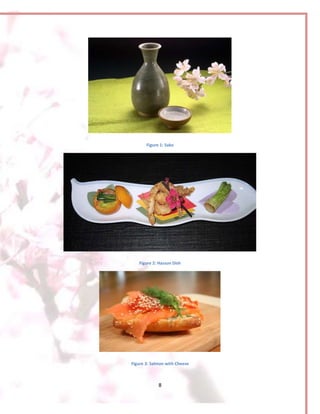
 During the wedding ceremony, there is a ‘sake’ sharing tradition called san-san-kudo;
san meaning three, ku meaning deliver and do meaning nine. The bride and groom, and
their parents, take sips from three ‘sake’ cups to cement the bond between the families
and the couple (Vardaman & Vardaman).
6
 Sekihan (sweet rice and red beans) are a symbol of celebration in Japan. These are used
in various forms to make desserts during the weddings (Mizuno, 2014).
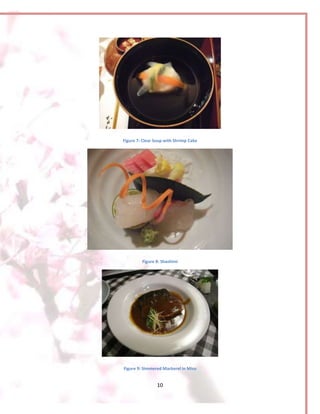
 Ebi (shrimp) is a symbol of longevity and health in Japan and is used widely in
weddings (Taste of Japan, 2010).
 Seabream or Tai (snapper fish) symbolizes celebration in Japan. It is an expensive and
rare fish and is a particular favorite for weddings (Mizuno, 2014).
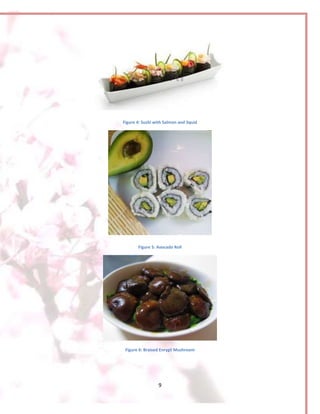
 Traditionally, sushi was not served in weddings; however it has recently become an
integral part of a Japanese menu (Mizuno, 2014).
 Japanese people are very health conscious and avoid eating fried foods. This trend is
also very apparent in their weddings (Noguchi, 2014).
 A large majority of Japanese population is lactose-intolerant. Hence, they stay away
from dairy products (Noguchi, 2014).
 Japanese people do not serve green tea in weddings. This is because green tea gives a
cloudy appearance to the clear water, which is not perceived to be good for celebration
rituals like weddings. They instead use sakura-yu (cherry blossom tea) or kobu-cha
(seaweed tea) (Fukutomi, 2002).
 Tea leaves used during weddings are not supposed to be of good quality, but rather
should be cheap. This is because rich tea leaves easily “ocha-o dasu (produce a cup of
tea)”, while inexpensive ones take longer. It is a belief that when tea comes out easily
from rich tea leaves, the bride will also leave her husband’s family easily (Fukutomi,
2002).
 There are two types of chopsticks in Japan – wari-bashi (half-split chopsticks) and
maru-bashi (round chopsticks). In weddings, wari-bashi is not used because it splits
from between and indicates the couple’s inevitable separation. Maru-bashi is used in
weddings (Fukutomi, 2002).
 Usually the number of courses in the meal is 5, 7 or 9. It is always an odd number
because its considered auspicious and never a multiple of four, since, four is the number
associated with death (Noguchi, 2014).
 White and red colors are considered auspicious and hence used a lot in preparing and
garnishing food (Librarian, 2014).
7
 Kaiseki cuisine includes multiple courses, each prepared using different cooking
techniques. (Noguchi, 2014)
 Each course also has a specific presentation style and serving style associated with it.
(Noguchi, 2014)
Keeping the above-mentioned customs in mind, we have designed a menu for our couple’s
wedding.
8
Figure 1: Sake
Figure 2: Hassun Dish
Figure 3: Salmon with Cheese
9
Figure 4: Sushi with Salmon and Squid
Figure 5: Avocado Roll
Figure 6: Braised Enrygii Mushroom
10
Figure 7: Clear Soup with Shrimp Cake
Figure 8: Shashimi
Figure 9: Simmered Mackerel in Miso
11
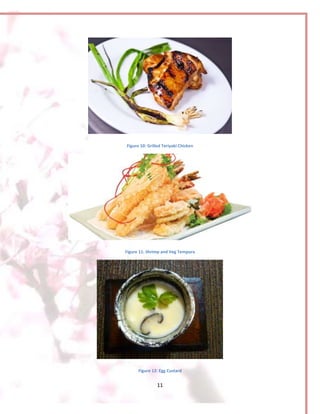
Figure 10: Grilled Teriyaki Chicken
Figure 11: Shrimp and Veg Tempura
Figure 12: Egg Custard
12
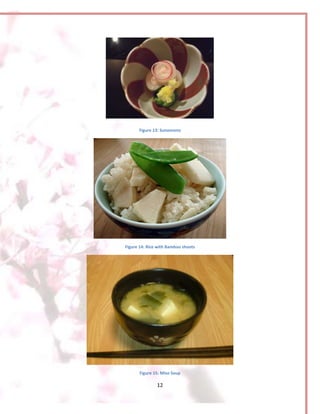
Figure 13: Sunomono
Figure 14: Rice with Bamboo shoots
Figure 15: Miso Soup
13
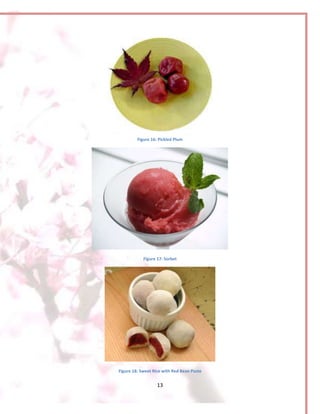
Figure 16: Pickled Plum
Figure 17: Sorbet
Figure 18: Sweet Rice with Red Bean Paste
14
Bibliography
Andressen, C. A. (2002). A short history of Japan: from samurai to Sony. Crows Nest, N.S.W.:
Allen & Unwin.
Fodor's Japan (19th ed.). (2009). New York: Fodor's Travel Publications.
Fukutomi, S. (2002). Japan: Foods and Weddings.
Koichi. (2010, October 6). Why Do Japanese People Live So Long? Retrieved from
http://www.tofugu.com/2010/10/06/why-do-japanese-people-live-so-long/
Kikuchi, H. (2014, 02, 01) Japanese Culture & Traditions.(D. Panday, Interviewer)
Librarian. (2014, 02 10). (M. Agarwal, & S. Prajapati, Interviewers)
Mizuno, S. (2014, 02 10). (M. Agarwal, & S. Prajapati, Interviewers)
Noguchi, K. (2014, February 11). Japanese Wedding Menu, Customs and Traditions. (A.
Patel, Interviewer)
Shelley, R., Yong, T. C., & Mok, R. (2002). Japan (2nd ed.). New York: Marshall Cavendish.
Taste of Japan. (2010). Retrieved from CEREMONIAL AND CELEBRATORY DISHES:
http://www.tasteofjapan.ru/eng/useful_info/ceremonial/wedding.php
Vardaman, J. M., & Vardaman, M. S. (n.d.). Do It Right.
Tsuchiya, Y. (2002). The Fine Art of Japanese Food Arrangement.
Fukuoka, Y. (2002). Japanese Food and Cooking

International Menu Assignment

  • 1.
    Japan International Menu Project For: JimStone By: Manshi Agrawal, Deserée Panday, Ankita Patel & Shivani Prajapati, Due Date: February 13/14
  • 2.
    1 History Although there islimited data on early Japanese history, it is said that the Japanese people were a Mongoloid race of migrants from China, Korea and Manchuria. Early inhabitants were hunters and gatherers. Jimmu Tenno, the leader of the Yamato clan, believed he was a descendant of the sun goddess and in the seventh century became the first Emperor of the Imperial line (Shelly, Yong & Mok, 2002). Today, Japan is a democracy with a Prime Minister as well as an Emperor who lead the country. Japan was then in constant conflict between regions until unification in the 16th century. The first ships from the West arrived in Japan shortly after the people became united. With the appearance of these ships, Christian missionaries arrived and quickly began converting the populace. By the mid 1800’s, Japan was beginning to accept new concepts and technologies introduced by the West (Shelly, et al., 2002). Over the years Japan was seen as a military threat as they warred and battled with several powerful nations including China, Russia and America. Specifically, the Japanese is known for their military involvement in World War II when they allied with Nazi Germany and Italy. On August 6th 1945, America was responsible for dropping an atomic bomb on Hiroshima. Russia declared war on Japan on August 8th, and a second atomic bomb was dropped on Nagasaki on August 9th. After several other attacks, Japan surrendered on August 14th 1945, ending their involvement with World War II. During the seven years of American occupation, Japan was restored and underwent a major transformation where the foundation was set up in areas such as the constitution, the legal system, and language. It became one of the major industrial nations in the world (Shelly, et al., 2002). Food and History Dry rice was harvested as early as 1000 BC in the region of Kyushu. As fishing had become a main source of nourishment at that time, the emergence of rice was key to the survival of the Japanese people. The practice of rice harvesting was then spread throughout other regions of the country. Around 300 BC, the Yayoi period, wet rice agriculture was introduced. This was an innovation that led to a massive impact on Japanese society. It
  • 3.
    2 provided a highlevel of food production which led to the increase of population which therefore headed to settlement in new areas (Andressen, 2002). Western influences was a dominant factor in Japanese art, music and literature. As a result, the diet of the nation began to change as well. Beer was first produced in Japan in the 1870’s and beef consumption began to grow. Japan did not face any other major changes in terms of food until the 1940’s. During the Second World War, Japan nearly came to a state of starvation (Andressen, 2002). Following the war, the Japanese government and politicians stepped in to encourage people to support farmers which resulted in substantial growth of agriculture that has persevered until today. Religion and Food Religion is part of everyday life in Japan. It is a regular practice for the people and is an integral part of their daily routine. The primary religions in Japan are Shinto and Buddhism. Most Japanese people follow both religions without conflict or believing one religion is right or true over the other (Shelly, Yong & Mok, 2002). It is believed that Shinto takes care of one’s daily living whereas Buddhism takes care of one’s afterlife. However, the leading Religion in Japan is Shinto. In 500 A.D, Buddhism was introduced to the nation. People found an intellectual satisfaction is Buddhist philosophy that could not be quenched with Shinto (Shelly, et al., 2002). Due to the nature of this religion there was a tremendous influence of food within Japan. Buddhism discouraged meat eating within one’s way of life. As the religion became more widespread, so did meat substitutes specifically soybeans. Tofu and Soybeans are widely popular today in Japan due Buddhist beliefs and can be said that Japanese food would not be the same without it (Shelly, et al., 2002). Other than the Buddhist influence on eating tofu and soybeans, there was no other relationship found between Religious beliefs and Japanese food.
  • 4.
    3 Health Beliefs andPractices Individuals in Japan are known to have the oldest life expectancy in the world. This is due to their health conscious lifestyle and diet choices. Their health beliefs and practices are as follows:  More fish products are eaten rather than any other choice of meat. Japanese people prefer staying away from red meat, as red meat is higher in cholesterol and there are higher chances to have a heart attack or a stroke (Koichi, 2010).  Less dairy products (Ex. milk, butter, cheese) are consumed because most Japanese people are lactose intolerant (Noguchi, 2014).  Seaweed, rice, tofu, soy and vegetables are usually eaten as different meal combinations. They are all high in nutrients, protein, and are helped to fight against many kinds of cancer. In addition, soy products are used as an alternative to milk, meat and other items that are considered to be unhealthy (Koichi, 2010).  Smaller plates are used in the Japanese culture because Japanese people believe there is a correlation between the plate size and the amount one eats. They believe the smaller the plate sizes, the smaller the portions, ultimately causing people to eat less (Koichi, 2010). Meal Customs Food is said to reflect the character and culture of the Japanese. Presentation and taste are the two main factors when it comes to preparing a Japanese meal. Plates are designed to “please the eye and whet the appetite” (Shelly, Tong, & Mok, 2002, pg. 123). Meals are traditionally served on a variety of differently shaped plates and bowls. The use of round plates in Western culture has eventually influenced this limitation in serving style. There are many different rules and customs when it comes to presenting a Japanese meal. For example, when serving a whole fish, it is always placed with its head facing left when given to the guest (Shelly, et al., 2002). It is a regular custom for individuals in Japan to eat while sitting on cushions on the floor. Tables are lowered as to be conveniently located in relation to the cushioned seats.
  • 5.
    4 Rice is astaple when it comes to Japanese foods. They eat sticky rice that can be picked up in lumps with pointed chopsticks. An individual will use the chopsticks to pick up a piece of vegetable or meat, dip it into a sauce and then put it into their mouths. This is then followed with a mouthful of rice. It is a custom to keep these dishes separate and not to mix meat or vegetables with or on top of their rice (Shelly, et al., 2002). Although Tea originated in China, it is said to be the drink of Japan. It is offered to visitors and is served at all meals. The living room of a house in Japan is called the “cha-no- ma” which means the “tearoom” (Shelly, et al., 2002). The tea ceremony is considered an art form today which was developed more than a 1000 years ago by Zen monks for the preparation and offering of tea to special guests. The tea ceremony begins as the server prepares the tea for the first guest. This process involves a series of movements and actions that are determined and specific. Within this process, the utensils that are to be used are cleaned. Each guest slurps their bowl of tea one at a time which is followed by eating sweets that are served with it. The ceremony is concluded with compliments about the beauty of the bowls used (Bisker, et al., 2009). The entire ritual is taken quite seriously, and commands a mood of serenity. Boisterous or rowdy behaviour during the tea ceremony is frowned upon and not acceptable. Even the slurping of tea must be controlled, and guests as well as the host sit quietly while serving and drinking (Bisker, et al., 2009).
  • 6.
    5 “A servant cutsevery last flower from a lush gardenia bush. Upon his return home that night, his master notices the naked plant and becomes enraged. Naturally, the master draws his sword and confronts the servant (presumably to give him slightly more than a stern talking-to). But when he enters the house, the master stops in his tracks at the sight of a single—perfect— gardenia blossom hung against a bare wall in the moonlight. Its beauty is essential, its scarcity arresting (Librarian, 2014) (kaiseki-japanese-seasonal-cuisine, 2013).” Wedding Traditions Traditional Japanese weddings are fairly large and expensive, as there is a high emphasis on the quality of food. This is because the food and beverage component creates an unique atmosphere and a memorable impression on friends and families.Japanese people usually tend to use Kaiseki cuisine for their weddings (Noguchi, 2014). A tale is famous in the Japanese culture to describe the Kaiseki cuisine: This tale describes the art of Kaiseki, which lies in the careful selection and preparation of the food to emphasize the season. Kaiseki is an art form that balances the taste, texture, appearance and colors of food. This could be enhanced using the seasonal ingredients, flavors or colors associated with the festival or celebration. According to the Japanese tradition, red is the color for celebrations and festivities and is widely used in weddings. This tradition impacts the menu and presentation of food during the weddings. Several food dishes are white and red in colour, and can be seen in Japanese weddings. Sometimes, red food coloring and accents are added to food to make it look more traditional (kaiseki-japanese-seasonal-cuisine, 2013). The presentation of the food is a very important aspect in the Kaiseki cuisine. There are specific styles of serving dishes for every course and the placement of food on the plates also varies course to course. Following are some of the unique food and beverage traditions in Japanese weddings:  During the wedding ceremony, there is a ‘sake’ sharing tradition called san-san-kudo; san meaning three, ku meaning deliver and do meaning nine. The bride and groom, and their parents, take sips from three ‘sake’ cups to cement the bond between the families and the couple (Vardaman & Vardaman).
  • 7.
    6  Sekihan (sweetrice and red beans) are a symbol of celebration in Japan. These are used in various forms to make desserts during the weddings (Mizuno, 2014).  Ebi (shrimp) is a symbol of longevity and health in Japan and is used widely in weddings (Taste of Japan, 2010).  Seabream or Tai (snapper fish) symbolizes celebration in Japan. It is an expensive and rare fish and is a particular favorite for weddings (Mizuno, 2014).  Traditionally, sushi was not served in weddings; however it has recently become an integral part of a Japanese menu (Mizuno, 2014).  Japanese people are very health conscious and avoid eating fried foods. This trend is also very apparent in their weddings (Noguchi, 2014).  A large majority of Japanese population is lactose-intolerant. Hence, they stay away from dairy products (Noguchi, 2014).  Japanese people do not serve green tea in weddings. This is because green tea gives a cloudy appearance to the clear water, which is not perceived to be good for celebration rituals like weddings. They instead use sakura-yu (cherry blossom tea) or kobu-cha (seaweed tea) (Fukutomi, 2002).  Tea leaves used during weddings are not supposed to be of good quality, but rather should be cheap. This is because rich tea leaves easily “ocha-o dasu (produce a cup of tea)”, while inexpensive ones take longer. It is a belief that when tea comes out easily from rich tea leaves, the bride will also leave her husband’s family easily (Fukutomi, 2002).  There are two types of chopsticks in Japan – wari-bashi (half-split chopsticks) and maru-bashi (round chopsticks). In weddings, wari-bashi is not used because it splits from between and indicates the couple’s inevitable separation. Maru-bashi is used in weddings (Fukutomi, 2002).  Usually the number of courses in the meal is 5, 7 or 9. It is always an odd number because its considered auspicious and never a multiple of four, since, four is the number associated with death (Noguchi, 2014).  White and red colors are considered auspicious and hence used a lot in preparing and garnishing food (Librarian, 2014).
  • 8.
    7  Kaiseki cuisineincludes multiple courses, each prepared using different cooking techniques. (Noguchi, 2014)  Each course also has a specific presentation style and serving style associated with it. (Noguchi, 2014) Keeping the above-mentioned customs in mind, we have designed a menu for our couple’s wedding.
  • 9.
    8 Figure 1: Sake Figure2: Hassun Dish Figure 3: Salmon with Cheese
  • 10.
    9 Figure 4: Sushiwith Salmon and Squid Figure 5: Avocado Roll Figure 6: Braised Enrygii Mushroom
  • 11.
    10 Figure 7: ClearSoup with Shrimp Cake Figure 8: Shashimi Figure 9: Simmered Mackerel in Miso
  • 12.
    11 Figure 10: GrilledTeriyaki Chicken Figure 11: Shrimp and Veg Tempura Figure 12: Egg Custard
  • 13.
    12 Figure 13: Sunomono Figure14: Rice with Bamboo shoots Figure 15: Miso Soup
  • 14.
    13 Figure 16: PickledPlum Figure 17: Sorbet Figure 18: Sweet Rice with Red Bean Paste
  • 15.
    14 Bibliography Andressen, C. A.(2002). A short history of Japan: from samurai to Sony. Crows Nest, N.S.W.: Allen & Unwin. Fodor's Japan (19th ed.). (2009). New York: Fodor's Travel Publications. Fukutomi, S. (2002). Japan: Foods and Weddings. Koichi. (2010, October 6). Why Do Japanese People Live So Long? Retrieved from http://www.tofugu.com/2010/10/06/why-do-japanese-people-live-so-long/ Kikuchi, H. (2014, 02, 01) Japanese Culture & Traditions.(D. Panday, Interviewer) Librarian. (2014, 02 10). (M. Agarwal, & S. Prajapati, Interviewers) Mizuno, S. (2014, 02 10). (M. Agarwal, & S. Prajapati, Interviewers) Noguchi, K. (2014, February 11). Japanese Wedding Menu, Customs and Traditions. (A. Patel, Interviewer) Shelley, R., Yong, T. C., & Mok, R. (2002). Japan (2nd ed.). New York: Marshall Cavendish. Taste of Japan. (2010). Retrieved from CEREMONIAL AND CELEBRATORY DISHES: http://www.tasteofjapan.ru/eng/useful_info/ceremonial/wedding.php Vardaman, J. M., & Vardaman, M. S. (n.d.). Do It Right. Tsuchiya, Y. (2002). The Fine Art of Japanese Food Arrangement. Fukuoka, Y. (2002). Japanese Food and Cooking